
Submitted:
15 July 2026
Posted:
22 July 2026
You are already at the latest version
Abstract
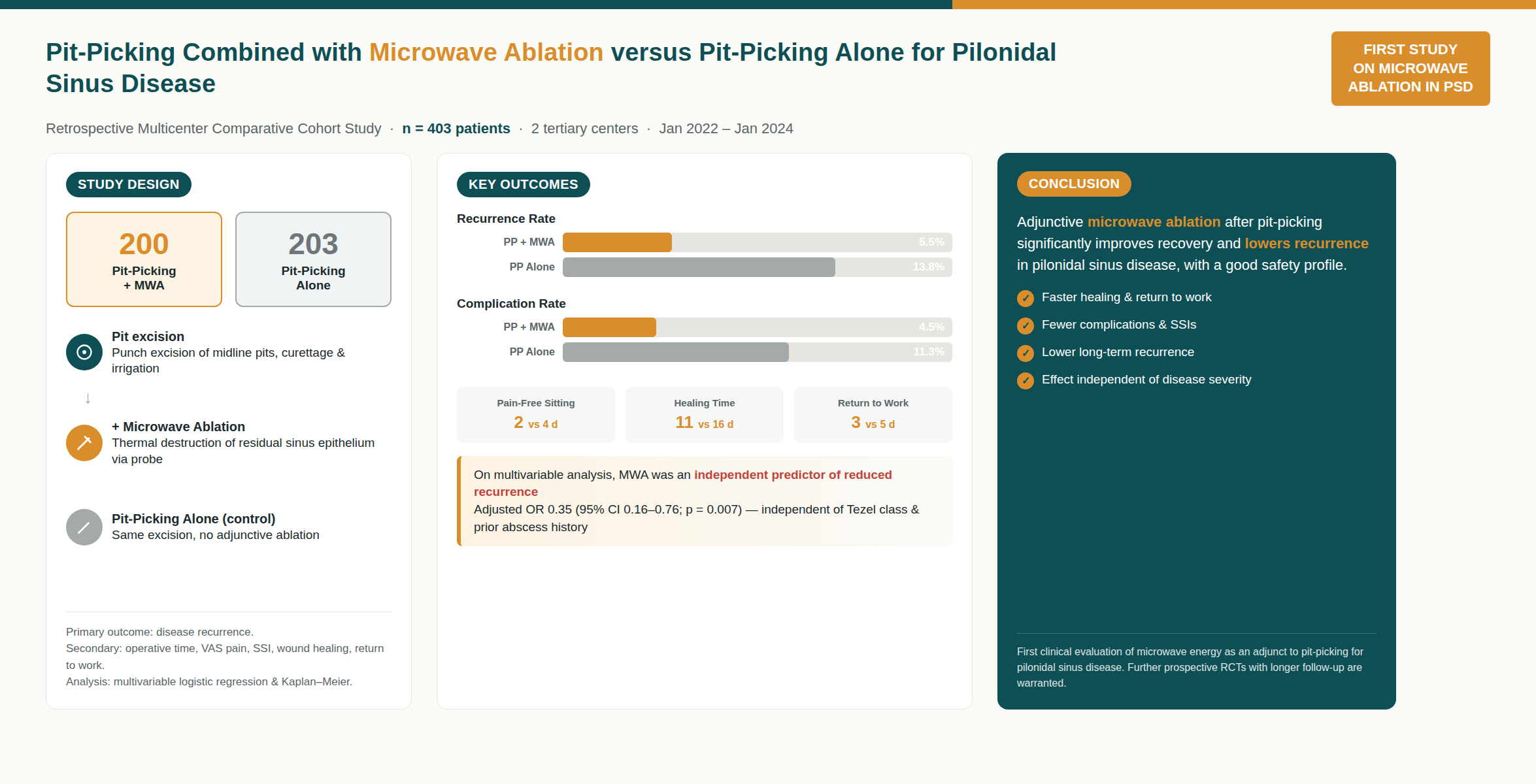
Background: Pilonidal sinus disease (PSD) is a chronic inflammatory condition predominantly affecting young adults. Minimally invasive techniques such as pit-picking have gained increasing popularity; however, recurrence rates remain a significant concern. Microwave ablation (MWA) has recently emerged as a novel adjunctive modality that may improve treatment durability through enhanced destruction of residual sinus epithelium. Materials and Methods: This retrospective multicenter comparative cohort study included 403 consecutive patients treated for PSD between January 2022 and January 2024. Among these, 200 patients underwent pit-picking combined with MWA (MWA group) and 203 underwent pit-picking alone (PP group). Recurrence was defined as any clinical reappearance of pit, abscess, or discharging sinus confirmed at follow-up. Primary outcome was disease recurrence; secondary outcomes included operative time, postoperative pain (VAS), complications, SSI, wound healing time, pain-free sitting, and return to work. Multivariable logistic regression and Kaplan–Meier analysis were performed. Results: MWA group demonstrated superior postoperative outcomes: shorter pain-free sitting (2 vs 4 days), healing time (11 vs 16 days), and return to work (3 vs 5 days). Overall complication rates were lower (4.5% vs 11.3%; OR 0.37, 95% CI 0.16–0.84; p=0.018). Recurrence rates were significantly reduced (5.5% vs 13.8%; OR 0.36, 95% CI 0.17–0.75; p=0.006). MWA treatment remained an independent predictor of reduced recurrence on multivariable analysis (adjusted OR 0.35, 95% CI 0.16–0.76; p=0.007). Conclusion: Pit-picking combined with microwave ablation is a safe and effective minimally invasive treatment strategy for PSD, significantly improving postoperative recovery, reducing morbidity, and lowering recurrence rates. Further prospective randomized studies with longer follow-up are warranted.
Keywords:
pilonidal sinus disease
; pit-picking
; microwave ablation
; minimally invasive surgery
; recurrence
; postoperative outcomes
1. Introduction
Pilonidal sinus disease (PSD) is a chronic inflammatory disorder of the sacrococcygeal region that predominantly affects young adults and is associated with significant morbidity, prolonged wound care, loss of productivity, and impaired quality of life [1,2]. Although numerous surgical techniques have been described, an ideal treatment modality that simultaneously minimizes recurrence, postoperative pain, and wound complications has not yet been established [3].
Traditional excisional procedures remain effective but are associated with prolonged healing time, postoperative discomfort, and delayed return to work [4,5]. Pit-picking, first popularized by Bascom, represents one of the most widely adopted minimally invasive techniques [6], allowing rapid postoperative recovery through limited excision. Nevertheless, recurrence rates remain variable [7,8].
Several adjunctive modalities — including endoscopic treatment (EPSiT), laser ablation, phenol application, and radiofrequency-based techniques — have been investigated to improve treatment durability [9,10,11,12,13]. Among these, microwave ablation (MWA) has recently attracted attention as a novel energy-based modality capable of achieving effective thermal destruction of sinus epithelium and inflammatory tissue with minimal collateral injury [14,15]. The Tezel classification (Figure 1) is used to grade disease morphology and guide treatment selection [16].
The aim of the present study was to compare perioperative outcomes, postoperative recovery, complications, and recurrence rates between pit-picking combined with MWA and conventional pit-picking alone in patients with PSD.
2. Materials and Methods
2.1. Study Design and Patient Population
This retrospective multicenter comparative cohort study included consecutive patients who underwent surgical treatment for PSD at two tertiary referral centers between January 2022 and January 2024. A total of 403 patients were enrolled: 200 in the MWA group and 203 in the PP group. The study protocol was conducted in accordance with the Declaration of Helsinki, and the study protocol, covering both participating centers, was approved by the Scientific Research Ethics Committee of the University of Health Sciences Şehit Prof. Dr. İlhan Varank Training and Research Hospital (approval no: 2026/336; date of approval: 24 June 2026); institutional permission for participation was additionally obtained from Balıkesir Atatürk City Hospital. A flow diagram of patient selection is shown in Figure 2.
2.2. Treatment Allocation and Patient Counseling
All patients received standardized counseling regarding both procedures. Treatment allocation was entirely patient-driven, minimizing surgeon-related selection bias. The groups did not differ meaningfully in terms of disease severity, symptom duration, or prior abscess history (Table 1).
2.3. Surgical Technique
All procedures were performed under local anesthesia in an outpatient setting by surgeons experienced in the management of PSD.
In the PP group, all visible midline pits were excised using 3–4 mm skin punches. The sinus tracts were subsequently curetted to remove hair and granulation tissue, followed by irrigation with saline solution. The wounds were left open to heal by secondary intention.
In the MWA group, pit excision and sinus tract debridement were performed in the same manner as described for the PP group. Subsequently, microwave ablation was applied using the ECO Microwave Ablation System (Medel Healthcare, Turkey). This system consists of a touchscreen-controlled microwave generator and dedicated disposable microwave antennas designed for precise thermal energy delivery. The device permits controlled tissue ablation through flexible probes of varying lengths, facilitating effective destruction of residual sinus epithelium while minimizing collateral tissue injury.
Following pit excision and curettage, the microwave antenna was introduced into the sinus tract through each pit opening, and microwave energy was delivered along the entire tract according to the manufacturer's recommendations. The same microwave platform was used throughout the study period to ensure procedural consistency and minimize device-related variability. Procedural steps and device settings were standardized across both participating centers.
2.4. Outcome Definitions and Follow-Up
The primary outcome was disease recurrence, defined as any clinical reappearance of a pit, abscess, or discharging sinus confirmed on physical examination. Secondary outcomes included operative time, VAS pain scores (0–10), complications, SSI, wound healing time, time to pain-free sitting, and time to return to work.
All patients were assessed at 1 week, 4 weeks, 3, 6, and 12 months, and annually thereafter. Median follow-up was 16 months (IQR 12–22) with no significant between-group difference (p=0.812).
2.5. Statistical Analysis
Categorical variables were compared using the chi-square or Fisher's exact test; continuous variables using Student's t-test or Mann–Whitney U test, and reported as mean ± SD or median (IQR). Odds ratios (OR) with 95% confidence intervals (CI) were calculated for binary outcomes. Multivariable binary logistic regression was performed incorporating variables with p<0.10 on univariable analysis. Recurrence-free survival was estimated using the Kaplan–Meier method and compared with the log-rank test. Statistical significance was defined as p<0.05. All analyses were performed using SPSS version 27.0 (IBM Corp., Armonk, NY, USA). This study was reported in accordance with the Strengthening the Reporting of Observational Studies in Epidemiology (STROBE) guidelines.
3. Results
3.1. Baseline Characteristics
A total of 403 patients were included. Baseline demographic and clinical characteristics were comparable between groups (Table 1). All patients had Tezel Class III or higher disease, reflecting the referral population of the participating tertiary centers. Tezel Classes I and II were absent because these patients are typically managed conservatively at our institutions.
3.2. Surgical and Postoperative Outcomes
Median operative time was modestly longer in the MWA group (22 vs 15 min, p<0.001). All postoperative recovery parameters significantly favored the MWA group: shorter pain-free sitting (2 vs 4 days, p<0.001), faster healing (11 vs 16 days, p<0.001), and earlier return to work (3 vs 5 days, p<0.001). Complication rates were lower (4.5% vs 11.3%; OR 0.37, 95% CI 0.16–0.84; p=0.018) and SSI rates were lower (1.5% vs 5.4%; OR 0.26, 95% CI 0.07–0.95; p=0.031). Full results are shown in Table 2.
3.3. Recurrence
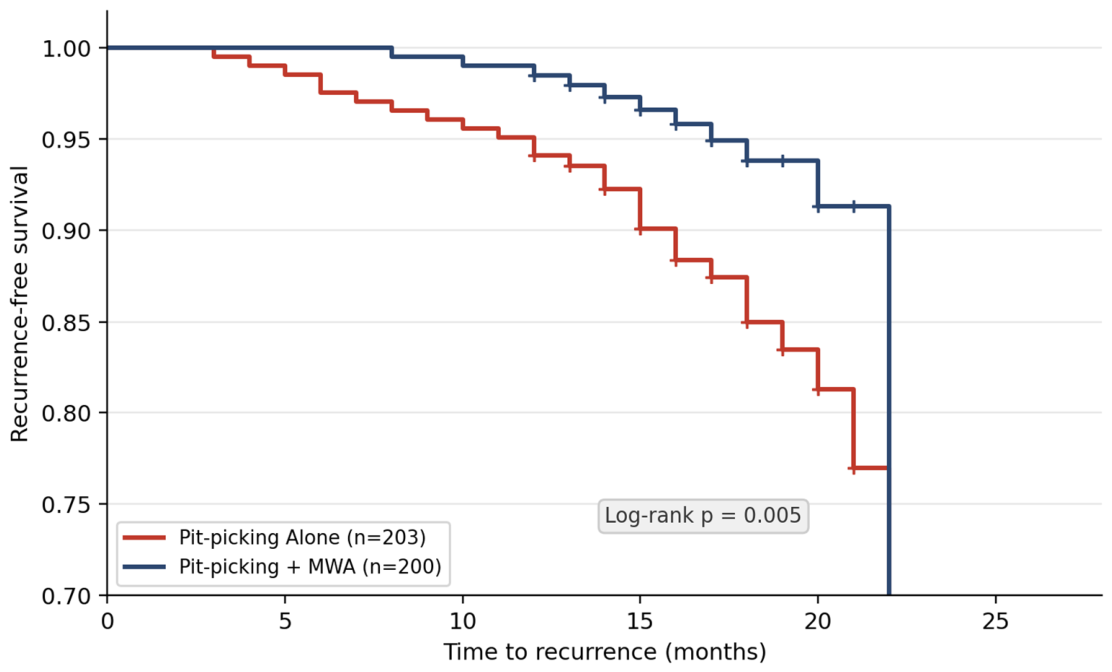
Recurrence rates were significantly lower following pit-picking combined with MWA compared with pit-picking alone (5.5% vs 13.8%; OR 0.36, 95% CI 0.17–0.75; p=0.006). Kaplan–Meier analysis demonstrated significantly higher recurrence-free survival in the MWA group (log-rank p=0.005) (Figure 3). Median time to recurrence was not reached in the MWA group; in the PP group, median time to recurrence was 14 months (IQR 9–18).
Figure 3.
ECO Microwave Ablation System (Medel Healthcare, Turkey) used for microwave-assisted treatment of pilonidal sinus disease. The system comprises a touchscreen-controlled microwave generator and dedicated disposable microwave antennas for controlled thermal tissue ablation.
Figure 3.
ECO Microwave Ablation System (Medel Healthcare, Turkey) used for microwave-assisted treatment of pilonidal sinus disease. The system comprises a touchscreen-controlled microwave generator and dedicated disposable microwave antennas for controlled thermal tissue ablation.
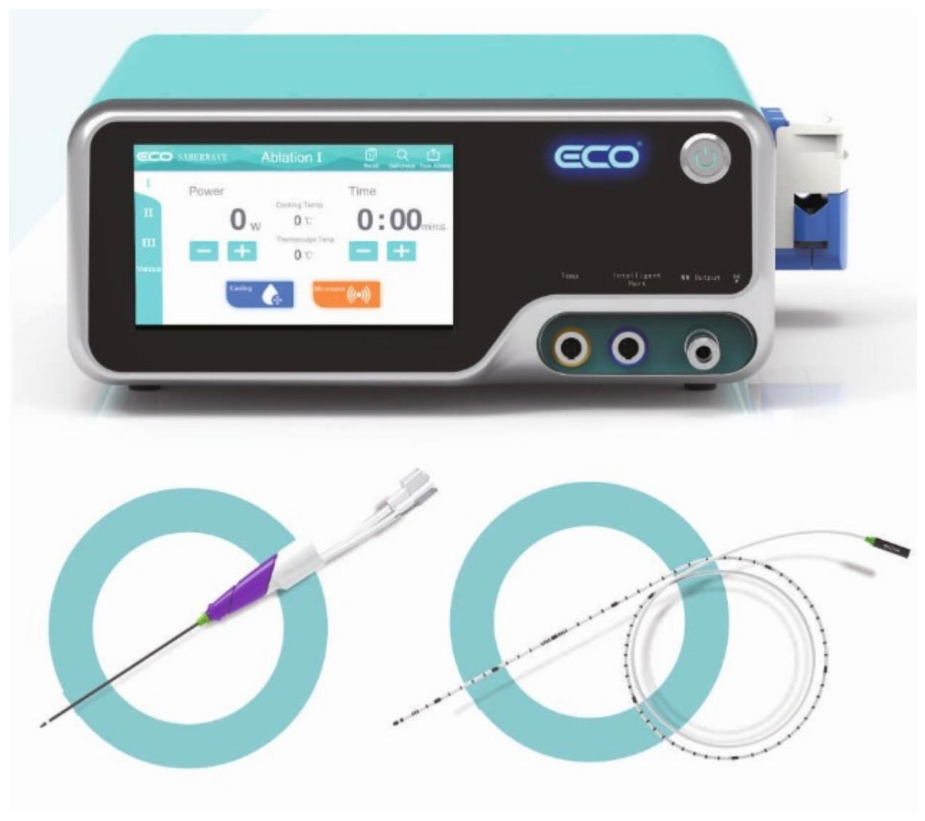
Figure 3.
Kaplan–Meier curves for time to recurrence comparing pit-picking alone (red) versus pit-picking with microwave ablation (blue). Tick marks indicate censored observations (log-rank p=0.005).
Figure 3.
Kaplan–Meier curves for time to recurrence comparing pit-picking alone (red) versus pit-picking with microwave ablation (blue). Tick marks indicate censored observations (log-rank p=0.005).
3.4. Recurrence Risk Stratification
Kaplan–Meier analysis by Tezel classification demonstrated significantly higher recurrence rates with increasing disease severity (Tezel III: 5.5%; IV: 16.5%; V: 11.5–11.9%; log-rank p<0.001) (Figure 4). Patients with postoperative complications had significantly higher recurrence rates compared with those without complications (log-rank p<0.001) (Figure 5).
3.5. Multivariable Analysis
On multivariable logistic regression, MWA treatment remained an independent predictor of reduced recurrence (adjusted OR 0.35, 95% CI 0.16–0.76; p=0.007). Higher Tezel class (Class V vs III: OR 2.81, 95% CI 1.09–7.25; p=0.032) and previous abscess drainage (OR 2.14, 95% CI 1.03–4.42; p=0.041) were independently associated with increased recurrence risk (Table 3).
4. Discussion
The principal finding of the present study is that the addition of microwave ablation to pit-picking significantly improved postoperative outcomes and reduced recurrence rates compared with pit-picking alone in patients with pilonidal sinus disease. Our results demonstrated that pit-picking combined with MWA was associated with lower postoperative pain scores, fewer wound-related complications, faster recovery, and superior long-term disease control, with MWA remaining an independent predictor of reduced recurrence on multivariable analysis.
Recurrence following pit-picking alone remains a significant concern. Our recurrence rate of 13.8% in the PP group is consistent with previously reported rates of 10–18% for pit-picking alone [7,8], while the 5.5% recurrence rate in the MWA group compares favorably with endoscopic and laser-assisted techniques [9,10,11,12,13]. MWA may improve treatment durability through more effective eradication of residual sinus epithelium and inflammatory tissue. Its localized thermal effect may additionally reduce bacterial burden and contribute to coagulative tissue sealing [14,15].
Postoperative pain and recovery parameters significantly favored pit-picking combined with MWA. Patients in the MWA group experienced earlier pain-free sitting, shorter healing time, and faster return to work — findings of particular clinical importance given that PSD predominantly affects young adults during their most productive years.
Tezel classification and prior abscess drainage emerged as independent recurrence predictors on multivariable analysis, reinforcing existing literature on disease severity as a determinant of outcome [16]. These factors should be considered in patient counseling and preoperative risk stratification.
Several limitations should be acknowledged. The retrospective design inherently carries risk of unmeasured confounding. The median follow-up of 16 months may be insufficient to capture late recurrences. Procedural standardization across surgeons and centers may not have been entirely uniform. Propensity-score matching was not feasible given the sample size. Future prospective randomized studies with larger cohorts and extended follow-up are necessary to validate these findings.
5. Conclusions
Pit-picking combined with microwave ablation represents an effective and promising minimally invasive treatment strategy for pilonidal sinus disease. Compared with pit-picking alone, adjunctive microwave energy application provided significant advantages regarding postoperative pain control, wound healing, complication rates, and time to functional recovery while also achieving substantially lower recurrence rates. MWA treatment was an independent predictor of reduced recurrence on multivariable analysis, even after adjusting for disease severity. Further prospective randomized multicenter studies with longer follow-up are necessary to confirm the long-term efficacy of microwave-assisted treatment.
Author Contributions
Conceptualization, A.T.; methodology, A.T. and İ.E.S.; software, S.E.T.; validation, A.T., M.F.Y. and F.S.; formal analysis, İ.E.S. and G.Ö.; investigation, A.T., F.S. and M.F.Y.; resources, A.T.; data curation, F.S. and S.E.T.; writing—original draft preparation, A.T. and İ.E.S.; writing—review and editing, A.T., M.F.Y., G.Ö. and S.E.T.; visualization, İ.E.S.; supervision, A.T.; project administration, A.T.; funding acquisition, not applicable. All authors have read and agreed to the published version of the manuscript.
Funding
This research received no specific grant from any funding agency in the public, commercial, or not-for-profit sectors.
Institutional Review Board Statement
This study was conducted in accordance with the Declaration of Helsinki and was approved by the Scientific Research Ethics Committee of the University of Health Sciences Şehit Prof. Dr. İlhan Varank Training and Research Hospital (approval no: 2026/336; date of approval: 24 June 2026).
Informed Consent Statement
Written informed consent for the surgical procedure was obtained from all patients prior to treatment, as part of routine clinical practice. As this study was a retrospective analysis of anonymized medical records, the requirement for additional study-specific informed consent was waived by the Scientific Research Ethics Committee of the University of Health Sciences Şehit Prof. Dr. İlhan Varank Training and Research Hospital (approval no: 2026/336; date of approval: 24 June 2026). Patient data were anonymized and processed in accordance with applicable data protection regulations.
Data Availability Statement
The data presented in this study were extracted from the hospital information systems (HIS) of the participating centers. Due to institutional data protection policies and patient privacy regulations, the data are not publicly available; anonymized data supporting the findings of this study may be made available by the corresponding author upon reasonable request and with permission of the participating institutions.
Conflicts of Interest
The authors declare no conflicts of interest.
References
- Guner, A.; et al. Limberg flap versus Bascom cleft lift for pilonidal sinus. World J. Surg. 2013, 37, 2074–80. [Google Scholar] [CrossRef] [PubMed]
- Doll, D.; et al. Surgery for asymptomatic pilonidal sinus disease. Int. J. Colorectal Dis. 2008, 23, 839–44. [Google Scholar] [CrossRef] [PubMed]
- Enriquez-Navascues, J.M.; et al. Meta-analysis of RCTs for chronic pilonidal sinus. Tech Coloproctol. 2014, 18, 863–72. [Google Scholar] [CrossRef] [PubMed]
- de Parades, V.; et al. Pilonidal sinus disease. J. Visc. Surg. 2013, 150, 237–47. [Google Scholar] [CrossRef] [PubMed]
- Stauffer, V.K.; et al. Common surgical procedures in pilonidal sinus: a meta-analysis. Sci. Rep. 2018, 8, 3058. [Google Scholar] [CrossRef] [PubMed]
- Bascom, J. Pilonidal disease: long-term results of follicle removal. Dis. Colon Rectum 1983, 26, 800–7. [Google Scholar] [CrossRef] [PubMed]
- Gips, M.; et al. Minimal surgery for pilonidal disease using trephines. Dis. Colon Rectum 2008, 51, 1656–62. [Google Scholar] [CrossRef] [PubMed]
- Di Castro, A.; et al. Minimally invasive surgery for pilonidal disease. The Gips procedure on 2347 patients. Int. J. Surg. 2016, 36, 201–5. [Google Scholar] [CrossRef] [PubMed]
- Meinero, P.; et al. Endoscopic pilonidal sinus treatment. Tech Coloproctol. 2014, 18, 389–92. [Google Scholar] [PubMed]
- Milone, M.; et al. Video-assisted ablation of pilonidal sinus. Surgery 2014, 155, 562–6. [Google Scholar] [CrossRef] [PubMed]
- Dessily, M.; et al. Pilonidal sinus destruction with a radial laser probe. Acta Chir. Belg. 2017, 117, 164–8. [Google Scholar] [CrossRef] [PubMed]
- Emile, S.H.; et al. Endoscopic pilonidal sinus treatment: systematic review. Surg. Endosc. 2018, 32, 3754–62. [Google Scholar] [CrossRef] [PubMed]
- Milone, M.; et al. Long-term results of a RCT comparing endoscopic versus conventional treatment. Int. J. Surg. 2020, 74, 81–5. [Google Scholar] [CrossRef] [PubMed]
- Huurman, E.A.; et al. Non-excisional techniques for intergluteal pilonidal sinus: systematic review. Tech Coloproctol. 2023, 27, 1191–1200. [Google Scholar] [CrossRef] [PubMed]
- Lorant, T.; et al. Sinus excision and primary closure versus laying open in pilonidal disease. Dis. Colon Rectum 2011, 54, 300–5. [Google Scholar] [CrossRef] [PubMed]
- Tezel, E. A new classification for sacrococcygeal pilonidal disease. Colorectal Dis. 2007, 9, 575–6. [Google Scholar] [CrossRef] [PubMed]
Figure 1.
Tezel navicular area classification of pilonidal sinus disease. Classes I and II were excluded from the present study.
Figure 1.
Tezel navicular area classification of pilonidal sinus disease. Classes I and II were excluded from the present study.
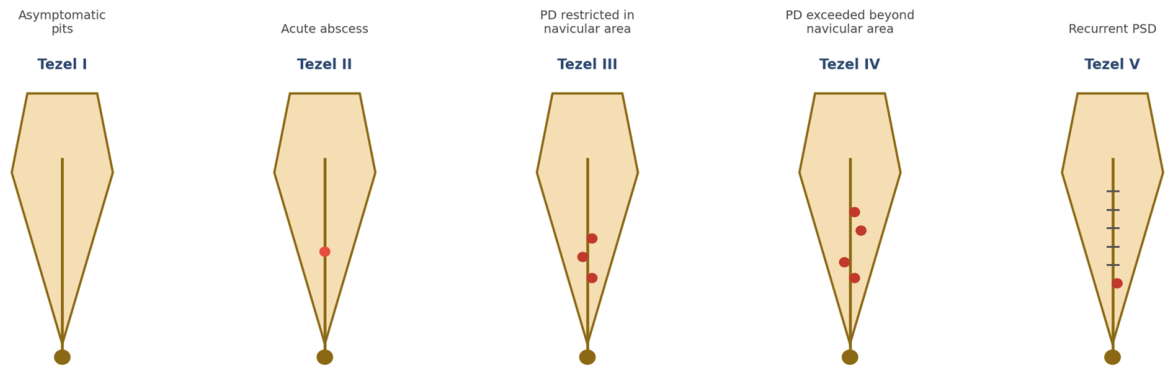
Figure 2.
Flow diagram of patient selection and allocation.
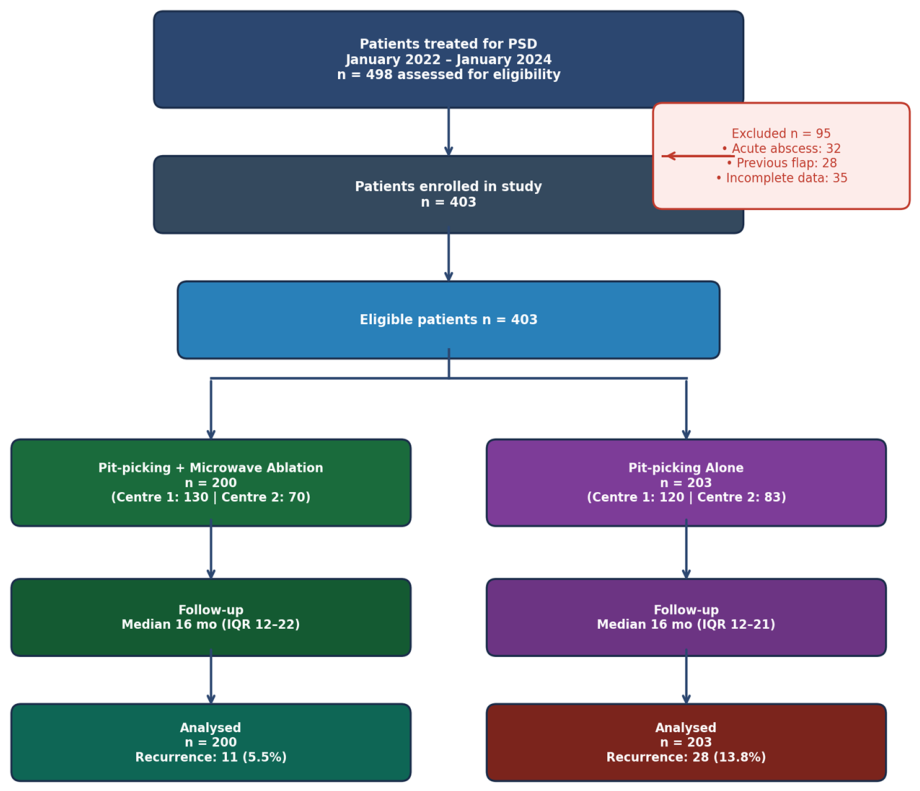
Figure 4.
Kaplan–Meier curves for time to recurrence by Tezel classification comparing Class III (blue), Class IV (red), and Class V (green). Tick marks indicate censored observations (log-rank p<0.001).
Figure 4.
Kaplan–Meier curves for time to recurrence by Tezel classification comparing Class III (blue), Class IV (red), and Class V (green). Tick marks indicate censored observations (log-rank p<0.001).
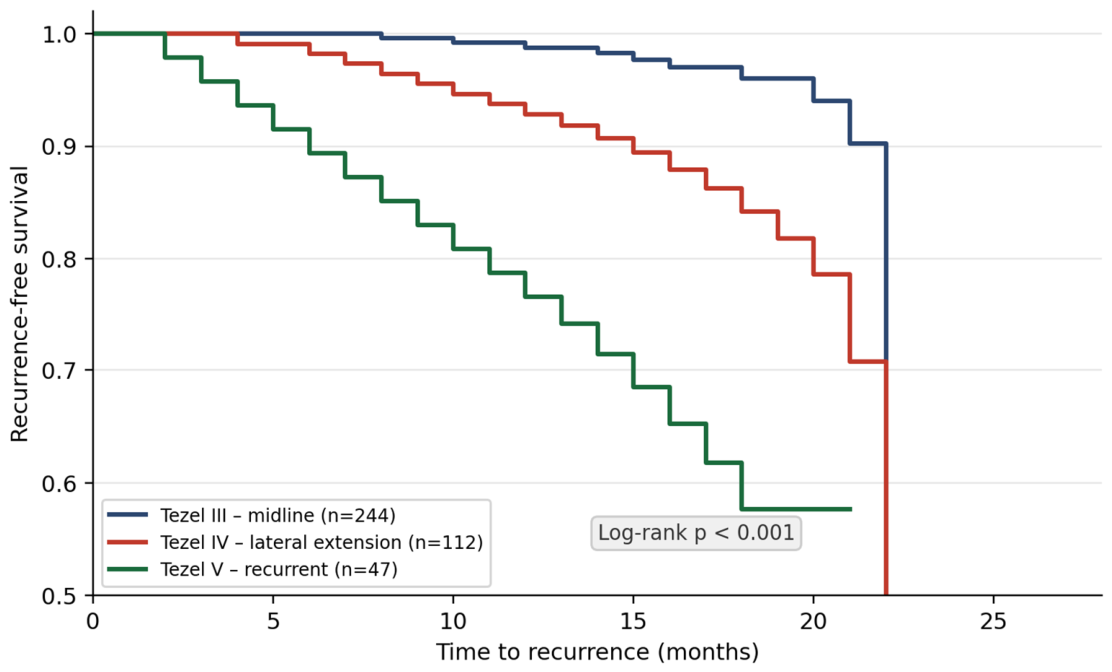
Figure 5.
Kaplan–Meier curves for time to recurrence by postoperative complication status comparing no complication (blue) versus complication (red). Tick marks indicate censored observations (log-rank p<0.001).
Figure 5.
Kaplan–Meier curves for time to recurrence by postoperative complication status comparing no complication (blue) versus complication (red). Tick marks indicate censored observations (log-rank p<0.001).
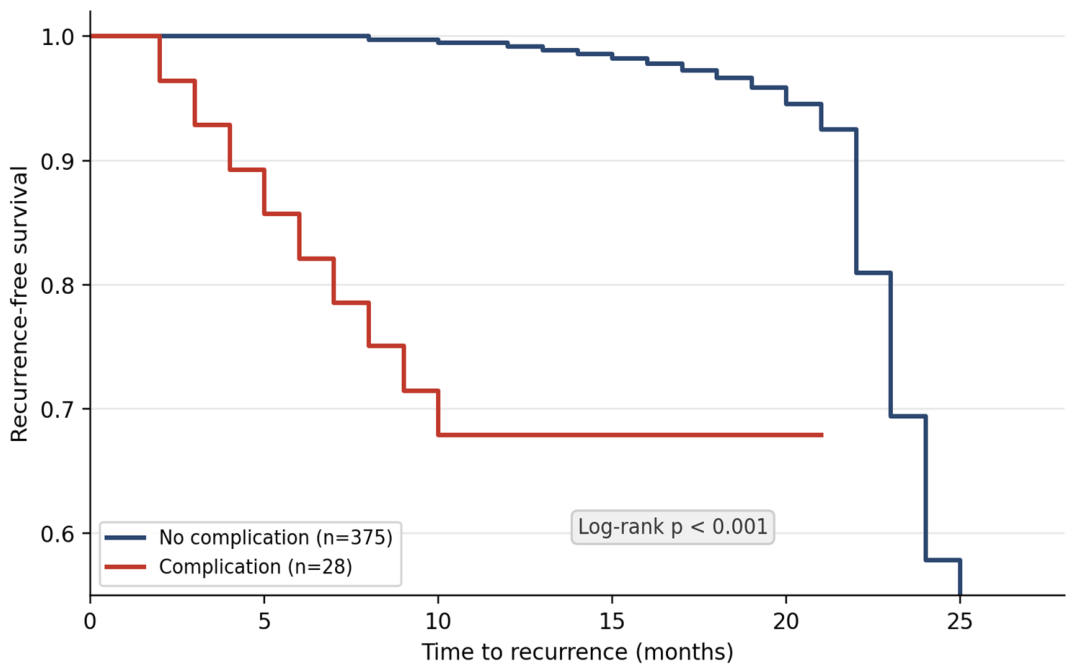

Table 1.
Baseline demographic and clinical characteristics of the study groups.
| Variable | Pit-Picking + MWA (n=200) | Pit-Picking Alone (n=203) | p-Value |
| Age, median (IQR), years | 24 (20–29) | 25 (20–30) | 0.428 |
| Male sex, n (%) | 130 (65.0%) | 129 (63.5%) | 0.751 |
| BMI, mean ± SD (kg/m²) | 25.9 ± 3.4 | 26.1 ± 3.5 | 0.364 |
| Family history, n (%) | 28 (14.0%) | 27 (13.3%) | 0.842 |
| Symptom duration, median (IQR), months | 8 (4–14) | 9 (4–15) | 0.291 |
| Previous abscess drainage, n (%) | 49 (24.5%) | 53 (26.1%) | 0.702 |
| Smoking, n (%) | 90 (45.0%) | 90 (44.3%) | 0.889 |
| Tezel classification, n (%) | |||
| Class III | 122 (61.0%) | 122 (60.1%) | 0.854 |
| Class IV | 55 (27.5%) | 57 (28.0%) | 0.913 |
| Class V | 23 (11.5%) | 24 (11.9%) | 0.902 |
| Follow-up, median (IQR), months | 16 (12–22) | 16 (12–21) | 0.812 |
BMI: Body mass index; IQR: Interquartile range; SD: Standard deviation. No statistically significant differences were observed between groups.
Table 2.
Surgical and postoperative outcomes by treatment group.
| Outcome | Pit-Picking + MWA (n=200) | Pit-Picking Alone (n=203) | p-Value | OR (95% CI) |
| Operative time, median (IQR), min | 22 (18–27) | 15 (12–19) | <0.001 | — |
| Overall complication, n (%) | 9 (4.5%) | 23 (11.3%) | 0.018 | 0.37 (0.16–0.84) |
| Surgical site infection, n (%) | 3 (1.5%) | 11 (5.4%) | 0.031 | 0.26 (0.07–0.95) |
| VAS score at 24 h, median (IQR) | 2 (1–3) | 4 (3–5) | <0.001 | — |
| VAS score at day 7, median (IQR) | 0 (0–1) | 2 (1–3) | <0.001 | — |
| Time to pain-free sitting, median (IQR), days | 2 (1–3) | 4 (3–6) | <0.001 | — |
| Complete wound healing, median (IQR), days | 11 (9–14) | 16 (13–20) | <0.001 | — |
| Return to work, median (IQR), days | 3 (2–4) | 5 (4–7) | <0.001 | — |
| Recurrence, n (%) | 11 (5.5%) | 28 (13.8%) | 0.006 | 0.36 (0.17–0.75) |
MWA: Microwave ablation; VAS: Visual Analogue Scale; OR: Odds ratio; CI: Confidence interval; IQR: Interquartile range.
Table 3.
Multivariable logistic regression analysis for independent predictors of recurrence.
| Variable | p-Value | Adjusted OR | 95% CI |
| Pit-picking + MWA (vs. pit-picking alone) | 0.007 | 0.35 | 0.16–0.76 |
| Tezel Class V (vs. Class III) | 0.032 | 2.81 | 1.09–7.25 |
| Previous abscess drainage | 0.041 | 2.14 | 1.03–4.42 |
| Smoking | 0.118 | 1.62 | 0.88–2.99 |
| Age (per year) | 0.214 | 1.03 | 0.98–1.08 |
| BMI (per kg/m²) | 0.387 | 1.04 | 0.95–1.14 |
| Male sex | 0.502 | 1.24 | 0.65–2.38 |
OR: Odds ratio; CI: Confidence interval; MWA: Microwave ablation. Reference: treatment = pit-picking alone; Tezel class = Class III.
Disclaimer/Publisher’s Note: The statements, opinions and data contained in all publications are solely those of the individual author(s) and contributor(s) and not of MDPI and/or the editor(s). MDPI and/or the editor(s) disclaim responsibility for any injury to people or property resulting from any ideas, methods, instructions or products referred to in the content. |
© 2026 by the authors. Licensee MDPI, Basel, Switzerland. This article is an open access article distributed under the terms and conditions of the Creative Commons Attribution (CC BY) license (http://creativecommons.org/licenses/by/4.0/).
Copyright: This open access article is published under a Creative Commons CC BY 4.0 license, which permit the free download, distribution, and reuse, provided that the author and preprint are cited in any reuse.


