

Submitted:
21 July 2026
Posted:
21 July 2026
You are already at the latest version
Abstract
Sustainable and demand-adaptive railway operation requires frameworks capable of aligning service capacity with time-varying demand while ensuring safe, operationally feasible, and energy-efficient service. This paper proposes an integrated control-and-planning framework for modular pod-based railway operation based on virtual coupling. The framework combines a convoy control layer, which ensures safe and dynamically feasible virtually coupled operation, with a planning layer formulated as a mixed-integer linear programming (MILP) model for daily service allocation and convoy sizing. This hierarchical automation architecture coordinates real-time convoy control with service-level planning to adapt capacity to passenger demand. The proposed methodology is evaluated through comparative simulations under peak-hour, shoulder-period, and off-peak demand scenarios, as well as over a daily schedule of 20 services. Its performance is compared with a conventional fixed-composition diesel-electric multiple unit (DEMU)-based operation. Results show that the pod-based configuration increases energy consumption under peak-hour conditions, remains comparable during shoulder periods, and substantially reduces energy consumption in off-peak operation, achieving a 57% saving in that regime. At the daily level, total energy consumption decreases from 3864 kWh to 3075 kWh, corresponding to a 20% reduction. These findings indicate that the main value of the proposed framework lies in transforming convoy composition into a demand-adaptive operational variable, thereby improving energy performance at the daily system level while preserving the safe and dynamically feasible operation of virtually coupled pod formations.
Keywords:
virtual coupling
; railway automation
; modular railway systems
; energy-efficient railway operation
; demand-adaptive operation
; hierarchical control
; cooperative vehicle control
; model predictive control
; mixed-integer linear programming
1. Introduction
In recent decades, the steady growth in mobility demand—driven by urbanization, globalization, and changing societal expectations—has intensified the limitations of conventional transport systems and reinforced the need for more sustainable, flexible, and efficient mobility solutions. In Europe, this transition is strongly supported by strategic initiatives such as the European Green Deal and the Sustainable and Smart Mobility Strategy, which call for significant reductions in greenhouse gas emissions while improving accessibility, resilience, and service quality. Achieving these objectives requires a progressive shift from rigid, mode-specific transport systems toward integrated, electrified, and increasingly automated mobility ecosystems capable of adapting to evolving passenger and freight needs [1,2].
At the same time, digitalization, automation, and advanced communications are enabling new transport paradigms in which operational decisions can be taken in a more distributed, responsive, and intelligent manner. In the railway sector, these developments are particularly relevant because they make it possible to reconsider traditional operating principles based on fixed train compositions, large safety margins, and limited adaptability to temporal demand variations. Emerging concepts such as virtual coupling (VC) create new opportunities for railway operation by allowing independently operated units to coordinate their motion in real time while maintaining safe separation distances. In this way, VC has the potential to enhance operational flexibility, increase capacity, and improve energy efficiency, especially when combined with modular vehicle concepts and demand-responsive service design [3,4,5].
Within this broader context, modular transport architectures based on standardized units are gaining increasing interest as a possible way to reconcile the high-capacity advantages of rail with the flexibility typically associated with road-based transport. By enabling transport units to be dynamically grouped, separated, and reassigned according to operational requirements, these concepts open the door to a new generation of railway systems that are more scalable, more adaptive to real demand, and better aligned with future multimodal mobility ecosystems. This is precisely the context in which the Pods4Rail [2] concept is framed.
1.1. Context and Motivationt
Pods4Rail (Pods on Moving Infrastructure for Rail) is conceived as a forward-looking transport concept addressing some of the most pressing challenges currently faced by the European mobility system, including the need for decarbonization, the demand for seamless multimodal travel, and the requirement for greater flexibility in low-density and spatially dispersed mobility contexts. The project explores a new vision of guided transport based on standardized modular pods that can be transferred across different transport modes, including rail, road, and ropeway systems. In this way, Pods4Rail moves beyond the logic of isolated transport modes and proposes a genuinely interoperable mobility architecture centered on the continuity of the transported unit [2,6].
A central feature of the concept is the use of compact and modular pods capable of carrying passengers and/or light freight. These pods can be attached to autonomous carrier vehicles specifically designed for each transport mode, thereby enabling mode changes without transferring passengers or goods between vehicles. This modularity provides the basis for more flexible, service-oriented transport chains and supports a Mobility as a Service (MaaS) perspective in which transport supply can be tailored more precisely to actual user needs. The standardization of interfaces between pods, carriers, and infrastructure elements is therefore a key enabler of multimodal interoperability within the proposed concept [2,6].
Although Pods4Rail is multimodal by design, the railway mode plays a particularly important role as the backbone of the overall system. Rail transport offers high energy efficiency, large-scale carrying capacity, and strong integration with metropolitan and regional corridors, making it especially suitable for structuring the main segment of future multimodal mobility chains. At the same time, however, conventional railway operation remains strongly constrained by fixed train compositions and timetable rigidity, which can reduce efficiency when demand is low, variable, or spatially uneven. This limitation is especially relevant in regional, peri-urban, and secondary corridors, where conventional trainsets may be oversized for a substantial portion of daily operation [2,7].
In this context, the rail-based implementation of Pods4Rail offers the possibility of replacing conventional trainsets with modular pods that can be grouped into variable-composition convoys. Rather than operating a fixed train size throughout the day, the number of pods forming a convoy could be adapted according to actual transport demand. Such an operating concept has the potential to improve resource utilization, reduce unnecessary vehicle mass in circulation, and lower energy consumption under medium- and low-demand conditions. However, realizing this potential requires the development of suitable control and planning mechanisms capable of coordinating pod movement safely, managing convoy composition, and ensuring feasible railway operation in real time [4,8,9].
The present paper is positioned precisely at this interface between the conceptual vision of Pods4Rail and the operational requirements of its rail-based deployment. More specifically, it focuses on the design of an integrated framework capable of handling both the movement coordination of virtually coupled pods and the daily planning decisions required to adapt convoy composition to demand. Figure 1 provides an overview of the broader Pods4Rail concept and the role of the railway subsystem within that multimodal architecture [2].
1.2. State of the Art
Virtual coupling has attracted substantial research interest in recent years because it fundamentally changes the way railway vehicles can be coordinated. Unlike conventional fixed-block or moving-block operation, VC allows independently controlled units to travel in close succession while preserving safe separation through real-time coordination and communication. As a result, VC introduces new challenges in control, safety assurance, communication reliability, and traffic management. In particular, short-headway operation amplifies the effect of uncertainty and requires control strategies that can handle dynamic interactions, braking constraints, and disturbances in a systematic and computationally feasible way [3,4,5,10].
From the control perspective, a wide range of approaches has been explored for train coordination and railway automation, including rule-based strategies, classical feedback control, dynamic-programming formulations, and optimization-based predictive control. Among these alternatives, Model Predictive Control (MPC) has emerged as one of the most promising paradigms for VC-enabled railway operation because it provides a systematic framework for incorporating system dynamics, operational objectives, and hard safety constraints into a unified decision-making problem. In safety-critical applications, Robust Model Predictive Control (RMPC) is particularly attractive because it explicitly accounts for disturbances and modeling uncertainty while preserving constraint satisfaction, which is especially important in short-headway VC operation, where small deviations in speed, spacing, or braking response may rapidly compromise formation safety [3,5,10,11,12]. More broadly, MPC-based formulations are well suited to VC because they make it possible to jointly encode safety requirements—such as spacing policies and braking constraints—and operational objectives, including tracking performance, ride comfort, and energy efficiency, within a single constrained optimization framework [3,5,10,11]. In the present study, the control layer is not assessed as an isolated end in itself, but as the enabling layer that guarantees the safe and dynamically feasible execution of the demand-adaptive operation evaluated later in the paper.
Within RMPC, the literature commonly distinguishes several robust formulations, each offering a different trade-off between conservatism, computational tractability, and robustness guarantees. Classical min–max RMPC addresses bounded uncertainty via worst-case optimization and provides strong safety assurances but often incurs high computational cost for long horizons or multiple uncertainty sources [13,14]. Constraint-tightening approaches improve tractability by shrinking state and input constraint sets according to uncertainty bounds, ensuring robust feasibility at the expense of increased conservatism when bounds are pessimistic or difficult to calibrate [15]. Tube MPC further reduces online complexity by combining a nominal MPC plan with an ancillary feedback controller that keeps the true trajectory inside a robust invariant “tube” around the nominal prediction; tube-based approaches are repeatedly motivated in VC by the presence of communication imperfections and the need for robust safety under bounded disturbances [16]. In parallel, stochastic MPC is often discussed as a less conservative alternative to robust designs, but its adoption in safety-critical railway applications remains constrained by validation and certification challenges; recent contributions emphasize safety-oriented stochastic MPC and dual-control perspectives for active uncertainty learning [17,18,19].
Among robust formulations, multi-stage RMPC (MS-RMPC) has gained particular attention as a scenario-based approach that explicitly captures the evolution of uncertainty over the prediction horizon by means of a scenario tree [16,20]. This formulation is especially attractive when uncertainties are time-varying and have meaningful temporal structure, since the controller optimizes across branching uncertainty realizations while enforcing shared decisions at common nodes and scenario-dependent recourse actions [20]. However, MS-RMPC faces a fundamental scalability limitation: the problem size grows rapidly with the horizon length and the number of uncertainty sources/scenarios, creating a central tension between robustness fidelity and real-time feasibility [20,21]. This trade-off is particularly relevant for railway applications with tight sampling constraints and convoy-level coordination requirements, which has motivated real-time robust MPC developments and computationally efficient robust formulations [21,22].
The importance of RMPC—particularly in VC settings—stems from the breadth of uncertainty sources that directly affect safe separation, braking performance, and formation stability. Practical railway uncertainties include physical and parametric effects (e.g., time-varying mass, resistance/drag variations, and heterogeneous braking capability) as well as cyber–physical effects such as train-to-train communication delays, switching communication topologies, and positioning/sensing errors [10,23,24]. These uncertainties are not merely secondary modeling details: under reduced headways, small deviations can translate into large errors in braking distance and spacing, motivating explicit uncertainty handling rather than purely nominal design [12,25,26]. Accordingly, the literature shows a growing emphasis on distributed and decentralized robust predictive control architectures that scale to multi-train formations while remaining resilient to local disturbances and imperfect information exchange, including robust event-triggered MPC under switching topologies and robust control designs tailored to merge/separation maneuvers [12,24,25]. In addition, robustness is increasingly extended to adversarial conditions at the information layer (e.g., denial-of-service or jamming), motivating complementary secure control, monitoring, and resilience mechanisms for VC-enabled train sets [27,28,29].
Alongside classical robustness, learning-enhanced predictive control has emerged as a complementary direction for railway systems, particularly in repetitive operations where historical data can be exploited to improve performance [30,31,32]. For example, Learning MPC (LMPC) has been proposed to refine terminal ingredients and improve energy-related objectives over repeated runs while maintaining feasibility and stability. However, LMPC frameworks do not necessarily provide explicit set-based robustness guarantees (e.g., worst-case constraint satisfaction under bounded uncertainty) unless uncertainty is modeled directly within the optimization problem [4,31]. As a result, recent reviews point toward hybrid strategies that combine robust MPC’s hard safety guarantees with adaptive or learning mechanisms to reduce conservatism and improve efficiency in practice [4,5,31,32].
On the other hand, VC does not only introduce a new control paradigm at the vehicle layer; it also reshapes the traffic planning and scheduling problem by relaxing headway constraints and enabling dynamic (de)coupling and variable train compositions as explicit decision variables. As a result, VC-related planning research typically spans multiple interconnected layers, including (i) line/service design, (ii) timetabling and dispatching, (iii) rolling stock circulation and formation planning, and (iv) rescheduling and service recovery under disruptions. Recent surveys emphasize that the operational value of VC depends on how effectively the control-layer capability (short headways) is converted into system-level benefits such as capacity redistribution, punctuality, and energy reduction through robust scheduling decisions [4,5,33,34].
At the planning layer, VC is commonly modeled as a capacity-enabling mechanism that expands the feasible service envelope and allows differentiated service structures along corridors. Representative works show that VC can be embedded into mixed-integer programming formulations by representing VC as relaxed headway constraints and close-following formations, enabling joint optimization of full-length and short-turn services to match spatially uneven demand [34]. Similarly, VC can support cross-line/corridor-sharing operations, where trains temporarily form platoons on shared segments and decouple after divergence. This enables capacity redistribution without additional infrastructure, and it shifts service design toward composition-aware corridor management [33]. These line-planning studies establish a consistent modeling pattern: VC impacts are typically captured through constraints that reduce minimum separations and through decision variables that represent platoon participation and formation composition.
Moving from strategic planning to operational timetabling, VC introduces scheduling problems where departure times, platoon membership, and coupling/decoupling events must be synchronized. Recent contributions develop exact or hybrid optimization schemes to handle the combinatorial complexity induced by platoon formation. For instance, a branch-and-cut approach has been proposed to schedule train platoons in urban networks, highlighting the role of exact methods when the decision space includes formation coordination [35]. Demand-oriented metro platoon scheduling further demonstrates that VC timetables should be coupled with passenger-flow considerations [36]. In more topology-specific contexts, dynamic scheduling models have been proposed for bottlenecked structures such as Y-shaped lines, where VC can reduce conflicts by coordinating platoons through merge/diverge zones [37,38]. Overall, the emerging theme is that VC timetabling becomes a joint optimization of (i) time decisions (headways, departures, dwell/holding), and (ii) formation decisions (platoon size, coupling timing), often under infrastructure conflict constraints.
A distinctive difference between VC-enabled and conventional operations is that “train size” and composition can be adjusted dynamically. This leads to integrated problems combining timetable design with rolling stock circulation, often formulated as mixed-integer or network-flow models in time–space graphs. Recent work addresses integrated optimization of train diagrams and circulation under full-length and short-turn routes with VC, explicitly capturing the cost–capacity trade-offs enabled by flexible compositions [39]. Other studies extend this idea to demand-oriented timetabling and circulation with flexible compositions and multiple service routes, emphasizing the system-level leverage of coupling train composition to spatiotemporal demand patterns [8]. In addition, rolling stock circulation planning problems for regional systems with flexible composition modes have been investigated, reflecting that VC planning must coordinate not only on-line operations but also fleet logistics and depot interactions when formations are variable [9]. Collectively, these studies suggest that the most impactful VC planning formulations are those that integrate composition decisions with operational schedules, rather than treating platooning as an ex-post control feature.
Robustness becomes central when VC is used in real operations, because disturbances (delays, demand shocks, incidents) can propagate rapidly in short-headway regimes. A key research direction therefore focuses on VC-enabled rescheduling under disruptions. For heavy-haul contexts, timetable rescheduling methods explicitly incorporating VC have been proposed to improve resilience during disturbances, typically by exploiting headway relaxation and formation flexibility to absorb delays [40]. In metro contexts, rescheduling under overcrowding and disruptions has been studied by combining VC with stop-skipping strategies, illustrating how VC can support recovery policies beyond conventional retiming [41]. Complementary work addresses passenger-centric integrated rescheduling for high-speed rail under multiple disruptions, reinforcing the shift toward robust recovery that balances punctuality with passenger-level performance metrics [42].
From a methodological perspective, robust rescheduling is also closely linked to MPC-based traffic management. An MPC-based rescheduling algorithm has been proposed for large-scale railway networks under disruptions and disturbances, highlighting the suitability of rolling-horizon optimization for real-time recovery [43]. In metros, integrated MPC frameworks have been used for rescheduling with backup trains, showing how model predictive approaches can unify timetable adjustment and resource deployment in one optimization loop [44]. These results support a consistent conclusion: VC increases the feasible solution space for recovery, but robust rescheduling requires optimization frameworks capable of reacting in real time while respecting safety constraints.
Beyond disruption response, robust VC scheduling also addresses uncertainty at design time—notably uncertain passenger flows, stochastic delays, and imperfect information. A representative example is scenario-based decentralized MPC for real-time train scheduling under uncertain passenger flows, which explicitly models uncertainty through scenarios and distributes computation—an approach well aligned with the decentralized nature of VC operations [45]. Similarly, robust cooperative trajectory optimization under VC with stochastic delays highlights that uncertainty in communication/dispatching can be embedded in the optimization layer, not only in low-level control [46]. On the modeling side, stochastic activity networks have been used to represent VC-related operational uncertainties and availability effects, suggesting additional system-level tools for assessing robustness beyond deterministic optimization [47].
Despite rapid progress, several research gaps remain particularly relevant for positioning VC-enabled traffic planning and robust scheduling contributions. First, the integration between control-layer VC and planning-layer optimization is still limited. Many planning and scheduling models incorporate VC mainly through relaxed headway constraints and formation decisions, but rely on simplified train dynamics, whereas control-oriented studies typically assume fixed schedules and focus on low-level safety and stability. As a result, bridging these layers into a consistent framework that jointly captures formation decisions and dynamic feasibility remains an open challenge [4,5].
Second, robustness across multiple uncertainty sources is often treated in a fragmented manner. Existing studies frequently focus on a single dominant uncertainty class—such as uncertain passenger demand, stochastic delays, or disruption scenarios—while real deployments typically involve combinations of demand volatility, operational disturbances, and information imperfections. Consequently, unified formulations that address multiple uncertainty sources within a single VC-enabled planning and scheduling framework are still scarce [40,45].
Third, while topology-specific feasibility has been studied extensively—particularly for corridor-sharing operations, junction bottlenecks, and Y-shaped lines—the development of generalizable frameworks that scale to network-level VC operations with robust performance guarantees remains comparatively immature. In practice, models that are highly effective for specific topologies do not always transfer directly to more complex networks without substantial reformulation, limiting their applicability for system-wide deployment [35,37,38].
Finally, the literature highlights a persistent tension between computational tractability and operational realism. Exact optimization approaches (e.g., MILP-based or branch-and-cut scheduling) can provide strong guarantees and detailed formation decisions, but often face scalability limits in large networks or high-frequency operations. Conversely, rolling-horizon and MPC-based dispatching approaches are naturally aligned with real-time control requirements, but demand careful modeling to preserve feasibility, safety, and robust performance when VC formation decisions and uncertainty are explicitly represented [35,43,44].
These issues are particularly important for the deployment of modular rail pods under VC, where planning decisions on convoy composition and service allocation are inherently coupled to the safe and dynamically feasible execution of convoy operation.
1.3. Research Gap and Originality
Motivated by the gaps identified above, this paper positions itself at the intersection of railway convoy control, demand-adaptive planning, and energy-aware operation. Rather than addressing only low-level coordination or only high-level scheduling, the proposed work combines both dimensions within a common framework tailored to the rail-based implementation of Pods4Rail. In this sense, the paper adopts a systems perspective in which operational feasibility, convoy composition, and service allocation are treated as interacting elements of the same railway operating concept.
Although virtual coupling, modular railway vehicles, and demand-adaptive operation have been investigated from different perspectives, their integration into a unified operational framework remains a relevant challenge. In particular, few approaches jointly consider real-time convoy coordination, safety and dynamic-feasibility constraints, and service-level planning decisions over a complete operating horizon.
The originality of the proposed framework lies in four main aspects. First, it introduces a rail-based operating scenario based on modular pods arranged in variable-composition convoys under virtual coupling. Second, it proposes a two-layer architecture that combines convoy control with planning decisions over the daily operational horizon. Third, it uses the control layer as the safety and dynamic-feasibility basis for the proposed operation. Fourth, it evaluates the resulting system through a comparative simulation study against conventional DEMU-based operation, with particular emphasis on the energy implications of adapting convoy size to actual demand. In this context, the main value of the proposed framework lies in transforming convoy composition into a demand-adaptive operational variable, thereby improving energy performance at the daily system level while preserving the safe and dynamically feasible operation of virtually coupled pod formations.
1.4. Objective of the Paper
The primary objective of this paper is to investigate a rail-centric operating concept in which conventional fixed train formations are replaced by variable-composition convoys of modular pods operating under virtual coupling. In the proposed approach, pods remain physically independent but cooperate as a coordinated convoy, so that the formation can be adjusted according to demand while preserving safe and efficient traffic management. This concept represents a significant departure from conventional railway operation, in which service capacity is typically determined by a small number of predefined train compositions that are only weakly coupled to short-term demand fluctuations.
A key limitation of fixed-composition railway operation is that vehicle capacity is typically dimensioned according to peak-hour demand. This is particularly relevant in regional and suburban railway services, where the same trainsets are often operated throughout the day regardless of variations in passenger demand. As a result, fixed-composition trains may run during shoulder or off-peak periods with low occupancy levels, leading to unnecessary vehicle mass, traction energy consumption, and operational inefficiencies. This mismatch between available capacity and actual demand motivates the development of railway operating strategies in which transport capacity can be adjusted more flexibly over the daily service horizon.
The operational idea underlying this work is that railway capacity should be continuously aligned with actual service requirements. Instead of dispatching fixed trainsets regardless of occupancy levels, the proposed system allows the number of pods assigned to a convoy to vary over time and across services. In doing so, it exploits the flexibility enabled by modular vehicles and virtual coupling to reduce structural oversizing, particularly during medium- and low-demand periods. This demand-adaptive logic is intended to improve overall energy efficiency while maintaining the safety and operational feasibility requirements inherent to railway traffic.
Although virtual coupling, modular railway vehicles, and demand-responsive operation have been investigated from different perspectives, their integration into a unified operational framework remains a relevant challenge. In particular, there is a need for approaches that jointly consider real-time convoy coordination, safety and dynamic-feasibility constraints, and service-level planning decisions over a complete operating horizon. Addressing these aspects simultaneously is essential to move from the conceptual potential of modular and virtually coupled railway systems toward practically applicable operating strategies.
To address this challenge, this paper proposes an integrated control-and-planning framework for modular pod-based railway operation based on virtual coupling. The framework is organized into two complementary functional layers. The first is a convoy control layer, responsible for the safe and coordinated movement of pods within virtually coupled formations. This layer governs the dynamic interaction between pods and ensures that convoy operation remains compatible with safety constraints, traffic conditions, and the physical limitations of railway motion. The second is a planning layer, formulated as a mixed-integer linear programming model, responsible for determining service allocation and convoy sizing over the daily operational horizon according to time-varying demand.
From this perspective, the proposed framework can be regarded as a hierarchical automation architecture in which real-time convoy control and service-level planning are jointly coordinated. The lower layer addresses the safe and dynamically feasible motion of virtually coupled pods, while the upper layer determines how modular capacity should be allocated across services. For example, the planning layer may assign longer pod formations to high-demand services while reducing the number of pods in off-peak services, provided that service requirements and operational constraints are satisfied. This allows the system to avoid operating unnecessary vehicle capacity when passenger demand does not justify it.
Beyond the formulation of this operating concept, the paper also assesses its practical value from an operational and energy perspective. In particular, the proposed demand-adaptive pod-based operation is compared with a conventional diesel-electric multiple unit (DEMU)-based railway service using fixed train compositions. The objective is not only to demonstrate the technical feasibility of the integrated control-and-planning framework, but also to quantify how demand-adaptive convoy sizing affects service allocation and overall energy performance under representative daily operating conditions.
Overall, the proposed framework contributes to the development of demand-adaptive railway operation by integrating convoy-level control and service-level planning within a single decision-making structure. This integration makes it possible to evaluate not only whether modular virtually coupled pods can operate safely and feasibly, but also whether their flexible composition can improve energy performance over a complete daily service horizon.
1.5. Paper’s Organization
The remainder of this paper is organized as follows. Section 2 presents the system architecture, the main definitions, and the methodological foundations of the proposed framework, including both the convoy control layer and the planning layer. Section 3 introduces the operational scenario under analysis, the case-study assumptions, and the uncertainty sources considered in the models. Section 4 reports the main results of the comparative analysis, focusing on service allocation, convoy sizing, and energy performance under representative daily demand conditions. Section 5 discusses the main implications of the obtained results, as well as the limitations and practical relevance of the proposed approach. Finally, Section 6 summarizes the main conclusions and outlines directions for future research.
2. Materials and Methods
This section presents the methodological framework developed to analyze the operation of modular rail-based pods under virtual coupling within the Pods4Rail concept. The proposed framework is designed to address two complementary but strongly interconnected decision levels. On the one hand, it must ensure the real-time safe and feasible motion of pods operating as virtually coupled convoys. On the other hand, it must determine how transport services should be configured and allocated over the daily operating horizon so that convoy size can be adapted to time-varying demand. Accordingly, the methodology is structured into two main layers: a Convoy Control Layer and a Planning Layer.
The Convoy Control Layer focuses on the dynamic and safe coordination of pods traveling in convoy formation. Its role is to guarantee trajectory tracking, enforce safety-related separation constraints, and maintain robust operation in the presence of relevant uncertainties affecting rail vehicle motion and inter-pod coordination. To this end, the control problem is formulated from a longitudinal train-dynamics model and implemented through a decentralized architecture in which each pod is equipped with its own controller.
The Planning Layer addresses the operational organization of services over a longer time horizon. In this layer, service allocation, convoy composition, and the temporal distribution of resources are determined according to infrastructure constraints and passenger-demand variations. To obtain an operationally feasible and computationally tractable formulation, the planning problem is expressed over a finite time horizon, discretized in time, and reformulated as a MILP problem. This enables the simultaneous handling of binary service-allocation decisions and time-related operational constraints within a unified optimization framework.
In addition to presenting both methodological layers, this section defines the main variables, parameters, and modeling assumptions used throughout the paper. It also describes the railway line under study, the operating scenario selected for the comparative assessment, and the uncertainty sources considered in both the control and planning models. Together, these elements provide the basis for the simulations conducted in the Results section and for the subsequent comparison between the proposed pod-based operation and conventional fixed-composition services.
2.1. General Methodology
The overall methodology adopted in this study follows an integrated control-and-planning perspective aimed at evaluating the feasibility and energy implications of demand-adaptive railway operation based on modular pods. Rather than treating traffic control and service planning as independent problems, the proposed approach links both levels within a common operational framework. In this way, the methodology captures not only the local dynamic behavior of virtually coupled pods, but also the system-level consequences of adapting convoy composition to changing demand conditions over the course of daily operation.
The methodological process starts with the definition of the railway operating environment and its main modeling elements. The infrastructure is represented through stations, interstation sections, and occupancy blocks, which provide the spatial structure required for both traffic control and service planning. At the vehicle level, pods are modeled through their longitudinal dynamics, including traction and braking actions, motion resistances, and track-related effects such as gradient and curvature. This representation makes it possible to evaluate the physical feasibility of convoy operation and to incorporate relevant sources of uncertainty, such as variations in mass, drag, or inter-pod operating conditions.
Based on this physical description, the first methodological layer concerns convoy control. In this layer, a virtually coupled convoy is modeled as a leader–follower structure operating under a decentralized architecture. The leading pod defines the convoy reference motion, while each follower regulates its dynamics relative to the preceding unit to maintain safe spacing and coordinated motion. The control design is therefore aimed at guaranteeing safety, trajectory consistency, and robustness against modeling errors and operational disturbances during real-time operation. This layer provides the dynamic feasibility conditions under which the convoy can operate safely along the railway line.
The second methodological layer addresses daily service planning. At this level, the objective is to determine how services should be scheduled and how many pods should be assigned to each operation according to demand and infrastructure constraints. To formulate this problem in a way that is compatible with optimization-based traffic management, the railway operation is expressed over a finite prediction horizon and discretized in time. This time discretization transforms the operational evolution of trains and block occupancy into a set of discrete decision variables and linear constraints, which allows the planning problem to be reformulated as a MILP model. Through this reformulation, the method simultaneously captures service sequencing, station dwell conditions, block occupation, departure permissions, and convoy allocation decisions within a single optimization framework.
The interaction between both layers is central to the proposed methodology. The Planning Layer determines the service pattern and the convoy composition required to satisfy daily transport demand, while the Convoy Control Layer ensures that the resulting formations can be operated safely and efficiently in real time. In practical terms, the planning outputs define the operational context in which the convoy controllers act, whereas the control models provide the physical and safety basis that justifies the feasibility of the proposed operation. This two-layer structure therefore enables the analysis of railway services not only from a scheduling perspective, but also from the viewpoint of dynamic execution and safe traffic coordination.
Finally, the methodology is assessed through a comparative simulation workflow. First, representative demand scenarios are defined to capture peak, shoulder, and off-peak operation. Second, the planning layer is used to allocate services and determine the required convoy composition over the daily horizon. Third, the control-layer assumptions and vehicle models are used to characterize the safe and feasible operation of the resulting convoy formations. On this basis, the energy consumption of the proposed pod-based concept is estimated and compared with that of conventional fixed-composition operation. This evaluation makes it possible to quantify the operational and energetic effects of continuously adapting convoy size to actual demand.
The proposed framework should therefore be understood as an integrated decision-making structure: the planning layer determines which convoy formations should be operated, whereas the control layer ensures that these formations can be executed safely and dynamically within the constraints of railway motion.
2.2. Convoy Control Layer
The Convoy Control Layer is responsible for the real-time safe operation of virtually coupled rail-based pod convoys. While the Planning Layer determines convoy composition and scheduling decisions over a longer horizon, the Convoy Control Layer ensures that each pod executes these decisions by enforcing safe inter-pod distances, tracking reference trajectories, and robustness against uncertainties.
A decentralized architecture is adopted, in which each pod is equipped with an onboard controller. One pod acts as the leader, defining the reference motion of the convoy, while the remaining pods operate as followers, regulating their motion relative to the preceding unit through virtual coupling.
2.2.1. System Modeling and Dynamics
This section presents the dynamic model used to describe the longitudinal motion of rail vehicles operating within a virtually coupled pod convoy. Each vehicle is represented as a lumped mass with a single longitudinal degree of freedom. The model accounts for traction and braking forces, rolling and aerodynamic resistances, as well as the effects of track slope and curvature. Nonlinear dynamics is considered to enable robust predictive control design. Known track-dependent parameters, such as gradient and curve radius, are incorporated as position-dependent inputs.
The longitudinal motion of the rail vehicle is described using a longitudinal train dynamics (LTD) model. The train is represented as a lumped point mass with a single longitudinal degree of freedom. The model captures the main physical effects acting along the direction of motion, including traction and braking forces, rolling and bearing resistances, aerodynamic drag, and track dependent resistances due to gradients and curvature. The dynamic equations are expressed as:
where s (m) and (m/s) denote the longitudinal position and speed of the train, respectively. The variable (N) represents the commanded traction or braking force, while (N) is the resulting force applied to the vehicle after actuator dynamics, modeled by the time constant . The parameter (kg) is the train mass. Coefficients (N), (Ns/m), and (Ns2/m2) account for rolling and bearing resistance, air intake losses, and aerodynamic drag, respectively.
The resistance force due to the infrastructure, denoted by , is composed of a gradient-related term and a curvature-related term:
where (N) is the gravitational component induced by the track slope, () is the gravitational acceleration, and (m/m) is the longitudinal inclination of the track. The term (N) represents the resistance due to track curvature, with (m) being the curve radius. Both slope and curvature are functions of the track layout and the train position , and are therefore assumed to be known at each time instant. Figure 2 shows the longitudinal train dynamics model.
Finally, in pod dynamics, certain parameters, such as mass or drag coefficient, are subject to uncertainty because they can vary over time due to passengers boarding or disembarking, or the distance between pods. These parameters are denoted by .
Then equations (1) can be written compactly as (3).
being .
2.2.2. Control Architecture for the Virtually Coupled Convoy
The control framework considers a virtually coupled convoy composed of one leading unit and multiple following units, as illustrated in Figure 3. All units operate under a decentralized control structure, where each pod is equipped with its own controller. This architecture enables independent actuation of each unit while ensuring coordinated motion through virtual coupling.
The variables and parameters involved are associated with a specific pod using a superscript . The leader is indexed by while the followers are indexed by . The measured state of the leader at time is denoted by , with and representing its longitudinal position and speed, respectively, and the applied traction or braking force. Similarly, , , , and denote the corresponding quantities for follower , which is virtually coupled to its preceding unit .
The longitudinal separation between two consecutive units is defined as the end to front distance, which constitutes a key variable for safety enforcement and control objectives (4).
Within this framework, the leader is responsible for establishing the reference motion policy by tracking a predefined speed profile. In contrast, the followers regulate their motion relative to the preceding unit in order to guarantee a minimum safe distance and ensure string stability of the convoy, even in the presence of model uncertainties.
Safe operation requires each follower to anticipate the future motion of the preceding unit. This is achieved through a Preceding Train Predictor (PTP) embedded in each follower controller, which computes predicted states of the preceding unit based on communicated measurements and the known unit length . These predicted trajectories are incorporated into the controller formulation, allowing the follower to maintain safe inter-unit distances and coordinated motion under uncertainty.
The developed controllers are based on robust control, meaning the control actions satisfy the system constraints in the presence of uncertainty. In particular, we apply a multi-stage Nonlinear Model Predictive Control (MS-NMPC) approach. By explicitly accounting for these parameter variations, the MS-NMPC formulation enables the controller to anticipate different operating scenarios and maintain robust performance and safety across a wide range of loading conditions and convoy configurations.
Multi-stage MPC models use trees of discrete scenarios to represent uncertainty [48]. For nonlinear systems, MSNMPC can rigorously guarantee constraint satisfaction for uncertainties explicitly represented in the scenario tree. However, fully capturing continuous uncertainty is impractical. A common strategy is to create a scenario tree using the minimum, nominal, and maximum values of uncertain parameters or disturbances. This results in an over-approximation of the true uncertainty set in the form of a box [49]. This leads to a box over-approximation of the true uncertainty region. This is the approach followed in this paper.
The use of multistage MS-NMPC is particularly well suited to this application, as the train dynamics are influenced by two key time varying parameters that have a significant impact on control performance.
First, the mass of each pod varies over time as a function of the number of passengers on board. This variation directly affects the longitudinal dynamics and must be explicitly considered to avoid performance degradation or overly conservative control actions.
Second, the aerodynamic resistance experienced by the pods is not constant, especially within a convoy configuration. The effective drag coefficient depends on both the operating speed and mainly the inter-pod spacing, leading to different aerodynamic conditions for pods traveling in close formation compared to isolated operation. This effect is particularly relevant for followers within the convoy, where wake interactions and slipstreaming phenomena alter the resistance forces acting on each unit.
In our case, then, for the -th pod
Following this approach, the control problem for each pod is formulated as a MS-NMPC problem. To formulate the MPC, a prediction horizon is considered at time . The notation represents the state vector at time , predicted at time and obtained by starting from the current state . The unknown input variables to be optimized are denoted by . The state estimate is derived via moving horizon estimation (MHE) and is denoted as .
In this framework, uncertainty is represented through a finite set of discrete scenarios, where is the number of parameters and is the number of explicit values considered for the -th parameter which leads to an exponential growth in the number of scenarios with the prediction horizon. To preserve computational tractability, a robust horizon is introduced. Scenario branching is applied only over the first steps, while uncertain parameters are kept constant over the remaining horizon. This strategy significantly reduces computational complexity while retaining the essential effects of uncertainty on system behavior. In our case, since we are considering two uncertain parameters, as previously mentioned. And since we are using the maximum and minimum possible values as the explicit values for the uncertain parameters. For example, mass is considered with the minimum, standard, and maximum number of passengers. This represents a total of scenarios to consider. Figure 4 shows this scenario branching for the two uncertain parameters considered.
Then, the MPC formulation for a generic pod in the multi-stage approach is given by the following:
where , weighs the probability of the scenario and of size denotes the set of all occurring pairs .
Finally, in the multi-stage setting, the system equation for a discretized system is given by:
The full discretization of the dynamic equations (3) is based on orthogonal collocation on finite elements as expressed in (7) which is a direct, simultaneous, and full discretization approach [50].
2.2.3. Leader Controller
Within the decentralized control architecture, the leading pod may operate under any conventional railway control and signaling system, including Automatic Train Control (ATC), Communication-Based Train Control (CBTC), or the European Train Control System (ETCS). In this work, for the sake of simplicity and clarity, the leader is assumed to operate under an ATC-based scheme that tracks a predefined speed profile.
The superscript , with denotes the leader. Accordingly, the leading pod follows a precomputed reference speed trajectory obtained through an optimization-based planning approach. This trajectory is generated offline using dynamic programming (DP) and explicitly incorporates infrastructure constraints, such as line speed limits, station locations, and mandatory stopping requirements. The resulting speed profile defines the global motion policy of the convoy and serves as the reference for all subsequent control actions and is denoted as .
The DP formulation is sufficiently general to accommodate different optimization objectives, including the minimization of energy consumption or the maximization of operational speed. In this study, the latter objective is considered. Specifically, the DP algorithm computes the maximum feasible speed profile that satisfies all line-imposed speed constraints at every position along the route. Consequently, the leader’s trajectory establishes a reference behavior that ensures compliance with operational limits while maximizing convoy throughput. Further details on the DP implementation can be found in [3].
Then, the optimization problem is subject to the following constraints:
Constraint (8a) establish the measured state as the initial condition, while (8b) describes the discrete time evolution of the dynamics.
Constraint (8c) establish that decision variables branching from the same node need to be identical, because they are based on the same information.
Constraint (8d) imposes the position-dependent speed limit , corresponding to the precomputed reference speed, considered as a soft constraint where the slack must be minimized.
Constraint (8e) limits the jerk associated with the control input , ensuring smooth actuation.
Constraints (8f) and (8g) define the admissible bounds on traction and braking forces as well as the corresponding power limits.
Constraint (8h) represents a terminal speed constraint included here ensuring that future speed limits are respected even beyond the prediction horizon.
The objective of the control for the leader is to move the train following the predefined speed profile while satisfying the state and input constraints. Therefore, the cost function can be formulated as (9):
where , are weighting factors that penalize the output deviation from the reference speed, its associated slack as soft constraints, and the input jerk respectively.
2.2.4. Follower Controller
Each follower pod is controlled using a MS-RMPC strategy that regulates its motion relative to the preceding pod. The primary objective is to maintain a safe interpod separation while closely tracking the preceding pod’s trajectory, thereby ensuring safety and string stability of the convoy under uncertainty.
The optimization problem for the -th follower is now subject to the following constraints:
For the -th follower, the constraints (10a-h) have the same meaning as for the leader. Simply replace the superscript 0 with i.
The term represents the predicted speed of the preceding pod, obtained from the Preceding Train Predictor (PTP).
Safety is guaranteed by constraint (10i), which enforces a minimum separation distance at all prediction steps, following the principle of Relative Distance Braking Mode (RDBM) used for virtual coupling (VC) [4] as shown in Figure 5. In this constraint, (m/s2) corresponds to the maximum braking capacity of the preceding train, which is given as a constant value. Meanwhile, (m/s2) represents the maximum service braking capacity of the following train, which is also given as a constant value by the technical specifications of the train.
Finally, terminal constraints (10j) and (10k) ensure recursive feasibility and collision-free stopping, even if the preceding pod performs emergency braking with maximum deceleration . Specifically, constraint (10j) acts as a safety condition, and constraint (10k) serves as an operational constraint that accounts for braking dynamics.
The objective function for the follower is based on the idea of keeping it as close as possible to the train ahead of it. Therefore, the objective function penalizes deviations from a desired inter-pod distance . The desired distance used in the cost function is selected to be greater than , providing a safety margin under nominal operation. Then, the cost function is for the follower defined as (11):
The superscript again denotes the corresponding follower. In the cost function in (11), is a dimensionless weighting factor that penalizes deviations from the desired inter-pod distance .
As in the case of the leader, and are weighting factors that penalize deviations from the reference speed and the input jerk, both treated as soft constraints. Similarly, and are weighting factors that penalize slack variable deviations associated with the minimum safety distance constraints.
2.3. Planning Layer
The Planning Layer determines the operational organization of pod-based railway services over a finite daily operating horizon. Its objective is to allocate convoy movements, station departures, and infrastructure occupation in a way that is compatible with demand variations, resource availability, and railway operating constraints. In contrast to the Convoy Control Layer, which addresses the real-time dynamic feasibility of virtually coupled pods, the Planning Layer operates at a higher decision level and provides the time-indexed service plan to be executed by the lower-level controllers.
The planning problem is formulated as a MILP model. This formulation is suitable because the movement of each convoy through the railway infrastructure can be represented by binary occupation and departure variables, while timing-related restrictions, such as dwell times, headways, and block traversal times, can be expressed through linear constraints. The resulting optimization problem combines service-allocation decisions, infrastructure-capacity limitations, station-operation rules, and timetable constraints within a unified mathematical framework.
2.3.1. Receding-Horizon Planning, Infrastructure Representation, and Nomenclature
The MILP formulation is embedded in a receding-horizon planning scheme, as illustrated in Figure 6. At each iteration, the current state of the railway line, defined by the infrastructure block occupied by each convoy, is used to initialize a new MILP instance over the finite horizon . Once the problem has been solved, only the first-step departure decisions are applied to the system. The remaining steps of the optimized sequence are not directly executed, but are discarded when the next planning iteration starts. The simulation clock is then advanced by , the system state is updated, and the optimization problem is rebuilt for the next iteration. This procedure allows the Planning Layer to react to the evolving occupation of the line while preserving the structure of the MILP formulation.
The railway corridor is represented through the block-based infrastructure model shown in Figure 7. The line consists of a sequence of stations and inter-station line blocks. The set of convoys is denoted by , the set of stations by , and the set of infrastructure blocks by . The latter includes line blocks, station access blocks, and platform blocks. Each inter-station block represents the section between two consecutive stations and is assigned a finite capacity. In the case considered in this work, this capacity is equal to one for single-track inter-station blocks, meaning that only one convoy may occupy each block at a given time.
Each station is represented by three types of blocks: a left-side access block , a right-side access block , and a set of platform blocks . Platform blocks represent independent tracks within the station, whereas and represent the station access areas connected to the adjacent line sections. The terminal station only includes the left-side access block , whereas the head station only includes the right-side access block . This block-based representation allows both station occupation and inter-station movements to be described within the same time-indexed framework.
Each block is associated with a travel or occupation time. For line blocks and station access blocks, this value corresponds to the time required by a convoy to traverse the corresponding infrastructure element. For platform blocks, it represents the minimum dwell time required at the station. A convoy may remain at a platform for longer than this minimum value when downstream blocks are occupied, when departure constraints prevent immediate movement, or when timetable conditions require additional waiting time. Consequently, the model determines not only where each convoy is located, but also when it is allowed to leave its current block.
The time discretization is selected so that station entry and exit movements are represented with sufficient temporal resolution. Specifically, the time interval is computed from the minimum station entry and exit times and as
This definition ensures that the entry and exit blocks of each station contain at least two intervals of the adopted time discretization. The prediction horizon is then defined from the maximum number of discrete time intervals required to traverse or occupy any block:
For clarity, the main notation used in the Planning Layer is summarized in Table 1. The table includes the sets, indices, infrastructure parameters, topological quantities, timing parameters, timetable-related quantities, and objective-function weights required to formulate the MILP problem. Binary decision variables are not included in this table, since they are introduced separately in the following subsection.
2.3.2. Decision Variables
The central decision variable is the block-occupation variable . It takes value one if convoy c occupies block at time step of the prediction horizon, and zero otherwise:
Station departures are described by the binary variable , which indicates whether convoy leaves station at time step :
Together, these variables define the complete space-time trajectory of each convoy, including station stops, departures, and movements through inter-station blocks.
2.3.3. Initial-State and Movement-Consistency Constraints
At the beginning of the prediction horizon, each convoy is assigned to its measured or predefined initial block. This initializes the optimization problem from a physically meaningful traffic state:
At each time step, every convoy must occupy exactly one admissible block. This prevents the same convoy from being simultaneously assigned to different locations:
Movement consistency is enforced by linking the occupation of a block at one time step with the admissible successor blocks at the next time step. If the occupation time of the current block has not elapsed, the convoy remains in that block; otherwise, it may move only to a physically adjacent block according to its direction of travel.
2.3.4. Block Capacity Constraints
The block-capacity constraints define the admissible occupation of each infrastructure block during the prediction horizon. The first constraint corresponds to the instantaneous capacity of each block. It ensures that, at any time step, the number of convoys occupying block does not exceed the capacity assigned to that block, . This condition is expressed as
Constraint (18) prevents any block section from being occupied by more convoys than its allowed capacity. In the present formulation, this condition is applied to every block and to every prediction step , except the initial instant, which is already fixed by the initial-state constraint.
The second block-capacity condition corresponds to the locking capacity. This constraint is used to represent the fact that, when a convoy exits a station, the route toward the next station must remain locked for that convoy. In other words, the model prevents other convoys from using the same exit-related block configuration while the movement is reserved. The formulation is
Constraint (19) therefore accounts for the occupation of the exit block , together with its previous and next associated blocks, and . Its purpose is to impose the locking condition associated with a convoy departure from a station, so that the path toward the next station is reserved for that convoy according to the block configuration defined in the model.
2.3.5. Station Constraints
The station constraints define the logical conditions that regulate convoy departures, dwell times, station exits, and the use of station platforms. These constraints ensure that a convoy can only leave a station when it is physically located there, that the required stopping time has been satisfied, and that the subsequent movement after departure is consistent with the direction of travel.
The first station constraint states that a departure from station can only be activated if convoy is located at that station at time step . This condition is expressed as
Constraint (20) prevents the optimizer from scheduling a departure from a station that is not occupied by the corresponding convoy. In other words, the binary departure variable can only take value one when the station-occupation variable is also active.
The second constraint imposes the minimum stopping time at a station. For a convoy to depart from station at time step , it must have remained at that station for at least consecutive time steps immediately before departure. This sliding-window condition is written as
Constraint (21) guarantees that a departure can only occur after the required dwell time has elapsed. If , the stopping-time condition is skipped.
The third station constraint links the departure decision with the entry into the next block. If convoy leaves station at step , then at step it must be located on the corresponding exit segment, either or , according to the direction of movement. The formulation is
Constraint (22) therefore ensures that a scheduled departure is immediately followed by occupation of the corresponding station-exit block in the next time step.
The fourth station constraint defines the complementary case in which no departure is authorized. If the station-exit authorization is not activated, the convoy remains at the same station in the following time step. This condition is expressed as
Constraint (23) prevents a convoy from leaving a station unless the corresponding departure variable has been activated. Together with constraint (22), it establishes the logical relationship between remaining at the station and entering the next block after departure.
Finally, the preferred-direction constraint restricts the use of platforms at intermediate stations according to the direction of travel. In the original formulation, convoy is prohibited from using tracks associated with the opposite direction for the first two platforms. If more tracks are available, they may be used in either direction. The constraint is written as
This condition applies only to intermediate stations, excluding the head station and the terminal station . Its purpose is to avoid assigning convoys to platforms associated with the opposite direction of travel, while still allowing additional tracks, if present, to be used more flexibly.
2.3.6. Timetable and Headway Constraints
The headway constraints are introduced to ensure that departures from the head and terminal stations are consistent with the predefined timetable. To this end, an indicator function is first defined to determine whether a scheduled departure time falls within the time interval associated with prediction step .
The indicator function takes value one when the scheduled departure time belongs to the interval between and , and zero otherwise. This is expressed as
This function therefore identifies whether a departure is scheduled within the time window associated with step . It is subsequently used to limit departures from the head and terminal stations to those that are allowed by the timetable.
For the head station, the number of departures activated at each prediction step must not exceed the number of scheduled departures falling within the corresponding time interval. The formulation is
This constraint ensures that, at any step , departures from the head station can only occur if they are scheduled for that time interval. In other words, the optimization model cannot authorize more departures from the head station than those permitted by the timetable.
Similarly, departures from the terminal station are constrained by the scheduled departure times associated with the terminal timetable. The formulation is
This condition imposes the same logic at the timetable terminal station: for each prediction step , a convoy can only be authorized to depart from the terminal station if a departure is scheduled within the corresponding time window.
Together, these constraints connect the binary departure variables with the external timetable. The indicator function maps continuous or absolute scheduled departure times into the discrete optimization horizon, while the two timetable constraints ensure that departures from the head and terminal stations respect the prescribed service pattern.
2.3.7. Inter-Station Block Constraints
The inter-station block constraints describe the temporal evolution of convoy occupation in line blocks, entry blocks, and exit blocks. Their purpose is to ensure that, once a convoy is initially located in a block or enters a block during the prediction horizon, it remains there for the required remaining time before being allowed to enter the next admissible block.
The first condition corresponds to the case in which a convoy is already located in an inter-station-related block at the initial step of the prediction horizon. If convoy occupies block at , then it must continue occupying that block for the remaining time associated with that initial occupation. The formulation is
Constraint (28) therefore ensures that a convoy initially present in block cannot immediately disappear from that block in the following prediction steps. Instead, it must remain there during the remaining time imposed by the model.
The second condition in this group applies when a convoy enters a block during the prediction horizon. In that case, the convoy must remain in the block for its corresponding occupation time. The formulation is
Constraint (29) captures the future occupation of a block after entry. If the term indicates that convoy has newly entered block at time step , then the summation on the left-hand side forces the convoy to remain in that block for the required number of subsequent time steps, limited by the end of the prediction horizon .
The second group of constraints defines what happens when the remaining occupation time of a block has elapsed. Once this time has ended, the convoy must be able to enter one of the admissible next blocks. For the case in which the convoy is located in a block at the initial step, the formulation is
Constraint (30) ensures that, when the remaining time associated with the initial occupation of block has elapsed, convoy must enter one of the next admissible blocks .
Finally, the equivalent condition is imposed for blocks entered during the prediction horizon. If the convoy is occupying block at time step and the remaining time condition is satisfied within the prediction horizon, then at the following step it must either continue consistently or enter one of the admissible next blocks. The formulation is
Constraint (31) therefore prevents the convoy from leaving block without entering either the same block at the next time step or one of the admissible next blocks. In combination with constraints (28), (29), and (30), it enforces temporal consistency for convoy movements through inter-station block.
2.3.8. Objective Function
The objective function promotes efficient use of the railway infrastructure by minimizing unnecessary station occupation and favoring early departures when they are operationally feasible. The primary term penalizes the cumulative time spent by convoys at stations, whereas the secondary term rewards departures placed earlier in the prediction horizon:
where and are non-negative weighting coefficients. The first term reduces platform occupation and waiting time, while the second term acts as a symmetry-breaking mechanism by favoring earlier departures among otherwise equivalent feasible solutions. The objective is minimized subject to the initial-state, movement-consistency, block-capacity, station-operation, timetable, headway, and inter-station block-occupation constraints defined above.
The outputs of the Planning Layer are the time-indexed block occupations and departure decisions for each convoy. These outputs define the service pattern to be executed by the lower-level Convoy Control Layer, which then guarantees that the resulting convoy movements can be performed safely and accurately in real time.
2.4. Operational Scenario to Be Evaluated and Context Analysis
The operational scenario considered in this study is derived from the reference use case Use Case 1 (UC1), basic public passenger transport, as defined within the Pods4Rail framework [6]. The scenario represents a regional public-transport service operating on secondary railway corridors, characterized by moderate speeds, frequent stops, and heterogeneous demand profiles including low demand during certain time slots. Such conditions are representative of a large share of European regional rail services and provide a suitable benchmark for assessing innovative vehicle concepts under realistic operating constraints.
For the rail domain, the simulations are based on a real-world reference line with characteristics comparable to typical Category A European secondary railways. The selected line features a total length of approximately 90 km, a maximum operating speed of 80 km/h, gradients reaching up to 28‰, tight curve radii, and a relatively high number of intermediate stops. This operational envelope is fully consistent with the intended deployment context of small-capacity, flexible passenger services and allows a meaningful comparison between conventional and novel rail-based transport solutions.
Within this operational framework, two alternative transport concepts are analyzed and compared through numerical simulations under identical operational conditions:
- Conventional reference system: a diesel–electric multiple unit (DEMU), representative of current regional rail traction technology, operating as a single trainset providing the required passenger capacity.
- Pods-based system: a virtual platoon of autonomous, battery-electric rail pods, operating in coordinated formation and offering an overall passenger transport capacity equivalent to that of the reference DEMU. The pods are assumed to be virtually coupled, allowing synchronized operation while retaining individual propulsion and energy management.
The comparison is deliberately structured to ensure equivalence in transport service provision. Both systems are evaluated under identical boundary conditions in terms of route geometry, timetable constraints, passenger capacity, maximum speed, and stopping patterns. This guarantees that any observed differences in performance can be attributed to the vehicle concepts and energy architectures rather than to external operational factors.
The simulations focus on two complementary dimensions:
- Operational performance, including running times, traction power demand, and the ability to comply with speed limits and gradients along the reference route.
- Energy performance, quantified through total traction energy consumption over the complete route, explicitly accounting for regenerative braking, drivetrain efficiencies, auxiliary loads, and realistic battery utilization margins.
For the pods-based configuration, the aggregated energy consumption of the platoon is considered, enabling a direct system-level comparison with the single DEMU trainset. This approach reflects the practical perspective of transport operators, for whom total energy demand per transported passenger-kilometer is a key decision variable.
Overall, the selected operational scenario and simulation framework provide a robust and transparent basis for evaluating the potential advantages and trade-offs of a pods-based rail system relative to a conventional diesel–electric train. By combining realistic infrastructure characteristics with capacity-equivalent vehicle configurations, the analysis allows a consistent assessment of both operational feasibility and energy-efficiency impacts under conditions relevant to future regional passenger rail services. Table 2 and Figure 6 present the main characteristics of the analyzed line.
Figure 8.
Pilot line characteristics and main parameters: (a) Speed limitations and maximum speed able to be reached by the vehicle. (b) Radius of curvature. (c) Vertical alignment with slopes.
Figure 8.
Pilot line characteristics and main parameters: (a) Speed limitations and maximum speed able to be reached by the vehicle. (b) Radius of curvature. (c) Vertical alignment with slopes.
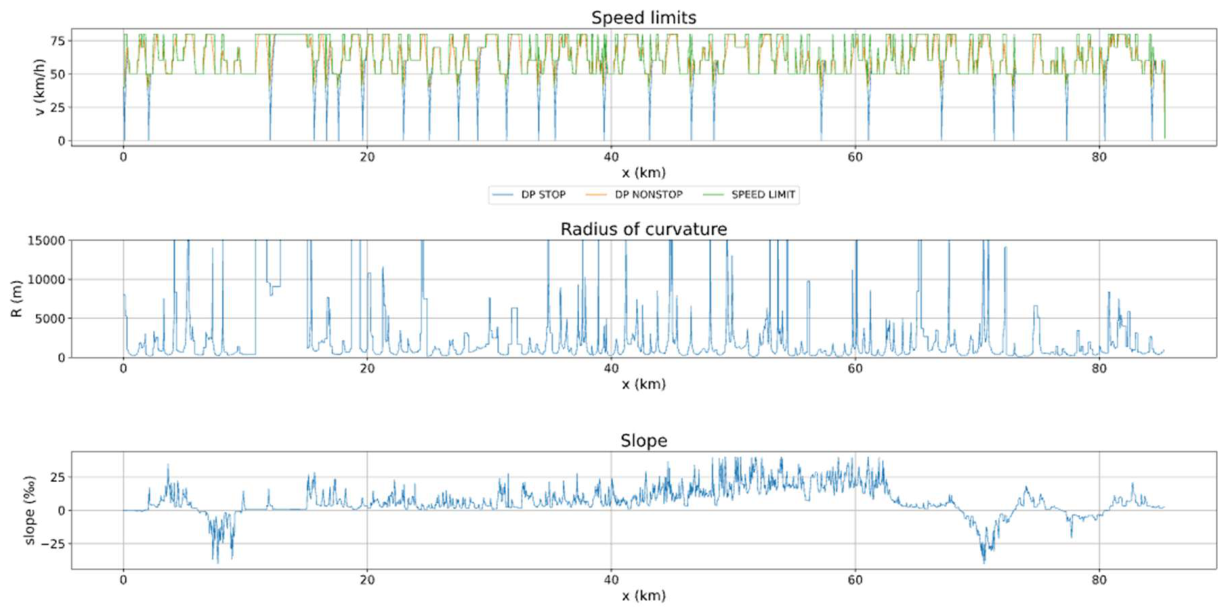
On the other hand,, the baseline operation considered in the comparative simulations relies on fixed DEMU formations, with two-coach vehicles deployed during peak-hour and high-demand periods and single-coach vehicles used under medium- and low-demand conditions, whereas the proposed pod-based concept enables dynamic adjustment of convoy size according to the demand observed at each station, so that only the number of pods strictly required at a given time is operated, thereby improving rolling stock allocation, operational flexibility, and overall system efficiency. The characteristics of the DEMU configurations and a single pod are included in Table 3.
2.5. Uncertainties Considered in the Models
As previously mentioned, the multi-stage MS-NMPC algorithm is particularly well-suited for this application due to the presence of dominant time-varying parameters and uncertainties that affect train dynamics. Changes in the mass of pods and DEMU vehicles, driven by variations in passenger load, directly impact the longitudinal dynamics of all units in the system. Because this effect affects both pods and DEMU vehicles, mass uncertainty is explicitly considered in all motion controllers to ensure robust performance and avoid overly conservative control actions. In contrast, aerodynamic resistance varies significantly, primarily in convoy operation, as it depends on vehicle speed and inter-pod spacing. These effects are especially pronounced for follower pods, where wake interactions and slipstream phenomena lead to substantial variations in the effective drag coefficient. Consequently, follower controllers explicitly address aerodynamic drag uncertainty. DEMU vehicles do not experience slipstream-induced variations in aerodynamic resistance because they operate as independent vehicles rather than in a convoy configuration.
Regarding mass uncertainty, for the pod configuration a minimum of two occupants, a maximum of 20 passengers, and an average occupancy of 12 passengers are considered, assuming a nominal mass of 100 kg per passenger. Similarly, minimum, maximum, and nominal passenger occupancy levels are defined for the two DEMU configurations, as summarized in Table 4.
On the other hand, the aerodynamic resistance is modeled through a coefficient derived from air density, vehicle frontal area, and a drag coefficient that depends on both vehicle speed and inter-pod spacing. In virtual coupling operation, the close proximity between pods significantly alters the airflow, affecting aerodynamic drag, train dynamics, and energy consumption. To accurately capture these effects, CFD simulations were conducted in OpenFOAM [51] using a steady finite-volume approach with established boundary conditions and turbulence modeling commonly adopted for railway aerodynamics. The results show that virtual coupling leads to a reduction in aerodynamic drag, particularly for follower pods, resulting in improved energy efficiency, as shown in [7]. For an isolated pod, the drag coefficient converges to a value of , which represents the asymptotic behavior as inter-pod distance increases (Figure 9), while Figure 10 shows the flow velocity for a composition of several pods. Additional simulations for multiple speeds and pod separations demonstrate that the drag coefficient varies with both parameters, yielding three-dimensional functions for each pod in the convoy, as shown in Figure 11. These functions are subsequently used to define the aerodynamic coefficient in the dynamic model employed in the control simulations.
In this way, regarding aerodynamic drag uncertainty, for the pod configuration Table 5 includes the minimum, maximum and average drag values to be considered in the MS-NMPC algorithm
3. Results
This section reports the results of the comparative simulation study carried out to assess the operational and energetic performance of the proposed pod-based railway concept under demand-adaptive operation. Three representative demand conditions were considered—peak-hour-period, shoulder-period, and off-peak-period operation—and the proposed virtual-coupled pod system was compared with a conventional DEMU-based service using fixed train compositions. The analysis focuses on vehicle-level energy behavior, the relationship between passenger demand and required convoy size, and the daily energy implications of adapting convoy composition to time-varying demand. Accordingly, the results reported in this section focus on the operational-allocation and energy consequences of demand-adaptive convoy sizing, while the control layer provides the safety and dynamic-feasibility basis for the analyzed operation.
3.1. Vehicle-Level Energy Comparison
A first comparison was conducted at the vehicle level in order to characterize the energy implications of different traction-unit sizes. Figure 12 compares the energy consumption associated with one complete round trip for three representative vehicle configurations, thereby providing the vehicle-level basis for understanding why demand-adaptive convoy sizing can improve overall railway energy efficiency. As expected, the results show that energy consumption is strongly dependent on vehicle size and carried mass, which confirms that consist sizing is a key variable for efficient railway operation. This comparison provides the physical basis for the proposed demand-adaptive concept: if smaller units can be deployed when demand is lower, part of the structural inefficiency of fixed-composition operation can be avoided.
From an operational perspective, this result is especially relevant because conventional services are typically constrained to a limited number of predefined train compositions. By contrast, the pod-based concept makes it possible to tailor convoy size more closely to actual demand. Therefore, the vehicle-level comparison in Figure 12 should not be interpreted as an isolated traction result, but rather as evidence that flexible convoy formation can become an effective lever for reducing energy consumption when the transport task does not require the full capacity of a conventional trainset.
3.2. Demand Distribution and Required Number of Pods
To evaluate how demand variability translates into convoy-sizing requirements, additional simulations were carried out using random passenger-demand distributions within the uncertainty ranges defined for the three representative operating conditions. The considered scenarios correspond to peak-hour-period high demand (50–150 passengers, average 105), shoulder-period medium demand (10–65 passengers, average 40), and off-peak low demand (2–20 passengers, average 12). For each line segment, the number of pods required to satisfy the resulting passenger load was determined and compared with the conventional operation, which relies on a two-coach DEMU in peak conditions and a one-coach DEMU in shoulder and off-peak periods. The resulting passenger loads and pod requirements are summarized in Table 6, showing how strongly capacity needs vary both across time periods and along the line. This result confirms that the main benefit of the proposed concept is not simply the replacement of one train type by another, but the introduction of a scalable operating logic capable of matching convoy size to spatiotemporally heterogeneous demand.
The results confirm a strong mismatch between fixed-composition railway operation and time-varying demand. Under peak conditions, several line segments require multiple pods in order to match the passenger load, reflecting the high-capacity needs of the service. However, under shoulder and especially off-peak conditions, the number of pods required per segment decreases substantially, often to only one or a few units. This behavior highlights one of the main advantages of the proposed concept: it allows transport capacity to be continuously adjusted to actual demand instead of maintaining oversized rolling stock in circulation during periods of low occupancy. In this way, the pod-based approach transforms demand variability from an operational inefficiency into a controllable planning variable.
A closer inspection of Table 6 further shows that the capacity requirements vary significantly along the line, not only across time periods but also across stations and interstation segments. This reinforces the idea that the main benefit of modular pod operation is not simply the replacement of one train type by another, but the introduction of a scalable operating logic capable of adapting vehicle deployment to spatiotemporally heterogeneous demand. Such flexibility is difficult to achieve with conventional rolling stock unless multiple train compositions are available and can be dynamically managed with sufficient operational granularity.
3.3. Daily Service Plan and Operational Allocation
To assess the system at the operational level, a daily plan of 20 services was considered. These services were distributed across the three demand conditions so as to represent a realistic operating day: five services under peak-hour-period demand, five under shoulder-period demand, and ten under off-peak demand. The scheduling process combines the planning decisions associated with convoy allocation and service distribution with the dynamic feasibility conditions defined by the convoy control layer. The resulting timetable is illustrated in Figure 13.
This daily operating plan is important because it moves the analysis beyond isolated trip comparisons and places the proposed framework in a realistic service context. Rather than evaluating a single convoy or a single demand snapshot, the 20-service schedule captures how the proposed demand-adaptive logic behaves over an entire operating day. In particular, it shows that the main benefit of modular convoy formation does not necessarily arise from maximizing efficiency in peak operation, but from avoiding the repeated use of oversized vehicles across medium- and low-demand services, which often represent a substantial share of the daily timetable.
Under the demand conditions considered in this study, the conventional operation based on BEMUs requires different train compositions depending on the service period. In peak-hour operation, a double BEMU configuration with two coaches is necessary to accommodate the higher passenger demand. By contrast, during shoulder-period and off-peak operation, demand levels can be adequately served using a single BEMU with one coach. This highlights the limited adaptability of fixed-composition operation, where train capacity can only be adjusted in discrete steps that may not fully match the temporal variability of demand.
The energy results obtained for each demand period and for the complete daily operation are summarized in Table 7. The comparison reveals a differentiated behavior depending on demand level. During peak-hour-period operation, the pod-based solution consumes 383 kWh, compared with 307 kWh for the conventional two-coach DEMU service. This corresponds to an energy penalty of 77 kWh, or approximately 25%, indicating that under high-demand conditions the conventional larger-capacity train remains more favorable from an energy perspective.
The behavior under lower-demand conditions is more nuanced. In shoulder-period operation, the conventional one-coach DEMU consumes 165 kWh, whereas the pod-based solution requires 171 kWh. This corresponds to a difference of only 6 kWh, or approximately 4%. Given the small magnitude of this variation, both systems can be regarded as broadly equivalent from an energy-consumption perspective under medium-demand conditions. By contrast, in off-peak operation the pod-based solution reduces energy consumption from 165 kWh to 72 kWh, yielding a saving of 93 kWh, or approximately 57%. These results indicate that the main energy advantage of the proposed concept emerges when demand is clearly below the level that justifies the operation of a conventional fixed-capacity trainset.
At the daily level, the cumulative effect of this adaptive operation remains clearly visible. For the 20-service schedule considered in this study, the conventional DEMU-based operation results in a total energy consumption of 3864 kWh, whereas the proposed pod-based system requires 3075 kWh. The resulting reduction is 789 kWh, corresponding to a daily energy saving of 20%. This is the most relevant quantitative result of the study, since it shows that even if the flexible pod-based concept is not advantageous in peak-hour conditions and is only broadly equivalent to the conventional solution in shoulder-period operation, it can still outperform fixed-composition operation when the complete daily demand profile—particularly the contribution of off-peak services—is taken into account.
Overall, the results indicate that the value of the proposed framework lies in its ability to align convoy size with actual demand over time. The pod-based solution does not seek to outperform conventional rolling stock in all operating conditions; instead, its strength lies in reducing the structural inefficiencies associated with fixed-capacity train operation when the daily timetable includes a substantial share of low-demand services. This explains why the strongest gains are obtained not at peak load, but over the full daily operation, where demand-adaptive convoy sizing enables a meaningful reduction in energy consumption without compromising operational feasibility.
4. Discussion
The results obtained in this study confirm that the main advantage of the proposed framework does not lie in maximizing efficiency under a single extreme operating condition, but in enabling the railway system to adapt convoy size to the temporal variability of demand over the course of daily operation. This distinction is important. In conventional railway services based on fixed train compositions, vehicle capacity is only weakly coupled to actual occupancy, which often leads to the circulation of excess mass and unused capacity during a large portion of the operating day. By contrast, the proposed pod-based concept allows convoy size to be adjusted according to service needs, thereby transforming train composition from a fixed design choice into a dynamic operational variable. In this sense, the framework should be interpreted primarily as a demand-adaptive operating strategy rather than as a vehicle-level replacement of conventional rolling stock.
A first important outcome of the results is that the energy benefits of modularity are strongly demand-dependent. Under peak-hour-period operation, where capacity requirements are the highest, the pod-based solution consumes more energy than the reference two-coach DEMU service. In shoulder-period operation, by contrast, the difference between both systems is small enough to be considered practically negligible within the context of the present comparison, so their energy performance may be regarded as broadly equivalent in this medium-demand regime. These results indicate that the flexibility of modular units does not necessarily translate into lower energy use when demand remains high or intermediate. Therefore, the proposed concept should not be interpreted as universally superior under all traffic conditions. Its value emerges more clearly when the operating context departs from the medium- and high-demand regimes and the system can exploit composition flexibility more effectively.
The off-peak results reinforce this interpretation. In this regime, the main source of efficiency improvement is not a fundamentally different driving profile, but the ability to avoid the structural oversizing inherent to fixed-composition operation. When demand falls to low levels, conventional trainsets continue to move capacity that is not actually required by the service. The pod-based concept reduces this mismatch by assigning a smaller number of units to the convoy, which directly lowers the transported mass and the energy needed to complete the service. The large reduction obtained in off-peak operation shows that the true energy advantage of the proposed framework appears when service capacity can be closely matched to effective demand. This is particularly relevant for regional, secondary, and peri-urban rail services, where low-occupancy periods often represent a large share of daily operation.
When the analysis is extended from individual services to a full daily operating horizon, the significance of this adaptive logic becomes even more evident. The daily 20-service evaluation shows that the clear energy penalty incurred in peak-hour-period operation, together with the near-equivalence observed in shoulder-period operation, is offset by the savings obtained during off-peak services, leading to a total daily reduction of 789 kWh, equivalent to 20%. This result is central to the interpretation of the framework. It shows that the effectiveness of modular pod-based railway operation should be assessed at the level of the complete service pattern, rather than through isolated high-demand cases only. In operational terms, the framework enables the system to accept lower efficiency in the most capacity-intensive services while maintaining essentially comparable performance in medium-demand services and achieving a larger overall gain during the periods in which conventional operation is clearly oversized. In this sense, the main value of the proposed framework lies in transforming convoy composition into a demand-adaptive operational variable, thereby improving energy performance at the daily system level while preserving the safe and dynamically feasible operation of virtually coupled pod formations.
These findings also clarify the role of the two-layer architecture proposed in this work. The planning layer is essential because the energy benefits do not arise automatically from the use of pods, but from the possibility of assigning the appropriate convoy size to each service over the daily horizon. At the same time, the convoy control layer provides the dynamic and safety-related conditions that make such flexible operation credible from an execution standpoint. In other words, the planning layer converts demand information into service allocation and convoy-sizing decisions, whereas the control layer ensures that these decisions can be implemented safely and coherently under virtual coupling. The results therefore suggest that the contribution of the framework lies not only in the efficiency of individual vehicles, but in the integration of system-level planning with dynamically feasible convoy operation.
From a broader railway-systems perspective, the proposed approach is especially promising for operational contexts characterized by pronounced temporal variability in demand. Many conventional services are designed around peak-capacity requirements and then maintained with limited flexibility throughout the rest of the day. This operating logic is robust from a planning standpoint, but often inefficient in energetic and resource-utilization terms. The present results indicate that virtual-coupled modular pods can offer a different paradigm, in which transport supply is continuously adapted to actual service needs while preserving operational feasibility. Such a strategy may be particularly valuable in corridors where service frequency must be maintained even when occupancy is low, since the possibility of resizing convoy capacity can improve efficiency without eliminating service availability.
At the same time, the present results should be interpreted within the scope of the modeling assumptions adopted in the study. The assessment is based on a simulated operating environment, a specific railway line, and a finite set of representative demand scenarios and uncertainty ranges. Consequently, the quantitative savings reported here should not be taken as universally transferable to all railway contexts without further validation. In particular, infrastructure characteristics, operational rules, fleet availability, and the exact relationship between aerodynamic effects, convoy spacing, and payload may influence the magnitude of the achievable gains. Therefore, the main contribution of the present discussion is not to claim a universal numerical benchmark, but to demonstrate the operational logic through which demand-adaptive convoy sizing can outperform fixed-composition services over realistic daily demand patterns.
These limitations also point naturally to future work. A next step would be to evaluate the proposed framework under a wider variety of infrastructure topologies, timetable structures, and demand distributions, as well as to analyze its sensitivity to disturbances affecting both traffic conditions and information availability. It would also be valuable to extend the assessment beyond energy consumption alone and consider additional performance indicators, such as fleet utilization, service robustness, passenger waiting times, and computational requirements for real-time deployment. Such extensions would help clarify under which operational conditions the pod-based concept provides the strongest advantage and how it could be integrated into broader railway traffic-management practice.
Overall, the discussion supports a clear conclusion: the proposed pod-based railway concept is most valuable not because it minimizes energy consumption in every single scenario, but because it replaces a rigid fixed-composition logic with a flexible, demand-adaptive operating strategy that performs better over the full daily service profile. The framework is therefore especially relevant for railway systems in which demand fluctuates significantly throughout the day and where conventional rolling stock is frequently operated with excess capacity. Under such conditions, modular virtual-coupled convoys can provide a meaningful step toward more energy-efficient, scalable, and operationally responsive railway services.
5. Conclusions
This paper has presented an integrated control-and-planning framework for sustainable and demand-adaptive railway operation based on modular pods organized in virtually coupled convoys. The proposed approach combines two complementary layers: a convoy control layer, responsible for ensuring safe and dynamically feasible operation of virtually coupled formations, and a planning layer, formulated as a mixed-integer linear programming model, which determines service allocation and convoy sizing over the daily operating horizon. From this perspective, the framework can be interpreted as a hierarchical automation architecture in which real-time convoy coordination and service-level planning are jointly considered to support safe, feasible, and energy-efficient operation.
The results confirm that the proposed approach is most beneficial when low- and medium-demand services represent a significant share of the daily timetable, since these are the operating conditions in which fixed-composition trains tend to operate with excess capacity. Under peak-hour demand, the pod-based configuration exhibits higher energy consumption than the conventional fixed-composition reference, mainly because the modular solution must operate several units to satisfy high-capacity requirements. Under shoulder-period demand, both systems show broadly comparable energy performance. By contrast, under off-peak conditions, the proposed solution becomes clearly advantageous, reducing energy consumption by 57% with respect to the conventional operation. This confirms that the principal benefit of modular virtual-coupled operation appears when demand is below the level that justifies the use of fixed-capacity trainsets.
At the daily level, the ability to adapt convoy composition throughout the timetable leads to a significant system-level energy improvement. For the 20-service operating day considered in this study, total energy consumption decreases from 3864 kWh for the conventional DEMU-based operation to 3075 kWh for the proposed pod-based system, corresponding to a net saving of 789 kWh, or 20%. These results indicate that the effectiveness of demand-adaptive railway operation should be assessed over complete daily demand profiles rather than only through isolated service conditions. Although the proposed system is not necessarily optimal for every individual service, it can reduce the structural inefficiencies associated with fixed-composition operation when low- and medium-demand periods represent a relevant share of the timetable.
The study also highlights the importance of integrating control and planning decisions in the assessment of future railway operating concepts. The planning layer determines how modular capacity should be distributed across services, while the control layer ensures that the resulting pod formations remain compatible with safety constraints and the dynamic limitations of railway motion. This integration is essential for translating the flexibility offered by modular vehicles and virtual coupling into an operationally feasible strategy. Therefore, the contribution of the proposed framework is not limited to energy reduction, but also lies in turning convoy composition into an explicit operational decision variable within an automated and demand-responsive railway system.
The conclusions of this work should nevertheless be interpreted within the scope of the adopted modeling assumptions, the selected case study, and the considered demand scenarios. Future research should extend the analysis to more complex railway networks, heterogeneous service patterns, and larger fleets, including operational constraints related to vehicle circulation, station capacity, passenger waiting times, and fleet availability. Further work should also investigate data-driven and artificial-intelligence-based decision mechanisms for real-time convoy reconfiguration under uncertain demand conditions, as well as robustness, computational performance, passenger service quality, and implementation requirements for practical deployment.
Author Contributions
Conceptualization, S.A., M.-A.V.S and J.F.; methodology, S.A., M.-A.V.S and J.F.; formal analysis, S.A., M.-A.V.S and J.F.; investigation, S.A. and J.F.; validation, S.A. and J.F.; writing—original draft preparation, S.A. and J.F.; writing—review and editing, S.A., M.-A.V.S and J.F.; supervision, J.F.; project administration, J.F.; funding acquisition, J.F. All authors have read and agreed to the published version of the manuscript.
Funding
The Pods4Rail project HORIZON-ER-JU-2022-FA7-01 is supported by the Europe’s Rail Joint Undertaking and its members under the Horizon Europe Programme with the grant agreement no. 101121853. Although funded by the European Union, the views and opinion expressed are those of the author(s) only and do not necessarily reflect those of the European Union or the Europe’s Rail Joint Undertaking. Neither the European Union nor the granting authority can be held responsible for them. The project Pods4Rail project is supported by the Europe’s Rail Joint Undertaking and its members.
 |
 |
Data Availability Statement
The original contributions presented in this study are included in the article. Further inquiries can be directed to the corresponding author.
Conflicts of Interest
The authors declare that the research was conducted in the absence of any commercial or financial relationships that could be construed as a potential conflict of interest.
Abbreviations
The following abbreviations are used in this manuscript:
| ATC | Automatic Train Control |
| CBTC | Communication Based Train Control |
| DEMU | Diesel–Electric Multiple Unit |
| DP | Dynamic programming |
| ETCS | European Train Control System |
| LMPC | Learning Model Predictive Control |
| LTD | Longitudinal Train Dynamics |
| MaaS | Mobility as a Service |
| MHE | Moving Horizon Estimation |
| MILP | Mixed-Integer Linear Programming |
| MPC | Model Predictive Control |
| MS-NMPC | Multi-stage Nonlinear Model Predictive Control |
| PTP | Preceding Train Predictor |
| RDBM | Relative Distance Braking Mode |
| RMPC | Robust Model Predictive Controller |
| UC | Use Case |
| VC | Virtual Coupling |
References
- Europe’s Rail, ‘Europe’s Rail Jint Undertaking, A body of the European Union’. Accessed: May 20, 2026. [Online]. Available: https://rail-research.europa.eu/.
- Pods4Rail, ‘Pods4Rail: A European Research Project Exploring the Future of Rail Transportation’. Accessed: May 20, 2026. [Online]. Available: https://pods4rail.eu/.
- J. Felez, Y. Kim, and F. Borrelli, ‘A Model Predictive Control Approach for Virtual Coupling in Railways’, IEEE Trans. Intell. Transp. Syst., vol. 20, no. 7, pp. 2728–2739, Jul. 2019. [CrossRef]
- J. Felez and M. A. Vaquero-Serrano, ‘Virtual Coupling in Railways: A Comprehensive Review’, Machines, vol. 11, no. 5, p. 521, May 2023. [CrossRef]
- Q. Zhang, Y. Liao, and Y. Ji, ‘A Comprehensive Review of Virtually Coupled Train Systems’, Urban Rail Transit, May 2026. [CrossRef]
- Pods4Rail, ‘Pods4Rail Deliverables’. Accessed: May 25, 2026. [Online]. Available: https://pods4rail.eu/#deliverables.
- J. Felez et al., ‘A New Concept of Hybrid Maglev-Derived Systems for Faster and More Efficient Rail Services Compatible with Existing Infrastructure’, Sustainability, vol. 17, no. 11, p. 5056, May 2025. [CrossRef]
- X. Bao, Q. Zhang, H. Yin, E. Wang, and Y. Xiao, ‘Integrated optimization of demand-oriented timetabling and rolling stock circulation planning with flexible train compositions and multiple service routes on urban rail lines’, Transp. Res. Part C Emerg. Technol., vol. 174, p. 105071, May 2025. [CrossRef]
- G. Tai, A. Lai, G. Li, Y. Wang, W. Guo, and Y. Huang, ‘Flexible Train Composition Mode–Based Rolling Stock Circulation Planning Problem for Regional Rapid Rail Transit’, J. Adv. Transp., vol. 2025, no. 1, p. 2721207, Jan. 2025. [CrossRef]
- Q. Wu et al., ‘Dynamics and control simulation of railway virtual coupling’, Veh. Syst. Dyn., vol. 61, no. 9, pp. 2292–2316, Sep. 2023. [CrossRef]
- C. Di Meo, M. Di Vaio, F. Flammini, R. Nardone, S. Santini, and V. Vittorini, ‘ERTMS/ETCS Virtual Coupling: Proof of Concept and Numerical Analysis’, IEEE Trans. Intell. Transp. Syst., vol. 21, no. 6, pp. 2545–2556, Jun. 2020. [CrossRef]
- J. Felez, M. A. Vaquero-Serrano, and J. De Dios Sanz, ‘A Robust Model Predictive Control for Virtual Coupling in Train Sets’, Actuators, vol. 11, no. 12, p. 372, Dec. 2022. [CrossRef]
- A. Bemporad and M. Morari, ‘Robust model predictive control: A survey’, in Robustness in identification and control, vol. 245, A. Garulli and A. Tesi, Eds, in Lecture Notes in Control and Information Sciences, vol. 245., London: Springer London, 1999, pp. 207–226. [CrossRef]
- J. Lan and D. Zhao, ‘Min-Max Model Predictive Vehicle Platooning With Communication Delay’, IEEE Trans. Veh. Technol., vol. 69, no. 11, pp. 12570–12584, Nov. 2020. [CrossRef]
- A. Richards and J. How, ‘Robust stable model predictive control with constraint tightening’, in 2006 American Control Conference, Minneapolis, MN, USA: IEEE, 2006, p. 6 pp. [CrossRef]
- S. Subramanian, Y. Abdelsalam, S. Lucia, and S. Engell, ‘Robust Tube-Enhanced Multi-Stage NMPC With Stability Guarantees’, IEEE Control Syst. Lett., vol. 6, pp. 1112–1117, 2022. [CrossRef]
- T. Brudigam, R. Jacumet, D. Wollherr, and M. Leibold, ‘Safe Stochastic Model Predictive Control’, in 2022 IEEE 61st Conference on Decision and Control (CDC), Cancun, Mexico: IEEE, Dec. 2022, pp. 1796–1802. [CrossRef]
- T. A. N. Heirung, J. A. Paulson, J. O’Leary, and A. Mesbah, ‘Stochastic model predictive control — how does it work?’, Comput. Chem. Eng., vol. 114, pp. 158–170, Jun. 2018. [CrossRef]
- A. Mesbah, ‘Stochastic model predictive control with active uncertainty learning: A Survey on dual control’, Annu. Rev. Control, vol. 45, pp. 107–117, 2018. [CrossRef]
- S. Lucia and S. Engell, ‘Potential and Limitations of Multi-stage Nonlinear Model Predictive Control’, IFAC-Pap., vol. 48, no. 8, pp. 1015–1020, 2015. [CrossRef]
- M. N. Zeilinger, D. M. Raimondo, A. Domahidi, M. Morari, and C. N. Jones, ‘On real-time robust model predictive control’, Automatica, vol. 50, no. 3, pp. 683–694, Mar. 2014. [CrossRef]
- M. Lorenzen, M. Cannon, and F. Allgöwer, ‘Robust MPC with recursive model update’, Automatica, vol. 103, pp. 461–471, May 2019. [CrossRef]
- J. Park, B.-H. Lee, and Y. Eun, ‘Virtual Coupling of Railway Vehicles: Gap Reference for Merge and Separation, Robust Control, and Position Measurement’, IEEE Trans. Intell. Transp. Syst., vol. 23, no. 2, pp. 1085–1096, Feb. 2022. [CrossRef]
- H. Zhao, X. Dai, Q. Zhang, and J. Ding, ‘Robust Event-Triggered Model Predictive Control for Multiple High-Speed Trains With Switching Topologies’, IEEE Trans. Veh. Technol., vol. 69, no. 5, pp. 4700–4710, May 2020. [CrossRef]
- M. A. Vaquero-Serrano and J. Felez, ‘A decentralized robust control approach for virtually coupled train sets’, Comput.-Aided Civ. Infrastruct. Eng., vol. 38, no. 14, pp. 1896–1915, Sep. 2023. [CrossRef]
- X. Zhang, D. Yang, W. Zhang, and J. Huang, ‘Optimal robust constraints-following control for rail vehicle virtual coupling’, J. Vib. Control, vol. 29, no. 5–6, pp. 1352–1365, Mar. 2023. [CrossRef]
- R. Kour, A. Patwardhan, A. Thaduri, and R. Karim, ‘A review on cybersecurity in railways’, Proc. Inst. Mech. Eng. Part F J. Rail Rapid Transit, vol. 237, no. 1, pp. 3–20, Jan. 2023. [CrossRef]
- S. Ma, B. Bu, and H. Wang, ‘A Virtual Coupling Approach Based on Event-triggering Control for CBTC Systems under Jamming Attacks’, in 2020 IEEE 92nd Vehicular Technology Conference (VTC2020-Fall), Victoria, BC, Canada: IEEE, Nov. 2020, pp. 1–6. [CrossRef]
- S. Ma, H. Wang, Z. Li, and Q. Zhang, ‘A Novel Approach for Estimating Performance of IIoT-Based Virtual Control Train Sets under DoS Attacks’, Secur. Commun. Netw., vol. 2022, pp. 1–19, Sep. 2022. [CrossRef]
- U. Rosolia and F. Borrelli, ‘Learning Model Predictive Control for Iterative Tasks. A Data-Driven Control Framework’, IEEE Trans. Autom. Control, vol. 63, no. 7, pp. 1883–1896, Jul. 2018. [CrossRef]
- U. Rosolia and F. Borrelli, ‘Sample-Based Learning Model Predictive Control for Linear Uncertain Systems’, in 2019 IEEE 58th Conference on Decision and Control (CDC), Nice, France: IEEE, Dec. 2019, pp. 2702–2707. [CrossRef]
- M. A. Vaquero-Serrano, F. Borrelli, and J. Felez, ‘A learning model predictive control for virtual coupling in intelligent train control systems’, Comput.-Aided Civ. Infrastruct. Eng., vol. 40, no. 31, pp. 6279–6304, Dec. 2025. [CrossRef]
- L. Sun, Y. Liu, Y. Xu, D. Kong, H. Lu, and H. Lu, ‘Train Service Design for Rail Transit Cross-Line Operation Applying Virtual Coupling’, Appl. Sci., vol. 14, no. 15, p. 6787, Aug. 2024. [CrossRef]
- X. Zhou, F. Lu, and L. Wang, ‘Optimization of Train Operation Planning with Full-Length and Short-Turn Routes of Virtual Coupling Trains’, Appl. Sci., vol. 12, no. 15, p. 7935, Aug. 2022. [CrossRef]
- S. Chai, J. Yin, A. D’Ariano, R. Liu, L. Yang, and T. Tang, ‘A branch-and-cut algorithm for scheduling train platoons in urban rail networks’, Transp. Res. Part B Methodol., vol. 181, p. 102891, Mar. 2024. [CrossRef]
- S. Chai, J. Yin, A. D’Ariano, M. Samà, and T. Tang, ‘Scheduling of Coupled Train Platoons for Metro Networks: A Passenger Demand-Oriented Approach’, Transp. Res. Rec. J. Transp. Res. Board, vol. 2677, no. 2, pp. 1671–1689, Feb. 2023. [CrossRef]
- C. Chen, L. Zhu, and X. Wang, ‘Enhancing Subway Efficiency on Y-Shaped Lines: A Dynamic Scheduling Model for Virtual Coupling Train Control’, IEEE Trans. Intell. Transp. Syst., vol. 25, no. 8, pp. 10020–10034, Aug. 2024. [CrossRef]
- H. Wang, L. Yang, J. Zhang, Q. Luo, and Z. Fan, ‘Real-time train timetabling with virtual coupling operations on a Y-type metro line’, Eur. J. Oper. Res., vol. 319, no. 1, pp. 168–190, Nov. 2024. [CrossRef]
- F. Lu, L. Wang, J. Hu, Q. Zhang, and X. Li, ‘Integrated Optimization of Train Diagrams and Rolling Stock Circulation with Full-Length and Short-Turn Routes of Virtual Coupling Trains in Urban Rail Transit’, Appl. Sci., vol. 14, no. 12, p. 5006, Jun. 2024. [CrossRef]
- X. Ma, M. Zhou, H. Wang, W. Song, and H. Dong, ‘Virtual-Coupling-Based Timetable Rescheduling for Heavy-Haul Railways Under Disruptions’, IEEE Trans. Comput. Soc. Syst., vol. 11, no. 5, pp. 7045–7054, Oct. 2024. [CrossRef]
- L. Yuxuan, H. Baoming, and C. Zebin, ‘Rescheduling Metro Trains in the Over-Crowded Situation After Disruptions with Virtual Coupling Technology and Stop-Skipping Strategy’, in The Proceedings of the 11th International Conference on Traffic and Transportation Studies, vol. 616, L. Meng, Y. Qian, Y. Bai, B. Lv, and Y. Tang, Eds, in Lecture Notes in Civil Engineering, vol. 616., Singapore: Springer Nature Singapore, 2025, pp. 552–560. [CrossRef]
- L. Fan, K. Qiao, Y. Chen, M. Hui, T. Shen, and P. Wen, ‘Passenger-Centric Integrated Timetable Rescheduling for High-Speed Railways Under Multiple Disruptions’, Sustainability, vol. 17, no. 12, p. 5624, Jun. 2025. [CrossRef]
- G. Cavone, T. Van Den Boom, L. Blenkers, M. Dotoli, C. Seatzu, and B. De Schutter, ‘An MPC-Based Rescheduling Algorithm for Disruptions and Disturbances in Large-Scale Railway Networks’, IEEE Trans. Autom. Sci. Eng., vol. 19, no. 1, pp. 99–112, Jan. 2022. [CrossRef]
- Y. Tong, W. Xu, M. Dotoli, and G. Cavone, ‘An Integrated Model Predictive Control Method for the Rescheduling of Metro Traffic with Backup Trains’, in 2022 American Control Conference (ACC), Atlanta, GA, USA: IEEE, Jun. 2022, pp. 4648–4653. [CrossRef]
- X. Liu, A. Dabiri, Y. Wang, and B. De Schutter, ‘Real-Time Train Scheduling With Uncertain Passenger Flows: A Scenario-Based Distributed Model Predictive Control Approach’, IEEE Trans. Intell. Transp. Syst., vol. 25, no. 5, pp. 4219–4232, May 2024. [CrossRef]
- P. Wang, Y. Zhu, and W. Zhu, ‘Robust cooperative train trajectory optimization with stochastic delays under virtual coupling’, IET Intell. Transp. Syst., vol. 17, no. 7, pp. 1415–1433, Jul. 2023. [CrossRef]
- F. Flammini, S. Marrone, R. Nardone, and V. Vittorini, ‘Compositional modeling of railway Virtual Coupling with Stochastic Activity Networks’, Form. Asp. Comput., vol. 33, no. 6, pp. 989–1007, Dec. 2021. [CrossRef]
- S. Lucia, T. Finkler, D. Basak, and S. Engell, ‘A new Robust NMPC Scheme and its Application to a Semi-batch Reactor Example’, IFAC Proc. Vol., vol. 45, no. 15, pp. 69–74, 2012. [CrossRef]
- S. Lucia, T. Finkler, and S. Engell, ‘Multi-stage nonlinear model predictive control applied to a semi-batch polymerization reactor under uncertainty’, J. Process Control, vol. 23, no. 9, pp. 1306–1319, Oct. 2013. [CrossRef]
- L. T. Biegler, Nonlinear programming: concepts, algorithms, and applications to chemical processes. in MOS-SIAM series on optimization, no. 10. Philadelphia, Pa: Society for Industrial and Applied Mathematics (SIAM, 3600 Market Street, Floor 6, Philadelphia, PA 19104), 2010.
- H. G. Weller, G. Tabor, H. Jasak, and C. Fureby, ‘A tensorial approach to computational continuum mechanics using object-oriented techniques’, Comput. Phys., vol. 12, no. 6, pp. 620–631, Nov. 1998. [CrossRef]
Figure 1.
Overview of the Pods4Rail approach [2].
Figure 1.
Overview of the Pods4Rail approach [2].
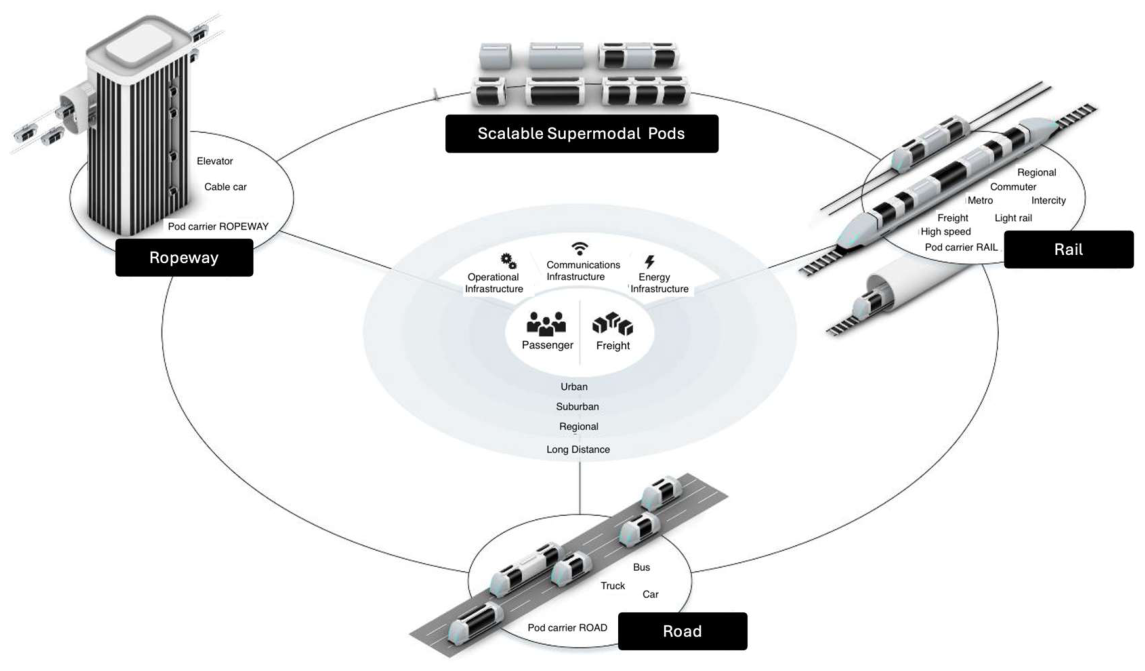
Figure 2.
Longitudinal train dynamics model.
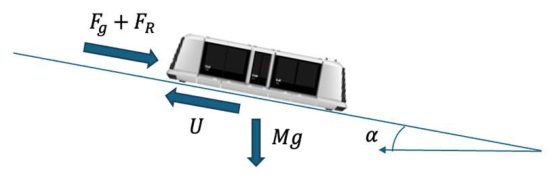
Figure 3.
Decentralized control architecture for a set of three virtually coupled pods.
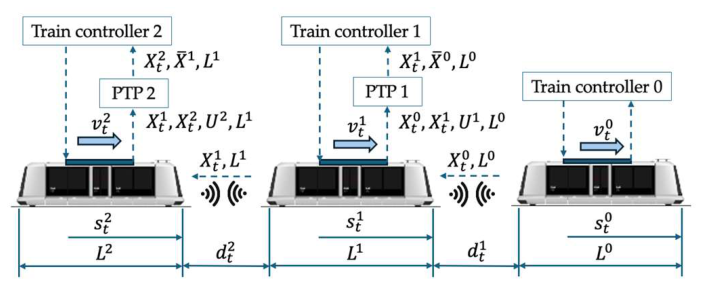
Figure 4.
Scenario branching for the two uncertain parameters considered.
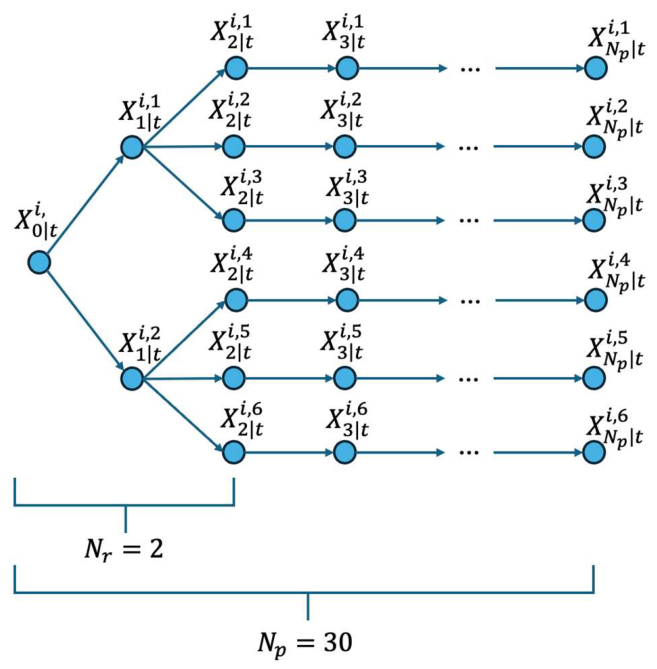
Figure 5.
Minimum separation distance based on Relative Distance Braking Mode.
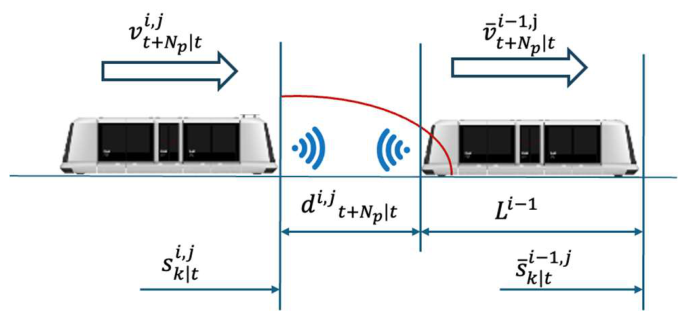
Figure 6.
Receding-horizon planning scheme used in the Planning Layer.
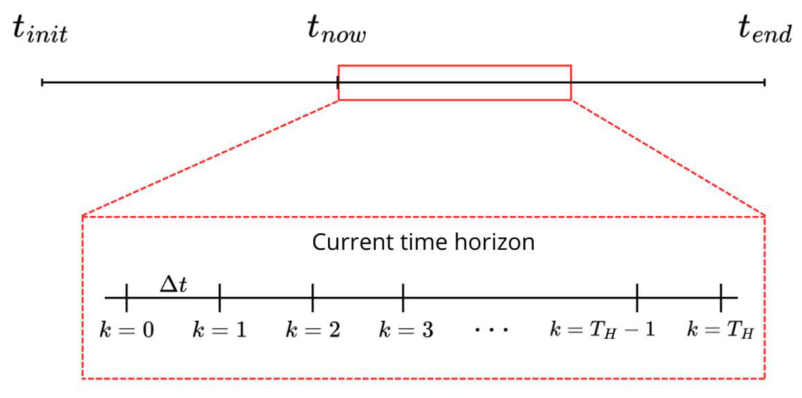
Figure 7.
Block-based representation of the railway line, including stations, access blocks, platforms, and inter-station sections.
Figure 7.
Block-based representation of the railway line, including stations, access blocks, platforms, and inter-station sections.

Figure 9.
CDF Simulations for estimating the aerodynamic drag. Individual pod at 60 km/h.

Figure 10.
The flow velocity at 60 km/h for a composition of pods.

Figure 11.
Example of Cx variation for a pod in the convoy, depending on velocity and the distance between pods. (a) leader pod in the convoy (b) follower pod.
Figure 11.
Example of Cx variation for a pod in the convoy, depending on velocity and the distance between pods. (a) leader pod in the convoy (b) follower pod.
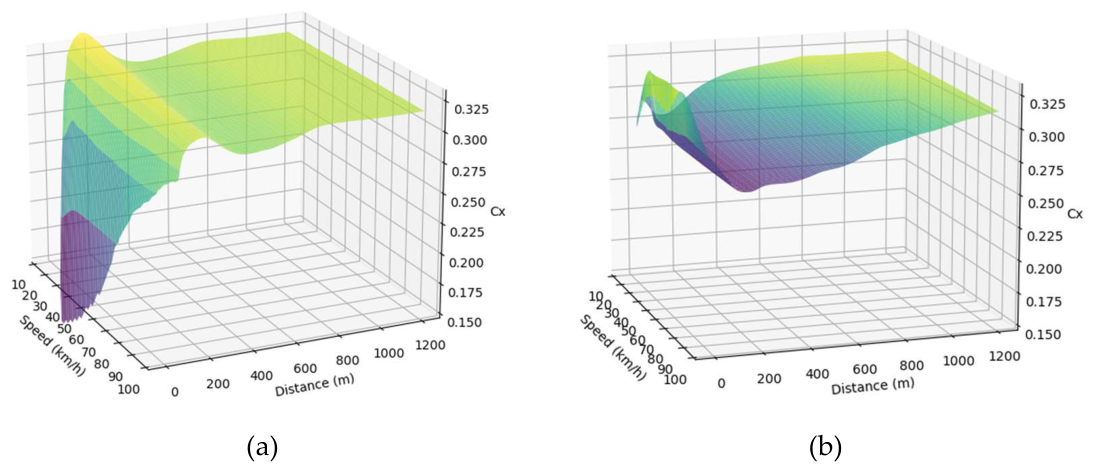
Figure 12.
Comparative Energy Consumption per Round Trip for a Two-Coach DEMU (DEMU2), a Single-Coach DEMU (DEMU1), and a Single Pod.
Figure 12.
Comparative Energy Consumption per Round Trip for a Two-Coach DEMU (DEMU2), a Single-Coach DEMU (DEMU1), and a Single Pod.
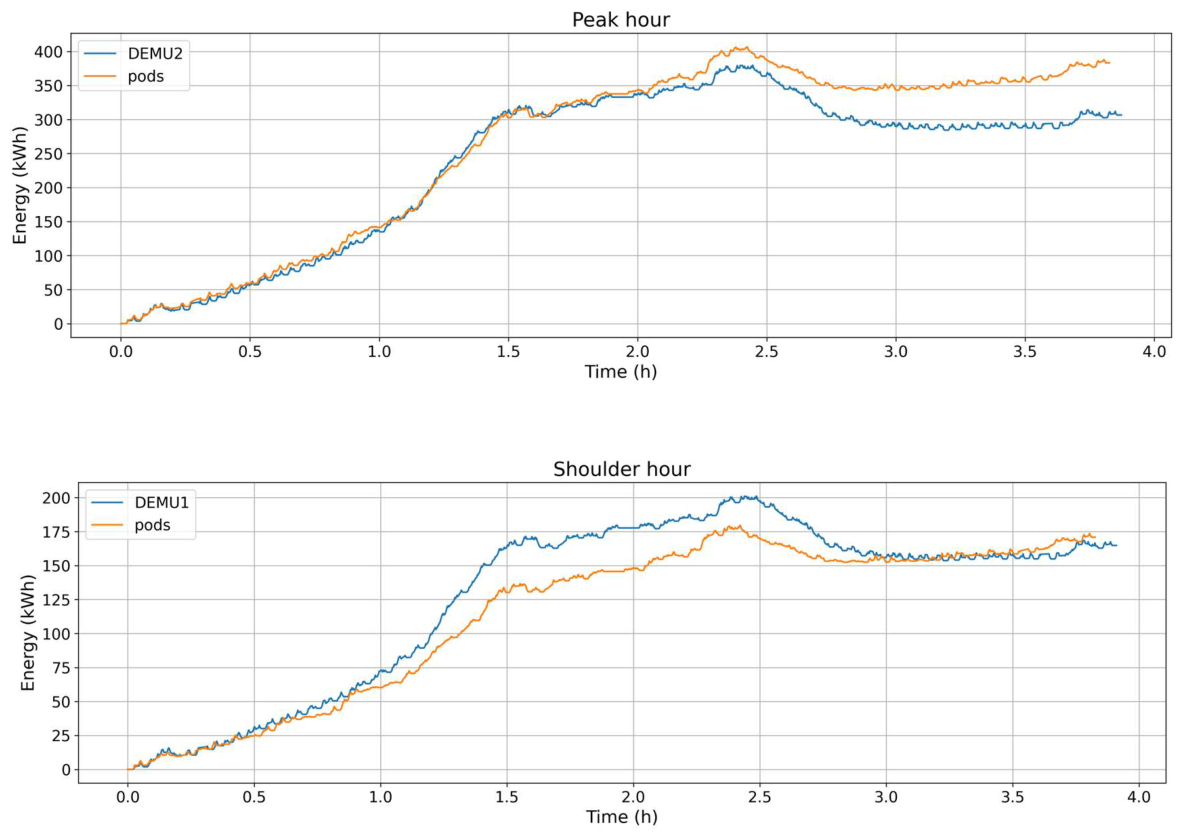
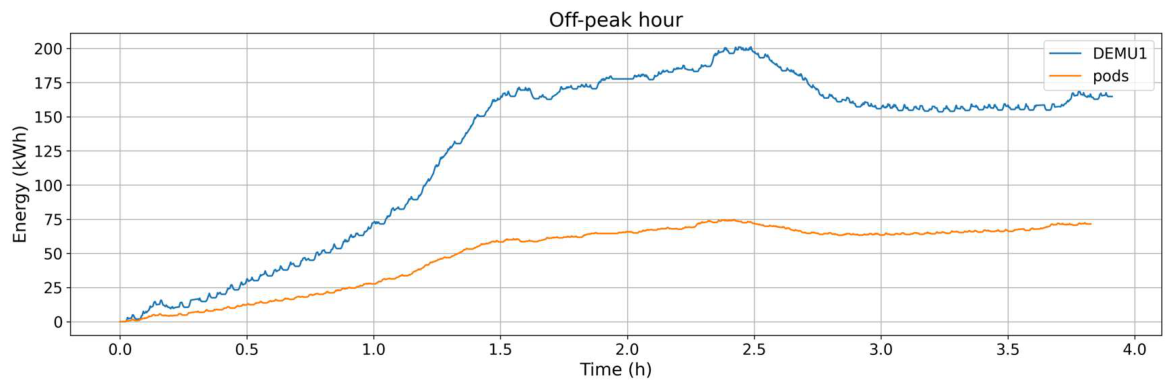
Figure 13.
Daily service timetable generated by the integrated convoy control and planning framework for the 20-service operating scenario.
Figure 13.
Daily service timetable generated by the integrated convoy control and planning framework for the 20-service operating scenario.
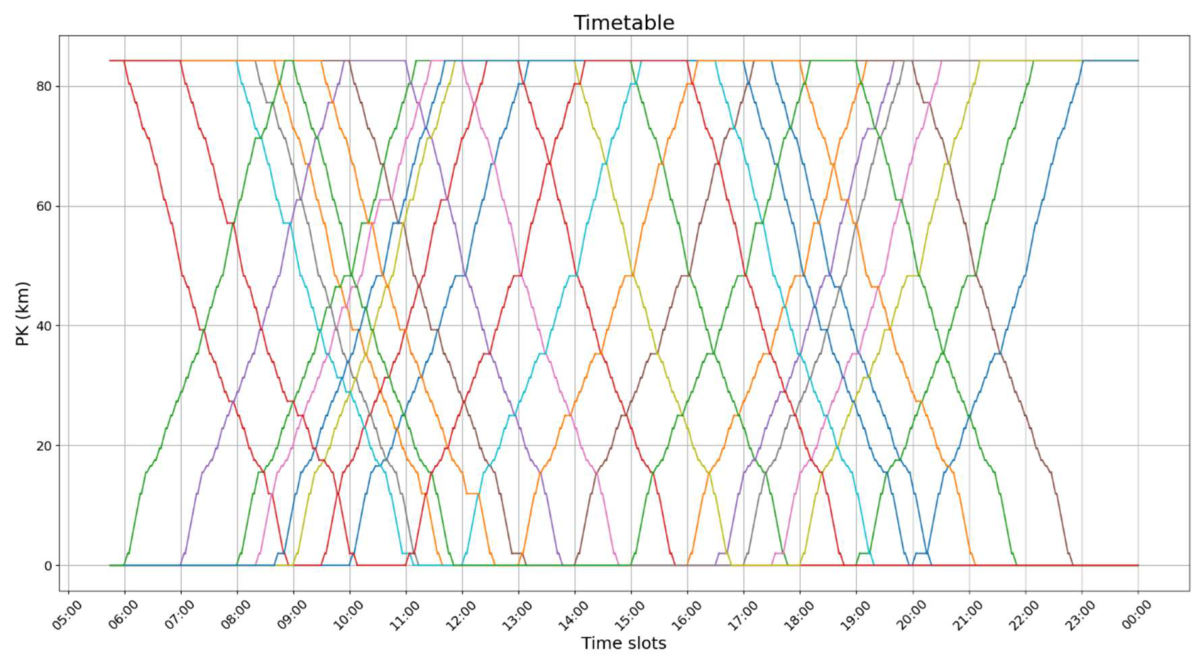

Table 1.
Main notation used in the Planning Layer MILP formulation.
| Category | Symbol | Meaning | Description |
| Sets | Set of convoys | Convoys considered in the planning problem. | |
| Sets | Set of stations | Includes the head station, terminal station, and intermediate stations. | |
| Sets | Set of infrastructure blocks | Includes line blocks, station access blocks, and platform blocks. |
|
| Sets | Set of line blocks | Inter-station blocks connecting consecutive stations. | |
| Sets | Set of left-side access blocks | Left-side station access blocks. | |
| Sets | Set of right-side access blocks | Right-side station access blocks. | |
| Sets | Set of station access blocks | Blocks involved in station entry or exit movements. | |
| Sets | Head-station departure set | Station blocks associated with departures from the head station. | |
| Sets | Terminal-station departure set | Station blocks associated with departures from the terminal station. | |
| Sets | Discrete prediction horizon | Set of time steps, . | |
| Sets | Set of admissible next blocks | Blocks that a convoy may enter from its current block. | |
| Indices | Convoy index | Index of an individual convoy, with . | |
| Indices | Station indices | Indices of stations, with . | |
| Indices | Block index | Index of an infrastructure block, with . | |
| Indices | Station access block index | Index of a block belonging to . | |
| Indices | Next-block index | Index of an admissible next block, with . | |
| Indices | Platform index | Index used to identify a platform within a station. | |
| Indices | Time-step index | Index of a discrete time step in the prediction horizon, with . | |
| Indices | Scheduled departure time | Scheduled departure time from the timetable. | |
| Infrastructure | Number of convoys | Number of convoys included in the optimization model. | |
| Infrastructure | Number of stations | Total number of stations in the railway line. | |
| Infrastructure | Number of line blocks | Number of inter-station line sections. | |
| Infrastructure | Number of platforms | Number of independent platforms at station . | |
| Infrastructure | Block capacity | Maximum number of convoys allowed in block . | |
| Infrastructure | Left-side access block | Access block on the left side of station . | |
| Infrastructure | Right-side access block | Access block on the right side of station . | |
| Infrastructure | Platform block | Platform at station . | |
| Topology | Convoy direction | Direction of convoy , defined as or . | |
| Topology | Initial convoy state | Block occupied by convoy at the beginning of the prediction horizon. | |
| Topology | Next physical block | Block following in the positive direction. | |
| Topology | Previous physical block | Block preceding in the negative direction. | |
| Topology | Next block of | Block immediately following station access block . | |
| Topology | Previous block of | Block immediately preceding station access block . | |
| Timing | Station entry time | Time required for a convoy to enter station . | |
| Timing | Station exit time | Time required for a convoy to leave station . | |
| Timing | Dwell time | Minimum stopping time at station . | |
| Timing | Time step | Time interval used to discretize the planning horizon. | |
| Timing | Block time intervals | Number of discrete intervals associated with block . | |
| Timing | Prediction horizon | Number of time steps in the finite planning horizon. | |
| Timing | Remaining block occupation time | Remaining time for convoy in block at the initial step. | |
| Timing | Minimum station dwell time | Number of time steps convoy must remain at station before departure. | |
| Timing | Current planning time | Current time at which the receding-horizon MILP is solved. | |
| Timetable | Headway | Minimum number of time steps between consecutive departures. | |
| Timetable | Head-station timetable | Set of programmed departures from the head station. | |
| Timetable | Terminal-station timetable | Set of programmed departures from the terminal station. | |
| Timetable | Head-station departures | Number of departures allowed from the head station at time step . | |
| Timetable | Terminal-station departures | Number of departures allowed from the terminal station at time step . | |
| Timetable | Timetable indicator function | Equals one if scheduled departure falls within time step , and zero otherwise. | |
| Objective | Station-occupation weight | Weighting coefficient associated with station occupation in the objective function. | |
| Objective | Departure-timing weight | Weighting coefficient associated with departure timing in the objective function. |
Note: Binary decision variables are not included in this table, as they are introduced separately in Section 2.3.2.
Table 2.
Line characteristics and main parameters.
| Parameter | Value |
| Length: | 91.3 km |
| Maximum speed: | 80 km/h |
| Max gradient: | 28 ‰ |
| Minimum curve radius | 78 m |
| Number of stations/stops | 26 |
Table 3.
Vehicle characteristics and main parameters.
| Parameter | 1 coach DEMU
|
2 coaches DEMU
|
Pod
|
| Mass (ton) | 72 | 144 | 20.75 |
| Number of passengers | 65 | 150 | 20 |
| Length (m) | 27.4 | 53.1 | 12.3 |
| Normal acceleration (m/s2) | 1.1 | 1.1 | 1.1 |
| Maximum speed (km/h) | 120 | 120 | 120 |
| Power (kW) | 990 | 1925 | 335 |
| Traction/brake maximum force (kN) | ±63 | ±126 | 25 |
| A (N) | 995.6 | 991.1 | 220 |
| B (N/(m/s)) | 14.6 | 29.1 | 2.79 |
| C (N/(m/s)2) | 3.1 | 3.25 | 1.47 |
| Acceleration at maximum speed (m/s2) | 0.1 | 0.1 | 0.1 |
Table 4.
Mass uncertainty (in ton).
| Parameter | DEMU 1 coach | DEMU 2 coaches | Pod | |||
| Passengers | Mass | Passengers | Mass | Passengers | Mass | |
| Minimum | 10 | 66.30 | 50 | 130.00 | 2 | 18.95 |
| Maximum | 65 | 72.00 | 150 | 144.00 | 20 | 20.75 |
| Average | 40 | 69.30 | 105 | 137.00 | 12 | 19.95 |
Table 5.
Aerodynamic drag uncertainty for the pods.
| Parameter | (Ns2/m2) | |
| Minimum | 0,328 | 1.56 |
| Maximum | 0.15 | 0.71 |
| Standard | 0.31 | 1.47 |
Table 6.
Passenger Demand and Required Number of Pods per Line Segment.
| Station | P.K. (km) | Distance (m) | Peak-hour-period | Shoulder-period | Off-peak-period | |||
| Passengers | Pods | Passengers | Pods | Passengers | Pods | |||
| 1 | 0 | 0 | 150 | 8 | 65 | 4 | 20 | 1 |
| 2 | 1.980 | 1.980 | 83 | 5 | 28 | 2 | 8 | 1 |
| 3 | 11.955 | 9.975 | 96 | 5 | 35 | 2 | 10 | 1 |
| 4 | 15.550 | 3.595 | 128 | 7 | 53 | 3 | 16 | 1 |
| 5 | 16.572 | 1.022 | 52 | 3 | 11 | 1 | 2 | 1 |
| 6 | 17.542 | 970 | 133 | 7 | 56 | 3 | 17 | 1 |
| 7 | 19.519 | 1.977 | 53 | 3 | 12 | 1 | 3 | 1 |
| 8 | 22.876 | 3.357 | 136 | 7 | 57 | 3 | 17 | 1 |
| 9 | 25.003 | 2.127 | 150 | 8 | 65 | 4 | 20 | 1 |
| 10 | 27.374 | 2.371 | 103 | 6 | 39 | 2 | 11 | 1 |
| 11 | 28.939 | 1.565 | 66 | 4 | 19 | 1 | 5 | 1 |
| 12 | 31.316 | 2.377 | 60 | 4 | 16 | 1 | 4 | 1 |
| 13 | 33.948 | 2.632 | 120 | 6 | 48 | 3 | 15 | 1 |
| 14 | 35.294 | 1.346 | 150 | 8 | 65 | 4 | 20 | 1 |
| 15 | 39.313 | 4.019 | 50 | 3 | 10 | 1 | 2 | 1 |
| 16 | 43.043 | 3.730 | 53 | 3 | 12 | 1 | 3 | 1 |
| 17 | 46.469 | 3.426 | 110 | 6 | 43 | 3 | 13 | 1 |
| 18 | 48.317 | 1.848 | 95 | 5 | 35 | 2 | 10 | 1 |
| 19 | 57.116 | 8.799 | 86 | 5 | 30 | 2 | 8 | 1 |
| 20 | 60.988 | 3.872 | 149 | 8 | 65 | 4 | 20 | 1 |
| 21 | 66.985 | 5.997 | 134 | 7 | 56 | 3 | 17 | 1 |
| 22 | 71.287 | 4.302 | 150 | 8 | 65 | 4 | 20 | 1 |
| 23 | 72.862 | 1.575 | 135 | 7 | 57 | 3 | 17 | 1 |
| 24 | 77.237 | 4.375 | 144 | 8 | 62 | 4 | 19 | 1 |
| 25 | 80.347 | 3.110 | 82 | 5 | 28 | 2 | 8 | 1 |
| 26 | 84.230 | 3.883 | 58 | 3 | 14 | 1 | 3 | 1 |
Table 7.
Energy consumption comparison between conventional DEMU operation and the proposed pod-based solution for each demand condition and for total daily operation.
Table 7.
Energy consumption comparison between conventional DEMU operation and the proposed pod-based solution for each demand condition and for total daily operation.
| Metric | Peak-hour-period | Shoulder-period | Off-peak-period | Total daily operation |
| Conventional operation (kWh) | 307 | 165 | 165 | 3864 |
| Pod-based operation (kWh) | 383 | 171 | 72 | 3075 |
| Difference (kWh) | -77 | -6 | 93 | 789 |
| Relative difference vs. conventional (%) | -25% | -4% | 57% | 20% |
Note: Per-service values are reported rounded to the nearest kilowatt-hour; therefore, minor differences may appear when aggregated values are compared with totals computed from unrounded simulation outputs.
Disclaimer/Publisher’s Note: The statements, opinions and data contained in all publications are solely those of the individual author(s) and contributor(s) and not of MDPI and/or the editor(s). MDPI and/or the editor(s) disclaim responsibility for any injury to people or property resulting from any ideas, methods, instructions or products referred to in the content. |
© 2026 by the authors. Licensee MDPI, Basel, Switzerland. This article is an open access article distributed under the terms and conditions of the Creative Commons Attribution (CC BY) license.
Copyright: This open access article is published under a Creative Commons CC BY 4.0 license, which permit the free download, distribution, and reuse, provided that the author and preprint are cited in any reuse.


