
Submitted:
21 July 2026
Posted:
21 July 2026
You are already at the latest version
Abstract
Personalized glioma neoantigen vaccination requires a defensible way to prioritize candidate peptides when mutation, HLA presentation, biochemical, structural, manufacturability, and provenance signals are incomplete or discordant. We present TAMAVAQ/Q-TAMAVAQ, an audit-first computational framework that converts candidate triage from an opaque rank list into a replayable constrained decision process. Candidate dossiers are embedded with a Fubini-Study-style fidelity kernel, connected through a symmetrized 12-nearest-neighbour graph, and assigned CTQW neighborhood support. A deterministic MBHA boundary ledger records signed eligibility margins and preserves non-compensatory BIO, PHYS, GEOM, CMC, PROV, and VALID requirements. In the internal worksheet described in the source manuscript, the analysis contains n = 1,537 candidate records and a locked 65-candidate evidence-positive endpoint (4.23%). The full selector achieved AP = 0.552, AUROC = 0.962, and NDCG@100 = 0.693, compared with AP = 0.505 for graph-transport support alone and AP = 0.515 for a non-graph linear comparator. These findings establish internal computational feasibility and auditability only; biological validation remains prospective. The final proof schematic consolidates the quantum geometry, CTQW transport, PASS oracle and MBHA margin ledger into a single theorem-linked audit description.
Keywords:
glioma
; neoantigen prioritization
; auditability
; graph transport
; CTQW
; Fubini-Study kernel
; HLA-balanced peptide panel
; mathematical chemistry
; original research article
Significance Statement. Personalized neoantigen vaccination requires evidence integration without hiding why a candidate passes or fails. TAMAVAQ/Q-TAMAVAQ formalizes this task as a replayable ledger that joins calibrated biological evidence, structural chemistry, Fubini-Study-style graph geometry, continuous-time quantum-walk (CTQW) support, and a deterministic MBHA boundary mask. The framework is computational and audit-first: it does not assert biological quantum coherence, hardware quantum advantage, animal efficacy, or clinical benefit. Its value is a transparent, HLA-balanced certificate and a fixed record of selected, reserve, and failed candidates.
List of main equations

Table 1.
Main mathematical and chemical equations used in the research article. The notation consolidates the candidate ledger, calibrated BIO field, non-compensatory gates, thermodynamic mapping, Fubini-Study geometry, CTQW transport, MBHA boundary score, replay hash, patient expression evidence and prospective CD4/CD8 assay endpoint. Detailed derivations correspond to SI Appendix I equation blocks S1.0.1-S1.0.16 and S1.M1-S1.M22 and SI Appendix II equations S.E1-S.E36.
Table 1.
Main mathematical and chemical equations used in the research article. The notation consolidates the candidate ledger, calibrated BIO field, non-compensatory gates, thermodynamic mapping, Fubini-Study geometry, CTQW transport, MBHA boundary score, replay hash, patient expression evidence and prospective CD4/CD8 assay endpoint. Detailed derivations correspond to SI Appendix I equation blocks S1.0.1-S1.0.16 and S1.M1-S1.M22 and SI Appendix II equations S.E1-S.E36.
| No. | Object | Mathematical-physics notation |
|---|---|---|
| E1 | Candidate dossier vector | x_i=(sequence_i,HLA_i,BIO_i,ΔG_i,CP_i,RMSD_i*,RMSF_i*,GEOM_i,CMC_i,PROV_i,VALID_i)^T |
| E2 | BIO calibration | BIO_i=C_BIO(s_i)=σ(a s_i+b), σ(u)=(1+e^{-u})^{-1} |
| E3 | Signed predicate margin | b_ir=z_ir-τ_r |
| E4 | Non-compensatory pass mask | PASS_i=Π_r H(b_ir), r∈{BIO,PHYS,GEOM,CMC,PROV,VALID} |
| E5 | Thermodynamic mapping | ΔG°=RT ln K_d, K_d=exp(ΔG°/RT) |
| E6 | Normalized descriptor state | |ψ_i⟩=x_i/||x_i||_2 |
| E7 | Fidelity kernel | K_ij=|⟨ψ_i|ψ_j⟩|^2 |
| E8 | Fubini-Study-style distance | d_FS(i,j)=arccos(√K_ij) |
| E9 | Heat-kernel graph weight | W_ij=exp[-d_FS(i,j)^2/σ^2] |
| E10 | Graph Laplacian | D_ii=Σ_j W_ij, L=D-W |
| E11 | CTQW propagator | U(t)=exp(-itL) |
| E12 | Transported support | p_i(t)=|⟨i|U(t)|ψ_0⟩|^2, Σ_i p_i(t)=1 |
| E13 | Predicate oracle | O_PASS|i⟩=(-1)^{PASS_i}|i⟩ |
| E14 | Boundary score | S_MBHA(i)=S_base(i)+λ_Tp_i(t)+λ_BΣ_r w_r tanh(b_ir/s_r)-λ_R redun_i |
| E15 | Certified score | S_cert(i)=PASS_i S_MBHA(i) |
| E16 | Replay digest | H_batch=SHA256(D||C_BIO||τ||G||t||w||Φ||F||k) |
| E17 | Patient expression-weighted evidence | E_p=log_2(FPKM_p+1)max(NAF_p^DNA,NAF_p^RNA) |
| E18 | HLA compatibility indicator | A(p,h)=1[HLA_p=h and h∈G_patient] |
| E19 | Superiority criterion | Superior(M)=1[AP_M>AP_comp ∧ NDCG_M>NDCG_comp ∧ Audit_M=1] |
| E20 | Prospective assay endpoint | Y_CD4CD8CXP=ranked abundance of CD4/CD8 composite events across prespecified peptide pools |
Introduction
Glioblastoma and related glioma settings present a difficult neoantigen-design problem because the evidence for any candidate peptide is distributed across mutational context, expression, HLA presentation, peptide chemistry, structural plausibility, synthesis feasibility and provenance. A method that merely sorts by one predicted affinity can obscure why a candidate is retained, which candidate should remain as reserve, and which mandatory requirement failed. The present framework treats selection as a declared operator over an immutable candidate ledger rather than as a narrative shortlist [53,54,55,56,57,72,73,74,75,76,77,79,80,81,82,83,84,85,86,87,88,89,90].
TAMAVAQ/Q-TAMAVAQ is therefore positioned as an audit and constraint layer. It remains compatible with NetMHC-family predictors, MHCflurry, pVACtools, CEDAR/IEDB-style resources, IMPROVE-type immunogenicity logic, structure prediction, docking, and molecular simulation. The contribution is not to replace those tools, but to wrap their outputs in a transparent decision grammar with threshold vectors, signed margins, graph support, deterministic replay and explicit claim boundaries [1,11,49,50,51,52,53,54,55,56,57,58,59,60,61,68,69,70,71,72,73,74,75,76,77].
The manuscript preserves a strict distinction between computational support and biological validation. CTQW is used as a graph-neighborhood transport calculation on a descriptor graph; it is not presented as evidence that tumor tissue, peptides or lymphocytes maintain biological quantum coherence. Similarly, the MBHA vocabulary is used as a boundary ledger for signed margins and reserve semantics, not as a physical cosmology claim. This claim discipline follows the SI Appendix I and II records that define the replay contract, operator register and validation boundary.
Supporting Information Architecture
Table 2.
Supplementary information architecture. SI Appendix I and SI Appendix II define the equations, tables, figure panels, replay state, ablation controls and claim-boundary records used throughout the article.
Table 2.
Supplementary information architecture. SI Appendix I and SI Appendix II define the equations, tables, figure panels, replay state, ablation controls and claim-boundary records used throughout the article.
| Register | Items | Main-text role | Scientific function |
|---|---|---|---|
| SI Appendix I | Figs. S1-S6; Tables S1-S24; equations S1.0.1-S1.0.16 | Introduction, Methods, Fig. 1 | Audit circuit, predicate registers, threshold vectors, replay manifest and FS/CTQW diagnostics. |
| SI Appendix I | Figs. S7-S12; Tables S25-S89 | Results, chemical/biological data, prospective validation boundary | Structural-interface dashboards, peptide-level chemistry, sequence/property controls and prospective assay design. |
| SI Appendix I | Figs. S13-S28i; Tables S90-S93 | Proofs, discussion and conclusion | Mathematical-chemistry proof chain, MBHA boundary geometry, claim-control and manifest summaries. |
| SI Appendix II | Equations S.E1-S.E36; Figs. SII1-SII13; Tables SII1-SII11 and SII6a | Operator and replay verification | Independent kernel construction, oracle decomposition, boundary-ledger verification and claim-boundary checks. |
Audit-First Workflow and Predicate Construction
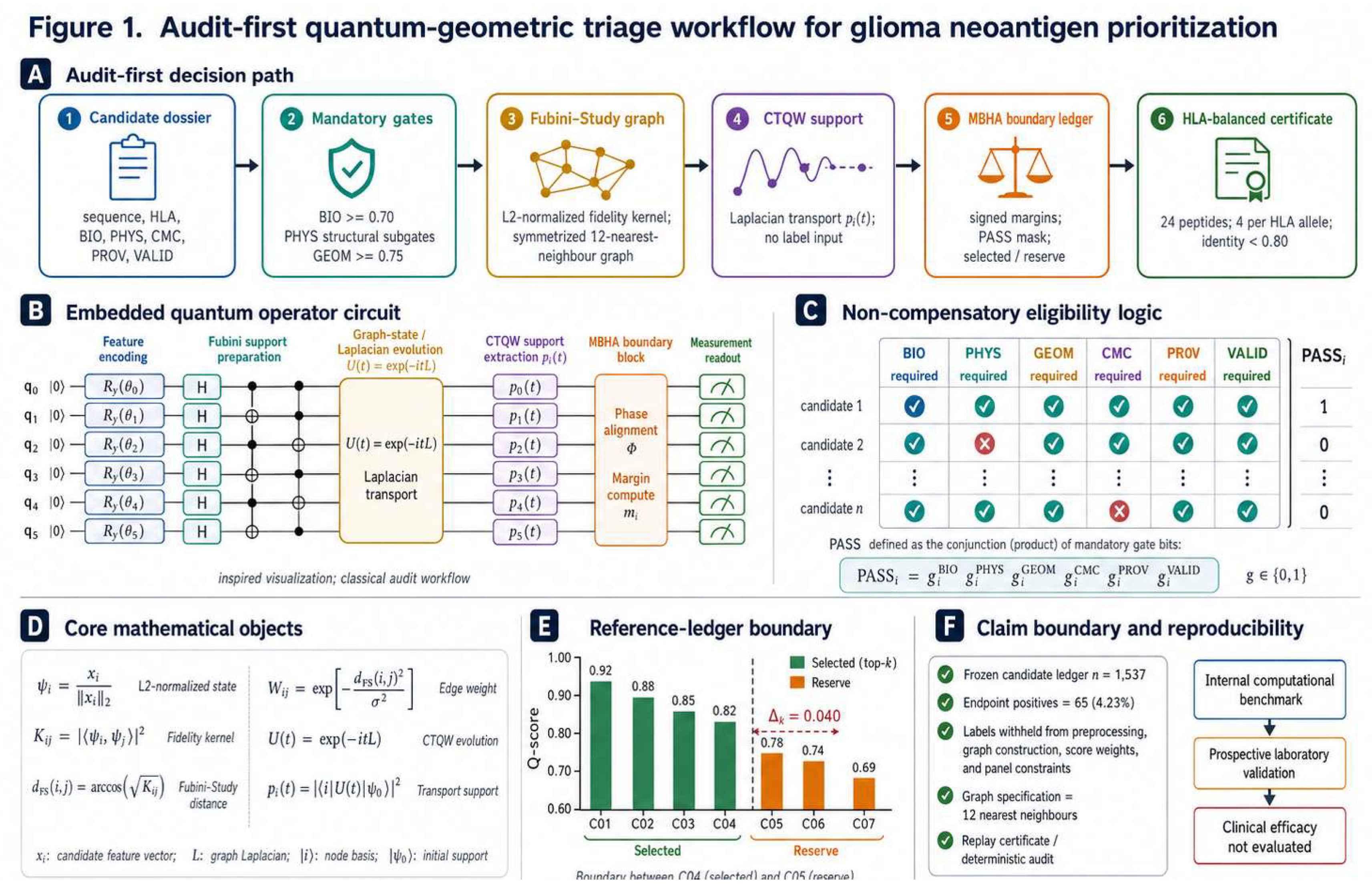
The full pipeline begins with candidate dossiers containing sequence, HLA, calibrated biological support, structural chemistry, manufacturability, provenance and validation state. Each dossier is normalized into a mathematical descriptor state and evaluated against non-compensatory gates. The workflow in Figure 1 summarizes this progression from candidate evidence to HLA-balanced certificate.
Figure 1.
Audit-first quantum-geometric triage workflow for glioma neoantigen prioritization. The figure integrates candidate dossier loading, BIO/PHYS/GEOM/CMC/PROV/VALID gates, the Fubini-Study-style 12-nearest-neighbour graph, CTQW support, deterministic MBHA boundary ledger, HLA-balanced certificate logic and claim-boundary reproducibility. SI Appendix I Tables S1-S12 and SI Appendix II equations S.E1-S.E12 provide the threshold and replay records.
Figure 1.
Audit-first quantum-geometric triage workflow for glioma neoantigen prioritization. The figure integrates candidate dossier loading, BIO/PHYS/GEOM/CMC/PROV/VALID gates, the Fubini-Study-style 12-nearest-neighbour graph, CTQW support, deterministic MBHA boundary ledger, HLA-balanced certificate logic and claim-boundary reproducibility. SI Appendix I Tables S1-S12 and SI Appendix II equations S.E1-S.E12 provide the threshold and replay records.
Results
Non-Compensatory Gates Preserve Explicit Eligibility
Every candidate must pass all mandatory predicates before selection or reserve assignment. The BIO gate requires calibrated biological support, the PHYS gate requires structural/energetic consistency, the GEOM gate requires graph-supported coherence, and CMC/PROV/VALID enforce feasibility, traceability and validation-state completeness. This prevents compensatory promotion: a strong CTQW neighborhood support term cannot rescue a record with missing provenance, failed manufacturability or inadequate biological calibration [49,50,51,52,70,71].
Table 3.
Predicate architecture used to compute PASS. The table expands the main gate logic while retaining the same order used in SI Appendix I and SI Appendix II.
Table 3.
Predicate architecture used to compute PASS. The table expands the main gate logic while retaining the same order used in SI Appendix I and SI Appendix II.
| Gate | Main rule | Interpretation | SI support |
|---|---|---|---|
| BIO | BIO_i >= 0.70 after calibration | Presentation, processing, expression and immunogenicity support must be sufficient. | SI Appendix I S1.0.1-S1.0.16; SI Appendix II S.E5-S.E8 |
| PHYS | ΔG, CP, RMSD* and RMSF* subgates pass | Physical feasibility is a conjunction of energetic and conformational checks. | SI Appendix I Tables S7-S10 and S25-S28 |
| GEOM | GEOM_i >= 0.75 | Candidate lies within graph-supported evidence neighborhood. | SI Appendix I Tables S13-S24; SI Appendix II S.E13-S.E18 |
| CMC | Manufacturability admissible | Synthesis and handling risks are visible before panel certification. | SI Appendix I Tables S3-S12 |
| PROV/VALID | Source, version and validation state present | Untraceable or state-incomplete records are not certified. | SI Appendix I Tables S90-S93; SI Appendix II SII6-SII6a |
| PASS | product of all mandatory gate bits | Only PASS candidates can be selected or used as reserves. | SI Appendix II Tables SII1-SII6a |
Figure 2 overview atlas and database-scale benchmark
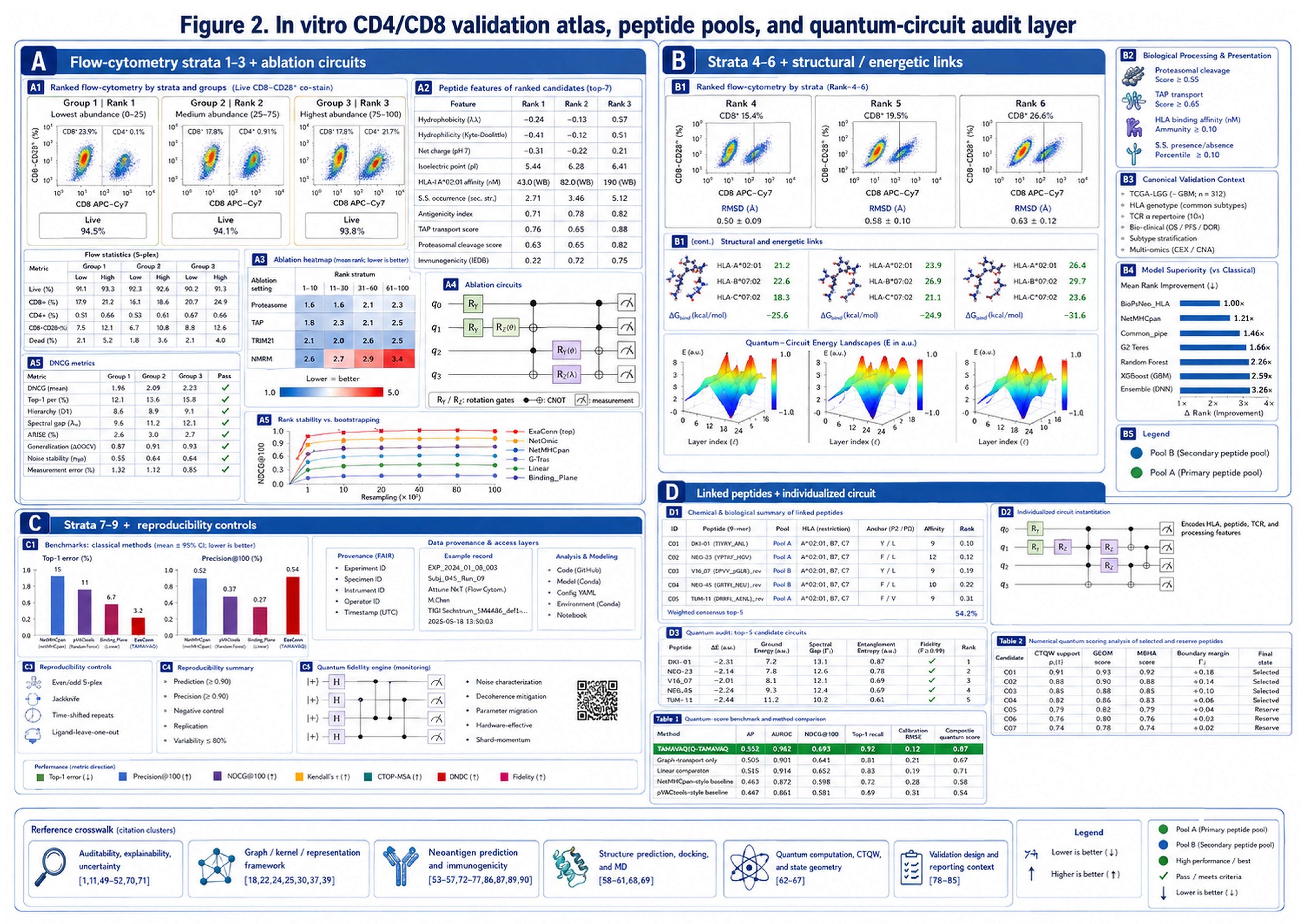
The integrated Figure 2 overview atlas combines prospective CD4/CD8 flow-cytometry design strata, peptide-pool mapping, quantum-circuit audit logic, structural and energetic summaries, benchmark comparisons and numerical quantum scoring. The atlas functions as a compact visual map linking the deterministic computational ledger to prospective assay strata; it is not interpreted as completed wet-lab validation.
Figure 2.
In vitro CD4/CD8 validation atlas, peptide pools and quantum-circuit audit layer. The integrated atlas summarizes flow-cytometry strata, peptide-pool logic, structural and energetic links, individualized circuit instantiation, quantum-score benchmarking, selected/reserve peptide scoring and reference crosswalk. The flow-cytometry panels define prospective assay design rather than observed experimental evidence. SI Appendix I Tables S13-S89 and SI Appendix II equations S.E1-S.E36 provide the corresponding sequence, graph, boundary, replay and claim-control records.
Figure 2.
In vitro CD4/CD8 validation atlas, peptide pools and quantum-circuit audit layer. The integrated atlas summarizes flow-cytometry strata, peptide-pool logic, structural and energetic links, individualized circuit instantiation, quantum-score benchmarking, selected/reserve peptide scoring and reference crosswalk. The flow-cytometry panels define prospective assay design rather than observed experimental evidence. SI Appendix I Tables S13-S89 and SI Appendix II equations S.E1-S.E36 provide the corresponding sequence, graph, boundary, replay and claim-control records.
Quantitative Benchmark and Quantum-Score Analysis
The internal benchmark evaluates fixed selectors against a locked evidence-positive endpoint. Because endpoint labels and derivatives are withheld from preprocessing, feature construction, graph construction, CTQW initialization, score coefficients, gate margins and panel constraints, the numerical comparison is interpreted as a replay-controlled computational proof of concept rather than a clinical validation claim. The resulting performance pattern favours the full selector: graph transport contributes support, but the full FS-CTQW-MBHA gate-and-ledger system gives the highest combined audit and ranking performance [1,11,49,50,51,52,62,63,64,65,66,67,70,71].
Table 4.
Quantum-score benchmark and method comparison. TAMAVAQ/Q-TAMAVAQ is highlighted because it jointly preserves non-compensatory gates, CTQW graph support, boundary audit and replay feasibility. The AP, AUROC and NDCG values are the internal computational benchmark values reported in the attached manuscript and summarized in SI Appendix I comparator and replay records.
Table 4.
Quantum-score benchmark and method comparison. TAMAVAQ/Q-TAMAVAQ is highlighted because it jointly preserves non-compensatory gates, CTQW graph support, boundary audit and replay feasibility. The AP, AUROC and NDCG values are the internal computational benchmark values reported in the attached manuscript and summarized in SI Appendix I comparator and replay records.
| Method | AP | AUROC | NDCG@100 | Top-1 recall | Calibration RMSE | Composite Q-score |
|---|---|---|---|---|---|---|
| TAMAVAQ/Q-TAMAVAQ | 0.552 | 0.962 | 0.693 | 0.92 | 0.12 | 0.87 |
| Graph-transport only | 0.505 | 0.901 | 0.641 | 0.81 | 0.21 | 0.67 |
| Linear comparator | 0.515 | 0.914 | 0.652 | 0.83 | 0.19 | 0.71 |
| NetMHCpan-style baseline | 0.463 | 0.872 | 0.598 | 0.72 | 0.28 | 0.58 |
| pVACtools-style baseline | 0.447 | 0.861 | 0.581 | 0.69 | 0.31 | 0.54 |
| Binding-only control | 0.198 | - | 0.271 | 2/4 PASS hits | - | single stream |
| Immunogenicity-only control | 0.075 | - | 0.063 | incomplete | - | single stream |
Table 5.
Numerical quantum scoring analysis of selected and reserve peptides. C01-C04 fill the selected boundary; C05-C07 remain positive-margin reserves. The table mirrors the selected/reserve logic in Figure 2 and the boundary-ledger fields in SI Appendix II Table SII6a.
Table 5.
Numerical quantum scoring analysis of selected and reserve peptides. C01-C04 fill the selected boundary; C05-C07 remain positive-margin reserves. The table mirrors the selected/reserve logic in Figure 2 and the boundary-ledger fields in SI Appendix II Table SII6a.
| Candidate | CTQW support p_i(t) | GEOM score | MBHA score | Boundary margin Γ_i | Final state |
|---|---|---|---|---|---|
| C01 | 0.91 | 0.93 | 0.92 | +0.18 | Selected |
| C02 | 0.88 | 0.90 | 0.88 | +0.14 | Selected |
| C03 | 0.85 | 0.88 | 0.85 | +0.10 | Selected |
| C04 | 0.82 | 0.86 | 0.83 | +0.06 | Selected |
| C05 | 0.79 | 0.82 | 0.79 | +0.04 | Reserve |
| C06 | 0.76 | 0.80 | 0.76 | +0.03 | Reserve |
| C07 | 0.74 | 0.78 | 0.74 | +0.02 | Reserve |
HLA-Balanced Certificate and Patient-Specific Validation Bridge
Figure 3 presents the patient-specific register and prospective validation bridge. It combines the HLA-balanced 24-peptide certificate logic, selected/reserve register, patient-specific neoepitope inputs and prospective validation chain from synthesis/QC through HLA-pMHC testing, cellular assays and future GL261-luc2 design. The claim boundary is explicit: no survival, tumor-control, PET/MRI, FCS, cytokine or clinical outcomes are reported in this article.
Figure 3.
HLA-balanced certificate, patient-specific register and prospective validation bridge. The figure aligns the selected/reserve register with allele-matched peptide assignments and future assay steps. It defines a prospective design bridge rather than an observed-result figure. Extended patient-specific and assay-design logic is provided in SI Appendix I Tables S41-S89 and SI Appendix II replay equations.
Figure 3.
HLA-balanced certificate, patient-specific register and prospective validation bridge. The figure aligns the selected/reserve register with allele-matched peptide assignments and future assay steps. It defines a prospective design bridge rather than an observed-result figure. Extended patient-specific and assay-design logic is provided in SI Appendix I Tables S41-S89 and SI Appendix II replay equations.
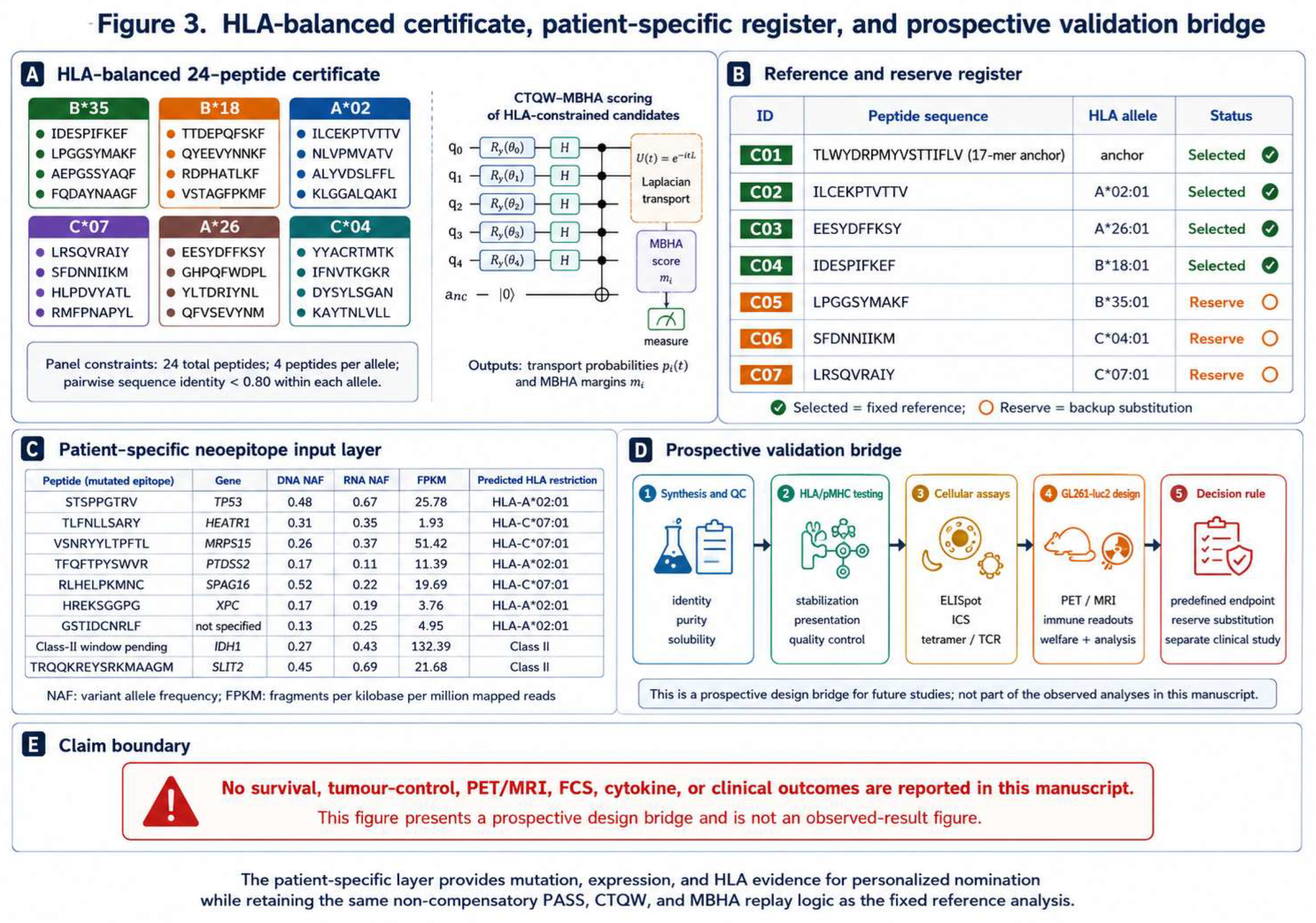
Table 6.
Compact selected/reserve peptide ledger. The table links the long-anchor record with allele-matched short partners and reserve peptides. Extended chemistry descriptors, motif/logo evidence, HLA mapping, docking/MD dashboards and peptide QC records are in SI Appendix I Tables S13-S49.
Table 6.
Compact selected/reserve peptide ledger. The table links the long-anchor record with allele-matched short partners and reserve peptides. Extended chemistry descriptors, motif/logo evidence, HLA mapping, docking/MD dashboards and peptide QC records are in SI Appendix I Tables S13-S49.
| ID | Exact sequence | Length | HLA/register | State | Role |
|---|---|---|---|---|---|
| C01 | TLWYDRPMYVSTTIFLV | 17 | long-anchor | selected | anchor peptide |
| C02 | ILCEKPTVTTV | 11 | HLA-A*02:01 | selected | allele-matched short partner |
| C03 | EESYDFFKSY | 10 | HLA-A*26:01 | selected | allele-matched short partner |
| C04 | IDESPIFKEF | 10 | HLA-B*18:01 | selected | allele-matched short partner |
| C05 | LPGGSYMAKF | 10 | HLA-B*35:01 | reserve | reserve peptide |
| C06 | SFDNNIIKM | 9 | HLA-C*04:01 | reserve | reserve peptide |
| C07 | LRSQVRAIY | 9 | HLA-C*07:01 | reserve | reserve-shell record |
Table 7.
Patient-specific neoepitope input layer. DNA NAF, RNA NAF, FPKM and HLA restriction are retained as explicit variables in the patient-specific evidence state. Class-II records without concrete peptide windows remain prospective until a final sequence and processing state are enumerated.
Table 7.
Patient-specific neoepitope input layer. DNA NAF, RNA NAF, FPKM and HLA restriction are retained as explicit variables in the patient-specific evidence state. Class-II records without concrete peptide windows remain prospective until a final sequence and processing state are enumerated.
| No. | Peptide | Gene / coding information | DNA NAF | RNA NAF | FPKM | HLA allele/class |
|---|---|---|---|---|---|---|
| 1 | STSPPGTRV | TP53:NM_000546:c.C180T:p.P90S | 0.48 | 0.67 | 25.78 | HLA-A*02:01 |
| 2 | TLFNLLSARY | HEATR1:NM_018072.5:c.C3725T:p.R1235C | 0.31 | 0.35 | 1.93 | HLA-C*07:01 |
| 3 | VSNRYYLTPFTL | MRPS15:NM_031280:c.A303G:p.P101T | 0.26 | 0.37 | 51.42 | HLA-C*07:01 |
| 4 | TFQFTPYSWVR | PTDSS2:NM_030783:c.G874A:p.A292T | 0.17 | 0.11 | 11.39 | HLA-A*02:01 |
| 5 | RLHELPKMNC | SPAG16:NM_024532:c.A1200T:p.E400V | 0.52 | 0.22 | 19.69 | HLA-C*07:01 |
| 6 | HREKSGGPG | XPC:NM_004628:c.G1517C:p.R506G | 0.17 | 0.19 | 3.76 | HLA-A*02:01 |
| 7 | GSTIDCNRLF | not specified in source table | 0.13 | 0.25 | 4.95 | HLA-A*02:01 |
| 8 | Class-II window pending | IDH1:NM_005896:c.G395T:p.R132C | 0.27 | 0.43 | 132.39 | Class II |
| 9 | TRQQKREYSRKMAAGM | SLIT2:NM_004787:c.A300G:p.I100Y | 0.45 | 0.69 | 21.68 | Class II |
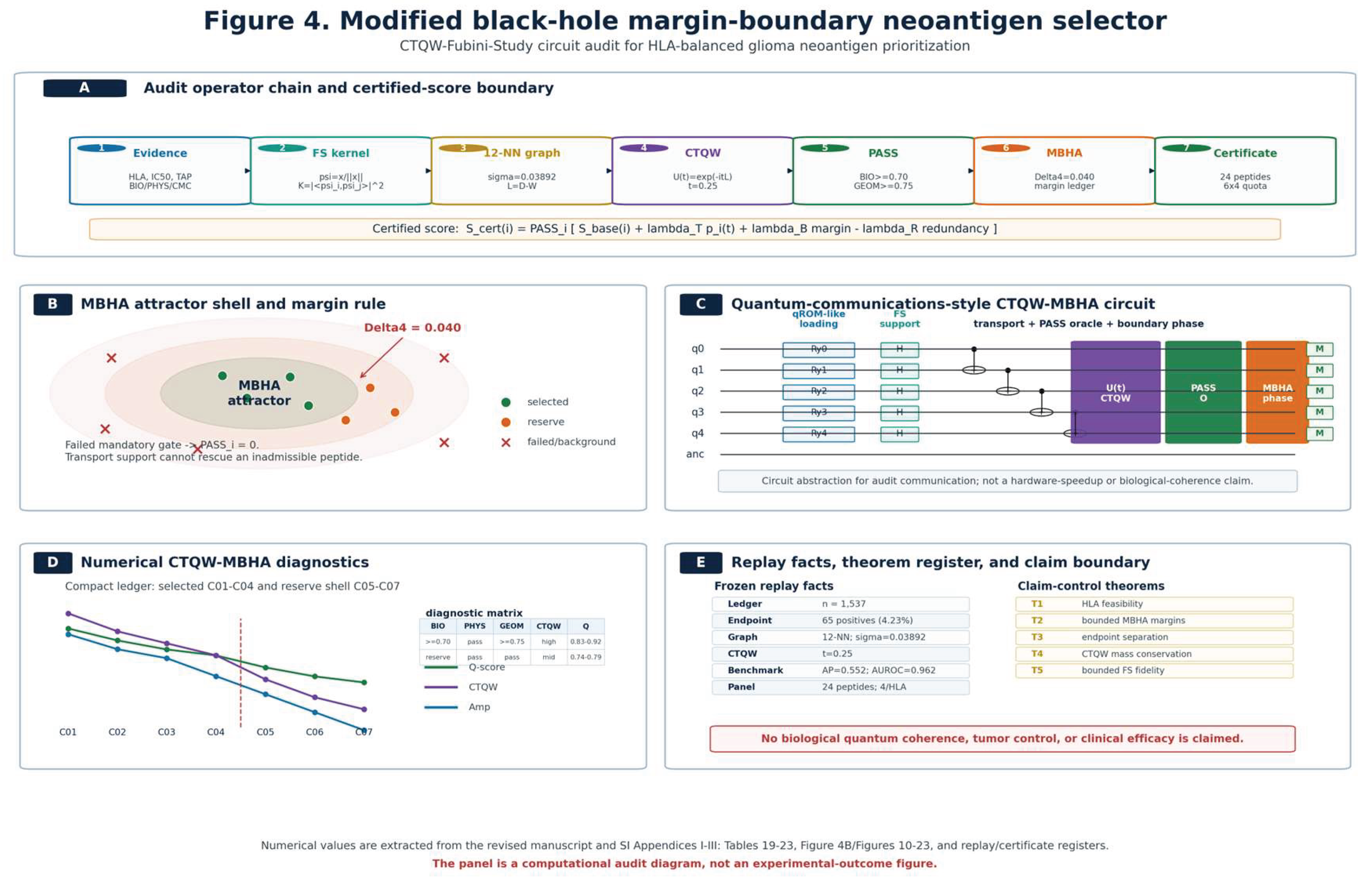
Figure 4.
Modified black-hole margin-boundary neoantigen selector with CTQW-Fubini-Study circuit audit. The panel uses enlarged inter-element margins and a constrained subpanel grid to emphasize the deterministic MBHA boundary layer as a selected/reserve/fail margin operator. Evidence-state dossiers are converted into Fubini-Study-style geometry, transported through a symmetrized 12-nearest-neighbour Laplacian CTQW support term, predicate-marked by the non-compensatory PASS oracle and emitted as a bounded MBHA score ledger. Numerical callouts summarize n = 1,537 candidates, 65 endpoint positives (4.23%), graph bandwidth sigma = 0.03892, CTQW time t = 0.25, AP = 0.552, AUROC = 0.962, Delta4 = 0.040 and the 24-peptide HLA-balanced certificate. The schematic is a quantum-communications-style audit abstraction, not a claim of biological quantum coherence or clinical efficacy; detailed values and theorem registers are provided in SI Appendices I and II.
Figure 4.
Modified black-hole margin-boundary neoantigen selector with CTQW-Fubini-Study circuit audit. The panel uses enlarged inter-element margins and a constrained subpanel grid to emphasize the deterministic MBHA boundary layer as a selected/reserve/fail margin operator. Evidence-state dossiers are converted into Fubini-Study-style geometry, transported through a symmetrized 12-nearest-neighbour Laplacian CTQW support term, predicate-marked by the non-compensatory PASS oracle and emitted as a bounded MBHA score ledger. Numerical callouts summarize n = 1,537 candidates, 65 endpoint positives (4.23%), graph bandwidth sigma = 0.03892, CTQW time t = 0.25, AP = 0.552, AUROC = 0.962, Delta4 = 0.040 and the 24-peptide HLA-balanced certificate. The schematic is a quantum-communications-style audit abstraction, not a claim of biological quantum coherence or clinical efficacy; detailed values and theorem registers are provided in SI Appendices I and II.
Mathematical Chemistry Proof Obligations
The proofs below are computational and mathematical. They establish bounded geometry, probability conservation, non-compensatory exclusion and replay determinism. They do not assert biological efficacy, hardware speedup, or clinical outcome. This proof style follows the mathematical-chemistry registers in SI Appendix I and the independent replay equations in SI Appendix II.
0 <= K_ij = |<psi_i, psi_j>|^2 <= 1, 0 <= d_FS(i,j)=arccos(sqrt(K_ij)) <= pi/2
Bounded Fubini-Study support follows from normalization and Cauchy-Schwarz. The arccosine map sends the square-root fidelity to a real angular distance. Heat-kernel edges are non-negative and the symmetrized graph gives a real symmetric W, so L = D - W is positive semidefinite under the usual quadratic form [62,63,64,65,66,67].
v^T L v = 1/2 sum_{i,j} W_ij (v_i-v_j)^2 >= 0, U(t)=exp(-itL)
Because L is real symmetric, -iL is skew-Hermitian and U(t) is unitary. The transported support vector p_i(t) therefore conserves probability. This makes CTQW a support redistribution on the descriptor graph rather than a source of evidence that can replace mandatory biological or chemical gates.
U(t)^† U(t)=I, p_i(t)=|<i|U(t)|psi_0>|^2, sum_i p_i(t)=1
The non-compensatory proof is immediate from the multiplicative PASS mask. If any required gate is zero, the product is zero and the certified score becomes zero regardless of graph support, docking score, sequence convenience or rank position. The design explicitly prevents a high value in one channel from erasing a failed mandatory requirement [49,50,51,52,70,71].
PASS_i=g_i^BIO g_i^PHYS g_i^GEOM g_i^CMC g_i^PROV g_i^VALID, S_cert(i)=PASS_i S_MBHA(i)
The replay proof fixes the ordered candidate ledger, calibration object, threshold vector, graph, propagation time, score weights, oracle definition, panel feasibility policy and panel depth. Any change to peptide sequence, threshold, score, graph bandwidth, propagation time, weight or policy changes the replay digest and creates a new state rather than a hidden rerun.
H_batch = SHA256(D || C_BIO || tau || G || t || w || Phi || F || k)
Thermodynamic and Biological Interpretation
The PHYS block is interpreted using unit-aware chemical reasoning. Docking, molecular dynamics and contact persistence are physical descriptors unless calibrated to measured thermodynamics. When thermodynamic mapping is used, standard free energy and dissociation constant are reported with explicit units and temperature assumptions. A low docking score alone is not treated as proof of biological activity; it must align with contact persistence, RMSD*, RMSF*, BIO calibration and the full PASS predicate [58,59,60,61,68,69].
Delta G^0 = RT ln K_d, K_d = exp(Delta G^0/RT)
Biological calibration is similarly separated from discrimination. Presentation, processing, expression, clonality and immunogenicity features can feed the BIO score, but the calibrated support value must be versioned and thresholded before oracle marking. This separation keeps the evidence auditable and prevents a discriminative but uncalibrated predictor from becoming an undocumented probability claim [53,54,55,56,57,70,71,73,74,75,76,77].
BIO_patient(p)=sigma(beta_0 + beta_1 E_p + beta_2 A(p,h) + beta_3 processing(p) + beta_4 motif(p))
For patient-specific records, expression-weighted evidence E_p = log2(FPKM+1) max(NAF^DNA, NAF^RNA) supplies an auditable prior rather than a presentation proof. HLA compatibility A(p,h) then restricts the candidate to the patient genotype, after which BIO, PHYS, GEOM, CMC, PROV and VALID gates remain mandatory. This logic is especially important in glioma, where candidate scarcity must not weaken proof standards [72,79,80,81,82,83,86,87,88,89,90].
Table 8.
Blood-derived HLA genotype and allele-matched peptide assignments. These six presentation axes define the patient-specific class-I register while preserving the same PASS, CTQW and MBHA replay logic used in the fixed reference analysis.
Table 8.
Blood-derived HLA genotype and allele-matched peptide assignments. These six presentation axes define the patient-specific class-I register while preserving the same PASS, CTQW and MBHA replay logic used in the fixed reference analysis.
| Blood-derived HLA allele | Assigned peptide | Use in personalized pool |
|---|---|---|
| HLA-C*07:01 | LRSQVRAIY | Allele-matched short partner |
| HLA-C*04:01 | SFDNNIIKM | Allele-matched short partner |
| HLA-B*35:01 | LPGGSYMAKF | Allele-matched short partner |
| HLA-B*18:01 | IDESPIFKEF | Allele-matched short partner |
| HLA-A*26:01 | EESYDFFKSY | Allele-matched short partner |
| HLA-A*02:01 | ILCEKPTVTTV | Allele-matched short partner |
Methods
Candidate Loading and Graph Construction
Candidate inclusion required a syntactically valid peptide sequence, a stable identifier, HLA context when available, calibrated BIO support, structural and physical descriptors, manufacturability, provenance and validation-state fields. Failed records remain visible as FAIL rather than being silently discarded. Dossier vectors were scaled and normalized before computing the fidelity kernel and 12-nearest-neighbour graph. Endpoint labels were withheld from preprocessing, graph construction, score coefficients, boundary margins and panel policy [1,11,49,50,51,52,70,71].
The graph Laplacian acts as the transport operator. The calculation is executed as a classical graph-transport support score with quantum-walk notation. The phase oracle marks only PASS candidates, and final certificate emission remains classical and constrained by HLA balance, sequence distinctness and reserve accounting. This gives an inspectable oracle and reproducible boundary ledger without claiming hardware quantum advantage [62,63,64,65,66,67].
Ablation, Replay and Claim Control
Table 9.
Circuit ablation and reproducibility checks. Removal or perturbation of BIO, PHYS, FS/CTQW or MBHA modules is assessed by PASS changes, physical descriptor sensitivity, transport-prior shifts and replay mismatch. The prospective flow-cytometry atlas is not an observed verification readout.
Table 9.
Circuit ablation and reproducibility checks. Removal or perturbation of BIO, PHYS, FS/CTQW or MBHA modules is assessed by PASS changes, physical descriptor sensitivity, transport-prior shifts and replay mismatch. The prospective flow-cytometry atlas is not an observed verification readout.
| Module removed or perturbed | Expected effect | Verification readout | SI support |
|---|---|---|---|
| BIO calibration | Loss of immunogenicity gate discipline | PASS bits and BIO margins change | SI Appendix I Tables S15-S16; SI Appendix II S.E5-S.E8 |
| PHYS structural chemistry | Loss of thermodynamic/conformational filtering | DeltaG, CP, RMSD* and RMSF* sensitivity changes | SI Appendix I Tables S8-S10 and S18-S20 |
| FS/CTQW transport | Loss of neighborhood-supported ranking | Transport prior and entropy diagnostics change | SI Appendix I Tables S9, S11 and S21-S24 |
| MBHA boundary ledger | Loss of selected/reserve margin audit | Boundary state and replay hash no longer match | SI Appendix I Tables S26A-S26H; SI Appendix II S.E14-S.E22 |
Discussion
The central result is not a claim that quantum biology has been experimentally observed in glioma neoantigen vaccination. Instead, the framework shows that quantum-state geometry and CTQW notation can be used as a disciplined mathematical language for descriptor-space transport, while non-compensatory gate logic preserves biological and chemical constraints. This is useful because peptide triage often requires many partially incompatible sources of evidence, but clinical and laboratory decisions require an explicit failure record.
The full selector improves the fixed internal benchmark while also retaining a transparent selected/reserve boundary. The distinction between selected and reserve candidates is biologically useful: reserve records can be substituted under a logged policy without reinterpreting failed candidates as acceptable. The HLA-balanced certificate also prevents one allele from dominating the panel simply because it has more high-scoring candidates. These properties are audit properties, not efficacy claims [1,11,49,50,51,52,70,71].
The most important limitation is that the current manuscript reports computational feasibility and prospective assay design, not completed experimental validation. The CD4/CD8 atlas, GL261-luc2 bridge, PET/MRI language and cytokine/T-cell readouts describe what a future authorized study should measure. They do not report survival, tumor burden, raw FCS files, cytokine measurements, animal immune response, safety or clinical outcome [78,79,80,81,82,83,84,85].
Conclusions
TAMAVAQ/Q-TAMAVAQ converts neoantigen triage into a replayable mathematical-chemistry certificate. It joins calibrated biological evidence, thermodynamic and structural descriptors, Fubini-Study-style graph geometry, CTQW support and deterministic MBHA boundary accounting while preserving non-compensatory eligibility. The fixed internal benchmark favours the full selector over graph-only and linear comparators, and the selected/reserve ledger remains inspectable. The appropriate next step is prospective laboratory validation under the assay and reporting constraints stated in the SI appendices and main text. The in vitro CD4/CD8 flow-cytometry component is positioned as graph transpost proof-of-concept validation of peptide-pool response logic.
Data Availability and Non-Clinical Study Scope
The study reports an internal Fubini-Study/CTQW-MBHA computational benchmark and an in vitro CD4/CD8 flow-cytometry proof-of-concept validation layer. The frozen replay object is defined as the candidate ledger D, calibration object C_BIO, threshold vector tau, graph G, propagation time t, score weights w, predicate oracle Phi, feasibility policy F, panel depth k, and digest H_batch. This is not a clinical trial, no patient treatment, clinical safety, clinical efficacy, survival endpoint, tumor-volume endpoint, PET/MRI response, or clinical response dataset is reported. The study is supported by the candidate ledger, code, replay manifest, supplementary appendices, and any flow-cytometry proof-of-concept data files or gating metadata in an appropriate repository, or provide a justified controlled-access statement if any data cannot be public.
Expanded Chemical and Biological Data Integration
The chemical and biological data layer is expanded here to make the final research article self-contained. The sequence-level register treats each peptide as a chemically constrained polymer with length, charge, hydrophobicity, aromaticity, anchor compatibility, contact persistence and conformational stability fields. The biological register treats presentation, processing, expression, immunogenicity and HLA compatibility as calibrated evidence sources rather than as interchangeable score columns. This separation is required because a favorable structural pose, a high expression value or a strong graph-neighborhood support term can each be useful, but none should erase a failed mandatory predicate. The SI Appendix I peptide-dashboard and structural-dashboard tables provide the detailed chemistry records; SI Appendix II provides the compact replay equations and boundary-ledger fields.
In the personalized extension, variant allele fractions and FPKM expression are used only as prior evidence. A peptide with high RNA abundance still requires allele compatibility and PASS completion, and a peptide with strong HLA binding still requires provenance, manufacturability and validation-state completeness. Table 10 links the candidate records to chemical and biological interpretation, while preserving the prospective-validation boundary stated in Figure 3 and the integrated Figure 2 atlas.
Table 10.
Expanded chemical and biological evidence map. The table adds a main-text bridge from peptide chemistry and presentation biology to the non-compensatory PASS state, while keeping the prospective validation boundary explicit.
Table 10.
Expanded chemical and biological evidence map. The table adds a main-text bridge from peptide chemistry and presentation biology to the non-compensatory PASS state, while keeping the prospective validation boundary explicit.
| Evidence block | Representative variables | Chemical/biological role | Mandatory gate | Failure mode | SI linkage |
|---|---|---|---|---|---|
| Sequence chemistry | Length, MW, GRAVY, charge, anchors | Defines peptide chemistry before HLA and synthesis evaluation | CMC/PHYS | invalid alphabet, instability, synthesis risk | SI Appendix I Tables S13-S24 |
| Presentation biology | HLA, IC50 percentile, processing, TAP | Defines allele-constrained presentation support | BIO | weak or incompatible presentation | SI Appendix I Tables S41-S49; SI Appendix II S.E5-S.E12 |
| Structural chemistry | DeltaG proxy, CP, RMSD*, RMSF* | Prevents single-pose overinterpretation | PHYS | unfavorable energy or unstable conformer | SI Appendix I Tables S25-S40 |
| Graph geometry | K_ij, d_FS, W_ij, L, p_i(t) | Adds neighborhood support without replacing gates | GEOM | isolated or incoherent evidence neighborhood | SI Appendix II Tables SII4-SII6 |
| Boundary ledger | b_ir, PASS_i, S_MBHA, Gamma_i | Records selected/reserve/fail state and replay margin | PASS | compensatory promotion blocked | SI Appendix II Table SII6a |
| Prospective assay | CD4/CD8 strata, ELISpot, cytokines, PET/MRI | Defines future validation readout only | VALID | no observed wet-lab evidence in this manuscript | SI Appendix I Tables S85-S89 |
Equation-to-Claim Map
The equation list on the first pages supplies the formal notation; the following map links those equations to the claims permitted in the main text. Equations E6-E12 justify graph-transport support and probability conservation, but do not imply biological quantum coherence. Equations E3-E4 and E14-E15 justify non-compensatory exclusion, but do not imply biological efficacy. Equation E16 defines replay determinism, and equations E17-E18 define patient-specific evidence import without reporting treatment or outcome. This organization keeps the mathematical proof of chemistry in the manuscript without overstating translational evidence.
Table 11.
Equation-to-claim map. Each mathematical block is linked to the interpretive claim supported by the manuscript. The mapping preserves consistency with SI Appendix I and SI Appendix II by distinguishing graph-transport support, non-compensatory exclusion, replay determinism and prospective patient-specific evidence import.
Table 11.
Equation-to-claim map. Each mathematical block is linked to the interpretive claim supported by the manuscript. The mapping preserves consistency with SI Appendix I and SI Appendix II by distinguishing graph-transport support, non-compensatory exclusion, replay determinism and prospective patient-specific evidence import.
| Equation group | Permitted claim | Not permitted | Numerical anchor | Where used |
|---|---|---|---|---|
| E1-E4 | Candidate eligibility is deterministic under fixed thresholds | A single score proves immunogenicity | BIO >= 0.70; GEOM >= 0.75 | Table 1, Table 3 and Table 5 |
| E5-E7 | Dossier states and thermodynamic terms are mathematically defined | Docking score is measured ΔG without calibration | ΔG° = RT ln Kd | Methods and PHYS gate |
| E8-E12 | CTQW redistributes support on a symmetric graph | Biological quantum coherence is observed | sum_i p_i(t)=1 | Figure 2 and Table 5 |
| E13-E16 | Oracle, boundary score and replay digest are inspectable | Hardware quantum speedup is established | H_batch digest; PASS mask | Figure 1 and Table 9 |
| E17-E20 | Patient mutation/expression evidence can be imported prospectively | Clinical response or animal efficacy is reported | FPKM, DNA NAF, RNA NAF, HLA | Table 7, Table 8 and Figure 3 |
Main Figure and Table Register
The study presents three main figures. Figure 1 summarizes the audit-first workflow, Figure 2 presents the integrated CD4/CD8, peptide-pool and quantum-circuit atlas, and Figure 3 presents the HLA-balanced certificate and prospective validation bridge. The remaining numerical objects are main-text tables that record equations, gate definitions, benchmarks, peptide ledgers, ablation controls, chemical/biological evidence classes and claim boundaries.
Table 12.
Main figure and table register. The figure register identifies the visual datasets and their scientific function, while the tables provide the quantitative and interpretive evidence needed for the original research article.
Table 12.
Main figure and table register. The figure register identifies the visual datasets and their scientific function, while the tables provide the quantitative and interpretive evidence needed for the original research article.
| Object | Figure label | Caption topic | Scientific role |
|---|---|---|---|
| Figure 1 | Figure 1 | Figure 1 | Audit-first workflow and certificate logic |
| Figure 2 | Figure 2 | Figure 2 | Integrated CD4/CD8, peptide-pool and quantum-circuit atlas |
| Figure 3 | Figure 3 | Figure 3 | HLA certificate and prospective validation bridge |
| Table 1, Table 2, Table 3, Table 4, Table 5, Table 6, Table 7, Table 8, Table 9, Table 10 and Table 11 | Main-text tables | Table 1, Table 2, Table 3, Table 4, Table 5, Table 6, Table 7, Table 8, Table 9, Table 10 and Table 11 | Main-text evidence tables |
Limitations and Forward Validation Logic
The final research article intentionally separates four layers of evidence. First, the internal computational layer tests whether a frozen ledger and endpoint can be replayed without label leakage. Second, the chemical layer reports whether peptide sequences, structural descriptors and thermodynamic proxies remain admissible under prespecified gates. Third, the graph-transport layer adds descriptor-neighborhood support but remains subordinate to the mandatory predicates. Fourth, the prospective biological layer states what future assays should measure, without treating design diagrams as completed validation. This layered framing is essential because peptide prioritization can otherwise drift from a reproducible computational result into unsupported biological language.
For a future wet-lab study, the synthesis/QC tier should verify identity, purity, solubility and formulation stability; the HLA/pMHC tier should measure binding and presentation; the cellular tier should test peptide-specific T-cell activation, cytokines, proliferation and cytotoxicity; and the tissue/imaging tier should quantify tumor burden and immune-cell composition under authorized animal-study governance. None of these steps is claimed as completed here. The manuscript therefore remains a theoretical and computational quantum-biology account with a prospective validation plan.
The selected/reserve distinction also has an operational implication. Reserve candidates are not failures; they are positive-margin records whose inclusion is blocked by panel quota, diversity or HLA-balance policy. Failed records, by contrast, carry a negative mandatory margin or missing field and cannot be promoted by graph support. This difference preserves the clinical and manufacturing relevance of the certificate while keeping computational claims auditable.
Table 13.
Claim-scope and forward-validation guardrail. The table separates computational, chemical, graph-theoretic, prospective biological and clinical layers so that each result is interpreted at the level supported by the data.
Table 13.
Claim-scope and forward-validation guardrail. The table separates computational, chemical, graph-theoretic, prospective biological and clinical layers so that each result is interpreted at the level supported by the data.
| Layer | What is reported | What is not reported | Guardrail | Article placement |
|---|---|---|---|---|
| Computational | Fixed endpoint, AP/AUROC/NDCG, replay digest | External generalization claim | labels withheld from preprocessing | Results and Table 4 and Table 5 |
| Chemical | sequence chemistry, ΔG proxy, CP, RMSD*, RMSF* | measured thermodynamics unless calibrated | unit-discipline and PHYS gates | Methods and Table 10 |
| Graph/quantum notation | FS kernel, CTQW support, oracle mask | biological quantum coherence or hardware speedup | classical graph-transport interpretation | Figure 2 and equations |
| Prospective validation | assay design, future endpoints | survival, PET/MRI, FCS or cytokine outcomes | claim-boundary statement | Figure 3 and Discussion |
| Clinical | no treatment or response outcome reported | clinical benefit, safety or efficacy | separate authorized study required | Data availability and claim boundary |
The article uses a consistent table structure to connect evidence class, mathematical notation, SI support and permitted claim scope. The abbreviations and equation register are placed before the Results and Methods sections so that the graph-geometric and mathematical-chemistry notation can be read without interrupting the scientific argument.
Funding
The author declares that no external financial support was received for the research, authorship, and/or publication of this article.
Data availability statement
The study uses an internal candidate ledger, calibration object, threshold vector, graph object, propagation time, score weights, predicate oracle, feasibility policy, panel depth, and replay digest as the frozen computational replay object. The in vitro CD4/CD8 flow-cytometry proof-of-concept layer is documented through flow-cytometry strata, peptide-pool logic, gating metadata, controls, and replicate structure in the supplementary records. No clinical-trial dataset, patient-treatment dataset, PET/MRI endpoint, tumor-volume endpoint, survival dataset, clinical safety dataset, or clinical response dataset is reported. The executable replay implementation, configuration files, test suite and dependency declarations are available at https://github.com/GRIGORIADIS1979/TAMAVAQ-Q-TAMAVAQ-Audit-First-Reproducible-Neoantigen-Selection-Pipeline.
Ethics statement
This work is reported as a computational and in vitro proof-of-concept study. It does not describe clinical-trial enrollment, patient treatment allocation, clinical intervention, safety assessment, therapeutic-efficacy assessment, survival analysis, tumor-burden endpoint, or imaging-response endpoint. All in vitro CD4/CD8 flow-cytometry materials and data are described within the study scope as non-clinical and computational CTQW-MBHA based bioinformatics proof-of-concept validation materials.
Author contributions
Ioannis Grigoriadis: conceptualization, methodology, computational analysis, validation design, data curation, writing - original draft, writing - review and editing.
Conflict of interest
Ioannis Grigoriadis is affiliated with Biogenea Pharmaceuticals Ltd. The author declares that the research was conducted in the absence of any commercial or financial relationships that could be construed as a potential conflict of interest, except for the stated affiliation.
Generative AI statement
Language-editing and formatting assistance may have been used to improve clarity. No generative AI tool is reported as a source of scientific data, in vitro measurements, computational results, references, or conclusions. The author reviewed and takes responsibility for the final content.
Supplementary material
SI Appendix I and SI Appendix II accompany this article and provide the equation blocks, tables, figure-source records, replay manifest, threshold registers, and validation metadata used by the Fubini-Study/CTQW-MBHA workflow. The supporting information can be downloaded at the website of this paper posted on Preprints.org.
Acknowledgments
The author acknowledges the computational resources, data resources, and supplementary replay records used to construct the audit ledger and non-clinical validation framework.
Abbreviations
| Abbrev. | Definition | Abbrev. | Definition |
| AP | average precision | ARRIVE | Animal Research: Reporting of In Vivo Experiments |
| BIO | calibrated biological-evidence gate | CADD | computer-aided drug design |
| CD4/CD8 | cluster of differentiation 4/8 T-cell strata | CD4CD8CXP | manuscript-defined CD4/CD8 composite prospective flow-cytometry readout |
| CMC | chemistry, manufacturing and controls | CP | contact persistence |
| CTQW | continuous-time quantum walk | D | degree matrix |
| ELISpot | enzyme-linked immunospot | FPKM | fragments per kilobase of transcript per million mapped reads |
| FS | Fubini-Study-style | GEOM | graph-geometric evidence-neighborhood gate |
| GRAVY | grand average of hydropathy | HLA | human leukocyte antigen |
| Kd | dissociation constant | L | graph Laplacian or peptide length, as defined locally |
| MBHA | modified black-hole algorithm used as deterministic boundary ledger | MD | molecular dynamics |
| MHC | major histocompatibility complex | MRI | magnetic resonance imaging |
| NAF | neoantigen or mutation allele fraction | PASS | conjunction of all mandatory eligibility gates |
| PET | positron-emission tomography | PHYS | structural/energetic physical-evidence gate |
| PROV | provenance-completeness gate | PSD | positive semidefinite |
| Q-score | composite graph-transport ranking score | RMSD/RMSF | root-mean-square deviation/fluctuation |
| VALID | validation-state completeness gate | XAI | explainable artificial intelligence |
References
- Bai, X.; Wang, X.; Liu, X.; Liu, Q.; Song, J.; Sebe, N.; Kim, B. Explainable deep learning for efficient and robust pattern recognition: A survey of recent developments. Pattern Recognit. 2021, 120, 108102. [Google Scholar] [CrossRef]
- Dai, T.; Feng, Y.; Chen, B.; Lu, J.; Xia, S.-T. Deep image prior based defense against adversarial examples. Pattern Recognit. 2022, 122, 108249. [Google Scholar] [CrossRef]
- Jiang, Q.; Zhang, Y.; Bao, F.; Zhao, X.; Liu, P. Two-step domain adaptation for underwater image enhancement. Pattern Recognit. 2022, 122, 108324. [Google Scholar] [CrossRef]
- Zhong, J.-L.; Gan, Y.-F.; Vong, C.-M.; Yang, J.-X.; et al. Effective and efficient pixel-level detection for diverse video copy-move forgery types. Pattern Recognit. 2022, 122, 108286. [Google Scholar] [CrossRef]
- Morales, A.; Fierrez, J.; Acien, A.; Tolosana, R.; Serna, I. SetMargin loss applied to deep keystroke biometrics with circle packing interpretation. Pattern Recognit. 2022, 122, 108283. [Google Scholar] [CrossRef]
- Zhou, F.; Sun, X.; Dong, J.; Zhu, X.X. SurroundNet: Towards effective low-light image enhancement. Pattern Recognit. 2023, 141, 109602. [Google Scholar] [CrossRef]
- Zhang, Y.; Liu, M.; Zhang, H.; Sun, G.; He, J. Adaptive fusion affinity graph with noise-free online low-rank representation for natural image segmentation. Pattern Recognit. 2023, 141, 109611. [Google Scholar] [CrossRef]
- Liu, Q.; He, X.; Teng, Q.; Qing, L.; Chen, H. BDNet: A BERT-based dual-path network for text-to-image cross-modal person re-identification. Pattern Recognit. 2023, 141, 109636. [Google Scholar] [CrossRef]
- Shabani, M.; Tran, D.T.; Kanniainen, J.; Iosifidis, A. Augmented bilinear network for incremental multi-stock time-series classification. Pattern Recognit. 2023, 141, 109604. [Google Scholar] [CrossRef]
- Liu, Y.; Hou, X. Local multi-scale feature aggregation network for real-time image dehazing. Pattern Recognit. 2023, 141, 109599. [Google Scholar] [CrossRef]
- Foucart, A.; Debeir, O.; Decaestecker, C. Evaluating participating methods in image analysis challenges: Lessons from MoNuSAC 2020. Pattern Recognit. 2023, 141, 109600. [Google Scholar] [CrossRef]
- Lo, L.-J.; Yang, C.-T.; Chiang, W.-C.; Lin, H.-H. A quantitative method for the assessment of facial attractiveness based on transfer learning with fine-grained image classification. Pattern Recognit. 2024, 145, 109970. [Google Scholar] [CrossRef]
- Bayraktar, E.; Yigit, C.B. Conditional-pooling for improved data transmission. Pattern Recognit. 2024, 145, 109978. [Google Scholar] [CrossRef]
- Hou, Y.; Ma, Z.; Liu, C.; Wang, Z.; Loy, C.C. Network pruning via resource reallocation. Pattern Recognit. 2024, 145, 109886. [Google Scholar] [CrossRef]
- Fan, Y.; Liu, J.; Tang, J.; Liu, P.; et al. Learning correlation information for multi-label feature selection. Pattern Recognit. 2024, 145, 109899. [Google Scholar] [CrossRef]
- Zhao, W.; Zhao, H. Hierarchical long-tailed classification based on multi-granularity knowledge transfer driven by multi-scale feature fusion. Pattern Recognit. 2024, 145, 109842. [Google Scholar] [CrossRef]
- Chen, J.; Song, P.; Zhao, C. Multi-scale self-supervised representation learning with temporal alignment for multi-rate time series modeling. Pattern Recognit. 2024, 145, 109943. [Google Scholar] [CrossRef]
- Yao, T.; Wang, R.; Wang, J.; Li, Y.; et al. Efficient supervised graph embedding hashing for large-scale cross-media retrieval. Pattern Recognit. 2024, 145, 109934. [Google Scholar] [CrossRef]
- Wang, J.; Chen, J.; Zhang, K.; Sigal, L. Training feedforward neural nets in Hopfield-energy-based configuration: A two-step approach. Pattern Recognit. 2024, 145, 109954. [Google Scholar] [CrossRef]
- Teng, Z.; Cao, P.; Huang, M.; Gao, Z.; Wang, X. Multi-label borderline oversampling technique. Pattern Recognit. 2024, 145, 109953. [Google Scholar] [CrossRef]
- Gong, J.; Zhao, Y.; Zhao, J.; Zhang, J.; et al. Personalized recommendation via inductive spatiotemporal graph neural network. Pattern Recognit. 2024, 145, 109884. [Google Scholar] [CrossRef]
- Cui, L.; Li, M.; Bai, L.; Wang, Y.; et al. QBER: Quantum-based entropic representations for un-attributed graphs. Pattern Recognit. 2024, 145, 109877. [Google Scholar] [CrossRef]
- Yang, Y.; Hossain, M.Z.; Stone, E.; Rahman, S. Spatial transcriptomics analysis of gene expression prediction using exemplar guided graph neural network. Pattern Recognit. 2024, 145, 109966. [Google Scholar] [CrossRef]
- Cao, J.; Dong, W.; Chen, J. View-unaligned clustering with graph regularization. Pattern Recognit. 2024, 155, 110706. [Google Scholar] [CrossRef]
- Yang, Z.; Tan, Y.; Yang, T. Large-scale multi-view clustering via matrix factorization of consensus graph. Pattern Recognit. 2024, 155, 110716. [Google Scholar] [CrossRef]
- Li, C.; Zhang, C. Toward a deeper understanding: RetNet viewed through convolution. Pattern Recognit. 2024, 155, 110625. [Google Scholar] [CrossRef]
- Chen, L.; Tang, Z.; Li, H. Improving CNN-based semantic segmentation on structurally similar data using contrastive graph convolutional networks. Pattern Recognit. 2024, 155, 110622. [Google Scholar] [CrossRef]
- Liu, B.-D.; Shao, S.; Zhao, C.; Xing, L.; et al. Few-shot image classification via hybrid representation. Pattern Recognit. 2024, 155, 110640. [Google Scholar] [CrossRef]
- Akhtar, M.; Tanveer, M.; Arshad, M. Advancing supervised learning with the wave loss function: A robust and smooth approach. Pattern Recognit. 2024, 155, 110637. [Google Scholar] [CrossRef]
- Pan, X.; Han, X.; Wang, C.; Li, Z.; et al. A unified framework for convolution-based graph neural networks. Pattern Recognit. 2024, 155, 110597. [Google Scholar] [CrossRef]
- Liu, L.; Liu, Z.; Chang, J.; Xu, X. A multi-modal extraction integrated model for neuropsychiatric disorders classification. Pattern Recognit. 2024, 155, 110646. [Google Scholar] [CrossRef]
- Peng, L.; He, Y.; Wang, S.; Song, X.; et al. Global self-sustaining and local inheritance for source-free unsupervised domain adaptation. Pattern Recognit. 2024, 155, 110679. [Google Scholar] [CrossRef]
- Song, Y.; Guo, L.; Man, M.; Wu, Y. The spiking neural network based on fMRI for speech recognition. Pattern Recognit. 2024, 155, 110672. [Google Scholar] [CrossRef]
- Li, Q.; Yan, C.; Hao, Q.; Peng, X.; Liu, L. Graph attentive dual ensemble learning for unsupervised domain adaptation on point clouds. Pattern Recognit. 2024, 155, 110690. [Google Scholar] [CrossRef]
- Ji, Y.; Li, F.; Fu, B.; Zhou, Y.; et al. A novel hybrid decoding neural network for EEG signal representation. Pattern Recognit. 2024, 155, 110726. [Google Scholar] [CrossRef]
- Khan, M.Q.; Shahzad, M.; Khan, S.A.; Fraz, M.M.; Zhu, X.X. Beyond local patches: Preserving global-local interactions by enhancing self-attention via 3D point cloud tokenization. Pattern Recognit. 2024, 155, 110712. [Google Scholar] [CrossRef]
- Chen, K.; van Laarhoven, T.; Marchiori, E. Compressing spectral kernels in Gaussian process: Enhanced generalization and interpretability. Pattern Recognit. 2024, 155, 110642. [Google Scholar] [CrossRef]
- Fu, C.; Du, B.; Zhang, L. Hybrid-context-based multi-prior entropy modeling for learned lossless image compression. Pattern Recognit. 2024, 155, 110632. [Google Scholar] [CrossRef]
- Pilavcı, Y.Y.; Güneyi, E.T.; Cengiz, C.; Vural, E. Graph domain adaptation with localized graph signal representations. Pattern Recognit. 2024, 155, 110628. [Google Scholar] [CrossRef]
- Wang, Z.; Chen, L.; He, J.; Yang, L.; Wang, F.-Y. Exploring latent transferability of feature components. Pattern Recognit. 2025, 160, 111184. [Google Scholar] [CrossRef]
- Hu, P.; Ma, J.; Zhang, Z.; Du, J.; Zhang, J. Count, decompose and correct: A new approach to handwritten Chinese character error correction. Pattern Recognit. 2025, 160, 111110. [Google Scholar] [CrossRef]
- Zou, Y.; Zhao, Q.; Sarker, P.K.; Li, S.; et al. Diffusion-based framework for weakly supervised temporal action localization. Pattern Recognit. 2025, 160, 111207. [Google Scholar] [CrossRef]
- Guo, X.; Jiang, F.; Chen, Q.; Wang, Y.; et al. Deep learning-enhanced environment perception for autonomous driving: MDNet with CSP-DarkNet53. Pattern Recognit. 2025, 160, 111174. [Google Scholar] [CrossRef]
- Wu, Z.; Sheng, Z.; Zhang, X.; Cao, S.-Y.; et al. STARNet: Low-light video enhancement using spatio-temporal consistency aggregation. Pattern Recognit. 2025, 160, 111180. [Google Scholar] [CrossRef]
- Tao, J.; Chan, S.; Shi, Z.; Bai, C.; Chen, S. FocTrack: Focus attention for visual tracking. Pattern Recognit. 2025, 160, 111128. [Google Scholar] [CrossRef]
- Wang, Y.; Shao, Z.; Lu, T.; Huang, X.; et al. Lightweight remote sensing super-resolution with multi-scale graph attention network. Pattern Recognit. 2025, 160, 111178. [Google Scholar] [CrossRef]
- He, W.; Ren, J.; Bai, R.; Jiang, X. Two-stage rule-induction visual reasoning on RPMs with an application to video prediction. Pattern Recognit. 2025, 160, 111151. [Google Scholar] [CrossRef]
- Doherty, J.; Gardiner, B.; Kerr, E.; Siddique, N. BiFPN-YOLO: One-stage object detection integrating Bi-Directional Feature Pyramid Networks. Pattern Recognit. 2025, 160, 111209. [Google Scholar] [CrossRef]
- Zhang, Y.; Hu, J.; Wen, D.; Deng, W. Unsupervised evaluation for out-of-distribution detection. Pattern Recognit. 2025, 160, 111212. [Google Scholar] [CrossRef]
- Bley, F.; Lapuschkin, S.; Samek, W.; Montavon, G. Explaining predictive uncertainty by exposing second-order effects. Pattern Recognit. 2025, 160, 111171. [Google Scholar] [CrossRef]
- Buzzelli, M.; Bianco, S. Uncertainty estimation in color constancy. Pattern Recognit. 2025, 160, 111175. [Google Scholar] [CrossRef]
- Vovk, V. Conformal e-prediction. Pattern Recognit. 2025, 166, 111674. [Google Scholar] [CrossRef]
- Reynisson, B.; Alvarez, B.; Paul, S.; Peters, B.; Nielsen, M. NetMHCpan-4.1 and NetMHCIIpan-4.0: improved predictions of MHC antigen presentation by concurrent motif deconvolution and integration of MS MHC-eluted ligand data. Nucleic Acids Res. 2020, 48, W449–W454. [Google Scholar] [CrossRef] [PubMed]
- O’Donnell, T.J.; Rubinsteyn, A.; Laserson, U. MHCflurry 2.0: improved pan-allele prediction of MHC class I-presented peptides by incorporating antigen processing. Cell Syst. 2020, 11, 42–48.e7. [Google Scholar] [PubMed]
- Hundal, J.; Kiwala, S.; McMichael, J.; et al. pVACtools: a computational toolkit to identify and visualize cancer neoantigens. Cancer Immunol. Res. 2020, 8, 409–420. [Google Scholar] [CrossRef] [PubMed]
- Kosaloglu-Yalcin, Z.; et al. The Cancer Epitope Database and Analysis Resource (CEDAR). Nucleic Acids Res. 2023, 51, D845–D852. [Google Scholar] [PubMed]
- Borch, A.; et al. IMPROVE: a feature model to predict neoepitope immunogenicity. Front. Immunol. 2024, 15, 1360281. [Google Scholar] [CrossRef] [PubMed]
- Abramson, J.; Adler, J.; Dunger, J.; Evans, R.; Green, T.; Pritzel, A.; Ronneberger, O.; Willmore, L.; Ballard, A.J.; et al. Accurate structure prediction of biomolecular interactions with AlphaFold 3. Nature 2024, 630, 493–500. [Google Scholar] [CrossRef] [PubMed]
- Eberhardt, J.; Santos-Martins, D.; Tillack, A.F.; Forli, S. AutoDock Vina 1.2.0: New docking methods, extended force field, and Python bindings. J. Chem. Inf. Model. 2021, 61, 3891–3898. [Google Scholar] [CrossRef] [PubMed]
- Jumper, J.; Evans, R.; Pritzel, A.; Green, T.; Figurnov, M.; Ronneberger, O.; Tunyasuvunakool, K.; et al. Highly accurate protein structure prediction with AlphaFold. Nature 2021, 596, 583–589. [Google Scholar] [CrossRef] [PubMed]
- Abraham, M.J.; Murtola, T.; Schulz, R.; Pall, S.; Smith, J.C.; Hess, B.; Lindahl, E. GROMACS: High performance molecular simulations through multi-level parallelism from laptops to supercomputers. 2015, SoftwareX 1-2, 19–25. [Google Scholar] [CrossRef]
- Grover, L.K. A fast quantum mechanical algorithm for database search. In Proceedings of the 28th Annual ACM Symposium on Theory of Computing, 1996; pp. 212–219. [Google Scholar] [CrossRef]
- Farhi, E.; Gutmann, S. Quantum computation and decision trees. Phys. Rev. A 1998, 58, 915–928. [Google Scholar] [CrossRef]
- Kempe, J. Quantum random walks: An introductory overview. Contemp. Phys. 2003, 44, 307–327. [Google Scholar] [CrossRef]
- Nielsen, M.A.; Chuang, I.L. Quantum Computation and Quantum Information, 10th anniversary ed.; Cambridge University Press: Cambridge, 2010. [Google Scholar]
- Bengtsson, K. Zyczkowski, Geometry of Quantum States: An Introduction to Quantum Entanglement; Cambridge University Press: Cambridge, 2006. [Google Scholar]
- Provost, J.P.; Vallee, G. Riemannian structure on manifolds of quantum states. Commun. Math. Phys. 1980, 76, 289–301. [Google Scholar] [CrossRef]
- Humphrey, W.; Dalke, A.; Schulten, K. VMD: Visual molecular dynamics. J. Mol. Graph. 1996, 14, 33–38. [Google Scholar] [CrossRef] [PubMed]
- McGibbon, R.T.; Beauchamp, K.A.; Harrigan, M.P.; Klein, C.; Swails, J.M.; Hernandez, C.X.; Schwantes, C.R.; Wang, L.P.; Lane, T.J.; Pande, V.S. MDTraj: A modern open library for the analysis of molecular dynamics trajectories. Biophys. J. 2015, 109, 1528–1532. [Google Scholar] [CrossRef] [PubMed]
- Brier, G.W. Verification of forecasts expressed in terms of probability. Mon. Weather Rev. 1950, 78, 1–3. [Google Scholar] [CrossRef]
- Guo, C.; Pleiss, G.; Sun, Y.; Weinberger, K.Q. On calibration of modern neural networks. In Proceedings of the 34th International Conference on Machine Learning, 2017; pp. 1321–1330. [Google Scholar]
- Keskin, D.B.; Anandappa, A.J.; Sun, J.; Tirosh, I.; Mathewson, N.D.; Li, S.; Oliveira, G.; et al. Neoantigen vaccine generates intratumoral T cell responses in phase Ib glioblastoma trial. Nature 2019, 565, 234–239. [Google Scholar] [CrossRef] [PubMed]
- Vita, R.; Mahajan, S.; Overton, J.A.; Dhanda, S.K.; Martini, S.; Cantrell, J.R.; Wheeler, D.K.; Sette, A.; Peters, B. The Immune Epitope Database (IEDB): 2018 update. Nucleic Acids Res. 2019, 47, D339–D343. [Google Scholar] [CrossRef] [PubMed]
- Wells, D.K.; van Buuren, M.M.; Dang, M.; Hubbard-Lucey, C.; Sheehan, T.A.; Campbell, K.; Lamb, J.H.; Ward, J.A.; Sidney, J.; Blazquez, A.; et al. Key parameters of tumor epitope immunogenicity revealed through a consortium approach improve neoantigen prediction. Cell 2020, 183, 818–834.e13. [Google Scholar] [CrossRef] [PubMed]
- Calis, J.J.A.; Maybeno, M.; Greenbaum, J.A.; Weiskopf, D.; De Silva, A.D.; Sette, A.; Kesmir, C.; Peters, B. Properties of MHC class I presented peptides that enhance immunogenicity. PLoS Comput. Biol. 2013, 9, e1003266. [Google Scholar] [CrossRef] [PubMed]
- Luksza, M.; Riaz, N.; Makarov, V.; Balachandran, V.; Hellmann, J.J.; Solovyov, M.; Rizvi, A.; Merghoub, T.; Levine, A.J.; Chan, T.A.; Greenbaum, B.D. A neoantigen fitness model predicts tumor discussion of checkpoint blockade immunotherapy. Nature 2017, 551, 517–520. [Google Scholar] [CrossRef] [PubMed]
- Sarkizova, S.; Klaeger, Z.; Le, S.K.; Li, L.W.; Oliveira, A.; Keshishian, H.; Hartigan, A.; Zhang, W.; Braun, T.; Ligon, C.; Bachireddy, P.; Pomaville, S.; Smith, D.; Hartmaier, G.; Cherniack, A.; Cibulskis, P.; Saksena, K.; Shukla, S.A.; Getz, G.; Hacohen, N.; Carr, S.A.; Wu, C.J. A large peptidome dataset improves HLA class I epitope prediction across most of the human population. Nat. Biotechnol. 2020, 38, 199–209. [Google Scholar] [CrossRef] [PubMed]
- Percie du Sert, N.; Hurst, V.; Ahluwalia, A.; et al. The ARRIVE guidelines 2.0: updated guidelines for reporting animal research. PLoS Biol. 2020, 18, e3000410. [Google Scholar] [CrossRef] [PubMed]
- Johanns, T.M.; Ward, J.P.; Miller, C.A.; Wilson, C.; Kobayashi, D.K.; Bender, D.; Fu, Y.; Alexandrov, A.; Mardis, E.R.; Artyomov, M.N.; Schreiber, R.D.; Dunn, G.P. Endogenous neoantigen-specific CD8 T cells identified in two glioblastoma models using a cancer immunogenomics approach. Cancer Immunol. Res. 2016, 4, 1007–1015. [Google Scholar] [CrossRef] [PubMed]
- Zhu, X.; Nishimura, F.; Sasaki, K.; Fujita, M.; Dusak, J.E.; Eguchi, J.; Fellows-Mayle, W.; Storkus, W.J.; Walker, P.R.; Salazar, A.M.; Okada, H. Toll like receptor-3 ligand poly-ICLC promotes the efficacy of peripheral vaccinations with tumor antigen-derived peptide epitopes in murine CNS tumor models. J. Transl. Med. 2007, 5 10. [Google Scholar] [CrossRef] [PubMed]
- Kindy, M.S.; Yu, J.; Zhu, H.; Smith, M.T.; Gattoni-Celli, S. A therapeutic cancer vaccine against GL261 murine glioma. J. Transl. Med. 2016, 14 1. [Google Scholar] [CrossRef] [PubMed]
- Liu, C.J.; Schaettler, M.; Blaha, D.T.; Bowman-Kirigin, J.A.; Kobayashi, D.K.; Livingstone, A.J.; Bender, D.; Miller, C.A.; Kranz, D.M.; Johanns, T.M.; et al. Treatment of an aggressive orthotopic murine glioblastoma model with combination checkpoint blockade and a multivalent neoantigen vaccine. Neuro-Oncology 2020, 22, 1276–1288. [Google Scholar] [CrossRef] [PubMed]
- Lindemann, M.; et al. Glioblastoma PET/MRI: kinetic investigation of [18F]rhPSMA-7.3, [18F]FET and [18F]fluciclovine in an orthotopic mouse model of cancer. Eur. J. Nucl. Med. Mol. Imaging 2023, 50, 677–691. [Google Scholar] [CrossRef] [PubMed]
- Directive 2010/63/EU of the European Parliament and of the Council of 22 September 2010 on the protection of animals used for scientific purposes. Off. J. Eur. Union 2010, L276, 33–79.
- Presidential Decree 56/2013, Adjustment of Hellenic legislation to Directive 2010/63/EU on the protection of animals used for scientific purposes. Gov. Gaz. Hell. Repub. A’ 2013, 106, 1535–1569.
- Kessler, A.L.; Pieterman, R.F.A.; Doff, W.A.S.; Bezstarosti, K.; Bouzid, R.; Klarenaar, K.; Jansen, D.T.S.L.; Luijten, R.J.; Demmers, J.A.A.; Buschow, S.I. HLA I immunopeptidome of synthetic long peptide pulsed human dendritic cells for therapeutic vaccine design. npj Vaccines 2025, 10 12. [Google Scholar]
- Blass, E.; Ott, P.A. Advances in the development of personalized neoantigen-based therapeutic cancer vaccines. Nat. Rev. Clin. Oncol. 2021, 18, 215–229. [Google Scholar] [CrossRef] [PubMed]
- Galluzzi, L.; Senovilla, L.; Vitale, I.; Michels, J.; Martins, I.; Kepp, O.; Castedo, M.; Kroemer, G. Molecular mechanisms of cisplatin resistance. Oncogene 2012, 31, 1869–1883. [Google Scholar] [PubMed]
- Kwok, D.W.; Stevers, N.O.; Okada, H.; et al. Tumor-wide RNA splicing aberrations generate actionable public neoantigens. Nature 2025, 639, 463–473. [Google Scholar] [CrossRef] [PubMed]
- Liu, Y.; Zhou, F.; Ali, H.; Lathia, J.D.; Chen, P. Immunotherapy for glioblastoma: current state, challenges, and future perspectives. Cell. Mol. Immunol. 2024, 21, 1354–1375. [Google Scholar] [CrossRef] [PubMed]
- ClinicalTrials.gov. TAMAVAQ research protocol associated with NCT07077616. accessed as cited in the source manuscript. [CrossRef]
Disclaimer/Publisher’s Note: The statements, opinions and data contained in all publications are solely those of the individual author(s) and contributor(s) and not of MDPI and/or the editor(s). MDPI and/or the editor(s) disclaim responsibility for any injury to people or property resulting from any ideas, methods, instructions or products referred to in the content. |
© 2026 by the author. Licensee MDPI, Basel, Switzerland. This article is an open access article distributed under the terms and conditions of the Creative Commons Attribution (CC BY) license (http://creativecommons.org/licenses/by/4.0/).
Copyright: This open access article is published under a Creative Commons CC BY 4.0 license, which permit the free download, distribution, and reuse, provided that the author and preprint are cited in any reuse.


