

Submitted:
20 July 2026
Posted:
21 July 2026
You are already at the latest version
Abstract
Purpose: This study aimed to compare the effects of velocity-based resistance training (VBT) and traditional percentage-based training (PBT) on boxing-specific performance in collegiate boxers. Methods: Twenty-eight male collegiate boxers were randomly assigned to either the VBT group (n = 14) or the PBT group (n = 14) for an 8-week program. Both groups performed four sets of back squat, Bulgarian split-squat, and deadlift at 70% of their one-repetition maximum (1RM). VBT group performed repetitions until mean velocity decreased by more than 10% from the fastest repetition of the set, whereas PBT group performed five repetitions per set. The pre- and post-tests included the lead and rear straight punch (LSP, RSP) force and 10s, 30s, and 1min continuous punch (CP) frequency. Results: Except for the 1min-CP frequency (p = 0.293), all variables showed significant main effects of “time” (p ≤ 0.023; averaged Hedges’ g = 0.57 for the VBT group and 0.18 for the PBT group). Significant “time” × “group” interactions were observed for LSP, RSP, 10s-CP, and 30s-CP (p ≤ 0.043). VBT group exhibited small-to-moderate greater improvements in LSP force (g = 0.42), RSP force (g = 0.48), 10s-CP frequency (g = 0.68), and 30s-CP frequency (g = 0.38). Conclusion: VBT was more effective than PBT in enhancing high-velocity performance tasks.
Keywords:
combat sports
; strength training
; velocity-based resistance training
1. Introduction
Resistance training (RT) is widely recognized as an effective method for improving muscle strength, hypertrophy, power output, speed, endurance [1]. As a high-intensity sport, boxing requires athletes to deliver powerful punches, execute rapid movements, and perform evasive actions within very short time frames, demanding both high levels of strength and quick responsiveness [2,3]. To succeed in competition, boxers must possess highly developed technical-tactical skills and favorable physical and physiological capacities [4,5]. Evidence indicates that while physical fitness forms the foundation for boxing performance [5], boxing-specific outcomes ultimately determine competitive success [6,7]. However, research examining the effects of RT on boxing-specific performance indicators remains limited.
Traditional RT in boxing conditioning typically prescribes load as a fixed percentage of an individual’s one-repetition maximum (1RM) with standardized repetitions per set [1,8]. However, the percentage-based training (PBT) approach fails to account for daily fluctuations in performance, which are often influenced by factors such as sleep, fatigue, nutrition, and psychological stress, potentially resulting in inappropriate load prescriptions and reduced training effectiveness [9]. The use of fixed repetitions also neglects inter-individual variability in the fatigue experienced, as individuals may complete the same number of repetitions yet exhibit markedly different levels of fatigue, thereby limiting the capacity for truly individualized training [10,11]. Therefore, VBT has been proposed as a more precise alternative, leveraging the stable relationship between barbell velocity and relative load (%1RM) [12], as well as the close association between velocity loss (VL) and neuromuscular fatigue [13], to prescribe both load and training volume with greater accuracy. Importantly, incorporating velocity feedback into training has been shown to enhance punching force and decision-making speed, even under fatigued conditions [3,14]. During the competitive season, optimizing the RT load and volume is essential for balancing performance gains, fatigue management, and recovery [15]. Moderate training volumes combined with individualized adjustments appear to be the most effective for promoting strength and hypertrophy while minimizing fatigue and the risk of overtraining [16].
VBT incorporates a variety of strategies based on VL thresholds and has consistently demonstrated superior effects on strength and power outcomes compared with PBT in sports such as soccer, rugby, and basketball [17,18,19]. Over the past several decades, researchers have extensively examined the different VL thresholds. In general, lower VL thresholds (≤ 20%) produce comparable or even greater gains in maximal strength, sprint performance, and jumping ability than higher VL thresholds (≥ 20%), whereas higher VL thresholds tend to be more effective in inducing muscle hypertrophy [20,21,22,23]. Notably, most of these studies, whether employing lower or higher VL thresholds, have focused primarily on lower-limb strength adaptations, with limited attention to sport-specific performance outcomes. This gap is particularly evident in combat sports, where sport-specific performance is of critical importance to coaches, athletes, and practitioners.
Building on prior VBT interventions across various sports [17,18,19], and considering the demands of boxing for high-velocity force application and its sensitivity to fatigue, VBT may be particularly well-suited for boxers [3,24]. Therefore, the present study aimed to compare the effects of an 8-week VBT program using a 10% VL threshold with those of the traditional PBT on boxing-specific performance (straight punching ability), thereby providing novel insights into boxing RT strategies. We hypothesized that, compared with PBT, VBT would result in greater improvements in straight punching force and continuous punching frequency.
2. Materials and Methods
2.1. Subjects
The required sample size was estimated using G*Power 3.1 [25] with a medium effect size (f = 0.30), α = 0.05, and power (1-β) = 0.80, indicating that a minimum of 24 participants were necessary for repeated-measures ANOVA. Ultimately, 28 male collegiate boxers volunteered to participate and were randomly assigned to either the VBT or PBT groups (Table 1). Written informed consent was obtained from all participants after they were fully briefed about the study procedures, potential risks, and benefits. The study was approved by the Ethics Committee (Approval No. 102772025RT044) and conducted in accordance with the Declaration of Helsinki. Throughout the training period, none of the participants exhibited any physical limitations or health issues and none reported the use of medications, ergogenic aids, or dietary supplements.
2.2. Experimental Procedures
All testing and training interventions were conducted at the Strength and Conditioning Research Center (Shanghai, China). Baseline assessments were conducted across three separate days: day 1 involved 1RM testing for multiple exercises; day 2 evaluated the load-velocity relationship; and day 3 included assessments of LSP and RSP force, and 10s, 30s and 1min-CP frequency. To minimize bias in data collection, assessors were blinded to the group allocation throughout the study. This ensured that the testing procedures were not influenced by knowledge of group assignment. This trial forms part of a larger project, in which we previously reported that VBT significantly improved lower-limb strength performance [26]. This study exclusively focused on boxing-specific outcomes. Following the 8-week RT intervention, all outcome variables were reassessed using the same testing procedures as those used at baseline. Previous studies have indicated that a 6-8 week RT period is commonly used to capture the initial adaptations elicited by different strength training protocols [27,28].
2.3. Testing Procedures
2.3.1. Individualised Load-Velocity Relationships
The details and results of maximal strength testing have been reported in a separate study [26] and are not reiterated here. For the purpose of establishing load-velocity profiles, a linear position transducer (GymAware Power Tool, Kinetic Performance Technologies, Canberra, Australia) was securely attached to the barbell to measure mean velocity (MV). Following the same standardized warm-up as in the 1RM test, the participants performed three repetitions at 40% and 60% of the baseline 1RM, two repetitions at 80%, and one repetition at 90%. These percentages were used solely to construct the load-velocity relationship, and the corresponding results are not presented here. GymAware has been shown to provide reliable MV measurements across this the 40-90% 1RM range [29]. To isolate the concentric phase and minimize stretch-shortening cycle (SSC) effects, participants were instructed to pause for 3-4 seconds at the bottom position before initiating the upward movement, thereby ensuring purely concentric execution (pause method). Strong verbal encouragement was provided to elicit maximal concentric effort during each attempt. In the Bulgarian split-squat (BSS) test, the left and right legs were tested separately in random order. The rest intervals consisted of 10s between repetitions and 3 min between the load conditions. MV values from all repetitions were recorded, and the highest value from each load condition was plotted against the corresponding load to construct individualized load-velocity profiles using linear regression. These individualized L-V relationships were subsequently used to prescribe and adjust the training loads for the VBT group throughout the RT period.
2.3.2. Straight Punching Ability Test
The straight punching ability was measured using the Xingxun Boxing Training Monitoring System (Xingxun NY-BX101, Shanghai, China; Version: 2.0) and a punching bag. In this test, participants stood in a standard fighting posture at their chosen punching distance. Upon hearing the “start” command, participants executed a straight punch by driving their lower limbs, rotating their torso, and extending their arms to strike the target area on the bag. The test began with the measurement of the lead and rear straight punch forces, with each side completing 5 effective punches. The best result was recorded with a 30s rest between each attempt. Continuous punching tests were conducted for 10s, 30s, and 1min. Each test was repeated three times, with 30s, 2min, and 3min rest intervals. The procedure was supervised to ensure proper technique and accurate data collection. Previous studies have demonstrated the reliability of punch force measurements using similar equipment. For example, Finlay et al. [30] evaluated the reliability of punch impact force and rate of force development (RFD) measured with a vertically mounted force plate. They found excellent within-day reliability and good to excellent between-day reliability for peak punch force and RFD (ICC = 0.89–0.99), indicating that force-based punch measurements are reliable.
2.3.3. Resistance Training Program
The intervention lasted eight weeks, with two sessions per week (Figure 1). The VBT and PBT groups were trained at the same time of day. After four weeks of training, the participants’ 1RM for each exercise was retested, and training loads were adjusted accordingly in the PBT group for the remaining four weeks. During the lower-limb strength training sessions, the VBT group used a linear position transducer (GymAware Power Tool Version 6.1; Canberra, Australia) to monitor movement velocity. Studies have shown that GymAware is highly reliable across the entire velocity range [29,31]. Other training components, such as technical-tactical exercises, remained the same. Before training, all participants performed a warm-up, which included general physical activities as well as boxing-specific preparation drills, lasting 10-15 minutes, followed by 3-5 minutes of recovery. During training, the PBT group used a constant load of 70% of the 1RM, completing four sets of five repetitions with 3-minute rest intervals between sets. The VBT group selected loads based on the velocity corresponding to 70% of the 1RM (with a target velocity deviation maintained within ± 0.03 m/s). Each set was terminated when the VL reached a predefined threshold of 10%. The VBT group completed four sets, with 3-minute rest intervals between the sets. After training, the participants performed a cool-down to alleviate exercise-induced fatigue under the guidance of the same instructors who led the training sessions. Total training volume (sets × repetitions × load) and total repetitions per session were recorded throughout the intervention period to monitor potential between-group differences in training exposure.
2.4. Statistical Analyses
Descriptive statistics were presented as mean ± standard deviation (mean ± SD). The normality of the data was assessed using the Shapiro-Wilk test, and Levene’s test was used to check for homogeneity of variance. A two-factor mixed analysis of variance test was used to examine the effects of “time” (within-subject factor: pre-test vs post-test) and “training group” (between-subject factor: VBT vs. PBT) on the straight punching ability of boxers. The magnitude of the changes was assessed using Hedges’ g effect size (ES), along with 95%CIs. ES was calculated using the pretest SD for within-group and pooled pretest SD for between-group comparisons. ES magnitudes were classified as trivial (< 0.20), small (0.20-0.59), moderate (0.60-1.19), large (1.20-2.00), or extremely large (> 2.00) [32]. Statistical significance was set at p ≤ 0.05, and all analyses were performed using SPSS (version 27, IBM, Armonk, NY, USA).
3. Results
No significant differences in any measured variables at baseline were observed between the VBT and PBT groups (p > 0.05). Analysis of training exposure revealed no significant between-group differences in average total repetitions per session or total training volume throughout the intervention period (p > 0.05). After the 8-week training program, significant main effects of “time” were found for all dependent variables (F ≥ 5.8, p < 0.023) except for 1min-CP frequency (F = 1.2, p = 0.293) (Table 2). However, “time” × “group” interactions varied across outcomes, with significant interactions detected for LSP, RSP, 10s-CP, and 30s-CP performance (F ≥ 4.5, p ≤ 0.043). Furthermore, when comparing the magnitude of change between the groups, the VBT group showed greater improvements in LSP force (ES = 0.42), RSP force (ES = 0.48), 10s-CP frequency (ES = 0.68), and 30s-CP frequency (ES = 0.38), all corresponding to small-to-moderate effect sizes. In contrast, the difference between the groups for the 1min-CP frequency was trivial (ES < 0.20) (Figure 2).
4. Discussion
This study is the first to systematically compare the differences in boxing-specific performance between VBT and PBT, and the main results support our hypothesis regarding the greater adaptations induced by VBT. Notably, no significant differences in total training volume were observed between groups. Accordingly, the superior adaptations observed in the VBT group are unlikely to be explained by differences in absolute training volume, and are more plausibly related to the VL regulation and real-time feedback mechanisms inherent to VBT. In terms of straight punching ability, the VBT group demonstrated greater improvements than the PBT group in LSP force (g = 0.54 vs 0.11), RSP force (g = 0.47 vs 0.31), 10s-CP frequency (g = 0.71 vs 0.02), and 30s-CP frequency (g = 0.57 vs 0.26). In contrast, no significant difference was observed between the groups in the 1min-CP frequency. This may be explained by the increased influence of upper-limb muscular endurance on the total punching output as the punching duration increased, leading to reduced movement velocity and, consequently, fewer strikes.
It is noteworthy that in our previous study we reported that VBT significantly enhanced lower-limb explosiveness [26] assessed in basic exercises such as countermovement jump (CMJ) height (Hedges’ g = 0.76), standing long jump (SLJ) distance (Hedges’ g = 0.76), and 30m sprint run time (Hedges’ g = 0.59). Evidence indicates that although lower-limb strength is the primary source of punching force in boxing [24,33,34], lower-limb explosiveness is equally indispensable. Prior studies have consistently demonstrated the decisive influence of lower-limb maximal power on punching performance [35]. For example, Stanley et al. [36] emphasized that rear-hand straight punches rely heavily on leg driving and trunk rotation force. Loturco et al. [3] further reported strong associations between CMJ height and both lead- and rear-hand straight punch force, reinforcing the role of lower-limb power in striking performance. Similarly, Rimkus et al. [37] found significant correlations between CMJ height and punching frequency (r = 0.735) as well as between squat jump performance and rear-hand punching effectiveness (r = 0.751). Taken together with the results of the present study, these findings further suggest that boxing-specific performance is closely linked to lower-limb explosiveness and that the superiority of VBT in enhancing sport-specific outcomes may be mediated through improvements in this capacity.
The superiority of VBT in enhancing boxing-specific performance may be attributed to three key variables that distinguish it from PBT: (i) daily-based individualized load adjustment, (ii) flexible volume regulation using VL thresholds, and (iii) continuous real-time feedback on lifting velocity. VBT enables real-time load prescription that more accurately reflects an athlete’s current 1RM [38], thereby ensuring training at the desired intensity, which presumably maximizes performance gain while minimizing injury risk [39]. Beyond load adjustment, VL thresholds allow for precise monitoring and regulation of training volume [22,28], typically resulting in lower overall loads than PBT [40,41,42] and promoting better fatigue management [13,43]. The integration of real-time velocity feedback is another unique feature of VBT; providing athletes with repetition-by-repetition feedback enhances motivation, focus, and movement quality while reducing perceived exertion [44,45]. Evidence further shows that such continuous feedback not only improves acute performance but also yields superior long-term adaptations compared with training without feedback [46]. Particularly for athletes engaged in concurrent training demands or in-season competition, VBT offers a practical strategy to optimize training stimuli, mitigate stress, and maintain high levels of intensity and strength output.
Despite the positive findings of this study, it must be acknowledged that the VBT intervention simultaneously manipulated three variables: load, volume, and feedback. Therefore, it remains unclear whether the observed superior adaptations were driven by a single factor or by the combined effects of all three factors. Future research should aim to isolate these variables to determine their independent contributions to training outcomes. Clarifying these mechanisms will provide targeted guidance for optimizing resistance training in boxing and other combat sports.
5. Conclusions
This study is the first to systematically compare the effects of VBT and PBT on boxing-specific performance in male collegiate boxers. After eight weeks of training, the VBT group demonstrated significantly greater improvements than the PBT group in LSP force, RSP force, 10s-CP frequency, and 30s-CP frequency, underscoring the critical role of lower-limb explosiveness in striking performance. Notably, our previous research has reported that VBT significantly improves lower-limb strength performance during non-specific exercises [26], further supporting the close relationship between general lower-body explosiveness and boxing-specific outcomes. Nevertheless, because the VBT protocol in this study simultaneously manipulated load, volume, and feedback, it remains unclear whether the superior adaptations were driven by a single factor or the combined effects of all three factors, which warrants further investigation. Overall, we recommend the integration of VBT into boxing training programs to optimize athletic performance.
6. Practical Applications
Practitioners are encouraged to adopt VBT as part of the strength and conditioning programs for boxing athletes, not only to improve general strength but also to enhance boxing-specific performance such as straight punching force and continuous punching frequency. By utilizing real-time velocity monitoring to tailor daily training loads, VBT can help athletes sustain explosive punching performance while minimizing fatigue, which is critical during seasonal training and competitions. Moreover, the efficiency and safety benefits of VBT make it a practical strategy under conditions of high training density, enabling athletes to devote more time to skill acquisition, tactical preparation, and practise. Future program designs should further explore individualized VBT protocols to maximize long-term improvements in sport-specific boxing performance.
Author Contributions
Conceptualization, A.G.-R.; Methodology, Y.H.; Software, Y.H. and A.G.-R.; Data Curation, Y.H., Y.X. and Z.Z.; Resources, Z.Z.; Visualization, Y.H. and Z.Z.; Supervision, Y.X. and A.G.-R.; Writing – Original Draft Preparation, Y.H., Y.X., Z.Z. and A.G.-R.; Writing – Review & Editing, Y.H., Y.X., Z.Z. and A.G.-R. All authors have read and agreed to the published version of the manuscript.
Funding
This work did not receive any specific grants from funding agencies in the public, commercial, or not-for-profit sectors.
Institutional Review Board Statement
The study was conducted in accordance with the Declaration of Helsinki and was approved by the Scientific Research Ethics Committee of Shanghai University of Sport (IRB No. 102772025RT044; approval date: 20 January 2025).
Informed Consent Statement
Informed consent was obtained from all subjects involved in the study.
Data Availability Statement
The original contributions presented in this study are included in the supplementary material. Further inquiries can be directed to the corresponding author(s).
Acknowledgments
The authors thank all subjects who participated in this study.
Conflicts of Interest
No potential conflict of interest was reported by the authors.
References
- Kraemer, W. Fundamentals of resistance training: progression and exercise prescription. Med. Sci. Sports Exerc. 2004. [Google Scholar] [CrossRef]
- Liu, Y.; Zhu, Z.; Chen, X.; Deng, C.; Ma, X.; Zhao, B. Biomechanics of the lead straight punch of different level boxers. Front. Physiol. 2022, 13, 1015154. [Google Scholar] [CrossRef] [PubMed]
- Loturco, I.; Nakamura, F.Y.; Artioli, G.G.; Kobal, R.; Kitamura, K.; Abad, C.C.C.; Cruz, I.F.; Romano, F.; Pereira, L.A.; Franchini, E. Strength and power qualities are highly associated with punching impact in elite amateur boxers. J. Strength Cond. Res. 2016, 30, 109–116. [Google Scholar] [CrossRef] [PubMed]
- Davis, P.; Wittekind, A.; Beneke, R. Amateur boxing: activity profile of winners and losers. Int. J. Sports Physiol. Perform. 2013, 8, 84–92. [Google Scholar] [CrossRef] [PubMed]
- Chaabène, H.; Tabben, M.; Mkaouer, B.; Franchini, E.; Negra, Y.; Hammami, M.; Amara, S.; Chaabène, R.B.; Hachana, Y. Amateur boxing: physical and physiological attributes. Sports Med. 2015, 45, 337–352. [Google Scholar] [CrossRef] [PubMed]
- Davis, P.; Connorton, A.J.; Driver, S.; Anderson, S.; Waldock, R. The activity profile of elite male amateur boxing after the 2013 rule changes. J. Strength Cond. Res. 2018, 32, 3441–3446. [Google Scholar] [CrossRef] [PubMed]
- Slimani, M.; Chaabène, H.; Davis, P.; Franchini, E.; Cheour, F.; Chamari, K. Performance aspects and physiological responses in male amateur boxing competitions: A brief review. J. Strength Cond. Res. 2017, 31, 1132–1141. [Google Scholar] [CrossRef] [PubMed]
- Scott, B.R.; Duthie, G.M.; Thornton, H.R.; Dascombe, B.J. Training Monitoring for Resistance Exercise: Theory and Applications. Sports Med. 2016, 46, 687–698. [Google Scholar] [CrossRef] [PubMed]
- Gonzalez-Badillo, J.J.; Sanchez-Medina, L. Movement velocity as a measure of loading intensity in resistance training. Int. J. Sports Med. 2010, 31, 347–352. [Google Scholar] [CrossRef] [PubMed]
- Schwartz, H.; Emanuel, A.; Rozen Samukas, I.I.; Halperin, I. Exploring the acute affective responses to resistance training: A comparison of the predetermined and the estimated repetitions to failure approaches. PLoS ONE 2021, 16, e0256231. [Google Scholar] [CrossRef] [PubMed]
- Dankel, S.J.; Jessee, M.B.; Mattocks, K.T.; Mouser, J.G.; Counts, B.R.; Buckner, S.L.; Loenneke, J.P. Training to fatigue: the answer for standardization when assessing muscle hypertrophy? Sports Med. 2017, 47, 1021–1027. [Google Scholar] [CrossRef] [PubMed]
- García-Ramos, A.; Pestaña-Melero, F.L.; Pérez-Castilla, A.; Rojas, F.J.; Gregory Haff, G. Mean Velocity vs. Mean Propulsive Velocity vs. Peak Velocity: Which Variable Determines Bench Press Relative Load With Higher Reliability? J. Strength Cond. Res. 2018, 32, 1273–1279. [Google Scholar] [CrossRef] [PubMed]
- Sánchez-Medina, L.; González-Badillo, J.J. Velocity Loss as an Indicator of Neuromuscular Fatigue during Resistance Training. Med. Sci. Sport Exer 2011, 43, 1725–1734. [Google Scholar] [CrossRef] [PubMed]
- Cunniffe, B.; Ellison, M.; Loosemore, M.; Cardinale, M. Warm-up Practices in Elite Boxing Athletes: Impact on Power Output. J. Strength Cond. Res. 2017, 31, 95–105. [Google Scholar] [CrossRef] [PubMed]
- Sekulović, V.; Jezdimirović-Stojanović, T.; Andrić, N.; Elizondo-Donado, A.; Martin, D.; Mikić, M.; Stojanović, M.D. Effects of In-Season Velocity-Based vs. Traditional Resistance Training in Elite Youth Male Soccer Players. Appl. Sci. 2024, 14, 9192. [Google Scholar] [CrossRef]
- Zhang, M.; Tan, Q.; Sun, J.; Ding, S.; Yang, Q.; Zhang, Z.; Lu, J.; Liang, X.; Li, D. Comparison of velocity and percentage-based training on maximal strength: meta-analysis. Int. J. Sports Med. 2022, 43, 981–995. [Google Scholar] [CrossRef] [PubMed]
- Ortega, J.A.F.; De los Reyes, Y.G.; Pena, F.R.G. Effects of strength training based on velocity versus traditional training on muscle mass, neuromuscular activation, and indicators of maximal power and strength in girls soccer players. Apunt. Sports Med. 2020, 55, 53–61. [Google Scholar] [CrossRef]
- Zhang, M.; Liang, X.; Huang, W.; Ding, S.; Li, G.; Zhang, W.; Li, C.; Zhou, Y.; Sun, J.; Li, D. The effects of velocity-based versus percentage-based resistance training on athletic performances in sport-collegiate female basketball players. Front. Physiol. 2023, 13, 992655. [Google Scholar] [CrossRef] [PubMed]
- Orange, S.T.; Metcalfe, J.W.; Robinson, A.; Applegarth, M.J.; Liefeith, A. Effects of In-Season Velocity- Versus Percentage-Based Training in Academy Rugby League Players. Int. J. Sports Physiol. Perform. 2020, 15, 554–561. [Google Scholar] [CrossRef] [PubMed]
- Rodríguez-Rosell, D.; Yáñez-García, J.M.; Mora-Custodio, R.; Pareja-Blanco, F.; Ravelo-García, A.G.; Ribas-Serna, J.; González-Badillo, J.J. Velocity-based resistance training: impact of velocity loss in the set on neuromuscular performance and hormonal response. Appl. Physiol. Nutr. Me 2020, 45, 817–828. [Google Scholar] [CrossRef] [PubMed]
- Pareja-Blanco, F.; Alcazar, J.; Sánchez-Valdepeñas, J.; Cornejo-Daza, P.J.; Piqueras-Sanchiz, F.; Mora-Vela, R.; Sánchez-Moreno, M.; Bachero-Mena, B.; Ortega-Becerra, M.; Alegre, L.M. Velocity Loss as a Critical Variable Determining the Adaptations to Strength Training. Med. Sci. Sport Exer 2020, 52, 1752–1762. [Google Scholar] [CrossRef] [PubMed]
- Pareja-Blanco, F.; Rodríguez-Rosell, D.; Sánchez-Medina, L.; Sanchis-Moysi, J.; Dorado, C.; Mora-Custodio, R.; Yáñez-García, J.M.; Morales-Alamo, D.; Pérez-Suárez, I.; Calbet, J.A.L.; et al. Effects of velocity loss during resistance training on athletic performance, strength gains and muscle adaptations. Scand. J. Med. Sci. Spor 2017, 27, 724–735. [Google Scholar] [CrossRef] [PubMed]
- Jukic, I.; Castilla, A.P.; Ramos, A.G.; Van Hooren, B.; McGuigan, M.R.; Helms, E.R. The Acute and Chronic Effects of Implementing Velocity Loss Thresholds During Resistance Training: A Systematic Review, Meta-Analysis, and Critical Evaluation of the Literature. Sports Med. 2023, 53, 177–214. [Google Scholar] [CrossRef] [PubMed]
- Turner, A.; Baker, E.; Miller, S. Increasing the Impact Force of the Rear Hand Punch. Strength Cond. J. 2011, 33, 2–9. [Google Scholar] [CrossRef]
- Faul, F.; Erdfelder, E.; Buchner, A.; Lang, A.G. Statistical power analyses using G*Power 3.1: tests for correlation and regression analyses. Behav. Res. Methods 2009, 41, 1149–1160. [Google Scholar] [CrossRef] [PubMed]
- Han, Y.; Xie, Y.; Zhang, Z.; García Ramos, A. The effect of velocity-based resistance training (VBT) on lower-limb strength performance in male collegiate boxers: a randomized controlled trial. Front. Physiol. 2025, 16, 1701045. [Google Scholar] [CrossRef] [PubMed]
- Schoenfeld, B.J.; Grgic, J.; Ogborn, D.; Krieger, J.W. Strength and hypertrophy adaptations between low-vs. high-load resistance training: a systematic review and meta-analysis. J. Strength Cond. Res. 2017, 31, 3508–3523. [Google Scholar] [CrossRef] [PubMed]
- Pareja-Blanco, F.; Alcazar, J.; Cornejo-Daza, P.J.; Sánchez-Valdepeñas, J.; Rodriguez-Lopez, C.; Hidalgo-de Mora, J.; Sánchez-Moreno, M.; Bachero-Mena, B.; Alegre, L.M.; Ortega-Becerra, M. Effects of velocity loss in the bench press exercise on strength gains, neuromuscular adaptations, and muscle hypertrophy. Scand. J. Med. Sci. Spor 2020, 30, 2154–2166. [Google Scholar] [CrossRef] [PubMed]
- Orange, S.T.; Metcalfe, J.W.; Marshall, P.; Vince, R.V.; Madden, L.A.; Liefeith, A. Test-retest reliability of a commercial linear position transducer (GymAware PowerTool) to measure velocity and power in the back squat and bench press. J. Strength Cond. Res. 2020, 34, 728–737. [Google Scholar] [CrossRef] [PubMed]
- Finlay, M.J.; Page, R.M.; Greig, M.; Bridge, C.A. Test-retest reliability and sensitivity of senior elite amateur boxers maximal punch force, as quantified by a vertically mounted force plate. PLoS ONE 2023, 18, e0289791. [Google Scholar] [CrossRef] [PubMed]
- Mitter, B.; Hölbling, D.; Bauer, P.; Stöckl, M.; Baca, A.; Tschan, H. Concurrent Validity of Field-Based Diagnostic Technology Monitoring Movement Velocity in Powerlifting Exercises. J. Strength Cond. Res. 2021, 35, 2170–2178. [Google Scholar] [CrossRef] [PubMed]
- Hopkins, W.G.; Marshall, S.W.; Batterham, A.M.; Hanin, J. Progressive statistics for studies in sports medicine and exercise science. Med. Sci. Sports Exerc 2009, 41, 3–13. [Google Scholar] [CrossRef] [PubMed]
- Liu, Y.; Liu, X.; Geng, J. Effects of unilateral, bilateral, and combined unilateral+ bilateral complex resistance training on bench press and squat strength in adolescent boxers. Front. Physiol. 2024, 15, 1321519. [Google Scholar] [CrossRef] [PubMed]
- Dunn, E.C.; Humberstone, C.E.; Franchini, E.; Iredale, K.F.; Blazevich, A.J. Relationships between punch impact force and upper-and lower-body muscular strength and power in highly trained amateur boxers. J. Strength Cond. Res. 2022, 36, 1019–1025. [Google Scholar] [CrossRef] [PubMed]
- Filimonov, V.; Koptsev, K.; Husyanov, Z.; Nazarov, S. Boxing: Means of increasing strength of the punch. Strength Cond. J. 1985, 7, 65–66. [Google Scholar] [CrossRef]
- Stanley, E.; Thomson, E.; Smith, G.; Lamb, K.L. An analysis of the three-dimensional kinetics and kinematics of maximal effort punches among amateur boxers. Int. J. Perform. Anal. Sport 2018, 18, 835–854. [Google Scholar] [CrossRef]
- Rimkus, L.; Satkunskiene, D.; Kamandulis, S.; Bruzas, V. Lower-body power in boxers is related to activity during competitive matches. Int. J. Perform. Anal. Sport 2019, 19, 342–352. [Google Scholar] [CrossRef]
- García-Ramos, A.; Pestaña-Melero, F.L.; Pérez-Castilla, A.; Rojas, F.J.; Haff, G.G. Differences in the Load–Velocity Profile Between 4 Bench-Press Variants. Int. J. Sports Physiol. Perform. 2018, 13, 326–331. [Google Scholar] [CrossRef] [PubMed]
- Ramos, A.G. Resistance Training Intensity Prescription Methods Based on Lifting Velocity Monitoring. Int. J. Sports Med. 2024, 45, 257–266. [Google Scholar] [CrossRef] [PubMed]
- Banyard, H.G.; Tufano, J.J.; Weakley, J.J.; Wu, S.; Jukic, I.; Nosaka, K. Superior changes in jump, sprint, and change-of-direction performance but not maximal strength following 6 weeks of velocity-based training compared with 1-repetition-maximum percentage-based training. Int. J. Sports Physiol. Perform. 2020, 16, 232–242. [Google Scholar] [CrossRef] [PubMed]
- Held, S.; Hecksteden, A.; Meyer, T.; Donath, L. Improved strength and recovery after velocity-based training: a randomized controlled trial. Int. J. Sports Physiol. Perform. 2021, 16, 1185–1193. [Google Scholar] [CrossRef] [PubMed]
- Dorrell, H.F.; Smith, M.F.; Gee, T.I. Comparison of velocity-based and traditional percentage-based loading methods on maximal strength and power adaptations. J. Strength Cond. Res. 2020, 34, 46–53. [Google Scholar] [CrossRef] [PubMed]
- González-Badillo, J.J.; Yañez-García, J.M.; Mora-Custodio, R.; Rodríguez-Rosell, D. Velocity Loss as a Variable for Monitoring Resistance Exercise. Int. J. Sports Med. 2017, 38, 217–225. [Google Scholar] [CrossRef] [PubMed]
- Weakley, J.J.S.; Wilson, K.M.; Till, K.; Read, D.B.; Darrall-Jones, J.; Roe, G.A.B.; Phibbs, P.J.; Jones, B. Visual Feedback Attenuates Mean Concentric Barbell Velocity Loss and Improves Motivation, Competitiveness, and Perceived Workload in Male Adolescent Athletes. J. Strength Cond. Res. 2019, 33, 2420–2425. [Google Scholar] [CrossRef] [PubMed]
- Wilson, K.M.; de Joux, N.R.; Head, J.R.; Helton, W.S.; Dang, J.S.; Weakley, J.J.S. Presenting objective visual performance feedback over multiple sets of resistance exercise improves motivation, competitiveness, and performance. Proc. Hum. Factors Ergon. Soc. Annu. Meet. 2018, 62, 1306–1310. [Google Scholar] [CrossRef]
- Weakley, J.; Cowley, N.; Schoenfeld, B.J.; Read, D.B.; Timmins, R.G.; Garcia-Ramos, A.; McGuckian, T.B. The Effect of Feedback on Resistance Training Performance and Adaptations: A Systematic Review and Meta-analysis. Sports Med. 2023, 53, 1789–1803. [Google Scholar] [CrossRef] [PubMed]
Figure 1.
— Overview of the experimental design. 1RM, one-repetition maximum; BS, back squat; BSS, Bulgarian split-squat; PBT, percentage-based training; VBT, velocity-based resistance training.
Figure 1.
— Overview of the experimental design. 1RM, one-repetition maximum; BS, back squat; BSS, Bulgarian split-squat; PBT, percentage-based training; VBT, velocity-based resistance training.
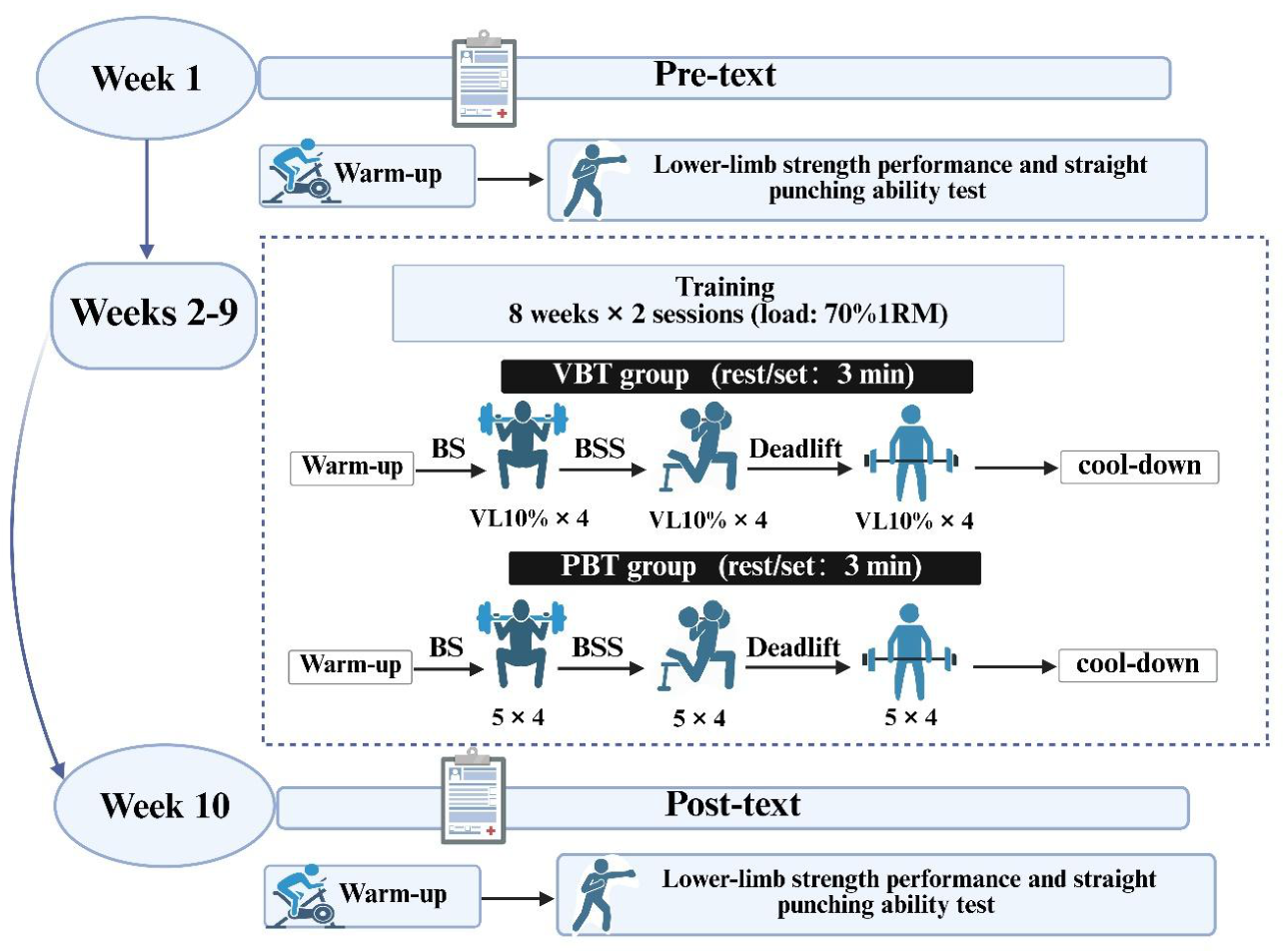
Figure 2.
Standardized differences with 95% confidence intervals for the pre to post changes in boxing-specific performance variables between the VBT and PBT. LSP, lead straight punch; RSP, rear straight punch; CP, continuous punch; PBT, percentage-based training; VBT, velocity-based resistance training.
Figure 2.
Standardized differences with 95% confidence intervals for the pre to post changes in boxing-specific performance variables between the VBT and PBT. LSP, lead straight punch; RSP, rear straight punch; CP, continuous punch; PBT, percentage-based training; VBT, velocity-based resistance training.
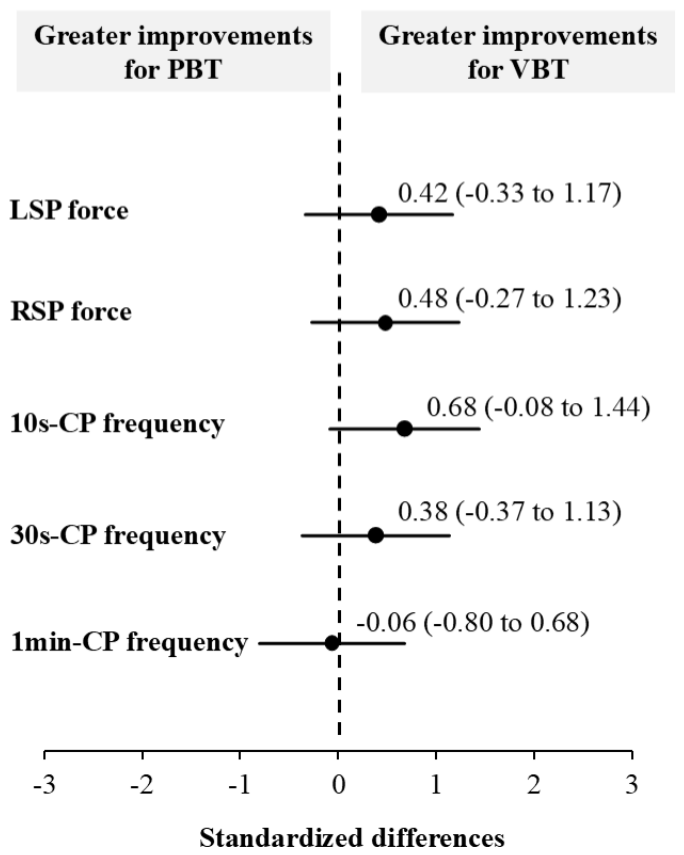

Table 1.
Baseline characteristics of study participants.
| Variable | VBT (n = 14) | PBT (n = 14) |
|---|---|---|
| Age (years) | 19.6 ± 1.0 | 19.9 ± 1.0 |
| Height (cm) | 181.9 ± 7.4 | 179.1 ± 7.3 |
| Body mass (kg) | 77.9 ± 9.1 | 78.4 ± 9.5 |
| Boxing experience (years) | 6.3 ± 1.4 | 6.0 ± 1.5 |
Abbreviations: VBT, velocity-based resistance training; PBT, percentage-based training.
Table 2.
Two-way ANOVA comparing the pre to post changes in boxing-specific performance variables for the PBT and VBT groups.
Table 2.
Two-way ANOVA comparing the pre to post changes in boxing-specific performance variables for the PBT and VBT groups.
| Variable/group | Pre-test, Mean (SD) |
Post-test, Mean (SD) |
Hedges g, ES (95% CI) |
ANOVA | |
|---|---|---|---|---|---|
| Time | Interaction | ||||
| lead straight punch force, kg | 56.2 (13.7) 58.9 (14.1)* |
0.11 (-0.64, 0.85) 0.54 (-0.22, 1.29) |
F (1, 26) = 10.3 p = 0.003 |
F (1, 26) = 4.7 p = 0.039 |
|
| PBT VBT |
54.6 (15.7) 50.3 (16.8) |
||||
| rear straight punch force, kg | 72.7 (7.7) 77.6 (19.8)* |
0.31 (-0.44, 1.05) 0.47 (-0.28, 1.22) |
F (1, 26) = 44.4 p < 0.001 |
F (1, 26) = 16.3 p < 0.001 |
|
| PBT VBT |
70.4 (6.8) 68.1 (19.3) |
||||
| 10-second continuous punch frequency, punches·10 s−1 | |||||
| PBT VBT |
34.9 (6.9) 34.2 (6.2) |
35.0 (4.8) 38.9 (6.7)* |
0.02 (-0.72, 0.76) 0.71 (-0.06, 1.47) |
F (1, 26) = 5.8 p = 0.023 |
F (1, 26) = 5.1 p = 0.032 |
| 30-second continuous punch frequency, punches·30 s−1 | |||||
| PBT VBT |
100.9 (12.3) 101.5 (13.6) |
103.9 (9.7) 109.6 (14.1)* |
0.26 (-0.48, 1.01) 0.57 (-0.19, 1.32) |
F (1, 26) = 21.7 p < 0.001 |
F (1, 26) = 4.5 p = 0.043 |
| 1-minute continuous punch frequency, punches·min−1 | |||||
| PBT VBT |
185.5 (38.9) 183.4 (48.1) |
189.8 (35.7) 185.1 (41.5) |
0.11 (-0.63, 0.85) 0.22 (-0.70, 0.78) |
F (1, 26) = 1.2 p = 0.293 |
F (1, 26) = 0.2 p = 0.636 |
Abbreviations: ANOVA, analysis of variance; PBT, percentage-based training; VBT, velocity-based resistance training; 1RM, one-repetition maximum; ES, effect size = (post-test mean − pre-test mean)/pre-test SD. *Significant differences compared with pre-test (p < 0.05).
Disclaimer/Publisher’s Note: The statements, opinions and data contained in all publications are solely those of the individual author(s) and contributor(s) and not of MDPI and/or the editor(s). MDPI and/or the editor(s) disclaim responsibility for any injury to people or property resulting from any ideas, methods, instructions or products referred to in the content. |
© 2026 by the authors. Licensee MDPI, Basel, Switzerland. This article is an open access article distributed under the terms and conditions of the Creative Commons Attribution (CC BY) license (http://creativecommons.org/licenses/by/4.0/).
Copyright: This open access article is published under a Creative Commons CC BY 4.0 license, which permit the free download, distribution, and reuse, provided that the author and preprint are cited in any reuse.


