

Submitted:
20 July 2026
Posted:
21 July 2026
You are already at the latest version
Abstract
Animals hold many executable behavioral programs at once yet express one at a time. This review builds an account of that arbitration in three stages. First, we revisit six classical findings—stickleback territorial contests, white-crowned sparrow song learning, behavioral choice in Drosophila, rodent lordosis genetics, clownfish sex change and cichlid social ascent—and show that each poses a problem its original framing cannot resolve. Reanalysis of the published data from four of these systems supplies quantitative tests: winner-loser effects fit a metaplastic drift of the baseline threshold rather than a change in drive; the song-learning window behaves as a graded threshold rather than a categorical veto, with fifty percent adoption near sixty-five days; behavioral alternation in Drosophila follows from each program consuming the very terms that opened it, with no fatigue or noise term required; and lordosis knockouts separate into categorical and graded failure modes by whether the deleted element is an obligatory transducer. Second, we assemble these results into an explicit model of Dynamic Archetypal Coordination: conjunctive gating with a structural veto, a winner-take-all arbitration layer, margin consumption, and a slow metaplastic baseline. This model requires no gating field and stands on data generated by other laboratories. Third, we identify what it cannot explain—that a single physiological manipulation can scale several unrelated behaviors together—and propose a shared sterol-derived permissive field as the resolution, deriving a dissociation signature that distinguishes it from gain-control and additive accounts. This is a theoretical synthesis: no new experiments are reported and all data are previously published.
Keywords:
behavioral arbitration
; dynamic archetypal coordination
; ethology
; neurosteroids
; comparative neurobiology
; decision-making
; metaplasticity
Part I. What the classics show
1. The Problem
At any moment an animal holds many executable behavioral programs. A male fruit fly can court, fight, feed, groom or flee; the circuits for all of these are intact and the animal is capable of each. It performs one. The question of how that selection is made is among the oldest in ethology, and two families of answer have dominated it.
The first holds that selection is performed somewhere. Classical ethology proposed hierarchically organized instinct centers in which higher centers gate lower ones (Tinbergen, 1951), and modern versions of the same intuition look for command neurons or dedicated decision nodes that arbitrate among competing programs. On this account, behavioral choice has an address. The second holds that selection is emergent. Parallel circuits inhibit one another, the deepest attractor captures motor output, and no structure performs the choice because the choice is distributed across the competitors. Recent evidence favors the second view: targeted screens across octopaminergic, tyraminergic, dopaminergic, serotonergic and mushroom-body populations in Drosophila identify no locus that governs all behavioral decisions (Ladd & Simpson, 2025), and brain-wide recordings in mice likewise find decision-relevant variables distributed across nearly every level of processing rather than localized to a single node (Findling et al., 2025). Both findings sit within a broader turn toward treating internal states as distributed, slowly varying quantities rather than discrete centers (Flavell et al., 2022).
Both accounts are supported, and neither is sufficient. This review takes an indirect route to the difficulty. Rather than beginning with a model, we begin with six findings that are already familiar to most readers of this journal—Tinbergen's sticklebacks, Marler's sparrows, choice assays in Drosophila, the genetics of rodent lordosis, sex change in clownfish, and social ascent in Astatotilapia burtoni. Each is a landmark. Each also contains a result that the framework it was collected under cannot comfortably accommodate. Taken together, those residues specify an architecture.
We build that architecture in three stages. Part I presents the six cases as problems and, for four of them, reanalyzes the published data. Part II assembles the resulting model of Dynamic Archetypal Coordination—the real-time arbitration of competing programs—and states plainly what it explains. Part III identifies the one class of observation the model cannot handle, and proposes a shared sterol-derived permissive field as the resolution. A reader persuaded by Parts I and II is not thereby committed to Part III; the layers are separable, and we have kept them so deliberately.
One term needs defining before we begin, because it is used throughout in a specific sense.
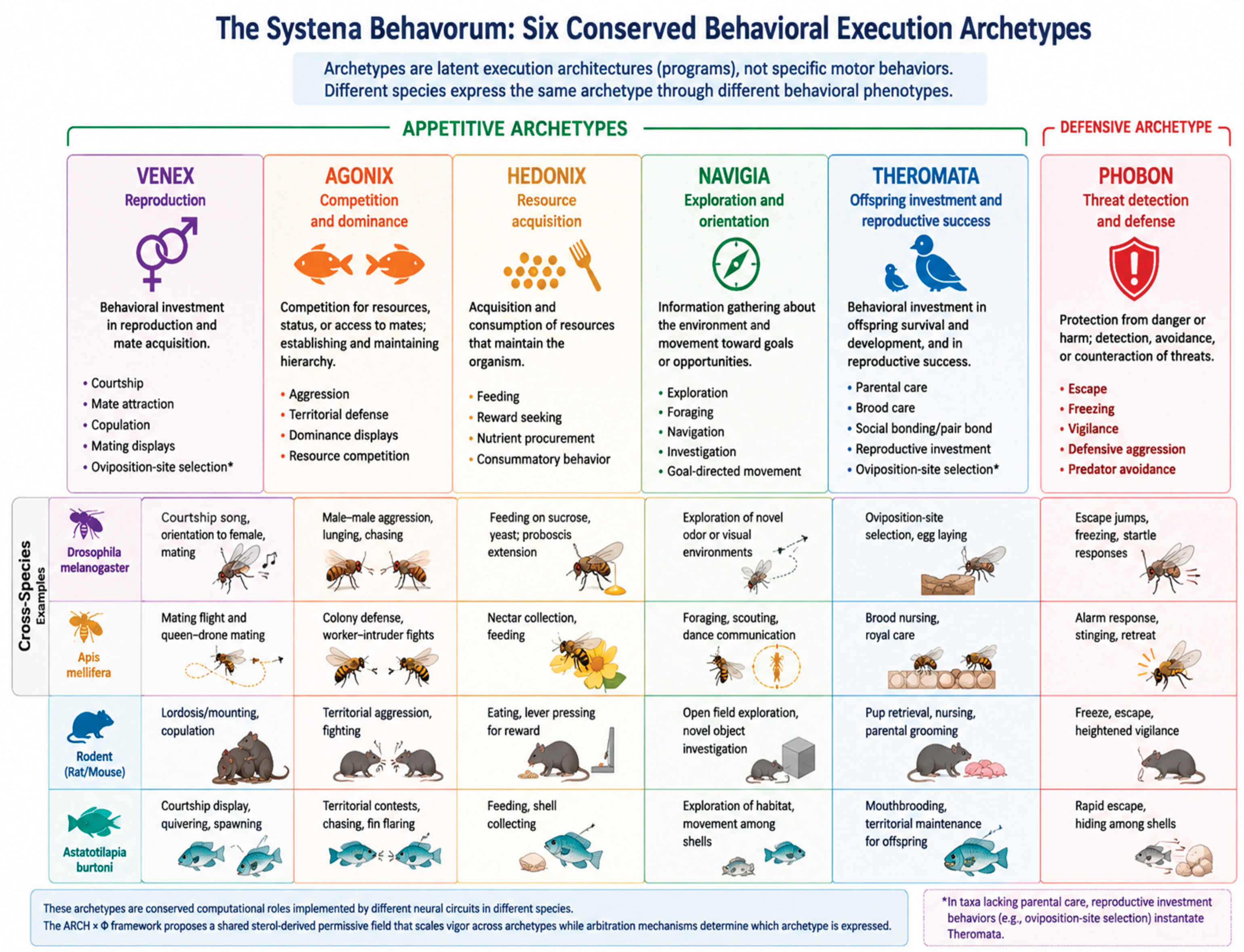
The term Archetype refers not to an observed behavior but to the latent execution architecture capable of producing one. Throughout this paper we use the Systema Behavorum (Rahman et al., 2025), a functional taxonomy of ten conserved behavioral execution systems, to classify these architectures across species. Six archetypes are considered: Venex (reproduction), Agonix (competition and territoriality), Hedonix (resource acquisition), Navigia (exploration and navigation), Theromata (behavioral investment in offspring and reproductive success), and Phobon (threat detection and defense). These names describe conserved computational roles rather than specific motor behaviors. Thus, mating, courtship song, lordosis, and oviposition-site selection are different species-specific expressions of Venex, while parental care in mammals, brood care in eusocial insects, and reproductive investment behaviors in species lacking direct caregiving are expressions of Theromata. The archetypes, summarized in Figure 3, therefore provide a common functional vocabulary for comparing diverse behavioral repertoires across phyla.
2. Six Classics, Six Residues
2.1. Sticklebacks: What a Releaser Model Has No Term for
Tinbergen's account of the threespine stickleback is the founding case of the sign stimulus: a male in breeding condition attacks a model bearing a red underside, and the response is stereotyped enough to be treated as released rather than decided. What the releaser framework has no term for is history. A male that has just won a contest attacks more readily than one that has just lost, though the cue, the circuit and the hormonal state are unchanged. Winner and loser effects are ubiquitous across taxa and are usually described as changes in motivation (Hsu et al., 2006). We argue they are something else: a shift in the threshold the animal brings to the next encounter, drifting with its own activation history. Bakker and Sevenster (1983) supply the data to test this, because they crossed prior contest experience factorially with a graded morphological cue, a manipulation whose interpretation was subsequently refined by Rowland (1982).
The mapping matters, and it differs from the obvious one. Prior victory and defeat are not a Drive manipulation: they do not energize the aggressive program in the moment, they change the threshold the animal brings to the next encounter. In the notation of Section 3.1 they enter as ηᵢ⟨Gᵢ⟩, drifting θᵢ⁰ down after wins and up after losses, exactly the metaplastic term. The Archetype (preoptic circuitry), the Drive (breeding-condition androgen), and the sterol-derived Φ (breeding-season neurosteroid tone) are constant across all five conditions, as is the Cue: every pair is a brighter male against a duller one, so the coloration contrast never varies.
Experience modulates the outcome robustly. A logistic fit gives an odds ratio of 2.01 per unit of experience differential (intercept 1.457, slope 0.697), a 16.3-fold shift across the range; the likelihood-ratio test against an experience-free model gives χ² = 6.84, df = 1, p = 0.009. Contests in which coloration and experience are aligned are won 16 of 17 times, against 3 of 6 when they oppose (Fisher p = 0.040), and pooling by direction gives 25/28 versus 9/16 (Fisher p = 0.023). Model selection favors a single linear experience term (AIC 53.92) over an intercept-only model (58.76), a quadratic (55.65), or a saturated model (57.16).
Two limits deserve statement. The series is not monotonic—the win probability at +1 (9/11 = 0.82) falls below that at 0 (14/15 = 0.93)—and a quadratic term does not rescue it (p = 0.61); with 11 and 15 contests in those cells this is most economically read as sampling noise, but we do not smooth it. More importantly, because A, D, C and Φ are all held constant, no term-by-term interaction is estimable, and a multiplicative latent model fits no better than an additive one (Δ logL = 0.12 for one extra parameter; ΔAIC +1.76). These data therefore test the slow baseline, not the integration rule. What they establish is that behavior rewrites the threshold for its own recurrence—the feedback the activation equation alone does not contain.
Were the framework wrong here, the experience effect would be confined to the encounter in which it was induced rather than carrying forward to alter the next contest, and prior victory would raise win probability only when the cue favoring it was simultaneously present. Neither is observed.
2.2. Song Learning: Is the Sensitive Period a Window or a Dial?
Marler's demonstration that a white-crowned sparrow learns its song only within an early window is one of the most cited results in behavioral biology, and it is routinely described in categorical language: the window opens, the window closes. That description carries a strong implicit claim—that closure is absolute, and that no stimulus, however salient, can reopen it. The alternative is that the window is a dial rather than a gate: the threshold rises with age, and a sufficiently powerful cue can still cross it. The two readings are empirically distinguishable, and the published literature already contains the discriminating observation, because live tutors are far more effective than tape.
Tape-tutoring experiments established a sensitive phase from roughly 10 to 50 days, with conspecific song heard after 50 days rejected (Marler, 1970). Live tutors tell a different story. Naive 50-day-old birds placed with a single live social tutor learned that tutor’s song in 12 of 12 cases, in some instances even the song of an alien species (Baptista & Petrinovich, 1984). Birds tape-tutored through the window and then given a live tutor of a different dialect after 50 days adopted the second song in 11 of 20 males, against 1 of 15 females (Petrinovich & Baptista, 1987). Group-isolated birds given a live tutor at 100 days adopted nothing—all sang isolate song.
The veto reading fails immediately: it predicts zero adoption after 50 days, and males adopt in 11 of 20 (p ≪ 10⁻¹⁰). The graded reading is what the data support. Holding rearing history constant among naive birds, live tutoring at 50 days yields 12/12 and at 100 days 0/4 (Fisher p = 0.00055), so age alone carries adoption from certainty to zero with tutor modality fixed. Fitting the three male age points, a graded logistic threshold (logL −13.76, AIC 31.53) beats both a constant rate (AIC 44.81) and a hard step (AIC 42.02, best cut at 66 days) by ΔAIC 10.5, with 50% adoption at 65.1 days. The window is therefore a dial, and the modality of the cue sets whether it can be crossed: tape tutoring fails after 50 days where a live tutor—a larger ‖wᵢ · C‖ in the projection of Section 3.4—still succeeds, the same lower-bounding logic the RoboBee experiment supplies for Navigia in Section 4.4.
Two cautions apply. Age and prior tutoring are confounded in the contrast between the naive 50-day birds (12/12) and the tape-tutored birds past 50 days (11/20): overwriting an already-written baseline may be harder than writing a fresh one, which is precisely the hysteresis a canalized bistable θᵢ⁰ predicts (Figure 7), and separating the two requires naive and tutored birds compared at matched age. The sex difference is large (males 23/34, females 1/17; p = 2.3 × 10⁻⁵) but confounded by the well-documented poor song learning of female white-crowned sparrows in captivity, so we do not read it as a sex-specific gate (Beecher, 2008). Cell sizes are small (2–20) and the counts are those reported in the published summaries.
Taken together, the two reanalyses supply what the comparative Φ evidence cannot: direct behavioral tests of the slow term. Sticklebacks show experience rewriting the baseline within adulthood; sparrows show the same baseline rising with developmental age, gradually rather than categorically. Both are threshold phenomena, and neither is a manipulation of Φ.
Figure 1.
Two empirical tests of the slow baseline. (A) Stickleback contest outcomes (Bakker & Sevenster, 1983; N = 59). Points are observed proportions with binomial standard errors and raw counts; the curve is the fitted logistic (OR 2.01 per unit of experience differential). Coloration contrast is constant in every pair, so prior experience acts on θᵢ⁰ rather than on C or D. (B) White-crowned sparrow adoption of a live tutor’s song as a function of age (males; Baptista & Petrinovich, 1984; Petrinovich & Baptista, 1987). The graded threshold (green) fits decisively better than a hard veto step (red dashed) by ΔAIC 10.5, with 50% adoption at 65 days. Tape tutoring after 50 days fails, so cue modality determines whether the raised threshold can be crossed.
Figure 1.
Two empirical tests of the slow baseline. (A) Stickleback contest outcomes (Bakker & Sevenster, 1983; N = 59). Points are observed proportions with binomial standard errors and raw counts; the curve is the fitted logistic (OR 2.01 per unit of experience differential). Coloration contrast is constant in every pair, so prior experience acts on θᵢ⁰ rather than on C or D. (B) White-crowned sparrow adoption of a live tutor’s song as a function of age (males; Baptista & Petrinovich, 1984; Petrinovich & Baptista, 1987). The graded threshold (green) fits decisively better than a hard veto step (red dashed) by ΔAIC 10.5, with 50% adoption at 65 days. Tape tutoring after 50 days fails, so cue modality determines whether the raised threshold can be crossed.
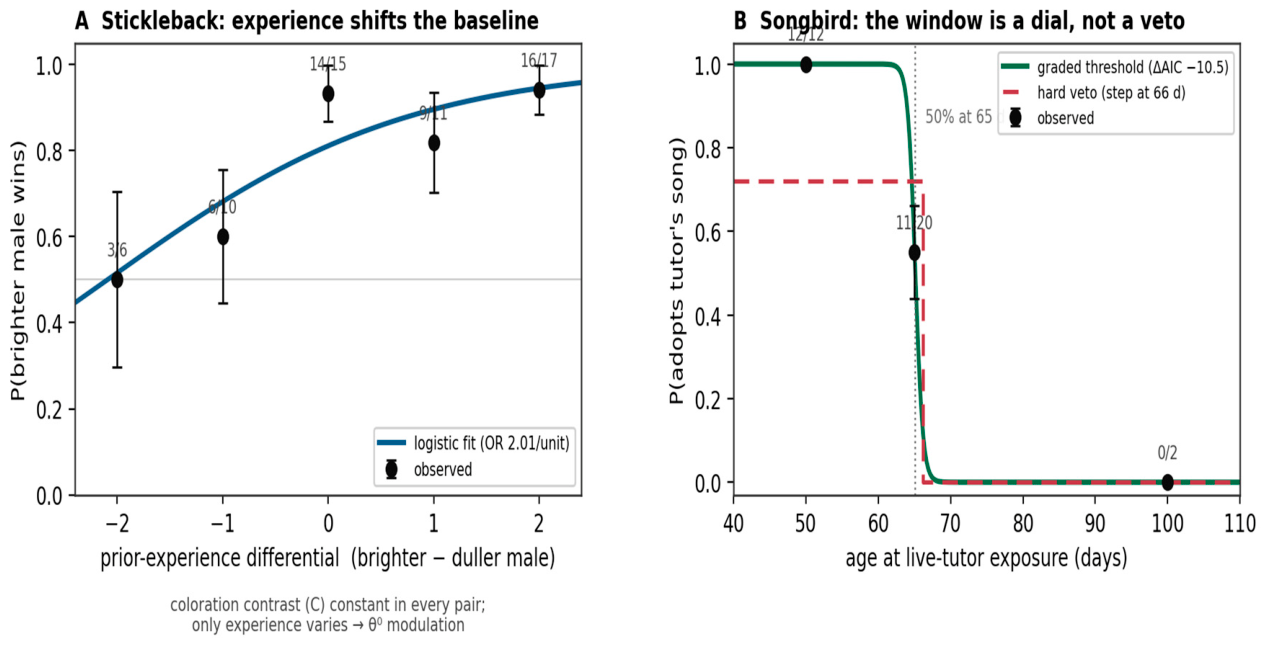
Were the framework wrong here, adoption would fall off as a step rather than a slope, and the failure at 100 days would be insensitive to whether the tutor was live or recorded. The graded fit and the live-versus-tape contrast rule both out.
2.3. Choice in Drosophila: Competition Without a Decision Centre
If selection among behaviors is performed by a dedicated structure, that structure should be findable. Ladd and Simpson (2025) looked for it in Drosophila and did not find it. Their screen is the cleanest modern statement of the distributed position: flies given pairwise choices among grooming, feeding and courting show no absolute hierarchy, competing drives delay initiation rather than suppressing the loser, and no manipulation identified a locus whose removal abolishes choice. The finding that makes the strongest demand on any model, however, is the fourth one. Flies do not settle on a winner. They alternate, in short bouts, indefinitely.
Three of their findings bear on the layer. First, there is no absolute hierarchy: flies typically groom first, but they feed instead if sufficiently starved, or court if an appropriate female is present. This is what a commitment attractor predicts and a fixed priority ordering does not—which archetype captures output depends on the relative input biases Gᵢ, not on rank. Second, competing drives delay behavior initiation, measured as time to first wing extension or first proboscis contact. In the network of Section 3.3 a competitor’s lateral inhibition β xⱼ subtracts from the winner’s net drive, so time to threshold lengthens whenever a second archetype is simultaneously active; delayed initiation under competition is the observable signature. Third, a targeted screen across octopaminergic, tyraminergic, dopaminergic, serotonergic, leucokinin and mushroom-body populations identified no locus affecting all three decisions. That is the distributed-arbitration expectation, and it is why the framework locates competition in a layer rather than in a structure.
The fourth finding is the demanding one: flies alternate, performing short bouts of each action rather than satisfying one drive before turning to the next. A winner-take-all network with β/w > 1 settles into one attractor and stays there, so alternation is not a free consequence of the architecture—it is what forced the consumption term of Section 3.3. With margins depleting during expression and recovering during idleness, alternation emerges with β/w held at 2.33 and no stochastic input (Figure 5A). Simulated time allocation grades with the baseline margin ratio—0.50 at parity, 0.67 at a ratio of 1.25, 0.85 at 1.5—while switching persists until drive becomes lopsided, at which point the favored archetype monopolizes output (Figure 5B). Alternation with graded allocation, and dominance only under strongly asymmetric drive, is the reported pattern.
This yields a prediction that is not fitted. Because bout length is set by the recovery rate rᵢ rather than by the consumption rate, archetypes whose depleted term replenishes quickly should show shorter, more frequent bouts than archetypes whose term replenishes slowly. Grooming, where mechanosensory load redistributes across the body as the animal moves, should therefore alternate more finely than feeding, where gut filling proceeds slowly and irreversibly within an assay. Bout-length distributions of the kind Ladd and Simpson report are the appropriate test, and the ordering is fixed by the physiology of the consumed term rather than by any parameter we choose. We note the corresponding cost: ρᵢ and rᵢ are free parameters, and the simulations locate the alternation regime rather than fit these data quantitatively.
Figure 2.
Alternation as a consequence of consuming the ARCH terms. (A) Two archetypes in the arbitration network of Section 3.3 with β/w = 2.33 and no stochastic input. Solid traces show committed activity xᵢ; dashed traces show each archetype’s margin Φ·AᵢDᵢCᵢ, which depletes during expression and recovers during idleness (ρ = 0.20, r = 0.02). The bout bar beneath marks which archetype holds output. Winner-take-all governs the momentary commitment; alternation emerges on the slower timescale of consumption and recovery. (B) Time allocated to archetype A as a function of the baseline margin ratio. Allocation grades with relative drive while alternation persists, and switching ceases only when the ratio becomes lopsided (≥1.7), at which point one archetype monopolizes output.
Figure 2.
Alternation as a consequence of consuming the ARCH terms. (A) Two archetypes in the arbitration network of Section 3.3 with β/w = 2.33 and no stochastic input. Solid traces show committed activity xᵢ; dashed traces show each archetype’s margin Φ·AᵢDᵢCᵢ, which depletes during expression and recovers during idleness (ρ = 0.20, r = 0.02). The bout bar beneath marks which archetype holds output. Winner-take-all governs the momentary commitment; alternation emerges on the slower timescale of consumption and recovery. (B) Time allocated to archetype A as a function of the baseline margin ratio. Allocation grades with relative drive while alternation persists, and switching ceases only when the ratio becomes lopsided (≥1.7), at which point one archetype monopolizes output.
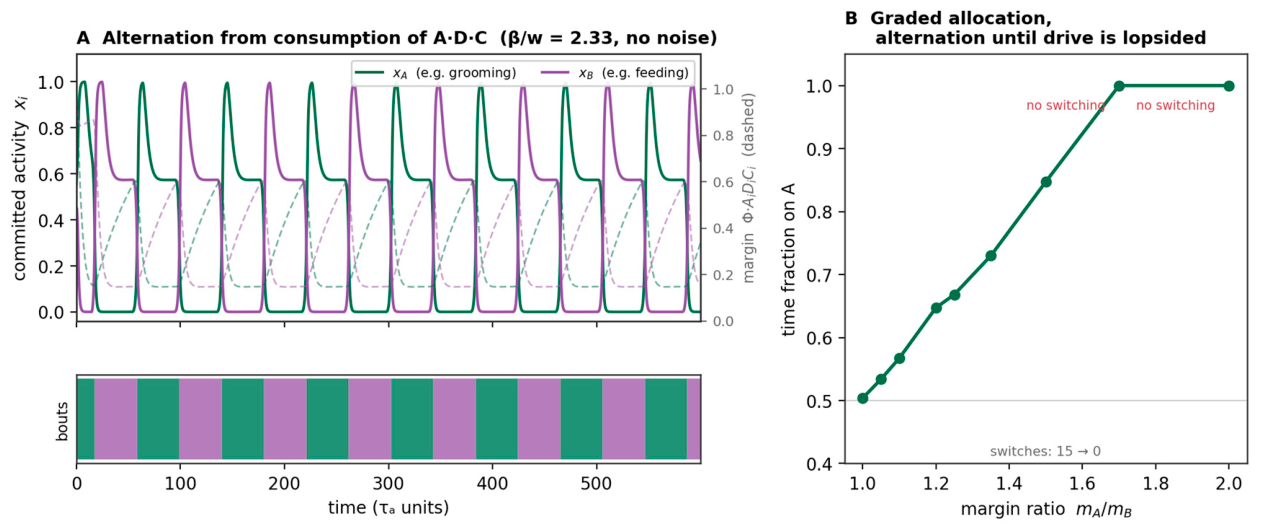
Were the framework wrong here, a competing archetype would capture output only when the incumbent’s drive was exhausted, producing a single relay rather than repeated switching, and time allocation would be all-or-none rather than graded by margin ratio. Both fail against the reported ethograms.
2.4. Lordosis Genetics: Why Some Deletions Abolish and Others Merely Reduce
Rodent lordosis is the best-characterized vertebrate example of a behavior assembled from separable requirements: an intact ventromedial hypothalamic circuit, hormonal priming, and a tactile cue from the male. Decades of genetic work have removed each of these components in turn. The pattern in that literature is rarely commented on, but it is striking. Some deletions abolish the behavior outright and cannot be rescued by any amount of hormone; others merely attenuate it, and can be restored by bypassing the missing step. If behavioral requirements were simply additive, we would expect a single graded continuum. We do not observe one.
The framework makes a discriminating prediction. If Vᵢ ∈ {0, 1} is a genuine structural term rather than a limiting case of a graded one, deletions should fall into two classes rather than along a continuum: categorical failures in which lordosis is abolished and cannot be restored by supplying upstream signals, and graded failures in which lordosis is attenuated in proportion to the loss and can be restored by bypassing the missing step. A thresholded-additive architecture predicts a single graded distribution instead. This is the multiplicative-versus-additive discrimination attempted pharmacologically elsewhere in this paper, performed genetically.

Table 1.
Lordosis knockouts classified by failure mode and isolation quality. Isolation quality grades how far terms other than the targeted one are held constant: clean = adult-onset and site-specific, gonads intact; partial = target term deleted, one other term measurably shifted; confounded = several terms perturbed by the deletion itself.
Table 1.
Lordosis knockouts classified by failure mode and isolation quality. Isolation quality grades how far terms other than the targeted one are held constant: clean = adult-onset and site-specific, gonads intact; partial = target term deleted, one other term measurably shifted; confounded = several terms perturbed by the deletion itself.
| Manipulation | Effect on lordosis | Failure mode | Rescue | Isolation |
| Esr1 (ERα) RNAi knockdown, adult VMN (Musatov et al., 2006) | Abolished; females actively reject mounts | Categorical (Vᵢ = 0) | none reported | Clean |
| VMHvl PR⁺ cell ablation (Yang et al., 2013) | >20-fold reduction in lordosis duration; aggression spared | Categorical (Vᵢ = 0) | none reported | Clean |
| αERKO, global Esr1 deletion (Ogawa et al., 1998, 1999) | No lordosis in intact or primed females | Categorical (Vᵢ = 0) | E + P priming fails | Confounded (abnormal ovaries; elevated E₂ and testosterone) |
| PRKO, global Pgr deletion (Lydon et al., 1995; Chappell et al., 1997) | Attenuated, not abolished | Graded | Rapid intravenous P₄ and 3α,5α-THP restore lordosis | Partial (anovulatory) |
| SF-1 brain-specific KO (Nr5a1; Kim et al., 2010) | Reduced levels of lordosis | Graded | — (VMH disorganized, not deleted) | Partial (gonads intact; VMH cytoarchitecture altered) |
| 5α-RKO, Srd5a1 deletion (Koonce & Frye, 2014) | No estrous rise in LQ or lordosis rating; P₄ ineffective | Graded (Φ arm) | 3α,5α-THP restores LQ in KO and wild type alike | Partial (elevated circulating androgens) |
| βERKO, global Esr2 deletion (Ogawa et al., 1999) | Normal at estrus; fails to decline the following day | Disinhibited | — | Partial |
Two mechanistically distinct failure modes emerge, and the criterion separating them is structural rather than post hoc. Deletions that remove an obligatory transducer within the gate—ERα in the ventromedial nucleus, the VMHvl PR⁺ population itself—abolish lordosis categorically and cannot be rescued by supplying hormone, because the element that converts the signal is gone. Deletions that remove one step of a synthesis chain, or degrade the structure without deleting it—5α-reductase, nuclear PR, SF-1—attenuate lordosis proportionally and are rescued by bypassing the missing step. The 5α-RKO case is the cleanest illustration on the Φ arm: progesterone cannot facilitate lordosis because it cannot be 5α-reduced, medroxyprogesterone acetate (which does not convert to 3α,5α-THP) facilitates lordosis in neither genotype, and 3α,5α-THP itself restores receptivity in knockout and wild type alike. The parallel logic applies to nuclear PR, where rapid membrane-initiated progestin action supplies a second route that survives the deletion. Categorical failure therefore marks a term the architecture cannot route around; graded failure marks one it can.
The isolation column carries an important qualification. Test conditions in these studies are genuinely matched—identical ovariectomy, E₂ and P₄ priming, sexually experienced stimulus males, and the standard mount denominator—so behavioral differences are attributable to genotype. The remaining ARCH terms, however, are not thereby held constant, because several deletions perturb them directly: αERKO females have abnormal ovaries and elevated circulating steroids, 5α-RKO females have elevated androgens, and constitutive SF-1 nulls are born without gonads or adrenal glands and so lack endogenous steroid exposure altogether, which is why only the brain-specific conditional is usable here. Constitutive deletions also permit developmental compensation, so the Archetype itself may differ. The adult-onset, site-specific manipulations accordingly carry the argumentative weight, and it is worth noting that the two cleanest of them are both categorical.
Two limits remain. Most of these effects are reported as descriptions—abolished, reduced, attenuated—rather than as paired LQ means with variance, so the bimodality implied by the two failure modes cannot yet be tested formally; recovering per-genotype LQ distributions is the obvious next step. And one prediction follows directly from the Φ implementation proposed here but appears untested: if allopregnanolone gates lordosis through tonic extrasynaptic inhibition, then deletion of the δ subunit of the GABAA receptor should attenuate lordosis. Gabrd-null mice lack the tonic conductance that neurosteroids preferentially target and show cycle-linked δ regulation across the estrous cycle (Maguire et al., 2005), but their documented behavioral phenotype is postpartum rather than reproductive. The experiment is available with existing animals.
Were the framework wrong here, deletions would form a single graded continuum with no categorical class, and no deletion would resist rescue by supplying upstream hormone. The unrescuable abolitions under adult-onset, site-specific manipulation are what a structural veto predicts and a purely graded architecture does not.
2.5. Clownfish: Thresholds That Differ in Each Direction
Socially controlled sex change in Amphiprion supplies a case in which commitment is slow enough to watch and irreversible enough to matter. Removal of the dominant female permits the largest male to begin a transition that, once past a point, does not reverse if she is returned. The forward and reverse boundaries are not the same boundary. That asymmetry—hysteresis—is a signature of threshold architecture rather than of graded response, and it recurs across the cases in this review at every timescale from milliseconds to months (Rahman, 2026b).
2.6. Cichlid Ascent: The Same Circuit, a Different Animal
Astatotilapia burtoni provides the complementary case: a rapid, reversible change in behavioral state with no change in the underlying circuitry. A subordinate male placed in a vacant territory becomes dominant within minutes, long before any structural remodeling could occur, and the transition is bidirectional. Whatever is being modified here is not the architecture.
A subordinate cichlid male waits at the territory’s edge while a brightly colored dominant courts females and drives off rivals. The dominant disappears, and within minutes the subordinate transforms: coloration intensifies, he courts, attacks rivals, excavates a spawning pit, and claims the territory. Few vertebrates undergo so rapid and fully reversible a change of state.
Why does this system matter? Unlike Drosophila or the honeybee, the decisive contextual cue can be delivered with extraordinary precision—simply remove the dominant male. The animal, its endocrine milieu, and its circuitry are initially unchanged, yet its priorities reorganize almost immediately. A. burtoni therefore offers one of the clearest vertebrate demonstrations that social opportunity alone can re-rank the behavioral landscape. Equally important, it exposes the limits of the framework: the principal sterol associated with the transition behaves not as a permissive field but as a directional suppressor, letting the cichlid serve at once as a strong A/C system and as a critical negative test of Φ.
2.6.1. Remodeling the Dominance Circuit
At the center of the transition are the GnRH1 neurons of the preoptic area, at the apex of the brain–pituitary–gonadal axis. As males ascend, these neurons enlarge roughly eightfold, elaborate their dendrites, and sharply increase GnRH synthesis (Davis & Fernald, 1990). The reverse follows defeat: coloration fades within minutes, the fish rejoins the subordinate school, and over weeks the neurons regress to about one-eighth of their dominant volume. The circuit is not replaced but remodeled—the A term made visible, a behavioral architecture whose physical structure scales with social state.
2.6.2. Social Opportunity as Context
The first event in ascent is neither endocrine nor structural but contextual. Remove the dominant male, and the subordinate behaves as though a new environment has appeared. Within 20 minutes the immediate-early gene egr-1 is selectively induced in GnRH1 neurons; by 30 minutes c-fos activation spreads through the conserved social-behavior network, while overt behavioral change begins within 3–5 minutes (Burmeister et al., 2005; Maruska et al., 2013). The neural substrate is identical immediately before and after the manipulation; what changes is the meaning of the environment. Social opportunity is a contextual signal that re-ranks the landscape—analogous to the vertebrate counterpart of the target cue in Drosophila and the geometric signal of the waggle dance.
2.7. What the Six Cases Jointly Require
Read together, the residues in these six findings are specific rather than diffuse, and they name four requirements. First, some behavioral requirements fail categorically and others gradually, which means the model needs both an all-or-none structural term and continuously varying ones (2.4). Second, thresholds drift with an archetype's own activation history, which requires a slow state variable distinct from moment-to-moment drive (2.1, 2.2). Third, selection is competitive and distributed rather than adjudicated centrally, and the winner is not stable: programs alternate (2.3). Fourth, commitment is asymmetric in time, with forward and reverse boundaries that differ (2.5, 2.6).
None of these requirements involves a gating field, a sterol, or any global variable. They are demands placed on the architecture by published behavioral data, and Part II assembles a model that meets them.
Part II. Dynamic Archetypal Coordination
3. The Architecture
We now state the model the six cases require. Because it will later be extended, we build it in the order the evidence arrived: first the conjunctive gate and its structural veto, then the slow baseline that drifts with history, then the arbitration layer in which programs compete and alternate. Throughout this Part no global variable appears. Everything here is local to an archetype, and everything here is supported by the reanalyses of Part I.
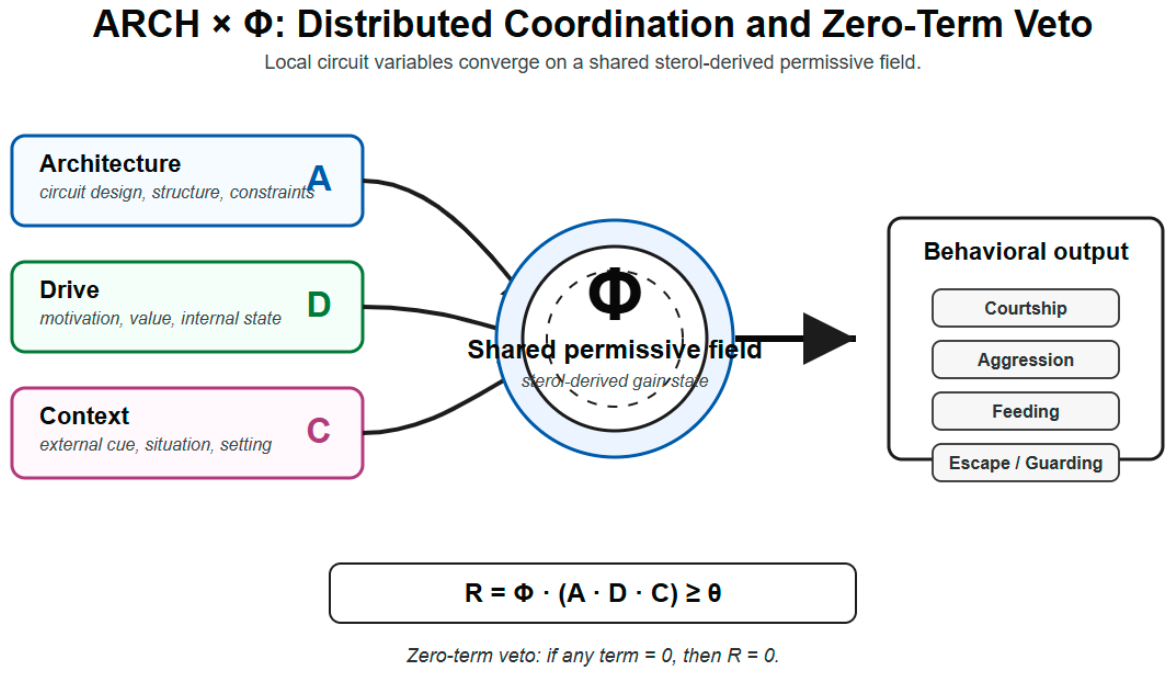
Execution of archetype i requires the joint satisfaction of three local quantities: a latent circuit substrate (Archetype, A), an activating internal state (Drive, D), and an appropriate external cue (Context, C). These combine multiplicatively rather than additively, so that a deficit in one cannot be repaid by a surplus in another, and the product is compared against a threshold θᵢ. In plain terms: the animal must have the machinery, be in the state, and receive the cue—and no amount of one substitutes for the absence of another.
The gate is written Gᵢ = Vᵢ · σ(kᵢ[(Aᵢ · Dᵢ · Cᵢ) − θᵢ]), where σ is a logistic function of slope kᵢ and Vᵢ ∈ {0, 1} is a structural veto. The distinction between Vᵢ and the graded terms is the one the lordosis genetics forced in Section 6.3: Vᵢ encodes the presence of obligatory transducers and circuit integrity, so its loss is categorical and unrescuable, whereas reduction of a graded term merely narrows the margin and can be compensated by bypassing the missing step.
We write the graded opening of each archetype’s gate as a logistic function of its margin above threshold, modulated by an all-or-none structural term:
Gᵢ = Vᵢ · σ( kᵢ [ (Aᵢ · Dᵢ · Cᵢ) − θᵢ ] ).
Here σ is the logistic function, kᵢ sets its steepness, and Vᵢ ∈ {0, 1} is a structural veto that encodes the archetype’s all-or-none prerequisites: circuit integrity and obligatory receptor or transducer expression. Vᵢ makes explicit a distinction the biology forces. The A, D, and C terms are graded dials whose partial reduction degrades behavior proportionally, whereas some prerequisites are structural: a lesioned motor arc or a deleted obligatory receptor sets Vᵢ = 0 and zeroes the gate regardless of how permissive Φ and the graded terms remain. With Vᵢ = 1 the graded product sets how far the gate opens. The hard vetoes and graded vetoes catalogued in Section 7 are therefore two formally distinct failure modes: hard vetoes act through Vᵢ and the collapse of a graded term to zero; graded vetoes act through partial reduction of Φ or a graded term.
Figure 3.
The ARCH × Φ architecture. Four jointly necessary terms—circuit substrate (A), drive (D), context/cue (C), and the proposed sterol-derived permissive field (Φ)—converge on a shared field that gates behavioral output without replacing local circuit computations. Suppressing any single term to zero vetoes execution (zero-term veto). The distinctive prediction (inset): when Φ is shared across competing behaviors, raising Φ scales vigor while leaving allocation between behaviors stable.
Figure 3.
The ARCH × Φ architecture. Four jointly necessary terms—circuit substrate (A), drive (D), context/cue (C), and the proposed sterol-derived permissive field (Φ)—converge on a shared field that gates behavioral output without replacing local circuit computations. Suppressing any single term to zero vetoes execution (zero-term veto). The distinctive prediction (inset): when Φ is shared across competing behaviors, raising Φ scales vigor while leaving allocation between behaviors stable.
3.1. The Slow Baseline
The stickleback and sparrow reanalyses of Section 3 and Section 2.2 both require the same addition: the baseline threshold is not a constant but a slow state variable, drifting with the archetype's own history of activation.
The baseline θᵢ⁰ is treated above as fixed, but the landscape on which Φ acts is itself written over slower timescales. We promote the baseline to a state variable driven by the archetype’s own activation history:
where Θᵢ is the innate set-point, ⟨Gᵢ⟩ the recently averaged gate activation, and ηᵢ a signed use-dependent gain: positive where activation potentiates the gate (experience lowering its threshold), negative where it habituates. The separation of timescales keeps the fast field Φ and the slow baseline θᵢ⁰ as distinct axes—Φ gates execution now, while the slow term records what recurs into the resting configuration on which Φ later acts. This is the framework’s formal point of contact with development: sensitive-period plasticity, endocrine history, and chromatin-associated modification enter as slow drift in Θᵢ and θᵢ⁰, so adult arbitration and developmental commitment become the fast and slow limits of one architecture (Section 9.5); the term is tested directly against stickleback contest outcomes and sparrow song learning in Sections 7.5–7.6 (Figure 1).
τₛ dθᵢ⁰/dt = −(θᵢ⁰ − Θᵢ) − ηᵢ ⟨Gᵢ⟩, with τₛ ≫ τ,
In plain terms: thresholds are not fixed constants. Behaving repeatedly rewrites the threshold for behaving again, so an animal’s history is carried forward as a bias in what it does next.
3.2. Activation Is Not Arbitration
One refinement concerns levels of description. The gate Gᵢ above is an activation rule. It determines, independently for each archetype, whether that program clears the commitment threshold and with what vigor. It does not by itself determine which behavior is expressed when several archetypes clear threshold together. Selection is a second operation: a winner-take-all arbitration in which the deepest available attractor captures motor output and suppresses competitors. This distinction is essential, because one archetype’s activation cannot mathematically suppress another whose A, D, C, and Φ terms are unchanged. Competition therefore belongs to the arbitration layer, not the activation layer. Throughout this paper, term-isolation experiments and zero-term vetoes (Table 2 and Table 3) are activation-layer phenomena, whereas suppression of competing behaviors by supernormal contextual cues (Table 5) is an arbitration-layer process. Keeping these layers separate prevents the equation from being asked to explain selection that lies beyond its scope.
Table 2.
The ARCH × Φ framework and the behavioral execution equation. Behavioral execution requires the multiplicative interaction of four jointly necessary domains. Reducing any single term to zero produces the zero-term veto (R = 0), irrespective of the remaining terms.
Table 2.
The ARCH × Φ framework and the behavioral execution equation. Behavioral execution requires the multiplicative interaction of four jointly necessary domains. Reducing any single term to zero produces the zero-term veto (R = 0), irrespective of the remaining terms.
| Domain | Symbol | Definition | Representative biological examples |
| Archetype | A | Conserved neural circuit architecture required for a behavioral program. | VMHvl (Venex), mPOA (Theromata), AgRP neurons (Hedonix), P1/pC1 network (Drosophila) |
| Drive | D | Internal motivational or physiological state that energizes execution. | Testosterone, estradiol, oxytocin, octopamine, hunger signals |
| Context | C | External releasing cues that determine whether execution is appropriate. | Receptive mate, predator odor, brood pheromone, social opportunity |
| Permissive Field | Φ | Shared physiological state that scales behavioral readiness across multiple archetypes within a species. | Ecdysteroids (Drosophila), makisterone A (Apis), allopregnanolone (rodents) |
| Behavioral Readiness | R | Net activation of a behavioral archetype; execution occurs only if Φ · (A · D · C) ≥ θ. | Behavioral commitment when threshold is exceeded |
Table 3.
ARCH × Φ term perturbations across four species (condensed; the term isolated in each study is named, with the remaining terms held stable or assumed stable).
Table 3.
ARCH × Φ term perturbations across four species (condensed; the term isolated in each study is named, with the remaining terms held stable or assumed stable).
| Dataset | Species | Term isolated | Finding |
| Pan et al., 2012 | Drosophila | D | Optogenetic P1 drive graded; motion cues + P1 jointly gate courtship |
| Ribeiro & Dickson, 2010 | Drosophila | D | Sex peptide raises protein appetite; allocation shifts carbohydrate→protein; motor programs unchanged (cleanest insect D) |
| Hoopfer et al., 2015 | Drosophila | D-threshold + C | Lower P1 promotes aggression, higher promotes courtship; target biases outcome; shared P1 node |
| Cazalé-Debat et al., 2024 | Drosophila | C | Threat-activated LC16→serotonergic inhibition early; dopaminergic filter progressively reduces threat weight as courtship advances |
| Ganter et al., 2011 | Drosophila | Φ (partial) | ecd1 adult depletion elevates male–male courtship; 20E rescues female preference; locomotion and song unchanged (target re-ranked, motor vigor preserved) |
| Barron et al., 2007 | Apis | D | Octopamine dose–response: dance vigor more sensitive than initiation; mianserin eliminates enhancement (vigor/allocation dissociation explicit) |
| Traynor et al., 2014 | Apis | D + C | e-β-ocimene + brood ester pheromone drive nursing physiology; suppress ovary, activate hypopharyngeal gland |
| Scofield & Mattila, 2015 | Apis | Φ (partial) | Pollen sterol deficit reduces makisterone A substrate; dance rate and precision reduced together; resource rank preserved |
| Landgraf et al., 2018 | Apis | C | RoboBee cues recruit foragers without live contact; minimal C content sufficient |
| Davis & Fernald, 1990 | A. burtoni | A | POA GnRH1 soma volume increases 8× on ascent, shrinks to 1/8 on descent (state-dependent circuit rescaling) |
| Maruska et al., 2013 | A. burtoni | C | Social opportunity → egr-1 in POA GnRH1 within 20 min; c-fos in social nuclei within 30 min; behavior shifts in 3–5 min |
| Carpenter et al., 2014 | A. burtoni | Sterol, D-like | Cortisol and CRF/CRFR1 rapidly downregulated in POA on ascent; directional inhibitory action, not permissive Φ |
| Pfaff & Sakuma, 1979 | Rodent | A | VMHvl lesion abolishes lordosis; social approach to castrated male preserved (Venex hard veto) |
| Numan, 1988; Numan et al., 2005 | Rodent | A | mPOA lesion abolishes pup retrieval and nest-building; hoarding, activity, EPM intact (Theromata hard veto) |
| Insel & Shapiro, 1992 | Rodent | A | OTR/V1aR distribution differs between monogamous and polygamous voles; shifts toward parental pattern at parturition |
| Aponte et al., 2011 | Rodent | D | Optogenetic AgRP activation drives feeding in sated animals; food present throughout (optogenetic precision) |
| Frye & Rhodes, 2008; Frye et al., 2020 | Rodent | Φ | VTA 3α,5α-THP (OVX/ADX) simultaneously enhances lordosis + exploration + anti-anxiety + social; VTA bicuculline suppresses all four (strongest; four domains at once) |
| Pinna et al., 2003; Nelson & Pinna, 2011 | Rodent | Φ | Isolation → 5αR1↓ → Allo −60% → Agonix↑, Phobon↑, Venex↓; rescue normalizes all three; intra-BLA pregnanolone reduces attack 96% |
| Haddad & Wieck, 2004 | Human | D (Venex) | Antipsychotic D₂ blockade → hyperprolactinemia suppresses the GnRH axis; libido falls with circuit and cue intact; galactorrhea marks a directional (D-like) signal; reverses on discontinuation |
| Weintraub et al., 2010 | Human | Φ-like (excluded) | Nigrostriatal dopamine loss lowers vigor across archetypes; dopaminergic therapy drives coordinated appetitive impulse-control disorders—a Φ-like multi-archetype signature that is non-sterol and so excluded from Φ |
3.3. The Arbitration Layer
Section 3.2 separated activation from selection but left the selection step informal. We close that gap by giving the arbitration layer explicit dynamics: a continuous-time recurrent competitive network in which the activation gates Gᵢ enter as input bias and mutual inhibition forces a single winner. Writing xᵢ for the committed trajectory of archetype i,
where [·]₊ is rectification, w is self-excitation, and β is the strength of lateral inhibition. The gate Gᵢ of Section 3 supplies the input bias that drives the network toward one archetype’s basin; it enters additively rather than as a multiplicative growth factor, because a resting organism (xᵢ = 0) must be able to initiate a behavior from rest, which a purely multiplicative term cannot do. When lateral inhibition exceeds self-excitation, β / w > 1, the symmetric fixed point is unstable and the system collapses to a single winner—exactly one coherent behavioral state at a time, the modern form of the reciprocal-innervation principle Sherrington (1906) drew from spinal reflexes. Competition thus lives entirely in this layer; the activation layer never suppresses anything. The structural veto Vᵢ of Section 3 multiplies the entire production term, not merely the input bias: with Vᵢ = 0 the whole right-hand drive vanishes and xᵢ decays as −xᵢ with time constant τₐ, so a lesioned circuit or a deleted obligatory receptor abolishes the behavior categorically and at once, even for a unit already held in its winner state by self-excitation. This is required by the data—medial preoptic and ventromedial-hypothalamic lesions abolish caregiving and mating outright (Numan, 1988; Pfaff & Sakuma, 1979)—which a veto acting only on the input bias would fail to reproduce, since residual recurrent drive (w xᵢ) could otherwise sustain an ongoing behavior after the gate falls to zero.
τₐ dxᵢ/dt = −xᵢ + Vᵢ · [ Gᵢ + w xᵢ − β Σⱼ≠ᵢ xⱼ ]₊,
A final element makes the layer dynamic rather than static. The gate Gᵢ is not constant while a behavior is expressed, because expression consumes the very terms that opened it: grooming removes the dust that supplies C, feeding relieves the starvation that supplies D, courtship discharges the drive it acts on. We therefore let each archetype’s margin mᵢ = Φ · (Aᵢ · Dᵢ · Cᵢ) deplete during expression and recover when the archetype is idle,
with ρᵢ the consumption rate and rᵢ the recovery rate toward the baseline margin mᵢ⁰. No new machinery is required: the depleting quantity is the ARCH product itself, and the winner-take-all condition β/w > 1 is untouched. The consequence is that winner-take-all describes the momentary commitment while behavior alternates on the slower timescale of consumption and recovery. A committed archetype spends its own margin, its gate closes, a competitor’s basin becomes the deeper one, and output switches—without noise, and without any fatigue term added by hand. Three regimes follow directly (Section 2.3, Figure 2). When recovery is negligible the system relays once and then satiates, the zero-term veto arriving by consumption rather than by lesion. When recovery is fast relative to consumption the margin refills as quickly as it is spent and the network locks on a single winner. Sustained alternation occupies the band between, and within it the time allocated to each archetype grades with its baseline margin while bout length is set by the recovery rate rᵢ.
dmᵢ/dt = −ρᵢ xᵢ mᵢ + rᵢ (mᵢ⁰ − mᵢ),
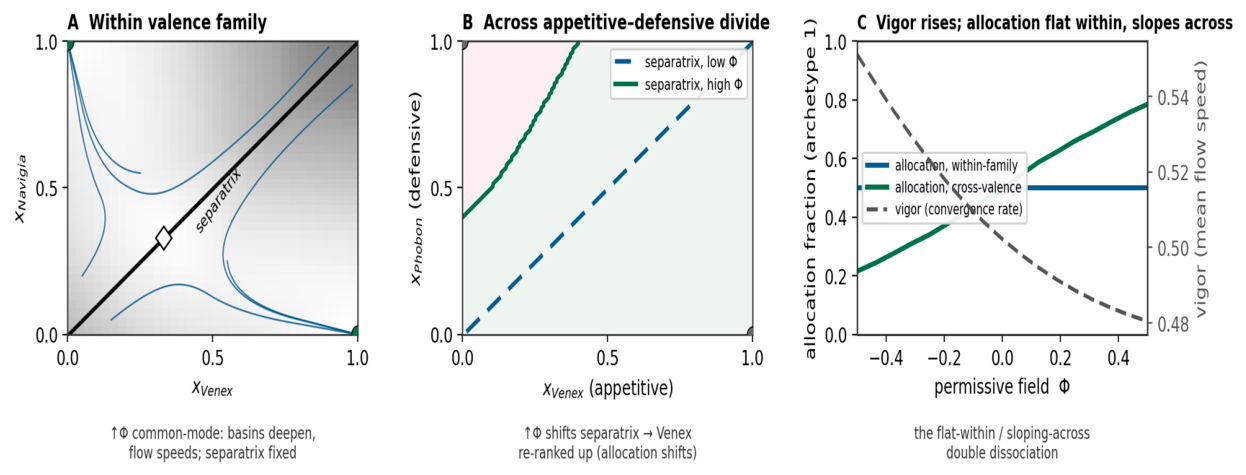
This turns the vigor/allocation dissociation into a geometric statement about attractor basins (Figure 4). A common-mode rise in Φ raises Gᵢ for every appetitive archetype together (all sᵢ > 0), which deepens their basins and speeds convergence—dxᵢ/dt grows, so behavior is executed with more vigor—without moving the separatrix that divides the basins, so which basin is favored, the allocation, is unchanged. Across the appetitive–defensive divide the signs of sᵢ differ, so the same rise moves the two gates oppositely, shifts the separatrix, and re-ranks the competitors. Within-family invariance and cross-valence re-ranking are therefore not two rules but one signed field acting on one competitive geometry: raising Φ sets how deep the basins are and how fast the system commits, while only the signed, cross-valence component changes which basin wins.
Figure 4.
The arbitration layer as a commitment attractor. A two-archetype competitive network, τₐ dxᵢ/dt = −xᵢ + [Gᵢ + w xᵢ − β Σⱼ≠ᵢ xⱼ]₊ with β/w > 1, collapses to a single winner. (A) Within a valence family, a common-mode rise in Φ deepens both basins and speeds the flow (background shading) while the separatrix stays on the diagonal—vigor rises, allocation is invariant. (B) Across the appetitive–defensive divide the signed sensitivities move the gates oppositely, so raising Φ shifts the separatrix and re-ranks the competitors. (C) The resulting flat-within / sloping-across double dissociation: allocation stays constant within a family and slopes across valence as Φ varies, while vigor (mean convergence rate) rises throughout. Parameters w = 0.6, β = 1.4. Under a structural veto (Vᵢ = 0) the production term vanishes and the corresponding basin collapses to the origin, abolishing the behavior categorically.
Figure 4.
The arbitration layer as a commitment attractor. A two-archetype competitive network, τₐ dxᵢ/dt = −xᵢ + [Gᵢ + w xᵢ − β Σⱼ≠ᵢ xⱼ]₊ with β/w > 1, collapses to a single winner. (A) Within a valence family, a common-mode rise in Φ deepens both basins and speeds the flow (background shading) while the separatrix stays on the diagonal—vigor rises, allocation is invariant. (B) Across the appetitive–defensive divide the signed sensitivities move the gates oppositely, so raising Φ shifts the separatrix and re-ranks the competitors. (C) The resulting flat-within / sloping-across double dissociation: allocation stays constant within a family and slopes across valence as Φ varies, while vigor (mean convergence rate) rises throughout. Parameters w = 0.6, β = 1.4. Under a structural veto (Vᵢ = 0) the production term vanishes and the corresponding basin collapses to the origin, abolishing the behavior categorically.
In plain terms: competing programs inhibit one another until one captures output and holds it. Because expression consumes the very drive and cue that opened the gate, the winner eventually yields and the animal alternates.
3.4. Context as a Projection
A second refinement concerns C. The pC1 network of Drosophila, like its vertebrate counterparts, does not read raw sensory channels; it receives convergent input already weighted by behavioral relevance. The context term is therefore best understood as an effective projection rather than a single cue. An animal is exposed to a multidimensional sensory vector C = (visual, olfactory, gustatory, mechanosensory, social, positional), and each archetype samples it through its own weighting function, so the effective context for archetype i is Cᵢ = wᵢ · C, and activation is Rᵢ = Φ Aᵢ Dᵢ (wᵢ · C). A physically unchanged stimulus can then gain or lose behavioral weight as the weighting shifts—the mechanism by which a stable environment is re-projected onto competing archetypal states over the course of a single behavioral episode (Section 3.3).
3.5. The Systema Behavorum
As mentioned in the introduction, the Systema Behavorum, was first described in our foundational ARCH paper (Rahman et al., 2025). It supplies the taxonomy of behavioral archetypes. Unlike behavioral labels (e.g., mating, parenting, feeding), which describe observable actions, the archetypes denote latent computational programs that can be expressed through different motor behaviors in different species. The four species examined—Drosophila melanogaster, Apis mellifera, Astatotilapia burtoni, and rodents—were selected a priori because each pairs a well-characterized repertoire with enough evidence to assign the ARCH × Φ terms comparatively across phyla. The six archetypes analyzed here were likewise chosen a priori from the ten canonical systems as the only ones for which all four species provide sufficient behavioral and neurobiological data: Venex (reproduction), Agonix (competition, dominance, and territorial defense), Hedonix (feeding and reward), Phobon (threat detection and defense), Navigia (exploration and goal-directed navigation), and Theromata (behavioral investment in offspring, caregiving). Predatory attack in rodents is treated as a territorial-resource expression of Agonix rather than a separate archetype, consistent with the original definition. Table 2 summarizes the A, D, C, and Φ assignments across all four species.
The Latinate names are not ornamental substitutes for familiar labels; they distinguish latent execution roles from observed behaviors. “Mating” names a phenotype; Venex names the execution architecture that generates mating when the terms jointly exceed threshold. The distinction has three consequences. A single archetype may encompass behaviors with entirely different motor patterns—male mounting, female lordosis, courtship song, pheromone signaling, and oviposition-site selection all instantiate Venex—while a single observable behavior may belong to different archetypes depending on its terms, as when dominance mounting in A. burtoni expresses Agonix rather than Venex. An archetype persists even when its output is absent: a castrated rodent retains the Venex circuit (A) despite producing no reproductive behavior because Drive (D) equals zero, the zero-term veto made visible. And the archetypes generalize across phyla where behavioral descriptions do not— “mating” denotes four unrelated repertoires in flies, bees, cichlids, and rodents, whereas Venex identifies a conserved functional role realized by different neural implementations. The term archetype is used as a deliberate tribute to Carl Jung, the physician and psychiatrist who developed the concept of archetypes as inherited instinctual patterns expressed in both humans and other animals (Jung, 1959); here, however, archetypes are defined operationally as evolutionarily conserved circuit modules that organize recurrent behavioral functions (Rahman et al., 2025), latent execution architectures that become expressed only when the A, D, C, and Φ conditions jointly exceed threshold.
Viewed comparatively, Table 2 exposes an asymmetry among the four terms. A is archetype-specific: VMHvl ablation abolishes Venex while sparing caregiving; mPOA lesions abolish Theromata while sparing hoarding and exploration; AgRP ablation abolishes Hedonix while sparing other archetypes (Gropp et al., 2005; Luquet et al., 2005). D is likewise archetype-specific: reproductive hormones promote Venex, androgens promote Agonix, oxytocin and prolactin promote Theromata, and corticotropin-releasing factor promotes Phobon. By contrast, Φ is shared across all archetypes within a species. Although implemented by different molecules—ecdysteroids in Drosophila, makisterone A in Apis, allopregnanolone in rodents—each Φ candidate is sterol-derived, each couples organism-wide sterol metabolism to behavioral state, and each is therefore predicted to modulate every archetype simultaneously rather than selectively. This is the structural core of the hypothesis: A, D, and C set the architecture, drive, and contextual gating of individual systems; Φ sets the behavioral readiness of all of them at once.
4. What This Model Explains
The model of Section 3 accounts for every residue identified in Part I. Categorical versus graded failure follows from Vᵢ multiplying the whole production term. History-dependent thresholds follow from the metaplastic term, and both the stickleback odds ratio and the sparrow age function are fit by it without further assumptions. Distributed competition without a decision centre follows from lateral inhibition exceeding self-excitation. Alternation follows from margin consumption, and yields the unfitted prediction that bout length is set by recovery rate rather than by anything about the competing behavior. Hysteresis follows from the attractor structure of the arbitration layer.
This is a complete account of behavioral arbitration, it is supported by four independent reanalyses of data generated by other laboratories, and it contains no permissive field. A reader who stops here has a usable model. Part III exists because one class of observation does not fit it.
Part III. The residual: what arbitration alone cannot explain
5. One Manipulation, Four Behaviors
The model of Part II is built entirely from terms local to each archetype. A, D and C are archetype-specific by construction; the veto, the baseline and the competitive weights all belong to individual programs. That structure makes a firm prediction: any manipulation should act on one program, or on a few, and its effect on the others should follow only from the competition between them. Increasing one program's drive should reduce the expression of its rivals, not raise them.
A recurring class of observation violates this directly.
A hormonally primed female rat encounters a sexually experienced male. She approaches, arches into lordosis, deflects her tail, and signals receptivity. The scent of a snake enters the environment, and within moments the behavioral landscape reorganizes: courtship gives way to vigilance, risk assessment, and defensive withdrawal. The same nervous system now expresses an entirely different state. What changed? Did a different set of circuits engage, or did a shared signal alter the probability that existing circuits would be expressed?
Rodents provide the strongest system for addressing this, because the candidate Φ molecule—allopregnanolone—can be manipulated pharmacologically with exceptional precision. Allopregnanolone is synthesized locally from progesterone through 5α-reductase type I and 3α-hydroxysteroid dehydrogenase, principally within glutamatergic neurons of cortex, hippocampus, and amygdala. The pathway can be suppressed rapidly by 5α-reductase inhibitors or enhanced by focal infusion or stimulation of neurosteroidogenesis. Acting mainly as a positive allosteric modulator of GABAA receptors, allopregnanolone simultaneously alters inhibitory tone across cortical, limbic, and hypothalamic circuits—a plausible physiological substrate for a shared permissive field: one sterol-derived molecule scaling behavioral thresholds across multiple archetypes in parallel.
Can a single molecule make an animal simultaneously more receptive to mating, more willing to explore, less anxious, and more social? If Φ is a shared permissive field rather than a behavior-specific regulator, the answer should be yes. Frye and Rhodes (2008) came remarkably close to performing exactly this experiment. Ovariectomized and adrenalectomized female rats—lacking peripheral steroid sources, and so minimizing both reproductive drive and endogenous Φ—received bilateral infusions of allopregnanolone into the ventral tegmental area and were assessed across four domains: sexual receptivity (Venex), anxiety-related behavior on the elevated plus maze (Phobon), open-field exploration (Navigia), and social interaction. A single infusion enhanced all four, and GABAA blockade with bicuculline abolished the facilitation of all four (Frye et al., 2020). Circuit architecture, motivation, and context were held effectively constant; only Φ varied. No vertebrate experiment has isolated the proposed Φ term more cleanly across multiple archetypes. The findings resist simpler explanations. Enhanced lordosis cannot fully account for increased exploration or social interaction; reduced anxiety cannot explain facilitated reproduction; and generalized locomotor activation is excluded because central open-field entries measure approach rather than locomotion. The data instead suggest the multi-domain scaling expected of a shared permissive field.
Consider what each of the two dominant positions predicts here. Distributed local competition predicts no such coupling, because nothing links the competitors: the model of Part II has no term through which a manipulation could raise four unrelated programs at once. Centralized arbitration predicts re-ranking rather than uniform scaling, because a decision node that changes its output changes which program wins. What is observed is neither. The observation is not that one behavior displaced another; it is that all of them became easier to execute together, while their relative ordering was preserved.
This is the residual, and it is what the remainder of the paper is about. It requires a variable that is shared across archetypes rather than local to any of them, that scales the vigor of whichever program wins without determining which program that is, and that is regulated on a timescale slower than the competition it permits.
6. The Permissive Field
We write that variable Φ and call it a permissive field. The execution equation of Part II becomes Φ · (Aᵢ · Dᵢ · Cᵢ) ≥ θᵢ, with Φ common to all competing archetypes. The consequence that matters is a cancellation: in the ratio of two competing programs, Φ appears in both numerator and denominator and drops out. Raising Φ therefore scales how vigorously the winner is executed while leaving unchanged which program wins.
Formally, the gate of Part II acquires one multiplier and is otherwise unchanged:
with Φ identical across all i. Every result of Part II is recovered by setting Φ to a constant. This is the only change the field makes to the architecture, and it is the reason the two layers can be evaluated separately.
Gᵢ = Vᵢ · σ( kᵢ [ Φ · (Aᵢ · Dᵢ · Cᵢ) − θᵢ ] ),
The first is the zero-term veto. Because the terms multiply, eliminating any single term drives the whole product to zero. A rat with an intact ventromedial hypothalamic (VMH) circuit, appropriate hormonal priming, and a receptive partner still fails to show lordosis once the VMH is lesioned; a Drosophila male with intact circuitry, a receptive female, and appropriate ecdysteroid levels still fails to court once P1 neurons are silenced. Failure is categorical rather than graded—the direct behavioral signature of a multiplicative AND-gate, which an additive integrator would not produce.
The second is the vigor/allocation dissociation. Because Φ cancels in the ratio of two competing archetypes, a manipulation that changes only Φ scales the vigor of execution while leaving competitive ordering unchanged. This is the defining prediction of the Φ-field hypothesis, and, as developed below, its scope can be stated precisely.
A definitional point is required before these consequences can be relied on. Φ is not a molecule, and it is not a hormone titer. It is the component of a signal's action that is common to the archetypes in competition—the part that multiplies every term alike. The distinction is forced by the biology rather than adopted for convenience, because the molecules that implement Φ are multiplexed. Ecdysteroid acts through the nuclear receptor EcR on a genomic timescale and through DopEcR, a G-protein-coupled receptor binding both dopamine and ecdysone, on a non-genomic one (Srivastava et al., 2005); progesterone acts through nuclear PR while its 5α-reduced metabolite acts within seconds at extrasynaptic GABAA receptors, and sulfated neurosteroids act in the opposite direction at the same site. One precursor pool therefore carries several messages along different receptor routes, on different timescales, to different targets.
The consequence for the framework is exact. Only the shared component belongs to Φ; receptor-specific or target-specific actions of the same molecule belong to A, D or C according to what they modulate. Cancellation of Φ from the allocation ratio pk / pj holds for the shared component and for nothing else, so a manipulation of hormone titer is not by itself a manipulation of Φ. Where a sterol adjusts the sensitivity of the sensory channel that identifies a target, that effect enters C and is expected to re-rank alternatives; where it scales readiness across archetypes alike, it enters Φ and is not. This is the same discipline within a species that the conservation claim applies across species: the framework identifies a functional role rather than a chemical species, and accepts the burden of showing that a given manipulation isolates that role. Section 3.2 examines a case in which it demonstrably does not.
Box 1. Criteria for a Φ field.
A variable qualifies as Φ only if it satisfies all five conditions below. Signals that meet some but not all are effector-layer modulators and belong to A, D or C. Two worked exclusions follow in Section 7.1 and Section 7.4.
(i) Shared. It acts on every competing archetype rather than on one. A signal released from specific terminals onto specific targets is excluded by this criterion alone.
(ii) Non-directional. It scales the vigor of whichever program wins without determining which one wins. A variable that reliably favors one archetype over another is a Drive or Context term, not a field.
(iii) Sterol-derived. Its implementer is cholesterol-derived in vertebrates, or isoprenoid-derived in lineages that do not synthesize sterols. This restriction is substantive, not definitional, and is defended in Section 6.1.
(iv) Tonic and extrasynaptic in action. It sets a background conductance or permissiveness rather than carrying phasic, information-bearing signals.
(v) Slow relative to what it gates. Its recovery timescale exceeds that of the competition it permits, which is what allows it to bias execution without participating in selection.
Applied to two candidates the framework rejects: striatal dopamine in Parkinson's disease fails (iii) and (iv), and its depletion re-ranks rather than uniformly scales, so it fails (ii); cortisol in Astatotilapia fails (ii), acting as a directional suppressor of a specific archetype rather than a permissive multiplier. Both are excluded on stated grounds rather than by convenience.
6.1. Why Sterols
The restriction of Φ to sterol-derived signals is not an arbitrary choice of molecule. In both lineages considered here the nervous system maintains a sterol economy segregated from the rest of the body, though by opposite means. The mammalian brain holds roughly a quarter of the body's cholesterol in some two percent of its mass, and synthesizes nearly all of it locally, because the blood–brain barrier excludes plasma lipoprotein cholesterol. Insects cannot synthesize the sterol nucleus at all; they acquire it from the diet and allocate it preferentially to nervous tissue when supply is restricted (Jing & Behmer, 2020). The same logic operates outside arthropods: in Caenorhabditis elegans a cholesterol-derived ligand acting through the nuclear receptor DAF-12 gates the dauer decision, a sterol-dependent switch between alternative developmental programs (Motola et al., 2006). The mammalian figure is dominated by myelin, a structural pool with a half-life measured in years and kinetically distinct from the small precursor pool that feeds neurosteroid synthesis; insects have no myelin, so no comparable sink obscures the signaling pool. What the two cases share is that the tissue in which archetypes compete regulates its sterol supply separately from the tissue around it.
That property is what a permissive field requires. To arbitrate among programs rather than merely drive one, a variable must be shared across the competing circuits, regulated independently of the sensory input that selects between them, and slow relative to the events it gates. A transmitter released from specific terminals onto specific targets fails the first condition by construction. A locally regulated sterol pool acting at extrasynaptic receptors satisfies all three as a matter of physical organization rather than of correlation. The evolutionary and biophysical case for this identification—the separation of stored drive from discharge permissiveness at the origin of sterol biosynthesis—is developed elsewhere (Rahman & Zorumski, 2026); here we take it as established and ask what follows for behavior when several programs compete beneath one such field.
6.2. The Regional Sign
The model predicts that Φ scales vigor without re-ranking alternatives within a valence family—appetitive or defensive—but not necessarily across it, because Φ is regionally signed across the appetitive–defensive divide. Allopregnanolone is functionally disinhibitory in the ventral tegmental area, facilitating approach, yet inhibitory in the basolateral amygdala, suppressing aggression and fear. A global rise in neurosteroid tone can therefore enhance appetitive behaviors while reducing defensive ones, re-ranking across valence while preserving allocation within each family.
We make this explicit by writing the effective threshold of archetype i as
where the sensitivity sᵢ carries the sign of the archetype’s valence: sᵢ > 0 for appetitive archetypes (Venex, Navigia, Hedonix, Theromata), so rising Φ lowers their threshold, and sᵢ < 0 for defensive archetypes (Phobon, and the defensive expression of Agonix), so the same rise raises theirs. The gate becomes
θᵢ(Φ) = θᵢ⁰ − sᵢ Φ,
Gᵢ = Vᵢ · σ( kᵢ [ Aᵢ · Dᵢ · Cᵢ − θᵢ⁰ + sᵢ Φ ] ).
Crucially, the sign of each sᵢ is fixed a priori by regional pharmacology—the disinhibitory action of the neurosteroid in approach-related nodes (VTA, mPOA) versus its inhibitory action in defensive nodes (BLA, and downstream of CRF drive)—not assigned after the behavior is observed. Within a valence family the sensitivities share a sign, so a change in Φ shifts competing gates in common mode and leaves their ordering—the allocation—unchanged while scaling their vigor together. Across the appetitive–defensive divide the signs differ, so the same change moves the two gates oppositely and re-ranks them. Within-family allocation invariance and cross-valence re-ranking are thus two faces of a single signed field, not two independent assumptions.
In plain terms: Φ does not decide which behavior happens. It makes every behavior of a given valence easier to execute, and the sign of that effect flips between appetitive and defensive circuits.
6.3. State-Dependent Sensitivity
The linear form θᵢ(Φ) = θᵢ⁰ − sᵢΦ is a local approximation. The sterols that implement Φ act biphasically at their receptors: allopregnanolone, for example, potentiates GABAA transmission across most of its physiological range but reverses toward paradoxical effects at the extremes of concentration or during rapid fluctuation. We therefore treat the sensitivity as state-dependent, sᵢ = sᵢ(Φ), with a minimal non-monotonic form,
sᵢ(Φ) = sᵢ⁰ [ 1 − (Φ / Φ*ᵢ)² ].
For |Φ| well below the turning point Φᵢ the shift reduces to the linear −sᵢ⁰Φ; beyond it the effective sensitivity changes sign, and a further rise in Φ paradoxically reverses the gate. The linear model is the small-Φ limit. Whether Φᵢ lies inside the physiological range is an empirical, per-archetype question rather than an assumption, and it marks the regime in which even within-family invariance is expected to break. When Φ drives the bracket deeply negative and the effective sensitivity changes sign, this should be read as a breakdown of the field’s permissive action at that site—the paradoxical GABAA effects and receptor internalization documented at extreme neurosteroid concentrations—not as a functional re-assignment of an appetitive archetype to defensive status. The regional sign of Section 6.2 is fixed by anatomy (VTA versus BLA), which a concentration excursion does not reverse; what fails past Φᵢ is coherent gating, not valence identity. The super-Φᵢ regime therefore lies outside the model’s domain of validity—the pathological range of PMDD/PPD-type states—rather than defining a literal inversion the arbitration network is expected to compute.
In plain terms: the permissive field helps only within a working range. Pushed far beyond it, the same signal stops facilitating and begins to impair, which marks the edge of the model’s domain of validity rather than a reversal of valence.
What happens in the arbitration layer at this boundary is worth stating explicitly, because two different things could be meant. The basin geometry does not invert. A negative sᵢ reduces the input bias Gᵢ that a unit contributes to the competition; it does not convert an appetitive attractor into a defensive one, and it does not exchange the positions of two basins. What collapses is depth, not identity. If Φ rises past the turning point for every archetype at once, all basins shallow together, the winner-take-all layer loses the margin that separates them, and the system tends toward a state in which no archetype is reliably selected—behavioral arrest rather than a different behavior.
The consequential case is the asymmetric one. Because Φ*ᵢ is indexed by archetype, the archetypes with the lowest turning points enter the reversing regime first, while the others are still being facilitated. In that window the shared multiplier no longer acts identically on all competitors, so the cancellation from the allocation ratio pₖ / pⱼ fails and allocation can shift. The flat-within, sloping-across prediction of Section 6.4 is therefore bounded, and we state the bound rather than leave it implicit: it holds for Φ below the smallest Φ*ᵢ among the competing archetypes, and not above it.
This is a prediction rather than an escape. It says that states of extreme or rapidly fluctuating neurosteroid tone—the regimes invoked clinically for premenstrual dysphoric disorder and the postpartum period—should show exactly what ordinary variation in Φ does not: re-ranking within a valence family, and a narrowing rather than a shifting of the behavioral repertoire. A framework in which allocation shifted at all values of Φ would be unfalsifiable by the criterion of Section 6.4; one in which it never shifted could not accommodate these states. The turning point is where the two regimes meet.
6.4. The Falsifying Signature
The formulation is falsifiable in a way that distinguishes it from its nearest rivals. For two competing archetypes k and j, the relative allocation is
because the shared Φ term cancels. Manipulating Φ alone should therefore change behavioral vigor while leaving relative allocation unchanged. Generic gain-control models predict the vigor change but make no commitment about allocation. Temperature-like selection models predict that increasing a global signal sharpens choice, progressively favoring the dominant option. Additive-threshold models predict that deficits in one term can be compensated by surpluses in another, allowing allocation to shift continuously. The present framework predicts neither compensation nor sharpening within a valence family, but rather stable allocation with increasing vigor; because Φ is regionally signed across the appetitive–defensive divide, it further predicts systematic re-ranking across valence. This flat-within, sloping-across double dissociation distinguishes the framework from its principal alternatives.
6.5. What Is Conserved
The stronger claim is architectural, not molecular. We do not propose that insects and vertebrates use the same sterol or receptor, but that they implement the same computational role through different molecular solutions: ecdysteroids in Drosophila, makisterone A in the honey bee, allopregnanolone in rodents. These molecules differ chemically, yet each is sterol-derived, each couples organism-wide physiological state to neural excitability, and each is positioned to influence multiple systems at once. The conserved feature is the architecture—a sterol-derived signal that globally modulates permissiveness while leaving behavioral identity to A, D, and C. Two boundary cases sharpen what the restriction excludes: cichlid cortisol is sterol-derived but directional (Section 7.4), while dopaminergic modulation in Parkinson’s disease is coordinated and multi-archetype but not sterol-derived (Section 7.1)—a Φ-like signature and a sterol origin are each necessary, neither alone sufficient.
Whether this reflects deep homology or convergence remains unresolved, and the two make different predictions. If sterol-derived neurosteroids scale vigor while preserving allocation in amphibians or basal teleosts, the coupling likely predates the tetrapod radiation, supporting deep homology within the deuterostome lineage; if the signature first appears in tetrapods, behavioral recruitment of the pathway is younger and more consistent with convergence. A. burtoni occupies exactly the phylogenetic position where these hypotheses can be distinguished, so the neurosteroid manipulation of Section 7.4 is simultaneously a test of Φ and a test of evolutionary history.
Figure 5.
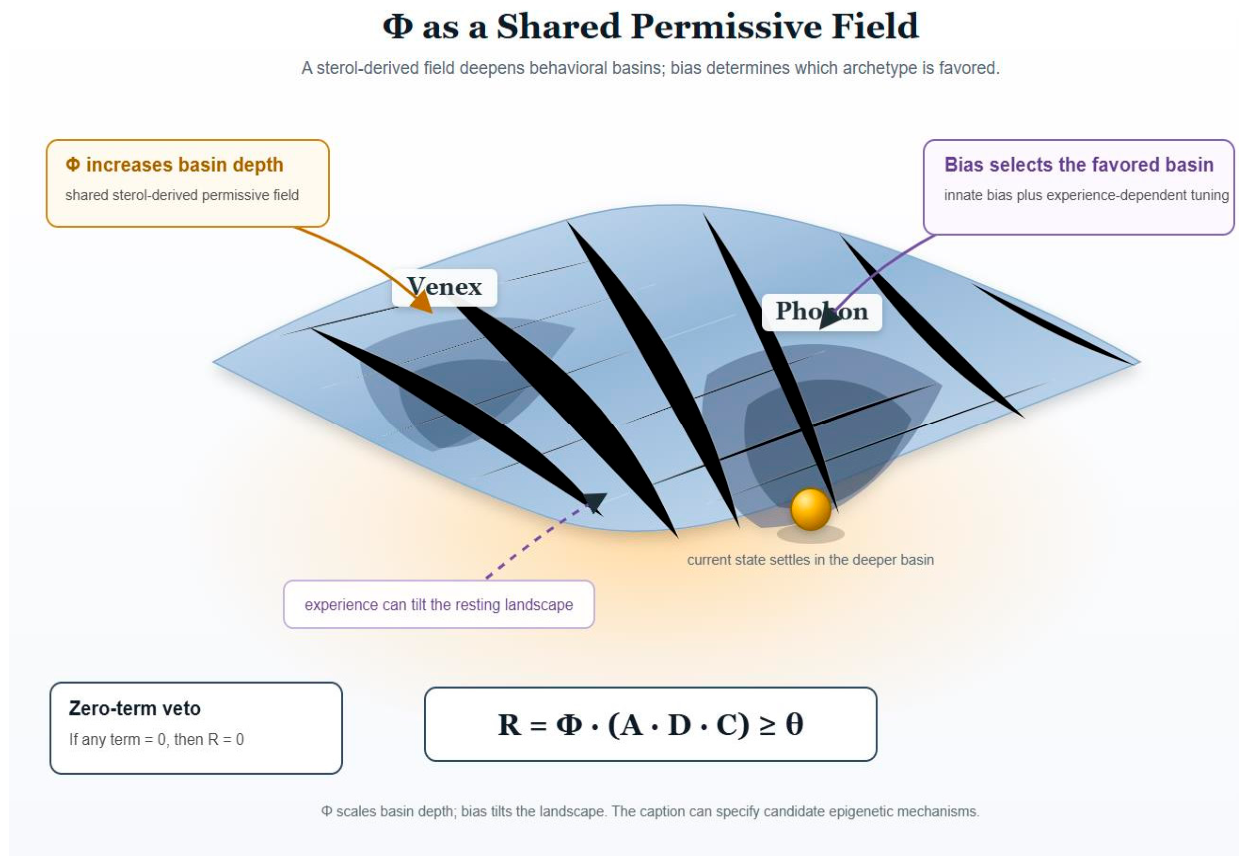
Φ as a proposed sterol-derived value landscape gating competing archetypes. Two archetypes (here Venex and Phobon) appear as competing basins; behavioral state settles into the deeper basin once it clears the commitment threshold θ. A shared sterol field scales basin depth—raising Φ deepens both basins together (vigor up) while preserving their relative ranking (allocation stable). The resting bias is treated as innate and potentially written by experience, a value landscape in the spirit of Lewin’s field theory rather than a spatial metric: the axes do not move, only depth over them. Under the zero-term veto, loss of any term flattens the basins to the plane and execution fails.
Figure 5.
Φ as a proposed sterol-derived value landscape gating competing archetypes. Two archetypes (here Venex and Phobon) appear as competing basins; behavioral state settles into the deeper basin once it clears the commitment threshold θ. A shared sterol field scales basin depth—raising Φ deepens both basins together (vigor up) while preserving their relative ranking (allocation stable). The resting bias is treated as innate and potentially written by experience, a value landscape in the spirit of Lewin’s field theory rather than a spatial metric: the axes do not move, only depth over them. Under the zero-term veto, loss of any term flattens the basins to the plane and execution fails.
7. The Evidence, Graded Honestly
The field hypothesis is supported unevenly, and we state the gradient rather than smoothing it. Evidence is strongest in rodents, where the implementer is identifiable and the multi-domain result of Section 5 was obtained. It is suggestive but unresolved in the cichlid. In insects it is indirect, and one widely cited result runs against the prediction rather than for it. We take each in turn.
7.1. Rodents
5.3 Allopregnanolone and Agonix: when isolation rewrites behavior
House a male mouse alone for several weeks and his priorities change: more aggression toward intruders, more fear of threats, less interest in social contact—a coordinated reorganization, not a set of isolated changes. Pinna et al. (2003) and Nelson and Pinna (2011) traced this to a common neurosteroid mechanism. Four weeks of isolation reduce brain allopregnanolone by roughly half through selective downregulation of 5α-reductase type I in olfactory bulb, cortex, and amygdala; simultaneously, resident-intruder aggression rises, conditioned fear intensifies, and affiliation declines. Restoring allopregnanolone—or locally stimulating its synthesis within the basolateral amygdala—normalizes all three, and intra-amygdala pregnanolone reduces aggressive attacks by as much as 96%.
These results also fix the limits of the hypothesis, and they are where the regional sign earns its place. A naïve model predicts that lowering Φ uniformly reduces every output. Instead aggression increases. Within the basolateral amygdala allopregnanolone normally suppresses aggression-related output, so lowering Φ releases defensive circuitry from inhibition (sₚ < 0), while chronic isolation elevates Agonix and Phobon drive through territorial sensitization and sustained stress. The escalation reflects a regionally signed Φ field interacting with changing drive, not a uniform lowering of thresholds—precisely the cross-valence condition in which Φ re-ranks priorities, and the empirical anchor for the a-priori sign assignment of Section 6.2.
5.4 Theromata: a mother hears her pup
A pup wanders from the nest, and within seconds its mother retrieves it, rebuilds the nest, licks and grooms, nurses, and repels intruders. Few states are as coherent, or as essential, as maternal care. Excitotoxic lesions of the medial preoptic area (mPOA) abolish pup retrieval and nest building while leaving hoarding, home-cage activity, and elevated-plus-maze behavior largely intact (Numan, 1988; Numan et al., 2005): the caregiving archetype disappears even though hormonal state and pup cues remain permissive—a hard A-term veto.
The same logic extends across species. Insel and Shapiro (1992) asked why some voles form enduring pair bonds and biparental families while close relatives do not. Monogamous, biparental prairie and pine voles express dense oxytocin and vasopressin receptors in nucleus accumbens, prelimbic cortex, and bed nucleus of the stria terminalis; polygamous, non-parental meadow and montane voles concentrate these receptors in lateral septum and ventromedial hypothalamus. When normally non-parental montane voles briefly become parental after parturition, receptor distributions shift toward the prairie pattern. Receptor architecture predicts both species differences and transient state—a naturally occurring demonstration of the A term—and blockade of accumbens oxytocin receptors abolishes partner preference, completing the causal chain. Finally, a sterol-derived mechanism gates the onset of motherhood: allopregnanolone rises through pregnancy and falls sharply before parturition, altering GABAA function in magnocellular oxytocin neurons and across hippocampal and frontal circuits to help trigger maternal behavior (Brunton et al., 2009; Russell & Brunton, 2009). The same sterol-derived field that scales Venex, Navigia, Phobon, and social interaction in the Frye experiments thus also gates the transition into caregiving, extending Φ to a sixth archetype through a common mechanism.
5.5 Human neuroendocrine cases: term isolation in the clinic
Two human clinical phenomena isolate ARCH terms as cleanly as any experimental manipulation, and they do so in opposite ways. The first, antipsychotic-induced hyperprolactinemia suppresses sex steroids, and the drive-term of Venex. Dopamine D₂-receptor blockade removes the tonic dopaminergic inhibition of pituitary lactotrophs, prolactin rises—often ten-fold—and elevated prolactin suppresses the GnRH–gonadal axis, so sexual desire falls while the reproductive circuit and the partner cue remain intact (Haddad & Wieck, 2004). In the framework this is a graded D-veto: with A, C, and Φ permissive, driving the D factor of the Venex margin down closes the gate, G_Venex = Vᵥ·σ(k[A·D·C − θ⁰ + sΦ]) with D↓, and the behavior fails by loss of drive rather than categorically. The accompanying galactorrhea is the diagnostic tell that this is a directional signal and not a permissive field: prolactin suppresses one archetype while driving lactation, the single-target, directional profile that separates a D-like signal from Φ—the mammalian parallel of the cichlid cortisol case (Section 7.4). Discontinuation reverses the chain: prolactin falls, the gonadal axis disinhibits, D_Venex recovers, and the gate clears threshold again—a clinically consequential term restoration, since libido returns alongside unopposed fertility in patients who are often not counseled to expect it. Prolactin has central actions that also touch contextual salience, so the isolation is predominantly, not exclusively, on D; we note the confound rather than claim a single-term manipulation.
The second, Parkinson’s disease, is instructive precisely because it produces a Φ-like signature and is nonetheless excluded from Φ. Nigrostriatal dopaminergic loss lowers behavioral vigor across many archetypes at once—bradykinesia and akinesia alongside apathy, anhedonia, reduced exploration, and blunted libido—while the underlying circuits remain structurally present and dopaminergic replacement restores them. That graded, multi-archetype, motor-pattern-preserving profile is the one the framework attributes to a lowered permissive field, not the categorical single-archetype collapse of an A-term veto. The treatment makes the effect bidirectional: in a susceptible fraction of patients, dopamine agonists and levodopa produce impulse-control disorders—pathological gambling, hypersexuality, compulsive buying and eating—in which several appetitive archetypes scale up together under one pharmacological manipulation (Weintraub et al., 2010). Low dopaminergic tone yields coordinated appetitive hypoactivity; high tone yields coordinated appetitive hyperactivity; the vigor axis moves in both directions within the appetitive family under a single manipulation. Yet Parkinson’s is not a Φ manipulation. Dopamine is the monoaminergic effector layer through which A, D, and C operate, not a sterol-derived field, and the sterol restriction that defines Φ excludes it. Parkinson’s is therefore the mammalian mirror of the cichlid control: where A. burtoni cortisol is sterol-derived but directional and so fails the criterion, dopaminergic modulation is coordinated and multi-archetype but not sterol-derived and so fails it too. Together the two cases show that a Φ-like functional signature is necessary but not sufficient—molecular identity is the additional constraint. The impulse-control data, though striking, are heterogeneous and agonist- and dose-dependent, and are offered as consistent with coordinated appetitive scaling rather than as a demonstration of it.
7.2. Drosophila Melanogaster
3. Drosophila melanogaster: Ecdysteroids and the pC1 Social Behavior Network in Fruit Flies
3.1 The behavioral architecture
A male Drosophila mid-courtship is in continuous arbitration. He taps the female, samples her cuticular hydrocarbons, extends a wing to sing, and monitors her receptivity. A looming shadow appears. The threat cue does not silence the courtship circuit; it activates the escape circuit until escape becomes the deepest accessible state. What determines the winner is Context: the circuit substrate, the drive, and the theorized sterol field remain constant across the transition.
The underlying machinery is well defined. Two sex-determination genes, fruitless (fru) and doublesex (dsx), specify much of the sexually dimorphic circuitry governing male social behavior. The male-specific fru isoform is expressed in roughly 2,000 neurons that direct the development and function of courtship and aggression circuits, whereas dsx labels a smaller population forming the core social-decision network. These genes matter here not because they determine behavior directly but because they mark circuits that can be identified, manipulated, and causally linked to behavior.
At the center lies the doublesex⁺/pC1 social-behavior network: a small cluster of sexually dimorphic protocerebral interneurons that integrate pheromonal, gustatory, mechanosensory, and visual cues with internal state to compute behavioral choice. Within it, P1 neurons—a male-specific subset expressing both fru and dsx—promote courtship song and copulation (Venex). Remarkably, the same network supports inter-male aggression (Agonix). Hoopfer et al. (2015) showed that lower P1 activation favors aggression and higher activation favors courtship, with target identity biasing the outcome. The fly computes alternative social behaviors from a shared decision network rather than switching between dedicated circuits—a pattern consistent with the structural separability of the ARCH terms: A remains constant while D and C determine which archetype is expressed.
How is this shared circuit globally tuned? Here the ecdysteroid system offers a plausible Φ mechanism. The adult ecdysone receptor isoform EcR-A is expressed in fru⁺ neurons throughout the network. Reducing EcR-A increases male–male courtship (Dalton et al., 2009), consistent with Φ depletion lowering the threshold that separates Venex from Agonix rather than altering circuit or drive. A complementary pathway runs through DopEcR, a G-protein-coupled receptor that binds both dopamine and ecdysone and mediates rapid, non-genomic ecdysteroid signaling (Srivastava et al., 2005). The genomic action of EcR-A and the rapid signaling of DopEcR together provide complementary routes by which a shared sterol-derived field could tune arbitration across the network.
3.2 The ecd1 evidence
The most direct published test of Φ in adult Drosophila behavior is Ganter et al. (2011), who used the temperature-sensitive ecd1 allele to acutely deplete adult ecdysteroids. Depletion elevated male–male courtship, and dietary 20-hydroxyecdysone supplementation reduced male–male attraction. The pattern of what did not change is where the result becomes demanding. Locomotor activity in depleted males was comparable to wild type, courtship song patterns were unaltered, and attraction to females was preserved; what moved was the choice of target. Measured against the framework, this is the wrong way round. Φ is predicted to scale vigor while leaving allocation within a valence family intact, and here allocation shifted while vigor did not.
Two readings are available, and the evidence does not yet select between them. The first denies that this is an allocation effect at all. If ecdysteroid signaling sets the sensitivity of the chemosensory neurons that identify a suitable target, then depletion degrades the specificity of mate recognition rather than re-ranking archetypes, and elevated male–male courtship is a failure of discrimination—an effect on C rather than on Φ. Independent evidence supports that route: ecdysis-triggering hormone acts directly on primary chemosensory neurons, and knockdown of its receptor in GR32A-expressing neurons reduces ligand sensitivity and elevates male–male courtship (Meiselman et al., 2022). The second reading takes the observation at face value and accepts that adult ecdysteroid acts here on a term other than Φ. On either reading the ecd1 result should not be counted as confirmation of the vigor/allocation dissociation, and we do not count it as such.
The limitation is equally clear. The ecd1 experiments examined only a pairwise choice, comparing male–male against male–female courtship without simultaneously assaying Hedonix, Navigia, or Phobon. They therefore cannot determine whether ecdysteroid depletion selectively re-ranks courtship or globally alters readiness across archetypes. Adult ecdysteroid signaling does extend beyond the social network—20-hydroxyecdysone increases sleep, EcR loss reduces it, and adult signaling in cortex glia contributes to sleep regulation (Ishimoto & Kitamoto, 2010; Li et al., 2023)—but sleep lies outside the present taxonomy and has not been assayed concurrently with other archetypes. The defining Φ prediction—that perturbing Φ simultaneously modulates the vigor of multiple systems while preserving within-family allocation—therefore remains untested in Drosophila. A graded adult-stage ecdysteroid manipulation with simultaneous measurement of multiple archetypes is the critical falsifiable experiment proposed in Section 9.
3.3 Cazalé-Debat and the dynamic threat gate
Cazalé-Debat et al. (2024) provide one of the clearest demonstrations of a dynamically regulated C term. Early in courtship, looming stimuli activate LC16 visual projection neurons, which inhibit the courtship network through serotonergic interneurons and drive escape. As courtship advances, dopaminergic modulation progressively attenuates this threat pathway, so a threat that reliably interrupts early courtship fails to interrupt late courtship—not because escape circuitry changed (A constant) or motivation shifted (D unchanged), but because the contextual weighting of the threat cue (C_Phobon) was progressively attenuated.
How can the same circuit respond differently to the same stimulus? The pC1 network does not read raw sensory channels; it receives convergent, already-weighted input. The C term represents the integrated weighting of many simultaneous cues, not a single stimulus. As courtship advances, the weight on the looming stimulus falls while the weight on female reproductive cues rises, letting the same network compute different outcomes from an unchanged environment. In the projection form Rᵢ = Φ Aᵢ Dᵢ (wᵢ · C), the looming stimulus remains physically constant, but its weight in the Phobon projection decreases while the Venex-relevant weight increases. The transition is a change in the projection of a stable sensory environment onto competing archetypes—in effect, the lure of the female eventually outweighs the threat of the swatter—while Φ holds constant throughout.
3.4 Theromata: from mate acquisition to offspring investment
If Drosophila provides no parental care, why include Theromata (reproductive investment and caregiving archetype)? Because Theromata denotes the allocation of investment toward offspring success, with caregiving as only one implementation. Flies lack a mammalian-style caregiving circuit, yet they undergo a striking post-mating transition in which effort is reallocated from mate acquisition to offspring investment. After mating, the male transfers Sex Peptide, which acts through its receptor in sensory neurons co-expressing fru and dsx; receptivity declines, oviposition rises, and the female shifts from seeking mates to selecting and provisioning egg-laying sites (Häussmann et al., 2013; Yang et al., 2009; Chapman et al., 2003). Resources devoted to mate acquisition are redirected toward offspring survival—functionally the same adaptive niche as mammalian caregiving.
Two observations support this reading. The post-mating transition is mediated by the same fru/dsx network that governs Venex and Agonix, so Theromata is an alternative state of a shared substrate rather than a distinct circuit. And the transition changes allocation while leaving the motor repertoire largely intact, matching the activation-layer prediction. What remains missing is the decisive Φ experiment: if adult-stage manipulation of ecdysteroid signaling proportionally scales the vigor of this reproductive reallocation without altering its allocation, the case for Theromata as a Φ-regulated archetype would be substantially strengthened. Until then, Drosophila Theromata is best regarded as a well-characterized reproductive-investment program whose regulation by Φ is a clear, testable prediction.
7.3. Apis Mellifera
4.1 The waggle dance and collective decision-making
A forager returns carrying nectar gathered kilometers away. Rather than simply depositing it, she climbs onto the comb and dances, her body tracing a figure-eight whose central waggle run encodes the direction and distance of the source. Workers surround her, antennating her abdomen and departing for places they have never visited. The waggle dance is among the most sophisticated symbolic communication systems outside our own species.
Yet the dance poses the Drosophila problem again. At any moment a worker can nurse larvae, guard the entrance, exploit a familiar source, investigate a new one, or rest. The colony rarely fragments into incompatible states; thousands of individuals self-organize into coherent divisions of labor without central control. Within ARCH × Φ, the waggle dance is the Apis expression of Navigia and brood care is Theromata, and together they let us ask how a shared physiological state might coordinate transitions between archetypes at colony scale.
4.2 Nursing as Theromata
Most workers begin life deep in the hive, feeding thousands of larvae. A young nurse inspects brood cells, responds to hungry larvae, and produces protein-rich hypopharyngeal-gland secretions. Within ARCH × Φ, nursing is the Apis expression of Theromata (reproductive investment, caregiving). The hypopharyngeal gland is the principal A-term effector. Context (C) is supplied by brood ester pheromone together with the volatile brood signal e-β-ocimene, which suppress ovarian activation while stimulating gland development, biasing workers toward brood care (Maisonnasse et al., 2010; Traynor et al., 2014). Drive (D) is the colony’s demand for nursing, signaled by larval presence and nutritional need.
The Φ connection is unusually direct. Makisterone A, an ecdysteroid synthesized from the dietary phytosterol campesterol through the Halloween pathway, promotes hypopharyngeal-gland autophagy (Corby-Harris et al., 2019; Yamazaki et al., 2011), dismantling the nurse phenotype as workers transition to foraging. Because honeybees cannot synthesize cholesterol from phytosterols, the endocrine state governing this transition is constrained directly by pollen sterols. The colony’s behavioral organization is thus coupled to its nutritional ecology: the proposed permissive field lies literally downstream of dietary sterol availability.
4.3 The waggle dance as Navigia (navigation)
For ARCH × Φ, the dance affords an unusually clean test of the vigor/allocation dissociation, because both variables can be measured independently. Allocation asks whether a forager advertises a resource at all; vigor asks how strongly she advertises it—through dance duration, waggle-run precision, and recruitment success. Barron et al. (2007) manipulated the drive term via octopamine: dance vigor increased at lower octopamine doses than dance initiation, an explicit dissociation between vigor and allocation, and mianserin abolished the enhancement, confirming that D scales Navigia vigor without re-ranking resource preference.
Scofield and Mattila (2015) moved one step upstream, toward Φ. Bees reared on pollen-deficient diets emerged with impaired foraging and less precise waggle dances. Within ARCH × Φ we read this as a sterol-substrate limitation: dietary phytosterols constrain makisterone A synthesis and reduce the colony-wide permissive field. The prediction follows directly—both dance vigor and precision should decline together while preference among competing sources is preserved—and the available evidence is consistent with it, though nutritional confounds remain unresolved and await sterol-specific holidic diets.
4.4 RoboBee and the minimal context
How much of the dance is actually required? Landgraf et al. (2018) replaced the living dancer with a robot that reproduced core dance-borne cues. The robot elicited natural dance-following, and harmonic-radar tracking confirmed that followers departed along the advertised heading. Because the robot reproduced an incomplete cue set and recruitment was weak relative to a living dancer, the experiment bounds C_Navigia from below: a reduced, sub-maximal contextual projection already suffices to clear threshold and engage Navigia, while the weak recruitment shows the full biological cue set is a stronger, supra-robotic projection. In the projection form of Section 3.4, the robot is a small-‖wᵢ · C‖ input that nonetheless crosses θ—evidence of sufficiency, not of a ceiling.
7.4. Astatotilapia Burtoni: The Unresolved Case
Section 2.6 left one question open. The dominant sterol signal during ascent is cortisol acting through the CRF/HPA axis. As males ascend, CRF signaling falls rapidly within the preoptic area (Carpenter et al., 2014), releasing GnRH1 neurons from inhibition and activating the reproductive axis. This is best read as directional gating rather than a shared permissive field: cortisol behaves like a suppressive D term, not an allopregnanolone-like Φ. Rather than weakening the framework, the distinction strengthens it. Not every sterol-derived molecule qualifies as Φ, and A. burtoni supplies a clear example of a sterol that regulates direction rather than global permissiveness.
The decisive experiment is straightforward. The cichlid brain expresses 5α-reductase and synthesizes neurosteroids. If manipulating a 5α-reduced neurosteroid selectively scales the vigor of social ascent—the intensity and persistence of territorial display, courtship, and coloration—without altering whether ascent occurs when opportunity is present, then A. burtoni would satisfy the defining prediction of a Φ field. Until that experiment is done, the Φ entry for A. burtoni remains a deliberately flagged candidate rather than established evidence.
Figure 6.
Φ-implementer conservation across four species. Each lineage gates a multi-archetype behavioral landscape through a chemically distinct sterol-derived signal: ecdysteroids in Drosophila, makisterone A in Apis, allopregnanolone in rodents, with cortisol/CRF a directional candidate in A. burtoni. Filled circles mark characterized archetypes. The shared prediction—Φ scales vigor across archetypes while preserving allocation rank—is the unifying test, strongest in rodents and untested under simultaneous multi-archetype assessment in the insect systems.
Figure 6.
Φ-implementer conservation across four species. Each lineage gates a multi-archetype behavioral landscape through a chemically distinct sterol-derived signal: ecdysteroids in Drosophila, makisterone A in Apis, allopregnanolone in rodents, with cortisol/CRF a directional candidate in A. burtoni. Filled circles mark characterized archetypes. The shared prediction—Φ scales vigor across archetypes while preserving allocation rank—is the unifying test, strongest in rodents and untested under simultaneous multi-archetype assessment in the insect systems.
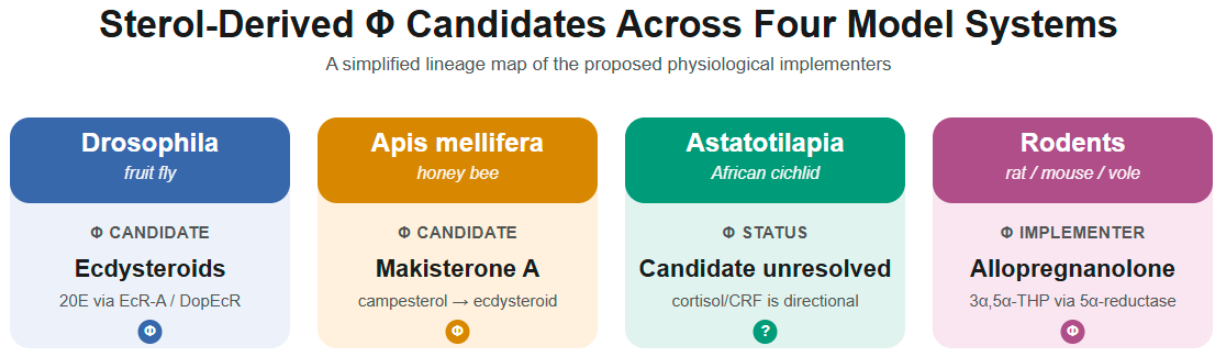
7.5. The Pattern Across Systems
7.1 Term perturbations
Table 3 organizes the comparative evidence by the ARCH term that was experimentally manipulated rather than by species. Several patterns emerge at once. A, D, and C have been isolated across all four species, often with remarkable precision; by contrast Φ remains unevenly supported—strongest in rodents, suggestive but indirect in insects, and a candidate in Astatotilapia burtoni. Among the individual experiments, several stand out as canonical. AgRP optogenetic activation gives perhaps the clearest D-term isolation in any vertebrate, driving feeding in sated animals while food availability is unchanged. The mPOA lesions of Numan and the VMHvl lesions of Pfaff give the clearest A-term zero-vetoes, each abolishing one archetype while sparing its neighbors. The vole studies of Insel and Shapiro extend the A term to naturally occurring, state-dependent variation in circuit architecture. And the Frye and Rhodes design remains unique in isolating Φ across multiple domains at once while holding A, D, and C constant—an isolation no insect experiment yet matches.
7.2 The zero-term veto
Table 4 organizes the evidence by predicted mode of failure. Hard vetoes—perturbing a single term abolishes execution—are well established for A, D, and C across species; the clearest are the mPOA lesions of Numan and the VMHvl lesions of Pfaff, each abolishing one archetype while leaving neighbors intact and other terms permissive. Φ produces a different signature: rather than collapsing behavior to zero, perturbing Φ scales the strength of execution. Behaviors weaken rather than vanish, the motor pattern is preserved, and within a valence family the ordering of competitors is unchanged. Hard vetoes characterize failures of A, D, or C, formalized through Vᵢ and the collapse of a graded term; graded modulation without re-ranking is the characteristic signature of Φ.
Table 4.
Zero-term veto evidence across four species (condensed).
| Species | Archetype | Term → 0 | Outcome | Veto type |
| Drosophila | Venex | C (male target at fixed P1) | Courtship blocked; aggression substitutes; motor programs intact | Hard |
| Apis | Navigia | D (mianserin, OA antagonist) | OA-induced dance enhancement eliminated; baseline dance unaffected | Hard |
| Rodent | Venex | A (VMHvl lesion; Esr1⁺ ablation) | Lordosis abolished; social approach to castrated male preserved | Hard |
| Rodent | Theromata | A (mPOA excitotoxic lesion) | Pup retrieval and nest-building abolished; hoarding, activity, EPM intact | Hard |
| Rodent | Venex | D (ovariectomy; castration) | Lordosis/mounting abolished within ~2 weeks; hormone replacement restores | Hard |
| Rodent | Hedonix | A (adult AgRP ablation) | Severe hypophagia despite intact hunger signals and available food | Hard |
| Rodent | Phobon | C (predator cue removed) | Threat-defense fails without cue even when CRF drive is elevated | Hard |
| A. burtoni | Agonix | C (no social opportunity) | Ascent does not initiate; subordinate phenotype maintained despite intact capacity | Hard (cue-gated) |
| Drosophila | Venex | Φ (ecd1 depletion; 20E rescue) | Target selection re-ranked toward males; song and locomotion unchanged; rescue restores preference | Graded |
| Apis | Navigia | Φ (pollen sterol deficit) | Dance rate and precision reduced; rank order preserved (basin shallowing without re-ranking) | Graded |
| Rodent | Venex | Φ (VTA THP; sub-maximal bicuculline) | Four domains scaled together in one direction; graded dose–response; rank ordering preserved | Graded |
| Rodent | Theromata | Φ (pre-parturition Allo/progesterone fall) | Maternal-onset timing gated by neurosteroid decline on GABAA in magnocellular oxytocin neurons | Graded |
| Human | Venex | D (hyperprolactinemia) | Libido suppressed with A, C, Φ intact; galactorrhea marks a directional signal; reverses on drug discontinuation | Graded |
7.3 Supernormal C and cross-archetype competition
That exaggerated cues can dominate behavior is among the oldest discoveries in ethology. Tinbergen showed that herring-gull chicks peck harder at an enlarged red spot than at the real beak and that male sticklebacks attack crude models bearing exaggerated red undersides more readily than real rivals; Lorenz (1981) showed that greylag geese retrieve oversized artificial eggs in preference to their own; and Gould (1982) catalogued the phenomenon as a systematic property of releaser-based control. Within ARCH × Φ these are supernormal C perturbations: contextual cues whose exaggerated salience inflates one behavioral landscape until it captures output.
Their effects occur at the arbitration layer, not the activation layer. A supernormal cue increases the contextual weight (C) of one archetype, deepening its attractor basin; competing archetypes are not suppressed because their own terms changed—they have not—but because the inflated landscape now wins arbitration. Two patterns recur. First, supernormal C for one archetype simultaneously suppresses competitors at the point of selection: full-field looming suppresses both Venex and Hedonix in Drosophila; supernormal alarm pheromone suppresses foraging colony-wide in Apis; predator odor (TMT) simultaneously suppresses Hedonix and Venex in rodents, with a lateral hypothalamus–VTA pathway carrying the feeding suppression. Second, the winning program is itself unchanged—a goose still rolls an egg, a stickleback still attacks, a gull chick still pecks, a fly still courts. Classical ethology described the phenomenon; ARCH × Φ supplies the computational reading: supernormal stimuli are exaggerated contextual signals that bias arbitration by selectively amplifying C.
Table 5.
Supernormal C-term perturbations (condensed).
| Species | Archetype | Supernormal C | Behavioral outcome | Cross-archetype effect |
| Drosophila | Agonix | Receptor-saturating cVA | Courtship toward females suppressed; male–male aggression substituted | Agonix over Venex at constant D and A |
| Drosophila | Phobon | Full-field looming beyond natural angular velocity | Escape at ceiling during courtship/feeding | Hedonix and Venex suppressed simultaneously |
| Apis | Navigia | Supernormal sucrose; RoboBee geometric signal | Dance probability/duration elevated; robot recruits without natural co-stimuli | Navigia deepens; non-foraging suppressed during recruitment |
| Apis | Phobon | Supernormal isoamyl acetate at entrance | Mass defensive stinging disproportionate to threat | Phobon dominates colony-wide; foraging/dancing suppressed |
| Rodent | Venex | Purified ESP1 / synthetic MUP above natural range | Lordosis quotient elevated; copulation latency reduced; motor pattern unchanged | Venex deepens; Phobon/Hedonix suppressed |
| Rodent | Phobon | TMT at milligram supernormal dose | Freezing at ceiling; flight during feeding/mating | Phobon suppresses Hedonix and Venex; LH→VTA pathway identified |
| Rodent | Hedonix | Cafeteria diet (ultra-processed) | Hyperphagia beyond caloric satiation; C overrides D satiation | Sustained Hedonix inflation impairs Venex over weeks (partial) |
7.4 The Φ evidence pattern
If Φ is a genuine permissive field rather than another drive signal, the signature is not a single experiment but a recurring pattern. Table 6 orders the evidence by degree of control over Φ. The strength follows a clear gradient: rodents provide the strongest support because allopregnanolone can be manipulated while A, D, and C are held effectively constant; insects provide consistent but more indirect evidence, since ecdysteroid manipulations carry developmental or nutritional confounds; and A. burtoni occupies an intermediate position, with strong A- and C-term evidence but an unresolved Φ candidate. Three features recur that A-, D-, or C-term manipulations do not explain. Wherever more than one domain is measured, Φ perturbation moves multiple archetypes at once rather than one selectively. Behavioral vigor changes while the motor program stays intact—the animal still courts, dances, retrieves pups, or attacks, but more weakly or strongly. And graded changes in Φ preserve within-family allocation even when absolute vigor falls: pollen-stressed bees still prefer richer sources, isolated mice still distinguish intruders from cage-mates, and finasteride-treated rats retain palatable-food preferences despite reduced expression. Together these define the characteristic signature of a shared permissive field.
Table 6.
Φ-field evidence by strength of control (condensed).
| Dataset | Species | Multi-domain finding | Design quality |
| Ganter et al., 2011 | Drosophila | Motor pattern unchanged; courtship target re-ranked; 20E restores female preference (Φ controls target-gating, not motor vigor) | Partial |
| Scofield & Mattila, 2015 | Apis | Dance rate (allocation) and precision (vigor) reduced together; resource rank preserved; D and C unchanged | Partial (nutrition confound) |
| Barron et al., 2007 | Apis | Vigor more sensitive to low octopamine than allocation—vigor/allocation dissociation explicit; D isolated, Φ stable | D isolated (analog of Frye vigor scaling) |
| Frye & Rhodes, 2008; Frye et al., 2020 | Rodent | Four domains simultaneously enhanced by single focal infusion; all four suppressed by bicuculline | Strongest |
| Pinna et al., 2003; Nelson & Pinna, 2011 | Rodent | Three domains change together under single Φ depletion; motor patterns preserved; rescue normalizes all three | Strong |
| Brunton et al., 2009 (pregnancy series) | Rodent | Neurosteroid decline at parturition gates maternal-onset timing via GABAA on magnocellular oxytocin neurons | Mechanism (onset timing) |
| Godar et al., 2019 | Rodent | Finasteride reduces incentive, exploratory, prosocial, and stress-coping behavior together; gonadal D route excluded by orchiectomy | Strong (D excluded) |
8. Three Open Questions
Three questions follow from this formulation, and we pose them here because the framework's value lies as much in making them askable as in settling them. Why should the terms combine multiplicatively rather than additively? A physical answer may lie in how the implementing molecules act. Neurosteroids increase a tonic conductance at extrasynaptic receptors, whereas drive and cue arrive as phasic synaptic current, and a conductance change scales the slope of a neuron's input–output relation while injected current shifts it laterally. The effect is conditional rather than automatic: shunting conductance is subtractive under steady excitation and becomes divisive only when synaptic input fluctuates, as it does in vivo (Mitchell & Silver, 2003; Prescott & De Koninck, 2003; Ayaz & Chance, 2009). If that condition holds, multiplicativity would follow from the biophysics of the implementer rather than being imposed by the model.
What fixes the sign of the field's effect in a given region? We assign sᵢ > 0 to appetitive and sᵢ < 0 to defensive archetypes on pharmacological grounds, but this remains an assignment rather than a derivation. Cell-type-specific expression of the δ subunit is one candidate, though its distribution across principal cells and interneurons is regionally mosaic rather than aligned with valence (Marowsky & Vogt, 2014), and in the basolateral amygdala the dominant extrasynaptic subunit of principal cells is α3 rather than δ (Marowsky et al., 2012). We therefore treat regional sign as an empirical constraint the framework must respect, not a result it derives.
Why do some programs execute in milliseconds and others over minutes? Escape runs through dedicated command pathways with latencies of a few milliseconds—the Mauthner-mediated C-start of teleosts, the giant-fiber escape of Drosophila (Korn & Faber, 2005)—while courtship and mating unfold over minutes. The contrast is sharpest in humans, where the nociceptive flexion reflex is spinal, polysynaptic and survives cord transection, whereas sexual response separates into a sacral reflexogenic arc and a thoracolumbar route requiring descending input. Spinal injury dissociates the two: lesions above the thoracolumbar centers preserve reflexogenic response while abolishing the psychogenic component, and conus lesions do the reverse (Shridharani & Brant, 2016). We read this as a division of labor in which A sets the timescale and Φ sets the gain, with the fastest protective reflexes lying outside the arbitration layer altogether—a scope condition of the framework rather than a gap in it.
9. Decisive Experiments
Three experiments would be decisive, and we state them in ascending order of tractability. First, is insect Φ a global permissive field or primarily a regulator of social behavior? The decisive Drosophila experiment is a graded adult-stage manipulation of ecdysteroid signaling with simultaneous assessment of courtship, aggression, feeding, exploration, and escape. If all archetypes scale together, the global hypothesis is strengthened; if the effects stay confined to the social network, the framework must accommodate a lineage-specific implementation. Second, can the honey-bee Φ substrate be separated from general nutrition? A sterol-defined holidic diet that independently varies campesterol, cholesterol, protein, and calories would isolate the contribution of phytosterols; restoring dance vigor and precision by campesterol alone, at fixed caloric and protein intake, would show that Φ depends specifically on sterol availability. Third, does the rodent signature extend across the full Systema Behavorum? The Frye paradigm establishes simultaneous scaling of Venex, Navigia, Phobon, and social behavior; equivalent experiments for Hedonix and Theromata—proportional scaling of feeding, retrieval, or nest-building under controlled A, D, and C—would complete the strongest available test.
One feature of insect physiology makes these questions unusually tractable. Insects cannot synthesize the sterol nucleus de novo; they are sterol auxotrophs that must acquire sterols from the diet and dealkylate phytosterols to cholesterol before ecdysteroid synthesis can proceed (Behmer & Nes, 2003). Φ is therefore dietarily gated in insects in a way it is not in mammals, and can be manipulated non-invasively, reversibly, and across a graded range without surgery or pharmacology. The methodology already exists. Behmer and colleagues showed that grasshoppers detect unsuitable dietary sterols post-ingestively rather than through mouthpart chemoreceptors, using haemolymph injection to separate the internal signal from the gustatory one (Behmer et al., 1999), and that the sterol requirement is itself thresholded with saturation—a minimum near 0.05% of dry weight, above which additional sterol confers no further benefit (Behmer & Elias, 1999). A threshold-with-saturation dose function is the shape Φ is predicted to have.
The decisive version of the experiment measures behaviors with no role in sterol acquisition. Feeding readouts are confounded, because dietary sterol enters the animal both as the precursor of Φ and as a nutrient whose deficiency generates a specific appetite; meal length, host choice and aversion learning therefore report the Drive term as much as the field. Grooming bout rate, aggression intensity, locomotor vigor and courtship persistence carry no such confound. Titrating dietary sterol across a graded range while measuring these together—and measuring allocation among them—would establish whether depletion scales vigor across archetypes while preserving within-family allocation, or instead re-ranks them. We are not aware that this experiment has been performed, and it requires no technique that is not already standard.
A fourth question reaches beyond adult behavior to development. The framework treats Φ as an acute field that gates execution, but the baseline landscape on which Φ acts is itself shaped over longer timescales. The slow term of Section 3.1, τₛ dθᵢ⁰/dt = −(θᵢ⁰ − Θᵢ) − ηᵢ⟨Gᵢ⟩, makes this concrete: repeated activation and developmental experience drift the resting thresholds that Φ later modulates. Acute Φ determines whether execution occurs now; developmental endocrine signals and chromatin-associated modifications set the baseline bias on which Φ subsequently acts. Adult arbitration and developmental commitment are then not separate problems but fast and slow limits of one architecture.
The slow term does more than tune the baseline additively; it undergoes a bifurcation in the coupling ηᵢ that reshapes the resting landscape itself (Figure 7). When ηᵢ < 0—activation habituates the gate—the baseline has a single stable state, and repeated use simply relaxes the system toward its innate set-point Θᵢ. When ηᵢ exceeds a critical value ηᵢ, the positive feedback between activation and threshold-lowering becomes self-reinforcing and the resting landscape turns bistable: a quiescent state and a canalized, high-activation state coexist, separated by an unstable threshold. Below ηᵢ experience shifts a single well; above ηᵢ* experience can commit an archetype to a durable, self-maintaining configuration that persists after the driving history is removed. Developmental canalization and adult metaplasticity are then the same fold seen at different values of one coupling constant, and the crossing at ηᵢ* is where a repeatedly executed behavior stops being a transient state and becomes a trait.
Figure 7.
Bifurcation of the slow baseline. (A) Steady-state gate activation Gᵢ* as a function of the metaplastic coupling ηᵢ. Below a critical value ηᵢ* the baseline is monostable (one resting state); above ηᵢ* it is bistable (canalized), with two stable states separated by an unstable threshold (shaded region). For ηᵢ < 0 the gate habituates and the system is monostable. (B) The effective potential U(θᵢ⁰) over the baseline threshold at three couplings: the single well at ηᵢ = 0 becomes a double well as ηᵢ crosses ηᵢ*, so repeated activation can write a durable, self-maintaining state. Parameters k = 18, m = 0.5, Θ = 0.8.
Figure 7.
Bifurcation of the slow baseline. (A) Steady-state gate activation Gᵢ* as a function of the metaplastic coupling ηᵢ. Below a critical value ηᵢ* the baseline is monostable (one resting state); above ηᵢ* it is bistable (canalized), with two stable states separated by an unstable threshold (shaded region). For ηᵢ < 0 the gate habituates and the system is monostable. (B) The effective potential U(θᵢ⁰) over the baseline threshold at three couplings: the single well at ηᵢ = 0 becomes a double well as ηᵢ crosses ηᵢ*, so repeated activation can write a durable, self-maintaining state. Parameters k = 18, m = 0.5, Θ = 0.8.
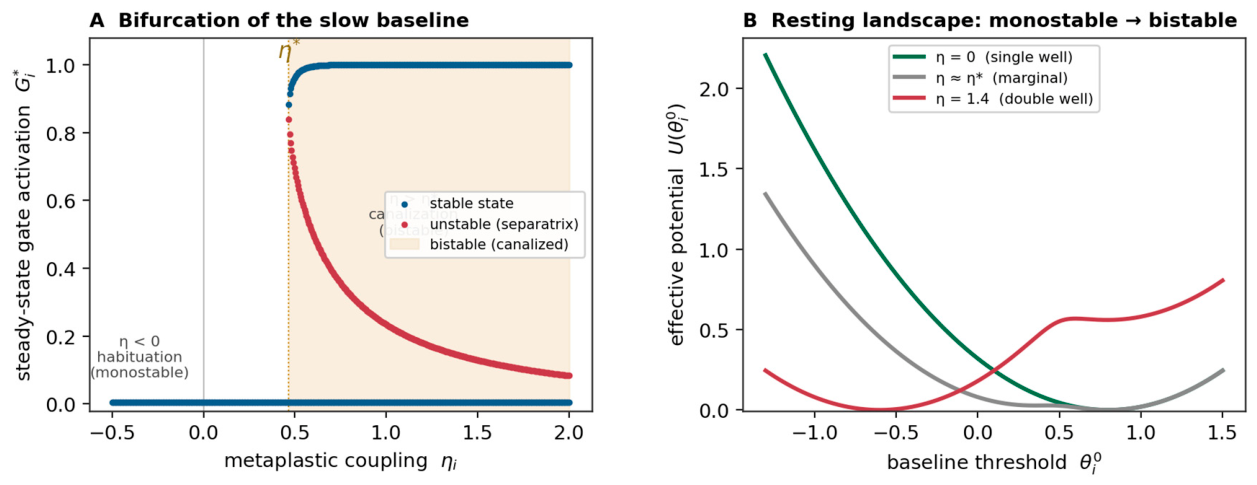
8.4 The decisive prediction
Every framework stands or falls on a prediction that separates it from competitors. For ARCH × Φ that prediction is the dissociation between vigor and allocation. Generic gain-control models predict only that raising a global signal strengthens behavior. Temperature-like selection models predict that raising the signal sharpens choice—re-ranking toward the dominant option. ARCH × Φ predicts neither within a valence family: there, raising Φ scales vigor while holding allocation flat. Across the appetitive–defensive divide the regional sign permits re-ranking. This flat-within / sloping-across double dissociation is predicted by ARCH × Φ and by none of the alternatives.
The comparative evidence is consistent with it. In rodents, allopregnanolone scales sexual behavior, exploration, anxiety, and social interaction together without within-family re-ranking. In honey bees, pollen stress reduces dance vigor and precision while preserving source preference. In Drosophila the evidence remains indirect, because no experiment has measured multiple archetypes under graded adult ecdysteroid manipulation. The Pinna isolation studies mark the boundary, showing that cross-valence re-ranking emerges when a regionally signed Φ interacts with elevated defensive drive.
The decisive experiment follows directly. Hold A, D, and C constant; vary Φ across a graded range; and measure two allocation ratios at once—one within a valence family (Venex versus Navigia) and one spanning the divide (Venex versus Phobon). The framework predicts the first ratio stays flat while the second slopes systematically. A flat-within / sloping-across result supports a regionally signed field; two flat ratios favor an unsigned global Φ; parallel shifts in both argue against the multiplicative formulation. The prediction’s strength is its generality: it is independent of species, circuit, and molecule. Whether Φ is instantiated by ecdysteroids, makisterone A, allopregnanolone, or another permissive signal, the same signature should emerge if the architecture is correct.
10. Scope Beyond Nervous Systems
Conjunctive threshold gating is not confined to behavior. Initiation of DNA replication requires licensing, kinase activity and chromatin accessibility to be jointly satisfied; closure of the Venus flytrap requires mechanical count, timing and metabolic state to coincide (Rahman, 2026a); and non-photochemical quenching in plant chloroplasts requires both a proton gradient and an independently necessary carotenoid-and-protein gate, with knockouts of either component abolishing the response while the others remain intact (Demmig-Adams & Adams, 1996; Li et al., 2000). Both cases have been developed at length elsewhere, together with the evolutionary argument that sterol incorporation into eukaryotic membranes first separated stored drive from discharge permissiveness (Rahman, 2025; Rahman & Zorumski, 2026). We note them here as scope rather than as support: they show the gating logic is general, but they are not evidence about behavioral arbitration, and we do not count them as such.
We state these cases as scope rather than support, and the distinction matters for falsifiability. The framework is not a claim that all biological regulation is multiplicative. It applies where a system holds multiple executable programs, commits to one, and separates the question of which program executes from the question of how strongly. Metabolic pathways with no alternatives competing for a shared output channel do not meet that condition, and pathways lacking any permissive term meet only half of it. A framework that absorbed every thresholded process would predict nothing; the value of the flat-within, sloping-across signature developed in Section 9 is that it can fail. The full cross-kingdom argument, including the isoprenoid pathway’s distinct functional roles across timescales, is developed separately and is not required by anything claimed here.
11. Conclusions
Why does the same stimulus sometimes release a behavior and at other times fail to? Classical ethology identified a gate between possibility and action but left its implementation unresolved. ARCH × Φ proposes that this gate is distributed—a shared permissive field acting across many circuits at once. Across fruit flies, honey bees, rodents, and African cichlids, one pattern recurs: circuit architecture (A), drive (D), and context (C) behave as local, archetype-specific variables, while candidate Φ systems show a qualitatively different signature—perturbing them alters vigor across multiple domains while preserving behavioral identity and, within a valence family, allocation. The pattern is strongest in rodents, consistent but incomplete in insects, and presently unresolved in cichlids.
The conservation claim is therefore architectural rather than molecular. Ecdysteroids, makisterone A, and allopregnanolone are not proposed to be homologous; they are candidate implementations of one computational role—a sterol-derived field that globally modulates permissiveness while leaving selection to local circuitry. The formulation converts a long-standing conceptual problem into a tractable one, making explicit predictions that separate it from additive-threshold models, generic gain control, and temperature-like selection. Each proposed experiment—adult ecdysteroids in Drosophila, dietary sterols in honey bees, allopregnanolone in rodents, neurosteroids in A. burtoni—tests the same hypothesis. If these diverse systems show the predicted dissociation between vigor and allocation, the evidence will support a conserved architectural solution to one of biology’s oldest computational problems: how distributed nervous systems generate a single coherent behavioral state from many simultaneously possible alternatives.
Why sterols? Their recruitment as global execution gates is plausibly no accident. Sterols are ancient markers of metabolic and oxygen availability; their lipid solubility lets them cross biological barriers, including the blood–brain barrier; and they bifurcate into genomic and non-genomic signaling arms. A single sterol-based gate can therefore modulate immediate membrane states and longer-term transcription at once—the same dual reach that lets Φ act acutely while the slow processes of Section 3.1 write the baseline beneath it.
AI Disclosure
Language and formatting were refined using AI language tools under author supervision. All scientific interpretations, research, and conclusions are original and verified by the author. Illustrations were conceived by the author and formatted with AI assistance (BioBender).
Acknowledgments
Gratitude is extended to Charles F. Zorumski, Reid Meloy, Robert Sapolsky, Gregory Santoscoy, Barry Rossheim (1957-2022), Christopher Limes.
Conflicts of Interest
The author declares no competing financial interests. There were no funding sources for this work.
References
- Aponte, Y., Atasoy, D., & Sternson, S. M. (2011). AgRP neurons are sufficient to orchestrate feeding behavior rapidly and without training. Nature Neuroscience, 14, 351–355.
- Ayaz, A., & Chance, F. S. (2009). Gain modulation of neuronal responses by subtractive and divisive mechanisms of inhibition. Journal of Neurophysiology, 101, 958–968.
- Bakker, T. C. M., & Sevenster, P. (1983). Determinants of dominance in male sticklebacks (Gasterosteus aculeatus L.). Behaviour, 86, 55–71.
- Baptista, L. F., & Petrinovich, L. (1984). Social interaction, sensitive phases and the song template hypothesis in the white-crowned sparrow. Animal Behaviour, 32, 172–181.
- Barron, A. B., Maleszka, R., Vander Meer, R. K., & Robinson, G. E. (2007). Octopamine modulates honey bee dance behavior. PNAS, 104, 1703–1707.
- Beecher, M. D. (2008). Function and mechanisms of song learning in song sparrows. Advances in the Study of Behavior, 38, 167–225.
- Behmer, S. T., & Elias, D. O. (1999). The nutritional significance of sterol metabolic constraints in the generalist grasshopper Schistocerca americana. Journal of Insect Physiology, 45, 339–348.
- Behmer, S. T., & Nes, W. D. (2003). Insect sterol nutrition and physiology: a global overview. Advances in Insect Physiology, 31, 1–72.
- Behmer, S. T., Elias, D. O., & Bernays, E. A. (1999). Post-ingestive feedbacks and associative learning regulate the intake of unsuitable sterols in a generalist grasshopper. Journal of Experimental Biology, 202, 739–748.
- Brunton, P. J., McKay, A. J., Ochedalski, T., et al. (2009). Central opioid inhibition of neuroendocrine stress responses in pregnancy in the rat is induced by the neurosteroid allopregnanolone. Journal of Neuroscience, 29, 6449–6460.
- Burmeister, S. S., Jarvis, E. D., & Fernald, R. D. (2005). Rapid behavioral and genomic responses to social opportunity in a cichlid fish. PLoS Biology, 3, e363.
- Carpenter, R. E., Maruska, K. P., Becker, L., & Fernald, R. D. (2014). Social opportunity rapidly regulates expression of CRF and CRF receptors in the brain during social ascent of a teleost fish, Astatotilapia burtoni. PLoS ONE, 9, e96632.
- Cazalé-Debat, L., Scheunemann, L., Day, M., et al. (2024). Mating proximity blinds threat perception. Nature, 634, 635–643.
- Chapman, T., Bangham, J., Vinti, G., et al. (2003). The sex peptide of Drosophila melanogaster: female post-mating responses analyzed by using RNA interference. PNAS, 100, 9923–9928.
- Chappell, P. E., Schneider, J. S., Kim, P., Xu, M., Lydon, J. P., O’Malley, B. W., & Levine, J. E. (1997). Absence of gonadotropin surges and gonadotropin-releasing hormone self-priming in ovariectomized, estrogen-treated, progesterone receptor knockout mice. Endocrinology, 138, 4147–4152.
- Corby-Harris, V., Snyder, L., & Meador, C. (2019). Fat body lipolysis connects poor nutrition to hypopharyngeal gland degradation in Apis mellifera. Journal of Insect Physiology, 116, 1–9.
- Dalton, J. E., Lebo, M. S., Sanders, L. E., et al. (2009). Ecdysone receptor acts in fruitless-expressing neurons to mediate Drosophila courtship behaviors. Current Biology, 19, 1447–1452.
- Davis, M. R., & Fernald, R. D. (1990). Social control of neuronal soma size. Journal of Neurobiology, 21, 1180–1188.
- Demmig-Adams, B., & Adams, W. W. (1996). The role of xanthophyll cycle carotenoids in the protection of photosynthesis. Trends in Plant Science, 1, 21–26.
- Findling, C., Hubert, F., International Brain Laboratory, Acerbi, L., Benson, B., Benson, J., … & Pouget, A. (2025). Brain-wide representations of prior information in mouse decision-making. Nature, 645(8079), 192–200.
- Flavell, S. W., Gogolla, N., Lovett-Barron, M., & Zelikowsky, M. (2022). The emergence and influence of internal states. Neuron, 110(16), 2545–2570.
- Frye, C. A., & Rhodes, M. E. (2008). Infusions of 3α,5α-THP to the VTA enhance exploratory, anti-anxiety, social and sexual behavior and increase levels of 3α,5α-THP in midbrain, hippocampus, diencephalon and cortex of female rats. Behavioural Brain Research, 187, 88–99.
- Frye, C. A., Qrareya, A., Llaneza, D. C., & Paris, J. J. (2020). Central actions of 3α,5α-THP involving NMDA and GABAA receptors regulate affective and sexual behavior of female rats. Frontiers in Behavioral Neuroscience, 14, 11.
- Ganter, G. K., Monk, K. J., Ganter, M. L., et al. (2011). Drosophila male courtship behavior is modulated by ecdysteroids. Journal of Insect Physiology, 57, 1477–1483.
- Godar, S. C., Cadeddu, R., Floris, G., Mosher, L. J., Mi, Z., Jarmolowicz, D. P., … & Bortolato, M. (2019). The steroidogenesis inhibitor finasteride reduces the response to both stressful and rewarding stimuli. Biomolecules, 9(11), 749.
- Gould, J. L. (1982). Ethology: The Mechanisms and Evolution of Behavior. W. W. Norton.
- Gropp, E., Shanabrough, M., Borok, E., et al. (2005). Agouti-related peptide-expressing neurons are mandatory for feeding. Nature Neuroscience, 8, 1289–1291.
- Haddad, P. M., & Wieck, A. (2004). Antipsychotic-induced hyperprolactinaemia: mechanisms, clinical features and management. Drugs, 64(20), 2291–2314.
- Häussmann, I. U., Hemani, Y., Wijesekera, T., et al. (2013). Multiple pathways mediate the sex-peptide-regulated switch in female Drosophila reproductive behaviours. Proceedings of the Royal Society B, 280, 20131938.
- Hoopfer, E. D., Jung, Y., Inagaki, H. K., Rubin, G. M., & Anderson, D. J. (2015). P1 interneurons promote a persistent internal state that enhances inter-male aggression in Drosophila. eLife, 4, e11346.
- Hsu, Y., Earley, R. L., & Wolf, L. L. (2006). Modulation of aggressive behaviour by fighting experience: mechanisms and contest outcomes. Biological Reviews, 81, 33–74.
- Insel, T. R., & Shapiro, L. E. (1992). Oxytocin receptor distribution reflects social organization in monogamous and polygamous voles. PNAS, 89, 5981–5985.
- Ishimoto, H., & Kitamoto, T. (2010). The steroid molting hormone ecdysone regulates sleep in adult Drosophila melanogaster. Genetics, 185(1), 269–281.
- Jing, X., & Behmer, S. T. (2020). Insect sterol nutrition: physiological mechanisms, ecology, and applications. Annual Review of Entomology, 65, 251–271.
- Jung, C. G. (1959). The archetypes and the collective unconscious (Collected Works, Vol. 9, Part 1). Princeton University Press.
- Kim, K. W., Li, S., Zhao, H., Peng, B., Tobet, S. A., Elmquist, J. K., Parker, K. L., & Zhao, L. (2010). CNS-specific ablation of steroidogenic factor 1 results in impaired female reproductive function. Molecular Endocrinology, 24, 1240–1250.
- Koonce, C. J., & Frye, C. A. (2014). Female mice with deletion of Type One 5α-reductase have reduced reproductive responding during proestrus and after hormone-priming. Pharmacology Biochemistry and Behavior, 122, 20–29.
- Korn, H., & Faber, D. S. (2005). The Mauthner cell half a century later: a neurobiological model for decision-making? Neuron, 47, 13–28.
- Ladd, C. E., & Simpson, J. H. (2025). Behavior choices amongst grooming, feeding and courting in Drosophila show contextual flexibility, not an absolute hierarchy of needs. Journal of Experimental Biology, 228, jeb250826.
- Landgraf, T., Bierbach, D., Kirbach, A., et al. (2018). Dancing honey bee robot elicits dance-following and recruits foragers. arXiv preprint arXiv:1803.07126.
- Li, X.-P., Björkman, O., Shih, C., Grossman, A. R., Rosenquist, M., Jansson, S., & Niyogi, K. K. (2000). A pigment-binding protein essential for regulation of photosynthetic light harvesting. Nature, 403, 391–395.
- Li, Y., Haynes, P., Zhang, S. L., Yue, Z., & Sehgal, A. (2023). Ecdysone acts through cortex glia to regulate sleep in Drosophila. eLife, 12, e81723.
- Lorenz, K. (1981). The Foundations of Ethology. Springer-Verlag.
- Luquet, S., Perez, F. A., Hnasko, T. S., & Palmiter, R. D. (2005). NPY/AgRP neurons are essential for feeding in adult mice but can be ablated in neonates. Science, 310, 683–685.
- Lydon, J. P., DeMayo, F. J., Funk, C. R., Mani, S. K., Hughes, A. R., Montgomery, C. A., Shyamala, G., Conneely, O. M., & O’Malley, B. W. (1995). Mice lacking progesterone receptor exhibit pleiotropic reproductive abnormalities. Genes & Development, 9, 2266–2278.
- Maguire, J. L., Stell, B. M., Rafizadeh, M., & Mody, I. (2005). Ovarian cycle-linked changes in GABAA receptors mediating tonic inhibition alter seizure susceptibility and anxiety. Nature Neuroscience, 8, 797–804.
- Maisonnasse, A., Lenoir, J. C., Beslay, D., et al. (2010). E-β-ocimene, a volatile brood pheromone involved in social regulation in the honey bee colony. PLoS ONE, 5, e13531.
- Marler, P. (1970). A comparative approach to vocal learning: song development in white-crowned sparrows. Journal of Comparative and Physiological Psychology Monographs, 71, 1–25.
- Marowsky, A., & Vogt, K. E. (2014). Delta-subunit-containing GABAA-receptors mediate tonic inhibition in paracapsular cells of the mouse amygdala. Frontiers in Neural Circuits, 8, 27.
- Marowsky, A., Rudolph, U., Fritschy, J.-M., & Arand, M. (2012). Tonic inhibition in principal cells of the amygdala: a central role for α3 subunit-containing GABAA receptors. Journal of Neuroscience, 32, 8611–8619.
- Maruska, K. P., Becker, L., Neboori, A., & Fernald, R. D. (2013). Social descent with territory loss causes rapid behavioral, endocrine and transcriptional changes in the brain. Journal of Experimental Biology, 216, 3656–3666.
- Meiselman, M. R., Ganguly, A., Dahanukar, A., & Adams, M. E. (2022). Endocrine modulation of primary chemosensory neurons regulates Drosophila courtship behavior. PLoS Genetics, 18, e1010357.
- Mitchell, S. J., & Silver, R. A. (2003). Shunting inhibition modulates neuronal gain during synaptic excitation. Neuron, 38, 433–445.
- Motola, D. L., Cummins, C. L., Rottiers, V., et al. (2006). Identification of ligands for DAF-12 that govern dauer formation and reproduction in C. elegans. Cell, 124, 1209–1223.
- Musatov, S., Chen, W., Pfaff, D. W., Kaplitt, M. G., & Ogawa, S. (2006). RNAi-mediated silencing of estrogen receptor α in the ventromedial nucleus of hypothalamus abolishes female sexual behaviors. PNAS, 103, 10456–10460.
- Nelson, B. S., & Pinna, G. (2011). S-norfluoxetine microinfused into the basolateral amygdala increases allopregnanolone levels and reduces aggression in socially isolated mice. Neuropharmacology, 60, 416–424.
- Numan, M. (1988). Neural basis of maternal behavior in the rat. Psychoneuroendocrinology, 13, 47–62.
- Numan, M., Numan, M. J., Schwarz, J. M., et al. (2005). Medial preoptic area interactions with the nucleus accumbens–ventral pallidum circuit and maternal behavior in rats. Behavioural Brain Research, 158, 53–68.
- Ogawa, S., Chan, J., Chester, A. E., Gustafsson, J. Å., Korach, K. S., & Pfaff, D. W. (1999). Survival of reproductive behaviors in estrogen receptor β gene-deficient (βERKO) male and female mice. PNAS, 96, 12887–12892.
- Ogawa, S., Eng, V., Taylor, J., Lubahn, D. B., Korach, K. S., & Pfaff, D. W. (1998). Roles of estrogen receptor-α gene expression in reproduction-related behaviors in female mice. Endocrinology, 139, 5070–5081.
- Pan, Y., Meissner, G. W., & Baker, B. S. (2012). Joint control of Drosophila male courtship behavior by motion cues and activation of male-specific P1 neurons. PNAS, 109, 10065–10070.
- Petrinovich, L., & Baptista, L. F. (1987). Song development in the white-crowned sparrow: modification of learned song. Animal Behaviour, 35, 961–974.
- Pfaff, D. W., & Sakuma, Y. (1979). Deficit in the lordosis reflex of female rats caused by lesions in the ventromedial nucleus of the hypothalamus. Journal of Physiology, 288, 203–210.
- Pinna, G., Dong, E., Matsumoto, K., et al. (2003). In socially isolated mice, the reversal of brain allopregnanolone down-regulation mediates the anti-aggressive action of fluoxetine. PNAS, 100, 2035–2040.
- Prescott, S. A., & De Koninck, Y. (2003). Gain control of firing rate by shunting inhibition: roles of synaptic noise and dendritic saturation. PNAS, 100, 2076–2081.
- Rahman, T. (2025). A multiplicative behavioral model of DNA replication initiation. Open Life Sciences, 20, 20251229.
- Rahman, T. (2026a). Threshold decision-making in the Venus flytrap. Plant Science, 365, 113010.
- Rahman, T. (2026b). Sex change in clownfish as an ARCH-governed biological decision. Hormones and Behavior, 180, 105907.
- Rahman, T., & Zorumski, C. F. (2026). ARCH × Φ: sterols and the evolution of gated biological execution. BioSystems, 265, 105812.
- Rahman, T., Zorumski, C. F., & Meloy, J. R. (2025). The ARCH model: a neuroevolutionary framework for behavioral execution. Frontiers in Psychiatry, 16, 1669530.
- Ribeiro, C., & Dickson, B. J. (2010). Sex peptide receptor and neuronal TOR/S6K signaling modulate nutrient balancing in Drosophila. Current Biology, 20, 1000–1005.
- Rowland, W. J. (1982). The effects of male nuptial coloration on stickleback aggression: a reexamination. Behaviour, 80, 118–126.
- Russell, J. A., & Brunton, P. J. (2009). Physiological roles for the neurosteroid allopregnanolone in the modulation of brain function during pregnancy and parturition. Progress in Brain Research, 170, 425–438.
- Scofield, H. N., & Mattila, H. R. (2015). Honey bee workers that are pollen stressed as larvae become poor foragers and waggle dancers as adults. PLoS ONE, 10, e0121731.
- Sherrington, C. S. (1906). The Integrative Action of the Nervous System. Yale University Press.
- Shridharani, A. N., & Brant, W. O. (2016). The treatment of erectile dysfunction in patients with neurogenic disease. Translational Andrology and Urology, 5, 88–101.
- Srivastava, D. P., Yu, E. J., Kennedy, K., et al. (2005). Rapid, nongenomic responses to ecdysteroids and catecholamines mediated by a novel Drosophila G-protein-coupled receptor. Journal of Neuroscience, 25, 6145–6155.
- Tinbergen, N. (1951). The Study of Instinct. Oxford University Press.
- Traynor, K. S., Le Conte, Y., & Page, R. E. (2014). Queen and young larval pheromones impact nursing and reproductive physiology of honey bee workers. Behavioral Ecology and Sociobiology, 68, 2059–2073.
- Weintraub, D., Koester, J., Potenza, M. N., Siderowf, A. D., Stacy, M., Voon, V., Whetteckey, J., Wunderlich, G. R., & Lang, A. E. (2010). Impulse control disorders in Parkinson disease: a cross-sectional study of 3090 patients. Archives of Neurology, 67(5), 589–595.
- Yamazaki, Y., Kiuchi, M., Takeuchi, H., & Kubo, T. (2011). Ecdysteroid biosynthesis in workers of the European honeybee Apis mellifera L. Insect Biochemistry and Molecular Biology, 41, 283–293.
- Yang, C. F., Chiang, M. C., Gray, D. C., et al. (2013). Sexually dimorphic neurons in the ventromedial hypothalamus govern mating in both sexes and aggression in males. Cell, 153, 896–909.
- Yang, C. H., Rumpf, S., Xiang, Y., et al. (2009). Control of the postmating behavioral switch in Drosophila females by internal sensory neurons. Neuron, 61, 519–526.
Disclaimer/Publisher’s Note: The statements, opinions and data contained in all publications are solely those of the individual author(s) and contributor(s) and not of MDPI and/or the editor(s). MDPI and/or the editor(s) disclaim responsibility for any injury to people or property resulting from any ideas, methods, instructions or products referred to in the content. |
© 2026 by the authors. Licensee MDPI, Basel, Switzerland. This article is an open access article distributed under the terms and conditions of the Creative Commons Attribution (CC BY) license (http://creativecommons.org/licenses/by/4.0/).
Copyright: This open access article is published under a Creative Commons CC BY 4.0 license, which permit the free download, distribution, and reuse, provided that the author and preprint are cited in any reuse.