

Submitted:
19 July 2026
Posted:
21 July 2026
You are already at the latest version
Abstract
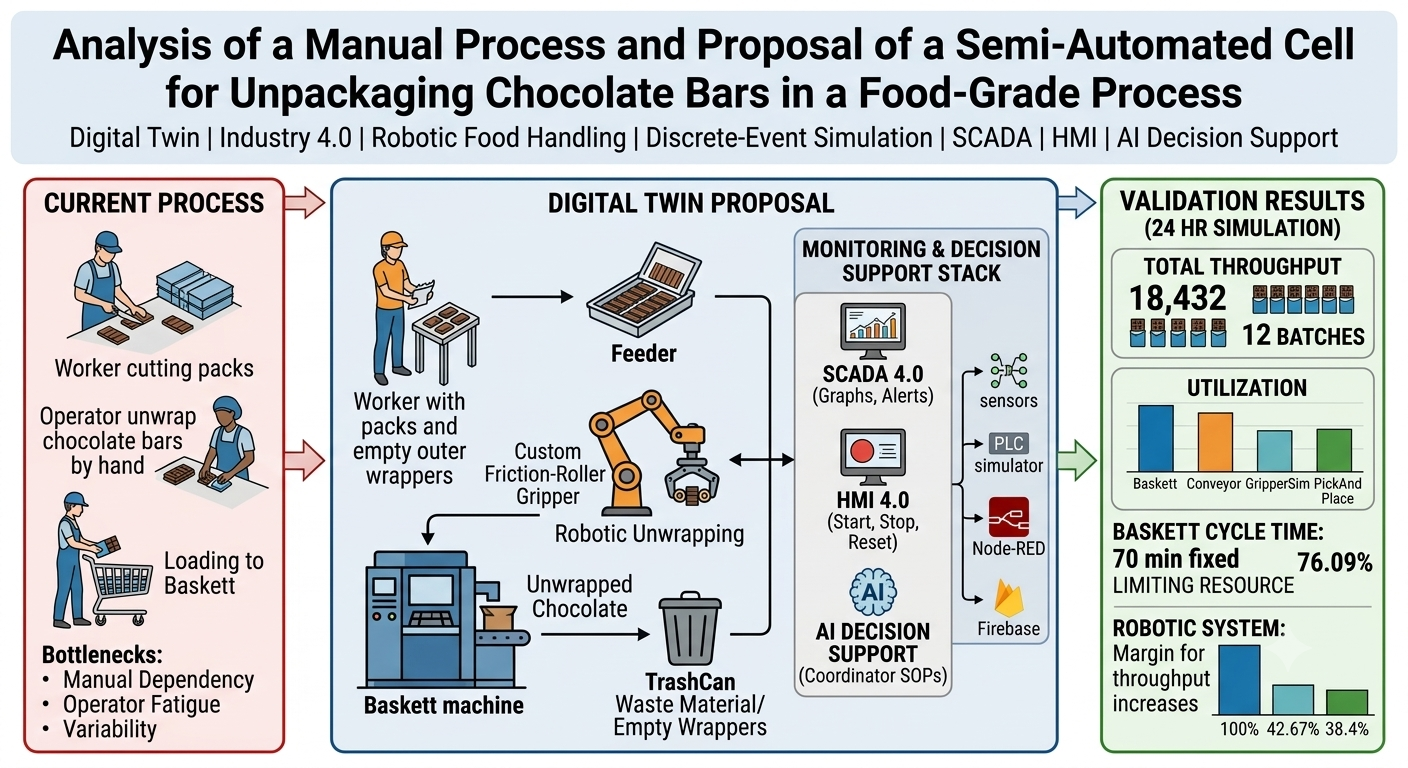
Chocolate-handling process currently relies on manual labor: operators open cardboard boxes, cut packaging, unwrap each chocolate bar by hand, and load the unwrapped product into a Baskett tempering machine. This manual dependency introduces process variability, operator fatigue, and a throughput ceiling imposed by the Baskett’s fixed 70-minute batch cycle. This paper presents the design and Digital Twin simulation of a semi-automated workstation that integrates a feeder, a collaborative robotic arm with a custom friction-roller gripper, a waste-handling subsystem, and an Industry 4.0 monitoring stack (SCADA, HMI, and an AI-based decision-support layer) to remove the manual unwrapping bottleneck. The material flow was modeled in Siemens Plant Simulation, and the robotic operation was validated in Process Simulate, while a Node-RED/Firebase/React architecture emulated the supervisory control layer. Over a simulated 24-hour period, the workstation processed 18,432 individual chocolate bars across 12 production batches while sustaining synchronization with the Baskett cycle. The Baskett remained the limiting resource, occupied 76.09% of the time, while the robotic subsystem operated well under capacity (conveyor utilization 100%, gripper utilization 42.67%, pick-and-place utilization 38.4%), indicating margin for future throughput increases. The results confirm that the proposed cell eliminates the manual unwrapping task while remaining compatible with existing downstream equipment, and they identify the Baskett cycle time as the priority target for further improvement.
Keywords:
digital twin
; Industry 4.0
; robotic food handling
; discrete-event simulation
; SCADA
; human–machine interface
; AI-based decision support
Copyright: This open access article is published under a Creative Commons CC BY 4.0 license, which permit the free download, distribution, and reuse, provided that the author and preprint are cited in any reuse.


