

Submitted:
19 July 2026
Posted:
21 July 2026
You are already at the latest version
Abstract
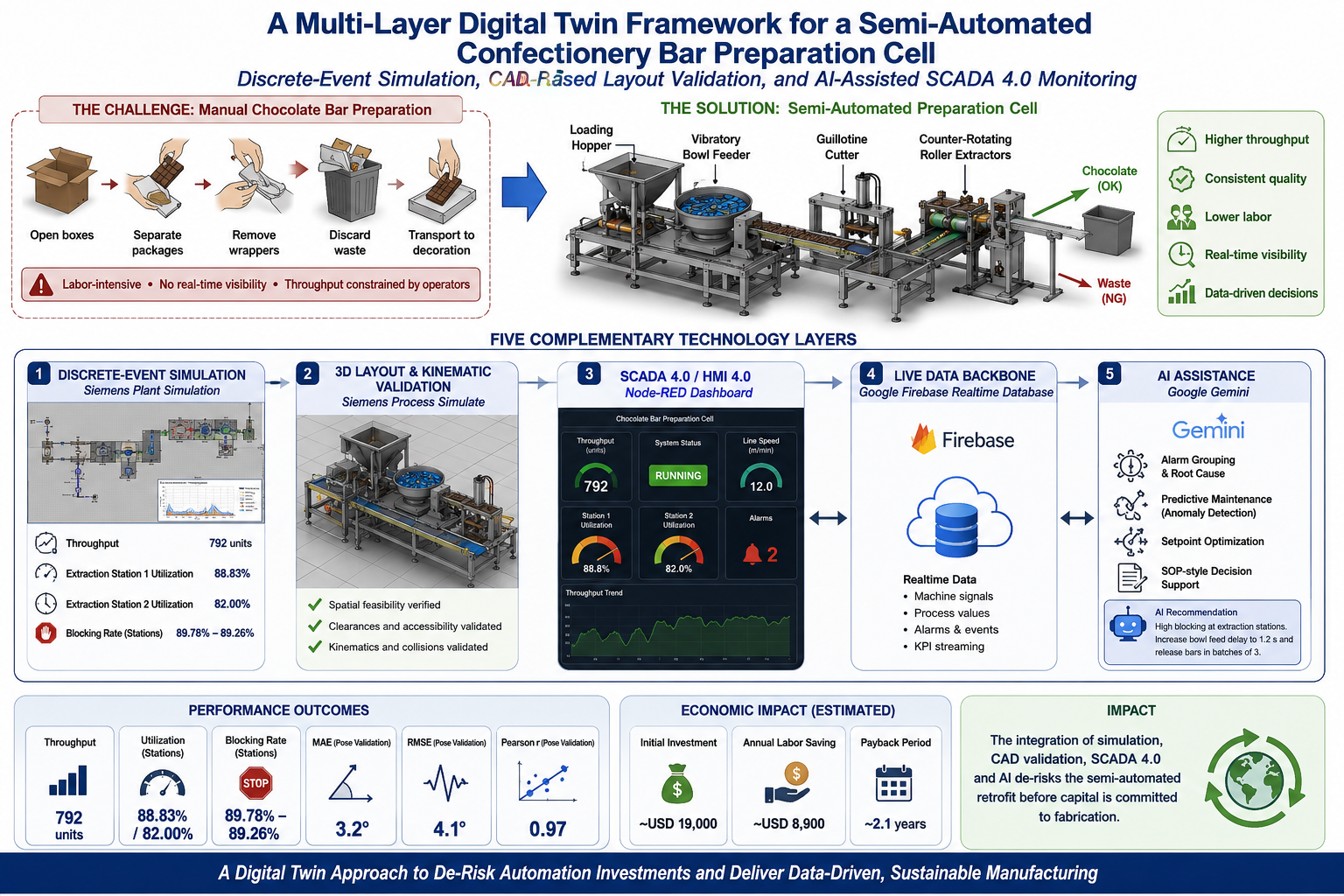
This paper presents a semester-long engineering project that develops a multi-layer Digital Twin for the chocolate-bar preparation stage, a bakery producer in Monterrey, Mexico. In the current process, operators manually open shipping boxes, separate multi-bar packages, peel individual wrappers, discard packaging waste, and transport exposed bars to a downstream decoration station with labor-intensive activity with no real-time visibility into throughput, cycle time, or quality events. We propose a compact, inline semi-automated preparation cell a loading hopper, vibratory bowl feeder, food-grade conveyor, pneumatically actuated guillotine cutter, counter-rotating roller extractors, and separated collection paths for product and waste and validate it across five complementary technology layers: (1) discrete-event simulation in Siemens Tecnomatix Plant Simulation; (2) 3D spatial and kinematic validation in Siemens Process Simulate with CAD solid models; (3) a Node-RED operator dashboard; (4) a Google Firebase Realtime Database as the shared live data backbone; and (5) Google Gemini for alarm grouping, predictive maintenance, setpoint optimization, and SOP-style decision support. The simulation sustains a conveyor output of 792 units over the modeled horizon, with extraction-station utilization of 88.83% and 82.00% and blocking rates approaching 89.78–89.26%, indicating that buffer and release-logic tuning is required before physical deployment. CAD-based validation confirms the station's spatial and kinematic feasibility, and the SCADA/HMI/AI layer demonstrates functioning live monitoring and AI-generated operational guidance. A preliminary economic analysis estimates an initial investment near USD 19,000, an annual labor saving near USD 8,900, and a payback period of approximately 2.1 years. The results indicate that discrete-event simulation, CAD validation, and SCADA 4.0/AI integration can jointly de-risk a semi-automated retrofit before capital is committed to fabrication.
Keywords:
digital twin
; discrete-event simulation
; Siemens plant simulation
; process simulate
; SCADA 4.0
; HMI 4.0
; Node-RED
; firebase
; Gemini AI
; ISA-95
; automation pyramid
; semi-automated packaging cell
Copyright: This open access article is published under a Creative Commons CC BY 4.0 license, which permit the free download, distribution, and reuse, provided that the author and preprint are cited in any reuse.


