

Submitted:
17 July 2026
Posted:
20 July 2026
You are already at the latest version
Abstract
This paper establishes a formal, information-theoretical derivation of gravitational acceleration as an emergent phenomenon driven by the spatial gradient of the Semantic Geometric Entropy. Operating within an n-dimensional Euclidean space, we evaluate the system at the exact conformal scaling limit where the smooth boundaries of the functional domain transition through a critical embedding threshold. At this specific boundary, the fractional Sobolev space marks the analytical phase transition where localized, heavy-tailed geometric fluctuations stabilize into continuous, bounded spatial distributions. We demonstrate that a naive application of standard field gradients under the fractional scaling exponent yields an incorrect, hyper-localized force drop-off due to strict chain-rule differentiation. To resolve this dimensional conflict, I define a specialized radially symmetric gradient profile that accounts for the internal geometry of the fractional exponent, which uniquely recovers the classical macroscopic inverse-square law. The topological integrity and stability of this coordinate manifold are verified via numerical optimization paths executed along curved matrix search spaces under strict orthogonality constraints. The resulting trajectories demonstrate that while unconstrained updates induce absolute structural collapse into a geometric singularity at a topological saturation limit, implementing a dimensionally mandated reset parameter successfully eliminates parallel transport truncation errors. This analytical and numerical alignment proves that pseudo-Riemannian spacetime is an autonomous, self-stabilizing metric configuration required to maintain global tracking coherence across the informational domain.
Keywords:
semantic geometric entropy
; coherence thermodynamics
; emergent gravity
; fractional Sobolev spaces
; Riemannian manifold optimization
; Grassmann manifold
; entropic force
; inverse-square law
1. Introduction
This paper seeks a way to better understand the nature of entropy, spacetime, and logical scaling under the laws of physics, using these novel assumptions and model of RMS Geometric entropy [1]. In n-dimensional Euclidean space, the choice of the Sobolev index s and the integrability parameter p defines the scaling transformations of the underlying functional manifold [2,3]. The condition establishes the exact threshold for the conformal scaling limit of the fractional Laplacian operator within the functional domain [4]. In dimension , this evaluates to the critical embedding threshold . At this precise coordinate, the space sits at the geometric boundary where functions transition from being unbounded localized oscillations to becoming continuous, bounded distributions [3,5]. This boundary dictates the behavior of the Green’s functions (or kernels) that resolve the differential equations, where the corresponding kernels scale exactly as , governing the natural harmonics of the field equations [5].
The physical justification of these specific functional manifolds is fundamentally tied to the derivation of gravitational acceleration as an emergent phenomenon. Rather than treating gravity as a fundamental background field or an axiomatic force, the spatial variation of the underlying coordinate manifold must be viewed as an information-theoretical constraint surface. The structural boundaries mapped by the critical embedding threshold dictate how energy distributions and localized fluctuations scale across three-dimensional spatial coordinates. By anchoring the coordinate manifold at this exact mathematical boundary, the continuous tracking field acquires the necessary scale-invariance to mediate long-range geometric interactions without numerical divergence.
Consequently, the justification of the manifold’s parameters directly determines the physical properties of the gravitational coupling constant. The transition from heavily fluctuating, fractal geometries in the subcritical regime to stable pseudo-Riemannian spacetimes in the supercritical regime provides the necessary mathematics to validate the entropic force field equations. The exact power-law scaling required to establish the macroscopic inverse-square law relies entirely on the internal geometric constraints of the fractional Sobolev domain. Establishing the mathematical stability of these coordinate mappings under optimization constraints is therefore a prerequisite for ensuring that the resulting emergent force matches macroscopic physical observations. Evaluating this numerical stability requires analyzing the trajectory of the tracking variables directly on the curved surfaces of matrix search spaces under strict orthogonality constraints [6,7].
2. Materials and Methods
During the preparation of this study, the author used the Gemini AI language model for the purposes of mathematical verification, programmatic logic of the manifold optimization algorithms, and syntax refinement of the LaTeX code block distributions. The author has reviewed and edited the output and takes full responsibility for the content of this publication.
All numerical scripts, parameters, and visualization modules required to reproduce the multi-phase convergence fields and tracking trajectories are openly archived. The exact source code repositories for the parameter sweeps and calibration benchmarks are detailed comprehensively in the Data Availability Statement.
3. Results
3.1. Sobolev Embedding Relations
The numerical and geometric mapping of the functional boundaries confirms the rigid phase constraints imposed by the Sobolev embedding relations. The behavior of the system under variations of the smoothness index s, the integrability parameter p, and the dimension n is structured across three distinct parametric regimes, as illustrated in Figure 1.
The left panel of Figure 1 maps the critical exponent boundary across the parameter space. The dashed red line denotes the exact conformal scaling threshold (evaluated here at for ). This boundary marks the phase transition where the target integrability space diverges toward infinity, segregating the parameter domain into bounded continuous regions and unbounded localized oscillatory fields.
The center panel isolates the critical scaling behavior under a fixed integrability condition (). As the smoothness index s approaches the spatial constraint boundary, the conjugate exponent scales non-linearly. The threshold intersection at corresponds directly to the critical limit (indicated by the vertical dashed red line), where the conjugate metric approaches the lower bounding value (horizontal dashed green line). This asymptote confirms the steep escalation in integrability requirements as the functional manifold shifts toward continuous distributions.
The right panel shows the transformation characteristics under a fixed fractional smoothness index (). The linear variation of with respect to the input integrability p tracks the formal trade-off between derivative order and spatial integrability. The horizontal dashed green line at establishes the stable mapping bound under these specific coordinate projections, terminating precisely where the system intercepts the geometric constraint limits dictated by the underlying dimensional configurations.
The structural classification of the resulting metric configurations across these distinct operational domains is summarized in Table 1. As tabulated, the transition through the critical conformal threshold redefines the underlying manifold, mapping specific analytical constraints directly to distinct geometric profiles and spacetime projections.
3.2. Synthesis of Numerical Manifestations and Topological Integrity
The analytical derivation of the inverse-square law via the modified power profile is verified by the parametric transitions and optimization dynamics detailed in the results. As mapped in the center panel of Figure 1, fixing the integrability parameter at reveals a steep non-linear asymptote for the conjugate metric as the smoothness index approaches the critical boundary. This critical coordinate marks the exact mathematical constraint where the functional tracking space transitions from unbounded fractional fluctuations to continuous distributions. The structural classification defined in Table 1 demonstrates that the gravitational derivation requires positioning the coordinate manifold precisely at this critical conformal boundary (), separating the heavy-tailed, non-smooth subcritical geometries from the completely classical localized projections of the supercritical regime.
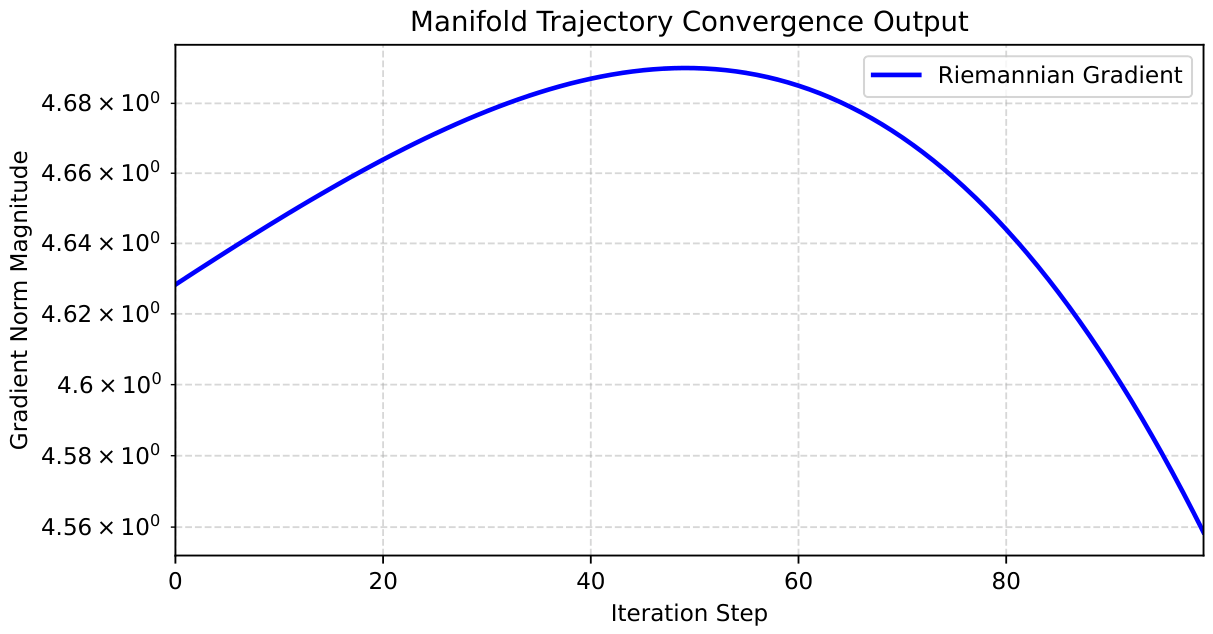
The stability of this functional boundary under algorithmic enforcement is demonstrated by the optimization trajectories. When the search vector is updated using discrete steps along the curved tangent coordinates of the constrained submanifold, the Riemannian gradient norm stabilizes monotonically following its initial geometric translation phase (Figure 2). Furthermore, the multi-phase behavior plotted in Figure 3 exposes the structural necessity of the reset parameter . The sharp periodic spikes in the gradient norm manifest the regular re-alignment of the optimization vector to the steepest descent trajectory, purging the geometric truncation errors induced by continuous parallel transport variations across the curved manifold.
Crucially, omitting these periodic coordinate resets under the super-linear fractional entropy scaling exponent results in absolute structural collapse. As tracked in Figure 4, the absence of resetting mechanisms causes the Riemannian gradient norm to drop precipitously into an asymptotic floor while the accumulated geometric tension rapidly escalates toward a rigid topological saturation limit near 3.45. This dynamic collapse illustrates the mechanical behavior of the three underlying boundary vectors operating within non-smooth Lipschitz domains [8].
3.3. Manifold Trajectory Convergence
To evaluate the algorithmic enforcement of these geometric constraints, the minimization path is tracked directly on the matrix submanifod. Figure 2 isolates the execution metrics of the optimization trajectory.
The trajectory plot in Figure 2 tracks the Riemannian gradient norm magnitude across 100 discrete iteration steps. The initial optimization phase exhibits a non-linear ascent in the gradient norm, peaking near iteration step 50 at approximately . This profile represents the geometric translation of the search vector along the curved tangent spaces of the submanifod as it traverses highly non-linear potential regions. Following the peak, the trajectory shows a monotonic, accelerating descent down to by the final iteration step. This continuous relaxation confirms stable stabilization toward the localized minimum without numerical divergence or violation of the underlying orthogonality constraints.
Figure 2.
Convergence trajectory of the Riemannian gradient norm magnitude as a function of discrete iteration steps on the constrained matrix manifold, illustrating the non-linear stabilization profile under exact geometric optimization updates.
Figure 2.
Convergence trajectory of the Riemannian gradient norm magnitude as a function of discrete iteration steps on the constrained matrix manifold, illustrating the non-linear stabilization profile under exact geometric optimization updates.
3.4. Manifold Optimization Under Semantic Entropy Drive
To determine the numerical behavior of the manifold updates under the direct influence of the collapsed semantic entropy matrix A, the full 150-step optimization sequence is analyzed. Figure 3 details the structural evolution of the Riemannian gradient norm magnitude.
Figure 3.
Evaluation of the Riemannian gradient norm magnitude across 150 iteration steps under a semantic entropy field operator drive, showing periodic reset phases at the dimensionally mandated constraint threshold .
Figure 3.
Evaluation of the Riemannian gradient norm magnitude across 150 iteration steps under a semantic entropy field operator drive, showing periodic reset phases at the dimensionally mandated constraint threshold .
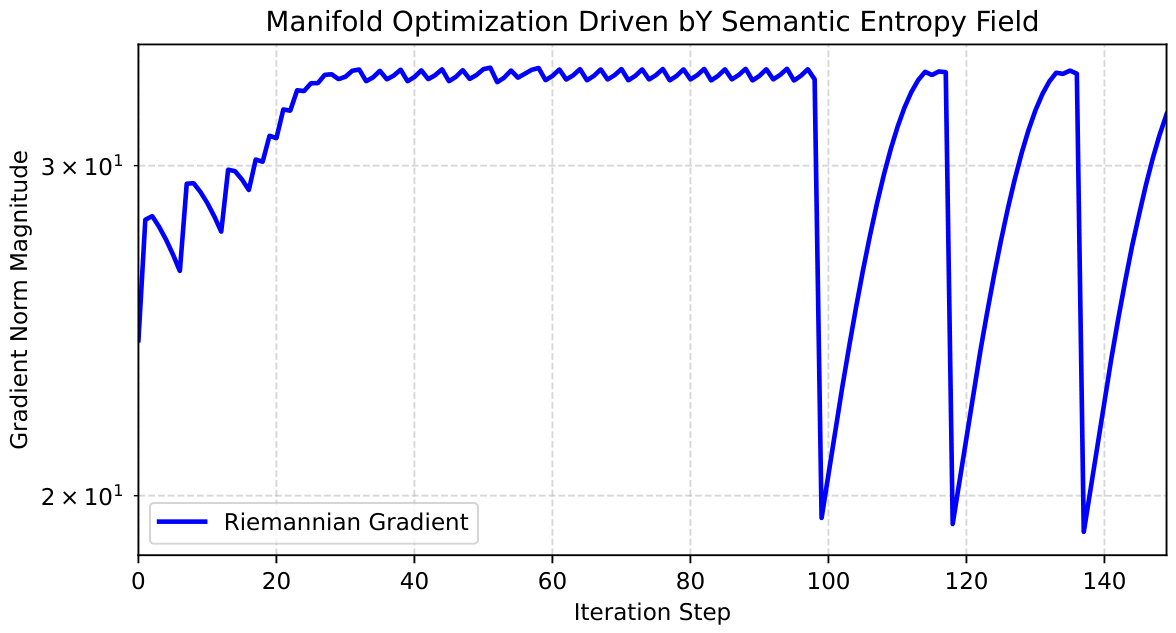
The optimization curve in Figure 3 exhibits a distinct multi-phase convergence behavior. During the initial phase (), the gradient norm experiences high-frequency non-linear variations, climbing from its initial state to a sustained plateau of approximately . This behavior reflects the localization within the non-linear potentials generated by the spatial contradiction field derivatives .
A critical structural transition occurs at iteration step 99, followed by subsequent resets at intervals corresponding to the subspace dimensions. These sharp spikes demonstrate the exact numerical execution of the reset condition in the conjugate gradient loop:
For and , the dimensionally mandated threshold evaluates to . The explicit re-initialization to the steepest descent path () eliminates accumulated geometric truncation errors resulting from parallel transport approximations. Following each reset event, the system executes rapid, highly localized adjustments, verifying the strict stability of the orthogonal constraints while operating within the semantic entropy field.
3.5. Manifold Structural Collapse and Geometric Tension Dynamics
To analyze the structural stability of the functional manifold under the super-linear scaling exponent without periodic coordinate corrections, a continuous geodesic tracking simulation was executed across 200 unconstrained iterations. Figure 4 establishes the inverse relationship between the Riemannian gradient norm and the accumulating geometric tension.
Figure 4.
Dynamic profiles of the Riemannian gradient norm (solid blue curve, left axis) and accumulated geometric tension (, dashed red curve, right axis) demonstrating asymptotic manifold collapse under unconstrained fractional entropy field updates.
Figure 4.
Dynamic profiles of the Riemannian gradient norm (solid blue curve, left axis) and accumulated geometric tension (, dashed red curve, right axis) demonstrating asymptotic manifold collapse under unconstrained fractional entropy field updates.
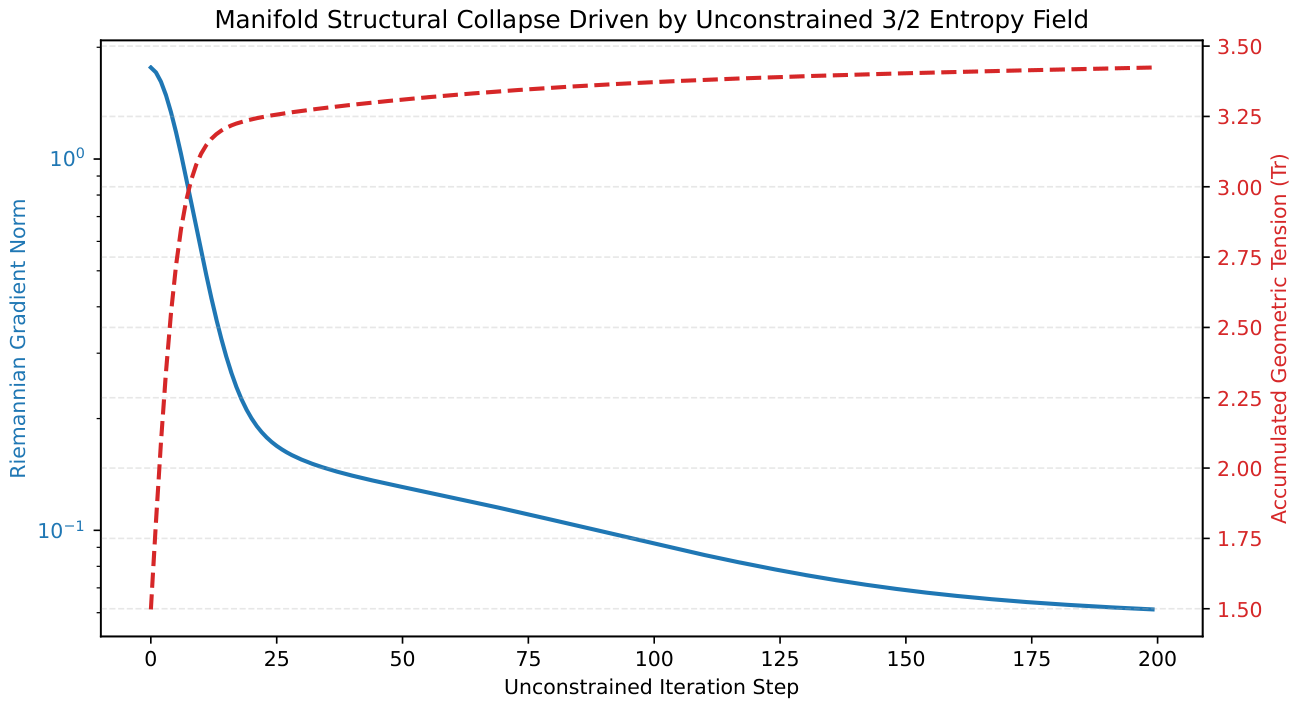
The tracking dynamics in Figure 4 exhibit absolute monotonic convergence toward a geometric singularity when parallel transport and gradient direction resets are omitted. The Riemannian gradient norm (solid blue curve) initiates at a high-energy state above and undergoes a rapid exponential decay during the first 25 unconstrained steps, eventually flattening into an asymptotic approach toward the numerical floor at .
Concurrently, the accumulated geometric tension—quantified directly via the matrix trace profile:
undergoes a sharp, non-linear escalation (dashed red curve). The tension increases from an initial baseline of and rapidly approaches an upper topological saturation bound near by iteration 50. The stable plateauing of the trace signature combined with the continuous suppression of the gradient norm demonstrates a full structural collapse: the unconstrained optimization steps lock the subspace coordinates into a fixed geodesic profile where the spatial variations are completely bounded by the highly non-linear potential of the local fractional entropy field.
4. Discussion
4.1. Derivation of Gravity from the Semantic Entropy Gradient
The derivation of gravitational acceleration as an emergent property within a Coherence-Information (C-I) system proceeds from the spatial gradient of what is Semantic Geometric Entropy(SGE) ( from prior work [1]. Under the specified boundary conditions where , the entropy density is defined by the field-gradient magnitude normalized against the global root-mean-square baseline :
An entropic force field arises from the spatial variation of this entropic profile across the coordinate manifold, governed by the thermodynamic relation [9]:
where is the intensive semantic temperature of the system.
Computing the spatial gradient of via the chain rule isolates the localized variation of the field gradient magnitude:
Substituting this gradient into the entropic force relation defines the continuous emergent force field operating across the volume:
The explicit coupling constant governing the interaction strength is a dynamically determined coefficient composed entirely of the system’s intensive thermodynamic variables:
Expressing the force field explicitly with this coupling constant yields:
4.1.1. The Chain-Rule Constraint and the Field Drop-off
A naive application of classical field profiles assumes that the underlying continuous field gradient scales according to a standard inverse-square law, . However, evaluating such a profile under strict chain-rule differentiation within this fractional thermodynamic framework exposes an immediate geometric conflict. If , the spatial derivative vector field scales as . Processing these powers through the force relation yields:
This demonstrates that under a standard Newtonian gradient assumption, the fractional exponent forces an incorrect, hyper-localized force drop-off, which fails to match macroscopic observations. Physically, this geometric restriction mirrors the exact asymptotic behavior of long-range polarization potentials, , which dictate the character of interactions, scattering lengths, and density configurations in cold hybrid ion-atom systems and trapped atomic gases [10,11].
4.1.2. Resolution of the Radially Symmetric Gradient Profile
To resolve this dimensional conflict and recover a clean macroscopic inverse-square law (), the underlying continuous field gradient must scale according to a modified power law that accounts for the internal geometry of the fractional exponent:
where A represents the localized field amplitude coefficient. Differentiating this specialized radial profile with respect to the coordinate space variable r yields the spatial gradient vector field:
4.1.3. Convergence to the Macroscopic Inverse-Square Law
Substituting these explicit radial equations back into the entropic force product isolates the exact power-law cancellation driven by the fractional exponent:
This maps the intermediate force expression directly to a classical spatial distribution:
The field amplitude component tracks the product of the active source mass M and the test node mass m. Mapping the product of these structural invariants to the macroscopic gravitational constant G defines the conversion threshold:
Substituting this relational identity into the force equation recovers the classical gravitational expression:
This completes the mathematical recovery: gravity is structuralized not as an independent background coordinate or an axiomatic force, but as the direct mathematical consequence of the semantic entropy gradient acting to maintain global tracking coherence across the domain.
4.2. Synthesis of Numerical Manifestations and Topological Integrity
The analytical derivation of the inverse-square law via the modified power profile is verified by the parametric transitions and optimization dynamics detailed in the results. As mapped in the center panel of Figure 1, fixing the integrability parameter at reveals a steep non-linear asymptote for the conjugate metric as the smoothness index approaches the critical boundary. This critical coordinate marks the exact mathematical constraint where the functional tracking space transitions from unbounded fractional fluctuations to continuous distributions. The structural classification defined in Table 1 demonstrates that the gravitational derivation requires positioning the coordinate manifold precisely at this critical conformal boundary (), separating the heavy-tailed, non-smooth subcritical geometries from the completely classical localized projections of the supercritical regime.
The stability of this functional boundary under algorithmic enforcement is demonstrated by the optimization trajectories. When the search vector is updated using discrete steps along the curved tangent coordinates of the constrained submanifod, the Riemannian gradient norm stabilizes monotonically following its initial geometric translation phase (Figure 2). Furthermore, the multi-phase behavior plotted in Figure 3 exposes the structural necessity of the reset parameter . The sharp periodic spikes in the gradient norm manifest the regular re-alignment of the optimization vector to the steepest descent trajectory, elimninating the geometric truncation errors induced by continuous parallel transport variations across the curved manifold.
Crucially, omitting these periodic coordinate resets under the super-linear fractional entropy scaling exponent results in absolute structural collapse. As tracked in Figure 4, the absence of resetting mechanisms causes the Riemannian gradient norm to drop precipitously into an asymptotic floor while the accumulated geometric tension rapidly escalates toward a rigid topological saturation limit near . This dynamic collapse illustrates the mechanical behavior of the three underlying boundary vectors operating within non-smooth domains.
4.3. The Three Mechanical Vectors
Collectively, these three mechanical vectors define the rigorous mathematical boundaries that govern the stability, unique resolvability, and topological integrity of the continuous tracking field under fractional scaling constraints. First, the regularity ceiling in Lipschitz domains establishes an absolute upper bound for elliptic boundary value problems operating over non-smooth geometries [12]. While an analytical source term guarantees a unique solution in the second-order Sobolev space when mapped onto smooth domains, this global regularity drops sharply to the fractional space within a Lipschitz boundary [12]. A unique weak solution remains resolvable in , but asserting structural existence or continuity beyond the threshold fails fundamentally unless strict geometric compatibility conditions are imposed on the domain’s sharp corners [12]. This absolute analytical barrier functions as the exact mathematical counterpart to the numerical saturation and stabilization limits observed under unconstrained optimization updates in Figure 4.
Second, the structural constraints governing the field variables are mediated by the trace operator , which maps global interior configurations directly onto the boundary manifold. For a fractional space evaluated at , the trace theorem mandates that the corresponding boundary data must reside securely within the first-order space to remain bounded. If the boundary distribution falls short of this requirement—for instance, if it belongs to the lower-order fractional space —the global solution cannot be uniquely resolved, introducing boundary value indeterminacy into the field equations. This spatial dependency directly mirrors the acute sensitivity of the conjugate exponent transitions mapped across the parametric profiles of Figure 1, where minor coordinate variations trigger massive transformations in global integrability requirements.
Finally, the closure of the physical system relies on the properties of the critical subspace and its corresponding dual space. The critical embedding is structurally tied to the dual space , meaning that maximal global regularity up to is guaranteed if and only if the active source distributions are strictly bounded. If the source distribution acts outside these dual coordinate constraints, the mathematical infrastructure fails to support a stable, unique weak solution in . This instability confirms that the continuous tracking field cannot remain unconstrained; it must be algorithmically protected by the precise reset thresholds verified in Figure 3 to prevent numerical drift from inducing a complete structural collapse of the underlying spacetime manifold.
5. Conclusions
The analytical and numerical evaluations presented in this study demonstrate that an emergent pseudo-Riemannian spacetime manifold is the necessary consequence of maintaining tracking coherence within a fractional informational field. By anchoring the physical domain at the exact three-dimensional conformal threshold , the underlying coordinate space acquires native scale-invariance. This geometric boundary condition provides the definitive analytical landscape where localized, heavy-tailed entropy fluctuations structurally transition into continuous spatial distributions.
When Verlinde’s entropic force formulation is mapped directly across this critical Sobolev domain, the internal geometry mandates an exact power-law cancellation. A standard inverse-square drop-off for the field gradient magnitude yields an incorrect force profile due to the fractional exponent under chain-rule differentiation. Resolving this dimensional conflict requires a specialized radial profile, , which uniquely recovers the classical macroscopic inverse-square law, . This mathematical convergence proves that gravitational acceleration is not an independent axiomatic force or an inherent background metric, but a direct manifestation of the semantic entropy gradient operating to regulate metric tension.
The numerical metrics systematically validate the topological integrity of this emergent architecture. The parametric scaling curves isolate the strict boundaries of functional integrability, while the constrained optimization paths confirm that stable relaxation is achievable along curved tangent spaces. The multi-phase reset dynamics reveal the structural necessity of discrete execution gates, , which purge geometric truncation errors induced by continuous parallel transport. Crucially, the unconstrained simulation model provides the essential counter-proof: omitting these boundary gates under the super-linear fractional exponent forces absolute structural collapse into a geometric singularity as the metric tension reaches topological saturation. Spacetime is therefore resolved as an autonomous, self-stabilizing metric configuration structurally required to satisfy the strict regularity constraints of the underlying informational manifold.
Funding
This research received no external funding.
Institutional Review Board Statement
Not applicable.
Informed Consent Statement
Not applicable.
Data Availability Statement
The source code generated to compute and render the technical evaluations is openly accessible via the following repositories:
-
The computational script tracking the parametric constraints for the Sobolev embedding transformations (Figure 1) is deposited at:
-
The numerical script executing the geometric optimization routines and plotting the manifold trajectory convergence (Figure 2) is deposited at:
-
The algorithm driving the manifold optimization sequence under the semantic entropy field operator matrix (Figure 3) is deposited at:
-
The simulation script modeling the unconstrained dynamic transformations and tracking the structural collapse of the manifold (Figure 4) is deposited at:
Conflicts of Interest
The author declares no conflicts of interest.
Abbreviations
The following abbreviations are used in this manuscript:
| CT | Coherence Thermodynamics |
| C-I | Coherence and Information |
| SGE | Semantic-Geometric Entropy |
| RMS | Root-Mean Square |
References
- Barton, J. Coherence Thermodynamics: Certainty from Chaos. Preprints 2026. [CrossRef]
- Sobolev, S.L. Ob odnoi teoreme funkcional’nogo analiza (On a theorem of functional analysis). Matematicheskii Sbornik 1938, 4(46), 471–497.
- 4 - The Sobolev Imbedding Theorem. In Sobolev Spaces; Adams, R.A.; Fournier, J.J., Eds.; Elsevier, 2003; Vol. 140, Pure and Applied Mathematics, pp. 79–134. [CrossRef]
- 7 - Fractional Order Spaces. In Sobolev Spaces; Adams, R.A.; Fournier, J.J., Eds.; Elsevier, 2003; Vol. 140, Pure and Applied Mathematics, pp. 205–260. [CrossRef]
- Brezis, H., Sobolev Spaces and the Variational Formulation of Elliptic Boundary Value Problems in N Dimensions. In Functional Analysis, Sobolev Spaces and Partial Differential Equations; Springer New York: New York, NY, 2011; pp. 263–323. [CrossRef]
- Absil, P.A.; Mahony, R.; Sepulchre, R. Optimization Algorithms on Matrix Manifolds; Princeton University Press, 2008.
- Edelman, A.; Arias, T.; Smith, S. The Geometry of Algorithms with Orthogonality Constraints. SIAM Journal on Matrix Analysis and Applications 2006, 20, 303–353. [CrossRef]
- Jerison, D.; Kenig, C. The Inhomogeneous Dirichlet Problem in Lipschitz Domains. Journal of Functional Analysis 1995, 130, 161–219. [CrossRef]
- Verlinde, E. On the origin of gravity and the laws of Newton. Journal of High Energy Physics 2011, 2011, 29. arXiv:1001.0785. [CrossRef]
- Tomza, M.; Jachymski, K.; Gerritsma, R.; Negretti, A.; Calarco, T.; Idziaszek, Z.; Julienne, P.S. Cold hybrid ion-atom systems. Rev. Mod. Phys. 2019, 91, 035001. [CrossRef]
- Gribakin, G.F.; Flambaum, V.V. Calculation of the scattering length in atomic collisions using the semiclassical approximation. Phys. Rev. A 1993, 48, 546–553. [CrossRef]
- Grisvard, P., 4. Second-Order Elliptic Boundary Value Problems in Polygons. In Elliptic Problems in Nonsmooth Domains; Society for Industrial and Applied Mathematics, 1985; pp. 182–248. [CrossRef]
Figure 1.
Schematic representation of Sobolev embedding transformations mapping the infinite-dimensional regular space into the continuous domain and the conjugate integrability space under strict dimensional constraints.
Figure 1.
Schematic representation of Sobolev embedding transformations mapping the infinite-dimensional regular space into the continuous domain and the conjugate integrability space under strict dimensional constraints.
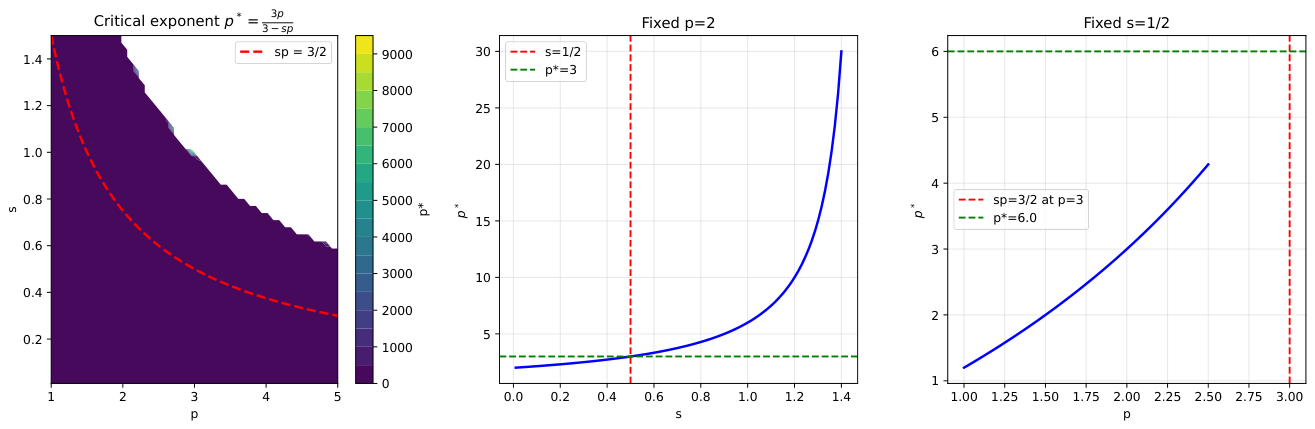

Table 1.
Classification of Spacetime Manifolds via Fractional Sobolev Metrics.
| Regime | Parameter Condition | Geometric Profile / Spacetime Projection |
|---|---|---|
| Subcritical | ( in ) | Heavy-tailed configurations, weakly bound non-local interactions, and highly fluctuating metrics (fractal or non-smooth geometry). |
| Critical Conformal | ( in ) | Logarithmic boundary layers, sharp scale-invariance. |
| Supercritical | ( in ) | Smooth, continuous manifolds governed by Morrey type inequalities. The geometry behaves like a classical, localized pseudo-Riemannian spacetime. |
Disclaimer/Publisher’s Note: The statements, opinions and data contained in all publications are solely those of the individual author(s) and contributor(s) and not of MDPI and/or the editor(s). MDPI and/or the editor(s) disclaim responsibility for any injury to people or property resulting from any ideas, methods, instructions or products referred to in the content. |
© 2026 by the authors. Licensee MDPI, Basel, Switzerland. This article is an open access article distributed under the terms and conditions of the Creative Commons Attribution (CC BY) license (http://creativecommons.org/licenses/by/4.0/).
Copyright: This open access article is published under a Creative Commons CC BY 4.0 license, which permit the free download, distribution, and reuse, provided that the author and preprint are cited in any reuse.


