
Submitted:
19 July 2026
Posted:
20 July 2026
You are already at the latest version
Abstract
Fibromyalgia and chronic fatigue syndrome/myalgic encephalomyelitis (CFS/ME) are chronic, multisystem disorders characterized by persistent fatigue, musculoskeletal pain, cognitive dysfunction, sleep disturbances, and markedly reduced quality of life. Fatigue is one of the most disabling symptoms and remains insufficiently addressed by current therapeutic approaches. Increasing evidence implicates mitochondrial dysfunction, oxi-dative and nitrosative stress, immune dysregulation, and impaired nicotinamide adenine dinucleotide (NAD⁺) metabolism as central mechanisms underlying fatigue in these conditions. Micronutrients constitute essential cofactors of mitochondrial bioenergetics, redox homeostasis, and immune metabolism. This narrative review synthesizes current evidence on mitochondrial dysfunction in fibromyalgia and CFS/ME and examines the mechanistic and clinical rationale for targeted micronutritional interventions aimed at restoring redox balance, mitochondrial efficiency, and Adenosine triphosphate (ATP) production. Particular attention is given to strategies targeting glutathione repletion, NAD⁺ metabolism, and electron transport chain function. Finally, we present a proposal for a randomized placebo-controlled clinical trial in fibromyalgia patients with severe fatigue (PROMIS Fatigue T-score > 60), designed to evaluate a mitochondrial-oriented micronutritional formulation as an adjunctive therapeutic approach.
Keywords:
fibromyalgia
; chronic fatigue syndrome
; mitochondrial dysfunction
; micronutrition
; fatigue
; NAD⁺
; glutathione
1. Introduction
Fibromyalgia and chronic fatigue syndrome/myalgic encephalomyelitis (CFS/ME) are prevalent chronic conditions characterized by persistent fatigue, widespread pain, cognitive impairment, sleep disturbances, and substantial functional limitations including chronic fatigue. Despite their high prevalence and significant socioeconomic impact, effective treatments for fatigue, the symptom most strongly associated with disability and reduced quality of life, remain limited.
Historically, fatigue in fibromyalgia and CFS/ME has often been conceptualized as a subjective or centrally mediated phenomenon. However, accumulating evidence indicates that fatigue is not merely a subjective symptom but reflects impaired cellular energy availability resulting from disturbances in mitochondrial bioenergetics and immunometabolic adaptation. [1,2,3,4]. Mitochondria play a central role in ATP production, oxidative metabolism, immune signaling, and adaptive stress responses. Functional mitochondrial impairment—rather than irreversible structural mitochondrial disease—has been consistently reported in CFS/ME and, more recently, in fibromyalgia, suggesting a potentially reversible contribution to the disease progression [5,6,7].
Micronutrients include diverse biomolecules such vitamins, minerals, trace elements, and vitamin-like factors such as coenzyme Q10, choline, myo-inositol, essential and semi-essential fatty acids, essential and conditionally essential amino acids, and nucleotides. Micronutrients are indispensable regulators of mitochondrial function and must be supplied continuously, as body reserves are limited or absent. At the mitochondrial level, nearly all steps of oxidative metabolism rely on adequate micronutrient availability, rendering mitochondria particularly vulnerable to subclinical deficiencies. While macronutrients provide energy substrates, micronutrients act as coenzymes, cofactors, antioxidants, and signaling molecules that determine the efficiency of oxidative phosphorylation and cellular resilience [8,9].
Micronutrition has therefore emerged as a scientific approach that emphasizes the coordinated optimization of multiple micronutrients through individualized interventions. Rather than relying on single-agent interventions, micronutrition recognizes that mitochondrial metabolism depends on a coordinated network of interdependent micronutrients acting simultaneously as cofactors, antioxidants, signaling molecules, and metabolic regulators, offering a biologically plausible strategy to address mitochondrial dysfunction and fatigue [10,11].
2. Materials and Methods
This narrative review was conducted to synthesize and critically interpret current evidence regarding mitochondrial dysfunction and micronutritional therapeutic strategies in fibromyalgia and chronic fatigue syndrome/myalgic encephalomyelitis (CFS/ME). A structured, non-systematic search of PubMed/MEDLINE, Scopus, and the Cochrane Library was performed for English-language publications available up to 31 January 2026. Search strategies combined Medical Subject Headings (MeSH) terms and free-text keywords related to the following domains: “Fibromyalgia”, “Chronic Fatigue Syndrome”, “Myalgic Encephalomyelitis”, “Mitochondrial Dysfunction,” “Oxidative Stress”, “Nitrosative Stress”, “NAD,” “NAD+ metabolism” “Glutathione,” “Micronutrients,”B-complex vitamins”, “magnesium”, ”NAD precursors”, “Coenzyme Q10“, ”Alpha-Lipoic Acid”, “Carnitine”, “Acetyl L-carnitine”, “Pyrroloquinoline Quinone”, “PQQ”, “Creatine,”, ”Taurine” and “GlyNAC.” Boolean operators were used to refine combinations across pathophysiological and therapeutic domains. The scope focused on studies addressing: Mitochondrial bioenergetics and metabolic dysfunction in fibromyalgia and CFS/ME; Redox and immune–metabolic mechanisms contributing to fatigue; Clinical and translational evidence evaluating micronutritional interventions targeting mitochondrial pathways.
Priority was given to recent systematic reviews, randomized controlled trials, mechanistic translational studies, and high-quality observational research. Preclinical studies were included when relevant to mechanistic understanding of mitochondrial signaling, redox regulation, or NAD⁺ metabolism. Additional relevant publications were identified through reference screening of key articles and citation tracking of influential reviews. Literature inclusion was guided by thematic relevance, methodological rigor, and conceptual contribution to the redox–immune–mitochondrial framework proposed in this review. Given the narrative nature of the review, no formal risk-of-bias assessment or quantitative meta-analysis was performed.
3. Pathophysiology of CFS/ME and Fibromyalgia
The underlying pathophysiological mechanisms of CFS/ME and fibromyalgia remain incompletely understood, and diagnosis often occurs at advanced disease stages. However, increasing evidence supports the involvement of oxidative and nitrosative stress, mitochondrial dysfunction, genetic susceptibility, and neuroendocrine and immune dysregulation
3.1. Immune and Inflammatory Alterations
Both fibromyalgia and CFS/ME are associated with immune dysregulation, including altered cytokine profiles, impaired natural killer (NK) cell activity, and abnormalities in T-cell subsets [12,13,14]. Increased levels of pro-inflammatory cytokines, such as interleukin-6 (IL-6) and IL-12, have been reported, along with reduced NK cell cytotoxicity, which correlates with disease severity in CFS/ME [15]. Patients with CFS/ME also exhibit increased susceptibility to viral infections, including Epstein–Barr virus, cytomegalovirus, and human herpesviruses, suggesting impaired immune surveillance [16].
3.2. Oxidative and Nitrosative Stress
Persistent immune activation following infection may contribute to chronic inflammation and increased oxidative and nitrosative stress. Numerous studies have documented elevated markers of oxidative and nitrosative stress in fibromyalgia and CFS/ME, accompanied by impaired antioxidant defenses [17,18,19]. Excessive production of reactive oxygen and nitrogen species (ROS/RNS) damages mitochondrial DNA, proteins, and membranes, further impairing oxidative phosphorylation and ATP synthesis. Importantly, oxidative stress both contributes to and results from mitochondrial dysfunction, creating a self-perpetuating pathological cycle.
4. Mitochondrial Dysfunction as a Core Mechanism of Fatigue
4.1. Evidence from Bioenergetic Studies
Mitochondrial dysfunction in CFS/ME has been demonstrated using multiple methodologies, including reduced oxidative phosphorylation capacity, diminished respiratory reserve, altered mitochondrial membrane potential, and impaired ATP production in immune and muscle cells [5,6,7,20].
Importantly, similar bioenergetic abnormalities are increasingly reported in fibromyalgia. A recent study by Macchi et al. demonstrated that patients with fibromyalgia exhibit significantly reduced mitochondrial bioenergetic health index (BHI) in peripheral blood mononuclear cells compared with healthy controls, with mitochondrial impairment correlating with symptom severity, including fatigue and pain [21]. These findings provide objective evidence that mitochondrial dysfunction is clinically relevant in fibromyalgia and may represent both a biomarker and a therapeutic target.
4.2. The Redox–Immune–Mitochondrial Triangle
Mitochondrial function, redox homeostasis, and immune regulation form a tightly interconnected triad. Mitochondria are not only bioenergetic organelles but also key signaling hubs that regulate innate and adaptive immune responses. Chronic immune activation leads to sustained ROS/RNS production, depleting intracellular glutathione (GSH) and disrupting nicotinamide adenine dinucleotide (NAD⁺) homeostasis [18,22].
NAD⁺ depletion is particularly relevant, as NAD⁺ is required for sirtuin activity, mitochondrial biogenesis, DNA repair, and metabolic flexibility. Excessive activation of poly(ADP-ribose) polymerase (PARP) in response to oxidative DNA damage accelerates NAD⁺ consumption, further impairing mitochondrial repair mechanisms and ATP synthesis [23,24].
Immune cells, particularly T lymphocytes and NK cells, are highly dependent on intact mitochondrial metabolic flexibility. Reduced ATP availability and altered redox signaling impair cytotoxic activity and cytokine balance, perpetuating chronic low-grade inflammation and fatigue [25,26]. This establishes a self-reinforcing vicious cycle linking immune dysregulation, redox imbalance, and mitochondrial dysfunction, ultimately manifesting clinically as persistent fatigue and post-exertional malaise (25) Table 1.
4.3. Mitonuclear Communication and Retrogade Signaling.
In addition to classical bioenergetic defects, mitochondrial dysfunction in ME/CFS and fibromyalgia may also involve disturbed mito-nuclear communication. Experimental models have shown that mitochondrial stress activates retrograde signaling pathways to the nucleus, reprogramming cellular metabolism, inflammatory responses, and redox status, and thereby contributing to persistent hypometabolic and stress phenotypes (26).
In ME/CFS, metabolomic studies have identified a characteristic hypometabolic signature together with widespread alterations in energy metabolism that are compatible with sustained mito-nuclear signaling and adaptive metabolic reprogramming (2,21).
Similarly, patients with fibromyalgia exhibit impaired mitochondrial bioenergetics in peripheral blood mononuclear cells and ultrastructural mitochondrial abnormalities, supporting the concept that mitochondrial dysfunction contributes to disease pathophysiology [21,27]. Furthermore, recent evidence suggests that mitochondrial-derived danger-associated molecular patterns (mtDAMPs), including circulating cell-free mitochondrial DNA released after physiological stress or exercise, may contribute to innate immune activation and chronic inflammation. Although direct evidence linking these mitochondrial-derived signals to nuclear transcriptional remodeling in fibromyalgia remains limited, this mechanism provides a biologically plausible framework connecting mitochondrial dysfunction, immune dysregulation, and persistent fatigue [17,25].
5. Micronutrients and Mitochondrial Bioenergetics
Micronutrients are required for virtually every step of mitochondrial energy metabolism. Subclinical deficiencies, or increased functional requirements due to chronic inflammation or stress, can create metabolic bottlenecks even in the absence of overt nutritional deficiency states [8]. Key Micronutrients Involved in Mitochondrial Function and Fatigue are shown in Table 2.
5.1. NAD⁺ Metabolism / Precursors
NAD⁺ is a central redox cofactor and signaling molecule required for oxidative metabolism, DNA repair, and sirtuin-mediated mitochondrial regulation. Reduced NAD⁺ availability may be exacerbated by chronic PARP activation in response to oxidative DNA damage, leading to increased NAD⁺ consumption and impaired mitochondrial homeostasis [20,24]. Restoration of NAD⁺ levels through nicotinamide-based precursors has been shown to improve mitochondrial function and resistance to oxidative stress in multiple experimental and clinical settings [20,28].
5.2. B-Complex Vitamins and Magnesium
B-complex vitamins act as indispensable cofactors in glycolysis, the tricarboxylic acid cycle, and the electron transport chain. Magnesium is required for ATP stabilization and hundreds of enzymatic reactions involved in energy metabolism. Suboptimal status of these micronutrients is associated with fatigue, weakness, and cognitive impairment [30,31,32].
5.3. Coenzyme Q10
Coenzyme Q10 (CoQ10) is a key component of the mitochondrial electron transport chain and a potent lipophilic antioxidant. Reduced CoQ10 levels have been reported in CFS/ME and fibromyalgia and are associated with increased oxidative stress and fatigue severity [33]. Clinical evidence supports the role of CoQ10-based interventions in fatigue syndromes. In a randomized, double-blind, placebo-controlled trial, Castro-Marrero et al. demonstrated that combined supplementation with CoQ10 (200 mg/day) and NADH (20 mg/day) for 12 weeks significantly reduced fatigue impact, improved quality of life, and enhanced biochemical markers of mitochondrial function in patients with CFS/ME [34]. These findings support a direct link between mitochondrial support and symptomatic benefit.
5.4. Alpha-Lipoic Acid
Alpha-lipoic acid (ALA) is a dithiol compound that functions as a coenzyme for key mitochondrial dehydrogenase complexes, including pyruvate and α-ketoglutarate dehydrogenase, thereby directly supporting oxidative metabolism and ATP production. In addition, ALA exhibits antioxidant activity in both its oxidized and reduced forms and contributes to the regeneration of other antioxidants, such as glutathione, vitamins C and E, and coenzyme Q10 [35,36]. ALA stimula AMPK–SIRT1–PGC-1α signaling and NRF1/NRF2-driven mitochondrial biogenesis, which may contribute to restoring redox-sensitive mito-nuclear crosstalk in cells under metabolic stress (36)
Although direct clinical evidence for ALA supplementation in fibromyalgia or CFS/ME is limited, its relevance is supported by studies in conditions characterized by mitochondrial dysfunction, oxidative stress, and chronic pain, including diabetic neuropathy and metabolic disorders (37). Given the documented imbalance between oxidative stress and antioxidant defenses in fibromyalgia and CFS/ME [18,19,20], ALA may contribute to mitochondrial protection and redox homeostasis when used as part of a broader, multi-micronutrient strategy.
5.5. Glutathione Repletion and GlyNAC
Glutathione is the principal intracellular antioxidant and a critical regulator of mitochondrial redox homeostasis. Reduced glutathione levels have been documented in fibromyalgia and CFS/ME and are associated with increased oxidative damage [18,38].
5.5.1. N-acetylcysteine and glycine
N-acetylcysteine (NAC) provides cysteine for glutathione synthesis, while glycine represents an additional rate-limiting substrate. Combined supplementation with NAC and glycine (GlyNAC) has been shown to restore glutathione levels more effectively than NAC alone, improve mitochondrial fuel oxidation improve mitochondrial bioenergetics, and reduce oxidative stress and inflammation (39,40). Experimental studies often use weight-based doses (approximately 100–120 mg/kg/day of each component) [39]. In clinical practice, lower doses (typically NAC 600–1800 mg/day combined with glycine 1–8 g/day) are used to balance efficacy and tolerability.
5.6. Additional Mitochondrial-Supporting Micronutrients
5.6.1. Acetyl L-Carnitine
5.6.2. Pyrroloquinoline Quinone (PQQ), Taurine, and Creatine
PQQ stimulates mitochondrial biogenesis and improves mitochondrial efficiency, thereby enhancing the coordinated expression of nuclear and mitochondrial genes and supporting mito-nuclear communication [43,44,45]. Taurine stabilizes mitochondrial membranes and modulates calcium homeostasis, supporting neuromuscular function [46]. Creatine acts as an intracellular phosphagen buffer, facilitating rapid ATP regeneration in tissues with high energetic demand, including skeletal muscle and the central nervous system[47]. In a randomized, double-blind, placebo-controlled trial, creatine supplementation improved muscle strength, functional capacity, and muscle bioenergetics in women with fibromyalgia, supporting its potential as an adjunctive strategy for improving mitochondrial energy metabolism in fatigue-related disorders [48].
5.6.3. Synergistic Micronutrient Combinations
General multivitamin–mineral supplementation has not demonstrated consistent benefits in fibromyalgia or CFS/ME. This concept aligns with the systems biology paradigm in which correction of multiple interconnected metabolic bottlenecks is more likely to restore mitochondrial homeostasis than supplementation with isolated nutrients. Hence, targeted combinations addressing specific mitochondrial and redox pathways—such as NAD⁺ precursors, GlyNAC, CoQ10, B-complex vitamins, magnesium, and Acetyl L-carnitine, have shown promising improvements in fatigue, vitality, and quality of life [38,39,40]. A summary of the evidence is shown in Table 3.
6. Proposal for a Randomized Placebo-Controlled Trial in Fibromyalgia (Currently Recruiting)
Fatigue remains one of the most disabling and insufficiently treated symptoms in fibromyalgia. Based on accumulating evidence linking mitochondrial dysfunction to fatigue severity in fibromyalgia [21], and on clinical trials demonstrating that mitochondrial-oriented micronutritional interventions can reduce fatigue in related conditions, we propose and are currently conducting a randomized, double-blind, placebo-controlled clinical trial (RPCT) in patients with fibromyalgia presenting fatigue. The proposed intervention reflects the mechanistic rationale developed throughout this review by simultaneously targeting mitochondrial bioenergetics, redox homeostasis, and immunometabolic regulation.
6.1. Study Population
The study includes adult patients with a confirmed diagnosis of fibromyalgia according to established criteria and PROMIS Fatigue T-scores > 60, ensuring selection of a clinically homogeneous population with severe fatigue and high unmet therapeutic need.
6.2. Intervention Rationale
The investigational intervention is a targeted micronutritional formulation designed to: restore glutathione levels (GlyNAC), optimize NAD⁺ metabolism, enhance electron transport chain efficiency (CoQ10, B-complex vitamins), and support ATP synthesis and buffering (magnesium, carnitine, creatine, lipoic acid).
6.3. Clinical Relevance
This RPCT aims to evaluate the efficacy and safety of a mitochondrial-oriented micronutritional strategy as an adjunctive treatment for fibromyalgia-related fatigue. If successful, this approach could represent a safe, scalable, and biologically grounded option to address a major unmet clinical need.
7. Conclusions
Mitochondrial dysfunction, redox imbalance, and immune–metabolic dysregulation forms a convergent pathophysiological framework underlying fatigue in fibromyalgia and CFS/ME. Micronutrients play indispensable roles in maintaining mitochondrial bioenergetics and cellular resilience. Targeted micronutritional strategies—particularly those aimed at restoring glutathione and NAD⁺ homeostasis—represent a promising therapeutic avenue. Ongoing and future randomized clinical trials will be critical to translating these mechanistic insights into evidence-based clinical practice.
Funding
This narrative review received no external funding. Laboratorio LCN (Barcelona, Spain) provides financial support exclusively for the ongoing randomized placebo-controlled clinical trial described in Section 8 and had no involvement in the design, literature review, interpretation of the scientific evidence, writing of the manuscript, or the decision to submit it for publication.
Acknowledgments
The authors used ChatGPT (OpenAI) during manuscript preparation exclusively to assist with the graphical design of Figure 1. The authors were responsible for all scientific concepts, literature review, data interpretation, writing, critical revision, and final approval of the manuscript. All AI-assisted output was reviewed, edited, and verified by the authors, who accept full responsibility for the content of this publication.
Conflicts of Interest
Nuria Capdevila and Francisco Cardona are Medical Directors of Laboratorio LCN (Barcelona, Spain). Laboratorio LCN sponsors the ongoing randomized, placebo-controlled clinical trial described in Section 8. The present narrative review was conducted independently and received no financial support from Laboratorio LCN. The sponsor had no role in the conception of this review, literature selection, interpretation of the scientific evidence, manuscript preparation, or the decision to submit the manuscript for publication. Sergio Abanades serves as Chief Scientific Advisor to Laboratorio LCN for the aforementioned clinical trial, and Irene Fernández serves as the Principal Investigator of the trial. Aside from these disclosed roles related to the clinical trial, the authors declare no other competing interests.
Abbreviations
The following abbreviations are used in this manuscript:
| CFS/ME | fatigue syndrome/myalgic encephalomyelitis |
| NAD | nicotinamide adenine dinucleotide |
| ATP | adenosine triphosphate |
| ROS | reactive oxygen species |
| PQQ | pyrroloquinoline Quinone |
| NADH | Reduced nicotinamide adenine dinucleotide |
| CoQ10 | Coenzyme Q10 (ubiquinone) |
| ALA | Alpha-lipoic acid |
| NR | Nicotinamide riboside |
| NMN | Nicotinamide mononucleotide |
| RPCT R | andomized placebo-controlled clinical |
References
- Myhill, S.; Booth, N.E.; McLaren-Howard, J. Chronic fatigue syndrome and mitochondrial dysfunction. Int. J. Clin. Exp. Med. 2009, 2, 1–16. [Google Scholar] [PubMed]
- Naviaux, R.K.; Naviaux, J.C.; Li, K.; Bright, A.T.; Alaynick, W.A.; Wang, L.; Baxter, A.; Nathan, N.; Anderson, W.; Gordon, E. Metabolic features of chronic fatigue syndrome. Proc. Natl. Acad. Sci. USA 2016, 113, E5472–E5480. [Google Scholar] [CrossRef] [PubMed]
- Maes, M.; Twisk, F.N. Chronic fatigue syndrome: Mitochondrial dysfunction, inflammation and oxidative/nitrosative stress. Neuro Endocrinol. Lett. 2010, 31, 300–311. [Google Scholar]
- Morris, G.; Maes, M. Oxidative and nitrosative stress and immune-inflammatory pathways in chronic fatigue syndrome. Mol. Neurobiol. 2014, 50, 19–36. [Google Scholar] [CrossRef]
- Booth, N.E.; Myhill, S.; McLaren-Howard, J. Mitochondrial dysfunction and the pathophysiology of chronic fatigue syndrome. Int. J. Clin. Exp. Med. 2012, 5, 208–220. [Google Scholar] [PubMed]
- Tomas, C.; Brown, A.; Strassheim, V.; Elson, J.L.; Newton, J.L.; Manning, P. Cellular bioenergetics is impaired in chronic fatigue syndrome. PLoS ONE 2017, 12, e0186802. [Google Scholar] [CrossRef] [PubMed]
- Missailidis, D.; Annesley, S.J.; Allan, C.Y.; Sanislav, O.; Lidbury, B.A.; Lewis, D.P.; Fisher, P.R. An isolated complex V inefficiency and dysregulated mitochondrial function in immortalized lymphocytes from patients with myalgic encephalomyelitis/chronic fatigue syndrome. Nat. Commun. 2020, 11, 4946. [Google Scholar] [CrossRef]
- Ames, B.N. Low micronutrient intake may accelerate the degenerative diseases of aging. Proc. Natl. Acad. Sci. USA 2006, 103, 17589–17594. [Google Scholar] [CrossRef] [PubMed]
- Calder, P.C. Feeding the immune system. Br. J. Nutr. 2013, 109 (Suppl. 2), S2–S8. [Google Scholar] [CrossRef]
- Cornelli, U. Micronutrition: A new frontier. J. Nutr. Health Aging 2010, 14, 291–295. [Google Scholar] [CrossRef]
- Shenkin, A. Micronutrients in health and disease. Postgrad. Med. J. 2006, 82, 559–567. [Google Scholar] [CrossRef] [PubMed]
- Fletcher, M.A.; Zeng, X.R.; Barnes, Z.; Levis, S.; Klimas, N.G. Plasma cytokines in women with chronic fatigue syndrome. J. Transl. Med. 2009, 7, 96. [Google Scholar] [CrossRef] [PubMed]
- Klimas, N.G.; Broderick, G.; Fletcher, M.A. Biomarkers for chronic fatigue. Front. Immunol. 2012, 3, 268. [Google Scholar] [CrossRef] [PubMed]
- Loebel, M.; Strohschein, K.; Giannini, C.; Koelsch, U.; Bauer, S.; Doebis, C.; Thomas, S.; Unterwalder, N.; von Baehr, V.; Reinke, P.; et al. Deficient EBV-specific B- and T-cell response in patients with chronic fatigue syndrome. Brain Behav. Immun. 2014, 38, 103–109. [Google Scholar] [CrossRef] [PubMed]
- Brenu, E.W.; van Driel, M.L.; Staines, D.R.; Ashton, K.J.; Ramos, S.B.; Keane, J.; Klimas, N.G.; Marshall-Gradisnik, S.M. Immunological abnormalities as potential biomarkers in chronic fatigue syndrome/myalgic encephalomyelitis. J. Transl. Med. 2011, 9, 81. [Google Scholar] [CrossRef] [PubMed]
- Lerner, A.M.; Beqaj, S.H.; Deeter, R.G.; Fitzgerald, J.T. Valacyclovir treatment in Epstein–Barr virus subset chronic fatigue syndrome. Virus Adapt. Treat. 2010, 2, 47–57. [Google Scholar]
- Morris, G.; Berk, M.; Walder, K.; Maes, M. Central pathways causing fatigue in neuro-inflammatory and autoimmune illnesses. BMC Med. 2015, 13, 28. [Google Scholar] [CrossRef] [PubMed]
- Richards, R.S.; Roberts, T.K.; Mathers, D.A.; Dunstan, R.H.; Butt, H.L.; McGregor, N.R. Oxidative stress is associated with symptom expression in chronic fatigue syndrome. J. Clin. Pathol. 2000, 53, 38–43. [Google Scholar] [CrossRef] [PubMed]
- Valko, M.; Leibfritz, D.; Moncol, J.; Cronin, M.T.D.; Mazur, M.; Telser, J. Free radicals and antioxidants in normal physiological functions and human disease. Int. J. Biochem. Cell Biol. 2007, 39, 44–84. [Google Scholar] [CrossRef] [PubMed]
- Cantó, C.; Menzies, K.J.; Auwerx, J. NAD(+) metabolism and the control of energy homeostasis: A balancing act between mitochondria and the nucleus. Cell Metab. 2015, 22, 31–53. [Google Scholar] [CrossRef] [PubMed]
- Macchi, C.; Giachi, A.; Fichtner, I.; Ravera, F.; Bazzichi, L.; Matucci-Cerinic, M.; Aloisi, A.M.; Lucacchini, A.; Bombardieri, S.; Migliore, A.; et al. Mitochondrial function in fibromyalgia correlates with disease severity. Sci. Rep. 2024, 14, 81298. [Google Scholar] [CrossRef] [PubMed]
- Lu, S.C. Regulation of glutathione synthesis. Mol. Asp. Med. 2009, 30, 42–59. [Google Scholar] [CrossRef] [PubMed]
- Bai, P. Biology of poly(ADP-ribose) polymerases: The factotums of cell maintenance. Mol. Cell 2015, 58, 947–958. [Google Scholar] [CrossRef] [PubMed]
- Covarrubias, A.J.; Perrone, R.; Grozio, A.; Verdin, E. NAD+ metabolism and its roles in cellular processes during ageing. Nat. Rev. Mol. Cell Biol. 2021, 22, 119–141. [Google Scholar] [CrossRef] [PubMed]
- Syed, A.M.; Karius, A.K.; Ma, J.; Wang, P.Y.; Hwang, P.M. Mitochondrial Dysfunction in Myalgic Encephalomyelitis/Chronic Fatigue Syndrome. Physiology 2025, 40(4), 0. [Google Scholar] [CrossRef] [PubMed]
- Gureev, A.P.; Shaforostova, E.A.; Popov, V.N. Regulation of mitochondrial biogenesis as a way for active longevity: Interaction between the Nrf2 and PGC-1α signaling pathways. Front. Genet. 2019, 10, 435. [Google Scholar] [CrossRef] [PubMed]
- Israel, L.; Furer, V.; Levin-Zaidman, S.; Dezorella, N.; Brontvein, O.; Ablin, J.N.; Gross, A. Mitochondrial structural alterations in fibromyalgia: A pilot electron microscopy study. Clin. Exp. Rheumatol. 2024, 42, 1215–1223. [Google Scholar] [CrossRef] [PubMed]
- Dehhaghi, M.; Panahi, H.K.S.; Kavyani, B.; Heng, B.; Tan, V.X.Y.; Braidy, N.; Guillemin, G.J. The role of kynurenine pathway and NAD+ metabolism in myalgic encephalomyelitis/chronic fatigue syndrome. Aging Dis. 2022, 13, 698–711. [Google Scholar] [CrossRef] [PubMed]
- Trammell, S.A.J.; Weidemann, B.J.; Chadda, A.; Yorek, M.S.; Holmes, A.; Coppey, L.J.; Obrosov, A.; Kardon, R.H.; Yorek, M.A.; Brenner, C. Nicotinamide riboside is uniquely and orally bioavailable in mice and humans. Nat. Commun. 2016, 7, 12948. [Google Scholar] [CrossRef] [PubMed]
- Kennedy, D.O. B vitamins and the brain: Mechanisms, dose and efficacy—A review. Nutrients 2016, 8, 68. [Google Scholar] [CrossRef] [PubMed]
- Haskell, C.F.; Robertson, B.; Jones, E.; Forster, J.; Jones, R.; Wilde, A.; Hinks, E.; Maggini, S.; Kennedy, D.O. Effects of a multi-vitamin/mineral supplementation on cognitive function and fatigue during extended multi-tasking. Hum. Psychopharmacol. 2010, 25, 448–461. [Google Scholar] [CrossRef] [PubMed]
- de Baaij, J.H.F.; Hoenderop, J.G.J.; Bindels, R.J.M. Magnesium in man: Implications for health and disease. Physiol. Rev. 2015, 95, 1–46. [Google Scholar] [CrossRef] [PubMed]
- Bentler, S.E.; Hartz, A.J.; Kuhn, E.M. Prospective observational study of coenzyme Q10 in chronic fatigue syndrome. J. Chronic Fatigue Syndr. 2005, 13, 71–78. [Google Scholar] [CrossRef]
- Castro-Marrero, J.; Sáez-Francàs, N.; Segundo, M.J.; Calvo, N.; Faro, M.; Aliste, L.; Fernández de Sevilla, T.; Alegre, J. Effect of coenzyme Q10 plus nicotinamide adenine dinucleotide supplementation on maximum heart rate after exercise testing in chronic fatigue syndrome: A randomized, controlled, double-blind trial. J. Clin. Med. 2020, 9, 3527. [Google Scholar] [CrossRef] [PubMed]
- Packer, L.; Witt, E.H.; Tritschler, H.J. Alpha-lipoic acid as a biological antioxidant. Free Radic. Biol. Med. 1995, 19, 227–250. [Google Scholar] [CrossRef] [PubMed]
- Shay, K.P.; Moreau, R.F.; Smith, E.J.; Smith, A.R.; Hagen, T.M. Alpha-lipoic acid as a dietary supplement: Molecular mechanisms and therapeutic potential. Biochim. Biophys. Acta 2009, 1790, 1149–1160. [Google Scholar] [CrossRef] [PubMed]
- Ziegler, D.; Ametov, A.; Barinov, A.; Dyck, P.J.; Gurieva, I.; Low, P.A.; Münzel, U.; Yakhno, N.; Raz, I.; Novosadova, M. Oral treatment with alpha-lipoic acid improves symptomatic diabetic polyneuropathy: The SYDNEY 2 trial. Diabetes Care 2006, 29, 2365–2370. [Google Scholar] [CrossRef] [PubMed]
- Sekhar, R.V.; McKay, S.V.; Patel, S.G.; Guthikonda, A.P.; Reddy, V.T.; Balasubramanyam, A.; Jahoor, F. Glutathione synthesis is diminished in healthy aging and is improved by dietary supplementation with cysteine and glycine. J. Clin. Endocrinol. Metab. 2011, 96, E118–E126. [Google Scholar] [CrossRef] [PubMed]
- Kumar, P.; Liu, C.; Hsu, J.W.; Chacko, S.; Minard, C.; Jahoor, F.; Sekhar, R.V. GlyNAC supplementation improves glutathione deficiency, oxidative stress, mitochondrial dysfunction, inflammation, insulin resistance, endothelial dysfunction, genotoxicity, muscle strength, and cognition in older adults. Clin. Transl. Sci. 2021, 14, 1130–1142. [Google Scholar] [CrossRef] [PubMed]
- Elhassan, Y.S.; Philp, A.A.; Lavery, G.G. Targeting NAD⁺ and glutathione metabolism to improve mitochondrial health during ageing. Aging Cell 2023, 22, e13788. [Google Scholar] [CrossRef] [PubMed]
- Brass, E.P. Carnitine metabolism and deficiency. J. Nutr. 2000, 130, 218S–220S. [Google Scholar] [CrossRef]
- Vermeulen, R.C.W.; Scholte, H.R. Exploratory open-label, randomized study of acetyl- and propionylcarnitine in chronic fatigue syndrome. Am. J. Med. 2004, 117, 823–829. [Google Scholar] [CrossRef] [PubMed]
- Chowanadisai, W.; Bauerly, K.A.; Tchaparian, E.; Wong, A.; Cortopassi, G.A.; Rucker, R.B. Pyrroloquinoline quinone stimulates mitochondrial biogenesis through cAMP response element-binding protein phosphorylation and increased PGC-1α expression. J. Nutr. Biochem. 2010, 21, 29–37. [Google Scholar] [CrossRef] [PubMed]
- Harris, C.B.; Chowanadisai, W.; Mishchuk, D.O.; Satre, M.A.; Slupsky, C.M.; Rucker, R.B. Dietary pyrroloquinoline quinone (PQQ) alters indicators of inflammation and mitochondrial-related metabolism in healthy rats. Nutrients 2013, 5, 3909–3927. [Google Scholar] [CrossRef]
- Yan, T.; Nisar, M.F.; Hu, X.; Chang, J.; Wang, Y.; Wu, Y.; Liu, Z.; Cai, Y.; Jia, J.; Xiao, Y.; et al. Pyrroloquinoline quinone (PQQ): Its impact on human health and potential benefits. Curr. Res. Food Sci. 2024, 9, 100889. [Google Scholar] [CrossRef] [PubMed]
- Schaffer, S.W.; Jong, C.J.; Ramila, K.C.; Azuma, J. Physiological roles of taurine in mitochondria. Amino Acids 2010, 38, 1115–1122. [Google Scholar] [CrossRef]
- Rae, C.; Digney, A.L.; McEwan, S.R.; Bates, T.C. Oral creatine monohydrate supplementation improves brain performance: A double-blind, placebo-controlled, cross-over trial. Proc. R. Soc. Lond. B Biol. Sci. 2003, 270, 2147–2150. [Google Scholar] [CrossRef] [PubMed]
- Alves, C.R.R.; Santiago, B.M.; Lima, F.R.; Otaduy, M.C.G.; Calich, A.L.; Tritto, A.C.C.; de Sá Pinto, A.L.; Roschel, H.; Gualano, B. Creatine supplementation in fibromyalgia: A randomized, double-blind, placebo-controlled trial. Arthritis Care Res. 2013, 65, 1449–1459. [Google Scholar] [CrossRef]
Figure 1.
Micronutrients supports mitochondrial bioenergetics and reduce fatigue.
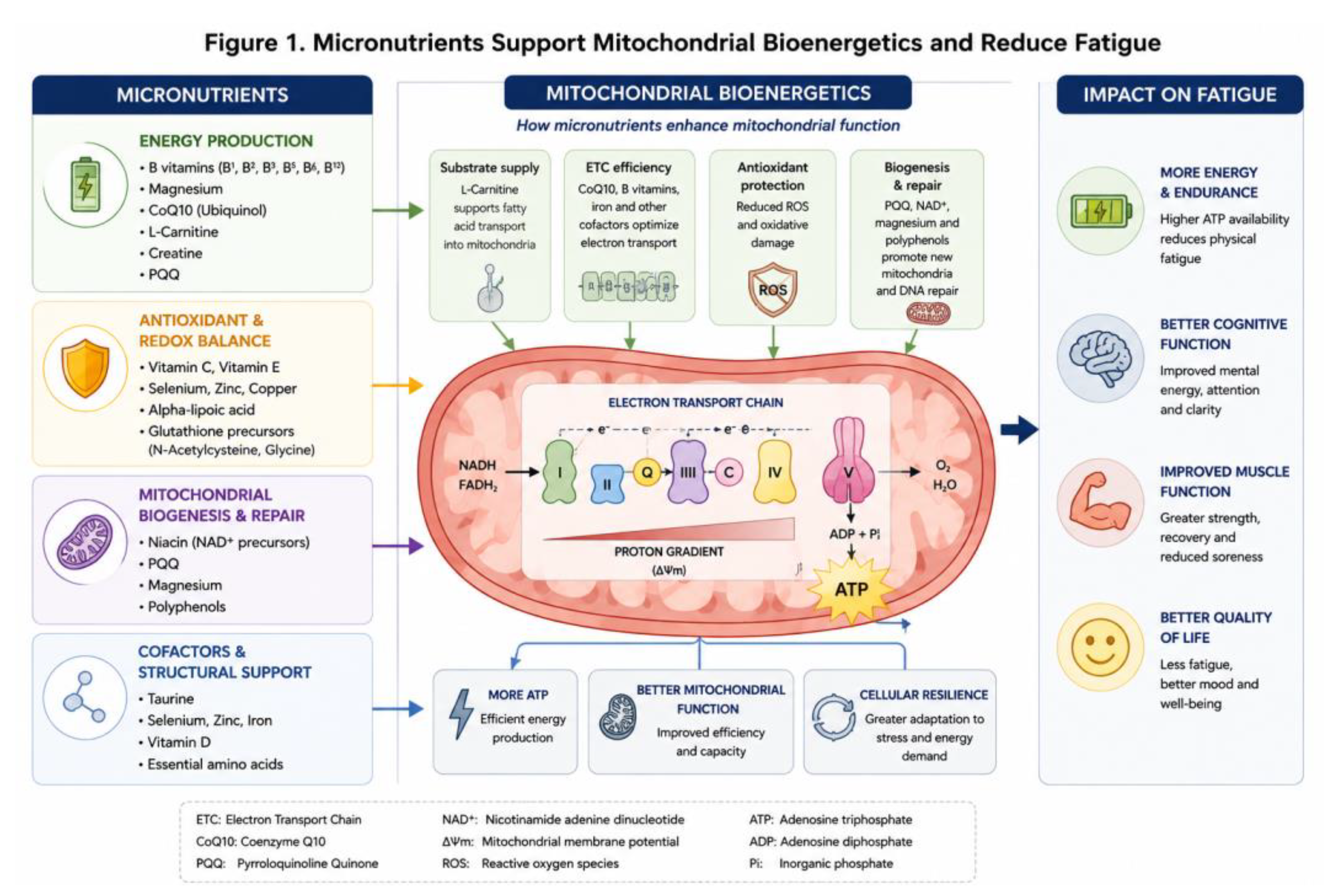

Table 1.
The Redox–Immune–Mitochondrial Triangle in Fatigue Pathophysiology.
| Component | Pathophysiological Alteration | Downstream Effects |
|---|---|---|
| Mitochondria | Reduced oxidative phosphorylation, ATP depletion | Physical and cognitive fatigue, post-exertional malaise |
| Redox balance | Increased ROS/RNS, glutathione depletion | Mitochondrial damage, impaired signaling |
| Immune system | Chronic low-grade activation, NK/T-cell dysfunction | Persistent inflammation, impaired viral clearance |
| Integrated outcome | Self-reinforcing vicious cycle | Sustained fatigue and symptom chronicity |
Table 2.
Key Micronutrients Involved in Mitochondrial Function and Fatigue.
| Micronutrient | Primary Mitochondrial Role | Mechanistic Relevance to Fatigue | Key References |
|---|---|---|---|
| NAD⁺ precursors (niacin, nicotinamide, tryptophan, nicotinamide riboside (NR), nicotinamide mononucleotide (NMN)) | Redox cofactor regeneration, sirtuin activation, DNA repair, mitochondrial biogenesis | Improves oxidative metabolism, metabolic flexibility, mitochondrial repair capacity | [20,24,28] |
| B-complex vitamins (B1, B2, B3, B5, B6, folate, B12) | Enzymatic cofactors in glycolysis, TCA cycle, and ETC | Prevents metabolic bottlenecks, supports neurocognitive function | [30,31,32] |
| Magnesium | ATP stabilization, enzymatic cofactor | Enhances ATP availability and neuromuscular function | [28] |
| Coenzyme Q10 | Electron transport chain (Complex I–III), antioxidant | Improves ATP synthesis, reduces oxidative stress | [33,34] |
| Alpha-lipoic acid | Mitochondrial dehydrogenase cofactor, antioxidant recycling | Supports oxidative metabolism and redox homeostasis | [35,36,37] |
| N-acetylcysteine (NAC) | Glutathione precursor (cysteine donor) | Restores antioxidant capacity, reduces ROS | [18,38,39,40] |
| Glycine | Glutathione precursor, mitochondrial protein synthesis | Rate-limiting for glutathione synthesis | [18,38,39,40] |
| Acetyl L-carnitine | Fatty acid transport into mitochondria | Enhances β-oxidation and energy production | [41,42] |
| Pyrroloquinoline quinone (PQQ) | Mitochondrial biogenesis and signaling | Increases mitochondrial number and efficiency | [43,44,45] |
| Taurine | Membrane stabilization, calcium homeostasis | Improves neuromuscular and mitochondrial stability | [46] |
| Creatine | Phosphocreatine energy buffering | Rapid ATP regeneration in muscle and brain | [47,48] |
Table 3.
Summary of Clinical Evidence for Mitochondrial-Oriented Micronutrients in Fatigue.
| Intervention | Population Studied | Study Type | Main Outcome |
|---|---|---|---|
| CoQ10 + NADH | CFS/ME | RCT | Reduced fatigue, improved QoL |
| GlyNAC | Aging, metabolic dysfunction | Interventional | Improved mitochondrial function |
| Acetyl L-carnitine | CFS/ME | Exploratory trial | Reduced fatigue |
| Alpha-lipoic acid | Diabetic neuropathy | RCTs | Reduced pain, oxidative stress |
| Creatine | Healthy adults, Fibromyalgia | RCTs | Improved cognitive fatigue |
Disclaimer/Publisher’s Note: The statements, opinions and data contained in all publications are solely those of the individual author(s) and contributor(s) and not of MDPI and/or the editor(s). MDPI and/or the editor(s) disclaim responsibility for any injury to people or property resulting from any ideas, methods, instructions or products referred to in the content. |
© 2026 by the authors. Licensee MDPI, Basel, Switzerland. This article is an open access article distributed under the terms and conditions of the Creative Commons Attribution (CC BY) license (http://creativecommons.org/licenses/by/4.0/).
Copyright: This open access article is published under a Creative Commons CC BY 4.0 license, which permit the free download, distribution, and reuse, provided that the author and preprint are cited in any reuse.


