
Submitted:
17 July 2026
Posted:
20 July 2026
You are already at the latest version
Abstract
Diallyl ether possesses unique chemical activities due to its dual functional allyl group and ether bond and is thus a high-value-added fine chemical with diverse applications. In this work, thin-plate ZSM-5 is synthesized and then subjected to alkaline post-treatment to improve its catalytic performance for allyl alcohol etherification to diallyl ether. The study shows that the post-treatment impacts on both the microstructure and acidic properties of ZSM-5. Although the selectivity of diallyl ether obtained over different ZSM-5 catalysts are similarly high, the treatment with tetrapropylammonium hydroxide and/or dilute NaOH solutions enhances the conversion of allyl alcohol. The highest turnover number of the reaction achieves when there is a moderate amount of strong acid sites in ZSM-5. This study contributes to the knowledge base for potential application of ZSM-5 in diallyl ether production from allyl alcohol.
Keywords:
allyl alcohol
; allyl ether
; ZSM-5
; alkali
; post-treatment
1. Introduction
Diallyl ether (DAE), as a high-value-added fine chemical, possesses unique chemical activity due to its dual functional properties of allyl (-CH2=CH-CH2) and ether bond (-O-) in its molecular structure. In the conventional process, diallyl ether production involves reacting allyl halide with allyl alcohol under alkaline conditions in a solvent to achieve etherification, in what is known as the Williamson ether synthesis.[1,2] Various allylating reagents, such as allyl acetate [3] and allyl carbonate,[4] have also been utilized as electrophiles to generate diallyl ether. However, the main shortcomings of these methods include the generation of halide waste, organic acids by-products,[3,4,5] and wastewater, resulting in significant environmental pressure. In addition, homogeneous catalysts utilized in such process require expensive ligands in synthesis, and are difficult to reuse the spent catalyst, resulting in high industrial costs.
The development of heterogeneous catalysts, such as zeolites, can increase the reaction selectivity to >95% with reduced wastewater discharge. ZSM-5 is a typical microporous zeolite with controllable acidity and is widely used in various industrial processes. ZSM-5 has two types of intersecting 10-memebered ring channels. The straight channels (0.53 nm × 0.56 nm) align parallel to the crystallographic b-axis and the sinusoidal channels (0.51 nm × 0.55 nm) parallel to the a-axis. Typically, the straight channels are better at promoting the migration of reactants and reducing coke formation, that is crucial for catalyst longevity.[8] The recent advancement in producing hierarchical ZSM-5 (zeolites containing both micropores and mesopores or macropores) [9,10] and nanosized ZSM-5 [11,12] provides some innovative solutions to enhance acid site accessibility and micropore channel connectivity, thereby improving catalytic activity and catalyst stability.
Our research group has the synthesis know-how on producing thin-plate ZSM-5 with short b-axis thicknesses and superior diffusion at molecular level. [13] Recently, the group applied thin-plate ZSM-5 to catalyse alkylation reaction [14] and found that it has enhanced catalytic activity and improved resistance to coke formation, owing to the short diffusion length and excellent acid site accessibility.
For allyl alcohol etherification, poor DAE selectivity over conventional ZSM-5 has been well documented. For example, Bezouhanova et al. (1998) showed that allyl alcohol undergoes multiple parallel reactions including dehydration and condensation over the active sites of H-ZSM-5, leading to the formation of a complex product mixture containing diallyl ether (DAE), oxygenated compounds, hydrocarbons, and heterocyclic compounds. Anderson et al. (1995) also found that DAE selectivity declines significantly as temperature increases. At 250 °C hydrocarbons became the dominant product, accompanied by a rapid catalyst deactivation due to coke deposition.
The poor performance of conventional ZSM-5 in allyl alcohol etherification is believed to originate from two aspects. Firstly, the acid strength of ZSM-5 plays a crucial role in determining the reaction pathway and product distribution. Conventional H-ZSM-5 possesses abundant weak-to-moderate acid sites, which are not sufficient to catalyse the reaction. On the other side, excessive strong acid sites are more conducive to the side reactions such as coking. Secondly, the diffusion constraints imposed by the microporous structure. With a pore diameter of only 0.51–0.56 nm, the micropores of ZSM-5 are insufficient to permit the smooth diffusion of DAE, which has a molecular size (~1.02 nm) lager than that of allyl alcohol (~0.65 nm). This diffusion restriction prolongs the residence time of DAE within the micropore channels, which further intensifies side reactions and coke formation.
Considering above, we deploy the design strategy to take advantage of shortened diffusion length of thin-plate ZSM-5 and to subject it to post-treatment to tailor the acid strength to the desired moderate-to-weak range. This study investigates the impact of a range of alkali agents on the structure and acidity of thin-plate ZSM-5. It is for the first time, thin-plate ZSM-5 is used to catalyse allyl alcohol to diallyl ether under relatively mild reaction conditions.
2. Experimental Section
2.1. Chemicals Used in Synthesis
The synthesis and post-treatment of the thin-plate ZSM-5 zeolite consumes the following chemicals reagent: tetrapropylammonium bromide (TPABr, >98%, Shandong Hengtai Chemical Co., Ltd.), colloidal silica (30 wt.%, Shanghai Macklin Biochemical Co., Ltd.), aluminium sulfate hydrate (Al2(SO4)3·18H2O, >99%, Tianjin Guangfu Technology Development Co., Ltd.), urea (NH2CONH2, >99%, Tianjin Damao Chemical Reagent Factory), ethylamine (CH3CH2NH2, 68-72 wt% in H2O, Shanghai Aladdin Biochemical Technology Co., Ltd.), tetrapropylammonium hydroxide (TPAOH, 25 wt% in water, Shanghai Aladdin Biochemical Co., Ltd.), ammonium nitrate (NH4NO3, >99%) prepared from nitric acid (HNO3, 65 wt%, Beijing Chemical Reagent Co., Ltd.) and ammonia solution (NH4OH, 25%, Tianjin Damao Chemical Reagent Factory), gamma alumina (γ-Al2O3, Qingdao Marine Chemical Co., Ltd.) and Sesbania powder (98 wt%, Hangzhou Zhongtuan Biotechnology Co., Ltd.).
2.2. Synthesis and Preparation of ZSM-5 Catalysts
Synthesis of thin-plate ZSM-5: Thin-plate ZSM-5 (nominal Si/Al = 50) was synthesized with in a semi-industrial scale 20 L stainless steel reactor, using a gel composition of 1 SiO2: 0.3 CH3CH2NH2: 0.1 TPABr: 0.02 Al2O3: 30 H2O: 0.15 CO(NH2)2: 5 wt.% seeds (respect to the silica in TEOS). Typically, the deionized water, TPABr, ethylamine, colloidal silica (30 wt.%), and Silicalite-1 seed suspension were mixed and stirred. Then, Al2(SO4)3·18H2O and CO(NH2)2 were dissolved in deionized water, respectively, and added to the mixture to obtain a synthesis gel. The gel was transferred into the 20 L stainless-steel reactor and heated at 170 °C for 24 h. The solid product was repeatedly filtered and washed with deionized water until neutral, dried at 80 °C for 12 h, and calcined at 540 °C in air for 6 h. The resulting powder is named ZSM-5-0.
Post-treatment of ZSM-5 in TPAOH solutions: The as-prepared thin-plate ZSM-5 powder was post-treated with organic hydroxide TPAOH. Typically, 8.0 g of ZSM-5 powder was dispersed and mixed well in 80 mL of TPAOH solution (0.06 mol/L). The mixture was transferred to a Teflon-lined vessel stainless-steel autoclave and heated to and maintained at 170 °C for 48 h. After being cooled down, pH of the treatment solution was measured and recorded before the solid product was recovered by centrifugation. It was then washed with deionized water until the pH of the washing water was neutral, dried at 80 °C for 12 h, and calcined at 540 °C in air for 4 h to obtain the TPAOH-treated ZSM-5 catalysts, denoted as ZSM-5-P.
Post-treatment of ZSM-5 in NaOH solution: The as-prepared thin-plate ZSM-5 powder was also post-treated in NaOH solutions of different concentrations for different times. In one group, 1.0 g of ZSM-5 powder was treated in 15 mL of NaOH solution (0.1 mol/L) for 2, 5 or 15 h under vigorous stirring at 50 °C. In another, 1.0 g of ZSM-5 powder was treated in 15 mL of NaOH solution of molar concentration of 0.1, 0.2 or 0.5 mol/L for 2 h under vigorous stirring at 50 °C. For each treatment, pH of the solution was measured and recorded at the end of each treatment. After the treatment, the solid was filtered, washed with deionized water until the pH of the washing water was neutral, dried at 80 °C for 12 h, and calcined at 540 °C in air for 4 h to obtain the NaOH-treated ZSM-5 catalysts, denoted as ZSM-5-N-C-t. Here, N refers NaOH, C refers to the molar concentration of NaOH solution, and t refers to the time of treatment in hours.
Post-treatment of ZSM-5 in mixed TPAOH and NaOH solution: Finally, 1.0 g of as-prepared thin-plate ZSM-5 powder was post-treated in 15 mL of mixed solution of NaOH (0.1 mol/L, 11.25 ml) and TPAOH (1.23 mol/L, 3.75 ml) for 2 h, under otherwise identical procedures as in other NaOH post-treatments. The resulted sample is denoted as ZSM-5-PN-2.
Preparation of ZSM-5 extrudate catalyst: In this study, the as-prepared and post-treated thin-plate ZSM-5 powders was extruded and then ion-exchanged for the catalytic performance evaluation as catalyst. As an example, the extrudate of the as-prepared thin-plate ZSM-5 was prepared with the following procedure. First, 6.0 g of thin-plate ZSM-5 powder, 1.5 g of γ-Al2O3 powder, and 1.0 g of Sesbania powder were premixed, followed by the addition of 5.5 mL of HNO3 (10% v/v). The resulting mixture was subsequently shaped into cylindrical rods of 2.0 mm diameter by rapid extrusion moulding, dried at room temperature for 12 h, dried at 80 °C for 7 h, and then calcined at 540 °C in air for 4 h. The resulting extruded ZSM-5 was finally cut into 2 mm × 2 mm pellets.
2.3. Characterization
Powder X-ray diffraction (XRD) patterns were obtained on a Rigaku SmartLab 9 diffactometer, which was operated with Cu Kα radiation (λ = 1.5418 Å) with a scanning range of 2θ = 5-50°, scanning speed of 2° min-1, scanning step of 0.02° at 40 kV and 100 mA. The relative crystallinity (RC) was calculated as the ratio of the total intensity of the five characteristic peaks of the MFI topology of each sample to that of the ZSM-5-0. The overall elemental compositions of the samples were determined by inductively coupled plasma-optical emission spectrometer (ICP-OES) on an AVIO 500 optical emission spectrometer. The acidity of the samples was obtained by NH3 temperature-programmed desorption (NH3-TPD) on a ChemBET Pulsar TPR/TPD automatic chemisorption instrument (Quantachrome). The desorption of NH3 was performed by ramping up the temperature from 400 K to 923 K at a heating rate of 10 K per minute. The signal was collected by using a TCD as the detector. Scanning electron microscopy (SEM) images were collected on a Hitachi SU8220 at an acceleration voltage of 5 kV to observe the morphology and crystal sizes. Transmission electron microscopy (TEM) images were taken using a JEM-F200 instrument (Jeol Company) at an acceleration voltage of 200 kV. Nitrogen adsorption-desorption isotherms were measured with an Autosorb SI gas adsorption analyzer (Conta Company, USA). Before measurements, about 0.05 g of the sample was heated at 300 °C for 8 h under vacuum. The specific surface area was determined via the Brunauer, Emmett and Teller (BET) method. The micropore area and volume were obtained via the t-plot method. The total pore volume was taken as the value at a relative pressure of 0.95. Thermogravimetric (TGA) measurements were conducted using an SDTQ-600 analyzer (TA Instruments Company) to analyse the spent ZSM-5 catalysts.
2.4. Catalytic Evaluation
The etherification reaction of allyl alcohol was carried out in a fixed-bed reactor. In a typical reaction test, 4.0 g of extrudate catalyst was placed in the middle zone of a stainless-steel tube reactor with an inner diameter of 13 mm and packed with carborundum (SiC) balls below and above a quartz wool layer, with the catalyst between the layers of quartz wool. The system pressure of 1.0 MPa was maintained by nitrogen. The weight hourly space velocity (WHSV) of allyl alcohol was set at 0.8 h-1. The flow rate of allyl alcohol was 3.7 mL/h and was fed to the reactor by a controlled pump. The reaction was then carried out at 120 °C. The product effluent from the tube reactor was cooled in a storage tank placed inside a refrigerator. The sampling was done at a time interval of 4 h. The products of the reaction were analysed on an Agilent 7890F gas chromatograph with a flame ionisable detector (FID) and a capillary column (30 m × 0.25 mm × 0.5 µm). Diallyl ether (DAE) was the main product. The conversion of allyl alcohol (X(AA)), selectivity of diallyl ether (S(DAE)), and turnover number (TON) were calculated with Equations (1), (2) and (3), respectively.
X(AA) = [n(AA)in - n(AA)out] / n(AA)in
S(DAE) = n(DAE) / [n(DAE) + n(Others)]
TON = n(AA)in × X(AA) / [mcat × wAl / 27]
Here, n(AA)in and n(AA)out stand for the inlet and outlet molar numbers of AA, respectively. n(DAE) is the molar number of DAE, n(Others) represents the overall molar number of the by-products, mcat is the weight of ZSM-5 catalyst, and wAl is the weight percent of Al in the corresponding catalyst, which is determined by ICP-OES.
3. Results and Discussion
3.1. Microstructure Characteristics
Figure 1 shows the XRD patterns and relative crystallinity (RC) data of ZSM-5-0 (taken as RC=100%) and post-treated ZSM-5 samples. As seen, the five characteristic diffraction peaks of MFI topology at the 2θ of 7.8°, 8.8°, 23.0°, 23.9°, and 24.4° are observed in each sample, with no peaks belonging to other phase observed. This indicates that the intrinsic MFI structure of ZSM-5-0 is preserved during the post-treatment regardless of the type of alkaline treatment solution used. Among the post-treated samples, only the two samples treated with TPAOH has a higher RC than that of ZSM-5-0, reaching the highest of 109% for ZMS-5-P. In contrast, the NaOH post-treatment results in reduced RC across all samples. Firstly, post-treatment in 0.1 mol/L NaOH results in a progressive reduction in RC with treatment time from 98% at 2 h to 93% at 15 h. When the NaOH concentration increases from 0.1 to 0.5 mol/L, RC of the post-treated samples decrease progressively from 98% to 85% after 2 h of treatment. When treated in the mixed TPAOH and NaOH (0.1 mol/L) solution for 2 h, ZSM-5-PN-2 has a RC of 105%.
Figure 2 shows the SEM images of the thin-plate ZSM-5-0 and post-treated ZSM-5 samples. At the magnification shown, all samples appear to have well preserved crystal plates of smooth surfaces and sharp edges. The average b-axis thickness of the crystals is ~50-60 nm and the a-c dimensions are relatively uneven within a sample and across the samples. This seems to indicate that the post-treatment does not cause destruction or macroscopical damages to the ZSM-5 crystals.
Figure 3 shows the TEM images of the thin-plate ZSM-5 and a selection of post-treated samples. As seen in Figure 3a, the as-prepared ZSM-5-0 contains pristine thin crystals of smooth surfaces and sharp edges. After post-treatment in TPAOH solution, noticeable internal defects (~20 nm) are observed within the crystals of ZSM-5-P (Figure 3b). When post-treated in NaOH solution, the samples experience varied degrees of superficial damage to the crystals, depending on the solution concentration and treatment time. For example, in 0.1 mol/L NaOH solution, 2 h treatment results in the formation of small surface pits which seem to be randomly distributed in ZSM-5-N-0.1-2 (Figure 3c). Interestingly, extended 15 h treatment does not seem to cause obvious changes to the crystals (Figure 3d). When NaOH concentration is increased from 0.1 to 0.5 mol/L, some degree of fragmentation is observed in ZSM-5-N-0.5-2 after 2 h treatment (Figure 3e). When treated in the mixed TPAOH and NaOH solution for 2 h, small pits seem to be partially restored in ZSM-5-PN-2 (Figure 3f).
Figure 4 presents the N2 adsorption-desorption isotherms of the thin-plate ZSM-5-0 and post-treated ZSM-5 samples. As shown in the figure, all samples display type I physisorption behaviour typical of a microporous zeolite. In addition, a minor hysteresis loop is observed at P/P0 = 0.9-1.0 for each sample, indicating the presence of a small amount of mesopores.
Table 1 summarizes the texture properties of the samples extracted from the isotherms, including BET surface area (SBET), micropore area and volume (Smicro, Vmicro), and mesopore area and volume (Smeso, Vmeso). .
As shown in Table 1, the TPAOH-treated ZSM-5-P sample exhibits slightly higher SBET, Smeso and Vtotal than the parent ZSM-5-0. In contrast, all NaOH-treated samples show a decrease in SBET to varying degrees compared to ZSM-5-0. Among the samples treated with the same NaOH concentration for different time (ZSM-5-N-0.1-x), both SBET and Smicro increase progressively with the prolonging treatment time. For the samples treated with varying NaOH concentrations for the same time (ZSM-5-N-x-2), SBET and Smicro also increase significantly with increasing concentration. For the combined TPAOH+NaOH treatment (ZSM-5-PN-2), the textural properties are largely preserved and remain comparable to that of ZSM-5-0. The above results show that firstly, TPAOH can effectively suppresses excessive framework dissolution during post-treatment of ZSM-5. It has unique ability to induce internal cavities with ZSM-5 crystals while preserving external geometries of crystals. Secondly, the NaOH treatment would initially dissolve the microporous framework structure, resulting in decreased SBET and Smicro comparing to that of ZSM-5-0. As the treatment proceeds, surface pits and defects continuously form (Figure 3d), leading to a partial recovery of SBET and Smicro in the treated samples.
Table 1 also lists the actual Si/Al ratio determined by ICP-OES of the samples. Firstly, ZSM-5-0 has an actual Si/Al ratio of 56, slightly higher than the nominal ratio of 50. The post-treatment consistently results in a reduction in Si/Al ratio for all post-treated samples, indicating a net desilication of samples after the alkaline treatment. Notably, TPAOH and TPAOH+NaOH treated samples both show less reduction in Si/Al ratios than those treated in pure NaOH solutions. This indicates that pure NaOH solution causes more severe desilication to ZSM-5 than TPAOH or TPAOH-containing solution. Such effect is not likely caused by the slight pH differences of the treatment solutions as listed in Table 1.
3.2. Acidity Properties
Figure 5 shows the NH3-TPD profiles of the thin-plate ZSM-5-0 and post-treated ZSM-5 samples. As seen, each sample displays a NH3 desorption curve (solid black line) that can be deconvoluted to three desorption peaks in temperature ranges of 475-525 K, 550-620 K, and 540-710 K. They represent the weak (orange dashed line), medium (purple dashed line), and strong (pink dashed line) acidic sites in ZSM-5, respectively.[14,19].
Table 2 lists the relative amounts of the three types of acid sites in each sample obtained by Gaussian peak fitting of its NH3-TPD curve. As seen, compared to the parent ZSM-5-0, the total acid amount decreases across all post-treated samples, except for ZSM-5-N-0.5-2. For TPAOH-treated ZSM-5-P, while the amounts weak and medium-strength acid sites remain largely unchanged, the strong acid amount decreases noticeably, so does the total acid amount. On the other hand, depending on the concentration and/or treatment time, NaOH solution has different impact to the acidity of post-treated ZSM-5. For ZSM-5-N-0.1-2, all acid types decrease sharply relative to that of ZSM-5-0, particularly the strong acid amount drops from 145 to 83 μmol/gcat (~43% reduction) and weak acid amount declines from 96 to 59 μmol/gcat (~39% reduction). This results in ~37% reduction of the total acid amount in ZSM-5-N-0.1-2 compared to ZSM-5-0. Interestingly, prolonged treatment to 15 h in the same 0.1 mol/L NaOH solution has seen a strong recovery in amounts of weak, strong and total acid in ZSM-5-N-0.1-15. In fact, the medium-strength acid in this sample exceeds that in ZSM-5-0. Furthermore, pots-treatment in high concentration of NaOH solution has resulted in a significant increase in both the weak acid and total acid amounts in ZSM-5-N-0.5-2, while maintaining the amounts of medium-strength and strong acids compared to ZSM-5-0. Finally, the acidity characteristic of ZSM-5-PN-2 (treated in TPAOH+NaOH (0.1 mol/L) for 2 h) appears more impacted by the NaOH than TPAOH in the treatment solution.
3.3. Catalytic Allyl Alcohol Etherification to Diallyl Ether over ZSM-5
Figure 6 presents the allyl alcohol etherification results over ZSM-5.
As Figure 6a, the conversion of allyl alcohol (X(AA)) over ZSM-5-0 is 6.3% during 12 h time-on-stream (TOS). Over TPAOH-treated ZSM-5-P, X(AA) improves obviously to 13.6%. Over ZSM-5 catalysts treated with NaOH, X(AA) reaches the highest (14.5%) over ZSM-5-N-0.1-2 (the catalyst treated in 0.1 mol/L solution for 2 h) but remains significantly lower over all other NaOH-treated ZSM-5. X(AA) over mixed TPAOH+NaOH post-treated ZSM-5-PN-2 is lower than either of ZSM-5-P or ZSM-5-N-0.1-2. On the other hand, as also seen in Figure 6a, close to 100% selectivity of diallyl ether (S(DAE)) is achieved over all ZSM-5 catalysts including ZSM-5-0.
Figure 6b presents the relationship between the turnover number (TON) and amount of strong acid in ZSM-5 catalysts. TON value quantifies the number of reactant molecules that a single active site of the catalyst can convert into products in 12 h. It is seen that the TON exhibits a general correlation to the strong acid amount. In other words, a proper strong acid amount (70-100 μmol/gcat) gains a high TON. This is consistent with the understanding that etherification is catalysed by strong acid sites, but excessive strong acid sites would promote coking of products and causing deactivation of the catalyst.
Figure 7 shows the TGA curves of the spent catalysts measured in air. There are three weight loss events revealed by the TGA curve of each sample. Firstly, the weight loss event observed below 150 °C is associated with the removal of physically adsorbed moisture and light hydrocarbon products. The second weight loss event is observed between 150-350 °C and it is due to the decomposition of coke species [27]. The final weight loss event above 350 °C is assigned to the combustion of coke species [28]. The coke content (measured as the sum of both 2nd and 3rd weight loss events) on the spend catalysts are also listed in the figure.
As seen in Figure 6a, three catalysts of ZSM-5-N-0.1-2, ZSM-5-P, and ZSM-5-PN-2 deliver the highest X(AA) among all catalysts studied, they also show similar levels of coking. However, ZSM-5-N-0.1-2 stands out with the highest TON, due to its relatively suitable acid property, which promotes the etherification and, at the same time, resists secondary reactions feeding into coking.
4. Conclusions
This work reports a post-treatment strategy to tune the acidity of thin-plate ZSM-5 catalysts for allyl alcohol etherification to diallyl ether, thus taking the advantage of the short-diffusion length inherent of the thin-plate ZSM-5. The study examines the effects of TPAOH and/or NaOH solutions on the microstructure and acidity of ZSM-5, as well as impacts to their catalytic activities in allyl alcohol etherification to diallyl ether. Specifically, the study has achieved the following.
Firstly, the MFI structure is well preserved after all post-treatments. TPAOH treatment creates internal hollow structure to ZSM-5 crystals, increases mesopores area and relative crystallinity. NaOH treatment causes some degree of framework dissolution and surface pitting, even crystal fragmentation at high concentration of treatment solution. The combined TPAOH+NaOH treatment suppresses framework dissolution.
Secondly, TPAOH treatment selectively reduces strong acid sites while preserving weak and medium-strength acid amounts. NaOH treatment at low concentration of 0.1 mol/L initially reduces all types of acid sites, but prolonged treatment time partially restores them. NaOH treatment at high concentration of 0.5 mol/L increases all types of acid sites. The combined TPAOH+NaOH (0.1 mol/L) treatment increases the weak acid sites but reduces strong acid sites significantly.
Finally, nearly 100% selectivity toward diallyl ether is achieved over all catalysts. A general trend is observed between the turnover number (TON) and strong acid amount in ZSM-5, revealing that the optimum strong acid amount is 70–100 μmol/gcat for the highest TON. Excessive strong acid sites promote coking and inhibit the main reaction. Among all catalysts, ZSM-5-N-0.1-2 exhibits the best performance due to its suitable acidity.
Author Contributions
Conceptualization, Yi Zuo, Hong Yang and Xinwen Guo; Methodology, Yi Zuo and Xinwen Guo; Formal analysis, Yi Zuo; Investigation, Gideon Abaidoo Ocran, Huali Tan, Bosong Zhang, Jiaxing Zhang and Yi Zuo; Writing – original draft, Gideon Abaidoo Ocran, Huali Tan, Bosong Zhang and Jiaxing Zhang; Writing – review & editing, Bosong Zhang, Yi Zuo, Hong Yang and Xinwen Guo; Supervision, Yi Zuo and Xinwen Guo; Project administration, Xinwen Guo; Funding acquisition, Yi Zuo and Xinwen Guo.
Funding
This work was financially supported by the Liaoning Revitalization Talents program (XLYC2008032).
Institutional Review Board Statement
Not applicable.
Informed Consent Statement
Not applicable.
Data Availability Statement
The original contributions presented in this study are included in the article.
Conflicts of Interest
The authors declare no conflicts of interest.
References
- Yoshihiro, K., Tadahiro, F., Takuya, N., Toru, M., Wataru, U., Versatile etherification of alcohols with allyl alcohol by a titanium oxide-supported molybdenum oxide catalyst: gradual generation from titanium oxide and molybdenum oxide. Catalysis Science & Technology 2018, 8 (18), 4618-4625.
- Williamson, A., XLV. Theory of etherification. The London, Edinburgh, and Dublin Philosophical Magazine and Journal of Science 1850, 37 (251), 350-356.
- Muzart, J., Genêt, J.-P., Denis, A., “Palladium complexes-KF/alumina” catalysed exchange of allylic groups of esters with phenol. Journal of Organometallic Chemistry 1987, 326 (1), C23-C28. [CrossRef]
- Minami, I., Shimizu, I., Tsuji, J., Reactions of allylic carbonates catalyzed by palladium, rhodium, ruthenium, molybdenum, and nickel complexes; allylation of carbonucleophiles and decarboxylation- dehydrogenation. Journal of Organometallic Chemistry 1985, 296 (1-2), 269-280. [CrossRef]
- Larock, R. C., Comprehensive Organic Transformations. 2nd ed.; John Wiley & Sons. Inc.: New York, 1999.
- Bensafi, B., Chouat, N., Djafri, F., The universal zeolite ZSM-5: Structure and synthesis strategies. A review. Coordination Chemistry Reviews 2023, 496. [CrossRef]
- Zheng, Y., Ning, W., Wang, Q., Wei, X., Li, X., Pan, M., Hierarchical ZSM-5 zeolite using amino acid as template: Avoiding phase separation and fabricating an ultra-small mesoporous structure. Microporous and Mesoporous Materials 2023, 355, 112578. [CrossRef]
- Liu, H., Luo, W., Wang, K., Wang, Y., Yuan, H., Hierarchical ZSM-5 nanosheets for production of light olefins and aromatics by catalytic cracking of oleic acid. Sustainable Energy & Fuels 2025, 9 (1), 152-171. [CrossRef]
- Milina, M., Mitchell, S., Cooke, D., Crivelli, P., Perez-Ramirez, J., Impact of pore connectivity on the design of long-lived zeolite catalysts. Angew Chem Int Ed Engl 2015, 54 (5), 1591-4.
- Li, J., Ji, W., Liu, M., Zhao, G., Jia, W., Zhu, Z., New insight into the alkylation-efficiency of methanol with toluene over ZSM-5: Microporous diffusibility significantly affects reacting-pathways. Microporous and Mesoporous Materials 2019, 282, 252-259. [CrossRef]
- Lee, C., Lee, S., Kim, W., Ryoo, R, High utilization of methanol in toluene methylation using MFI zeolite nanosponge catalyst. Catalysis Today 2018, 303, 143-149.
- Xiong, F., Ji, C., Gan, S., Liang, P., Huang, Y., Shang, J., Liu, B., Dong, J, Tuning the mesoscopically structured ZSM-5 nanosheets for the alkylation between toluene and methanol. AIChE Journal 2023, 69 (6). [CrossRef]
- Zhang, J., Ren, L., Zhou, A., Li, W., Shang, S., Liu, Y., Jia, Z., Liu, W., Zhang, A., Guo, X., Song, C. , Tailored synthesis of ZSM-5 nanosheets with controllable b-Axis thickness and aspect ratio: Strategy and growth mechanism. Chemistry of Materials 2022, 34 (7), 3217-3226. [CrossRef]
- Zhang, J., Zhou, A., Gawande, K., Li, G., Shang, S., Dai, C., Fan, W., Han, Y., Song, C., Ren, L., Zhang, A., Guo, X., b-axis-oriented ZSM-5 nanosheets for efficient alkylation of Benzene with Methanol: Synergy of acid sites and diffusion. ACS Catalysis 2023, 13 (6), 3794-3805. [CrossRef]
- Groen, J., On the introduction of intracrystalline mesoporosity in zeolites upon desilication in alkaline medium. Microporous and Mesoporous Materials 2004, 69 (1-2), 29-34. [CrossRef]
- Qi, R., Fu, T., Wan, W., Li, Z., Pore fabrication of nano-ZSM-5 zeolite by internal desilication and its influence on the methanol to hydrocarbon reaction. Fuel Processing Technology 2017, 155, 191-199. [CrossRef]
- Fu, T., Qi, R., Wan, W., Shao, J., Wen, J.Z., Li, Z., Fabrication of hollow mesoporous nanosized ZSM-5 catalyst with superior methanol-to-hydrocarbons performance by controllable desilication. ChemCatChem 2017, 9 (22), 4212-4224. [CrossRef]
- Zhang, Y., Li, M., Xing, E., Luo, Y., Shu, X., Protective desilication of highly siliceous H-ZSM-5 by sole tetraethylammonium hydroxide for the methanol to propylene (MTP) reaction. RSC Adv 2018, 8 (66), 37842-37854. [CrossRef]
- Han, H., Yang, H., Zhang, A., Ren, L., Nie, X., Chen, C., Liu, M., Shi, C., Song, C., Guo, X., Design of highly stable metal/ZSM-5 catalysts for the shape-selective alkylation of toluene with methanol to para-xylene. Inorganic Chemistry Frontiers 2022, 9 (13), 3348-3358. [CrossRef]
- Paul, G., Bisio, C., Braschi, I., Cossi, M., Gatti, G., Gianotti, E., Marchese, L., Combined solid-state NMR, FT-IR and computational studies on layered and porous materials. Chem Soc Rev 2018, 47 (15), 5684-5739. [CrossRef]
- Jin, W.-Y., Qiao, J.-R., Yu, J.-P., Wang, Y.-L., Cao, J.-P., Influence of hollow ZSM-5 zeolites prepared by treatment with different alkalis on the catalytic conversion of methanol to aromatics. Energy & Fuels 2020, 34 (11), 14633-14646. [CrossRef]
- Li, Z., Jiang, X., Xiong, G., Nie, B., Liu, C., He, N., Liu, J., Towards the preparation of binderless ZSM-5 zeolite catalysts: the crucial role of silanol nests. Catalysis Science & Technology 2020, 10 (23), 7829-7841. [CrossRef]
- Alonso-Doncel, M., Peral, A., Ochoa-Hernández, C., Sanz, R., Serrano, D. P., Tracking the evolution of embryonic zeolites into hierarchical ZSM-5. Journal of Materials Chemistry A 2021, 9 (23), 13570-13587. [CrossRef]
- Groen, J. C., Moulijn, J.A., Pérez-Ramírez, J., Desilication: On the controlled generation of mesoporosity in MFI zeolites. J. Mater. Chem. 2006, 16 (22), 2121-2131. [CrossRef]
- Čimek, A., Subotić, B., Šmit, I., Tonejc, A., Aiello, R., Crea, F.,; Nastro, A., Dissolution of high-silica zeolites in alkaline solutions I. Dissolution of ‘activated’ silicalite-1 and ZSM-5 with different aluminum content. Microporous Mater 1997, 8 (3), 159-169. [CrossRef]
- Wang, N., Hou, Y., Sun, W., Cai, D., Chen, Z., Liu, L., Ge, B., Hu, L., Qian, W., Wei, F., Modulation of b-axis thickness within MFI zeolite: Correlation with variation of product diffusion and coke distribution in the methanol-to-hydrocarbons conversion. Applied Catalysis B: Environmental 2019, 243, 721-733. [CrossRef]
- José M. Ortega, Ana G. Gayubo, Andrés T. Aguayo, Pedro L. Benito, Javier Bilbao, Role of Coke Characteristics in the Regeneration of a Catalyst for the MTG Process. Industrial & Engineering Chemistry Research 1997, 36, 1, 60–66. [CrossRef]
- Song Y., Liu S., Wang Q., Xu L., Zhai Y. Coke burning behavior of a catalyst of ZSM-5/ZSM-11 co-crystallized zeolite in the alkylation of benzene with FCC off-gas to ethylbenzene. Fuel Processing Technology 2006, 87, 4, 297-302.
Figure 1.
XRD patterns of thin-plate ZSM-5-0 and post-treated ZSM-5 samples with different alkaline solutions.
Figure 1.
XRD patterns of thin-plate ZSM-5-0 and post-treated ZSM-5 samples with different alkaline solutions.
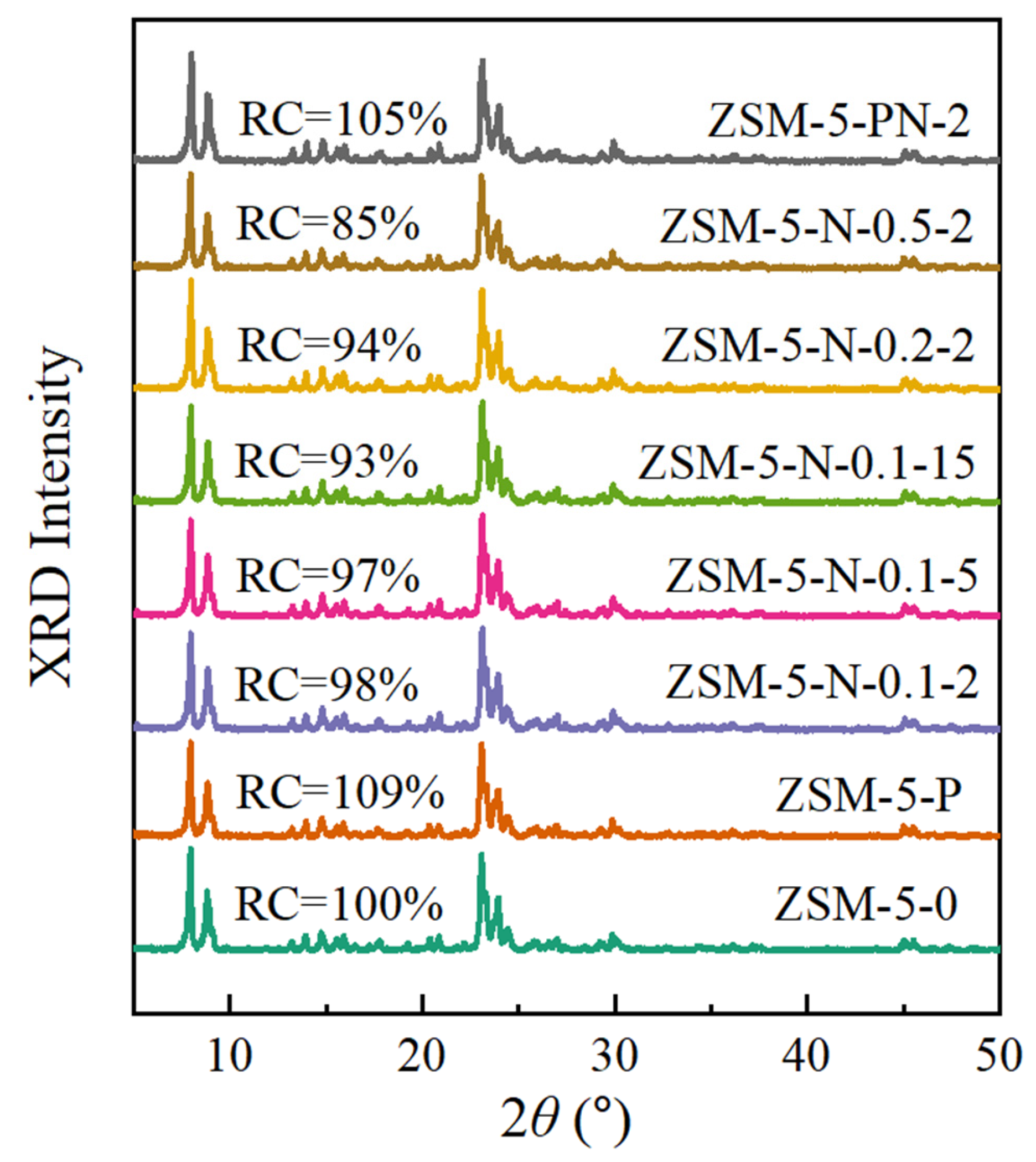
Figure 2.
SEM images of thin-plate ZSM-5-0 and post-treated ZSM-5 samples with different alkaline solutions. (a) ZSM-5-0, (b) ZSM-5-P, (b) ZSM-5-N-0.1-2, (d) ZSM-5-N-0.1-15, (e) ZSM-5-N-0.5-2 and (f) ZSM-5-PN-2.
Figure 2.
SEM images of thin-plate ZSM-5-0 and post-treated ZSM-5 samples with different alkaline solutions. (a) ZSM-5-0, (b) ZSM-5-P, (b) ZSM-5-N-0.1-2, (d) ZSM-5-N-0.1-15, (e) ZSM-5-N-0.5-2 and (f) ZSM-5-PN-2.
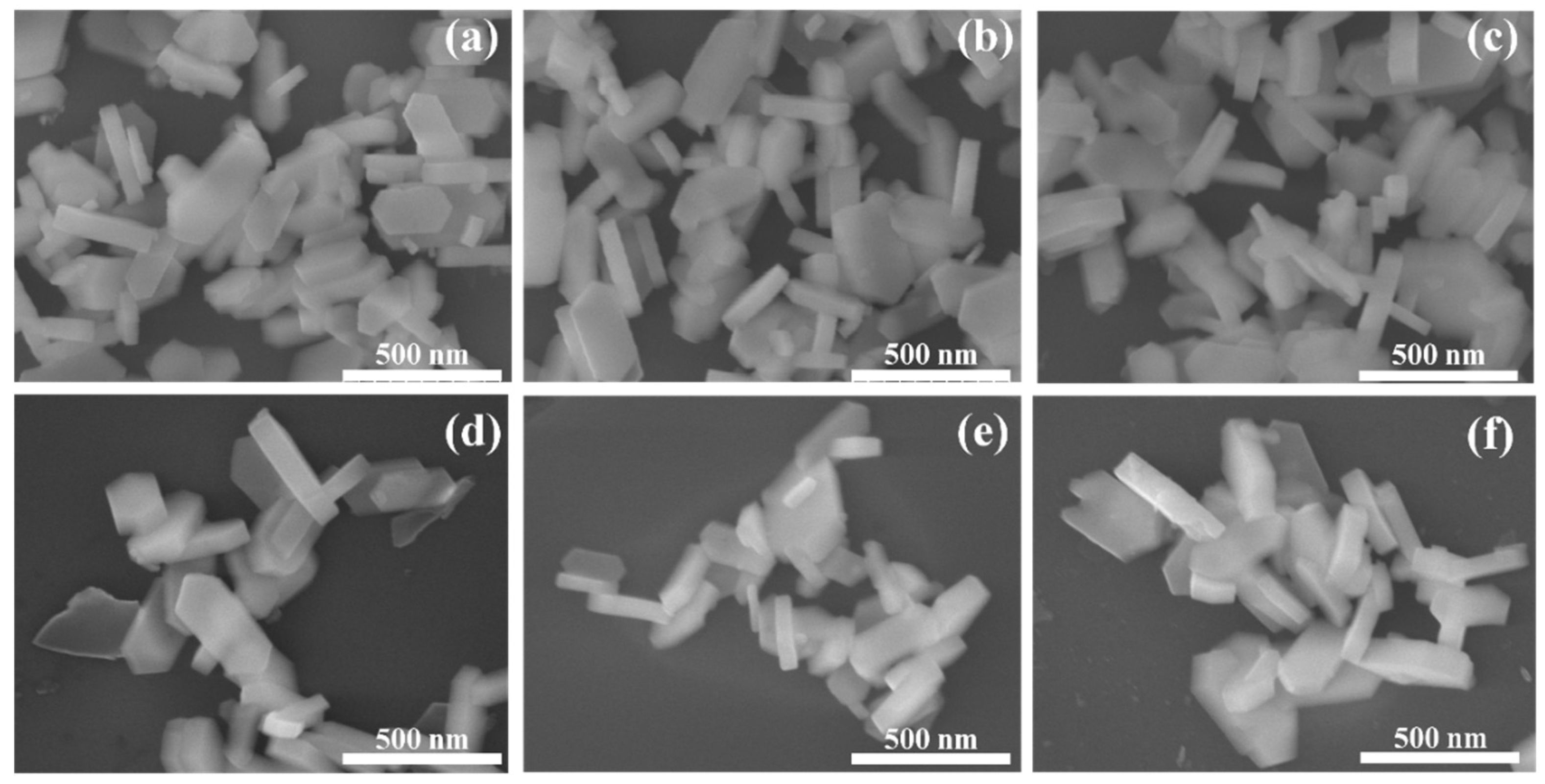
Figure 3.
TEM images of thin-plate ZSM-5-0 and post-treated ZSM-5 samples: (a) ZSM-5-0, (b) ZSM-5-P, (c) ZSM-5-N-0.1-2, (d) ZSM-5-N-0.1-15, (e) ZSM-5-N-0.5-2, and (f) ZSM-5-PN-2.
Figure 3.
TEM images of thin-plate ZSM-5-0 and post-treated ZSM-5 samples: (a) ZSM-5-0, (b) ZSM-5-P, (c) ZSM-5-N-0.1-2, (d) ZSM-5-N-0.1-15, (e) ZSM-5-N-0.5-2, and (f) ZSM-5-PN-2.
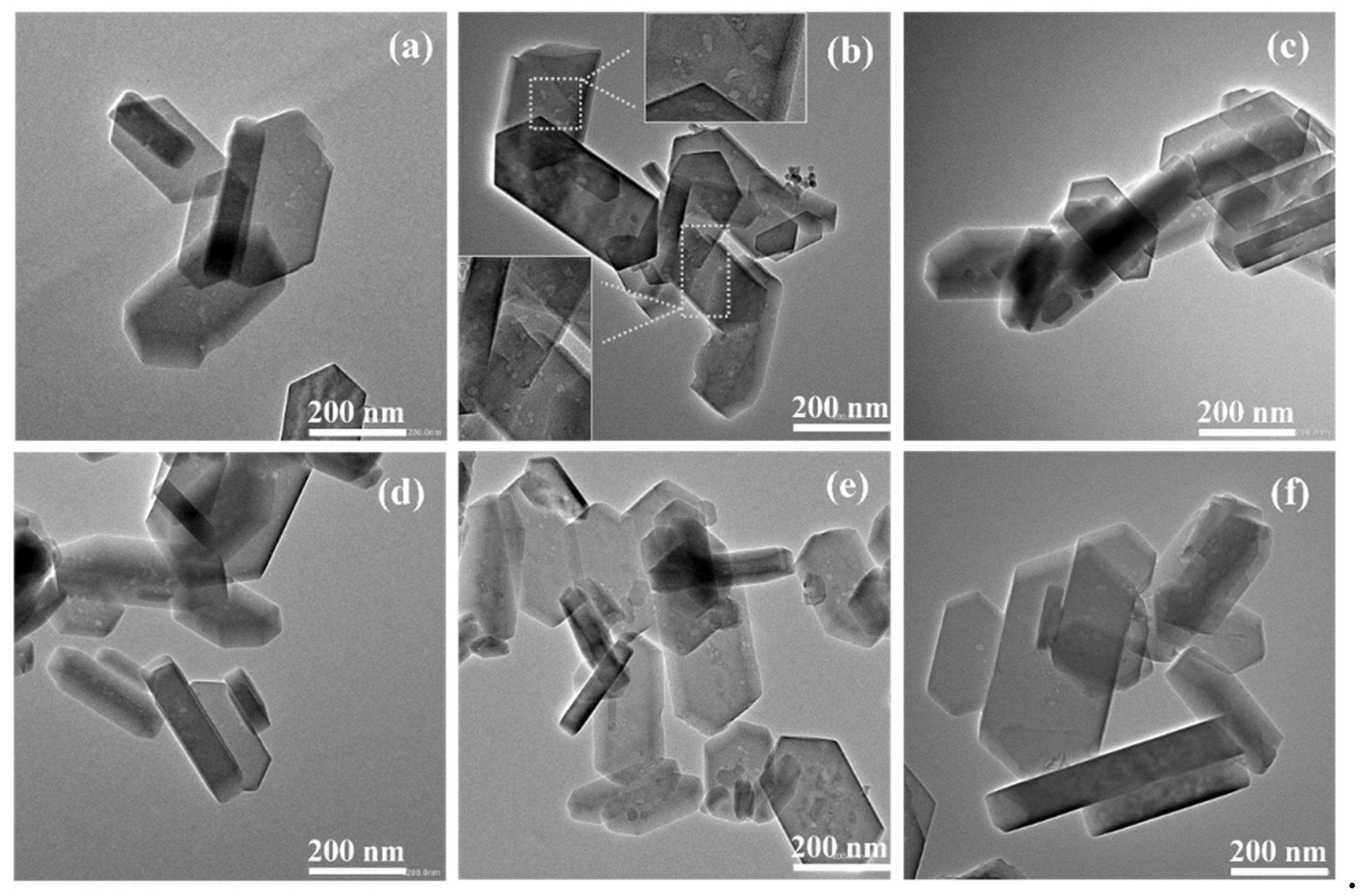
Figure 4.
N2 adsorption-desorption isotherms of thin-plate ZSM-5-0 and post-treated ZSM-5 samples.
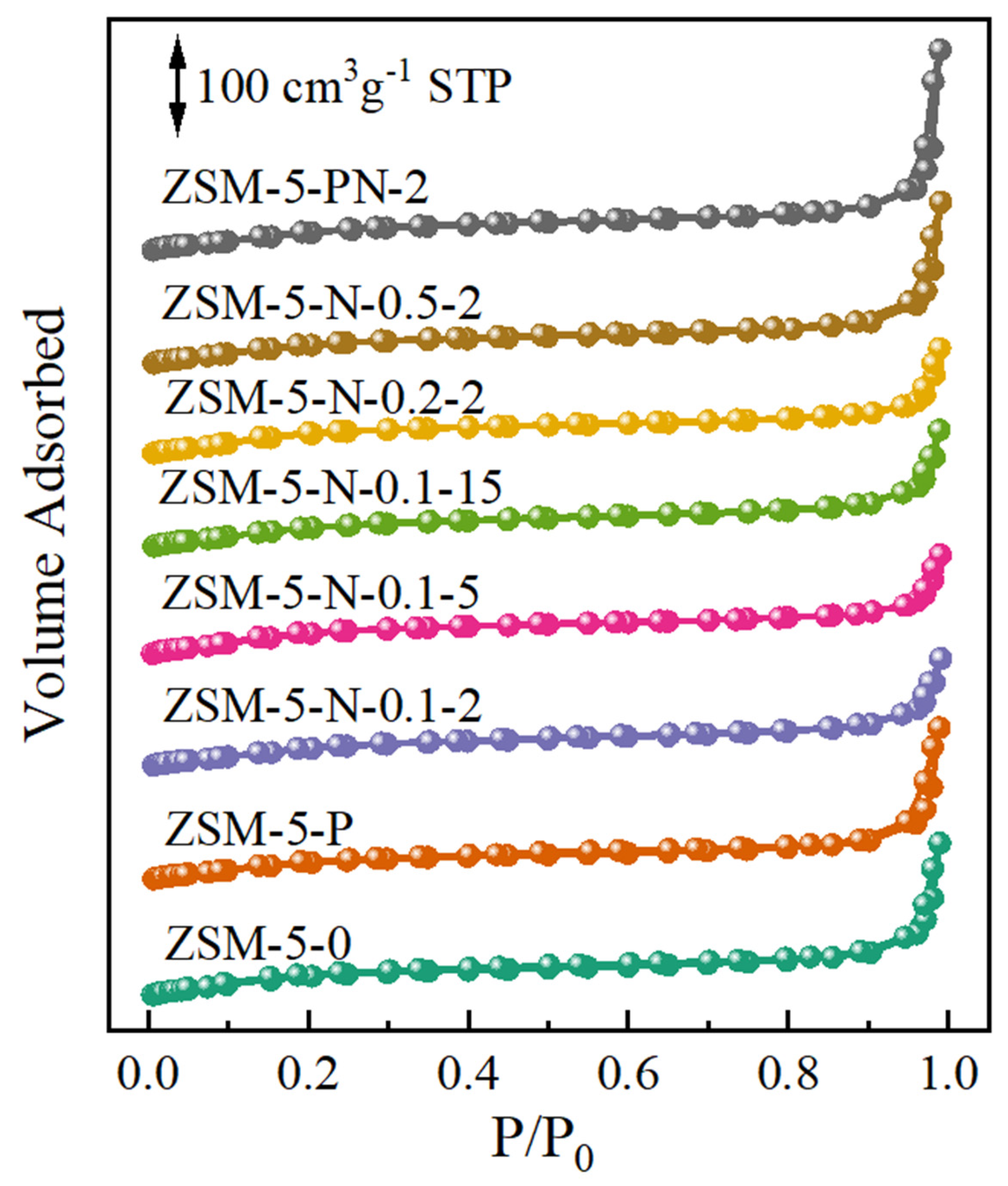
Figure 5.
NH3-TPD profiles and deconvoluted NH3 desorption peaks of thin-plate ZSM-5-0 and post-treated ZSM-5.
Figure 5.
NH3-TPD profiles and deconvoluted NH3 desorption peaks of thin-plate ZSM-5-0 and post-treated ZSM-5.
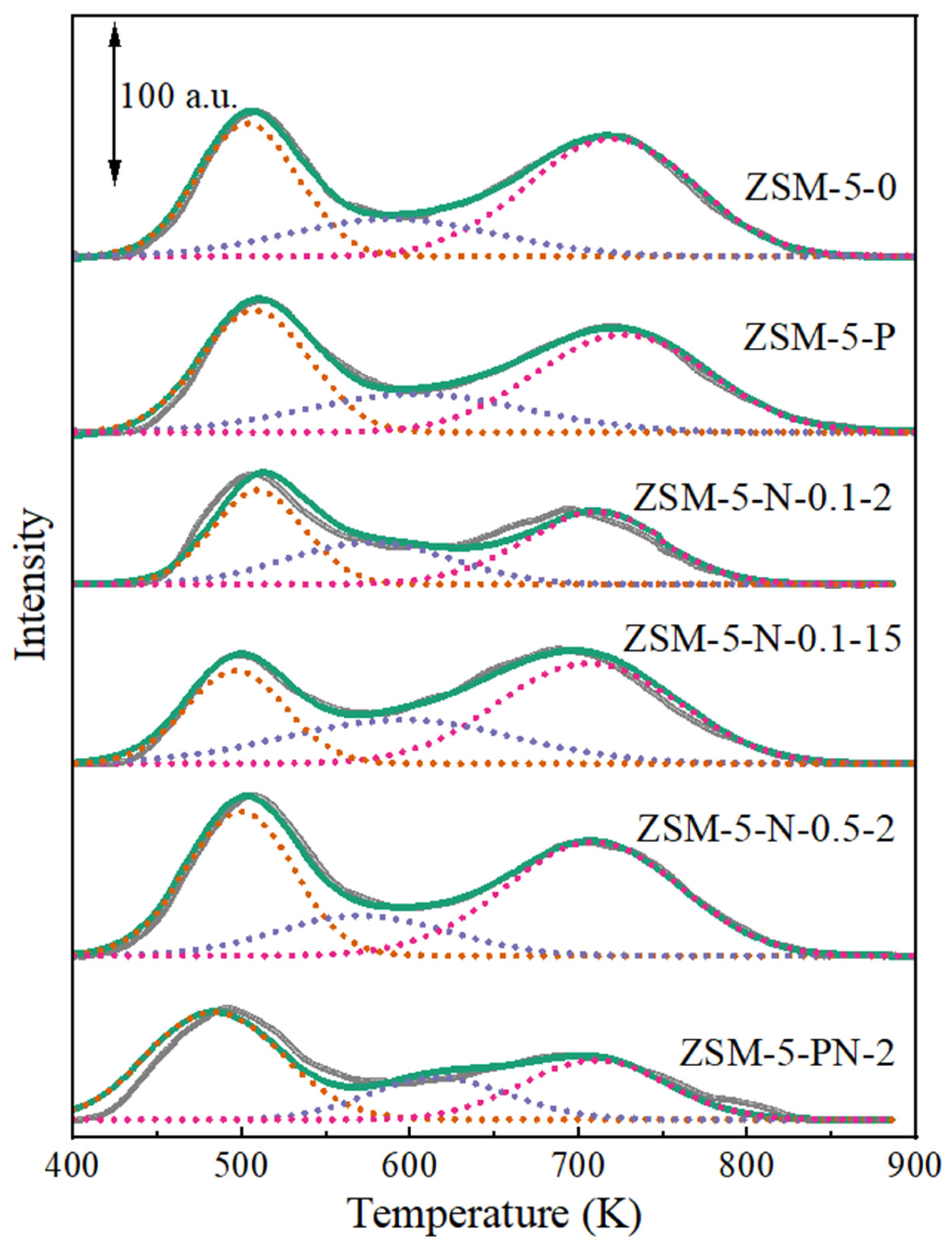
Figure 6.
Catalytic performance of allyl alcohol etherification over ZSM-5-0 and post-treated ZSM-5 catalysts. (a) Conversion of allyl alochol and (b) Plots of TON versus strong acid amount. Reaction conditions: 120 °C, 1.0 MPa, cat. 4.0 g, and WHSV of allyl alcohol 0.8 h-1.
Figure 6.
Catalytic performance of allyl alcohol etherification over ZSM-5-0 and post-treated ZSM-5 catalysts. (a) Conversion of allyl alochol and (b) Plots of TON versus strong acid amount. Reaction conditions: 120 °C, 1.0 MPa, cat. 4.0 g, and WHSV of allyl alcohol 0.8 h-1.
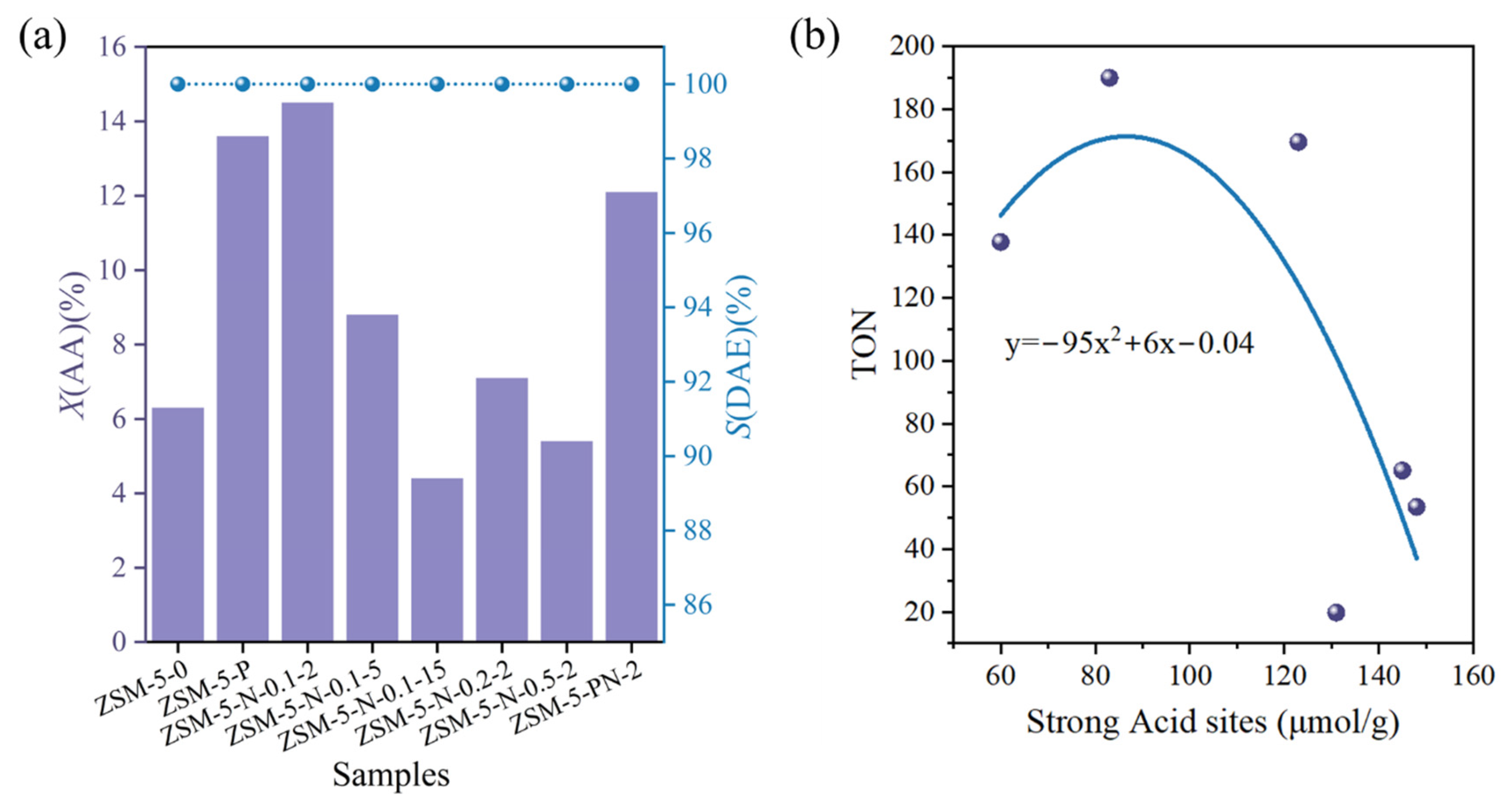
Figure 7.
TGA curves of the spent thin-plate ZSM-5-0 and post-treated ZSM-5 samples after allyl alcohol etherification reaction (TOS=12 h).
Figure 7.
TGA curves of the spent thin-plate ZSM-5-0 and post-treated ZSM-5 samples after allyl alcohol etherification reaction (TOS=12 h).
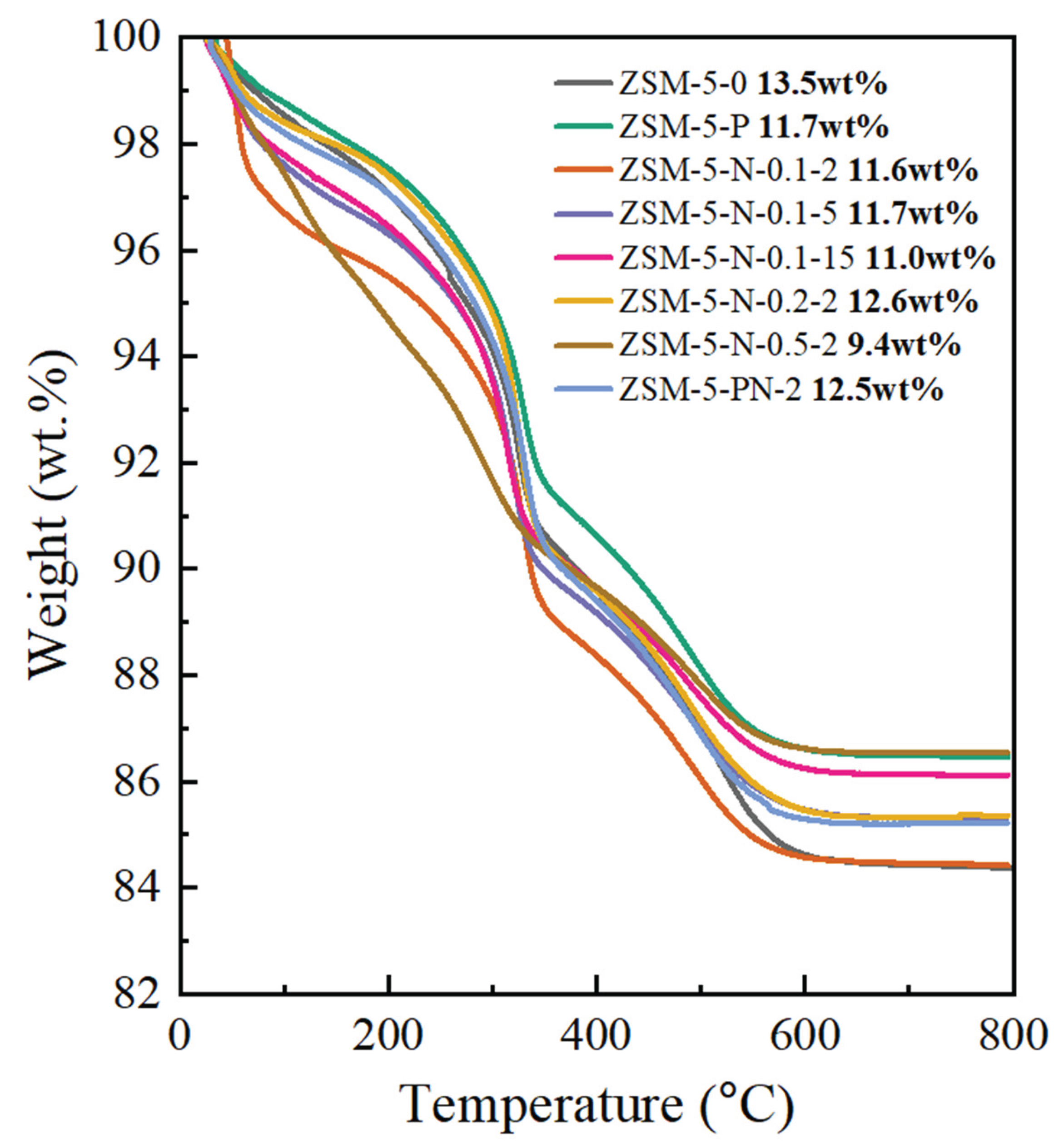

Table 1.
Texture properties, actual Si/Al molar ratio, and pH values of post-treatment solution of thin-plate ZSM-5-0 and post-treated ZSM-5 samples.
Table 1.
Texture properties, actual Si/Al molar ratio, and pH values of post-treatment solution of thin-plate ZSM-5-0 and post-treated ZSM-5 samples.
| Samples | pH | a Si/Al |
b RC (%) |
Surface area (m2/g) |
Pore volume (cm3/g) | |||
|---|---|---|---|---|---|---|---|---|
| c SBET | d Smicro | e Smeso | d Vmicro | f Vtotal | ||||
| ZSM-5-0 | / | 56 | 100 | 366 | 327 | 39 | 0.15 | 0.23 |
| ZSM-5-P | 12.7 | 53 | 109 | 385 | 345 | 41 | 0.16 | 0.24 |
| ZSM-5-N-0.1-2 | 13.0 | 46 | 98 | 347 | 304 | 43 | 0.14 | 0.22 |
| ZSM-5-N-0.1-5 | 13.0 | / | 97 | 350 | 312 | 38 | 0.14 | 0.22 |
| ZSM-5-N-0.1-15 | 13.0 | 47 | 93 | 355 | 319 | 36 | 0.15 | 0.23 |
| ZSM-5-N-0.2-2 | 13.0 | / | 94 | 361 | 322 | 36 | 0.16 | 0.23 |
| ZSM-5-N-0.5-2 | 13.7 | 45 | 85 | 361 | 325 | 36 | 0.16 | 0.23 |
| ZSM-5-PN-2 | 13.4 | 53 | 105 | 361 | 326 | 35 | 0.14 | 0.23 |
a.molar ratio of Si/Al determined by ICP-OES. b.RC determined by XRD. c.SBET obtained by the BET method. d.Smicro and Vmicro determined by the t-plot method. e.Smeso = SBET – Smicro. f.Vtotal is the specific adsorption volume at P/P0=0.95.
Table 2.
Acidity properties of thin-plate ZSM-5-0 and post-treated ZSM-5 samples determined by NH3-TPD measurements.
Table 2.
Acidity properties of thin-plate ZSM-5-0 and post-treated ZSM-5 samples determined by NH3-TPD measurements.
| Samples | Acid amount (μmol/gcat) | |||
|---|---|---|---|---|
| Total | cweak (T1,K) | cmedium (T2,K) | cstrong (T3,K) | |
| ZSM-5-0 | 298 | 96 (506) | 57 (590) | 145 (718) |
| ZSM-5-P | 282 | 96 (511) | 62 (604) | 123 (713) |
| ZSM-5-N-0.1-2 | 189 | 59 (503) | 47 (564) | 83 (696) |
| ZSM-5-N-0.1-15 | 269 | 65 (498) | 73 (591) | 131 (700) |
| ZSM-5-N-0.5-2 | 314 | 114 (503) | 51 (574) | 148 (709) |
| ZSM-5-PN-2 | 212 | 109 (496) | 43 (629) | 60 (718) |
T1, T2 and T3 denote the peak temperatures of NH3 desorption peaks from low to high temperatures, respectively.
Disclaimer/Publisher’s Note: The statements, opinions and data contained in all publications are solely those of the individual author(s) and contributor(s) and not of MDPI and/or the editor(s). MDPI and/or the editor(s) disclaim responsibility for any injury to people or property resulting from any ideas, methods, instructions or products referred to in the content. |
© 2026 by the authors. Licensee MDPI, Basel, Switzerland. This article is an open access article distributed under the terms and conditions of the Creative Commons Attribution (CC BY) license.
Copyright: This open access article is published under a Creative Commons CC BY 4.0 license, which permit the free download, distribution, and reuse, provided that the author and preprint are cited in any reuse.