

Submitted:
18 July 2026
Posted:
20 July 2026
You are already at the latest version
Abstract
Symptom distress is a major determinant of quality of life (QoL) in cancer patients, yet the influence of cancer metastasis on this relationship remains unclear, particularly during the COVID-19 pandemic. This cross-sectional study recruited 100 patients receiving chemotherapy at a medical center in Taiwan during the pandemic. Participants completed the Symptom Distress Scale, Resourcefulness Scale, and Functional Assessment of Cancer Therapy–General. Canonical correlation analysis, hierarchical multiple regression, and moderation analysis using the PROCESS macro with Johnson–Neyman probing, were performed. Canonical correlation analysis identified symptom distress as the predominant contributor associated with all four QoL domains. Hierarchical regression demonstrated that symptom distress remained the strongest independent predictor of overall QoL, whereas personal resourcefulness showed a smaller but significant positive association. Cancer metastasis significantly moderated the relationship between symptom distress and QoL. Johnson–Neyman analysis identified a symptom distress score of 23 as the threshold beyond which QoL declined significantly more among patients with metastatic disease. Symptom distress is the strongest determinant of QoL in patients receiving chemotherapy, and its detrimental effects are amplified by metastatic disease. Early identification of patients with symptom distress scores ≥23 may facilitate timely supportive care and improve QoL, particularly during periods of healthcare disruption.
Keywords:
cancer metastasis
; chemotherapy
; quality of life
; resourcefulness
; symptom distress
; supportive care
1. Introduction
Cancer remains a leading cause of mortality worldwide. According to the World Health Organization, approximately one in five individuals globally will receive a cancer diagnosis during their lifetime, underscoring the growing burden of cancer and the increasing demand for supportive care [1]. In Taiwan, cancer has been the leading cause of death since the 1980s. Although advances in cancer treatment have improved survival, patients continue to experience substantial physical and psychosocial challenges throughout the cancer trajectory.
A cancer diagnosis often initiates a complex illness trajectory characterized by multiple concurrent symptoms. Symptom distress refers to patients’ subjective perception of the severity and disruption caused by multiple concurrent symptoms [2,3]. As survival has improved, maintaining quality of life (QoL) has become a central goal of contemporary cancer care, making effective symptom management increasingly important. Symptom distress is a well-documented predictor of reduced QoL, influencing physical, emotional, and social dimensions. Among patients undergoing chemotherapy, toxicity from treatment agents often exacerbates symptom burden. Disease severity, particularly the presence of metastatic cancer, may interact with symptom burden and patients’ coping capacity, further complicating the QoL trajectory.
1.1. Resourcefulness
Psychological and behavioral traits, particularly resourcefulness, may significantly shape patients’ perceptions and management of these burdens. Resourcefulness facilitates adaptation to illness and has been proposed as a protective factor that buffers the adverse effects of symptom distress on QoL [4]. Grounded in the concept of learned resourcefulness [5], it has emerged as an important construct in nursing science. Learned resourcefulness refers to a set of cognitive-behavioral skills that enable individuals to manage internal stress and external demands effectively [4]. These skills include cognitive reframing, positive self-talk, problem-solving, delaying immediate gratification, and emotional regulation [6]. These abilities are particularly valuable given the prolonged and often distressing nature of treatment and recovery in cancer care.
1.2. Symptom Distress and Resourcefulness
Empirical studies have demonstrated the holistic benefits of resourcefulness. For example, resourcefulness has been linked to improved psychological adaptation and enhanced self-concept and sexual satisfaction in rectal cancer survivors [7]. Moreover, it also influences symptom perception and management. Interestingly, patients with higher levels of resourcefulness may report greater pain intensity, potentially due to increased bodily awareness or concerns about the stigma associated with opioid use [8]. These findings underscore the nuanced role of resourcefulness in the context of cancer care, particularly its potential impact on symptom management.
Emerging evidence suggests that resourcefulness can mitigate symptom distress. For instance, a longitudinal quasi-experimental study found that learned resourcefulness was inversely related to fatigue in patients with non-Hodgkin lymphoma, even after controlling for clinical and demographic variables [9]. Similarly, in patients with nasopharyngeal carcinoma, resourcefulness training was shown to significantly reduce symptom distress [10]. These findings support the conceptualization of resourcefulness as a protective psychological factor that buffers the negative impact of symptoms.
1.3. Resourcefulness and Qol
Resourcefulness plays a critical role in enhancing QoL. Among breast cancer patients, higher levels of resourcefulness were associated with lower levels of depression and improved QoL outcomes [11]. Another study found that resourcefulness mediated the relationship between depression and QoL in prostate cancer survivors. Furthermore, Resourcefulness may also exert broader effects beyond patients themselves [12]. A study of patients with colorectal cancer and their family caregivers, has found that higher patient resourcefulness was associated with reduced caregiver burden and better caregiver adjustment [13]. Collectively, these findings suggest that resourcefulness positively influences both patient and caregivers’ well-being.
1.4. Symptom Distress and Qol
Symptom distress has been repeatedly identified as a primary determinant of reduced QoL in cancer patients. Symptoms such as pain, fatigue, and emotional distress can severely disrupt daily life and overall well-being. A five-year longitudinal study in women with gynecological cancers showed that while psychological distress declined over time, physiological symptom distress increased and was associated with declining QoL [14]. Other studies have demonstrated similar associations in older patients with digestive system and head and neck cancers [15] and among hospice patients with advanced cancer [16]. Hope had also been identified as a mediating factor in the symptom distress–QoL relationship, highlighting the complex psychosocial dynamics involved [17].
1.5. Impact of the Covid-19 Pandemic
Cancer is rarely experienced by patients alone. Throughout the trajectory of illness, family caregivers often accompany patients in managing symptoms, making treatment decisions, and providing emotional reassurance [18]. Consequently, patients and their family caregivers have increasingly been conceptualized as an interdependent care unit [19]. Previous studies had shown that caregiver-related factors influence patients’ adaptation to cancer. For example, caregivers’ perceived obligation to provide care was positively associated with patients’ resourcefulness and QoL whereas disruption of caregivers’ daily schedules showed the opposite relationship [13].
However, the COVID-19 pandemic substantially altered this caregiving context. Infection-control policies restricted caregiver involvement and altered healthcare delivery, potentially disrupting the mechanisms through which psychosocial resources such as resourcefulness contribute to QoL. Consistent with these changes, previous studies reported increased psychological distress related to social isolation, absence of family caregivers, and concerns about life-threatening outcomes during the COVID-19 pandemic [20].
1.6. Knowledge Gap
Despite the strong empirical support for the individual relationships among symptom distress, resourcefulness, and QoL, few studies have examined how these factors interact in the context of disease severity, particularly in patients with metastatic cancer. Cancer metastatic status, which often indicates advanced-stage disease, is typically associated with increased symptom burden, poorer prognoses, and reduced coping resources. However, it remains unclear whether metastatic status moderates the effect of symptom distress on QoL or whether resourcefulness retains its protective influence in this high-risk subgroup. In addition, it remains unclear whether the COVID-19 pandemic altered the relationship between resourcefulness and QoL reported in previous studies.
Understanding whether the presence of metastasis amplifies or attenuates these relationships is crucial for tailoring psychosocial interventions in cancer care. Without addressing this moderating role, healthcare providers may overlook key differences in patient experience based on disease severity. Clarifying this relationship may facilitate earlier identification of patients requiring intensified supportive care.
1.7. Theoretical Framework
Guided by the middle-range theory of resourcefulness and quality of life [4], we adapted the theoretical framework to examine how resourcefulness, as an internal coping mechanism, interacts with symptom distress to influence QoL in cancer patients. The theory conceptualizes resourcefulness as a multidimensional construct comprising personal resourcefulness (self-help behaviors) and social resourcefulness (help-seeking behaviors). The original theory consists of four key components: (1) antecedent contextual factors, (2) process regulators, (3) resourcefulness, and (4) QoL.
Based on this theory, an adapted conceptual framework was developed, as illustrated in Figure 1. The adapted framework consists of five components: antecedent contextual factors, symptom distress, resourcefulness, cancer metastatic status, and multidimensional QoL. The present study focused on examining how resourcefulness and symptom distress influence QoL in patients with cancer. Cancer metastatic status was incorporated into the framework as a clinically relevant moderator of the association between symptom distress and QoL. Accordingly, canonical correlation analysis was first used to examine the multivariate relationships proposed in the framework, followed by hierarchical regression and moderation analyses to evaluate the hypothesized effects on overall QoL. The five components in the framework are described below:
1.7.1. Antecedent Contextual Factors
These refer to baseline patient characteristics that may influence subsequent experiences and outcomes. In this study, contextual factors included demographic characteristics (e.g., age, gender, employment, education, religion, and family caregivers’ involvement), and disease characteristics (e.g., cancer type, treatment modality, and metastatic status). In the present study, antecedent contextual factors were included as covariates in the hierarchical regression models.
1.7.2. Symptom Distress
Symptom distress was incorporated into the adapted framework as an illness-related construct to represent patients’ symptom burden during chemotherapy, thereby extending the original theory to the context of cancer care. Symptom distress reflects not only the severity of individual symptoms but also the extent to which they interfere with daily functioning and emotional well-being. In the present framework, symptom distress was conceptualized as the primary illness-related predictor of QoL.
1.7.3. Resourcefulness
Resourcefulness is defined in this study as an individual’s capacity to apply both personal and social strategies to adapt to cancer-related challenges during treatment. Consistent with the original theory, resourcefulness comprises personal and social resourcefulness.
1.7.4. Cancer Metastatic Status
Cancer metastatic status was conceptualized as a clinically relevant moderator that may alter the impact of symptom distress on QoL. The moderating role of metastatic status was empirically tested to explore its impact on the symptom distress–QoL pathway.
1.7.5. Qol
In the adapted framework, QoL was conceptualized as the primary outcome, reflecting patients’ physical, emotional, social, and functional well-being [21].
The adapted conceptual framework provides the theoretical basis for examining the multivariate relationships among symptom distress, resourcefulness, and multidimensional QoL, while evaluating whether cancer metastatic status moderates the association between symptom distress and QoL. This framework guided the analytical strategy, whereby canonical correlation analysis was first used to examine multivariate relationships, followed by hierarchical regression and moderation analyses to evaluate the proposed hypotheses.
1.8. Purpose of the Study
The Purposes of This Study Were:
(1) to examine the multivariate relationships among symptom distress, resourcefulness, and multidimensional QoL.
(2) to Evaluate Whether Cancer Metastatic Status Modifies the Impact of Symptom Distress on Qol
(3) to identify the symptom distress threshold at which patients with metastatic disease become particularly vulnerable to poorer QoL.
2. Materials and Methods
2.1. Study Design
This exploratory cross-sectional design study was conducted in the oncology inpatient units of a medical center in central region of Taiwan.
2.2. Variables and Instruments
Data were collected using four instruments: a demographic and clinical characteristics questionnaire, the Symptom Distress Scale (SDS), the Traditional Chinese version of the Resourcefulness Scale, and the Functional Assessment of Cancer Therapy–General (FACT-G).
2.2.1. Demographic and Clinical Characteristics
This self-reported questionnaire included demographic variables such as age, gender, education level, and employment status. Clinical information included cancer type, disease severity, comorbidities (measured using the Charlson comorbidity index (CCI)), and performance status (assessed using the eastern cooperative oncology group [ECOG] score).
2.2.2. Symptom Distress
Symptom distress was measured using the SDS, a 13-item, 5-point Likert scale originally developed by McCorkle and Young [3]. Higher scores indicate greater symptom distress. The SDS has demonstrated good criterion validity, with corrected item-total correlation coefficients ranging from 0.58 to 0.99, and internal consistency reliability with Cronbach’s alpha values between 0.67 and 0.88 in previous studies [22]. In the present study, Cronbach’s alpha was 0.76.
2.2.3. Resourcefulness
The traditional Chinese resourcefulness scale was used to assess participants’ resourcefulness. This 28-item instrument includes subscales for personal and social resourcefulness. Higher scores indicate higher levels of resourcefulness. The scale has demonstrated good construct validity through confirmatory factor analysis and internal consistency reliability, with Cronbach’s alpha values of 0.87 for the personal subscale, 0.77 for the social subscale, and 0.88 for the total score [7,23]. In the present study, Cronbach’s alpha was 0.87 for the personal resourcefulness subscale, 0.78 for the social resourcefulness subscale, and 0.88 for the overall scale.
2.2.4. Qol
QoL was measured using the FACT-G, a 28-item instrument assessing four domains: physical, emotional, social, and functional well-being. Higher scores indicate better QoL. The instrument has demonstrated high reliability and validity, with Cronbach’s alpha values ranging from 0.82 to 0.88 for subscales and 0.92 for the total scale [21]. In the current study, Cronbach’s alpha ranged from 0.78 to 0.82 for the subscales and was 0.87 for the total score.
2.3. Sample and Setting
2.3.1. Sample Size Estimation
The sample size was calculated using G*Power 3.1.9.4 software for multiple regression analysis. Parameters included a medium effect size (f2 = 0.15), an alpha level of 0.05, a statistical power of 0.80, and six independent predictors. The estimated sample size was 83. To account for a 20% nonresponse or invalid response rate, a target sample of 100 participants was established.
Participants were eligible for this present study if they 1) were aged 20 years or older, 2) had normal cognitive function (with a Glasgow Coma Scale score of 15), 3) had a confirmed cancer diagnosis, 4) were aware of their diagnosis and disease progression, 5) were receiving chemotherapy for cancer, and 6) were able to communicate in Mandarin or Taiwanese. Participants were excluded from this study if they 1) lacked awareness of their disease, 2) had a diagnosed psychiatric disorder.
2.3.2. Recruitment and Sample Characteristics
Data were collected between January, 2022 and January, 2023, during the COVID-19 pandemic. During the study period, infection-control policies required patients receiving chemotherapy and other active cancer treatments to be hospitalized, enabling recruitment from inpatient oncology units. A total of 576 patients were screened, of whom 156 met the eligibility criteria and 100 consented to participate in the study.
The sample included patients with digestive system cancers (44%) and head and neck cancers (33%), with 69% presenting with metastatic disease. The mean age was 59 8.37 years, ranging from 37 to 74 years, and 68% of participants were male. The mean Charlson Comorbidity Index score was 8 1.88 ranging from 2 to11. At the time of data collection, 66% of participants were unemployed. Most participants received chemotherapy alone (86%), whereas 14% received concurrent chemoradiotherapy. A detailed summary of participant characteristics is provided in Table 1.

Table 1.
Demographic Characteristics and Clinical Status (N=100).
| Variables | Mean | SD | Range |
| Age | 59.00 | 8.37 | 37-74 |
| CCI1 | 8.00 | 1.88 | 2-11 |
| Variables | N | % | |
| Gender | |||
| -Male | 68 | 68% | |
| -Female | 32 | 32% | |
| Education | |||
| -9 years Compulsory Education | 39 | 39% | |
| -High School | 37 | 37% | |
| -College and above | 24 | 24% | |
| Occupation | |||
| -Yes | 33 | 33% | |
| -No | 67 | 67% | |
| Type of Cancer | |||
| -Head & Neck | 33 | 33% | |
| -Digestive System | 44 | 44% | |
| -Others Breast Cancer, Lung Cancer |
23 | 23% | |
| Treatment | 86 | 86% | |
| -Chemotherapy only | 14 | 14% | |
| -CCRT2 | |||
| Metastatic Status | |||
| -No | 31 | 31% | |
| -Yes | 69 | 69& |
Table 1.
(Cont.’). Demographic Characteristics and Clinical Status (N=100).
| Variables | N | % |
| ECOG3 | ||
| - 0 Fully active, able to carry on all pre-disease performance without restriction | 1 | 1% |
| -1 Restricted in physically strenuous activity but ambulatory and able to carry out work of a light or sedentary nature, e.g., light housework, office work | 94 | 94% |
| -2 Ambulatory and capable of all selfcare but unable to carry out any work activities; up and about more than 50% of waking hours | 5 | 5% |
1. Cci: Charleson’s Comorbidity Index. 2. Ccrt: Concurrent Radiation and Chemotherapy. 3. ECOG” The ECOG Performance Status Scale was developed by the Eastern Cooperative Oncology Group (ECOG), now the ECOG-ACRIN Cancer Research Group.
2.4. Data Analysis
Data were analyzed using IBM SPSS Statistics version 30.0 (IBM Corp., Armonk, NY, USA). Descriptive statistics were used to summarize participants’ demographic and clinical characteristics. Canonical correlation analysis (CCA) was performed to examine the multivariate relationships between two sets of variables: (1) symptom distress, personal resourcefulness, and social resourcefulness; and (2) the four domains of QoL (physical, emotional, social, and functional well-being).
CCA was selected to characterize the overall multivariate relationships among multidimensional constructs before regression analyses were used to evaluate independent predictors and moderation effects. Hierarchical multiple regression analysis was subsequently conducted to examine the independent contributions of symptom distress and resourcefulness to overall QoL after controlling for antecedent contextual factors. To minimize multicollinearity when testing the interaction effect, symptom distress was standardized before creating the interaction term. Cancer metastasis was examined as a moderator of the relationship between symptom distress and QoL by including the interaction term (standardized symptom distress × metastatic status) in the regression model. Significant moderation effects were further probed using the PROCESS macro for SPSS (version 5.0; Model 1) and the Johnson–Neyman technique was applied to identify the range of symptom distress at which the moderating effect of metastasis became statistically significant [24].
This sequential analytical strategy allowed us to first characterize the overall multivariate relationships among the study variables and then determine their independent and moderating effects on overall QoL.
3. Results
3.1. Cca
Two statistically significant canonical functions were identified. Because the first canonical function explained the largest proportion of shared variance (57.76%) and demonstrated meaningful canonical loadings across both variable sets, subsequent interpretation focused primarily on this function. Within the predictor variable set, symptom distress demonstrated the largest canonical loading (−0.95). Within the QoL variable set, all four QoL domains demonstrated meaningful canonical loadings (|loading| ≥ 0.30), with physical well-being (−0.88) showing the strongest loading, followed by emotional well-being (−0.68), social well-being (0.46), and functional well-being (0.44). Together, these findings indicate that the first canonical function primarily represented the multivariate association between symptom distress and multidimensional QoL.
Canonical Function 2 demonstrated a moderate canonical correlation (Rs = 0.51, p = 0.01), accounting for an additional 26.01% of the shared variance. Emotional well-being (loading = 0.68) and social well-being (loading = 0.48) demonstrated meaningful loadings within the QoL variable set. However, none of the variables in the predictor variable set (symptom distress, personal resourcefulness, and social resourcefulness) reached the predefined criterion for meaningful interpretation (|loading| ≥ 0.30). Therefore, although the second canonical function was statistically significant, it was not interpreted further because it did not demonstrate a meaningful multivariate pattern across both variable sets. The complete canonical correlation results are presented in Table 2.
3.2. Hierarchical Multiple Linear Regression
Hierarchical multiple linear regression analysis was conducted to examine the independent effects of symptom distress and resourcefulness on QoL after controlling for demographic and clinical variables. As shown in Table 3, the covariates entered in Block 1 did not significantly explain the variance in QoL. After adjustment for these variables, the addition of personal resourcefulness, social resourcefulness, and symptom distress in Block 2 explained an additional 47.9% of the variance in QoL (p < .001). Among the variables entered in Block 2, symptom distress emerged as the strongest independent predictor of QoL (β = −.49, p < .001), followed by personal resourcefulness (β = .23, p < .01), whereas social resourcefulness was not statistically significant. In Block 3, the interaction between symptom distress and cancer metastasis was statistically significant (β = −.26, p < .05), indicating that cancer metastasis moderated the relationship between symptom distress and QoL. The final model explained 62.3% of the variance in QoL. Variance inflation factors ranged from 1.12 to 4.07, indicating no evidence of problematic multicollinearity. Table 3 presents the detailed regression results.
3.3. Moderation Analysis
Moderation analysis was conducted using PROCESS macro, Model 1 (version 5.0) [24]. A significant interaction between symptom distress and cancer metastasis was observed (β = −0.23, p < .01), indicating that cancer metastasis moderated the relationship between symptom distress and QoL (Figure 2). Johnson–Neyman analysis further demonstrated that this moderating effect became statistically significant when symptom distress exceeded a score of 23. When symptom distress exceeded this threshold, patients with metastatic disease reported significantly poorer QoL than those without metastasis. The Johnson–Neyman plot illustrating the region of significance is presented in Figure 3.
4. Discussion
4.1. Main Findings Interpretation
This study examined the relationships among symptom distress, resourcefulness, cancer metastatic status, and QoL in patients receiving chemotherapy during the COVID-19 pandemic. Across the sequential analyses, symptom distress consistently emerged as the primary determinant of QoL in patients receiving chemotherapy during the COVID-19 pandemic. More importantly, this detrimental effect was further amplified by metastatic disease, indicating that symptom burden and disease severity jointly influenced patients’ QoL
Moreover, the Johnson–Neyman analysis identified a clinically meaningful threshold. Once symptom distress exceeded a score of 23, QoL declined more steeply among patients with metastatic disease than among those without metastasis. Rather than merely demonstrating statistical significance, the Johnson–Neyman threshold translates a statistical interaction into a clinically meaningful decision point, identifying patients who may benefit from earlier and more intensive supportive care interventions.
The consistency of findings across three complementary statistical approaches strengthens this conclusion. CCA identified symptom distress as the predominant contributor within the predictor variable set and demonstrated meaningful associations with all four domains of QoL, particularly physical and emotional well-being. Hierarchical regression confirmed these findings after adjustment for demographic and disease characteristics and resourcefulness. Finally, moderation analysis showed that cancer metastatic status further intensified this relationship, indicating that patients with advanced disease were particularly vulnerable to the adverse effects of symptom distress.
In addition, the present study was conducted during the COVID-19 pandemic, when infection-control policies substantially altered cancer care delivery and reduced opportunities for caregiver involvement. A large multicenter cohort study involving more than 6,000 participants reported that patients with cancer receiving active treatment experienced higher mortality during the COVID-19 pandemic than individuals without cancer [25]. Under these circumstances, symptom distress may have assumed a more prominent role in determining QoL because patients experienced greater physical and psychological burden while receiving less direct family support during hospitalization. Although we could not determine whether the COVID-19 pandemic directly strengthened the influence of symptom burden, the unique care environment created by the pandemic may partly explain the prominent role of symptom distress observed in this study.
Nevertheless, these findings are consistent with research by Chung and colleagues and Morrison and colleagues which documented that symptom burden and cancer metastasis synergistically reduce QoL across various cancer types [26,27]. Early identification of patients approaching this threshold could allow clinicians to intervene before significant deterioration in QoL occurs. Our findings also complement previous studies [17,28] that reported the mediating role of hope in the symptom–QoL pathway and heterogeneous responses to symptom management among patients with cancer metastasis. Our findings extend this evidence by demonstrating that cancer metastatic status functions as a vulnerability amplifier, intensifying the adverse effects of symptom distress on patient well-being. Furthermore, the identification of a symptom distress threshold provides clinically actionable information beyond the associations reported in previous studies.
Taken together, these complementary analyses consistently demonstrate that symptom distress is not only the strongest determinant of QoL but also a clinically actionable target whose detrimental effects are substantially amplified in patients with cancer metastasis. These findings support prioritizing early symptom assessment and timely supportive care for this high-risk population.
Within the context of the middle-range theory of resourcefulness and quality of life, these findings suggest that when symptom burden becomes sufficiently severe, particularly during periods of healthcare disruption, the influence of disease severity may outweigh the protective effects of psychosocial resources. Because symptom distress reflects patients’ subjective appraisal of multiple concurrent symptoms rather than symptom severity alone, interventions targeting symptom perception, coping, and self-management may improve QoL beyond the management of physical symptoms alone.
Compared with our previous studies [8,13], the protective role of resourcefulness appeared to be less prominent in the present study. Although personal resourcefulness remained an independent protective predictor of QoL, its contribution was substantially smaller than that of symptom distress. One possible explanation is that the COVID-19 pandemic substantially altered the supportive care environment, thereby limiting the extent to which resourcefulness could buffer the adverse effects of symptom distress. Nevertheless, personal resourcefulness remained a significant protective psychosocial factor, whereas social resourcefulness was not significantly associated with QoL. These findings may reflect the unique circumstances of the COVID-19 pandemic, during which infection-control policies restricted family caregiver accompaniment and reduced opportunities for patients to seek and receive social support. Consequently, the beneficial effects of social resourcefulness may have been attenuated.
Collectively, these findings suggest that the protective effects of resourcefulness are not static but depend on the availability of environmental and interpersonal resources. When patients experience severe symptom burden together with restricted access to family support during the COVID-19 pandemic, the combined effects of severe symptom burden and advanced disease may outweigh the protective effects of psychosocial coping resources.
4.2. Clinical Implication
From a clinical perspective, based on our findings, resourcefulness alone may be insufficient for patients experiencing severe symptom distress or metastatic disease. Instead, interventions should combine aggressive symptom management with strategies to enhance psychosocial coping and maintain social support, particularly during periods of healthcare disruption. Particular attention should be given to patients with metastatic disease whose symptom distress approaches or exceeds the identified clinical threshold. Rather than indicating that resourcefulness is unimportant, the present findings suggest that its protective effects are contingent upon the clinical and healthcare context in which patients receive treatment. Accordingly, interventions that combine effective symptom management with strategies to strengthen psychosocial coping may provide the greatest benefit for patients receiving chemotherapy, particularly those with metastatic disease.
4.3. Limitation and Recommendations for Future Research
Several limitations should be acknowledged. First, the cross-sectional design precludes causal inference and does not capture temporal changes in symptom distress, resourcefulness, or QoL throughout the cancer trajectory. Longitudinal studies are needed to determine whether the observed relationships remain stable over time and whether changes in symptom distress precede changes in QoL.
Second, participants were recruited from a single medical center in Taiwan and primarily included patients with digestive system and head and neck cancers receiving chemotherapy during the COVID-19 pandemic. Consequently, the findings may not be generalizable to patients with other cancer types, treatment modalities, healthcare systems, or post-pandemic care settings.
Third, all study variables were measured using self-reported questionnaires, which may have introduced reporting bias or common method variance. Future studies should incorporate objective clinical indicators, such as disease progression, treatment toxicity, symptom records, and healthcare utilization, together with patient-reported outcomes to provide a more comprehensive evaluation.
Fourth, because data were collected during the COVID-19 pandemic, infection-control policies substantially altered healthcare delivery and caregiver involvement. Although these contextual factors may have influenced symptom distress, resourcefulness, and QoL, the present study did not include a pre-pandemic comparison group. Therefore, the specific contribution of the pandemic to the observed relationships cannot be determined, and the findings should be interpreted within the context of healthcare disruption during the pandemic.
Future studies should evaluate whether the clinically identified symptom distress threshold (score ≥23) can be replicated in independent populations and whether threshold-guided interventions improve patient outcomes. Future studies should validate the symptom distress threshold identified in this study in larger and more diverse oncology populations and evaluate whether threshold-guided interventions improve patient outcomes.
5. Conclusions
This study demonstrated that symptom distress was the primary determinant of QoL among patients receiving chemotherapy during the COVID-19 pandemic and that its detrimental effects were substantially amplified by metastatic disease. Although personal resourcefulness remained an independent protective psychosocial factor, its contribution to QoL was considerably smaller than that of symptom distress, suggesting that the effectiveness of psychosocial coping may depend on the clinical context. The identification of a clinically meaningful symptom distress threshold (score ≥23) provides a practical indicator for identifying patients at high risk of poor QoL. These findings support integrating routine symptom distress screening, timely symptom management, and psychosocial interventions into supportive oncology care, particularly for patients with metastatic disease.
Author Contributions
Conceptualization, T.L. & C.L.; methodology, T.L. & C.L..; software, C.L. & Y.H..; validation, T.L., Y.H. and C.L.; formal analysis, C.L.; investigation, T.L..; resources, Y.H & C.L..; data curation, C.L.; writing—original draft preparation, T.L.; writing—review and editing, C.L..; visualization, C.L..; supervision, C.L..; project administration, C.L. All authors have read and agreed to the published version of the manuscript.
Funding
This research received no specific grant from any funding agency in the public, commercial, or not-for-profit sectors.
Institutional Review Board Statement
Completion of the questionnaire required approximately 15–30 minutes and posed no anticipated physical or psychological risks. A researcher was available during data collection to address questions and ensure participants’ rights were protected. All participants provided informed consent prior to participation. All collected data were coded to ensure anonymity, and no personal identifiers were linked to the dataset. Study findings are reported in aggregate form to maintain confidentiality.
Informed Consent Statement
Informed consent was obtained from all subjects involved in the study.
Data Availability Statement
The data presented in this study are available on request from the corresponding author due to privacy and ethical restriction.
Acknowledgments
We gratefully acknowledge all patients who participated in this study, especially during the COVID-19 pandemic.
Conflicts of Interest
The authors declare no conflicts of interest.
Abbreviations
The following abbreviations are used in this manuscript:
| CCA | Canonical Correlation Analysis |
| QoL: | Quality of Life |
| EWB | Emotional Well Being |
| FWB | Functional Well Being |
| PWB | Physical Well Being |
| SWB | Social Well Being |
| RS | Resourcefulness Scale |
| SDS | Symptom Distress Scale |
References
- World Health Organization. Available online: https://www.who.int/news/item/01-02-2024-global-cancer-burden-growing--amidst-mounting-need-for-services (accessed on 29 April 2026).
- Yeh, Y.C. Symptom distress, stress, and quality of life in the first year of gynecological cancers: A longitudinal study of women in Taiwan. Eur. J. Oncol. Nurs. 2021, 53, 101984. [Google Scholar] [CrossRef] [PubMed]
- McCorkle, R.; Young, K. Development of a symptom distress scale. Cancer Nurs. 1978, 1(5), 373–378. [Google Scholar] [CrossRef] [PubMed]
- Zauszniewski, J.A. Resourcefulness. West J. Nurs. Res. 2016, 38(12), 1551–1553. [Google Scholar] [CrossRef] [PubMed]
- Rosenbaum, M. (Ed.) Learned resourcefulness: On coping skills, self-control, and adaptive behavior; Springer Publishing Co, 1990. [Google Scholar]
- Wang, Y.F.; Zauszniewski, J.A. Predictors of Resourcefulness in Preadolescent Children. West J. Nurs. Res. 2018, 40(8), 1163–1183. [Google Scholar] [CrossRef] [PubMed]
- Au, T.Y.; Zauszniewski, J.A.; King, T.M. Health-seeking behaviors and sexuality in rectal cancer survivors in Taiwan: associations with spirituality and resourcefulness. Oncol. Nurs. Forum 2012, 39(5), E390–E397. [Google Scholar] [CrossRef] [PubMed]
- Hsu, P.Y.; Liou, C.F. Impact of patient resourcefulness on cancer patients’ pain management and medical opioid use: A cross-sectional study. Eur. J. Oncol. Nurs. 2025, 74, 102771. [Google Scholar] [CrossRef] [PubMed]
- Menshadi, N.; Bar-Tal, Y.; Barnoy, S. The relationship between learned resourcefulness and cancer-related fatigue in patients with non-Hodgkin lymphoma. Oncol. Nurs. Forum 2013, 40(2), 133–138. [Google Scholar] [CrossRef] [PubMed]
- Huang, L.F.; Gui, S.J.; Wan, Y.P.; et al. Effect of Resourcefulness Training on Symptoms Distress of Patients with Nasopharyngeal Carcinoma. Med. Sci. Monit. Published. 2018, 24, 5624–5634. [Google Scholar] [CrossRef] [PubMed]
- Huang, C.Y.; Guo, S.E.; Hung, C.M.; et al. Learned resourcefulness, quality of life, and depressive symptoms for patients with breast cancer. Oncol. Nurs. Forum 2010, 37(4), E280–E287. [Google Scholar] [CrossRef] [PubMed]
- Lin, H.Y.; Lai, H.L.; Chen, C.I.; Huang, C.Y. Depression and Health-Related Quality of Life and Their Association With Re-sourcefulness in Survivors of Prostate Cancer. Arch. Psychiatr. Nurs. 2017, 31(4), 407–413. [Google Scholar] [CrossRef] [PubMed]
- Liou, C.F.; Huang, S.T. Family Caregivers’ Burden, Patients’ Resourcefulness, and Health-Related Quality of Life in Patients With Colorectal Cancer. Oncol. Nurs. Forum 2023, 51(1), 39–48. [Google Scholar] [CrossRef] [PubMed]
- Lee, J.J.; Longcoy, L.H.; Tai, C.Y. Symptom Distress and Quality of Life in Women With Newly Diagnosed Ovarian Cancer Un-dergoing Chemotherapy: A Longitudinal Approach. Clin. J. Oncol. Nurs. 2022, 26(6), 643–650. [Google Scholar] [CrossRef] [PubMed]
- Gonçalves, F.; Gaudêncio, M.; Paiva, I.; Semedo, V.A.; Rego, F.; Nunes, R. Impact of Symptom Distress on the Quality of Life of Oncology Palliative Care Patients: A Portuguese Cross-Sectional Study. Healthcare Published. 2024, 12(23), 2487. [Google Scholar] [CrossRef] [PubMed]
- McMillan, S.C.; Small, B.J. Symptom distress and quality of life in patients with cancer newly admitted to hospice home care. Oncol. Nurs. Forum 2002, 29(10), 1421–1428. [Google Scholar] [PubMed]
- Chen, N.Y.; Chen, K.H.; Wang, Y.W.; Tsai, H.H.; Lee, W.C.; Weng, L.C. The impact of symptom distress on health-related quality of life in liver cancer patients receiving arterial chemoembolization: the mediating role of hope. BMC Gastroenterol. Published. 2022, 22(1), 456. [Google Scholar] [CrossRef] [PubMed]
- Sherwood, P.; Given, B.; Fisher, A.H. Caregiver, Burden. In Encyclopedia of Quality of Life and Well-Being Research; Maggino, F., Ed.; Springer: Cham, 2023; pp. 640–643. [Google Scholar] [CrossRef]
- Northouse, L.; Schafenacker, A.; Barr, K.L.; Katapodi, M.; Yoon, H.; Brittain, K.; Song, L.; Ronis, D.L.; An, L. A tailored Web-based psychoeducational intervention for cancer patients and their family caregivers. Cancer Nurs. 2014, 37(5), 321–30. [Google Scholar] [CrossRef] [PubMed] [PubMed Central]
- Momenimovahed, Z.; Salehiniya, H.; Hadavandsiri, F.; Allahqoli, L.; Günther, V.; Alkatout, I. Psychological Distress Among Cancer Patients During COVID-19 Pandemic in the World: A Systematic Review. Front. Psychol. 2021, 12, 682154. [Google Scholar] [CrossRef] [PubMed]
- Cella, D.F.; Tulsky, D.S.; Gray, G.; et al. The Functional Assessment of Cancer Therapy scale: development and validation of the general measure. J. Clin. Oncol. 1993, 11(3), 570–579. [Google Scholar] [CrossRef] [PubMed]
- Stapleton, S.J.; Holden, J.; Epstein, J.; Wilkie, D.J. A Systematic Review of the Symptom Distress Scale in Advanced Cancer Studies. Cancer Nurs. 2016, 39(4), E9–E23. [Google Scholar] [CrossRef] [PubMed]
- Zauszniewski, J.A.; Lai, C.Y.; Tithiphontumrong, S. Development and testing of the Resourcefulness Scale for Older Adults. J. Nurs. Meas. 2006, 14(1), 57–68. [Google Scholar] [CrossRef] [PubMed]
- Hayes, A. F. Introduction to Mediation, Moderation, and Conditional Process Analysis: A Regression-Based Approach, 3rd ed.; The Guilford Press, 2022. [Google Scholar]
- Turtle, L.; Elliot, S.; Drake, T. M.; Thorpe, M.; Khoury, E. G.; Greenhalf, W.; Hardwick, H. E.; Leeming, G.; Law, A.; Oosthuyzen, W.; Pius, R.; Shaw, C. A.; Baillie, J. K.; Openshaw, P. J. M.; Docherty, A. B.; Semple, M. G.; Harrison, E. M.; Palmieri, C.; ISARIC4C Investigators. Changes in hospital mortality in patients with cancer during the COVID-19 pan-demic (ISARIC-CCP-UK): a prospective, multicentre cohort study. Lancet. Oncol. 2024, 25(5), 636–648. [Google Scholar] [CrossRef] [PubMed]
- Chung, K.C.; Muthutantri, A.; Goldsmith, G.G.; Watts, M.R.; Brown, A.E.; Patrick, D.L. Symptom impact and health-related quality of life (HRQoL) assessment by cancer stage: a narrative literature review. BMC Cancer Published. 2024, 24(1), 884. [Google Scholar] [CrossRef] [PubMed]
- Morrison, E.J.; Novotny, P.J.; Sloan, J.A.; et al. Emotional Problems, Quality of Life, and Symptom Burden in Patients With Lung Cancer. Clin. Lung Cancer 2017, 18(5), 497–503. [Google Scholar] [CrossRef] [PubMed]
- Keane, D.; Phillips, G.; Mitchell, N.; Connolly, R.M.; Hegarty, J. Improving quality of life and symptom experience in patients with metastatic breast cancer: A systematic review of supportive care interventions. Psychooncology 2023, 32(8), 1192–1207. [Google Scholar] [CrossRef] [PubMed]
Figure 1.
The Conceptual Framework. Note: Solid arrows indicate relationships examined in the present study. Dashed arrows indicate theoretical relationships guided by the adapted middle-range theory of resourcefulness and quality of life [4] that were not directly tested. Antecedent contextual factors were included as covariates in the hierarchical regression analytic models.
Figure 1.
The Conceptual Framework. Note: Solid arrows indicate relationships examined in the present study. Dashed arrows indicate theoretical relationships guided by the adapted middle-range theory of resourcefulness and quality of life [4] that were not directly tested. Antecedent contextual factors were included as covariates in the hierarchical regression analytic models.
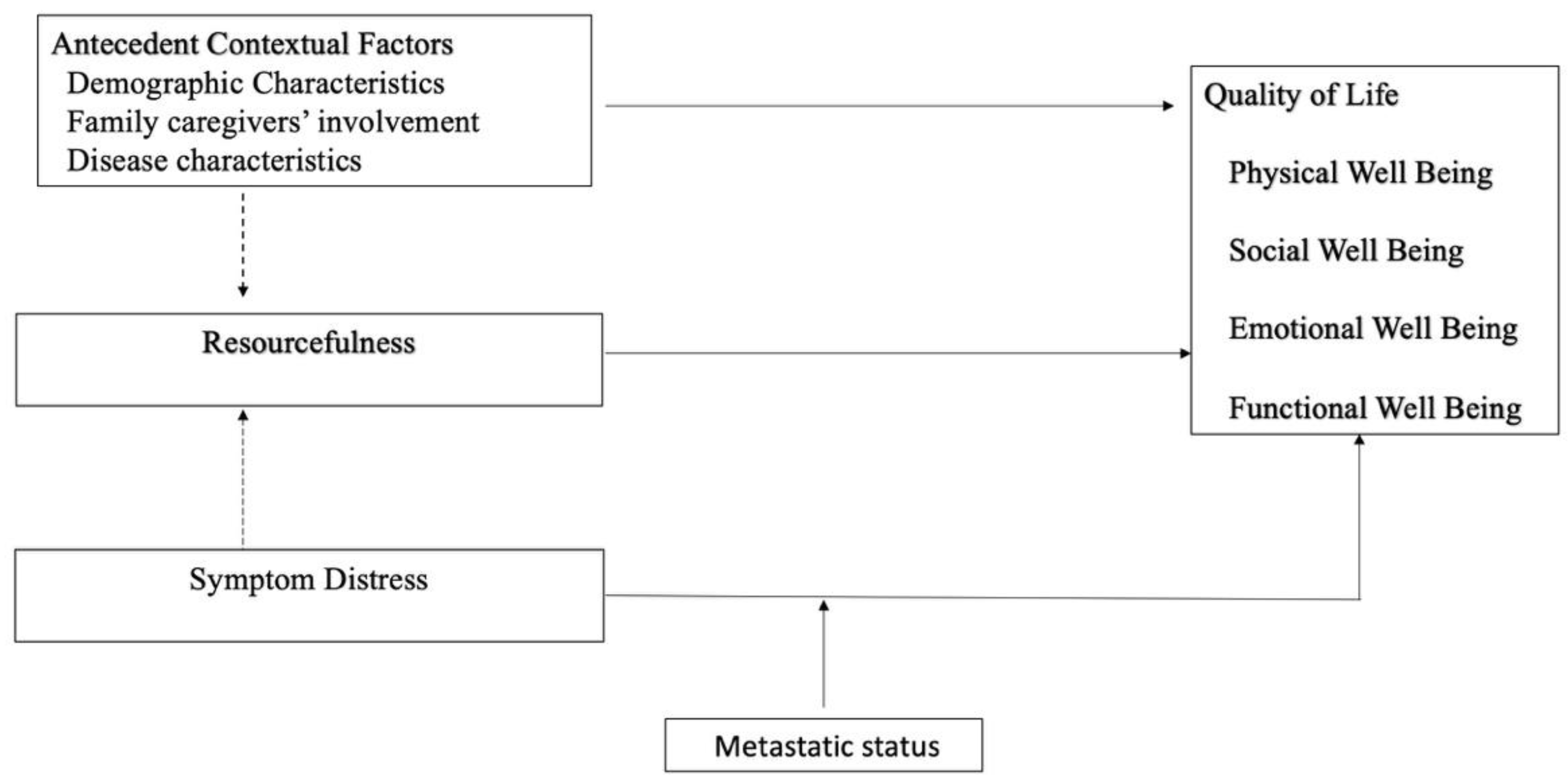
Figure 2.
Moderating effect of cancer metastasis on the association between symptom distress and QoL. *P < 0.05; ***P<0.001.
Figure 2.
Moderating effect of cancer metastasis on the association between symptom distress and QoL. *P < 0.05; ***P<0.001.
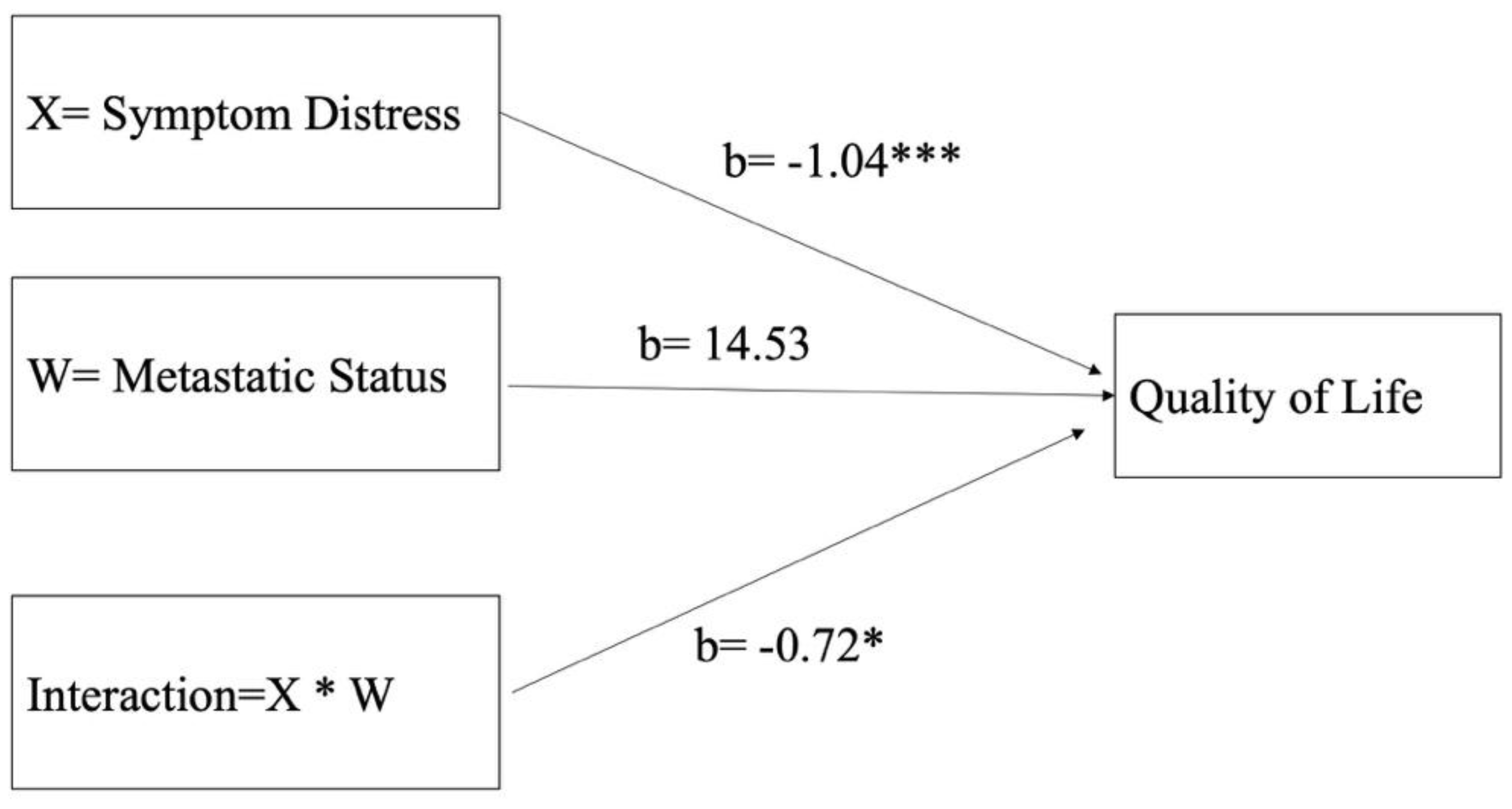
Figure 3.
The Johnson–Neyman plot. The vertical dashed line indicates the Johnson-Neyman threshold (score = 23), beyond which the effect becomes statistically significant.
Figure 3.
The Johnson–Neyman plot. The vertical dashed line indicates the Johnson-Neyman threshold (score = 23), beyond which the effect becomes statistically significant.
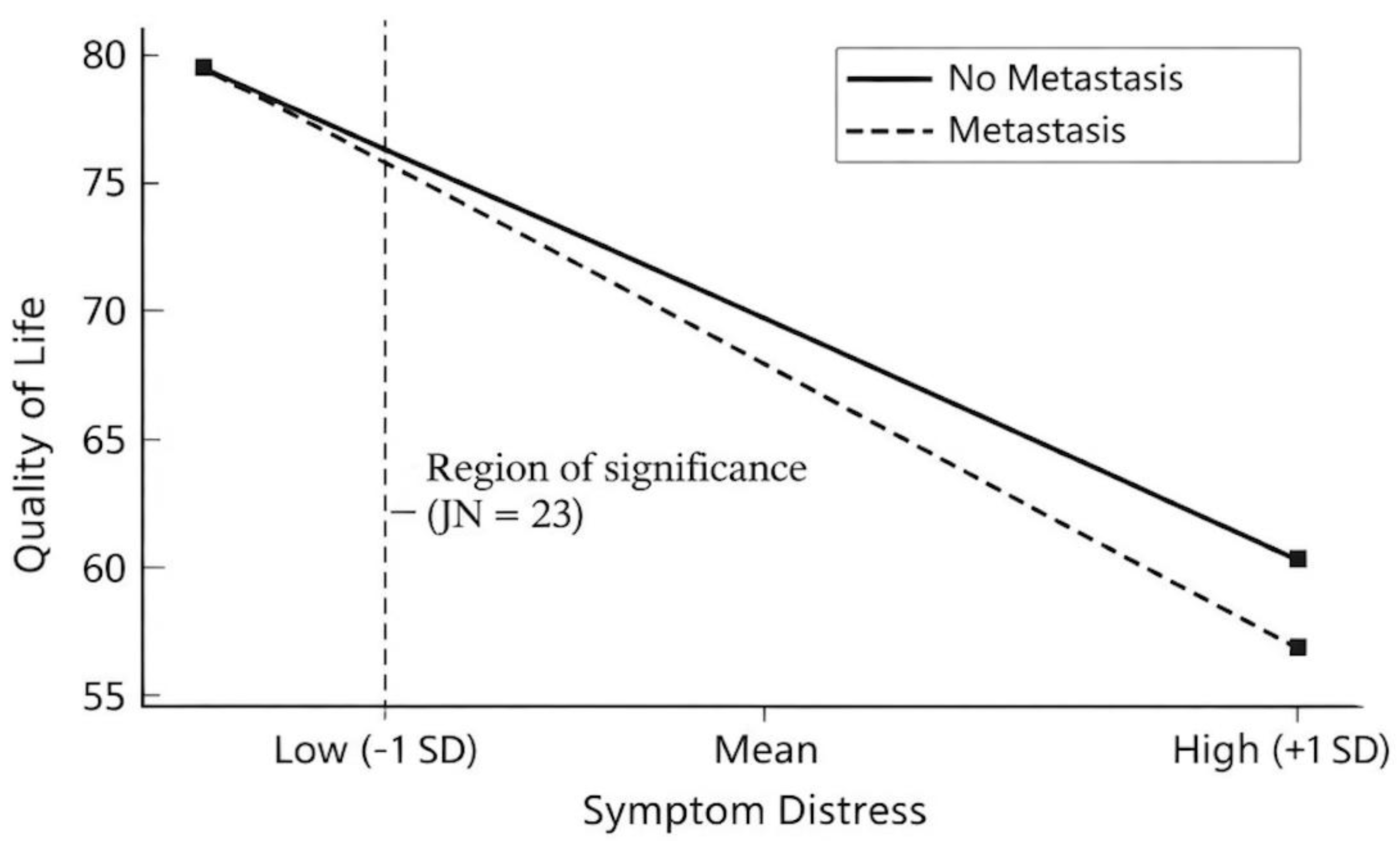
Table 2.
Canonical Correlation Analysis Between Symptom Distress, Resourcefulness, dimensions of QoL.
Table 2.
Canonical Correlation Analysis Between Symptom Distress, Resourcefulness, dimensions of QoL.
| Statistic Summary | Function 1 | Function 2 |
| Shared Variance (%) | 57.76 | 26.01 |
| Canonical Correlation | .76 | .51 |
| Wilks λ | .27 | .64 |
| F (df1) | 4.91 (12) | 3.04 (6) |
| p | < .001 | =.01 |
| Canonical Loadings | ||
| Set 1 -Personal Resourcefulness |
.37 |
-.03 |
| -Social Resourcefulness | .12 | .13 |
| -Symptom Distress | -.95 | -.04 |
| Set 2 Dimensions of QoL -Emotional Well-Being |
-.68 |
.68 |
| -Functional Well-Being | .44 | .12 |
| -Physical Well-Being | -.88 | -.10 |
| -Social Well-Being | .46 | .48 |
Note: 1. Df= Degree of Freedom. Only canonical functions with statistically significant canonical correlations are interpreted. Canonical loadings ≥ |0.30| were considered meaningful for interpretation.
Table 3.
Results of the Hierarchical Multiple Linear Model.
| Variables | Unstandardized Coefficients | Standard Error | Standardized Coefficients |
| Block 1 (serves as covariate) R2=0.124, p=0.73 | |||
| Demographic and Clinical Status | |||
| - Patients’ age | .06 | .13 | .04 |
| -Patients’ gender | - 3.28 | 2.30 | -.11 |
| - Employment (full-time/part-time/ no) |
.91 | 2.24 | .03 |
| -Education | .46 | .86 | .04 |
| - Religion | 1.95 | 2.10 | .07 |
| - Family Caregiver in treatment plans (yes/no) |
1.15 | 3.54 | .02 |
| Disease characteristics | |||
| -Meta 1 | -3.92 | 2.05 | -.13 |
| -Treatment Modality (Chemotherapy Versus CCRT2) |
.70 | 1.56 | .04 |
| -Type of Cancer (Head & neck; Gastric & Intestine; Others) |
-2.25 | 1.51 | -.12 |
| Block 2 (r R2=0.479, p <0.001) | |||
|
Patients’ Resourcefulness -Personal |
.27 |
.10 |
.23** |
| -Social | -.11 | .12 | -.07 |
| Symptom Distress | -6.66 | 1.84 | -.49*** |
| Block 3 (r R2=0.02, p <0.05) | |||
| Symptom Distress x Meta (Interaction term)3 | -4.13 | 2.12 | -.26* |
This hierarchal multiple regression explained total variance of 62.3% of QoL on cancer patients receiving chemotherapy during the COVID-19 pandemic, p<0.001. The parameters of VIF were between 1.12 and 4.07, indicating no multicollinearity. 1 Meta: Metastatic Status. 2 Ccrt: Current Chemotherapy and Radiation. 3 the Interaction Term Was Calculated Using Standardized Symptom Distress X Metastasis. *p.05; **p<0.01; ***p0.001.
Disclaimer/Publisher’s Note: The statements, opinions and data contained in all publications are solely those of the individual author(s) and contributor(s) and not of MDPI and/or the editor(s). MDPI and/or the editor(s) disclaim responsibility for any injury to people or property resulting from any ideas, methods, instructions or products referred to in the content. |
© 2026 by the authors. Licensee MDPI, Basel, Switzerland. This article is an open access article distributed under the terms and conditions of the Creative Commons Attribution (CC BY) license (http://creativecommons.org/licenses/by/4.0/).
Copyright: This open access article is published under a Creative Commons CC BY 4.0 license, which permit the free download, distribution, and reuse, provided that the author and preprint are cited in any reuse.


