

Submitted:
17 July 2026
Posted:
20 July 2026
You are already at the latest version
Abstract
Aging and glycative stress are major contributors to skeletal fragility, yet they affect bone through partially overlapping and distinct mechanisms. Aging is characterized by progressive deterioration of bone mass, microarchitecture, and remodeling balance, driven by hallmarks such as cellular senescence, mitochondrial dysfunction, oxidative stress, chronic low-grade inflammation, impaired autophagy, and altered intercellular communication. These processes disrupt the function of osteocytes, osteoblasts, and osteoclasts, leading to reduced bone formation, increased bone resorption, and impaired adaptation to mechanical loading. In parallel, glycative stress results from the accumulation of advanced glycation end-products (AGEs) and advanced glycoxidation end-products, which accumulate during aging and are accelerated in metabolic disorders such as type 2 diabetes mellitus. Unlike aging, glycative stress predominantly compromises bone quality rather than bone mass by altering collagen cross-linking, matrix mechanics, and cellular signaling through activation of the AGE–RAGE axis. Both conditions converge on shared pathways involving oxidative stress, inflammation, mitochondrial dysfunction, autophagy impairment, senescence, and defective mechanotransduction, ultimately reducing osteocyte viability and disrupting bone remodeling. Glycative stress additionally impairs bone mechanosensitivity by modifying extracellular matrix properties and altering key signaling networks, including Wnt/β-catenin, connexin 43, and PTH1R-dependent pathways. Emerging evidence identifies NLRP3 inflammasome activation, ferroptosis, and metabolic reprogramming as important downstream mediators linking aging, inflammation, and glycation-induced skeletal deterioration. Understanding the convergent and divergent mechanisms underlying bone aging and glycative stress may facilitate the development of targeted therapeutic strategies combining anti-resorptive, anabolic, senolytic, antiglycative, and mechanoprotective approaches to reduce fracture risk and preserve skeletal health.
Keywords:
bone
; aging
; glycative stress
; AGEs
; skeletal damage
; signaling pathways
1. Introduction to Aging and Glycative Stress in Bone
Bone is a highly dynamic and mechanically responsive tissue that continuously adapts its structure and function to meet both mechanical and metabolic demands. This adaptive capacity, known as mechanoadaptation, enables the skeleton to sense and respond to external mechanical forces through the coordinated activity of bone cells, particularly osteocytes, which translate physical stimuli into biochemical signals that regulate bone turnover and maintain skeletal integrity [1]. Structurally, bone is composed of two major compartments: cortical (compact) bone and trabecular (cancellous) bone. Cortical bone forms the dense outer shell of the skeleton and provides mechanical strength and resistance to bending and torsion, whereas trabecular bone consists of a porous interconnected network that contributes to load distribution, shock absorption, and metabolic activity [2]. Bone homeostasis is maintained through the coordinated processes of remodeling and modeling. Bone remodeling is a lifelong process in which old or damaged bone is removed by osteoclast-mediated resorption and subsequently replaced by osteoblast-derived bone formation, followed by matrix mineralization [3]. In contrast, bone modeling involves independent bone formation and resorption occurring on different bone surfaces, allowing the skeleton to modify its geometry and architecture in response to growth and changing mechanical demands [2]. Osteocytes, the most abundant bone cell population, play a central role in coordinating both processes through their ability to sense mechanical and hormonal cues, regulate mineralization, and secrete paracrine and endocrine factors that influence cells within the bone and bone marrow microenvironment [4].
Aging profoundly affects skeletal health and is one of the major risk factors for common bone disorders such as osteoporosis and fragility fractures. During aging, the balance of bone remodeling progressively shifts toward increased bone resorption and reduced bone formation, resulting in net bone loss [5]. These alterations lead to characteristic structural changes, including reductions in trabecular thickness and trabecular bone volume, as well as increased cortical porosity, which collectively compromise bone mass and strength and fracture resistance [6,7].
Glycative stress, induced by the accumulation of advanced glycation end-products (AGEs), also causes deleterious effects on skeletal health and has also been associated with osteoporosis and bone fragility, particularly in aging and metabolic disorders such as type 2 diabetes (T2DM) [8,9]. Unlike aging, AGEs accumulation primarily compromises bone quality rather than necessarily reducing bone mass. In glycative stress, particularly in T2DM, bone mineral density and even bone mass may remain unchanged or increased, yet fracture risk is paradoxically increased [8,9]. Although AGEs accumulation has been associated with reductions in trabecular thickness, trabecular bone volume, and increases in cortical porosity, these structural changes are generally less pronounced than those observed during aging [10]. Consequently, whereas aging predominantly leads to skeletal fragility through a progressive loss of bone mass and microarchitectural deterioration, glycative stress contributes to fracture susceptibility mainly through deterioration of bone material properties, impaired mechanosensing, and altered bone remodeling, explaining the disproportionately high fracture risk observed in elderly individuals and patients with T2DM despite preserved bone mineral density [8,9].
Aging and glycative stress share several molecular mechanisms that contribute to skeletal deterioration, including oxidative stress, chronic inflammation, mitochondrial dysfunction, and cellular senescence. However, glycative stress also exerts unique effects through AGE accumulation and interaction of AGEs with Receptors for Advanced Glycation End Products (RAGEs)-multiligand pattern-recognition receptors of the immunoglobulin superfamily- leading to specific alterations in bone matrix composition and mechanical properties. This review aims to examine both the common and distinct pathways through which aging and glycative stress affect bone cells, skeletal remodeling, and bone quality.
2. Molecular Mechanisms of Aging in Bone
Aging-related bone deterioration arises from the interaction of intrinsic and extrinsic factors, including genetic predisposition, endocrine changes, oxidative stress, glycative stress, and chronic low-grade inflammation. In particular, the age-associated decline in sex steroid hormones, accumulation of reactive oxygen species, and increased production of pro-inflammatory cytokines contribute to skeletal fragility by disrupting bone cellular function and promoting osteoclastogenesis [11]. A wide body of research has identified a series of conserved biological mechanisms, collectively known as the hallmarks of aging, which contribute to age-related functional decline in different organs, including bone. López-Otín and colleagues first proposed nine hallmarks of aging in 2013, including genomic instability, telomere attrition, epigenetic alterations, loss of proteostasis, deregulated nutrient sensing, mitochondrial dysfunction, cellular senescence, stem cell exhaustion, and altered intercellular communication. More recently, this framework has been expanded to incorporate disabled macroautophagy, dysbiosis, and chronic inflammation (inflammaging). These hallmarks share several common features: they emerge progressively during aging, contribute causally to age-related dysfunction, and represent potential targets for therapeutic intervention [12]. Age-related alterations cause different effects on the major bone cell populations involved in skeletal homeostasis, namely osteocytes, osteoblasts and osteocytes, as discussed in the following sections (Figure 1).
2.1. Aging Actions in Osteocytes
At the cellular level, the effects of aging are more pronounced in osteocytes, as they are long-lived terminally differentiated cells in the bone, in contrast to osteoclasts and osteoblasts, that live only for a few days or months, respectively [3].
Osteocytes are the most abundant cells in bone tissue and represent the terminally differentiated stage of the osteoblast lineage. They present an extensive dendritic network that extends into the lacuno-canalicular system (LCN) in bone, establishing communications with neighboring osteocytes and other bone-resident cells, acting as key regulators of skeletal homeostasis. Osteocytes function as the primary mechanosensors of bone, detecting mechanical stimuli such as matrix deformation and fluid shear stress, and translating these signals into biochemical responses that regulate bone remodeling. Osteocytes also control osteoblast and osteoclast activity through the secretion of regulatory molecules, including sclerostin (SOST), an inhibitor of Wnt/β-catenin signaling and bone formation, and receptor activator of nuclear factor κB ligand (RANKL), which is essential for osteoclast differentiation [1].
Aging induces profound structural alterations in osteocytes, characterized by a more rounded cellular morphology, reduced dendritic processes, and decreased LCN volume. Aged osteocytes also display pathological features observable by microscopy, including empty or lysed lacunae and nuclear abnormalities, reflecting impaired cellular viability and function [13]. These age-related alterations are closely associated with apoptosis and cellular senescence. Apoptotic osteocytes contribute to empty lacunae and reduced osteocyte density [14], while senescent osteocytes progressively lose their dendritic connectivity and functional capacity [15].
2.1.1. Osteocyte Apoptosis
Osteocyte apoptosis contributes to the removal of “dead” bone through autophagy-associated programmed cell death. This physiological process facilitates bone cell renewal and helps maintain bone strength and structural integrity [14]. Nonetheless, a large proportion of apoptotic osteocytes display a pivotal role in several pathologic conditions, such as aging. Increased osteocyte apoptosis induced by conditions such as aging and mechanical unloading promotes bone resorption by activating NF-κB signaling and stimulating RANKL-dependent osteoclastogenesis. This process is associated with increased oxidative stress (ROS), mitochondrial dysfunction, and upregulation of key pro-resorptive factors such as RANKL and sclerostin [16]. It has been observed that mechanical loading plays a protective role in bone homeostasis by maintaining osteocyte viability, decreasing osteoclastogenesis and promoting anabolic responses [17] In this regard, Tirado-Cabrera et al. demonstrated that mechanically stimulated osteocytes activate a protective pathway involving the translocation of parathyroid hormone receptor type 1 (PTH1R) to the primary cilium, which leads to decreased secretion of osteoclastogenic factors [18].
Apoptotic osteocytes can promote osteoclast formation both directly and indirectly, by signaling to neighboring viable osteocytes and through the release of apoptotic bodies that influence osteoclast precursors [19]. Molecules such as High Mobility Group Box 1 (HMGB1) play a central role in this crosstalk. HMGB1 is released during osteocyte apoptosis and directly triggers osteoclastogenesis via activation of Receptor for advanced glycation end products (RAGE). However, it has an indirect role in osteocyte apoptosis through signaling to neighboring viable osteocytes. Then these surviving neighbor osteocytes upregulate RANKL, that further induce osteoclastogenesis and other pro-inflammatory factors, such as TNF-α, IL-6, IL-11 [20].
In addition to cytokine-mediated communication with surrounding bone cells through the LCN, osteocytes communicate with neighboring cells via gap junctions and hemichannels. Connexin 43 (Cx43), a key component of these channels, plays a critical role in this intercellular communication and has important implications for osteocyte apoptosis. [21,22]. Aging reduces Cx43 expression in bone, leading to increased osteocyte apoptosis, elevated osteoclast numbers and enhanced cortical resorption. Cx43 silencing in osteocytic cells triggers caspase-3 mediated apoptosis, along with upregulation of apoptosis-related genes and reduced levels of the pro-survival signaling axis miR-21/Phosphatase and TENsin homolog (PTEN)/Akt. Furthermore, Cx43- deficient osteocytes produce higher levels of the pro-osteoclastogenic factors RANKL and HMGB1, contributing to osteoclast formation through RAGE signaling [23]. Cx43 may also appear in osteocytes formin hemichannels. A recent study has demonstrated that enhanced Cx43 hemichannel activity promotes bone loss through increased osteoclastogenesis, while impaired Cx43 hemichannel function increases osteocyte apoptosis by reducing Prostaglandin E₂ (PGE₂) production [22].
2.1.2. Osteocyte Metabolism and Hormonal Responsiveness
Aging has also been associated with alterations in cellular energy metabolism, a recognized hallmark of the aging process and a key intrinsic mechanism affecting osteocyte function[24]. In addition, the expression of several hormone receptor genes that regulate paramount bone homeostasis functions, including parathyroid hormone receptor type 1 receptor (Pth1r), Vitamin D receptor (Vdr) and fibroblast growth factor 1 (Fgfr1) and 2 (Fgfr2), was reduced in aged cortical bone, suggesting an impaired hormonal responsiveness of osteocytes [25] Supporting this notion, various studies have shown that stimulation of the PTH1R protects osteocytes from oxidative stress and contributes to the prevention of age-related bone loss [13,26].
2.1.3. Osteocyte senescence
Aging osteocytes can alternatively become resistant to apoptosis and undergo a distinct cell fate known as cellular senescence [13]. Senescence is a state characterized by irreversible proliferation arrest, changes at chromatin level and reprogramming of protein synthesis. Despite the growth arrest, senescent cells are highly-metabolically active and acquire a senescence-associated secretory phenotype (SASP), that involves the secretion of inflammatory cytokines, chemokines that recruit and retain immune cells, tissue-degrading proteases, and factors that influence stem and progenitor cell function. These molecules can act through paracrine and endocrine signaling pathways to promote local and systemic inflammation, immune activation, fibrosis, apoptosis, tissue damage, and stem cell dysfunction, while also facilitating the spread of senescence to neighboring and distant cells [15,27]. Many stimuli that activate senescence are stress triggers such as telomere erosion, DNA damage, lysosomal stress, oncogene activation, and oxidative stress that are closely related to aging [28].
Among the pathways altered in senescence, the cyclin-dependent kinase inhibitors, particularly p16Ink4a and p21Cip1 are particularly prominent. In response to repeated cell damage, they are upregulated to arrest the cell cycle and prevent malignant transformation [15]. In this context, recent studies have demonstrated that selective induction of caspase-8-mediated apoptosis in senescent cells using the INK-ATTAC “suicide” transgene, as well as suppression of the pro-inflammatory SASP with a Janus Kinase (JAK) inhibitor, attenuated bone loss, increased bone mass and strength, and improved bone microarchitecture compared with vehicle-treated mice. The skeletal benefits observed following senescent cell targeting were attributable to decreased bone resorption, accompanied by maintained bone formation in trabecular bone and increased bone formation in cortical bone [15,29]. Another recent study demonstrated that osteocyte-derived RANKL is a critical mediator of age-related cortical bone loss and that its expression is enhanced by the accumulation of senescent cells within cortical bone [20].
Furthermore, the senescent phenotype of bone can be enhanced by Cx43-enriched small extracellular vesicles (sEVs) released by osteoarthritic (OA) chondrocytes that play a major role in spreading disease-promoting signals throughout the joint. These Cx43-containing sEVs induce cellular senescence, inflammation, and tissue degeneration in bone cells by stimulating the release of SASP factors such as IL-1β, IL-6, and matrix metalloproteinases (MMPs). They also activate NF-κB and ERK1/2 signaling pathways, promoting cellular that contributes to loss of normal cell function [30].
2.2. Aging Defects in Osteoblasts
2.2.1. Osteoblast Apoptosis, Proliferation and Differentiation
Osteoblasts are spindle-shaped or cuboidal cells located on bone surfaces that regulate bone formation. Mature, active osteoblasts exhibit large nuclei, expanded Golgi apparatus, and extensive endoplasmic reticulum and secrete type I collagen and other matrix proteins in a polarized manner toward the bone-forming surface. During later differentiation stages, they release calcium and phosphate ions to initiate mineralization, thereby preserving bone structural integrity. Osteoblasts also maintain bone homeostasis by regulating osteoclast activity through direct cell-cell contact, cytokines, and extracellular matrix interactions [31].
Osteoblast proliferation and function are regulated by multiple factors that are susceptible to being affected in aging. The key transcription factors Runx2 and Osx drive osteogenic differentiation of skeletal stem cells (SSCs). Pro-osteoblastic cytokines include IL-10, IL-11, IL-18, and IFN-γ, whereas the anti-osteoblastic factors TNF-α, TNF-β, IL-1α, IL-7, IFN-α, IFN-β suppress osteoblast production. Major signaling pathways involved in this regulation include Notch, Wnt, and bone morphogenetic protein (BMP) [32]. Notch signaling has a context-dependent role in osteoblast differentiation, promoting mineralization and early osteoblast formation while potentially inhibiting terminal maturation through suppression of the Wnt/β-catenin signaling pathway. Notch interacts with key osteogenic pathways, including BMP/Smad, Wnt, and NFAT, to regulate bone formation and remodeling [33]. However, although it has been shown that aging increases Notch signaling in skeletal stem progenitor cells (SSPCs), it promotes adipogenic rather than osteogenic differentiation. In these cells, inhibition of Notch restores osteoblast formation, reduces marrow adiposity, and improves bone mass and repair, identifying Notch modulation as a potential strategy to counteract skeletal aging [34].
During aging, osteoblast apoptosis increases and osteoblast numbers decline, at least in part, as a consequence of a reduced pool of skeletal stem cells (SSCs). Although osteoblasts and adipocytes originate from a common progenitor, aging shifts SSC differentiation toward the adipogenic rather than the osteogenic lineage [35]. Under physiological conditions, SSCs differentiate into osteogenic precursor cells through activation of canonical Wnt signaling. The Wnt pathway promotes osteoblastogenesis while suppressing adipogenesis; however, its activity is reduced with aging. This decline in Wnt signaling favors bone marrow adiposity, which, in turn, negatively affects osteoblast survival [32].
Related to this, OSTEOPONTIN (OPN), produced by several bone cells, including osteoblasts, osteocytes, and osteoclasts, is highly expressed by osteoblast-lineage cells in the bone marrow. OPN regulates mesenchymal stem cell (MSC) differentiation by osteogenesis promotion and adipogenesis inhibition via αVβ1 integrin signaling. With aging, osteoblastic OPN declines, inducing a shift in MSCs toward adipogenic differentiation, with a subsequent reduction in the supportive osteoblastic niche of bone marrow [36]. Aging is also associated with reduced IGF-1 levels and IGF-1 resistance in osteoblasts, attenuating their proliferative and anti-apoptotic responses. In parallel, aging is related to a weakening of several osteogenic signaling pathways in osteoblats, such as Wnt and Hedgehog signaling, which compromises osteogenic differentiation, and to a reduction in IGF-1 levels and IGF-1 resistance, undermining proliferative and anti-apoptotic responses [32,37].
2.3. Aging Defects in Osteoclasts
2.3.1. Increased Osteoclast Formation
Osteoclasts are large, multinucleated, highly motile hematopoietic cells that originate from granulocyte–macrophage colony-forming units and diverge from the monocyte–macrophage lineage during the early stages of differentiation [38]. Their proliferation, survival and responsiveness to receptor activator of nuclear factor-κB ligand (RANKL) is primarily regulated by macrophage colony-stimulating factor (M-CSF). Meanwhile RANKL binding to its receptor RANK triggers signaling pathways essential for osteoclast formation and activity. In contrast, OPG acts as a decoy receptor that inhibits RANKL–RANK interactions, thereby limiting osteoclastogenesis.
EphrinB2 also acts as a negative regulator of osteoclastogenesis by restraining RANKL-induced NFATc1 activation and limiting osteoclast differentiation. Through ephrinB2/EphB4 bidirectional signaling, osteoclast activity is coupled to osteoblast-mediated bone formation, ensuring balanced remodeling. In this context, it has been shown that PTH induces ephrinB2 in osteoblasts, enhancing bone formation [39]. As mentioned above, Pth1r gene expression is reduced in aged cortical bone, which suggest a possible reduction in ephrn B2 expression due to PTH-defective signaling. Moreover, alterations in ephrinB2/EphB4-mediated coupling may contribute to the imbalance between bone resorption and formation observed during pathological bone loss [1].
Mature osteoclasts possess a unique morphology characterized by multiple nuclei and specialized structures that facilitate bone resorption [40]. Aging is associated with increased osteoclast number and activity, contributing to age-related bone loss. Various studies have shown that aged-senescent bone exhibits enhanced osteoclast formation due to increased survival of osteoclast precursors [41], elevated levels of colony-stimulating factor 1 (CSF-1) [42], and an imbalance in the RANKL/OPG system characterized by increased RANKL and decreased OPG expression [32]. Additionally, age-related alterations in regulatory proteins such as Connexin 43 (CX43) signaling can promote osteoclast formation and activity [23] and defects in Sonic hedgehog signaling (Shh) may contribute to the unpaired bone formation and resorption observed in age-related delay of fracture healing [43].
2.3.2. Impairment in Osteoblast-Osteoclast Communication
Osteoclast precursors also affect osteogenic functions, mainly through secreting both osteogenesis-promoting and osteogenesis-inhibiting factors. Mature osteoclasts regulate osteoclast-osteoblast coupling during bone remodeling through release of extracellular vesicles (EVs) such as exosomes and apoptotic bodies [44]. Apoptotic bodies can enhance osteogenesis via RANKL-mediated signaling, and osteoclast-derived exosomes promote osteogenic differentiation and mineralization through their enrichment in miR-324 and miR-106a-5p miRNAs [44]. On the other hand, exosomes released from osteoblasts may include RANKL that activates osteoclast formation through binding to its receptor RANK in osteoclast precursors [45]. Bone aging is associated with substantial alterations in the molecular cargo of EVs, including changes in their protein, lipid, RNA, and DNA composition. These modifications reflect age-related changes in bone cell physiology and contribute to the progressive deterioration of bone quality and function [11]. Therefore, senescent osteoblast may reduce cell proliferation by promoting cell senescence and apoptosis through release of miR-139-5p exosomes [32].
3. Molecular Mechanisms of Glycative Stress in Bone
In parallel to aging hallmarks, growing evidence supports glycative stress as an important contributor to biological and skeletal aging [46]. Glycative stress is defined as the cellular state in which advanced glycation end-products (AGEs) and their reactive dicarbonyl precursors accumulate at a pathological rate. This imbalance arises from two conditions. One, from an increase in their formation, driven by hyperglycaemia, glycaemic variability, lipid peroxidation and high-glycaemic-index diets. Or second, from the failure of the cellular systems that normally detoxify them, namely the glyoxalase pathway, DJ-1/Park7, the ubiquitin-proteasome system (UPS) and autophagy, a self-degradation and recycling of cellular components process in cells. When these systems are overwhelmed, glycative modifications accumulate in extracellular matrix proteins and in intracellular components, altering cell function and activating pro-inflammatory, pro-oxidative and pro-apoptotic signalling pathways (47–50).
Similar to the established hallmarks of aging, glycative stress increases progressively with age, interacts closely with oxidative stress and chronic inflammation, and contributes to cellular and tissue dysfunction [46]. In addition, AGEs can amplify several aging-associated processes, including mitochondrial dysfunction, cellular senescence, and altered intercellular communication [51,52]. However, glycative stress also displays distinctive characteristics that differentiate it from the canonical hallmarks. Rather than representing a broad biological process, it primarily arises from cumulative chemical modifications of long-lived macromolecules and is strongly influenced by metabolic conditions such as hyperglycemia [51]. Consequently, glycative stress may be viewed both as a downstream consequence of aging-related metabolic alterations and as an independent driver of tissue degeneration [12,46] (Figure 2).
In bone, glycative stress result from as a combination of AGEs and advanced glycoxidation end-products (AGOEs), the latter requiring concomitant ROS and reactive carbonyl species (RCS) [50,53]. The actions of AGES and AGOES contribute to the increased risk of fragility fractures observed in elderly and diabetic individuals, at least partly independently of bone mineral density (BMD). Moreover, they provide a mechanistic link between skeletal fragility and age-related cognitive and metabolic disorders, including Alzheimer’s disease, through shared pathogenic pathways [54,55] (Figure 3).
AGEs are a heterogeneous family of compounds generated through the Maillard reaction, in which a reducing sugar condenses with the free amino group of a protein, lipid or nucleic acid to form a reversible Schiff base, which rearranges into a more stable Amadori product. After oxidation, dehydration and cyclisation, Amadori products fragment into highly reactive α-dicarbonyl species: methylglyoxal (MGO), glyoxal (GO) and 3-deoxyglucosone (3-DG). These dicarbonyls attack lysine, arginine and histidine residues, generating irreversible AGEs [47,49,56].
Sroga and Vashishth (2024) and Wang and Vashishth (2023) extended this definition. AGEs that incorporate ROS and reactive carbonyl species (RCS) during their formation are termed advanced glycoxidation end-products (AGOEs); they include Nε-(carboxymethyl)lysineCML), Nε-(carboxyethyl)lysine (CEL) and pentosidine.
AGOEs accumulate in tissues exposed simultaneously to carbonyl and oxidant stress (for example in type 2 diabetes mellitus [T2DM], aging, chronic kidney disease [CKD]), whereas pure-glycation crosslinks reflect cumulative diffusion-based exposure. AGEs are classified into three groups: fluorescent crosslinks (pentosidine, PEN), non-fluorescent crosslinks (glucosepane, GSPN) and non-fluorescent, non-crosslinking adducts (CML, CEL, MG-H1/2/3, pyrraline) [53,57,58,59].
Endogenous AGEs derive from glycolytic intermediates (mainly MGO), the polyol pathway, lipid peroxidation and protein catabolism. Chen et al. (2025) demonstrate that, beyond mean glycaemia, glycaemic variability (GV) is an independent driver of bone damage in T2DM. Diet, tobacco and, in CKD, the failure of renal clearance further amplify the systemic AGE burden, which also includes uraemic toxins such as indoxyl sulfate (IS) and p-cresyl sulfate (pCS) [55].
The glyoxalase system (GLO1, GLO2) and reduced glutathione (GSH) constitute the primary line of defence against MGO and GO. Age-dependent decline of GLO1 activity and lower GSH are central mechanisms of glycative stress in aging tissues [49,50,60]. Once AGEs/AGOEs are formed and insoluble, UPS, macroautophagy and chaperone-mediated autophagy (CMA) are responsible for their clearance. The proteostasis network, comprising the UPS, macroautophagy, and CMA, is the principal intracellular machinery responsible for protein quality control through the recognition, degradation, and recycling of damaged, misfolded, or obsolete proteins. AGEs themselves impair these systems, generating a vicious cycle that worsens with age (47–49).
3.2. The AGE/RAGE Axis
RAGE is an immunoglobulin-superfamily receptor encoded by the AGER gene. It recognizes and binds a diverse range of molecules, including AGEs (such as CML and MG-H1), alarmin and inflammatory mediators (including HMGB1 and S100/calgranulins), and protein aggregates (such as β-amyloid) [61]. The effects of RAGE ligands on bone cells are biphasic — low or transient AGE/HMGB1 doses stimulate osteoblast autophagy and differentiation, whereas high or sustained doses induce osteoblast/osteocyte apoptosis and increase cytokine production that promotes osteoclastogenesis. Ligand binding induces receptor oligomerisation and recruitment of DIAPH1 to the cytoplasmic tail, activating Ras/Raf/MEK/ERK and p38-MAPK, JAK/STAT and Rac1/Cdc42, which converge on NF-κB. NF-κB initiates a transcriptional programme that includes RAGE itself (a positive feedback loop), pro-inflammatory cytokines (TNF-α, IL-1β, IL-6), adhesion molecules (ICAM-1, VCAM-1), VEGF and pro-oxidant enzymes (iNOS, NADPH oxidase), and represses GLO1 [47,48,56,60,62,63,64] (Figure 4).
Another axis converges with RAGE on the same downstream targets. Toll-like receptor 4 (TLR4), a pattern-recognition receptor classically associated with microbial detection, is also activated by damage-associated molecular patterns (DAMPs) such as HMGB1 —a ligand it shares with RAGE— and by selected S100 proteins. TLR4 engagement signals through the Akt/mTOR and NF-κB cascades, inhibiting osteoblast autophagy and enhancing the transcription of pro-inflammatory cytokines that drive osteoclast differentiation. Consistently, TLR4 deletion in animal models restores the expression of the autophagy-related proteins Beclin1 and LC3-II in osteoblasts, improves bone formation and attenuates systemic inflammation [65]. This functional overlap, reinforced by ERK-mediated phosphorylation of LC3 —which initially promotes autophagosome formation but becomes deleterious when sustained— and by TGF-β1-driven suppression of osteoblast autophagy through Smad2/3 and PI3K/Akt/mTOR, supports the unified "RAGE-ligand-driven bone loss" paradigm proposed by Plotkin et al. [64]. According to this, the diverse ligands that accumulate in the glycative, oxidative and inflammatory environment of aged or diabetic bone —AGEs, HMGB1 and S100 proteins— converge on a shared intracellular network that reduces osteoblast and osteocyte viability while amplifying osteoclastogenic cytokine output, irrespective of the specific receptor engaged.
3.3. Glycative Stress in Bone: Cellular Effects
3.3.1. Glycative Stress Actions in Osteocytes
Osteocytes are particularly susceptible to glycative stress because of their long lifespan and their embedment within a matrix that progressively accumulates AGEs during aging, diabetes, and chronic hyperglycemia. AGEs bind to RAGE expressed on osteocytes, activating multiple intracellular signaling pathways, including NADPH oxidase-mediated ROS production, NF-κB, ERK1/2, JNK, and p38 MAPK signaling [61,66]. These pathways promote oxidative stress, inflammation, and cellular dysfunction, impairing the ability of osteocytes to sense and respond to mechanical stimuli. As the principal mechanosensors of bone, osteocytes exposed to glycative stress exhibit reduced mechanotransduction capacity and altered regulation of bone remodeling [61,66].
Another consequence of glycative stress in osteocytes is the promotion of apoptosis and cellular senescence. Excessive ROS generation induces mitochondrial dysfunction, activation of caspase-dependent apoptotic pathways, and DNA damage responses that compromise osteocyte survival and lead to osteocyte death [61,66]. Glycative stress increases expression of sclerostin (SOST), an osteocyte-derived inhibitor of canonical Wnt/β-catenin signaling, thereby suppressing osteoblast recruitment and activity [61,67,68].
Regarding AGEs effects on osteocyte regulation of osteoclastogenesis, the evidence is not entirely consistent across studies and remains controversial. Some studies revealed that AGEs stimulate osteocytic expression of RANKL, while reducing the production of osteoprotegerin (OPG), shifting the RANKL/OPG ratio toward enhanced osteoclastogenesis. These reports suggest that combined effects of osteocyte apoptosis, impaired mechanotransduction, increased sclerostin production, and altered RANKL/OPG signaling contribute to reduced bone formation, increased bone resorption, accumulation of microdamage, and deterioration of bone quality [61,69]. However, in studies using osteocyte cell lines, the actions of AGEs on osteocytic RANKL expression report opposite results. Studies conducted in MLO-Y4-A2 osteocyte-like cells found that AGEs decrease, rather than increase, RANKL expression [67,70]. Based on these observations, it has been proposed that high glucose and AGEs increased SOST/sclerostin and decreased RANKL in osteocytic cells, produce a low-turnover phenotype that perpetuates AGE accumulation [64].
In contrast, in vitro studies that used other murine osteocyte cell lines, namely OCY454-12H and MLO-Y4 cells showed the contrary; increased expression of RANKL in these cells [68,69], supporting the role of AGEs on osteocytic promotion of osteoclastogenesis. These apparent discrepancies may reflect differences in the osteocyte-like cell models employed, as distinct cell lines can exhibit different stages of differentiation, phenotypic characteristics, receptor expression profiles, and signaling pathways. Such variations may influence the activation of AGE-responsive pathways, including RAGEs, FOXO1, TGF-β1, MAP kinases, and NF-κB-mediated signaling, ultimately leading to different RANKL expression.
3.3.2. Glycative Stress Actions in Osteoblasts
Osteoblasts are also highly sensitive to the detrimental effects of glycative stress. AGE binding to RAGE triggers activation of ERK1/2, JNK, p38 MAPK, PI3K/Akt, and NF-κB signaling pathways, leading to increased intracellular oxidative stress and inflammatory signaling [61,66,71]. Although low concentrations of AGEs may transiently stimulate autophagy through the RAGE/Raf/MEK/ERK pathway and promote short-term cell survival due to cell self-degradation of damaged components, prolonged exposure or higher AGE concentrations predominantly induce detrimental effects [71].[68] Persistent ROS accumulation induces mitochondrial dysfunction, protein oxidation, and DNA damage, ultimately impairing osteoblast viability and function, ultimately leading to increased apoptosis [61,66,71].
Glycative stress inhibits osteoblast differentiation and exposure to AGEs suppresses the expression of essential osteogenic transcription factors, including RUNX2 and osterix (SP7), together with downstream markers such as alkaline phosphatase (ALP), osteocalcin, bone sialoprotein, and type I collagen [66,72]. Moreover, AGEs interfere with Wnt/β-catenin and BMP/Smad signaling pathways, thereby impairing osteogenic commitment and maturation [61,66]. Matrix production is further compromised by reduced expression of lysyl oxidase and lysyl hydroxylase, enzymes responsible for collagen maturation and extracellular matrix organization [72]. Consequently, osteoblasts exhibit diminished matrix deposition and mineralization capacity, leading to reduced bone formation [61,72].
Related to this, some studies have reported that AGEs downregulate ALP/RUNX2/osterix/osteopontin/osteocalcin expression and promote apoptosis via NF-κB, ROS, TGF-β, ER stress and Bax/Bcl-2 imbalance (62–64,73).
In this regard, glycative stress promotes both osteoblast apoptosis and senescence. AGE-induced oxidative stress activates intrinsic apoptotic pathways through modulation of Bcl-2 family proteins (increased Bax/Bcl-2 ratios), mitochondrial membrane depolarization (causing cytochrome c release), and caspase-3 activation, promoting osteoblast apoptosis [61,66,74].
Chronic glycative stress may also induce a senescence-associated secretory phenotype (SASP) characterized by increased secretion of pro-inflammatory cytokines such as IL-6, TNF-α, and IL-1β, and other inflammatory mediators that further inhibit osteogenesis and enhance osteoclastogenic signaling [75,76]. Evidence also suggests that apoptotic and senescence-related pathways involve activation of p53 and its downstream target p21, resulting in cell-cycle arrest, reduced proliferation, and impaired osteoblastogenesis.
These mechanisms collectively are proposed to contribute to the low bone turnover, impaired bone regeneration, and skeletal fragility which are hallmarks of both diabetic and age-related bone loss (75–77).
3.3.3. Glycative Stress Actions in Osteoclasts
The effects of glycative stress on osteoclasts are complex and depend on the level and duration of AGE exposure as well as on interactions with neighboring bone cells. Direct exposure of osteoclast precursors to AGEs generally suppresses osteoclast differentiation. This effect has been associated with AGEs ability to inhibit RANKL-induced activation of JNK, p38 MAPK, Akt, and NFATc1 signaling pathways that are essential for osteoclastogenesis [72].
This inhibition reduces the expression of osteoclast-specific genes such as tartrate-resistant acid phosphatase (TRAP), cathepsin K, matrix metalloproteinase-9, and DC-STAMP, resulting in impaired precursor fusion and decreased formation of mature multinucleated osteoclasts [72]. AGEs additionally suppress adhesion-related pathways involving ICAM-1 and LFA-1, which are required for osteoclast precursor migration and cell–cell fusion [72].
However, these direct inhibitory effects differ from indirect actions of glycative stress. In this regard, AGEs can indirectly promote osteoclastogenesis through AGE-mediated alterations of osteocytes and osteoblasts. Activation of RAGE signaling in these cells increases RANKL expression, decreases OPG production and enhanced secretion of pro-inflammatory cytokines such as TNF-α, IL-1β, and IL-6 through NF-κB-dependent mechanisms, generating a microenvironment that promotes osteoclast recruitment and activation [61,66]. Furthermore, NF-κB-dependent production of inflammatory cytokines, including TNF-α, IL-1β, and IL-6, enhances the responsiveness of osteoclast precursors to RANKL and stimulates bone resorption [61,66]. Therefore, although AGEs may directly suppress osteoclast differentiation in isolated culture systems, the overall in vivo environment may still favor increased osteoclastic activity because of changes in bone-cell crosstalk.
Glycative stress also seems to affect osteoclast survival and function through oxidative stress pathways. Moderate levels of ROS production can act as a secondary messenger in RANKL signaling that potentiates osteoclast activation, whereas excessive ROS eventually induces mitochondrial damage, cytoskeletal disorganization, impaired actin ring formation (a structure required for osteoclast bone resorption), and apoptosis [61,66,72]. As consequence of these effects, glycative stress disrupts the normal coupling between bone resorption and bone formation. The combined suppression of osteoblast activity and dysregulation of osteoclast differentiation by AGEs is believed to result in impaired remodeling, reduced tissue toughness, and increased fracture risk despite relatively normal bone mineral density (60–63,66,78).
4. Aging/Glycative Stress-Related Loss of Mechanosensing Ability
4.1. Cells and Molecules Involved in Skeletal Mechanotransduction
The adaptive capacity of bone to adapt to mechanical stimuli relies on a mechanotransduction system in which mechanical signals, such as fluid shear stress, matrix strain and substrate stiffness, are converted into biochemical responses that regulate osteoblast, osteoclast and osteocyte activity. Osteocytes, embedded in the mineralised matrix and connected to neighbouring cells thanks to their lacuno-canalicular network, are regarded as the principal cellular mechanosensors of bone tissue [79]. An integrated picture of how mechanical loading is translated into anabolic signalling in osteocytes is summarized in the review of bone mechanotransduction by Maycas, Esbrit and Gortazar [80].
At the molecular level, mechanotransduction in bone cells depends on different sensor families: cell-matrix adhesion complexes (integrins clustered in focal adhesions that bind to the cytoskeleton), stretch-activated channels (Piezo1/2), gap-junction/hemichannel networks, cell membrane receptors including PTH1R, the Wnt/β-catenin and Hippo/YAP/TAZ signaling pathways and subcellular structures such as the primary cilium and caveolae [81,82] (Figure 5).
4.2. Aging-Derived Defects in Mechanotransduction
Minimal mechanical strain in bone tissue from routine daily activities can be significantly amplified at the single-cell level through interstitial fluid flow along the lacuna/canalicular wall, inducing membrane deformation and activating a biological response. Given that aging is frequently accompanied by bone loss and increased skeletal fragility, the increasingly spherical morphology of osteocytes and changes of the LCN density due to hypermineralization may be linked to a reduced capacity to sense and respond to mechanical stimuli, a process that is essential for preserving bone mass and structural integrity [13,83].
A study to test the impact of the age-related degeneration of the lacunocanalicular network (LCN) using imaging-based reconstructions and computational modeling has shown that reduction of the osteocyte LCN network reduces the shear stress experienced by osteocytes, thereby compromising mechanotransduction [84]. The decline in mechanical stimulation was associated with the loss of canalicular surface area [84]. In this study, the disruption of TGF-β signaling by deleting TGF-β receptor II (TβRII) in osteocytes, predicted fewer and more twisted canaliculi and a decrease in shear stress experienced by osteocytes, inducing a similar phenotype of impaired mechanotransduction to the one observed due to aging [84]. These findings suggest that age-related impairment of osteocyte mechanotransduction may arise not only from structural deterioration of the LCN itself but also from alterations in signaling pathways required to maintain LCN integrity.
Additional evidence supporting age-related impairments in mechanotransduction comes from transcriptomic analyses showing reduced expression of genes involved in mechanosensing (integrins, cytoskeleton and calnexin), secondary messenger production (NO, PGE2, ATP synthesis relevant, and calcium signaling genes), and downstream pathways such as Wnt signaling, PI3K-AKT and cGMP-PKG. These alterations in paramount mechanical sensing molecules provide a plausible explanation for the decline in the mechanical responsiveness observed with aging [85,86].
The Wnt/β-catenin pathway is considered the master anabolic promoter of mechanical signals in bone. Sclerostin and Dickkopf-related protein 1, encoded by SOST and DKK1 genes respectively, act as inhibitors of Wnt signaling, playing a central role in load-induced bone anabolism [87]. It has been observed that mechanical loading suppresses osteocyte sclerostin and DKK1 production, relieving Wnt inhibition, and therefore inducing osteoblast differentiation and bone formation. However, with aging the expression of Wnt antagonists (sclerostin and Dkk1) increase, and a net bone loss follows [88]. In addition, aging is also associated with the downregulation of genes involved in the activation of the Wnt signaling pathway, leading to a diminished osteogenic response to mechanical stimulation in aged bone [85].
Focal adhesions (FAs) act as pivotal mechanosensors by integrating mechanical and biochemical signals through focal adhesion kinase (FAK), Src, paxillin and vinculin, linking the extracellular matrix to the actin cytoskeleton. When destabilized, FAs impair mechanical force transmission and activate proteolytic pathways such as the ubiquitin–proteasome system (UPS). In parallel, mechanical loading triggers Nox2-derived ROS production in osteocytes, which acts as a physiological second messenger that downregulates sclerostin and activates the Wnt/β-catenin pathway, promoting bone formation [79,89]. This redox-sensitive mechanism establishes a bidirectional crosstalk between oxidative balance and mechanotransduction: low, transient ROS acts as pro-mechanosensing signals, whereas chronic oxidative stress, such as the one induced in aging, disrupts FA integrity and ends with mechanosensing failure [89].
Integrins are heterodimeric cell adhesion receptors that mediate focal adhesion formation and mechanical signal transduction. Composed of different α and β subunits, there are 24 distinct human integrins with tissue-specific and time-dependent expression patterns that regulate key cellular processes including adhesion, migration, differentiation, proliferation, and apoptosis [90]. Integrins play an important role in regulating bone metabolism across multiple cell types, including osteoblasts, osteoclasts, and osteocytes. Among other functions, they can act as mechanotransducers, translating physical stimuli such as mechanical loading, fluid shear stress, microgravity, hypergravity, and extracellular pressure into biochemical signals that regulate bone cell activity [91]. Collagen-binding integrins, particularly integrin α2β1, play a key role in cell–extracellular matrix interactions in bone. As the main receptor for collagen type I, the most abundant bone matrix protein, α2β1 integrin is involved in regulating bone formation and structure. Experimental studies in integrin α2-deficient mice show altered bone properties, including increased trabecular architecture and resistance to age-related bone loss, along with preserved biomechanical properties during aging. These effects are associated with increased but abnormally organized collagen type I deposition and enhanced expression of osteoblastic bone formation markers, while osteoclast activity appears unchanged. Overall, these findings suggest that integrin α2β1 is an important regulator of bone matrix organization and remodeling, and its absence alters bone quality and age-related skeletal changes in a complex manner [90].
The functional integrity of the osteocyte network additionally depends on connexin 43 (Cx43)-based gap junctions and hemichannels, which support cell-to-cell communication and the propagation of small messengers (ATP, prostaglandin E2, Ca²⁺) along the LCN. Cx43 hemichannel opening can be transiently induced by oxidative stress as a cytoprotective response that prevents osteocyte apoptosis. However, persistent oxidative reduces Cx43 expression and disrupts gap-junction communication, compromising the integrity of the osteocyte network and the propagation of mechanical signals [92]. In parallel, the age-related downregulation of Cx43 disrupts a miR-21/PTEN/Akt axis that sustains osteocyte survival; its loss increases osteocytic caspase-3-mediated apoptosis and promotes osteclastogenesis [93].
It has also been recently reported that senescence-associated changes in osteocytes, particularly cytoskeletal stiffening and altered cytoskeletal organization, may impair cell interactions with the extracellular matrix and affect dendritic integrity, causing modifications in osteocyte-specific gene expression and altering mechanosensing of these cells [94].
In addition, intracellular calcium signaling is one of the earliest osteocyte responses to mechanical loading, that acts as a second messenger of different active mechanosensors [81]. In aged mice, osteocytes exhibit attenuated calcium signaling during mechanical loading [95], possibly contributing to defective mechanosensation. Regarding this, aging could cause a potential disfunction of Piezo1, a key bone mechanotransduction calcium channel that promotes bone formation upon its activation [96], in osteocytes. This alteration has been described in vascular smooth muscle cells [97], although direct evidence in bone remains limited.
While GPCRs are classically activated by hormones, neurotransmitters, and growth factors, accumulating evidence indicates that several GPCRs can also function as mechanosensors and be directly activated by mechanical stimuli[98]. In this regard, the PTH1R has been shown to act as mechanotransducer in osteocytes promoting cell survival [99], and being capable of interacting with subcellular structures involved in mechanical sensing such as the primary cilia [100,101] or the caveolae [102] to regulate osteogenic and bone remodeling responses. Age-associated changes in primary cilia structure and signaling have been reported in multiple tissues [103] and may contribute to the reduced mechanosensitivity of aged osteocytes -caused by altered interactions with PTH1R or by other mechanisms- although the precise mechanisms remain to be fully elucidated. Regarding PTH1R-caveolae axis, it has been shown that aging increases the expression of caveolin-1, an important component of caveolae, associated with PTH1R signaling directed towards a lower Runx2, osteocalcin, ALP and OPG expression output [102]. In this study we suggested that increasing caveolae with aging could act modifying PTH1R signaling leading to compromised osteogenesis and bone remodeling [102].
Beyond the different signaling pathways and mechanisms introduced previously, mechanical signals in bone are also integrated by the Hippo pathway and its transcriptional coactivators Yes-associated protein (YAP) and transcriptional coactivator with PDZ-binding motif (TAZ). YAP and TAZ are key mechanosensitive transcriptional regulators that act as molecular mediators between the extracellular matrix (ECM) and gene expression [104]. Their activity is influenced by ECM stiffness, integrin engagement, cytoskeletal tension, and cell–cell interactions. Under mechanically favorable conditions, YAP/TAZ translocate to the nucleus, where they interact with TEAD transcription factors to promote genes involved in cell survival, proliferation, and osteogenesis. Conversely, when retained in the cytoplasm, they are inhibited through the canonical Hippo pathway and undergo phosphorylation-dependent degradation which interact with Wnt signaling and osteogenic transcription factors [104].
Several mechanosensory systems implicated in bone aging, including integrins, Piezo1 channels, and GPCRs, regulate YAP/TAZ activity through both Hippo-dependent and Hippo-independent pathways (105–107). Because aging is associated with alterations in ECM composition, matrix stiffness, mechanosensor function, and cytoskeletal organization, these upstream regulatory mechanisms may become compromised, leading to impaired YAP/TAZ activation. Accumulating evidence indicates that YAP/TAZ signaling declines with aging. Reduced nuclear YAP/TAZ activity diminishes their protective role against cellular senescence and disrupts cellular homeostasis, whereas YAP inhibition accelerates aging-associated phenotypes homeostasis [105]. Furthermore, dysregulation of the Snail/Slug–YAP/TAZ axis has been proposed as a contributor to the age-related loss of skeletal regenerative capacity by altering mechanotransduction pathways and mesenchymal stem cell (MSC) fate decisions [108]. In bone, YAP/TAZ participate in the regulation of osteoblast differentiation, proliferation, and lineage commitment through interactions with β-catenin, Wnt, and BMP signaling pathways [109]. Therefore, age-related reductions in YAP/TAZ activity may contribute to the impaired osteogenic potential and altered bone remodeling characteristic of the aging skeleton. In addition, because YAP/TAZ activity is highly sensitive to mechanical stimuli and matrix stiffness, age-related changes in bone matrix properties are likely to affect their transcriptional activity. Experimental studies have demonstrated that YAP/TAZ function as sensors of mechanical stimuli, translating differences in shear stress and substrate stiffness into distinct transcriptional programs, while chromatin-remodeling mechanisms such as the SWI/SNF complex further modulate this mechanosensitive response [110] [111]. Taken together, these findings suggest that aging-related alterations in matrix stiffness, mechanosensor function, and intracellular force transmission may converge on reduced YAP/TAZ signaling, thereby impairing mechanotransduction, osteogenic responses, and skeletal regeneration in aging bone.
Another important regulator involved in osteocyte response to mechanical loading is the estrogen receptor α (ERα). Interestingly, mechanical stimulus can activate ERα in a ligand-independent manner, supporting bone homeostasis [112]. One of the features that characterizes aging in women is progressive decline of estrogen levels, with the most dramatic change occurring during the menopausal transition. Estrogen deficiency impairs ERα signaling in bone and, in some experimental models, is associated with reduced ERα expression [113,114]. Given that ERα participates in the transduction of mechanical forces into pro-survival signals in osteocytes and osteoblasts [112], estrogen depletion during aging could substantially contribute to the diminished bone mechanoresponsiveness observed in postmenopausal women [115].
Notably, estrogen-deficiency-induced osteoporosis (EDOP) and diabetes-related osteoporosis (DOP) converge on impaired mechanotransduction, oxidative stress and inflammation, although through partially distinct molecular mechanisms. Consequently, the coexistence of estrogen deficiency and glycative stress is likely to induce additive or even synergistic deleterious effects on bone mechanosensitivity, possibly contributing to the increased fracture risk observed in older women with T2DM [116].
Overall, the bone anabolic response to mechanical loading clearly declines with age, but the exact molecular reasons and their interconnexions remain only partially understood. Aging-related mechanosensing failure probably is the result of different mechanisms — combination of ECM stiffening, FA–ROS feedback dysregulation, alterations in integrins and calcium signaling, Wnt-antagonist accumulation, ERα downregulation…— rather than a single dominant process. From a therapeutic perspective, this multifactorial nature reinforces the need for combination strategies that act simultaneously against aging actions on the matrix and on the cellular mechanosensing machinery.
4.3. Glycative Stress Actions in Mechanotransduction
Accumulation of advanced glycation end-products (AGEs) may contribute to a decline in osteocyte mechanosensitivity resembling that observed during skeletal aging. By increasing collagen cross-linking, altering bone matrix mechanical properties, promoting hypermineralization-associated changes, and inducing osteocyte dysfunction through RAGE-mediated oxidative stress pathways, glycative stress may impair the transmission and sensing of loading-induced fluid-flow stimuli within the lacuno-canalicular network (117–119).
Beyond the cellular mechanosensors, AGEs and AGOEs directly modify the substrate that osteocytes mechanosense. The progressive accumulation of non-crosslinking glycation-derived modifications (adducts), coupled with a decline in lysyl oxidase-dependent enzymatic crosslinking between adjacent collagen fibrils-essential for bone strength and toughness-, alters the organization and physicochemical interactions of the collagen–mineral–water composite. Therefore, key material properties of bone matrix, such as stiffness, viscoelasticity and toughness become compromised [50,53,57,58]. These matrix changes alter the way mechanical strain is transmitted to bone cells and disrupt the canonical FA-mediated coupling between extracellular stimuli and intracellular signalling. The consequence is a reduced ability of osteocytes to integrate and convert physiological strain into anabolic biochemical signals, even when sclerostin levels and Wnt responsiveness are partially preserved.
Regarding the Wnt/β-catenin pathway, the deleterious scenario observed with aging seems to be exacerbated by AGE accumulation: AGEs and high glucose synergistically increase sclerostin in MLO-Y4 osteocyte-like cells, decrease RANKL expression and antagonize canonical Wnt/β-catenin signalling [64]. In vitro experimental evidence supporting this scenario comes from studies performed in osteocytes mechanically-stimulated by fluid-flow (FF) under high glucose (HG). In MLO-Y4 osteocytes, pre-conditioning with glucose blocks FF-induced β-catenin nuclear translocation and modifies the osteocyte secretome (VEGF, RANTES, MIP-1α/β, MCP-1, GM-CSF), suppressing the FF-triggered chemoattraction of RAW264.7 osteoclast precursors[120].
This disruption of mechano-anabolic coupling is not limited to canonical Wnt signaling pathways but also affects the ability of mechanically stimulated osteocytes to regulate osteoclast recruitment. Consequently, hyperglycemia-induced osteocyte dysfunction may play a central role in the imbalance between bone formation and resorption characteristic of diabetic bone disease.
Additional evidence derives from analyses of the osteocyte secretory metabolome. Metabolomic study of mechanically stimulated MLO-Y4 cells by Liquid Chromatography- (LC-MS) and Capillary Electrophoresis–Mass Spectrometry (CE-MS) revealed that fluid-flow significantly increases the extracellular release of citric acid (citrate); an effect that is abolished by HG pre-conditioning and that is not reproduced by an iso-osmolar mannitol control [121].
As citrate plays an essential role in the organization of the bone apatite–collagen structure and in maintaining matrix quality, the reduction of osteocyte-derived citrate under hyperglycemic conditions suggests that glycative stress disrupts not only cellular mechanotransduction pathways such as the Wnt/β-catenin pathway, but also the extracellular matrix architecture that supports efficient mechanical signal transmission.
Collectively, these studies characterize the diabetic osteocyte as a cell with preserved initiation of mechanosensing but impaired transduction into β-catenin signaling, pro-anabolic secretome production, and citrate secretion. Importantly, this defect is pharmacologically rescuable, as discussed in section 5.1.
Focal adhesions (FAs) integrate mechanical and biochemical signals through integrin engagement of extracellular matrix ligands, coupling substrate cues to the actin cytoskeleton via focal adhesion kinase (FAK), Src, paxillin and vinculin. AGE-driven modification of the very residues that integrins recognise —chiefly lysine and arginine on collagen fibrils— alters the presentation of these ligands and destabilises FA assembly. In diabetic and aged bone, this glycative modification of the collagen surface has been proposed to impair α2β1-mediated adhesion, attenuate load-induced FAK phosphorylation and reduce the transmission of force to the cytoskeleton. The result is a mechano-sensing failure that operates upstream of downstream signalling cascades: even when integrin proteins remain expressed at normal levels, their ability to engage a chemically modified matrix is compromised, which provides a molecular explanation for why the anabolic response to mechanical loading is blunted in bone from diabetic and aged individuals.
Intracellular Ca²⁺ signalling, one of the earliest osteocyte responses to mechanical loading, is largely orchestrated by the mechanosensitive channel Piezo1. Under glycative stress, both the amplitude and the coordination of load-induced Ca²⁺ transients are impaired, mirroring the attenuation already documented in aged bone and providing a further mechanism by which chronic HG degrades the early phase of mechano-transduction. Beyond simple attenuation, sustained Piezo1 activation under conditions of combined mechanical overload and metabolic stress has been shown to amplify NF-κB and NLRP3 inflammasome activity, biasing the osteocyte response away from anabolic Ca²⁺-Wnt coupling and toward inflammatory Ca²⁺-NLRP3 output. This shift is consistent with the low-turnover, pro-inflammatory bone phenotype observed in diabetic osteoporosis and identifies Piezo1 as a converging node between mechano-sensing failure and glycative-inflammatory damage.
As previously observed in aging, Glycative stress has also been shown to downregulate Cx43 expression and disrupt gap-junction intercellular communication, thereby compromising osteocyte network integrity and the transmission of mechanosensory signals [92].
Beyond its classical hormonal role, PTH1R has emerged as a mechanosensor that translates load-induced strain into pro-anabolic signalling in the osteocyte. In mechanically stimulated osteocytes, PTH1R translocates to the primary cilium, where its activation prevents cell death and modulates the secretion of CXCL5 and IL-6, thereby controlling osteoclast formation. The subcellular localisation of PTH1R is regulated by caveolin-1 (Cav1) at lipid-raft microdomains: Cav1 sequesters PTH1R and shapes the balance between rapid receptor internalisation and sustained downstream signalling. Because Cav1 expression rises with age and is further up-regulated under conditions of chronic metabolic stress, the trafficking of PTH1R between caveolae and the primary cilium is likely to be perturbed in diabetic bone. This provides a mechanistic explanation for the blunted anabolic response of aged and diabetic osteocytes to both mechanical loading and PTHrP-based interventions, and identifies PTH1R–Cav1 as a potential therapeutic entry point (developed in section 5.1).
Interestingly, in vivo evidence in a streptozotocin (STZ)-induced type 1 diabetes model shows that osteopenia and the loss of bone mechanical strength characteristic of diabetic bone can be rescued by PTHrP-derived peptides; importantly, this rescue is additive to the anabolic effect of mechanical loading, indicating that PTHrP/PTH1R activation operates downstream of, or in parallel with, the partially defective osteocyte mechanotransduction machinery [122].
Beyond the cellular mechanosensors, AGEs and AGOEs directly modify the substrate that osteocytes mechanosense. The progressive accumulation of non-crosslinking glycation-derived modifications (adducts), coupled with a decline in lysyl oxidase-dependent enzymatic crosslinking between adjacent collagen fibrils-essential for bone strength and toughness-, alters the organization and physicochemical interactions of the collagen–mineral–water composite. Therefore, key material properties of bone matrix, such as stiffness, viscoelasticity and toughness become compromised [50,53,57,58]. These matrix changes alter the way mechanical strain is transmitted to bone cells and disrupt the canonical FA-mediated coupling between extracellular stimuli and intracellular signalling. The consequence is a reduced ability of osteocytes to integrate and convert physiological strain into anabolic biochemical signals, even when sclerostin levels and Wnt responsiveness are partially preserved. Similar observations in the intervertebral disc support this concept: in nucleus pulposus cells, glycative stress and extracellular matrix stiffening synergistically impair mechanotransduction and accelerate degeneration [123].
Regarding the Hippo/YAP/TAZ signaling pathway in the context of glycative stress, as previously described AGE accumulation increases collagen crosslinking and matrix stiffness. These actions would tend to release SWI/SNF inhibition and aberrantly activate YAP/TAZ. However, it has been demonstrated that ROS triggers canonical Hippo activity and YAP/TAZ repression by cytoplasmic retention and proteasomal degradation via a mechanism dependent on CBP acetyltransferase/LATS1 phosphorylation [124]. AGE-driven oxidative stress therefore imposes a paradoxical signal on bone cells: matrix stiffening pushes YAP/TAZ toward the nucleus, while concurrent ROS-mediated Hippo activation drags them back to the cytoplasm. The outcome would be a decoupling of YAP/TAZ activity from the genuine mechanical demands of the tissue, with osteocytes and osteoblasts failing to deliver an adequate transcriptional response despite a stiffened, mechanically active substrate. These decoupling likely amplifies the Wnt–sclerostin alterations described at the beginning of this section and could explain why the anabolic response to mechanical loading is so blunted in aged and diabetic bone even when individual mechanosensor proteins remain expressed.
Together, these observations extend the cellular impact of glycative stress beyond apoptosis and ALP/RUNX2 suppression to mechano-anabolic coupling, hormonal signalling and gap-junction-dependent survival. These findings suggest that the effects of the AGE/RAGE axis should be also interpreted within the context of an age-dependent mechanosensitive environment.
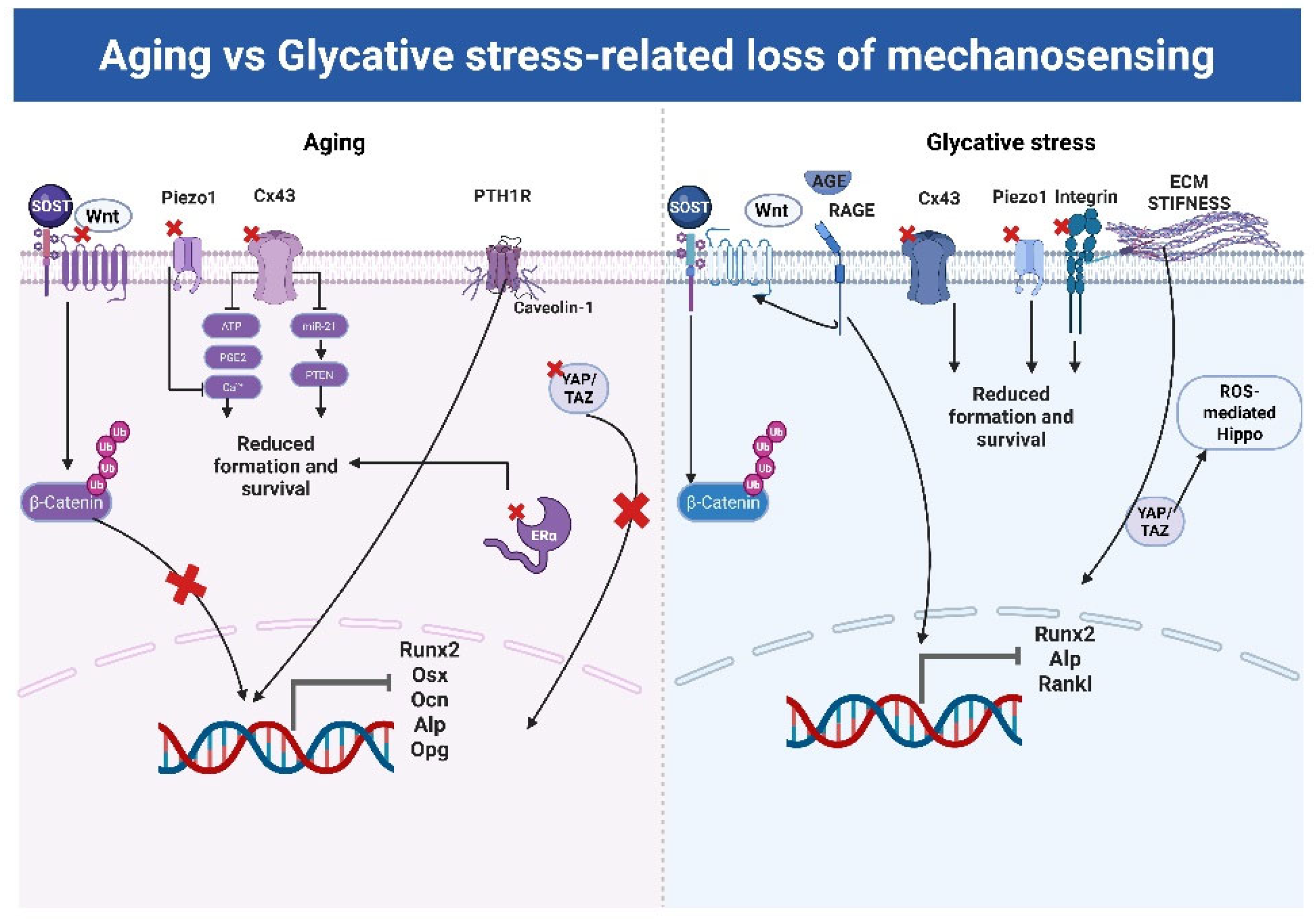
Figure 6.
Aging vs Glycative stress-related loss of mechanosensing. Comparison of the molecular mechanisms underlying impaired mechanotransduction in bone cells during aging and glycative stress.
Figure 6.
Aging vs Glycative stress-related loss of mechanosensing. Comparison of the molecular mechanisms underlying impaired mechanotransduction in bone cells during aging and glycative stress.
5. Bone Aging by Inflammation, AGES and Loss of Autophagy
5.1. Inflammaging and AGE-Driven Immune Activation in Bone
Recent studies have revealed an age-associated enhancement of the innate immune response, specifically in genes involved in key pattern-recognition receptor pathways, including the Toll-like receptor (TLR) and NOD-like receptor (NLR) signaling pathways [86,125]. Furthermore, numerous genes related to inflammation and immune function were differentially expressed, highlighting the pro-inflammatory environment associated with aging. Notably, the JAK–STAT signaling pathway emerged as a critical regulator due to its central roles in inflammation and immune responses, apoptosis, and cellular senescence [13].
Inflammaging, one of the aging hallmarks, has related to excessive production of ROS, which can cause oxidative damage to cellular components, amplify inflammatory responses, and trigger pathways leading to cell death [126]. Chronic D-gal administration is capable to promote the accumulation of AGEs, which intertact with their receptor RAGE to generate ROS and mitochondrial dysfunction, thereby mimicking natural aging. Combination of D-gal and high fat diet accelerates systemic aging, as evidenced by early reduction in soluble RAGE and subsequent AGEs accumulation, establishing the possible use of sRAGE as an early biomarker of aging [127]. Both D-gal and high fat diet increased oxidative stress, along with an enhanced inflammation and production of pro-inflammatory cytokines such as TNF-a, IL-1b and IL-6 in bone tissue, stimulating osteoclastogenesis and osteoclast activity, as evidenced by elevated serum CTX-I levels and increased RANKL expression. In contrast, bone formation marker P1NP remains unchanged, suggesting that enhanced osteoclast activity occurs before detectable reductions in osteoblast function. At structural level, as it has been described before, aging contributes to alter trabecular bone microarchitecture, reducing bone volume fraction (BV/TV) and trabecular number (Tb.N) [127].
5.2. Metabolic Reprogramming of Bone Cells During Aging and Diabetes.
Aging and osteoporosis are associated with metabolic reprogramming in bone cells. Senescent bone marrow stromal stem cells (BMSCs) exhibit altered energy metabolism, including increased reliance on oxidative phosphorylation (OXPHOS), which impairs proliferation, stemness, and osteogenic differentiation. Dysregulation of lipid and amino acid metabolism, including alterations in fatty acids and tryptophan-derived kynurenine, further contributes to reduced osteoblast function and skeletal aging. In parallel, osteoclastogenesis is also metabolically regulated, with OXPHOS supporting osteoclast differentiation and glycolysis promoting mature osteoclast activation and bone resorption [128]. Metabolic rewiring observed in osteoporosis shares several features with diabetic bone disease, suggesting common mechanisms linking metabolic dysfunction to impaired bone homeostasis. In type 2 diabetes mellitus (T2DM), chronic hyperglycemia promotes excessive glycolytic flux, mitochondrial dysfunction, ROS accumulation, and advanced glycation end-product (AGE) formation, which negatively affect osteoblast differentiation and survival. Similar to age-related osteoporosis, diabetic conditions induce alterations in lipid metabolism, amino acid metabolism, and mitochondrial activity, leading to impaired mesenchymal stem cell (MSC) function and reduced osteogenesis. Moreover, diabetes-associated metabolic stress can influence post-translational modifications (PTMs), including acetylation, glycosylation, and oxidation of key regulatory proteins, thereby altering transcriptional programs involved in bone remodeling.
5.3. Epigenetic Regulation: The NAD+-Sirtuin Axis in bone
Histone acetylation and deacetylation are key epigenetic mechanisms that connect metabolic status to skeletal aging involved in osteosarcopenia and regulation of bone–muscle crosstalk through chromatin remodeling. Class I/II histone deacetylases (HDACs) generally impair osteogenic differentiation, whereas NAD+ dependent sirtuins (SIRT1–7) preserve osteocyte viability by promoting mitochondrial function. Sirtuins are a family of NAD⁺-dependent protein deacetylases and ADP-ribosyltransferases that function as cellular metabolic sensors, coupling energy availability to gene expression, mitochondrial homeostasis, stress resistance, and longevity pathways. Aging disrupts the HDAC–sirtuin balance through NAD+ depletion and chronic inflammation, leading to reduced SIRT1/SIRT3 activity and activation of catabolic pathways in bone. SIRT1 promotes osteoblastogenesis by deacetylating FOXO and β-catenin, thereby enhancing Wnt/β-catenin signaling. During aging, increased mitochondrial ROS activate FOXO, promoting its interaction with β-catenin and suppressing bone formation. Age-related NAD+ decline increases FOXO and β-catenin acetylation, impairing SIRT1 activity and contributing to skeletal aging. These findings identify the NAD+/SIRT1/FOXO/β-catenin axis as a key mechanism linking metabolic dysfunction to age-related bone loss [129,130].
Age-related hypermethylation of the SIRT1 promoter reduces its anti-inflammatory activity by impairing NF-κB suppression, thereby reinforcing inflammation and cellular senescence [131]. On the other hand, SIRT1 and SIRT6 activation suppress SASP factors, including pro-inflammatory macrophage migration inhibitory factor (MIF) chemokine MIF and cathepsins B and K [132].
Sirtuins have also emerged as linkers between obesity and osteoporosis through their effects on adipogenesis, osteogenesis, and osteoclast activity. By modulating mesenchymal stem cell fate, insulin signaling, and gut microbiota, SIRT1 promotes bone formation while limiting fat accumulation [133]. Metabolic dysfunction, including insulin resistance, mitochondrial impairment, and oxidative stress, drives both senescence and epigenetic dysregulation by altering nutrient-sensing pathways (mTOR, AMPK) and reducing the availability of key metabolites such as NAD+. These changes impair the activity of epigenetic regulators, leading to aberrant gene expression that contributes to bone loss [131]. In this context, a recent study has shown that restoring age-related NAD+ decline improves metabolic homeostasis and physical performance while ameliorating age-associated declines in insulin sensitivity and preserving bone mineral density. These findings support NAD+ replenishment as an effective strategy to preserve sirtuin activity and counteract aging-related tissue dysfunction [134]. Age-related chronic inflammation contributes to skeletal deterioration by promoting osteoclast activation and bone resorption through increased production of pro-inflammatory cytokines, including IL-1β, IL-6, and TNF-α. SIRT1 has emerged as a key regulator of this process by suppressing inflammatory pathways such as the NOD-like receptor family, pyrin domain-containing 3 (NLRP3) inflammasome and modulating Notch1 signaling, highlighting the potential role of SIRT1 activation in counteracting inflammaging and preserving bone homeostasis during aging [135].
5.4. IGF-1/PI3K/AKT/FOXO Signaling in Skeletal Aging
Insulin-like Growth Factor 1 (IGF-1/IGF-1R) signaling is also a major regulator of bone homeostasis. Through activation of the PI3K/AKT and MAPK pathways, IGF-1 promotes osteoblast proliferation, differentiation, mineralization, and the expression of osteogenic markers, while maintaining bone mass and preventing age-related bone loss. IGF-1 also enhances osteoblast differentiation via AMPK, and regulates osteoclast differentiation and bone remodeling, highlighting its essential role in skeletal growth and remodeling [136]. Although IGF-1 is essential for osteoblast activity and bone formation, attenuation of IGF-1 signaling in specific experimental models has been associated with reduced age-related skeletal deterioration, suggesting that the effects of IGF-1 on bone aging are context-dependent and influenced by the balance between anabolic activity and age-related remodeling [137,138].
The PI3K/AKT pathway represents the canonical regulatory mechanism controlling FOXO transcriptional activity. FOXO factors and SIRT1 contribute to skeletal longevity by maintaining a balance between bone formation and remodeling. As mentioned above, SIRT1 regulates FOXO activity through post-translational deacetylation, promoting osteoblast function and limiting bone resorption. In contrast, IGF-1/IGF-1R signaling may exert opposing effects depending on the cellular context. FOXO activity is tightly regulated by multiple post-translational modifications, including phosphorylation, acetylation, methylation, ubiquitination, PARylation, glycosylation, and hydroxylation. Under normal conditions, insulin/IGF-1 signaling activates PI3K, leading to AKT-mediated phosphorylation and inhibition of FOXO transcription factors. Conversely, metabolic stress and oxidative damage, characterized by increased AMP/ATP ratios and ROS accumulation, activate AMPK and JNK, promoting FOXO phosphorylation and nuclear translocation. Nuclear FOXOs induce the expression of genes involved in stress resistance, metabolism, redox regulation, apoptosis, and longevity. However, excessive FOXO activation can suppress Wnt and insulin signaling pathways, contributing to impaired osteogenesis, cellular dysfunction, insulin resistance, hyperglycemia, and the development of metabolic disorders such as type 2 diabetes [139]. Age-related insulin resistance and impaired glucose metabolism contribute to skeletal deterioration by promoting oxidative stress, chronic inflammation, and accumulation of advanced glycation end-products (AGEs). In bone tissue, AGEs alter type I collagen cross-linking, impair extracellular matrix properties, and activate AGE–RAGE signaling, leading to osteoblast dysfunction, increased inflammatory responses, and compromised bone quality. Therefore, metabolic dysfunction associated with aging may accelerate skeletal fragility independently of changes in bone mineral density [140,141].
5.5. NLRP3 Inflammasome as a Convergence Point of Glycative and Mechanical Stress
The combination of altered mechanotransduction (section 4) and chronic glycative stress (section 3) shown in this review generates two pathological inputs that converge on the NLR family pyrin domain containing 3 (NLRP3) inflammasome through a damage-associated molecular pattern (DAMP) mechanism: extracellular adenosine triphosphate (ATP). Under physiological conditions, mechanically loaded bone cells release small amounts of ATP through pannexin and connexin hemichannels, especially Cx43 (described in sections 2 and 4) as part of cell paracrine communication. When loading becomes pathological, either because the bone matrix is glycated and the strain is distorted or because the magnitude of the load is excessive, extracellular ATP accumulates and binds the ionotropic purinergic receptor P2X7. The ATP–P2X7 axis then triggers NLRP3 oligomerisation, caspase-1 activation and the release of interleukin-1β (IL-1β), establishing a self-amplifying inflammatory loop that mirrors, at the inflammasome level, the NF-κB–RAGE positive feedback [142].
Two recent studies further support the relevance of these mechanisms and suggest that similar processes may operate in the bone tissue. Yu et al. (2025) showed that mechanical overload activates the mechanosensitive channel Piezo1 and engages downstream NF-κB and NLRP3 signalling in synoviocytes, driving osteoarthritis-associated synovitis and fibrosis. This identifies Piezo1 as a direct upstream activator of the inflammasome when the mechanical input is excessive or qualitatively distorted; precisely the scenario created by AGE-induced stiffening of the bone matrix [143]. Meier et al. (2024) described that AGEs, methylglyoxal-derived dicarbonyls and saturated fatty acids act as activating signals of NLRP3 in adipose tissue, pancreatic islets and circulating immune cells of patients with type 2 diabetes mellitus and obesity and proposed selective NLRP3 inhibitors (namely MCC950) as therapeutic strategies [144].
Taken together, these data support a unifying model in which the bone of aged or diabetic individuals integrates two convergent inputs, AGEs accumulation acting as chemical DAMPs and altered mechanical signaling acting a physical DAMP— into a common ATP/P2X7–NLRP3 output that amplifies osteocyte and osteoblast dysfunction through IL-1β-driven inflammation. Therapeutic interruption of this axis with NLRP3 inhibitors, P2X7 antagonists or anti-IL-1β biologics emerges as a logical addition to the multi-level framework outlined in section 6.2 (145–148).
NRF2 acts as a negative regulator of NLRP3 inflammasome activation by controlling oxidative stress. During aging, impaired NRF2 antioxidant responses allow ROS accumulation, promoting NLRP3 activation, chronic inflammation, and senescence of skeletal stem cells, thereby contributing to reduced osteogenesis and age-related bone loss. TRAF6 regulates this NRF2/NLRP3 axis by enhancing oxidative stress and BMSC senescence, whereas its inhibition restores antioxidant defenses and osteogenic capacity [149]. Furthermore, enhancement of Nrf2– Antioxidant Response Elements (ARE) signaling in osteoblast-lineage cells has been shown to protect against age-related osteoporosis. Nrf2 activation reduces oxidative stress, DNA damage, and cellular senescence, while promoting osteoblastogenesis and inhibiting RANKL-mediated osteoclast bone resorption [150].
Additionally,the ROS/NLRP3 inflammasome activation has been related to an impaired autophagic flux in bone marrow mesenchymal stem cells (BMSCs), highlighting the interplay between inflammasome activation and autophagy impairment in age-related bone deterioration [151].
Oxidative stress plays a central role in maintaining bone remodeling homeostasis by affecting both anabolic and catabolic bone processes. Elevated ROS levels induce apoptosis of osteocytes and osteoblasts, suppress bone formation and mineralization, and contribute to dysregulated osteoclastogenesis, thereby promoting bone loss and the development of osteoporosis [78], both phenomena observed during aging. In osteoblasts, exposure to oxidative stress suppresses the osteogenic differentiation by reducing alkaline phosphatase (ALP) activity and downregulating two transcription factors essential for osteoblast function, RUNX2 (the master regulator of osteoblast lineage commitment) and ATF4 (Activating Transcription Factor 4, a basic leucine-zipper factor that drives osteocalcin transcription and integrates ER-stress signals through the PERK-eIF2α arm of the UPR) [152]. ROS not only induce oxidative stress but also modulate signaling pathways involved in osteoblast proliferation, differentiation, and apoptosis. High ROS levels activate MAPK pathways, including JNK, ERK1/2, and p38, thereby promoting osteoblast apoptosis [78]. Furthermore, RANKL-derived accumulation of ROS also promotes osteoclast differentiation by acting as important secondary messengers that activate downstream signaling pathways, including MAPK and NF-κB.
5.6. Oxidative Stress, Autophagy, and Bone Cell Survival
Autophagy is a metabolic process that warrants cell survival in cases of nutrient or energy deficiencies, oxidative stress, infections or hypoxia [78]. It may counteract ROS damage in both osteoblasts, osteocytes and osteoclasts.
Autophagy plays a dual role in the response of bone cells to glycative stress. First, it provides the principal pathway for the clearance of AGE-modified proteins and damaged organelles, such as dysfunctional mitochondria, which are removed through selective mitophagy. Second, at the same time autophagy itself is modulated by AGEs in a concentration and time-dependent manner. Low or transient exposure tends to elicit a cytoprotective autophagic response, whereas sustained or high-dose exposure overwhelms the system and shifts the balance towards apoptotic cell death [47,48,153,154].
Mechanistically, the canonical macroautophagy cascade is initiated by the inhibition of the mechanistic target of rapamycin complex 1 (mTORC1), which sequentially activates the unc-51-like autophagy activating kinase 1 (ULK1) complex and the class III phosphoinositide 3-kinase (PI3K) complex at the phagophore. Two ubiquitin-like conjugation systems (ATG12–ATG5–ATG16L1) and the lipidation of microtubule-associated protein light chain 3 (LC3) from LC3-I to LC3-II, promotes the formation of an intracellular compartment, the autophagosome, that ultimately fuses with lysosomes. In parallel, chaperone-mediated autophagy selectively degrades soluble cytosolic proteins bearing a KFERQ motif via HSC70 and LAMP-2A; a pathway whose activity declines with age due to LAMP-2A instability [154,155].
In osteoblasts, under moderate oxidative stress, activation of the MAPK/FOXO3, SIRT1/FOXO3, and AMPK pathways, together with inhibition of the Akt/mTOR pathway, stimulates autophagy, facilitating the removal of excess ROS and thereby promoting osteoblast survival and bone formation. In this context, it has been shown that pharmacological activation of the AMPK–FoxO–sirtuin axis restores autophagic and mitophagic flux and attenuates senescence in skeletal stem-cell lineages exposed to AGE-driven damage, identifying AMPK and SIRT3 as potential therapeutic targets in bone-protective strategies [73,156].
However, when ROS accumulation exceeds the protective capacity of autophagy, activation of the JNK signaling pathway can trigger excessive autophagy and apoptosis, ultimately impairing osteoblast function and reducing bone formation. Although extensive evidence supports a close interplay between autophagy and JNK-mediated apoptosis, the precise mechanisms through which JNK regulates the balance between these processes in osteoblasts under oxidative stress remain incompletely understood [157].
With aging, osteocytes exhibit elevated apoptosis and reduced autophagic activity, as indicated by decreased levels of LC3-II, the LC3-II/I ratio, Beclin-1, and ULK1 and increased expression of SQSTM1/p62 and. This reduction in autophagy markers has been related to reduction of bone mineral density in the proximal tibia, suggesting that impaired osteocyte autophagy may contribute to age-related bone loss, and that reduced autophagic activity may play a role in the development of senile osteoporosis [158]. In osteocytes, two major signaling pathways have been implicated in autophagy counteracting of ROS-induced damage: the ROS/MAPK/ERK and ROS/mTOR/ULK1 axes. ROS-induced activation of the MAPK/ERK pathway enhances the expression of autophagy-related proteins and promotes osteocyte survival under moderate stress conditions. Similarly, elevated ROS levels can activate autophagy through inhibition of mTOR and activation of ULK1, as demonstrated in osteocytes exposed to bisphenol A (BPA) [156,159].
The endoplasmic reticulum (ER) is intrinsically associated with apoptosis and autophagy and plays a central role in protein synthesis, folding and secretion. Disruption of ER proteostasis, due to aging, metabolic dysfunction, calcium imbalance, adverse drug effects, and lifestyle-related stressors, results in the accumulation of unfolded or misfolded proteins and ER stress [160,161] . Persistent or severe ER stress can ultimately lead to apoptosis. Increasing evidence indicates that ER stress contributes to the pathogenesis of osteoporosis by impairing bone remodeling through the promotion of osteoblast apoptosis, enhanced bone loss, and altered osteoclast activity [162]. In osteoclasts, ROS-derived ER stress upregulates both autophagy markers (Beclin-1, LC3-II) and osteoclast-related enzymes (TRAP, cathepsin K). Additionally, ROS regulate autophagy through the TFEB pathway, a key controller of lysosomal biogenesis. Oxidative stress promotes TFEB nuclear translocation, enhancing autophagy and osteoclast activity, indicating that ROS-driven ER stress and TFEB activation converge on autophagy to facilitate osteoclastogenesis and bone resorption [163,164].
5.7. Ferroptosis as a Downstream Effector of AGE-Induced Damage
The accumulation of AGEs and the chronic activation of RAGE/NADPH oxidase 2-driven oxidative stress described ultimately lead pools of bone cells toward ferroptosis. This process is an iron-dependent form of regulated cell death characterized by the lethal accumulation of lipid peroxides and the failure of glutathione peroxidase 4 (GPX4)-mediated repair. Unlike classical apoptosis, ferroptosis does not require caspase activation; it depends instead on the balance between iron availability, polyunsaturated fatty acid (PUFA)-containing membrane lipids and the GPX4/glutathione antioxidant system. Several lines of evidence now place this pathway at the centre of the bone phenotype produced by chronic glycative stress [161] .
First, mitochondrial dysfunction, a hallmark of AGE-exposed bone cells, is a potent driver of ferroptosis. Liang et al. (2024) demonstrated that activation of the inner mitochondrial membrane GTPase optic atrophy 1 (OPA1) promotes ferroptosis by increasing mitochondrial ROS production and simultaneously suppressing the integrated stress response (ATF4/CHOP), which would otherwise activate protective transcriptional programme [165]. Since AGE/RAGE engagement increases mitochondrial ROS via NADPH oxidase 2 and impairs, the conditions for OPA1-driven ferroptosis are essentially fulfilled in chronically glycated osteocytes and osteoblasts, particularly in scenarios of iron overload such as postmenopausal and chronic-kidney-disease-associated bone loss [165].
Second, the SIRT3 axis already discussed in this section intersects directly with ferroptosis regulation. Zhu et al. (2023) demonstrated in nucleus pulposus cells that the deubiquitinating enzyme USP11 stabilizes SIRT3 by removing its ubiquitin tags, and that this stabilization suppresses oxidative-stress-induced ferroptosis [166]. By analogy with the irisin–SIRT3 axis described in skeletal stem cells, the USP11–SIRT3 axis emerges as a candidate brake on AGE/ROS-driven ferroptosis in bone, providing a mechanistic link between the autophagic and mitophagic machinery and the ferroptotic programme [166].
In addition, it has been described that hyperglycemia promotes ferroptosis by increasing ROS and lipid peroxidation, thereby impairing osteoblast viability and osteogenic differentiation. Mitochondrial ferritin (FtMt) protects against high glucose-induced ferroptosis by restoring iron homeostasis, whereas activation of the NRF2 suppresses ferroptosis and improves osteoblast function [167,168]. Ferroptosis also contributes to age-related cortical bone loss by promoting osteocyte death through iron overload and lipid peroxidation by inducing activating transcription factor 3 (ATF3). ATF3 promotes ferroptosis through a dual mechanism. ATF3 upregulates transferrin receptor 1 (TfR1), increasing intracellular iron uptake and promoting iron (Fe²⁺)-dependent reactive oxygen species (ROS) production. At the same time, ATF3 suppresses solute carrier family 7 member 11 (SLC7A11), a component of the cystine/glutamate antiporter system Xc⁻, reducing cystine availability and limiting glutathione (GSH) synthesis. This decreases the activity of glutathione peroxidase 4 (GPX4), a key antioxidant enzyme responsible for detoxifying lipid peroxides. Consequently, iron accumulation and impaired antioxidant defense enhance lipid peroxidation, leading to osteocyte ferroptosis [25]. These findings identify ferroptosis as a key mechanism linking diabetes to bone fragility and a potential therapeutic target for diabetic osteoporosis.
Diabetes and aging synergistically impair bone regeneration through dysfunction of bone marrow mesenchymal stem cells (BMSCs), driven by the interaction between ferroptosis and metabolic reprogramming. Diabetic stress promotes ALKBH5-mediated ferroptosis, while aging further reduces METTL3-dependent glycolytic activity, impairing osteogenic differentiation.
Taken together, ferroptosis represents a point of convergence for three of the central themes of this review. First, the matrix glycation and AGE-driven collagen crosslinking described in section 2 shape a substrate that sustains oxidative demand and iron deposition. Second, the RAGE-driven mitochondrial ROS described above (OPA1, ATF3/TfR1/GPX4/SLC7A11) provide the biochemical machinery that converts this demand into iron-dependent lipid peroxidation. Third, the mechano-sensing failure described in section 3.3 is amplified by ferroptotic membrane damage, which destabilises focal adhesions, accelerates osteocyte death and reduces LCN cellularity (Figure 7). The net result is a bone tissue with low turnover, low cellularity and low mechanosensitivity, a phenotype mirroring that of aged and diabetic boneTherapeutically, ferroptosis offers several intervention points complementary to the chemistry–receptor–downstream framework of section 6.2: iron-chelating agents (deferoxamine), lipid radical scavengers (ferrostatin-1, liproxstatin-1, vitamin E), GPX4 stabilisers and SIRT3 activators or USP11-modulating strategies, all of which would deserve evaluation in pre-clinical models of glycative bone fragility [25,167,168,169].
A combined therapeutic approach using milk-derived exosomes and anaerobic exercise has been described to restore bone regeneration by suppressing ferroptosis through NRF2 activation and enhancing glycolytic metabolism, respectively [170].
Another report suggests that exercise exerts osteoprotective effects through muscle–bone crosstalk mediated by the myokine irisin. Exercise-derived irisin promotes osteoblast protection by binding to caveolin-1 (Cav1), which facilitates AMPKα activation. Activated AMPKα stimulates NRF2 signaling, leading to the transcription of antioxidant and iron-regulatory genes, including HMOX1 and ferroportin (FPN). Increased FPN expression enhances intracellular iron clearance, reducing ROS accumulation and ferroptosis, thereby preserving osteoblast function during aging and osteoporosis [171].
6. Therapies for Age/Glycative Stress-Related Bone Loss
6.1. Therapeutic Targets Emerging from Aging
Therapeutic approaches for aging-related bone loss could potentially include anabolic agents, anti-resorptives, senolytics, and senomorphic drugs, each targeting distinct aspects of skeletal aging.
Parathyroid hormone (PTH) and parathyroid hormone-related protein (PTHrP) are key regulators of bone homeostasis, making their common receptor, PTH1R, an important therapeutic target for osteoporosis. Teriparatide, a synthetic analogue comprising the first 34 amino acids of PTH, and abaloparatide, a structural analogue of PTHrP, are both PTH1R agonists that stimulate bone formation. They both promote bone formation by enhancing osteoblast activity, increasing osteoblast differentiation, and reducing osteoblast apoptosis mechanisms [172]. Teriparatide is also known to activate Wnt signaling and has been associated with improved DNA repair and suppression of senescence markers such as p16^Ink4a [173].
Anti-sclerostin therapy, particularly romosozumab, represents a more recent anabolic strategy. Sclerostin, produced by osteocytes, inhibits bone formation by suppressing Wnt and BMP signaling. Neutralization of sclerostin with monoclonal antibodies enhances osteoblast function and bone formation while simultaneously reducing bone resorption. Clinical studies have demonstrated that romosozumab significantly increases BMD and may exert stronger anabolic effects than teriparatide [174]. However, its effects diminish after discontinuation, often requiring follow-up anti-resorptive therapy such as denosumab or zoledronate to maintain bone gains.
Anti-resorptive therapies remain a cornerstone of osteoporosis management. Bisphosphonates, including alendronate, risedronate, and zoledronate, inhibit osteoclast activity by targeting farnesyl diphosphate synthase in the mevalonate pathway, leading to reduced osteoclast survival and function. Denosumab, a monoclonal antibody against RANKL, prevents osteoclast differentiation by blocking RANKL–RANK interaction, thereby reducing bone resorption [175].
More recently, senotherapeutic strategies have emerged as promising interventions for age-related skeletal decline. Senolytic drugs selectively eliminate senescent cells, including osteoblasts and osteocytes, thereby reducing the senescence-associated secretory phenotype (SASP), which contributes to chronic inflammation and osteoclast activation. Experimental models have shown that senolytic combinations such as dasatinib and quercetin, as well as agents like fisetin, navitoclax, and other BCL-2 family inhibitors, can improve bone architecture in both physiological aging and radiation-induced osteoporosis [41]. However, responses vary depending on the compound and disease context, suggesting heterogeneous mechanisms of action. Senomorphic therapies, in contrast, do not eliminate senescent cells but instead suppress SASP-associated inflammatory signaling. Agents such as JAK inhibitors (e.g., ruxolitinib), rapamycin, and related mTOR inhibitors reduce the secretion of pro-inflammatory cytokines (including IL-6, IL-8, and PAI-1), thereby attenuating osteoclast activation and preserving bone homeostasis. Additional compounds, including MDM2 inhibitors, have also been shown to modulate SASP activity through regulation of p53 signaling [40,41,176].
Overall, while anabolic and anti-resorptive drugs primarily target bone formation and resorption pathways, senolytic and senomorphic strategies address a more upstream mechanism of aging by targeting senescent cells and their inflammatory secretome.
6.2. Therapeutic Targets Emerging from Glycative Stress
A coherent therapeutic strategy against glycative damage in bone must act simultaneously at three complementary levels: the upstream chemistry that generates AGEs and AGOEs, the receptor- and effector-mediated cascades that translate them into cellular damage, and the downstream proteostatic, mechanotransductive and metabolic networks that ultimately determine cell fate. Although no single agent currently fulfils all three roles, the available pharmacological and lifestyle interventions can be organised within this conceptual framework.
The first line of attack targets the chemistry of AGE/AGOE formation. Classical inhibitors such as aminoguanidine, pyridoxamine, alagebrium (ALT-711) and phenacyl thiazolium showed considerable promise in preclinical models —reducing AGE crosslinks, improving collagen mechanics and ameliorating diabetic complications— but their clinical development was hampered by toxicity, limited bioavailability or modest efficacy in patients [49,57,177]. More recent strategies include bi-functional molecules capable of acting simultaneously as ROS scavengers and dicarbonyl traps, as well as synthetic detoxifying systems designed to mimic the enzymatic activity of glyoxalase or DJ-1, which Sroga and Vashishth and Wang and Vashishth review as the next generation of antiglycative chemistry [50,53].
Another line of intervention is the blockade of RAGE signalling. Small-molecule inhibitors such as Azeliragon and FPS-ZM1, together with decoy soluble RAGE (sRAGE) variants, are being explored to prevent ligand-receptor engagement and disrupt the auto-amplifying NF-κB–RAGE loop. In bone, the protective effect of RAGE inhibition appears to operate primarily on osteoblasts and osteocytes —by limiting their apoptosis and the secretion of pro-osteoclastogenic cytokines— rather than having a direct action on osteoclasts [14]. Upstream of RAGE, the natural activation of the glyoxalase pathway by Nrf2 agonists such as sulforaphane, resveratrol and hesperidin restore the cellular capacity to detoxify methylglyoxal, as exemplified by recent preclinical studies. One report shows that oleuropein, the major bioactive compound of olive leaf, restores Glo1 activity in methylglyoxal-treated human dental pulp stem cells and prevents glycative damage in a Nrf2-dependent manner [178]. Other study describes that the bark extract of Syzygium aromaticum (clove) upregulates Nrf2 and Glo1 expression, inhibits AGE formation and AGE-collagen crosslinks in vitro, and reduces blood glucose, kidney weight and proteinuria in streptozotocin-induced diabetic rats [179]. In addition, sodium-glucose cotransporter 2 (SGLT-2) inhibitors target the AGE-COL1 axis and reduce glycaemic variability, offering bone protection that is, at least in part, independent of HbA1c [39,90].
Further downstream, the autophagic and senescence-related machinery has emerged as an attractive level of intervention. Metformin, rapamycin, Torin1, the PPARβ/δ agonist GW501516, empagliflozin, AdipoAI and AICAR are compounds that converge on the AMPK/mTOR axis to restore autophagic and mitophagic flux in osteoblasts, osteocytes and skeletal stem cells [65,73]. Other enotherapeutic candidates such as licochalcone D [73] and irisin [180] attenuate AGE-induced senescence and preserve the osteogenic potential of stem-cell populations through AMPK/FoxO and SIRT3-mediated pathways. In a more specific clinical scenario, bazedoxifene illustrates how a selective oestrogen receptor modulator (SERM) can simultaneously act on oxidative stress and on the lysyl oxidase/pentosidine balance, reversing homocysteine-induced osteoblast damage [181].
Finally, lifestyle interventions retain a central place in this therapeutic landscape. Aerobic exercise reduces circulating AGEs and malondialdehyde (MDA), increases GSH, lowers the systemic inflammatory tone and improves trabecular and cortical microarchitecture in aged models [182]. Mediterranean, low-glycaemic-index and low-AGE diets reduce both the endogenous formation and the exogenous intake of glycative species, and exert favourable effects on glyoxalase activity, RAGE expression and the gut microbiome [49,183].
Taken together, these observations suggest that glycative stress is unlikely to be effectively addressed by a single “magic bullet”: the most realistic and clinically meaningful strategy will probably combine an upstream control of AGE formation and dicarbonyl burden, a targeted blockade of RAGE-mediated inflammation, a fine-tuned modulation of autophagy, senescence and mechanotransduction, and a sustained, individualised lifestyle component.
Figure 8.
Multi-level therapeutic strategy against bone glycative stress. Three complementary levels of intervention. Upstream (chemistry): AGE formation inhibitors (aminoguanidine, pyridoxamine), crosslink breakers (alagebrium, phenacyl thiazolium) and low-AGE diets. Intermediate (receptor/signalling): RAGE blockade (Azeliragon, FPS-ZM1, sRAGE), Nrf2-mediated glyoxalase activation and SGLT-2 inhibitors. Downstream (cellular): AMPK/mTOR modulators of autophagy/mitophagy (metformin, rapamycin, empagliflozin), senotherapeutic candidates and antiglycative SERM combined with aerobic exercise. The three levels converge on the rescue of bone mechanotransduction and reduced fragility-fracture risk independent of BMD.
Figure 8.
Multi-level therapeutic strategy against bone glycative stress. Three complementary levels of intervention. Upstream (chemistry): AGE formation inhibitors (aminoguanidine, pyridoxamine), crosslink breakers (alagebrium, phenacyl thiazolium) and low-AGE diets. Intermediate (receptor/signalling): RAGE blockade (Azeliragon, FPS-ZM1, sRAGE), Nrf2-mediated glyoxalase activation and SGLT-2 inhibitors. Downstream (cellular): AMPK/mTOR modulators of autophagy/mitophagy (metformin, rapamycin, empagliflozin), senotherapeutic candidates and antiglycative SERM combined with aerobic exercise. The three levels converge on the rescue of bone mechanotransduction and reduced fragility-fracture risk independent of BMD.
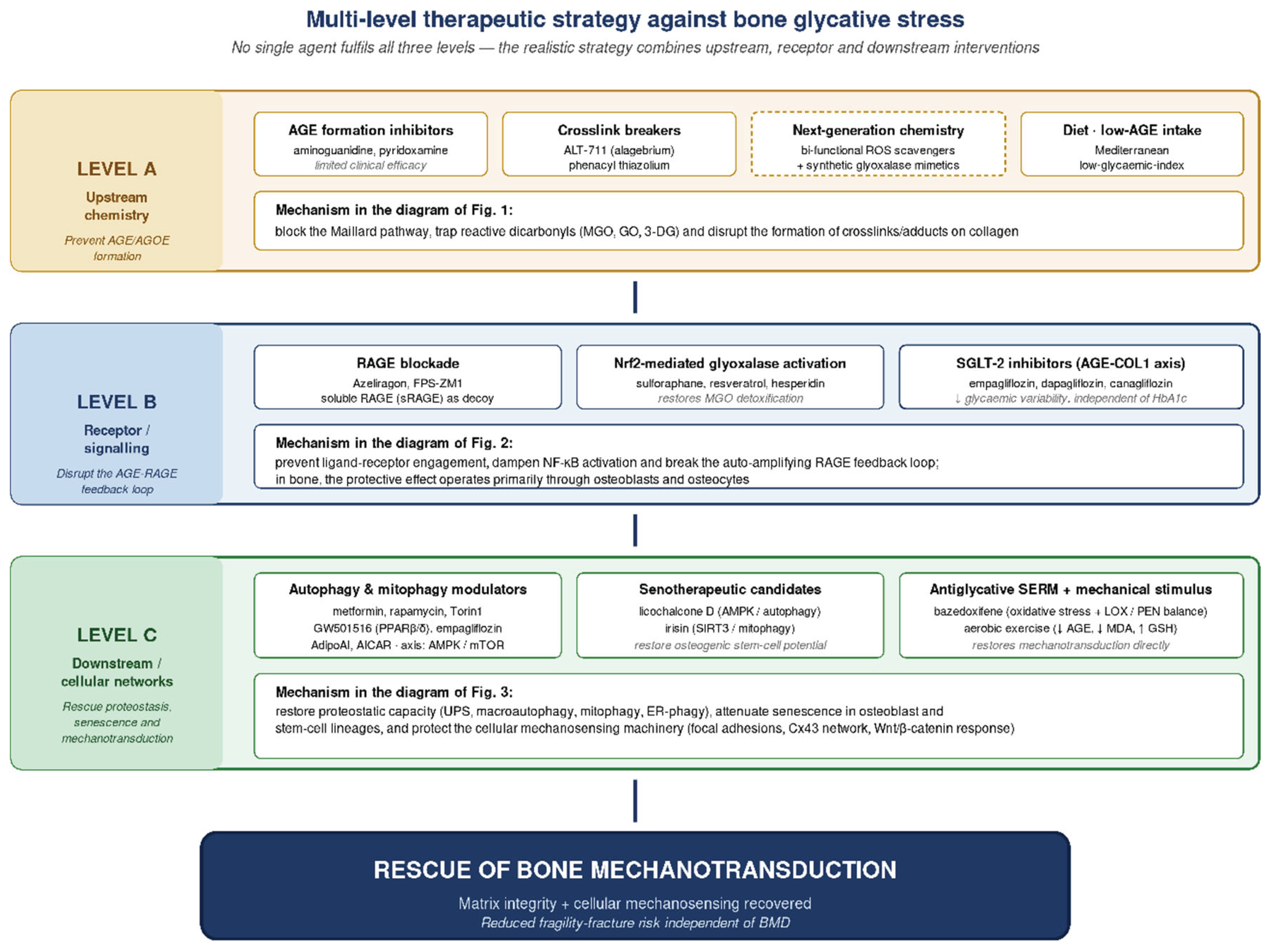
References
- Bolamperti, S.; Villa, I.; Rubinacci, A. Bone remodeling: an operational process ensuring survival and bone mechanical competence. In Bone Research; Springer Nature, 2022. [Google Scholar] [CrossRef] [PubMed]
- Barak, M.M. Cortical and Trabecular Bone Modeling and Implications for Bone Functional Adaptation in the Mammalian Tibia. In Bioengineering; Multidisciplinary Digital Publishing Institute (MDPI), 2024. [Google Scholar] [CrossRef]
- Manolagas, S.C.; Parfitt, A.M. What old means to bone. In Trends in Endocrinology and Metabolism; 2010; pp. 369–74. [Google Scholar] [CrossRef] [PubMed]
- Cui, J.; Shibata, Y.; Zhu, T.; Zhou, J.; Zhang, J. Osteocytes in bone aging: Advances, challenges, and future perspectives. In Ageing Research Reviews; Elsevier Ireland Ltd, 2022. [Google Scholar] [CrossRef] [PubMed]
- Boskey, A.L.; Coleman, R. Critical reviews in oral biology & medicine: Aging and bone. J. Dent. Res. 2010, 1333–48. [Google Scholar] [CrossRef] [PubMed]
- Kim, H.N.; Xiong, J.; MacLeod, R.S.; Iyer, S.; Fujiwara, Y.; Cawley, K.M.; et al. Osteocyte RANKL is required for cortical bone loss with age and is induced by senescence. JCI Insight 2020, 5(19). [Google Scholar] [CrossRef] [PubMed]
- Piemontese, M.; Almeida, M.; Robling, A.G.; Kim, H.N.; Xiong, J.; Thostenson, J.D.; et al. Old age causes de novo intracortical bone remodeling and porosity in mice. JCI Insight 2017, 2(17). [Google Scholar] [CrossRef] [PubMed]
- Wang, B.; Vashishth, D. Advanced glycation and glycoxidation end products in bone. Bone 2023, 176, 116880. [Google Scholar] [CrossRef]
- Forner, P.; Sheu, A. Bone Health in Patients With Type 2 Diabetes. J. Endocr. Soc. 2024, 8(7). [Google Scholar] [CrossRef]
- Cirovic, A.; Jadzic, J.; Djukic, D.; Djonic, D.; Zivkovic, V.; Nikolic, S.; et al. Increased Cortical Porosity, Reduced Cortical Thickness, and Reduced Trabecular and Cortical Microhardness of the Superolateral Femoral Neck Confer the Increased Hip Fracture Risk in Individuals with Type 2 Diabetes. Calcif. Tissue Int. 2022, 111(5), 457–65. [Google Scholar] [CrossRef]
- Wang, J.; Zhang, Y.; Wang, S.; Wang, X.; Jing, Y.; Su, J. Bone aging and extracellular vesicles. In Science Bulletin; Elsevier B.V., 2024; pp. 3978–99. [Google Scholar] [CrossRef]
- López-Otín, C.; Blasco, M.A.; Partridge, L.; Serrano, M.; Kroemer, G. Hallmarks of aging: An expanding universe. Cell. 2023, 186(2), 243–78. [Google Scholar] [CrossRef]
- Cui, J.; Shibata, Y.; Zhu, T.; Zhou, J.; Zhang, J. Osteocytes in bone aging: Advances, challenges, and future perspectives. In Ageing Research Reviews; Elsevier Ireland Ltd, 2022. [Google Scholar] [CrossRef] [PubMed]
- ying, Ru J; fen, Wang Y. Osteocyte apoptosis: the roles and key molecular mechanisms in resorption-related bone diseases. In Cell Death and Disease; Springer Nature, 2020. [Google Scholar] [CrossRef] [PubMed]
- Farr, J.N.; Kaur, J.; Doolittle, M.L.; Khosla, S. Osteocyte Cellular Senescence. In Current Osteoporosis Reports; Springer, 2020; pp. 559–67. [Google Scholar] [CrossRef] [PubMed]
- Nakashima, T.; Hayashi, M.; Fukunaga, T.; Kurata, K.; Oh-Hora, M.; Feng, J.Q.; et al. Evidence for osteocyte regulation of bone homeostasis through RANKL expression. Nat. Med. 2011, 17(10), 1231–4. [Google Scholar] [CrossRef] [PubMed]
- Bellido, T. Osteocyte-driven bone remodeling. In Calcified Tissue International; Springer Science and Business Media, LLC, 2014; pp. 25–34. [Google Scholar] [CrossRef] [PubMed]
- Tirado-Cabrera, I.; Martin-Guerrero, E.; Heredero-Jimenez, S.; Ardura, J.A.; Gortázar, A.R. PTH1R translocation to primary cilia in mechanically-stimulated ostecytes prevents osteoclast formation via regulation of CXCL5 and IL-6 secretion. In J Cell Physiol.; 1 Oct 2022; Volume 237, pp. 3927–43. [Google Scholar] [CrossRef] [PubMed]
- ying, Ru J; fen, Wang Y. Osteocyte apoptosis: the roles and key molecular mechanisms in resorption-related bone diseases. In Cell Death and Disease; Springer Nature, 2020. [Google Scholar] [CrossRef] [PubMed]
- Kim, H.N.; Xiong, J.; MacLeod, R.S.; Iyer, S.; Fujiwara, Y.; Cawley, K.M.; et al. Osteocyte RANKL is required for cortical bone loss with age and is induced by senescence. JCI Insight 2020, 5(19). [Google Scholar] [CrossRef] [PubMed]
- Plotkin, L.I.; Bellido, T. Beyond gap junctions: Connexin43 and bone cell signaling; Bone, 2013; pp. 157–66. [Google Scholar] [CrossRef] [PubMed]
- Li, G.; Zhang, L.; Lu, Z.; Yang, B.; Yang, H.; Shang, P.; et al. Connexin 43 Channels in Osteocytes Are Necessary for Bone Mass and Skeletal Muscle Function in Aged Male Mice. Int. J. Mol. Sci. 2022, 23(21). [Google Scholar] [CrossRef] [PubMed]
- Davis, H.M.; Pacheco-Costa, R.; Atkinson, E.G.; Brun, L.R.; Gortazar, A.R.; Harris, J.; et al. Disruption of the Cx43/miR21 pathway leads to osteocyte apoptosis and increased osteoclastogenesis with aging. Aging Cell 2017, 16(3), 551–63. [Google Scholar] [CrossRef] [PubMed]
- López-Otín, C.; Blasco, M.A.; Partridge, L.; Serrano, M.; Kroemer, G. Hallmarks of aging: An expanding universe. In Cell; Elsevier B.V., 2023; pp. 243–78. [Google Scholar] [CrossRef] [PubMed]
- Yin, Y.; Chen, G.J.; Yang, C.; Wang, J.J.; Peng, J.F.; Huang, X.F.; et al. Osteocyte ferroptosis induced by ATF3/TFR1 contributes to cortical bone loss during ageing. Cell Prolif. 2024, 57(10). [Google Scholar] [CrossRef] [PubMed]
- PTH1R aging-13-203808.
- Khosla, S.; Farr, J.N.; Tchkonia, T.; Kirkland, J.L. The role of cellular senescence in ageing and endocrine disease. In Nature Reviews Endocrinology. Nature Research; 2020; pp. 263–75. [Google Scholar] [CrossRef] [PubMed]
- Ajoolabady, A.; Pratico, D.; Bahijri, S.; Eldakhakhny, B.; Tuomilehto, J.; Wu, F.; et al. Hallmarks and mechanisms of cellular senescence in aging and disease. In Cell Death Discovery; Springer Nature, 2025. [Google Scholar] [CrossRef]
- Xu, M.; Tchkonia, T.; Ding, H.; Ogrodnik, M.; Lubbers, E.R.; Pirtskhalava, T.; et al. JAK inhibition alleviates the cellular senescence-associated secretory phenotype and frailty in old age. Proc. Natl. Acad. Sci. USA 2015, 112, E6301–10. [Google Scholar] [CrossRef] [PubMed]
- Varela-Eirín, M.; Carpintero-Fernández, P.; Guitián-Caamaño, A.; Varela-Vázquez, A.; García-Yuste, A.; Sánchez-Temprano, A.; et al. Extracellular vesicles enriched in connexin 43 promote a senescent phenotype in bone and synovial cells contributing to osteoarthritis progression. In Cell Death Dis.; 1 Aug 2022; p. 13. [Google Scholar] [CrossRef] [PubMed]
- Sims, N.A.; Martin, T.J. Coupling the activities of bone formation and resorption: a multitude of signals within the basic multicellular unit. Bonekey Rep. 2014, 3. [Google Scholar] [CrossRef]
- Zhang, L.; Guan, Q.; Wang, Z.; Feng, J.; Zou, J.; Gao, B. Consequences of Aging on Bone. In Aging and Disease; International Society on Aging and Disease, 2024; pp. 2417–52. [Google Scholar] [CrossRef]
- Zhu, S.; Chen, W.; Masson, A.; Li, Y.P. Cell signaling and transcriptional regulation of osteoblast lineage commitment, differentiation, bone formation, and homeostasis. In Cell Discovery; Springer Nature, 2024. [Google Scholar] [CrossRef]
- Remark, L.H.; Leclerc, K.; Ramsukh, M.; Lin, Z.; Lee, S.; Dharmalingam, B.; et al. Loss of Notch signaling in skeletal stem cells enhances bone formation with aging. Bone Res. 2023, 11(1). [Google Scholar] [CrossRef]
- Bethel, M.; Chitteti, B.R.; Srour, E.F.; Kacena, M.A. The changing balance between osteoblastogenesis and adipogenesis in aging and its impact on hematopoiesis. Curr. Osteoporos. Rep. 2013, 11(2), 99–106. [Google Scholar] [CrossRef] [PubMed]
- Hoffman, C.M.; Han, J.; Calvi, L.M. Impact of aging on bone, marrow and their interactions. In Bone; Elsevier Inc., 2019; pp. 1–7. [Google Scholar] [CrossRef] [PubMed]
- Zhang, L.; Fu, X.; Ni, L.; Liu, C.; Zheng, Y.; You, H.; et al. Hedgehog Signaling Controls Bone Homeostasis by Regulating Osteogenic/Adipogenic Fate of Skeletal Stem/Progenitor Cells in Mice. J. Bone Mineral. Res. 2022, 37, 559–76. [Google Scholar] [CrossRef] [PubMed]
- Daponte, V.; Henke, K.; Drissi, H. Current perspectives on the multiple roles of osteoclasts: Mechanisms of osteoclast–osteoblast communication and potential clinical implications. Elife 2024, 13. [Google Scholar] [CrossRef]
- Matsuo, K.; Otaki, N. Bone cell interactions through Eph/ephrin: Bone modeling, remodeling and associated diseases. In Cell Adhesion and Migration; Taylor and Francis Inc., 2012; pp. 148–56. [Google Scholar] [CrossRef] [PubMed]
- Chandra, A.; Rajawat, J. Skeletal aging and osteoporosis: Mechanisms and therapeutics. In International Journal of Molecular Sciences; MDPI AG, 2021. [Google Scholar] [CrossRef] [PubMed]
- Farr, J.N.; Xu, M.; Weivoda, M.M.; Monroe, D.G.; Fraser, D.G.; Onken, J.L.; et al. Targeting cellular senescence prevents age-related bone loss in mice. Nat. Med. 2017, 23(9), 1072–9. [Google Scholar] [CrossRef] [PubMed]
- Ambrosi, T.H.; Marecic, O.; McArdle, A.; Sinha, R.; Gulati, G.S.; Tong, X.; et al. Aged skeletal stem cells generate an inflammatory degenerative niche. Nature 2021, 597, 256–62. [Google Scholar] [CrossRef] [PubMed]
- Matsumoto, K.; Shimo, T.; Kurio, N.; Okui, T.; Obata, K.; Masui, M.; et al. Expression and Role of Sonic Hedgehog in the Process of Fracture Healing with Aging.
- Fan, Z.; Shuai, F.; Xie, Y.; Lin, Y.; Yao, Y.; Han, X.; et al. Characteristics of osteoclasts at different developmental stages and therapeutic strategies. In European Journal of Medicinal Chemistry; Elsevier Masson s.r.l., 2026. [Google Scholar] [CrossRef]
- Deng, L.; Wang, Y.; Peng, Y.; Wu, Y.; Ding, Y.; Jiang, Y.; et al. Osteoblast-derived microvesicles: A novel mechanism for communication between osteoblasts and osteoclasts. Bone 2015, 79, 37–42. [Google Scholar] [CrossRef] [PubMed]
- Semba, R.D.; Nicklett, E.J.; Ferrucci, L. Does Accumulation of Advanced Glycation End Products Contribute to the Aging Phenotype? J. Gerontol. A Biol. Sci. Med. Sci. 2010, 65A(9), 963–75. [Google Scholar] [CrossRef]
- Sruthi, C.R.; Raghu, K.G. Advanced glycation end products and their adverse effects: The role of autophagy. In Journal of Biochemical and Molecular Toxicology; John Wiley and Sons Inc, 2021. [Google Scholar] [CrossRef] [PubMed]
- Gómez, O.; Perini-Villanueva, G.; Yuste, A.; Rodríguez-Navarro, J.A.; Poch, E.; Bejarano, E. Autophagy and Glycative Stress: A Bittersweet Relationship in Neurodegeneration. In Frontiers in Cell and Developmental Biology; Frontiers Media S.A., 2021. [Google Scholar] [CrossRef]
- Rowan, S.; Bejarano, E.; Taylor, A. Mechanistic targeting of advanced glycation end-products in age-related diseases. In Biochimica et Biophysica Acta - Molecular Basis of Disease; Elsevier B.V., 2018; pp. 3631–43. [Google Scholar] [CrossRef] [PubMed]
- Sroga, G.E.; Vashishth, D. In vivo glycation - Interplay between oxidant and carbonyl stress in bone. In JBMR Plus; Oxford University Press, 2024. [Google Scholar] [CrossRef]
- Ott, C.; Jacobs, K.; Haucke, E.; Navarrete Santos, A.; Grune, T.; Simm, A. Role of advanced glycation end products in cellular signaling. Redox Biol. 2014, 2, 411–29. [Google Scholar] [CrossRef]
- Teissier, T.; Boulanger, É. The receptor for advanced glycation end-products (RAGE) is an important pattern recognition receptor (PRR) for inflammaging. Biogerontology 2019, 20(3), 279–301. [Google Scholar] [CrossRef]
- Wang, B.; Vashishth, D. Advanced glycation and glycoxidation end products in bone. In Bone; Elsevier Inc., 2023. [Google Scholar] [CrossRef] [PubMed]
- Inflammatory Bridges: Interconnections Between Alzheimer’s Disease and Bone Health. Aging Dis. 2025. [CrossRef]
- Ter, Chao C; Lin, S.H. Uremic toxins and frailty in patients with chronic kidney disease: A molecular insight. Int. J. Mol. Sci. 2021, 22. [Google Scholar] [CrossRef] [PubMed]
- Li, Z.P.; Luo, C.; Yu, X.M.; Ye, L.Y.; Sun, D.; Duan, C.Z.; et al. Diabetic bone fragility through advanced glycation end product-collagen axis: Mechanisms and therapy of sodium glucose cotransporter 2 inhibitors. World J. Diabetes 2025, 16(10). [Google Scholar] [CrossRef]
- Willett, T.L.; Voziyan, P.; Nyman, J.S. Causative or associative: A critical review of the role of advanced glycation end-products in bone fragility. In Bone; Elsevier Inc., 2022. [Google Scholar] [CrossRef] [PubMed]
- Vashishth, D.; Dhaliwal, R.; Rubin, M. AGEs (Advanced Glycation End-products) in bone come of age. In Bone; Elsevier Inc., 2025. [Google Scholar] [CrossRef] [PubMed]
- Sroga, G.E.; Stephen, S.J.; Wang, B.; Vashishth, D. Techniques for advanced glycation end product measurements for diabetic bone disease: pitfalls and future directions. In Current Opinion in Endocrinology, Diabetes and Obesity; Lippincott Williams and Wilkins, 2022; pp. 333–42. [Google Scholar] [CrossRef] [PubMed]
- Cavati, G.; Pirrotta, F.; Merlotti, D.; Ceccarelli, E.; Calabrese, M.; Gennari, L.; et al. Role of Advanced Glycation End-Products and Oxidative Stress in Type-2-Diabetes-Induced Bone Fragility and Implications on Fracture Risk Stratification. In Antioxidants. MDPI; 2023. [Google Scholar] [CrossRef]
- Plotkin, L.I.; Essex, A.L.; Davis, H.M. RAGE Signaling in Skeletal Biology. Curr. Osteoporos. Rep. 2019, 17(1), 16–25. [Google Scholar] [CrossRef]
- Sanguineti, R.; Puddu, A.; Mach, F.; Montecucco, F.; Viviani, G.L. Advanced glycation end products play adverse proinflammatory activities in osteoporosis. In Mediators of Inflammation; Hindawi Publishing Corporation, 2014. [Google Scholar] [CrossRef] [PubMed]
- Shi, P.; Gong, H.; Lyu, L.; Liu, S.; Jia, S.; Li, C.; et al. Low bone turnover is associated with advanced glycation end-products, oxidative stress, and inflammation induced by type 2 diabetes mellitus. FASEB J. 2024, 38(15). [Google Scholar] [CrossRef] [PubMed]
- Plotkin, L.I.; Essex, A.L.; Davis, H.M. RAGE Signaling in Skeletal Biology. In Current Osteoporosis Reports; Current Medicine Group LLC, 2019; Volume 1, pp. 16–25. [Google Scholar] [CrossRef] [PubMed]
- Hou, K.; Shi, W.; Xu, K.; Wang, T.; Zhang, Y. The Critical Role of Autophagy in the Pathogenesis of Diabetic Osteoporosis: Mechanisms and Therapeutic Measures. In Drug Design, Development and Therapy; Dove Medical Press Ltd, 2025; pp. 9913–42. [Google Scholar] [CrossRef] [PubMed]
- Asadipooya, K.; Uy, E.M. Advanced Glycation End Products (AGEs), Receptor for AGEs, Diabetes, and Bone: Review of the Literature. J. Endocr. Soc. 2019, 3(10), 1799–818. [Google Scholar] [CrossRef]
- ichiro, Tanaka K; Yamaguchi, T.; Kanazawa, I.; Sugimoto, T. Effects of high glucose and advanced glycation end products on the expressions of sclerostin and RANKL as well as apoptosis in osteocyte-like MLO-Y4-A2 cells. Biochem Biophys. Res. Commun. 2015, 461(2), 193–9. [Google Scholar] [CrossRef]
- Vaidya, R.; Conlon, L.; Duclos, O.; Behzad, R.; Aaronson, J.; Karim, L. Effect of High Glucose and Carboxymethyl-Lysine on Osteocyte Gene Expression. Am. J. Mol. Biol. 2025, 15(02), 150–69. [Google Scholar] [CrossRef]
- Zhang, C.; Wei, W.; Chi, M.; Wan, Y.; Li, X.; Qi, M. Z.Y. FOXO1 Mediates Advanced Glycation End Products Induced Mouse Osteocyte-Like MLO-Y4 Cell Apoptosis and Dysfunctions. J. Diabetes Res. 2019, 2019, 6757428. [Google Scholar]
- Notsu, M.; Kanazawa, I.; Takeno, A.; Yokomoto-Umakoshi, M.; ichiro, Tanaka K; Yamaguchi, T.; et al. Advanced Glycation End Product 3 (AGE3) Increases Apoptosis and the Expression of Sclerostin by Stimulating TGF-β Expression and Secretion in Osteocyte-Like MLO-Y4-A2 Cells. Calcif. Tissue Int. 2017, 100(4), 402–11. [Google Scholar] [CrossRef]
- Meng, H.Z.; Zhang, W.L.; Liu, F.; Yang, M.W. Advanced Glycation End Products Affect Osteoblast Proliferation and Function by Modulating Autophagy Via the Receptor of Advanced Glycation End Products/Raf Protein/Mitogen-activated Protein Kinase/Extracellular Signal-regulated Kinase Kinase/Extracellular Signal-regulated Kinase (RAGE/Raf/MEK/ERK) Pathway. J. Biol. Chem. 2015, 290(47), 28189–99. [Google Scholar] [CrossRef]
- Park, S.Y.; Choi, K.H.; Jun, J.E.; Chung, H.Y. Effects of Advanced Glycation End Products on Differentiation and Function of Osteoblasts and Osteoclasts. J. Korean Med. Sci. 2021, 36(37). [Google Scholar] [CrossRef]
- Maharajan, N.; Ganesan, C.D.; Moon, C.; Jang, C.H.; Oh, W.K.; Cho, G.W. Licochalcone d ameliorates oxidative stress-induced senescence via ampk activation. Int. J. Mol. Sci. 2021, 22. [Google Scholar] [CrossRef] [PubMed]
- Alikhani, M.; Alikhani, Z.; Boyd, C.; MacLellan, C.M.; Raptis, M.; Liu, R.; et al. Advanced glycation end products stimulate osteoblast apoptosis via the MAP kinase and cytosolic apoptotic pathways. Bone 2007, 40(2), 345–53. [Google Scholar] [CrossRef]
- Farr, J.N.; Khosla, S. Cellular senescence in bone. Bone 2019, 121, 121–33. [Google Scholar] [CrossRef]
- Lawrence, M.; Goyal, A.; Pathak, S.; Ganguly, P. Cellular Senescence and Inflammaging in the Bone: Pathways, Genetics, Anti-Aging Strategies and Interventions. Int. J. Mol. Sci. 2024, 25(13), 7411. [Google Scholar] [CrossRef]
- Zhou, Z.; Immel, D.; Xi, C.X.; Bierhaus, A.; Feng, X.; Mei, L.; et al. Regulation of osteoclast function and bone mass by RAGE. J. Exp. Med. 2006, 203(4), 1067–80. [Google Scholar] [CrossRef]
- Zhu, C.; Shen, S.; Zhang, S.; Huang, M.; Zhang, L.; Chen, X. Autophagy in Bone Remodeling: A Regulator of Oxidative Stress. Front Endocrinol. 2022, 13. [Google Scholar] [CrossRef]
- Reis, J.; Ramos, A. Sickness and in Health: The Oxygen Reactive Species and the Bone. In Frontiers in Bioengineering and Biotechnology; Frontiers Media S.A., 2021. [Google Scholar] [CrossRef]
- Maycas, M.; Esbrit, P.; Gortázar, A.R. Molecular mechanisms in bone mechanotransduction. In Histology and Histopathology; 2017; pp. 751–60. [Google Scholar] [CrossRef]
- Qin, L.; Liu, W.; Cao, H.; Xiao, G. Molecular mechanosensors in osteocytes. Bone Res. 2020, 8(1), 23. [Google Scholar] [CrossRef]
- Choi, J.U.A.; Kijas, A.W.; Lauko, J.; Rowan, A.E. The Mechanosensory Role of Osteocytes and Implications for Bone Health and Disease States. Front Cell Dev. Biol. 2022, 9. [Google Scholar] [CrossRef]
- Hemmatian, H.; Bakker, A.D.; Klein-Nulend, J.; van Lenthe, G.H. Aging, Osteocytes, and Mechanotransduction. In Current Osteoporosis Reports; Current Medicine Group LLC, 2017; Volume 1, pp. 401–11. [Google Scholar] [CrossRef] [PubMed]
- Schurman, C.A.; Verbruggen, S.W.; Alliston, T. Disrupted osteocyte connectivity and pericellular fluid flow in bone with aging and defective TGF-β signaling. Proc. Natl. Acad. Sci. 2021, 118(25). [Google Scholar] [CrossRef]
- Galea, G.L.; Meakin, L.B.; Harris, M.A.; Delisser, P.J.; Lanyon, L.E.; Harris, S.E.; et al. Old age and the associated impairment of bones’ adaptation to loading are associated with transcriptomic changes in cellular metabolism, cell-matrix interactions and the cell cycle. Gene 2017, 599, 36–52. [Google Scholar] [CrossRef] [PubMed]
- Zhang, C.; Xu, S.; Zhang, S.; Liu, M.; Du, H.; Sun, R.; et al. Ageing characteristics of bone indicated by transcriptomic and exosomal proteomic analysis of cortical bone cells. J. Orthop. Surg. Res. 2019, 14. [Google Scholar] [CrossRef] [PubMed]
- Tu, X.; Rhee, Y.; Condon, K.W.; Bivi, N.; Allen, M.R.; Dwyer, D.; et al. Sost downregulation and local Wnt signaling are required for the osteogenic response to mechanical loading. Bone 2012, 50(1), 209–17. [Google Scholar] [CrossRef] [PubMed]
- Sung, H.H.; Chalamalasetty, N.; Alzainal, A.; Liu, H.; Wang, L.; Arikita, P.C.; et al. The Role of Wnt Signaling in Age-Related Alveolar Bone Loss and Regeneration. In Journal of Periodontal Research; John Wiley and Sons Inc, 2026. [Google Scholar] [CrossRef]
- Kamal, K.Y.; Trombetta-Lima, M. Mechanotransduction and Skeletal Muscle Atrophy: The Interplay Between Focal Adhesions and Oxidative Stress. In International Journal of Molecular Sciences; Multidisciplinary Digital Publishing Institute (MDPI), 2025. [Google Scholar] [CrossRef] [PubMed]
- Stange, R.; Kronenberg, D.; Timmen, M.; Everding, J.; Hidding, H.; Eckes, B.; et al. Age-related bone deterioration is diminished by disrupted collagen sensing in integrin α2β1 deficient mice. Bone 2013, 56, 48–54. [Google Scholar] [CrossRef] [PubMed]
- Mao, L.; Wang, L.; Xu, J.; Zou, J. The role of integrin family in bone metabolism and tumor bone metastasis. In Cell Death Discovery; Springer Nature, 2023. [Google Scholar] [CrossRef] [PubMed]
- Hua, R.; Zhang, J.; Riquelme, M.A.; Jiang, J.X. Connexin Gap Junctions and Hemichannels Link Oxidative Stress to Skeletal Physiology and Pathology. In Current Osteoporosis Reports; Springer, 2021; pp. 66–74. [Google Scholar] [CrossRef] [PubMed]
- Davis, H.M.; Pacheco-Costa, R.; Atkinson, E.G.; Brun, L.R.; Gortazar, A.R.; Harris, J.; et al. Disruption of the Cx43/miR21 pathway leads to osteocyte apoptosis and increased osteoclastogenesis with aging. Aging Cell 2017, 16(3), 551–63. [Google Scholar] [CrossRef]
- Tilton, M.; Liao, J.; Kim, C.; Shaygani, H.; Potes, M.A.; Cordova, D.J.; et al. Tracing Cellular Senescence in Bone: Time-Dependent Changes in Osteocyte Cytoskeleton Mechanics and Morphology. Small 2025, 21. [Google Scholar] [CrossRef] [PubMed]
- Morrell, A.E.; Robinson, S.T.; Silva, M.J.; Guo, X.E. Mechanosensitive Ca2+ signaling and coordination is diminished in osteocytes of aged mice during ex vivo tibial loading. Connect Tissue Res. 2020, 61(3–4), 389–98. [Google Scholar] [CrossRef] [PubMed]
- Wang, B.; Liu, J.; Wang, Q.; Arhatte, M.; Cheong, L.Y.; Glogowska, E.; et al. Piezo1 activation suppresses bone marrow adipogenesis to prevent osteoporosis by inhibiting a mechanoinflammatory autocrine loop. In Signal Transduct Target Ther; 1 Dec 2025; p. 10. [Google Scholar] [CrossRef] [PubMed]
- Luu, N.; Bajpai, A.; Li, R.; Park, S.; Noor, M.; Ma, X.; et al. Aging-associated decline in vascular smooth muscle cell mechanosensation is mediated by Piezo1 channel. Aging Cell 2024, 23(2). [Google Scholar] [CrossRef]
- Wilde, C.; Mitgau, J.; Suchý, T.; Schöneberg, T.; Liebscher, I. Translating the force—mechano-sensing GPCRs. Am. J. Physiol.-Cell Physiol. 2022, 322(6), C1047–60. [Google Scholar] [CrossRef]
- Maycas, M.; Ardura, J.A.; de Castro, L.F.; Bravo, B.; Gortázar, A.R.; Esbrit, P. Role of the Parathyroid Hormone Type 1 Receptor (PTH1R) as a Mechanosensor in Osteocyte Survival. J. Bone Min. Res. 2015, 30(7). [Google Scholar] [CrossRef] [PubMed]
- Martín-Guerrero, E.; Tirado-Cabrera, I.; Buendía, I.; Alonso, V.; Gortázar, A.R.; Ardura, J.A. Primary cilia mediate parathyroid hormone receptor type 1 osteogenic actions in osteocytes and osteoblasts via Gli activation. J. Cell Physiol. 2020, 235(10). [Google Scholar] [CrossRef] [PubMed]
- Tirado-Cabrera, I.; Martin-Guerrero, E.; Heredero-Jimenez, S.; Ardura, J.A.; Gortázar, A.R. PTH1R translocation to primary cilia in mechanically-stimulated ostecytes prevents osteoclast formation via regulation of CXCL5 and IL-6 secretion. J. Cell Physiol. 2022, 237(10), 3927–43. [Google Scholar] [CrossRef] [PubMed]
- Heredero-Jiménez, S.; Martín-Guerrero, E.; Pizarro-Gómez, J.; Tirado-Cabrera, I.; Álvarez-Carrión, L.; Bellido, T.; et al. Caveolin-1 Regulates Parathyroid Hormone (PTH)-Related Protein (PTHrP) Actions on PTH Receptor Type 1 in Bone Cells. J. Cell Physiol. 2025, 240(7). [Google Scholar] [CrossRef]
- Silva, D.F.; Cavadas, C. Primary cilia shape hallmarks of health and aging. Trends Mol. Med. 2023, 29(7), 567–79. [Google Scholar] [CrossRef]
- Pocaterra, A.; Romani, P.; Dupont, S. YAP/TAZ functions and their regulation at a glance. J. Cell Sci. 2020, 133(2). [Google Scholar] [CrossRef]
- Li, Z.; Lin, J.; Wu, J.; Suo, J.; Wang, Z. The Hippo signalling pathway in bone homeostasis: Under the regulation of mechanics and aging. In Cell Proliferation; John Wiley and Sons Inc, 2024. [Google Scholar] [CrossRef] [PubMed]
- Kaneko, K.; Ito, M.; Naoe, Y.; Lacy-Hulbert, A.; Ikeda, K. Integrin αv in the mechanical response of osteoblast lineage cells. Biochem Biophys. Res. Commun. 2014, 447(2), 352–7. [Google Scholar] [CrossRef] [PubMed]
- Feng, R.; Hu, W.; Li, Y.; Yao, X.; Li, J.; Li, X.; et al. Mechanotransduction in subchondral bone microenvironment and targeted interventions for osteoarthritis. In Mechanobiology in Medicine; Elsevier B.V., 2024. [Google Scholar] [CrossRef]
- Tang, Y.; Weiss, S.J. Snail/Slug-YAP/TAZ complexes cooperatively regulate mesenchymal stem cell function and bone formation. In Cell Cycle; Taylor and Francis Inc., 2017; pp. 399–405. [Google Scholar] [CrossRef] [PubMed]
- Yin, H.; Ruan, Z.; Wan, T.F.; Lin, Z.R.; Chen, C.Y.; Wang, Z.X.; et al. Metformin ameliorates osteoporosis by enhancing bone angiogenesis via the YAP1/TAZ-HIF1α axis. Mol. Med. 2025, 31(1). [Google Scholar] [CrossRef] [PubMed]
- Wang, L.; Luo, J.Y.; Li, B.; Tian, X.Y.; Chen, L.J.; Huang, Y.; et al. Integrin-YAP/TAZ-JNK cascade mediates atheroprotective effect of unidirectional shear flow. Nature 2016, 540(7634), 579–82. [Google Scholar] [CrossRef] [PubMed]
- Chang, L.; Azzolin, L.; Di Biagio, D.; Zanconato, F.; Battilana, G.; Lucon Xiccato, R.; et al. The SWI/SNF complex is a mechanoregulated inhibitor of YAP and TAZ. Nature 2018, 563(7730), 265–9. [Google Scholar] [CrossRef] [PubMed]
- Aguirre, J.I.; Plotkin, L.I.; Gortazar, A.R.; Millan, M.M.; O’Brien, C.A.; Manolagas, S.C.; et al. A novel ligand-independent function of the estrogen receptor is essential for osteocyte and osteoblast mechanotransduction. J. Biol. Chem. 2007, 282(35), 25501–8. [Google Scholar] [CrossRef]
- Lim, S.K.; Won, Y.J.; Lee, H.C.; Huh, K.B.; Park, Y.S. A PCR Analysis of ERα and ERβ mRNA Abundance in Rats and the Effect of Ovariectomy. J. Bone Mineral. Res. 1999, 14(7), 1189–96. [Google Scholar] [CrossRef]
- Lara-Castillo, N. Estrogen Signaling in Bone. Appl. Sci. 2021, 11(10), 4439. [Google Scholar] [CrossRef]
- Sapir-Koren, R.; Livshits, G. Is interaction between age-dependent decline in mechanical stimulation and osteocyte–estrogen receptor levels the culprit for postmenopausal-impaired bone formation? Osteoporos. Int. 2013, 24(6), 1771–89. [Google Scholar] [CrossRef]
- Pang, C.Y.; Chen, L.R.; Chen, K.H. Osteoporosis in Patients with Pre-Existing Diabetes Mellitus and in Women with Estrogen Deficiency: A Molecular and Cellular Perspective. In International Journal of Molecular Sciences; Multidisciplinary Digital Publishing Institute (MDPI), 2026. [Google Scholar] [CrossRef]
- Vashishth, D.; Dhaliwal, R.; Rubin, M. AGEs (Advanced Glycation End-products) in bone come of age. Bone 2025, 190, 117301. [Google Scholar] [CrossRef]
- Chen, Y.; Klein-Nulend, J.; Bravenboer, N. Ageing-Related Changes in Ultrastructural Bone Matrix Composition and Osteocyte Mechanosensitivity. Curr. Osteoporos. Rep. 2025, 23(1), 35. [Google Scholar] [CrossRef]
- van Tol, A.F.; Schemenz, V.; Wagermaier, W.; Roschger, A.; Razi, H.; Vitienes, I.; et al. The mechanoresponse of bone is closely related to the osteocyte lacunocanalicular network architecture. Proc. Natl. Acad. Sci. 2020, 117(51), 32251–9. [Google Scholar] [CrossRef]
- Maycas, M.; Portolés, M.T.; Matesanz, M.C.; Buendía, I.; Linares, J.; Feito, M.J.; et al. High glucose alters the secretome of mechanically stimulated osteocyte-like cells affecting osteoclast precursor recruitment and differentiation. J. Cell Physiol. 2017, 232(12), 3611–21. [Google Scholar] [CrossRef]
- Villaseñor, A.; Aedo-Martín, D.; Obeso, D.; Erjavec, I.; Rodríguez-Coira, J.; Buendía, I.; et al. Metabolomics reveals citric acid secretion in mechanically–stimulated osteocytes is inhibited by high glucose. Sci. Rep. 2019, 9(1). [Google Scholar] [CrossRef]
- Maycas, M.; McAndrews, K.A.; Sato, A.Y.; Pellegrini, G.G.; Brown, D.M.; Allen, M.R.; et al. PTHrP-Derived Peptides Restore Bone Mass and Strength in Diabetic Mice: Additive Effect of Mechanical Loading. J. Bone Min. Res. 2017, 32(3), 486–97. [Google Scholar] [CrossRef] [PubMed]
- Ke, W.; Xu, H.; Zhang, C.; Liao, Z.; Liang, H.; Tong, B.; et al. An overview of mechanical microenvironment and mechanotransduction in intervertebral disc degeneration. In Experimental and Molecular Medicine; Springer Nature, 2025; pp. 2157–68. [Google Scholar] [CrossRef] [PubMed]
- Jin, J.; Zhang, L.; Li, X.; Xu, W.; Yang, S.; Song, J.; et al. Oxidative stress-CBP axis modulates MOB1 acetylation and activates the Hippo signaling pathway. Nucleic Acids Res. 2022, 50(7), 3817–34. [Google Scholar] [CrossRef] [PubMed]
- Youlten, S.E.; Kemp, J.P.; Logan, J.G.; Ghirardello, E.J.; Sergio, C.M.; Dack, M.R.G.; et al. Osteocyte transcriptome mapping identifies a molecular landscape controlling skeletal homeostasis and susceptibility to skeletal disease. Nat. Commun. 2021, 12(1). [Google Scholar] [CrossRef] [PubMed]
- Zuo, L.; Prather, E.R.; Stetskiv, M.; Garrison, D.E.; Meade, J.R.; Peace, T.I.; et al. Inflammaging and oxidative stress in human diseases: From molecular mechanisms to novel treatments. In International Journal of Molecular Sciences; MDPI AG, 2019. [Google Scholar] [CrossRef] [PubMed]
- Imerb, N.; Thonusin, C.; Pratchayasakul, W.; Arunsak, B.; Nawara, W.; Ongnok, B.; et al. D-galactose-induced aging aggravates obesity-induced bone dyshomeostasis. Sci. Rep. 2022, 12(1). [Google Scholar] [CrossRef] [PubMed]
- Metabolic Rewiring and Post-Translational Modifications: Unlocking the Mechanisms of Bone Turnover in Osteoporosis. Aging Dis. 2025. [CrossRef]
- Kim, H.N.; Ponte, F.; Warren, A.; Ring, R.; Iyer, S.; Han, L.; et al. A decrease in NAD+ contributes to the loss of osteoprogenitors and bone mass with aging. npj Aging Mech. Dis. 2021, 7(1). [Google Scholar] [CrossRef]
- Almeida, M.; Porter, R.M. Sirtuins and FoxOs in osteoporosis and osteoarthritis. Bone 2019, 121, 284–92. [Google Scholar] [CrossRef] [PubMed]
- Nusrat, S.; Din, R.U.; Tariq, M.A.; Yang, H. Epigenetic Dysregulation and Osteocyte Senescence: Convergent Drivers of Osteosarcopenia in Aging Bone and Muscle. In Aging and Disease; International Society on Aging and Disease, 2025. [Google Scholar] [CrossRef]
- Yamada, C.; Ho, A.; Akkaoui, J.; Garcia, C.; Duarte, C.; Movila, A. Glycyrrhizin mitigates inflammatory bone loss and promotes expression of senescence-protective sirtuins in an aging mouse model of periprosthetic osteolysis. Biomed. Pharmacother. 2021, 138. [Google Scholar] [CrossRef] [PubMed]
- Du, Y.; Huo, Y.; Yang, Y.; Lin, P.; Liu, W.; Wang, Z.; et al. Role of sirtuins in obesity and osteoporosis: molecular mechanisms and therapeutic targets. In Cell Communication and Signaling; BioMed Central Ltd, 2025. [Google Scholar] [CrossRef] [PubMed]
- Mills, K.F.; Yoshida, S.; Stein, L.R.; Grozio, A.; Kubota, S.; Sasaki, Y.; et al. Long-Term Administration of Nicotinamide Mononucleotide Mitigates Age-Associated Physiological Decline in Mice. Cell Metab. 2016, 24(6), 795–806. [Google Scholar] [CrossRef] [PubMed]
- Luo, J.; Li, L.; Shi, W.; Xu, K.; Shen, Y.; Dai, B. Oxidative stress and inflammation: roles in osteoporosis. In Frontiers in Immunology; Frontiers Media SA, 2025. [Google Scholar] [CrossRef] [PubMed]
- Khan, M.Z.; Zugaza, J.L.; Torres Aleman, I. The signaling landscape of insulin-like growth factor 1. In Journal of Biological Chemistry; American Society for Biochemistry and Molecular Biology Inc., 2025. [Google Scholar] [CrossRef] [PubMed]
- Courtland, H.W.; Kennedy, O.D.; Wu, Y.; Gao, Y.; Sun, H.; Schaffler, M.B.; et al. Low levels of plasma IGF-1 inhibit intracortical bone remodeling during aging. Age 2013, 35(5), 1691–703. [Google Scholar] [CrossRef] [PubMed]
- Ashpole, N.M.; Herron, J.C.; Mitschelen, M.C.; Farley, J.A.; Logan, S.; Yan, H.; et al. IGF-1 Regulates Vertebral Bone Aging Through Sex-Specific and Time-Dependent Mechanisms. J. Bone Mineral. Res. 2016, 31(2), 443–54. [Google Scholar] [CrossRef] [PubMed]
- Sergi, C.; Shen, F.; Liu, S.M. Insulin/IGF-1R, SIRT1, and FoxOS pathways-an intriguing interaction platform for bone and osteosarcoma. In Frontiers in Endocrinology; Frontiers Media S.A., 2019. [Google Scholar] [CrossRef]
- Khalid, M.; Petroianu, G.; Adem, A. Advanced Glycation End Products and Diabetes Mellitus: Mechanisms and Perspectives. In Biomolecules; 2022. [Google Scholar] [CrossRef] [PubMed]
- Wang, B.; Vashishth, D. Advanced glycation and glycoxidation end products in bone. In Bone; Elsevier Inc., 2023. [Google Scholar] [CrossRef] [PubMed]
- Higashikuni, Y.; Liu, W.; Numata, G.; Tanaka, K.; Fukuda, D.; Tanaka, Y.; et al. NLRP3 Inflammasome Activation Through Heart-Brain Interaction Initiates Cardiac Inflammation and Hypertrophy During Pressure Overload. Circulation 2023, 147, 338–55. [Google Scholar] [CrossRef] [PubMed]
- Yu, L.; Tian, D.; Su, Z.; Zhang, L.; Jie, L.; Guo, S.; et al. Mechanical stress overload promotes NF-κB/NLRP3-mediated osteoarthritis synovitis and fibrosis through Piezo1. Cell Signal 2025, 132. [Google Scholar] [CrossRef] [PubMed]
- Meier, D.T.; de Paula Souza, J.; Donath, M.Y. Targeting the NLRP3 inflammasome–IL-1β pathway in type 2 diabetes and obesity. In Diabetologia; Springer Science and Business Media Deutschland GmbH, 2025; pp. 3–16. [Google Scholar] [CrossRef] [PubMed]
- Zhuang, Z.; Han, C.; Cai, M.; Li, M.; Lin, S.; Chen, L.; et al. The purinergic receptor P2rx7 mediated ATP sensing is required to prevent bone aging by directing mitochondrial fitness of MSCs. J. Adv. Res. 2025. [Google Scholar] [CrossRef]
- Kvist, T.M.; Syberg, S.; Petersen, S.; Ding, M.; Jørgensen, N.R.; Schwarz, P. The role of the P2X7 receptor on bone loss in a mouse model of inflammation-mediated osteoporosis. Bone Rep. 2017, 7, 145–51. [Google Scholar] [CrossRef]
- Murakami, T.; Nakaminami, Y.; Takahata, Y.; Hata, K.; Nishimura, R. Activation and Function of NLRP3 Inflammasome in Bone and Joint-Related Diseases. Int. J. Mol. Sci. 2022. [Google Scholar] [CrossRef] [PubMed]
- Fan, J.; Du, G.; Ba, T.; Sun, H.X. NLRP3 Inflammasome-Mediated Pyroptosis in Osteoporosis: Osteoimmune Mechanisms and Therapeutic Targeting. In Journal of Cellular and Molecular Medicine; John Wiley and Sons Inc, 2025. [Google Scholar] [CrossRef] [PubMed]
- Li, Y.; Yang, Y.; Xia, D.; Fang, Y.; Tang, C.; Yu, J.; et al. Nrf2/Nlrp3 signaling in aging BMSCs: Traf6 intervention as a novel approach to osteoporosis treatment. Redox Biol. 2025, 86. [Google Scholar] [CrossRef] [PubMed]
- Li, J.; Zhang, J.; Xue, Q.; Liu, B.; Qin, R.; Li, Y.; et al. Pyrroloquinoline quinone alleviates natural aging-related osteoporosis via a novel MCM3-Keap1-Nrf2 axis-mediated stress response and Fbn1 upregulation. Aging Cell 2023, 22(9). [Google Scholar] [CrossRef] [PubMed]
- Hu, R.; Luo, H.; Ji, Y.; Wang, Z.; Zheng, P.; Ouyang, H.; et al. Activation of NLRP3 signaling contributes to cadmium-induced bone defects, associated with autophagic flux obstruction. Sci. Total Environ. 2023, 893. [Google Scholar] [CrossRef] [PubMed]
- Chen, T.; Wang, H.; Jiang, C.; Lu, Y. PKD1 alleviates oxidative stress-inhibited osteogenesis of rat bone marrow-derived mesenchymal stem cells through TAZ activation. J. Cell Biochem. 2021, 122(11), 1715–25. [Google Scholar] [CrossRef] [PubMed]
- Wang, J.; Zhang, Y.; Cao, J.; Wang, Y.; Anwar, N.; Zhang, Z.; et al. The role of autophagy in bone metabolism and clinical significance. In Autophagy; Taylor and Francis Ltd., 2023; pp. 2409–27. [Google Scholar] [CrossRef] [PubMed]
- Bejarano, E.; Cuervo, A.M. Chaperone-mediated autophagy. In Proceedings of the American Thoracic Society; 2010; pp. 29–39. [Google Scholar] [CrossRef] [PubMed]
- Aman, Y.; Schmauck-Medina, T.; Hansen, M.; Morimoto, R.I.; Simon, A.K.; Bjedov, I.; et al. Autophagy in healthy aging and disease. In Nature Aging; Springer, 2021; pp. 634–50. [Google Scholar] [CrossRef] [PubMed]
- Kar, R.; Riquelme, M.A.; Hua, R.; Jiang, J.X. Glucocorticoid-Induced Autophagy Protects Osteocytes Against Oxidative Stress Through Activation of MAPK/ERK Signaling. JBMR Plus 2019, 3(4). [Google Scholar] [CrossRef]
- Zhu, C.; Shen, S.; Zhang, S.; Huang, M.; Zhang, L.; Chen, X. Autophagy in Bone Remodeling: A Regulator of Oxidative Stress. Front Endocrinol. 2022, 13. [Google Scholar] [CrossRef]
- Chen, K.; Yang, Y.H.; Jiang, S.D.; Jiang, L.S. Decreased activity of osteocyte autophagy with aging may contribute to the bone loss in senile population. Histochem Cell Biol. 2014, 142, 285–95. [Google Scholar] [CrossRef] [PubMed]
- Zhang, Y.; Yan, M.; Kuang, S.; Lou, Y.; Wu, S.; Li, Y.; et al. Bisphenol A induces apoptosis and autophagy in murine osteocytes MLO-Y4: Involvement of ROS-mediated mTOR/ULK1 pathway. Ecotoxicol. Env. Saf. 2022, 230. [Google Scholar] [CrossRef] [PubMed]
- Hetz, C.; Zhang, K.; Kaufman, R.J. Mechanisms, regulation and functions of the unfolded protein response. In Nature Reviews Molecular Cell Biology. Nature Research; 2020; pp. 421–38. [Google Scholar] [CrossRef] [PubMed]
- Dixon, S.J.; Lemberg, K.M.; Lamprecht, M.R.; Skouta, R.; Zaitsev, E.M.; Gleason, C.E.; et al. Ferroptosis: An iron-dependent form of nonapoptotic cell death. Cell. 2012, 149(5), 1060–72. [Google Scholar] [CrossRef] [PubMed]
- Zhong, M.; Wu, Z.; Chen, Z.; Ren, Q.; Zhou, J. Advances in the interaction between endoplasmic reticulum stress and osteoporosis. In Biomedicine and Pharmacotherapy; Elsevier Masson s.r.l., 2023. [Google Scholar] [CrossRef] [PubMed]
- Fernández, A.; Ordõñez, R.; Reiter, R.J.; González-Gallego, J.; Mauriz, J.L. Melatonin and endoplasmic reticulum stress: Relation to autophagy and apoptosis. In Journal of Pineal Research; Blackwell Publishing Ltd, 2015; pp. 292–307. [Google Scholar] [CrossRef] [PubMed]
- Wang, H.; Wang, N.; Xu, D.; Ma, Q.; Chen, Y.; Xu, S.; et al. Oxidation of multiple MiT/TFE transcription factors links oxidative stress to transcriptional control of autophagy and lysosome biogenesis. Autophagy 2020, 16, 1683–96. [Google Scholar] [CrossRef] [PubMed]
- Liang, F.G.; Zandkarimi, F.; Lee, J.; Axelrod, J.L.; Pekson, R.; Yoon, Y.; et al. OPA1 promotes ferroptosis by augmenting mitochondrial ROS and suppressing an integrated stress response. Mol. Cell 2024, 84(16), 3098–3114.e6. [Google Scholar] [CrossRef] [PubMed]
- Zhu, J.; Sun, R.; Sun, K.; Yan, C.; Jiang, J.; Kong, F.; et al. The deubiquitinase USP11 ameliorates intervertebral disc degeneration by regulating oxidative stress-induced ferroptosis via deubiquitinating and stabilizing Sirt3. Redox Biol. 2023, 62. [Google Scholar] [CrossRef] [PubMed]
- Wang, Z.; Yan, Q.; Wang, Z.; Hu, Z.; Wang, C.; Zhang, X.; et al. Ferroptosis and its implications in bone-related diseases. In PeerJ; PeerJ Inc., 2024. [Google Scholar] [CrossRef]
- Chen, Y.; Zhao, W.; Hu, A.; Lin, S.; Chen, P.; Yang, B.; et al. Type 2 diabetic mellitus related osteoporosis: focusing on ferroptosis. In Journal of Translational Medicine; BioMed Central Ltd, 2024. [Google Scholar] [CrossRef] [PubMed]
- Zheng, H.; Jiang, L.; Tsuduki, T.; Conrad, M.; Toyokuni, S. Embryonal erythropoiesis and aging exploit ferroptosis. Redox Biol. 2021, 48. [Google Scholar] [CrossRef] [PubMed]
- Wang, Z.; Lin, H.; Li, Y.; Li, Y.; Xu, C.; Gan, Y. Milk-derived exosome-based strategy targeting ferroptosis–glycolysis network promotes bone regeneration in diabetic aging comorbidity. J. Nanobiotechnology 2026. [Google Scholar] [CrossRef]
- Tao, L.; Wang, J.; Wang, K.; Liu, Q.; Li, H.; Xu, S.; et al. Exerkine FNDC5/irisin-enriched exosomes promote proliferation and inhibit ferroptosis of osteoblasts through interaction with Caveolin-1. Aging Cell 2024, 23(8). [Google Scholar] [CrossRef] [PubMed]
- Fuggle, N.; Rizzoli, R.; Beaudart, C.; Cortet, B.; Curtis, E.M.; Hiligsmann, M.; et al. Parathyroid hormone receptor agonists in the management of osteoporosis. In Nature Reviews Rheumatology. Nature Research; 2025; pp. 599–611. [Google Scholar] [CrossRef] [PubMed]
- Cui, C.; Zheng, L.; Fan, Y.; Zhang, J.; Xu, R.; Xie, J.; et al. Parathyroid hormone ameliorates temporomandibular joint osteoarthritic-like changes related to age. Cell Prolif. 2020, 53(4). [Google Scholar] [CrossRef] [PubMed]
- Langdahl, B.L.; Libanati, C.; Crittenden, D.B.; Bolognese, M.A.; Brown, J.P.; Daizadeh, N.S.; et al. Romosozumab (sclerostin monoclonal antibody) versus teriparatide in postmenopausal women with osteoporosis transitioning from oral bisphosphonate therapy: a randomised, open-label, phase 3 trial. The Lancet 2017, 390, 1585–94. [Google Scholar] [CrossRef] [PubMed]
- Jiang, Y.; He, B.; Shang, Q.; Liu, H.; Chen, W.; Zhao, W.H.; et al. Analysis of the efficacy and safety of denosumab in the treatment of patients with osteoporotic vertebral compression fractures after PVP. Sci. Rep. 2025, 15. [Google Scholar] [CrossRef] [PubMed]
- Wiley, C.D.; Schaum, N.; Alimirah, F.; Lopez-Dominguez, J.A.; Orjalo, A. V.; Scott, G.; et al. Small-molecule MDM2 antagonists attenuate the senescence-associated secretory phenotype. Sci. Rep. 2018, 8(1). [Google Scholar] [CrossRef] [PubMed]
- Chen, N.X.; Srinivasan, S.; O’Neill, K.; Nickolas, T.L.; Wallace, J.M.; Allen, M.R.; et al. Effect of Advanced Glycation End-Products (AGE) Lowering Drug ALT-711 on Biochemical, Vascular, and Bone Parameters in a Rat Model of CKD-MBD. J. Bone Mineral. Res. 2020, 35(3), 608–17. [Google Scholar] [CrossRef] [PubMed]
- Delle Monache, S.; Pulcini, F.; Frosini, R.; Mattei, V.; Talesa, V.N.; Antognelli, C.; et al. Methylglyoxal-Dependent Glycative Stress Is Prevented by the Natural Antioxidant Oleuropein in Human Dental Pulp Stem Cells through Nrf2/Glo1 Pathway [Internet]. 2021. [Google Scholar] [CrossRef]
- Do, M.H.; Choi, J.; Kim, Y.; Ha, S.K.; Yoo, G.; Hur, J. Syzygium aromaticum Reduces Diabetes-induced Glucotoxicity via the NRF2/Glo1 Pathway. Planta Med. 2020, 86, 876–83. [Google Scholar] [CrossRef] [PubMed]
- Li, G.; Jian, Z.; Wang, H.; Xu, L.; Zhang, T.; Song, J. Irisin Promotes Osteogenesis by Modulating Oxidative Stress and Mitophagy through SIRT3 Signaling under Diabetic Conditions. Oxid. Med. Cell Longev. 2022. [Google Scholar] [CrossRef] [PubMed]
- Kanazawa, I.; Tomita, T.; Miyazaki, S.; Ozawa, E.; Yamamoto, L.A.; Sugimoto, T. Bazedoxifene Ameliorates Homocysteine-Induced Apoptosis and Accumulation of Advanced Glycation End Products by Reducing Oxidative Stress in MC3T3-E1 Cells. Calcif. Tissue Int. 2017, 100, 286–97. [Google Scholar] [CrossRef] [PubMed]
- Sierra-Ramírez, J.A.; Saucedo-Bueno, L.; García-Hernández, A.L.; Martínez-Dávalos, A.; Rodríguez-López, C.; Drago-Serrano, M.E.; et al. Moderate aerobic exercise on bone quality changes associated with aging and oxidative stress in BALB/c mice. J. Biomech. 2022, 135. [Google Scholar] [CrossRef] [PubMed]
- Bejarano, E.; Domenech-Bendaña, A.; Avila-Portillo, N.; Rowan, S.; Edirisinghe, S.; Taylor, A. Glycative stress as a cause of macular degeneration. In Progress in Retinal and Eye Research; Elsevier Ltd, 2024. [Google Scholar] [CrossRef] [PubMed]
Figure 1.
Comparison of the cellular phenotype of young and aged bone cells. Schematic representation of the molecular and functional characteristics of osteoblasts, osteocytes, and osteoclasts during physiological aging.
Figure 1.
Comparison of the cellular phenotype of young and aged bone cells. Schematic representation of the molecular and functional characteristics of osteoblasts, osteocytes, and osteoclasts during physiological aging.
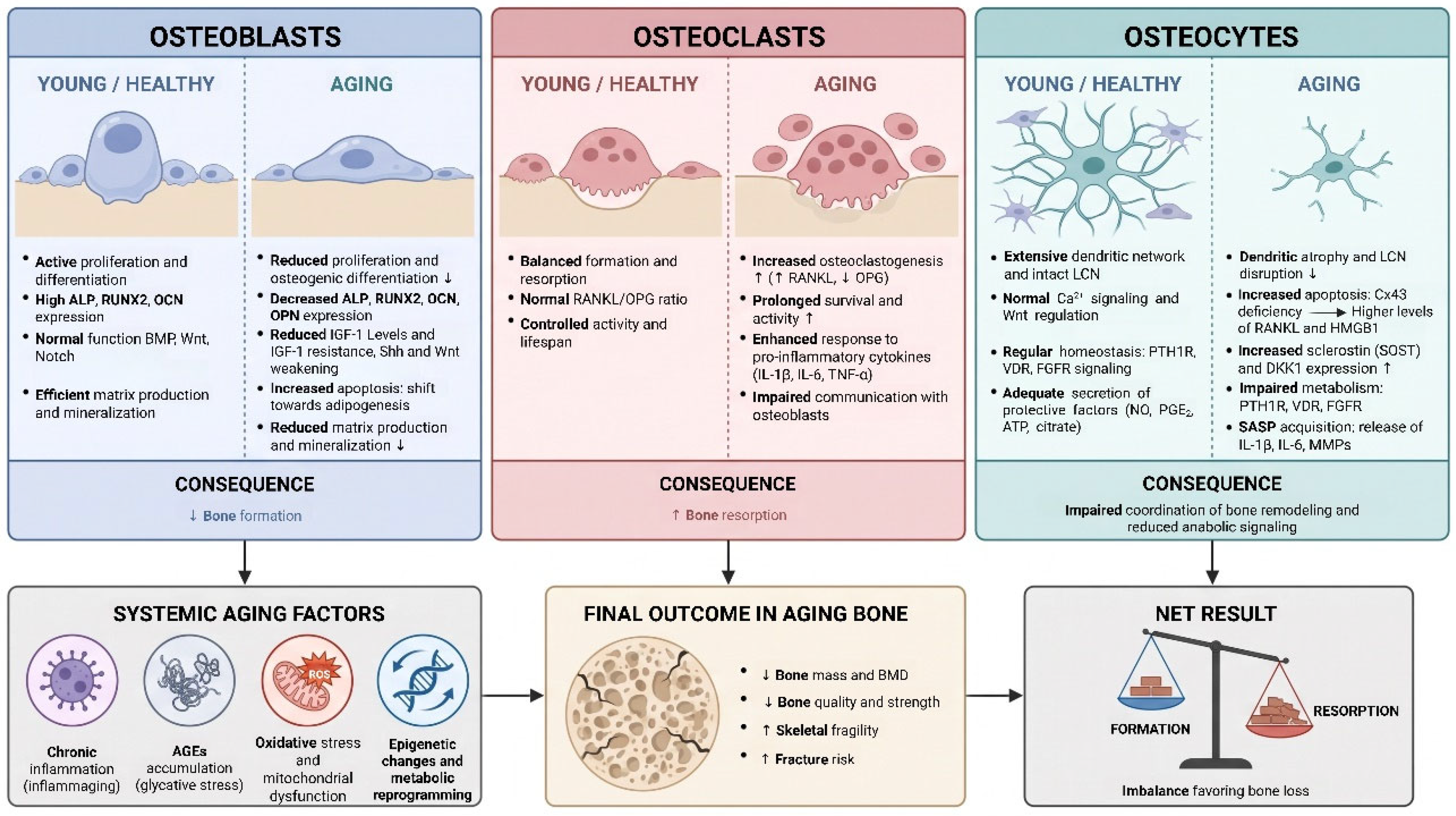
Figure 2.
Comparison of the cellular phenotype of normal/healty and glycative stress-induced bone cells. Schematic representation of the molecular and functional characteristics of osteoblasts, osteocytes, and osteoclasts due to glycative stress.
Figure 2.
Comparison of the cellular phenotype of normal/healty and glycative stress-induced bone cells. Schematic representation of the molecular and functional characteristics of osteoblasts, osteocytes, and osteoclasts due to glycative stress.
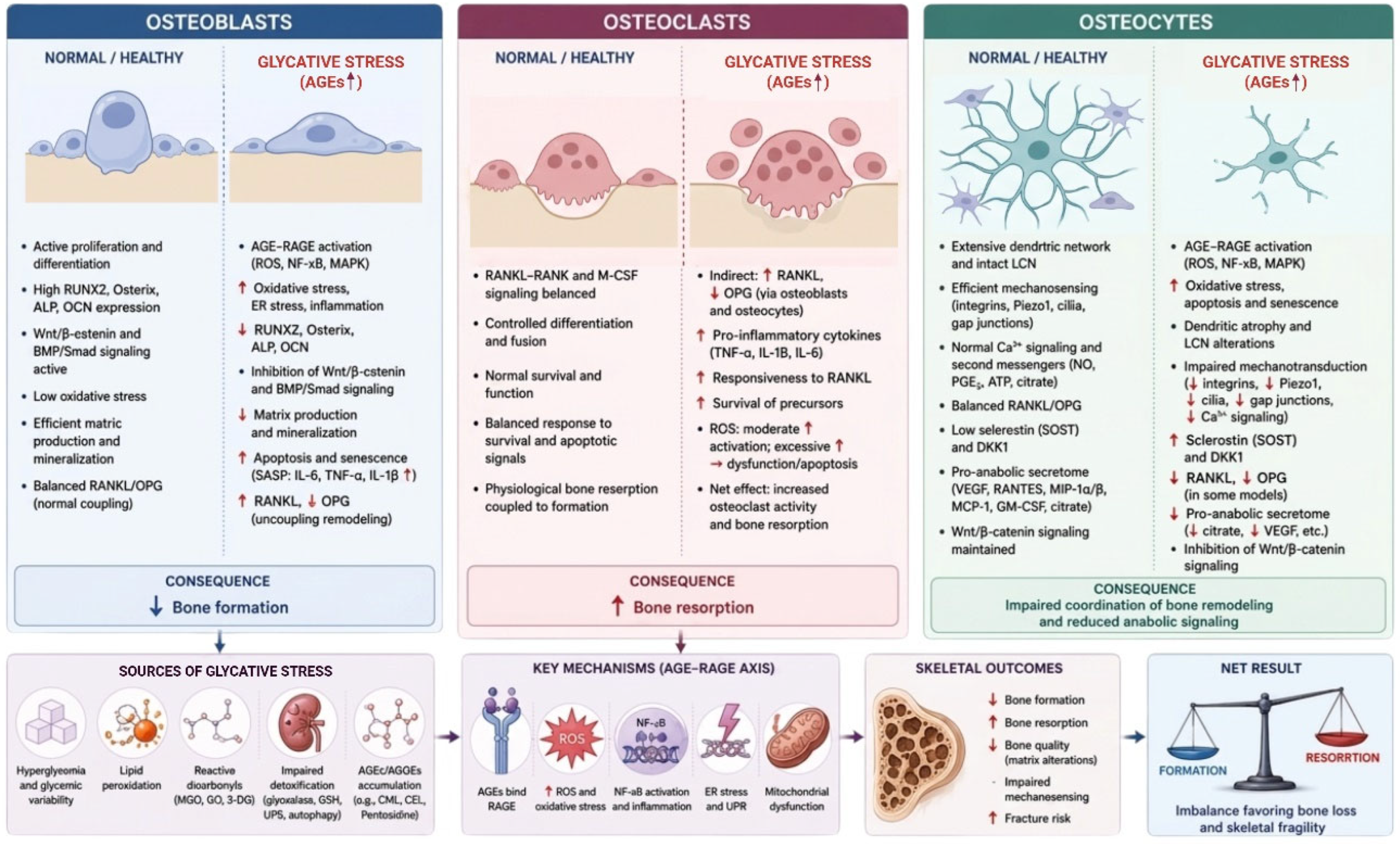
Figure 3.
Chemistry and detoxification of AGEs and AGOEs.(A) The Maillard reaction converts reducing sugars and free amino groups (Lys, Arg, His) into Schiff bases and Amadori products, which fragment into the α-dicarbonyls MGO, GO and 3-DG that irreversibly yield AGEs; AGOEs additionally require ROS. (B) Two defence systems oppose glycative stress: the glyoxalase system (GLO1/GLO2 + GSH) against MGO and GO, and the proteostasis network (UPS, macroautophagy, chaperone-mediated autophagy) that clears AGE-modified proteins. Both decline with age and are impaired by AGEs themselves, sustaining a vicious cycle.
Figure 3.
Chemistry and detoxification of AGEs and AGOEs.(A) The Maillard reaction converts reducing sugars and free amino groups (Lys, Arg, His) into Schiff bases and Amadori products, which fragment into the α-dicarbonyls MGO, GO and 3-DG that irreversibly yield AGEs; AGOEs additionally require ROS. (B) Two defence systems oppose glycative stress: the glyoxalase system (GLO1/GLO2 + GSH) against MGO and GO, and the proteostasis network (UPS, macroautophagy, chaperone-mediated autophagy) that clears AGE-modified proteins. Both decline with age and are impaired by AGEs themselves, sustaining a vicious cycle.
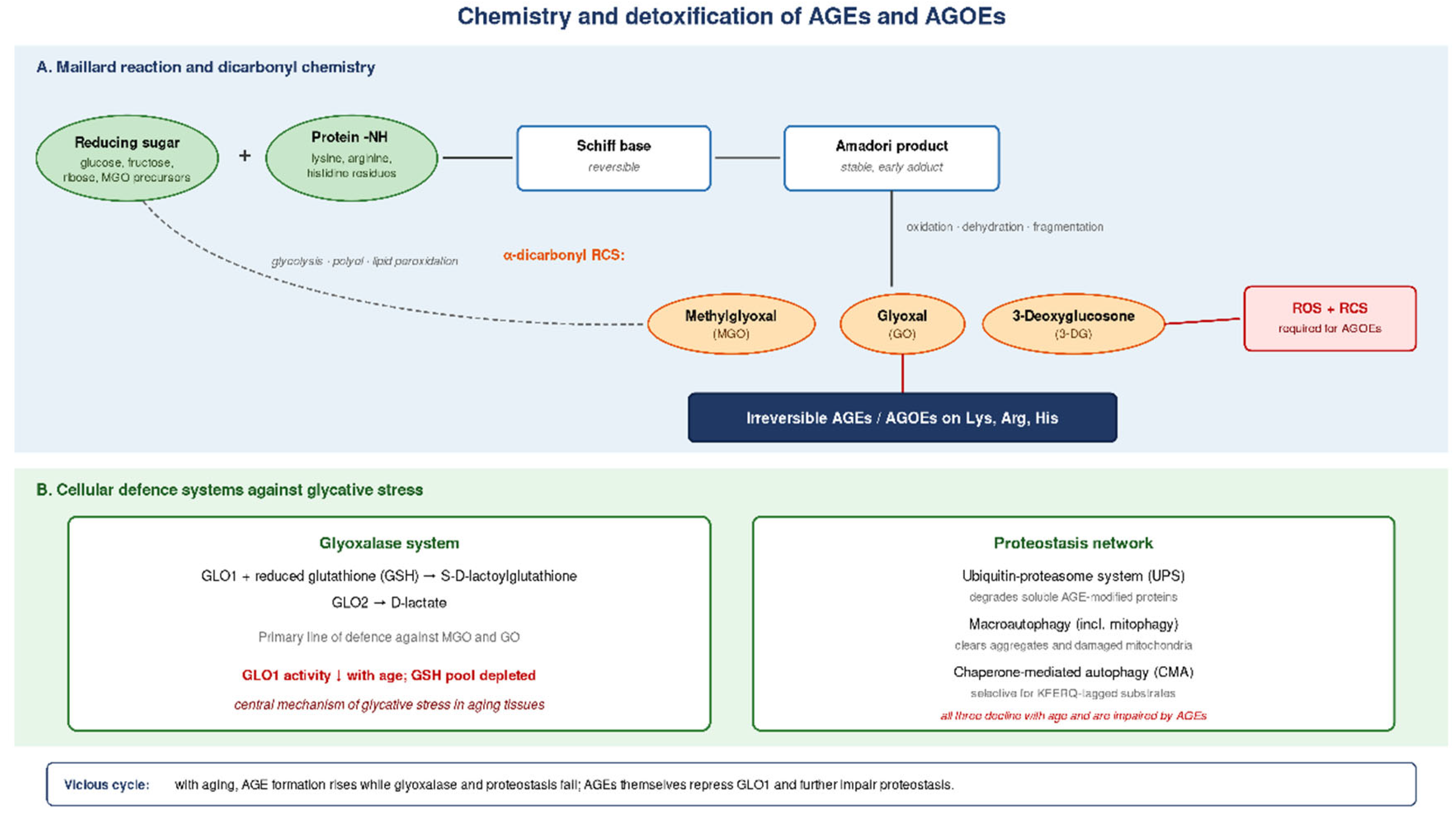
Figure 4.
AGE/RAGE signalling axis and convergence with TLR4 in bone cells. AGEs (CML, MG-H1), HMGB1, S100 proteins and β-amyloid activate RAGE; HMGB1 and S100 also engage TLR4. Three downstream cascades (Ras/MAPK, JAK/STAT, Rac1/Cdc42) converge on NF-κB, which drives pro-inflammatory cytokines and closes a positive-feedback loop by up-regulating RAGE and repressing GLO1. In bone, the response is biphasic (Plotkin et al., 2019): low or transient exposure promotes osteoblast differentiation, whereas sustained exposure drives osteoblast/osteocyte apoptosis and indirect bone resorption.
Figure 4.
AGE/RAGE signalling axis and convergence with TLR4 in bone cells. AGEs (CML, MG-H1), HMGB1, S100 proteins and β-amyloid activate RAGE; HMGB1 and S100 also engage TLR4. Three downstream cascades (Ras/MAPK, JAK/STAT, Rac1/Cdc42) converge on NF-κB, which drives pro-inflammatory cytokines and closes a positive-feedback loop by up-regulating RAGE and repressing GLO1. In bone, the response is biphasic (Plotkin et al., 2019): low or transient exposure promotes osteoblast differentiation, whereas sustained exposure drives osteoblast/osteocyte apoptosis and indirect bone resorption.
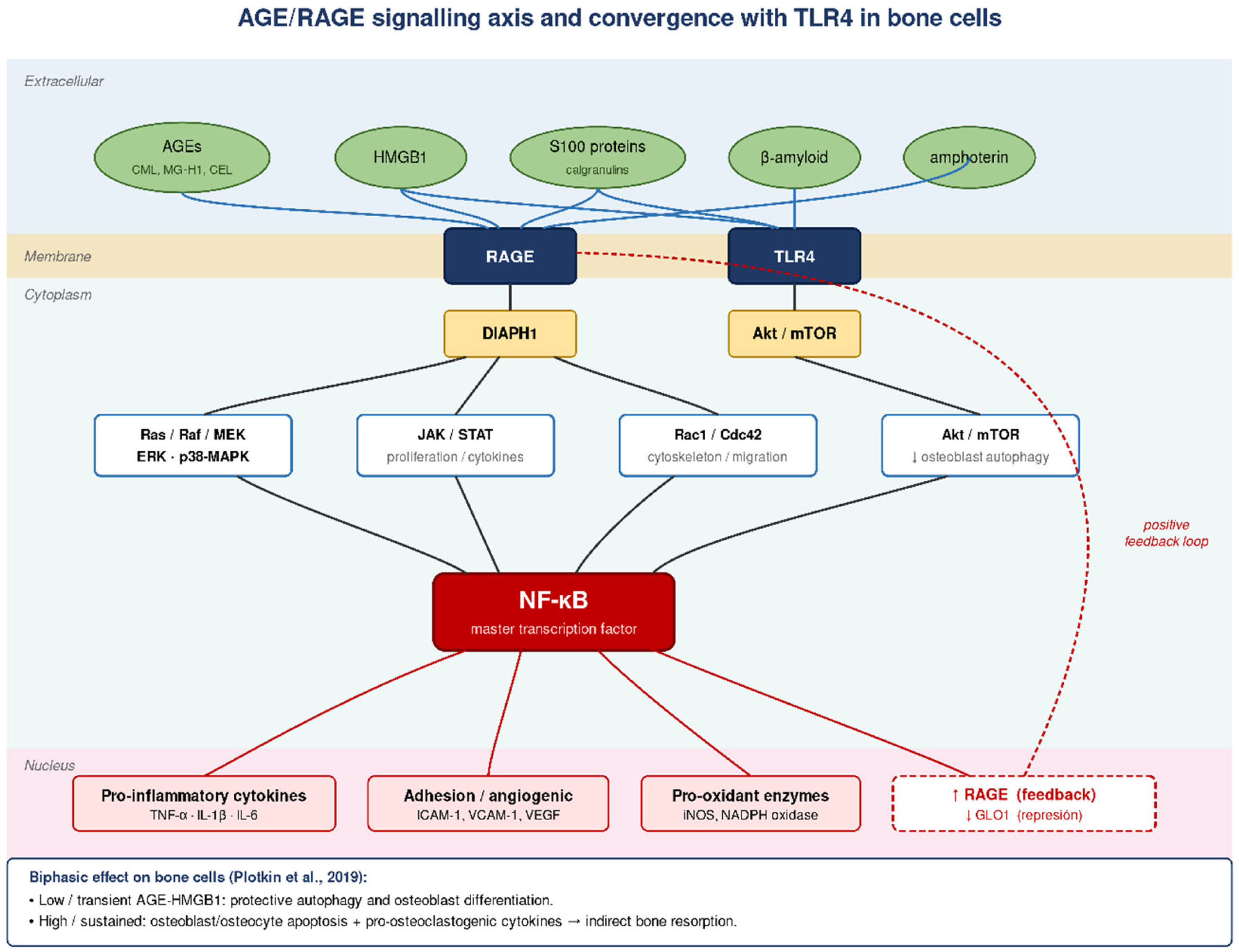
Figure 5.
Dual mechanosensorial failure in bone under chronic glycative stress. Left: osteocyte mechanosensors — focal adhesions with integrins, Piezo1/2 channels and Cx43 gap junctions — are compromised by dendrite loss, blunted Ca²⁺ signalling and disruption of the Cx43 network. Right: AGE/AGOE accumulation introduces non-enzymatic crosslinks (glucosepane, pentosidine) and suppresses enzymatic LOX crosslinks, altering collagen stiffness and toughness. The two lesions combine into a bilateral mechano-anabolic uncoupling that abolishes the load-induced anabolic response in aged and diabetic bone.
Figure 5.
Dual mechanosensorial failure in bone under chronic glycative stress. Left: osteocyte mechanosensors — focal adhesions with integrins, Piezo1/2 channels and Cx43 gap junctions — are compromised by dendrite loss, blunted Ca²⁺ signalling and disruption of the Cx43 network. Right: AGE/AGOE accumulation introduces non-enzymatic crosslinks (glucosepane, pentosidine) and suppresses enzymatic LOX crosslinks, altering collagen stiffness and toughness. The two lesions combine into a bilateral mechano-anabolic uncoupling that abolishes the load-induced anabolic response in aged and diabetic bone.
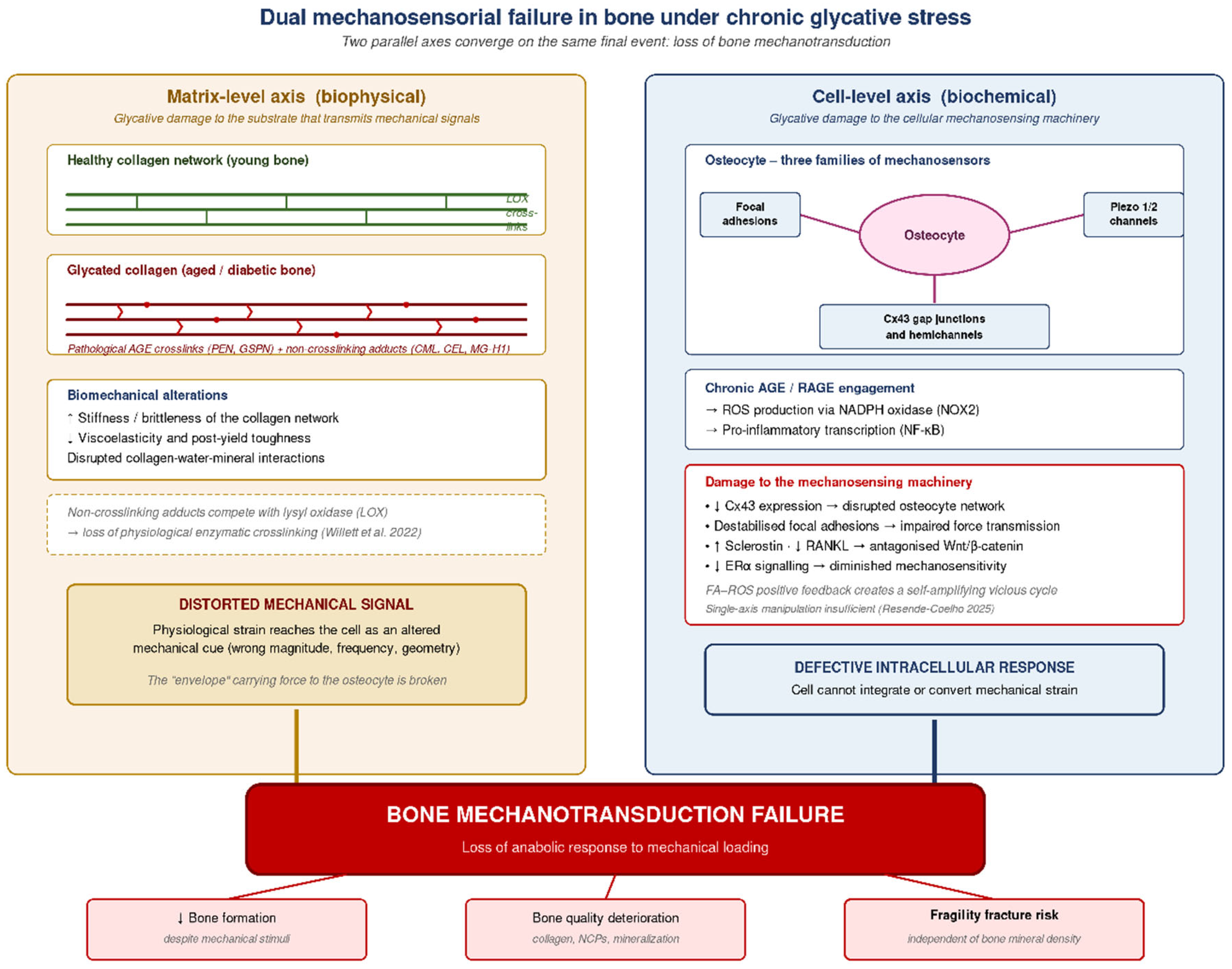
Figure 7.
Bone aging by inflammation, glycative stress and loss of autophagy. Schematic overview of the molecular mechanisms, biological processes, and signaling pathways involved in bone aging associated with inflammation, glycative stress, and impaired autophagy.
Figure 7.
Bone aging by inflammation, glycative stress and loss of autophagy. Schematic overview of the molecular mechanisms, biological processes, and signaling pathways involved in bone aging associated with inflammation, glycative stress, and impaired autophagy.
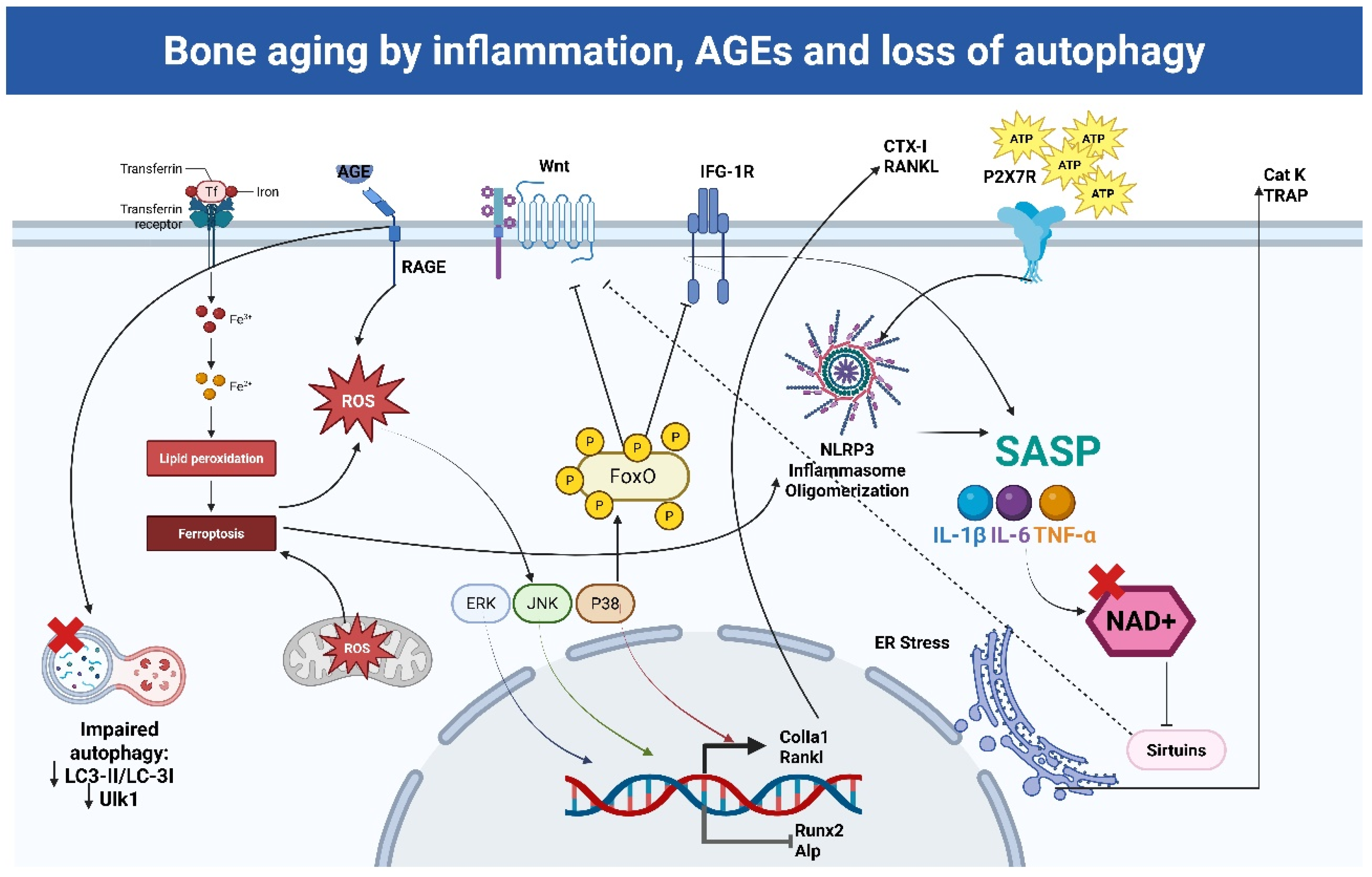
Disclaimer/Publisher’s Note: The statements, opinions and data contained in all publications are solely those of the individual author(s) and contributor(s) and not of MDPI and/or the editor(s). MDPI and/or the editor(s) disclaim responsibility for any injury to people or property resulting from any ideas, methods, instructions or products referred to in the content. |
© 2026 by the authors. Licensee MDPI, Basel, Switzerland. This article is an open access article distributed under the terms and conditions of the Creative Commons Attribution (CC BY) license (http://creativecommons.org/licenses/by/4.0/).
Copyright: This open access article is published under a Creative Commons CC BY 4.0 license, which permit the free download, distribution, and reuse, provided that the author and preprint are cited in any reuse.


