
Submitted:
16 July 2026
Posted:
20 July 2026
You are already at the latest version
Abstract
Spatial hearing is a key auditory function that enables the perception and interpretation of sound location and spatial cues in the environment. It plays a crucial role in everyday listening situations, particularly in complex acoustic settings. Despite its importance, spatial hearing remains under investigated in Brazil due to the limited availability of validated assessment instruments. Background/Objectives: Currently, few tools are available, including the Listening in Spatialized Noise Sentences (LiSN), the Speech, Spatial and Qualities of Hearing Scale (SSQ) and its short version (SSQ-12), and the Spatial Hearing Questionnaire (SHQ). While the SSQ has been adapted into Brazilian Portuguese, it is not exclusively focused on spatial hearing, and the LiSN adaptation is still in progress. Thus, there is a need for validated instruments specifically designed to assess spatial hearing in this population. Methods: This methodological study aimed to translate, cross-culturally adapt, and validate the Spatial Hearing Questionnaire (SHQ) into Brazilian Portuguese. The study was approved by the Research Ethics Committee of the Federal University of Minas Gerais (UFMG) (approval number 3,605,895). Data were collected at the Audiology Service of Hospital São Geraldo (UFMG). A total of 126 individuals with normal hearing thresholds (≤25 dB HL from 250 to 8000 Hz) and type A tympanometric curves participated. After signing informed consent, participants completed the Mini-Mental State Examination (MMSE), Visual Analog Scale (VAS) of the tinnitus magnitude, SSQ-12, and the Brazilian Portuguese version of the SHQ. Semantic validation, conducted with 30 individuals, showed comprehension rates above 80% for all items, with no need for modifications. Statistical analyses included the Shapiro–Wilk test, Wilcoxon signed-rank test, Cronbach’s alpha, and Spearman’s correlation. Conclusions: Internal consistency was high (Cronbach’s alpha: 0.97 for SHQ; 0.96 for retest; 0.88 for SSQ-12). Significant differences were observed in SHQ, VAS, MMSE, and SSQ-12 spatial scores between individuals with and without auditory complaints. No significant differences were found between SSQ-12 items 6–8 and total SHQ scores. The Brazilian Portuguese version of the SHQ demonstrated excellent reliability and validity, supporting its use as a robust instrument for assessing self-perceived spatial hearing abilities in Brazilian Portuguese-speaking populations.
Keywords:
auditory perception
; cross-cultural adaptation
; self-assessment
; hearing outcomes
; spatial hearing
1. Introduction
Spatial hearing refers to the ability of the auditory system to perceive and interpret the location of sound in the environment. This ability involves not only identifying the direction of a sound source but also segregating target sounds from competing noise arriving from different spatial locations [1]. Consequently, spatial hearing plays a crucial role in complex listening situations, relying on the binaural processing of spatial auditory cues [2].
Binaural processing involves the integration of auditory information from both ears and underlies the ability to localize sounds and understand speech in noisy or acoustically challenging environments [3]. Efficient binaural processing enables the central auditory system to separate relevant speech signals from competing sounds and to construct a three-dimensional auditory percept [4].
Spatial hearing can be assessed using both behavioral and self-report measures. Among the most commonly used instruments are the Listening in Spatialized Noise Sentences test (LiSN-S) and the Spatial Hearing Questionnaire (SHQ), as well as the Speech, Spatial and Qualities of Hearing Scale (SSQ), which evaluates broader aspects of auditory function.
The LiSN-S, developed by Cameron and Dillon, is a standardized behavioral test used in the assessment of central auditory processing. It can be administered via headphones or in a free-field setup and evaluates listening performance in spatially complex and acoustically competitive environments [5].
The Spatial Hearing Questionnaire (SHQ), developed by Tyler et al., was specifically designed to assess self-perceived spatial hearing abilities [6]. It comprises 24 items organized into eight subscales, addressing aspects such as perception of male, female, and children’s voices, music perception in quiet, sound localization, and speech understanding in both quiet and noisy environments. The SHQ has been translated and adapted into several languages, including Persian, French, Dutch, Chinese, Turkish, and Korean [7,8,9,10,11,12].
The Speech, Spatial and Qualities of Hearing Scale (SSQ), developed by Gatehouse and Noble in 2004, consists of 49 items and is typically administered as an interview [13]. It assesses hearing across three domains: speech, spatial hearing, and qualities of hearing. A shorter 12-item version (SSQ-12) was later developed, maintaining the same domains [14]. The spatial hearing domain includes 17 items in the full version and three items in the abbreviated version.
To date, a Brazilian Portuguese version of the LiSN-S is not yet available. Among the questionnaires, only the SSQ has been translated and adapted into Brazilian Portuguese, including both the full and abbreviated versions [15,16]. While the SSQ includes items related to spatial hearing, it is not specifically designed for this purpose. In contrast, the SHQ exclusively focuses on spatial hearing and differentiates performance according to stimuli with distinct vocal characteristics, such as male, female, and children’s voices.
Spatial hearing deficits are commonly observed in individuals with hearing loss, Central Auditory Processing Disorder (CAPD), and in older adults [17,18]. Therefore, instruments such as the SHQ may contribute to both functional auditory assessment and clinical decision-making by capturing the impact of spatial hearing difficulties in everyday listening situations.
Given the limited availability of validated instruments for assessing spatial hearing in Brazilian Portuguese, the present study aimed to translate, cross-culturally adapt, and validate the Spatial Hearing Questionnaire (SHQ) for use in this population.
2. Materials and Methods
This methodological study was conducted in accordance with the Declaration of Helsinki, and the protocol was approved by the Ethics Committee of Federal University of Minas Gerais (protocol number 17962919.6.0000.5149). Prior to the study, permission to translate the questionnaire into Brazilian Portuguese was obtained from the author of the original English version. The validation process followed the methodology proposed by the Scientific Advisory Committee of the Medical Outcomes Trust (SAC) and was conducted in five stages, as described below [19].
Stage 1. Translation and Back-Translation
The original questionnaire was independently translated from English into Portuguese by two Brazilian translators. After comparison and consensus among the authors, a first Portuguese version was established.
This version was then back-translated into English by two independent native English speakers who were blinded to the study objectives and had not participated in the initial translation. An expert committee, composed of two speech-language pathologists fluent in English, compared the original and back-translated versions. Based on this analysis, a second Portuguese version was produced.
Stage 2. Semantic Validation
The second version was self-administered to 30 individuals attending the audiology service of a university hospital to assess item comprehensibility. Each item was accompanied by the question: “Is this question easy to understand?” Participants responded with either “Yes, it is easy” or “No, it is difficult.”
Items were considered acceptable if at least 80% of respondents indicated “Yes, it is easy” (Appendix 10). All items met this criterion; therefore, no modifications were required, and the version was considered semantically validated.
Stage 3. Questionnaire Administration and Additional Measures
The SHQ was administered to 126 Brazilian participants along with a case history questionnaire, a Visual Analog Scale (VAS), and the Mini-Mental State Examination (MMSE).
Case History Questionnaire
A structured case history questionnaire was used to investigate participants’ auditory complaints and listening difficulties. For the purposes of this study, the analysis focused on questions related to hearing ability and sound localization in quiet and noisy environments. Participants responded “yes” or “no” to the following questions:
- Do you have any hearing complaints?
- Do you hear well in quiet environments?
- Do you hear well in noisy environments?
- Can you localize the source of sound in quiet environments?
- Can you localize the source of sound in noisy environments?
Visual Analog Scale (VAS)
The VAS was used to assess participants’ self-perceived hearing ability. Participants were asked: “How would you rate your hearing, considering 0 as very good and 10 as very poor?”
Mini-Mental State Examination (MMSE)
The MMSE was used as a cognitive screening tool to minimize the influence of cognitive factors on the results. Developed by Folstein et al. in 1975, it is widely used to assess cognitive function and screen for cognitive impairment [20].
The MMSE evaluates temporal and spatial orientation, memory, attention, language, and visuoconstructive abilities. Scores range from 0 to 30, with higher scores indicating better cognitive performance.
Participants were required to meet minimum MMSE cutoff scores adjusted for educational level, according to the criteria established by the Brazilian Academy of Neurology [21]. The cutoff values for the Brazilian population are presented in Table 1.
Stage 4. Validation
As part of the validation process, the Speech, Spatial and Qualities of Hearing Scale (SSQ) was administered, and its results were compared with SHQ scores using Spearman’s correlation coefficient.
For this analysis, only the three spatial hearing items from the abbreviated version of the SSQ were considered:
Question 6: You are outside. A dog barks loudly. Can you immediately tell where it is without looking?
Question 7: Can you tell how far away a bus or truck is based on its sound?
Question 8: Can you tell, from the sound alone, whether a bus or truck is approaching or moving away?
Stage 5. Reliability and Reproducibility
Test-retest reliability was assessed by re-administering the SHQ to 10% of the sample (n = 12) after an interval of 7 to 14 days.
This interval was considered sufficient to minimize recall bias and to ensure no significant changes in hearing status. Reproducibility was evaluated using the Wilcoxon signed-rank test, which showed no statistically significant differences between test and retest scores (p = 0.283).
Reliability was further assessed using Spearman’s correlation coefficient, which demonstrated a strong positive correlation between administrations (ρ = 0.85), indicating good response stability over time.
The stages involved in the translation, cross-cultural adaptation, and validation of the SHQ are summarized in Figure 1.
Inclusion Criteria
Participants were eligible for inclusion if they met the following criteria:
• Adults aged 18 years or older, of either sex;
• Pure-tone air-conduction thresholds within normal limits at all tested frequencies (250–8000 Hz);
• Type A tympanometric curve, according to Jerger’s classification [22];
• Adequate cognitive performance for educational level, as assessed by the MMSE [21];
• Provision of written informed consent.
The inclusion of only individuals with normal hearing was adopted to ensure sample homogeneity during the translation and validation of the instrument, representing a necessary initial step prior to its application in clinical populations.
Exclusion Criteria
The following exclusion criteria were applied:
• Cognitive impairment identified by the MMSE, whether clinically evident or self-reported;
• Illiteracy, due to the self-administration format of the questionnaires.
3. Results
A total of 126 individuals participated in the study, including 103 females and 23 males. The mean age was 39.4 years (range: 18–76 years). Data were collected on handedness, educational level, years of schooling, hearing complaints, self-reported hearing and sound localization abilities in quiet and noisy environments, and history of recurrent childhood ear infections. The descriptive characteristics of the sample are presented in Table 2.
During the semantic validation stage, conducted with 30 participants, all questionnaire items achieved comprehension rates above 80%. Therefore, no modifications to the translated version were required. Item-specific comprehension rates are presented in Table 3.
Descriptive statistics for the MMSE, VAS, and SHQ scores are presented in Table 4.
Data normality was assessed using the Shapiro–Wilk test, which indicated a non-normal distribution for all variables. Accordingly, non-parametric analyses were performed using the Wilcoxon signed-rank test.
For SHQ validation, test–retest reliability was assessed by re-administering the questionnaire to 10% of the sample (n = 12) after an interval of 7 to 14 days. No statistically significant differences were observed between the first and second administrations (p = 0.283), indicating good temporal stability. Comparisons of SHQ, SSQ, VAS, and MMSE scores between participants with and without hearing complaints revealed statistically significant differences across all measures, as shown in Table 5.
To assess internal consistency, Cronbach’s alpha coefficient was calculated. In the present study, values above 0.80 were considered indicative of good reliability [23]. The SHQ demonstrated excellent internal consistency (α = 0.97), which remained high in the test–retest condition (SHQ-R; α = 0.96). The SSQ also showed good internal consistency (α = 0.88).
Spearman’s correlation coefficient was used to assess the association between SHQ scores obtained in the test and retest administrations, as well as the correlation between SHQ and SSQ responses. For the test–retest analysis, correlation coefficients above 0.7 were considered high, values between 0.4 and 0.7 were considered moderate, and values below 0.4 were considered low. For correlations between SHQ and SSQ responses, statistical significance was set at the 5% level [24].
Test–retest analysis demonstrated a strong positive correlation (Spearman’s ρ = 0.85), indicating high reliability and temporal stability of SHQ scores. Participants with higher scores in the initial assessment tended to maintain similar scores upon reassessment, as did those with lower scores.
To further examine convergent validity, the three spatial hearing items of the SSQ-12 (Items 6, 7, and 8) were compared with total SHQ scores. No statistically significant associations were observed (p = 0.688, 0.694, and 0.681, respectively).
4. Discussion
The results obtained during the translation, cross-cultural adaptation, and validation of the SHQ demonstrated excellent reliability, supporting its use in audiology and speech-language pathology among Brazilian Portuguese-speaking individuals. Adequate correlations were observed both between instruments and in the test–retest analysis. Furthermore, the methodological procedures strictly followed the recommendations of the Scientific Advisory Committee of the Medical Outcomes Trust (SAC), which are widely used in the validation of health-related questionnaires [19].
Regarding sex distribution, the sample consisted predominantly of females (81.8%), with a mean age of 39.4 years (range: 18–76 years). These findings are consistent with those reported in the original SHQ validation study in individuals with normal hearing, which also showed a predominance of female participants and a similar mean age [2]. The higher participation of women may reflect greater health awareness and healthcare-seeking behavior compared to men [25,26].
During semantic validation, 91.6% of the items were understood by more than 90% of participants, indicating that the Brazilian Portuguese version of the SHQ is clear and easily comprehensible.
In terms of educational level, nearly half of the sample had completed secondary education (49.2%), followed by individuals with higher education (21%). These findings are consistent with population data from the state of Minas Gerais, which indicate a predominance of individuals within these educational levels [27].
With respect to auditory complaints, 59.5% of participants reported no complaints. Among those who did, tinnitus (19%) and difficulty understanding speech in noisy environments (11.9%), often associated with hyperacusis, were the most frequently reported. Although nearly all participants reported adequate hearing and sound localization in quiet environments, approximately 30% reported difficulties in noisy conditions. Tinnitus is among the most prevalent and distressing symptoms reported in clinical practice, surpassed only by pain and severe dizziness [28]. Difficulties in speech perception in noise have also been widely reported, even among individuals with normal hearing thresholds, reinforcing the need to assess central auditory function in this population [29,30].
The MMSE and VAS were included as screening tools to control for cognitive and self-perceived hearing factors. The MMSE was selected due to its rapid administration and ability to identify cognitive impairment, minimizing potential confounding effects. As expected, participants demonstrated high MMSE scores and low VAS scores. The mean SHQ score (81 points) was comparable to that reported in the original validation study (87 points) [2].
Test–retest analysis demonstrated high reliability and reproducibility, confirming the temporal stability of SHQ responses. This psychometric property is essential, as it ensures that the instrument yields consistent results when administered under similar conditions over time.
Comparisons between individuals with and without auditory complaints revealed statistically significant differences across SHQ, VAS, MMSE, and SSQ spatial items. These findings suggest a possible association between auditory complaints and broader perceptual or cognitive factors, even in individuals with normal hearing sensitivity. While associations between hearing loss and cognition have been widely reported, evidence in normal-hearing populations remains limited [31,32]. The main complaints identified in this study—tinnitus, difficulty understanding speech in noise, and hyperacusis—are commonly associated with cochlear synaptopathy (CS), a condition involving damage to synapses between inner hair cells and auditory nerve fibers [33,34,35]. This may explain the presence of functional auditory difficulties despite normal audiometric thresholds.
Internal consistency analysis demonstrated high reliability for all instruments, with Cronbach’s alpha values of 0.97 (SHQ), 0.96 (SHQ retest), and 0.88 (SSQ), indicating strong consistency among questionnaire items.
No statistically significant associations were observed between SSQ spatial items (questions 6–8) and total SHQ scores. This result likely reflects differences in the scope and specificity of the instruments. The SSQ assesses multiple auditory domains and includes only a limited number of spatial items, whereas the SHQ is specifically designed to assess spatial hearing in greater detail, including variations in vocal characteristics such as male, female, and children’s voices.
The SHQ also offers practical advantages, including brevity (24 items), ease of administration, and good participant comprehension. Given the limited availability of behavioral tests and self-report instruments specifically targeting spatial hearing, the SHQ represents a valuable tool for both clinical and research applications. It may also be used to guide intervention planning and to monitor outcomes before, during, and after auditory training programs.
This study has some limitations. The validation was conducted exclusively in individuals with normal peripheral hearing and did not include individuals with hearing loss, hearing aid users, or cochlear implant recipients. Future studies should investigate the applicability of the Brazilian Portuguese version of the SHQ in these populations, particularly in the context of auditory rehabilitation and hearing device fitting.
5. Conclusions
The Brazilian Portuguese version of the SHQ demonstrated excellent reliability and validity, supporting its use as a robust instrument for assessing self-perceived spatial hearing abilities in Brazilian Portuguese-speaking individuals.
Author Contributions
Conceptualization, R.T. and P.C.M.; Methodology, N.L.O.B, L.M.R. and P.C.M.; Validation, N.L.O.B, L.M.R. and P.C.M.; Formal Analysis, N.L.O.B, L.M.R. and P.C.M.; Investigation, N.L.O.B. and P.C.M.; Writing – Original Draft Preparation, N.L.O.B, L.M.R. and P.C.M.; Writing – Review & Editing, R.T. and P.C.M.; Supervision, P.C.M., L.M.R. and R.T.; Project Administration, P.C.M. and L.M.R; Funding Acquisition, P.C.M.
Funding
This research received no external funding. Conselho Nacional de Desenvolvimento Científico e Tecnológico (CNPq), Brazil, provided a research scholarship to Dr. Mancini (process number 308302/2022-2) and Coordenação de Aperfeiçoamento de Pessoal de Nível Superior (CAPES), Brazil, provided a scholarship to Najlla L. O. Burle (process number 308302/2022-2).
Institutional Review Board Statement
The study was conducted in accordance with the Declaration of Helsinki, and approved by the Ethics Committee of Universidade Federal de Minas Gerais, Brazil (protocol number 17962919.6.0000.5149 on September 27, 2019).
Informed Consent Statement
Informed consent was obtained from all subjects involved in the study.
Data Availability Statement
The raw data supporting the conclusions of this article will be made available by the authors on request.
Acknowledgments
To Conselho Nacional de Desenvolvimento Científico e Tecnológico (CNPq), Brazil, for their support in the development of this research (Research Productivity Grant number 308302/2022-2) and to Coordenação de Aperfeiçoamento de Pessoal de Nível Superior (CAPES), Brazil, for providing a scholarship to Najlla L. O. Burle (process number 308302/2022-2).
Conflicts of Interest
The authors declare no conflicts of interest.
Abbreviations
The following abbreviations are used in this manuscript:
| SHQ | Spatial Hearing Questionnaire |
| LiSN | Listening in Spatialized Noise Sentences |
| SSQ | Speech, Spatial and Qualities of Hearing Scale |
| SSQ-12 | Speech, Spatial and Qualities of Hearing Scale – Short version |
| UFMG | Universidade Federal de Minas Gerais |
| MMSE | Mini-Mental State Examination |
| VAS | Visual Analogue Scale |
References
- Muthu, A.N.P.; Fathima, H.; Kanagokar, V.; Bhat, J.S.; Kumar, S. A system for spatial hearing research. MethodsX 2022, 9, 101727. [CrossRef]
- Perreau, A.E.; Spejcher, B.; Ou, H.; Tyler, R.S. The Spatial Hearing Questionnaire: Data from individuals with normal hearing. Am. J. Audiol. 2014, 23, 173–181. [CrossRef]
- Azevedo, M.M.; Santos, S.N.; Costa, M.J. Performance of elderly adults with binaural versus monaural fitting in speech tests in silence and in noise. Rev. CEFAC 2015, 17, 431–438.
- Litovsky, R.Y.; Goupell, M.J.; Popper, A.N.; Fay, R.R. Binaural Hearing; Springer International Publishing: Cham, Switzerland, 2021.
- Cameron, S.; Dillon, H. Development of the Listening in Spatialized Noise-Sentences Test (LiSN-S). Ear Hear. 2007, 28, 196–211. [CrossRef]
- Tyler, R.S.; Perreau, A.E.; Ji, H. Validation of the Spatial Hearing Questionnaire. Ear Hear. 2009, 30, 466–474. [CrossRef]
- Delphi, M.; Zamiri Abdolahi, F.; Tyler, R.S.; Bakhit, M.; Saki, N.; Nazeri, A.R. Validity and reliability of the Persian version of the Spatial Hearing Questionnaire. Med. J. Islam. Repub. Iran 2015, 29, 231. PMID: 26793624.
- Moulin, A.; Richard, C. Validation of a French-language version of the Spatial Hearing Questionnaire, cluster analysis and comparison with the Speech, Spatial and Qualities of Hearing Scale. Ear Hear. 2016, 37, 412–423. [CrossRef]
- Potvin, J.; Punte, A.K.; Van de Heyning, P. Validation of the Dutch version of the Spatial Hearing Questionnaire. B-ENT 2011, 7, 235–244. PMID: 22338235.
- Ou, H.; Wen, B.; Perreau, A.; Kim, E.; Tyler, R.S. Validation of the Chinese translation of the Spatial Hearing Questionnaire and its short form. Am. J. Audiol. 2016, 25, 25–33. [CrossRef]
- Kılıç, N.; Şahin Kamışlı, G.İ.; Gündüz, B.; Bayramoğlu, İ.; Kemaloğlu, Y.K. Turkish validity and reliability study of the Speech, Spatial and Qualities of Hearing Scale. Turk. Arch. Otorhinolaryngol. 2021, 59, 172–187. [CrossRef]
- Kong, T.H.; Park, Y.A.; Bong, J.P.; Park, S.Y. Validation of the Korean version of the Spatial Hearing Questionnaire for assessing the severity and symmetry of hearing impairment. Yonsei Med. J. 2017, 58, 842–847. [CrossRef]
- Gatehouse, S.; Noble, W. The Speech, Spatial and Qualities of Hearing Scale (SSQ). Int. J. Audiol. 2004, 43, 85–99. [CrossRef]
- Noble, W.; Jensen, N.S.; Naylor, G.; Bhullar, N.; Akeroyd, M.A. A short form of the Speech, Spatial and Qualities of Hearing Scale suitable for clinical use: The SSQ12. Int. J. Audiol. 2013, 52, 409–412. [CrossRef]
- Gonsalez, E.C.M.; Almeida, K. Adaptação cultural do questionário Speech, Spatial and Qualities of Hearing Scale (SSQ) para o Português Brasileiro. Audiol. Commun. Res. 2015, 20, 215–224. [CrossRef]
- Gonsalez, E.C.M.; Almeida, K. Incapacidade auditiva medida por meio do questionário Speech, Spatial and Qualities of Hearing Scale (SSQ): Estudo piloto da versão reduzida em Português Brasileiro. Audiol. Commun. Res. 2017, 22, e1709. [CrossRef]
- Glyde, H.; Cameron, S.; Dillon, H.; Hickson, L. The effects of hearing impairment and aging on spatial processing. Ear Hear. 2013, 34, 15–28. [CrossRef]
- Cameron, S.; Dillon, H.; Newall, P. The Listening in Spatialized Noise Test: An auditory processing disorder study. J. Am. Acad. Audiol. 2006, 17, 306–320. [CrossRef]
- Scientific Advisory Committee of the Medical Outcomes Trust. Assessing health status and quality of life instruments: Attributes and review criteria. Qual. Life Res. 2002, 11, 193–205. [CrossRef]
- Folstein, M.F.; Folstein, S.E.; McHugh, P.R. Mini-mental state: A practical method for grading the cognitive state of patients for the clinician. J. Psychiatr. Res. 1975, 12, 189–198. [CrossRef]
- Smid, J.; et al. Declínio cognitivo subjetivo, comprometimento cognitivo leve e demência: Diagnóstico sindrômico. Dement. Neuropsychol. 2022, 16 (Suppl. 1), 1–17. [CrossRef]
- Jerger, J. Clinical experience with impedance audiometry. Arch. Otolaryngol. 1970, 92, 311–324. [CrossRef]
- Cronbach, L.J. Como julgar os testes: Fidedignidade e outras qualidades. In Fundamentos da Testagem Psicológica; Artes Médicas: Porto Alegre, Brazil, 1996; pp. 176–201.
- Dancey, C.; Reidy, J. Estatística sem Matemática para Psicologia: Usando o SPSS para Windows; Artmed: Porto Alegre, Brazil, 2006.
- Coelho, C.C.B.; Sanchez, T.G.; Bento, R.F. Características do zumbido em pacientes atendidos em serviço de referência. Arq. Int. Otorrinolaringol. 2004, 8, 284–292.
- Costa-Junior, F.M.; Couto, M.T.; Maia, A.C.B. Gênero e cuidados em saúde: Concepções de profissionais que atuam no contexto ambulatorial e hospitalar. Sex. Salud Soc. 2016, 23, 97–117. [CrossRef]
- Instituto de Pesquisa Econômica Aplicada (IPEA). IPEADATA: Dados macroeconômicos e regionais. Available online: http://www.ipeadata.gov.br (accessed on 10 June 2026).
- Sanchez, T.G.; Bento, R.F.; Miniti, A.; Câmara, J. Zumbido: Características e epidemiologia. Rev. Bras. Otorrinolaringol. 1997, 63, 229–235.
- Zhao, F.; Stephens, D. A critical review of King-Kopetzky syndrome: Hearing difficulties, but normal hearing? Audiol. Med. 2007, 5, 119–124. [CrossRef]
- Davis, A.C. The prevalence of hearing impairment and reported hearing disability among adults in Great Britain. Int. J. Epidemiol. 1989, 18, 911–917. [CrossRef]
- Powell, D.S.; Oh, E.S.; Reed, N.S.; Lin, F.R.; Deal, J.A. Hearing loss and cognition: What we know and where we need to go. Front. Aging Neurosci. 2022, 13, 769405. [CrossRef]
- Loughrey, D.G.; Kelly, M.E.; Kelley, G.A.; Brennan, S.; Lawlor, B.A. Association of age-related hearing loss with cognitive function, cognitive impairment, and dementia: A systematic review and meta-analysis. JAMA Otolaryngol. Head Neck Surg. 2018, 144, 115–126. [CrossRef]
- Schaette, R.; McAlpine, D. Tinnitus with a normal audiogram: Physiological evidence for hidden hearing loss and a computational model. J. Neurosci. 2011, 31, 13452–13457. [CrossRef]
- Guest, H.; Munro, K.J.; Prendergast, G.; Howe, S.; Plack, C.J. Tinnitus with a normal audiogram: Relation to noise exposure but no evidence for cochlear synaptopathy. Hear. Res. 2017, 344, 265–274. [CrossRef]
- Bal, N.; Derinsu, U. The possibility of cochlear synaptopathy in young people using a personal listening device. Auris Nasus Larynx 2021, 48, 1092–1098. [CrossRef]
Figure 1.
Stages of translation, cross-cultural adaptation, and validation of the Spatial Hearing Questionnaire for Brazilian Portuguese.
Figure 1.
Stages of translation, cross-cultural adaptation, and validation of the Spatial Hearing Questionnaire for Brazilian Portuguese.
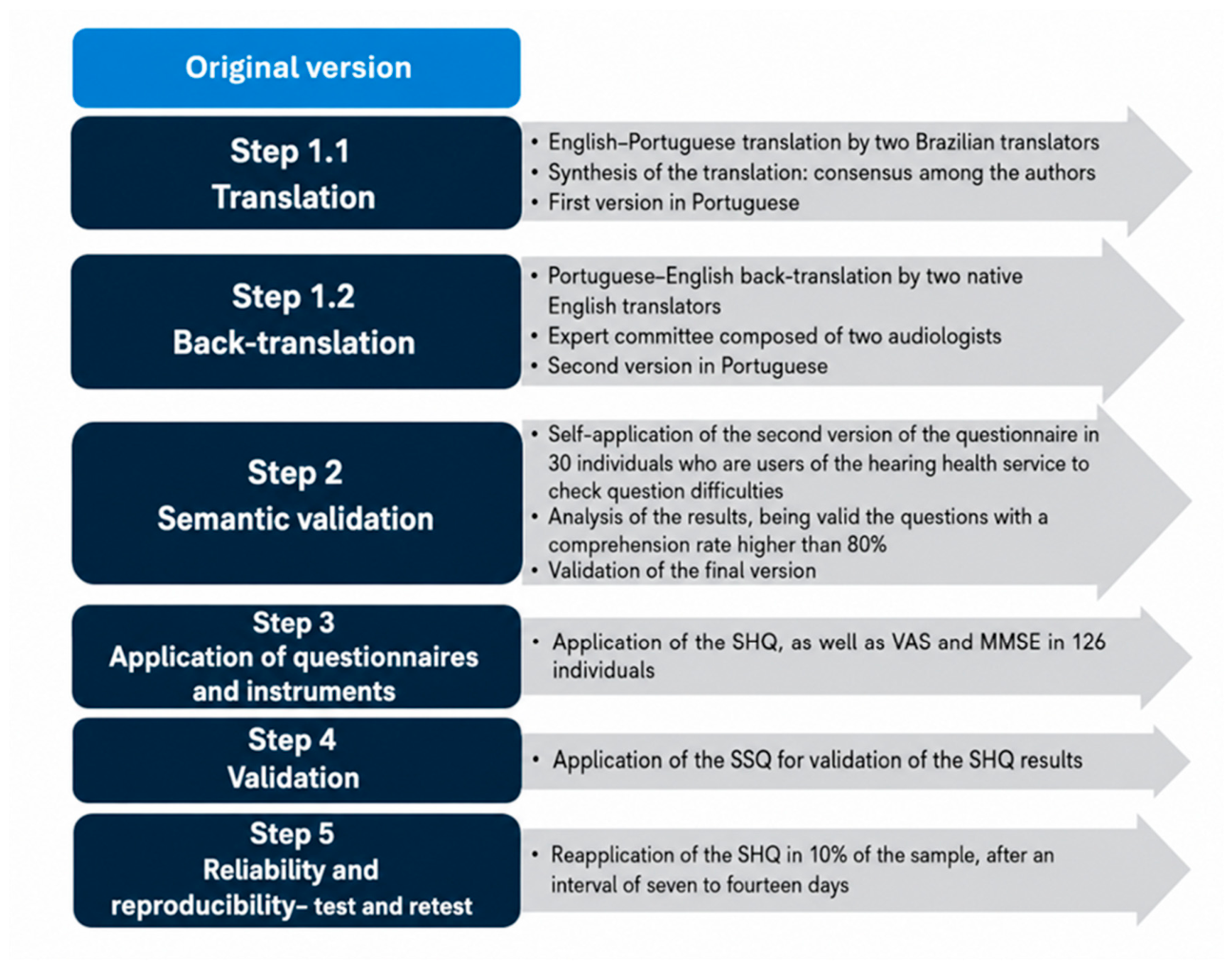
Figure 1.
Relationship between total SHQ and total SSQ scores.
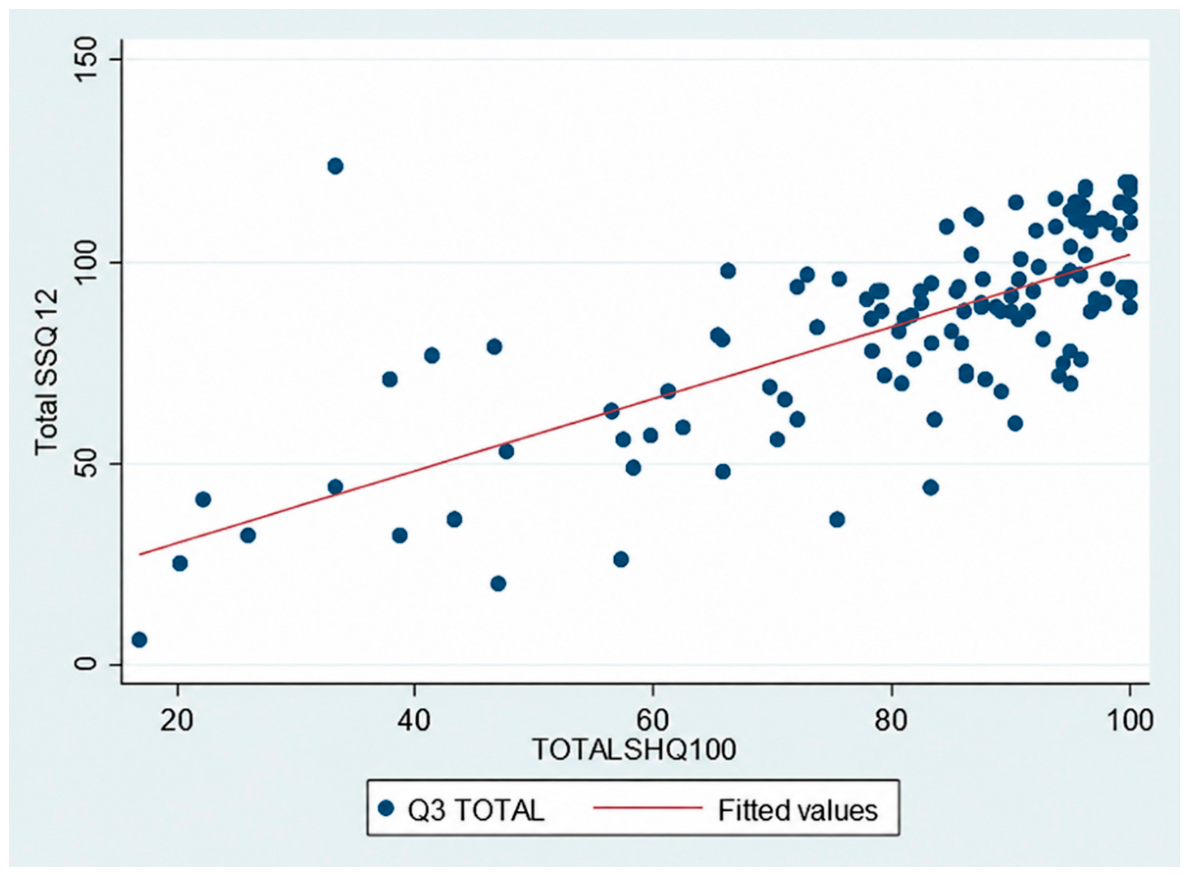
Figure 2.
Relationship between total SHQ scores and the mean SSQ-12 spatial hearing item scores (Items 6–8).
Figure 2.
Relationship between total SHQ scores and the mean SSQ-12 spatial hearing item scores (Items 6–8).
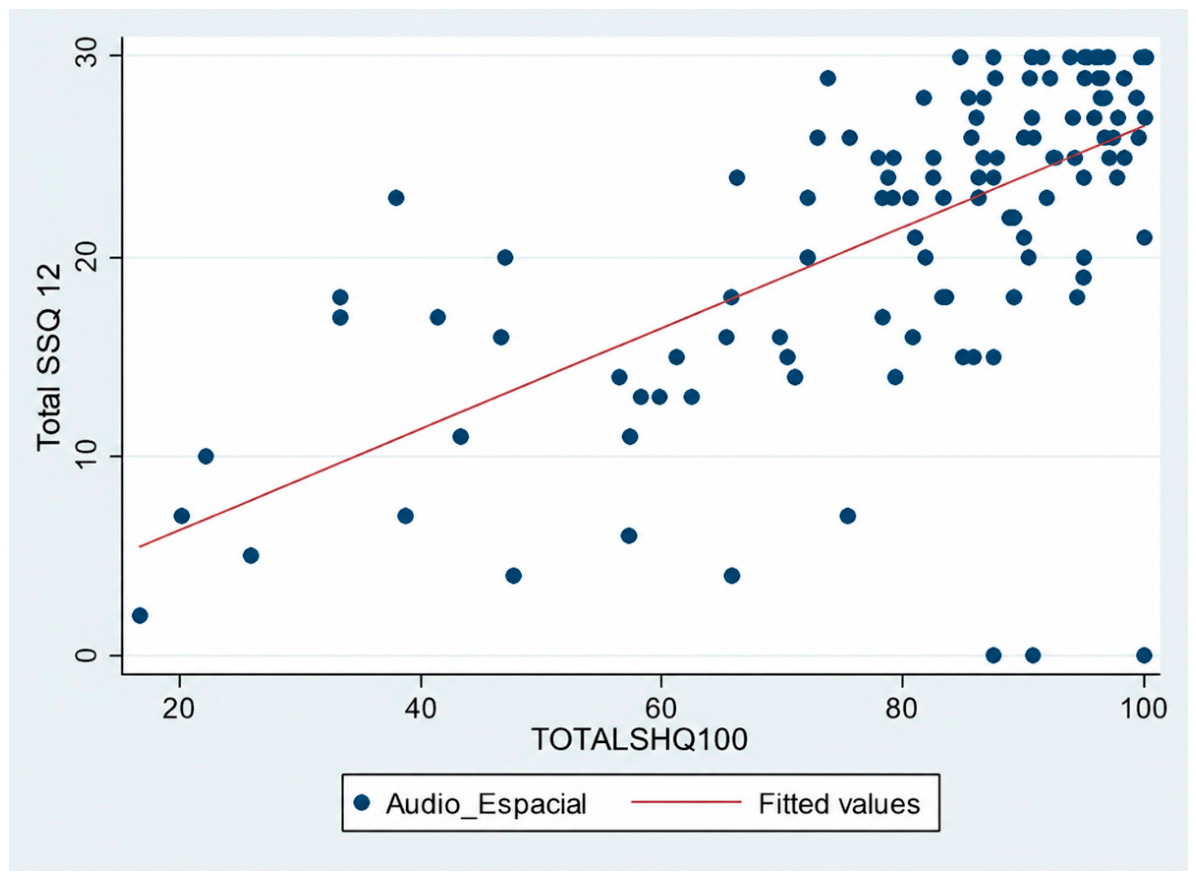

Table 1.
Mini-Mental State Examination cutoff scores for the Brazilian population according to years of education.
Table 1.
Mini-Mental State Examination cutoff scores for the Brazilian population according to years of education.
| Cognitive Screening Test |
Cognitive Domains Assessed |
Cutoff Scores by Years of Education |
|---|---|---|
| MMSE1 | Temporal and Spatial Orientation |
Illiterate: ≥ 19 |
| Verbal Episodic Memory | 1–4 years: ≥ 24 | |
| Attention and Calculation | 5–8 years: ≥ 26 | |
| Language | 9–11 years: ≥ 27 | |
| Visuoconstructive Abilities | ≥12 years: ≥ 28 |
1 MMSE = Mini-Mental State Examination.
Table 2.
Demographic and clinical characteristics of the sample.
| Characteristics | N (%) | |
|---|---|---|
| Sex | Male | 23 (18.3%) |
| Female | 103 (81.7%) | |
| Handedness | Right-handed | 120 (95.2%) |
| Left-handed | 6 (4.8%) | |
| Educational level | Elementary School I (1st–4th grade) | 5 (4.0%) |
| Elementary School II (5th–8th grade) | 3 (2.4%) | |
| Incomplete High School | 2 (1.6%) | |
| Complete High School | 61 (48.4%) | |
| Incomplete Higher Education | 22 (17.4%) | |
| Complete Higher Education | 27 (21.4%) | |
| Postgraduate | 6 (4.8%) | |
| Years of education | Up to 4 years | 5 (4.0%) |
| Up to 8 years | 5 (4.0%) | |
| 9 to 11 years | 62 (49.2%) | |
| >11 years | 54 (42.8%) | |
| Auditory complaints | No | 75 (59.5%) |
| Yes | 51 (40.5%) | |
| Self-reported auditory complaints | None | 75 (59.5%) |
| Tinnitus | 24 (19.0%) | |
| Difficulty understanding speech in noise | 5 (4.0%) | |
| Sound intolerance | 15 (11.9%) | |
| Speech comprehension difficulties | 4 (3.2%) | |
| Sensation of hearing loss | 8 (6.3%) | |
| Aural fullness | 7 (5.5%) | |
| Dizziness | 2 (1.6%) | |
| Hearing in quiet environments | No | 1 (0.8%) |
| Yes | 125 (99.2%) | |
| Hearing in noisy environments | No | 38 (30.2%) |
| Yes | 88 (69.8%) | |
| Sound localization in quiet environments |
No | 4 (3.2%) |
| Yes | 122 (96.8%) | |
| Sound localization in noisy environments |
No | 37 (29.4%) |
| Yes | 89 (70.6%) | |
| History of recurrent childhood ear infections | No | 108 (86.4%) |
| Yes | 18 (13.6%) | |
* Abbreviations: N = number of participants; % = percentage.
Table 3.
Item comprehension rates during semantic validation.
| Item # | Comprehension Rate (%) |
|---|---|
| 1 | 100.0 |
| 2 | 100.0 |
| 3 | 100.0 |
| 4 | 100.0 |
| 5 | 95.5 |
| 6 | 90.9 |
| 7 | 90.9 |
| 8 | 90.9 |
| 9 | 86.4 |
| 10 | 86.4 |
| 11 | 95.5 |
| 12 | 95.5 |
| 13 | 100.0 |
| 14 | 95.5 |
| 15 | 95.5 |
| 16 | 95.5 |
| 17 | 95.5 |
| 18 | 95.5 |
| 19 | 95.5 |
| 20 | 95.5 |
| 21 | 90.9 |
| 22 | 95.5 |
| 23 | 90.9 |
| 24 | 95.5 |
* Abbreviations: % = percentage.
Table 4.
Descriptive statistics for MMSE, VAS, and SHQ scores (N = 126).
| Instrument | N | Minimum | Maximum | Mean | P25 | P50 | P75 |
|---|---|---|---|---|---|---|---|
| MMSE | 126 | 25 | 30 | 28.9 | 28 | 29 | 30 |
| VAS | 126 | 0 | 10 | 2.4 | 0 | 1 | 4 |
| SHQ | 126 | 16 | 100 | 81.3 | 72 | 89 | 102 |
* Abbreviations: MMSE = Mini-Mental State Examination; VAS = Visual Analogue Scale; SHQ = Spatial Hearing Questionnaire; N = number of participants.
Table 5.
Comparison of SHQ, SSQ, VAS, and MMSE scores between individuals with and without hearing complaints.
Table 5.
Comparison of SHQ, SSQ, VAS, and MMSE scores between individuals with and without hearing complaints.
| Instrument | With Hearing Complaint (N = 75) |
Without Hearing Complaint (N = 51) |
p-value |
|---|---|---|---|
| SHQ | 74.1 | 86.2 | < 0.001* |
| SSQ6 | 6.6 | 8.0 | 0.012* |
| SSQ7 | 6.4 | 7.6 | 0.036* |
| SSQ8 | 6.6 | 8.4 | < 0.001* |
| VAS | 4.5 | 1.0 | < 0.001* |
| MMSE | 28.6 | 29.1 | 0.028* |
* Abbreviations: SHQ = Spatial Hearing Questionnaire; SSQ = Speech, Spatial and Qualities of Hearing Scale; VAS = Visual Analog Scale; N = number of participants. (P-value: Wilcoxon test).
Disclaimer/Publisher’s Note: The statements, opinions and data contained in all publications are solely those of the individual author(s) and contributor(s) and not of MDPI and/or the editor(s). MDPI and/or the editor(s) disclaim responsibility for any injury to people or property resulting from any ideas, methods, instructions or products referred to in the content. |
© 2026 by the authors. Licensee MDPI, Basel, Switzerland. This article is an open access article distributed under the terms and conditions of the Creative Commons Attribution (CC BY) license (http://creativecommons.org/licenses/by/4.0/).
Copyright: This open access article is published under a Creative Commons CC BY 4.0 license, which permit the free download, distribution, and reuse, provided that the author and preprint are cited in any reuse.


