

Submitted:
16 July 2026
Posted:
20 July 2026
You are already at the latest version
Abstract
The apparent yield of “full” recombinant adeno-associated virus (rAAV) capsids is a key metric in gene-therapy manufacturing, but it can substantially overstate the fraction of particles that actually carry a single intact, transduction-competent genome. Here, I suggest that authentic full-capsid yield is not just hard to optimize; it is fundamentally limited by a stochastic occupancy ceiling that bulk assays often obscure. This idea starts from a straightforward but important observation: single-particle and single-molecule studies show that the density- and mass-defined “full” population is heterogeneous, containing truncated, rearranged, and multi-DNA species in addition to intact genomes. Such heterogeneity is incompatible with a strictly deterministic, one-genome-per-capsid packaging process and instead points to stochastic genome loading.In the resulting occupancy model, the fraction of capsids containing exactly one intact genome is p(1) = m·e−m, where m is the mean number of genome-equivalents per capsid. This fraction reaches its maximum at m = 1, which imposes an e−1 ≈ 36.8% ceiling on the fraction of authentic single-genome capsids in any independent single-batch loading regime. This conclusion is counterintuitive but potentially important: increasing genome supply beyond this point cannot increase authentic yield. Instead, it converts empty capsids into physically full but functionally defective multi-occupancy particles that co-purify with authentic capsids and evade density-, size-, and bulk-DNA assays. As a result, high reported full-capsid fractions should be interpreted with caution unless they are backed by sequence-level evidence for single intact genomes.I further propose that simultaneous or near-simultaneous insertion through more than one of the twelve fivefold capsid channels offers a plausible route to these stealth-defective particles, because exclusive use of a single portal during packaging has not been demonstrated. The model also highlights the only way to exceed the ceiling: occupancy-dependent protection, represented by a relative second-capture parameter, σ, combined with decoupled, low-instantaneous-MOE loading. In this view, rAAV filling is better understood not as a separations problem but as a quantitative loading-control problem. A decisive experimental test is single-molecule sequencing of the full-density fraction across a range of genome supplies; the model predicts a peak in authentic particles near m = 1, an increase in defective multi-occupancy species at higher genome supply, and failure of authentic yield to exceed the predicted ceiling unless σ < 1.
Keywords:
adeno-associated virus
; AAV manufacturing
; empty and full capsids
; defective-interfering particles
; stochastic packaging
; Poisson statistics
; multi-channel insertion
; single-molecule sequencing
; gene therapy
Highlights
• Apparent “full” rAAV capsid yield may overstate authentic
single-intact-genome particles.
• Stochastic genome loading imposes an e−1 ≈ 36.8% ceiling on
authentic single-genome capsids in independent single-batch production.
• Genome excess is predicted to shift capsids from empty to
physically full but functionally defective multi-occupancy states.
• Stealth-defective particles may evade density-, size-, and
bulk-DNA assays and may arise through nonexclusive fivefold-channel loading.
• Exceeding the ceiling requires occupancy-dependent protection,
captured by σ<1, and low-instantaneous-MOE staged loading.
• Single-molecule sequencing across varied genome supply provides a
direct falsifiable test of the predicted authentic-yield peak and
multi-occupancy rise.
1. Introduction
Recombinant adeno-associated virus (rAAV) is the leading platform for in vivo gene therapy, with several approved products and a large clinical pipeline [Kuzmin et al., 2021; Wang et al., 2019]. A persistent manufacturing challenge is the low and variable proportion of capsids that carry the intended therapeutic genome. The conventional framework distinguishes “empty” capsids, which lack a genome, from “full” capsids, which are assumed to contain one, and treats process optimization as a problem of maximizing the full-to-empty ratio. Empty capsids are considered liabilities because they may be immunogenic, compete for receptor binding and intracellular trafficking, and dilute the effective dose. Accordingly, substantial effort has focused on increasing the full-length fraction and separating full from empty capsids by density or charge [Penaud-Budloo et al., 2018].
This paper advances a different interpretation. I argue that the empty/full dichotomy obscures a third, analytically hidden class of particles; that the authentic full-capsid fraction—that is, capsids carrying a single intact, ITR-flanked, expression-competent genome—is constrained by a ceiling that conventional process optimization cannot overcome; and that this ceiling lies well below the values commonly reported for purified preparations. The argument has three components. First, published single-particle studies already show that the “full” population is heterogeneous in genome content. Second, this heterogeneity is incompatible with strictly deterministic, single-genome packaging and instead implies stochastic loading. Third, a simple stochastic-occupancy model predicts an upper bound of approximately 36.8% on authentic single-genome capsids in any independent single-batch regime and indicates that increasing the genome-to-capsid ratio converts empty capsids into defective particles rather than authentic ones.
The central object of this argument is the “stealth-defective” particle: a capsid that is physically full, and therefore indistinguishable from an authentic capsid by density or mass, but whose packaged DNA does not constitute a single intact genome. The quantitative ceiling proposed here does not depend on any specific molecular mechanism; it follows from stochastic loading itself. Nevertheless, Section 4.1 proposes one plausible mechanism for generating such particles and explains the rationale for that mechanism.
The empirical premise is that the full-density fraction is internally heterogeneous. Multiple independent single-particle and single-molecule methods now show that capsids banding at full density, or registering as full by mass, are not uniformly occupied by a single intact genome.
Single-molecule sequencing of the full-density fraction (≈1.39–1.45 g/cm³) of purified rAAV showed that many recovered molecules were shorter than half the genome length; in the foundational study, 5′-containing fragments below half-genome length accounted for roughly half of all 5′ ends sequenced from that fraction [Kapranov et al., 2012]. Subsequent long-read and next-generation sequencing studies of AAV populations have identified snapback, truncated, rearranged, and other subgenomic species co-resident with canonical genomes, with some apparently homogeneous preparations containing well under half full-length species [Lecomte et al., 2015; Tai et al., 2018; Zhang et al., 2022]. Charge-detection and native mass spectrometry of intact particles further resolve species consistent with partial genomes, heterogeneous non-vector DNA, and particles whose mass indicates more than one genome-equivalent of packaged nucleic acid [Pierson et al., 2016; Nakatsuka et al., 2024].
If packaging produced exactly one intact genome in every genome-containing capsid, as a strictly single-genome, processive “fill-to-capacity-then-stop” mechanism would imply, the full-density fraction should be approximately homogeneous for single-intact-genome content. It is not. The observed heterogeneity therefore provides direct evidence that genome loading departs from strict single-genome determinism and includes a stochastic component. Although the same data could be interpreted as challenging any simple packaging-ceiling claim, they are used here as the empirical basis for the model because they are closely concordant with its central predictions.
2. Materials and Methods
2.1. The stochastic-Occupancy Model
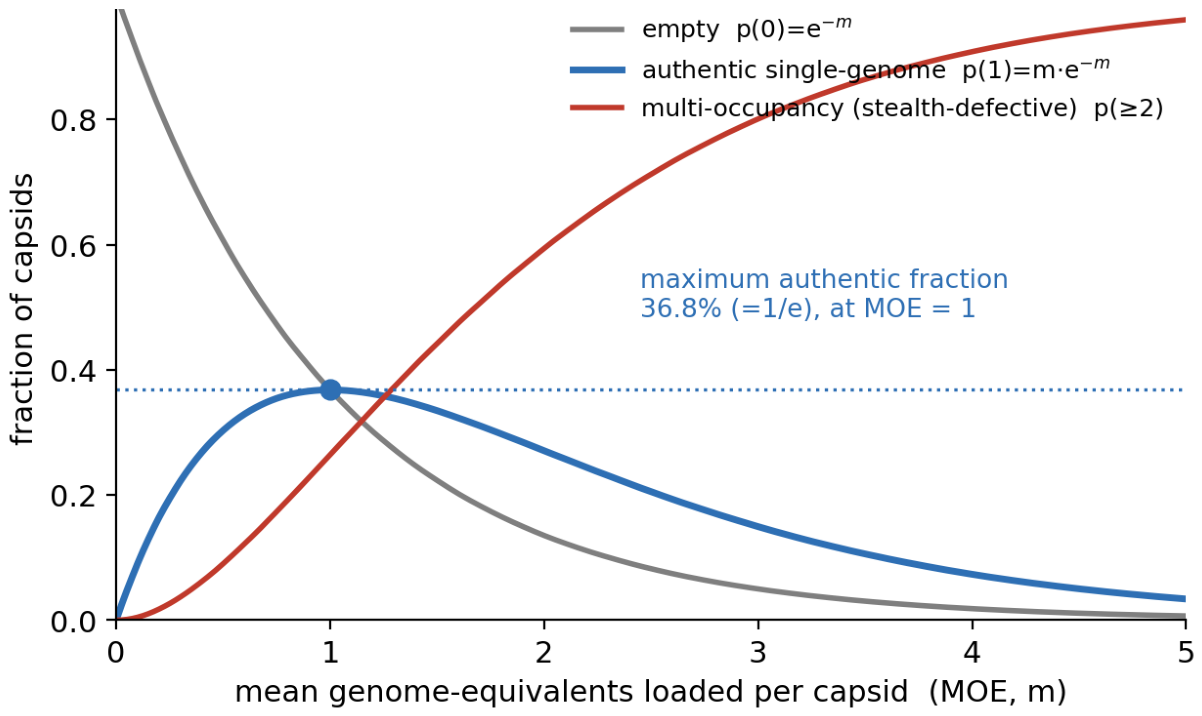
Genome loading was modeled as a stochastic process occurring across a population of preformed capsids. The mean number of genome-equivalents loaded per capsid is denoted by m and is referred to here as the multiplicity of encapsidation (MOE). Under the minimal assumption that loading events are independent across the available genome supply, the number of genome-equivalents in an individual capsid follows a Poisson distribution:
p(k) = (mᵏ · e^(−m)) / k!
giving three operationally relevant occupancy classes:
Empty: p(0) = e^(−m)
Authentic single-genome: p(1) = m · e^(−m)
Multi-occupancy (stealth-defective): p(≥2) = 1 − e^(−m)(1 + m)
Here, “loading event” denotes the incorporation of one genome-equivalent of DNA into a capsid, irrespective of the physical route by which that DNA enters. The model therefore does not assume, or require, a specific portal-insertion mechanism.
2.2. Model Development and Computational Methods
The hypotheses and governing mathematical expressions were initially derived by the author by hand using Poisson statistics and associated polynomial series expansions; discrete examples from this derivation were presented and defended in the cited poster presentation. During preparation of this manuscript, Claude Opus 4.8 (Anthropic) was used, under the author’s direction and verification, to support several analytic and presentational steps. Specifically, the tool was used to (i) express the hand-derived relations in compact symbolic notation for review and verification; (ii) introduce and formalize the protection coefficient, σ, defined as the occupancy-dependent relative second-capture rate; (iii) extend the original discrete loading model to the continuous, fully staged limit by formulating, integrating, and simplifying the governing ordinary differential equations; and (iv) compute and plot the model across parameter space, thereby making the probability-space behavior explicit and confirming the conclusions obtained from the discrete analysis. All AI-assisted derivations and figures were checked by the author against the original hand derivations for concordance. The author verified that the model assumptions, derivations, and behavior support the claims made in the text. Full model details are provided in Appendices B and C.
3. Results
3.1. The Ceiling
Differentiating p(1) = m·e^(−m): d/dm = e^(−m)(1 − m) = 0 at m = 1, so
p(1)|_(m=1) = e^(−1) ≈ 0.3679 ≈ 36.8%
At this optimum, p(0) ≈ 36.8% of capsids are empty and p(≥2) ≈ 26.4% are multi-occupancy defectives. This value is far below the authentic full-capsid fractions often implied by high reported “percent full” values and is the central quantitative proposition of the model.
3.2. Why Increasing Genome Supply Can Reduce Authentic Yield
When m < 1, the population remains dominated by empty capsids, but most genome-containing capsids fall into the authentic single-genome class. As m increases beyond 1, the empty fraction continues to fall, but additional loading events increasingly populate the multi-occupancy class. Consequently, the authentic fraction declines even as the apparent full fraction rises. In this regime, increasing genome supply relative to capsid number cannot improve authentic yield; instead, it converts empty capsids into physically full but functionally defective stealth-defective particles. Strategies that raise total genome availability while holding capsid number fixed are therefore predicted to enrich defective particles rather than authentic vectors.
Figure 1.
Poisson occupancy distribution versus mean genome-equivalents per capsid (MOE): empty e^(−m), authentic m·e^(−m), multi-occupancy 1 − e^(−m)(1+m), for m = 0–5; authentic maximum 36.8% at m = 1 annotated.
Figure 1.
Poisson occupancy distribution versus mean genome-equivalents per capsid (MOE): empty e^(−m), authentic m·e^(−m), multi-occupancy 1 − e^(−m)(1+m), for m = 0–5; authentic maximum 36.8% at m = 1 annotated.
3.3. Scope and Relaxation of the Stochastic Bound
The bound represents the theoretical maximum for authentic genome encapsidation under stochastic, independent loading. If packaging were strictly processive and limited to one genome per capsid, no such ceiling would arise, because genome-containing capsids would be expected to be nearly uniform in authenticity. The heterogeneity described in the Introduction is therefore the empirical basis for rejecting that strict deterministic model. The Poisson formulation further assumes that loading events are independent and identically distributed; the most consequential relaxation of this assumption concerns whether successive loading events on the same capsid remain independent. If a capsid that has captured one genome becomes less likely to capture another—for example, through interior volume exclusion, conformational sealing, or motor dissociation—then the single-occupancy state is protected, and the authentic fraction can exceed 1/e. Section 3.4 formalizes this possibility with a single parameter, σ, defined as the relative rate at which an already-loaded capsid captures an additional genome. In this framework, the 36.8% ceiling is the σ = 1, or no-protection, limit. Finally, the model counts genome-equivalents rather than intact genomes; the additional distinction between single occupancy and a single intact genome is an empirical factor addressed in Section 4.3.
3.4. Exceeding the Ceiling Through Occupancy-Dependent Protection
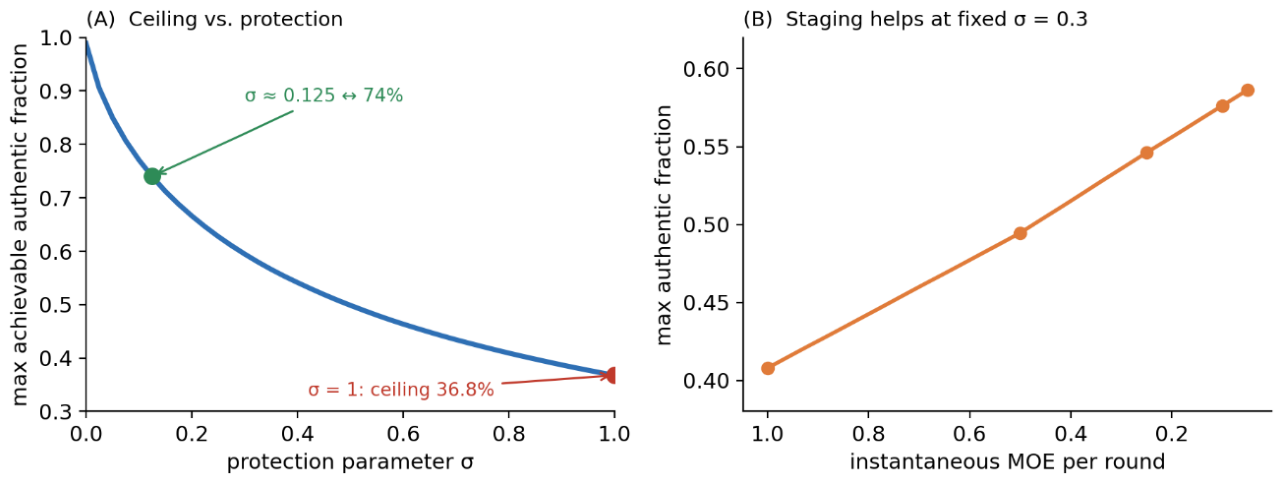
The ceiling corresponds to the σ = 1 limit, where σ denotes the rate at which a single-occupancy capsid captures an additional genome relative to the rate at which an empty capsid captures its first genome. Authentic yield can exceed 1/e only if σ < 1; that is, if a capsid that already contains one genome is protected against additional capture. To model decoupled loading explicitly, capsid number was held fixed while genomes were introduced over R rounds at a per-empty-capsid dose “α” (the instantaneous MOE), with single-occupancy capsids capturing additional genomes at the relative rate σ.
The model gives a clear result, including one that tempers the benefit expected from staged loading:
When σ = 1, staging the genome dose has no effect. A total MOE of 1 yields the same occupancy distribution whether delivered in one round, ten rounds, or one hundred rounds: 36.8% empty capsids, 36.8% authentic single-genome capsids, and 26.4% multi-occupancy particles. Across all schedules, the maximum authentic fraction remains exactly 1/e. Thus, when loading is memoryless—that is, when loading events are fully independent—only the total dose matters, and iterative genome addition cannot exceed the stochastic ceiling.
For σ < 1, the achievable authentic fraction is a “smooth function” of σ: ~49.9% at σ = 0.5, ~59.5% at σ = 0.3, ~66.6% at σ = 0.2, ~77.1% at σ = 0.1, and approaching ~99% as σ → 0.
Staging improves authentic yield only when σ < 1, but under that condition the effect can be substantial. For example, at σ = 0.3, reducing the instantaneous MOE from 1.0 to 0.05 increases the achievable authentic fraction from approximately 41% to approximately 59%. This increase occurs because low per-round genome availability allows capsids to accumulate in the protected single-occupancy state faster than they transition into multi-occupancy.
Importantly, these values are not merely simulation output. In the fully staged limit (per-round dose approaching zero), the proposed model yields an exact closed-form solution: the maximum achievable authentic fraction equals [e^(−σλ*) − e^(−λ*)] / (1 − σ), achieved at the cumulative per-empty-capsid dose λ* = ln(1/σ)/(1 − σ). This expression reproduces the values above and recovers the 1/e ceiling as σ → 1. A full derivation is provided in Appendix C.
Figure 2.
(A) Maximum achievable authentic fraction as a function of the protection parameter σ; the σ = 1 limit yields the 36.8% ceiling, and σ ≈ 0.125 corresponds to ~74%. (B) At fixed partial protection (σ = 0.3), lowering the per-round instantaneous MOE increases the achievable authentic fraction.
Figure 2.
(A) Maximum achievable authentic fraction as a function of the protection parameter σ; the σ = 1 limit yields the 36.8% ceiling, and σ ≈ 0.125 corresponds to ~74%. (B) At fixed partial protection (σ = 0.3), lowering the per-round instantaneous MOE increases the achievable authentic fraction.
This framework clarifies how strategies intended to reduce empty capsids should be interpreted. The operative lever is not simply gradual genome addition; rather, it is the combination of occupancy-dependent protection with low-instantaneous-MOE staged loading. In this model, staged loading improves authentic yield only when σ < 1. Recent capsid-production studies are consistent with the existence of such a lever. Chronologically distributed transfection, in which capsid components and payload are delivered before the genome-replication machinery, has been reported to increase capsid filling several-fold, consistent with a temporal-misalignment model in which capsids assemble before genomes become abundant [Chen, 2025]. Similarly, inducible producer systems that separate replication from packaging allow the genome-containing fraction to be tuned [Merten, 2024; Ren, 2025]. The occupancy model adds a quantitative target and prediction: achievable authentic yield is determined by σ, so measuring σ predicts the ceiling, whereas interventions that merely increase total genome supply are predicted to fail.
For orientation, an authentic fraction of approximately 74% corresponds to σ ≈ 0.125, meaning that a loaded capsid is roughly 88% less likely than an empty capsid to capture an additional genome. This value is physically plausible given the approximately 1.25-genome-equivalent interior volume of the capsid, but it remains a parameter to be measured rather than assumed.
Appendix A presents one concrete biological strategy for implementing controlled, low-instantaneous-MOE loading.
4. Discussion
4.1. Multi-Channel Insertion: A Mechanism
Although the ceiling argument is mechanism-agnostic, it should still account for how defective particles might arise and should generate falsifiable predictions. I therefore propose, as a formal hypothesis, that simultaneous or near-simultaneous insertion of DNA through more than one of the capsid’s twelve fivefold channels is a principal route to stealth-defective multi-occupancy particles. The prevailing single-portal model may describe an individual translocation event, but it has often been treated as if it excludes use of the other eleven channels. At present, compelling evidence for such exclusion is lacking.
The relevant structural facts are well established. Mature AAV capsids present twelve channels at the fivefold vertices; genome translocation is driven by a Rep motor that engages a fivefold pore; and a single translocation event can proceed processively from the 3′ end [King et al., 2001; Bleker et al., 2005, 2006; Mietzsch et al., 2019; Kaelber et al., 2025]. What remains assumed, rather than demonstrated, is exclusivity: that only one channel is ever engaged on a given capsid and that each capsid undergoes exactly one initiation event before sealing. I am aware of no experiment that directly demonstrates such exclusivity. The single-portal model explains how a genome can be packaged, but it does not measure how many channels can be engaged during packaging. In the absence of a demonstrated exclusion mechanism, twelve equivalent, Rep-accessible channels make multi-channel or multi-initiation loading a plausible expectation rather than an exceptional case. The burden of proof therefore rests on the claim of obligate single-portal exclusivity.
Two observations support this hypothesis. First, the single-particle data summarized in the Introduction show multi-equivalent and subgenomic occupancy as empirical phenomena; multi-occupancy occurs, leaving the mechanistic route as the remaining question. Second, the capsid interior can accommodate approximately 1.25 genome-equivalents. This capacity is sufficient for two or more short species inserted through distinct channels to produce a full-density particle without any one species being an intact genome. Thus, the physical geometry permits the occupancy states required by the model.
This hypothesis is intended as a coherent and testable proposition, not as a required premise of the stochastic ceiling itself. If it is correct, three predictions follow. First, structural capture of capsids during active packaging, rather than after maturation and sealing, should reveal more than one fivefold channel engaged with DNA or Rep under high genome availability. Second, the multi-occupancy signature should scale with genome supply, as predicted by the Poisson model. Third, no obligate single-portal exclusion mechanism should be required by capsid structure. Conversely, a direct demonstration that packaging is obligatorily restricted to a single portal would falsify the multi-channel hypothesis and return the argument to the mechanism-agnostic ceiling described in Section 3, which would remain intact. Other routes to multi-occupancy are also possible, including sequential reloading before sealing, co-packaging of snapback or replication intermediates, and partial loading followed by truncation. These alternatives are compatible with the occupancy model and need not be excluded. Multi-channel insertion is emphasized here because it is naturally suggested by the capsid’s twelvefold architecture and is experimentally testable.
4.2. Reconciling the Model with Reported Full-Capsid Fractions
A potential objection is that reported “percent full” values often exceed 36.8%. This objection conflates two distinct quantities and therefore does not invalidate the model.
First, the highest reported values, often 50–90% or higher, generally describe purified material after density-gradient or ion-exchange enrichment, during which empty capsids have been deliberately removed. The proposed production ceiling does not limit enrichment by downstream selection; empty capsids can be discarded without violating the model. Such values therefore describe the composition of the purified product, not the fraction of capsids that exited production carrying an authentic genome.
Second, and more importantly, a purified preparation reported as 90% “full” is full by density, charge, or a related bulk property. The central claim of this framework is that such measurements cannot distinguish authentic particles from stealth-defective particles. A density-defined 90% full fraction is therefore compatible with an authentic fraction near the stochastic ceiling plus a substantial stealth-defective remainder.
When production-level full fractions are measured by rigorous single-particle methods rather than inferred from bulk ratios, the reported values are low and broadly consistent with the proposed ceiling. Cryo-EM enumeration of unpurified preparations from a standard Rep system has reported full fractions of approximately 10–20%, with engineered improvements reaching only the low-to-mid 30% range [Mietzsch et al., 2021]. These values do not exceed 36.8%; they fall below it. This agreement supports the view that direct single-particle counts cluster beneath the predicted bound.
4.3. The Measurement Problem and a Decisive Test
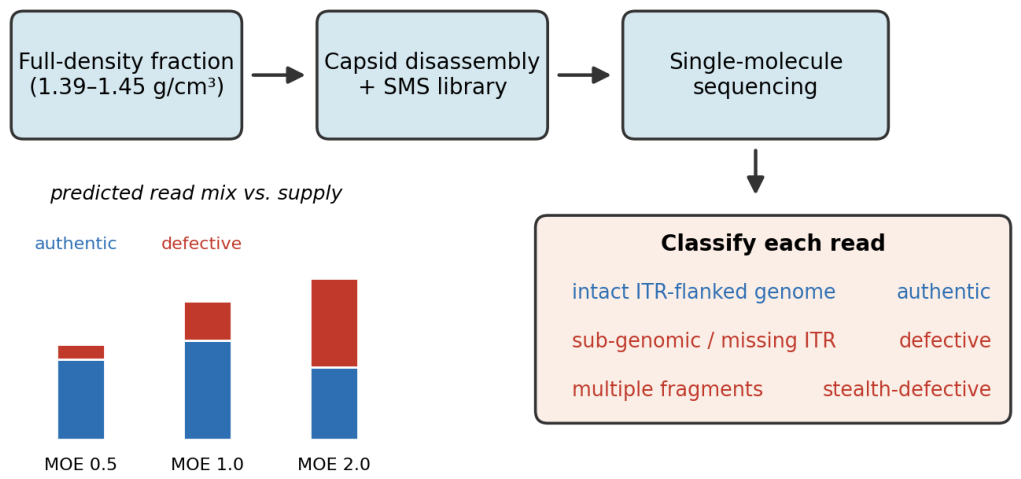
Density, light scattering, electron microscopy, and bulk genome titering cannot distinguish a capsid containing a single intact genome from a capsid with the same total DNA mass distributed across partial species. These methods therefore cannot determine the authentic fraction. Single-molecule sequencing (SMS) of the full-density fraction is the only currently available approach that can directly enumerate reads corresponding to (i) intact, ITR-flanked, full-length genomes; (ii) subgenomic fragments lacking one or both ITRs; and (iii) signatures consistent with multi-occupancy. The Kapranov result summarized in the Introduction provides both precedent and partial validation for this approach.
The central falsifiable test is to perform SMS on the full-density fraction across a systematically varied genome-to-capsid ratio and compare the measured authentic and subgenomic fractions with the Poisson predictions. The model predicts that the authentic fraction will peak near MOE = 1 and decline at higher genome supply, that the subgenomic fraction will rise monotonically with supply, and that the authentic fraction will not exceed approximately 36.8% at any supply in a single-batch regime. Conversely, if the authentic fraction within the full-density band rises smoothly toward 100% as genome supply increases, the framework would be falsified.
Figure 3.
Single-molecule sequencing assay to discriminate authentic from stealth-defective particles, with predicted read-class distributions at MOE values of 0.5, 1.0, and 2.0.
Figure 3.
Single-molecule sequencing assay to discriminate authentic from stealth-defective particles, with predicted read-class distributions at MOE values of 0.5, 1.0, and 2.0.
4.4. Implications
If this framework is correct, reported authentic full-capsid fractions far above approximately 37% in single-batch production should be interpreted as mixtures of authentic and stealth-defective particles in unknown proportions. Strategies that increase total genome supply while capsid expression remains fixed are predicted to enrich defective particles rather than authentic vectors. Potency and dose calculations based on total vector genomes may therefore overestimate the transduction-competent dose to the extent that stealth-defective particles contribute genome-equivalents. Conventional lot-release assays cannot confirm the authentic fraction, defined here as capsids containing exactly one intact genome. These implications do not depend on the specific multi-channel mechanism proposed in Section 4.1; they follow from stochastic multi-occupancy and from the inability of bulk methods to distinguish authentic from stealth-defective particles. The multi-channel hypothesis is offered as the most direct and experimentally testable explanation for why multi-occupancy arises.
4.5. Discussion Summary and Future Model Validation
This framework reframes an established quality metric as the observable outcome of a constrained stochastic process. Its strength lies in combining elementary occupancy mathematics with single-particle evidence that is already accepted in the field. The central empirical claim—that the full-density fraction is heterogeneous and that the authentic fraction within it is bounded near 1/e under independent batch loading—is directly testable and already partially supported. The extent to which the bound can be exceeded reduces to a single measurable parameter, σ.
Several elements of the framework remain unproven. Section 4.1 intentionally advances a strong, contestable hypothesis: that single-portal exclusivity during packaging has not been demonstrated and may not hold. The stochastic ceiling in Section 3, however, does not depend on this mechanism and would remain applicable even if the multi-channel route were disproven. The independence assumption underlying the Poisson formulation is also an idealization. The most consequential relaxation considered here—occupancy-dependent protection—is explicit, quantitative, and testable. Finally, the relationship among fragments, partial genomes, and genome-equivalents is precisely what the proposed SMS experiment is designed to resolve. The 36.8% value is therefore presented not as a measured constant but as the null expectation of an independent stochastic loading process, against which experimental data can be plotted. Current data are not inconsistent with that expectation.
The relationship to adjacent work is complementary. Native mass spectrometry has established that AAV capsid assembly is stochastic with respect to VP composition [Wörner et al., 2021]. The present model addresses a distinct stochastic process: genome loading into those capsids. Likewise, the heterogeneity of packaged genomes is documented in the single-molecule and charge-detection literature. The contribution of this work is to connect that heterogeneity to a quantitative occupancy bound, to define σ as a measurable parameter governing escape from the bound, to propose multi-channel insertion as a testable mechanism, and to specify an SMS-based experimental test.
5. Conclusions
This work proposes that authentic full-capsid yield in single-batch rAAV production is bounded near 36.8% by stochastic genome loading. Increasing genome supply beyond the optimum is predicted to convert empty capsids into physically full but functionally defective multi-occupancy particles that are not resolved by conventional analytics. Direct single-particle counts are consistent with this bound, whereas higher reported full-capsid values often reflect post-purification enrichment and cannot establish the authentic fraction without sequence-level analysis. I further propose that multi-channel insertion is a principal mechanism for generating these defective particles and that single-portal exclusivity remains an unproven assumption. Single-molecule sequencing of the full-density fraction across varied genome supply provides the decisive test of the framework. Within this model, authentic yield is improved not by maximizing genome supply, but by exploiting occupancy-dependent protection, represented by σ, through decoupled, low-instantaneous-MOE loading. The framework therefore challenges the interpretation of a widely used quality metric while identifying a measurable ceiling, a testable mechanism, and a practical route for improving authentic vector yield.
Author Contributions
G.L.D.: Conceptualization, theory development, mathematical analysis, manuscript writing.
Declaration of generative AI and AI-assisted technologies in manuscript preparation
During preparation of this manuscript, the author used Claude Opus 4.8 (Anthropic) to convert hand-derived mathematical expressions into compact symbolic notation, assist with extending and solving the model under the author’s direction, generate computational figures, and improve textual readability. After using this tool, the author reviewed and edited all AI-assisted content as needed and takes full responsibility for the final manuscript.
Acknowledgments
The author thanks colleagues and reviewers whose skepticism and critical feedback helped sharpen the arguments developed in this manuscript.
Conflicts of Interest
The author declares no conflicts of interest.
Appendix A. A Candidate Biological Throttle: The FKBP52/ITR D-Sequence Axis
Section 3.4 established that exceeding the stochastic ceiling requires two conditions: occupancy-dependent protection (σ < 1) and maintenance of a low instantaneous genome-to-capsid ratio, so that capsids accumulate in the protected single-occupancy state rather than being driven into multi-occupancy. Protection is a property of the capsid and packaging machinery. By contrast, control over the rate at which packageable genomes are presented to assembling capsids is an engineering variable. The most direct approaches are physical: staged delivery of replication components or an inducible genome-replication switch, both noted in Section 3.4. Here, I develop a more speculative alternative: a biological, pharmacologically tunable handle that could, in principle, meter genome availability continuously, functioning as a rheostat rather than a switch. The individual components of this proposal are well established in the AAV literature; what remains unproven is their integration into a production-phase throttle.
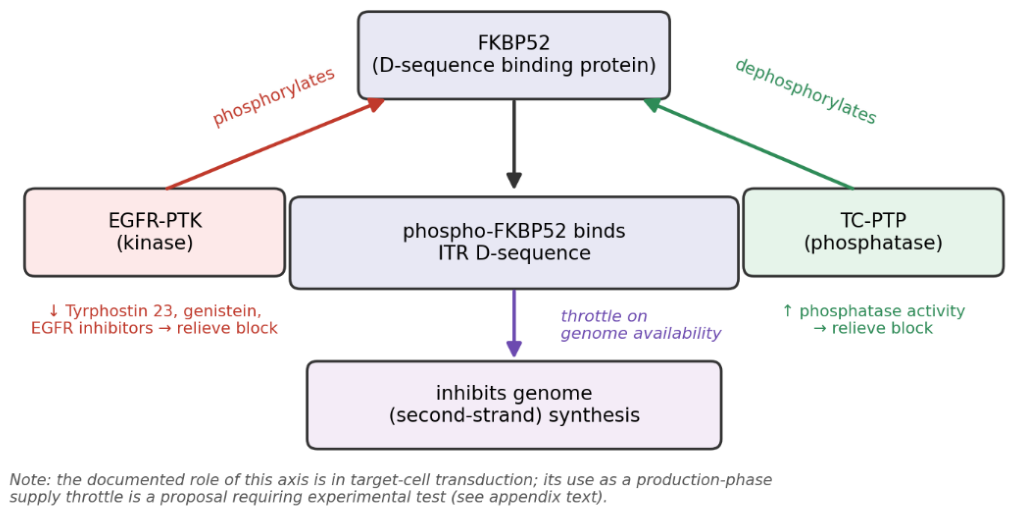
The relevant node is a host-protein interaction at the AAV inverted terminal repeat (ITR). Each ITR contains a short single-stranded element, the D-sequence, which participates in genome replication and packaging. FKBP52 binds this single-stranded D-sequence, and its activity is regulated by phosphorylation: the tyrosine-phosphorylated form binds the D-sequence and inhibits conversion of the single-stranded vector genome to its double-stranded form during second-strand synthesis, whereas the dephosphorylated form does not [Qing et al., 2001; Mah et al., 1998]. The D-sequence is therefore not only a structural motif but also a regulatable control point in AAV genome metabolism.
This control point is governed by opposing enzymatic activities, making it a molecular toggle. Epidermal growth factor receptor protein tyrosine kinase (EGFR-PTK) phosphorylates FKBP52, shifting it toward the inhibitory state, whereas T-cell protein tyrosine phosphatase (TC-PTP) removes the phosphate and relieves the block [Qing et al., 2003; Zhao et al., 2006]. This toggle is pharmacologically addressable with reagents already characterized in the AAV transduction literature. EGFR-PTK inhibitors, including Tyrphostin 23 and genistein, as well as clinically used EGFR inhibitors, reduce FKBP52 phosphorylation and shift it toward the non-inhibitory state [Zhong et al., 2007]. The toggle position, and therefore the throughput of the D-sequence-dependent step, can thus be externally adjusted by small molecules in a dose-dependent manner.
The proposal follows from this logic. If an analogous, externally adjustable handle governs the rate at which packageable genomes accumulate in producer cells, titrating the relevant small molecule could meter genome supply without directly altering capsid expression. In principle, this would keep the instantaneous MOE at or below approximately 1 across an extended loading window. That regime corresponds to the staged, low-instantaneous-MOE condition described in Section 3.4: capsids would encounter genomes slowly enough to accumulate in the protected single-occupancy state, and the achievable authentic fraction would be governed by σ rather than by collapse into multi-occupancy. A continuously tunable small-molecule rheostat would be more convenient than staged transfection or an inducible production line and would, by design, decouple genome supply from capsid supply, as required by the model.
This scheme is speculative, and its central weakness should be stated explicitly. The cited FKBP52 results were obtained in the context of target-cell transduction, where FKBP52 regulates second-strand synthesis of an incoming vector genome after cell entry. They were not measured in producer cells, where the relevant process is Rep-mediated replication and accumulation of single-stranded genomes available for packaging. Repurposing the FKBP52/D-sequence enzymatic control system as a production-phase throttle therefore rests on an untested premise: that the same D-sequence interaction, or an engineered analogue of it, can modulate the supply of packageable genomes during manufacturing. This premise is plausible because the D-sequence is integral to replication and packaging, but its use as a control lever remains unproven. The first requirement for proof of concept would be to show that pharmacological modulation of the FKBP52 phosphorylation balance changes the rate of packageable-genome accumulation in producer cells.
Beyond that primary question, several practical issues would need to be resolved: whether the direction of control is appropriate for the model, specifically whether modulation slows rather than accelerates genome availability; whether the required small-molecule concentrations are compatible with producer-cell viability and overall yield across an extended loading window; and how chemical modulation should be timed relative to capsid assembly. For these reasons, this scheme should be viewed as less immediately actionable than the staged-delivery and inducible-replication approaches described in Section 3.4, which already provide more direct ways to decouple replication from capsid production. Nonetheless, the approach is included because, if the premise holds, it would provide a simple, continuously tunable implementation of the loading control required by the model, using candidate molecules that are already experimentally accessible.
Figure A1.
The FKBP52 / ITR D-sequence axis as a candidate genome-supply throttle. The epidermal growth factor receptor protein tyrosine kinase (EGFR-PTK) phosphorylates FKBP52; the phosphorylated form binds the single-stranded D-sequence of the AAV ITR and inhibits genome (second-strand) synthesis, whereas T-cell protein tyrosine phosphatase (TC-PTP) reverses this modification and relieves the block. Small-molecule EGFR-PTK inhibitors (e.g., Tyrphostin 23, genistein) shift the balance toward the non-inhibitory state, providing dose-dependent external control of the D-sequence-dependent step. This axis is documented to regulate target-cell transduction; its use as a production-phase throttle on packageable-genome supply is proposed here and remains to be tested.
Figure A1.
The FKBP52 / ITR D-sequence axis as a candidate genome-supply throttle. The epidermal growth factor receptor protein tyrosine kinase (EGFR-PTK) phosphorylates FKBP52; the phosphorylated form binds the single-stranded D-sequence of the AAV ITR and inhibits genome (second-strand) synthesis, whereas T-cell protein tyrosine phosphatase (TC-PTP) reverses this modification and relieves the block. Small-molecule EGFR-PTK inhibitors (e.g., Tyrphostin 23, genistein) shift the balance toward the non-inhibitory state, providing dose-dependent external control of the D-sequence-dependent step. This axis is documented to regulate target-cell transduction; its use as a production-phase throttle on packageable-genome supply is proposed here and remains to be tested.
Appendix B. The Stochastic-Occupancy Ceiling,
Premises.
Genome loading deposits genome equivalents into a population of preformed capsids.
Loading events are independent and share a common mean rate; let denote the mean number of genome-equivalents loaded per capsid (the multiplicity of encapsidation, MOE).
No capsid-level memory: the chance that a capsid receives its next genome-equivalent does not depend on how many it already holds. (This premise is relaxed in the Appendix C. Premises).
Derivation. Premises 1–3 are the defining conditions of a Poisson process, so the number of genome-equivalents in a given capsid is Poisson-distributed.
The three operationally relevant occupancy classes are
The multi-occupancy term is simply the tail of the series, .
The authentic single-genome fraction is . Differentiating,
and the second derivative at confirms a maximum. Therefore
At this optimum the population is empty and multi-occupancy.
Monotonic decline beyond the optimum. For , , so raising genome supply past one equivalent per capsid strictly lowers the authentic fraction: the added genomes convert empty capsids into multi-occupancy particles rather than authentic ones. As a polynomial expansion,
a series in whose coefficients are the alternating reciprocal factorials.
Appendix C. Occupancy-Dependent Protection: The Model and the Achievable Ceiling
This appendix relaxes premise 3 of Appendix B and precisely specifies how far, and under what condition, the ceiling can be exceeded.
Premises.
Empty capsids capture genome equivalents via independent Poisson loading, as in Appendix B.
A capsid that already holds one genome captures a second genome at a rate times that of an empty capsid, with . Here, indicates no protection (full memorylessness), and indicates complete protection. As introduced here, is the relative second-capture rate; it is a defined protection coefficient, not a quantity derived from the Poisson model.
Loading is delivered over rounds; in each round, an empty capsid receives a mean dose “” (the instantaneous MOE per round), and a single-occupancy capsid receives a mean dose .
Discrete recursion. Writing for the empty, single, and multi fractions after each round and applying the within-round Poisson splits (an empty capsid stays empty with probability , gains exactly one with , and gains two or more with ; a single-occupancy capsid stays single with and leaks to multi with ),
The invariance (staging does nothing). When the single-occupancy capture rate equals the empty-capsid rate, the population is indistinguishable from one-shot Poisson loading with total mean . Then , maximized at to give exactly , for any schedule. Iterative or staged addition therefore cannot beat the ceiling unless .
Continuous (fully-staged) limit and closed-form model. Let the per-round dose with the cumulative empty-dose retained as the loading variable. The probability of gaining two or more genomes in an infinitesimal increment is , so empties flow only to singles, and the recursion becomes a linear system.
Hence and, solving the first-order linear equation for ,
The limit recovers (by L’Hôpital rule), consistent with Appendix B.
Maximization. Setting ,
and the achievable authentic-fraction ceiling as a function of protection is
Numerical values (by direct substitution; the discrete recursion with fine staging agrees to better than ):
| 1.000 | 1.000 | 0.368 |
| 0.500 | 1.386 | 0.500 |
| 0.300 | 1.720 | 0.597 |
| 0.200 | 2.012 | 0.669 |
| 0.125 | 2.377 | 0.743 |
| 0.100 | 2.558 | 0.774 |
Thus, the figure corresponds to : a loaded capsid roughly less likely to capture a second genome than an empty one.
Polynomial-expansion form. Expanding the closed form about ,
a power series in whose coefficients are the finite geometric sums . At, each such sum equals , reproducing ; note: these are the explicit σ-polynomial coefficients a symbolic calculator returns.
References
- Bleker S, Sonntag F, Kleinschmidt JA. Mutational analysis of narrow pores at the fivefold symmetry axes of adeno-associated virus type 2 capsids reveals a dual role in genome packaging and activation of phospholipase A2 activity. J Virol. 2005;79(4):2528–2540.
- Bleker S, Pawlita M, Kleinschmidt JA. Impact of capsid conformation and Rep-capsid interactions on adeno-associated virus type 2 genome packaging. J Virol. 2006;80(2):810–820.
- Chen Q, Lee CH, Whitfield R, Nesbeth DN. Chronologically distributed transfection improves AAV2 and AAV2/8 capsid filling. Mol Ther Methods Clin Dev. 2025.
- Kaelber JT, Barnakov V, Shen J, Hernandez K, Tarbox HJ, Khan A, Escalante CR. Insights into the AAV packaging mechanism: cryo-EM structure of the AAV2 Rep-capsid packaging complex. bioRxiv. 2025;2025.12.09.693273.
- Kapranov P, Chen L, Dederich D, Dong B, He J, Steinmann KE, Moore AR, Thompson JF, Milos PM, Xiao W. Native molecular state of adeno-associated viral vectors revealed by single-molecule sequencing. Hum Gene Ther. 2012;23(1):46–55.
- King JA, Dubielzig R, Grimm D, Kleinschmidt JA. DNA helicase-mediated packaging of adeno-associated virus type 2 genomes into preformed capsids. EMBO J. 2001;20(12):3282–3291.
- Kuzmin DA, Shutova MV, Johnston NR, et al. The clinical landscape for AAV gene therapies. Nat Rev Drug Discov. 2021;20(3):173–174.
- Laughlin CA, Myers MW, Risin DL, Carter BJ. Defective-interfering particles of the human parvovirus adeno-associated virus. Virology. 1979;94(1):162–174.
- Lecomte E, Tournaire B, Cogné B, et al. Advanced characterization of DNA molecules in rAAV vector preparations by single-stranded virus next-generation sequencing. Mol Ther Nucleic Acids. 2015;4:e260.
- Lee Z, Lu M, Irfanullah E, Soukup M, Hu W-S. Construction of an rAAV producer cell line through synthetic biology. ACS Synth Biol. 2022;11(10):3285–3295.
- Mah C, Qing K, Khuntirat B, Ponnazhagan S, Wang X-S, Kube DM, Yoder MC, Srivastava A. Adeno-associated virus type 2-mediated gene transfer: role of epidermal growth factor receptor protein tyrosine kinase in transgene expression. J Virol. 1998;72(12):9835–9843.
- Merten, O-W. Development of Stable Packaging and Producer Cell Lines for the Production of AAV Vectors. Microorganisms 2024; 12(2) 384.
- Mietzsch M, Pénzes JJ, Agbandje-McKenna M. Twenty-five years of structural parvovirology. Viruses. 2019;11(4):362.
- Mietzsch M, Eddington C, Jose A, Hsi J, Chipman P, Henley T, Choudhry M, McKenna R, Agbandje-McKenna M. Improved genome packaging efficiency of adeno-associated virus vectors using Rep hybrids. J Virol. 2021;95(19):e00773-21.
- Nakatsuka R, Yamaguchi Y, Hirohata K, Shimojo S, Murakami M, Rocafort MAV, Tsunaka Y, et al. Multimass analysis of adeno-associated virus vectors by Orbitrap-based charge detection mass spectrometry. Anal Chem. 2024;96:17037–17046.
- Penaud-Budloo M, François A, Clément N, Ayuso E. Pharmacology of recombinant adeno-associated virus production. Mol Ther Methods Clin Dev. 2018;8:166–180.
- Pierson EE, Keifer DZ, Asokan A, Jarrold MF. Resolving adeno-associated viral particle diversity with charge detection mass spectrometry. Anal Chem. 2016;88(13):6718–6725.
- Qing K, Hansen J, Weigel-Kelley KA, Tan M, Zhou S, Srivastava A. Adeno-associated virus type 2-mediated gene transfer: role of cellular FKBP52 protein in transgene expression. J Virol. 2001;75(19):8968–8976.
- Qing K, Li W, Hansen L, et al. Adeno-associated virus type 2-mediated gene transfer: role of cellular T-cell protein tyrosine phosphatase in transgene expression in established cell lines in vitro and transgenic mice in vivo. J Virol. 2003;77(4):2741–2746.
- Ren, H, Nie, J, Son, Z, Yang Y, Bai Z. Enhanced Adeno-Associated Virus Production in HEK293 Cells vis Dual Inducible Control of Cap and Rep Proteins. Biotech Bioeng 2025; 1222(10):2862-2873.
- Tai PWL, Xie J, Fong K, Seetin M, Heiner C, Su Q, et al. Adeno-associated virus genome population sequencing achieves full vector genome resolution and reveals human-vector chimeras. Mol Ther Methods Clin Dev. 2018;9:130–141.
- Wang D, Tai PWL, Gao G. Adeno-associated virus vector as a platform for gene therapy delivery. Nat Rev Drug Discov. 2019;18(5):358–378.
- Wörner TP, Bennett A, Habka S, Snijder J, Friese O, Powers T, Agbandje-McKenna M, Heck AJR. Adeno-associated virus capsid assembly is divergent and stochastic. Nat Commun. 2021;12:1642.
- Zhang J, Guo P, Yu X, Frabutt DA, Lam AK, Mulcrone PL, et al. Subgenomic particles in rAAV vectors result from DNA lesion/break and non-homologous end joining of vector genomes. Mol Ther Nucleic Acids. 2022;29:852–861.
- Zhao W, Zhong L, Wu J, Chen L, Qing K, Weigel-Kelley KA, et al. Role of cellular FKBP52 protein in intracellular trafficking of recombinant adeno-associated virus 2 vectors. Virology. 2006;353(2):283–293.
- Zhong L, et al. A dual role of EGFR protein tyrosine kinase signaling in ubiquitination of AAV2 capsids and viral second-strand DNA synthesis. Mol Ther. 2007. 15(7):1323-30.
Disclaimer/Publisher’s Note: The statements, opinions and data contained in all publications are solely those of the individual author(s) and contributor(s) and not of MDPI and/or the editor(s). MDPI and/or the editor(s) disclaim responsibility for any injury to people or property resulting from any ideas, methods, instructions or products referred to in the content. |
© 2026 by the authors. Licensee MDPI, Basel, Switzerland. This article is an open access article distributed under the terms and conditions of the Creative Commons Attribution (CC BY) license (http://creativecommons.org/licenses/by/4.0/).
Copyright: This open access article is published under a Creative Commons CC BY 4.0 license, which permit the free download, distribution, and reuse, provided that the author and preprint are cited in any reuse.


