

Submitted:
16 July 2026
Posted:
17 July 2026
You are already at the latest version
Abstract
MicroRNAs (miRNAs) are small non-coding RNAs that regulate gene expression through post-transcriptional gene silencing. Since their discovery, miRNAs have emerged as key regulators of numerous biological processes and have been implicated in a wide range of human diseases, including liver cancer. Altered miRNA expression profiles have been associated with disease initiation, progression, therapeutic response, and clinical outcome, including in chronic liver diseases and hepatocellular carcinoma, where numerous dysregulated miRNAs have been proposed as therapeutic targets. Consequently, considerable efforts have focused on restoring downregulated tumor suppressor miRNAs using synthetic mimics or inhibiting oncogenic miRNAs with antisense oligonucleotides and related technologies. Despite encouraging preclinical results and substantial investment over the past two decades, the clinical translation of miRNA-based therapeutics has remained limited.In this review, we examine the biological and translational challenges that inherently limit therapeutic modulation of miRNAs in vivo. We discuss how the broad regulatory scope of individual miRNAs, their extensive target networks, context-dependent functions, functional redundancy, and the difficulty of achieving physiologically relevant modulation contribute to unpredictable therapeutic outcomes. Collectively, the available data suggests that although miRNAs remain invaluable biomarkers and powerful tools for understanding disease biology, the very biological properties that make them attractive regulators of cellular processes also represent fundamental challenges to their successful therapeutic application.
Keywords:
microRNA therapeutics
; chronic liver disease
; antisense oligonucleotides
; clinical studies
Introduction
MicroRNAs (miRNAs) are a class of evolutionarily conserved, small non-coding RNAs of approximately 21–23 nucleotides that regulate gene expression primarily through post-transcriptional mechanisms [1]. A defining feature of miRNA biology is their mode of action across molecular networks. That is to say, individual miRNAs have been shown to modulate the translation of hundreds of targets, while the levels of translation of single transcript is often fine-tuned by multiple miRNAs [2,3]. Consequently, therapeutic modulation of a single miRNA has the potential to influence intersecting regulatory networks. Since their discovery, miRNAs have been implicated in virtually all fundamental cellular processes, including development [4], differentiation [5], proliferation [6], apoptosis [7], metabolism [8], and immune regulation [9]. Accordingly, dysregulated miRNA expression has been linked to the biogenesis of human disease, with particularly strong evidence in liver cancer and in chronic liver diseases, including viral hepatitis [10], metabolic dysfunction-associated steatotic liver disease (MASLD) [11], alcohol-associated liver disease (ALD) [12], liver fibrosis [13,14], cirrhosis [15], and hepatocellular carcinoma (HCC) [16,17]. In the liver, numerous miRNAs have been associated with disease progression and clinical outcome, leading to the hypothesis that their therapeutic modulation could provide a strategy to influence gene regulatory programs involved in disease pathogenesis. In liver cancer and other malignancies, miRNAs can function either as tumor suppressors [17,18] or oncogenic drivers (oncomiRs) [19], influencing key cancer hallmarks including proliferation [19], immune evasion [9], epithelial-to-mesenchymal transition [20], and metastatic dissemination [21,22]. These properties have made miRNAs attractive targets for therapeutic development.
Among solid organs, the liver represents an especially attractive target for RNA-based therapeutics. Receiving approximately 25% of cardiac output through its dual blood supply and possessing a highly fenestrated sinusoidal endothelium, the liver is readily accessible to systemically administered oligonucleotides. Moreover, hepatocytes account for approximately 70–80% of the liver cell population and selectively express the asialoglycoprotein receptor (ASGPR) [23], enabling highly efficient and clinically validated hepatocyte-specific delivery through N-acetylgalactosamine (GalNAc) conjugation [24]. The clinical success of GalNAc-conjugated siRNA therapeutics has demonstrated that efficient, selective, and well-tolerated delivery of nucleic acids to hepatocytes is achievable in humans, substantially reducing delivery as a major barrier for liver-directed RNA therapeutics and placing greater emphasis on the biological characteristics of the therapeutic target itself. As illustrated in Figure 1, therapeutic modulation of miRNAs differs fundamentally from conventional RNA-targeted therapies because a single miRNA simultaneously regulates numerous downstream transcripts and biological pathways rather than a single disease-associated transcript [2,3]. Despite compelling biological rationale, the clinical translation of miRNA-based therapeutics has been largely unsuccessful [25]. While the limited predictive value of preclinical models undoubtedly contributes to this disconnect [26], we propose that the fundamental biological properties of miRNAs themselves may represent an additional and underappreciated barrier to therapeutic success. This apparent discrepancy raises a fundamental question: if GalNAc conjugation enables efficient and selective delivery of RNA therapeutics to hepatocytes, why have miRNA-targeting strategies achieved only limited clinical success despite strong biological rationale and encouraging preclinical evidence?
In this review, we examine whether the challenges encountered in the clinical development of miRNA therapeutics reflect intrinsic features of miRNA biology rather than limitations in delivery technologies or oligonucleotide chemistry. We discuss evidence from clinical trials across different disease contexts, with a focus on chronic liver diseases.
Clinical Development of miRNA Therapeutics
Two principal pharmacological strategies have been pursued for miRNA therapeutics: (i) restoration of reduced miRNA activity using synthetic miRNA mimics, typically for tumor suppressor miRNAs (e.g., miR-34a [27]; see Table 1); and (ii) inhibition of overexpressed pathogenic miRNAs using antisense oligonucleotides (e.g., miR-122 [8,28]; see Table 1), including locked nucleic acids (LNAs), antagomirs, and related chemistries. In multiple preclinical studies, both strategies have shown robust target engagement and phenotypic effects, often accompanied by apparent disease modification, driving the advancement of several candidates into clinical trials.
Despite compelling preclinical evidence supporting both miRNA replacement and miRNA inhibition strategies, the clinical translation of miRNA therapeutics has remained limited. Over the past two decades, multiple miRNA-targeting programs have advanced to clinical evaluation across diverse diseases, including cancer, viral infections, fibrosis, and metabolic disorders. An overview of these clinical programs and their translational outcomes is presented in Figure 2, while the corresponding therapeutic strategies and clinical indications, are summarized in Table 2.
Collectively, these studies illustrate a broad spectrum of challenges, including organ-specific and immune-mediated toxicities during clinical development. Importantly, many of these programs were supported by compelling preclinical evidence demonstrating target engagement and therapeutic benefit in experimental models, highlighting the disconnect between strikingly preclinical data and clinical trial outcomes. In the following sections we examine these selected clinical programs individually, focusing on their biological rationale, preclinical evidence, clinical outcomes, and the mechanistic insights they provide into the challenges associated with therapeutic modulation of miRNAs. Although each program presents distinct clinical and biological features, together they reveal recurring patterns that support a common underlying biological principle.
miRNA Replacement Strategies (miR-34a)
The development of MRX34, a synthetic miR-34a mimic, represents the first clinical attempt to restore the activity of a tumor-suppressive miRNA in cancer patients and remains one of the most illustrative examples of the challenges associated with miRNA replacement therapy [29,30]. miR-34a was selected as a therapeutic candidate based on extensive evidence supporting its role as a tumor suppressor across multiple cancer types. miR-34a expression is frequently reduced in human malignancies, including hepatocellular carcinoma, and is transcriptionally regulated by p53 [31]. Functional studies demonstrated that restoration of miR-34a activity induces cell-cycle arrest, promotes apoptosis, suppresses cancer stem cell properties, and inhibits tumor growth through coordinated regulation of multiple oncogenic pathways, including MYC, MET, BCL2, and other cancer-associated targets [32]. These findings were further supported by preclinical studies showing antitumor activity of miR-34a replacement in xenograft and genetically engineered mouse models [33], providing the rationale for clinical development of MRX34.
MRX34 entered a first-in-human phase I clinical trial (NCT01829971) using a liposomal nanoparticle formulation designed for systemic delivery of the miR-34a mimic [27]. Although pharmacodynamic evidence indicated target engagement and some patients achieved stable disease or partial responses, clinical development of MRX34 was terminated after the emergence of severe immune-mediated toxicities during the phase I trial. The study was closed early after serious immune-related adverse events resulted in four treatment-related deaths, highlighting the difficulty of predicting systemic toxicity associated with miRNA replacement strategies [30]. Subsequent analyses suggested that the toxicity profile of MRX34 likely reflected a combination of factors, including immune activation associated with systemic miRNA mimic delivery and the broad biological functions of miR-34a itself. Beyond its tumor suppressive activity, miR-34a participates in the regulation of immune responses, cellular homeostasis, and stress adaptation [34,35], raising the possibility that systemic restoration of miR-34a may affect physiological pathways beyond the intended antitumor effects.
The MRX34 experience highlights a central challenge of miRNA replacement strategies: restoring a miRNA that is lost during tumor development does not selectively reactivate a single tumor suppressive pathway but instead perturbs a broad regulatory network across multiple tissues. Thus, the same biological properties that initially supported miR-34a as an attractive therapeutic candidate—its ability to regulate numerous oncogenic pathways simultaneously—also contributed to the difficulty of predicting systemic consequences following pharmacological intervention.
miRNA Inhibition in Liver-Targeted Disease (miR-122)
The clinical development of miR-122 inhibitors represents one of the most informative examples of the challenges associated with therapeutic miRNA inhibition, particularly in the liver. miR-122 is a highly abundant, liver-enriched miRNA accounting for approximately 70% of the total miRNA population in hepatocytes and was initially identified as a critical host factor required for hepatitis C virus (HCV) replication [10,11]. Through binding to conserved sequences within the HCV genome, miR-122 promotes viral RNA stability and replication, providing a strong biological rationale for therapeutic inhibition. Consequently, miR-122 emerged as an attractive target for antiviral intervention, with the expectation that selective suppression of a liver-restricted miRNA would provide potent antiviral activity while limiting systemic toxicity [36].
Miravirsen, an LNA-modified antisense oligonucleotide developed to inhibit miR-122, represented the first miRNA-targeting therapeutic to demonstrate clinical activity. In preclinical studies, Miravirsen produced potent and durable inhibition of miR-122, resulting in marked suppression of HCV replication in chimpanzee models and sustained antiviral effects in early clinical studies [37]. Phase I and II clinical trials demonstrated dose-dependent reductions in HCV RNA, confirming target engagement and supporting the feasibility of miRNA inhibition in humans. However, despite these encouraging results, Miravirsen did not progress toward clinical use as a broadly applicable antiviral therapy [38], largely due to changes in the therapeutic landscape following the emergence of highly effective direct-acting antiviral agents.
A second approach targeting the same miRNA, RG-101, further illustrated the complexity of miR-122 inhibition. RG-101 was a GalNAc-conjugated antisense oligonucleotide designed to exploit the hepatocyte-specific ASGPR pathway for efficient delivery of anti-miR-122 activity [39]. In contrast to Miravirsen, RG-101 demonstrated the potential of next-generation liver-targeted delivery approaches and achieved potent suppression of miR-122 with antiviral activity in clinical studies. However, development was discontinued after the occurrence of safety concerns, including transient hyperbilirubinemia and cases of jaundice, which prompted regulatory evaluation and termination of the clinical program.
The experience with miR-122 inhibition highlights an important distinction between achieving hepatocyte delivery and achieving safe therapeutic modulation of a hepatic miRNA. Although miR-122 was initially considered an attractive antiviral target because of its liver-restricted expression and essential role in HCV replication, subsequent studies demonstrated that miR-122 also regulates fundamental aspects of liver biology, including cholesterol and lipid metabolism, hepatocyte differentiation, inflammatory responses, and tumor suppression. In collaboration with Santaris Pharma, we demonstrated that pharmacological inhibition of miR-122 using Miravirsen induced systemic iron deficiency in mice by disrupting miR-122-dependent regulation of iron homeostasis, revealing an unanticipated physiological function of this miRNA [28]. Subsequent studies further showed that loss of miR-122 promotes chronic hepatic inflammation, fibrosis, and spontaneous hepatocellular carcinoma development in mice, indicating that miR-122 functions as a critical regulator of liver homeostasis [40,41]. Together, these findings illustrate the central challenge of therapeutic miRNA inhibition: the disease-associated function that identifies a miRNA as a therapeutic target often represents only one component of a much broader physiological role. The outcomes of these clinical trials demonstrates that even a highly liver-enriched miRNA, targeted using clinically validated hepatocyte delivery technologies, cannot be considered equivalent to a conventional single-gene therapeutic target.
miRNA Inhibition Strategies in Cancer and Metabolic Disease (miR-155, miR-21, miR-107)
Additional clinical programs targeting oncogenic miRNAs have further highlighted the challenges associated with translating promising biological concepts into effective therapies. miR-155, miR-21, and miR-103/107 were selected as therapeutic targets based on extensive preclinical evidence implicating these miRNAs in cancer progression, fibrosis, or metabolic regulation. However, clinical development of inhibitors against these miRNAs has been limited by insufficient efficacy, safety concerns, or termination despite strong mechanistic rationales.
miR-155 represents a prototypical oncomiR involved in immune regulation and hematological malignancies [21]. Overexpression of miR-155 promotes lymphomagenesis through modulation of multiple targets involved in inflammation, immune signaling, and cell survival. The LNA-modified anti-miR-155 oligonucleotide cobomarsen (MRG-106) demonstrated efficient miR-155 inhibition and encouraging activity in preclinical models of lymphoma and cutaneous T-cell lymphoma (CTCL) [42]. Early clinical studies showed biological activity and partial responses in CTCL; however, the program did not achieve sufficient clinical benefit for further development [43]. These findings illustrate the challenge of targeting a miRNA that regulates multiple interconnected pathways, where inhibition of a single regulatory node may be insufficient to overcome the complexity and redundancy of malignant signaling networks.
Similarly, miR-21 was identified as a broadly acting oncomiR and profibrotic miRNA, with increased expression reported across multiple cancers and chronic diseases [44]. Preclinical studies demonstrated that miR-21 inhibition could suppress tumor growth and fibrosis in experimental models. The anti-miR-21 oligonucleotide RG-012 (lademirsen) advanced to clinical evaluation for Alport syndrome based on preclinical evidence of reduced renal fibrosis [45]; Although miR-21 inhibition achieved measurable pharmacological effects, the trial was discontinued following lack of sufficient clinical efficacy [46]. These findings highlight the difficulty of translating modulation of a pleiotropic regulatory miRNA into a significant impact in the clinical display of patients.
A similar pattern was observed for miR-103 and miR-107. These closely related miRNAs differ by only a single nucleotide at the 3′ end of their mature sequences and share an identical seed sequence, resulting in substantial overlap in their predicted target repertoire and biological functions [47]. Based on compelling preclinical evidence implicating miR-103/107 in metabolic regulation and insulin sensitivity [48], the antisense oligonucleotide RG-125 (AZD4076), a GalNAc-conjugated antisense oligonucleotide targeting the miR-103/107 family, was advanced into clinical development for metabolic disorders, including type 2 diabetes and NASH, based on preclinical studies demonstrating improved insulin sensitivity and glucose homeostasis. However, despite encouraging preclinical findings, the clinical development program was subsequently discontinued. Subsequent, independent studies demonstrated that miR-103/107 also regulate additional physiological processes, including cardiac metabolism and function [49], and have been reported to exert tumor-suppressive activities in liver cancer [17]. Moreover, the extensive overlap in target recognition between miR-103 and miR-107 raises the possibility that inhibition of a single family member may be partially compensated by the other, further limiting therapeutic efficacy. Collectively, these findings illustrate how the biological functions that initially identify a miRNA as a therapeutic target may represent only a subset of its physiological roles, complicating the prediction of both efficacy and safety following systemic miRNA inhibition.
Together, these examples reinforce the concept that inhibition of an oncogenic or disease-associated miRNA does not necessarily reproduce the selective suppression of a single pathological pathway. Instead, therapeutic inhibition modifies a broader regulatory network, where biological redundancy, compensatory responses, and incomplete pharmacodynamic effects may limit clinical efficacy.
Lessons from Clinical miRNA Programs
Although the clinical programs discussed above targeted distinct miRNAs and disease contexts, they reveal recurring failure patterns that extend beyond individual therapeutic candidates. MRX34 illustrates the challenges of miRNA replacement [30], where systemic restoration of a tumor suppressive miRNA resulted in unexpected immune-mediated toxicity despite strong preclinical efficacy. The clinical trials conducted to silence miR-122 demonstrates that even a liver-enriched miRNA with a well-defined disease-associated function and successful hepatocyte delivery (e.g., the ASGPR/GalNAc axis) can produce unforeseen consequences when broader physiological roles are disrupted [38,39]. Programs targeting miR-155 highlight the difficulty of modulating immune-associated regulatory networks in the presence of biological redundancy and compensatory mechanisms [42,43]. Similarly, miR-21 inhibition illustrates the challenge of translating anti-fibrotic effects observed in experimental models into meaningful clinical benefit [45,46], while miR-103/107 targeting emphasizes the difficulty of achieving sufficient therapeutic impact when modulating broadly expressed regulatory miRNAs [47,48]. Collectively, these examples suggest that the limitations encountered during clinical development are not restricted to a specific miRNA, disease indication, or therapeutic platform, but reflect recurring challenges inherent to the biological properties of miRNAs themselves.
Discussion
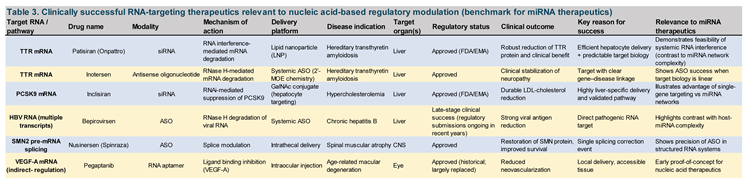
Clinical experience accumulated over the past two decades suggests that the limited success of miRNA therapeutics cannot be explained solely by limitations inherent to RNA-based therapeutic approaches or by challenges in delivery technologies. Indeed, the clinical success of GalNAc conjugation for hepatocyte-directed delivery has demonstrated that efficient, selective, and well-tolerated delivery of RNA therapeutics to the liver is achievable in humans. In fact, the clinical approval of multiple RNA therapeutics across diverse tissues and disease settings—including liver-directed therapies such as patisiran and inclisiran [50], central nervous system-targeted antisense oligonucleotides such as nusinersen and tofersen [51], and exon-skipping therapies for Duchenne muscular dystrophy such as eteplirsen [52]—demonstrates that RNA-therapeutics can be effective when directed against targets with a well-defined function [53] (Table 3).
One important factor contributing to the challenges for achieving a successful translation of miRNA therapeutics into the clinical praxis is the inadequate predictive value of current experimental models. More broadly, the poor translation of promising preclinical findings into effective therapies is a well-recognized challenge in biomedical research, not only associated to miRNA-therapeutics, reflecting the inability of existing experimental models to fully recapitulate the cellular complexity, tissue architecture, disease heterogeneity, and chronic progression of human disease. This limitation is particularly relevant for miRNAs, whose biological functions are highly dependent on cell type, disease stage, and the surrounding tissue microenvironment.
A second, and perhaps more fundamental, limitation stems from the role played by miRNAs in gene regulation. Rather than acting as “binary molecular switches”, miRNAs fine-tune gene expression by modulating hundreds of transcripts within interconnected networks. Furthermore, many miRNAs are expressed across multiple cell types and tissues, where their biological functions vary according to the cellular and pathological context. Consequently, therapeutic modulation of a single miRNA can simultaneously affect multiple biological processes, making both therapeutic efficacy and adverse effects inherently difficult to predict, a concept illustrated in Figure 3.
The clinical development of anti-miR-122 therapies provides a notable example of this challenge. Initial studies identified miR-122 as a critical host factor required for hepatitis C virus replication, making its inhibition an attractive antiviral strategy. However, work performed by our group in collaboration with Santaris Pharma demonstrated that in vivo silencing of miR-122 using Miravirsen induced systemic iron deficiency in mice, revealing an unexpected role for miR-122 in the regulation of systemic iron homeostasis [28]. Subsequent studies from independent groups further demonstrated that genetic or pharmacological loss of miR-122 promotes chronic hepatic inflammation and spontaneous liver cancer development in mice. Additional work showed that miR-122 expression is physiologically downregulated during infection, inflammation, and liver regeneration, suggesting that transient suppression of miR-122 forms part of a tightly regulated adaptive response. Collectively, these observations indicate that miR-122 participates in a broad network of functions extending far beyond viral replication. In retrospect, the clinical development of anti-miR-122 strategies illustrates how a therapeutically attractive phenotype may obscure a substantially larger set of physiological functions that become apparent only upon systemic inhibition.
A similar conclusion emerges from studies targeting miR-103/107. These miRNAs were initially proposed as therapeutic targets based on preclinical evidence implicating them in metabolic regulation and insulin sensitivity, ultimately leading to the clinical development of RG-125 (AZD4076). However, the corresponding clinical program was discontinued despite encouraging preclinical data. Independent studies subsequently suggested that inhibition of miR-103/107 may adversely affect cardiac metabolism and function. In parallel, our own work investigating miR-107 in hepatocellular carcinoma revealed an important conceptual distinction between targeting a regulatory miRNA and targeting its critical downstream effector. While restoration of miR-107 expression delayed tumor development in oncogene-driven liver cancer models, direct silencing of its downstream target KIF23 completely prevented tumor formation. These findings suggest that modulation of the upstream miRNA may only partially influence the relevant disease network while simultaneously affecting numerous unrelated pathways, whereas direct targeting of a validated downstream effector achieves greater specificity and therapeutic impact.
Together, these examples illustrate a broader principle that likely extends beyond miR-122 and miR-103/107. The biological functions that initially identify a miRNA as an attractive therapeutic target often represent only a subset of its physiological roles. Because individual miRNAs regulate extensive gene networks across multiple tissues, therapeutic modulation inevitably influences both disease-relevant and unrelated biological processes. However, the therapeutic objective in most diseases is rarely to broadly reprogram gene regulatory networks but rather to selectively modulate a limited number of disease-driving effectors. This concept also helps explain why clinically successful RNA therapeutics have predominantly targeted individual transcripts with well-defined causal roles in disease. Taken together, the available evidence suggests that the challenges encountered during the clinical development of miRNA therapeutics reflect not only limitations inherent to specific delivery of active compounds but also fundamental biological properties of miRNAs themselves. The same characteristics that make miRNAs invaluable modulators of cellular homeostasis and informative biomarkers, also limit their suitability as therapeutic targets. Rather than directly targeting regulatory miRNAs, future RNA-based therapeutic strategies may benefit from using miRNA biology to identify critical downstream disease effectors that can be targeted with greater efficacy and safety.
Software and Figures
Figures were generated with Biorender and edited by using Affinity Canva (v3.2.2)
Acknowledgments
The authors are grateful to the colleagues within the Department of Gastroenterology, Hepatology and Infectious Diseases at the University Hospital of Dusseldorf for the valuable feedback.
Conflicts of Interest
The author has no relevant financial or non-financial interests to disclose.
Abbreviations
microRNAs (miRNAs), antisense oligonucleotides (ASOs), small interfering RNAs (siRNAs), locked nucleic acids (LNAs), hepatocellular carcinoma (HCC), metabolic dysfunction-associated steatotic liver disease (MASLD), alcohol-associated liver disease (ALD), asialoglycoprotein receptor (ASGPR), N-acetylgalactosamine (GalNAc), hepatitis C virus (HCV), T-cell lymphoma (CTCL), direct-acting antivirals (DAAs).
References
- Kim, H.; Lee, Y.Y.; Kim, V.N. The biogenesis and regulation of animal microRNAs. Nat Rev. Mol. Cell Biol 2025, 26(4), 276–296. [Google Scholar] [CrossRef] [PubMed]
- Denzler, R.; McGeary, S.E.; Title, A.C.; Agarwal, V.; Bartel, D.P.; Stoffel, M. Impact of MicroRNA Levels, Target-Site Complementarity, and Cooperativity on Competing Endogenous RNA-Regulated Gene Expression. Mol Cell 2016, 64(3), 565–579. [Google Scholar] [CrossRef] [PubMed]
- Bjerke, G.A.; Yi, R. Integrated analysis of directly captured microRNA targets reveals the impact of microRNAs on mammalian transcriptome. RNA 2020, 26(3), 306–323. [Google Scholar] [CrossRef] [PubMed]
- Zhao, Y.; Samal, E.; Srivastava, D. Serum response factor regulates a muscle-specific microRNA that targets Hand2 during cardiogenesis. Nature 2005, 436(7048), 214–220. [Google Scholar] [CrossRef] [PubMed]
- Melton, C.; Judson, R.L.; Blelloch, R. Opposing microRNA families regulate self-renewal in mouse embryonic stem cells. Nature 2010, 463(7281), 621–626. [Google Scholar] [CrossRef] [PubMed]
- Ventura, A.; Young, A.G.; Winslow, M.M.; Lintault, L.; Meissner, A.; Erkeland, S.J.; Newman, J.; Bronson, R.T.; Crowley, D.; Stone, J.R.; Jaenisch, R.; Sharp, P.A.; Jacks, T. Targeted deletion reveals essential and overlapping functions of the miR-17 through 92 family of miRNA clusters. Cell 2008, 132(5), 875–886. [Google Scholar] [CrossRef] [PubMed]
- Cimmino, A.; Calin, G.A.; Fabbri, M.; Iorio, M.V.; Ferracin, M.; Shimizu, M.; Wojcik, S.E.; Aqeilan, R.I.; Zupo, S.; Dono, M.; Rassenti, L.; Alder, H.; Volinia, S.; Liu, C.G.; Kipps, T.J.; Negrini, M.; Croce, C.M. miR-15 and miR-16 induce apoptosis by targeting BCL2. Proc Natl. Acad. Sci. U S A 2005, 102(39), 13944–13949. [Google Scholar] [CrossRef] [PubMed]
- Esau, C.; Davis, S.; Murray, S.F.; Yu, X.X.; Pandey, S.K.; Pear, M.; Watts, L.; Booten, S.L.; Graham, M.; McKay, R.; Subramaniam, A.; Propp, S.; Lollo, B.A.; Freier, S.; Bennett, C.F.; Bhanot, S.; Monia, B.P. miR-122 regulation of lipid metabolism revealed by in vivo antisense targeting. Cell Metab 2006, 3(2), 87–98. [Google Scholar] [CrossRef] [PubMed]
- O’Connell, R.M.; Kahn, D.; Gibson, W.S.; Round, J.L.; Scholz, R.L.; Chaudhuri, A.A.; Kahn, M.E.; Rao, D.S.; Baltimore, D. MicroRNA-155 promotes autoimmune inflammation by enhancing inflammatory T cell development. Immunity 2010, 33(4), 607–619. [Google Scholar] [CrossRef] [PubMed]
- Henke, J.I.; Goergen, D.; Zheng, J.; Song, Y.; Schuttler, C.G.; Fehr, C.; Junemann, C.; Niepmann, M. microRNA-122 stimulates translation of hepatitis C virus RNA. EMBO J 2008, 27(24), 3300–3310. [Google Scholar] [CrossRef] [PubMed]
- Cheung, O.; Puri, P.; Eicken, C.; Contos, M.J.; Mirshahi, F.; Maher, J.W.; Kellum, J.M.; Min, H.; Luketic, V.A.; Sanyal, A.J. Nonalcoholic steatohepatitis is associated with altered hepatic MicroRNA expression. Hepatology 2008, 48(6), 1810–1820. [Google Scholar] [CrossRef] [PubMed]
- Bala, S.; Marcos, M.; Kodys, K.; Csak, T.; Catalano, D.; Mandrekar, P.; Szabo, G. Up-regulation of microRNA-155 in macrophages contributes to increased tumor necrosis factor alpha (TNFalpha) production via increased mRNA half-life in alcoholic liver disease. J Biol. Chem 2011, 286(2), 1436–1444. [Google Scholar] [CrossRef] [PubMed]
- Zhang, Y.; Ghazwani, M.; Li, J.; Sun, M.; Stolz, D.B.; He, F.; Fan, J.; Xie, W.; Li, S. MiR-29b inhibits collagen maturation in hepatic stellate cells through down-regulating the expression of HSP47 and lysyl oxidase. Biochem Biophys. Res. Commun 2014, 446(4), 940–944. [Google Scholar] [CrossRef] [PubMed]
- Roderburg, C.; Urban, G.W.; Bettermann, K.; Vucur, M.; Zimmermann, H.; Schmidt, S.; Janssen, J.; Koppe, C.; Knolle, P.; Castoldi, M.; Tacke, F.; Trautwein, C.; Luedde, T. Micro-RNA profiling reveals a role for miR-29 in human and murine liver fibrosis. Hepatology 2011, 53(1), 209–218. [Google Scholar] [CrossRef] [PubMed]
- Ji, J.; Shi, J.; Budhu, A.; Yu, Z.; Forgues, M.; Roessler, S.; Ambs, S.; Chen, Y.; Meltzer, P.S.; Croce, C.M.; Qin, L.X.; Man, K.; Lo, C.M.; Lee, J.; Ng, I.O.; Fan, J.; Tang, Z.Y.; Sun, H.C.; Wang, X.W. MicroRNA expression, survival, and response to interferon in liver cancer. N Engl. J. Med 2009, 361(15), 1437–1447. [Google Scholar] [CrossRef] [PubMed]
- Kota, J.; Chivukula, R.R.; O’Donnell, K.A.; Wentzel, E.A.; Montgomery, C.L.; Hwang, H.W.; Chang, T.C.; Vivekanandan, P.; Torbenson, M.; Clark, K.R.; Mendell, J.R.; Mendell, J.T. Therapeutic microRNA delivery suppresses tumorigenesis in a murine liver cancer model. Cell 2009, 137(6), 1005–1017. [Google Scholar] [CrossRef] [PubMed]
- Castoldi, M.; Roy, S.; Angendohr, C.; Pellegrino, R.; Vucur, M.; Singer, M.T.; Buettner, V.; Dille, M.A.; Wolf, S.D.; Heij, L.R.; Ghallab, A.; Albrecht, W.; Hengstler, J.G.; Flügen, G.; Knoefel, W.T.; Bode, J.G.; Zender, L.; Neumann, U.P.; Heikenwälder, M.; Longerich, T.; Roderburg, C.; Luedde, T. Regulation of KIF23 by miR-107 controls replicative tumor cell fitness in mouse and human hepatocellular carcinoma. Journal Hepatol.> 2025, 82(3), 499–511. [Google Scholar] [CrossRef] [PubMed]
- Roy, S.; Hooiveld, G.J.; Seehawer, M.; Caruso, S.; Heinzmann, F.; Schneider, A.T.; Frank, A.K.; Cardenas, D.V.; Sonntag, R.; Luedde, M.; Trautwein, C.; Stein, I.; Pikarsky, E.; Loosen, S.; Tacke, F.; Ringelhan, M.; Avsaroglu, S.K.; Goga, A.; Buendia, M.A.; Vucur, M.; Heikenwalder, M.; Zucman-Rossi, J.; Zender, L.; Roderburg, C.; Luedde, T. microRNA 193a-5p Regulates Levels of Nucleolar- and Spindle-Associated Protein 1 to Suppress Hepatocarcinogenesis. Gastroenterology 2018, 155(6), 1951–1966 e1926. [Google Scholar] [CrossRef] [PubMed]
- Meng, F.; Henson, R.; Wehbe-Janek, H.; Ghoshal, K.; Jacob, S.T.; Patel, T. MicroRNA-21 regulates expression of the PTEN tumor suppressor gene in human hepatocellular cancer. Gastroenterology 2007, 133(2), 647–658. [Google Scholar] [CrossRef] [PubMed]
- Liu, Z.; Wang, J.; Guo, C.; Fan, X. microRNA-21 mediates epithelial-mesenchymal transition of human hepatocytes via PTEN/Akt pathway. Biomed Pharmacother 2015, 69, 24–28. [Google Scholar] [CrossRef] [PubMed]
- Mohan, S.; Hakami, M.A.; Dailah, H.G.; Khalid, A.; Najmi, A.; Zoghebi, K.; Halawi, M.A.; Alotaibi, T.M. From inflammation to metastasis: The central role of miR-155 in modulating NF-kappaB in cancer. Pathol Res. Pr.> 2024, 253, 154962. [Google Scholar] [CrossRef] [PubMed]
- Ma, L.; Teruya-Feldstein, J.; Weinberg, R.A. Tumour invasion and metastasis initiated by microRNA-10b in breast cancer. Nature 2007, 449(7163), 682–688. [Google Scholar] [CrossRef] [PubMed]
- Gu, D.; Jin, H.; Jin, G.; Wang, C.; Wang, N.; Hu, F.; Luo, Q.; Chu, W.; Yao, M.; Qin, W. The asialoglycoprotein receptor suppresses the metastasis of hepatocellular carcinoma via LASS2-mediated inhibition of V-ATPase activity. Cancer Lett 2016, 379(1), 107–116. [Google Scholar] [CrossRef] [PubMed]
- Debacker, A.J.; Voutila, J.; Catley, M.; Blakey, D.; Habib, N. Delivery of Oligonucleotides to the Liver with GalNAc: From Research to Registered Therapeutic Drug. Mol Ther 2020, 28(8), 1759–1771. [Google Scholar] [CrossRef] [PubMed]
- van Rooij, E.; Kauppinen, S. Development of microRNA therapeutics is coming of age. EMBO Mol. Med 2014, 6(7), 851–864. [Google Scholar] [CrossRef] [PubMed]
- Mak, I.W.; Evaniew, N.; Ghert, M. Lost in translation: animal models and clinical trials in cancer treatment. Am J. Transl. Res 2014, 6(2), 114–118. [Google Scholar] [PubMed]
- Trang, P.; Wiggins, J.F.; Daige, C.L.; Cho, C.; Omotola, M.; Brown, D.; Weidhaas, J.B.; Bader, A.G.; Slack, F.J. Systemic delivery of tumor suppressor microRNA mimics using a neutral lipid emulsion inhibits lung tumors in mice. Mol Ther 2011, 19(6), 1116–1122. [Google Scholar] [CrossRef] [PubMed]
- Castoldi, M.; Vujic Spasic, M.; Altamura, S.; Elmen, J.; Lindow, M.; Kiss, J.; Stolte, J.; Sparla, R.; D’Alessandro, L.A.; Klingmuller, U.; Fleming, R.E.; Longerich, T.; Grone, H.J.; Benes, V.; Kauppinen, S.; Hentze, M.W.; Muckenthaler, M.U. The liver-specific microRNA miR-122 controls systemic iron homeostasis in mice. J Clin. Invest 2011, 121(4), 1386–1396. [Google Scholar] [CrossRef] [PubMed]
- Bouchie, A. First microRNA mimic enters clinic. Nat Biotechnol 2013, 31(7), 577. [Google Scholar] [CrossRef] [PubMed]
- Hong, D.S.; Kang, Y.K.; Borad, M.; Sachdev, J.; Ejadi, S.; Lim, H.Y.; Brenner, A.J.; Park, K.; Lee, J.L.; Kim, T.Y.; Shin, S.; Becerra, C.R.; Falchook, G.; Stoudemire, J.; Martin, D.; Kelnar, K.; Peltier, H.; Bonato, V.; Bader, A.G.; Smith, S.; Kim, S.; O’Neill, V.; Beg, M.S. Phase 1 study of MRX34, a liposomal miR-34a mimic, in patients with advanced solid tumours. Br J. Cancer 2020, 122(11), 1630–1637. [Google Scholar] [CrossRef] [PubMed]
- Pollutri, D.; Gramantieri, L.; Bolondi, L.; Fornari, F. TP53/MicroRNA Interplay in Hepatocellular Carcinoma. Int J. Mol. Sci 2016, 17(12). [Google Scholar] [CrossRef] [PubMed]
- Li, N.; Fu, H.; Tie, Y.; Hu, Z.; Kong, W.; Wu, Y.; Zheng, X. miR-34a inhibits migration and invasion by down-regulation of c-Met expression in human hepatocellular carcinoma cells. Cancer Lett 2009, 275(1), 44–53. [Google Scholar] [CrossRef] [PubMed]
- Zhao, Y.; Tu, M.J.; Wang, W.P.; Qiu, J.X.; Yu, A.X.; Yu, A.M. Genetically engineered pre-microRNA-34a prodrug suppresses orthotopic osteosarcoma xenograft tumor growth via the induction of apoptosis and cell cycle arrest. Sci Rep 2016, 6, 26611. [Google Scholar] [CrossRef] [PubMed]
- Wu, X.; Cheng, Y.L.; Matthen, M.; Yoon, A.; Schwartz, G.K.; Bala, S.; Taylor, A.M.; Momen-Heravi, F. Down-regulation of the tumor suppressor miR-34a contributes to head and neck cancer by up-regulating the MET oncogene and modulating tumor immune evasion. J Exp. Clin. Cancer Res 2021, 40(1), 70. [Google Scholar] [CrossRef] [PubMed]
- Hermeking, H. The miR-34 family in cancer and apoptosis. Cell Death Differ 2010, 17(2), 193–199. [Google Scholar] [CrossRef] [PubMed]
- Janssen, H.L.; Kauppinen, S.; Hodges, M.R. HCV infection and miravirsen. N Engl. J. Med 2013, 369(9), 878. [Google Scholar] [CrossRef] [PubMed]
- Lanford, R.E.; Hildebrandt-Eriksen, E.S.; Petri, A.; Persson, R.; Lindow, M.; Munk, M.E.; Kauppinen, S.; Orum, H. Therapeutic silencing of microRNA-122 in primates with chronic hepatitis C virus infection. Science 2010, 327(5962), 198–201. [Google Scholar] [CrossRef] [PubMed]
- Janssen, H.L.; Reesink, H.W.; Lawitz, E.J.; Zeuzem, S.; Rodriguez-Torres, M.; Patel, K.; van der Meer, A.J.; Patick, A.K.; Chen, A.; Zhou, Y.; Persson, R.; King, B.D.; Kauppinen, S.; Levin, A.A.; Hodges, M.R. Treatment of HCV infection by targeting microRNA. N Engl. J. Med 2013, 368(18), 1685–1694. [Google Scholar] [CrossRef] [PubMed]
- van der Ree, M.H.; de Vree, J.M.; Stelma, F.; Willemse, S.; van der Valk, M.; Rietdijk, S.; Molenkamp, R.; Schinkel, J.; van Nuenen, A.C.; Beuers, U.; Hadi, S.; Harbers, M.; van der Veer, E.; Liu, K.; Grundy, J.; Patick, A.K.; Pavlicek, A.; Blem, J.; Huang, M.; Grint, P.; Neben, S.; Gibson, N.W.; Kootstra, N.A.; Reesink, H.W. Safety, tolerability, and antiviral effect of RG-101 in patients with chronic hepatitis C: a phase 1B, double-blind, randomised controlled trial. Lancet 2017, 389(10070), 709–717. [Google Scholar] [CrossRef] [PubMed]
- Hsu, S.H.; Wang, B.; Kota, J.; Yu, J.; Costinean, S.; Kutay, H.; Yu, L.; Bai, S.; La Perle, K.; Chivukula, R.R.; Mao, H.; Wei, M.; Clark, K.R.; Mendell, J.R.; Caligiuri, M.A.; Jacob, S.T.; Mendell, J.T.; Ghoshal, K. Essential metabolic, anti-inflammatory, and anti-tumorigenic functions of miR-122 in liver. J Clin. Invest 2012, 122(8), 2871–2883. [Google Scholar] [CrossRef] [PubMed]
- Paluschinski, M.; Kordes, C.; Vucur, M.; Buettner, V.; Roderburg, C.; Xu, H.C.; Shinte, P.V.; Lang, P.A.; Luedde, T.; Castoldi, M. Differential Modulation of miR-122 Transcription by TGFbeta1/BMP6: Implications for Nonresolving Inflammation and Hepatocarcinogenesis. Cells 2023, 12(15). [Google Scholar] [CrossRef] [PubMed]
- Anastasiadou, E.; Seto, A.G.; Beatty, X.; Hermreck, M.; Gilles, M.E.; Stroopinsky, D.; Pinter-Brown, L.C.; Pestano, L.; Marchese, C.; Avigan, D.; Trivedi, P.; Escolar, D.M.; Jackson, A.L.; Slack, F.J. Cobomarsen, an Oligonucleotide Inhibitor of miR-155, Slows DLBCL Tumor Cell Growth In Vitro and In Vivo. Clin Cancer Res 2021, 27(4), 1139–1149. [Google Scholar] [CrossRef] [PubMed]
- Querfeld, C.; Pacheco, T.; Foss, F.M.; Halwani, A.S.; Porcu, P.; Seto, A.G.; Ruckman, J.; Landry, M.L.; Jackson, A.L.; Pestano, L.A.; Dickinson, B.A.; Sanseverino, M.; Rodman, D.M.; Gordon, G.; Marshall, W. Preliminary Results of a Phase 1 Trial Evaluating MRG-106, a Synthetic microRNA Antagonist (LNA antimiR) of microRNA-155, in Patients with CTCL. Blood 2016, 128(22), 1829–1829. [Google Scholar] [CrossRef]
- Krichevsky, A.M.; Gabriely, G. miR-21: a small multi-faceted RNA. J Cell Mol. Med 2009, 13(1), 39–53. [Google Scholar] [CrossRef] [PubMed]
- Gomez, I.G.; MacKenna, D.A.; Johnson, B.G.; Kaimal, V.; Roach, A.M.; Ren, S.; Nakagawa, N.; Xin, C.; Newitt, R.; Pandya, S.; Xia, T.H.; Liu, X.; Borza, D.B.; Grafals, M.; Shankland, S.J.; Himmelfarb, J.; Portilla, D.; Liu, S.; Chau, B.N.; Duffield, J.S. Anti-microRNA-21 oligonucleotides prevent Alport nephropathy progression by stimulating metabolic pathways. J Clin. Invest 2015, 125(1), 141–156. [Google Scholar] [CrossRef] [PubMed]
- Gale, D.P.; Gross, O.; Wang, F.; Esteban de la Rosa, R.J.; Hall, M.; Sayer, J.A.; Appel, G.; Hariri, A.; Liu, S.; Maski, M.; Shen, Y.; Zhang, Q.; Iqbal, S.; Kowthalam, M.U.; Lin, J.; Ding, J.; Group HCT. A Randomized Controlled Clinical Trial Testing Effects of Lademirsen on Kidney Function Decline in Adults with Alport Syndrome. Clin J. Am. Soc. Nephrol 2024, 19(8), 995–1004. [Google Scholar] [CrossRef] [PubMed]
- Peng, H.; Park, J.K.; Katsnelson, J.; Kaplan, N.; Yang, W.; Getsios, S.; Lavker, R.M. microRNA-103/107 Family Regulates Multiple Epithelial Stem Cell Characteristics. Stem Cells 2015, 33(5), 1642–1656. [Google Scholar] [CrossRef] [PubMed]
- Trajkovski, M.; Hausser, J.; Soutschek, J.; Bhat, B.; Akin, A.; Zavolan, M.; Heim, M.H.; Stoffel, M. MicroRNAs 103 and 107 regulate insulin sensitivity. Nature 2011, 474(7353), 649–653. [Google Scholar] [CrossRef] [PubMed]
- Rech, M.; Kuhn, A.R.; Lumens, J.; Carai, P.; van Leeuwen, R.; Verhesen, W.; Verjans, R.; Lecomte, J.; Liu, Y.; Luiken, J.; Mohren, R.; Cillero-Pastor, B.; Heymans, S.; Knoops, K.; van Bilsen, M.; Schroen, B. AntagomiR-103 and -107 Treatment Affects Cardiac Function and Metabolism. Mol Ther. Nucleic Acids 2019, 14, 424–437. [Google Scholar] [CrossRef] [PubMed]
- Setten, R.L.; Rossi, J.J.; Han, S.P. The current state and future directions of RNAi-based therapeutics. Nat Rev. Drug Discov 2019, 18(6), 421–446. [Google Scholar] [CrossRef] [PubMed]
- Bennett, C.F. Therapeutic Antisense Oligonucleotides Are Coming of Age. Annu Rev. Med 2019, 70, 307–321. [Google Scholar] [CrossRef] [PubMed]
- Aartsma-Rus, A.; Takeda, S. A historical perspective on the development of antisense oligonucleotide treatments for Duchenne muscular dystrophy and spinal muscular atrophy. J Neuromuscul. Dis 2026, 13(2), 147–155. [Google Scholar] [CrossRef] [PubMed]
- Smith, C.I.E.; Zain, R. Therapeutic Oligonucleotides: State of the Art. Annu Rev. Pharmacol. Toxicol 2019, 59, 605–630. [Google Scholar] [CrossRef] [PubMed]
Figure 1.
Regulatory architecture of gene-targeted versus miRNA-targeted therapeutics. Schematic comparison of conventional gene-targeted therapeutic approaches and miRNA-targeted interventions. In the classical paradigm, disease is driven by a single pathogenic gene or transcript that can be selectively targeted using antibodies, small molecules, antisense oligonucleotides (ASOs), or small interfering RNAs (siRNAs). Such interventions typically affect a limited number of downstream pathways, resulting in predictable therapeutic outcomes and a favorable therapeutic index. Representative examples include inclisiran, which targets PCSK9 mRNA, and patisiran, which targets transthyretin (TTR) mRNA. In contrast, miRNAs function as regulatory hubs controlling large gene expression networks. A single miRNA may simultaneously regulate dozens to hundreds of transcripts involved in diverse biological processes, including metabolism, immunity, regeneration, fibrosis, and cell proliferation. Consequently, therapeutic modulation of a miRNA affects both disease-relevant and disease-independent pathways, increasing the risk of unintended biological effects and reducing the predictability of therapeutic responses. This fundamental difference in regulatory architecture may contribute to the limited clinical success of miRNA-targeting strategies despite promising preclinical results.
Figure 1.
Regulatory architecture of gene-targeted versus miRNA-targeted therapeutics. Schematic comparison of conventional gene-targeted therapeutic approaches and miRNA-targeted interventions. In the classical paradigm, disease is driven by a single pathogenic gene or transcript that can be selectively targeted using antibodies, small molecules, antisense oligonucleotides (ASOs), or small interfering RNAs (siRNAs). Such interventions typically affect a limited number of downstream pathways, resulting in predictable therapeutic outcomes and a favorable therapeutic index. Representative examples include inclisiran, which targets PCSK9 mRNA, and patisiran, which targets transthyretin (TTR) mRNA. In contrast, miRNAs function as regulatory hubs controlling large gene expression networks. A single miRNA may simultaneously regulate dozens to hundreds of transcripts involved in diverse biological processes, including metabolism, immunity, regeneration, fibrosis, and cell proliferation. Consequently, therapeutic modulation of a miRNA affects both disease-relevant and disease-independent pathways, increasing the risk of unintended biological effects and reducing the predictability of therapeutic responses. This fundamental difference in regulatory architecture may contribute to the limited clinical success of miRNA-targeting strategies despite promising preclinical results.
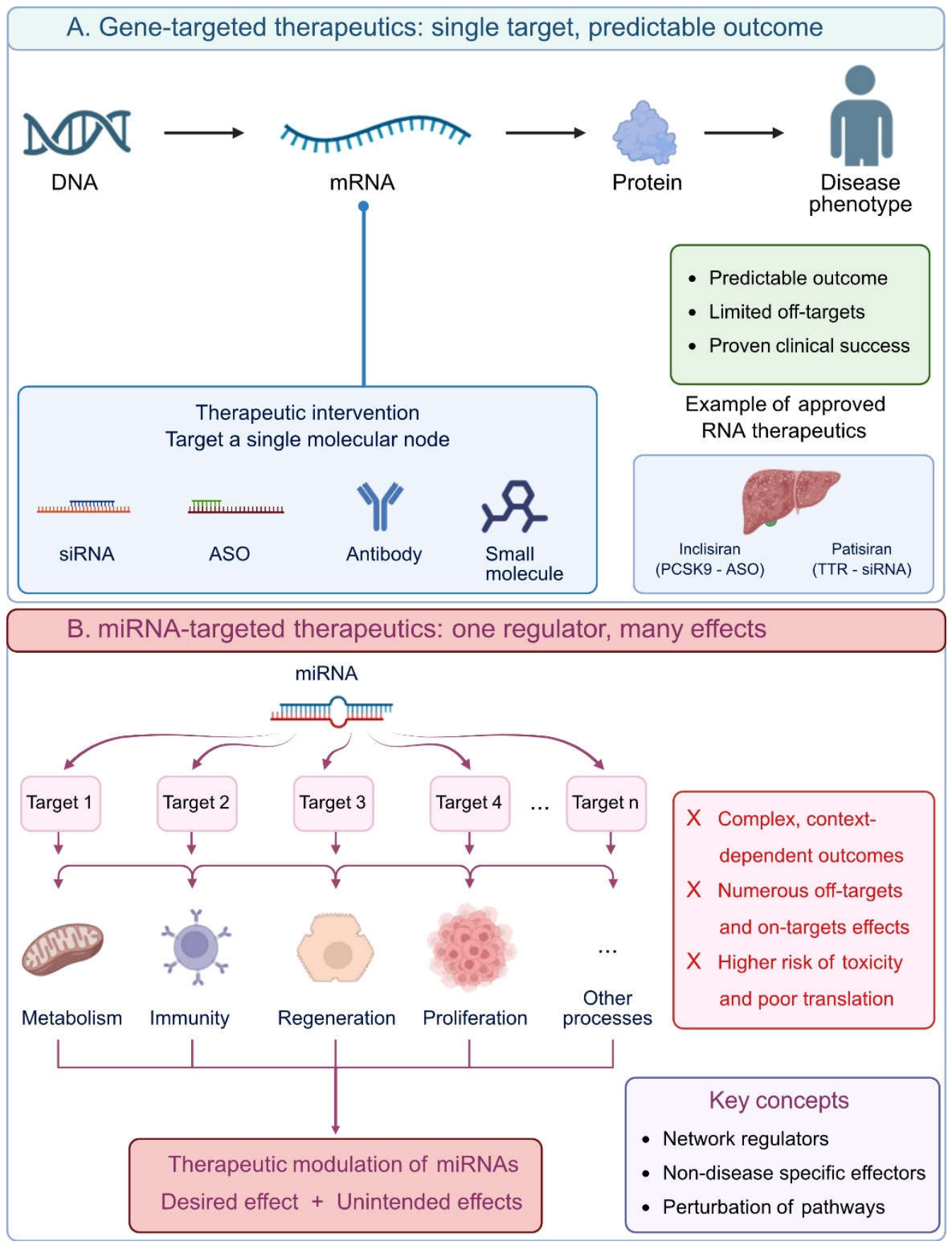
Figure 2.
Clinical development and translational outcomes of miRNA-targeting therapeutics. Timeline summarizing the clinical development of representative miRNA-targeting therapeutics that advanced to human evaluation and their eventual clinical outcomes. Programs include both miRNA replacement strategies, represented by the miR-34a mimic MRX34, and miRNA inhibition approaches targeting miR-122 (Miravirsen and RG-101), miR-155 (Cobomarsen/MRG-106), miR-21 (RG-012/lademirsen), and miR-103/107 (RG-125/AZD4076). Colors indicate the primary reason for program discontinuation, including immune-mediated toxicity, organ-specific safety concerns, insufficient clinical efficacy, or strategic discontinuation. For comparison, selected RNA therapeutics that achieved regulatory approval—including patisiran, inclisiran, and nusinersen—are shown to illustrate the successful clinical translation of RNA-based therapies directed against individual transcripts with well-defined biological functions. Despite differences in therapeutic strategy, disease indication, and mechanism of action, miRNA-targeting programs have consistently encountered translational challenges. Collectively, these clinical experiences suggest that the limited clinical translation of miRNA therapeutics is unlikely to be explained solely by limitations of RNA-based therapeutic platforms or delivery technologies and may instead reflect intrinsic biological properties of miRNAs.
Figure 2.
Clinical development and translational outcomes of miRNA-targeting therapeutics. Timeline summarizing the clinical development of representative miRNA-targeting therapeutics that advanced to human evaluation and their eventual clinical outcomes. Programs include both miRNA replacement strategies, represented by the miR-34a mimic MRX34, and miRNA inhibition approaches targeting miR-122 (Miravirsen and RG-101), miR-155 (Cobomarsen/MRG-106), miR-21 (RG-012/lademirsen), and miR-103/107 (RG-125/AZD4076). Colors indicate the primary reason for program discontinuation, including immune-mediated toxicity, organ-specific safety concerns, insufficient clinical efficacy, or strategic discontinuation. For comparison, selected RNA therapeutics that achieved regulatory approval—including patisiran, inclisiran, and nusinersen—are shown to illustrate the successful clinical translation of RNA-based therapies directed against individual transcripts with well-defined biological functions. Despite differences in therapeutic strategy, disease indication, and mechanism of action, miRNA-targeting programs have consistently encountered translational challenges. Collectively, these clinical experiences suggest that the limited clinical translation of miRNA therapeutics is unlikely to be explained solely by limitations of RNA-based therapeutic platforms or delivery technologies and may instead reflect intrinsic biological properties of miRNAs.
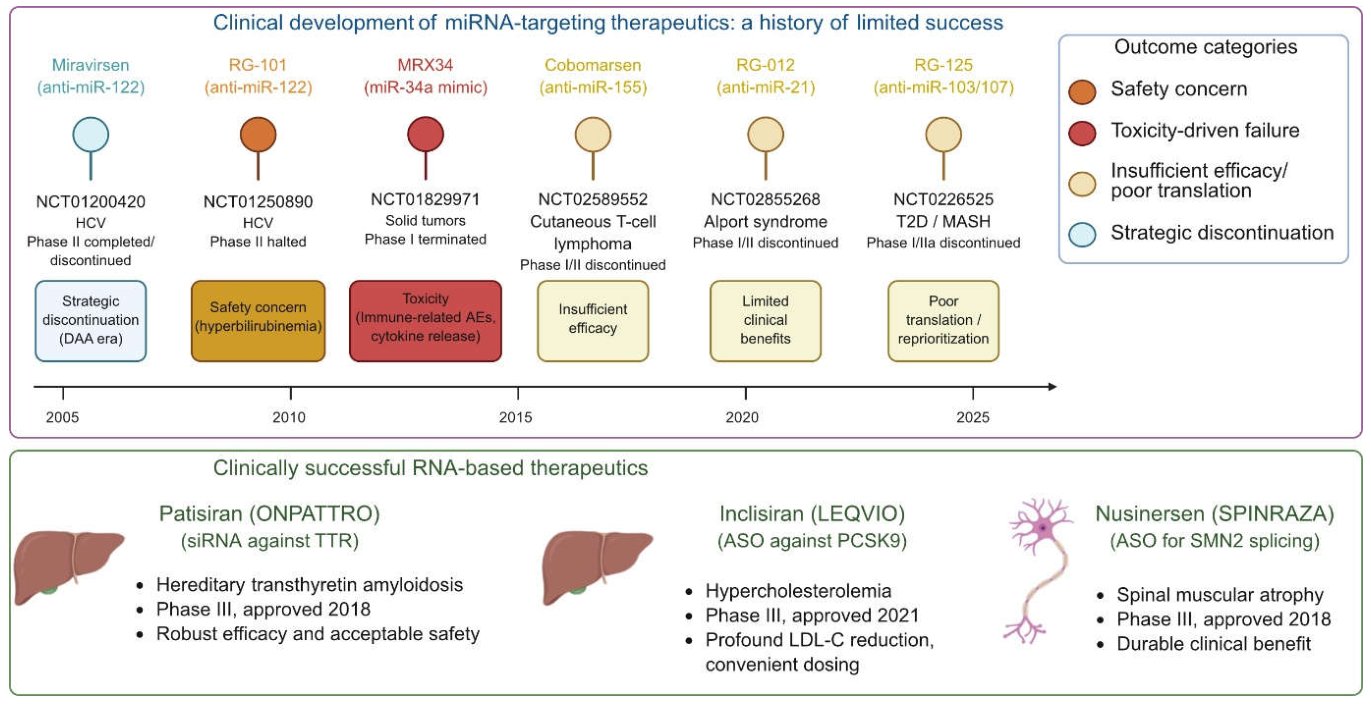
Figure 3.
The translational gap between preclinical and clinical miRNA modulation. Schematic representation of the discrepancy between preclinical efficacy and clinical outcomes observed in miRNA-targeting strategies. In experimental models, modulation of disease-associated miRNAs frequently produces the intended therapeutic phenotype, such as inhibition of viral replication, improved metabolic control, reduced fibrosis, or suppression of tumor growth. These observations have driven the development of multiple miRNA-targeting therapeutic programs. However, because miRNAs participate in extensive regulatory networks, many physiological functions remain incompletely captured by current experimental models. As a result, systemic modulation of a miRNA may affect additional pathways involved in immunity, iron metabolism, tissue regeneration, inflammation, fibrosis, or tumor suppression that are not fully represented in animal models. Upon translation into humans, these hidden layers of regulation may contribute to unexpected toxicity, insufficient efficacy, or adverse biological responses. Examples include the involvement of miR-122 in systemic iron homeostasis and liver physiology, and the effects of miR-103/107 modulation on metabolic and cardiac pathways. The figure illustrates how incomplete representation of miRNA biology in preclinical systems may contribute to clinical failure.
Figure 3.
The translational gap between preclinical and clinical miRNA modulation. Schematic representation of the discrepancy between preclinical efficacy and clinical outcomes observed in miRNA-targeting strategies. In experimental models, modulation of disease-associated miRNAs frequently produces the intended therapeutic phenotype, such as inhibition of viral replication, improved metabolic control, reduced fibrosis, or suppression of tumor growth. These observations have driven the development of multiple miRNA-targeting therapeutic programs. However, because miRNAs participate in extensive regulatory networks, many physiological functions remain incompletely captured by current experimental models. As a result, systemic modulation of a miRNA may affect additional pathways involved in immunity, iron metabolism, tissue regeneration, inflammation, fibrosis, or tumor suppression that are not fully represented in animal models. Upon translation into humans, these hidden layers of regulation may contribute to unexpected toxicity, insufficient efficacy, or adverse biological responses. Examples include the involvement of miR-122 in systemic iron homeostasis and liver physiology, and the effects of miR-103/107 modulation on metabolic and cardiac pathways. The figure illustrates how incomplete representation of miRNA biology in preclinical systems may contribute to clinical failure.
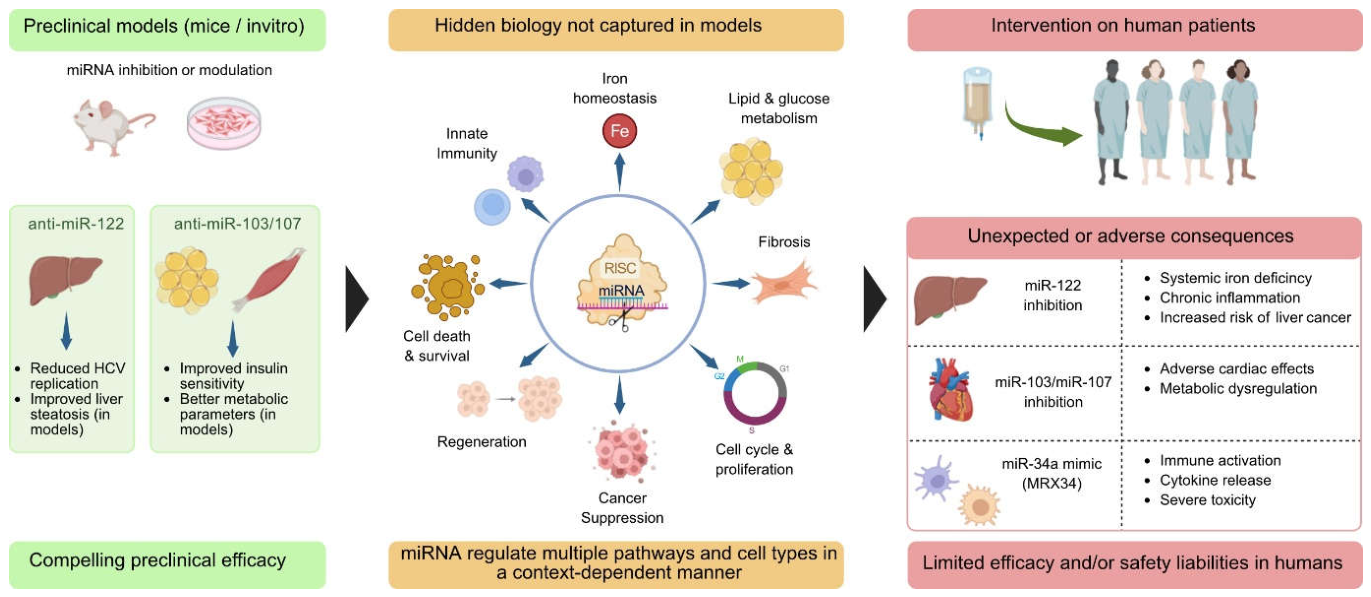

Table 1.
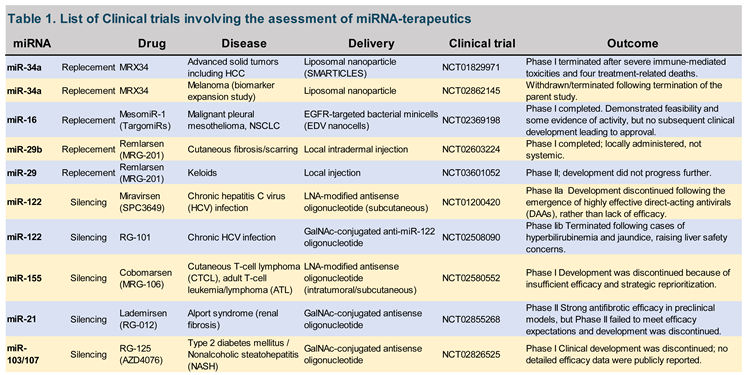 |
Table 2.
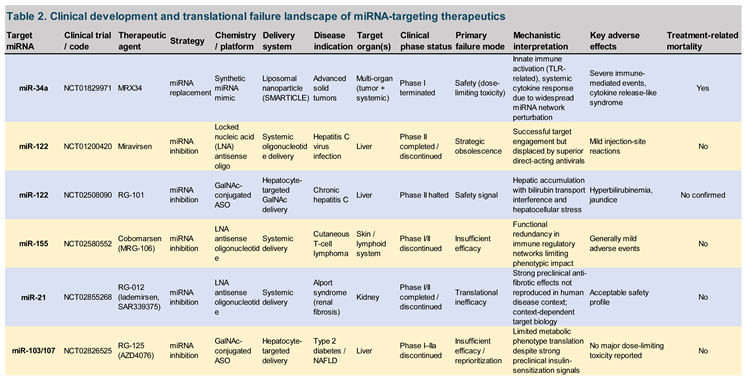 |
Table 3.
 |
Disclaimer/Publisher’s Note: The statements, opinions and data contained in all publications are solely those of the individual author(s) and contributor(s) and not of MDPI and/or the editor(s). MDPI and/or the editor(s) disclaim responsibility for any injury to people or property resulting from any ideas, methods, instructions or products referred to in the content. |
© 2026 by the authors. Licensee MDPI, Basel, Switzerland. This article is an open access article distributed under the terms and conditions of the Creative Commons Attribution (CC BY) license (http://creativecommons.org/licenses/by/4.0/).
Copyright: This open access article is published under a Creative Commons CC BY 4.0 license, which permit the free download, distribution, and reuse, provided that the author and preprint are cited in any reuse.