

Submitted:
16 July 2026
Posted:
17 July 2026
You are already at the latest version
Abstract
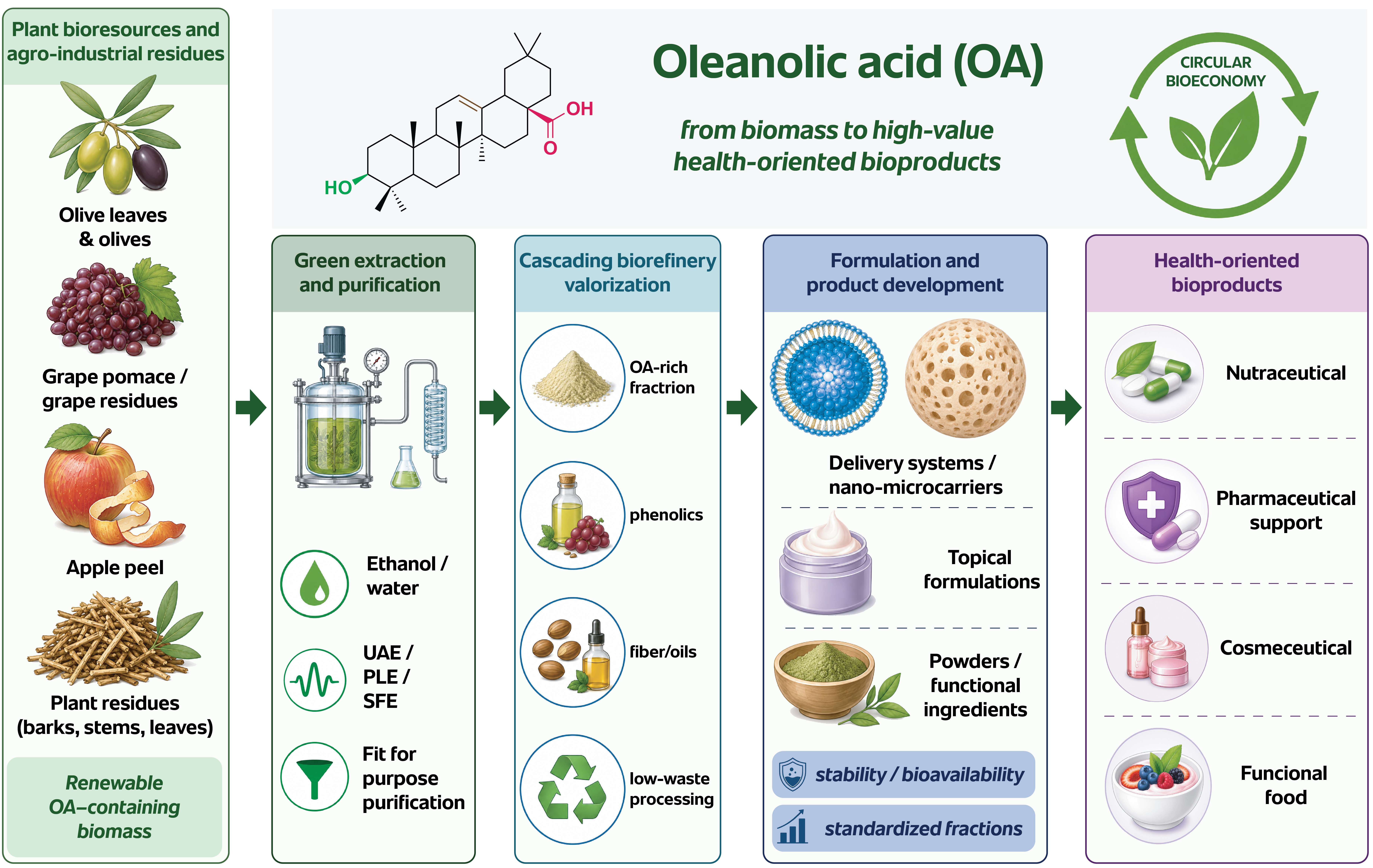
Oleanolic acid (OA) is a pentacyclic triterpenoid present in numerous plant tissues and agro-industrial residues, including olive leaves and pomace, grape pomace, and apple peel-rich fractions. This review evaluates these materials as renewable feedstocks for OA recovery and for the production of OA-rich bioproducts. It compares feedstock characteristics, stabilization requirements, and green extraction and purification routes, with emphasis on supercritical CO2, dimethyl carbonate, intensified solvent extraction, deep eutectic solvents, chromatography, and crystallization. OA recovery is examined within cascading biorefinery schemes that preserve co-product streams such as phenolics, lipids, waxes, fibers, and pectin. Because poor water solubility and limited oral bioavailability restrict direct application, the review also assesses formulation strategies suitable for purified OA and standardized OA-rich fractions. Evidence for metabolic, hepatic, vascular, anti-inflammatory, antioxidant, skin-related, and anticancer applications is evaluated according to study type and product format. Across the value chain, the main constraints are feedstock variability, incomplete process standardization, purification burden, residual solvents, limited exposure data, and insufficient integration of techno-economic and environmental assessment. A source-to-product readiness framework is proposed to link biomass selection, processing, formulation, safety, evidence level, and sustainability assessment. OA is therefore positioned not as an isolated natural product, but as a candidate bio-based chemical whose practical value depends on coordinated residue valorization, process design, and product-specific validation.
Keywords:
oleanolic acid
; agro-industrial bioresidues
; green extraction
; biovalorization
; circular bioeconomy
; biorefinery
; formulation
; health-oriented bioproducts
Copyright: This open access article is published under a Creative Commons CC BY 4.0 license, which permit the free download, distribution, and reuse, provided that the author and preprint are cited in any reuse.


