

Submitted:
16 July 2026
Posted:
17 July 2026
You are already at the latest version
Abstract
To systematically evaluate the growth heterosis and genetic characteristics of the hybrid offspring E. moara ♀ × E. tukula ♂, this study assessed the phenotypic growth pattern through a comparative breeding experiment and cytogenic and molecular genetic characteristics through integrated chromosomal karyotype and mitogenomic analyses. The results showed that at 9 months of age, the body weight of the hybrid offspring reached 137.08 ± 26.41 g, which was 1.50 times that of the maternal E. moara (91.60 ± 18.63 g), but significantly lower than that of the paternal E. tukula (178.19 ± 32.74 g), exhibiting a mid-parent growth heterosis (1.62%). The chromosome number of the hybrid offspring was 2n=48, with a karyotype formula of 2sm+1st+45t, NF=51, and an intermediate chromosomal composition between the parents. The mitochondrial genome was 16,405 bp, and its gene composition, arrangement order, base composition and codon usage preference were highly consistent with those of E. moara. A phylogenetic analysis further supported that its mitochondrial genome strictly followed maternal inheritance. This study provides a theoretical foundation for evaluating the breeding potential and germplasm characteristics of E. moara ♀ × E. tukula ♂ hybrids.
Keywords:
Epinephelus moara ♀ × E. tukula ♂
; mid-parent heterosis
; karyotype
; mitochondrial genome
; phylogenetic analysis
1. Introduction
Epinephelus (order Perciformes, family Epinephelidae) is a genus of high-value warm-water groupers that inhabit rocky or coral reef environments and exhibit a narrow thermal tolerance range. They are a highly valued food source, making them important species in marine aquaculture and high-value commercial fisheries in China [1]. However, their warm-water affinity substantially constrains the expansion of large-scale aquaculture operations. For most species, the optimal growth temperature ranges from 22 to 30 °C, with feeding activity and growth rates decreasing markedly when temperatures fall below 18 °C [2]. Prolonged exposure to temperatures below 15 °C induces stress responses and may even result in mass mortalities. Owing to this thermal limitation, the primary grouper aquaculture regions in China are confined to the southern coastal provinces, including Fujian, Guangdong, Guangxi, and Hainan, as winter cold surges in the north can cause seawater temperature drops exceeding 8 °C. The adverse effects of low-temperature stress on metabolic processes and physiological and biochemical indices of groupers cannot be fully mitigated, even within industrial aquaculture systems.
The taxonomically diverse groupers, comprising more than 160 species, represent an abundant genetic resource for hybridization breeding research. Among them, the kelp grouper (E. moara) is a unique low-temperature-tolerant species, with a suitable temperature range of 8-35 °C [3]. However, as a medium-sized grouper, under artificial breeding conditions, it faces challenges such as slow growth rates, low survival rates, and long breeding cycles, limiting the industrialization of this low-temperature species [4]. Large groupers that exhibit fast-growing traits, such as E. tukula and E. lanceolatus, are mostly used to improve the growth performance of existing grouper species through hybridization breeding programs. Multi-omics analyses have demonstrated that paternal subgenomic dominance, together with DNA hypomethylation, regulates lipid metabolism pathways and promotes growth heterosis in groupers [5]. To date, three rapid-growth grouper hybrids have been authorized by the Chinese government: E. fuscoguttatus ♀ × E. lanceolatus ♂, E. moara ♀ × E. lanceolatus ♂ and E. fuscoguttatus ♀ × E. tukula ♂. Among them, E. tukula is characterized by its large body size and rapid growth rate with the largest individuals reaching 2 m in total length and 100 kg in weight, and it is often used as the paternal parent in grouper hybridization. E. tukula is mainly distributed across the Indian Ocean to the Pacific Ocean, including Taiwan and the southern marine region of China. Artificial spawning technology for this species has not yet been fully developed, with its sperm predominantly used in hybridization breeding programs to harness the fast-growing traits of large groupers.
Hybridization breeding integrates the parental genomes, thereby producing hybrid offspring with highly variable genotypes and phenotypes that may result in desirable traits such as growth heterosis, stress tolerance, and disease resistance [6]. In this study, distant hybridization breeding was used to cross the fast-growing E. tukula with the low-temperature-tolerant E. moara to develop a new hybrid germplasm, the Yunjin hybrid grouper (E. moara ♀ × E. tukula ♂), that exhibits rapid growth and low-temperature tolerance. Overall, it exhibited paternal-biased inheritance for growth traits but maternal-biased low-temperature tolerance. The chromosomal karyotype and mitochondrial composition of the hybrid were analyzed, providing a theoretical basis for understanding heterosis formation in grouper hybridization.
2. Materials and Methods
2.1. Experimental Materials
The experimental site and E. tukula and E. moara broodstock were supplied by Laizhou Ming Bo Aquaculture Co., Ltd. (Laizhou, China). The broodstock were reared to maturity under industrial aquaculture conditions and healthy broodstock were subsequently selected and injected with 15 μg/kg LHRH-A3 and 300 IU/kg HCG (Hubei Tusuo Technology Co., Ltd., Wuhan, China) to induce ovulation and spermiation. Mature eggs were collected in a dry plastic basin from E. moara by gently pressing the abdomen, and E. tukula sperm was collected simultaneously for artificial fertilization. The fertilized eggs were transferred to a factory recirculating aquaculture workshop for artificial incubation, nursery rearing and cultivation.
2.2. DNA Extraction and Sequencing
A total of 600 healthy and disease-free 4-month-old E. tukula, E. moara and their hybrid offspring were selected to carry out comparative breeding experiments to evaluate growth heterosis of the hybrids. The experimental fish were placed in three industrial recirculating tanks (each 40m3 water volume), with 200 fish per tank, and were fed twice daily with artificial compound feed. The culture conditions comprised 22-25℃ water temperature, 28-30% salinity, and 6-8 mg/L dissolved oxygen. In the later rearing stages, the feed formula and rations were adjusted according to the growth specifications of the fish fry. At 9 months of age, 30 fish from each tank were randomly selected for measurement of growth indicators (body weight and total length), and the growth heterosis characteristics of the hybrids were determined using the following formula:
HM(%)=(F1-MP)/MP×100
where HM is the average heterosis; F1 is the average value of a trait in the hybrid offspring, and MP is the average value of a trait in both parents.
2.3. Chromosome Karyotype Analysis
2.3.1. Karyotype Preparation using the Head Kidney-PHA Injection Method
Three 215-day-old individuals from each group (E. tukula, E. moara, and hybrids) were selected and 6 μg/g phytohemagglutinin (PHA) solution (Beijing Solarbio Science & Technology Co., Ltd.) was injected into the thoracic cavity of each fish. After 12 hours, 10 μg/g colchicine solution (Shanghai Jizhi Biochemical Technology Co., Ltd.) was injected at the same position. After 4 more hours, the experimental fish were anesthetized with anesthetic MS-222, and the head kidneys were used for karyotype preparation. The head kidneys were rinsed in 0.9% isotonic NaCl solution to remove blood, then minced into small pieces and transferred into 1.5 mL centrifuge tubes, after adding 0.5 mL physiological saline for homogenization and centrifugation. The precipitate was then treated with 1 mL preheated 0.075 mol/L KCl solution at 37℃ for 30 min, 0.5 mL of pre-cooled fresh Carnoy’s fixative was the added and pre-fixed at 4 °C for 1 min, and, after centrifugation at 6000 r/min for 3 min, the precipitate was fixed with 1 mL fixative at room temperature for 30 min and repeated 3 times. After the fourth centrifugation, 1 mL of Carnoy’s fixative was added, and the mixture was stored at 4 °C. Microscope slides were preheated in a 70 °C distilled water bath for 30 min, adding 1-2 drops of the cell suspension onto the slides and passing them back and forth through an alcohol lamp flame 2-3 times to dry. Finally, the slides were stained with 10% Giemsa stain for 30 min, rinsed with distilled water, and air-dried at room temperature.
2.3.2. Karyotype Analysis
Chromosome observations were performed using an optical microscope (Olympus CX43, Yijingtong Optics Technology Co., Ltd., Shanghai, China), where mitotic metaphases were initially screened under low magnification, then photographed under oil immersion.Clear images of 100 split phases with complete numbers were selected to count and were processed using ImageJ and Photoshop. The chromosome types were classified according to the standard proposed by Levan et al. (1964). Five well-spread metaphases with clear morphology, each for E. tukula, E. moara and hybrids, were selected for parameter measurement and these were statistically sorted using Microsoft Excel, and the chromosome karyotype map was prepared.
2.4. DNA Extraction and Sequencing
Genomic DNA was extracted from the parents and hybrids using the DNeasy Tissue Kit (Qiagen, Beijing, China), and the concentration and quality of the DNA were analyzed with a Qubit 4.0 fluorometer and 1.0% agarose gel electrophoresis, respectively. Genomic libraries were sequenced using paired-end reads on the Illumina NovaSeq 6000 platform(BIOZERON Co., Ltd., Shanghai, China), and the sequencing data were processed with Trimmomatic v0.39.
2.5. Mitochondrial Genome Assembly and Annotation
The mitochondrial genomes of the parents and hybrid were assembled using GetOrganelle v1.7.5, following methods used by Jiao et al. [7]. MITOS was used to annotate the mitochondrial genes, and BLAST alignment was performed against reference mitochondrial genes to determine the location of each coding gene. Through alignment, the start and stop codons were manually corrected using SnapGene Viewer, and the genome compositions were visualized through a circular map using CGView online.
The base composition and gene distribution of the mitochondrial genomes were statistically analyzed and summarized, with the coding genes, rRNA, and tRNA arranged in genomic coordinate order. Gene length, gene interval, and codon composition were used to visualize the mitochondrial genome distribution. The CUSP software (EMBOSS v6.6.0.0) was used to calculate the Relative Synonymous Codon Usage (RSCU) to assess codon preference.
2.6. Mitochondrial Genomic Collinearity Analysis
BLASTp alignment (e-value < 1 × 10⁻⁵) was performed against the protein sequences of the parental and hybrid mitochondrial genomes, and gene annotation was performed on the assembled mitochondrial genomes to determine the different genetic components. For genes with multiple alignments in the database, only the best alignment result for each gene was retained. AliTV software version 1.0.6 was used to analyze the collinearity of the mitochondrial genomes.
2.7. Mitochondrial Genome Ka/Ks Analysis
To understand natural selection pressure during the evolution of E. tukula, E. moara and their hybrid offspring, gene sequences were compared using the MUSCLE v3.8.31, and then the KaKs Calculator 2.0 was used to calculate the non-synonymous (Ka) synonymous to (Ks) ratio (Ka/Ks) with −c 11 (codon table) and −m = MS (model selection based on AICc index).
2.8. Mitochondrial Genome Phylogeny
To evaluate the genomic evolutionary relationship among the parental and hybrid species, mitochondrial genome sequences of known purebred and hybrid groupers were downloaded from the NCBI database. Genomic alignment of the nucleotide sequences of protein-coding genes (PCGs) was performed using MEGA 7.0 with the default settings. Using jModeltest v2.1.10, the optimal nucleotide substitution model for the gene sequences was GTR+I+G. Phylogenetic analyses were performed on the PCG of 19 mitochondrial genomes using both maximum likelihood (ML) and neighbor-joining (NJ) methods, with 1,000 bootstrap replicates, and the evolutionary tree was visualized using iTOL 3.4.3.
3. Results
3.1. Growth Heterosis of E. moara ♀ × E. tukula ♂
After 5 months of comparative rearing, morphological observations and growth measurements were conducted on E. moara ♀ × E. tukula ♂ and its parents (Figure 1). The morphology and pattern distribution of E. moara ♀ × E. tukula ♂ were between those of its parents, with the overall appearance being more similar to that of the maternal E. moara (Figure 1A). The hybrid body weight reached 137.08 ± 26.41 g at 9 months old, 49.65% higher than that of the maternal E. moara (91.60 ± 18.63 g), but significantly lower than that of the paternal E. tukula (178.19 ± 32.74 g). The total length of the hybrid reached 21.61 ± 1.17 cm, 1.16 times that of maternal E. moara (18.70 ± 1.08 cm), but lower than that of the paternal E. tukula (23.11 ± 1.33 cm) (Figure 1B). The average heterosis for its body weight was 1.62%, indicating that the growth characteristics of the hybrid germplasm exhibited mid-parent heterosis.
3.2. Karyotype Analysis
3.2.1. Chromosome Number
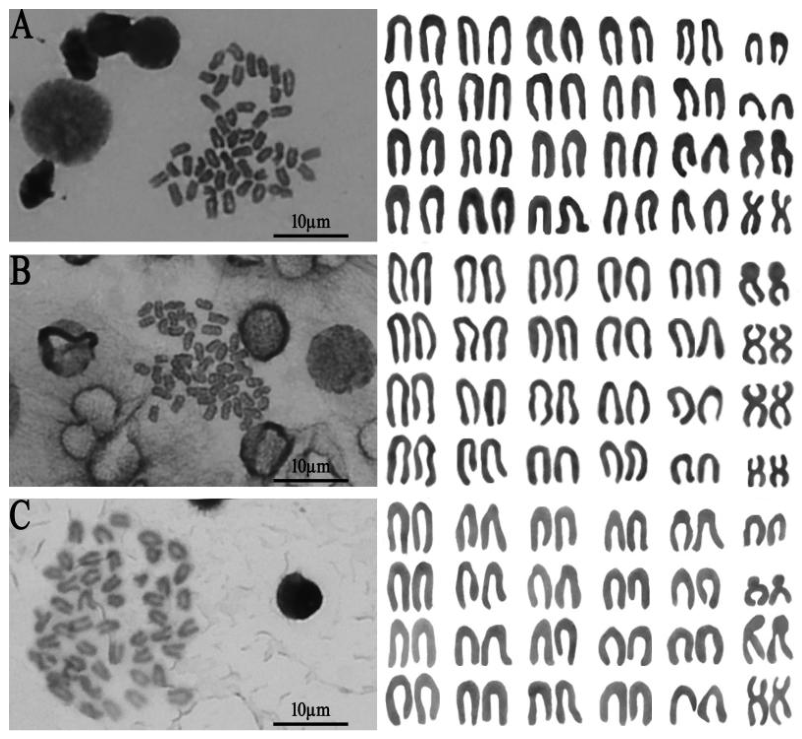
A total of 100 well-dispersed and morphologically clear chromosome metaphase spreads were analyzed for E. tukula, E. moara, and their hybrid offspring. After observation and statistics, it was found that all three grouper species showed the same diploid chromosome number of 2n = 48, consistent with most grouper species. Among them, metaphase spreads with 2n = 48 accounted for 79% in the paternal E. tukula, 84% in the maternal E. moara, and 76% in the hybrid offspring (Table 1).
3.2.2. Chromosome Composition
Five metaphase spreads from each of the three grouper species were selected for microscopic examination to calculate the relative chromosome length, arm ratio, and chromosome type (Table 2, Figure 1). No satellites, secondary constrictions, heteromorphic chromosomes or polyploids were found. Among the 48 chromosomes of E. tukula, one pair was submetacentric (sm), one pair was subtelocentric (st), and the remaining 44 were telocentric (t), giving it a karyotype formula of 2n=48, 1sm+1st+46t, NF=50. Of the 48 chromosomes of E. moara, four pairs were sm, and the remaining were t, with a karyotype formula of 2n=48, 4sm+44t, NF=52. Of the 48 chromosomes of the hybrids, two pairs were sm, one pair was st, and the remaining were t, with a karyotype formula of 2n=48, 2sm+1st+45t, NF=51. The sm chromosomes of the hybrids were intermediates of its parents, while the st chromosomes were inherited from the paternal E. tukula.
3.3. Analysis of M
Figure 2.
The chromosomal metaphase and karyotypes of Epinephelus tukula(A), E. moara(B), and E. moara ♀ × E. tukula ♂(C).
Figure 2.
The chromosomal metaphase and karyotypes of Epinephelus tukula(A), E. moara(B), and E. moara ♀ × E. tukula ♂(C).
3.3. Mitochondrial Genome Composition
The mitochondrial genome sizes of the paternal E. tukula, the maternal E. moara and their hybrid offspring were 16,485bp, 16,405bp and 16,405bp, respectively (Figure 3). A total of 37 known genes were separately identified in their mitochondrial genomes, including 13 PCGs, 22 tRNA genes and two rRNA genes (Figure 3, Table S1).
Among the 13 PCGs of the paternal E. tukula, most had a start codon ATG, with the exception of cox1 and atp6 which had GTG and CTG start codons, respectively. Three stop codons were identified, including TAG (nad5, nad6), TAA (nad1, cox1, atp8, atp6, cox3, nad4I) and T (nad2, cox2, nad3, nad4, cob). Three start codons were found for the maternal E. moara, including CTG (atp6), GTG (cox1, nad4), and ATG for the other genes. Among the three stop codons (TAG, TAA, and T) for the maternal E. moara, all were consistent with E. tukula, except for TAA (nad6). For the hybrid offspring, three start codons (CTG, GTG, and ATG) and three stop codons (TAG, TAA, and T) were identified, with a mitochondrial composition identical to that of the maternal E. moara. In addition, the shortest tRNA of the paternal E. tukula was 68 bp (trnC, GCA), while the longest tRNA was 76 bp (trnL2, TAA). The shortest tRNA of the maternal E. moara was 67 bp (trnC, GCA), while the longest was 76 bp (trnL2, TAA). The mitochondrial genome of the hybrid offspring was consistent with the maternal E. moara (Table S1).
The mitochondrial base compositions of the three grouper species are shown in Table S2. The nucleotide composition of E. tukula comprised 28.35% A, 26.28% T, 29.11% C, 16.25% G, with an AT bias of 54.64%, and a GC bias of 45.36%. The nucleotide composition of E. moara comprised 28.49% A, 26.21% T, 29.15% C, 16.16% G, an AT bias of 54.69%, and a GC bias of 45.31%. The mitochondrial base composition of the hybrid offspring was consistent with that of the maternal E. moara.
3.4. Analysis of Mitochondrial PCGs
Figure 4 shows the RSCU values of the PCGs in the three grouper species. Among them, the paternal E. tukula had 30 codons with RSCU values greater than 1, including 6 codons ending with A, 9 codons ending with C, 6 codons ending with G, and 9 codons ending with T. The maternal E. moara had 31 codons with RSCU values>1, including 12 codons ending with A, 15 codons ending with C, and 4 codons ending with T. The hybrid offspring had 31 codons with RSCU > 1, and the codon composition was consistent with that of the maternal E. moara. For all three grouper species, Ala, Arg, Gly, Leu1, Pro, Ser2, Thr and Val were encoded by four codons with the highest codon abundance, while Trp was encoded by only one codon and showed the lowest codon abundance. In addition, the RSCU value for Trp in all species was 1, indicating the lowest usage frequency of this amino acid. Leu1 had the highest RSCU value (4.9 in E. tukula and 4.8 in E. moara and the hybrid offspring), indicating the highest usage frequency.
3.5. Collinearity Analysis
A collinearity comparison of the mitochondrial genomes of the hybrid and its parents was conducted based on their mitochondrial gene linkage relationships (Figure 5). The results showed that the mitochondrial genomes of all three species were largely consistent in both gene composition and arrangement. However, in terms of mitogenomic consistency, the hybrid offspring exhibited a stronger gene linkage and closer genetic relationship with the maternal E. moara, following a maternal inheritance pattern.
3.6. Ka/Ks Analysis
To assess the selective pressure on PCGs within the mitochondrial genome of the hybrid, the Ka/Ks substitution rates were determined (Figure 6). The Ka/Ks ratios of all PCGs were less than 1, indicating that the mitochondrial genome underwent purifying selection. Furthermore, the Ka/Ks ratios of all PCGs were less than 0.10, indicating that all genes experienced strong negative selection pressure, resulting in high conservation of the encoded amino acid sequences. However, compared with other PCGs, atp8 and nad6 exhibited relatively higher Ka/Ks ratios, suggesting that these genes were subject to relatively lower negative selective pressure.
3.7. Phylogenetic Analysis
Based on the mitochondrial genome sequences of 10 purebred grouper species (Epinephelus, Cromileptes, Plectropomus, and Cephalopholis) and their 9 hybrid offspring, a comparative phylogenetic analysis of the E. moara ♀ × E. tukula ♂ hybrid was conducted (Figure 7). The analysis revealed that all hybrids had a closer genetic relationship to its maternal parent compared to its paternal parent, consistent with maternal inheritance patterns. In addition, the differences between Cromileptes and Epinephelus were not significant. In particular, the E. moara ♀ × E. tukula ♂ hybrid clustered with the maternal E. moara, and exhibited a relatively greater genetic distance from the paternal E. tukula.
4. Discussion
Hybridization and the exploitation of heterosis are important strategies for the genetic improvement of groupers. Grouper aquaculture in China produces 267,500 tons of fish, generating an output value of 30 billion Yuan, with hybrid varieties making up over 70% of this production [8]. By crossing maternal E. moara with the large-sized paternal E. tukula, we successfully developed a new germplasm, the E. moara ♀ × E. tukula ♂, which exhibits rapid growth and thermal stress resistance. At 9 months of age, the body weight of the hybrid reached 137.08 ± 26.41 g, 1.50 times that of the maternal E. moara (91.60 ± 18.63 g), but lower than the paternal E. tukula, exhibiting a positive but weak mid-parent heterosis (1.62%). Other hybrid grouper species, such as E. fuscoguttatus ♀ × E. lanceolatus ♂, E. moara ♀ × E. lanceolatus ♂, and E. fuscoguttatus ♀ × E. tukula ♂, also showed a phenotypic growth pattern, growing faster than their maternal parents but slower than their larger paternal parents. By integrating multi-omics analyses, it was found that paternal subgenome dominance, together with genomic DNA hypomethylation, regulates lipid metabolism pathways and promotes growth heterosis in the E. fuscoguttatus ♀ × E. tukula ♂, and the lipid metabolism genes fads6, fabp3, and fabp7 were regulated by paternal subgenomic dominance [5]. This type of paternal subgenome dominance regulation has also been identified in the dietary adaptation of the hybrid offspring of ray-finned fish Megalobrama amblycephala ♀ × Culter alburnus ♂ [9].
This study revealed that the diploid chromosome numbers of E. tukula, E. moara, and their hybrid offspring were all 48 (2n=48), which is consistent with that reported for 28 grouper species [10]. The karyotype of E. tukula was 2n=48, 1sm+1st+46t, NF=50, which is different from that reported previously [11,12]. This may be due to chromosomal polymorphism exhibited by different geographical populations, or due to different experimental methods and subjective judgments. The karyotype of E. moara, 2n=48, 4sm+44t, NF=52, was consistent with previously reported results [13]. The karyotype of the hybrid offspring was 2n=48, 2sm+1st+45t, NF=51, in which its sm chromosomes were intermediate between those of the parents, while the st chromosome was inherited from the paternal E. tukula. For the hybrid E. fuscoguttatus ♀ × E. lanceolatus ♂, the karyotype formula was 2n=48, 4st+44t, NF=52, consistent with the karyotype of the paternal E. lanceolatus, but differs significantly from that of the maternal E. fuscoguttatus (2n=48, 2sm+46t, NF=50) [14]. The chromosome karyotype of the hybrid E. awoara ♀ × E. tukula ♂ was 2n=48,1sm+47t, NF=49, where the sm chromosome was inherited from the paternal E. tukula and had karyotype differences to that of the maternal E. awoara (2n=48, 48t, NF=48) [11]. Overall, the karyotypes of the above hybrid groupers are closely related to those of the large paternal E. lanceolatus and E. tukula, which may be associated with the rapid growth advantage of the hybrid offspring. However, the karyotype of the E. moara ♀ × E. lanceolatus ♂ hybrid (2n=48, 4sm+6st+38t, NF=58) possessed both maternal sm and paternal st chromosomes, indicating that the genetic material of both parents was recombined in the hybrid [13]. Therefore, further genetic analysis is still required to fully understand the gene inheritance pattern of the hybrid offspring.
In vertebrates, the gene order within the mitochondrial genome exhibits high conservation. Due to maternal inheritance and a high mutation rate, the mitochondrial genome has been widely used for evolution and genetic analyses, particularly in fish [15,16]. Analysis of start and stop codon usage characteristics in these mitochondrial genomes can provide deeper insights into the mechanisms underlying translation regulation and evolutionary adaptation [17]. In this study, most of the PCGs started with the typical ATG for all three species, common in many bony fish species [18]. As a widely used start codon, ATG may be associated with its high efficiency and preference in transcription and translation [19]. Furthermore, cox1 and nad4 have GTG start codons, while atp6 has a CTG start codon. Similar start codon usage was detected in other hybrid groupers, indicating potential species-specific selective pressures or adaptive requirements [20]. For stop codons, nad6 uses TAA in E. moara and the hybrid, while in E. tukula it uses TAG. These species-specific stop codon usage patterns demonstrate the dynamic evolution of the mitochondrial genome and its potential for ecological and physiological adaptation [21].
The mitochondrial genomes of E. moara, E. tukula and the hybrid all showed a higher AT than GC bias, consistent with the nucleotide composition of most bony fish [22,23,24,25]. The RSCU value is typically used to evaluate the usage bias of synonymous codons [26,27]. Leu1 was detected as the most abundant amino acid, which can regulate mitochondrial function through rapamycin target protein (mTOR) and optic atrophy protein 1 (Opa-1) signaling pathways [28]. Dietary supplementation of Leu1 can significantly improve humoral immunity and antioxidant capacity in fish [29]. In addition, we identified GCC(Ala), CGA(Arg), GGC (Gly), CTA (Leu1), CCC (Pro), TCC(Ser2), ACA (Thr), and GTA(Val) as the dominant codons within the genomes of the three species, suggesting that their usage patterns may be related to natural selection [30]. The PCGs identified used A and C rather than T and G on the third codon, similar to other bony fish [26]. In brief, the hybrid mitochondrial base composition and codon usage bias was highly consistent with its maternal E. moara, further supporting maternal mitochondrial inheritance.
The results of this study showed that the hybrid offspring had a higher degree of collinearity and a closer genetic relationship with the maternal E. moara, indicating maternal inheritance of the mitochondrial genome. In molecular evolution, the Ka/Ks ratio is commonly used to assess selection pressure and evolutionary relationships [31]. In this study, the Ka/Ks ratio for all PCGs was less than 0.10, signifying that the mitochondrial genomes of all three species underwent strong purification or negative selection, resulting in high conservation of their amino acid sequences. Purifying selection tends to preserve the regulatory genes essential for survival and reproduction, thereby reducing the mutation frequency of harmful genes and maintaining a highly stable genome [32]. During purifying selection, non-synonymous mutations are eliminated, while synonymous mutations can occur relatively freely [33,34]. Among the 13 identified PCGs, atp8 showed a relatively high Ka/Ks ratio (0.08), indicating a relatively weak purification selection pressure during evolution, consistent with the relatively relaxed evolutionary constraint characteristics of most grouper species [7,26]. The atp8 gene may also play an important role in the adaptive evolution of new species through the energy metabolism pathway [35].
A phylogenetic tree analysis indicates that hybrid is more closely related to E. moara than E. tukula, supporting maternal mitochondrial inheritance. This strict maternal inheritance pattern was common in the mitochondrial genomes of hybrid Epinephelidae, which maintains the genetic stability of energy metabolism-related genes, increasing survival rate and environmental adaptability of the hybrid offspring [36,37,38]. In addition, we found that the greater the genetic distance between the parents, the higher the integrity of the mitochondrial genome of the hybrid offspring inherited from the maternal parent. For example, the intergeneric hybrid of E. fasciatus ♀ × P. leopardus ♂ has a stronger and closer genetic relationship with E. fasciatus (100% bootstrap support) and a more distant genetic relationship with P. leopardus. The relatively large genetic distance between the parental species can enhance the validation of maternal inheritance and provides valuable data to investigate the mechanisms of energy metabolism and identify germplasm associated with heterosis [7]. In addition, the boundary between the genera Chromileptes and Epinephelus is indistinct, and practical hybridization breeding has demonstrated high compatibility in their intergeneric hybrid offspring, yielding superior hybrids such as C. altivelis ♀ × E. lanceolatus ♂, C. altivelis ♀ × E. tukula ♂, and C. altivelis ♀ × E. fuscoguttatus ♂ [39,40]. Therefore, it has been suggested that C. altivelis should be classified under the genus Epinephelus, and relevant conclusions require further molecular biological evidence for support.
5. Conclusions
In this study, a new hybrid grouper E. moara ♀ × E. tukula ♂ was created. The growth of this hybrid was significantly greater than E. moara but less than E. tukula, exhibiting a mid-parent growth heterosis. The chromosome number of the hybrid is 2n=48, with a karyotype of 2sm+1st+45t, NF=51. Analyses of genomic composition, collinearity, Ka/Ks ratios, and phylogenetics collectively indicated that its mitochondrial genome follows maternal inheritance. Overall, the results of this study provide theoretical support for grouper hybrid breeding, germplasm identification and genetic diversity research.
Supplementary Materials
The following supporting information can be downloaded at the website of this paper posted on Preprints.org, Table S1: Mitochondrial genome characteristics of Epinephelus tukula, E. moara, and E. moara ♀ × E. tukula ♂; Table S2. Mitochondrial base composition of Epinephelus tukula, E. moara, and E. moara ♀ × E. tukula ♂.
Author Contributions
Y.L., Y.G. and Y.T. co-conceived this study and supervised the experiments; X.J., T.D., Y.W., S.W., C.Z. and F.Y. performed the experiments, and created the figures; Z.L. and Y.X. conducted the data analysis, and provided the funding support. X.J. wrote the manuscript. All authors have read and agreed to the published version of the manuscript.
Funding
This research was funded by Hainan Province Science and Technology Special Fund (ZDYF2025SXLH002); Research on breeding technology of candidate species for Guangdong modern marine ranching (2025-MRB-00-001); the Key Research and Development Project of Shandong Province (2026LZGC045); Shandong Province Natural Science Foundation (ZR2025QC146); Hainan Province Science and Technology Commissioner Project (KJTP202548); Hainan Seed Industry Laboratory (B25H10CB2; B25H1QC02; B25Z10C03); China Agriculture Research System of MOF and MARA (CARS-47-G31); the Central Public-interest Scientific Institute Basal Research Fund, CAFS (2020TD19); and the Yellow Sea Fisheries Research Institute Research Fees (20603022025002).
Institutional Review Board Statement
The research in this manuscript has been conducted under the Experimental Animal Care, Ethics and Safety Inspection Form Yellow Sea Fisheries Research Institute, CAFS (approval code: YSFRI-2026080 and approval date: 10 July 2026).
Informed Consent Statement
Informed consent was obtained from all subjects involved in the study.
Data Availability Statement
The mitochondrial genome data presented in the study are deposited in the NCBI SRA repository (https://www.ncbi.nlm.nih.gov/ (accessed on 12 May 2026), accession number PRJNA1464489).
Conflicts of Interest
The author declares no conflicts of interest.
References
- Wang L., Chen S., Li Z., Liu Y., Wang S., Ding T., Yang F., Zhang C., Li L., Li W., Wang Q., Zhao X., Tian Y. Insights into low temperature adaptation in Epinephelus awoara through integrated genome and transcriptome analysis. Aquaculture, 2026, 613(P1): 743306-. [CrossRef]
- Pengfei D., Yongsheng T., Zhentong L., Shuai C., Linlin L., Xinyi W., Linna W., Yang L., Jieming Z., Wensheng L., Qingbin W., Wenhui M., Zunfang P. Comparative transcriptome analysis of hybrid Jinhu grouper (Epinephelus fuscoguttatus ♀ × Epinephelus tukula ♂) and Epinephelus fuscoguttatus under temperature stress. Aquaculture, 2024, 578. [CrossRef]
- P P. G., W L. B., Y Z. W. The effects of cold stress on theantioxidant defense and immune parameters of juvenile Epinephelus moara. Shanghai Ocean Univ., 2016, 25(1): 78-85. [CrossRef]
- L G. M., Q S. Y., F C. X., X D. S., J W. Comparative studieson morphology of Epinephelus moara and E. bruneus. Acta Oceanol Sin, 2008, 30(6): 106-14.
- Liu Y., Wang L., Li Z., Li L., Chen S., Duan P., Wang X., Qiu Y., Ding X., Su J., Deng Y., Tian Y. DNA Methylation and Subgenome Dominance Reveal the Role of Lipid Metabolism in Jinhu Grouper Heterosis. International Journal of Molecular Sciences, 2024, 25(17): 9740-. [CrossRef]
- Wang S., Tang C., Tao M., Qin Q., Zhang C., Luo K., Zhao R., Wang J., Ren L., Xiao J. Establishment and application of distant hybridization technology in fish. Sci China:Life Sci, 2019, 62(1): 22-45. [CrossRef]
- Jiao X., Ding T., Tian Y., Guo Y., Wang Y., Wang S., Zhang C., Yang F., Wang L., Li Z., Li L., Xu Y., Liu Y. Comparative Analysis of Embryonic Development and Mitochondrial Genome of a New Intergeneric Hybrid Grouper (Epinephelus fasciatus ♀ × Plectropomus leopardus ♂). Animals, 2025, 15(23): 3445-. [CrossRef]
- Yang Y., Tong W., Jingfang C., Xi W., Lina W., Weiwei Z., Jian L., Junhong X., Zining M., Xiaochun L. First construction of interspecific backcross grouper and genome-wide identification of their genetic variants associated with early growth. Aquaculture, 2021, 545. [CrossRef]
- Li W., Wang S., Hu J., Tang C., Wu C., Liu J., Ren L., Sun C., Dong J., Liu S. Asymmetric expression of homoeologous genes contributes to dietary adaption of an allodiploid hybrid fish derived from Megalobrama amblycephala (♀)× Culter alburnus (♂). BMC genomics, 2021, 22(1): 362. [CrossRef]
- Pinthong K., Maneechot N., Tanomtong A., Supiwong W., Chanaboon T., Jangsuwan N. The first karyological analysis and chromosomal characteristics of NORs of the cloudy grouper, Epinephelus erythrurus (Perciformes, Epinephelinae) in Thailand. Cytologia, 2015, 80(3): 279-86. [CrossRef]
- S C., S T. Y., L C. M., T L. Z., Q L. Z., L L. L., N W. L., M W. X. Karyotype analysis ofhybrid Epinephelus awoara (♀) and Epinephelus tukula (♂)progenies and their parents. J. Fish. Sci. China, 2021, 28(8): 988-1000. [CrossRef]
- Liu S, Q Y. Y., F Z. H., Y Z., H W. J., X H. J., R S. H. The karyotype of Epinephelus tukula. Marine Sciences, 2017, 41(12): 46-50.
- Cheng M L, Tian Y S, P W. Y., T L. Z., J Z. J., N W. L., S L. W., H M. W., M W. X., M Z. J., B L. Chromosome karyo-type analysis of hybrids of Epinephelus moara ♀ × Epinephelus lanceolatus ♂. Progress in Fishery Sciences, 2018, 39(2): 67-75. [CrossRef]
- Liu L, Zhang Y, C C., L L. Y., D K. X., H Y. H., G C. J., M Z. J. Preparation of chromosomes and analysis of karyotypes of hybrid F1 (Epinephelus fuscoguttatus ♀ × Epinephelus lanceolatus ♂) groupers. Progress in Fishery Sciences, 2016, 37(2): 33-40. [CrossRef]
- Harrison R. G. Animal mitochondrial DNA as a genetic marker in population and evolutionary biology. Trends Ecol. Evol., 1989, 4(1): 6-11. [CrossRef]
- Miya M., Satoh T. P., Nishida M. The phylogenetic position of toadfishes (order Batrachoidiformes) in the higher ray-finned fish as inferred from partitioned Bayesian analysis of 102 whole mitochondrial genome sequences. Biological Journal of the Linnean Society, 2005, 85(3): 289-306. [CrossRef]
- Wang F., Jia C., Gao T., Guo X., Zhang X. Characterization of complete mitochondrial genome and phylogeny of three Echeneidae species. Animals, 2025, 15(1): 81. [CrossRef]
- Lü Z., Zhu K., Jiang H., Lu X., Liu B., Ye Y., Jiang L., Liu L., Gong L. Complete mitochondrial genome of Ophichthus brevicaudatus reveals novel gene order and phylogenetic relationships of Anguilliformes. Int J Biol Macromol, 2019, 135: 609-18. [CrossRef]
- Qiao Y., Zhang X., Li Z., Song Y., Sun Z. Assembly and comparative analysis of the complete mitochondrial genome of Bupleurum chinense DC. BMC genomics, 2022, 23(1): 664. [CrossRef]
- Gao F., Wei M., Zhu Y., Guo H., Chen S., Yang G. Characterization of the complete mitochondrial genome of the hybrid Epinephelus moara ♀ × Epinephelus lanceolatus ♂, and phylogenetic analysis in subfamily epinephelinae. Journal of Ocean University of China, 2017, 16(3): 555-63. [CrossRef]
- Boore J. L. Animal mitochondrial genomes. Nucleic acids research, 1999, 27(8): 1767-80. [CrossRef]
- Zhang R., Zhu T., Luo Q. The complete mitochondrial genome of the freshwater fish Onychostoma ovale (Cypriniformes, Cyprinidae): genome characterization and phylogenetic analysis. Genes, 2023, 14(6): 1227. [CrossRef]
- Miya M., Takeshima H., Endo H., Ishiguro N. B., Inoue J. G., Mukai T., Satoh T. P., Yamaguchi M., Kawaguchi A., Mabuchi K. Major patterns of higher teleostean phylogenies: a new perspective based on 100 complete mitochondrial DNA sequences. Mol. Phylogenet. Evol., 2003, 26(1): 121-38. [CrossRef]
- Consuegra S., John E., Verspoor E., de Leaniz C. G. Patterns of natural selection acting on the mitochondrial genome of a locally adapted fish species. Genetics Selection Evolution, 2015, 47(1): 58. [CrossRef]
- Ruan H., Li M., Li Z., Huang J., Chen W., Sun J., Liu L., Zou K. Comparative analysis of complete mitochondrial genomes of three Gerres fishes (Perciformes: Gerreidae) and primary exploration of their evolution history. International journal of molecular sciences, 2020, 21(5): 1874. [CrossRef]
- Wang C., Ye P., Liu M., Zhang Y., Feng H., Liu J., Zhou H., Wang J., Chen X. Comparative analysis of four complete mitochondrial genomes of Epinephelidae (Perciformes). Genes, 2022, 13(4): 660. [CrossRef]
- Wen J. Complete Mitochondrial Genome of King Threadfin, Polydactylus macrochir (Günther, 1867): Genome Characterization and Phylogenetic Analysis. Genes, 2025, 16(1): 88. [CrossRef]
- Morio A., Tsutsumi R., Kondo T., Miyoshi H., Kato T., Narasaki S., Satomi S., Nakaya E., Kuroda M., Sakaue H. Leucine induces cardioprotection in vitro by promoting mitochondrial function via mTOR and Opa-1 signaling. Nutrition, Metabolism and Cardiovascular Diseases, 2021, 31(10): 2979-86. [CrossRef]
- Zhao J., Zhao Y., Liu H., Cao Q., Feng L., Zhang Z., Jiang W., Wu P., Liu Y., Luo W. Dietary leucine improves fish intestinal barrier function by increasing humoral immunity, antioxidant capacity, and tight junction. International Journal of Molecular Sciences, 2023, 24(5): 4716. [CrossRef]
- Ben Slimen H., Awadi A., Tolesa Z. G., Knauer F., Alves P. C., Makni M., Suchentrunk F. Positive selection on the mitochondrial ATP synthase 6 and the NADH dehydrogenase 2 genes across 22 hare species (genus Lepus). Journal of Zoological Systematics and Evolutionary Research, 2018, 56(3): 428-43. [CrossRef]
- Zhang D., Zou H., Wu S. G., Li M., Jakovlić I., Zhang J., Chen R., Li W. X., Wang G. T. Three new Diplozoidae mitogenomes expose unusual compositional biases within the Monogenea class: implications for phylogenetic studies. BMC Evol Biol, 2018, 18(1): 133. [CrossRef]
- Cvijović I., Good B. H., Desai M. M. The effect of strong purifying selection on genetic diversity. Genetics, 2018, 209(4): 1235-78. [CrossRef]
- Shah P., McCandlish D. M., Plotkin J. B. Contingency and entrenchment in protein evolution under purifying selection. Proceedings of the National Academy of Sciences, 2015, 112(25): E3226-E35. [CrossRef]
- Pan X., Zhou K., Yuan C., Shi J., Lin Y., Chen Z., Qin J., Du X., Wang D., Han Y. Characterization of the Complete Mitochondrial Genome of Bellamya limnophila and Its Phylogenetic Status Within Viviparidae. Diversity, 2026, 18(3): 192. [CrossRef]
- Dowling D. K., Friberg U., Lindell J. Evolutionary implications of non-neutral mitochondrial genetic variation. Trends Ecol. Evol., 2008, 23(10): 546-54. [CrossRef]
- Li Z., Li L., Deng Y., Su J., Wang L., Liu Y., Chen S., Duan P., Wang X., Qiu Y. Characterization of the complete mitochondrial genome data of the allotriploid grouper Epinephelus fuscoguttatus ♀ × Epinephelus tukula ♂. Data in Brief, 2025: 112399. [CrossRef]
- Tang Z., Chen J., Tang L., Chen X., Li S., Liu Y., Zhang Y., Lin H., Zhao M. The complete mitochondrial genome of the hybrid grouper Epinephelus coioides ♀ × Epinephelus akaara ♂ with phylogenetic consideration. Mitochondrial DNA Part B, 2017, 2(1): 31-2. [CrossRef]
- Kim Y. H., Park J. Y., Huynh D. T., Kim K. R., Bang I.-C. Complete mitochondrial genome of the hybrid grouper Hyporthodus septemfasciatus (♀) × Epinephelus moara (♂)(Perciformes, Serranidae) and results of a phylogenetic analysis. Mitochondrial DNA Part B, 2021, 6(3): 771-3. [CrossRef]
- Cao L., Ma J., Li B., Fu H., Lu Y., Wu Y., Chen P., Hou X., Yang N., Huang H. Impact of hybridization on mitochondrial DNA in two kinds of hybrid groupers. Gene Reports, 2025, 40: 102279. [CrossRef]
- Li L., Tian Y., Li Z., Li Z., Chen S., Wang L., Niu Y., Wang Q., Wang X., Lin H. Characterization of the complete mitochondrial genome of the hybrid grouper (Cromileptes altivelis ♀ × Epinephelus tukula ♂) with phylogenetic consideration. Mitochondrial DNA Part B, 2021, 6(3): 1034-5. [CrossRef]
Figure 1.
Comparative morphological traits and body mass of Epinephelus moara, E. moara ♀ × E. tukula ♂ and E. tukula. (A) Appearance and total length of E. moara, E. moara ♀ × E. tukula ♂ and E. tukula. (B) Comparison of body weight of E. moara, E. moara ♀ × E. tukula ♂ and E. tukula.
Figure 1.
Comparative morphological traits and body mass of Epinephelus moara, E. moara ♀ × E. tukula ♂ and E. tukula. (A) Appearance and total length of E. moara, E. moara ♀ × E. tukula ♂ and E. tukula. (B) Comparison of body weight of E. moara, E. moara ♀ × E. tukula ♂ and E. tukula.
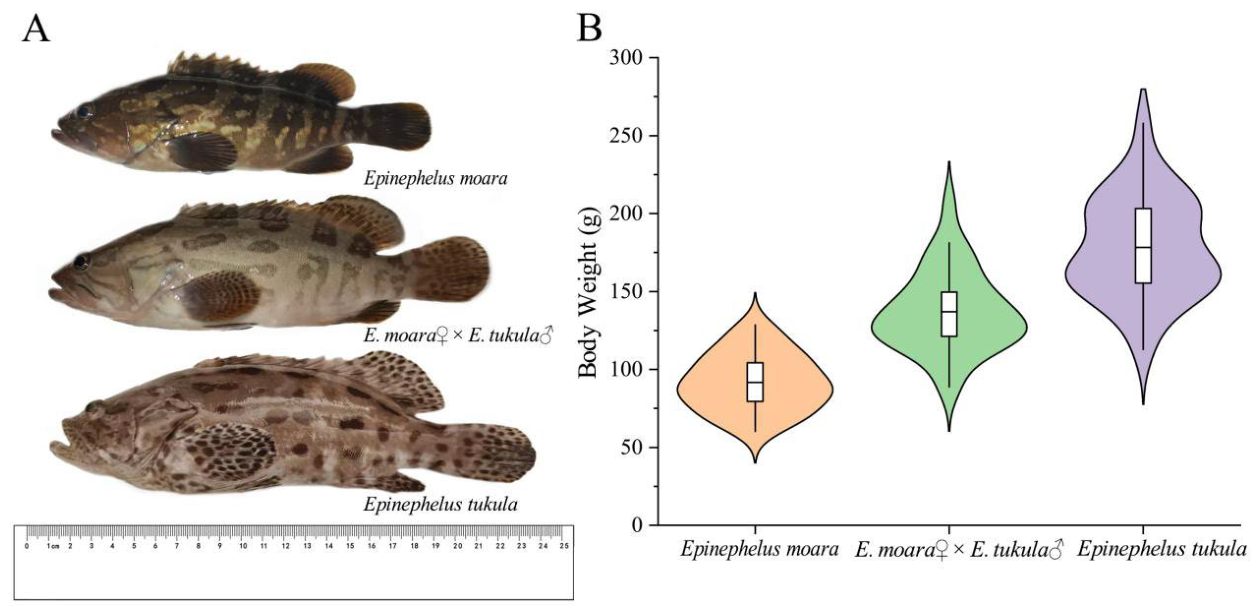
Figure 3.
Mitochondrial genome maps of Epinephelus tukula (A), E. moara (B), and E. moara ♀ × E. tukula ♂(C).
Figure 3.
Mitochondrial genome maps of Epinephelus tukula (A), E. moara (B), and E. moara ♀ × E. tukula ♂(C).
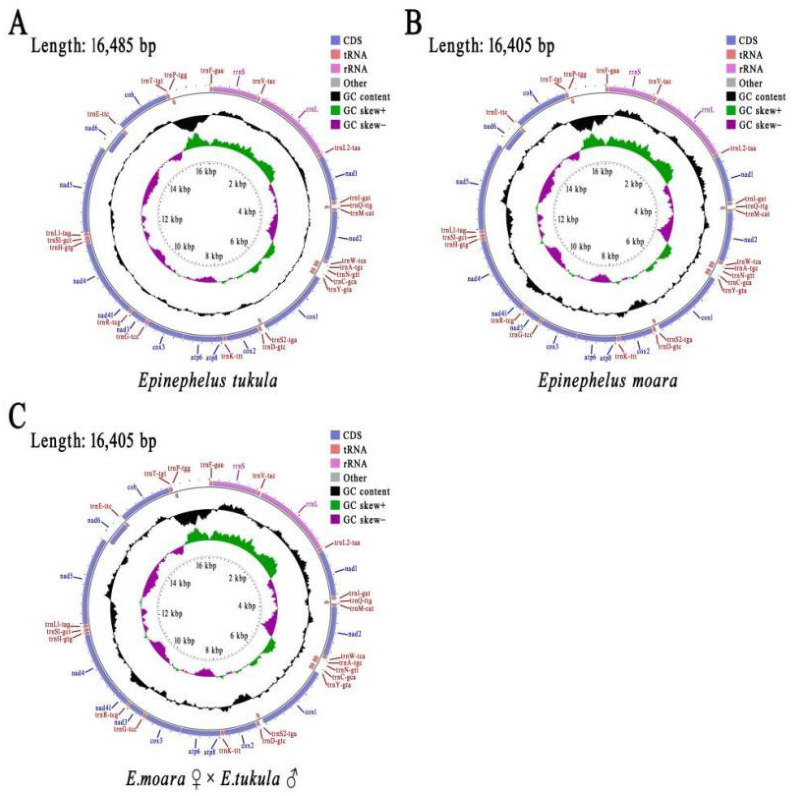
Figure 4.
Relative synonymous codon usage (RSCU) of Epinephelus tukula(A), E. moara(B), and E. moara ♀ × E. tukula ♂(C).
Figure 4.
Relative synonymous codon usage (RSCU) of Epinephelus tukula(A), E. moara(B), and E. moara ♀ × E. tukula ♂(C).
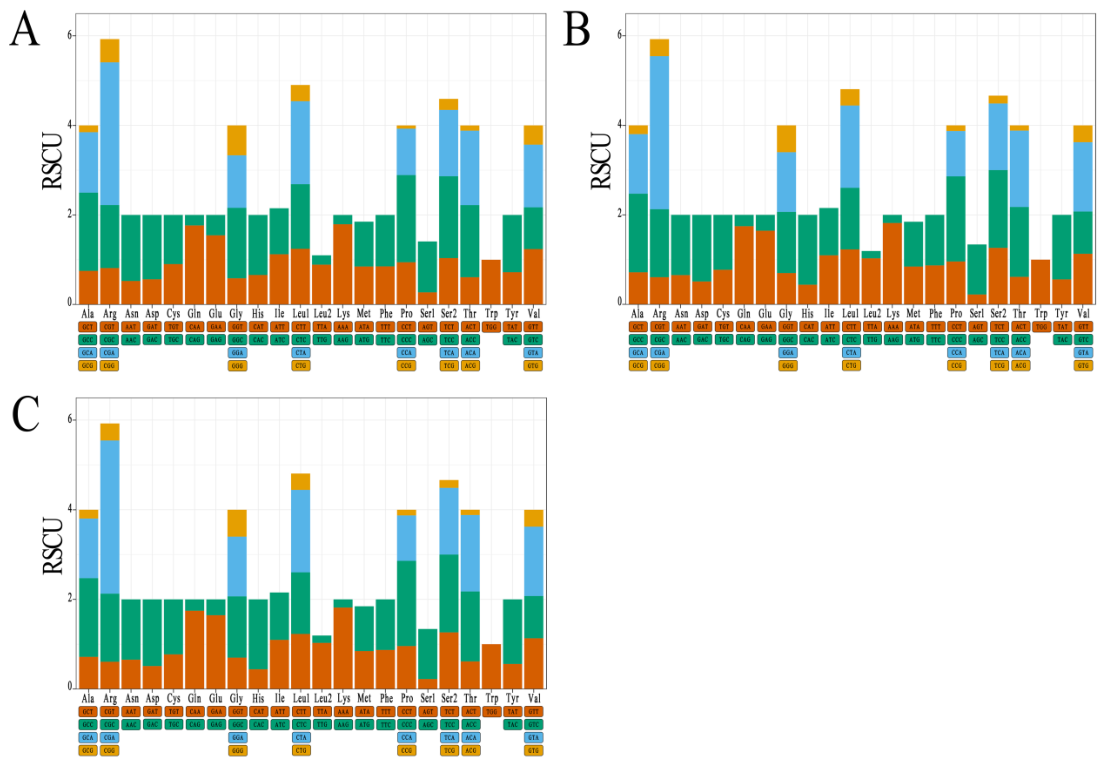
Figure 5.
Mitochondrial whole genome alignment of Epinephelus tukula, E. moara, and E. moara ♀ × E. tukula ♂.
Figure 5.
Mitochondrial whole genome alignment of Epinephelus tukula, E. moara, and E. moara ♀ × E. tukula ♂.
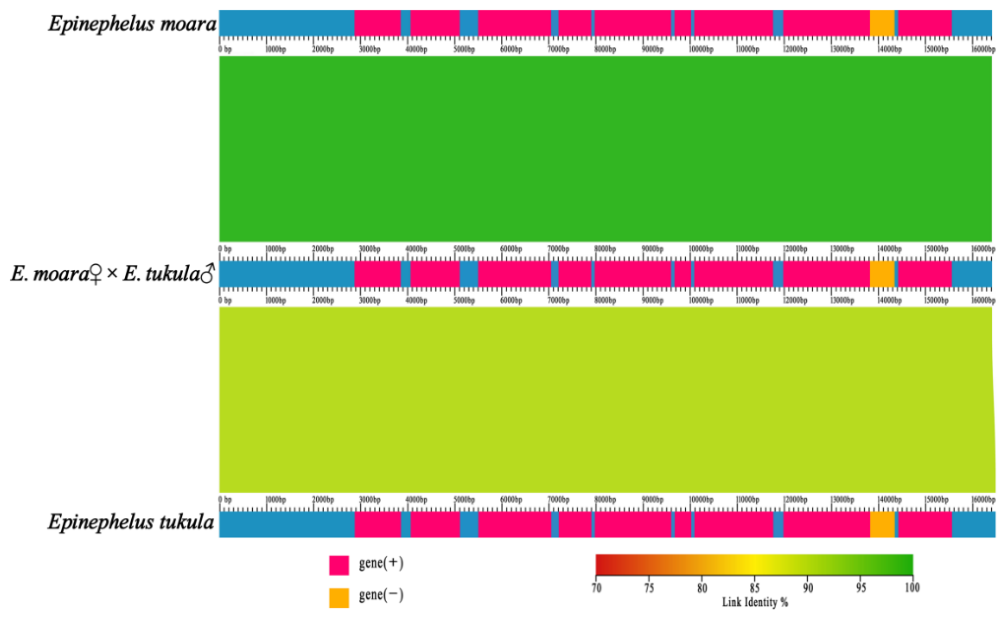
Figure 6.
Ka/Ks values for 13 PCGs of Epinephelus tukula, E. moara, and E. moara ♀ × E. tukula ♂. A: Heatmap of Ka, Ks and Ka/Ks values across 13 mitochondrial PCGs; B: Box plot showing the distribution of Ka/Ks ratios for each mitochondrial gene. Boxes in various colors indicate different mitochondrial genes.
Figure 6.
Ka/Ks values for 13 PCGs of Epinephelus tukula, E. moara, and E. moara ♀ × E. tukula ♂. A: Heatmap of Ka, Ks and Ka/Ks values across 13 mitochondrial PCGs; B: Box plot showing the distribution of Ka/Ks ratios for each mitochondrial gene. Boxes in various colors indicate different mitochondrial genes.
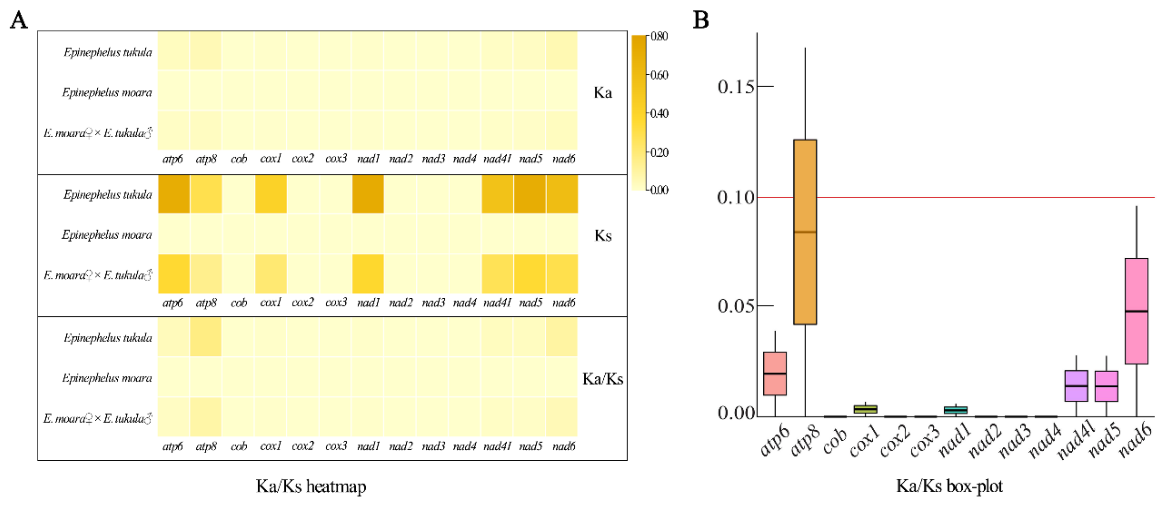
Figure 7.
The combined maximum likelihood (ML) and Neighbor-Joining (NJ) tree of 19 grouper species using 13 protein-coding genes (PCGs). Bootstrap values are shown at the base of each node. GenBank accession numbers follow scientific names. The species from the current study are highlighted with red dashed lines. Various background colors represent different genera of groupers.Numbers on each node are bootstrap values of 1000 replicates.
Figure 7.
The combined maximum likelihood (ML) and Neighbor-Joining (NJ) tree of 19 grouper species using 13 protein-coding genes (PCGs). Bootstrap values are shown at the base of each node. GenBank accession numbers follow scientific names. The species from the current study are highlighted with red dashed lines. Various background colors represent different genera of groupers.Numbers on each node are bootstrap values of 1000 replicates.
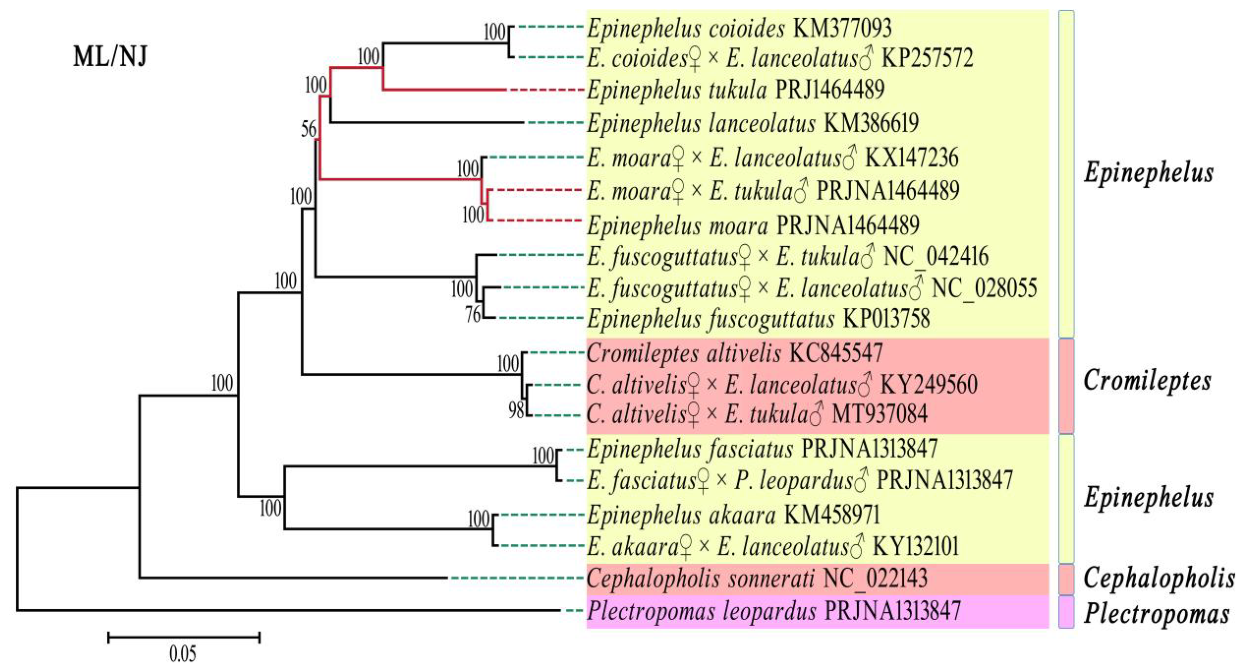

Table 1.
Counts of the chromosomes of Epinephelus tukula, E. moara and E. moara ♀ × E. tukula ♂.
| Number of chromosome | ≤42 | 43 | 44 | 45 | 46 | 47 | 48 | ≥49 |
|---|---|---|---|---|---|---|---|---|
| Epinephelus tukula | 6 | 2 | 0 | 1 | 2 | 8 | 79 | 2 |
| E. moara | 4 | 0 | 1 | 1 | 5 | 5 | 84 | 0 |
| E. moara ♀ × E. tukula ♂ | 9 | 1 | 3 | 0 | 3 | 7 | 76 | 1 |
Table 2.
The relative length and ratio of chromosomes of Epinephelus tukula, E. moara and E. moara ♀ × E. tukula ♂.
Table 2.
The relative length and ratio of chromosomes of Epinephelus tukula, E. moara and E. moara ♀ × E. tukula ♂.
| No. | Epinephelus tukula | E. moara | E. moara ♀ × E. tukula ♂ | ||||||
|---|---|---|---|---|---|---|---|---|---|
| Relative Length |
Arm Ratio |
Type | Relative Length |
Arm Ratio |
Type | Relative Length |
Arm Ratio |
Type | |
| 1 | 4.72±0.06 | ∞ | t | 4.80±0.19 | ∞ | t | 5.07±0.25 | ∞ | t |
| 2 | 4.70±0.07 | ∞ | t | 4.79±0.08 | ∞ | t | 4.91±0.15 | ∞ | t |
| 3 | 4.57±0.40 | ∞ | t | 5.13±0.29 | ∞ | t | 4.72±0.10 | ∞ | t |
| 4 | 4.50±0.24 | ∞ | t | 4.83±0.10 | ∞ | t | 4.98±0.34 | ∞ | t |
| 5 | 4.78±0.54 | ∞ | t | 4.03±0.32 | ∞ | t | 4.47±0.22 | ∞ | t |
| 6 | 4.75±0.15 | ∞ | t | 4.54±0.08 | ∞ | t | 4.43±0.23 | ∞ | t |
| 7 | 4.44±0.01 | ∞ | t | 4.46±0.13 | ∞ | t | 4.28±0.12 | ∞ | t |
| 8 | 4.45±0.33 | ∞ | t | 3.99±0.41 | ∞ | t | 4.57±0.08 | ∞ | t |
| 9 | 4.41±0.12 | ∞ | t | 4.58±0.27 | ∞ | t | 4.20±0.15 | ∞ | t |
| 10 | 4.58±0.22 | ∞ | t | 4.26±0.02 | ∞ | t | 4.23±0.24 | ∞ | t |
| 11 | 4.51±0.13 | ∞ | t | 4.32±0.01 | ∞ | t | 4.31±0.14 | ∞ | t |
| 12 | 3.90±0.13 | ∞ | t | 3.73±0.28 | ∞ | t | 4.12±0.15 | ∞ | t |
| 13 | 4.15±0.20 | ∞ | t | 4.44±0.42 | ∞ | t | 3.84±0.22 | ∞ | t |
| 14 | 4.22±0.08 | ∞ | t | 4.33±0.27 | ∞ | t | 3.95±0.19 | ∞ | t |
| 15 | 4.45±0.16 | ∞ | t | 4.22±0.30 | ∞ | t | 3.80±0.46 | ∞ | t |
| 16 | 4.04±0.11 | ∞ | t | 3.88±0.30 | ∞ | t | 4.30±0.18 | ∞ | t |
| 17 | 4.17±0.27 | ∞ | t | 3.80±0.08 | ∞ | t | 3.91±0.18 | ∞ | t |
| 18 | 3.71±0.13 | ∞ | t | 3.89±0.05 | ∞ | t | 3.82±0.07 | ∞ | t |
| 19 | 3.58±0.11 | ∞ | t | 3.42±0.26 | ∞ | t | 3.80±0.15 | ∞ | t |
| 20 | 3.95±0.79 | ∞ | t | 2.84±0.56 | ∞ | t | 3.64±0.22 | ∞ | t |
| 21 | 2.87±0.45 | ∞ | t | 3.50±0.36 | 2.66±0.38 | sm | 2.99±0.09 | ∞ | t |
| 22 | 2.52±1.34 | ∞ | t | 4.41±1.19 | 2.24±0.03 | sm | 2.72±0.14 | 2.63±0.43 | sm |
| 23 | 3.92±0.38 | 3.52±0.21 | st | 4.45±0.38 | 2.59±0.01 | sm | 3.91±0.03 | 3.49±0.49 | st |
| 24 | 4.10±0.53 | 2.88±0.27 | sm | 3.35±1.19 | 2.53±0.15 | sm | 5.04±0.66 | 2.89±0.17 | sm |
Disclaimer/Publisher’s Note: The statements, opinions and data contained in all publications are solely those of the individual author(s) and contributor(s) and not of MDPI and/or the editor(s). MDPI and/or the editor(s) disclaim responsibility for any injury to people or property resulting from any ideas, methods, instructions or products referred to in the content. |
© 2026 by the authors. Licensee MDPI, Basel, Switzerland. This article is an open access article distributed under the terms and conditions of the Creative Commons Attribution (CC BY) license (http://creativecommons.org/licenses/by/4.0/).
Copyright: This open access article is published under a Creative Commons CC BY 4.0 license, which permit the free download, distribution, and reuse, provided that the author and preprint are cited in any reuse.


