

Submitted:
16 July 2026
Posted:
17 July 2026
You are already at the latest version
Abstract
Freshwater bivalves are a poorly represented but biogeographically informative component of Chilean inland waters. Their distribution offers a useful framework for evaluating latitudinal gradients, historical biogeography and the southern limits of non-marine molluscs in South America. Here, we present a georeferenced synthesis and annotated checklist of Chilean inland-water bivalves based on 90 occurrence records compiled from the literature and associated datasets. The records comprise 12 species in four genera: Diplodon, Musculium, Pisidium and Sphaerium, belonging to Hyriidae and Sphaeriidae. Diplodon chilensis was the most frequently recorded species, with 52 records and a latitudinal range from approximately 30.5°S to 46.6°S. By contrast, the southernmost records were represented by Sphaeriidae, especially Pisidium magellanicum from Laguna El Salto, Isla Navarino, at approximately 55.0°S. Other high-latitude records included Pisidium lebruni from Punta Arenas, Musculium patagonicum from Puerto Natales and Pisidium chilense from the Aysén Region. The dataset indicates contrasting biogeographical patterns between large-bodied hyriid mussels and small-bodied sphaeriid clams. Whereas Diplodon appears mainly associated with central-southern and Patagonian continental freshwater systems, Sphaeriidae extend farther south into Magellanic and sub-Antarctic environments. This contrast may reflect differences in dispersal capacity, ecological tolerance, habitat use and historical responses to Quaternary glaciations. The checklist and distributional synthesis provide a baseline for future taxonomic, phylogeographical and conservation studies of Chilean freshwater bivalves.
Keywords:
Chile
; freshwater bivalves
; georeferenced records
; Hyriidae
; sphaeriidae
; diplodon
; pisidium
; patagonia
; isla navarino
; latitudinal gradient
1. Introduction
Freshwater bivalves are important components of inland aquatic ecosystems, contributing to water filtration, sediment bioturbation, nutrient cycling, organic matter processing and benthic habitat structure [1](Vaughn and Hakenkamp 2001). Despite their ecological relevance, non-marine bivalves remain unevenly documented across the Southern Hemisphere. Most global syntheses and conservation assessments have focused on Northern Hemisphere mussel faunas, whereas the diversity, taxonomy and distribution of South American freshwater bivalves are still comparatively less integrated in regional and global biogeographical analyses [2](Graf and Cummings 2007).
In Chile, freshwater bivalves are represented mainly by Hyriidae and Sphaeriidae. Hyriidae is represented by the genus Diplodon, including Diplodon chilensis and Diplodon solidulus, whereas Sphaeriidae includes small-bodied clams assigned to Pisidium, Sphaerium and Musculium [3,4,5](Parada and Peredo 2002, 2006; Ituarte 2007). These families differ markedly in body size, life-history traits, habitat use and probable dispersal mechanisms. Species of Diplodon are comparatively large mussels associated with rivers, lakes and permanent freshwater systems, whereas sphaeriid clams are smaller, often occur in lakes, ponds, wetlands and marginal habitats, and may disperse passively through waterbirds or other vectors.
The Chilean territory provides a natural setting for evaluating the distribution of freshwater bivalves along one of the longest latitudinal gradients in the Southern Hemisphere. Inland waters in Chile extend from arid and semi-arid northern basins to temperate, Patagonian, Magellanic and sub-Antarctic systems [3]. This gradient is particularly useful for identifying northern and southern distributional limits and for comparing the distributional behaviour of large-bodied mussels and small-bodied clams [4].
Previous studies have summarised the taxonomy, ecology and state of knowledge of Chilean freshwater bivalves, including progress and conflicts in their systematics, reproductive biology, karyology, ecology and conservation relevance [3,4,5,6,7,8,9,10,11,12,13](Parada and Peredo 1994, 2002, 2006; Parada et al. 1987, 1989, 1990; Peredo and Parada 1984; Jara-Seguel et al. 2000, 2010; Valdovinos and Pedreros 2007). However, the latitudinal structure of the Chilean fauna and the contrast between Hyriidae and Sphaeriidae have received less explicit attention. In particular, high-latitude records of Pisidium and related sphaeriid taxa are biogeographically important because they reach Patagonia, Magallanes and sub-Antarctic environments [5,14,15](Ituarte 1999, 2007; Rendoll-Cárcamo et al. 2020).
The objective of this study was to provide an annotated and georeferenced synthesis of Chilean inland-water bivalves and to analyse their latitudinal distribution. Specifically, we aimed to: (1) summarise the taxonomic composition of the compiled records; (2) provide an annotated checklist of the species included in the dataset; (3) determine northern and southern latitudinal limits for each species and genus; (4) compare distributional patterns between Hyriidae and Sphaeriidae; and (5) discuss the biogeographical implications of the observed patterns for southern South American inland waters.
2. Materials and Methods
2.1. Dataset and Sources
The analysis was based on a compiled database of Chilean inland-water bivalve occurrence records. The dataset included 90 records and 18 fields containing taxonomic, geographical and bibliographic information. The main variables used in the analysis were family, genus, species, locality, latitude, longitude, altitude and bibliographic reference. The dataset was treated as a literature-derived occurrence compilation rather than as a systematic field survey. Therefore, record frequency should be interpreted as the number of compiled records and not as a direct measure of abundance, population size or sampling effort.
Only records corresponding to inland waters were retained. Marine, strictly estuarine and coastal marine records were excluded when they were not compatible with freshwater or inland-water occurrence. When multiple records corresponded to the same species and locality but came from different bibliographic sources or entries, they were retained as independent literature records unless clear duplication was evident. The database was closed before analysis; no additional occurrence records were incorporated after closure.
2.2. Taxonomic Treatment
The dataset included species belonging to two freshwater bivalve families: Hyriidae and Sphaeriidae. Hyriidae was represented by Diplodon, whereas Sphaeriidae was represented by Musculium, Pisidium and Sphaerium. Species names were retained as recorded in the compiled sources and harmonised following the taxonomic treatments available for Chilean and southern South American freshwater bivalves [3,4,5,14] (Parada and Peredo 2002, 2006; Ituarte 1999, 2007). This treatment allows the database to preserve the nomenclature used in the primary literature while providing a standardised working list for the present analysis.
2.3. Data Cleaning and Georeferencing
The database was imported into R using the package readxl. Latitude values were inspected before analysis and corrected when evident formatting errors were detected, particularly records in which southern latitudes were written with an initial dot instead of a minus sign. Longitude values were retained in decimal degrees. The coordinates were treated as approximate locality coordinates when they came from bibliographic information rather than from direct GPS measurements. Records with uncertain or potentially inconsistent coordinates should be flagged in the final submitted dataset.
2.4. Descriptive and Spatial Analyses
Species-level summaries were calculated using dplyr. For each species, the number of records, northernmost latitude, southernmost latitude and latitudinal range were estimated. Southernmost records were identified by arranging the dataset by latitude, with more negative values representing higher southern latitudes. Genus-level summaries were also calculated to compare the distributional ranges of Diplodon, Musculium, Pisidium and Sphaerium.
Occurrence records were converted to spatial objects using sf, with coordinates defined in the WGS84 geographic reference system. A base map of Chile was obtained using rnaturalearth and rnaturalearthdata, and distribution maps were produced using ggplot2 and ggrepel. All analyses were conducted in R [16](R Core Team 2025) using readxl [17] (Wickham and Bryan 2023), dplyr [18] (Wickham et al. 2023), ggplot2 [19] (Wickham 2016), sf [20] (Pebesma 2018), rnaturalearth and rnaturalearthdata [21] (South 2017), and ggrepel [22] (Slowikowski 2024).
3. Results
3.1. Taxonomic Composition
A total of 90 occurrence records corresponding to 12 inland-water bivalve species were compiled for Chile. The records belonged to two families, Hyriidae and Sphaeriidae, and four genera: Diplodon, Musculium, Pisidium and Sphaerium. Sphaeriidae accounted for most of the species richness, with ten of the twelve species, whereas Hyriidae was represented by two species. By contrast, Hyriidae accounted for most compiled occurrence records because Diplodon chilensis alone represented 52 records, equivalent to 57.8% of the database (Table 1).
3. 2- Annotated Checklist
Diplodon chilensis (Gray, 1828) - Hyriidae
The most frequently recorded species in the dataset. It occurs mainly in central-southern Chile and northern Patagonia, with a compiled latitudinal range of approximately 30.5-46.6°S. Its high frequency reflects both broad distribution and greater historical research attention compared with other Chilean inland-water bivalves.
Diplodon (Australis) solidulus (R. A. Philippi, 1869) - Hyriidae
Represented by a single compiled record near 41.5°S. This taxon requires careful nomenclatural verification before submission because subgeneric usage and synonymy in South American Hyriidae have changed across the literature.
Musculium argentinum (d’Orbigny, 1835) - Sphaeriidae
Represented by eight records between approximately 38.5°S and 41.2°S. The species has been reported from Chilean continental waters and contributes to the regional diversity of small-bodied sphaeriid clams.
Musculium patagonicum Pilsbry, 1911 - Sphaeriidae
Represented by one high-latitude record from Puerto Natales, approximately 51.7°S. This record contributes to the evidence that Sphaeriidae reach Magellanic freshwater environments.
Pisidium chilense (d’Orbigny, 1846) - Sphaeriidae
The most frequently recorded sphaeriid in the dataset, with 15 records and a latitudinal range of approximately 36.6-44.6°S. It represents the widest species-level range among the Chilean sphaeriids included here, excluding the single northern outlier records of other species.
Pisidium huillichum Ituarte, 1999- Sphaeriidae
Represented by four records from southern Chile, between approximately 40.6°S and 43.3°S. Its distribution reinforces the importance of temperate and northern Patagonian freshwater systems for sphaeriid diversity.
Pisidium llanquihuense Ituarte, 1999- Sphaeriidae
Represented by three records, with a compiled range of approximately 40.6-42.6°S. The species appears associated with southern Chilean freshwater systems.
Pisidium magellanicum (Dall 1908)- Sphaeriidae
Represented by two records, including the southernmost occurrence in the dataset: Laguna El Salto, Isla Navarino, approximately 55.0°S. This taxon is central to the biogeographical interpretation of high-latitude sphaeriid distribution.
Pisidium lebruni Mabille, 1884 - Sphaeriidae
Represented by one record from Punta Arenas, approximately 53.1°S. Together with P. magellanicum and M. patagonicum, this species documents the extension of Sphaeriidae into Magellanic inland waters.
Pisidium meierbrooki Kuiper & Hinz, 1983- Sphaeriidae
Represented by a single northern Chilean record at approximately 18.2°S. This record strongly influences the genus-level northern limit of Pisidium in the compiled dataset and should be verified in the final database.
Sphaerium forbesi (Philippi, 1869)- Sphaeriidae
Represented by a single northern record at approximately 18.2°S. The record defines the northern limit of Sphaerium in the analysed dataset and requires coordinate and taxonomic verification before submission.
Sphaerium lauricochae (Philippi, 1869)- Sphaeriidae
Represented by a single record from northern Chile, approximately 21.6°S. Its inclusion indicates the occurrence of Sphaerium in arid or high-altitude northern inland-water systems, but final taxonomic validation is recommended.
3.3. Latitudinal Distribution
The analysed records covered a broad latitudinal gradient from approximately 18.2°S in northern Chile to 55.0°S in the Magallanes Region. The northernmost occurrences corresponded to Pisidium meierbrooki and Sphaerium forbesi in northern Chile, whereas the southernmost record corresponded to Pisidium magellanicum from Laguna El Salto, Isla Navarino, at approximately 55.0°S. Diplodon chilensis exhibited the broadest species-level distribution among frequently recorded taxa, extending from approximately 30.5°S to 46.6°S, equivalent to a range of 16.1 degrees of latitude (Table 2; Figure 1).
3.4. Latitudinal Distribution
The analysed records covered a broad latitudinal gradient from approximately 18.2°S in northern Chile to 55.0°S in the Magallanes Region. The northernmost occurrences corresponded to Pisidium meierbrooki and Sphaerium forbesi in northern Chile, whereas the southernmost record corresponded to Pisidium magellanicum from Laguna El Salto, Isla Navarino, at approximately 55.0°S. Diplodon chilensis exhibited the broadest species-level distribution among frequently recorded taxa, extending from approximately 30.5°S to 46.6°S, equivalent to a range of 16.1 degrees of latitude (Table 2; Figure 1).
3.5. Genus-Level Patterns
At the genus level, Diplodon accounted for 53 records and two species, whereas Pisidium comprised five species and 25 records. Pisidium exhibited the broadest genus-level latitudinal distribution, extending from 18.2°S to 55.0°S, although this broad range is strongly influenced by single northern and southern records. Diplodon ranged from 30.5°S to 46.6°S, Musculium reached 51.7°S and Sphaerium was restricted to northern Chile in the compiled dataset (Table 3).
4. Discussion
4.1. Diversity and Composition of Chilean Inland-Water Bivalves
This study provides a georeferenced synthesis and annotated checklist of Chilean inland-water bivalves based on compiled literature records. Although the analysed fauna is species-poor compared with that of larger South American countries, it is biogeographically distinctive because it combines large-bodied hyriid mussels and several small-bodied sphaeriid clams. The dataset also illustrates an important contrast between species richness and record frequency: Sphaeriidae contributed most species, whereas Diplodon chilensis dominated the compiled occurrence records.
The prominence of Diplodon chilensis in the dataset probably reflects a combination of true ecological distribution, conspicuous body size and stronger historical research attention. Chilean Diplodon populations have been studied in relation to reproduction, population dynamics, feeding behaviour, karyology, growth, trophic interactions and conservation [7,8,10,13,23,24,25,26,27,28,29,30,31,32] (Peredo and Parada 1984; Parada et al. 1987, 1990; Lara and Parada 1988, 1991; Lara and Moreno 1995; Lara et al. 2002; Peredo et al. 2003; Valdovinos and Pedreros 2007). In contrast, sphaeriids are small, less conspicuous and more easily overlooked in routine surveys, which may partly explain their lower frequency in compiled records despite higher taxonomic richness.
4.2. Contrasting Latitudinal Patterns
The most relevant biogeographical result is the contrast between the dominant but less austral distribution of Diplodon and the higher-latitude reach of Sphaeriidae [3]. Diplodon chilensis showed the broadest range among individual species with many records, but its southern limit in the dataset was approximately 46.6°S [4]. By contrast, sphaeriid clams reached Magellanic and sub-Antarctic environments, including Pisidium magellanicum at Isla Navarino, approximately 55.0°S [15].
This pattern suggests that southern distributional limits differ substantially among Chilean inland-water bivalve lineages [3,4]. Large freshwater mussels appear mainly associated with continental temperate and Patagonian freshwater systems, where permanent habitats and hydrographic connectivity are more favourable [3]. Small-bodied sphaeriids, in contrast, can occur in isolated, cold and high-latitude freshwater habitats. Their small size, short generation time, ecological flexibility and potential for passive dispersal may facilitate persistence in environments where large unionoid mussels are absent [4].
4.3. Biogeographical Implications for Southern South America
Patagonia, Tierra del Fuego and Isla Navarino are key areas for understanding the historical biogeography of freshwater organisms in southern South America [33,34]. These regions were strongly affected by Quaternary glaciations and subsequent post-glacial landscape reorganisation. The occurrence of Pisidium magellanicum, Pisidium lebruni and Musculium patagonicum in Magellanic and sub-Antarctic freshwater environments suggests that sphaeriid clams may be useful model organisms for studying high-latitude persistence, post-glacial colonisation and dispersal in southern inland waters [15].
The interpretation proposed here should be treated as a working biogeographical hypothesis rather than as a definitive reconstruction. The compiled dataset is literature-derived and is affected by uneven sampling effort among regions, taxa and habitat types. Northern and southern range limits based on single records require particular caution and should be validated through taxonomic revision, specimen examination and updated georeferencing [35]. Nevertheless, the observed contrast between Hyriidae and Sphaeriidae is strong enough to justify further research and provides a testable framework for future phylogeographical and ecological studies.
4.4. Conservation and Research Implications
Freshwater bivalves are sensitive to habitat degradation, eutrophication, sediment alteration, hydrological regulation and water pollution. In Chile, Diplodon species have particular conservation relevance because they are large, long-lived and associated with permanent freshwater habitats that are increasingly affected by land-use change and water management [4]. Sphaeriids, although smaller and less conspicuous, may provide important information on isolated wetlands, high-latitude systems and poorly explored inland waters [5].
The present checklist highlights the need for updated field surveys, specimen-based taxonomic confirmation, molecular analyses and public deposition of occurrence data. Future studies should prioritise poorly sampled northern systems, Patagonian waters, Magellanic wetlands and sub-Antarctic freshwater habitats. Integrating morphology, molecular data and standardised georeferenced records will be essential for resolving taxonomic uncertainty and improving conservation assessments of Chilean inland-water bivalves.
5. Conclusions
The inland-water bivalve fauna of Chile comprises a relatively small number of recorded species but exhibits clear biogeographical structure along the country’s extensive latitudinal gradient. Diplodon chilensis was the dominant species in terms of compiled occurrence records and showed the widest range among frequently recorded taxa. However, Sphaeriidae reached the greatest southern distributional limits, with Pisidium magellanicum from Isla Navarino representing the southernmost record in the database. This contrast between Hyriidae and Sphaeriidae suggests that body size, life-history traits, habitat requirements and dispersal capacity may shape freshwater bivalve distributions in southern South America. The revised checklist and georeferenced synthesis provide a baseline for future taxonomic, phylogeographical, ecological and conservation studies of Chilean inland-water bivalves.
Supplementary Materials
The following supporting information can be downloaded at the website of this paper posted on Preprints.org. The occurrence dataset supporting this study is provided as Supplementary material 1 and includes taxonomic identity, locality, geographic coordinates, altitude, bibliographic source and remarks for each record. A cleaned CSV or XLSX version should be deposited in a public repository before final submission.
Author Contributions
both coauthors contributed equally to redaction of the manuscript.
Funding
The present study was funded by MECESUP Project UCT 0804.
Institutional Review Board Statement
In this section, please add the Institutional Review Board Statement and approval number for studies involving humans or animals. You might choose to exclude this statement if the study did not require ethical approval. Please note that the Editorial Office might ask you for further information. Please add “The study was conducted in accordance with the Declaration of Helsinki, and approved by the Institutional Review Board (or Ethics Committee) of NAME OF INSTITUTE (protocol code XXX and date of approval).” for studies involving humans OR “The animal study protocol was approved by the Institutional Review Board (or Ethics Committee) of NAME OF INSTITUTE (protocol code XXX and date of approval).” for studies involving animals OR “Ethical review and approval were waived for this study due to REASON (please provide a detailed justification).” OR “Not applicable.” for studies not involving humans or animals.
Data Availability Statement
We encourage all authors of articles published in MDPI journals to share their research data. In this section, please provide details regarding where data supporting reported results can be found, including links to publicly archived datasets analyzed or generated during the study. Where no new data were created, or where data are unavailable due to privacy or ethical restrictions, a statement is still required. Suggested Data Availability Statements are available in the section “MDPI Research Data Policies” at https://www.mdpi.com/ethics.
Acknowledgments
The authors thank M.I. and S.M.A. for their valuable comments and suggestions that improved the manuscript, and to Prof. Cristian Ituarte by his bibliographic collaboration.
Conflicts of Interest
Declare conflicts of interest or state “The authors declare no conflicts of interest.” Authors must identify and declare any personal circumstances or interests that may be perceived as inappropriately influencing the representation or interpretation of reported research results. Any role of the funders in the design of the study; in the collection, analyses or interpretation of data; in the writing of the manuscript; or in the decision to publish the results must be declared in this section. If there is no role, please state “The funders had no role in the design of the study; in the collection, analyses, or interpretation of data; in the writing of the manuscript; or in the decision to publish the results”.
References
- Vaughn, C.C.; Hakenkamp, C.C. The functional role of burrowing bivalves in freshwater ecosystems. Freshwat. Biol. 2001, 46, 1431–1446. [Google Scholar] [CrossRef]
- Graf, D.L.; Cummings, K.S. Review of the systematics and global diversity of freshwater mussel species (Bivalvia: Unionoida). J. Moll. Stud. 2007, 73, 291–314. [Google Scholar] [CrossRef]
- Parada, E.; Peredo, S. Estado actual de la taxonomía de bivalvos dulceacuícolas chilenos: progresos y conflictos. Rev. Chil. Hist. Nat. 2002, 75, 691–701. [Google Scholar] [CrossRef]
- Parada, E.; Peredo, S. Estado de conocimiento de los bivalvos dulceacuícolas de Chile. Gayana 2006, 70, 82–87. [Google Scholar] [CrossRef]
- Ituarte, C. Las especies de Pisidium C. Pfeiffer, 1821 de Argentina, Bolivia, Chile, Perú y Uruguay (Bivalvia, Sphaeriidae). Rev. Mus. Argent. Cienc. Nat. 2007, 9, 169–203. [Google Scholar] [CrossRef]
- Parada, E.; Peredo, S. Un enfoque ecológico evolutivo de las estrategias de historia de vida de los híridos chilenos (Mollusca, Bivalvia). Bol. Soc. Biol. Concepción 1994, 65, 71–80. [Google Scholar]
- Peredo, S.; Parada, E. Gonadal organization and gametogenesis in the freshwater mussel Diplodon chilensis chilensis. The Veliger 1984, 27, 126–133. [Google Scholar]
- Parada, E.; Peredo, S.; Gallardo, C. Esfuerzo reproductivo en Diplodon chilensis chilensis (Gray, 1828) (Mollusca: Bivalvia). Una proposición para su determinación. Bol. Soc. Biol. Concepción 1987, 58, 121–126. [Google Scholar]
- Parada, E.; Peredo, S.; Lara, G.; Antonin, F. Contribución al conocimiento de los Hyriidae chilenos. Bol. Soc. Biol. Concepción 1989, 60, 173–182. [Google Scholar]
- Parada, E.; Peredo, S.; Gallardo, C. Tácticas reproductivas y dinámica poblacional de Diplodon chilensis (Gray, 1828) (Bivalvia: Hyriidae). Rev. Chil. Hist. Nat. 1990, 63, 23–35. [Google Scholar]
- Jara-Seguel, P.; Peredo, S.; Palma-Rojas, C.; Parada, E.; Lara, G. Quantitative karyotype of Diplodon chilensis (Gray, 1828) (Bivalvia: Hyriidae). Gayana Zool. 2000, 64, 189–193. [Google Scholar] [CrossRef]
- Jara-Seguel, P.; Parada, E.; Peredo, S.; Palma-Rojas, C.; Von Brand, E. Nuclear DNA content in two Chilean species of Pisidium (Veneroida: Sphaeriidae). J. Shell. Res. 2010, 29, 101–106. [Google Scholar] [CrossRef]
- Valdovinos, C.; Pedreros, P. Geographic variations in shell growth rates of the mussel Diplodon chilensis from temperate lakes of Chile: implications for biodiversity conservation. Limnologica 2007, 37, 63–75. [Google Scholar] [CrossRef]
- Ituarte, C. Pisidium chilense (d’Orbigny, 1846) and new species of Pisidium C. Pfeiffer, 1821 from southern Chile (Bivalvia, Sphaeriidae). Zoosystema 1999, 21, 249–258. [Google Scholar]
- Rendoll-Cárcamo, J.; Gañán, M.; Mackenzie, R.; Troncoso, S.; Troncoso, J.; Contador, T.; Convey, P. Macroinvertebrados dulceacuícolas del Parque Nacional Yendegala, Chile: resolviendo brechas de conocimiento sobre la biodiversidad de la Reserva de la Biosfera Cabo de Hornos. An. Inst. Patagon. 2020, 48, 23–37. [Google Scholar] [CrossRef]
- R Core Team R: A language and environment for statistical computing. R Foundation for Statistical Computing, Vienna, Austria, 2025.
- Wickham, H.; Bryan, J. readxl: Read Excel Files. R package version. 2023. [Google Scholar] [PubMed]
- Wickham, H.; François, R.; Henry, L.; Müller. K. dplyr: A Grammar of Data Manipulation. R package version. 2023. [Google Scholar] [PubMed]
- Wickham, H. ggplot2: Elegant Graphics for Data Analysis; Springer: New York, 2016. [Google Scholar]
- Pebesma, E. Simple Features for R: standardized support for spatial vector data. R Jour. 2018, 10, 439–446. [Google Scholar] [CrossRef]
- South, A. rnaturalearth: world map data from Natural Earth. R package version. 2017. [Google Scholar] [CrossRef] [PubMed]
- Slowikowski, K. ggrepel: Automatically position non-overlapping text labels with ggplot2. R package version. 2024. [Google Scholar] [PubMed]
- Lara, G.; Parada, E. Distribución espacial y densidad de Diplodon chilensis chilensis (Gray, 1828) en el Lago Villarrica (39º18’S; 72º05’W). Bol. Soc. Biol. Concepción 1988, 59, 105–114. [Google Scholar]
- Lara, G.; Parada, E. Seasonal changes in the condition index of Diplodon chilensis chilensis (Gray, 1828) in sandy and muddy substrata, Villarrica Lake, Chile (39º18’S; 72º05’W). Bol. Soc. Biol. Concepción 1991, 62, 99–106. [Google Scholar]
- Lara, G.; Moreno, C. Efectos de la depredación de Aegla abtao (Crustacea, Aeglidae) sobre la distribución espacial y abundancia de Diplodon chilensis (Bivalvia: Hyriidae) en el Lago Panguipulli, Chile. Rev. Chil. Hist. Nat. 1995, 68, 123–129. [Google Scholar]
- Lara, G.; Parada, E.; Peredo, S. Alimentación y conducta alimentaria de la almeja de agua dulce Diplodon chilensis (Bivalvia: Hyriidae). Gayana Zool. 2002, 66, 107–112. [Google Scholar] [CrossRef]
- Peredo, S.; Parada, E.; Jara-Seguel, P.; Palma-Rojas, C. Comparative karyology of lentic and lotic population of Diplodon chilensis chilensis (Mollusca: Bivalvia). The Veliger 2003, 46, 314–319. [Google Scholar]
- Parada, E.; Peredo, S.; Valenzuela, J.; Manuschevich, D. Extensión del límite norte de la distribución actual del chorito de agua dulce Diplodon chilensis (Gray, 1828) (Bivalvia: Hyriidae) en Chile. Gayana 2007, 71, 212–215. [Google Scholar] [CrossRef]
- Peredo, S.; Garrido, O.; Parada, E. Spermiogenesis and sperm ultrastructure in the freshwater mussel Diplodon chilensis chilensis (Mollusca: Bivalvia). Inv. Repr. Dev. 1990, 17, 171–179. [Google Scholar] [CrossRef]
- Sobarzo, C.; Jara-Seguel, P.; Peredo, S.; Parada, E. Primer registro de Musculium argentinum (d’Orbigny, 1835) (Bivalvia: Sphaeriidae) en aguas continentales chilenas. Gayana 2002, 66, 39–43. [Google Scholar] [CrossRef]
- Fuentealba, C.; Henriquez, O. Rol de las poblaciones de Diplodon chilensis (Gray, 1828) (Bivalvia: Hyriidae) en el estado trófico de la Laguna Chica de San Pedro (Chile). Com. Soc. Malacol. Urug. 2009, 9, 195–200. [Google Scholar] [CrossRef]
- Muñoz, E.; Mendoza, G.; Valdovinos, C. Evaluación rápida de la biodiversidad en cinco sistemas lénticos de Chile central: macroinvertebrados bentónicos. Gayana 2001, 65, 173–180. [Google Scholar] [CrossRef]
- Bonetto, A.A.; Tassara, M.; Rumi, A. Australis n. subgen. de Diplodon Spix (Bivalvia, Unionacea) y posibles relaciones con Hyriidae australianos. Bol. Soc. Biol. Concepción 1986, 57, 55–61. [Google Scholar]
- Clapperton, C.M. Quaternary Geology and Geomorphology of South America; Elsevier: Amsterdam, 1993. [Google Scholar]
- Kuiper, J.G.J.; Hinz, W. Zur fauna der kleinmuscheln in der Anden (Bivalvia: Sphaeriidae). Arch. Mollusk. 1983, 114, 109–116. [Google Scholar]
Figure 1.
Geographic distribution of freshwater bivalve genera recorded in Chile. Symbols represent occurrence records of Diplodon, Musculium, Pisidium and Sphaerium along the Chilean latitudinal gradient. This figure should be replaced by a higher-resolution, journal-ready version before final submission.
Figure 1.
Geographic distribution of freshwater bivalve genera recorded in Chile. Symbols represent occurrence records of Diplodon, Musculium, Pisidium and Sphaerium along the Chilean latitudinal gradient. This figure should be replaced by a higher-resolution, journal-ready version before final submission.
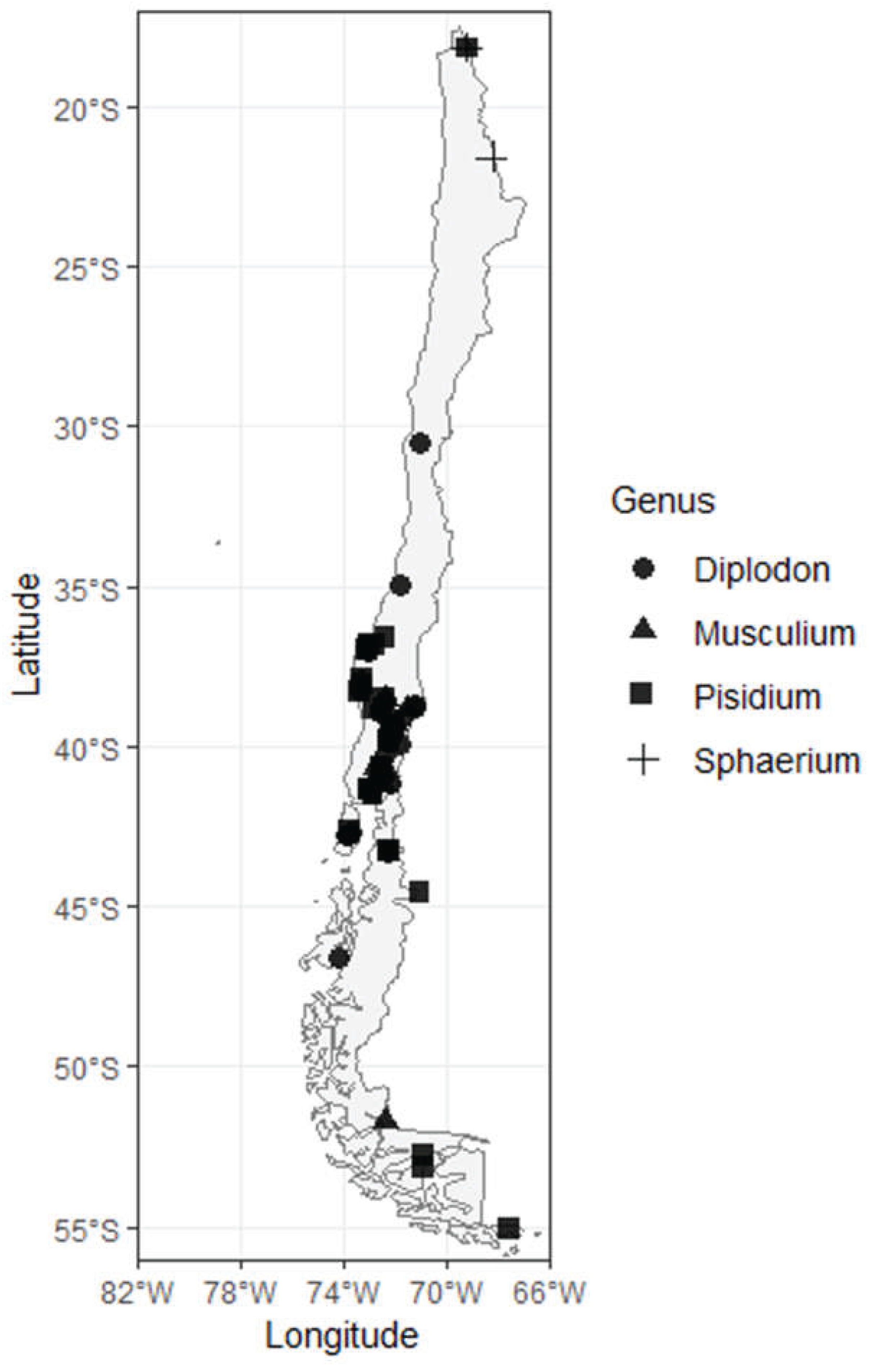

Table 1.
Species composition and number of occurrence records of Chilean inland-water bivalves included in the analysed database.
Table 1.
Species composition and number of occurrence records of Chilean inland-water bivalves included in the analysed database.
| Species | Family | Number of records |
| Diplodon chilensis | Hyriidae | 52 |
| Pisidium chilense | Sphaeriidae | 15 |
| Musculium argentinum | Sphaeriidae | 8 |
| Pisidium huillichum | Sphaeriidae | 4 |
| Pisidium llanquihuense | Sphaeriidae | 3 |
| Pisidium magellanicum | Sphaeriidae | 2 |
| Diplodon (Australis) solidulus | Hyriidae | 1 |
| Musculium patagonicum | Sphaeriidae | 1 |
| Pisidium lebruni | Sphaeriidae | 1 |
| Pisidium meierbrooki | Sphaeriidae | 1 |
| Sphaerium forbesi | Sphaeriidae | 1 |
| Sphaerium lauricochae | Sphaeriidae | 1 |
| Total | 90 |
Table 2.
Northern and southern latitudinal limits of Chilean inland-water bivalve species included in the analysed database.
Table 2.
Northern and southern latitudinal limits of Chilean inland-water bivalve species included in the analysed database.
| Species | Records | Northern limit (°S) | Southern limit (°S) | Latitudinal range (degrees) |
| Diplodon chilensis | 52 | 30.5 | 46.6 | 16.1 |
| Diplodon (Australis) solidulus | 1 | 41.5 | 41.5 | 0.0 |
| Musculium argentinum | 8 | 38.5 | 41.2 | 2.7 |
| Musculium patagonicum | 1 | 51.7 | 51.7 | 0.0 |
| Pisidium chilense | 15 | 36.6 | 44.6 | 8.0 |
| Pisidium huillichum | 4 | 40.6 | 43.3 | 2.7 |
| Pisidium llanquihuense | 3 | 40.6 | 42.6 | 2.0 |
| Pisidium magellanicum | 2 | 52.8 | 55.0 | 2.2 |
| Pisidium lebruni | 1 | 53.1 | 53.1 | 0.0 |
| Pisidium meierbrooki | 1 | 18.2 | 18.2 | 0.0 |
| Sphaerium forbesi | 1 | 18.2 | 18.2 | 0.0 |
| Sphaerium lauricochae | 1 | 21.6 | 21.6 | 0.0 |
Table 3.
Latitudinal limits and distributional characteristics of inland-water bivalve genera recorded in Chile.
Table 3.
Latitudinal limits and distributional characteristics of inland-water bivalve genera recorded in Chile.
| Genus | Species richness | Records | Northern limit (°S) | Southern limit (°S) |
| Diplodon | 2 | 53 | 30.5 | 46.6 |
| Musculium | 2 | 9 | 38.5 | 51.7 |
| Pisidium | 5 | 25 | 18.2 | 55.0 |
| Sphaerium | 2 | 2 | 18.2 | 21.6 |
Disclaimer/Publisher’s Note: The statements, opinions and data contained in all publications are solely those of the individual author(s) and contributor(s) and not of MDPI and/or the editor(s). MDPI and/or the editor(s) disclaim responsibility for any injury to people or property resulting from any ideas, methods, instructions or products referred to in the content. |
© 2026 by the authors. Licensee MDPI, Basel, Switzerland. This article is an open access article distributed under the terms and conditions of the Creative Commons Attribution (CC BY) license.
Copyright: This open access article is published under a Creative Commons CC BY 4.0 license, which permit the free download, distribution, and reuse, provided that the author and preprint are cited in any reuse.


