

Submitted:
15 July 2026
Posted:
16 July 2026
You are already at the latest version
Abstract
Background/Objectives: Recovery between exercise exposures is often framed as the rapid suppression of soreness, inflammation, oxidative stress, and fatigue, although the same perturbations may also initiate tissue repair and training adaptation. This review proposes recovery-adaptation coupling (RAC) as a decision framework for matching nu-tritional strategies to recovery bottlenecks while preserving adaptive signals. Methods: A mechanistic narrative synthesis integrated evidence on exercise-induced muscle dam-age, inflammation resolution, immune-redox regulation, muscle protein turnover, glyco-gen restoration, connective-tissue remodeling, micronutrient sufficiency, nutrient timing, individual variability, and recovery monitoring. Results: RAC links four tar-gets—damage attenuation, inflammation resolution, anabolic remodeling, and adaptive signal preservation—to the next athletic demand, the dominant recovery bottleneck, and the markers used to verify response. Nutritional strategies are interpreted according to context, dose, timing, and response phenotype. Conclusions: RAC is a heuristic decision architecture rather than a validated universal algorithm; it aims to restore readiness without indiscriminately suppressing the signals required for longer-term adaptation.
Keywords:
sports nutrition
; muscle recovery
; exercise-induced muscle damage
; delayed-onset muscle soreness
; inflammation resolution
; oxidative stress
; muscle protein synthesis
; polyphenols
; micronutrients
; recovery monitoring
; precision nutrition
1. Introduction
Recovery is an active interval between exercise exposures in which damaged contractile and extracellular-matrix structures are repaired, inflammatory and redox processes are coordinated, substrates are restored, and cellular signals are translated into future performance capacity [1,2,3,4]. High-intensity, eccentric, repeated-sprint, endurance, and contact-sport loads can produce delayed-onset muscle soreness (DOMS), transient strength loss, reduced power, glycogen depletion, autonomic disturbance, and perceived fatigue; when appropriately scaled and resolved, the same perturbations can also initiate remodeling and adaptation [5,6,7,8,9]. Consequently, the nutritional priority varies with the next demand: congested competition or repeated same-day sessions may require rapid functional restoration, whereas adaptation-oriented training may call for preserving redox and inflammatory signaling.
Most practical discussions of recovery nutrition remain product-centered: protein, carbohydrate, antioxidants, creatine, polyphenols, omega-3 fatty acids, nitrates, collagen, or micronutrients. This catalog approach is useful but incomplete. Athletes experience recovery across the interval between exercise exposures—including immediate, between-session, and overnight periods—as a pattern of soreness, force loss, substrate depletion, sleep disruption, psychological readiness, connective-tissue strain, and next-session demands. RAC therefore does not propose a new supplement hierarchy; it couples the dominant recovery bottleneck, the urgency and biological purpose of the next demand, the adaptive signal that may be modified, and the monitoring pattern used to confirm benefit. This distinguishes RAC from general recovery checklists and from fuel-periodization models [3,4,10,11].
This review proposes RAC as an integrative model for nutrition across the recovery interval. Nutrient quality, dose, timing, and periodization are selected according to the next athletic demand, a defined recovery bottleneck, a plausible adaptive consequence, and a monitoring marker. The framework is operational and hypothesis-generating rather than a validated treatment algorithm [3,4,6,10,11].
The review is guided by the following questions:
Q1.
Which exercise-induced damage and recovery processes should nutrition target without confusing symptom suppression with tissue repair?
Q2.
How can inflammation be resolved rather than bluntly inhibited?
Q3
. How can antioxidants and polyphenol-rich foods support recovery without erasing adaptive redox signaling?
Q4.
Which macronutrient strategies best restore substrate and support remodeling under different training densities?
Q5.
Which functional foods and nutraceuticals have plausible context-specific utility?
Q6.
How should nutritional decisions differ between competition recovery, adaptation-oriented training, and connective-tissue repair?
Q7.
How should response be monitored using subjective, functional, biochemical, and digital markers?
2. Review Approach and Methodological Framework
2.1. Search Strategy and Source Identification
Relevant literature was identified through targeted searches of PubMed/MEDLINE, Scopus, and Web of Science, supplemented by Google Scholar citation tracking and by backward and forward screening of key reviews, meta-analyses, consensus statements, and position stands. Searches covered literature available up to May 2026. Only peer-reviewed articles published in English were considered. Conference abstracts, non-peer-reviewed sources, duplicate records, and studies lacking sufficient methodological or outcome detail were not prioritized in the final synthesis. Screening and evidence selection were performed iteratively by the authors according to relevance to the RAC framework and applied recovery physiology.
Search combinations included terms related to exercise-induced muscle damage, delayed-onset muscle soreness, recovery nutrition, inflammation, cytokines, oxidative stress, redox signaling, reactive oxygen and nitrogen species, muscle protein synthesis, protein timing, leucine, essential amino acids, glycogen resynthesis, carbohydrate availability, omega-3 fatty acids, polyphenols, tart cherry, pomegranate, blueberry, curcumin, creatine, dietary nitrate, collagen, gelatin, vitamin C, hydration, electrolytes, vitamin D, iron, magnesium, energy availability, RED-S, sleep, heart-rate variability, wearables, athlete monitoring, and training load. These terms were combined, where appropriate, with athlete, trained, resistance exercise, endurance exercise, team sport, eccentric exercise, repeated sprint, competition, and return to play.
The search process followed three iterative passes. The first identified consensus statements, position stands, and high-level reviews defining accepted principles of sports nutrition, recovery, monitoring, and supplementation. The second identified randomized trials, controlled human studies, systematic reviews, and meta-analyses for specific nutrients, foods, and compounds. The third added mechanistic, connective-tissue, redox, immune, microbiome, and monitoring studies that clarified plausible pathways but were not used alone to justify strong sport-performance recommendations.
The final cited evidence base comprised 130 records. Because the review was narrative, iterative, and citation-led rather than protocol-registered and PRISMA-driven, a reliable denominator for all initially viewed, excluded, or citation-chased records was not reconstructed. Transparency is therefore provided through the eligibility logic, evidence-weighting rules, and claim-status distinctions described below.
2.2. Eligibility, De-Prioritization, and Evidence Weighting
Evidence was considered relevant when it addressed at least one of four domains: biological recovery processes after exercise; nutrition, functional foods, or supplements affecting recovery or adaptation-related mechanisms; applied outcomes such as strength, power, repeated-sprint ability, endurance capacity, soreness, fatigue, or readiness; or monitoring variables used to interpret recovery status.
Priority was given to randomized controlled trials, controlled human trials, systematic reviews, meta-analyses, consensus statements, and position stands in trained or athletic populations. When athlete-specific evidence was limited, mechanistic studies in healthy adults, clinical physiology, cell or animal work, and connective-tissue models were used only to clarify plausible pathways and not as stand-alone evidence for sport-performance claims.
Studies were down-weighted when they relied exclusively on untrained populations without clear transferability, poorly characterized supplement formulations, non-specific wellness endpoints, isolated biomarkers without functional interpretation, very short recovery windows, or conclusions that exceeded the design. Interpretation of supplement evidence also considered dose, timing, intervention duration, product composition, comparator condition, baseline nutritional status, exercise model, training status, sex-specific reporting, and proximity to the next training or competition demand.
When evidence was conflicting, greater interpretive weight was assigned to studies with trained or athletic participants, adequate comparator conditions, clearly characterized products or diets, functional outcomes, and recovery windows matching the proposed application. Biomarker-only effects were considered supportive only when they aligned with subjective or functional recovery, and null or inconsistent findings were retained when they narrowed the likely best-use context of an intervention. Author-derived conceptual papers, including those by the present authors, were used only for conceptual comparison and framework positioning; they were not treated as empirical support for intervention efficacy or for validation of RAC [12,13,14,15,16,17].
2.3. Synthesis Logic and Transparency Limits
Recovery outcomes were grouped into four interpretive domains: symptom recovery, tissue recovery, functional recovery and adaptive readiness. Symptom recovery included DOMS, perceived fatigue, mood, appetite, sleep quality, and subjective readiness. Tissue recovery included muscle damage, inflammatory, redox, collagen-turnover, hydration, and micronutrient-status markers. Functional recovery included restoration of force, power, sprint ability, repeated-effort output, endurance capacity, and sport-specific performance. Adaptive readiness referred to the preservation of molecular and systemic signals involved in training adaptation, including redox, AMPK, mTOR, PGC-1alpha, NAD+-linked, immune, and extracellular-matrix pathways.
The synthesis followed a target-to-strategy-to-context sequence: identify the dominant bottleneck, define the purpose and time horizon of the next demand, evaluate the likely adaptive consequence of an intervention, and specify the marker pattern that would support continuation or adjustment.
Narrative evidence-selection pathway: targeted database and citation searches → relevance screening against recovery biology, nutrition strategy, applied outcome, or monitoring domain → prioritization of athlete-relevant human evidence and consensus sources → de-prioritization of low-transferability or biomarker-only claims → interpretation of conflicting findings by population, dose, timing, product composition, and recovery window → mapping to RAC targets → classification of each claim as established practice, context-specific practice, mechanistic rationale, or testable RAC prediction.
No formal risk-of-bias scoring, certainty grading, PRISMA flow diagram, or pooled quantitative synthesis was performed, because the review was not designed as an intervention-specific systematic review. RAC should therefore not be interpreted as a validated predictive model, a universal recovery algorithm, or a substitute for individualized clinical and performance judgment. It is intended as a mechanistically informed decision architecture that organizes current evidence across recovery biology, nutrition, and athlete monitoring while identifying hypotheses for future validation in applied performance settings.
3. Exercise-Induced Muscle Damage and the Biology of Recovery
Exercise-induced muscle damage (EIMD) is a coordinated continuum in which mechanical disruption, metabolic perturbation, oxidative stress, inflammatory signaling, and molecular remodeling evolve over different time courses [18,19,20,21,22,23]. Classical markers such as creatine kinase, lactate dehydrogenase, and myoglobin are useful but indirect and highly variable, whereas structural markers may provide greater tissue specificity [23].
Inflammation and redox activity are not uniformly deleterious: immune cells support debris clearance, satellite-cell activation, and tissue remodeling, while reactive oxygen and nitrogen species also participate in mitochondrial biogenesis, antioxidant defense, and glucose transport [24,25,26,27,28,29,30,31]. The practical objective is therefore modulation rather than blanket suppression.
Because soreness, force loss, and circulating biomarkers recover on different timelines, nutritional decisions should be matched to the dominant functional bottleneck—structural damage, substrate depletion, connective-tissue strain, or systemic fatigue—and evaluated through convergent markers [1,2,23]. The main processes and targets are summarized in Table 1.
4. The Recovery-Adaptation Coupling Framework
The four RAC targets are operational rather than sequential. In a team-sport athlete competing again within 24 h, glycogen depletion and sweat loss may make rapid carbohydrate, protein, sodium, and fluid replacement the dominant priorities, verified by body-mass recovery and repeated-effort performance [50,51,52,53,54,55,56,57,92]. In a non-urgent endurance microcycle, adequate energy and protein with periodized carbohydrate may be preferable to routine high-dose antioxidant or anti-inflammatory supplementation [10,11,27,28,29,30]. During tendon rehabilitation, collagen or gelatin with vitamin C is relevant only when coupled to progressive loading and monitored through pain, stiffness, and load tolerance [72,73,74].
These examples illustrate how damage attenuation, inflammation resolution, anabolic remodeling, and adaptive-signal preservation change in relative importance with context. Solid arrows in Figure 1 represent evidence-supported or consensus-consistent relationships; dashed arrows indicate RAC-derived links requiring prospective validation; and feedback loops represent monitoring-informed reassessment rather than causal proof.
5. Macronutrient Strategies for Muscle Recovery
5.1. Protein Quantity, Quality, and Distribution
Protein is central to recovery because resistance, endurance, and damaging exercise alter muscle protein turnover [58,59,60,61,62,63,64,65,66,67,68]. A practical starting point is approximately 0.25-0.40 g/kg of high-quality protein per feeding, commonly 20-40 g, distributed every 3-4 h; total daily intake and energy availability remain more important than a single post-exercise bolus [58,59,60,61,62,63,64,65,66,67,68].
Pre-sleep protein may be useful after late training or when a long overnight fast limits amino-acid availability; trials using approximately 30-40 g of casein-rich protein have increased overnight muscle protein synthesis [69,70]. Early increases in muscle protein synthesis after severe damage may still reflect repair rather than hypertrophy [71].
5.2. Carbohydrate Availability and Glycogen-Centered Recovery
Carbohydrate is most urgent when the next glycogen-dependent session occurs within approximately 8 h [50,51,52,53,54]. In that setting, 1.0-1.2 g/kg/h during the first 4 h is a commonly studied target; carbohydrate-protein co-ingestion can be practical when carbohydrate intake or appetite is limited [50,51,52,53,54]. When the recovery window is longer, total daily carbohydrate and the purpose of the next session become more important than minute-by-minute timing.
Carbohydrate availability should also be periodized. High carbohydrate availability supports repeated high-intensity work and competition readiness, whereas deliberately lower carbohydrate availability may be used selectively to amplify some endurance-training adaptations. In RAC terms, carbohydrate is both a recovery tool and a signal-modulating tool [10,11].
5.3. Lipid Quality, Omega-3 Fatty Acids, and Membrane-Based Recovery
Dietary fat quality influences membrane composition, inflammatory lipid mediators, and possibly anabolic sensitivity. Omega-3 fatty acids have been investigated for their capacity to influence muscle protein metabolism, inflammation, stiffness, and soreness after damaging exercise [32,33,34,35,36]. The strongest practical interpretation is not that omega-3 supplementation is an acute analgesic, but that lipid status may shape the recovery environment over weeks rather than hours.
Because training adaptation depends on integrated dietary quality, lipid strategies should be considered part of the broader diet. Excessive focus on isolated supplements can obscure the importance of energy availability, micronutrient sufficiency, protein distribution, and carbohydrate timing.
5.4. Integrated Macronutrient Recovery
An effective recovery meal is rarely a single-nutrient solution. Athletes commonly need protein for remodeling, carbohydrate for substrate restoration, fluid and sodium for rehydration, and palatable foods that can be consumed under travel, time, and gastrointestinal constraints. Recovery plans should therefore be written as scenarios rather than generic prescriptions.
For example, after a hot 90-min session followed by evening training, a 75-kg athlete may combine approximately 75-90 g carbohydrate, 25-30 g high-quality protein, and sodium-containing fluid guided by body-mass loss [50,51,52,53,54,55,56,57]. In strength-oriented blocks, protein quality, dose distribution, creatine, and energy sufficiency may dominate; in endurance or repeated-sprint blocks, carbohydrate timing, fluid-electrolyte replacement, and sleep-linked recovery may dominate. In physique-sensitive contexts, aggressive restriction may reduce recovery capacity even when individual supplements are used correctly [78,79,80,81]. Table 2 translates these principles into best-use contexts and practical cautions.
6. Bioactive Compounds and Functional Foods in Exercise Recovery
6.1. Polyphenol-Rich Foods
Polyphenol-rich foods show product-specific rather than class-wide effects. Randomized trials have examined tart cherry, pomegranate, and blueberry preparations in eccentric, endurance, and repeated-sprint models, but responses vary with dose, formulation, training status, and outcome selection [37,38,39,40,41,42,43,44,45]. Functional recovery or next-session output is therefore more informative than a lower biomarker in isolation.
For example, 12 fl oz of tart-cherry blend twice daily for 8 days was tested around eccentric elbow-flexor exercise [39], whereas 30 mL of Montmorency concentrate twice daily for 7 days was studied after prolonged intermittent sprint activity [42]. A blueberry trial delivered five 200-g smoothie servings before and during the 36 h after eccentric exercise and reported faster recovery of isometric strength [43]. These protocols illustrate context specificity; they should not be generalized as universal doses.
6.2. Curcumin, Nitrates, and Creatine
Curcumin has been investigated for effects on DOMS, inflammatory markers, muscle damage indices, and perceived recovery. In one randomized trial, a phytosome provided 200 mg curcumin twice daily from 48 h before to 24 h after downhill running; another used 2.5 g twice daily from 2 days before through 3 days after eccentric exercise [46,47]. Meta-analytic evidence suggests probable benefit for DOMS and selected inflammatory or damage markers, but effects remain formulation-, dose-, and population-dependent [48,49]. Selective short-term use is more defensible than chronic unstructured use during adaptation-focused training.
Dietary nitrates have a stronger evidence base for reducing oxygen cost and supporting exercise performance than for classical muscle-damage recovery [93,94,95]. Creatine is relevant to phosphagen resynthesis, strength, lean mass, repeated high-intensity work, and potentially recovery from damaging exercise. A conventional loading protocol is approximately 0.3 g/kg/day for 5-7 days followed by 3-5 g/day, although recovery-specific effects are less certain than strength and power effects [96,97,98,99].
6.3. Collagen, Gelatin, and Connective-Tissue Support
Connective-tissue recovery requires a different logic from myofibrillar recovery. Tendons, ligaments, and extracellular matrix respond to mechanical loading, amino-acid availability, vitamin C-dependent collagen synthesis, and time. A mechanistic trial found that 15 g of vitamin C-enriched gelatin taken approximately 1 h before intermittent loading increased collagen-synthesis markers [72,73], although performance, injury-prevention, and return-to-play conclusions remain preliminary [74].
The practical message is that collagen strategies should be coupled to loading. Supplementation without progressive mechanical stimulus is unlikely to remodel tendon effectively. Conversely, high-load tendon rehabilitation without sufficient energy, protein, micronutrient sufficiency, and recovery time may also be limited. The layered interpretation of these strategies is shown in Figure 2.
Table 3 summarizes compound-specific mechanisms, best-use contexts, and cautions.
7. Micronutrients, Hydration, and Deficiency-Driven Recovery
Micronutrients, hydration, and energy availability should be interpreted primarily through sufficiency and deficiency correction rather than generic enhancement. Vitamin D supports muscle, bone, and immune function [75,76,77]. Iron contributes to oxygen transport and fatigue resistance [102,103]. Magnesium participates in neuromuscular function and energy metabolism [104,105]. Sodium and fluid balance support plasma volume and thermoregulation [55,56,57]. In RAC, these variables form a base layer: insufficiency can constrain recovery even when targeted supplements are otherwise well chosen.
Vitamin D supplementation is most defensible when baseline status is low, with interpretation informed by season, sun exposure, geography, and prior supplementation [75,76,77]. Iron should be assessed when fatigue, impaired endurance, or inflammation-mediated iron regulation is suspected, using ferritin together with hemoglobin, transferrin saturation, and inflammatory context [102,103]. Magnesium supplementation should be tied to intake or status rather than broad recovery claims [104,105].
Hydration is foundational but context-dependent. Exercise-induced sweat losses can impair plasma volume, thermoregulation, mood, and cognitive-motor performance [55,56,57]. Rehydration should account for measured fluid deficit, sodium loss, body-mass change, urine output, heat, travel, gastrointestinal tolerance, and the next session; recovery drinks are useful when they solve these practical constraints rather than because they are inherently superior to food [55,56,57].

Table 4.
Micronutrients, hydration, and energy availability in recovery physiology.
| Nutrient/system | Recovery relevance | Best-use logic | Assessment cue |
|---|---|---|---|
| Vitamin D | Muscle function, bone/connective tissue, immune context | Correct deficiency; maintain sufficiency in low-sun seasons [75,76,77] | 25(OH)D status, injury history, geography |
| Iron | Oxygen transport, fatigue, endurance recovery | Correct deficiency under medical/dietetic supervision [102,103] | Ferritin, hemoglobin, transferrin saturation, inflammation context |
| Magnesium | Neuromuscular function and energy metabolism | Prioritize dietary adequacy; supplement if intake/status suggests need [104,105] | Dietary intake, cramps/fatigue context, clinical status |
| Calcium | Bone, neuromuscular function, low-energy-availability contexts | Ensure adequacy in athletes with RED-S or bone-risk profiles [78,79,80,81,106] | Dietary intake, bone stress history |
| Zinc/selenium | Immune-redox support | Correct low intake; avoid excess [5,6,81] | Diet history, illness frequency, clinical judgment |
| Sodium/electrolytes | Fluid retention and sweat-loss replacement | Use after heavy sweating, heat, travel, short recovery windows [55,56,57] | Body-mass change, urine color/specific gravity, sweat rate |
| Total energy availability | Systemic capacity for repair and adaptation | Treat as primary recovery substrate, not optional background [78,79,80,81,106] | Body mass trend, menstrual/endocrine signs, mood, fatigue, injury risk |
Note. 25(OH)D = 25-hydroxyvitamin D; RED-S = relative energy deficiency in sport. Micronutrient supplementation should be interpreted primarily as correction of deficiency or insufficiency, not as generic enhancement in already sufficient athletes. Row-specific references are provided in the table.
8. Nutrient Timing, Chrononutrition, and Periodized Recovery
8.1. Immediate, Delayed, and Overnight Recovery Windows
Nutrient timing matters most when recovery time is short, appetite is impaired, or the next session is glycogen-dependent. Within a 0-4 h window, carbohydrate at approximately 1.0-1.2 g/kg/h, a high-quality protein feeding, and sodium-containing fluids can be prioritized [50,51,52,53,54,55,56,57,58,59,60,61,62,63,64,65,66,67,68,69,70,71]. When the next demanding session is more than a day away, total daily intake becomes more important than immediate timing; overnight recovery adds pre-sleep protein, hydration, gastrointestinal comfort, and sleep regularity [69,70,82,83,84].
Chrononutrition becomes especially relevant after late competition, when meal volume, fat and fiber load, caffeine exposure, and travel can impair sleep. A practical strategy is to split recovery into an immediate drink or snack followed by a later digestible meal, rather than forcing a large meal close to habitual sleep [82,83,84,92,107].
8.2. Competition Recovery versus Adaptation-Oriented Training
Competition recovery and adaptation-oriented recovery are not identical. During tournaments or congested fixtures, the immediate cost of incomplete glycogen restoration, dehydration, or force loss may justify aggressive carbohydrate restoration, fluid-electrolyte replacement, and selectively tested polyphenol-rich strategies [37,38,39,40,41,42,43,44,45,50,51,52,53,54,55,56,57,92]. During adaptation blocks, adequate energy and protein with planned carbohydrate availability should support training quality without routine high-dose suppression of redox or inflammatory signals [10,11,27,28,29,30].
Training-fuel coupling provides related conceptual background rather than direct validation of RAC: the fuel environment should match the intended stimulus, recovery window, and performance objective [15]. Thus, high carbohydrate availability, antioxidants, and anti-inflammatory strategies are not universally beneficial or harmful; their value depends on whether the immediate goal is readiness, remodeling, or adaptation.
8.3. Energy Availability, RED-S, and Systemic Recovery Capacity
Low energy availability can impair recovery at a systems level by altering endocrine function, bone health, immune resilience, mood, sleep, protein turnover, and injury risk [78,79,80,81,106]. Persistent fatigue, recurrent illness or injury, menstrual or endocrine disturbance, declining performance, and unintended body-mass change should prompt assessment of energy and carbohydrate availability before additional supplements are layered onto the plan.
This issue is especially relevant in athletes under body-composition pressure, endurance athletes, aesthetic sports, weight-category sports, and phases of heavy training. RAC treats energy availability as the base layer of recovery nutrition; without it, more specialized interventions become weaker.
8.4. Training-Load Oscillation and Nutrient Periodization
Training load fluctuates across microcycles, competitions, and seasonal phases. Nutritional support should vary with these demands rather than remain fixed. High-load days may require higher carbohydrate, protein distribution, fluid-electrolyte planning, and sleep-linked feeding. Lower-load adaptation days may allow a less aggressive recovery profile while maintaining micronutrient and energy sufficiency [3,85,86,87,88,89,90,91].
The practical objective is not maximal supplementation every day, but an appropriate nutritional rhythm. Nutritional intensity should increase when recovery bottlenecks threaten training continuity or competition readiness and decrease when the athlete has sufficient time to adapt without aggressive symptom control. Table 5 summarizes timing and periodization scenarios according to goal, priority strategy, and adaptation caution.
9. Assessment of Recovery: From Subjective Symptoms to Multimodal Monitoring
9.1. Subjective, Functional, and Biochemical Measures
Subjective measures such as DOMS, fatigue, mood, sleep quality, appetite, and readiness are valuable because they are frequent, inexpensive, and athlete-centered. They often detect changes that matter practically, but they are influenced by expectation, motivation, personality, and context. Functional tests such as countermovement jump, sprint output, strength, repeated-effort tasks, and sport-specific metrics are central because performance is the final applied target [85,86,87,88,89,90,91].
Biochemical markers such as creatine kinase, myoglobin, CRP, cytokines, oxidative-stress markers, iron status, and vitamin D can provide context when fatigue is persistent or unexplained. Yet biomarkers rarely define recovery alone because sampling time, training history, muscle mass, hydration, and individual variability strongly affect interpretation [100,101,108,109,110,111,112]. A recent synthesis emphasizes that classical and structural biomarkers are tissue- and time-dependent signals that require functional context [23].
9.2. Wearables and Integrated Dashboards
Wearable technologies provide information on sleep, heart-rate variability, resting heart rate, temperature, training load, and sometimes respiratory patterns. These signals can support recovery decisions, but they are indirect. HRV, for example, reflects autonomic regulation and may be influenced by psychological stress, illness, alcohol, travel, temperature, and sleep debt. The value of wearables lies less in single readings and more in longitudinal pattern recognition.
An integrated RAC dashboard should combine subjective reports, functional tests, biochemical data when needed, and digital/contextual markers. When several domains move in the same direction, confidence in a recovery decision increases. When markers conflict, the practitioner should avoid overreacting to a single variable and should interpret the athlete, session, and context together. This pattern-based logic is represented in Figure 3.
The strengths and limitations of each assessment domain are summarized in Table 6.
10. Individual Variability in Recovery Nutrition
Athletes vary substantially in recovery kinetics. Training status, sex, age, body composition, sleep quality, menstrual cycle phase, hormonal environment, energy availability, gut tolerance, injury history, baseline diet, microbiome profile, psychological stress, and genetic factors may influence response. A strategy that improves soreness or force recovery in one athlete may be neutral in another.
Sex-specific and female-athlete considerations are particularly important. Recovery studies frequently underrepresent women or inadequately characterize menstrual status, hormonal contraceptive use, and cycle-related symptoms. Current evidence does not support rigid phase-based nutrition prescriptions for all female athletes; rather, practitioners should monitor the athlete's symptom pattern, energy availability, iron and vitamin D status, gastrointestinal tolerance, sleep, and training load [106,107,108,109,110,111,112,113,114,115]. In applied RAC use, menstrual cycle phase or hormonal contraceptive status should be interpreted as contextual variables that may influence soreness, thermoregulation, substrate use, mood, sleep, and connective-tissue symptoms, but they should not be treated as deterministic recovery categories. This is especially relevant when low energy availability coexists with fatigue, menstrual disturbance, bone stress, or recurrent illness [78,79,80,81,106].
Small intervention trials illustrate context dependence. Multi-week EPA/DHA supplementation attenuated strength loss or stiffness after eccentric contractions in some cohorts [34,35,36]; a blueberry crossover trial accelerated isometric-strength recovery without reducing soreness [43]; and a favorable pomegranate study used a small elite-weightlifting sample and a high-volume juice protocol, limiting generalization [44]. These findings support monitored trials in defined contexts rather than universal responder labels.
Gut microbiome research reinforces the idea that recovery nutrition extends beyond a single feeding. Dietary pattern, fiber diversity, fermented foods, polyphenol exposure, protein source, immune function, and gastrointestinal tolerance may shape how athletes respond to nutritional interventions [116,117,118,119,120,121]. This field is not yet mature enough for strong individual prescriptions in most applied settings, but it supports a precision-recovery perspective.
A useful applied step is to classify athletes by recovery phenotype. Examples include high-soreness responders, slow force-recovery responders, glycogen-limited athletes, sleep-sensitive athletes, inflammation-dominant responders, low-energy-availability profiles, and connective-tissue risk profiles. These phenotypes are working hypotheses, not diagnoses; they should be assigned only after repeated patterns across at least two domains (for example, DOMS plus force loss) and updated as the athlete moves through the season. Table 7 translates these patterns into likely bottlenecks, nutritional emphases, and monitoring signals.
11. Practical Framework for Athletes and Practitioners
A practical RAC workflow begins with the next-demand question: what must this athlete be ready for next? Same-day training and competition prioritize rapid substrate, fluid, and functional restoration; lower-intensity adaptation sessions allow less aggressive recovery; return-to-play situations require tissue-capacity logic rather than symptom relief alone.
The second step is to identify the dominant recovery bottleneck. Soreness, force loss, glycogen depletion, dehydration, poor sleep, low energy availability, inflammation, micronutrient insufficiency, gastrointestinal intolerance, and psychological stress require different nutritional responses. Each intervention should have an expected marker pattern before it is introduced.
The third step is the minimum effective intervention. Foundation first: energy availability, protein distribution, carbohydrate matched to training, hydration, micronutrient sufficiency, and sleep. Functional foods and supplements should be layered only when they solve a defined problem. Table 8 summarizes the operational RAC matrix used to connect bottlenecks, strategies, cautions, and monitoring markers.
The table summarizes the operational RAC matrix, whereas Figure 4 translates this logic into a sequential decision workflow integrating competition urgency, tissue stress, adaptation priority, and recovery bottlenecks for applied sport-nutrition decision-making [3,6,85,86,87,88,89,90,91].
Three worked applications—a congested team-sport schedule, an adaptation-oriented training block, and a connective-tissue return-to-play context—are provided in Supplementary File S1.
12. Research Gaps and Future Directions
The recovery nutrition literature has several limitations. Many studies use small samples, untrained or recreationally active participants, isolated exercise models, heterogeneous supplement doses, short follow-up windows, and endpoints that do not map cleanly to sport performance. More trials are needed in trained populations, female athletes, older athletes, team-sport environments, and real-world congested schedules; female-athlete studies should report menstrual status, hormonal contraceptive use, energy availability, and cycle/symptom tracking where relevant [106,113,114,115,122,123,124].
Mechanistic research should also move beyond single markers. AMPK, mTOR, PGC-1alpha, SIRT1, NAD+-related metabolism, inflammation-resolution pathways, redox signaling, collagen turnover, and immune-endocrine regulation should be interpreted as interacting networks rather than isolated switches [125,126,127,128]. Multi-omics approaches, microbiome analysis, wearable data, and repeated functional testing may help identify recovery phenotypes.
Future trials should compare timing strategies, dose-response relationships, responder profiles, and competition-specific scenarios. They should also examine how recovery nutrition interacts with non-nutritional recovery modalities such as sleep extension, cold-water immersion, massage, compression, heat, and load management. The most useful studies will report not only whether an intervention reduced soreness, but whether it improved functional readiness and preserved adaptation over time [92,99,107,129,130]. Table 9 consolidates the most important research priorities for precision recovery nutrition.
12.1. Testable Predictions of the Recovery-Adaptation Coupling Framework
To move RAC from an integrative conceptual model toward an explicitly falsifiable framework, several predictions can be tested in randomized, crossover, longitudinal, and athlete-monitoring designs. These predictions derive directly from the model’s emphasis on context, bottleneck specificity, and adaptive signal preservation.
P1. Athletes exposed to repeated high-density competition schedules will benefit more from aggressive recovery strategies aimed at rapid substrate restoration and selective symptom control than athletes in adaptation-oriented training blocks, even when acute soreness responses are similar.
P2. During adaptation-oriented endurance or mixed training blocks, chronic indiscriminate high-dose antioxidant use may improve selected short-term symptom markers while attenuating some mitochondrial or redox-adaptive responses over time; the magnitude and practical relevance of this effect should be tested longitudinally.
P3. Recovery interventions matched to the dominant bottleneck phenotype (e.g., glycogen-limited, high-soreness, sleep-sensitive, low-energy-availability, or connective-tissue risk profiles) may improve functional readiness more effectively than standardized one-size-fits-all recovery protocols.
P4. Multimodal RAC dashboards integrating subjective, functional, biochemical, and digital/contextual signals may predict next-session readiness more accurately than isolated markers such as creatine kinase, heart-rate variability, or soreness scores alone.
P5. Collagen or gelatin supplementation combined with vitamin C and timed before targeted tendon or extracellular-matrix loading may improve connective-tissue recovery markers and load tolerance more effectively than the same supplementation provided without load-specific rehabilitation.
P6. Athletes using periodized recovery nutrition that varies according to training density, competition urgency, and adaptation goal may achieve superior long-term performance remodeling than athletes exposed to uniformly aggressive recovery strategies across all sessions.
Collectively, these predictions allow RAC to be evaluated not only as a narrative heuristic, but also as a falsifiable and practically testable framework for precision recovery nutrition.
12.2. Limitations of the Narrative Synthesis
Several limitations should be acknowledged. First, this was a narrative conceptual synthesis rather than a protocol-registered systematic review; no formal risk-of-bias scoring, certainty grading, PRISMA flow diagram, or pooled quantitative synthesis was performed. The resulting framework is therefore useful for organizing evidence and generating testable hypotheses, but it cannot estimate intervention-specific effect sizes.
Second, the recovery-nutrition literature is heterogeneous in population, training status, sex-specific reporting, supplement formulation, dose, timing, comparator condition, and outcome window. Many studies rely on untrained or recreationally active participants, short-term soreness outcomes, or isolated biomarkers that do not map directly to sport performance. These limitations justify the manuscript's emphasis on claim calibration and functional monitoring.
Third, RAC itself has not yet been validated as a predictive algorithm. Its phenotype categories, dashboard logic, and adaptive-signal preservation rules should be treated as heuristic decision aids until prospective studies test whether RAC-guided strategies improve readiness, tissue remodeling, and long-term performance adaptation more effectively than standard recovery protocols.
13. Conclusions
Recovery nutrition should be organized across the interval between exercise exposures rather than defined as the fastest possible suppression of soreness, inflammation, or oxidative stress. The central task is to restore readiness according to the next demand while preserving biological signals that support repair and adaptation.
The recovery-adaptation coupling framework organizes nutrition across the recovery interval around four linked targets: damage attenuation, inflammation resolution, anabolic remodeling, and adaptive signal preservation. Protein, carbohydrate, lipid quality, polyphenol-rich foods, curcumin, creatine, nitrates, collagen/gelatin with vitamin C, hydration, electrolytes, and micronutrients should be selected according to context, dose, timing, baseline status, and response phenotype rather than applied as a uniform recovery package.
For practice, RAC supports a simple but operational logic: define the next demand, identify the dominant recovery bottleneck, choose the smallest effective intervention, and monitor the response through convergent subjective, functional, biochemical, digital, and contextual signals. At present, RAC is best understood as a decision architecture and research agenda. Its strongest contribution is to help athletes recover enough to perform while preserving the adaptive signals needed to improve; its phenotype rules and dashboard thresholds now require prospective validation.
Supplementary Materials
The following supporting information can be downloaded at the website of this paper posted on Preprints.org. Supplementary File S1, Applied RAC Case Examples and Decision Triggers.
Author Contributions
Conceptualization, D.C.M., G.C., C.Pe., C.Pt., R.B., A.V., S.B., A.R.I., A.D., A.A.G., A.P., R.A., C.B. and R.L.P.; methodology, D.C.M., G.C., C.Pe., C.Pt., R.B., A.V., S.B., A.R.I., A.D., A.A.G., A.P., R.A., C.B. and R.L.P.; investigation, D.C.M., G.C., C.Pe., C.Pt., R.B., A.V., S.B., A.R.I., A.D., A.A.G., A.P., R.A., C.B. and R.L.P.; writing—original draft preparation, D.C.M., G.C., C.Pe., C.Pt., R.B., A.V., S.B., A.R.I., A.D., A.A.G., A.P., R.A., C.B. and R.L.P.; writing—review and editing, D.C.M., G.C., C.Pe., C.Pt., R.B., A.V., S.B., A.R.I., A.D., A.A.G., A.P., R.A., C.B. and R.L.P.; supervision, D.C.M., G.C., C.Pe., C.Pt., R.B., A.V., S.B., A.R.I., A.D., A.A.G., A.P., R.A., C.B. and R.L.P. All authors have read and agreed to the published version of the manuscript. All authors made equal contributions to this manuscript and share equal authorship. All authors have read and agreed to the published version of the manuscript.
Funding
This research received no external funding.
Institutional Review Board Statement
Not applicable.
Informed Consent Statement
Not applicable.
Data Availability Statement
No new data were created or analyzed in this study.
Conflicts of Interest
The authors declare no conflicts of interest.
Abbreviations
| RAC | Recovery-adaptation coupling |
| DOMS | Delayed-onset muscle soreness |
| EIMD | Exercise-induced muscle damage |
| CK | Creatine kinase |
| CRP | C-reactive protein |
| ROS | Reactive oxygen species |
| RNS | Reactive nitrogen species |
| MPS | Muscle protein synthesis |
| MPB | Muscle protein breakdown |
| EAA | Essential amino acids |
| AMPK | AMP-activated protein kinase |
| mTOR | Mechanistic target of rapamycin |
| PGC-1alpha | Peroxisome proliferator-activated receptor gamma coactivator 1-alpha |
| NAD+ | Nicotinamide adenine dinucleotide |
| RED-S | Relative energy deficiency in sport |
| HRV | Heart-rate variability |
| CMJ | Countermovement jump |
| RPE | Rating of perceived exertion |
References
- Peake, J.M.; Neubauer, O.; Della Gatta, P.A.; Nosaka, K. Muscle damage and inflammation during recovery from exercise. J. Appl. Physiol. 2017, 122, 559–570. [Google Scholar] [CrossRef] [PubMed]
- Owens, D.J.; Twist, C.; Cobley, J.N.; Howatson, G.; Close, G.L. Exercise-induced muscle damage: What is it, what causes it and what are the nutritional solutions? Eur. J. Sport Sci. 2019, 19, 71–85. [Google Scholar] [CrossRef] [PubMed]
- Kellmann, M.; Bertollo, M.; Bosquet, L.; Brink, M.; Coutts, A.J.; Duffield, R.; Erlacher, D.; Halson, S.L.; Hecksteden, A.; Heidari, J.; et al. Recovery and performance in sport: Consensus statement. Int. J. Sports Physiol. Perform. 2018, 13, 240–245. [Google Scholar] [CrossRef] [PubMed]
- Thomas, D.T.; Erdman, K.A.; Burke, L.M. Position of the Academy of Nutrition and Dietetics, Dietitians of Canada, and the American College of Sports Medicine: Nutrition and athletic performance. J. Acad. Nutr. Diet. 2016, 116, 501–528. [Google Scholar] [CrossRef] [PubMed]
- Kerksick, C.M.; Wilborn, C.D.; Roberts, M.D.; Smith-Ryan, A.; Kleiner, S.M.; Jager, R.; Collins, R.; Cooke, M.; Davis, J.N.; Galvan, E.; et al. ISSN exercise and sports nutrition review update: Research and recommendations. J. Int. Soc. Sports Nutr. 2018, 15, 38. [Google Scholar] [CrossRef] [PubMed]
- Maughan, R.J.; Burke, L.M.; Dvorak, J.; Larson-Meyer, D.E.; Peeling, P.; Phillips, S.M.; Rawson, E.S.; Walsh, N.P.; Garthe, I.; Geyer, H.; et al. IOC consensus statement: Dietary supplements and the high-performance athlete. Br. J. Sports Med. 2018, 52, 439–455. [Google Scholar] [CrossRef] [PubMed]
- Egan, B.; Zierath, J.R. Exercise metabolism and the molecular regulation of skeletal muscle adaptation. Cell Metab. 2013, 17, 162–184. [Google Scholar] [CrossRef] [PubMed]
- Hawley, J.A.; Hargreaves, M.; Joyner, M.J.; Zierath, J.R. Integrative biology of exercise. Cell 2014, 159, 738–749. [Google Scholar] [CrossRef] [PubMed]
- Powers, S.K.; Jackson, M.J. Exercise-induced oxidative stress: Cellular mechanisms and impact on muscle force production. Physiol. Rev. 2008, 88, 1243–1276. [Google Scholar] [CrossRef] [PubMed]
- Impey, S.G.; Hearris, M.A.; Hammond, K.M.; Bartlett, J.D.; Louis, J.; Close, G.L.; Morton, J.P. Fuel for the work required: A theoretical framework for carbohydrate periodization and the glycogen threshold hypothesis. Sports Med. 2018, 48, 1031–1048. [Google Scholar] [CrossRef] [PubMed]
- Bartlett, J.D.; Hawley, J.A.; Morton, J.P. Carbohydrate availability and exercise training adaptation: Too much of a good thing? Eur. J. Sport Sci. 2015, 15, 3–12. [Google Scholar] [CrossRef] [PubMed]
- Mănescu, D.C.; Tudor, A.; Mănescu, A.M.; Mărgărit, I.R.; Mănescu, C.O.; Prisăcaru, C.; Păun, L.; Tudor, V. Antioxidants and Exercise: A Redox-Informed Framework for Training Adaptation, Performance, and Recovery. Antioxidants 2026, 15, 456. [Google Scholar] [CrossRef] [PubMed]
- Mănescu, D.C.; Plăstoi, C.D.; Petre, R.L.; Mărgărit, I.R.; Mănescu, A.M.; Pîrvan, A. Metabolic Overdrive in Elite Sport: A Systems Model of AMPK-mTOR Oscillation, NAD+ Economy, and Epigenetic Drift. Int. J. Mol. Sci. 2026, 27, 1817. [Google Scholar] [CrossRef] [PubMed]
- Mănescu, A.M.; Hangu, S.Ș.; Mănescu, D.C. Nutritional Supplements for Muscle Hypertrophy: Mechanisms and Morphology-Focused Evidence. Nutrients 2025, 17, 3603. [Google Scholar] [CrossRef] [PubMed]
- Stoian, M.; Mănescu, D.C. Training-Fuel Coupling (TFC): A Molecular Sports Nutrition Framework for Energy Availability, Chrono-Nutrition, and Performance Optimization. Nutrients 2026, 18, 693. [Google Scholar] [CrossRef] [PubMed]
- Mănescu, D.C. Training Load Oscillation and Epigenetic Plasticity: Molecular Pathways Connecting Energy Metabolism and Athletic Personality. Int. J. Mol. Sci. 2026, 27, 792. [Google Scholar] [CrossRef] [PubMed]
- MacInnis, M.J.; Gibala, M.J. Physiological adaptations to interval training and the role of exercise intensity. J. Physiol. 2017, 595, 2915–2930. [Google Scholar] [CrossRef] [PubMed]
- Proske, U.; Morgan, D.L. Muscle damage from eccentric exercise: Mechanism, mechanical signs, adaptation and clinical applications. J. Physiol. 2001, 537, 333–345. [Google Scholar] [CrossRef] [PubMed]
- Clarkson, P.M.; Hubal, M.J. Exercise-induced muscle damage in humans. Am. J. Phys. Med. Rehabil. 2002, 81, S52–S69. [Google Scholar] [CrossRef] [PubMed]
- Hyldahl, R.D.; Hubal, M.J. Lengthening our perspective: Morphological, cellular, and molecular responses to eccentric exercise. Muscle Nerve 2014, 49, 155–170. [Google Scholar] [CrossRef] [PubMed]
- Tidball, J.G. Inflammatory processes in muscle injury and repair. Am. J. Physiol. Regul. Integr. Comp. Physiol. 2005, 288, R345–R353. [Google Scholar] [CrossRef] [PubMed]
- Tidball, J.G. Regulation of muscle growth and regeneration by the immune system. Nat. Rev. Immunol. 2017, 17, 165–178. [Google Scholar] [CrossRef] [PubMed]
- Özdemir, K.; Demir, Y. Biochemical markers of muscle damage and recovery: Insights from exercise physiology and molecular biology. Tissue Cell 2026, 101, 103406. [Google Scholar] [CrossRef] [PubMed]
- Serhan, C.N.; Savill, J. Resolution of inflammation: The beginning programs the end. Nat. Immunol. 2005, 6, 1191–1197. [Google Scholar] [CrossRef] [PubMed]
- Serhan, C.N. Pro-resolving lipid mediators are leads for resolution physiology. Nature 2014, 510, 92–101. [Google Scholar] [CrossRef] [PubMed]
- Powers, S.K.; Duarte, J.; Kavazis, A.N.; Talbert, E.E. Reactive oxygen species are signalling molecules for skeletal muscle adaptation. Exp. Physiol. 2010, 95, 1–9. [Google Scholar] [CrossRef] [PubMed]
- Gomez-Cabrera, M.C.; Domenech, E.; Romagnoli, M.; Arduini, A.; Borras, C.; Pallardo, F.V.; Sastre, J.; Vina, J. Oral administration of vitamin C decreases muscle mitochondrial biogenesis and hampers training-induced adaptations in endurance performance. Am. J. Clin. Nutr. 2008, 87, 142–149. [Google Scholar] [CrossRef] [PubMed]
- Ristow, M.; Zarse, K.; Oberbach, A.; Kloting, N.; Birringer, M.; Kiehntopf, M.; Stumvoll, M.; Kahn, C.R.; Bluher, M. Antioxidants prevent health-promoting effects of physical exercise in humans. Proc. Natl. Acad. Sci. USA 2009, 106, 8665–8670. [Google Scholar] [CrossRef] [PubMed]
- Paulsen, G.; Cumming, K.T.; Holden, G.; Hallen, J.; Ronnestad, B.R.; Sveen, O.; Skaug, A.; Paur, I.; Bastani, N.E.; Ostgaard, H.N.; et al. Vitamin C and E supplementation hampers cellular adaptation to endurance training in humans. J. Physiol. 2014, 592, 1887–1901. [Google Scholar] [CrossRef] [PubMed]
- Merry, T.L.; Ristow, M. Do antioxidant supplements interfere with skeletal muscle adaptation to exercise training? J. Physiol. 2016, 594, 5135–5147. [Google Scholar] [CrossRef] [PubMed]
- Schoenfeld, B.J. The mechanisms of muscle hypertrophy and their application to resistance training. J. Strength Cond. Res. 2010, 24, 2857–2872. [Google Scholar] [CrossRef] [PubMed]
- Smith, G.I.; Atherton, P.; Reeds, D.N.; Mohammed, B.S.; Rankin, D.; Rennie, M.J.; Mittendorfer, B. Omega-3 polyunsaturated fatty acids augment the muscle protein anabolic response to hyperinsulinaemia-hyperaminoacidaemia in healthy young and middle-aged men and women. Clin. Sci. 2011, 121, 267–278. [Google Scholar] [CrossRef] [PubMed]
- Smith, G.I.; Atherton, P.; Reeds, D.N.; Mohammed, B.S.; Rankin, D.; Rennie, M.J.; Mittendorfer, B. Dietary omega-3 fatty acid supplementation increases the rate of muscle protein synthesis in older adults: A randomized controlled trial. Am. J. Clin. Nutr. 2011, 93, 402–412. [Google Scholar] [CrossRef] [PubMed]
- Tsuchiya, Y.; Yanagimoto, K.; Nakazato, K.; Hayamizu, K.; Ochi, E. Eicosapentaenoic and docosahexaenoic acids-rich fish oil supplementation attenuates strength loss and limited joint range of motion after eccentric contractions: A randomized, double-blind, placebo-controlled, parallel-group trial. Eur. J. Appl. Physiol. 2016, 116, 1179–1188. [Google Scholar] [CrossRef] [PubMed]
- Ochi, E.; Tsuchiya, Y.; Yanagimoto, K. Effect of eicosapentaenoic acids-rich fish oil supplementation on motor nerve function after eccentric contractions. J. Int. Soc. Sports Nutr. 2017, 14, 23. [Google Scholar] [CrossRef] [PubMed]
- Tsuchiya, Y.; Yanagimoto, K.; Ueda, H.; Ochi, E. Supplementation of eicosapentaenoic acid-rich fish oil attenuates muscle stiffness after eccentric contractions of human elbow flexors. J. Int. Soc. Sports Nutr. 2019, 16, 19. [Google Scholar] [CrossRef] [PubMed]
- Bowtell, J.L.; Kelly, V. Fruit-derived polyphenol supplementation for athlete recovery and performance. Sports Med. 2019, 49, 3–23. [Google Scholar] [CrossRef] [PubMed]
- Howatson, G.; McHugh, M.P.; Hill, J.A.; Brouner, J.; Jewell, A.P.; van Someren, K.A.; Shave, R.E.; Howatson, S.A. Influence of tart cherry juice on indices of recovery following marathon running. Scand. J. Med. Sci. Sports 2010, 20, 843–852. [Google Scholar] [CrossRef] [PubMed]
- Connolly, D.A.J.; McHugh, M.P.; Padilla-Zakour, O.I.; Carlson, L.; Sayers, S.P. Efficacy of a tart cherry juice blend in preventing the symptoms of muscle damage. Br. J. Sports Med. 2006, 40, 679–683. [Google Scholar] [CrossRef] [PubMed]
- Bowtell, J.L.; Sumners, D.P.; Dyer, A.; Fox, P.; Mileva, K.N. Montmorency cherry juice reduces muscle damage caused by intensive strength exercise. Med. Sci. Sports Exerc. 2011, 43, 1544–1551. [Google Scholar] [CrossRef] [PubMed]
- Bell, P.G.; Walshe, I.H.; Davison, G.W.; Stevenson, E.; Howatson, G. Montmorency cherries reduce the oxidative stress and inflammatory responses to repeated days high-intensity stochastic cycling. Nutrients 2014, 6, 829–843. [Google Scholar] [CrossRef] [PubMed]
- Bell, P.G.; Stevenson, E.; Davison, G.W.; Howatson, G. The effects of Montmorency tart cherry concentrate supplementation on recovery following prolonged, intermittent exercise. Nutrients 2016, 8, 441. [Google Scholar] [CrossRef] [PubMed]
- McLeay, Y.; Barnes, M.J.; Mundel, T.; Hurst, S.M.; Hurst, R.D.; Stannard, S.R. Effect of New Zealand blueberry consumption on recovery from eccentric exercise-induced muscle damage. J. Int. Soc. Sports Nutr. 2012, 9, 19. [Google Scholar] [CrossRef] [PubMed]
- Ammar, A.; Turki, M.; Chtourou, H.; Hammouda, O.; Trabelsi, K.; Kallel, C.; Abdelkarim, O.; Hoekelmann, A.; Souissi, N.; Bailey, S.J. Pomegranate supplementation accelerates recovery of muscle damage and soreness and inflammatory markers after a weightlifting training session. PLoS ONE 2016, 11, e0160305. [Google Scholar] [CrossRef] [PubMed]
- Torregrosa-Garcia, A.; Avila-Gandia, V.; Luque-Rubia, A.J.; Abellan-Ruiz, M.S.; Querol-Calderon, M.; Lopez-Roman, F.J. Pomegranate extract improves maximal performance of trained cyclists after an exhausting endurance trial: A randomized controlled trial. Nutrients 2019, 11, 721. [Google Scholar] [CrossRef] [PubMed]
- Drobnic, F.; Riera, J.; Appendino, G.; Togni, S.; Franceschi, F.; Valle, X.; Pons, A.; Tur, J. Reduction of delayed onset muscle soreness by a novel curcumin delivery system (Meriva): A randomised, placebo-controlled trial. J. Int. Soc. Sports Nutr. 2014, 11, 31. [Google Scholar] [CrossRef] [PubMed]
- Nicol, L.M.; Rowlands, D.S.; Fazakerly, R.; Kellett, J. Curcumin supplementation likely attenuates delayed onset muscle soreness (DOMS). Eur. J. Appl. Physiol. 2015, 115, 1769–1777. [Google Scholar] [CrossRef] [PubMed]
- McFarlin, B.K.; Venable, A.S.; Henning, A.L.; Sampson, J.N.; Pennel, K.; Vingren, J.L.; Hill, D.W. Reduced inflammatory and muscle damage biomarkers following oral supplementation with bioavailable curcumin. BBA Clin. 2016, 5, 72–78. [Google Scholar] [CrossRef] [PubMed]
- Beba, M.; Djordjevic, B.; Vujovic, A.; Stojanovic, E.; Scanlan, A.T.; Milanovic, Z. The effect of curcumin supplementation on delayed-onset muscle soreness, inflammation, and muscle damage: A systematic review and meta-analysis. Phytother. Res. 2022, 36, 3331–3345. [Google Scholar] [CrossRef] [PubMed]
- Jentjens, R.; Jeukendrup, A.E. Determinants of post-exercise glycogen synthesis during short-term recovery. Sports Med. 2003, 33, 117–144. [Google Scholar] [CrossRef] [PubMed]
- Burke, L.M.; Hawley, J.A.; Wong, S.H.S.; Jeukendrup, A.E. Carbohydrates for training and competition. J. Sports Sci. 2011, 29, S17–S27. [Google Scholar] [CrossRef] [PubMed]
- Ivy, J.L.; Katz, A.L.; Cutler, C.L.; Sherman, W.M.; Coyle, E.F. Muscle glycogen synthesis after exercise: Effect of time of carbohydrate ingestion. J. Appl. Physiol. 1988, 64, 1480–1485. [Google Scholar] [CrossRef] [PubMed]
- Ivy, J.L.; Goforth, H.W.; Damon, B.M.; McCauley, T.R.; Parsons, E.C.; Price, T.B. Early postexercise muscle glycogen recovery is enhanced with a carbohydrate-protein supplement. J. Appl. Physiol. 2002, 93, 1337–1344. [Google Scholar] [CrossRef] [PubMed]
- Pedersen, D.J.; Lessard, S.J.; Coffey, V.G.; Churchley, E.G.; Wootton, A.M.; Ng, T.; Watt, M.J.; Hawley, J.A. High rates of muscle glycogen resynthesis after exhaustive exercise when carbohydrate is coingested with caffeine. J. Appl. Physiol. 2008, 105, 7–13. [Google Scholar] [CrossRef] [PubMed]
- Sawka, M.N.; Burke, L.M.; Eichner, E.R.; Maughan, R.J.; Montain, S.J.; Stachenfeld, N.S. American College of Sports Medicine position stand. Exercise and fluid replacement. Med. Sci. Sports Exerc. 2007, 39, 377–390. [Google Scholar] [CrossRef] [PubMed]
- McDermott, B.P.; Anderson, S.A.; Armstrong, L.E.; Casa, D.J.; Cheuvront, S.N.; Cooper, L.; Kenney, W.L.; O'Connor, F.G.; Roberts, W.O. National Athletic Trainers' Association position statement: Fluid replacement for the physically active. J. Athl. Train. 2017, 52, 877–895. [Google Scholar] [CrossRef] [PubMed]
- Nuccio, R.P.; Barnes, K.A.; Carter, J.M.; Baker, L.B. Fluid balance in team sport athletes and the effect of hypohydration on cognitive, technical, and physical performance. Sports Med. 2017, 47, 1951–1982. [Google Scholar] [CrossRef] [PubMed]
- Atherton, P.J.; Smith, K. Muscle protein synthesis in response to nutrition and exercise. J. Physiol. 2012, 590, 1049–1057. [Google Scholar] [CrossRef] [PubMed]
- Morton, R.W.; Murphy, K.T.; McKellar, S.R.; Schoenfeld, B.J.; Henselmans, M.; Helms, E.; Aragon, A.A.; Devries, M.C.; Banfield, L.; Krieger, J.W.; et al. A systematic review, meta-analysis and meta-regression of the effect of protein supplementation on resistance training-induced gains in muscle mass and strength in healthy adults. Br. J. Sports Med. 2018, 52, 376–384. [Google Scholar] [CrossRef] [PubMed]
- Phillips, S.M.; Van Loon, L.J.C. Dietary protein for athletes: From requirements to optimum adaptation. J. Sports Sci. 2011, 29, S29–S38. [Google Scholar] [CrossRef] [PubMed]
- Jager, R.; Kerksick, C.M.; Campbell, B.I.; Cribb, P.J.; Wells, S.D.; Skwiat, T.M.; Purpura, M.; Ziegenfuss, T.N.; Ferrando, A.A.; Arent, S.M.; et al. International Society of Sports Nutrition position stand: Protein and exercise. J. Int. Soc. Sports Nutr. 2017, 14, 20. [Google Scholar] [CrossRef] [PubMed]
- Areta, J.L.; Burke, L.M.; Ross, M.L.; Camera, D.M.; West, D.W.; Broad, E.M.; Jeacocke, N.A.; Moore, D.R.; Stellingwerff, T.; Phillips, S.M.; et al. Timing and distribution of protein ingestion during prolonged recovery from resistance exercise alters myofibrillar protein synthesis. J. Physiol. 2013, 591, 2319–2331. [Google Scholar] [CrossRef] [PubMed]
- Moore, D.R.; Robinson, M.J.; Fry, J.L.; Tang, J.E.; Glover, E.I.; Wilkinson, S.B.; Prior, T.; Tarnopolsky, M.A.; Phillips, S.M. Ingested protein dose response of muscle and albumin protein synthesis after resistance exercise in young men. Am. J. Clin. Nutr. 2009, 89, 161–168. [Google Scholar] [CrossRef] [PubMed]
- Witard, O.C.; Jackman, S.R.; Breen, L.; Smith, K.; Selby, A.; Tipton, K.D. Myofibrillar muscle protein synthesis rates subsequent to a meal in response to increasing doses of whey protein at rest and after resistance exercise. Am. J. Clin. Nutr. 2014, 99, 86–95. [Google Scholar] [CrossRef] [PubMed]
- Macnaughton, L.S.; Wardle, S.L.; Witard, O.C.; McGlory, C.; Hamilton, D.L.; Jeromson, S.; Lawrence, C.E.; Wallis, G.A.; Tipton, K.D. The response of muscle protein synthesis following whole-body resistance exercise is greater following 40 g than 20 g of ingested whey protein. Physiol. Rep. 2016, 4, e12893. [Google Scholar] [CrossRef] [PubMed]
- Tipton, K.D.; Rasmussen, B.B.; Miller, S.L.; Wolf, S.E.; Owens-Stovall, S.K.; Petrini, B.E.; Wolfe, R.R. Timing of amino acid-carbohydrate ingestion alters anabolic response of muscle to resistance exercise. Am. J. Physiol. Endocrinol. Metab. 2001, 281, E197–E206. [Google Scholar] [CrossRef] [PubMed]
- Biolo, G.; Tipton, K.D.; Klein, S.; Wolfe, R.R. An abundant supply of amino acids enhances the metabolic effect of exercise on muscle protein. Am. J. Physiol. 1997, 273, E122–E129. [Google Scholar] [CrossRef] [PubMed]
- Cermak, N.M.; Res, P.T.; de Groot, L.C.P.G.M.; Saris, W.H.M.; van Loon, L.J.C. Protein supplementation augments the adaptive response of skeletal muscle to resistance-type exercise training: A meta-analysis. Am. J. Clin. Nutr. 2012, 96, 1454–1464. [Google Scholar] [CrossRef] [PubMed]
- Snijders, T.; Res, P.T.; Smeets, J.S.J.; van Vliet, S.; van Kranenburg, J.; Maase, K.; Kies, A.K.; Verdijk, L.B.; van Loon, L.J.C. Protein ingestion before sleep increases muscle mass and strength gains during prolonged resistance-type exercise training in healthy young men. J. Nutr. 2015, 145, 1178–1184. [Google Scholar] [CrossRef] [PubMed]
- Res, P.T.; Groen, B.; Pennings, B.; Beelen, M.; Wallis, G.A.; Gijsen, A.P.; Senden, J.M.; van Loon, L.J.C. Protein ingestion before sleep improves postexercise overnight recovery. Med. Sci. Sports Exerc. 2012, 44, 1560–1569. [Google Scholar] [CrossRef] [PubMed]
- Damas, F.; Phillips, S.M.; Libardi, C.A.; Vechin, F.C.; Lixandrao, M.E.; Jannig, P.R.; Costa, L.A.R.; Bacurau, A.V.; Snijders, T.; Parise, G.; et al. Resistance training-induced changes in integrated myofibrillar protein synthesis are related to hypertrophy only after attenuation of muscle damage. J. Physiol. 2016, 594, 5209–5222. [Google Scholar] [CrossRef] [PubMed]
- Shaw, G.; Lee-Barthel, A.; Ross, M.L.R.; Wang, B.; Baar, K. Vitamin C-enriched gelatin supplementation before intermittent activity augments collagen synthesis. Am. J. Clin. Nutr. 2017, 105, 136–143. [Google Scholar] [CrossRef] [PubMed]
- Lis, D.M.; Baar, K. Effects of different vitamin C-enriched collagen derivatives on collagen synthesis. Int. J. Sport Nutr. Exerc. Metab. 2019, 29, 526–531. [Google Scholar] [CrossRef] [PubMed]
- Prowting, J.L.; Bemben, D.; Black, C.D.; Day, E.A.; Campbell, J.A. Effects of collagen peptides on recovery following eccentric exercise in resistance-trained males: A pilot study. Int. J. Sport Nutr. Exerc. Metab. 2021, 31, 32–39. [Google Scholar] [CrossRef] [PubMed]
- Owens, D.J.; Allison, R.; Close, G.L. Vitamin D and the athlete: Current perspectives and new challenges. Sports Med. 2018, 48, 3–16. [Google Scholar] [CrossRef] [PubMed]
- Farrokhyar, F.; Sivakumar, G.; Savage, K.; Koziarz, A.; Jamshidi, S.; Ayeni, O.R.; Peterson, D.; Bhandari, M. Effects of vitamin D supplementation on serum 25-hydroxyvitamin D concentrations and physical performance in athletes: A systematic review and meta-analysis of randomized controlled trials. Sports Med. 2017, 47, 2323–2339. [Google Scholar] [CrossRef] [PubMed]
- Close, G.L.; Russell, J.; Cobley, J.N.; Owens, D.J.; Wilson, G.; Gregson, W.; Fraser, W.D.; Morton, J.P. Assessment of vitamin D concentration in non-supplemented professional athletes and healthy adults during the winter months in the UK: Implications for skeletal muscle function. J. Sports Sci. 2013, 31, 344–353. [Google Scholar] [CrossRef] [PubMed]
- Mountjoy, M.; Sundgot-Borgen, J.; Burke, L.; Carter, S.; Constantini, N.; Lebrun, C.; Meyer, N.; Sherman, R.; Steffen, K.; Budgett, R.; et al. The IOC consensus statement: Beyond the Female Athlete Triad--Relative Energy Deficiency in Sport (RED-S). Br. J. Sports Med. 2014, 48, 491–497. [Google Scholar] [CrossRef] [PubMed]
- Mountjoy, M.; Sundgot-Borgen, J.; Burke, L.; Ackerman, K.E.; Blauwet, C.; Constantini, N.; Lebrun, C.; Lundy, B.; Melin, A.K.; Meyer, N.L.; et al. IOC consensus statement on relative energy deficiency in sport (RED-S): 2018 update. Br. J. Sports Med. 2018, 52, 687–697. [Google Scholar] [CrossRef] [PubMed]
- Loucks, A.B.; Kiens, B.; Wright, H.H. Energy availability in athletes. J. Sports Sci. 2011, 29, S7–S15. [Google Scholar] [CrossRef] [PubMed]
- Burke, L.M.; Castell, L.M.; Casa, D.J.; Close, G.L.; Costa, R.J.S.; Desbrow, B.; Halson, S.L.; Lis, D.M.; Melin, A.K.; Peeling, P.; et al. International Association of Athletics Federations consensus statement 2019: Nutrition for athletics. Int. J. Sport Nutr. Exerc. Metab. 2019, 29, 73–84. [Google Scholar] [CrossRef] [PubMed]
- Halson, S.L. Sleep in elite athletes and nutritional interventions to enhance sleep. Sports Med. 2014, 44, S13–S23. [Google Scholar] [CrossRef] [PubMed]
- Fullagar, H.H.K.; Skorski, S.; Duffield, R.; Hammes, D.; Coutts, A.J.; Meyer, T. Sleep and athletic performance: The effects of sleep loss on exercise performance, and physiological and cognitive responses to exercise. Sports Med. 2015, 45, 161–186. [Google Scholar] [CrossRef] [PubMed]
- Bonnar, D.; Bartel, K.; Kakoschke, N.; Lang, C. Sleep interventions designed to improve athletic performance and recovery: A systematic review of current approaches. Sports Med. 2018, 48, 683–703. [Google Scholar] [CrossRef] [PubMed]
- Halson, S.L. Monitoring training load to understand fatigue in athletes. Sports Med. 2014, 44, S139–S147. [Google Scholar] [CrossRef] [PubMed]
- Bourdon, P.C.; Cardinale, M.; Murray, A.; Gastin, P.; Kellmann, M.; Varley, M.C.; Gabbett, T.J.; Coutts, A.J.; Burgess, D.J.; Gregson, W.; et al. Monitoring athlete training loads: Consensus statement. Int. J. Sports Physiol. Perform. 2017, 12, S2-161-S2-170. [Google Scholar] [CrossRef] [PubMed]
- Saw, A.E.; Main, L.C.; Gastin, P.B. Monitoring the athlete training response: Subjective self-reported measures trump commonly used objective measures: A systematic review. Br. J. Sports Med. 2016, 50, 281–291. [Google Scholar] [CrossRef] [PubMed]
- Buchheit, M. Monitoring training status with heart rate measures: Do all roads lead to Rome? Front. Physiol. 2014, 5, 73. [Google Scholar] [CrossRef] [PubMed]
- Meeusen, R.; Duclos, M.; Foster, C.; Fry, A.; Gleeson, M.; Nieman, D.; Raglin, J.; Rietjens, G.; Steinacker, J.; Urhausen, A. Prevention, diagnosis and treatment of the overtraining syndrome: Joint consensus statement. Med. Sci. Sports Exerc. 2013, 45, 186–205. [Google Scholar] [CrossRef] [PubMed]
- Impellizzeri, F.M.; Marcora, S.M.; Coutts, A.J. Internal and external training load: 15 years on. Int. J. Sports Physiol. Perform. 2019, 14, 270–273. [Google Scholar] [CrossRef] [PubMed]
- Foster, C.; Florhaug, J.A.; Franklin, J.; Gottschall, L.; Hrovatin, L.A.; Parker, S.; Doleshal, P.; Dodge, C. A new approach to monitoring exercise training. J. Strength Cond. Res. 2001, 15, 109–115. [Google Scholar] [CrossRef]
- Heaton, L.E.; Davis, J.K.; Rawson, E.S.; Nuccio, R.P.; Witard, O.C.; Stein, K.W.; Baar, K.; Carter, J.M.; Baker, L.B. Selected in-season nutritional strategies to enhance recovery for team sport athletes: A practical overview. Sports Med. 2017, 47, 2201–2218. [Google Scholar] [CrossRef] [PubMed]
- Jones, A.M. Dietary nitrate supplementation and exercise performance. Sports Med. 2014, 44, S35–S45. [Google Scholar] [CrossRef] [PubMed]
- Bailey, S.J.; Winyard, P.; Vanhatalo, A.; Blackwell, J.R.; DiMenna, F.J.; Wilkerson, D.P.; Tarr, J.; Benjamin, N.; Jones, A.M. Dietary nitrate supplementation reduces the O2 cost of low-intensity exercise and enhances tolerance to high-intensity exercise in humans. J. Appl. Physiol. 2009, 107, 1144–1155. [Google Scholar] [CrossRef] [PubMed]
- Lansley, K.E.; Winyard, P.G.; Fulford, J.; Vanhatalo, A.; Bailey, S.J.; Blackwell, J.R.; DiMenna, F.J.; Gilchrist, M.; Benjamin, N.; Jones, A.M. Dietary nitrate supplementation reduces the O2 cost of walking and running: A placebo-controlled study. J. Appl. Physiol. 2011, 110, 591–600. [Google Scholar] [CrossRef] [PubMed]
- Kreider, R.B.; Kalman, D.S.; Antonio, J.; Ziegenfuss, T.N.; Wildman, R.; Collins, R.; Candow, D.G.; Kleiner, S.M.; Almada, A.L.; Lopez, H.L. International Society of Sports Nutrition position stand: Safety and efficacy of creatine supplementation in exercise, sport, and medicine. J. Int. Soc. Sports Nutr. 2017, 14, 18. [Google Scholar] [CrossRef] [PubMed]
- Cooke, M.B.; Rybalka, E.; Williams, A.D.; Cribb, P.J.; Hayes, A. Creatine supplementation enhances muscle force recovery after eccentrically-induced muscle damage in healthy individuals. J. Int. Soc. Sports Nutr. 2009, 6, 13. [Google Scholar] [CrossRef] [PubMed]
- Branch, J.D. Effect of creatine supplementation on body composition and performance: A meta-analysis. Int. J. Sport Nutr. Exerc. Metab. 2003, 13, 198–226. [Google Scholar] [CrossRef] [PubMed]
- Northeast, B.; Clifford, T. The effect of creatine supplementation on markers of exercise-induced muscle damage: A systematic review and meta-analysis of human intervention trials. Int. J. Sport Nutr. Exerc. Metab. 2021, 31, 276–291. [Google Scholar] [CrossRef] [PubMed]
- Harty, P.S.; Cottet, M.L.; Malloy, J.K.; Kerksick, C.M. Nutritional and supplementation strategies to prevent and attenuate exercise-induced muscle damage: A brief review. Sports Med. Open 2019, 5, 1. [Google Scholar] [CrossRef] [PubMed]
- Rickards, L.; Lynn, A.; Harrop, D.; Barker, M.E.; Russell, M.; Ranchordas, M.K. Effect of polyphenol-rich foods, juices, and concentrates on recovery from exercise-induced muscle damage: A systematic review and meta-analysis. Nutrients 2021, 13, 2988. [Google Scholar] [CrossRef] [PubMed]
- Sim, M.; Garvican-Lewis, L.A.; Cox, G.R.; Govus, A.; McKay, A.K.A.; Stellingwerff, T.; Peeling, P. Iron considerations for the athlete: A narrative review. Eur. J. Appl. Physiol. 2019, 119, 1463–1478. [Google Scholar] [CrossRef] [PubMed]
- Peeling, P.; Dawson, B.; Goodman, C.; Landers, G.; Trinder, D. Athletic induced iron deficiency: New insights into the role of inflammation, cytokines and hormones. Eur. J. Appl. Physiol. 2008, 103, 381–391. [Google Scholar] [CrossRef] [PubMed]
- Volpe, S.L. Magnesium and the athlete. Curr. Sports Med. Rep. 2015, 14, 279–283. [Google Scholar] [CrossRef] [PubMed]
- Zhang, Y.; Xun, P.; Wang, R.; Mao, L.; He, K. Can magnesium enhance exercise performance? Nutrients 2017, 9, 946. [Google Scholar] [CrossRef] [PubMed]
- Mountjoy, M.; Ackerman, K.E.; Bailey, D.M.; Burke, L.M.; Constantini, N.; Hackney, A.C.; Heikura, I.A.; Melin, A.; Pensgaard, A.M.; Stellingwerff, T.; Sundgot-Borgen, J.K.; et al. 2023 International Olympic Committee's (IOC) consensus statement on Relative Energy Deficiency in Sport (REDs). Br. J. Sports Med. 2023, 57, 1073–1097. [Google Scholar] [CrossRef] [PubMed]
- Guest, N.S.; VanDusseldorp, T.A.; Nelson, M.T.; Grgic, J.; Schoenfeld, B.J.; Jenkins, N.D.M.; Arent, S.M.; Antonio, J.; Stout, J.R.; Trexler, E.T.; et al. International Society of Sports Nutrition position stand: Caffeine and exercise performance. J. Int. Soc. Sports Nutr. 2021, 18, 1. [Google Scholar] [CrossRef] [PubMed]
- Brancaccio, P.; Maffulli, N.; Limongelli, F.M. Creatine kinase monitoring in sport medicine. Br. Med. Bull. 2007, 81-82, 209–230. [Google Scholar] [CrossRef] [PubMed]
- Lee, E.C.; Fragala, M.S.; Kavouras, S.A.; Queen, R.M.; Pryor, J.L.; Casa, D.J. Biomarkers in sports and exercise: Tracking health, performance, and recovery in athletes. J. Strength Cond. Res. 2017, 31, 2920–2937. [Google Scholar] [CrossRef] [PubMed]
- Dupuy, O.; Douzi, W.; Theurot, D.; Bosquet, L.; Dugue, B. An evidence-based approach for choosing post-exercise recovery techniques to reduce markers of muscle damage, soreness, fatigue, and inflammation: A systematic review with meta-analysis. Front. Physiol. 2018, 9, 403. [Google Scholar] [CrossRef] [PubMed]
- Machado, A.F.; Ferreira, P.H.; Micheletti, J.K.; de Almeida, A.C.; Lemes, I.R.; Vanderlei, F.M.; Netto Junior, J.; Pastre, C.M. Can water temperature and immersion time influence the effect of cold-water immersion on muscle soreness? A systematic review and meta-analysis. Sports Med. 2016, 46, 503–514. [Google Scholar] [CrossRef] [PubMed]
- Mănescu, D.C.; Voinea, A.; Plastoi, C.D.; Iacobini, A.R.; Vulpe, A.A.; Pîrvan, A.; Dinciu, C.C.; Vulpe, B.I.; Băltărețu, C.; Iacobini, A. Molecular Biomarkers of Training Responses: A Systems Framework for Exercise Adaptation and Athlete Monitoring. Int. J. Mol. Sci. 2026, 27, 3601. [Google Scholar] [CrossRef] [PubMed]
- McNulty, K.L.; Elliott-Sale, K.J.; Dolan, E.; Swinton, P.A.; Ansdell, P.; Goodall, S.; Thomas, K.; Hicks, K.M. The effects of menstrual cycle phase on exercise performance in eumenorrheic women: A systematic review and meta-analysis. Sports Med. 2020, 50, 1813–1827. [Google Scholar] [CrossRef] [PubMed]
- Elliott-Sale, K.J.; Minahan, C.L.; de Jonge, X.A.K.J.; Ackerman, K.E.; Sipila, S.; Constantini, N.W.; Lebrun, C.M.; Hackney, A.C. Methodological considerations for studies in sport and exercise science with women as participants: A working guide for standards of practice for research on women. Sports Med. 2021, 51, 843–861. [Google Scholar] [CrossRef] [PubMed]
- Romero-Parra, N.; Cupeiro, R.; Alfaro-Magallanes, V.M.; Rael, B.; Rubio-Arias, J.A.; Peinado, A.B.; Benito, P.J. IronFEMME Study Group. Exercise-induced muscle damage during the menstrual cycle: A systematic review and meta-analysis. J. Strength Cond. Res. 2021, 35, 549–561. [Google Scholar] [CrossRef] [PubMed]
- Clark, A.; Mach, N. Exercise-induced stress behavior, gut-microbiota-brain axis and diet: A systematic review for athletes. J. Int. Soc. Sports Nutr. 2016, 13, 43. [Google Scholar] [CrossRef] [PubMed]
- Jager, R.; Mohr, A.E.; Carpenter, K.C.; Kerksick, C.M.; Purpura, M.; Moussa, A.; Townsend, J.R.; West, N.P.; Black, K.; Gleeson, M.; et al. International Society of Sports Nutrition position stand: Probiotics. J. Int. Soc. Sports Nutr. 2019, 16, 62. [Google Scholar] [CrossRef] [PubMed]
- Mohr, A.E.; Jager, R.; Carpenter, K.C.; Kerksick, C.M.; Purpura, M.; Townsend, J.R.; West, N.P.; Black, K.; Gleeson, M.; Pyne, D.B.; et al. The athletic gut microbiota. J. Int. Soc. Sports Nutr. 2020, 17, 24. [Google Scholar] [CrossRef] [PubMed]
- Mailing, L.J.; Allen, J.M.; Buford, T.W.; Fields, C.J.; Woods, J.A. Exercise and the gut microbiome: A review of the evidence, potential mechanisms, and implications for human health. Exerc. Sport Sci. Rev. 2019, 47, 75–85. [Google Scholar] [CrossRef] [PubMed]
- Monda, V.; Villano, I.; Messina, A.; Valenzano, A.; Esposito, T.; Moscatelli, F.; Viggiano, A.; Cibelli, G.; Chieffi, S.; Monda, M.; et al. Exercise modifies the gut microbiota with positive health effects. Oxid. Med. Cell. Longev. 2017, 2017, 3831972. [Google Scholar] [CrossRef] [PubMed]
- Pyne, D.B.; West, N.P.; Cox, A.J.; Cripps, A.W. Probiotics supplementation for athletes - Clinical and physiological effects. Eur. J. Sport Sci. 2015, 15, 63–72. [Google Scholar] [CrossRef] [PubMed]
- Gibala, M.J.; Little, J.P.; Macdonald, M.J.; Hawley, J.A. Physiological adaptations to low-volume, high-intensity interval training in health and disease. J. Physiol. 2012, 590, 1077–1084. [Google Scholar] [CrossRef] [PubMed]
- Fyfe, J.J.; Bishop, D.J.; Stepto, N.K. Interference between concurrent resistance and endurance exercise: Molecular bases and the role of individual training variables. Sports Med. 2014, 44, 743–762. [Google Scholar] [CrossRef] [PubMed]
- Hardie, D.G.; Ross, F.A.; Hawley, S.A. AMPK: A nutrient and energy sensor that maintains energy homeostasis. Nat. Rev. Mol. Cell Biol. 2012, 13, 251–262. [Google Scholar] [CrossRef] [PubMed]
- Laplante, M.; Sabatini, D.M. mTOR signaling in growth control and disease. Cell 2012, 149, 274–293. [Google Scholar] [CrossRef] [PubMed]
- Canto, C.; Auwerx, J. PGC-1alpha, SIRT1 and AMPK, an energy sensing network that controls energy expenditure. Curr. Opin. Lipidol. 2009, 20, 98–105. [Google Scholar] [CrossRef] [PubMed]
- Baar, K. Using molecular biology to maximize concurrent training. Sports Med. 2014, 44, S117–S125. [Google Scholar] [CrossRef] [PubMed]
- Trexler, E.T.; Smith-Ryan, A.E.; Stout, J.R.; Hoffman, J.R.; Wilborn, C.D.; Sale, C.; Kreider, R.B.; Jager, R.; Earnest, C.P.; Bannock, L.; et al. International Society of Sports Nutrition position stand: Beta-alanine. J. Int. Soc. Sports Nutr. 2015, 12, 30. [Google Scholar] [CrossRef] [PubMed]
- Grgic, J.; Pedisic, Z.; Saunders, B.; Artioli, G.G.; Schoenfeld, B.J.; McKenna, M.J.; Bishop, D.J.; Kreider, R.B.; Stout, J.R.; Kalman, D.S.; et al. International Society of Sports Nutrition position stand: Sodium bicarbonate and exercise performance. J. Int. Soc. Sports Nutr. 2021, 18, 61. [Google Scholar] [CrossRef] [PubMed]
- Wilson, J.M.; Fitschen, P.J.; Campbell, B.; Wilson, G.J.; Zanchi, N.; Taylor, L.; Wilborn, C.; Kalman, D.S.; Stout, J.R.; Hoffman, J.R.; et al. International Society of Sports Nutrition position stand: Beta-hydroxy-beta-methylbutyrate (HMB). J. Int. Soc. Sports Nutr. 2013, 10, 6. [Google Scholar] [CrossRef] [PubMed]
Figure 1.
Recovery-adaptation coupling (RAC) framework with evidence-status coding. Exercise-induced perturbations generate mechanical, inflammatory, redox, metabolic, and autonomic stress. Solid arrows indicate broadly evidence-supported relationships between recovery processes and functional readiness; dashed arrows indicate RAC-derived conceptual links requiring prospective validation, particularly adaptive signal preservation, phenotype-specific decision rules, and monitoring-confirmed escalation. The model separates acute readiness from long-term remodeling and uses monitoring feedback to avoid equating lower soreness with complete tissue recovery. RAC = recovery-adaptation coupling.
Figure 1.
Recovery-adaptation coupling (RAC) framework with evidence-status coding. Exercise-induced perturbations generate mechanical, inflammatory, redox, metabolic, and autonomic stress. Solid arrows indicate broadly evidence-supported relationships between recovery processes and functional readiness; dashed arrows indicate RAC-derived conceptual links requiring prospective validation, particularly adaptive signal preservation, phenotype-specific decision rules, and monitoring-confirmed escalation. The model separates acute readiness from long-term remodeling and uses monitoring feedback to avoid equating lower soreness with complete tissue recovery. RAC = recovery-adaptation coupling.
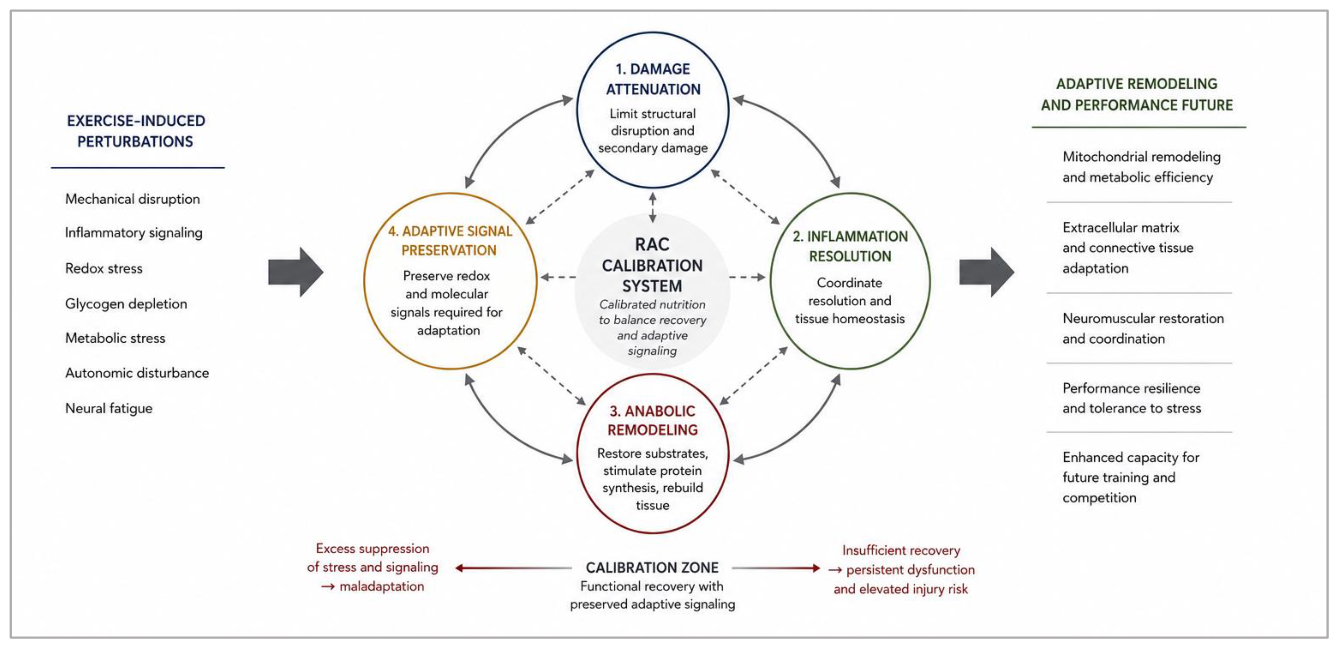
Figure 2.
Mechanistic layers of exercise-recovery nutrition with evidence-status interpretation. The vertical sequence separates exercise perturbations, recovery biology, nutritional modulation, regulatory integration, and functional outcomes. Solid downward arrows indicate broadly evidence-supported process links; dashed or interpretive elements indicate RAC-derived hypotheses that require prospective validation. The right-hand integration column represents the conceptual RAC interpretation of how context may modify the direction and magnitude of adaptation. RAC = recovery-adaptation coupling; ECM = extracellular matrix.
Figure 2.
Mechanistic layers of exercise-recovery nutrition with evidence-status interpretation. The vertical sequence separates exercise perturbations, recovery biology, nutritional modulation, regulatory integration, and functional outcomes. Solid downward arrows indicate broadly evidence-supported process links; dashed or interpretive elements indicate RAC-derived hypotheses that require prospective validation. The right-hand integration column represents the conceptual RAC interpretation of how context may modify the direction and magnitude of adaptation. RAC = recovery-adaptation coupling; ECM = extracellular matrix.
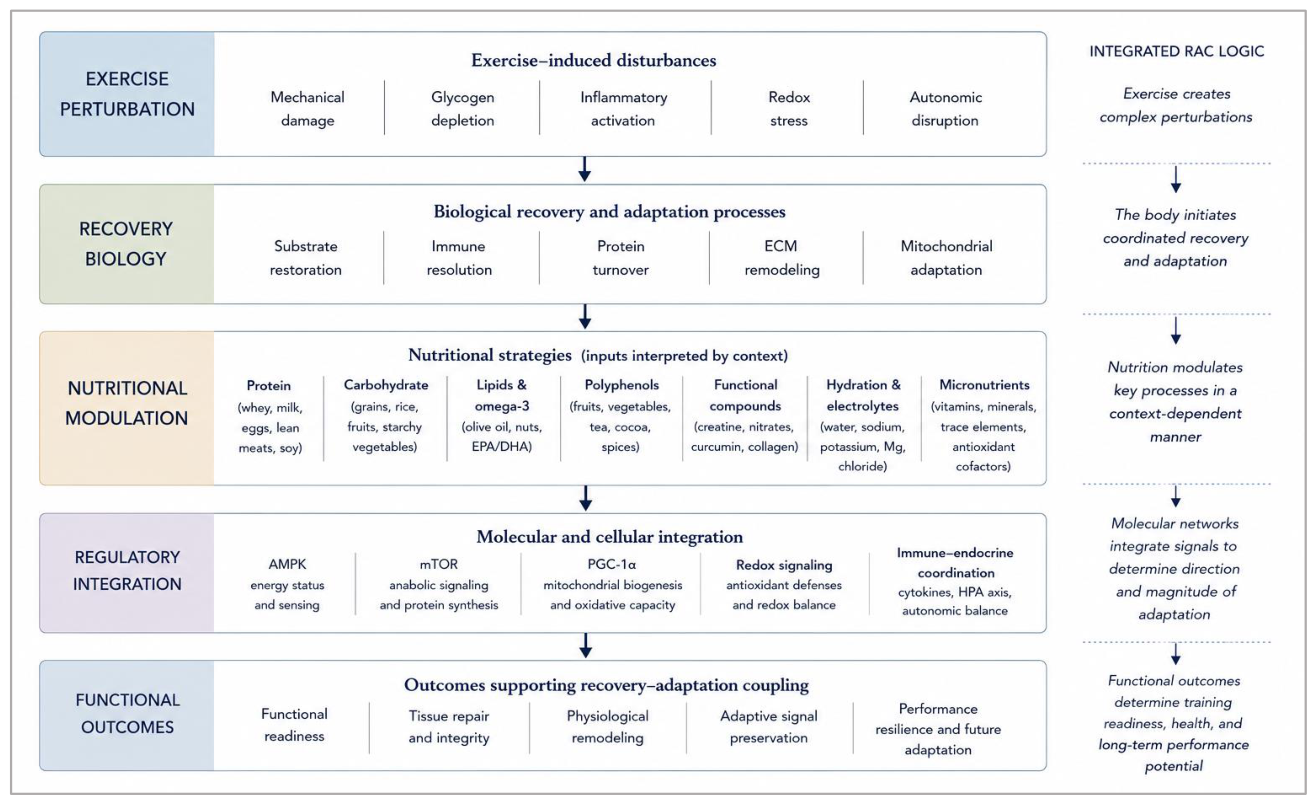
Figure 3.
Multimodal recovery-adaptation dashboard. Subjective, functional, biochemical, and digital/contextual domains are interpreted as convergent evidence streams rather than stand-alone diagnoses. The green, amber, and red outputs are decision categories, not validated universal cut-offs; feedback elements indicate monitoring-driven reassessment. CK = creatine kinase; CRP = C-reactive protein; HRV = heart-rate variability; CMJ = countermovement jump.
Figure 3.
Multimodal recovery-adaptation dashboard. Subjective, functional, biochemical, and digital/contextual domains are interpreted as convergent evidence streams rather than stand-alone diagnoses. The green, amber, and red outputs are decision categories, not validated universal cut-offs; feedback elements indicate monitoring-driven reassessment. CK = creatine kinase; CRP = C-reactive protein; HRV = heart-rate variability; CMJ = countermovement jump.
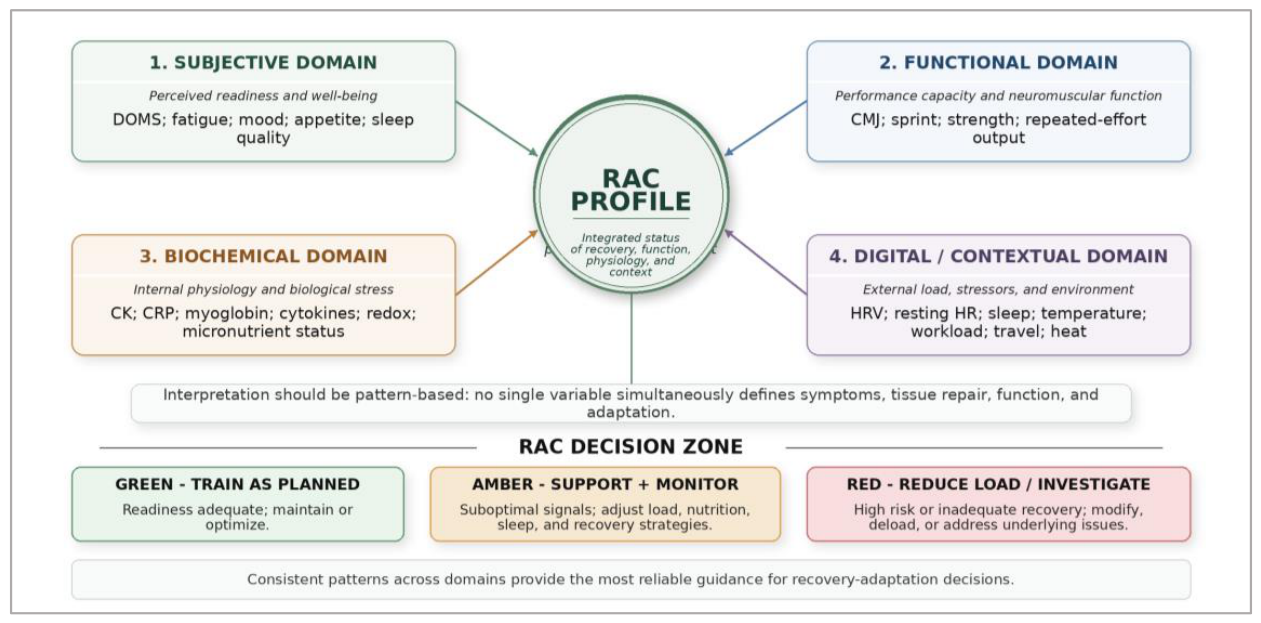
Figure 4.
Decision tree for context-specific recovery nutrition. The upper decision nodes indicate the dominant next biological priority, whereas the lower nodes specify monitoring, dose adjustment, and reassessment. Solid workflow arrows represent applied decision steps supported by recovery-management consensus; dashed reassessment elements represent RAC hypotheses requiring sport-specific validation. The decision tree should be interpreted as a heuristic workflow rather than a validated predictive algorithm.
Figure 4.
Decision tree for context-specific recovery nutrition. The upper decision nodes indicate the dominant next biological priority, whereas the lower nodes specify monitoring, dose adjustment, and reassessment. Solid workflow arrows represent applied decision steps supported by recovery-management consensus; dashed reassessment elements represent RAC hypotheses requiring sport-specific validation. The decision tree should be interpreted as a heuristic workflow rather than a validated predictive algorithm.
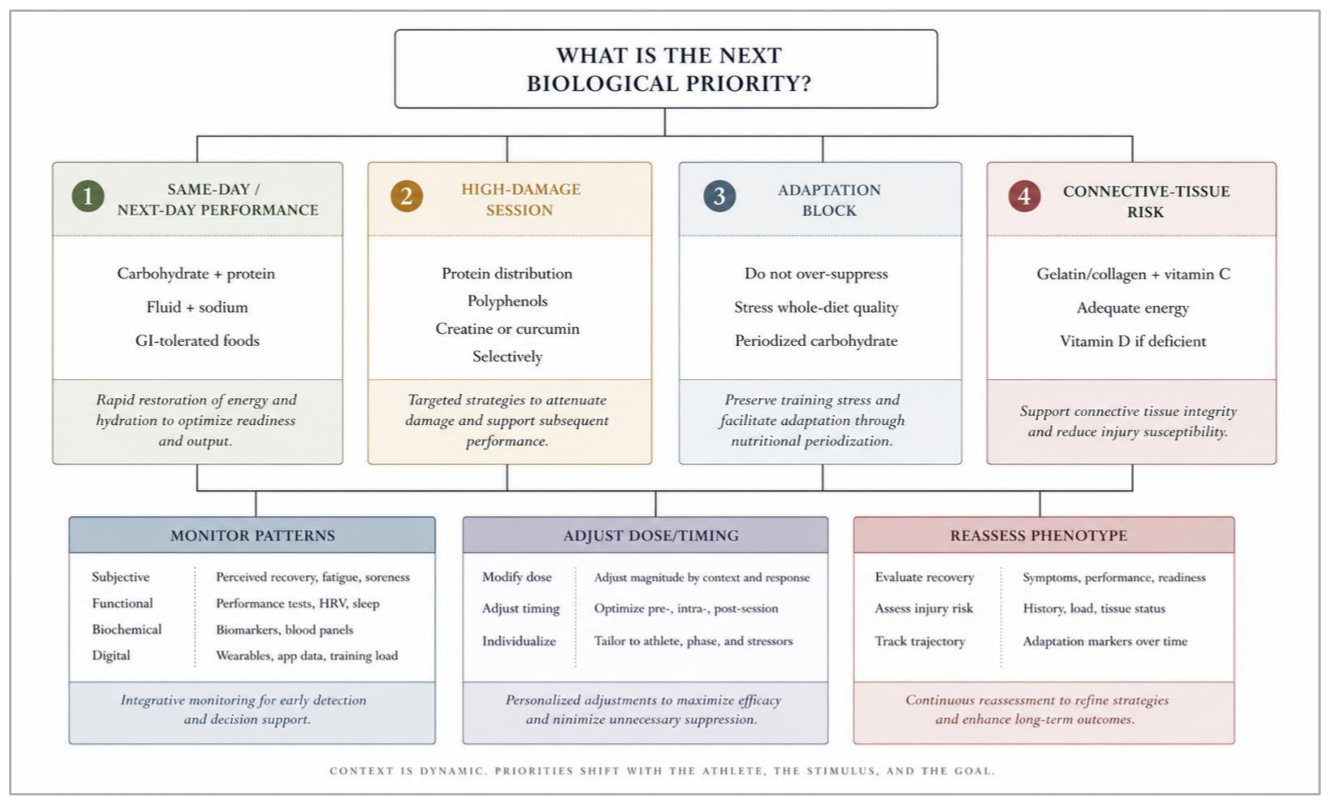
Table 1.
Biological recovery processes and their nutritional targets.
| Biological process | Typical signals/markers | Recovery implication | Nutritional target |
|---|---|---|---|
| Mechanical disruption | Force loss, soreness, CK, myoglobin | Symptoms do not equal complete recovery | Protein distribution, creatine, polyphenols, sufficient energy [1,2,18,19,20,21,22,23] |
| Inflammation | CRP, cytokines, leukocyte activity | Resolution is useful; chronic suppression may be problematic | Omega-3 status, polyphenols, selective curcumin, whole-diet quality [24,25,26,32,33,34,35,36,37,38,39,40,41,42,43,44,45,46,47,48,49] |
| Redox signaling | ROS/RNS, antioxidant enzymes, oxidative damage markers | Signal preservation matters for adaptation | Contextual antioxidant/polyphenol use, avoid chronic high-dose indiscriminate use [27,28,29,30,31] |
| Glycogen depletion | Repeated-session fatigue, substrate limitation | Performance may be impaired despite low soreness | Carbohydrate timing, carbohydrate-protein co-ingestion, fluid/electrolytes [10,11,50,51,52,53,54,55,56,57] |
| Protein turnover | MPS/MPB balance, remodeling markers | Repair requires repeated anabolic opportunities | High-quality protein, EAA/leucine, pre-sleep protein [58,59,60,61,62,63,64,65,66,67,68,69,70,71] |
| Connective-tissue remodeling | Tendon/ECM strain, pain/stiffness | Requires loading plus substrate support | Collagen/gelatin + vitamin C, vitamin D sufficiency, energy adequacy [72,73,74,75,76,77,78,79,80,81] |
| Autonomic/sleep disruption | HRV, resting HR, sleep duration/quality | Systemic readiness may lag behind local tissue signals | Evening protein, carbohydrate where needed, hydration, caffeine management [55,56,57,82,83,84,85,86,87,88,89,90,91] |
Note. CK = creatine kinase; CRP = C-reactive protein; ROS/RNS = reactive oxygen/nitrogen species; MPS/MPB = muscle protein synthesis/muscle protein breakdown; ECM = extracellular matrix; HRV = heart-rate variability. The table is a conceptual synthesis of evidence on exercise-induced muscle damage, inflammation resolution, redox signaling, substrate recovery, protein turnover, connective-tissue remodeling, hydration, and monitoring. Row-specific references are provided in the table.
Table 2.
Macronutrient and fluid strategies for recovery-adaptation coupling.
| Strategy | Primary mechanism | Best-use context | Main caution |
|---|---|---|---|
| High-quality protein distributed across the day | Repeated stimulation of MPS and remodeling | Resistance training, high-damage sessions, older or anabolic-resistant athletes | A single post-workout dose cannot compensate for poor total intake [58,59,60,61,62,63,64,65,66,67,68] |
| Leucine/EAA-rich feeding | Anabolic signaling and substrate availability | Low appetite, rapid recovery meals, plant-protein planning | Protein quality and total energy remain relevant [61,63,64,65,66,67,68] |
| Pre-sleep protein | Overnight amino acid availability | Late sessions, hypertrophy blocks, long fasting interval | Should not replace daytime protein distribution [69,70] |
| Carbohydrate restoration | Glycogen resynthesis and repeated-session capacity | Two-a-day training, tournaments, endurance and team sports | Less urgent when next session is far away or low intensity [10,11,50,51,52,53,54] |
| Carbohydrate-protein co-ingestion | Practical mixed recovery and energy support | Short windows, poor appetite, travel | Not always superior when carbohydrate intake is already sufficient [50,51,52,53,54] |
| Omega-3 fatty acids | Membrane and inflammation-resolution environment | Longer-term recovery support, inflammation-prone profiles | Effects are not immediate and dose/context matter [32,33,34,35,36] |
| Fluid and sodium | Plasma volume and thermoregulatory recovery | Sweaty sessions, heat, travel, next-day competition | Plain water alone may not restore sodium losses after heavy sweating [55,56,57] |
Note. MPS = muscle protein synthesis; EAA = essential amino acids. Strategies are interpreted as context-sensitive recovery tools rather than universal prescriptions; urgency depends on session density, adaptation goal, appetite, travel, and baseline dietary adequacy. Row-specific references are provided in the table.
Table 3.
Bioactive compounds and functional foods interpreted within recovery-adaptation coupling.
| Compound/food | Representative studied protocol | Best-use context | Qualitative evidence interpretation |
|---|---|---|---|
| Tart cherry | 12 fl oz blend twice daily for 8 d, or 30 mL concentrate twice daily for 7 d [39,42] | Eccentric damage, marathon, prolonged intermittent or congested competition | Moderate: several small RCTs and supportive synthesis; product standardization remains important [37,38,39,40,41,42,100,101] |
| Pomegranate | 250 mL three times/day for 48 h plus 500 mL 1 h pre-exercise in one weightlifting study [44] | Selected high-intensity or resistance-exercise contexts | Low: small samples and heterogeneous juice/extract protocols [44,45] |
| Blueberries/berries | Five 200-g smoothie servings (1 kg total) before and during 36 h after eccentric exercise [43] | Food-based support around severe eccentric exercise | Low: one small crossover trial reported faster isometric-strength recovery [43] |
| Curcumin | Phytosome providing 200 mg curcumin twice daily, or 2.5 g twice daily in another RCT [46,47] | High-DOMS, competition, or short-term symptom-control phases | Moderate for DOMS; formulation and bioavailability remain important [46,47,48,49] |
| Dietary nitrates/beetroot | Acute pre-exercise protocols; no validated recovery-specific dose [93,94,95] | Endurance and intermittent high-intensity performance | High for selected performance outcomes, low for classical muscle-damage recovery [93,94,95] |
| Creatine | Loading approximately 0.3 g/kg/day for 5-7 d, then 3-5 g/day [96,97,98] | Strength, power, repeated-sprint, and selected high-damage blocks | High for strength/power; low-to-moderate and heterogeneous for EIMD recovery [96,97,98,99] |
| Collagen/gelatin + vitamin C | 15 g vitamin C-enriched gelatin approximately 1 h before targeted loading [72,73,74] | Tendon, ligament, and connective-tissue rehabilitation | Low-to-moderate mechanistic evidence; loading and energy sufficiency are indispensable [72,73,74,92] |
Note. The evidence labels are qualitative interpretations rather than formal GRADE ratings. They consider study design, sample size, product characterization, functional outcomes, and consistency across trials. Representative protocols are research exposures, not universal recommendations; row-specific references are provided in the table.
Table 5.
Nutrient timing and periodization scenarios.
| Timing scenario | Primary goal | Priority strategy | Adaptation caution |
|---|---|---|---|
| 0-4 h between sessions | Rapid substrate and fluid restoration | Carbohydrate 1.0-1.2 g/kg/h initially; protein 0.25-0.40 g/kg; sodium/fluid [50,51,52,53,54,55,56,57,58,59,60,61,62,63,64,65,66,67,68,69,70,71] | Low concern if performance urgency is high |
| Same-day evening after late competition | Recovery without sleep disruption | Split digestible carbohydrate/protein feeding, sodium/fluid, and manage caffeine [50,51,52,53,54,55,56,57,82,83,84,92,107] | Avoid overfeeding or heavy foods that impair sleep |
| Overnight recovery | Extend anabolic and systemic recovery | Approximately 30-40 g pre-sleep protein, hydration, regular sleep schedule [69,70,82,83,84] | Keep timing practical and athlete-specific |
| High-DOMS microcycle | Limit excessive force loss and soreness | Protein, selective polyphenols/curcumin, creatine, carbohydrate, and sleep [32,33,34,35,36,37,38,39,40,41,42,43,44,45,46,47,48,49,82,83,84,93,94,95,96,97,98,99,100,101] | Do not use soreness alone as recovery endpoint |
| Adaptation-oriented endurance block | Support remodeling while preserving signaling | Periodized carbohydrate, adequate protein, whole-food antioxidants [10,11,27,28,29,30] | Avoid chronic high-dose antioxidant suppression |
| Tournament/congested fixtures | Short-term readiness | Aggressive recovery feeding, fluids/electrolytes, tested polyphenol-rich foods [37,38,39,40,41,42,43,44,45,50,51,52,53,54,55,56,57,92] | Adaptation concerns are secondary to performance continuity |
| Return-to-play tissue remodeling | Load tolerance and tissue repair | Energy adequacy, protein, collagen/gelatin + vitamin C with loading [72,73,74,75,76,77,78,79,80,81] | Do not confuse pain reduction with tissue capacity |
Note. Timing urgency increases when recovery windows are short, the next session is demanding, sleep may be disrupted, or competition continuity is prioritized. Row-specific references are provided in the table.
Table 6.
Recovery assessment tools and interpretation within RAC.
| Domain | Examples | Main strength | Main limitation |
|---|---|---|---|
| Subjective | DOMS, fatigue, mood, readiness, appetite, sleep quality | Frequent, low-cost, athlete-centered | Expectation, motivation, and personality can bias reports |
| Functional | CMJ, sprint, strength, repeated-effort tests, sport-specific output | Directly linked to performance readiness | Requires standardization and meaningful thresholds |
| Biochemical | CK, CRP, myoglobin, cytokines, redox markers, micronutrient status | Useful for deficiency, persistent fatigue, or systemic stress questions | High variability and poor stand-alone diagnostic power |
| Digital | HRV, resting HR, sleep, temperature, load metrics | Continuous trend detection and early warning patterns | Indirect and algorithm-dependent |
| Contextual | Training load, travel, heat, illness, menstrual cycle, nutrition history | Explains why markers change | Requires accurate athlete-coach communication |
| Integrated RAC decision | Traffic-light profile or recovery dashboard | Supports action and iteration | Needs sport-specific validation |
Table 7.
Recovery phenotypes and precision nutrition implications.
| Recovery phenotype | Likely bottleneck | Potential nutritional emphasis | Monitoring signal |
|---|---|---|---|
| High-soreness responder | Excessive local damage or inflammatory sensitivity | Protein distribution, polyphenols, sleep, load adjustment | DOMS plus force/power recovery |
| Slow force-recovery responder |
Neuromuscular or tissue recovery lag | Creatine, protein, carbohydrate if high density, recovery sleep | CMJ, sprint, strength trend |
| Glycogen-limited athlete | Substrate depletion and insufficient carbohydrate | Carbohydrate timing, total carbohydrate, mixed recovery meals | Repeated-session output, perceived exertion |
| Sleep-sensitive athlete | Autonomic and circadian recovery bottleneck | Evening meal structure, caffeine timing, hydration, pre-sleep protein | Sleep duration/quality, HRV/resting HR |
| Low-energy-availability profile | Systemic under-fueling | Energy restoration, carbohydrate, micronutrient assessment | Fatigue, menstrual/endocrine signs, injury risk |
| Connective-tissue risk profile |
Tendon/ligament/matrix load tolerance | Collagen/gelatin + vitamin C with loading, vitamin D, energy adequacy | Pain, stiffness, progressive load tolerance |
| GI-sensitive athlete | Tolerance and absorption constraints | Low-risk foods, liquid nutrition if needed, individualized timing | GI symptoms, adherence, energy intake |
Note. Phenotypes are heuristic categories for applied decision-making and should be updated longitudinally; they are not diagnostic labels. CMJ = countermovement jump; HRV = heart-rate variability; GI = gastrointestinal. Sources: [10,11,32,33,34,35,36,37,38,39,40,41,42,43,44,45,46,47,48,49,50,51,52,53,54,55,56,57,58,59,60,61,62,63,64,65,66,67,68,69,70,71,72,73,74,75,76,77,78,79,80,81,82,83,84,85,86,87,88,89,90,91,102,103,104,105,116,117,118,119,120,121].
Table 8.
Operational RAC matrix for applied decision-making.
| Bottleneck / context | Target | Priority strategy | Decision markers and caution |
|---|---|---|---|
| Short recovery window or congested competition | Substrate and fluid restoration | Carbohydrate plus protein, sodium/fluid, and portable foods | Body-mass/urine markers, GI tolerance, RPE, and repeated-session output; prioritize readiness when urgency is high. |
| High-DOMS or eccentric-damage block | Damage attenuation and force restoration | Protein distribution, creatine, polyphenol-rich foods, and sleep support | Use DOMS together with CMJ, sprint, strength, or sport output; soreness alone is insufficient. |
| Inflammatory/redox overload | Resolution and redox balance | Food-based polyphenols, omega-3 status, and selective curcumin | Use selectively for persistent symptoms or force loss; avoid routine high-dose antioxidant suppression in adaptation blocks. |
| Hypertrophy or remodeling block | Anabolic substrate and MPS support | High-quality protein distribution, leucine/EAA, and pre-sleep protein when useful | Check total protein, energy, meal distribution, body-mass and strength trends; single doses cannot fix poor intake. |
| Connective-tissue risk or return-to-play | ECM and tendon/ligament remodeling | Collagen/gelatin plus vitamin C before targeted loading; vitamin D and energy sufficiency | Track pain, stiffness, and load tolerance; pain relief does not equal tissue capacity. |
| Sleep-sensitive or autonomic strain | Circadian and systemic readiness | Evening meal structure, hydration, caffeine management, and pre-sleep protein if indicated | Track sleep, HRV/resting HR, caffeine timing, and morning fatigue; avoid heavy late meals. |
| Low energy availability or micronutrient insufficiency | Systemic recovery permissiveness | Restore energy and carbohydrate availability; assess iron, vitamin D, calcium, and magnesium as needed | Track fatigue, menstrual/endocrine signs, ferritin/hemoglobin when indicated, body mass, and injury pattern; supplements are secondary. |
Note. DOMS = delayed-onset muscle soreness; CMJ = countermovement jump; CK = creatine kinase; CRP = C-reactive protein; EAA = essential amino acids; ECM = extracellular matrix; HRV = heart-rate variability; MPS = muscle protein synthesis; RPE = rating of perceived exertion. The matrix is a heuristic practice aid and requires sport-specific validation.
Table 9.
Research priorities for precision recovery nutrition.
| Research gap | Rationale | Recommended design feature |
Priority outcome |
|---|---|---|---|
| Athlete-specific evidence | Trained athletes respond differently from untrained participants | Trials in trained, elite, female, and team-sport samples | Function plus recovery kinetics |
| Dose-response uncertainty | Many interventions vary by dose and product composition | Standardized products and multiple dosing arms | Dose-specific benefit-risk profile |
| Timing and periodization | Same strategy may differ between competition and adaptation blocks | Compare acute, chronic, and periodized protocols | Readiness and adaptation markers |
| Responder phenotypes | Group means hide individual recovery patterns | Preplanned responder analyses and baseline profiling | Personalized response prediction |
| Integrated monitoring | Single markers are insufficient | Subjective, functional, biochemical, and wearable dashboards | Decision accuracy and sport outcomes |
| Long-term adaptation risk | Acute symptom control may alter training signals | Longitudinal training studies | Performance remodeling, not only DOMS |
| Real-world implementation | Athletes face travel, limited appetite, and schedule constraints | Pragmatic trials in teams and competitions | Adherence, tolerance, and next-session performance |
Note. Priority outcomes emphasize translational relevance: next-session readiness, functional recovery kinetics, long-term adaptation, implementation feasibility, and sport-specific performance. Sources: [85,86,87,88,89,90,91,92,99,100,101,107,108,109,110,111,112,122,123,124,125,126,127,128,129,130].
Disclaimer/Publisher’s Note: The statements, opinions and data contained in all publications are solely those of the individual author(s) and contributor(s) and not of MDPI and/or the editor(s). MDPI and/or the editor(s) disclaim responsibility for any injury to people or property resulting from any ideas, methods, instructions or products referred to in the content. |
© 2026 by the authors. Licensee MDPI, Basel, Switzerland. This article is an open access article distributed under the terms and conditions of the Creative Commons Attribution (CC BY) license (http://creativecommons.org/licenses/by/4.0/).
Copyright: This open access article is published under a Creative Commons CC BY 4.0 license, which permit the free download, distribution, and reuse, provided that the author and preprint are cited in any reuse.


