

Submitted:
16 July 2026
Posted:
16 July 2026
You are already at the latest version
Abstract
Background: Generative Artificial Intelligence (GenAI) is increasingly integrated into nursing education, yet structured AI literacy training and ethical guidance remain limited. Consequently, nursing students often rely on informal learning, resulting in variability in AI readiness, confidence, and responsible use.
Aims: The study examined (1) whether AI literacy was positively associated with AI self-efficacy and AI attitudes and (2) whether AI self-efficacy mediated the relationship between AI literacy and AI attitudes.
Methods: A cross-sectional survey using convenience sampling was conducted with 100 prelicensure nursing students in New York City. Data were collected using the AI Literacy Scale (AILS), AI Self-Efficacy Scale (AISES), and Generative AI Attitude Scale (GAIAS). Correlation and path analyses were conducted using Amos 30.0.
Results: Participants had a mean age of 30.25 years, and 71% were women. AI literacy and AI self-efficacy were both positively associated with AI attitudes (all p < .001). Path analysis showed that AI literacy significantly predicted AI self-efficacy (β = .39, p < .001) and AI attitudes (β = .28, p = .003). AI self-efficacy significantly predicted AI attitudes (β = .31, p = .001) and partially mediated the relationship between AI literacy and AI attitudes. The model explained 24% of the variance in AI attitudes.
Conclusions: AI self-efficacy partially mediated the relationship between AI literacy and AI attitudes, supporting Social Cognitive Theory in explaining nursing students' readiness for GenAI. Educational strategies that strengthen AI literacy and AI self-efficacy may facilitate the ethical and effective integration of GenAI into nursing education.
Keywords:
GenAI
; nursing students
; social cognitive theory
; AI literacy
; AI self-efficacy
; AI attitudes
1. Introduction
1.1. Background
Generative artificial intelligence (GenAI) is driving a paradigm shift in nursing education and healthcare, transforming how students learn, access information, and prepare for clinical practice (Dornan, 2025). Nursing students increasingly use GenAI tools to support academic learning, synthesize complex medical-surgical concepts, and enhance clinical preparation (Dehghani et al., 2025; Han et al., 2025). Despite the rapid adoption of GenAI in nursing education, structured AI literacy training, clear ethical guidelines, and discipline-specific instructional strategies have not yet been systematically integrated into nursing curricula (Dodson et al., 2025). Consequently, many students rely on self-directed, peer-led, or informal learning experiences to develop AI-related competencies. Such unstructured approaches may result in considerable variability in students’ readiness, confidence, and ability to use AI responsibly and effectively in academic and clinical settings (Alqaissi & Qtait, 2025; O’Connor et al., 2025). Understanding students’ preparedness and educational needs is therefore essential for developing safe, effective, and pedagogically sound AI-integrated nursing education (Dodson et al., 2025; Han et al., 2025).
Current evidence suggests that although nursing students demonstrate strong interest in AI technologies and digital innovation, their levels of AI literacy remain inconsistent (Dodson et al., 2025; Han et al., 2025). Deficiencies are particularly evident in areas requiring higher-order judgment, including ethical decision-making, recognition of algorithmic bias, and critical evaluation of AI-generated information (Akca Sumengen et al., 2025; Dodson et al., 2025). When AI competencies are acquired primarily through informal and unverified sources, students may develop fragmented or inaccurate understandings of AI capabilities and limitations, potentially compromising their ability to critically appraise AI-generated content and apply these technologies appropriately in patient care contexts.
AI literacy has emerged as a foundational competency for the effective and responsible use of AI technologies. Students with higher levels of AI literacy are more likely to understand the capabilities, limitations, and ethical implications of AI systems, enabling them to critically evaluate AI-generated outputs, identify potential biases, and engage with GenAI tools more effectively (Berdida et al., 2026; Ho et al., 2026; Labrague & Al Harrasi, 2024). Greater AI literacy has also been associated with increased confidence in using AI technologies and more favorable perceptions of their usefulness in learning environments (Atalla et al., 2025; Labrague & Al Harrasi, 2024; Sengul et al., 2025). Conversely, limited AI literacy may contribute to anxiety, skepticism, and concerns regarding misinformation, ethical misuse, and overreliance on AI-generated content (Atalla et al., 2025; El Arab et al., 2025; Sandanasamy et al., 2025; Zhang et al., 2025).
Emerging evidence further suggests that AI self-efficacy plays a critical role in shaping students’ engagement with AI technologies. Individuals who feel confident in their ability to use AI tools are more likely to integrate them into academic learning, clinical preparation, and decision-making processes (Asio, 2025). Positive attitudes toward AI have likewise been associated with greater technology acceptance, higher self-efficacy, and improved learning outcomes (Asio, 2025; Labrague & Al Harrasi, 2024). Moreover, students’ attitudes toward AI appear to be influenced by their level of AI literacy, with greater knowledge and understanding fostering more balanced, informed, and constructive perceptions of AI technologies (Atalla et al., 2025; Zhang et al., 2025). Collectively, these findings highlight the importance of structured educational guidance, ethical frameworks, and intentional curricular integration to support responsible and confident AI engagement among nursing students (Dodson et al., 2025; Han et al., 2025; Hardie et al., 2025).
Guided by Social Cognitive Theory, this study conceptualizes AI literacy as a cognitive factor, AI self-efficacy as a belief factor, and AI attitudes as an affective outcome. Social Cognitive Theory posits that knowledge influences behavior through its impact on self-belief, which subsequently shapes attitudes and behavioral intentions. Consistent with this framework, students who possess greater AI literacy may develop stronger confidence in their ability to use AI technologies, which in turn may contribute to more positive attitudes toward AI adoption (Bandura, 1997, 2001). Supporting this proposition, Asio (2026) reported that self-efficacy mediated the relationship between AI attitudes and AI literacy. However, the mediating role of AI self-efficacy in the relationship between AI literacy and AI attitudes remains underexplored, particularly among nursing students.
Despite growing interest in AI integration within nursing education, there remains a notable lack of empirical research focusing specifically on prelicensure nursing students. This population represents a critical group for investigation because students enter nursing programs with diverse educational backgrounds, varying levels of digital competency, and unique learning needs (Dehghani et al., 2025; Han et al., 2025). Addressing this gap, this study investigated whether AI literacy is positively associated with AI self-efficacy and AI attitudes in prelicensure nursing students, while examining the mediating role of AI self-efficacy. By evaluating these variables, the study clarifies student readiness to engage with generative AI (GenAI) in nursing education. Ultimately, these insights aim to guide student-centered, evidence-based, and ethical strategies for integrating GenAI into nursing curricula.
1.2. Theoretical Framework
This study is grounded in Albert Bandura’s Social Cognitive Theory, which posits that human learning and behavior occur through the dynamic, reciprocal interaction of cognitive, behavioral, and environmental factors. Within this triadic framework, objective knowledge acquisition (cognitive factor) fundamentally shapes an individual’s internal beliefs regarding their capabilities (self-efficacy), which subsequently determines their affective evaluation and behavioral engagement with new technological modalities. In the context of this study, the variables are operationalized as follows: AI Literacy is conceptualized as the core cognitive factor, reflecting students’ objective knowledge, structural understanding, and critical evaluation of AI mechanisms. AI Self-Efficacy represents the belief factor, capturing students’ self-perceived confidence in their ability to successfully execute tasks using AI tools. AI Attitudes reflect the effective and evaluative outcome, representing students’ perceptions of the utility, safety, and relevance of AI in educational and clinical settings. Consistent with Social Cognitive Theory, students who possess higher levels of baseline AI literacy are expected to develop stronger, evidence-backed AI self-efficacy, which subsequently minimizes anxiety and fosters positive, adaptive attitudes toward AI adoption (Berdida et al., 2026 & Ho et al., 2026). By examining these explicit pathways, this theory-driven study provides an integrated cognitive-belief-affective framework to deconstruct prelicensure nursing students’ readiness for GenAI.
1.3. Purpose and Hypotheses
This study aimed to examine (1) whether AI literacy was positively associated with AI self-efficacy and AI attitudes and (2) whether AI self-efficacy mediated the relationship between AI literacy and AI attitudes. The hypotheses of this study are as follows:
H1:
AI literacy is positively associated with AI self-efficacy.
H2:
AI literacy is positively associated with AI attitudes.
H3:
AI self-efficacy is positively associated with AI attitudes.
H4:
AI self-efficacy mediates the relationship between AI literacy and AI attitudes.
Conceptual Model
This study is guided by a conceptual framework derived from Bandura’s Social Cognitive Theory, which posits that cognitive literacy directly shapes internal self-efficacy beliefs, subsequently influencing affective attitudes toward technological adoption. As illustrated in Figure 1, the model evaluates both the direct path from AI literacy to AI attitudes and the indirect path mediated by AI self-efficacy. This hypothesized mechanism clarifies how objective knowledge translates into constructive, adaptive attitudes within nursing education.
2. Methods
2.1. Study Design
This study employed a descriptive, cross-sectional quantitative survey design to evaluate the direct and indirect relationships among artificial intelligence (AI) literacy, AI self-efficacy, and AI attitudes among prelicensure nursing students.
2.2. Participants and Settings
A convenience sampling strategy was used to recruit undergraduate nursing students from a public community college nursing program in New York City. The inclusion criteria required participants to be (1) actively enrolled in Nursing clinical tracks within the nursing program, and (2) willing to provide voluntary informed consent. Students not actively enrolled in the nursing curriculum were excluded.
A total of 110 participants initially completed the survey. Following a systematic data-cleaning process, 10 incomplete responses were excluded, resulting in a final analytical sample of N = 100. This sample size meets the established methodological threshold of a minimum of 100 responses required to yield stable and valid maximum likelihood estimations in structural equation modeling (SEM) path analyses (Ding et al., 1995; Kline, 2005).
2.3. Procedures and Data Collection
This study was approved by the institutional review board at the first author’s college (#2025-0048-LCC). Data collection was conducted utilizing a secure, web-based survey hosted on the Qualtrics platform. Recruitment materials containing a secure hyperlink and QR code were distributed to students through institutional channels. Upon accessing the link, prospective participants were presented with an electronic informed consent form outlining the study’s purpose, data confidentiality protocols, voluntary participation guidelines, and withdrawal rights. Only individuals who explicitly provided electronic informed consent were permitted to proceed to the demographic questionnaires and validated psychometric instruments. The response rate was 91%.
2.4. Measures
2.4.1. Artificial Intelligence Literacy (AI Literacy)
AI literacy was measured using the 12-item Artificial Intelligence Literacy Scale (AILS) developed by Wang et al. (2022). The AILS assesses four domains of AI literacy: awareness, usage, evaluation, and ethics. Each item is rated on a 7-point Likert scale ranging from 1 (strongly disagree) to 7 (strongly agree). Three negatively worded items (Items 2, 5, and 11) were reverse-scored prior to analysis, with higher total scores indicating greater AI literacy. Cronbach’s alpha was 0.83 in the original validation study and 0.80 in the present study.
2.4.2. Artificial Intelligence Self-Efficacy
AI self-efficacy was measured using the 22-item Artificial Intelligence Self-Efficacy Scale (AISES) developed by Wang and Chuang (2024). The AISES assesses four domains of AI self-efficacy: conceptual understanding, practical application, critical evaluation, and ethical and responsible use. All items are rated on a 7-point Likert scale ranging from 1 (strongly disagree) to 7 (strongly agree), with higher scores indicating greater AI self-efficacy. Cronbach’s alpha was 0.96 in the original validation study and 0.94 in the present study.
2.4.3. Artificial Intelligence Attitude
AI attitudes were assessed using the 13-item Generative Artificial Intelligence Attitude Scale (GAIAS) developed by Marengo et al. (2025). The GAIAS measures both positive and negative AI attitudes across seven dimensions. Positive attitude items assess perceived educational utility, cognitive development support, engagement motivation, and technology appreciation. Negative attitudes assess concerns related to future impact, the learning process, and reliability and trust.
Responses are rated on a 5-point Likert scale ranging from 1 (strongly disagree) to 5 (strongly agree). Five negatively worded items are reverse scored prior to analysis, with higher total scores indicating more positive and adaptive AI attitudes integration in nursing education. Cronbach’s alpha was 0.85 in the original validation study and 0.83 in the present study.
2.5. Ethical Considerations
This study was approved and overseen by the Institutional Review Board of the City University of New York (CUNY). Data security measures were implemented to ensure anonymity; no personally identifiable information (PII) or IP addresses were collected during the web survey. Participants were explicitly informed that their participation or choice to withdraw would have no bearing on their academic standing, grades, or relationship with the college.
2.6. Data Analysis
The data were analyzed using SPSS version 30.0 and AMOS version 30.0 (IBM Corp., Armonk, NY, USA). Descriptive statistics (means, standard deviations, frequencies, and percentages) were computed to summaries participants’ characteristics and study variables. Normality of continuous variables was assessed using skewness and kurtosis. Pearson’s correlation coefficients were calculated to examine the relationships among the three study variables.
To test the hypothesized mediation model, structural equation modelling (SEM) was performed using AMOS 30.0. Bootstrapping, a nonparametric resampling procedure, is the preferred method for testing indirect effects (Preacher & Hayes, 2008). Thus, the indirect effect of the independent variable on the dependent variable through the mediator was estimated using a bootstrapping approach with 5000 resamples, considering a 95% bias-corrected confidence interval (CI), with significance indicated when the interval did not include zero.
Model fit was evaluated using the following indicators, including the chi-square statistic (χ2), hi-square divided by degrees of freedom (CMIN/DF, χ2/df < 3 indicates an acceptable fit), the comparative fit index (CFI), the Tucker–Lewis index (TLI), standardized root mean square residual (SRMR), and the root mean square error of approximation (RMSEA). In this study, an acceptable model fit (Kline, 2005) was defined by the following criteria: SRMR (<0.08), RMSEA (≤0.06), and CFI and TLI (≥0.95). All path coefficients are reported as standardized estimates. All statistical tests were two-tailed, with a significance level set at p < 0.05.
3. Results
3.1. Participant Characteristics
The participants’ mean age was 30.25 years (standard deviation [SD] = 7.84, range 19–48), and 71.0% were women. Most participants (80.0%) were in the first semester (36%) or the second semester (44%). Most of the students had a Grade Point Average (GPA) above 3.0.
Most participants reported that their computer skills were at an intermediate (65.3%) or advanced level (23.5%). GenAI use for academic purposes was reported as frequent (weekly, 27.6%) or very frequent (multiple times per week, 39.8%). The characteristics of the participants are summarized in Table 1.
3.2. Descriptive Statistics of Study Variables and Correlations
Table 2 presents the descriptive statistics and the bivariate correlations among the study variables. AI literacy was significantly positively associated with AI self-efficacy (r = 0.42, p < 0.001) and AI attitudes (r = 0.40, p < 0.001). AI self-efficacy was significantly positively associated with AI attitudes (r = 0.42, p < 0.001).
3.3. Path Coefficients and Mediating Effect of AI Self-Efficacy
We first tested the hypothesized model. The model was just identified (χ2 = 0.000, df = 0); therefore, model fit indices were not interpreted. The results of the path analysis (Table 3) indicated that AI literacy and AI self-efficacy are directly associated with AI attitudes (β = 0.28, p = 0.003; β = 0.31, p = 0.001, respectively). AI Literacy is directly associated with AI self-efficacy (β = 0.39, p < 0.001).
Table 4 presents the total, direct, and indirect effects of the study variables on AI attitudes. The results of the mediation analysis indicated that the direct effect of AI literacy on AI attitudes was significant (B = 0.170, β = 0.28, SE = 0.058, =0.003). The indirect effect through mediator AI self-efficacy was also significant (B = 0.073, 95% CI [0.03, 0.12]). The total effect of AI literacy on AI attitudes was B = 0.243 (95% CI [0.12, 0.38]). These findings suggest that AI self-efficacy partially mediates the relationship between AI literacy and AI attitudes. Overall, the model explained 24% of the variance in AI attitudes. A path model with the standardized coefficients and the square root (R2) is presented in Figure 2.
4. Discussion
This study found that AI literacy was positively associated with AI self-efficacy and AI attitudes and that AI self-efficacy partially mediated the relationship between AI literacy and AI attitudes. These findings provide empirical support for the proposed cognitive–belief–affective framework based on Social Cognitive Theory, suggesting that AI literacy enhances students’ confidence in using GenAI, which in turn promotes more favorable attitudes toward its use. Rather than knowledge alone, the combination of AI literacy and confidence appears to be important for preparing nursing students to engage with GenAI responsibly in educational and future clinical settings.
The positive association between AI literacy and AI self-efficacy is consistent with previous studies demonstrating that greater AI knowledge is associated with higher confidence in using AI technologies (Berdida et al., 2026; Ho et al., 2026). Similar findings have been reported across healthcare and higher education settings, where individuals with stronger AI-related knowledge perceive themselves as more capable of effectively using GenAI tools (Berdida et al., 2026; El Arab et al., 2025; El-Banna et al., 2025; Ho et al., 2026). Nursing students are increasingly exposed to AI through coursework, clinical education, and self-directed learning; however, concerns regarding ethical use, limitations, bias, and the reliability of AI-generated information remain common (Dodson et al., 2025; El Arab et al., 2025; Han et al., 2025).
The present findings suggest that students with greater AI literacy may be better equipped to critically evaluate AI-generated outputs, recognize potential biases and inaccuracies, and understand the appropriate application of AI in healthcare practice (Atalla et al., 2025; El Arab et al., 2025; Sandanasamy et al., 2025; Zhang et al., 2025). As students develop a deeper understanding of AI concepts and limitations, they are likely to gain greater confidence in their ability to use these technologies effectively and responsibly. This interpretation is consistent with Social Cognitive Theory, which posits that knowledge contributes to self-efficacy by strengthening individuals’ perceived capability to perform a given task successfully (Bandura, 1997, 2001). Likewise, previous studies have shown that individuals with greater confidence in using AI tend to hold more favorable attitudes toward these technologies (Atalla et al., 2025; Labrague & Al Harrasi, 2024; Sengul et al., 2025). Together, these findings suggest that improving AI literacy may be an effective educational strategy for strengthening nursing students’ confidence and supporting the responsible integration of AI into nursing education and future clinical practice.
A particularly noteworthy finding was the partial mediating effect of AI self-efficacy on the relationship between AI literacy and AI attitudes. This finding suggests that AI knowledge alone may not be sufficient to foster positive attitudes toward AI. Rather, students must also develop confidence in their ability to apply AI effectively and responsibly. The findings therefore extend Social Cognitive Theory by identifying AI self-efficacy as an important mechanism through which AI literacy contributes to more favorable attitudes toward AI.
The present findings are generally consistent with those of Asio (2025), who also identified AI self-efficacy as a mediator among AI-related variables. Although Asio (2025) proposed a different directional pathway, both studies emphasize the central role of self-efficacy in linking AI-related knowledge and perceptions. Because both studies employed cross-sectional designs, causal relationships cannot be established. Future longitudinal and intervention studies are needed to clarify the temporal relationships among AI literacy, AI self-efficacy, and AI attitudes.
The findings also align with recent evidence from nursing education demonstrating positive relationships among AI literacy, AI attitudes, and readiness for AI adoption (Boztepe et al., 2025). Furthermore, systematic reviews have identified AI literacy and self-efficacy as essential competencies for preparing nursing students to use AI safely, ethically, and effectively in educational and clinical settings (El Arab et al., 2025; El-Banna et al., 2025). Previous research has also shown that AI-focused educational interventions, including structured coursework, guided practice with AI tools, and hands-on learning experiences, can improve AI literacy, self-efficacy, and readiness for AI adoption (El Arab et al., 2025; El-Banna et al., 2025). Collectively, these findings reinforce the importance of integrating AI education into undergraduate nursing curricula.
The present findings also expand previous work by Han et al. (2025), which reported that nursing students frequently used GenAI and perceived educational benefits while expressing concerns regarding accuracy and ethical issues. The current study extends these findings by demonstrating that stronger AI literacy is associated with greater AI self-efficacy and more positive attitudes toward AI. Together, these studies suggest that nursing education should move beyond informal exposure to AI by implementing structured educational strategies that develop AI knowledge, critical evaluation skills, and confidence in the responsible use of AI technologies.
These findings have important implications for nursing education. First, nursing curricula should incorporate structured AI education that develops students’ foundational AI literacy, including AI concepts, capabilities, limitations, potential biases, ethical considerations, and strategies for critically evaluating AI-generated content. Developing these competencies may enhance students’ confidence in using AI responsibly and increase their readiness to integrate AI into future nursing practice. Second, educational strategies should extend beyond increasing AI knowledge to intentionally strengthen AI self-efficacy. Guided practice with GenAI tools, simulation exercises, case-based learning, and faculty mentorship can provide meaningful opportunities for students to apply GenAI in real clinical and educational contexts while receiving constructive feedback. These mastery experiences, as described by Social Cognitive Theory, may strengthen students’ confidence in using AI effectively and responsibly. Because AI self-efficacy partially mediated the relationship between AI literacy and AI attitudes in the present study, educational interventions that simultaneously promote AI literacy and AI self-efficacy may foster more positive attitudes toward AI and facilitate its successful integration into nursing education and future clinical practice.
Overall, the present findings suggest that effective AI integration in nursing education requires more than increasing students’ AI knowledge. Educational strategies should simultaneously strengthen AI literacy and AI self-efficacy through structured instruction, guided practice, and opportunities to critically evaluate AI-generated information. Such approaches may better prepare nursing students to use GenAI safely, ethically, and effectively in future clinical practice. Future longitudinal and intervention studies are warranted to clarify the causal relationships among AI literacy, AI self-efficacy, and AI attitudes and to identify the most effective educational strategies for promoting AI readiness in nursing education.
5. Limitations
Several limitations warrant consideration when evaluating these findings. First, the cross-sectional design limits inferences about the causal mechanisms underlying the relationships among the examined variables, namely AI Literacy, AI Self-Efficacy, and AI Attitudes. Longitudinal or intervention studies would provide greater clarity on developmental trajectories. Secondly, reliance on convenience sampling from a single institution limits generalizability across diverse populations and other nursing student cohorts, necessitating cautious interpretation. Thirdly, using only participant-reported measures may introduce bias due to social desirability pressures, which may affect the outcomes.
6. Conclusions
This study demonstrates that AI literacy is a robust positive predictor of both AI self-efficacy and AI attitudes among prelicensure nursing students, with AI self-efficacy serving as a critical statistical mediator. These empirical insights underscore the need to move beyond informal, casual exposure to GenAI by embedding structured AI education into nursing curricula. To achieve this, educational frameworks must seamlessly integrate technical literacy with guided clinical practice, critical content evaluation, and explicit ethical guidelines. Concurrently, accounting for baseline variability in student readiness and systematically cultivating AI self-efficacy will mitigate technology-related anxieties while promoting a more responsible, assured adoption of these tools. Ultimately, this dual focus on cognitive knowledge acquisition and psychological confidence building is essential for cultivating sustained academic engagement, driving self-directed learning, and preparing a future-ready nursing workforce capable of navigating GenAI ethically and effectively within complex clinical environments.
References
- Akca Sumengen, A.; Ozcevik Subasi, D.; Cakir, G.N. Nursing students’ attitudes and literacy toward artificial intelligence: A cross-sectional study. Teach. Learn. Nurs. 2025, 20, e250–e257. [Google Scholar] [CrossRef]
- Alqaissi, N.; Qtait, M. Knowledge, attitudes, practices, and barriers regarding the integration of artificial intelligence in nursing and health sciences education: A systematic review. SAGE Open Nurs. 2025, 11. [Google Scholar] [CrossRef] [PubMed]
- Asio, J.M.R. Navigating AI-self-efficacy: Mediating student attitudes and AI literacy. J. Pedagog. Sociol. Psychol. 2025, 7, 49–63. [Google Scholar] [CrossRef]
- Atalla, A.D.G.; El-Gawad Mousa, M.A.; Hashish, E.A.A.; Elseesy, N.A.M.; Abd El Kader Mohamed, A.I.; Sobhi Mohamed, S.M. Embracing artificial intelligence in nursing: Exploring the relationship between artificial intelligence-related attitudes, creative self-efficacy, and clinical reasoning competency among nurses. BMC Nurs. 2025, 24, 661. [Google Scholar] [CrossRef] [PubMed]
- Bandura, A. Self-Efficacy: The Exercise of Control; W.H. Freeman: New York, NY, USA, 1997. [Google Scholar]
- Bandura, A. Social cognitive theory: An agentic perspective. Annu. Rev. Psychol. 2001, 52, 1–26. [Google Scholar] [CrossRef] [PubMed]
- Berdida, D.J.E.; Grande, R.A.N.; Serag, R.M.; Abd Elmaksoud, D.M.F. Nursing students’ artificial intelligence (AI) literacy, AI self-efficacy and AI self-competency: A cross-sectional design and structural equation model analysis. Nurse Educ. Pract. 2026, 90, 104673. [Google Scholar] [CrossRef] [PubMed]
- Boztepe, H.; Akdeniz Kudubeş, A.; Semerci Şahin, R.; Durmuş Sarıkahya, S.; Çınar Özbay, S. Examining the relationship between nursing students’ readiness, literacy and attitudes toward medical artificial intelligence. Nurse Educ. Pract. 2025, 88, 104568. [Google Scholar] [CrossRef] [PubMed]
- Dehghani, M.; Pourasad, M.; Khezri, H. Challenges in Implementing Artificial Intelligence for Nursing Education: A Systematic Review. Educ. Res. Med. Sci. 2025, 14. [Google Scholar] [CrossRef]
- Ding, L.; Velicer, W.F.; Harlow, L.L. Effects of estimation methods, number of indicators per factor, and improper solutions on structural equation modeling fit indices. Struct. Equ. Model. 1995, 2, 119–143. [Google Scholar] [CrossRef]
- Dodson, T.M.; Thompson-Hairston, K.; Reed, J.M. Nursing students’ AI literacy and ethical understanding of AI in nursing education. Teach. Learn. Nurs. 2025, 20, 390–394. [Google Scholar] [CrossRef]
- Dornan, M. Every nurse an AI nurse: A framework for integrating artificial intelligence across nursing practice, education, research and policy. Digit. Health 2025, 11, 20552076251377939. [Google Scholar] [CrossRef] [PubMed]
- El Arab, R.A.; Alshakihs, A.H.; Alabdulwahab, S.H.; Almubarak, Y.S.; Alkhalifah, S.S.; Abdrbo, A.; Hassanein, S.; Sagbakken, M. Artificial intelligence in nursing: A systematic review of attitudes, literacy, readiness, and adoption intentions among nursing students and practicing nurses. Front. Digit. Health 2025, 7, 1666005. [Google Scholar] [CrossRef] [PubMed]
- El-Banna, M.M.; Sajid, M.R.; Rizvi, M.R.; Sami, W.; McNelis, A.M. AI literacy and competency in nursing education: preparing students and faculty members for an AI-enabled future-a systematic review and meta-analysis. Front. Med. 2025, 12, 1681784. [Google Scholar] [CrossRef] [PubMed]
- Han, S.; Kang, H.S.; Gimber, P.; Lim, S. Nursing students’ perceptions and use of generative artificial intelligence in nursing education. Nurs. Rep. 2025, 15, 68. [Google Scholar] [CrossRef] [PubMed]
- Hardie, P.; Darley, A.; Derwin, R.; Eustace-Cook, J.; Kearns, S.; Mc Brien, B.; Siddiquee, A.; Zheng, D.; Mooney, M. Applications, attitudes and ethical considerations of Generative Artificial Intelligence (Gen AI) in nursing education: A scoping review. BMC Nurs. 2026, 25, 148. [Google Scholar] [CrossRef] [PubMed]
- Ho, N.T.T.; Le, H.V. Empowered by AI: Exploring the link between literacy, self-efficacy, and career expectations. Acta Psychol. 2026, 264, 106408. [Google Scholar] [CrossRef] [PubMed]
- Kline, R.B. Principles and Practice of Structural Equation Modeling, 2nd ed.; The Guilford Press: New York, NY, USA, 2005. [Google Scholar]
- Labrague, L.J.; Al Harrasi, M. Nursing students’ perceptions of artificial intelligence (AI) using the technology acceptance model: A systematic review. Teach. Learn. Nurs. 2025, 20, 274–282. [Google Scholar] [CrossRef]
- Marengo, A.; Karaoglan-Yilmaz, F.G.; Yılmaz, R.; Ceylan, M. Development and validation of generative artificial intelligence attitude scale for students. Front. Comput. Sci. 2025, 7, 1528455. [Google Scholar] [CrossRef]
- O’Connor, S.; Alharthi, A.; Benton-Lee, J.; Horcasitas-Tovar, A.G.; McArdle, C.; Ouner, J.J.; Staley, A.; Tolarba, J.E.; Yuen, R. The importance of artificial intelligence literacy in nursing and midwifery to achieve the Sustainable Development Goals: Perspectives from the 80th session of the United Nations General Assembly. J. Nurs. Scholarsh. 2026, 58, e70064. [Google Scholar] [CrossRef] [PubMed]
- Preacher, K.J.; Hayes, A.F. Asymptotic and resampling strategies for assessing and comparing indirect effects in multiple mediator models. Behav. Res. Methods 2008, 40, 879–891. [Google Scholar] [CrossRef] [PubMed]
- Sandanasamy, S.; McFarlane, P.; Okamoto, Y.; Couper, A.L. Knowledge and attitudes of nursing students towards artificial intelligence and related factors: A systematic review. J. Nurs. Rep. Clin. Pract. 2025, 3, 582–590. [Google Scholar] [CrossRef]
- Sengul, T.; Bilgic, S.; Macit, B.; Sevim, F.; Alik, S.; Kirkland-Kyhn, H. Evaluation of nursing students’ ethical decision-making biases and attitudes toward artificial intelligence in nursing education. Nurse Educ. Pract. 2025, 86, 104432. [Google Scholar] [CrossRef] [PubMed]
- Wang, Y.Y.; Chuang, Y.W. Artificial intelligence self-efficacy: Scale development and validation. Educ. Inf. Technol. 2024, 29, 4785–4808. [Google Scholar] [CrossRef]
- Wang, B.; Rau, P.L.P.; Yuan, T. Measuring user competence in using artificial intelligence: Validity and reliability of artificial intelligence literacy scale. Behav. Inf. Technol. 2022, 42, 1324–1337. [Google Scholar] [CrossRef]
- Zhang, X.; Yang, L.; Bai, Y.; Zhang, L. Postgraduate nursing students’ knowledge, attitudes, and practices regarding artificial intelligence: A qualitative study. BMC Med. Educ. 2025, 25, 1269. [Google Scholar] [CrossRef] [PubMed]
Figure 1.
Conceptual Model. AI: Artificial Intelligence.
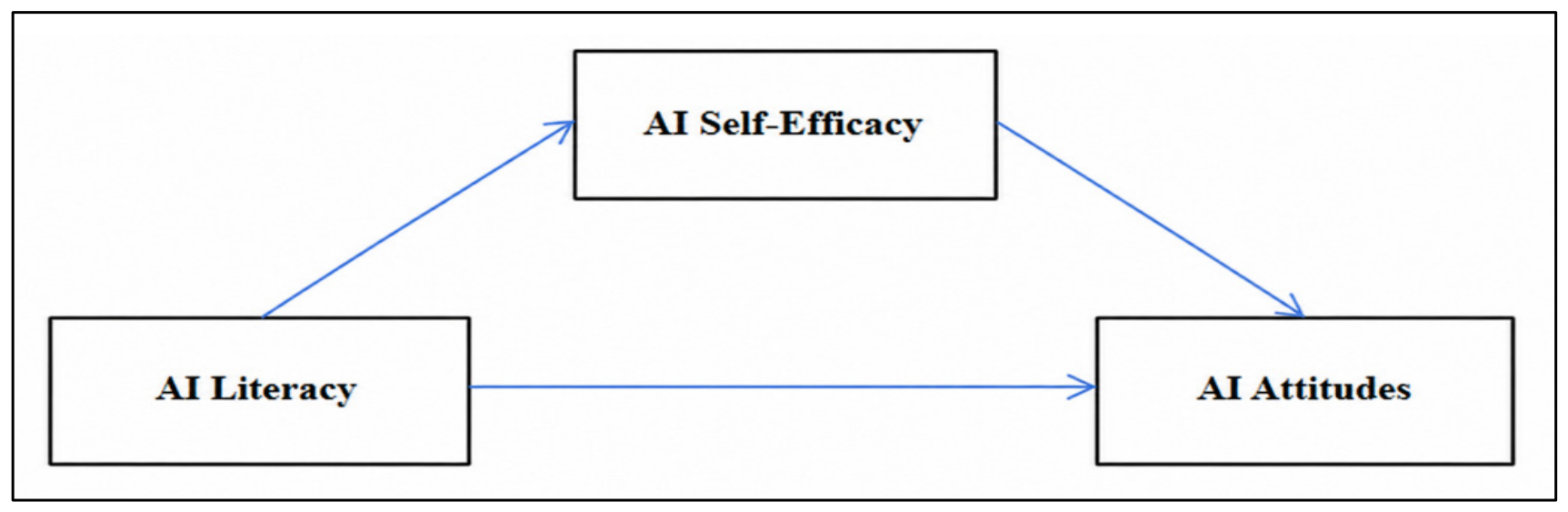
Figure 2.
Path Model of GAI Attitudes with Standardized Path Coefficients (β). Note. AI = Artificial Intelligence. * p < 0.05; ** p < 0.01 *** p < 0.001.
Figure 2.
Path Model of GAI Attitudes with Standardized Path Coefficients (β). Note. AI = Artificial Intelligence. * p < 0.05; ** p < 0.01 *** p < 0.001.
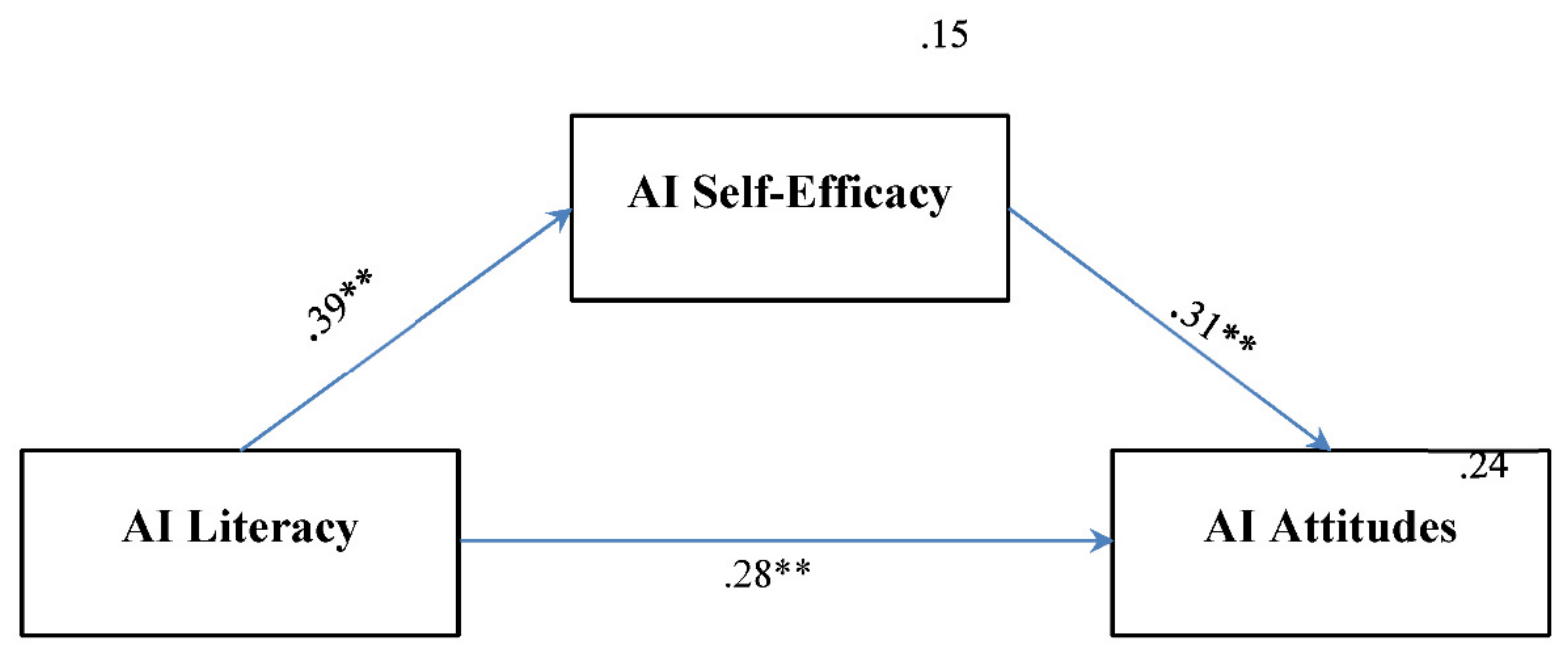

Table 1.
Participants’ General Characteristics. (n = 100).
| Variable | Category | n (%)/ M ± SD | Range |
|---|---|---|---|
| Age | 30.25 ± 7.84 | 19–48 | |
| Gender | Female | 71 (71.0) | |
| Male | 27 (27.0) | ||
| Prefer not to say | 2 (2.0) | ||
| Semester (n = 89) |
semester 1 | 36 (36.0) | |
| semester 2 | 44 (44.0) | ||
| ≥semester 3 | 9 (10.0) | ||
| Current Cumulative GPA (n = 95) |
2.5–<3.0 | 6 (6.3) | |
| 3.0–<3.5 | 26 (27.4) | ||
| 3.5–4.0 | 63 (66.3) | ||
| Computer Experience Level (n = 98) |
Beginner | 10 (10.2) | |
| Intermediate | 64 (65.3) | ||
| Advanced | 23 (23.5) | ||
| N/A | 1 (1.0) | ||
| Frequency of Generative AI Use for Academic Purposes (n = 98) |
Never | 4 (4.0) | |
| Rarely (1–2/semester) | 10 (10.2) | ||
| Occasionally (1–2/month) | 18 (18.4) | ||
| Frequently (weekly) | 27 (27.6) | ||
| Very frequently (multiple times/week) | 39 (39.8) |
Note. AI = Artificial Intelligence.
Table 2.
Study Variables and Correlations Between Variables (n = 100).
| Variables | r (p) | M ± SD | Range | |
|---|---|---|---|---|
| 1 | 2 | |||
| 1. AI Literacy | 1 | 4.84 ± 0.80 | 1–7 | |
| 2. AI Self-Efficacy | 0.42 (<0.001) | 1 | 4.90 ± 0.89 | 1–7 |
| 3. AI Attitudes | 0.40 (<0.001) | 0.42 (<0.001) | 3.30 ± 0.49 | 1–5 |
Note. GAI = Generative Artificial Intelligence.
Table 3.
Path coefficients of study variables.
| Path | B | β | SE | C. R. | p |
|---|---|---|---|---|---|
| AI Literacy-> AI Self-efficacy | 0.432 | 0.39 | 0.103 | 4.206 | <0.001 |
| AI Self-efficacy-> GAI Attitudes | 0.170 | 0.31 | 0.052 | 3.236 | 0.001 |
| AI Literacy-> GAI Attitudes | 0.170 | 0.28 | 0.058 | 2.920 | 0.003 |
β (standardized).
Table 4.
Mediation Analysis: Total, Direct, and Indirect Effects. (n = 100).
| Path | Direct Effect (B) |
Indirect Effect (B) |
Total Effect (B) |
Indirect Effect 95% CI |
SMC (R2) |
|---|---|---|---|---|---|
| AI Literacy-> GAI Attitudes | 0.170 | 0.073 | 0.243 | [0.03, 0.12] | 0.24 |
Note. AI = Artificial Intelligence; SMC = squared multiple correlations.
Disclaimer/Publisher’s Note: The statements, opinions and data contained in all publications are solely those of the individual author(s) and contributor(s) and not of MDPI and/or the editor(s). MDPI and/or the editor(s) disclaim responsibility for any injury to people or property resulting from any ideas, methods, instructions or products referred to in the content. |
© 2026 by the authors. Licensee MDPI, Basel, Switzerland. This article is an open access article distributed under the terms and conditions of the Creative Commons Attribution (CC BY) license (http://creativecommons.org/licenses/by/4.0/).
Copyright: This open access article is published under a Creative Commons CC BY 4.0 license, which permit the free download, distribution, and reuse, provided that the author and preprint are cited in any reuse.


