

Submitted:
14 July 2026
Posted:
15 July 2026
You are already at the latest version
Abstract
Immune checkpoint inhibitors (ICIs) targeting PD-1/PD-L1 have improved outcomes across squamous cell carcinomas (SCCs) of the head and neck, lung, esophagus, and skin, yet durable responses remain confined to a subset of patients in every subtype. Objective response rates vary substantially across SCCs despite overlapping genomic alterations, comparable tumor mutational burden, and high PD-L1 expression, indicating that tumor-intrinsic biomarkers alone do not explain this variability. Growing evidence points to the tumor immune microenvironment, and in particular the myeloid compartment, as a critical determinant of immunotherapy responsiveness. In this review, we synthesize current evidence on myeloid-mediated immune regulation across SCC subtypes, focusing on tumor-associated macrophages, myeloid-derived suppressor cells/tumor-associated neutrophils, and dendritic cells, and the mechanisms by which these populations impair antigen presentation, restrict T cell infiltration, and sustain immunologically "cold" tumor states. We further examine therapeutic strategies aimed at reprogramming rather than simply depleting suppressive myeloid populations, including radiation therapy, STING agonism, and myeloid-targeted agents (CSF1R, PI3Kγ, and CXCR2 inhibition), each of which has shown encouraging preclinical and early clinical activity in combination with ICI. Collectively, this evidence supports a model in which the myeloid compartment functions as an actionable, shared determinant of ICI resistance across SCC subtypes, rather than merely a passive biomarker. We propose that through the integration of spatial and single-cell profiling of myeloid states with clinical history it will be possible to predict response to immune checkpoint therapy and personalize myeloid-directed combination strategies capable of overcoming resistance to checkpoint blockade.
Keywords:
squamous cell carcinoma
; immune checkpoint inhibitors
; tumor immune microenvironment
; tumor-associated macrophages
; myeloid-derived suppressor cells
; dendritic cells
; immunotherapy resistance
; myeloid reprogramming
Introduction
Squamous cell carcinomas (SCCs) comprise a diverse group of epithelial malignancies arising from stratified squamous epithelia at multiple anatomical sites, including the head and neck, lung, esophagus, and skin. Collectively, these tumors account for a substantial global cancer burden and are frequently associated with chronic inflammatory exposures such as tobacco smoke, alcohol consumption, ultraviolet radiation, and environmental carcinogens (Johnson et al., 2020; Sung et al., 2021). Despite their distinct anatomical origins, SCCs share biological and histopathologic characteristics, including squamous differentiation, genomic instability, and inflammatory tumor microenvironments (TMEs) (Leemans et al., 2018; The Cancer Genome Atlas Network, 2015; The Cancer Genome Atlas Research Network, 2012).
Immune checkpoint inhibitors (ICIs) targeting programmed cell death protein-1 (PD-1) and programmed cell death ligand-1 (PD-L1) have emerged as an important therapeutic strategy across several squamous cell carcinoma subtypes. ICIs have improved survival outcomes and produced durable responses in specific subsets of patients with SCC, demonstrating the clinical potential of improving antitumor immunity (Burtness et al., 2019a; Grob et al., 2020a; Kato et al., 2019a; Migden et al., 2018; Seiwert et al., 2016; Uppaluri, Haddad, Tao, Le Tourneau, Lee, Westra, Chernock, Tahara, Harrington, Klochikhin, Braña, Vasconcelos Alves, Hughes, Oliva, Pinto Figueiredo Lima, Ueda, Rutkowski, Schroeder, Mauz, Fuereder, Laban, Oridate, Popovtzer, Mach, Korobko, Costa, Hooda-Nehra, Rodriguez, Bell, Manschot, Benjamin, Gumuscu, Adkins, et al., 2025). However, despite these advances, the overall clinical benefit remains limited in a large subset of patients. Objective response rates vary substantially across SCC subtypes, ranging from approximately 15-25% in recurrent or metastatic head and neck SCC (HNSCC) (Burtness et al., 2019a; Seiwert et al., 2016; Uppaluri, Haddad, Tao, Le Tourneau, Lee, Westra, Chernock, Tahara, Harrington, Klochikhin, Braña, Vasconcelos Alves, Hughes, Oliva, Pinto Figueiredo Lima, Ueda, Rutkowski, Schroeder, Mauz, Fuereder, Laban, Oridate, Popovtzer, Mach, Korobko, Costa, Hooda-Nehra, Rodriguez, Bell, Manschot, Benjamin, Gumuscu, Adkins, et al., 2025) and esophageal SCC (ESCC) (Kato et al., 2019a) to nearly 50% in advanced cutaneous SCC (Grob et al., 2020a; Migden et al., 2018), and durable disease control remains limited to a small proportion of treated patients (Burtness et al., 2019a; Grob et al., 2020a; Kato et al., 2019a; Migden et al., 2018; Seiwert et al., 2016; Uppaluri, Haddad, Tao, Le Tourneau, Lee, Westra, Chernock, Tahara, Harrington, Klochikhin, Braña, Vasconcelos Alves, Hughes, Oliva, Pinto Figueiredo Lima, Ueda, Rutkowski, Schroeder, Mauz, Fuereder, Laban, Oridate, Popovtzer, Mach, Korobko, Costa, Hooda-Nehra, Rodriguez, Bell, Manschot, Benjamin, Gumuscu, Adkins, et al., 2025). Notably, these differences occur despite overlapping genomic alterations, comparable tumor mutational burdens, and high PD-L1 expression, suggesting that conventional tumor-intrinsic biomarkers alone do not fully explain therapeutic response (Cassetta & Pollard, 2018; Cristescu et al., 2018; Samstein et al., 2019).
Growing evidence indicates that the composition, functional state, and spatial organization of the tumor immune microenvironment may exert a greater influence on immunotherapy outcomes than tumor-intrinsic characteristics alone (Cassetta & Pollard, 2018; Mantovani et al., 2004). Although cytotoxic T lymphocytes have traditionally been viewed as the principal mediators of antitumor immunity (DeNardo & Ruffell, 2019; Vitale et al., 2019), the importance of myeloid populations in regulating antitumor immune responses has become increasingly apparent (Gabrilovich & Nagaraj, 2009; Veglia et al., 2021). Advances in single-cell sequencing, spatial transcriptomics, multiplex imaging, and systems immunology have further refined our understanding of myeloid heterogeneity, spatial distribution, and functional states within SCCs (DeNardo & Ruffell, 2019; Gabrilovich & Nagaraj, 2009; Veglia et al., 2021; Vitale et al., 2019). Tumor-associated macrophages (TAMs), myeloid-derived suppressor cells (MDSCs), neutrophils, and dendritic cells, among other myeloid populations, collectively regulate antigen presentation, cytokine production, immune cell trafficking, stromal remodeling, and T cell activation (Jaillon et al., 2020; Kumar et al., 2016; Marvel & Gabrilovich, 2015; Shaul & Fridlender, 2019a). Consequently, these populations influence not only the baseline immune states but also the development of both primary and acquired resistance to ICI.
Myeloid-mediated immune suppression has emerged as a recurring feature across multiple SCC subtypes. Suppressive myeloid programs have been implicated in impaired antigen presentation, attenuation of type I and type II interferon signaling, recruitment and expansion of regulatory T cells (Tregs), exclusion of cytotoxic T cells, and establishment of immunologically “cold” TMEs (Coffelt et al., 2016; Gardner & Ruffell, 2016; Jaillon et al., 2020; Shaul & Fridlender, 2019a; Wculek et al., 2020). Such mechanisms may explain why tumors exhibiting favorable biomarkers, including high PD-L1 expression or high mutational burden, often fail to achieve durable responses to ICIs. Furthermore, differences in myeloid composition and functional polarization may also, in part, account for the marked variability in immunotherapy responsiveness. These observations have generated substantial interest in therapeutic strategies aimed at reshaping the myeloid compartment.
In this review, we examine the emerging roles of myeloid populations as central regulators of ICI responsiveness across SCC subtypes, focusing on HNSCC, LUSC, ESCC, and cSCC, which collectively account for a substantial portion of the global cancer burden (Sung et al., 2021). We review current understanding of the mechanisms through which myeloid populations mediate immune suppression and therapeutic resistance, and highlight emerging strategies aimed at reprogramming the TME through radiation therapy, innate immune activation, and targeted myeloid-directed interventions. While evidence from multiple SCC subtypes identifies shared biological principles, we place particular emphasis on HNSCC, given our group’s longstanding clinical and research focus on this disease. We propose that the composition, functional state, and spatial organization of the myeloid compartment represent a unifying biological framework that may explain the heterogeneous efficacy of immune checkpoint blockade across SCCs and inform the development of more effective precision immunotherapy strategies.
Differential Responses to Immunotherapy Across SCCs
The clinical experience with ICI across SCCs demonstrates that immunotherapy sensitivity is not uniform. We have summarized the major immunotherapy clinical trials across the four major SCC subtypes (HNSCC, LUSC, ESCC, and cSCC) over the past 10-15 years in Table 1. While these trials show that PD-1/PD-L1 blockade have improved clinical outcomes in different settings, there are important differences in responses across the SCC subtypes that warrant further investigation.
More recently, two phase III trials have extended support for PD1-blockade in the treatment of resectable locally advanced HNSCC. KEYNOTE-689 demonstrated that perioperative pembrolizumab anti-PD-1) significantly improved event-free survival (median 51.8 versus 30.4 months) when added to standard-of-care surgery and chemoradiation. NIVOPOSTOP, similarly, showed that the addition of nivolumab to cisplatin-based postoperative chemoradiation improved 3-year disease-free survival in resected, high-risk, locally advanced HNSCC (61.3% versus 52.5%) (Bourhis et al., 2025b). While these trials do represent breakthroughs for the field, they still highlight a persistent biological problem: a subset of tumors continue to recur, raising the question as to why many tumors fail to generate durable immune-mediated tumor control.
A similar pattern is observed in LUSC/squamous non-small-cell lung cancer (NSCLC), where checkpoint inhibition is now routinely integrated in advanced and perioperative treatment settings (Brahmer et al., 2015b; Burtness et al., 2019a; L. Paz-Ares et al., 2018b; Provencio et al., 2023). In CheckMate 017, nivolumab (anti-PD-1) improved overall survival (9.6 months vs. 6 months with docetaxel) and achieved an objective response rate of approximately 20% in advanced squamous-cell NSCLC (Brahmer et al., 2015b). In the first-line metastatic setting, KEYNOTE-406 showed that pembrolizumab (anti-PD-1) plus chemotherapy substantially improved objective response rates compared with chemotherapy alone (57.9% vs. 38.4%) in patients with untreated metastatic squamous NSCLC (Brahmer et al., 2015b; L. Paz-Ares et al., 2018b).
Similarly for ESCC as demonstrated in ATTRACTION-3, nivolumab (anti-PD-1) improved overall survival compared with taxane chemotherapy in previously treated advanced ESCC, supporting PD-1 blockade as an important therapeutic option in this disease (Kato et al., 2019a). However, only a subset of patients achieved durable clinical benefit, and most tumors ultimately progressed despite treatment (Kato et al., 2019a). In the first-line setting, KEYNOTE-590 showed that pembrolizumab plus cisplatin and 5-fluorouracil improved survival compared with chemotherapy alone in advanced ESCC, particularly in patients with PD-L1 CPS ≥10 [Add citation]. CheckMate 648 further validated first-line strategies in advanced ESCC, demonstrating improved overall survival with nivolumab plus chemotherapy and with nivolumab plus ipilimumab (anti-CTLA4) compared with chemotherapy alone (Doki et al., 2022). These findings indicate that although PD-1 blockade can improve outcomes in ESCC, additional mechanisms of immune resistance continue to limit therapeutic efficacy in many patients.
PD-1 blockade also transformed management of advanced cutaneous squamous cell carcinoma (cSCC). The phase II EMPOWER-CSCC-1 trial established cemiplimab as standard of care in locally advanced and metastatic cSCC, with an objective response rate of approximately 47% and durable responses maintained at extended follow-up (Migden et al., 2018). More recently, neoadjuvant cemiplimab has moved PD-1 blockade into the perioperative setting for resectable disease: in a phase II trial of patients with stage II to IV cSCC, neoadjuvant cemiplimab produced a pathologic complete response in 51% of patients and a major pathologic response in an additional 13%, meeting the study’s primary endpoint and enabling function-preserving surgery in a subset of patients (Gross et al., 2022). While these studies suggest that cSCC is among the more ICI-responsive SCC subtypes, primary resistance, incomplete pathologic response, and disease recurrence still occur, indicating that even highly immunogenic SCCs can maintain or acquire immune-evasive TME states. While these studies suggest that cSCC is among the more ICI-responsive SCC subtypes, primary resistance, incomplete pathologic response, and disease recurrence still occur, indicating that even highly immunogenic SCCs can maintain or acquire immune-evasive TME states.
Taken together, these clinical trials demonstrate that although ICIs have improved clinical outcomes across multiple SCC subtypes (Table 1), durable clinical benefit remains limited to a subset of patients. The critical question is not whether ICI-mediated antitumor immunity is an effective therapeutic strategy, but rather why most patients fail to derive durable benefit. The persistence of therapeutic resistance across both metastatic and perioperative settings, together with the limited predictive capacity of tumor-intrinsic biomarkers, suggests that additional factors influence treatment outcomes. Increasing evidence points to the TME as a central regulator of therapeutic responsiveness, highlighting the need to identify biomarkers that capture the cellular and functional states of the immune landscape and to develop therapeutic strategies capable of overcoming TME-mediated ICI resistance.
Myeloid Populations in SCC and Mechanisms of Myeloid-Mediated Resistance
The myeloid compartment has emerged as a central regulator of antitumor immunity in SCC, capable of shaping both baseline immune states and responses to immunotherapy. As mentioned in the previous section, across the major SCC subtypes resistance to ICI cannot be explained by checkpoint-ligand expression alone. In this regard, myeloid cells are an important variable as they regulate multiple facets of cancer immunity, including tumor antigen uptake and presentation, T cell priming, local cytotoxic functions etc. This is especially relevant in SCCs, where ICI failure is seen despite immune infiltration, suggesting a function failure due to the myeloid compartment. In this section, we review the main myeloid populations that play a role in ICI resistance, including tumor associated macrophages (TAMs), neutrophils, and dendritic cells (Figure 1).
Tumor-Associated Macrophages as Central Drivers of Immune Resistance
Tumor-associated macrophages (TAMs) are the most abundant immune population in SCC TMEs, and have emerged as central orchestrators of tumor-associated inflammation and immune regulation (Mantovani et al., 2004). Classically, macrophages have been described using the M1/M2 polarization paradigm. M1 macrophages are broadly associated with pro-inflammatory and antitumor functions, while M2 macrophages are associated with tissue repair, immune suppression, and tumor progression (Adams & Hamilton, 1984; Mantovani et al., 2017; Noy & Pollard, 2014; Pyonteck et al., 2013; Sockolosky et al., 2016). However, single-cell profiling studies have expanded the functional states of TAMs beyond this dichotomous classification (Ma et al., 2022; Martinez & Gordon, 2014; Mosser & Edwards, 2008; Nahrendorf & Swirski, 2016). Rather than discrete M1 and M2 populations, TAMs comprise multiple context-dependent subsets with distinct programs including antigen presentation, interferon signaling, angiogenesis, lipid metabolism, tissue remodeling, and immune suppression (Ma et al., 2022; Mosser & Edwards, 2008; Nahrendorf & Swirski, 2016). This functional diversity is particularly relevant in solid tumors, where TAM populations are shaped by local TME cues and may exert divergent effects on antitumor immunity and therapeutic responsiveness within the same tumor (Guilliams et al., 2020; Ma et al., 2022). TAM polarization is shaped by tumor-derived cytokines, metabolic stress, hypoxia, and stromal cues. Notably, M2-polarization can be driven by IL-4 and IL-13 through STAT6/PPARgamma signaling (Daniel et al., 2018), TGF-beta/SMAD signaling (F. Zhang et al., 2016), lactate accumulation, hypoxia-HIF-1alpha/PKM2 activity (Palsson-McDermott et al., 2015), and tumor-derived Sonic Hedgehog signaling (Kerneur et al., 2022).
Once polarized and infiltrated into the TME, TAMs suppress adaptive immunity through multiple mechanisms. TAM-derived IL-10 suppresses antigen presentation and production of inflammatory cytokines, while TAM-derived TGF-β suppresses CD8+ T cell function, promoting cytotoxic T cell exclusion and Treg infiltration (Gunderson et al., 2020; Mantovani et al., 2004; Mittal & Roche, 2015), DC cell (Cappello et al., 2004; Mantovani et al., 2004). Furthermore, macrophages also directly engage inhibitory immune receptors; PD-L1 on TAMs directly suppresses PD-1 expressing T cells (Lu et al., 2019), CD47/SIRPalpha signaling modulates phagocytosis and antigen presentation (Logtenberg et al., 2020), and VISTA or other myeloid checkpoint molecules can further influence immune suppression (S. Chen et al., 2023).
Several TAM subsets appear particularly relevant to ICI resistance in SCCs. In oral SCC, CD163+CD204+ TAMs produced IL-10 and PD-L1 reducing CD3+ T cell activation in vitro, and negatively correlated with 5-year progression-free survival (Kubota et al., 2017). TREM2+ TAMs (characterized by expression of C1QA, C1QB, C1QC, TREM2, SPP1, and APOE), an emerging TAM subset across cancers, was associated with poor prognosis and reduced sensitivity to anti-PD-1 therapy (H. Li et al., 2023). In HNSCC, a discrete TAM subset, PF4+ TAMs were associated with decreased response to anti-CD276 therapy through increase in exhausted CXCR6+CD8+ T cells via the CXCL16-CXCR6 axis (C. Zhang et al., 2024). Importantly, spatial organization also plays an important role in molecular suppression. In HNSCC, Naei et al. reported that ICI non-responders exhibit a higher density of localized PD-1/PD-L1 interactions on TAMs, specifically clustered at the tumor-stroma interface to create a functional immunosuppressive barrier (Naei et al., 2025).
Tumor-Associated Neutrophils and Granulocytic MDSCs as Amplifiers of Immune Suppression
Myeloid-derived suppressor cells (MDSCs) represent another major immunosuppressive component of the myeloid compartment. They arise through pathological myelopoiesis driven by chronic inflammation and cancer, resulting in the accumulation of immature and dysregulated myeloid populations with potent immunosuppressive properties (Boettcher & Manz, 2017; Hegde et al., 2021; Perez et al., 2020; Veglia et al., 2021). Contemporary models classify MDSCs into two principal subsets: polymorphonuclear/granulocytic MDSCs (PMN-MDSCs), which share phenotypic characteristics with tumor-associated neutrophils (TANs), and monocytic MDSCs (M-MDSCs), which resemble activated monocytes, although both populations possess distinct transcriptional, metabolic, and functional programs that differentiate them from their conventional counterparts (Condamine et al., 2016; Hegde et al., 2021). However, a persistent challenge in literature is the lack of strict definitions, leading to these terms frequently being used interchangeably. For the purposes of this review, we will focus on neutrophils and PMN-MDSCs, as across various cancers, including SCCs, elevated neutrophil infiltration consistently correlates with poorer survival outcomes (Shaul & Fridlender, 2019b), drawing significant interest to these populations as integral components of the immune TME.
PMN-MDSCs and TANs suppress antitumor immunity through multiple complementary mechanisms (Hegde et al., 2021; Katzenelenbogen et al., 2020; Rodriguez et al., 2004; Srivastava et al., 2010; Veglia et al., 2021). Arginase 1 released from TANs depletes L-arginine, reduces CD3zeta expression, IL-2 production, IFN-gamma secretion, and T cell proliferation (Grzywa et al., 2020). TANs produce reactive oxygen species primarily through NOX2 and STAT3-dependent pathways, which nitrate T cell receptor components and promote antigen-specific tolerance (Feng et al., 2018; Nagaraj et al., 2010). Additionally, iNOS-derived nitric oxide suppresses T cell function by disrupting IL-2 signaling (Kramer & Abrams, 2020).
TAN-mediated immunosuppression and resistance to ICI also relies on local TME cues and post-translational stabilization of inhibitory ligands. Within the tumor niche, intratumoral hypoxia directly upregulates PD-L1 expression on TANs via HIF-signaling, which is further sustained in a IL-10/STAT3 positive feedback loop by infiltrating T cells (Noman et al., 2014). Additionally, GPR84, a free fatty acid receptor, enriched on TANs, physically stabilizes surface PD-L1 by restricting endosomal trafficking for lysosomal degradation (Qin et al., 2023). This reinforces localized T cell exhaustion, and represents a distinct mechanism of TAN-mediated resistance to ICI.
Another important aspect of TAN-mediated immune suppression is the formation of neutrophil extracellular traps (NETs), which add a spatial dimension. NETs are formed through a specialized process called NETosis, resulting in the release of decondensed DNA, histones, and granular proteins, which form a physical barrier and structural anchor for recruitment of other immune cells (Brambilla et al., 2025). High NET scores have been correlated with poor immunotherapy response in various cancers, including SCCs (Shen et al., 2022). IL-8 and other CXCR1/CXCR2 agonists induce NET release from TANs (Alfaro et al., 2016), and NETs can limit contact between malignant cells and cytotoxic CD8+ T cells or natural killer cells (Teijeira et al., 2020). Long-term NET exposure has also been reported to increase expression of T cell exhaustion markers such as PD-1, LAG-3, and TIM-3 (Kaltenmeier et al., 2021). Thus, NETs represent physical immune barriers that can prevent the efficacy of ICI even in TMEs with T cell infiltration.
Dendritic Cell Dysfunction Shapes SCC Immune Landscape
DC dysfunction represents another important mechanism of immune resistance by limiting the initiation of productive adaptive immune responses, and acts upstream of T cell exhaustion. DCs are essential for the priming and activation of tumor specific T cells and serve as critical mediators linking innate and adaptive immunity (Mildner & Jung, 2014; Zong et al., 2016). Among dendritic cell subsets, conventional type 1 DC (cDC1s) play a central role in antitumor immunity through their capacity for antigen cross-presentation and CD8+ T cell priming (Böttcher & Reis e Sousa, 2018; Merad et al., 2013; Schlitzer et al., 2015; Segura et al., 2013; Sittig et al., 2016; Wculek et al., 2020).
Once activated via BATF3 and IRF8, cDC1s promote antitumor immunity by presenting tumor antigen on MHC I, and secreting IL-12 to support cytotoxic T cell differentiation (Salmon et al., 2016) and CXCL9/CXCL10 to recruit CXCR3+ effector T cells (Bayerl et al., 2023a). These functions directly relate to ICI response as effective PD-1 blockade requires tumor-specific T cells that can be primed, expanded, recruited, and maintained. Consequently, cDC1 recruitment is impaired by PGE2 (Bayerl et al., 2023b), TGF-beta, or IL-10 (K. Li et al., 2021), ICI may fail despite the presence of antigen-specific T cells.
It is important to note that in a suppressive tumor context, both cDC1s and cDC2s can transform to a mature regulatory DC (mregDC) program. After antigen acquisition, both populations can mature into LAMp3+CCR7+ DCs that co-express inhibitory ligands, such as PD-L1, PD-L2, and IDO1 alongside classic maturation markers (Maier et al., 2020). Additionally, mregDCs upregulate PD-L1 upregulation through AXL signaling. Hence, these DCs do not act as conventional stimulatory APCs, but rather acquire tolerogenic features that drive Treg recruitment and reinforce resistance to ICI. This is also highlighted in an emerging pDC-IFN-mregDC axis. While primary refractory tumors often show structural immune exclusion driven by cancer-associated fibroblasts, tumors with abundant CD8 T cell infiltration can remain resistant due to chronic type I IFN signaling driven by plasmacytoid DCs (Win et al., 2026). This also promotes the expansion of mregDCs and the recruitment of Tregs, resulting in suppressive niches (Lee et al., 2026).
Therapeutic Reprogramming Strategies
Recognition of the central role of myeloid populations in shaping antitumor immunity has shifted therapeutic development beyond conventional approaches focused solely on tumor-cell eradication. Accumulating evidence indicates that suppressive myeloid populations are not merely passive biomarkers of immune dysfunction but active regulators of therapeutic response, making them attractive targets for intervention (Veglia et al., 2021). Consequently, contemporary therapeutic strategies increasingly seek to reprogram rather than deplete the immune TME, with the goal of overcoming myeloid-mediated immune suppression (Lan et al., 2021; Mateus-Tique et al., 2026; X. Sun et al., 2026). Among these approaches, radiation therapy and activation of innate immune sensing pathways have emerged as particularly promising strategies. Radiation can promote antigen release, DC activation, and T cell priming, functioning in some settings as an in situ vaccine (Chakravarty et al., 1999; Demaria et al., 2004; Formenti & Demaria, 2013; Kim et al., 2004; Nikitina & Gabrilovich, 2001; Teitz-Tennenbaum et al., 2003), whereas activation of the cGAS-STING pathway stimulates type I interferon signaling, antigen cross-presentation, and tumor-specific T cell responses (Corrales & Gajewski, 2015; X.-D. Li et al., 2013; Schoggins et al., 2014). Together, these therapeutic modalities illustrate how manipulation of innate immunity and myeloid-cell function may enhance responsiveness to immune checkpoint blockade in SCCs (Figure 2).
Radiation Therapy Reprograms the Myeloid Compartment
Radiation therapy has traditionally been viewed as a local cytotoxic modality; however, accumulating evidence indicates that radiation also functions as a potent regulator of antitumor immunity (Demaria et al., 2016). Beyond inducing tumor cell death, radiation promotes release of tumor-associated antigens, enhances DC cross-presentation, stimulates type I interferon signaling through innate immune sensing pathways, and facilitates recruitment of effector lymphocytes into the TME (Demaria et al., 2016; Deng et al., 2014a, 2014b; Pilones et al., 2014; Woo et al., 2014). These observations led Demaria and colleagues to propose that radiation may function as an “in situ vaccine,” converting poorly immunogenic tumors into lesions capable of generating systemic antitumor immune responses (Formenti & Demaria, 2009, 2013). Importantly, subsequent studies demonstrated that radiation-induced immune activation is not intrinsically sufficient for durable tumor control because compensatory immunosuppressive pathways frequently emerge following treatment.
Indeed, resistance to combined radiation and CTLA-4 blockade is associated with adaptive upregulation of PD-L1 and expansion of suppressive immune programs within the TME (Twyman-Saint Victor et al., 2015). Addition of PD-L1 blockade restored therapeutic efficacy, suggesting that radiation simultaneously induces immune activation and compensatory resistance mechanisms (Twyman-Saint Victor et al., 2015). These findings highlight that successful radioimmunotherapy requires not only generation of antitumor immunity but also interruption of suppressive pathways that limit its durability (Formenti & Demaria, 2013; Twyman-Saint Victor et al., 2015). Subsequent work in HNSCC further reinforced the importance of combating these resistance programs. Resistance to combined radiotherapy and PD-L1 blockade was associated with increased TIM-3 expression on CD8+ T cells and Tregs, accompanied by accumulation of intratumoral Tregs (A. Oweida et al., 2018). Addition of TIM-3 blockade improved tumor control, enhanced cytotoxic T cell activity, and prolonged survival (A. Oweida et al., 2018). Similarly, STAT3 signaling has emerged as a major regulator of radiation-associated immunosuppressive remodeling (A. J. Oweida et al., 2019). Inhibition of STAT3 decreased infiltration of MDSCs, M2 macrophages, and Tregs, and concomitantly increased infiltration of M1 macrophages and effector T cells following radiation (A. J. Oweida et al., 2019).
Emerging clinical studies further support that radiation can favorably reshape the TME when combined with immunotherapy. In the Neoadjuvant Immuno-Radiotherapy Trial, stereotactic body radiation therapy (SBRT) with nivolumab (anti-PD-1) prior to surgery in patients with locally advanced HNSCC showed major pathological response (mPR) and pathological complete response (pCR) rates of 86% and 67%, respectively, with clinical-to-pathological downstaging in 90% of treated patients (Leidner et al., 2021). Importantly, these response rates greatly exceeded those historically reported with neoadjuvant ICI alone, where mPR rates in HNSCC are generally limited to approximately 7-14% (Leidner et al., 2021). Similarly, mechanistic studies have also that radiation enhances DC recruitment and antigen presentation, promotes expansion of tumor-specific CD8+ T cells within tumor-draining lymph nodes, and facilitates trafficking of effector T cells into the TME (Darragh & Karam, 2026). Notably, omission of elective nodal irradiation in preclinical HNSCC models resulted in greater circulating antigen-specific CD4+ T cell responses and improved distant tumor control, highlighting the importance of preserving immune-priming niches during radioimmunotherapy (Buchwald et al., 2020; Darragh et al., 2022; Darragh & Karam, 2026). Together, these findings suggest that radiation may function as a potent immune-modulating intervention capable of overcoming suppressive TME programs and enhancing responsiveness to ICI.
STING Activation and Innate Immune Reprogramming
Innate immune activation through the cGAS-STING pathway has emerged as a rational strategy for overcoming tumors that fail to generate productive antitumor T cell responses. STING activation represent a method to initiate immunity from within the TME itself, particularly in tumors that lack spontaneous CD8+ T cell infiltration (Corrales & Gajewski, 2015). Cytosolic DNA sensing activates STING signaling (L. Sun et al., 2013; Wu et al., 2013), leading to TBK1/IRF3-dependent type I interferon production, DCDC activation, antigen cross-presentation, and subsequent priming of tumor-specific CD8+ T cells (Corrales & Gajewski, 2015; Klarquist et al., 2014). STING activation therefore provides a mechanistic bridge between innate immune sensing and adaptive T cell immunity. Further, the magnitude and localization of STING activation determines whether the response becomes durable and T cell mediated (Sivick et al., 2018). Intratumoral STING activation with the STING agonist ADU-S100 can produce tumor regression, but that high-dose tumor-ablative regimens and lower-dose immunogenic regimens are not equivalent (Sivick et al., 2018). Low-dose immunogenic activation generated local expansion of tumor-specific CD8+ effector T cells and supported durable antitumor immunity, whereas excessive activation produced systemic drug distribution and innate inflammatory effects that were less compatible with adaptive immune priming (Sivick et al., 2018). Importantly, the durable response required STING expression and interferon-alpha/beta receptor (IFNAR) signaling in hematopoietic cells, showing that the therapeutic effect was not merely due to direct tumor toxicity but dependent on type I interferon signaling (Sivick et al., 2018).
Ataxia telangiectasia and Rad3-related protein (ATR) serves as a central regulator of the cellular response to DNA damage and replication stress (A. Li et al., 2019; Tarique et al., 2015). Pharmacologic inhibition of ATR with AZD6738 (ceralasertib) disrupts DNA repair pathways in cancer cells, leading to increased genomic instability and enhanced apoptotic cell death (A. Li et al., 2019; Tarique et al., 2015). In addition to its direct antitumor activity, AZD6738 has been demonstrated to reshape the TME, promoting a more immunogenic state (A. Li et al., 2019; Tarique et al., 2015). Recent work from our group further demonstrates that innate immune reprogramming can be achieved through modulation of the DNA damage and replication stress response in HNSCC (Da Costa et al., 2026). In preclinical models, pharmacologic ATR inhibition with AZD6738 (ceralasertib) significantly enhanced the antitumor efficacy of PD-1 blockade (Da Costa et al., 2026). This effect was associated with remodeling of the TME, including increased cytotoxic T cell activity, reduced immunosuppressive myeloid and Treg populations, and polarization toward a more inflammatory macrophage phenotype (Da Costa et al., 2026). Mechanistically, these changes were linked to activation of cGAS-STING signaling and suppression of STAT3 activity, suggesting that ATR inhibition may augment immunotherapy responses through coordinated effects on both innate and adaptive immunity (Da Costa et al., 2026).
Collectively, these studies identify STING signaling as a critical link between innate and adaptive immunity, promoting DC activation, type I interferon signaling, antigen presentation, and CD8+ T cell priming. Importantly, they demonstrate that therapeutic activation of this pathway can be achieved through multiple approaches, including direct STING agonism and indirect activation through ATR inhibition. By restoring innate immune sensing and overcoming suppressive myeloid programs, these strategies may convert immunologically resistant SCCs into tumors capable of mounting effective responses to immune checkpoint blockade.
Emerging Myeloid-Targeted Therapeutic Strategies
Recognition of the central role of suppressive myeloid populations has prompted the development of therapeutic strategies aimed not only at depleting these cells but also at selectively reprogramming their function. Early macrophage-directed approaches focused on inhibition of the colony-stimulating factor-1 receptor (CSF1R), a key survival pathway for TAMs (Stanley & Chitu, 2014). Early clinical studies with CSF1R-targeting agents, including pexidartinib (Mok et al., 2014) and monoclonal antibodies directed against CSF1R, demonstrated clear evidence of macrophage depletion and modulation within the TME (Cannarile et al., 2017). However, clinical efficacy as monotherapy has generally been limited, and treatment has been associated with dose-limiting toxicities and adaptive resistance mechanisms that may restrict durable responses (K. Chen et al., 2025). These observations have shifted attention toward combination strategies, particularly those integrating CSF1R inhibition with ICIs or other immunomodulatory therapies, with the goal of overcoming compensatory immunosuppressive pathways and enhancing antitumor immunity (K. Chen et al., 2025).
More recent work suggests that these limitations may arise, in part, from the biological heterogeneity of TAMs. As discussed in the previous section, single-cell and spatial profiling studies have identified distinct macrophage states across solid tumors, including recurrent TREM2+ (Binnewies et al., 2021; Colonna, 2023; Molgora et al., 2020), SPP1+ (Bill et al., 2023a; Qi et al., 2022), and CXCL9+ populations (Bill et al., 2023b; Iijima & Iwasaki, 2014; W. Li et al., 2024; Van Der Sluis et al., 2015). Hence, broad macrophage depletion approaches may simultaneously eliminate both immunosuppressive and immunostimulatory macrophage subsets (X. Sun et al., 2026). Consequently, current efforts increasingly emphasize selective reprogramming or targeting of specific TAM populations rather than indiscriminate macrophage depletion (X. Sun et al., 2026).
Beyond macrophage depletion, PI3Kγ inhibition is another promising approach of functional myeloid reprogramming. Macrophage PI3Kγ acts as a molecular switch controlling immune suppression: PI3Kγ activation promotes an immunosuppressive transcriptional program, whereas genetic or pharmacologic PI3Kγ inhibition shifts macrophages toward an immune-stimulatory state, increases CD8+ T cell activation, and enhances responsiveness to ICI (Kaneda et al., 2016). Consistent with these findings, emerging clinical studies with the PI3Kγ inhibitor eganelisib have demonstrated pharmacodynamic evidence of myeloid reprogramming (De Henau et al., 2016) and encouraging activity in combination with ICI, supporting the feasibility of therapeutically redirecting suppressive macrophage states rather than eliminating them (X. Sun et al., 2026). Beyond PI3Kγ-selective inhibition, broader PI3K/mTOR blockade with gedatolisib has also been shown to reshape the immunosuppressive TME in HNSCC, reducing regulatory T cell infiltration and tumor hypoxia while resensitizing cisplatin-resistant, Nrf2-hyperactivated tumors to chemotherapy (Yadollahi et al., 2025).
Targeting myeloid recruitment pathways represents another promising therapeutic strategy. The CXCL-CXCR2 signaling axis plays a central role in the recruitment of suppressive myeloid populations to the TME and has been implicated in immune evasion across multiple SCC subtypes, including HNSCC (Horn et al., 2024; Steele et al., 2016). Preclinical studies have demonstrated that CXCR2 inhibition can reduce the accumulation of immunosuppressive myeloid cells, enhance T cell infiltration, and improve responses to ICI (Horn et al., 2024).These findings support the broader concept that disrupting myeloid-cell recruitment may convert immune-excluded tumors into more immunologically responsive lesions and provide a rationale for combining CXCR2-targeted therapies with ICIs in SCC.
Additional strategies seek to restore productive communication between innate and adaptive immunity. Beatty and colleagues showed that CD40 agonism altered the pancreatic tumor stroma and produced antitumor effects in both mouse models and patients, with macrophage activation contributing to stromal remodeling and tumor regression rather than simple T cell-dependent killing (Beatty et al., 2011). In parallel, STING agonism represents another approach to innate immune activation. Optimized intratumoral STING activation with ADU-S100 generated tumor-specific CD8+ T cell expansion, durable antitumor immunity, and improved efficacy of ICI, but only when the magnitude and localization of STING activation supported adaptive immune priming rather than nonspecific inflammation (Sivick et al., 2018).Collectively, these therapeutic strategies demonstrate that the myeloid compartment is not merely a biomarker of immune resistance but an actionable determinant of treatment response. CSF1R blockade, PI3Kγ inhibition, CXCR2 inhibition, and STING activation each target different aspects of the same biological problem: suppressive myeloid survival, recruitment, polarization, or failure of innate-to-adaptive immune communication. These findings directly support the central argument of this review that improving immunotherapy outcomes across SCCs will likely require strategies that reprogram the myeloid TME in parallel with ICI.
Conclusion
Although ICI have transformed the treatment landscape of SCC, durable responses remain limited in a substantial proportion of patients. Accumulating evidence suggests that suppressive myeloid programs represent a common biological denominator underlying both primary and acquired resistance to immunotherapy across SCC subtypes. TAMs, MDSCs, TANs, and dysfunctional DCs collectively shape the balance between immune activation and immune suppression, thereby influencing therapeutic responsiveness. Importantly, emerging strategies capable of reprogramming these myeloid populations; including radiation therapy, STING activation, and targeted myeloid-directed interventions; have demonstrated encouraging pre-clinical and early clinical activity. Continued integration of spatial biology, systems immunology, and translational therapeutics will be essential for defining actionable myeloid vulnerabilities and ultimately improving outcomes for patients with SCC.
Future Directions
Several priorities emerge from the evidence reviewed here. First, most mechanistic insight into myeloid-mediated resistance has been generated in HNSCC and preclinical models, and comparable spatial and single-cell characterization of the myeloid compartment is still lacking in ESCC, LUSC, and cSCC; cross-subtype profiling will be needed to determine whether the TAM, TAN, and dendritic cell states described here represent a shared program of resistance or are subtype-specific. Second, functional TAM states such as TREM2+, SPP1+, and CXCL9+ populations were largely defined using single-cell transcriptomic clustering; validating these states with spatially resolved platforms and linking them prospectively to ICI outcomes will be necessary before they can be used as predictive biomarkers rather than descriptive correlates. Third, because myeloid-targeted agents (CSF1R, PI3Kγ, and CXCR2 inhibitors) have shown limited efficacy as monotherapy, future trials should prioritize rational combinations with ICI, with correlative spatial and single-cell endpoints built in to determine which myeloid states are being reprogrammed rather than depleted. Finally, integrating myeloid-TME profiling with clinical and exposure variables, such as smoking status, HPV status, and treatment setting, may help explain the variability in ICI response within a single SCC subtype and not only between subtypes, and could inform patient stratification for myeloid-directed combination therapy
Author Contributions
Jaafar A. Hadi: Conceptualization, literature review, manuscript writing (original draft), figure conceptualization, project coordination, and manuscript revision. Zohra N. Nizami: Critical review and editing of the manuscript, and figure preparation. Ahmed Tajmim Noor: Table preparation, literature review, manuscript review, and editing. Abdullah A. Osman: Critical review and editing of the manuscript. Jeffrey N. Myers: Conceptualization, supervision, critical revision of the manuscript, and overall project oversight. All authors reviewed and approved the final version of the manuscript.
Data Availability Statement
No new data were created or analyzed in this study. Data sharing is not applicable.
Conflicts of Interest
The authors declare no conflicts of interest related to this work.
References
- Adams, D. O., & Hamilton, T. A. (1984). The cell biology of macrophage activation. Annual Review of Immunology, 2, 283–318. [CrossRef]
- Alfaro, C., Teijeira, A., Oñate, C., Pérez, G., Sanmamed, M. F., Andueza, M. P., Alignani, D., Labiano, S., Azpilikueta, A., Rodriguez-Paulete, A., Garasa, S., Fusco, J. P., Aznar, A., Inogés, S., De Pizzol, M., Allegretti, M., Medina-Echeverz, J., Berraondo, P., Perez-Gracia, J. L., & Melero, I. (2016). Tumor-Produced Interleukin-8 Attracts Human Myeloid-Derived Suppressor Cells and Elicits Extrusion of Neutrophil Extracellular Traps (NETs). Clinical Cancer Research, 22(15), 3924–3936. [CrossRef]
- Antonia, S. J., Villegas, A., Daniel, D., Vicente, D., Murakami, S., Hui, R., Yokoi, T., Chiappori, A., Lee, K. H., De Wit, M., Cho, B. C., Bourhaba, M., Quantin, X., Tokito, T., Mekhail, T., Planchard, D., Kim, Y.-C., Karapetis, C. S., Hiret, S., … Özgüroğlu, M. (2017). Durvalumab after Chemoradiotherapy in Stage III Non–Small-Cell Lung Cancer. New England Journal of Medicine, 377(20), 1919–1929. [CrossRef]
- Bayerl, F., Meiser, P., Donakonda, S., Hirschberger, A., Lacher, S. B., Pedde, A.-M., Hermann, C. D., Elewaut, A., Knolle, M., Ramsauer, L., Rudolph, T. J., Grassmann, S., Öllinger, R., Kirchhammer, N., Trefny, M., Anton, M., Wohlleber, D., Höchst, B., Zaremba, A., … Böttcher, J. P. (2023a). Tumor-derived prostaglandin E2 programs cDC1 dysfunction to impair intratumoral orchestration of anti-cancer T cell responses. Immunity, 56(6), 1341-1358.e11. [CrossRef]
- Bayerl, F., Meiser, P., Donakonda, S., Hirschberger, A., Lacher, S. B., Pedde, A.-M., Hermann, C. D., Elewaut, A., Knolle, M., Ramsauer, L., Rudolph, T. J., Grassmann, S., Öllinger, R., Kirchhammer, N., Trefny, M., Anton, M., Wohlleber, D., Höchst, B., Zaremba, A., … Böttcher, J. P. (2023b). Tumor-derived prostaglandin E2 programs cDC1 dysfunction to impair intratumoral orchestration of anti-cancer T cell responses. Immunity, 56(6), 1341-1358.e11. [CrossRef]
- Beatty, G. L., Chiorean, E. G., Fishman, M. P., Saboury, B., Teitelbaum, U. R., Sun, W., Huhn, R. D., Song, W., Li, D., Sharp, L. L., Torigian, D. A., O’Dwyer, P. J., & Vonderheide, R. H. (2011). CD40 agonists alter tumor stroma and show efficacy against pancreatic carcinoma in mice and humans. Science, 331(6024), 1612–1616. [CrossRef]
- Bill, R., Wirapati, P., Messemaker, M., Roh, W., Zitti, B., Duval, F., Kiss, M., Park, J. C., Saal, T. M., Hoelzl, J., Tarussio, D., Benedetti, F., Tissot, S., Kandalaft, L., Varrone, M., Ciriello, G., McKee, T. A., Monnier, Y., Mermod, M., … Pittet, M. J. (2023a). CXCL9:SPP1 macrophage polarity identifies a network of cellular programs that control human cancers. Science, 381(6657), 515–524. [CrossRef]
- Bill, R., Wirapati, P., Messemaker, M., Roh, W., Zitti, B., Duval, F., Kiss, M., Park, J. C., Saal, T. M., Hoelzl, J., Tarussio, D., Benedetti, F., Tissot, S., Kandalaft, L., Varrone, M., Ciriello, G., McKee, T. A., Monnier, Y., Mermod, M., … Pittet, M. J. (2023b). CXCL9:SPP1 macrophage polarity identifies a network of cellular programs that control human cancers. Science, 381(6657), 515–524. [CrossRef]
- Binnewies, M., Pollack, J. L., Rudolph, J., Dash, S., Abushawish, M., Lee, T., Jahchan, N. S., Canaday, P., Lu, E., Norng, M., Mankikar, S., Liu, V. M., Du, X., Chen, A., Mehta, R., Palmer, R., Juric, V., Liang, L., Baker, K. P., … Sriram, V. (2021). Targeting TREM2 on tumor-associated macrophages enhances immunotherapy. Cell Reports, 37(3), 109844. [CrossRef]
- Boettcher, S., & Manz, M. G. (2017). Regulation of Inflammation- and Infection-Driven Hematopoiesis. Trends in Immunology, 38(5), 345–357. [CrossRef]
- Böttcher, J. P., & Reis e Sousa, C. (2018). The Role of Type 1 Conventional Dendritic Cells in Cancer Immunity. Trends in Cancer, 4(11), 784–792. [CrossRef]
- Bourhis, J., Auperin, A., Borel, C., Lefebvre, G., Racadot, S., Geoffrois, L., Sun, X. S., Saada, E., Cirauqui, B., Rutkowski, T., Henry, S., Modesto, A., Johnson, A., Calderon, B., Pointreau, Y., Perez Ruiz, E., Kazmierska, J., Psyrri, A., Mesia, R., … GORTEC. (2025a). NIVOPOSTOP (GORTEC 2018-01): A phase III randomized trial of adjuvant nivolumab added to radio-chemotherapy in patients with resected head and neck squamous cell carcinoma at high risk of relapse. Journal of Clinical Oncology, 43(17_suppl). [CrossRef]
- Bourhis, J., Auperin, A., Borel, C., Lefebvre, G., Racadot, S., Geoffrois, L., Sun, X. S., Saada, E., Cirauqui, B., Rutkowski, T., Henry, S., Modesto, A., Johnson, A., Calderon, B., Pointreau, Y., Perez Ruiz, E., Kazmierska, J., Psyrri, A., Mesia, R., … GORTEC. (2025b). NIVOPOSTOP (GORTEC 2018-01): A phase III randomized trial of adjuvant nivolumab added to radio-chemotherapy in patients with resected head and neck squamous cell carcinoma at high risk of relapse. Journal of Clinical Oncology, 43(17_suppl). [CrossRef]
- Brahmer, J., Reckamp, K. L., Baas, P., Crinò, L., Eberhardt, W. E. E., Poddubskaya, E., Antonia, S., Pluzanski, A., Vokes, E. E., Holgado, E., Waterhouse, D., Ready, N., Gainor, J., Arén Frontera, O., Havel, L., Steins, M., Garassino, M. C., Aerts, J. G., Domine, M., … Spigel, D. R. (2015a). Nivolumab versus Docetaxel in Advanced Squamous-Cell Non–Small-Cell Lung Cancer. New England Journal of Medicine, 373(2), 123–135. [CrossRef]
- Brahmer, J., Reckamp, K. L., Baas, P., Crinò, L., Eberhardt, W. E. E., Poddubskaya, E., Antonia, S., Pluzanski, A., Vokes, E. E., Holgado, E., Waterhouse, D., Ready, N., Gainor, J., Arén Frontera, O., Havel, L., Steins, M., Garassino, M. C., Aerts, J. G., Domine, M., … Spigel, D. R. (2015b). Nivolumab versus Docetaxel in Advanced Squamous-Cell Non–Small-Cell Lung Cancer. New England Journal of Medicine, 373(2), 123–135. [CrossRef]
- Brambilla, M., Zanichelli, A., Cancila, V., Colombo, M. P., Chiodoni, C., & Sangaletti, S. (2025). Neutrophil extracellular traps in cancer: Immune modulation, therapy resistance, and the dilemma of targeting. Cell Death & Disease, 16(1), 882. [CrossRef]
- Breukers, S. E., Traets, J. J. H., Van Dijk, S. W., Ostos, M. M., Fraterman, I., Crommelin, R. D., Van Der Hulst, H., Qiao, X., Boere, T., Van De Poll-Franse, L. V., Retèl, V., Van Der Noort, V., Vos, J. L., Toppenberg, A. G. L., Van Der Heijden, M., Missale, F., Balm, F., Van Den Brekel, M., Dirven, R., … Zuur, C. L. (2025). Neoadjuvant ipilimumab and nivolumab in resectable cutaneous squamous cell carcinoma: A randomized phase 2 trial. Nature Medicine, 31(12), 4055–4064. [CrossRef]
- Buchwald, Z. S., Nasti, T. H., Lee, J., Eberhardt, C. S., Wieland, A., Im, S. J., Lawson, D., Curran, W., Ahmed, R., & Khan, M. K. (2020). Tumor-draining lymph node is important for a robust abscopal effect stimulated by radiotherapy. Journal for Immunotherapy of Cancer, 8(2), e000867. [CrossRef]
- Burtness, B., Harrington, K. J., Greil, R., Soulières, D., Tahara, M., De Castro, G., Psyrri, A., Basté, N., Neupane, P., Bratland, Å., Fuereder, T., Hughes, B. G. M., Mesía, R., Ngamphaiboon, N., Rordorf, T., Wan Ishak, W. Z., Hong, R.-L., González Mendoza, R., Roy, A., … Yorio, J. (2019a). Pembrolizumab alone or with chemotherapy versus cetuximab with chemotherapy for recurrent or metastatic squamous cell carcinoma of the head and neck (KEYNOTE-048): A randomised, open-label, phase 3 study. The Lancet, 394(10212), 1915–1928. [CrossRef]
- Burtness, B., Harrington, K. J., Greil, R., Soulières, D., Tahara, M., De Castro, G., Psyrri, A., Basté, N., Neupane, P., Bratland, Å., Fuereder, T., Hughes, B. G. M., Mesía, R., Ngamphaiboon, N., Rordorf, T., Wan Ishak, W. Z., Hong, R.-L., González Mendoza, R., Roy, A., … Yorio, J. (2019b). Pembrolizumab alone or with chemotherapy versus cetuximab with chemotherapy for recurrent or metastatic squamous cell carcinoma of the head and neck (KEYNOTE-048): A randomised, open-label, phase 3 study. The Lancet, 394(10212), 1915–1928. [CrossRef]
- Cannarile, M. A., Weisser, M., Jacob, W., Jegg, A.-M., Ries, C. H., & Rüttinger, D. (2017). Colony-stimulating factor 1 receptor (CSF1R) inhibitors in cancer therapy. Journal for Immunotherapy of Cancer, 5(1), 53. [CrossRef]
- Cappello, P., Caorsi, C., Bosticardo, M., De Angelis, S., Novelli, F., Forni, G., & Giovarelli, M. (2004). CCL16/LEC powerfully triggers effector and antigen-presenting functions of macrophages and enhances T cell cytotoxicity. Journal of Leukocyte Biology, 75(1), 135–142. [CrossRef]
- Cassetta, L., & Pollard, J. W. (2018). Targeting macrophages: Therapeutic approaches in cancer. Nature Reviews. Drug Discovery, 17(12), 887–904. [CrossRef]
- Chakravarty, P. K., Alfieri, A., Thomas, E. K., Beri, V., Tanaka, K. E., Vikram, B., & Guha, C. (1999). Flt3-ligand administration after radiation therapy prolongs survival in a murine model of metastatic lung cancer. Cancer Research, 59(24), 6028–6032.
- Chen, K., Li, X., Dong, S., Guo, Y., Luo, Z., Zhuang, S.-M., Liu, J., Liu, T., Liao, J., & Wen, W. (2025). Modulating tumor-associated macrophages through CSF1R inhibition: A potential therapeutic strategy for HNSCC. Journal of Translational Medicine, 23(1), 27. [CrossRef]
- Chen, S., Saeed, A. F. U. H., Liu, Q., Jiang, Q., Xu, H., Xiao, G. G., Rao, L., & Duo, Y. (2023). Macrophages in immunoregulation and therapeutics. Signal Transduction and Targeted Therapy, 8(1), 207. [CrossRef]
- Coffelt, S. B., Wellenstein, M. D., & de Visser, K. E. (2016). Neutrophils in cancer: Neutral no more. Nature Reviews. Cancer, 16(7), 431–446. [CrossRef]
- Cohen, E. E. W., Soulières, D., Le Tourneau, C., Dinis, J., Licitra, L., Ahn, M.-J., Soria, A., Machiels, J.-P., Mach, N., Mehra, R., Burtness, B., Zhang, P., Cheng, J., Swaby, R. F., Harrington, K. J., Acosta-Rivera, M., Adkins, D. R., Aghmesheh, M., Ahn, M.-J., … Zandberg, D. (2019). Pembrolizumab versus methotrexate, docetaxel, or cetuximab for recurrent or metastatic head-and-neck squamous cell carcinoma (KEYNOTE-040): A randomised, open-label, phase 3 study. The Lancet, 393(10167), 156–167. [CrossRef]
- Colonna, M. (2023). The biology of TREM receptors. Nature Reviews Immunology, 23(9), 580–594. [CrossRef]
- Condamine, T., Dominguez, G. A., Youn, J.-I., Kossenkov, A. V., Mony, S., Alicea-Torres, K., Tcyganov, E., Hashimoto, A., Nefedova, Y., Lin, C., Partlova, S., Garfall, A., Vogl, D. T., Xu, X., Knight, S. C., Malietzis, G., Lee, G. H., Eruslanov, E., Albelda, S. M., … Gabrilovich, D. I. (2016). Lectin-type oxidized LDL receptor-1 distinguishes population of human polymorphonuclear myeloid-derived suppressor cells in cancer patients. Science Immunology, 1(2), aaf8943. [CrossRef]
- Corrales, L., & Gajewski, T. F. (2015). Molecular Pathways: Targeting the Stimulator of Interferon Genes (STING) in the Immunotherapy of Cancer. Clinical Cancer Research, 21(21), 4774–4779. [CrossRef]
- Cristescu, R., Mogg, R., Ayers, M., Albright, A., Murphy, E., Yearley, J., Sher, X., Liu, X. Q., Lu, H., Nebozhyn, M., Zhang, C., Lunceford, J. K., Joe, A., Cheng, J., Webber, A. L., Ibrahim, N., Plimack, E. R., Ott, P. A., Seiwert, T. Y., … Kaufman, D. (2018). Pan-tumor genomic biomarkers for PD-1 checkpoint blockade–based immunotherapy. Science, 362(6411), eaar3593. [CrossRef]
- Da Costa, F. H., Kawabe, M., Tsai, T.-Y., Okamoto, K., Bartels, M. D., Cortes, S., Veeramachaneni, R., Rangel, R., Frederick, M. J., Sandulache, V. C., Sikora, A. G., Myers, J. N., & Osman, A. A. (2026). Targeted inhibition of ATR kinase promotes antitumor immunity in HNSCC through enhanced STING activation and T cell function. Translational Oncology, 71, 102869. [CrossRef]
- Daniel, B., Nagy, G., Horvath, A., Czimmerer, Z., Cuaranta-Monroy, I., Poliska, S., Hays, T. T., Sauer, S., Francois-Deleuze, J., & Nagy, L. (2018). The IL-4/STAT6/PPARγ signaling axis is driving the expansion of the RXR heterodimer cistrome, providing complex ligand responsiveness in macrophages. Nucleic Acids Research, 46(9), 4425–4439. [CrossRef]
- Darragh, L. B., Gadwa, J., Pham, T. T., Van Court, B., Neupert, B., Olimpo, N. A., Nguyen, K., Nguyen, D., Knitz, M. W., Hoen, M., Corbo, S., Joshi, M., Zhuang, Y., Amann, M., Wang, X.-J., Dow, S., Kedl, R. M., Samedi, V., Boss, M.-K., & Karam, S. D. (2022). Elective nodal irradiation mitigates local and systemic immunity generated by combination radiation and immunotherapy in head and neck tumors. Nature Communications, 13(1), 7015. [CrossRef]
- Darragh, L. B., & Karam, S. D. (2026). Radiation as an immune modulator: Mechanisms and implications for combination with immunotherapy. Nature Reviews Cancer, 26(4), 270–284. [CrossRef]
- De Henau, O., Rausch, M., Winkler, D., Campesato, L. F., Liu, C., Cymerman, D. H., Budhu, S., Ghosh, A., Pink, M., Tchaicha, J., Douglas, M., Tibbitts, T., Sharma, S., Proctor, J., Kosmider, N., White, K., Stern, H., Soglia, J., Adams, J., … Merghoub, T. (2016). Overcoming resistance to checkpoint blockade therapy by targeting PI3Kγ in myeloid cells. Nature, 539(7629), 443–447. [CrossRef]
- Demaria, S., Coleman, C. N., & Formenti, S. C. (2016). Radiotherapy: Changing the Game in Immunotherapy. Trends in Cancer, 2(6), 286–294. [CrossRef]
- Demaria, S., Ng, B., Devitt, M. L., Babb, J. S., Kawashima, N., Liebes, L., & Formenti, S. C. (2004). Ionizing radiation inhibition of distant untreated tumors (abscopal effect) is immune mediated. International Journal of Radiation Oncology, Biology, Physics, 58(3), 862–870. [CrossRef]
- DeNardo, D. G., & Ruffell, B. (2019). Macrophages as regulators of tumour immunity and immunotherapy. Nature Reviews. Immunology, 19(6), 369–382. [CrossRef]
- Deng, L., Liang, H., Xu, M., Yang, X., Burnette, B., Arina, A., Li, X.-D., Mauceri, H., Beckett, M., Darga, T., Huang, X., Gajewski, T. F., Chen, Z. J., Fu, Y.-X., & Weichselbaum, R. R. (2014a). STING-Dependent Cytosolic DNA Sensing Promotes Radiation-Induced Type I Interferon-Dependent Antitumor Immunity in Immunogenic Tumors. Immunity, 41(5), 843–852. [CrossRef]
- Deng, L., Liang, H., Xu, M., Yang, X., Burnette, B., Arina, A., Li, X.-D., Mauceri, H., Beckett, M., Darga, T., Huang, X., Gajewski, T. F., Chen, Z. J., Fu, Y.-X., & Weichselbaum, R. R. (2014b). STING-Dependent Cytosolic DNA Sensing Promotes Radiation-Induced Type I Interferon-Dependent Antitumor Immunity in Immunogenic Tumors. Immunity, 41(5), 843–852. [CrossRef]
- Doki, Y., Ajani, J. A., Kato, K., Xu, J., Wyrwicz, L., Motoyama, S., Ogata, T., Kawakami, H., Hsu, C.-H., Adenis, A., El Hajbi, F., Di Bartolomeo, M., Braghiroli, M. I., Holtved, E., Ostoich, S. A., Kim, H. R., Ueno, M., Mansoor, W., Yang, W.-C., … Kitagawa, Y. (2022). Nivolumab Combination Therapy in Advanced Esophageal Squamous-Cell Carcinoma. New England Journal of Medicine, 386(5), 449–462. [CrossRef]
- Feng, S., Cheng, X., Zhang, L., Lu, X., Chaudhary, S., Teng, R., Frederickson, C., Champion, M. M., Zhao, R., Cheng, L., Gong, Y., Deng, H., & Lu, X. (2018). Myeloid-derived suppressor cells inhibit T cell activation through nitrating LCK in mouse cancers. Proceedings of the National Academy of Sciences, 115(40), 10094–10099. [CrossRef]
- Ferris, R. L., Blumenschein, G., Fayette, J., Guigay, J., Colevas, A. D., Licitra, L., Harrington, K., Kasper, S., Vokes, E. E., Even, C., Worden, F., Saba, N. F., Iglesias Docampo, L. C., Haddad, R., Rordorf, T., Kiyota, N., Tahara, M., Monga, M., Lynch, M., … Gillison, M. L. (2016a). Nivolumab for Recurrent Squamous-Cell Carcinoma of the Head and Neck. New England Journal of Medicine, 375(19), 1856–1867. [CrossRef]
- Ferris, R. L., Blumenschein, G., Fayette, J., Guigay, J., Colevas, A. D., Licitra, L., Harrington, K., Kasper, S., Vokes, E. E., Even, C., Worden, F., Saba, N. F., Iglesias Docampo, L. C., Haddad, R., Rordorf, T., Kiyota, N., Tahara, M., Monga, M., Lynch, M., … Gillison, M. L. (2016b). Nivolumab for Recurrent Squamous-Cell Carcinoma of the Head and Neck. New England Journal of Medicine, 375(19), 1856–1867. [CrossRef]
- Formenti, S. C., & Demaria, S. (2009). Systemic effects of local radiotherapy. The Lancet. Oncology, 10(7), 718–726. [CrossRef]
- Formenti, S. C., & Demaria, S. (2013). Combining radiotherapy and cancer immunotherapy: A paradigm shift. Journal of the National Cancer Institute, 105(4), 256–265. [CrossRef]
- Gabrilovich, D. I., & Nagaraj, S. (2009). Myeloid-derived suppressor cells as regulators of the immune system. Nature Reviews. Immunology, 9(3), 162–174. [CrossRef]
- Gardner, A., & Ruffell, B. (2016). Dendritic Cells and Cancer Immunity. Trends in Immunology, 37(12), 855–865. [CrossRef]
- Grob, J.-J., Gonzalez, R., Basset-Seguin, N., Vornicova, O., Schachter, J., Joshi, A., Meyer, N., Grange, F., Piulats, J. M., Bauman, J. R., Zhang, P., Gumuscu, B., Swaby, R. F., & Hughes, B. G. M. (2020a). Pembrolizumab Monotherapy for Recurrent or Metastatic Cutaneous Squamous Cell Carcinoma: A Single-Arm Phase II Trial (KEYNOTE-629). Journal of Clinical Oncology, 38(25), 2916–2925. [CrossRef]
- Grob, J.-J., Gonzalez, R., Basset-Seguin, N., Vornicova, O., Schachter, J., Joshi, A., Meyer, N., Grange, F., Piulats, J. M., Bauman, J. R., Zhang, P., Gumuscu, B., Swaby, R. F., & Hughes, B. G. M. (2020b). Pembrolizumab Monotherapy for Recurrent or Metastatic Cutaneous Squamous Cell Carcinoma: A Single-Arm Phase II Trial (KEYNOTE-629). Journal of Clinical Oncology, 38(25), 2916–2925. [CrossRef]
- Gross, N. D., Miller, D. M., Khushalani, N. I., Divi, V., Ruiz, E. S., Lipson, E. J., Meier, F., Su, Y. B., Swiecicki, P. L., Atlas, J., Geiger, J. L., Hauschild, A., Choe, J. H., Hughes, B. G. M., Schadendorf, D., Patel, V. A., Homsi, J., Taube, J. M., Lim, A. M., … Rischin, D. (2022). Neoadjuvant Cemiplimab for Stage II to IV Cutaneous Squamous-Cell Carcinoma. New England Journal of Medicine, 387(17), 1557–1568. [CrossRef]
- Grzywa, T. M., Sosnowska, A., Matryba, P., Rydzynska, Z., Jasinski, M., Nowis, D., & Golab, J. (2020). Myeloid Cell-Derived Arginase in Cancer Immune Response. Frontiers in Immunology, 11, 938. [CrossRef]
- Guilliams, M., Thierry, G. R., Bonnardel, J., & Bajenoff, M. (2020). Establishment and Maintenance of the Macrophage Niche. Immunity, 52(3), 434–451. [CrossRef]
- Gunderson, A. J., Yamazaki, T., McCarty, K., Fox, N., Phillips, M., Alice, A., Blair, T., Whiteford, M., O’Brien, D., Ahmad, R., Kiely, M. X., Hayman, A., Crocenzi, T., Gough, M. J., Crittenden, M. R., & Young, K. H. (2020). TGFβ suppresses CD8+ T cell expression of CXCR3 and tumor trafficking. Nature Communications, 11(1), 1749. [CrossRef]
- Hegde, S., Leader, A. M., & Merad, M. (2021). MDSC: Markers, development, states, and unaddressed complexity. Immunity, 54(5), 875–884. [CrossRef]
- Horn, L. A., Lind, H., Fousek, K., Qin, H., Rajabian, N., Angstadt, S., Hsiao-Sanchez, N., Medina-Enriquez, M. M., Kelly, M. D., Allen, C. T., Hammoudeh, S. M., Weigert, R., Maeda, D. Y., Zebala, J. A., & Palena, C. (2024). Inhibition of the chemokine receptors CXCR1 and CXCR2 synergizes with docetaxel for effective tumor control and remodeling of the immune microenvironment of HPV-negative head and neck cancer models. Journal of Experimental & Clinical Cancer Research: CR, 43(1), 318. [CrossRef]
- Hughes, B. G. M., Guminski, A., Bowyer, S., Migden, M. R., Schmults, C. D., Khushalani, N. I., Chang, A. L. S., Grob, J.-J., Lewis, K. D., Ansstas, G., Day, F., Ladwa, R., Stein, B. N., Muñoz Couselo, E., Meier, F., Hauschild, A., Schadendorf, D., Basset-Seguin, N., Modi, B., … Rischin, D. (2025). A phase 2 open-label study of cemiplimab in patients with advanced cutaneous squamous cell carcinoma (EMPOWER-CSCC-1): Final long-term analysis of groups 1, 2, and 3, and primary analysis of fixed-dose treatment group 6. Journal of the American Academy of Dermatology, 92(1), 68–77. [CrossRef]
- Iijima, N., & Iwasaki, A. (2014). A local macrophage chemokine network sustains protective tissue-resident memory CD4 T cells. Science, 346(6205), 93–98. [CrossRef]
- Jaillon, S., Ponzetta, A., Di Mitri, D., Santoni, A., Bonecchi, R., & Mantovani, A. (2020). Neutrophil diversity and plasticity in tumour progression and therapy. Nature Reviews. Cancer, 20(9), 485–503. [CrossRef]
- Johnson, D. E., Burtness, B., Leemans, C. R., Lui, V. W. Y., Bauman, J. E., & Grandis, J. R. (2020). Head and neck squamous cell carcinoma. Nature Reviews Disease Primers, 6(1), 92. [CrossRef]
- Jotte, R., Cappuzzo, F., Vynnychenko, I., Stroyakovskiy, D., Rodríguez-Abreu, D., Hussein, M., Soo, R., Conter, H. J., Kozuki, T., Huang, K.-C., Graupner, V., Sun, S. W., Hoang, T., Jessop, H., McCleland, M., Ballinger, M., Sandler, A., & Socinski, M. A. (2020). Atezolizumab in Combination With Carboplatin and Nab-Paclitaxel in Advanced Squamous NSCLC (IMpower131): Results From a Randomized Phase III Trial. Journal of Thoracic Oncology, 15(8), 1351–1360. [CrossRef]
- Kaltenmeier, C., Yazdani, H. O., Morder, K., Geller, D. A., Simmons, R. L., & Tohme, S. (2021). Neutrophil Extracellular Traps Promote T Cell Exhaustion in the Tumor Microenvironment. Frontiers in Immunology, 12, 785222. [CrossRef]
- Kaneda, M. M., Messer, K. S., Ralainirina, N., Li, H., Leem, C. J., Gorjestani, S., Woo, G., Nguyen, A. V., Figueiredo, C. C., Foubert, P., Schmid, M. C., Pink, M., Winkler, D. G., Rausch, M., Palombella, V. J., Kutok, J., McGovern, K., Frazer, K. A., Wu, X., … Varner, J. A. (2016). PI3Kγ is a molecular switch that controls immune suppression. Nature, 539(7629), 437–442. [CrossRef]
- Kato, K., Cho, B. C., Takahashi, M., Okada, M., Lin, C.-Y., Chin, K., Kadowaki, S., Ahn, M.-J., Hamamoto, Y., Doki, Y., Yen, C.-C., Kubota, Y., Kim, S.-B., Hsu, C.-H., Holtved, E., Xynos, I., Kodani, M., & Kitagawa, Y. (2019a). Nivolumab versus chemotherapy in patients with advanced oesophageal squamous cell carcinoma refractory or intolerant to previous chemotherapy (ATTRACTION-3): A multicentre, randomised, open-label, phase 3 trial. The Lancet Oncology, 20(11), 1506–1517. [CrossRef]
- Kato, K., Cho, B. C., Takahashi, M., Okada, M., Lin, C.-Y., Chin, K., Kadowaki, S., Ahn, M.-J., Hamamoto, Y., Doki, Y., Yen, C.-C., Kubota, Y., Kim, S.-B., Hsu, C.-H., Holtved, E., Xynos, I., Kodani, M., & Kitagawa, Y. (2019b). Nivolumab versus chemotherapy in patients with advanced oesophageal squamous cell carcinoma refractory or intolerant to previous chemotherapy (ATTRACTION-3): A multicentre, randomised, open-label, phase 3 trial. The Lancet Oncology, 20(11), 1506–1517. [CrossRef]
- Katzenelenbogen, Y., Sheban, F., Yalin, A., Yofe, I., Svetlichnyy, D., Jaitin, D. A., Bornstein, C., Moshe, A., Keren-Shaul, H., Cohen, M., Wang, S.-Y., Li, B., David, E., Salame, T.-M., Weiner, A., & Amit, I. (2020). Coupled scRNA-Seq and Intracellular Protein Activity Reveal an Immunosuppressive Role of TREM2 in Cancer. Cell, 182(4), 872-885.e19. [CrossRef]
- Kerneur, C., Cano, C. E., & Olive, D. (2022). Major pathways involved in macrophage polarization in cancer. Frontiers in Immunology, 13, 1026954. [CrossRef]
- Kim, K.-W., Kim, S.-H., Shin, J.-G., Kim, G.-S., Son, Y.-O., Park, S.-W., Kwon, B.-H., Kim, D.-W., Lee, C.-H., Sol, M.-Y., Jeong, M.-H., Chung, B.-S., & Kang, C.-D. (2004). Direct injection of immature dendritic cells into irradiated tumor induces efficient antitumor immunity. International Journal of Cancer, 109(5), 685–690. [CrossRef]
- Klarquist, J., Hennies, C. M., Lehn, M. A., Reboulet, R. A., Feau, S., & Janssen, E. M. (2014). STING-mediated DNA sensing promotes antitumor and autoimmune responses to dying cells. Journal of Immunology, 193(12), 6124–6134. [CrossRef]
- Kramer, E. D., & Abrams, S. I. (2020). Granulocytic Myeloid-Derived Suppressor Cells as Negative Regulators of Anticancer Immunity. Frontiers in Immunology, 11, 1963. [CrossRef]
- Kubota, K., Moriyama, M., Furukawa, S., Rafiul, H. A. S. M., Maruse, Y., Jinno, T., Tanaka, A., Ohta, M., Ishiguro, N., Yamauchi, M., Sakamoto, M., Maehara, T., Hayashida, J.-N., Kawano, S., Kiyoshima, T., & Nakamura, S. (2017). CD163+CD204+ tumor-associated macrophages contribute to T cell regulation via interleukin-10 and PD-L1 production in oral squamous cell carcinoma. Scientific Reports, 7(1), 1755. [CrossRef]
- Kumar, V., Patel, S., Tcyganov, E., & Gabrilovich, D. I. (2016). The Nature of Myeloid-Derived Suppressor Cells in the Tumor Microenvironment. Trends in Immunology, 37(3), 208–220. [CrossRef]
- Lan, Y., Moustafa, M., Knoll, M., Xu, C., Furkel, J., Lazorchak, A., Yeung, T.-L., Hasheminasab, S.-M., Jenkins, M. H., Meister, S., Yu, H., Schlegel, J., Marelli, B., Tang, Z., Qin, G., Klein, C., Qi, J., Zhou, C., Locke, G., … Abdollahi, A. (2021). Simultaneous targeting of TGF-β/PD-L1 synergizes with radiotherapy by reprogramming the tumor microenvironment to overcome immune evasion. Cancer Cell, 39(10), 1388-1403.e10. [CrossRef]
- Lee, M. Y., Sherman, A. R., Martinez Ramirez, L., Rahman, M., Zdravkovic, S., Shin, J. H., Stepanek, I., Colevas, A. D., Sunwoo, J. B., & Divi, V. (2026). Single-cell spatial transcriptomics uncovers niches that govern response to PD-1/PD-L1 blockade in cutaneous squamous cell carcinoma. Journal for ImmunoTherapy of Cancer, 14(1), e014067. [CrossRef]
- Leemans, C. R., Snijders, P. J. F., & Brakenhoff, R. H. (2018). The molecular landscape of head and neck cancer. Nature Reviews Cancer, 18(5), 269–282. [CrossRef]
- Leidner, R., Crittenden, M., Young, K., Xiao, H., Wu, Y., Couey, M. A., Patel, A. A., Cheng, A. C., Watters, A. L., Bifulco, C., Morris, G., Rushforth, L., Nemeth, S., Urba, W. J., Gough, M., & Bell, R. B. (2021). Neoadjuvant immunoradiotherapy results in high rate of complete pathological response and clinical to pathological downstaging in locally advanced head and neck squamous cell carcinoma. Journal for Immunotherapy of Cancer, 9(5), e002485. [CrossRef]
- Li, A., Yi, M., Qin, S., Song, Y., Chu, Q., & Wu, K. (2019). Activating cGAS-STING pathway for the optimal effect of cancer immunotherapy. Journal of Hematology & Oncology, 12(1), 35. [CrossRef]
- Li, H., Miao, Y., Zhong, L., Feng, S., Xu, Y., Tang, L., Wu, C., Zhang, X., Gu, L., Diao, H., Wang, H., Wen, Z., & Yang, M. (2023). Identification of TREM2-positive tumor-associated macrophages in esophageal squamous cell carcinoma: Implication for poor prognosis and immunotherapy modulation. Frontiers in Immunology, 14, 1162032. [CrossRef]
- Li, K., Shi, H., Zhang, B., Ou, X., Ma, Q., Chen, Y., Shu, P., Li, D., & Wang, Y. (2021). Myeloid-derived suppressor cells as immunosuppressive regulators and therapeutic targets in cancer. Signal Transduction and Targeted Therapy, 6(1), 362. [CrossRef]
- Li, W., Pan, L., Hong, W., Ginhoux, F., Zhang, X., Xiao, C., & Li, X. (2024). A single-cell pan-cancer analysis to show the variability of tumor-infiltrating myeloid cells in immune checkpoint blockade. Nature Communications, 15(1), 6142. [CrossRef]
- Li, X.-D., Wu, J., Gao, D., Wang, H., Sun, L., & Chen, Z. J. (2013). Pivotal roles of cGAS-cGAMP signaling in antiviral defense and immune adjuvant effects. Science, 341(6152), 1390–1394. [CrossRef]
- Logtenberg, M. E. W., Scheeren, F. A., & Schumacher, T. N. (2020). The CD47-SIRPα Immune Checkpoint. Immunity, 52(5), 742–752. [CrossRef]
- Lu, D., Ni, Z., Liu, X., Feng, S., Dong, X., Shi, X., Zhai, J., Mai, S., Jiang, J., Wang, Z., Wu, H., & Cai, K. (2019). Beyond T Cells: Understanding the Role of PD-1/PD-L1 in Tumor-Associated Macrophages. Journal of Immunology Research, 2019, 1–7. [CrossRef]
- Ma, R.-Y., Black, A., & Qian, B.-Z. (2022). Macrophage diversity in cancer revisited in the era of single-cell omics. Trends in Immunology, 43(7), 546–563. [CrossRef]
- Maier, B., Leader, A. M., Chen, S. T., Tung, N., Chang, C., LeBerichel, J., Chudnovskiy, A., Maskey, S., Walker, L., Finnigan, J. P., Kirkling, M. E., Reizis, B., Ghosh, S., D’Amore, N. R., Bhardwaj, N., Rothlin, C. V., Wolf, A., Flores, R., Marron, T., … Merad, M. (2020). A conserved dendritic-cell regulatory program limits antitumour immunity. Nature, 580(7802), 257–262. [CrossRef]
- Mantovani, A., Marchesi, F., Malesci, A., Laghi, L., & Allavena, P. (2017). Tumour-associated macrophages as treatment targets in oncology. Nature Reviews Clinical Oncology, 14(7), 399–416. [CrossRef]
- Mantovani, A., Sica, A., Sozzani, S., Allavena, P., Vecchi, A., & Locati, M. (2004). The chemokine system in diverse forms of macrophage activation and polarization. Trends in Immunology, 25(12), 677–686. [CrossRef]
- Martinez, F. O., & Gordon, S. (2014). The M1 and M2 paradigm of macrophage activation: Time for reassessment. F1000Prime Reports, 6. [CrossRef]
- Marvel, D., & Gabrilovich, D. I. (2015). Myeloid-derived suppressor cells in the tumor microenvironment: Expect the unexpected. The Journal of Clinical Investigation, 125(9), 3356–3364. [CrossRef]
- Mateus-Tique, J., Lakshmi, A., Singh, B., Iyer, R., Sánchez-Paulete, A. R., Falcomatà, C., Lin, M., Pantsulaia, G., Tepper, A., Nguyen, T., Amabile, A., Mollaoglu, G., Pia, L., Chhamalwan, D., Le Berichel, J., Potak, H., Colonna, M., Baccarini, A., Brody, J., … Brown, B. D. (2026). Armored macrophage-targeted CAR-T cells reset and reprogram the tumor microenvironment and control metastatic cancer growth. Cancer Cell, 44(3), 534-550.e11. [CrossRef]
- Merad, M., Sathe, P., Helft, J., Miller, J., & Mortha, A. (2013). The dendritic cell lineage: Ontogeny and function of dendritic cells and their subsets in the steady state and the inflamed setting. Annual Review of Immunology, 31, 563–604. [CrossRef]
- Migden, M. R., Rischin, D., Schmults, C. D., Guminski, A., Hauschild, A., Lewis, K. D., Chung, C. H., Hernandez-Aya, L., Lim, A. M., Chang, A. L. S., Rabinowits, G., Thai, A. A., Dunn, L. A., Hughes, B. G. M., Khushalani, N. I., Modi, B., Schadendorf, D., Gao, B., Seebach, F., … Fury, M. G. (2018). PD-1 Blockade with Cemiplimab in Advanced Cutaneous Squamous-Cell Carcinoma. New England Journal of Medicine, 379(4), 341–351. [CrossRef]
- Mildner, A., & Jung, S. (2014). Development and Function of Dendritic Cell Subsets. Immunity, 40(5), 642–656. [CrossRef]
- Mittal, S. K., & Roche, P. A. (2015). Suppression of antigen presentation by IL-10. Current Opinion in Immunology, 34, 22–27. [CrossRef]
- Mok, S., Koya, R. C., Tsui, C., Xu, J., Robert, L., Wu, L., Graeber, T., West, B. L., Bollag, G., & Ribas, A. (2014). Inhibition of CSF-1 receptor improves the antitumor efficacy of adoptive cell transfer immunotherapy. Cancer Research, 74(1), 153–161. [CrossRef]
- Molgora, M., Esaulova, E., Vermi, W., Hou, J., Chen, Y., Luo, J., Brioschi, S., Bugatti, M., Omodei, A. S., Ricci, B., Fronick, C., Panda, S. K., Takeuchi, Y., Gubin, M. M., Faccio, R., Cella, M., Gilfillan, S., Unanue, E. R., Artyomov, M. N., … Colonna, M. (2020). TREM2 Modulation Remodels the Tumor Myeloid Landscape Enhancing Anti-PD-1 Immunotherapy. Cell, 182(4), 886-900.e17. [CrossRef]
- Mosser, D. M., & Edwards, J. P. (2008). Exploring the full spectrum of macrophage activation. Nature Reviews Immunology, 8(12), 958–969. [CrossRef]
- Naei, V. Y., Tubelleza, R., Monkman, J., Sadeghirad, H., Donovan, M. L., Blick, T., Wicher, A., Bodbin, S., Viratham, A., Stad, R., Basu, S., Cooper, C., Barnett, C., O’Byrne, K., Ladwa, R., Warkiani, M. E., Hughes, B. G. M., & Kulasinghe, A. (2025). Spatial interaction mapping of PD-1/PD-L1 in head and neck cancer reveals the role of macrophage-tumour barriers associated with immunotherapy response. Journal of Translational Medicine, 23(1), 177. [CrossRef]
- Nagaraj, S., Schrum, A. G., Cho, H.-I., Celis, E., & Gabrilovich, D. I. (2010). Mechanism of T Cell Tolerance Induced by Myeloid-Derived Suppressor Cells. The Journal of Immunology, 184(6), 3106–3116. [CrossRef]
- Nahrendorf, M., & Swirski, F. K. (2016). Abandoning M1/M2 for a Network Model of Macrophage Function. Circulation Research, 119(3), 414–417. [CrossRef]
- Nikitina, E. Y., & Gabrilovich, D. I. (2001). Combination of gamma-irradiation and dendritic cell administration induces a potent antitumor response in tumor-bearing mice: Approach to treatment of advanced stage cancer. International Journal of Cancer, 94(6), 825–833. [CrossRef]
- Noman, M. Z., Desantis, G., Janji, B., Hasmim, M., Karray, S., Dessen, P., Bronte, V., & Chouaib, S. (2014). PD-L1 is a novel direct target of HIF-1α, and its blockade under hypoxia enhanced MDSC-mediated T cell activation. Journal of Experimental Medicine, 211(5), 781–790. [CrossRef]
- Noy, R., & Pollard, J. W. (2014). Tumor-associated macrophages: From mechanisms to therapy. Immunity, 41(1), 49–61. [CrossRef]
- Oweida, A., Hararah, M. K., Phan, A., Binder, D., Bhatia, S., Lennon, S., Bukkapatnam, S., Van Court, B., Uyanga, N., Darragh, L., Kim, H. M., Raben, D., Tan, A. C., Heasley, L., Clambey, E., Nemenoff, R., & Karam, S. D. (2018). Resistance to Radiotherapy and PD-L1 Blockade Is Mediated by TIM-3 Upregulation and Regulatory T-Cell Infiltration. Clinical Cancer Research, 24(21), 5368–5380. [CrossRef]
- Oweida, A. J., Darragh, L., Phan, A., Binder, D., Bhatia, S., Mueller, A., Court, B. V., Milner, D., Raben, D., Woessner, R., Heasley, L., Nemenoff, R., Clambey, E., & Karam, S. D. (2019). STAT3 Modulation of Regulatory T Cells in Response to Radiation Therapy in Head and Neck Cancer. JNCI: Journal of the National Cancer Institute, 111(12), 1339–1349. [CrossRef]
- Palsson-McDermott, E. M., Curtis, A. M., Goel, G., Lauterbach, M. A. R., Sheedy, F. J., Gleeson, L. E., van den Bosch, M. W. M., Quinn, S. R., Domingo-Fernandez, R., Johnston, D. G. W., Jiang, J., Israelsen, W. J., Keane, J., Thomas, C., Clish, C., Vander Heiden, M., Xavier, R. J., & O’Neill, L. A. J. (2015). Pyruvate Kinase M2 Regulates Hif-1α Activity and IL-1β Induction and Is a Critical Determinant of the Warburg Effect in LPS-Activated Macrophages. Cell Metabolism, 21(1), 65–80. [CrossRef]
- Paz-Ares, L. G., Ciuleanu, T.-E., Cobo, M., Bennouna, J., Schenker, M., Cheng, Y., Juan-Vidal, O., Mizutani, H., Lingua, A., Reyes-Cosmelli, F., Reinmuth, N., Menezes, J., Jassem, J., Protsenko, S., Richardet, E., Felip, E., Feeney, K., Zurawski, B., Alexandru, A., … Carbone, D. P. (2023). First-Line Nivolumab Plus Ipilimumab With Chemotherapy Versus Chemotherapy Alone for Metastatic NSCLC in CheckMate 9LA: 3-Year Clinical Update and Outcomes in Patients With Brain Metastases or Select Somatic Mutations. Journal of Thoracic Oncology, 18(2), 204–222. [CrossRef]
- Paz-Ares, L., Luft, A., Vicente, D., Tafreshi, A., Gümüş, M., Mazières, J., Hermes, B., Çay Şenler, F., Csőszi, T., Fülöp, A., Rodríguez-Cid, J., Wilson, J., Sugawara, S., Kato, T., Lee, K. H., Cheng, Y., Novello, S., Halmos, B., Li, X., … Kowalski, D. M. (2018a). Pembrolizumab plus Chemotherapy for Squamous Non–Small-Cell Lung Cancer. New England Journal of Medicine, 379(21), 2040–2051. [CrossRef]
- Paz-Ares, L., Luft, A., Vicente, D., Tafreshi, A., Gümüş, M., Mazières, J., Hermes, B., Çay Şenler, F., Csőszi, T., Fülöp, A., Rodríguez-Cid, J., Wilson, J., Sugawara, S., Kato, T., Lee, K. H., Cheng, Y., Novello, S., Halmos, B., Li, X., … Kowalski, D. M. (2018b). Pembrolizumab plus Chemotherapy for Squamous Non–Small-Cell Lung Cancer. New England Journal of Medicine, 379(21), 2040–2051. [CrossRef]
- Perez, C., Botta, C., Zabaleta, A., Puig, N., Cedena, M.-T., Goicoechea, I., Alameda, D., San José-Eneriz, E., Merino, J., Rodríguez-Otero, P., Maia, C., Alignani, D., Maiso, P., Manrique, I., Lara-Astiaso, D., Vilas-Zornoza, A., Sarvide, S., Riillo, C., Rossi, M., … Paiva, B. (2020). Immunogenomic identification and characterization of granulocytic myeloid-derived suppressor cells in multiple myeloma. Blood, 136(2), 199–209. [CrossRef]
- Pilones, K., Emerson, R., Formenti, S., Robins, H., & Demaria, S. (2014). Unique changes in the TCR repertoire of tumor-infiltrating lymphocytes underlie the synergy of radiotherapy with CTLA-4 blockade. Journal for ImmunoTherapy of Cancer, 2(S3), P141, 2051-1426-2-S3-P141. [CrossRef]
- Provencio, M., Nadal, E., González-Larriba, J. L., Martínez-Martí, A., Bernabé, R., Bosch-Barrera, J., Casal-Rubio, J., Calvo, V., Insa, A., Ponce, S., Reguart, N., De Castro, J., Mosquera, J., Cobo, M., Aguilar, A., López Vivanco, G., Camps, C., López-Castro, R., Morán, T., … Romero, A. (2023). Perioperative Nivolumab and Chemotherapy in Stage III Non–Small-Cell Lung Cancer. New England Journal of Medicine, 389(6), 504–513. [CrossRef]
- Pyonteck, S. M., Akkari, L., Schuhmacher, A. J., Bowman, R. L., Sevenich, L., Quail, D. F., Olson, O. C., Quick, M. L., Huse, J. T., Teijeiro, V., Setty, M., Leslie, C. S., Oei, Y., Pedraza, A., Zhang, J., Brennan, C. W., Sutton, J. C., Holland, E. C., Daniel, D., & Joyce, J. A. (2013). CSF-1R inhibition alters macrophage polarization and blocks glioma progression. Nature Medicine, 19(10), 1264–1272. [CrossRef]
- Qi, J., Sun, H., Zhang, Y., Wang, Z., Xun, Z., Li, Z., Ding, X., Bao, R., Hong, L., Jia, W., Fang, F., Liu, H., Chen, L., Zhong, J., Zou, D., Liu, L., Han, L., Ginhoux, F., Liu, Y., … Su, B. (2022). Single-cell and spatial analysis reveal interaction of FAP+ fibroblasts and SPP1+ macrophages in colorectal cancer. Nature Communications, 13(1), 1742. [CrossRef]
- Qin, G., Liu, S., Liu, J., Hu, H., Yang, L., Zhao, Q., Li, C., Zhang, B., & Zhang, Y. (2023). Overcoming resistance to immunotherapy by targeting GPR84 in myeloid-derived suppressor cells. Signal Transduction and Targeted Therapy, 8(1), 164. [CrossRef]
- Rischin, D., Porceddu, S., Day, F., Brungs, D. P., Christie, H., Jackson, J. E., Stein, B. N., Su, Y. B., Ladwa, R., Adams, G., Bowyer, S. E., Otty, Z., Yamazaki, N., Bossi, P., Challapalli, A., Hauschild, A., Lim, A. M., Patel, V. A., Walker, J. L., … Fury, M. G. (2025). Adjuvant Cemiplimab or Placebo in High-Risk Cutaneous Squamous-Cell Carcinoma. New England Journal of Medicine, 393(8), 774–785. [CrossRef]
- Rodriguez, P. C., Quiceno, D. G., Zabaleta, J., Ortiz, B., Zea, A. H., Piazuelo, M. B., Delgado, A., Correa, P., Brayer, J., Sotomayor, E. M., Antonia, S., Ochoa, J. B., & Ochoa, A. C. (2004). Arginase I production in the tumor microenvironment by mature myeloid cells inhibits T-cell receptor expression and antigen-specific T-cell responses. Cancer Research, 64(16), 5839–5849. [CrossRef]
- Salmon, H., Idoyaga, J., Rahman, A., Leboeuf, M., Remark, R., Jordan, S., Casanova-Acebes, M., Khudoynazarova, M., Agudo, J., Tung, N., Chakarov, S., Rivera, C., Hogstad, B., Bosenberg, M., Hashimoto, D., Gnjatic, S., Bhardwaj, N., Palucka, A. K., Brown, B. D., … Merad, M. (2016). Expansion and Activation of CD103+ Dendritic Cell Progenitors at the Tumor Site Enhances Tumor Responses to Therapeutic PD-L1 and BRAF Inhibition. Immunity, 44(4), 924–938. [CrossRef]
- Samstein, R. M., Lee, C.-H., Shoushtari, A. N., Hellmann, M. D., Shen, R., Janjigian, Y. Y., Barron, D. A., Zehir, A., Jordan, E. J., Omuro, A., Kaley, T. J., Kendall, S. M., Motzer, R. J., Hakimi, A. A., Voss, M. H., Russo, P., Rosenberg, J., Iyer, G., Bochner, B. H., … Morris, L. G. T. (2019). Tumor mutational load predicts survival after immunotherapy across multiple cancer types. Nature Genetics, 51(2), 202–206. [CrossRef]
- Schlitzer, A., McGovern, N., & Ginhoux, F. (2015). Dendritic cells and monocyte-derived cells: Two complementary and integrated functional systems. Seminars in Cell & Developmental Biology, 41, 9–22. [CrossRef]
- Schoggins, J. W., MacDuff, D. A., Imanaka, N., Gainey, M. D., Shrestha, B., Eitson, J. L., Mar, K. B., Richardson, R. B., Ratushny, A. V., Litvak, V., Dabelic, R., Manicassamy, B., Aitchison, J. D., Aderem, A., Elliott, R. M., García-Sastre, A., Racaniello, V., Snijder, E. J., Yokoyama, W. M., … Rice, C. M. (2014). Pan-viral specificity of IFN-induced genes reveals new roles for cGAS in innate immunity. Nature, 505(7485), 691–695. [CrossRef]
- Segura, E., Durand, M., & Amigorena, S. (2013). Similar antigen cross-presentation capacity and phagocytic functions in all freshly isolated human lymphoid organ-resident dendritic cells. The Journal of Experimental Medicine, 210(5), 1035–1047. [CrossRef]
- Seiwert, T. Y., Burtness, B., Mehra, R., Weiss, J., Berger, R., Eder, J. P., Heath, K., McClanahan, T., Lunceford, J., Gause, C., Cheng, J. D., & Chow, L. Q. (2016). Safety and clinical activity of pembrolizumab for treatment of recurrent or metastatic squamous cell carcinoma of the head and neck (KEYNOTE-012): An open-label, multicentre, phase 1b trial. The Lancet Oncology, 17(7), 956–965. [CrossRef]
- Shaul, M. E., & Fridlender, Z. G. (2019a). Tumour-associated neutrophils in patients with cancer. Nature Reviews. Clinical Oncology, 16(10), 601–620. [CrossRef]
- Shaul, M. E., & Fridlender, Z. G. (2019b). Tumour-associated neutrophils in patients with cancer. Nature Reviews Clinical Oncology, 16(10), 601–620. [CrossRef]
- Shen, X.-T., Xie, S.-Z., Xu, J., Yang, L.-Y., & Qin, L.-X. (2022). Pan-Cancer Analysis Reveals a Distinct Neutrophil Extracellular Trap-Associated Regulatory Pattern. Frontiers in Immunology, 13, 798022. [CrossRef]
- Sittig, S. P., Bakdash, G., Weiden, J., Sköld, A. E., Tel, J., Figdor, C. G., de Vries, I. J. M., & Schreibelt, G. (2016). A Comparative Study of the T Cell Stimulatory and Polarizing Capacity of Human Primary Blood Dendritic Cell Subsets. Mediators of Inflammation, 2016, 3605643. [CrossRef]
- Sivick, K. E., Desbien, A. L., Glickman, L. H., Reiner, G. L., Corrales, L., Surh, N. H., Hudson, T. E., Vu, U. T., Francica, B. J., Banda, T., Katibah, G. E., Kanne, D. B., Leong, J. J., Metchette, K., Bruml, J. R., Ndubaku, C. O., McKenna, J. M., Feng, Y., Zheng, L., … McWhirter, S. M. (2018). Magnitude of Therapeutic STING Activation Determines CD8+ T Cell-Mediated Anti-tumor Immunity. Cell Reports, 25(11), 3074-3085.e5. [CrossRef]
- Sockolosky, J. T., Dougan, M., Ingram, J. R., Ho, C. C. M., Kauke, M. J., Almo, S. C., Ploegh, H. L., & Garcia, K. C. (2016). Durable antitumor responses to CD47 blockade require adaptive immune stimulation. Proceedings of the National Academy of Sciences of the United States of America, 113(19), E2646-2654. [CrossRef]
- Srivastava, M. K., Sinha, P., Clements, V. K., Rodriguez, P., & Ostrand-Rosenberg, S. (2010). Myeloid-derived suppressor cells inhibit T-cell activation by depleting cystine and cysteine. Cancer Research, 70(1), 68–77. [CrossRef]
- Stanley, E. R., & Chitu, V. (2014). CSF-1 receptor signaling in myeloid cells. Cold Spring Harbor Perspectives in Biology, 6(6), a021857. [CrossRef]
- Steele, C. W., Karim, S. A., Leach, J. D. G., Bailey, P., Upstill-Goddard, R., Rishi, L., Foth, M., Bryson, S., McDaid, K., Wilson, Z., Eberlein, C., Candido, J. B., Clarke, M., Nixon, C., Connelly, J., Jamieson, N., Carter, C. R., Balkwill, F., Chang, D. K., … Morton, J. P. (2016). CXCR2 Inhibition Profoundly Suppresses Metastases and Augments Immunotherapy in Pancreatic Ductal Adenocarcinoma. Cancer Cell, 29(6), 832–845. [CrossRef]
- Sun, J.-M., Shen, L., Shah, M. A., Enzinger, P., Adenis, A., Doi, T., Kojima, T., Metges, J.-P., Li, Z., Kim, S.-B., Cho, B. C., Mansoor, W., Li, S.-H., Sunpaweravong, P., Maqueda, M. A., Goekkurt, E., Hara, H., Antunes, L., Fountzilas, C., … Kato, K. (2021). Pembrolizumab plus chemotherapy versus chemotherapy alone for first-line treatment of advanced oesophageal cancer (KEYNOTE-590): A randomised, placebo-controlled, phase 3 study. The Lancet, 398(10302), 759–771. [CrossRef]
- Sun, L., Wu, J., Du, F., Chen, X., & Chen, Z. J. (2013). Cyclic GMP-AMP synthase is a cytosolic DNA sensor that activates the type I interferon pathway. Science, 339(6121), 786–791. [CrossRef]
- Sun, X., Park, M. D., Merad, M., & Brown, B. D. (2026). Macrophages: Targets for next-generation cancer immunotherapy. Cancer Cell, 44(3), 498–518. [CrossRef]
- Sung, H., Ferlay, J., Siegel, R. L., Laversanne, M., Soerjomataram, I., Jemal, A., & Bray, F. (2021). Global Cancer Statistics 2020: GLOBOCAN Estimates of Incidence and Mortality Worldwide for 36 Cancers in 185 Countries. CA: A Cancer Journal for Clinicians, 71(3), 209–249. [CrossRef]
- Tarique, A. A., Logan, J., Thomas, E., Holt, P. G., Sly, P. D., & Fantino, E. (2015). Phenotypic, functional, and plasticity features of classical and alternatively activated human macrophages. American Journal of Respiratory Cell and Molecular Biology, 53(5), 676–688. [CrossRef]
- Teijeira, Á., Garasa, S., Gato, M., Alfaro, C., Migueliz, I., Cirella, A., De Andrea, C., Ochoa, M. C., Otano, I., Etxeberria, I., Andueza, M. P., Nieto, C. P., Resano, L., Azpilikueta, A., Allegretti, M., De Pizzol, M., Ponz-Sarvisé, M., Rouzaut, A., Sanmamed, M. F., … Melero, I. (2020). CXCR1 and CXCR2 Chemokine Receptor Agonists Produced by Tumors Induce Neutrophil Extracellular Traps that Interfere with Immune Cytotoxicity. Immunity, 52(5), 856-871.e8. [CrossRef]
- Teitz-Tennenbaum, S., Li, Q., Rynkiewicz, S., Ito, F., Davis, M. A., McGinn, C. J., & Chang, A. E. (2003). Radiotherapy potentiates the therapeutic efficacy of intratumoral dendritic cell administration. Cancer Research, 63(23), 8466–8475.
- The Cancer Genome Atlas Network. (2015). Comprehensive genomic characterization of head and neck squamous cell carcinomas. Nature, 517(7536), 576–582. [CrossRef]
- The Cancer Genome Atlas Research Network. (2012). Comprehensive genomic characterization of squamous cell lung cancers. Nature, 489(7417), 519–525. [CrossRef]
- Twyman-Saint Victor, C., Rech, A. J., Maity, A., Rengan, R., Pauken, K. E., Stelekati, E., Benci, J. L., Xu, B., Dada, H., Odorizzi, P. M., Herati, R. S., Mansfield, K. D., Patsch, D., Amaravadi, R. K., Schuchter, L. M., Ishwaran, H., Mick, R., Pryma, D. A., Xu, X., … Minn, A. J. (2015). Radiation and dual checkpoint blockade activate non-redundant immune mechanisms in cancer. Nature, 520(7547), 373–377. [CrossRef]
- Uppaluri, R., Haddad, R. I., Tao, Y., Le Tourneau, C., Lee, N. Y., Westra, W., Chernock, R., Tahara, M., Harrington, K. J., Klochikhin, A. L., Braña, I., Vasconcelos Alves, G., Hughes, B. G. M., Oliva, M., Pinto Figueiredo Lima, I., Ueda, T., Rutkowski, T., Schroeder, U., Mauz, P.-S., … Adkins, D. (2025). Neoadjuvant and Adjuvant Pembrolizumab in Locally Advanced Head and Neck Cancer. New England Journal of Medicine, 393(1), 37–50. [CrossRef]
- Uppaluri, R., Haddad, R. I., Tao, Y., Le Tourneau, C., Lee, N. Y., Westra, W., Chernock, R., Tahara, M., Harrington, K. J., Klochikhin, A. L., Braña, I., Vasconcelos Alves, G., Hughes, B. G. M., Oliva, M., Pinto Figueiredo Lima, I., Ueda, T., Rutkowski, T., Schroeder, U., Mauz, P.-S., … KEYNOTE-689 Investigators. (2025). Neoadjuvant and Adjuvant Pembrolizumab in Locally Advanced Head and Neck Cancer. The New England Journal of Medicine, 393(1), 37–50. [CrossRef]
- Van Der Sluis, T. C., Sluijter, M., Van Duikeren, S., West, B. L., Melief, C. J. M., Arens, R., Van Der Burg, S. H., & Van Hall, T. (2015). Therapeutic Peptide Vaccine-Induced CD8 T Cells Strongly Modulate Intratumoral Macrophages Required for Tumor Regression. Cancer Immunology Research, 3(9), 1042–1051. [CrossRef]
- Veglia, F., Sanseviero, E., & Gabrilovich, D. I. (2021). Myeloid-derived suppressor cells in the era of increasing myeloid cell diversity. Nature Reviews Immunology, 21(8), 485–498. [CrossRef]
- Vitale, I., Manic, G., Coussens, L. M., Kroemer, G., & Galluzzi, L. (2019). Macrophages and Metabolism in the Tumor Microenvironment. Cell Metabolism, 30(1), 36–50. [CrossRef]
- Wculek, S. K., Cueto, F. J., Mujal, A. M., Melero, I., Krummel, M. F., & Sancho, D. (2020). Dendritic cells in cancer immunology and immunotherapy. Nature Reviews. Immunology, 20(1), 7–24. [CrossRef]
- Win, T. S., Anufrieva, K. S., Kim, I. R., Teague, J. E., Gao, C., Ruiz, E. S., Schmults, C. D., Nambudiri, V., Wei, K., Silk, A. W., & Clark, R. A. (2026). Spatiotemporal evolution of immune evasion: Divergent resistance mechanisms in primary refractory versus new primary cutaneous squamous cell carcinomas during anti-PD1 therapy. Journal of Clinical Oncology, 44(16_suppl). [CrossRef]
- Woo, S.-R., Fuertes, M. B., Corrales, L., Spranger, S., Furdyna, M. J., Leung, M. Y. K., Duggan, R., Wang, Y., Barber, G. N., Fitzgerald, K. A., Alegre, M.-L., & Gajewski, T. F. (2014). STING-dependent cytosolic DNA sensing mediates innate immune recognition of immunogenic tumors. Immunity, 41(5), 830–842. [CrossRef]
- Wu, J., Sun, L., Chen, X., Du, F., Shi, H., Chen, C., & Chen, Z. J. (2013). Cyclic GMP-AMP is an endogenous second messenger in innate immune signaling by cytosolic DNA. Science, 339(6121), 826–830. [CrossRef]
- Yadollahi, P., McCord, K. A., Li, Y., Dayoub, H., Saab, K., Essien, F., Hyslop, S., Kan, E., Ahmed, K. M., Kirby, P. R., Putluri, V., Ambati, C. Shekar. R., Kami Reddy, K. R., Castro, P., Skinner, H. D., Coarfa, C., Decker, W. K., Osman, A. A., Patel, R., … Sandulache, V. C. (2025). Bypassing cisplatin resistance in Nrf2 hyperactivated head and neck cancer through effective PI3Kinase targeting. British Journal of Cancer, 133(12), 1802–1814. [CrossRef]
- Zhang, C., Li, K., Zhu, H., Cheng, M., Chen, S., Ling, R., Wang, C., & Chen, D. (2024). ITGB6 modulates resistance to anti-CD276 therapy in head and neck cancer by promoting PF4+ macrophage infiltration. Nature Communications, 15(1), 7077. [CrossRef]
- Zhang, F., Wang, H., Wang, X., Jiang, G., Liu, H., Zhang, G., Wang, H., Fang, R., Bu, X., Cai, S., & Du, J. (2016). TGF-β induces M2-like macrophage polarization via SNAIL-mediated suppression of a pro-inflammatory phenotype. Oncotarget, 7(32), 52294–52306. [CrossRef]
- Zong, J., Keskinov, A. A., Shurin, G. V., & Shurin, M. R. (2016). Tumor-derived factors modulating dendritic cell function. Cancer Immunology, Immunotherapy, 65(7), 821–833. [CrossRef]
Figure 1.
Myeloid barriers to immune checkpoint inhibitor efficacy in squamous cell carcinoma. In responsive tumors (left), functional cDC1-mediated cross-presentation primes naïve CD8⁺ T cells, while CXCL9/CXCL10 axis promotes intratumoral infiltration of T cells and facilitates T cell mediated-cytotoxicity following PD-1 blockade. In contrast, resistant SCCs (right) contain suppressive myeloid niches in which tumor-associated macrophages (TAMs), PMN-MDSCs/tumor-associated neutrophils (TANs), dysfunctional cDC1s, and pDC/mregDC–Treg cooperatively impair antigen presentation, restrict T cell recruitment and infiltration, impose cytokine- and metabolism-mediated suppression, and establish physical barriers that prevent effective cytotoxic immunity despite anti-PD-1 therapy.
Figure 1.
Myeloid barriers to immune checkpoint inhibitor efficacy in squamous cell carcinoma. In responsive tumors (left), functional cDC1-mediated cross-presentation primes naïve CD8⁺ T cells, while CXCL9/CXCL10 axis promotes intratumoral infiltration of T cells and facilitates T cell mediated-cytotoxicity following PD-1 blockade. In contrast, resistant SCCs (right) contain suppressive myeloid niches in which tumor-associated macrophages (TAMs), PMN-MDSCs/tumor-associated neutrophils (TANs), dysfunctional cDC1s, and pDC/mregDC–Treg cooperatively impair antigen presentation, restrict T cell recruitment and infiltration, impose cytokine- and metabolism-mediated suppression, and establish physical barriers that prevent effective cytotoxic immunity despite anti-PD-1 therapy.
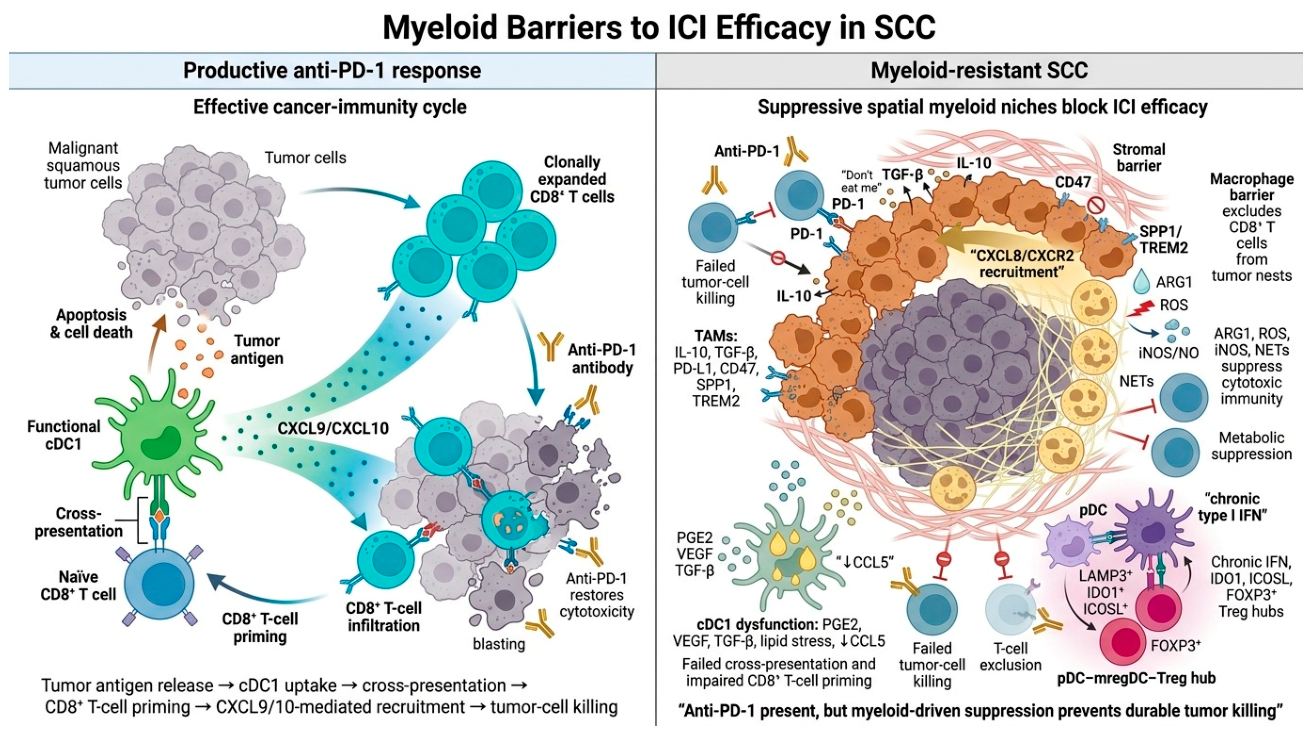
Figure 2.
Therapeutic reprogramming of myeloid-mediated resistance to immune checkpoint blockade in squamous cell carcinoma. Radiation promotes immunogenic tumor cell death and antigen release. cGAS–STING activation (including STING agonists or ATR or Wee1 inhibition) enhances type I interferon signaling, cDC1 activation, and antigen cross-presentation. Concurrent targeting of suppressive myeloid populations including TAMs (e.g., CSF1R, PI3Kγ, TREM2/SPP1, and CD40-directed therapies), PMN-MDSCs/TANs (CXCR2 inhibition), dysfunctional dendritic cells, and mregDC–Treg, restores antigen presentation, CD8⁺ T cell recruitment, and intratumoral cytotoxic activity.
Figure 2.
Therapeutic reprogramming of myeloid-mediated resistance to immune checkpoint blockade in squamous cell carcinoma. Radiation promotes immunogenic tumor cell death and antigen release. cGAS–STING activation (including STING agonists or ATR or Wee1 inhibition) enhances type I interferon signaling, cDC1 activation, and antigen cross-presentation. Concurrent targeting of suppressive myeloid populations including TAMs (e.g., CSF1R, PI3Kγ, TREM2/SPP1, and CD40-directed therapies), PMN-MDSCs/TANs (CXCR2 inhibition), dysfunctional dendritic cells, and mregDC–Treg, restores antigen presentation, CD8⁺ T cell recruitment, and intratumoral cytotoxic activity.
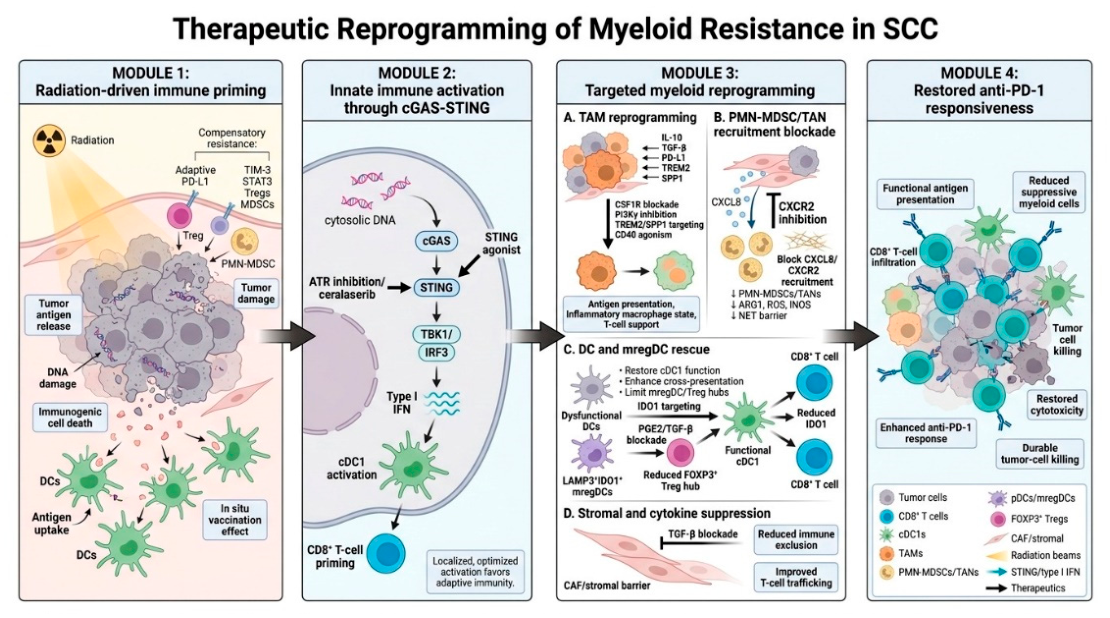

Table 1.
Landmark SCC Immunotherapy Trials.
| SCC Type | Trial | Phase | Setting | Regimen | Comparator | Endpoint | Key Result | Significance | Ref |
| HNSCC | CheckMate 141 | III | Platinum-refractory recurrent/metastatic | Nivolumab 3 mg/kg every 2 weeks | Investigator’s choice chemotherapy | OS | 7.5 vs 5.1 months; HR 0.70; P=0.01 | First PD-1 inhibitor to improve survival in R/M HNSCC | (Ferris et al., 2016a) |
| HNSCC | KEYNOTE-048 | III | First-line recurrent/metastatic | Pembrolizumab ± chemotherapy: pembrolizumab 200 mg IV every 3 weeks; platinum backbone with carboplatin AUC 5 or cisplatin 100 mg/m² every 3 weeks for up to 6 cycles; 5-FU 1000 mg/m²/day every 3 weeks | EXTREME regimen: cetuximab loading dose 400 mg/m² IV day 1, then 250 mg/m² IV weekly | OS; PFS | HR 0.61 in CPS ≥20; OS 14.9 vs 10.7 months; 14.7 vs 11.0 months; P=0.0004; PFS NS | Established PD-1–based first-line standard | (Burtness et al., 2019b) |
| HNSCC | KEYNOTE-040 | III | Previously treated recurrent/metastatic | Pembrolizumab 200 mg IV every 3 weeks | Standard therapy | OS | HR 0.80; OS 8.4 vs 6.9 months | Confirmed activity of PD-1 blockade in recurrent/metastatic disease | (Cohen et al., 2019) |
| HNSCC | KEYNOTE-689 | III | Resectable locally advanced | Perioperative pembrolizumab + SOC: 2 cycles neoadjuvant pembrolizumab; adjuvant risk-adjusted SOC, RT ± cisplatin, plus pembrolizumab every 3 weeks for 45 weeks | SOC alone: surgery followed by postoperative risk-adjusted SOC, RT ± cisplatin | EFS | HR 0.73; EFS 59.7 vs 26.9 months; P=0.0004 | First positive perioperative immunotherapy trial in HNSCC | (Uppaluri, Haddad, Tao, Le Tourneau, Lee, Westra, Chernock, Tahara, Harrington, Klochikhin, Braña, Vasconcelos Alves, Hughes, Oliva, Pinto Figueiredo Lima, Ueda, Rutkowski, Schroeder, Mauz, Fuereder, Laban, Oridate, Popovtzer, Mach, Korobko, Costa, Hooda-Nehra, Rodriguez, Bell, Manschot, Benjamin, Gumuscu, & Adkins, 2025) |
| HNSCC | NIVOPOSTOP | III | Postoperative locally advanced | Nivolumab + adjuvant CRT: nivolumab 360 mg every 3 weeks, then 480 mg every 6 weeks for 6 cycles | Adjuvant CRT: radiation up to 66 Gy + cisplatin 100 mg/m² every 3 weeks for 3 cycles | DFS | HR 0.76 | Supports incorporation of immunotherapy into postoperative management | (Bourhis et al., 2025a) |
| cSCC | EMPOWER-CSCC-1 | I/II | Advanced/metastatic | Cemiplimab 3 mg/kg IV every 2 weeks; later dosing 350 mg every 3 weeks | Single arm | ORR | ORR ~47%; DOR 88.3%; updated ORR 44.8%; DOR not reached | Led to first FDA approval of immunotherapy for cSCC | (Hughes et al., 2025) |
| cSCC | KEYNOTE-629 | II | Advanced/metastatic | Pembrolizumab 200 mg every 3 weeks | Single arm | ORR | ORR 34.3%; DCR 52.4% | Expanded role of PD-1 blockade in cSCC | (Grob et al., 2020b) |
| cSCC | MATISSE | II | Resectable disease | Neoadjuvant nivolumab ± ipilimumab | Single arm | MPR | MPR ~45–50% | Demonstrated feasibility of neoadjuvant immunotherapy | (Breukers et al., 2025) |
| cSCC | C-POST | III | High-risk resected | Adjuvant cemiplimab 350 mg IV every 3 weeks for 12 weeks, followed by 700 mg IV every 6 weeks for up to 36 weeks; 48 weeks total | Placebo | DFS | DFS HR 0.32; 24-month DFS rate 87.1% vs 64.1% | Established adjuvant immunotherapy for high-risk cSCC | (Rischin et al., 2025) |
| Squamous NSCLC | CheckMate 017 | III | Previously treated metastatic | Nivolumab | Docetaxel | OS | HR 0.59 | First PD-1 survival benefit in squamous NSCLC | (Brahmer et al., 2015a) |
| Squamous NSCLC | KEYNOTE-407 | III | First-line metastatic | Pembrolizumab + carboplatin/taxane | Chemotherapy | OS; PFS | OS 15.9 vs 11.3 months; HR 0.64; PFS 6.4 vs 4.8 months; HR 0.56 | Established chemo-immunotherapy standard | (L. Paz-Ares et al., 2018a) |
| Squamous NSCLC | PACIFIC | III | Unresectable stage III | Durvalumab after CRT | Placebo | PFS; OS | PFS 16.8 vs 5.6 months; HR 0.52; 12-month PFS 55.9% vs 35.5%; OS not reached | Established consolidation immunotherapy after CRT | (Antonia et al., 2017) |
| Squamous NSCLC | CheckMate 9LA | III | First-line metastatic | Nivolumab + ipilimumab + 2 cycles chemotherapy | Chemotherapy | OS | OS 15.8 vs 11.0 months; HR 0.74; 3-year OS rate 27% vs 19% | Validated dual checkpoint blockade strategy | (L. G. Paz-Ares et al., 2023) |
| Squamous NSCLC | IMpower131 | III | First-line metastatic | Atezolizumab + carboplatin/nab-paclitaxel | Chemotherapy | PFS | PFS 6.3 vs 5.6 months; HR 0.71; OS NS | Demonstrated activity of PD-L1 blockade in squamous NSCLC | (Jotte et al., 2020) |
| ESCC | ATTRACTION-3 | III | Previously treated advanced | Nivolumab | Chemotherapy | OS | OS 10.9 vs 8.4 months; HR 0.77 | First PD-1 inhibitor to improve OS in ESCC | (Kato et al., 2019b) |
| ESCC | KEYNOTE-590 | III | First-line advanced/metastatic | Pembrolizumab + cisplatin/5-FU | Chemotherapy | OS | HR 0.73 | Established chemo-immunotherapy as first-line standard | (J.-M. Sun et al., 2021) |
| ESCC | CheckMate 648 | III | First-line advanced/metastatic | Nivolumab + chemotherapy or nivolumab + ipilimumab | Chemotherapy | OS | HR 0.74 for nivolumab + chemotherapy | Validated both chemo-immunotherapy and dual checkpoint blockade approaches | (Doki et al., 2022) |
Abbreviations: 1L, first-line treatment; HNSCC, head and neck squamous cell carcinoma; cSCC, cutaneous squamous cell carcinoma; Sq NSCLC, squamous non-small cell lung cancer; ESCC, esophageal squamous cell carcinoma; R/M, recurrent and/or metastatic; LA, locally advanced; CRT, chemoradiotherapy; SOC, standard of care; OS, overall survival; PFS, progression-free survival; DFS, disease-free survival; EFS, event-free survival; ORR, objective response rate; HR, hazard ratio; MPR, major pathologic response; pCR, pathologic complete response; CPS, combined positive score; PD-1, programmed cell death protein 1; PD-L1, programmed death-ligand 1; IO, immunotherapy; NS, not statistically significant; mo, months;wk, week; yr, year PD-1 blockade has emerged as an important therapeutic strategy in HNSCC, particularly for recurrent and/or metastatic disease. CheckMate 141 established nivolumab (anti-PD-1) as a survival-improving therapy for platinum-refractory recurrent/metastatic HNSCC, with an objective response rate of 13.3% compared to 5.8% with standard single agent therapy (methotrexate, docetaxel, or cetuximab). However, only a subset of patients achieved durable disease control, and most patients ultimately progressed (Ferris et al., 2016b). KEYNOTE-040 subsequently confirmed the clinical activity of pembrolizumab, another anti-PD-1 antibody, in previously treated recurrent/metastatic HNSCC, although the survival benefit in the overall population was more modest than that observed in another trial CheckMate 141 (Ferris et al., 2016b). KEYNOTE-048 subsequently moved pembrolizumab (anti-PD-1) into the first-line recurrent/metastatic setting, with monotherapy achieving objective response rates of 23% in patients with PD-L1 combined positive score (CPS) ≥20, 19% in patients with CPS ≥1, and 17% in the overall population (Burtness et al., 2019a). Although KEYNOTE-048 established PD-1-based therapy as a first-line standard in recurrent/metastatic HNSCC, objective responses remained limited to a subset of patients, again highlighting that PD-L1 positivity and clinical eligibility for immunotherapy do not reliably translate into durable response.
Disclaimer/Publisher’s Note: The statements, opinions and data contained in all publications are solely those of the individual author(s) and contributor(s) and not of MDPI and/or the editor(s). MDPI and/or the editor(s) disclaim responsibility for any injury to people or property resulting from any ideas, methods, instructions or products referred to in the content. |
© 2026 by the authors. Licensee MDPI, Basel, Switzerland. This article is an open access article distributed under the terms and conditions of the Creative Commons Attribution (CC BY) license (http://creativecommons.org/licenses/by/4.0/).
Copyright: This open access article is published under a Creative Commons CC BY 4.0 license, which permit the free download, distribution, and reuse, provided that the author and preprint are cited in any reuse.