
Submitted:
13 July 2026
Posted:
15 July 2026
You are already at the latest version
Abstract
Phytosterols are key minor constituents of olive oil, contributing not only to its nutritional and bioactive properties but also to authenticity assessment, quality control, and regulatory classification. In Greek olive oils, particularly extra virgin olive oils produced from the dominant Koroneiki cultivar, sterolic composition represents a critical yet complex compositional marker, as total sterol content and specific sterol fractions may naturally approach regulatory thresholds without necessarily indicating adulteration or quality deterioration. This review critically synthesizes current knowledge on phytosterol profiling in Greek olive oil, emphasizing sterolic composition, analytical methodology, stability, and the principal biological, geographical, technological, and methodological factors governing sterolic variability. Particular attention is given to the characteristic sterolic fingerprint of Greek olive oils, dominated by β-sitosterol, Δ⁵-avenasterol, campesterol, stigmasterol, and Δ⁷-sterols, and to cultivar-dependent variation that may influence regulatory interpretation. The review further evaluates the official GC–FID analytical methodology, the complementary role of GC–MS and chemometric approaches, and the limitations of interpreting sterolic composition exclusively through fixed regulatory thresholds. This review proposes a context-dependent framework for interpreting phytosterol composition in authentic Greek olive oils and introduces the concept of the Near-Threshold Sterolic Space, describing the natural clustering of authentic oils close to regulatory decision limits as a consequence of cultivar- and terroir-driven biological variability. We argue that phytosterol data should be interpreted through an integrated framework combining regulatory thresholds, conditional verification criteria, cultivar-specific baselines, analytical methodology, and complementary compositional evidence. Overall, this review argues that phytosterol interpretation should evolve from a purely threshold-based regulatory exercise toward a biologically informed, method-aware and cultivar-sensitive framework that better reflects the natural complexity of Greek olive oils.
Keywords:
Greek olive oil
; extra virgin olive oil
; phytosterols
; sterol profiling
; Koroneiki
; authenticity
; GC-FID
; GC-MS
; chemometrics
; regulatory thresholds
1. Introduction
Virgin and extra virgin olive oils (VOO/EVOO) are among the most extensively characterized edible oils owing to their nutritional value and health-related significance, economic importance, and stringent regulatory framework governing their quality and authenticity[1,2,3]. Greek olive oil, mainly marketed as virgin and extra virgin olive oil (VOO/EVOO), is a major agricultural product characterized by strong cultivar- and region-linked identity across mainland and insular production areas [4,5]. Among its minor bioactive components, phytosterols represent a structurally distinct class of plant-derived sterols, that closely resemble cholesterol, found in its unsaponifiable fraction [6,7]. Plant sterols are nowadays routinely used as quality and authenticity markers and they remain determinant in the regulatory evaluation of VOO/EVOO [8]. In olive oil, the predominant sterols include β-sitosterol, campesterol, stigmasterol and Δ⁵-avenasterol, forming a characteristic sterolic fingerprint. This unique sterolic profile contributes to authenticity screening against adulteration with seed oils or refined fractions. It is also used for compliance assessment with compositional limits (e.g. total sterols, campesterol, Δ7 sterols, erythrodiol and uvaol) [9]. As a result, phytosterol profiling connects analytical chemistry to commercial classification as well as market access.
Beyond their analytical significance, phytosterols also contribute to the nutritional value of olive oil, primarily through their well-established cholesterol-lowering activity and, to a lesser extent, through reported anti-inflammatory and antioxidant-related properties. Nevertheless, within the context of olive oil, their principal importance lies in their role as robust compositional markers supporting authenticity assessment, quality control, and regulatory classification [10,11]. In olive oil, these effects should not be interpreted in isolation, but rather as part of the broader bioactive minor fraction, which also includes phenolic compounds, tocopherols, squalene, and triterpenic compounds. Therefore, phytosterols contribute to the functional profile of olive oil while simultaneously serving as robust compositional markers for authenticity and regulatory assessment [12,13].
During the last decade, studies on Greek olive oils have consistently demonstrated that phytosterol composition is shaped by complex interactions among cultivar, geographical origin, environmental conditions, fruit maturity and processing practices. Rather than representing fixed compositional values, sterolic profiles emerge as biologically dynamic fingerprints reflecting both genetic background and terroir. This is particularly evident for the dominant Greek cultivar Koroneiki, whose authentic oils frequently exhibit total sterol contents and individual sterol fractions approaching regulatory limits while fully complying with all other quality criteria. These observations raise important questions regarding the interpretation of sterolic composition within current regulatory frameworks [14].
Targeted data from Messinia and “Kalamata PDO” oils, have combined sterols and triterpenic diol levels with those of fatty acids and waxes and have implied that Greek olive oils may exhibit natural proximity to, or occasional deviations from regulatory thresholds, and as a result, significant interpretive questions are risen for compliance and PDO certification. Comparison between Greek cultivars showed that total sterolic content can be shifted, including individual sterol composition, which implies that sterolic data need to be interpretated with cultivar- specific baselines rather than generic Mediterranean averages [15,16].
Furthermore, Greek studies demonstrate that phytosterols serve not only as regulatory control parameters but also as integral components of multiparametric compositional characterization, contributing to varietal discrimination, authenticity assessment, and predictive modeling. For instance, phytosterols profiles have been used along with fatty acids and chemometrics for Greek monovarietal EVOO discrimination (e.g. Koroneiki versus Lianolia Kerkyras) in Western/North- Western Greece [16]. More recently, data from Messinia have included phytosterols to machine learning, aiming to predict sensory characteristics from chemical composition, showing a promising connection between sterolic composition and functional quality assessment at the product level [17].
Despite these important advances, a critical interpretative gap remains. Existing studies have largely focused on describing sterolic composition, whereas comparatively little attention has been devoted to understanding how biological variability, analytical methodology and regulatory thresholds interact during authenticity assessment. Consequently, sterolic values located close to regulatory decision limits are often interpreted without sufficient consideration of cultivar-specific baselines, methodological uncertainty or complementary compositional evidence. This is particularly significant, because Greek olive oils are near regulatory thresholds and may be sensitive to methodological and interpretive variability, with tangible consequences for compliance decisions [18].
Accordingly, this review moves beyond a descriptive synthesis of phytosterol composition and proposes a context-dependent interpretative framework for evaluating sterolic profiles in Greek olive oil [15,16,17,18,19,20,21]. Sterolic composition patterns are summarized across Greek cultivars and regions, while analytical methods are discussed with emphasis on comparability, methodological transparency and potential sources of bias [8,22,23]. By integrating recent evidence on sterolic composition, analytical methodology, biological variability and regulatory criteria, we introduce the concept of the Near-Threshold Sterolic Space, describing the natural clustering of authentic Greek olive oils close to regulatory decision limits. In addition, evidence on sterol stability under processing and storage conditions relevant to Greek olive oil production and distribution is critically evaluated [20,24]. Rather than advocating alternative regulatory thresholds, this framework provides a biologically informed and method-aware approach for interpreting sterolic data within the existing regulatory context.
By organizing recent Greek and international evidence into a coherent, method-aware narrative, this review aims to provide practical knowledge for researchers, quality control laboratories, regulatory authorities and stakeholders involved in Greek olive oil quality and authenticity. Although extra virgin olive oil constitutes the primary focus of available Greek phytosterol datasets, the broader term “Greek olive oil” is used throughout this review to reflect the analytical and regulatory relevance of sterols across olive oil categories, while emphasizing EVOO as the main source of compositional and interpretative evidence [22,25].
2. Phytosterols Composition in Greek Olive Oils
2.1. Structural and Biological Characteristics of Phytosterols
Phytosterols are triterpenoid-derived isoprenoid lipids that constitute the principal sterols of plant cell membranes, which are synthesized via the cytosolic mevalonate pathway. They are key structural constituents of plant plasma membranes, where they regulate membrane organization, permeability, fluidity ([26,27], as well as membrane-associated metabolic processes [28]. Beyond their fundamental structural role in plant physiology, they have become key compositional markers for the authentication and regulatory assessment of edible vegetable oils, particularly olive oil.
The term “phytosterol” originates from the Greek words “phytò” (plant) and “stereòs” (solid), reflecting their rigid structural nature in biological systems, followed by the suffix “-ol”, which denotes the presence of a polar hydroxyl group in their chemical structure [29]. To date, over 250 distinct sterols and sterol conjugates have been identified in plants, including free sterols, sterol esters, sterol glucosides, and acylated sterol glucosides; this structural diversity underlies the wide range of biological functions that sterols perform in plant physiology [30].
Sterols are amphiphilic compounds consisting of three principal structural components: a polar hydroxyl group, a rigid tetracyclic steroid nucleus, and a non-polar alkyl side chain. In contrast to animals and fungi, whose cell membranes predominantly contain cholesterol and ergosterol, respectively, plant membranes are characterized by a high structural diversity of sterol species [31]. According to IUPAC, phytosterols exhibit a polycyclic structure, with their carbon skeleton of most molecules consisting of 28 or 29 carbon atoms, with one or two double bonds between carbon atoms. They constitute a subgroup of steroids characterized by a β-oriented hydroxyl group at the C-3 position and a tetracyclic carbon framework derived from the cholestane skeleton, closely analogous to cholesterols, they differ primarily in the alkyl substituents of the side chain [13]. Phytosterols (the plant-derived sterols), are further distinguished by alkyl substitutions at the C-24 position of the side chain, a feature that differentiates them structurally from cholesterol and largely underlies their functional diversity in plant membranes [32]. This diversity mainly arises from variations in the alkyl side chain, including differences in length, degree of unsaturation, and structural configuration, leading to distinct steric conformations among sterols. In plants, β-sitosterol, stigmasterol, and campesterol represent the most abundant sterols at the plasma membrane. Sterol molecules bearing a 3β-hydroxyl group are classified as free sterols (FSs), whereas chemical modifications of this functional group give rise to sterol conjugates. Phytosterol conjugates are primarily represented by three major classes: steryl esters (SEs), steryl glycosides (SGs), and acyl steryl glycosides (ASGs) [33]. In order to facilitate the structural characterization and systematic classification of phytosterols, they are also grouped into three major categories based on the number of methyl groups at the C-4 position: sterols bearing two methyl groups (4,4-dimethylsterols), sterols bearing one methyl group (4-methylsterols), and sterols lacking methyl groups (4-desmethylsterols) [34]. In plant cells, phytosterols are essential structural and functional components of biological membranes. Together with phospholipids and sphingolipids, they contribute to the regulation of membrane fluidity, permeability, lipid packing, and microdomain organization, thereby influencing the activity and spatial distribution of membrane-associated proteins. Recent advances in plant sterol biology have further shown that sterols are not passive membrane constituents, but active regulators of plasma membrane organization, protein dynamics, signaling, development, and stress response [30,33]. Their ability to organize lipid-ordered membrane domains is particularly relevant, since plant sterols participate in the formation of membrane nanodomains involved in signal transduction, membrane trafficking, stress responses, and plant–environment interactions [35,36].
Consequently, the phytosterol profile of olive oil should be regarded as the biochemical fingerprint of sterol metabolism in the olive fruit, primarily determined by genetic background and subsequently modulated by environmental conditions, ripening stage, and physiological responses to abiotic and biotic stress.
Edible vegetable oils are among the main dietary sources of phytosterols, although their total phytosterol content and individual sterol distribution vary substantially among oil types.
Although olive oil contains lower total phytosterol concentrations than many seed oils, its sterolic composition is considerably more distinctive, providing one of the most informative compositional fingerprints for authenticity assessment and regulatory classification. Representative edible vegetable oils commonly used in authenticity and adulteration studies are shown in Table 1 for comparison with olive oil sterolic composition. Compared with phytosterol-rich seed oils such as wheat germ, corn or rapeseed oil, olive oil generally contains a moderate total phytosterol content; however, its sterolic profile is highly characteristic and analytically valuable for authenticity and regulatory assessment, as shown in Table 1 [8,20,37].
Accordingly, the diagnostic value of phytosterols lies not in their absolute abundance but in their characteristic phytosterol fingerprint. In Greek olive oil, this fingerprint—defined primarily by the predominance of β-sitosterol together with Δ⁵-avenasterol, campesterol, stigmasterol, and minor Δ⁷-sterols - constitutes the biochemical foundation upon which authenticity assessment, regulatory evaluation, and the context-dependent interpretative framework proposed in this review are built [8,9,20].
From the perspective of olive oil authenticity, phytosterols occupy a unique position among minor constituents. Unlike phenolic compounds or volatile metabolites, whose concentrations are often strongly affected by processing and storage, sterolic composition primarily reflects intrinsic biological regulation and therefore provides a comparatively stable compositional fingerprint. This biological robustness largely explains why sterols have become one of the cornerstones of international regulatory standards for olive oil authenticity and purity. At the same time, however, this apparent stability should not be mistaken for biological invariability - a distinction that underpins the context-dependent interpretative framework developed throughout this review.
2.2. Sterolic Composition and Cultivar-Dependent Variability in Greek Olive Oil
Greek olive oils exhibit a highly conserved phytosterol fingerprint that is nevertheless characterized by biologically meaningful quantitative variability among cultivars and growing environments. This variability is particularly important because it directly influences the interpretation of phytosterol composition within current regulatory frameworks. Sterolic composition of Greek olive oil, involving Extra Virgin Olive Oil (EVOO), Virgin Olive Oil (VOO) and other commercial categories, is exhibited characteristic of the olive- derived lipids, mainly consisting of β-sitosterol and followed by minor phytosterols such as Δ5- avenasterol and campesterol, stigmasterol and Δ7- sterols. Phytosterols remain regulated parameters across oil categories and, as a result, the evaluation of their composition is relevant to Greek olive oil as a whole. However, the vast majority of the available data over the last decade, concern Greek EVOO, which constitutes the primary basis for the sterolic patterns discussed below [18]. These patterns are associated with cultivar and region fingerprints with particular significance for quality assessment and regulatory interpretation.
Koroneiki cultivar-oriented olive oils appear a high potent recurring pattern across Greek dataset, with their total sterol content occurring near regulatory minimum of 1000 mg/kg. Values frequently range between 1020 and 1050 mg/kg [18]. Importantly, a non-negligible proportion of authentic Koroneiki olive oils has been reported to contain total sterol contents below the regulatory threshold of 1000 mg/kg despite full compliance with all other authenticity and quality criteria. This recurring observation challenges the implicit assumption that sterolic values located close to regulatory thresholds necessarily indicate adulteration or compromised quality. Instead, it suggests that biological variability itself must become part of the interpretative process.
Despite full compliance with other quality parameters and adulteration indicators absence. In addition, campesterol is also observed to be near the 4,0% regulatory limit (usually between 3,5 and 3,8 % in Koroneiki Greek olive oils) and occasionally beyond, particularly in datasets from Messinia and South Peloponnese[15,18]. This pattern is validated to be impacted by geographical and environmental factors: Koroneiki olive oils from Zakynthos, for instance, present shifts to total sterol content, depending on altitude, revealing that environmental changes may alter phytosterol values near to, or further from regulatory thresholds, without implying quality or non- authenticity issues [40].
Across all Greek olive oil studies published during the last decade, β-sitosterol consistently represents the predominant phytosterol, typically accounting for approximately 80–90% of total sterols, followed by Δ⁵-avenasterol (4–13%) and campesterol (2.5–4.7%). This conserved sterolic hierarchy is maintained across cultivars and geographical regions, indicating the existence of a common biochemical framework underlying Greek olive oil sterol metabolism [15].
Phytosterol profiles in Greek olive oils present cultivar-reliant differentiations, as well. Olive oils from Mastoides exhibit higher total sterols (app. 1200-1250 mg/kg) from Koroneiki cultivar, harvested from the same terroir, while Lanolia Kerkyras shows appreciably higher total sterol values (app. 1300-1350 mg/kg) higher β-sitosterol and meaningfully lower Δ5- avenasterol [15]. These observations indicate that near-threshold sterolic behaviour is cultivar-dependent rather than a universal characteristic of Greek olive oils.
Recent studies around Greek Olive Olis’ phytosterol composition not only describe it but also confront it as an integrated component of a multiparameter evaluation of quality and authenticity. Individual Phytosterols from Koroneiki Oils from Messinia, (including campesterol, β- sitosterol and Δ7 avenasterol) have been incorporated with other chemical parameters and regression models which aim to predict sensory characteristics, emphasizing their significance when sterolic values are near regulatory thresholds [17]. These findings further demonstrate that phytosterols should not be regarded solely as regulatory markers but also as informative compositional variables contributing to predictive models of olive oil quality.
Phytosterols are among the regulated compositional parameters used for authenticity assessment, empowering that their values that are located near threshold have actual regulatory and commercial implications [19].
Collectively, the available evidence indicates that phytosterol composition in Greek olive oils is better represented as a continuum of overlapping cultivar-specific distributions than as isolated numerical values. Consequently, the interpretation of sterolic composition should rely on biological distributions rather than single threshold values. This concept provides the scientific basis for the context-dependent interpretative framework developed in the following sections.
Growing consumer demand for authenticity and traceability has reinforced the importance of quality certification and the application of regulatory frameworks and international standards. Core quality and classification parameters include free acidity, peroxide value, ultraviolet absorption indices, fatty acid ethyl esters and sensory attributes, while purity and authenticity assessment relies additionally on compositional markers such as fatty acid profile, sterol composition, waxes and other minor constituents [22,25,41]. When combined with broader compositional profiling and chemometric approaches, these parameters provide robust tools for EVOO authentication, geographical/varietal discrimination and detection of potential fraudulent practices [6,8,19].
As illustrated in Figure 1, the available reported values suggest that Koroneiki oils occupy a lower sterolic range compared with Mastoides and Lianolia Kerkyras. This pattern is particularly relevant for total sterols, where Koroneiki values are positioned close to the regulatory minimum of 1000 mg/kg. The comparison with other varieties, illustrates the near-threshold positioning of Koroneiki oils, especially for total sterols, and supports the use of cultivar-specific baselines in the interpretation of Greek olive oil sterolic profiles. Although the available datasets are limited and should not be interpreted as exhaustive cultivar limits, the observed differences support the view that sterolic variability in Greek olive oil is structured by cultivar identity. Therefore, values close to regulatory thresholds should be evaluated within cultivar-specific and method-aware interpretative frameworks rather than treated as isolated numerical deviations.
Beyond total sterol content and individual regulatory parameters such as campesterol, the relative distribution of major sterols provides additional insight into cultivar-dependent phytosterol fingerprints. Therefore, Figure 2 compares the relative abundance of the main sterol fractions in selected Greek olive oil cultivars, highlighting differences in the internal structure of the sterolic profile.
As shown in Figure 2, cultivar-related differentiation is reflected not only in total sterol content but also in the relative distribution of individual sterols. This reinforces the need to interpret Greek olive oil phytosterol profiles as structured cultivar-dependent fingerprints rather than as isolated numerical values. Together, Figure 1 and Figure 2 demonstrate that the diagnostic value of phytosterols lies not only in absolute sterol concentrations but also in the structured organization of phytosterol fingerprints across cultivars. These observations constitute the biological foundation of the context-dependent interpretative framework proposed in this review.
3. Analytical Methodology of Phytosterols in Greek Olive Oil: From Standardized Measurement to Context-Dependent Interpretation
Across studies investigating phytosterol profiles in Greek olive oil over the last decade, sterolic data are usually reported as individual sterols expressed as percentages of total sterols, together with total sterol content expressed in mg/kg and, in many cases, triterpenic dialcohols. This reporting format reflects the inclusion of sterols within the official physicochemical control framework for olive oil quality and authenticity. Consequently, most Greek datasets prioritize alignment with official analytical procedures rather than exploratory profiling workflows. This is evident in studies focusing on the Koroneiki cultivar, including PDO-relevant contexts, as well as in comparative investigations among Greek cultivars such as Koroneiki, Mastoides, and Lianolia Kerkyras [14,15,17,20]. Such methodological consistency strengthens cross-study comparability. At the same time, it also highlights an important limitation: when sterolic values are positioned close to regulatory decision limits, analytical methodology becomes an integral part of interpretation rather than a purely technical step.
Analytical methodology is often regarded as an objective measurement process. However, when phytosterol values approach regulatory decision limits, methodological variability itself becomes part of the biological interpretation. Consequently, analytical methodology should not be viewed merely as a source of measurement uncertainty but as an integral component of the context-dependent framework proposed in this review.
3.1. Official Analytical Workflow: Sample Preparation and GC–FID Determination
The determination of sterolic composition in Greek olive oil is generally performed within a strict and standardized analytical framework, in accordance with European Union and International Olive Council requirements. Since phytosterols are regulated quality and authenticity parameters, most studies on Greek olive oils adopt methods aligned with the official EU/IOC analytical workflow, thereby ensuring comparability between laboratories and relevance to regulatory assessment [17,21,24].
The analytical workflow begins with saponification of the olive oil sample in the presence of an internal standard, commonly α-cholestanol, followed by extraction of the unsaponifiable fraction. This fraction contains sterols and triterpenic dialcohols, which are resistant to alkaline hydrolysis. Efficient recovery at this stage is essential, because incomplete hydrolysis or inefficient extraction may affect the quantitative determination of total and individual sterols [22]. The unsaponifiable fraction is then subjected to chromatographic isolation, commonly by thin-layer chromatography on silica gel plates, in order to separate the sterolic fraction from other co-extracted unsaponifiable compounds. This step reduces matrix interference before instrumental analysis and contributes substantially to the selectivity of the method.
The isolated sterols are subsequently derivatized into their corresponding trimethylsilyl ethers, usually using silylating reagents such as hexamethyldisilazane and trimethylchlorosilane. Derivatization increases volatility and improves chromatographic behavior, enabling effective gas chromatographic separation and detection [22]. Quantitative determination is typically performed by gas chromatography coupled to flame ionization detection (GC–FID), which remains the reference method for regulatory purposes. Identification is based mainly on retention-time comparison with reference compounds, whereas quantification relies on peak areas calculated relative to the internal standard [22].
Greek studies investigating sterolic composition have systematically followed this methodological approach, particularly those focused on Koroneiki oils and comparative studies involving Koroneiki, Mastoides, and Lianolia Kerkyras [14,15,16,17,18,20,21]. This common analytical foundation supports comparability among datasets and provides a reliable basis for regulatory interpretation. Nevertheless, even within a standardized workflow, individual steps such as extraction efficiency, chromatographic separation, derivatization, detector response, and peak integration may influence the reported sterolic values. These methodological effects become especially important when authentic oils naturally occupy a near-threshold sterolic range.
3.2. Advanced Detection: GC-MS and Complementary Approaches
Although GC–FID remains the official reference method for phytosterol determination in olive oil, gas chromatography–mass spectrometry (GC–MS) provides an important complementary approach, particularly in research-oriented, confirmatory, and metabolomic applications[42]. Compared with GC–FID, GC–MS offers mass spectral information that improves the identification of structurally similar sterols and related compounds.
This advantage is particularly relevant because olive oil is a complex lipid matrix in which co-elution may occur, especially for minor sterols and structurally related unsaponifiable constituents. While GC–FID identification relies primarily on retention-time matching, GC–MS enables more precise peak assignment through characteristic fragmentation patterns, thereby reducing the risk of misidentification. This is especially important for Δ⁷-sterols and other minor components that may not always be fully resolved by conventional GC–FID analysis [8].
Beyond qualitative confirmation, GC–MS has increasingly been used for targeted analysis of minor sterolic constituents and for broader metabolomic profiling in authenticity and traceability studies [7,43]. These applications extend beyond routine regulatory control but are particularly valuable for understanding the compositional complexity of olive oil and for supporting interpretation in borderline or atypical cases. Within the context-dependent framework proposed in this review, GC–MS should therefore be viewed not as a replacement for official GC–FID determination, but as a complementary tool that can increase analytical confidence when sterolic profiles approach regulatory decision limits.
3.3. Chemometrics and Data Interpretation
In recent years, olive oil compositional analysis has increasingly incorporated chemometric and multivariate statistical approaches, particularly in studies addressing authenticity, classification, traceability, and quality assessment [42,43]. Rather than evaluating individual chemical parameters in isolation, chemometrics enables the simultaneous analysis of multiple compositional variables, providing a more integrated representation of olive oil chemical identity [42,43].
In Greek olive oil research, chemometric tools have so far been applied mainly within broader compositional studies rather than in sterol-specific investigations. For example, volatile profiling combined with multivariate analysis has been used to assess the effects of cultivar and geographical origin on Greek monovarietal EVOOs, including Koroneiki, Kolovi, and Adramytini, demonstrating that chemical fingerprints can support varietal and geographical discrimination [7]. Although such studies do not focus specifically on sterols, they are relevant because they illustrate the broader transition from single-marker assessment toward multivariate interpretation in Greek olive oil research.
For sterolic data specifically, one of the most relevant Greek examples is the incorporation of individual sterols into regression-based models for sensory prediction. In Koroneiki olive oils from Messinia, chemical variables including total sterols, campesterol, β-sitosterol, Δ⁷-stigmasterol, and triterpenic dialcohols were included among predictors used to estimate positive sensory attributes such as fruitiness, bitterness, and pungency [17]. This approach demonstrates that sterols should not be regarded solely as regulatory parameters, but also as informative compositional variables that may contribute to broader quality-related models.
Beyond Greek datasets, multi-compound analytical approaches further support the relevance of chemometric interpretation in olive oil research. Multi-class GC–MS profiling of the minor fraction of virgin olive oil has enabled the simultaneous quantification of phenolic compounds, triterpenic compounds, tocopherols, sterols, and free fatty acids, highlighting the value of combined analytical and statistical approaches for varietal discrimination and compositional characterization [45]. Similarly, metabolomic and fingerprinting approaches have been proposed as tools for olive oil quality assessment and authentication, particularly when complex datasets require multivariate statistical treatment [19,43,44].
Despite the broader adoption of chemometrics in olive oil authenticity and classification studies, its targeted application to sterol profiling in Greek olive oil remains limited. Most Greek sterol datasets still report total and individual sterols in a regulatory, largely univariate format. A major methodological opportunity therefore lies in integrating sterolic data with fatty acids, phenolics, volatile compounds, triterpenic dialcohols, elemental profiles, sensory attributes, and other authenticity markers within multivariate frameworks. Such integration could substantially improve the interpretation of cultivar- and region-linked variability, especially for authentic Greek olive oils occupying the Near-Threshold Sterolic Space.
3.4. Methodological Sources of Variability in Sterol Profiling
Despite the high level of standardization associated with the official EU/IOC analytical protocol, sterol determination in olive oil is not entirely free from methodological variability. The official workflow includes saponification, extraction of the unsaponifiable fraction, chromatographic isolation of the sterolic fraction, derivatization to trimethylsilyl ethers, and GC-based determination. Variability may therefore arise at several analytical stages [23,45].
One major source of variability is sample preparation, particularly saponification and extraction of the unsaponifiable fraction. Incomplete hydrolysis or inefficient extraction may affect sterol recovery and, consequently, the quantitative expression of total sterols. Although internal standards are used to correct for recovery losses, sample preparation remains a critical step in sterol analysis, especially when results are interpreted close to regulatory thresholds [23].
Chromatographic isolation of the sterolic fraction, commonly performed by thin-layer chromatography on basic silica gel plates, is also important for analytical selectivity. Variations in plate activation, solvent composition, band visualization, and band collection may influence the purity of the isolated sterolic fraction and contribute to differences in reported sterolic values [22,23].
At the instrumental level, GC conditions such as column selectivity, temperature programming, chromatographic resolution, detector response, and peak integration may further affect reported sterolic composition. In GC–FID analysis, identification relies primarily on retention-time matching, whereas GC–MS provides additional mass spectral information that can improve peak assignment, particularly for minor sterols or structurally related compounds [43,44].
Reporting format also influences interpretation. Individual sterols are usually expressed as percentages of total sterols, whereas total sterols are reported in mg/kg. Therefore, small absolute changes in one compound may affect the relative percentages of others, especially for regulated parameters such as campesterol. This is particularly relevant for Greek datasets in which Koroneiki oils frequently occupy a sterolic range close to regulatory decision limits [16,18].
In Greek olive oil studies, alignment with the official EU/IOC workflow enhances comparability, since recent sterol-profiling studies on Koroneiki, Mastoides, and Lianolia Kerkyras follow the same general analytical logic [15,16,18,21]. Nevertheless, the lack of systematic Greek studies comparing alternative or complementary workflows—such as parallel GC–FID/GC–MS confirmation, inter-laboratory validation, or free versus esterified sterol profiling—limits the ability to quantify the magnitude of method-driven variability in Greek olive oils.
Collectively, the evidence reviewed in this chapter demonstrates that phytosterol determination extends beyond accurate analytical quantification. Although the official EU/IOC analytical framework provides a robust and standardized basis for regulatory assessment, methodological transparency becomes particularly important when authentic Greek olive oils exhibit sterolic profiles close to regulatory decision limits. Under these conditions, reliable authenticity assessment requires not only standardized analytical procedures but also biologically informed, method-aware interpretation that considers cultivar-specific variability together with complementary compositional evidence. Consequently, analytical methodology should be regarded not merely as a measurement tool but as an integral component of the interpretative framework proposed in this review.
4. Stability of Phytosterols in Greek Olive Oil
Phytosterols are generally regarded as among the most chemically stable constituents of the unsaponifiable fraction of olive oil, particularly when compared with more labile minor components such as phenolic compounds and pigments [46,47,48,49]. Their relative chemical stability underpins their widespread use as authenticity, quality and regulatory markers, since sterolic composition is governed predominantly by intrinsic biological factors including cultivar, geographical origin, and fruit ripening stage rather than by short-term post-harvest degradation processes. Importantly, however, chemical stability should not be interpreted as compositional invariability, particularly when sterolic values occur close to regulatory decision thresholds.
Although phytosterols exhibit considerable stability, they are not completely inert. Under oxidative conditions, particularly in the presence of oxygen, light, and elevated temperature, olive oil undergoes progressive compositional changes associated with lipid oxidation [48]. Within this oxidative environment, phytosterols may also be converted into oxidation products (oxysterols), accompanied by minor reductions in total sterol content and subtle changes in the relative abundance of individual sterols [21]. These oxidative processes are generally slow and limited in properly preserved extra virgin olive oils and are considerably less pronounced than the degradation observed for more oxidation-sensitive constituents.
Available studies on Greek olive oil consistently demonstrate that sterolic profiles are primarily cultivar- and region-dependent biochemical fingerprints rather than variables strongly influenced by storage or processing conditions. Investigations on major Greek cultivars such as Koroneiki, Mastoides, and Lianolia Kerkyras have reported highly reproducible sterolic distributions across different production areas, reinforcing the concept that phytosterol composition reflects intrinsic genetic and environmental determinants rather than post-harvest instability [16,17,19]. It should also be emphasized that the variability associated with storage conditions is generally expected to remain substantially smaller than the natural biological variability observed among cultivars, production environments, and growing conditions.
To date, systematic investigations specifically addressing the stability and oxidation behaviour of phytosterols in Greek olive oils remain limited. Most Greek shelf-life and storage studies have focused primarily on conventional quality indices, phenolic compounds, pigments, sensory attributes, oxidative stability parameters, and other minor constituents, while sterol-specific degradation pathways have received comparatively little attention [8,49]. For example, the long-term study on the Kolovi cultivar evaluated the effects of filtration and refrigerated storage on EVOO stability over 24 months, using parameters such as free acidity, peroxide value, UV absorption indices, sensory attributes, phenolic derivatives, pigments, and squalene, without developing a sterol-focused stability framework [24]. This highlights an important gap in the Greek literature, since the limited knowledge of sterol oxidation products and storage-related sterolic modifications constrains our understanding of how post-harvest changes may influence sterolic interpretation in authentic Greek olive oils.
From a practical perspective, evidence from the broader olive oil literature indicates that phytosterols are robust compositional markers of the unsaponifiable fraction, although they are not entirely resistant to oxidative modification [19,50]. Under adverse storage conditions, particularly prolonged exposure to oxygen, light, and elevated temperature, phytosterols may undergo oxidation or exhibit minor compositional changes [49]. These changes are generally modest compared with the variability introduced by cultivar, ripening stage, geographical origin, and environmental conditions; nevertheless, their interpretive significance may increase when sterolic values are expressed as percentages of total sterols and occur close to regulatory decision limits [20]. Accordingly, storage-related modifications should be regarded as a secondary interpretative layer superimposed on the primary cultivar- and terroir-driven phytosterol fingerprint rather than as the principal source of sterolic variability.
Overall, phytosterols in Greek olive oil should be considered chemically stable yet biologically dynamic compositional markers. Their relative resistance to post-harvest degradation supports their continued use in authenticity assessment and regulatory evaluation, while their interpretation should always account for the biological variability associated with cultivar, terroir, and fruit development. At the same time, the scarcity of targeted Greek studies on sterol oxidation products, the behaviour of free versus esterified, and storage-induced sterolic modifications identifies a clear direction for future research. Integrating these aspects with cultivar-specific sterolic baselines would further strengthen the context-dependent interpretative framework proposed in this review and improve the regulatory assessment of authentic Greek olive oils occupying the Near-Threshold Sterolic Space.
5. Factors Influencing Phytosterol Composition in Greek Olive Oil
5.1. Cultivar & Genetic Background
Among the various factors influencing phytosterol composition in olive oil, cultivar and genetic background constitute the primary determinants of sterolic variability. Phytosterols are synthesized through tightly regulated biosynthetic pathways in the olive fruit, and their composition reflects genotype-specific metabolic regulation rather than random variation [20,50]. Consequently, the sterolic profile of an olive oil represents an intrinsic biochemical characteristic of each cultivar, providing the biological foundation upon which subsequent environmental and technological influences are superimposed.
In Greek olive oils, this genetic regulation is clearly reflected in cultivar- specific phytosterol fingerprints. The Koroneiki cultivar, which dominates Greek olive oil production, is consistently associated with relatively low total sterol, with values frequently occurring close to the regulatory minimum of 1000 mg/kg. This characteristic has been repeatedly documented in independent datasets from Messinia and other Greek production regions and is now widely recognized as a stable cultivar-dependent trait rather than an indication of deterioration, adulteration, or reduced quality [16,18]. In contrast, other Greek cultivars exhibit distinct sterolic baselines. Oils produced from the Mastoides cultivar consistently contain higher total sterol concentrations than Koroneiki oils grown under comparable cultivation conditions, supporting the existence of genetically determined differences in sterol biosynthesis and accumulation [21].
Similarly, Lianolia Kerkyras oils display not only higher total sterol contents but also characteristic differences in the relative distribution of individual sterols compared with Koroneiki oils analyzed under the same experimental framework [16]. Beyond total sterols, cultivar also influences the relative proportions of individual sterols. Although β-sitosterol invariably represents the dominant phytosterol (typically accounting for approximately 80–90% of total sterols), followed by Δ⁵-avenasterol and campesterol, the proportional distribution of these sterols differs systematically among cultivars reflecting differences in the regulation of sterol biosynthetic pathways rather than analytical or random variation [20].
This cultivar- dependent variability has important implications for both authenticity assessment and regulatory interpretation. In particular, the combination of relatively lower total sterol concentrations and moderate variability in campesterol content frequently positions authentic Koroneiki oils close to regulatory decision limits. This recurrent "near-threshold" sterolic behaviour has now been documented across multiple independent Greek published datasets and should therefore be interpreted as a characteristic feature of the cultivar itself rather than as evidence of adulteration or regulatory non-compliance [15,17,18]. Accordingly, cultivar identity should represent the primary biological context within which sterolic data are interpreted.
Overall, the available evidence demonstrates that genetic background is the principal driver of phytosterol composition in Greek olive oil. Environmental conditions, cultivation practices, fruit maturation, processing, and storage undoubtedly contribute to sterolic variability; however, these factors generally operate by modifying an underlying cultivar-specific sterolic baseline rather than replacing it. This biological hierarchy constitutes a fundamental component of the context-dependent interpretative framework proposed in this review and provides the basis for understanding why authentic Greek olive oils may naturally occupy the Near-Threshold Sterolic Space.
5.2. Geography & Terroir
Beyond genetic background, geographical origin and terroir constitute important secondary determinants of olive oil composition. The concept of terroir encompasses the combined effects of climatic conditions, soil characteristics, altitude, water availability and local agronomic practices, all of which influence olive fruit metabolism and, consequently, the chemical composition of the resulting oil. In Greek extra virgin olive oil (EVOO), numerous studies have shown that geographical origin contributes to compositional differentiation, particularly when fatty acids, tocopherols, squalene, phenolic compounds and volatile profiles are evaluated collectively. However, direct evidence specifically isolating the effects of terroir on phytosterol composition remains comparatively limited [6,40].
Within Greek olive oil production systems, geographical differentiation has been investigated particularly in Koroneiki-based oils using integrated compositional and chemometric approaches. Oils originating from different regions, including the Peloponnese, Crete and the Ionian Islands, exhibit measurable compositional differences that reflect the combined influence of cultivar, environmental conditions, harvest practices, and local agronomic management. These regional differences should therefore be interpreted as modifications of an underlying cultivar-specific biochemical profile rather than as alterations of fundamental sterolic identity of olive oil [7,14,51].
Among the environmental variables contributing to terroir, altitude has received particular attention because of its influence on temperature regimes, solar radiation, and water availability. Studies on Koroneiki olive oils from Zakynthos, have demonstrated altitude- dependent variation in quality indices, phenolic composition, pigments content, antioxidant capacity, and volatile profiles. Although these investigations do not provide direct evidence for altitude-induced changes in phytosterol composition, they support the broader concept that environmental gradients can modulate the chemical fingerprint of olive oil [15,18]. Consequently, geographical origin should be regarded as an important contextual factor in phytosterol interpretation, particularly when sterolic values occur close to regulatory decision limits.
Climatic conditions - including temperature, rainfall patterns, and seasonal variability - also contribute to the geographical heterogeneity of Greek olive oils. Mediterranean production environments are characterized by considerable spatial variability, resulting in measurable compositional differences even within the same cultivar. This geographical heterogeneity has been demonstrated in studies where sterols, together with phenolic compounds and other minor constituents, contribute to the discrimination of olive oils according to geographical origin through multivariate analytical approaches [19].
Soil properties and local agronomic practices further contribute to terroir-driven variability by influencing olive tree physiology, fruit metabolism, and the overall chemical composition of the resulting oil. Nevertheless , these individual effects have rarely been investigated independently in sterol-focused studies, particularly for Greek olive oils. Instead, they are generally incorporated into broader compositional and chemometric models in which geographical origin is evaluated using multiple complementary authenticity markers, including fatty acids, tocopherols, squalene, volatile compounds, phenolics, elemental composition, and phytosterols [6,52,53].
Overall, the available evidence indicates that terroir acts primarily as a modifier of the cultivar-dependent sterolic baseline rather than as an independent determinant of phytosterol composition. Compared with the strong influence of genetic background, geographical effects are generally of lower magnitude but become increasingly important when authentic Greek olive oils naturally occupy the Near-Threshold Sterolic Space. Under these conditions, geographical origin provides essential biological context for interpreting sterolic values close to regulatory decision limits, particularly in Koroneiki oils, where relatively low total sterol concentrations and borderline campesterol values have been consistently reported [15,18,20].
5.3. Harvest Maturity
Harvest maturity represents a key biological factor influencing olive oil composition, as it reflects the physiological and metabolic state of the olive fruit at the time of oil extraction. During fruit ripening, the biosynthesis, accumulation, and transformation of lipid and minor compounds - including phytosterols - are dynamically regulated, leading to measurable changes in their concentration and relative distribution [19,20,54,55,56,57,58,59]. Consequently, harvest maturity should be regarded as a biological continuum influencing sterolic composition rather than as an isolated source of compositional variability.
Compared with phenolic compounds, phytosterols are generally considered less sensitive to fruit ripening. Nevertheless, several studies demonstrated that both total sterol concentration and the relative proportions of individual sterols may change during olive fruit development. These variations are typically gradual, biologically regulated, and strongly cultivar-dependent, reflecting developmental modulation of sterol biosynthetic pathways rather than abrupt metabolic shifts [20].
In Greek olive oils, direct evidence describing sterolic evolution throughout fruit maturation remains limited. Most available studies have examined oils collected at a single harvest date or within relatively narrow ripening intervals, particularly for the Koroneiki cultivar, which is commonly harvested at comparatively early maturity stages to maximize extra virgin olive oil quality and preserve desirable sensory and compositional characteristics [18,19].
Although sterol-focused maturity studies are scarce, broader investigations on Greek olive oils provide indirect evidence that harvest maturity influences the overall chemical profile, including constituents of the unsaponifiable fraction. Progressive changes in phenolic composition, oxidative stability, volatile compounds, and other quality-related parameters have been associated with harvest timing, suggesting that phytosterol biosynthesis and accumulation are likewise subject to developmental regulation, albeit to a lesser extent than other minor constituents [19].
From a physiological perspective, the sterolic composition of olive oil reflects sterol metabolism within the developing olive fruit, where phytosterols contribute to membrane organization, cellular integrity, and lipid metabolism [30,33]. As fruit maturation progresses, coordinated changes in enzymatic activity and lipid biosynthetic pathways may gradually modify sterol composition, particularly in the relative abundance of individual sterols and triterpene diols. However, the available evidence indicates that these maturity-related changes remain moderate and are largely superimposed upon cultivar-specific sterolic characteristics, making their overall influence substantially smaller than that of genetic background [20].
From both compositional and regulatory perspectives, harvest maturity should therefore be regarded as a secondary interpretative factor in phytosterol profiling. Sterolic values observed in Greek olive oils should first be interpreted within the biological context established by cultivar identity, while harvest maturity provides an additional layer of refinement. This consideration is particularly important for cultivars such as Koroneiki, whose naturally low total sterol concentrations and occasionally borderline campesterol values may place authentic oils close to regulatory decision limits [15,18]. Consequently, harvest maturity may contribute to the natural dispersion of sterolic values within the cultivar-specific range, but it should not be considered sufficient, on its own, to explain atypical or borderline sterolic profiles.
Overall, harvest maturity represents a biologically relevant but secondary modulator of phytosterol composition in Greek olive oil. Its influence should be interpreted in conjunction with stronger determinants such as cultivar and geographical origin, rather than independently. The limited availability of systematic Greek studies specifically examining sterolic evolution throughout fruit development highlights an important knowledge gap and underscores the need for cultivar-controlled, maturity-stage investigations across representative in Greek olive-growing regions. Such studies would substantially improve our understanding of biological sterolic variability and further strengthen the context-dependent interpretative framework proposed in this review.
5.4. Processing Parameters
Processing parameters constitute an additional source of variability on olive oil composition; however, although their influence on phytosterols composition is generally less pronounced than that of cultivar, geographical origin, or fruit maturity. Since virgin olive oil is produced exclusively through mechanical extraction processes, the natural sterolic composition established during fruit development is largely preserved Consequently, phytosterols, as constituents of the unsaponifiable fraction, are generally regarded as stable throughout standard olive oil processing [20].
Among the various processing stages, malaxation is considered one of the most critical technological steps influencing olive oil composition. Malaxation conditions - including temperature, duration, and oxygen exposure - affect enzymatic activity, emulsion breakdown, and oxidative reactions occurring during oil extraction [57]. While these parameters have a well-established impact on phenolic compounds, volatile constituents, and oxidative stability, their direct effect on phytosterol composition appears comparatively limited. Nevertheless, prolonged malaxation or elevated processing temperatures may indirectly promote minor alterations in sterolic composition through enhanced oxidative processes, particularly under suboptimal processing conditions [20,25].
Filtration represents another technological step that may indirectly influence the long-term preservation of sterolic composition. Although filtration itself does not modify phytosterol concentrations, it alters the physicochemical environment of the oil through the removal of water droplets and suspended solids, and residual enzymatic activity. These changes improve oxidative stability and may contribute to the preservation of sterolic profiles during subsequent storage, rather than directly affecting sterol biosynthesis or composition [25].
Within the Greek olive oil sector, most published studies have examined high-quality extra virgin olive oils produced under controlled mechanical extraction conditions, where technological variability is relatively limited. Consequently, sterolic composition is t generally interpreted as reflecting the intrinsic biochemical characteristics of the olive fruit rather than technological modifications introduced during processing [18,19].
Nevertheless, evidence from evidence from broader compositional studies indicates that processing practices may contribute to overall chemical variability when acting in combination with other biological and environmental factors, including cultivar, terroir, harvest maturity, and storage conditions. Multivariate analyses of Greek olive oils consistently demonstrate that technological parameters participate in shaping the overall compositional profile, even though phytosterols are rarely the primary variables driving sample discrimination [19]. These findings further support the view that processing acts primarily as a secondary modifier of an already established cultivar-dependent sterolic profile.
It is also important to distinguish mechanical extraction from industrial refining processes, which are applied to lower-quality olive oils but not to extra virgin olive oil. Refining may substantially alter sterolic composition through thermal degradation, oxidation, and the formation of sterol degradation products [58,59]. Although these technological treatments fall outside the production chain of authentic Greek EVOO, they clearly demonstrate that phytosterols remain chemically susceptible under sufficiently intensive processing conditions.
Consequently, phytosterol interpretation should integrate biological, environmental, technological, and analytical information within the context-dependent interpretative framework proposed in this review. The principal biological, environmental, technological, and methodological factors influencing phytosterol composition and interpretation in Greek olive oil are summarized in Table 2, highlighting the dominant role of cultivar identity and the secondary—but biologically meaningful—contributions of geography, harvest maturity, processing, storage, and analytical methodology.
Overall, processing parameters should be regarded as secondary technological modifiers of phytosterol composition in Greek olive oil. Under standard extra virgin olive oil production conditions, their influence remains limited compared with the primary biological determinants established by cultivar identity and subsequently modulated by geographical origin and fruit maturity. However, under extreme processing conditions—or through interactions with storage and other environmental factors—technological effects may contribute to the natural variability of sterolic composition. Consequently, phytosterol interpretation should integrate biological, environmental, technological and analytical information within the context-dependent interpretative framework proposed in this review. The principal biological, environmental, technological, and methodological factors influencing phytosterol composition and interpretation in Greek olive oil are summarized in Table 2, highlighting the dominant role of cultivar identity and the secondary - but biologically meaningful - contribution of geography, harvest maturity, processing, storage and analytical methodology.
6. Context Dependent Interpretation of Phytosterols in Greek Olive Oil
6.1. Why “Threshold-Based Interpretation” Requires Compositional Context
Phytosterols constitute one of the principal compositional parameters used for the regulatory evaluation of olive oil authenticity and quality, within the official analytical frameworks established by the European Union (EU) and the International Olive Council (IOC) [25,45]. These regulatory systems define fixed compositional thresholds for total sterols and specific sterolic constituents, including campesterol and apparent β-sitosterol, which are routinely applied for authenticity assessment, quality control and regulatory compliance.
Although these threshold-based criteria provide a robust and internationally harmonized framework for olive oil classification, their application to biologically variable systems present important interpretative challenges. Phytosterol composition is not a static characteristic but the outcome of multiple interacting biological and environmental factors, including cultivar, geographical origin, fruit maturity, and growing conditions [15,18,20]. Consequently, authentic olive oils produced under fully compliant conditions may naturally exhibit sterolic values approaching regulatory decision limits without implying adulteration, deterioration, or compromised quality.
This issue is particularly relevant for Greek olive oils, where cultivar-dependent sterolic behavior has been consistently documented. The Koroneiki cultivar, which accounts for the majority of Greek olive oil production, is characterized by relatively low total sterol concentrations that frequently approach the regulatory minimum of 1000 mg/kg, despite satisfying all other compositional and quality requirements [15,18]. Such observations indicate that proximity to a regulatory threshold should not automatically be interpreted as evidence of abnormal composition but rather evaluated within the biological context established by cultivar identity.
A similar consideration applies to individual sterols expressed as percentages of total sterols, particularly campesterol. Since these parameters are calculated relative to total sterol concentration, modest changes in the overall sterolic profile may alter their reported proportions and position authentic oils closer to regulatory thresholds. This effect becomes especially relevant in cultivars or production regions characterized by naturally narrow compositional margins, where biological variability may influence regulatory interpretation without affecting authenticity [48,60,61].
It should also be recognized that regulatory thresholds were established primarily to support authenticity assessment and the detection of adulteration, rather than to capture the full range of natural compositional variability. Consequently, a strictly threshold-based interpretation oversimplifies the evaluation of authentic olive oils whose sterolic composition naturally approaches regulatory decision limits while remaining entirely consistent with their genetic and geographical origin [19].
Importantly, the current European regulatory framework already acknowledges, to a certain extent, the existence of biological variability. For example, although the regulatory maximum for campesterol in virgin and extra virgin olive oils is 4.0%, oils presenting campesterol concentrations between 4.0% and 4.5% may still comply with authenticity requirements provided that additional sterolic parameters—including stigmasterol, Δ⁷-stigmastenol, and all other regulated compositional criteria—remain within their specified limits. Thus, the regulatory framework itself recognizes that borderline sterolic values should not necessarily be interpreted in isolation but rather evaluated through complementary compositional evidence [66].
Collectively, these observations demonstrate that identical sterolic values do not necessarily carry identical interpretative significance across different oils. The biological meaning of a particular sterolic value depends upon the compositional context within which it occurs, including cultivar identity, geographical origin, harvest maturity, analytical methodology, and the overall sterolic profile. Consequently, phytosterol interpretation should move beyond an exclusively threshold-based approach toward a context-dependent interpretative framework, in which regulatory criteria are integrated with biological and analytical evidence. This conceptual framework provides the scientific basis for understanding the Near-Threshold Sterolic Space, where authentic Greek olive oils may naturally cluster close to regulatory decision limits without compromising their authenticity or quality.
6.2. Cultivar-Dependent Interpretation
The interpretation of phytosterol composition in olive oil cannot be separated from cultivar identity, since genetic background establishes the biological sterolic baseline of each oil. As discussed in the preceding sections, phytosterol composition is governed primarily by genetically regulated biosynthetic pathways operating during olive fruit development, resulting in cultivar-specific sterolic profiles that remain remarkably consistent across different production regions studies and independent studies [15,18,20]. Consequently, cultivar identity represents the primary biological context within which sterolic data should be interpreted.
In Greek olive oils, this cultivar dependence is particularly evident in the Koroneiki variety, which consistently exhibits relatively low total sterol concentrations together with a tendency towards values approaching the regulatory minimum established by the current EU and IOC frameworks. This recurring pattern behavior has been documented repeatedly in independent datasets from different Greek olive-growing regions and should therefore be regarded as an intrinsic compositional characteristic of the cultivar rather than as evidence of adulteration, deterioration, or compromised quality [15,18].
In contrast, other important Greek cultivars, including Mastoides and Lianolia Kerkyras, consistently exhibit higher total sterol concentrations together with distinct distributions of individual sterols, reflecting differences in the genetic regulation of sterol biosynthesis [15,16,21]. These observations demonstrate that sterolic composition cannot be interpreted using a universal biological baseline applicable to all cultivars. Instead, each cultivar exhibits its own characteristic phytosterol fingerprint, within which natural compositional variability should be evaluated.
This cultivar-driven variability has important implications for regulatory interpretation. When sterolic parameters are assessed without consideration cultivar-specific compositional baselines, authentic olive oils exhibiting naturally low total sterol oncentrations or borderline regulatory values may be incorrectly regarded as atypical or potentially adulterated. In reality, such values may fall entirely within the expected biological range of the respective cultivar and therefore reflect normal genetic variability rather than abnormal composition.
Accordingly, the interpretation of phytosterol data should adopt a cultivar-dependent framework, in which regulatory thresholds are evaluated together with the known sterolic characteristics of each cultivar. Such an approach provides a more robust distinction between natural biological variability and genuine evidence of adulteration, particularly when sterolic values occur close to regulatory decision limits. Within the context-dependent interpretative framework proposed in this review, cultivar identity therefore constitutes the primary reference point for interpreting authentic Greek olive oils occupying the Near-Threshold Sterolic Space, while all subsequent biological, environmental, technological, and analytical factors should be regarded as modifiers of this underlying genetic sterolic baseline.
6.3. Geography & Environment as Modifiers
Beyond cultivar-specific sterolic baselines, geographical origin and environmental conditions constitute important secondary factors that modulate phytosterol composition and, consequently, influence its interpretation. As discussed in Section 5.2, environmental variables - including climate, altitude, soil characteristics, water availability, and local agronomic practices - contribute to measurable compositional variability in olive oil, even within the same cultivar [15,18,19]. Their influence, however, should be regarded as modulation of an underlying genetic sterolic profile rather than as an independent determinant of sterolic identity.
In Greek olive oil production systems, where the Koroneiki cultivar is cultivated across diverse agroecological regions such as Messinia, Crete, and the Ionian Islands, geographical influences are generally expressed as subtle quantitative shifts rather than fundamental changes in sterolic composition. These variations may affect both total sterol concentration and the relative abundance of individual sterols, thereby generating region-associated compositional patterns. Although these effects are typically less pronounced than those attributable to cultivar, they become particularly relevant when sterolic values occur close to regulatory decision limits. Under such circumstances, relatively small geography-driven compositional shifts may influence regulatory assessment without reflecting any meaningful change in authenticity or product quality [18,51,62].
For example, authentic olive oils produced under different environmental conditions may exhibit modest differences in total sterols concentration or campesterol percentage, resulting in values positioned slightly closer to - or further from the regulatory limits established by the current analytical framework. When interpreted without consideration of geographical context, such variations could be regarded as atypical or potentially suspicious, whereas they may simply represent expression of terroir-driven biological variability [19].
An important limitation of the current literature is that relatively few studies have specifically isolated the effects of geographical origin on sterolic composition while controlling cultivar. In most Greek investigations, geographical variability is evaluated within broader compositional datasets, in which sterols are interpreted together with fatty acids, phenolic compounds, tocopherols, volatile compounds, or other authenticity markers [63,64]. Consequently, the available evidence primarily reflects the combined influences of genetic and environmental factors rather than the independent contribution of geography alone [48].
Accordingly, geographical origin should be regarded as an essential secondary interpretative dimension within phytosterol analysis. Although it does not redefine the cultivar-dependent sterolic identity of Greek olive oils, it refines its expression by generating region-specific compositional envelopes within which authentic sterolic values should be interpreted. Within the context-dependent interpretative framework proposed in this review, geography therefore acts as a biological modifier that contributes to the natural variability of authentic Greek olive oils occupying the Near-Threshold Sterolic Space, reinforcing the need to interpret sterolic profiles through integrated biological and analytical evidence rather than fixed numerical thresholds alone.
6.4. Methodological & Reporting Effects
In addition to biological and environmental factors, the interpretation of phytosterol data is influenced by analytical methodology and the manner in which sterolic results are reported. Although the official analytical methods established by the European Union (EU) and the International Olive Council (IOC) provide a highly standardized and internationally accepted framework for sterol determination, the analytical workflow itself may contribute to the quantitative expression of sterolic parameters [22,25].
As discussed in Section 3, phytosterol determination involves a sequence of analytical steps—including saponification, isolation of the unsaponifiable fraction, chromatographic purification, derivatization, and gas chromatographic analysis—each of which may contribute, albeit to a limited extent, to analytical variability. While these procedures are rigorously standardized and validated, minor differences in sample preparation, chromatographic resolution, peak integration, or instrumental performance may influence the reported values of both total sterol concentration and individual sterolic constituents [25].
An additional interpretative consideration arises from the way sterolic results are expressed. Under the official analytical framework, total sterol content is reported as mg/kg, whereas individual sterols are expressed as percentages of total sterols. This dual reporting system introduces an important mathematical and analytical dimension to data interpretation. Because the relative abundance of individual sterols depends upon the total sterol concentration, modest variations in total sterol content may influence the calculated percentages of individual sterols, even when their absolute concentrations remain largely [65,66].
This consideration is particularly relevant for regulatory parameters such as campesterol, whose compliance is assessed against fixed percentage thresholds. In olive oils exhibiting sterolic values close to regulatory decision limits, relatively small analytical or compositional variations may influence the reported percentage of campesterol without necessarily reflecting biologically meaningful differences in sterol biosynthesis or oil authenticity. Consequently, borderline values should be interpreted within the broader analytical and compositional context rather than viewed as isolated numerical observations [18,20,67].
This issue is especially pertinent for authentic Greek olive oils, and particularly those derived from the Koroneiki cultivar, where total sterol concentrations frequently occur close to the regulatory minimum [15,18]. Under these circumstances, methodological considerations become increasingly important for the interpretation of borderline sterolic profiles. This observation should not be interpreted as a limitation of the official analytical methods. Rather, it emphasizes that analytical measurements represent the outcome of both the intrinsic chemical composition of the sample and the standardized procedures through which that composition is quantified. Accordingly, reliable interpretation requires awareness of both the biological origin of sterolic variability and the analytical framework within which sterolic data are generated [25,65].
Overall, analytical methodology and data reporting constitute essential components of the context-dependent interpretative framework proposed in this review. Integrating methodological awareness with biological and compositional evidence strengthens the interpretation of phytosterol profiles and reduces the risk of overinterpreting borderline values that naturally occur within the Near-Threshold Sterolic Space of authentic Greek olive oils [25].
6.5. The Near-Threshold Sterolic Space Concept
The interpretation of phytosterol composition becomes particularly critical when sterolic values are positioned close to regulatory decision limits. Under these circumstances, analytical results should not be interpreted as isolated numerical observations but rather within their biological, analytical, and regulatory context. In this review, this interpretative domain is conceptualized as the Near-Threshold Sterolic Space (NTSS), defined as the compositional region in which one or more sterolic parameters approach official regulatory decision limits while remaining consistent with the natural biological variability of authentic olive oils.
Rather than representing a fixed numerical interval, the NTSS arises from the combined influence of multiple interacting factors that shape phytosterol composition. Cultivar identity establishes the primary sterolic baseline, whereas geographical origin, environmental conditions, harvest maturity, processing parameters, storage conditions, and analytical methodology collectively modulate the observed sterolic profile. Consequently, authentic olive oils may naturally occupy compositional positions close to regulatory decision limits without indicating adulteration, quality deterioration, or non-compliance.
This concept is particularly relevant to Greek olive oils because cultivar-specific evidence consistently demonstrates that Koroneiki oils frequently exhibit sterolic values positioned close to current regulatory decision limits. Skiada et al. [18] reported relatively low total sterol concentrations together with campesterol values approaching, and occasionally exceeding, the standard 4.0% regulatory threshold in authentic Koroneiki oils from Messinia [17]. Likewise, the comparative studies of Skiada et al. [15,16] demonstrated that Koroneiki oils consistently exhibited lower total sterol concentrations than Mastoides and Lianolia Kerkyras, despite complying with the remaining compositional and authenticity criteria. Collectively, these findings support the interpretation that near-threshold sterolic behaviour represents a cultivar-dependent biochemical characteristic rather than evidence of adulteration or processing anomalies.
Importantly, the NTSS does not challenge or replace the current European Union (EU) or International Olive Council (IOC) regulatory framework. Instead, it provides a complementary interpretative framework that facilitates the evaluation of borderline sterolic values within their biological and analytical context. This approach builds upon the conditional assessment already embedded in European legislation. For example, although the regulatory maximum for campesterol in virgin and extra virgin olive oil is 4.0%, oils exhibiting campesterol concentrations between 4.0% and 4.5% may still satisfy authenticity requirements provided that stigmasterol, Δ⁷-stigmastenol, and all other regulated sterolic parameters remain within their prescribed limits [22,66]. Consequently, the NTSS should be regarded as an interpretative extension of existing regulatory practice rather than as a new regulatory criterion.
The figure summarizes a proposed framework for interpreting sterolic values located close to regulatory decision limits. Phytosterol composition is influenced primarily by cultivar/genetic background and secondarily by geographical origin, harvest maturity, processing, storage, and analytical methodology. Using campesterol as an example, the framework illustrates that values within the standard regulatory limit can be interpreted routinely, whereas borderline values require conditional assessment according to the existing regulatory framework and should be evaluated together with additional sterolic parameters, cultivar-specific behaviour, analytical comparability, and complementary compositional markers. The proposed framework does not replace EU or IOC criteria but supports their informed application to Greek olive oils, particularly Koroneiki-based systems that may naturally occur close to official sterolic limits [22,25,66].
As illustrated in Figure 3, sterolic values positioned close to regulatory decision limits should be interpreted through an integrated assessment that combines the conditional regulatory framework with cultivar-specific baselines, analytical comparability, and complementary compositional evidence. Such evidence may include fatty acid composition, triacylglycerols, phenolic compounds, volatile compounds, and other authenticity-related markers, ideally supported by multivariate statistical or chemometric approaches. Within the NTSS, identical sterolic values may therefore carry different interpretative significance depending on cultivar identity, geographical origin, analytical methodology, and the overall compositional profile of the oil.
Overall, the Near-Threshold Sterolic Space provides a conceptual bridge between biological variability and regulatory interpretation. Rather than replacing existing EU or IOC authenticity criteria, it offers a scientifically grounded framework for understanding why authentic Greek olive oils may naturally occur close to regulatory decision limits. By integrating cultivar identity, environmental influences, analytical methodology, and complementary compositional evidence, the NTSS facilitates a more robust interpretation of phytosterol data and helps distinguish genuine cases of adulteration from the normal expression of cultivar-dependent biological variability. As such, it provides a practical interpretative tool for researchers, quality-control laboratories, producers, and regulatory authorities involved in olive oil authenticity assessment.
6.6. Towards Holistic Interpretation
The limitations of threshold-based and single-parameter evaluation ultimately highlight the need for a more holistic approach to phytosterol interpretation. Rather than considering phytosterols as isolated regulatory markers, their assessment should be embedded within a broader compositional framework that integrates multiple chemical parameters together with the biological and analytical factors influencing their expression.
This evolution is already evident in contemporary olive oil research, where multivariate statistical and chemometric approaches increasingly evaluate sterols alongside fatty acids, triacylglycerols, phenolic compounds, volatile constituents, tocopherols, and other minor components, thereby generating comprehensive compositional fingerprints rather than relying on individual analytical parameters alone [17,43]. Within these integrated models, phytosterols contribute as one component of a multidimensional authenticity signature instead of functioning as isolated indicators.
For Greek olive oils, such an integrated approach is particularly relevant because the cultivar-dependent sterolic behaviour described throughout this review frequently results in phytosterol values positioned close to regulatory decision limits. When sterolic data are interpreted together with complementary compositional markers, the distinction between natural biological variability and potential adulteration becomes considerably more robust. For example, olive oils exhibiting borderline sterolic values may nevertheless display complete consistency across fatty acid composition, phenolic profile, volatile composition, and other authenticity-related parameters, collectively supporting their authentic origin [19].
Chemometric approaches—including principal component analysis (PCA), partial least squares (PLS) regression, supervised classification algorithms, and machine-learning models—provide powerful tools for integrating these multidimensional datasets into objective interpretative frameworks. Recent Greek studies have already demonstrated the value of combining sterols with complementary chemical variables to classify olive oils and predict sensory characteristics, illustrating the increased interpretative power achieved through multivariate analysis [17]. Such approaches further support the concept that phytosterol data acquire greater biological and regulatory significance when interpreted within integrated compositional systems rather than in isolation.
Importantly, holistic interpretation should not be viewed as an alternative to the existing EU and IOC regulatory framework. On the contrary, it complements the current analytical and regulatory system by providing additional biological and analytical evidence for interpreting borderline compositional profiles. Regulatory thresholds remain indispensable for harmonized authenticity assessment; however, their application becomes more scientifically robust when supported by cultivar-specific knowledge, complementary compositional markers, and multivariate analytical approaches. This is particularly important for authentic Greek olive oils occupying the Near-Threshold Sterolic Space (NTSS), where binary pass-or-fail interpretation may not adequately reflect the underlying biological variability.
Overall, the integration of phytosterol data into a holistic, multiparametric, and chemometric framework represents a logical progression in olive oil authenticity assessment. By combining regulatory criteria with biological understanding, analytical transparency, and complementary compositional evidence, the context-dependent interpretative framework proposed in this review provides a more comprehensive strategy for evaluating phytosterol composition in authentic Greek olive oils. This approach strengthens the distinction between natural cultivar-dependent variability and genuine evidence of adulteration, while preserving the robustness and integrity of the existing EU and IOC regulatory framework.
6.7. Practical Implications
The context-dependent interpretation of phytosterols proposed in this review has practical implications for all stakeholders involved in olive oil authenticity assessment, including quality control laboratories, regulatory authorities, producers, and researchers. While phytosterols remain essential regulatory markers within the analytical frameworks established by the European Union (EU) and the International Olive Council (IOC)[22,68] their interpretation can be strengthened by integrating biological, analytical, and compositional evidence, particularly in olive oils exhibiting sterolic values close to regulatory decision limits.
For quality control laboratories, the proposed framework does not replace the official analytical protocols but supports their interpretation in borderline cases. When total sterol concentration or individual sterolic parameters, particularly campesterol, approach regulatory decision limits, laboratory assessment should continue to follow the established EU and IOC criteria together with the applicable conditional verification procedures. At the same time, cultivar identity, analytical comparability, and complementary compositional markers should be considered to distinguish natural biological variability from observations that genuinely warrant further investigation[6,17,19].
For regulatory authorities, the proposed framework reinforces the robustness of the current regulatory system while recognizing the inherent biological variability of authentic olive oils. Regulatory decision limits remain indispensable for harmonized authenticity assessment; however, their interpretation may benefit from considering cultivar-specific sterolic behaviour and complementary analytical evidence. This consideration is particularly relevant for monovarietal production systems such as those dominated by the Koroneiki cultivar, where authentic oils may systematically occupy the Near-Threshold Sterolic Space (NTSS) without indicating adulteration[15,16,18].
For olive oil producers, particularly those producing Koroneiki oils, recognition of cultivar-dependent sterolic behaviour provides a more realistic understanding of phytosterol composition. Sterolic values approaching regulatory decision limits should be interpreted within the established compositional characteristics of the cultivar rather than being viewed automatically as indicators of inferior quality or fraudulent practices. This interpretation is further supported when sterolic profiles are evaluated together with complementary compositional parameters and multivariate analytical approaches[17,19].
The framework also has important implications for future research. The development of cultivar-specific reference datasets harmonized analytical reporting, integrated chemometric models, and multi-omics approaches may substantially improve the interpretation of phytosterol composition in authentic olive oils. Such advances would facilitate the establishment of more comprehensive authenticity assessment strategies while preserving the harmonized regulatory principles established by the EU and the IOC.
Overall, the context-dependent interpretative framework proposed in this review provides a practical means of integrating regulatory criteria with biological variability and analytical evidence. Rather than modifying existing authenticity standards, it supports their more informed and scientifically robust application, particularly for authentic Greek olive oils naturally occupying the Near-Threshold Sterolic Space (NTSS). In doing so, the proposed framework strengthens confidence in phytosterol-based authenticity assessment while reducing the risk of misinterpreting cultivar-dependent biological variability as evidence of adulteration.
6.8. Future Directions
Despite the considerable progress achieved in characterizing the chemical composition of Greek olive oils during the last decade, phytosterol research remains comparatively underdeveloped. Between 2010 and 2026, substantial advances have been made in the characterization of volatile compounds, phenolic profiles, and authenticity markers across numerous Greek cultivars, including Kolovi and Adramytini from Lesvos. In contrast, sterol-specific datasets remain relatively scarce for many emblematic Greek cultivars, limiting the development of robust cultivar-specific phytosterol fingerprints beyond Koroneiki and a limited number of well-characterized comparators [7].
The present review identifies several research priorities that should support the next generation of phytosterol studies in Greek olive oil. Foremost among these is the development of comprehensive cultivar-specific sterol datasets encompassing the major Greek olive-growing regions and multiple growing seasons. Such datasets would better capture the natural biological variability of phytosterol composition, establish realistic compositional baselines for individual cultivars, and strengthen the interpretation of sterolic values, particularly under near-threshold conditions [14,17,18].
Another important research priority concerns the systematic investigation of the factors influencing phytosterol composition under controlled experimental conditions. Future studies should evaluate the individual and combined effects of geographical origin, climatic variability, harvest maturity, processing conditions, and storage on sterolic composition. Particular attention should be given to the distinction between free and esterified sterols, as well as to the formation and evolution of sterol oxidation products, both of which remain poorly characterized in Greek olive oils [19,47,50].
Methodological harmonization also deserves increased attention. Although the official EU and IOC analytical methods provide a robust and standardized basis for sterol determination, comparative studies evaluating analytical variability among laboratories and complementary analytical platforms—including GC–FID, confirmatory GC–MS, and emerging high-resolution analytical technologies—would further improve data comparability and confidence in sterol-based authenticity assessment [8,21,24].
A particularly promising direction is the integration of phytosterol profiling with chemometric, metabolomic, and multi-omics approaches. Recent studies have demonstrated that combining sterolic data with fatty acid composition, phenolic compounds, volatile profiles, elemental fingerprints, and other compositional markers substantially improves cultivar discrimination, geographical classification, and authenticity assessment [16,18,67,68]. Future machine-learning and artificial intelligence approaches are expected to further enhance the predictive value of these integrated compositional datasets.
Ultimately, future research should move beyond describing phytosterol composition toward developing biologically informed interpretative models that integrate cultivar identity, environmental variability, analytical methodology, and regulatory assessment into unified decision frameworks. The Near-Threshold Sterolic Space (NTSS) proposed in this review provides an initial conceptual basis for such an approach. Continued refinement and validation of this framework through large-scale, multidisciplinary datasets may contribute to more accurate authenticity assessment while preserving the scientific robustness and regulatory consistency of the existing EU and IOC standards.
7. Regulatory Implications for Greek Olive Oils
Phytosterols constitute a fundamental component of the regulatory framework governing olive oil authenticity and quality within the European Union (EU) and the International Olive Council (IOC). Parameters such as total sterol content, campesterol, apparent β-sitosterol, and related sterolic indices are incorporated into the official analytical methodology to verify authenticity and detect adulteration with non-olive vegetable oils [21,24].
The strength of this regulatory framework lies in the use of harmonized analytical methods and internationally accepted compositional criteria that ensure consistency in authenticity assessment across producing countries. At the same time, the current legislation recognizes that certain sterolic parameters require conditional interpretation. For example, although the standard maximum campesterol content for virgin and extra virgin olive oils is 4.0%, oils exhibiting values between 4.0% and 4.5% may still comply with regulatory requirements provided that stigmasterol, Δ⁷-stigmastenol, and all other regulated parameters remain within the prescribed limits [24].
The evidence reviewed in this work indicates that the interpretation of these regulatory limits may require particular attention in Greek olive oils. The predominance of the Koroneiki cultivar, together with its characteristic sterolic profile, results in authentic oils that frequently exhibit relatively low total sterol content and sterolic values naturally approaching regulatory decision limits [14,15,17]. These observations reflect intrinsic biological characteristics rather than evidence of adulteration or quality deterioration.
Accordingly, regulatory interpretation should consider sterolic values within their broader compositional context, particularly when analytical results fall close to official decision limits. Such contextual evaluation does not modify the existing regulatory criteria but supports their informed application by integrating cultivar identity, analytical comparability, and complementary compositional evidence. This approach is fully consistent with the conditional assessment already incorporated into the current EU regulatory framework.
An additional implication concerns the development of cultivar-specific reference datasets for authentic Greek olive oils. Such datasets would improve the characterization of natural sterolic variability across cultivars and production regions, providing valuable reference information for quality control laboratories and regulatory authorities when evaluating borderline cases [17,19].
The integration of complementary analytical information—including fatty acid composition, phenolic profiles, volatile compounds, triacylglycerols, and chemometric analyses—may further strengthen regulatory assessment by reducing reliance on individual sterolic parameters alone [16,18,67,68]. Rather than replacing the official regulatory criteria, these approaches provide additional scientific evidence supporting authenticity evaluation when sterolic values occur within the Near-Threshold Sterolic Space (NTSS) proposed in this review.
Overall, the regulatory framework established by the EU and the IOC remains scientifically robust and appropriate for olive oil authenticity assessment. The principal contribution of the present review is not to advocate modifications of existing regulatory limits, but rather to propose a biologically informed interpretative framework that facilitates their consistent application to authentic Greek olive oils. By integrating regulatory criteria with cultivar-specific biology and analytical context, this approach enhances the reliability, transparency, and scientific robustness of phytosterol-based authenticity assessment.
8. Conclusions and Perspectives
The present review provides a comprehensive synthesis of current knowledge on phytosterol composition in Greek olive oils by integrating compositional evidence, analytical methodology, biological variability, and regulatory interpretation. The available literature consistently demonstrates that sterolic profiles are governed primarily by cultivar-specific biochemical characteristics, with the Koroneiki cultivar exhibiting a distinctive tendency toward relatively low total sterol content and sterolic values positioned close to current regulatory decision limits [14,15,17]. These observations highlight that sterolic composition reflects the intrinsic biology of the olive fruit rather than isolated analytical measurements.
Beyond genetic background, geographical origin, environmental conditions, harvest maturity, processing practices, storage conditions, and analytical methodology further contribute to phytosterol variability. Although these factors generally exert secondary effects compared with cultivar identity, they collectively shape the observed sterolic profile and influence its interpretation. Consequently, phytosterol composition should be viewed as the outcome of interacting biological and analytical processes rather than as a static compositional parameter.
The principal contribution of this review is the introduction of a context-dependent interpretative framework for evaluating phytosterol composition in Greek olive oils. Central to this framework is the concept of the Near-Threshold Sterolic Space (NTSS), which describes the compositional domain in which one or more sterolic parameters approach regulatory decision limits while remaining compatible with the natural biological variability of authentic olive oils. Rather than challenging the existing regulatory framework, the NTSS concept provides a scientifically grounded basis for understanding why authentic Greek olive oils—particularly those derived from the Koroneiki cultivar—may naturally occur close to official sterolic thresholds.
The review further demonstrates that the interpretation of phytosterol data is strengthened when sterols are evaluated within a broader compositional framework incorporating complementary analytical markers, including fatty acids, phenolic compounds, volatile profiles, triacylglycerols, and chemometric approaches [16,18,67,68]. Such multi-parameter strategies provide a more robust basis for distinguishing natural biological variability from potential adulteration than the interpretation of individual sterolic parameters in isolation.
From a regulatory perspective, the findings presented here fully support the existing EU and IOC authenticity framework while emphasizing the importance of its biologically informed application. The current legislation already incorporates conditional assessment for specific borderline sterolic values. The framework proposed in this review complements these provisions by integrating cultivar-specific behaviour, analytical methodology, and compositional context into the interpretation of sterolic profiles, thereby enhancing the consistency and scientific robustness of authenticity assessment without modifying the existing regulatory criteria.
Future research should focus on establishing comprehensive cultivar-specific sterol databases covering the principal Greek olive cultivars and production regions, supported by harmonized analytical methodologies and long-term, multi-season datasets. Additional studies addressing sterol oxidation products, free and esterified sterols, storage stability, and the integration of phytosterol profiling with metabolomics, chemometrics, and artificial intelligence approaches will further strengthen authenticity assessment and deepen our understanding of sterolic variability in olive oils.
Overall, this review supports a shift from threshold-based evaluation toward context-dependent interpretation of phytosterol composition. By integrating biological variability, analytical methodology, and regulatory principles within a unified interpretative framework, the proposed Near-Threshold Sterolic Space (NTSS) offers a more comprehensive approach to phytosterol evaluation in authentic Greek olive oils. Beyond its immediate relevance to Greek olive oils, this framework may also provide a useful conceptual model for interpreting compositional markers in other monovarietal olive oils and complex food authentication systems where natural biological variability intersects with regulatory decision thresholds. Ultimately, phytosterols should no longer be viewed solely as regulatory compliance markers but as biologically informative compositional descriptors whose interpretation benefits from integration of analytical methodology, cultivar identity, and compositional context. The framework proposed here provides a foundation for this transition in Greek olive oil research and may also stimulate similar approaches in other olive-growing regions.
Author Contributions
Original draft preparation, I.D., Conceptualization, writing—original draft preparation, project administration, funding acquisition, supervision, F.V. and E.T. All authors have read and agreed to the published version of the manuscript.
Funding
This publication is financed by the Project "Strengthening and optimizing the operation of MODY services and academic and research units of the Hellenic Mediterranean University", funded by the Public Investment Program of the Greek Ministry of Education and Religious Affairs
Acknowledgments
The authors acknowledge the use of OpenAI's ChatGPT (GPT-5.5) as an editorial writing assistant during the preparation of Figure 3, and to optimize the readability and linguistic flow of this manuscript.
Conflicts of Interest
The authors declare no conflicts of interest
Abbreviations
The following abbreviations are used in this manuscript:
| EVOO | Extra Virgin Olive Oil |
| VOO | Virgin Olive Oil |
| IUPAC | Directory of open access journals |
| FSs | free sterols |
| SEs | steryl esters |
| SGs | steryl glycosides |
| ASGs | acyl steryl glycosides |
| IOC | International Olive Council |
| GC–FID | gas chromatography–flame ionization detector |
| GC–MS | gas chromatography–mass spectrometry |
| NTSS | Near-Threshold Sterolic Space. |
| EU | European Union |
References
- Moral, R.; Escrich, E. Influence of Olive Oil and Its Components on Breast Cancer: Molecular Mechanisms. Molecules 2022, vol. 27(no. 2). [Google Scholar] [CrossRef] [PubMed]
- Correia, M.; et al. , Unraveling the Extra Virgin Olive Oil Effect on Inflammation and on Gut and Saliva Microbiota. Biomolecules 2025, vol. 15(no. 3). [Google Scholar] [CrossRef] [PubMed]
- Munteanu, C.; Kotova, P.; Schwartz, B. Impact of Olive Oil Components on the Expression of Genes Related to Type 2 Diabetes Mellitus. Nutrients 2025, vol. 17(no. 3). [Google Scholar] [CrossRef] [PubMed]
- Chiavarini, M.; Rosignoli, P.; Giacchetta, I.; Fabiani, R. Health Outcomes Associated with Olive Oil Intake: An Umbrella Review of Meta-Analyses. Foods 2024, vol. 13(no. 16), 2619. [Google Scholar] [CrossRef]
- Riolo, R.; De Rosa, R.; Simonetta, I.; Tuttolomondo, A. Olive Oil in the Mediterranean Diet and Its Biochemical and Molecular Effects on Cardiovascular Health through an Analysis of Genetics and Epigenetics. Int. J. Mol. Sci. 2022, vol. 23(no. 24), 16002. [Google Scholar] [CrossRef] [PubMed]
- Mikrou, T.; et al. , Varietal and Geographical Discrimination of Greek Monovarietal Extra Virgin Olive Oils Based on Squalene, Tocopherol, and Fatty Acid Composition. Mol. 2020 2020, Vol. 25, Page 3818, vol. 25(no. 17), 3818. [Google Scholar] [CrossRef] [PubMed]
- Mikrou, T.; Litsa, M.; Papantoni, A.; Kapsokefalou, M.; Gardeli, C.; Mallouchos, A. Effect of Cultivar and Geographical Origin on the Volatile Composition of Greek Monovarietal Extra Virgin Olive Oils. Chemosensors 2023, vol. 11(no. 2). [Google Scholar] [CrossRef]
- Cheng, K.; et al. , Phytosterol Profiling as a Tool for Edible Oil Authentication: Challenges and Prospects. Foods 2026 2026, Vol. 15, Page 1101, vol. 15(no. 6), 1101. [Google Scholar] [CrossRef] [PubMed]
- Caño-Carrillo, I.; Gilbert-López, B.; Ruiz-Samblás, C.; Molina-Díaz, A.; García-Reyes, J. F. Virgin Olive oil Authenticity Assays in a Single Run Using Two-Dimensional Liquid Chromatography-High Resolution Mass Spectrometry. Anal. Chem. 2024, vol. 96(no. 43), 17319–17328. [Google Scholar] [CrossRef] [PubMed]
- Faubel, N.; et al. , Anti-inflammatory activity of plant sterols in a co-culture model of intestinal inflammation: focus on food-matrix effect. Food Funct. 2024, vol. 15(no. 12), 6502–6511. [Google Scholar] [CrossRef] [PubMed]
- Zhang, Y.; et al. Effects of phytosterol-rich foods on lipid profile and inflammatory markers in patients with hyperlipidemia: a systematic review and meta-analysis. Front. Pharmacol. 2025, vol. 16, 1619922. [Google Scholar] [CrossRef] [PubMed]
- Salehi, B.; et al. , Phytosterols: From Preclinical Evidence to Potential Clinical Applications. Front. Pharmacol. 2021, vol. 11, 599959. [Google Scholar] [CrossRef] [PubMed]
- Shen, M.; et al. , Phytosterols: Physiological Functions and Potential Application. Foods 2024, Vol. 13, Page 1754, vol. 13(no. 11), 1754. [Google Scholar] [CrossRef] [PubMed]
- Kosma, I.; Vatavali, K.; Kontakos, S.; Kontominas, M.; Kiritsakis, A.; Badeka, A. Geographical Differentiation of Greek Extra Virgin Olive Oil from Late-Harvested Koroneiki Cultivar Fruits. JAOCS J. Am. Oil Chem. Soc. 2017, vol. 94(no. 11), 1373–1384. [Google Scholar] [CrossRef]
- Skiada, V.; Tsarouhas, P.; Varzakas, T. Comparison and discrimination of two major monocultivar extra virgin olive oils in the southern region of Peloponnese, according to specific compositional/traceability markers. Foods 2020, vol. 9(no. 2). [Google Scholar] [CrossRef] [PubMed]
- Skiada, V.; Agriopoulou, S.; Tsarouhas, P.; Katsaris, P.; Stamatelopoulou, E.; Varzakas, T. Evaluation and origin discrimination of two monocultivar extra virgin olive oils, cultivated in the coastline part of north-western Greece. Appl. Sci. 2020, vol. 10(no. 19), 1–11. [Google Scholar] [CrossRef]
- Kottaridi, K.; Anna, M.; Vasilis, D.; Aimilia, R.; Vasileios, N. A regression analysis method for the prediction of olive oil sensory attributes. J. Agric. Food Res. 2023, vol. 12. [Google Scholar] [CrossRef]
- Skiada, V.; Tsarouhas, P.; Varzakas, T. Preliminary study and observation of ‘kalamata PDO’ extra virgin olive oil, in the messinia region, southwest of peloponnese (Greece). Foods 2019, vol. 8(no. 12). [Google Scholar] [CrossRef] [PubMed]
- Drakopoulou, S.; et al. , Comparative Evaluation of Different Targeted and Untargeted Analytical Approaches to Assess Greek Extra Virgin Olive Oil Quality and Authentication. Molecules 2022, vol. 27(no. 4). [Google Scholar] [CrossRef] [PubMed]
- Lukić, M.; Lukić, I.; Moslavac, T. Sterols and triterpene diols in virgin olive oil: A comprehensive review on their properties and significance, with a special emphasis on the influence of variety and ripening degree. 2021, MDPI. [Google Scholar] [CrossRef]
- Skiada, V.; et al. “Fatty Acid and Sterolic Profile as Possible Indicators for Origin Discrimination of Mono-Cultivar Extra Virgin Olive Oils, Cultivated in the Coastline Part of North-Western Greece †,” 2020. Available online: www.mdpi.com/journal/proceedings.
- Delegated regulation - 2022/2104 - EN - EUR-Lex. Available online: https://eur-lex.europa.eu/eli/reg_del/2022/2104/oj/eng (accessed on Jun. 15 2026).
- “METHOD OF ANALYSIS DETERMINATION OF THE STEROL COMPOSITION AND CONTENT AND ALCOHOLIC COMPOUNDS BY CAPILLARY GAS CHROMATOGRAPHY”. Available online: http://www.internationaloliveoil.org/ (accessed on Jun. 15 2026).
- Lazarou, K.; et al. , Long-term stability of extra virgin olive oil: effects of filtration and refrigeration storage on the Kolovi variety. J. Sci. Food Agric. 2024, vol. 104(no. 15), 9673–9683. [Google Scholar] [CrossRef] [PubMed]
- “TRADE STANDARD APPLYING TO OLIVE OILS AND OLIVE POMACE OILS,” 2025. Available online: http://www.internationaloliveoil.org/ (accessed on Jun. 15 2026).
- Piironen, V.; Toivo, J.; Lampi, A. M. Natural sources of dietary plant sterols. 2000. [Google Scholar] [CrossRef]
- Poudel, P.; Petropoulos, S. A.; Di Gioia, F. Plant tocopherols and phytosterols and their bioactive properties. Nat. Second. Metab. From Nat. Through Sci. To Ind. 2023, 285–319. [Google Scholar] [CrossRef]
- Trautwein, E. A.; Demonty, I. Phytosterols: natural compounds with established and emerging health benefits. 2007. [Google Scholar] [CrossRef]
- Khallouki, F.; et al. Current advances in phytosterol free forms and esters: Classification, biosynthesis, chemistry, and detection. In Elsevier Inc.; 01 Dec 2024. [Google Scholar] [CrossRef] [PubMed]
- Du, Y.; et al. Biosynthesis and the Roles of Plant Sterols in Development and Stress Responses; 01 Feb 2022; Volume MDPI. [Google Scholar] [CrossRef] [PubMed]
- Moreau, R. A.; et al. , Phytosterols and their derivatives: Structural diversity, distribution, metabolism, analysis, and health-promoting uses. Prog. Lipid Res. 2018, vol. 70, 35–61. [Google Scholar] [CrossRef] [PubMed]
- MOSS, G. P. INTERNATIONAL UNION OF PURE AND APPLIED CHEMISTRY and INTERNATIONAL UNION OF BIOCHEMISTRY JOINT COMMISSION ON BIOCHEMICAL NOMENCLATURE* NOMENCLATURE OF STEROIDS; London, 1989. [Google Scholar]
- Vogel, P.; Persson, S.; Moreno-Pescador, G.; Noack, L. C. Sterols in plant biology – Advances in studying membrane dynamics. In Elsevier B.V.; 01 Jun 2025. [Google Scholar] [CrossRef] [PubMed]
- Moreau, R. A.; Whitaker, B. D.; Hicks, K. B. Phytosterols, phytostanols, and their conjugates in foods: Structural diversity, quantitative analysis, and health-promoting uses. Prog. Lipid Res. 2002, vol. 41(no. 6), 457–500. [Google Scholar] [CrossRef] [PubMed]
- Jaillais, Y.; Ott, T. The Nanoscale Organization of the Plasma Membrane and Its Importance in Signaling: A Proteolipid Perspective. Plant Physiol. 2020, vol. 182(no. 4), 1682–1696. [Google Scholar] [CrossRef] [PubMed]
- Tang, L.; Li, Y.; Zhong, C.; Deng, X.; Wang, X. Plant sterol clustering correlates with membrane microdomains as revealed by optical and computational microscopy. Membranes . 2021, vol. 11(no. 10), 747. [Google Scholar] [CrossRef]
- Schwartz, H.; Ollilainen, V.; Piironen, V.; Lampi, A. M. Tocopherol, tocotrienol and plant sterol contents of vegetable oils and industrial fats. J. Food Compos. Anal. 2008, vol. 21(no. 2), 152–161. [Google Scholar] [CrossRef]
- Gylling, H.; et al. , Plant sterols and plant stanols in the management of dyslipidaemia and prevention of cardiovascular disease. Atherosclerosis 2014, vol. 232(no. 2), 346–360. [Google Scholar] [CrossRef] [PubMed]
- Yang, R.; et al. , Phytosterol contents of edible oils and their contributions to estimated phytosterol intake in the Chinese diet. Foods 2019, vol. 8(no. 8). [Google Scholar] [CrossRef] [PubMed]
- Theodosi, S.; Kosma, I. S.; Badeka, A. V. Quality characteristics of Koroneiki olive oil from Zakynthos island (Greece) and differentiation depending on the altitude level. Eur. Food Res. Technol. 2021, vol. 247(no. 5), 1235–1248. [Google Scholar] [CrossRef]
- Conte, L.; et al. Olive oil quality and authenticity: A review of current EU legislation, standards, relevant methods of analyses, their drawbacks and recommendations for the future. In Elsevier Ltd; 01 Nov 2020. [Google Scholar] [CrossRef]
- Garcia-Llatas, G.; Alegría, A.; Barberá, R.; Cilla, A. Current methodologies for phytosterol analysis in foods. In Elsevier Inc.; 01 Sep 2021. [Google Scholar] [CrossRef]
- Olmo-García, L.; et al. Study of the minor fraction of virgin olive oil by a multi-class GC–MS approach: Comprehensive quantitative characterization and varietal discrimination potential. Food Res. Int. 2019, vol. 125. [Google Scholar] [CrossRef] [PubMed]
- Regulation - 2568/91 - EN - EUR-Lex. Available online: https://eur-lex.europa.eu/eli/reg/1991/2568/oj/eng (accessed on Jun. 16 2026).
- Calò, F.; Girelli, C. R.; Wang, S. C.; Fanizzi, F. P. Geographical Origin Assessment of Extra Virgin Olive Oil via NMR and MS Combined with Chemometrics as Analytical Approaches. Foods 2022, Vol. 11, Page 113, vol. 11(no. 1), 113. [Google Scholar] [CrossRef] [PubMed]
- Krichene, D.; Salvador, M. D.; Fregapane, G. Stability of Virgin Olive Oil Phenolic Compounds during Long-Term Storage (18 Months) at Temperatures of 5-50°C. J. Agric. Food Chem. 2015, vol. 63(no. 30), 6779–6786. [Google Scholar] [CrossRef]
- Ferweez, H.; Elsyiad, S.; Abddullah, T.; Mehanni, A.-H. Shelf Life Quality and Bioactive Constituents of Virgin Olive Oil Affected by Packaging Type and Storage Days. New Val. J. Agric. Sci. 2023, vol. 0(no. 0), 0–0. [Google Scholar] [CrossRef]
- Caño-Carrillo, I.; Gilbert-López, B.; Ruiz-Samblás, C.; García-Reyes, J. F. Olive oil quality and authenticity methods based on sterol analysis: a review. TrAC Trends Anal. Chem. 2026, vol. 200, 118852. [Google Scholar] [CrossRef]
- Mousavi, S.; et al. , Evolution of extra virgin olive oil quality under different storage conditions. Foods 2021, vol. 10(no. 8), 1945. [Google Scholar] [CrossRef]
- Jimenez-Lopez, C.; et al. Bioactive compounds and quality of extra virgin olive oil. In MDPI Multidisciplinary Digital Publishing Institute; 01 Aug 2020. [Google Scholar] [CrossRef] [PubMed]
- Kopsahelis, N.; Karabagias, I. K.; Eriotou, E. Regional Differentiation of Olive Oil of the Koroneiki Olive Cultivar from the Ionian Islands Based on Key Volatile Compounds and Descriptive Data Analysis. Foods 2025, Vol. 14, Page 4026, vol. 14(no. 23), 4026. [Google Scholar] [CrossRef] [PubMed]
- Damak, F.; et al. Soil geochemistry, edaphic and climatic characteristics as components of Tunisian olive terroirs: Relationship with the multielemental composition of olive oils for their geographical traceability. EuroMediterr. J. Environ. Integr. 2021, vol. 6(no. 1). [Google Scholar] [CrossRef]
- Lučić, M.; et al. Traceability of Croatian extra virgin olive oils to the provenance soils by multielement and carbon isotope composition and chemometrics. Food Chem. 2023, vol. 424. [Google Scholar] [CrossRef] [PubMed]
- Özdemi̇r, E. R.; Şeker, M. Investigation on Biosynthesis of Phytosterol Compounds in Ayvalık Olive Variety (Olea europaea L.) During Ripening under Conventional and Organic Cultivation Conditions. Int. J. Innov. Approaches Sci. Res. 2022, vol. 6(no. 2), 23–33. [Google Scholar] [CrossRef]
- Skodra, C.; et al. , Olive Fruit Development and Ripening: Break on through to the ‘-Omics’ Side. Int. J. Mol. Sci. 2021, vol. 22(no. 11), 5806. [Google Scholar] [CrossRef] [PubMed]
- Ullah, A.; et al. , The Effects of Storage and Maturity Index on the Quality of Virgin Olive Oil from ‘Pendolino’ Cultivar Produced in Nowshera, Pakistan. Sarhad J. Agric. vol. 41(no. 1), 88–99, 2025. [CrossRef]
- Aydin, S.; Ozkan, G.; Yorulmaz, A. Sterols and Triterpene Dialcohols in Virgin Olive Oil: A Comprehensive Study on Their Transition from Fruits Depending on Malaxation Conditions and Ripening Degree. Eur. J. Lipid Sci. Technol. 2022, vol. 124(no. 6). [Google Scholar] [CrossRef]
- Aued-Pimentel, S.; da Silva, S. A.; Takemoto, E.; Cano, C. B. Stigmastadiene and specific extitntion (270 nm) to evaluate the presence of refined oils in virgin olive oil commercialized in Brazil. Food Sci. Technol. 2013, vol. 33(no. 3), 479–484. [Google Scholar] [CrossRef]
- ESSID, K.; TRABELSI, M.; FRIKHA, M. H. EFFECT OF EXTRACTION SYSTEM AND REFINING ON THE STEROL COMPOSITION OF POMACE-OLIVE OILS. J. Adv. Chem. 2014, vol. 10(no. 3), 2329–2340. [Google Scholar] [CrossRef]
- IOC STUDY ON AUTHENTIC OLIVE OILS DISPLAYING OFF-LIMIT PARAMETERS: CAMPESTEROL.
- Kyçyk, O.; Aguilera, M. P.; Gaforio, J. J.; Jiménez, A.; Beltrán, G. Sterol composition of virgin olive oil of forty-three olive cultivars from the World Collection Olive Germplasm Bank of Cordoba. J. Sci. Food Agric. 2016, vol. 96(no. 12), 4143–4150. [Google Scholar] [CrossRef] [PubMed]
- Agriopoulou, S.; Skiada, V.; Tsarouhas, P.; Stamatelopoulou, E.; Varzakas, T. x; doi: FOR PEER REVIEW. Proceedings. 2020, 4. Available online: www.mdpi.com/journal/proceedings.
- Petrakis, P. V.; Agiomyrgianaki, A.; Christophoridou, S.; Spyros, A.; Dais, P. “Geographical Characterization of Greek Virgin Olive Oils (Cv. Koroneiki) Using 1 H and 31 P NMR Fingerprinting with Canonical Discriminant Analysis and Classification Binary Trees”. [CrossRef] [PubMed]
- Longobardi, F.; et al. , Characterisation of the geographical origin of Western Greek virgin olive oils based on instrumental and multivariate statistical analysis. Food Chem. 2012, vol. 133(no. 1), 169–175. [Google Scholar] [CrossRef]
- “METHOD OF ANALYSIS DETERMINATION OF THE COMPOSITION AND CONTENT OF STEROLS, TRITERPENIC DIALCOHOLS AND ALIPHATIC ALCOHOLS BY CAPILLARY COLUMN GAS CHROMATOGRAPHY,” 2020, Accessed: Jun. 22, 2026. Available online: http://www.internationaloliveoil.org/.
- European Commission. Commission Delegated Regulation (EU) 2024/1401 of 7 March 2024 amending Delegated Regulation (EU) 2022/2104 supplementing Regulation (EU) No 1308/2013 of the European Parliament and of the Council as regards marketing standards for olive oil. Off. J. Eur. Union 2024, L 2024/1401. Available online: https://eur-lex.europa.eu/eli/reg_del/2024/1401/oj/eng (accessed on Jun. 22 2026).
- Rey-Giménez, R.; Sánchez-Gimeno, A. C. Authenticity in Olive Oils from an Empeltre Clonal Selection in Aragon (Spain): How Environmental, Agronomic, and Genetic Factors Affect Sterol Composition. Foods 2022, vol. 11(no. 17). [Google Scholar] [CrossRef] [PubMed]
Figure 1.
Cultivar-dependent positioning of selected Greek olive oils in relation to regulatory sterol thresholds. (a) Cultivar-Dependent Positioning of Greek olive oils within the Near-Threshold Sterolic Space (mg/kg) in Koroneiki, Mastoides and Lianolia Kerkyras olive oils. The dashed vertical line indicates the regulatory minimum for total sterols in olive oil (1000 mg/kg). (b) Reported campesterol content (% of total sterols) in the same cultivars. The dashed vertical line indicates the regulatory maximum for campesterol in olive oil (4.0%). Horizontal bars represent reported study-derived ranges and should be interpreted as indicative values rather than exhaustive cultivar-specific limits. Data compiled from [15,16,18]. (*According to Regulation (EU) 2024/1401, for monovarietal extra virgin olive oils produced from Koroneiki variety, the limit for total sterols content is set at ≥800 mg/kg. [24]).
Figure 1.
Cultivar-dependent positioning of selected Greek olive oils in relation to regulatory sterol thresholds. (a) Cultivar-Dependent Positioning of Greek olive oils within the Near-Threshold Sterolic Space (mg/kg) in Koroneiki, Mastoides and Lianolia Kerkyras olive oils. The dashed vertical line indicates the regulatory minimum for total sterols in olive oil (1000 mg/kg). (b) Reported campesterol content (% of total sterols) in the same cultivars. The dashed vertical line indicates the regulatory maximum for campesterol in olive oil (4.0%). Horizontal bars represent reported study-derived ranges and should be interpreted as indicative values rather than exhaustive cultivar-specific limits. Data compiled from [15,16,18]. (*According to Regulation (EU) 2024/1401, for monovarietal extra virgin olive oils produced from Koroneiki variety, the limit for total sterols content is set at ≥800 mg/kg. [24]).
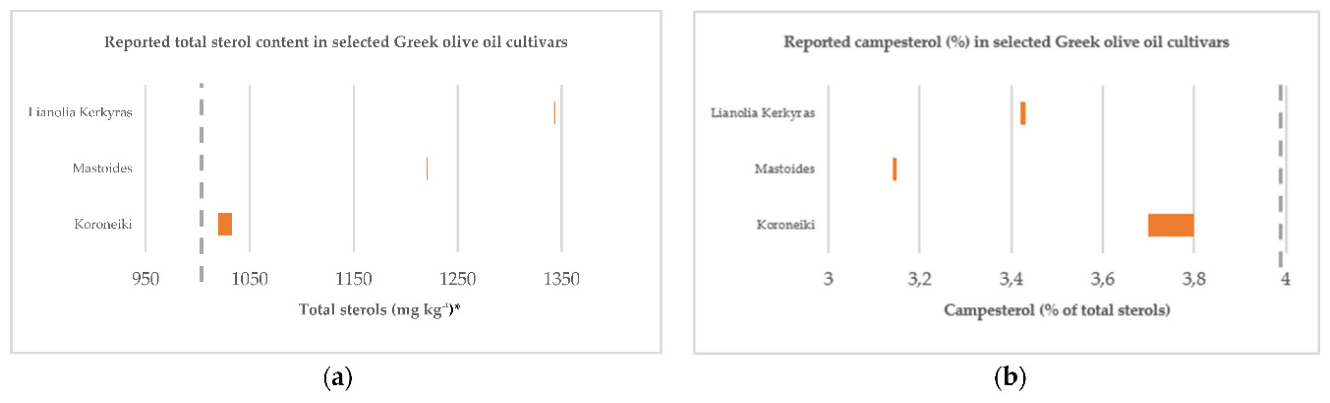
Figure 2.
Relative distribution of major sterols in selected Greek olive oil cultivars. The figure compares the relative abundance of the main sterol fractions in Koroneiki, Mastoides and Lianolia Kerkyras olive oils. β-Sitosterol is the predominant sterol in all three cultivars, whereas cultivar-dependent differences are observed in the relative proportions of Δ5-avenasterol, campesterol, stigmasterol and minor sterol fractions. This comparison supports the interpretation of Greek olive oil phytosterol profiles beyond absolute regulatory parameters and highlights the contribution of cultivar identity to the internal phytosterol fingerprint. Data compiled from [15,16,18].
Figure 2.
Relative distribution of major sterols in selected Greek olive oil cultivars. The figure compares the relative abundance of the main sterol fractions in Koroneiki, Mastoides and Lianolia Kerkyras olive oils. β-Sitosterol is the predominant sterol in all three cultivars, whereas cultivar-dependent differences are observed in the relative proportions of Δ5-avenasterol, campesterol, stigmasterol and minor sterol fractions. This comparison supports the interpretation of Greek olive oil phytosterol profiles beyond absolute regulatory parameters and highlights the contribution of cultivar identity to the internal phytosterol fingerprint. Data compiled from [15,16,18].
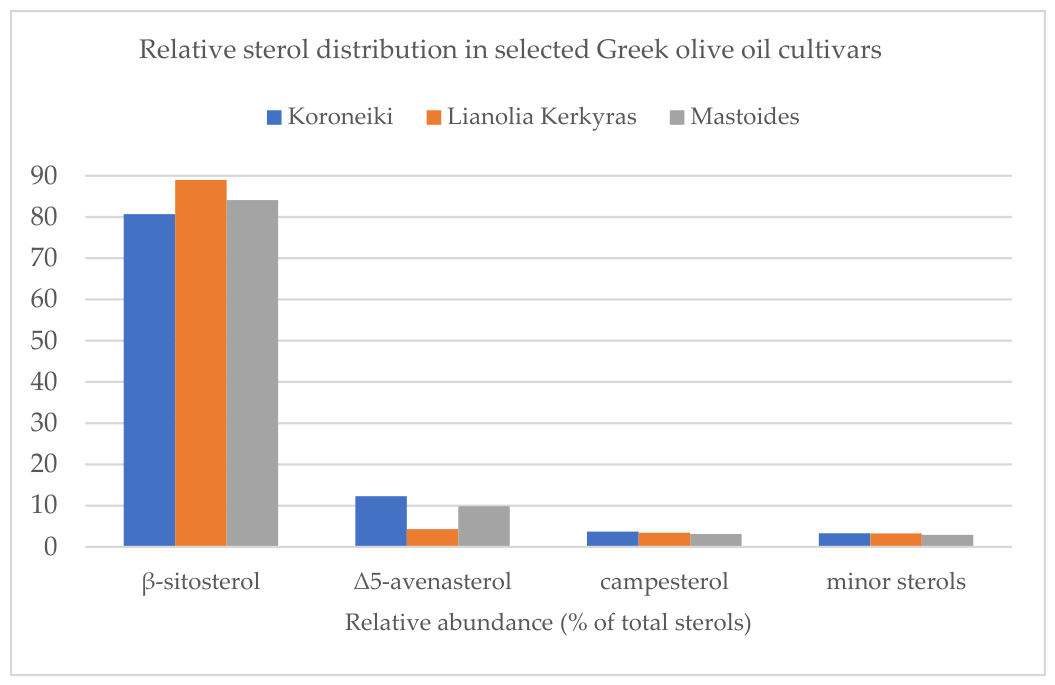
Figure 3.
The proposed interpretative framework for near-threshold sterolic space (NTSS) values in Greek olive oils that do not automatically indicate adulteration and require regulatory, cultivar-specific and multiparametric interpretation (OpenAI generated).
Figure 3.
The proposed interpretative framework for near-threshold sterolic space (NTSS) values in Greek olive oils that do not automatically indicate adulteration and require regulatory, cultivar-specific and multiparametric interpretation (OpenAI generated).
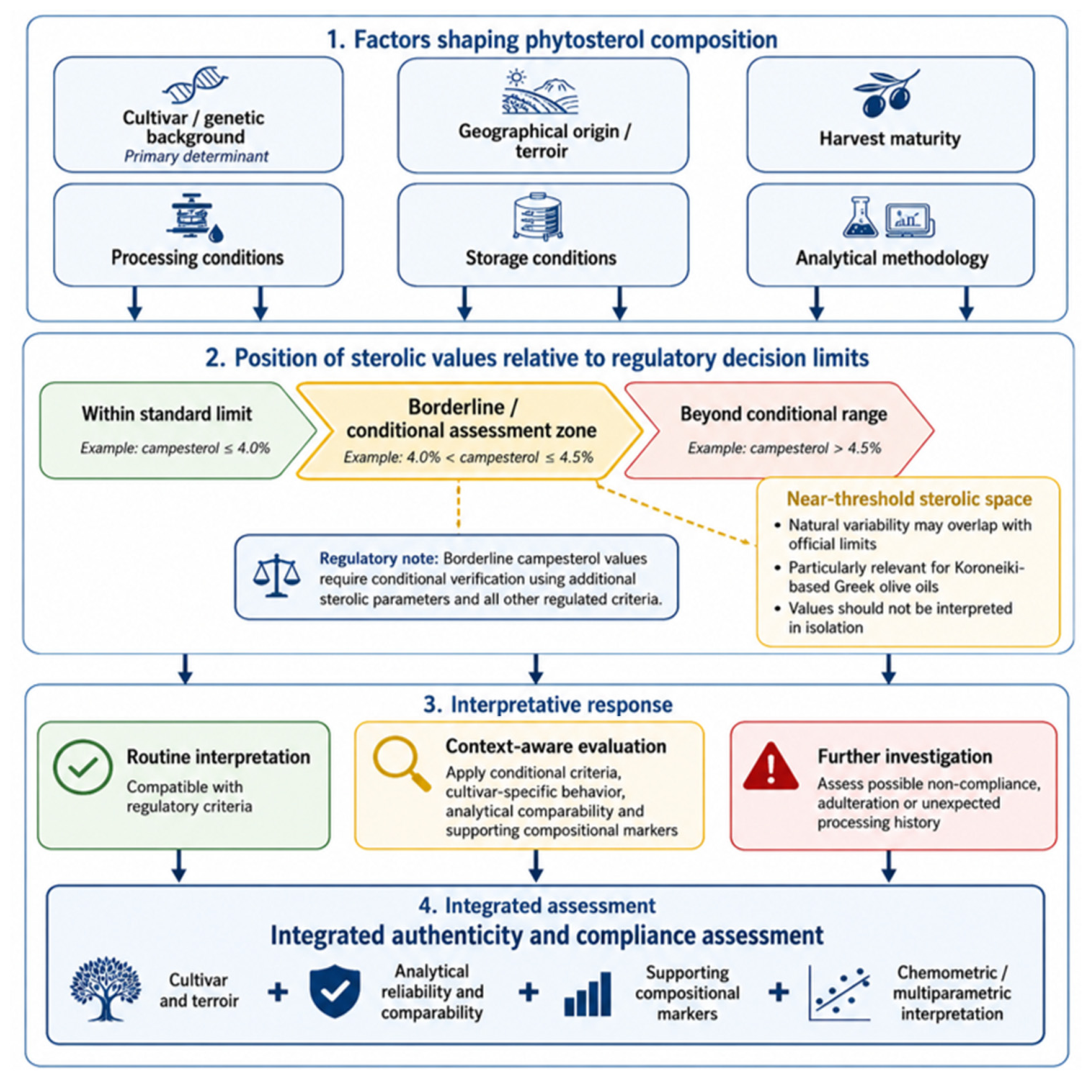

Table 1.
Typical phytosterol content of selected edible vegetable oils and relevance to olive oil profiling.
Table 1.
Typical phytosterol content of selected edible vegetable oils and relevance to olive oil profiling.
| Edible oil/source | Typical total phytosterol content (mg/100g of oil) | Main phytosterols commonly considered | Relevance to olive oil profiling | [ref.] |
| Wheat germ oil | 1700-2600 | β-Sitosterol, campesterol, stigmasterol | Very high-phytosterol oil; useful as a comparative reference for phytosterol-rich edible oils. | [31,34,37] |
| Crude corn oil | 780-1390 | β-Sitosterol, campesterol, stigmasterol | High-phytosterol seed oil; relevant in authenticity studies because its sterolic profile differs from that of olive oil. | [31,34,38] |
| Corn germ oil | 1070 | β-Sitosterol, campesterol, stigmasterol | High-phytosterol oil; useful for comparison with olive-derived phytosterol fingerprints. | [31,34] |
| Crude rapeseed oil | 680-880 | β-Sitosterol, campesterol, stigmasterol | Important comparator because brassicasterol and altered campesterol levels may indicate non-olive oil contribution. | [31,34] |
| Crude soybean oil | 300-440 | β-Sitosterol, campesterol, stigmasterol 1 | Common edible oil with a sterolic profile distinct from olive oil; relevant in adulteration screening. | [34,38,39] |
| Olive oil | 256-283 | β-Sitosterol, Δ5-avenasterol, campesterol, stigmasterol | Moderate total phytosterol content but highly characteristic phytosterol fingerprint; important for authenticity and regulatory assessment. | [8,34,39] |
| Palm oil | 70-80 | β-Sitosterol, campesterol, stigmasterol | Moderate total phytosterol content but highly characteristic phytosterol fingerprint; important for authenticity and regulatory assessment. | [34,38] |
Table 2.
Main factors influencing phytosterol composition and interpretation in Greek olive oil.
| Factor | Expected influence on sterolic profile | Strength of evidence in Greek olive oil | Main interpretative implication | [ref.] |
| Cultivar / genetic background | Primary determinant of total sterols and relative sterol distribution. Koroneiki tends to show lower total sterol values compared with other Greek cultivars. | Strong for Koroneiki, Mastoides and Lianolia Kerkyras; limited for many other Greek cultivars. | Sterolic values should first be interpreted against cultivar-specific baselines. | [15,16,18,20] |
| Geographical origin / terroir | May cause secondary quantitative shifts in the overall chemical fingerprint; direct sterol-specific evidence remains limited. | Moderate for broader Greek EVOO compositional fingerprints; limited for sterol-specific geographical effects. | Geography should refine, not redefine, the cultivar-dependent sterolic profile. | [6,7,14,19] |
| Harvest maturity | May gradually affect total sterols and relative proportions of individual sterols and triterpene diols. | Well supported in broader olive oil literature; limited Greek sterol-specific maturity datasets. | Maturity should be treated as a secondary modulator, especially in cultivar-controlled interpretation.. | [20] |
| Processing conditions | Generally limited direct effect under standard EVOO mechanical extraction; possible indirect effects through oxidation or storage environment. | Limited Greek sterol-specific evidence; stronger evidence for effects on phenolics, volatiles and oxidative stability. | Processing effects should be interpreted cautiously unless extreme conditions or refining are involved. | [20,24,49] |
| Storage / oxidation | Phytosterols are relatively stable but may undergo oxidation under adverse light, oxygen and temperature conditions. | Limited Greek sterol-specific storage evidence. | Sterols are robust markers but not chemically inert; sterol oxidation products represent a future research gap. | [8,20,49] |
| Analytical methodology / reporting | Sample preparation, chromatographic separation, peak integration and percentage-based reporting may affect near-threshold interpretation. | Strongly relevant due to official EU/IOC workflows; limited Greek inter-method comparison studies. | Methodological transparency is essential when values lie close to regulatory limits. | [8,22,25,43] |
Disclaimer/Publisher’s Note: The statements, opinions and data contained in all publications are solely those of the individual author(s) and contributor(s) and not of MDPI and/or the editor(s). MDPI and/or the editor(s) disclaim responsibility for any injury to people or property resulting from any ideas, methods, instructions or products referred to in the content. |
© 2026 by the authors. Licensee MDPI, Basel, Switzerland. This article is an open access article distributed under the terms and conditions of the Creative Commons Attribution (CC BY) license (http://creativecommons.org/licenses/by/4.0/).
Copyright: This open access article is published under a Creative Commons CC BY 4.0 license, which permit the free download, distribution, and reuse, provided that the author and preprint are cited in any reuse.


