
Submitted:
14 July 2026
Posted:
15 July 2026
You are already at the latest version
Abstract
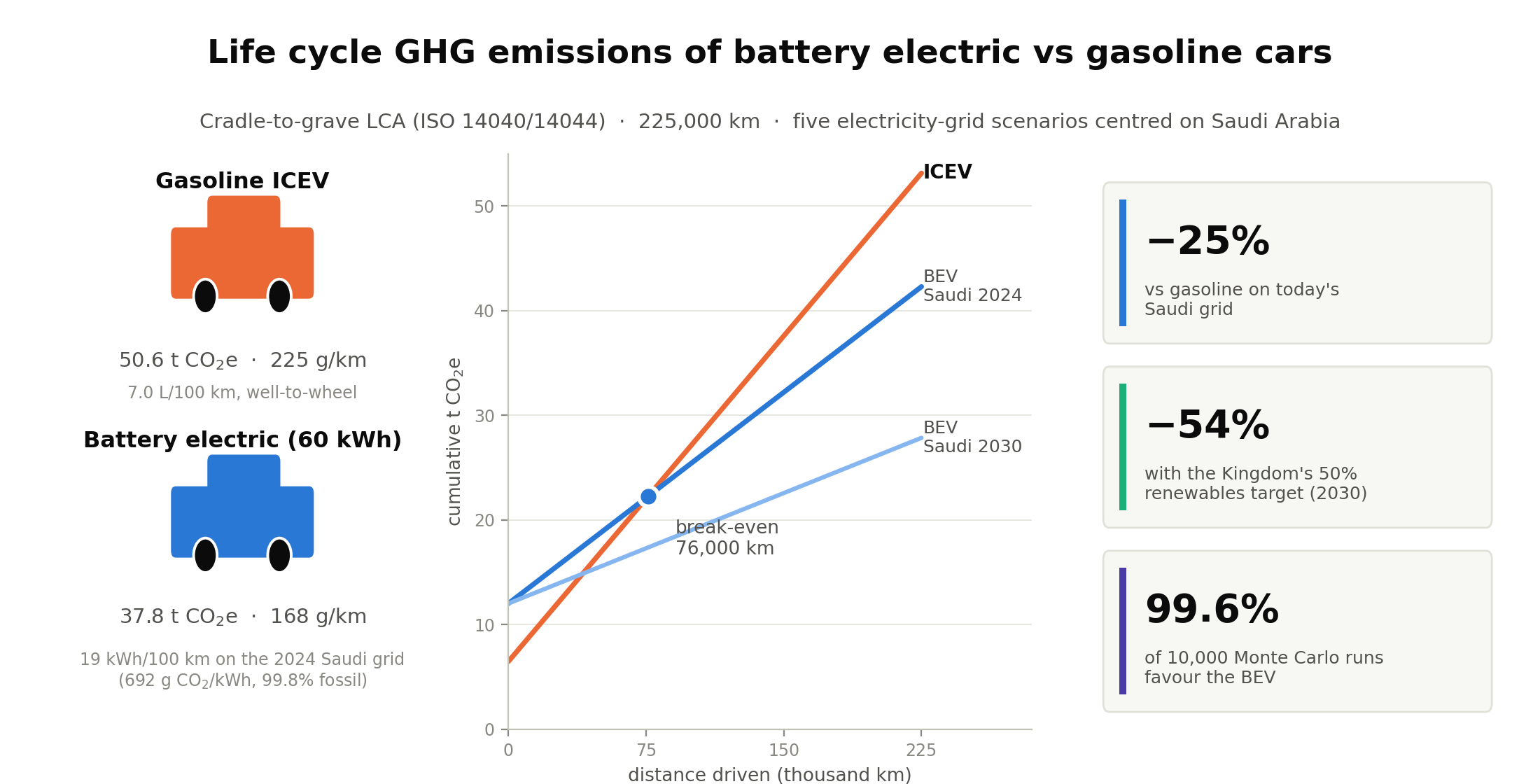
Battery electric vehicles (BEVs) relocate emissions from the tailpipe to the power station and the battery supply chain, so their climate benefit depends on the electricity that charges them. This study presents a transparent, ISO 14040/14044-conformant cradle-to-grave life cycle assessment comparing a representative mid-size BEV with a comparable gasoline internal combustion engine vehicle (ICEV), using a process-sum inventory in which every input is traceable to a published source. The use phase is evaluated under five electricity scenarios: the 2024 Saudi Arabian grid (692 g CO2/kWh), the 2024 world and European Union averages, a prospective 2030 Saudi grid meeting the Kingdom's 50% renewable-electricity target, and the French grid. Over 225,000 km, the ICEV emits 50.6 t CO2e (225 g CO2e/km); the BEV emits 37.8 t (168 g CO2e/km) on the current Saudi grid — a 25% reduction — falling to 23.4 t under the 2030 scenario and 17.4 t on the EU grid. BEV production emissions are 1.9 times the ICEV's, dominated by the traction battery; emission break-even occurs at 76,000 km on the Saudi grid. Monte Carlo analysis shows the BEV superior in 99.6% of 10,000 runs. Electrification therefore delivers a robust climate benefit even on a fossil-dominated grid, and the benefit roughly doubles with the announced power-sector transition.
Keywords:
life cycle assessment
; electric vehicle
; internal combustion engine vehicle
; greenhouse gas emissions
; electricity grid carbon intensity
; Saudi Arabia
Copyright: This open access article is published under a Creative Commons CC BY 4.0 license, which permit the free download, distribution, and reuse, provided that the author and preprint are cited in any reuse.


