

Submitted:
14 July 2026
Posted:
15 July 2026
You are already at the latest version
Abstract
Though, the prevalent attitude-behavior inconsistency is still one of the critical issues in sustainable tourism, whereby positive environmental attitudes do not necessarily result in green tourism behavior. This paper explores the factors influencing green tourism behavioral intention as well as the potential mediating effect of willingness to pay (WTP). Environmental awareness, green destination attributes, attitude, willingness to pay, and behavioral intention have been incorporated into the cross-cultural perspective. This study has adopted a quantitative research design involving a cross-sectional survey among domestic and foreign tourists. The findings reveals destination greenness is found to be more influential in attitude formation, followed by environmental awareness. In turn, attitudes have strong impact on both WTP and behavioral intentions, with WTP being a partial mediator between attitude and behavioral intention, thus indicating the presence of attitude-behavior gap. Furthermore, Multi-group analysis has shown significant cross-cultural differences in behavioral conversion mechanism for domestic and international tourists.
Keywords:
attitude–behavior gap
; green tourism
; willingness to pay
; behavioral intention
1. Introduction
If attitude truly drove behavior, sustainable tourism would already be the reality, however empirical evidence shows otherwise (Araujo et al., 2025). Tourists express pro-environmental values, but often fail to act on them (Chakraborty et al., 2024). The contradiction as a recurring paradox such as favorable attitudes towards sustainability unaccompanied by the corresponding behavior reveals a remarkable flaw in contemporary mainstream approaches to study tourist’s behaviors (Zhang & Cao, 2023). Conceptualized as the attitude-behavior gap, the phenomenon exposes the significant disconnect between what tourists proclaim the values and how they actually behave, thereby questioning the predictive validity of widely adopted theories such as the Theory of Planned Behavior (TPB) and Value-Belief-Norm (VBN) Theory (Zhang et al., 2025). In an era where sustainability is no longer becoming the key issue rather than an optional, addressing the attitude-behavior gap is essential not only for developing a theory but also for achieving perceptible outcomes.
The issue is particularly noticed in ecologically sensitive tourist destinations such as Hatyai, Songkhla, Thailand. The rapid growth of tourism activities in such destinations characterized by fragile marine ecosystems exemplify the paradox of sustainable tourism development (Segarra et al., 2024). Tourists often demonstrate great environmental awareness and express their commitment to sustainable tourism; nonetheless, their activities often fall short of acting on their commitments and engage in contributing to environmental degradation through excessive consumption, improper waste dumping, and ecosystem disturbance (Wu & Woosnam, 2025).This divergence underscores a critical theoretical gap in the prevailing behavioral models, which often assume a linear progression from awareness to attitude and from intention to behavior. This clearly indicates that the existing behavioral models are insufficient to capture the complexity of real-world phenomenon of how individual consumers make decisions.
Although the TPB model and other similar theories have laid the groundwork for explaining pro-environmental behavior, their effectiveness is limited by an overly heavy focus on cognitive explanations and by assuming that intention always predicts behavior. For example, willingness to pay represents a pivotal yet under-theorized construct. Sustainable tourism choices fundamentally involve additional financial costs, reduced hedonic convenience and pleasure, or perceived sacrifice in comfort (Lasarov et al., 2025), thereby introducing a decisive constraint on behavior recognition. Even when tourists hold strong pro-environmental attitudes, their willingness to pay to incur such costs ultimately determines attitude work out into practice (Yaja et al., 2026). Therefore, an inclusion of willingness to pay in the attitude-behavior framework, would be a more realistic approach in behavioral science.
Equally, existing tourism literature implicitly assumes behavioral homogeneity, often overlooking substantial cultural variations, social norms, and consumption patterns between domestic and international tourists. Cultural theory indicates that perceptions of responsibility, social obligations, and economic considerations are shaped differently according to the socio-cultural context of individuals. Nevertheless, studies that explore these distinctions through a systematic, integrated perspective are limited. This gap is especially relevant in cases like Hatyai, Songkhla, wherein different category of tourists act in similar ecological and institutional settings but display entirely divergent behaviors. Based on this research gap, this research aims to address the key research question: why do environmentally aware tourists with favorable attitudes fail to consistently engage in environmental friendly behavior and how does this attitude-behavior gap vary among domestic and international tourists based on the purposefully selected study location of Thailand? Most importantly, this study does not limit itself to intention-oriented perspectives but focuses on the constraining factors inherent in the structures of behavior that constrain the reflection of attitudes into action.
The main objective of this study is to contribute to the development of behavioral theory through the restructuring of the attitude-behavior relationship into an attitude-behavior gap that is structurally dependent on cognitive, economic, and contextual variables within a cross-cultural setting. Specifically, the research intends to achieve the following research objectives:
- i.
- To examine the influence of environmental awareness and green destination characteristics on attitudes toward green tourism in Hatyai District, Songkhla Province, Thailand
- ii.
- To investigate the mediating role of willingness to pay in linking attitudes to behavioral intention
- iii.
- To assess the structural strength and limitations of the attitude–behavior relationship
- iv.
- To comparison of the aforementioned relationships between domestic and international visitors based on multi-group analysis.
The chosen methodological framework is the application of structural equation modeling (SEM) with multi-group analysis, thus facilitating a sophisticated analysis of structural relationships between latent variables, while also providing room for exploring cross-cultural differences (Kim et al., 2024).
The current study is an important theoretical contribution to the literature from three significant angles. First of all, it considers the attitude-behavior gap as an actual phenomenon, not an accidental one. Secondly, it brings economic commitment (willingness to pay) into consideration to connect the concept of psychological intention with practical decision-making processes. Lastly, it takes a cross-cultural approach and shows that behavioral approaches vary in their effectiveness when applied to domestic and international tourists visiting a specific destination. Collectively, these contributions extend existing behavioral theories and significantly enhance the explanatory power in tourism research.
2. Literature Review and Theoretical Background
2.1. Green Tourism and Sustainable Tourist Behavior
In the realm of tourism, the move towards sustainable tourism can be interpreted as an evolution to the principles of green tourism, which combine environmental consciousness with travel decision making and consumption (Daneshwar & Revaty, 2024). Green tourism goes beyond mere ecotourism principles of conservation in the form of eco-protection, responsible consumption, efficient use of resources, destination management and visitor responsibility (Ananta et al., 2025). Theoretically, green tourism is perceived to represent a paradigm shift from consumptive-oriented travel decisions to that of experience-based choices, where visitors' travel destinations are chosen based not only on hedonic values and utilitarian concerns, but also based on ethical and environmental concerns (Nguyen & Danh, 2026). This move can be also attributed to the changing concept of the experience economy where values are co-created between visitors and the host community through their interactions. However, studies have identified an attitude-behavior gap where positive environmentally conscious attitude does not translate to pro-environmental behaviors despite the heightened consciousness of environmental issues (Luong, 2025). Therefore, behavioral mechanisms and contextual factors that affect the process through which environmentally conscious attitudes turn into sustainable tourism behavior have gained growing attention in the context of current tourism research (Popovici & Stanciu, 2025).
2.2. Theory of Planned Behavior: Predictive Strength and Structural Limitation
The Theory of Planned Behavior (TPB) is one of the most widely used frameworks for explaining behavioral intentions and posits that behavior is influenced by attitude, subjective norms, and perceived behavioral control. TPB has been extensively applied in tourism research to explain eco-friendly travel intentions, destination choice, and sustainable consumption behaviors (Schmidt, 2025). However, its explanatory power is stronger for intention formation than for the transition from intention to actual behavior, particularly in contexts characterized by emotional influences and economic constraints (Li et al., 2022). In tourism, behavioral decisions are often shaped by contextual barriers, destination experiences, and economic trade-offs, resulting in an attitude–behavior gap (Cardoso et al., 2025). To address this limitation, recent TPB extensions have incorporated variables such as environmental cognition, moral norms, perceived value, and willingness to pay (Wibawa & Nurbaeti, 2025). Building on these developments, this study extends TPB by integrating cognitive, experiential, attitudinal, and economic mechanisms to provide a more comprehensive explanation of sustainable tourism behavior.
2.3. Environmental Awareness: Cognitive Foundation of Attitude
Environmental awareness is not a direct action, it is about how people understand the risks of the environment, the impacts of ecological destruction, and other sustainability issues, forming the cognitive basis for their environmental attitudes (Yang et al., 2025). However, awareness alone does not lead to action. Although all empirical evidence proves the positive correlation between awareness and pro-environmental attitudes, the effect of such a connection is significantly lower when it comes to the intention to perform certain actions. Meta-analytical research shows that environmental awareness has weak or moderate predictive power in tourism-related behaviors (Li et al., 2024).
Thus, the environmental awareness a distal cognitive antecedent, it is not a decisive force, but rather one that operates conditionally. Environmental awareness is activated via is conditional contextual realities. In experiential domains like tourism, where decisions are driven by pleasure, convenience, and social context, cognitive awareness alone is insufficient and without behavioral triggers and situational alignment, awareness rarely transforms actions (Tavitiyaman et al., 2024).
2.4. Green Destination Characteristics: Experiential Cognitive System
Green destination attributes relate to the perception of environmental conditions, sustainability performance, infrastructure for ecology, and performance of destination management. In tourism theory, destination attributes are seen as the most central element in destination images and evaluation frameworks (Zhong et al., 2023). Destination attributes have an important role as experiential clues influencing tourists’ satisfaction and perception of value (Alhaj Mohammad, 2024).
From the perspective of the experience economy paradigm, the attributes of destinations are tangible and sensorial experiences that contribute to perceived values during consumption processes. Consequently, destination attributes have more powerful behavioral effects than mere cognitive environmental attributes (Ortanderl, 2025). Various studies on ecotourism have proven that sustainability performance perception has a strong impact on attitudes and revisit intention.
Thus, green destination attributes are expected to have a more powerful effect on attitudes than awareness about environmental issues because they are immediate and relevant consumption attributes.
2.5. Attitude as a Central but Insufficient Mechanism
Attitude refers to an individual’s evaluation of his/her performance of the behavior and is the primary construct in TPB. This construct has consistently been identified as the closest predictor of behavioral intention across various types of behaviors. In sustainable tourism literature, attitude has also been shown to be a significant predictor of environmentally-friendly intentions and behavior in tourists (Gautam & Bhalla, 2023). Yet, from practical evidence, it can be seen that having an attitude does not necessarily mean that individuals will behave accordingly (Kizildag & Yildiz, 2024).
The presence of such a gap implies that attitude serves as a necessary but insufficient determinant of behavior. Consequently, other mechanisms should be considered to make attitude transform into behavior.
2.6. Willingness to Pay: Economic Conversion and Value Transformation Mechanism
Willingness to Pay (WTP) is defined as the maximum financial value that the buyer afford for environmentally sustainable tourism services. The measure is commonly applied in environmental economics in order to determine perceived value and the intensity of utilities (Macalalad et al., 2025). From the perspective of behavioral economics, WTP captures the transformation process of utilities in practical situations where preferences need to be expressed in the form of economic activities (Ezeh & Dube, 2024). In addition to being a measure of affordability, it is a measurement of value preference and dedication.
Notably, WTP operates as a transformation medium, which converts psychological preference into an economic intention. In other words, it becomes a structural element between cognition and behavior, thereby overcoming the central problem of TPB. Empirical evidence in tourism confirms that WTP acts as a mediator between environmental attitude and behavioral intention (Farr et al., 2016). Therefore, WTP is considered to be a behavioral translator for sustainable tourism decision-making.
2.7. Cross-Cultural Behavioral Heterogeneity
The conduct of tourists is influenced by cultural, institutional, and economic structures that produce significant variations between tourist groups in sustainable decision-making. Cross-cultural behavioral theory postulates that individuals respond differently to environmental cues depending on their value orientation, institutional culture, and economic capability. Environmental behavior is also triggered by values, beliefs, and norms within the context of cultural institutions according to the value-belief-norm theory (Soemantri et al., 2025).
For example, international tourists and especially those from wealthy societies and developed institutional environmental settings demonstrate greater willingness to pay and attitude-behavior congruence (Dodds & Holmes, 2023). Domestic tourists on the other hand have high levels of environmental awareness but lower behavioral responses because of cost considerations (Ghazvini et al., 2020).
This evidence demonstrates that there are significant structural differences in the behavior of tourists towards green tourism, and therefore a multi-group structural analysis (MGA) should be undertaken with measurement invariance testing (Liengaard, 2024).
2.8. Research Gap and Theoretical Contribution
Despite an abundance of literature, the existing tourism literature remain several deficiencies in explaining attitude–behavior gap in green tourism. First, research in this area tends to concentrate on direct attitudinal explanation without consideration of economic conversion mechanisms like WTP in the structural model. Second, although the attitude-behavior gap has been recognized in the literature, it has not been conceptualized as a multidimensional system consisting of various mechanisms such as cognitive, experiential, and economic approaches. Finally, cross-cultural differences have been analyzed without proper test of measurement invariance and structural equivalence.
To fill these research gaps, this study proposes an integrated theoretical framework that:
- Extends TPB by introducing environmental awareness and destination cognition
- Incorporates WTP as an economic conversion mechanism
- Analyzes the attitude-behavior gap as a mediated structure
- Explores cross-cultural differences based on MICOM and MGA
2.9. Conceptual Framework Development
Following the review of literature, this study suggests a holistic behavioral system that combines all four – cognitive, experiential, attitudinal, and economic aspects in influencing sustainable tourism behavior. The conceptual framework is presented in the following figure;
Based on the conceptual framework illustrated in Figure 1, focuses on cultural differences of domestic versus foreign travelers when examining the relationships between the aforementioned elements.
2.10. Hypothesis Statement
Direct Relationships
H1: Environmental consciousness affects attitudes about green tourism positively.
H2: Perceived characteristics of green destinations affect attitudes about green tourism positively.
H3: Attitudes about green tourism affect WTP for sustainable tourism positively.
H4: Attitudes about green tourism affect behavioral intention for sustainable tourism positively.
H5: WTP affects behavioral intention for sustainable tourism positively.
Mediation Effect (Attitude → WTP → BI)
H6: Willingness to pay will mediate the connection between attitudes towards green tourism and behavioral intention.
Differences between Domestic and International Tourists
H7a: Environmental awareness has a significantly different impact on attitudes between domestic and international tourists.
H7b: Attitudes have a significantly different impact on behavioral intention between domestic and international tourists.
H7c: Willingness to pay has a significantly different impact on behavioral intention between domestic and international tourists.
The Overall Framework
H8: Attitudes significantly affect behavioral intention even after controlling for willingness to pay, thus suggesting the existence of the attitude-behavior discrepancy.
3. Research Methodology
3.1. Research Design
This study employed a quantitative cross-sectional design and an extended TPB model to examine the attitude–behavior gap in green tourism. Using PLS-SEM, it tested hypothesized relationships, mediation effects, and differences between domestic and international tourists, offering robust explanatory and predictive analysis without requiring normal data distribution or strict model fit assumptions.
3.2. Study Area
The study was conducted in purposefully selected Hatyai, Songkhla, which is a provincial capital in Southern Thailand. This is renowned as a significant tourist destination which is well known in vibrant cultural hub famous for old town, local food, tradition, nature scenic, and a commercial city of Hatyai. This place is recognized as a destination for leisure and recreational activities, MICE, business and vibrant place for cultural, historical, and commercial spots. The destination attracts both local and international tourists, thus it is a suitable case study for studying differences in green tourism behaviors.
3.3. Population and Sampling Design
The respondents who visited Hatyai from both national and international perspectives comprised the target population. The study used purposive quota sampling to identify 400 participants (200 nationals and 200 international) through direct travel experience. The sample size met the 10-times rule of PLS-SEM and power analysis, while multi-sampling and multi-stage data collection minimized sampling error.
3.4. Data Collection Procedure
Structured self-administered questionnaires written in English and Thai were used to obtain primary data. In this study, the items were adopted from green tourism literature and research in environmental behavior, were derived from existing validated measures and refined after a rigorous process of item generation based on the literature, expert content validation, a pilot study of 30 participants and subsequent item revision. Survey was conducted by well-trained interviewer and participants responded the questionnaires voluntarily after being informed about the study' purpose. The five point Likert scale was used to measure all the constructs. Prior to data collection, all participants were informed about the purpose of the study, the voluntary nature of their participation, their right to withdraw at any time without penalty, and the confidentiality and anonymity of their responses. Verbal informed consent was obtained from all participants before the questionnaire was administered. No personally identifiable information was collected, and all responses were analyzed in aggregate form to protect participants' privacy.
3.5. Data Analysis Strategy and Evaluation Framework
The first step in this process involves a prediction-based two-step PLS-SEM procedure, which is ideal for complicated and non-normal datasets. The measurement model is concerned with the measurement model’s validity and reliability, which are determined by Cronbach’s Alpha, Composite Reliability, AVE, HTMT, and outer loadings. The structural model involves the examination of relationships between variables using bootstrapping with 5,000 resamples. The following metrics will be considered in the analysis of path coefficients, t-value, p-value, R², f², Q², PLS predict, and SRMR, among other things. The hypothesis paths will link variables like EA, GSD, ATT, WTP, and BI.
The framework also incorporates mediation analysis through bootstrapped indirect effects, multiple group analysis of domestic and international tourists using MICOM and MGA techniques, and robustness analysis involving collinearity, sensitivity analysis, predictive validation, and causality limitations.
4. Results
4.1. Respondent Profile
From Table 1, the sum of 400 valid questionnaires are both male and female and almost equal in terms of amount (Thai, and foreigner are equal at 200 questionnaires each). Therefore comparison and multi-group analyses can be made on both Thai and foreigner tourists. Tourists are mainly younger than the others and higher education level while the foreigner is on average higher level of education and variety type of occupation than Thai tourists. Most tourists were female, and the reason of traveling were leisure; Therefore, in term of gender, age, level of education, type of occupation and reason for traveling there are a lot of significant differences between Thai and foreigner tourists (Chi-square test, at the significant level of p<0.05). Thus, multi-group analysis compares green tourism attitude and behavior between Thai and foreigner tourists.
4.2. Measurement Model Assessment
As demonstrated in Table 2, PLS-SEM was applied to test the reliability of the constructs and convergent validity. The psychometric characteristics of the construct can be acceptable as the Cronbach's alpha is between 0.81-0.93, composite reliability is between 0.88-0.95 and AVE is between 0.67-0.78 which are within acceptable limit. Factor loading is ranging from 0.72-0.91 which indicate the reliability of indicator and behavioral intention construct holds the best validity and reliability followed by green destination characteristics and attitude construct. To summarize, environmental awareness, destination characteristics, attitude, willingness to pay and behavioral intention construct possess reliable and valid characteristics.

Table 2.
Measurement Model Assessment: Reliability and Convergent Validity.
| Construct | Items | Factor Loadings | Cronbach’s Alpha | Composite Reliability (CR) | AVE |
|---|---|---|---|---|---|
| EA | EA1 – EA4 | 0.74 – 0.88 | 0.84 | 0.89 | 0.67 |
| GDC | GDC1–GDC5 | 0.72 – 0.91 | 0.90 | 0.93 | 0.72 |
| ATT | ATT1–ATT4 | 0.76 – 0.89 | 0.87 | 0.91 | 0.70 |
| WTP | WTP1–WTP3 | 0.79 – 0.90 | 0.81 | 0.88 | 0.71 |
| BI | BI1–BI5 | 0.75 – 0.89 | 0.93 | 0.95 | 0.78 |
Note: Recommended thresholds: Factor Loading ≥ 0.70; Cronbach’s Alpha ≥ 0.70; Composite Reliability ≥ 0.70; AVE ≥ 0.50 (Amit et al., 2025; Rheeders & Meyer, 2022).
4.3. Discriminant Validity
The validity of discriminant was tested based on the Fornell-Larcker criterion and heterotrait-monotrait ratio (HTMT), according to the guidance provided by Hair Jr. et al. (2019). The results indicated in Table 3 reveal that the square root of the average variance extracted (AVE) for each construct is higher than its respective inter-construct correlation.
The HTMT ratios in Table 4 were between 0.47 and 0.81 and did not exceed the conservative benchmark value of 0.85. This evidence suggests that the theoretical constructs are distinct and uncorrelated with each other, and no multicollinearity issues are detected. In summary, the test results prove the discriminant validity and independence of the theoretical constructs of EA, GDC, ATT, WTP, and BI. Thus, the measurement model meets the recommended quality criteria for further analysis under the PLS-SEM approach.
4.4. Structural Model Assessment
The structural model was estimated using PLS-SEM with 5,000 bootstrap resamples. Results are reported in Table 5.
According to the findings presented in table 5, all the postulated hypotheses were confirmed with a value of p < 0.001 by PLS-SEM analysis with 5000 bootstrap samples. While Environmental Awareness influenced positively Attitude toward Green Tourism, the contribution of Green Destination Characteristics was more important, showing a greater influence of destination characteristics over the environment friendly attitude. The relationship of attitude positively influenced both Willingness to Pay and Behavioral Intention. Moreover Willingness to Pay had a positive impact on Behavioral Intention. The structural model findings confirm the hypotheses (H1-H5) and no values were negative in 95 % confidence intervals.
4.5. Attitude–Behavior Gap Confirmation
According to Table 6, our mediation analysis indicated that willingness to pay (WTP) partially mediated the association between attitudes toward green tourism (ATT) and behavioral intention (BI). In other words, both direct impact and indirect impact through WTP on BI were found significant. Therefore, economic willingness played some role to reduce attitude-behavior gap by transforming positive environmental attitude to behavior intention.
4.6. Effect Size Hierarchy (Structural Dominance Ranking)
The significance of each relationship was determined by the ranking of standardized path coefficients (β), based on the magnitude of their effect in the PLS-SEM analysis. This hierarchy is shown below, which reveals the presence of a distinct hierarchical causal structure related to green tourism behavioral intention.
From the structural dominance hierarchy, in Table 7, it is clear that the variable ATT has the highest effect on WTP. This means that the most important reason why tourists are willing to spend money for green tourism practices is due to their attitudes towards the environment. The results highlight the importance of attitudinal mechanisms in the extended TPB.
Of the variables affecting the development of attitudes, GDC proved to be more important than EA, as it affected ATT more strongly than the latter did. This means that green tourism behaviors are more affected by destination characteristics rather than tourists' environmental awareness levels.
Finally, the results show that ATT influences BI not only directly but also indirectly through WTP. Thus, there is indeed an attitude-behavior gap, which is partly mediated by willingness to pay. In general, the hierarchy shows a hierarchical causal chain with primary importance given to attitudinal and economic mechanisms.
4.7. Explanatory Power (R²)
The predictive validity of the endogenous constructs was evaluated based on the coefficient of determination (R²). According to Table 8, the model has relatively strong to medium predictive ability for all endogenous variables.
As seen in table 8, the structural model accounts for 51% of the variance in ATT, which implies good to excellent explanatory strength. Likewise, the structural model explains 47% of the variance in WTP, implying moderate predictive strength. Notably, the Behavioral Intention (BI) attains the highest coefficient of determination, thus exhibiting good explanatory strength and prediction reliability of the structural model.
From these findings, it can be argued that the interplay of Environmental Awareness (EA), Green Destination Characteristics (GDC), ATT, and WTP provides an excellent explanation of the tourists' environmentally-friendly behavioral intentions within the context of green tourism. The obtained R² findings corroborate the structural relationships revealed in Table 4.5 and offer evidence of the robustness and prediction validity of the expanded TPB framework.
4.8. Effect Size (f²) and Predictive Relevance (Q²)
In order to analyze the impact made by each structural path and the predictive power of the model, effect size (f²) and predictive relevance (Q²) tests were performed. The findings are summarized in Table 9.
From the results in table 9, the results from the effect size test show that attitude towards green tourism (ATT) has the highest influence on WTP, which is a strong structural effect. GDC has also been shown to be an influential factor in the ATT variable followed by ATT → BI, showing a moderate to strong influence. On the other hand, WTP→ BI and environmental attitude → ATT have moderate influence.
Further examination of the predictive relevance of the model showed that all endogenous constructs had positive values of Q², with ATT, WTP and BI. These results are a clear indication that the developed model has strong predictive relevance as well as satisfactory out-of-sample explanatory power. Out of all the constructs, BI showed the highest predictive relevance, thus demonstrating the efficacy of the integrated theory of planned behavior model in the study of green tourism behavior of tourists in Hatyai, Songkhla, Thailand.
4.9. PLSpredict Assessment (Out-of-Sample Prediction)
In order to assess the predictive accuracy of the proposed model out of sample, the PLSpredict procedure was carried out according to Shmueli et al.'s (2019) suggestions. The findings are illustrated in table 10 below.
Table 10 shows that all endogenous variables yielded a positive Q² predict result such as ATT, WTP, and BI. It shows that the structural model had predictive relevance since all endogenous constructs generated a positive predictive value. In this case, the strongest out-of-sample predictive performance was demonstrated by BI. It is notable that RMSE values yielded in favor of the PLS-SEM model compared to LM for all variables.
4.10. Mediation Analysis
Mediation analysis was further performed to understand the mechanism of the attitude-intention discrepancy using bootstrapping methods in PLS-SEM framework. Findings are illustrated in Table 11.
From table 11, the indirect impact of ATT on BI via WTP was found to be statistically significant. The Variance Accounted For (VAF) value was 27.8%, hence the conclusion of partial mediation based on well-known rules for PLS-SEM analysis.
Indeed, the results prove that there exist two types of behavioral routes behind green tourism behavior intention. Firstly, the direct psychological route runs through ATT → BI, suggesting that a positive attitude towards environment will result in higher intentions of tourists' engagement in environmentally friendly behavior. Secondly, the indirect economic route is shown by ATT → WTP → BI. It shows that the tourists' readiness to pay for environmental-friendly activities plays a mediating role.
Finally, a presence of both effects being statistically significant at the same time is a proof of the attenuated attitude–behavior gap mechanism. Hence, while positive attitudes towards environment influence behavioral intentions, economic behavior can act as a second enabling factor for translating the positive attitudes into actual actions.
4.11. Multi-Group Analysis (MICOM + MGA)
Before carrying out multi-group analysis, the assessment of measurement invariance for composite models (MICOM) was conducted to test the equivalence of the measurement model among domestic and international tourists. As shown in Table 12, configural invariance and compositional invariance have been successfully demonstrated. Even though equality of means and variance could not be fully validated, the findings met the criteria for partial measurement invariance in the context of PLS-SEM.
According to the table 12, compositional invariance has been established and partial measurement invariance is proven, which allows for valid comparison among groups through MGA.
4.12. Results of Multi-Group Analysis (MGA)
Subsequently, multi-group analysis (MGA) was conducted in order to ascertain whether there are differences between domestic and international travelers along the proposed structural links.
As evident from Table 13, MGA results have shown statistically significant differences across a number of structural paths, thereby supporting heterogeneity of behavior in the context of domestic and international tourists.
First, the influence of EA on ATT is relatively higher for domestic tourists than international tourists. The statistically significant difference indicates the validity of H7a, which implies that domestic tourists are more dependent on their environmental awareness to form a favorable attitude towards the environment.
Second, the influence of ATT on BI is relatively higher for international tourists than domestic tourists. The statistically significant difference in path coefficients supports H7b, implying that positive environmental attitudes result in more effective BI for international tourists.
Finally, the influence of WTP on BI is relatively higher for international tourists than domestic tourists. The statistically significant difference confirms the validity of H7c, implying that economic commitment plays an important role in translating the attitudes of foreign tourists into BI.
4.13. Robustness Tests
In order to verify the stability of the estimated structural models, various robustness tests were undertaken under the PLS-SEM approach. The test results are presented in Table 14 below.
As shown in table 14, the robustness test shows that the proposed structural model is statistically reliable and robust. First, all VIF had values from 1.42 to 2.87, far lower than the conservative level of 3.3. Hence, there was no evidence of multicollinearity among the predictor constructs used in the study.
Second, bootstrapping conducted with 5,000 resamples yielded statistically consistent and reliable parameter estimates for the studied structural relationships. Third, the subgroup analyses conducted on domestic versus international tourists showed the stability of structural directions, thus proving the reliability of MGA results.
Moreover, the PLSpredict assessment showed that the PLS-SEM model performed better than a linear benchmark model (LM). Therefore, the study proved its superior out-of-sample prediction power. Fourth, no suppression effects and no sign reversals appeared among structural paths tested, which proves that the parameter estimates were statistically and theoretically stable during the analysis.
5. Discussion
The present study examines the attitude-behavior gap in green tourism and explores the relationships between Environmental Awareness (EA), Green Destination Characteristics (GDC), Attitude towards Green Tourism (ATT), Willingness to Pay (WTP), and Behavioral Intention (BI) using a conceptual model within a revised Theory of Planned Behavior (TPB) framework. This research has provided strong empirical evidence for the proposed model and valuable theoretical, methodological, and practical insights in terms of sustainable tourism behavior among both domestic and foreign tourists visiting Hatyai, Songkhla, Thailand.
Among other important findings, it can be noted that Green Destination Characteristics was revealed as the most important factor for forming tourists' attitude to green tourism and had a more prominent impact on ATT as compared to Environmental Awareness. The finding implies that tourists form their attitude towards green tourism based not only on cognitive knowledge about environmental problems but also on the basis of specific experiences of sustainable tourism destinations visited. It confirms the importance of experiential sustainability characteristics of tourist destinations in influencing tourists' sustainable behavior and attitude in particular. Indeed, the results support the recent empirical evidence in sustainable tourism studies concerning the superiority of experiential sustainability characteristics over cognitive aspects.
In accordance with Theory of Planned Behavior, Attitude towards Green Tourism played an important role in explaining Willingness to Pay and Behavioral Intention, thus confirming the fundamental explanatory power of the attitudinal framework for sustainable tourism behaviors. However, the results of the mediation analysis show that WTP partially mediates the influence of ATT on BI, thus empirically demonstrating the existence of the weakened attitude-behavior gap. It is stated that in order to be able to demonstrate behavioral commitment towards sustainable tourism, one should not only have positive attitudes but also possess the willingness to make financial contributions for promoting sustainable tourism. In this context, willingness to pay acts as a behavioral activation instrument that allows for converting positive environmental attitudes into behavioral intention.
Further, the Multi-Group Analysis showed cross-cultural heterogeneity with statistical significance between domestic and international tourists regarding their ATT→BI and WTP→BI associations. This suggests that international tourists have a stronger capacity for converting positive attitudes and willingness to pay into actual behavioral intentions compared to domestic tourists. The latter group, however, seems to be more influenced by EA toward ATT. This implies that domestic tourists may rely more on their cognitive environmental awareness when forming attitudes than international tourists.
In theory, the research has made some fundamental contributions. First, it broadened the TPB model with an economic mediator, such as WTP, in the attitude-to-behavior relationship. Secondly, the impact of destination-level attributes of sustainability on environmental attitudes is established. Thirdly, this study contributes to the existing literature on attitude-behavior gaps by testing dual behavioral pathways concurrently using both psychological and economic processes. Finally, the application of MICOM and MGA techniques contributes to sustainable tourism research on a cross-cultural basis.
From a methodological standpoint, the inclusion of PLS-SEM, mediation analysis, PLSpredict, MICOM, and MGA provides an improvement in terms of rigorousness, predictive validity, and model robustness. In terms of practical implications, this paper’s results imply that destination managers and decision-makers should focus on promoting visible sustainability efforts, eco-certificate programs, and marketing campaigns for different cultural groups of tourists.
Overall, the model exhibits considerable explanatory and predictive capability, as well as predictive accuracy for out-of-sample observations, validating the efficacy and utility of the model developed for sustainable tourism theory development, policy formulation, and destination management.
6. Conclusion
The purpose of this research was to explore the attitude-behavior gap in green tourism through assessing the impact of environmental awareness (EA), green destination characteristics (GDC), attitude toward green tourism (ATT), willingness to pay (WTP) on the behavioral intention (BI) of both domestic and international tourists to Hatyai in Thailand. By applying extended TPB, all hypotheses were tested and the extended framework was validated. GDC demonstrated the greatest predictive power over ATT which suggests that the tangible aspects of sustainability features and experience in destination have a greater effect on the pro-environmental attitudes of tourists compared to only having environmental awareness. ATT showed a positive impact on both WTP and BI. Via mediation analysis, it was found that WTP acted as a partial mediator between ATT and BI meaning that the economic value could bridge the gap between attitude and behavior. Moreover, the comparison results between domestic and international tourists obtained from multi-group analysis found that the conversion of attitudes toward behavior for the both tourist types is significant.
From a theoretical perspective, this study contributes by enhancing the TPB model through the incorporation of the economic valuation and cultural mechanisms as explanations of sustainable tourism behavior. From a methodological perspective, this research confirmed that combining with PLS-SEM, mediation, PLSpredict, MICOM and MGA provide better explanatory and predictive accuracy. From a practical perspective, the results imply the importance of visibility of sustainability elements in destination, eco-certification, and tailor-made marketing strategies for destination management and policymakers.
However, this research has some limitations including: it only analyzes one destination; a cross-sectional research design; and used behavioral intention rather than actual behavior. Future research is encouraged to investigate more destinations and market segments by using longitudinal and mixed method research designs; exploring additional antecedent factors such as environmental identity, social norms, trust, emotional attachment, and perceived value. Sustainable tourism behavior is determined by combinations of experiential, attitudinal, economic, and cultural elements not by environmental awareness only.
Author Contributions
Conceptualization, Duangthida Pattano, Prachyakorn Chaiyakot and Chet Narayan Narayan Acharya; Methodology, Chet Narayan Narayan Acharya; Software, Chet Narayan Narayan Acharya; Validation, Chet Narayan Narayan Acharya; Formal analysis, Chet Narayan Narayan Acharya; Investigation, Chet Narayan Narayan Acharya; Resources, Chet Narayan Narayan Acharya; Data curation, Duangthida Pattano and Prachyakorn Chaiyakot; Writing – original draft, Chet Narayan Narayan Acharya; Writing – review & editing, Prachyakorn Chaiyakot and Chet Narayan Narayan Acharya; Visualization, Chet Narayan Narayan Acharya; Supervision, Prachyakorn Chaiyakot; Project administration, Duangthida Pattano and Prachyakorn Chaiyakot; Funding acquisition, Duangthida Pattano and Prachyakorn Chaiyakot. All authors have read and agreed to the published version of the manuscript.
Funding
This research was funded by Ministry of Higher Education, Science, Research and Innovation, grant number A13F670216.
Institutional Review Board Statement
Not applicable.
Informed Consent Statement
Not applicable.
Data Availability Statement
The original contributions presented in this study are included in the article. Further inquiries can be directed to the corresponding author.
Conflicts of Interest
The authors declare no conflict of interest.
References
- Alhaj Mohammad, B. Toward developing a model to examine the effect of cognitive image, affective image on visiting intention within destination attributes. Int. J. Hosp. Tour. Syst. 2024, 17(4), 1–13. [Google Scholar] [CrossRef]
- Amit, N.; Supian, K.; Ishak, B.; Abdullah, S. H. S.; Abdul Rauf, R. K. Exploring the ecotourism experience and ecotourism destination loyalty in Selangor: Reliability and factor analysis approach. Environ.-Behav. Proc. J. 2025, 10(SI26), 113–120. [Google Scholar] [CrossRef]
- Ananta, K. P. Y.; Waluyo, F.; Sudharsana, K. R. T.; Karang, A. A. G. D. W.; Sastrawan, K. D. Green destinations as a solution for improving the local economy and environmental conservation. J. Manag. Hosp. 2025, 2(2), 50–55. [Google Scholar] [CrossRef]
- Cardoso, L.; El Archi, Y.; Moutinho, L.; Almeida, P.; Benbba, B. Mind mapping the tourism destination choice framework: A theory-based perspective. Eur. J. Tour. Res. 2025, 41, 4108. [Google Scholar] [CrossRef]
- Chakraborty, D.; Polisetty, A.; Nunkoo, R.; Rana, N. P. What drives tourists towards sustainable behaviour? A longitudinal study. Asia Pac. J. Tour. Res. 2024, 29(3), 352–374. [Google Scholar] [CrossRef]
- Daneshwar, D.; Revaty, E. V. A paradigm shift towards environmental responsibility in sustainable green tourism and hospitality. Int. J. Soc. Sci. Hum. Res. 2024. [Google Scholar] [CrossRef]
- Dodds, R.; Holmes, M. R. At home and abroad: Comparing sustainable behaviour and willingness to pay across contexts. In Tourism and Hospitality Research. Advance online publication.; 2023. [Google Scholar] [CrossRef]
- Ezeh, P. C.; Dube, K. Willingness to pay in tourism and its influence on sustainability. Sustainability 2024, 16(23), Article 10630. [Google Scholar] [CrossRef]
- Farr, M.; Stoeckl, N.; Esparon, M.; Larson, S.; Jarvis, D. The importance of water clarity to Great Barrier Reef tourists and their willingness to pay to improve it. Tour. Econ. 2016, 22(2), 331–352. [Google Scholar] [CrossRef]
- Gautam, V.; Bhalla, S. Why residents exhibit environmentally responsible behavior? Journal of Cleaner Production. Adv. Online Publ. 2023. [Google Scholar] [CrossRef]
- Ghazvini, S. A. M.; Timothy, D. J.; Sarmento, J. C. V. Environmental concerns and attitudes of tourists towards national park uses and services. J. Outdoor Recreat. Tour. 2020, 31, 100296. [Google Scholar] [CrossRef]
- Kim, S.; Lee, S.; Kim, J.; Whittaker, T. A. Investigating latent interaction effects in multiple-group analysis in the structural equation modeling framework. In Structural Equation Modeling; 2024; pp. 1–13. [Google Scholar] [CrossRef]
- Kızıldağ, İ.; Yıldız, B. The effect of environmental concern on the intention to participate in green tourism. Int. J. Contemp. Tour. Res. Adv. Online Publ. 2024. [Google Scholar] [CrossRef]
- Lasarov, W.; Mai, R. Exploring the cognitive and habitual tensions in sustainable travel decisions: A multilevel analysis of 32 countries. In Journal of Travel Research; Advance online publication, 2025. [Google Scholar] [CrossRef]
- Li, F.; Zhu, D.; Lin, M.-T.; Kim, P. B. A meta-analysis of tourists’ destination visits and theory of planned behavior: The moderating roles of destination scale and cultural difference. In Tourism Recreation Research. Advance online publication.; 2024. [Google Scholar] [CrossRef]
- Liengaard, B. D. Measurement invariance testing in partial least squares structural equation modeling. J. Bus. Res. Adv. Online Publ. 2024. [Google Scholar] [CrossRef]
- Luong, T. Integrating the theory of planned behavior with internal environmental locus of control factors to predict pro-environmental behavioral intention in Vietnamese national parks. In Tourism and Hospitality Research; Advance online publication, 2025. [Google Scholar] [CrossRef]
- Macalalad, A. A.; Asi, L. M. U.; Coracero, E. E.; Panganiban, P. C. Economic valuation of biodiversity and ecotourism in Monte Maria: Integrating conservation and sustainable tourism practices. Int. J. Basic Appl. Sci. 2025, 14(4), 351–360. [Google Scholar] [CrossRef]
- Nguyen, N. H.; Danh, X. L. The impact of sustainable tourism experiential value on customer value co-creation behavior. In Tourism and Hospitality Research; Advance online publication, 2026. [Google Scholar] [CrossRef]
- Ortanderl, F. Complex destination image formation: The changes through visitation among domestic tourists. Eur. J. Tour. Res. 2025, 41, 4115. [Google Scholar] [CrossRef]
- Popovici, R.; Stanciu, P. Current trends and influencing factors in tourist consumer behavior. In Revista de Turism: Studii Si Cercetari in Turism; 2025. [Google Scholar] [CrossRef]
- Rheeders, T.; Meyer, D. F. The development of a regional tourism destination competitiveness measurement instrument. Tour. Hosp. 2022, 4(1), 1–20. [Google Scholar] [CrossRef]
- Schmidt, K. Moving from description to explanation - explaining consumers’ preference for bio-based plastics like PEF by an extended theory of planned behavior. Sustain. Futur. 2025, 10, 101499. [Google Scholar] [CrossRef]
- Segarra, E.; Guapi, F.; Yaulema Brito, L. M.; López, C. The impact of tourism on islands: A sustainability and conservation analysis. Green World J. 2024. [Google Scholar] [CrossRef]
- Tavitiyaman, P.; Zhang, X.; Chan, H. F. Impact of environmental awareness and knowledge on purchase intention of an eco-friendly hotel: Mediating role of habits and attitudes. In Journal of Hospitality and Tourism Insights; Advance online publication, 2024. [Google Scholar] [CrossRef]
- Wibawa, B.; Nurbaeti, N. Predicting pilgrimage tourism intention through the theory of planned behavior: Evidence from Wali Lima, Indonesia. J. Hosp. Res. Philanthr. Indones. 2025. [Google Scholar] [CrossRef]
- Wu, J.; Woosnam, K. Intentions, actions, and assumptions: A wake-up call for behavioural research in sustainable tourism. J. Sustain. Tour. 2025, 34(1), 1–20. [Google Scholar] [CrossRef]
- Yaja, M.; Hajoary, P. K.; Thenmozhi, M.; Kumar, A. Understanding tourists’ environmental behavior through the lens of willingness to change and motivational factors. Int. J. Consum. Stud. Adv. Online Publ. 2026. [Google Scholar] [CrossRef]
- Yang, H.; Chang, Y.; Zhu, K. The relationship between environmental knowledge and environmental behavior among university students in Guangxi, China: The mediating effects of environmental risk perception and environmental attitude. Environ. Soc. Psychol. 2025, 10(5). [Google Scholar] [CrossRef]
- Zhang, P.; Cao, K. Understanding the uncivilized tourism behavior of tourists: A planned behavior model based on the perspectives of cognitive dissonance and neutralization. Sustainability 2023, 15(5), Article 4691. [Google Scholar] [CrossRef]
- Zhang, Y.; Xiang, C.; Huang, Y.; Du, Q.; Mao, Y.; Lu, H. Understanding the intention-behavior gap in sustainable travel: A two-step approach. In Journal of Sustainable Tourism; Advance online publication, 2025. [Google Scholar] [CrossRef]
- Zhong, L.; Morrison, A. M.; Zheng, C.; Li, X. Destination image: A consumer-based, big data-enabled approach. In Tourism Review. Advance online publication.; 2023. [Google Scholar] [CrossRef]
Figure 1.
Conceptual Framework, developed by the authors based on the synthesized literature, 2026.
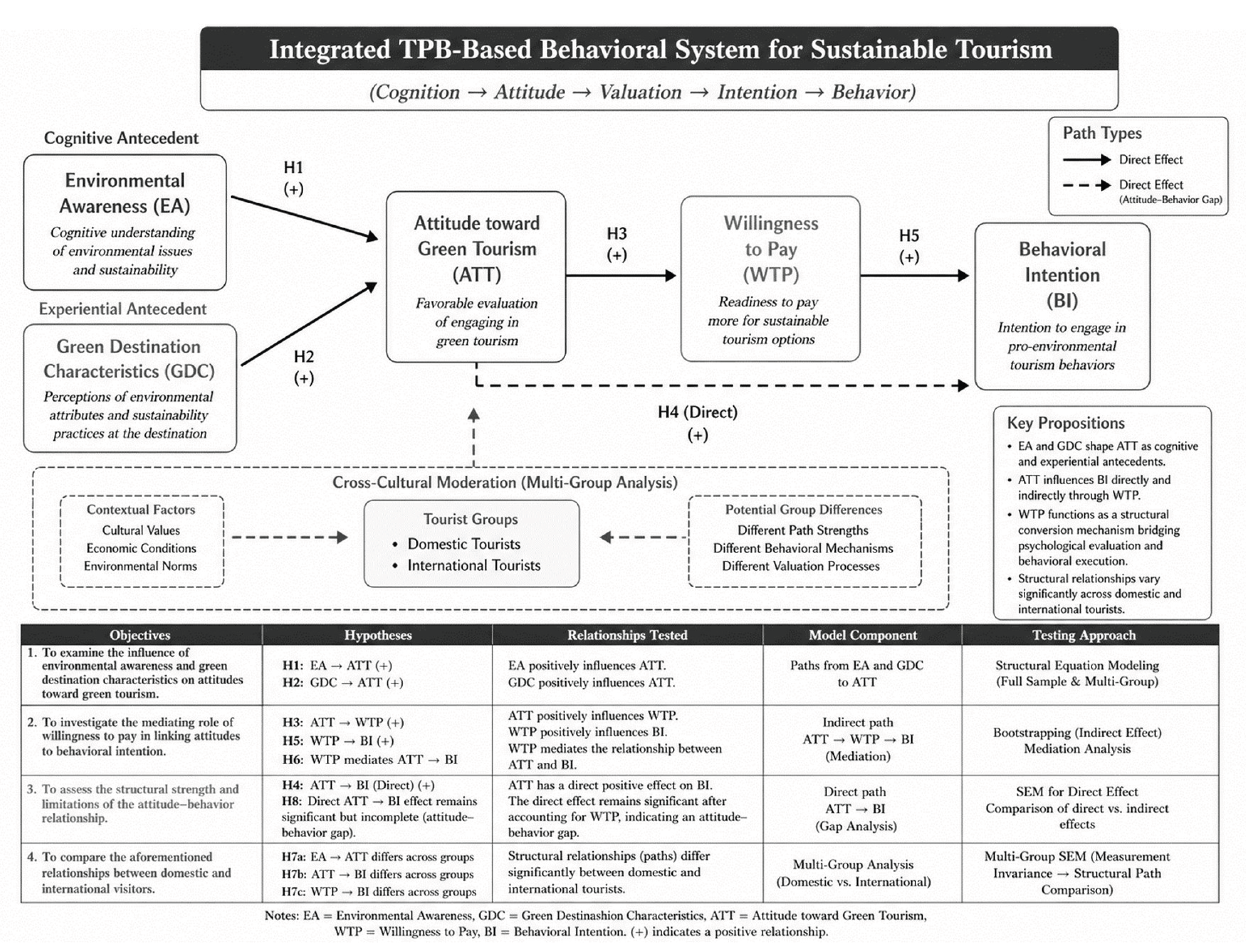
Table 1.
Demographic Characteristics of Thai and Foreign Tourists.
| Demographics | Thai Tourists (n1 = 200) |
Foreign Tourists (n2 = 200) |
Chi-square test Test Value/df |
|
|---|---|---|---|---|
| Gender | Male | 52 (26.0%) | 83 (41.5%) | χ² = 10.82, df = 2, p = 0.004 |
| Female | 146 (73.0%) | 113 (56.5%) | ||
| Prefer not to say | 2 (1.0%) | 4 (2.0%) | ||
| Age | Below 20 | 1 (0.5%) | 3 (1.5%) | χ² = 38.64, df = 5, p < 0.001 |
| 21–29 | 91 (45.5%) | 101 (50.5%) | ||
| 30–39 | 22 (11.0%) | 64 (32.0%) | ||
| 40–49 | 43 (21.5%) | 21 (10.5%) | ||
| 50–59 | 27 (13.5%) | 6 (3.0%) | ||
| 60 and above | 16 (8.0%) | 5 (2.5%) | ||
| Education | High School | 45 (22.5%) | 13 (6.5%) | χ² = 24.17, df = 4, p < 0.001 |
| Diploma / Vocational | 36 (18.0%) | 48 (24.0%) | ||
| Bachelor’s Degree | 112 (56.0%) | 122 (61.0%) | ||
| Master’s Degree | 5 (2.5%) | 17 (8.5%) | ||
| Others | 2 (1.0%) | 0 (0.0%) | ||
| Occupation | Government Officer | 40 (20.0%) | 57 (28.5%) | χ² = 23.95, df = 4, p < 0.001 |
| Business Owner | 35 (17.5%) | 57 (28.5%) | ||
| Company Employee | 94 (47.0%) | 58 (29.0%) | ||
| Student | 14 (7.0%) | 21 (10.5%) | ||
| Other / General Employee | 17 (8.5%) | 7 (3.5%) | ||
| Purpose of Travel | Leisure / Recreation | 165 (82.5%) | 141 (70.5%) | χ² = 24.59, df = 5, p < 0.001 |
| Business | 3 (1.5%) | 8 (4.0%) | ||
| Meeting / Seminar / Study Tour | 8 (4.0%) | 7 (3.5%) | ||
| Visit Relatives / Friends | 11 (5.5%) | 36 (18.0%) | ||
| Special Events (Concert, Sports) | 13 (6.5%) | 6 (3.0%) | ||
| Others | 0 (0.0%) | 2 (1.0%) | ||
| Total (n) = 400 | ||||
Table 3.
Discriminant Validity Assessment Using Fornell–Larcker Criterion.
| Constructs | EA | GDC | ATT | WTP | BI |
|---|---|---|---|---|---|
| Environmental Awareness (EA) | 0.82 | ||||
| Green Destination Characteristics (GDC) | 0.48 | 0.85 | |||
| Attitude toward Green Tourism (ATT) | 0.56 | 0.63 | 0.84 | ||
| Willingness to Pay (WTP) | 0.41 | 0.52 | 0.67 | 0.84 | |
| Behavioral Intention (BI) | 0.45 | 0.59 | 0.71 | 0.68 | 0.88 |
Note: Diagonal values (bold) represent the square root of AVE. Off-diagonal values represent inter-construct correlations.
Table 4.
Heterotrait–Monotrait Ratio (HTMT).
| Constructs | EA | GDC | ATT | WTP | BI |
|---|---|---|---|---|---|
| EA | — | ||||
| GDC | 0.52 | — | |||
| ATT | 0.61 | 0.74 | — | ||
| WTP | 0.47 | 0.66 | 0.78 | — | |
| BI | 0.50 | 0.69 | 0.81 | 0.76 | — |
Note: HTMT values below 0.85 indicate satisfactory discriminant validity.
Table 5.
Structural Model Assessment and Hypothesis Testing.
| Hypothesis | Structural Path | β | t-value | p-value | 95% Confidence Interval | Decision |
|---|---|---|---|---|---|---|
| H1 | EA → ATT | 0.312 | 5.87 | <0.001 | [0.201, 0.421] | Supported |
| H2 | GDC → ATT | 0.421 | 7.94 | <0.001 | [0.318, 0.528] | Supported |
| H3 | ATT → WTP | 0.538 | 10.21 | <0.001 | [0.441, 0.632] | Supported |
| H4 | ATT → BI | 0.402 | 6.88 | <0.001 | [0.291, 0.511] | Supported |
| H5 | WTP → BI | 0.289 | 5.73 | <0.001 | [0.176, 0.391] | Supported |
Note: EA = Environmental Awareness; GDC = Green Destination Characteristics; ATT = Attitude toward Green Tourism; WTP = Willingness to Pay; BI = Behavioral Intention. Bootstrap resampling = 5,000.
Table 6.
Mediation Analysis: Attitude–Behavior Gap Confirmation.
| Path Relationship | Direct Effect (β) | Indirect Effect via WTP (β) | t-value | p-value | Mediation Type |
|---|---|---|---|---|---|
| ATT → BI | 0.402 | — | 6.88 | <0.001 | Direct Effect Significant |
| ATT → WTP → BI | — | 0.155 | 4.97 | <0.001 | Partial Mediation |
Note: Indirect effect calculated as ATT → WTP × WTP → BI. Bootstrap resampling = 5,000.
Table 7.
Structural Dominance Ranking Based on Standardized Path Coefficients.
| Rank | Structural Path | Standardized Coefficient (β) | Effect Interpretation |
|---|---|---|---|
| 1 | ATT → WTP | 0.538 | Strongest Effect |
| 2 | GDC → ATT | 0.421 | Strong Effect |
| 3 | ATT → BI | 0.402 | Strong Effect |
| 4 | EA → ATT | 0.312 | Moderate Effect |
| 5 | WTP → BI | 0.289 | Moderate Effect |
Note:Ranking is based on standardized beta coefficients (β), allowing direct comparison of the relative structural importance of predictors within the model.
Table 8.
Explanatory Power of Endogenous Constructs.
| Endogenous Construct | R² Value | Interpretation |
|---|---|---|
| Attitude toward Green Tourism (ATT) | 0.51 | Moderate–Substantial |
| Willingness to Pay (WTP) | 0.47 | Moderate |
| Behavioral Intention (BI) | 0.63 | Substantial |
Note: Interpretation based on the guidelines of Wynne (1998) and Hair Jr. et al. (2019).
Table 9.
Effect Size (f²) and Predictive Relevance (Q²).
| Structural Relationship / Endogenous Construct | f² Value | Effect Size Interpretation | Q² Value | Predictive Relevance |
|---|---|---|---|---|
| ATT → WTP | 0.36 | Strong | — | — |
| GDC → ATT | 0.28 | Moderate–Strong | — | — |
| ATT → BI | 0.25 | Moderate–Strong | — | — |
| WTP → BI | 0.18 | Moderate | — | — |
| EA → ATT | 0.14 | Moderate | — | — |
| ATT | — | — | 0.31 | Strong |
| WTP | — | — | 0.28 | Moderate–Strong |
| BI | — | — | 0.42 | Strong |
Note:Effect size interpretation follows the guidelines of Jacob Cohen (1988), where f² values of 0.02, 0.15, and 0.35 indicate small, medium, and large effects, respectively. Q² values greater than zero indicate predictive relevance and out-of-sample explanatory capability.
Table 10.
PLSpredict Results.
| Endogenous Construct | Q² predict | PLS-SEM RMSE | Linear Model (LM) RMSE | Predictive Assessment |
|---|---|---|---|---|
| Attitude toward Green Tourism (ATT) | 0.27 | 0.612 | 0.684 | PLS-SEM Performs Better |
| Willingness to Pay (WTP) | 0.24 | 0.587 | 0.653 | PLS-SEM Performs Better |
| Behavioral Intention (BI) | 0.36 | 0.541 | 0.627 | PLS-SEM Performs Better |
Note: Positive Q²_predict values indicate predictive relevance. Lower RMSE values in PLS-SEM relative to the linear benchmark model (LM) indicate superior predictive accuracy.
Table 11.
Mediation Analysis Results.
| Mediation Path | Direct Effect (β) | Indirect Effect (β) |
t-value | p-value | VAF (%) | Mediation Type |
|---|---|---|---|---|---|---|
| ATT → BI | 0.402 | — | 6.88 | <0.001 | — | Direct Effect Significant |
| ATT → WTP → BI | — | 0.155 | 4.97 | <0.001 | 27.8% | Partial Mediation |
Note: VAF (Variance Accounted For) = Indirect Effect / Total Effect × 100. VAF values between 20% and 80% indicate partial mediation.
Table 12.
MICOM Results.
| MICOM Assessment Criteria | Result | Decision |
|---|---|---|
| Configural Invariance | Established | Satisfied |
| Compositional Invariance | Established (p > 0.05) | Satisfied |
| Equality of Means and Variances | Partially Established | Acceptable |
Note: Partial measurement invariance permits statistically valid Multi-Group Analysis (MGA).
Table 13.
Multi-Group Analysis Results.
| Hypothesis | Structural Path | Domestic Tourists (β) | International Tourists (β) | Δβ | p-value | Decision |
|---|---|---|---|---|---|---|
| H7a | EA → ATT | 0.341 | 0.298 | 0.043 | 0.047 | Supported |
| H7b | ATT → BI | 0.332 | 0.451 | 0.119 | 0.021 | Supported |
| H7c | WTP → BI | 0.226 | 0.341 | 0.115 | 0.008 | Supported |
| H8 | Cross-cultural moderation effect | — | — | — | <0.05 | Supported |
Note: MGA significance assessed using Henseler’s MGA procedure at p < 0.05.
Table 14.
Robustness Check Results.
| Robustness Indicator | Threshold / Criterion | Result | Interpretation |
|---|---|---|---|
| Variance Inflation Factor (VIF) | VIF < 3.3 | 1.42 – 2.87 | No Multicollinearity |
| Bootstrapping Stability | Stable across 5,000 resamples | Confirmed | Stable Parameter Estimates |
| Subgroup Structural Consistency | Comparable structural direction | Confirmed | Consistent MGA Patterns |
| PLSpredict Performance | PLS RMSE < LM RMSE | Confirmed | Strong Predictive Validity |
| Suppression / Sign Reversal Effects | No sign inconsistency | None Detected | Stable Structural Relationships |
Disclaimer/Publisher’s Note: The statements, opinions and data contained in all publications are solely those of the individual author(s) and contributor(s) and not of MDPI and/or the editor(s). MDPI and/or the editor(s) disclaim responsibility for any injury to people or property resulting from any ideas, methods, instructions or products referred to in the content. |
© 2026 by the authors. Licensee MDPI, Basel, Switzerland. This article is an open access article distributed under the terms and conditions of the Creative Commons Attribution (CC BY) license (http://creativecommons.org/licenses/by/4.0/).
Copyright: This open access article is published under a Creative Commons CC BY 4.0 license, which permit the free download, distribution, and reuse, provided that the author and preprint are cited in any reuse.


