
Submitted:
13 July 2026
Posted:
15 July 2026
You are already at the latest version
Abstract
We show that a logarithmic gravitational potential emerges from the classical phase-space geometry of the Keplerian 1/r interaction together with a phenomenological weak-field statistical ansatz. The number of accessible phase-space cells in a 1/r potential scales as N(r)∝rη, where η is determined by the effective dimension of accessible action space (η=1 for rotationally constrained disks, η=3/2 for isotropic spherical systems), yielding a logarithmic Boltzmann entropy S(r)∼ηkBlnr for any η. The effective logarithmic potential then follows from the potential of mean force after integrating out internal Keplerian phase-space degrees of freedom, F=ΦN−ΘHσ, where the effective energy scale ΘH is identified with the depth of the Newtonian potential well at the cosmological transition radius, introducing no free parameters. The resulting framework naturally reproduces flat galactic rotation curves, the baryonic Tully–Fisher relation vc4=GMba0 where a0∼cH0 is the empirical BTFR acceleration scale, and the weak-field lensing signature of isothermal halos. Three parameter-free comparisons against 357 unique galaxies from the SPARC and ATLAS3D surveys confirm the predicted scalings, including a parameter-free prediction for the velocity dispersion of early-type galaxies (σ/e4=3/8GMba0, R2=0.856, N=231), whose coefficient arises from an η=3/2 isotropic action-space geometry distinct from the η=1 disk relation. The framework is developed as a phenomenological statistical theory and does not claim to replace a complete microscopic description of dark matter at all scales.
Keywords:
dark matter
; galactic rotation curves
; entropic gravity
; baryonic Tully–Fisher relation
; phase space
; MOND
1. Introduction
1.1. The Galactic-Scale Problem
The discrepancy between the observed dynamics of galaxies and the gravitational field inferred from their visible baryonic content is one of the central open problems of modern astrophysics. In spiral galaxies, the circular velocity of stars and gas does not decrease at large radii according to the Keplerian expectation [1,2]. Instead, rotation curves typically approach an approximately constant value over an extended radial range,
in contradiction with the Newtonian prediction
generated by a centrally concentrated baryonic mass .
Within the standard cosmological framework, this discrepancy is attributed to a dominant non-luminous matter component—dark matter—whose halo dominates the gravitational field at large radii [3]. However, the discrepancy is not arbitrary: the transition from baryon-dominated to dark-matter-like behaviour occurs systematically in low-acceleration regions, tightly correlated with the baryonic distribution [6,7]. This regularity suggests that the observed phenomenology may reflect an effective large-scale gravitational regime rather than the independent distribution of an additional component.
1.2. The Baryonic Tully–Fisher Relation and the Cosmological Acceleration Scale
The most important empirical regularity is the baryonic Tully–Fisher relation [4] (BTFR),
where is a characteristic acceleration scale empirically found to be [5]
Remarkably, this value coincides numerically with the cosmological acceleration scale , where is the present-day Hubble parameter [6]. This coincidence, noted early in the MOND literature [8,10], strongly suggests that the weak-field galactic regime is coupled to the large-scale cosmological background.
1.3. Motivation: A Statistical Approach
In ordinary statistical mechanics, macroscopic laws emerge from the organisation of microscopic degrees of freedom. For a gas, the Maxwell–Boltzmann distribution arises from maximising entropy subject to an energy constraint; for quantum systems, the Fermi–Dirac and Bose–Einstein distributions follow from the statistics of state occupation. In all cases, the key object is not a force law imposed by hand but a state-counting function—the density of states or the number of accessible configurations—from which a distribution, and hence an effective dynamics, emerges.
We ask whether galactic dynamics admits an analogous description. The idea that gravity itself may have an entropic or thermodynamic origin has been explored from several directions [12,15,16], and entropic interpretations of the dark-matter phenomenology have been proposed in the context of emergent gravity [13]. The observable we wish to reproduce is a logarithmic effective potential,
since immediately generates the force law required by flat rotation curves. The problem therefore reduces to identifying a state-counting function such that
The central result of this paper is that , where is determined by the effective dimension of accessible action space, follows from the classical phase-space geometry of the Keplerian potential together with a phenomenological weak-field statistical ansatz.
1.4. Outline
Section 2 lists the phenomenological targets. Section 3 derives the logarithmic entropy from classical Keplerian phase space. Section 4 constructs the effective potential and fixes its amplitude. Section 5 identifies the transition radius and domain of validity. Section 6 works out the lensing predictions. Section 7 develops and tests the prediction for early-type galaxies. Section 8 discusses the physical picture, relation to MOND and emergent gravity, and open questions. Section 9 concludes.
2. Phenomenological Targets
Any viable framework must simultaneously satisfy the following constraints.
- Asymptotic flatness. For circular motion, . Constant requires .
- Newtonian limit. In the high-acceleration regime the framework must reduce to standard Newtonian gravity.
- Finite mass configurations. The effective density profile must not produce divergent total mass without a natural physical cut-off.
3. Derivation of the Logarithmic Entropy from Keplerian Phase Space
We now derive from the classical phase-space geometry of the gravitational potential. This derivation does not assume flat rotation curves; it follows entirely from the Keplerian problem.
3.1. Virial Scaling and the Orbital Radius–Energy Relation
3.2. Scaling of the Classical Radial Action
The characteristic radial momentum at energy E follows from the virial theorem: . A characteristic radial action is
giving
3.3. Action-Space Volume Counting and
We count accessible phase-space cells using the Liouville measure in action-angle variables [25,27]. For a spherically symmetric potential the full phase-space volume element is , where are the three action variables. Integrating over the angles yields
where is the accessible action-space region at energy E. For the Keplerian problem the energy depends only on the combination [25,26],
so fixed energy constrains .
3.3.0.1. Two-dimensional action space (disk galaxies).
For a rotationally coherent disk galaxy is effectively constrained, leaving as the two independent accessible actions. The accessible region is the triangle , whose area is . Therefore
3.3.0.2. Three-dimensional action space (spherical systems).
For a fully isotropic spherical system ranges over , contributing an additional factor , giving
3.3.0.3. General result.
Both cases are captured by the single scaling
where d is the effective dimension of accessible action space: for a disk and for a spherical system. Using the virial relation from Equation (8),
3.4. Emergence of the Logarithmic Entropy
Applying Boltzmann’s relation to Equation (16),
The entropy is logarithmic in radius for any value of d. The coefficient depends on geometry: for a disk and for a spherical system. The complete logical chain is
4. The Effective Statistical Potential
4.1. Free Energy from Coarse-Graining: The Potential of Mean Force
We define the dimensionless radial entropy
so that exactly. In the weak-field statistical regime the probability of finding the tracer near radius r is
where is an effective energy scale per unit mass (units of velocity squared) and the effective free energy per unit mass is
The Boltzmann-like weighting here should be interpreted as a phenomenological coarse-grained statistical description and is not claimed to arise from thermal equilibrium in the ordinary kinetic sense. Self-gravitating systems possess negative specific heat and no global entropy maximum, so is an effective coarse-graining energy scale rather than a thermodynamic temperature, and Equation (20) is an effective-ensemble ansatz rather than a theorem. The state count is obtained from single-particle Keplerian orbits; the assumption that the same weighting survives the many-body, partially relaxed dynamics of a real galaxy is the central open premise of the construction (Section 8.6).
This is the potential of mean force [30,31]: the effective potential governing the radial coordinate after the internal phase-space degrees of freedom have been integrated out. The analogy with the Born–Oppenheimer approximation [32] is precise: fast electronic degrees of freedom are integrated out leaving an effective potential for slow nuclear coordinates; here, the fast internal phase-space configurations are integrated out leaving for the slow radial coordinate. The effective force per unit mass follows directly:
Using , so that , the entropic contribution is
with the corresponding entropic potential
4.2. The Effective Energy Scale and Its Physical Origin
An additional physical input is required to fix the amplitude and determine when the statistical contribution becomes dynamically relevant. The activation of the weak-field statistical regime is assumed to occur when the local Newtonian acceleration becomes comparable to the cosmological infrared acceleration scale,
This condition is phenomenological in nature, analogous in its logical role to the critical acceleration of MOND, and its deeper microscopic origin remains an open problem (Section 8.2). This activation condition defines the crossover radius via
Evaluating the Newtonian binding energy per unit mass at this radius gives
is the unique gravitational binding-energy scale associated with the activation radius—the depth of the Newtonian potential well at the boundary between Keplerian confinement and the weak-field statistical regime.
4.3. The Effective Free Energy and the Statistical Potential
Substituting Equation (27) into Equation (21), the complete effective free energy per unit mass in the weak-field regime is
The entropic contribution,
has amplitude fixed by the activation condition (25) with no additional free parameters beyond . The resulting acceleration law is
and the circular velocity satisfies , so that squaring gives
recovering the BTFR with no free parameters. Figure 1 shows the theoretical prediction plotted against 126 SPARC galaxies [6,7] spanning four decades in baryonic mass, with scatter 0.066 dex and mean offset 0.040 dex.
5. Transition Scale and Domain of Validity
5.1. Two Dynamical Regimes
In the inner Newtonian regime the statistical contribution is negligible. In the outer weak-field regime the effective logarithmic potential dominates and produces flat rotation curves.
5.2. Liouville Consistency in the Weak-Field Regime
For a collisionless self-gravitating system, Liouville’s theorem states that the phase-space distribution function is conserved along trajectories: . In the regime where is approximately constant, the characteristic radial momentum is also approximately constant, so
consistent with Equations (10) and (16). This provides a self-consistency check for the flat-curve regime.
5.3. Outer Cut-Off
The effective density implies , which diverges as . The logarithmic potential is therefore an effective description valid over a finite radial range . The outer cut-off is expected to arise from the finite spatial extent of the galaxy, interactions with the cosmic web, or the breakdown of the scale-free Keplerian regime at cosmological scales. Its derivation from first principles is left to future work.
5.4. Observational Test: Predicted vs. Observed Transition Radius
The transition radius
is a parameter-free prediction depending only on total baryonic mass and [6]. Figure 2 compares to the observed rotation curve flattening radius for 47 SPARC galaxies [6,7]. The correlation has () with scatter 0.22 dex and best-fit proportionality . The slope has no free parameters; the factor between and reflects the onset vs. completion of the entropic regime.
6. Gravitational Lensing
6.1. Effective Density Profile
Within standard General Relativity, the effective potential is interpreted through the weak-field Poisson equation . For a spherically symmetric potential, with ,
an isothermal-like profile known to produce flat rotation curves.
6.2. Enclosed Mass
giving , consistent with Equation (23).
6.3. Projected Surface Density and Deflection Angle
The projected surface density at impact parameter b is
so . In the weak-field limit of General Relativity [19] the deflection angle is
The deflection angle is independent of impact parameter throughout the logarithmic-potential regime, reproducing the same qualitative signature as an isothermal dark-matter halo [18].
7. Prediction for Early-Type Galaxies:
7.1. Velocity Dispersion Scaling for Isotropic Systems
For pressure-supported, approximately isotropic early-type galaxies (ellipticals and lenticulars), the full three-dimensional action space is accessible and . The framework therefore predicts for such systems. For an isotropic pressure-supported system, the Jeans equation gives [18]
so that
where [6]. This prediction contains no free parameters. The factor arises entirely from (via ) and the standard isotropic Jeans projection factor .
The relationship of Equation (41) to MOND deserves clarification. MOND also predicts mass–velocity-dispersion relations for pressure-supported systems [8,11], so a scaling of the form is not unique to the present framework. The distinction lies in the origin of the coefficient: here arises directly from the geometry of the accessible action space through , with for disk systems and for isotropic spheroidal systems, requiring no modification of the gravitational field equations.
7.2. Comparison with ATLAS Data
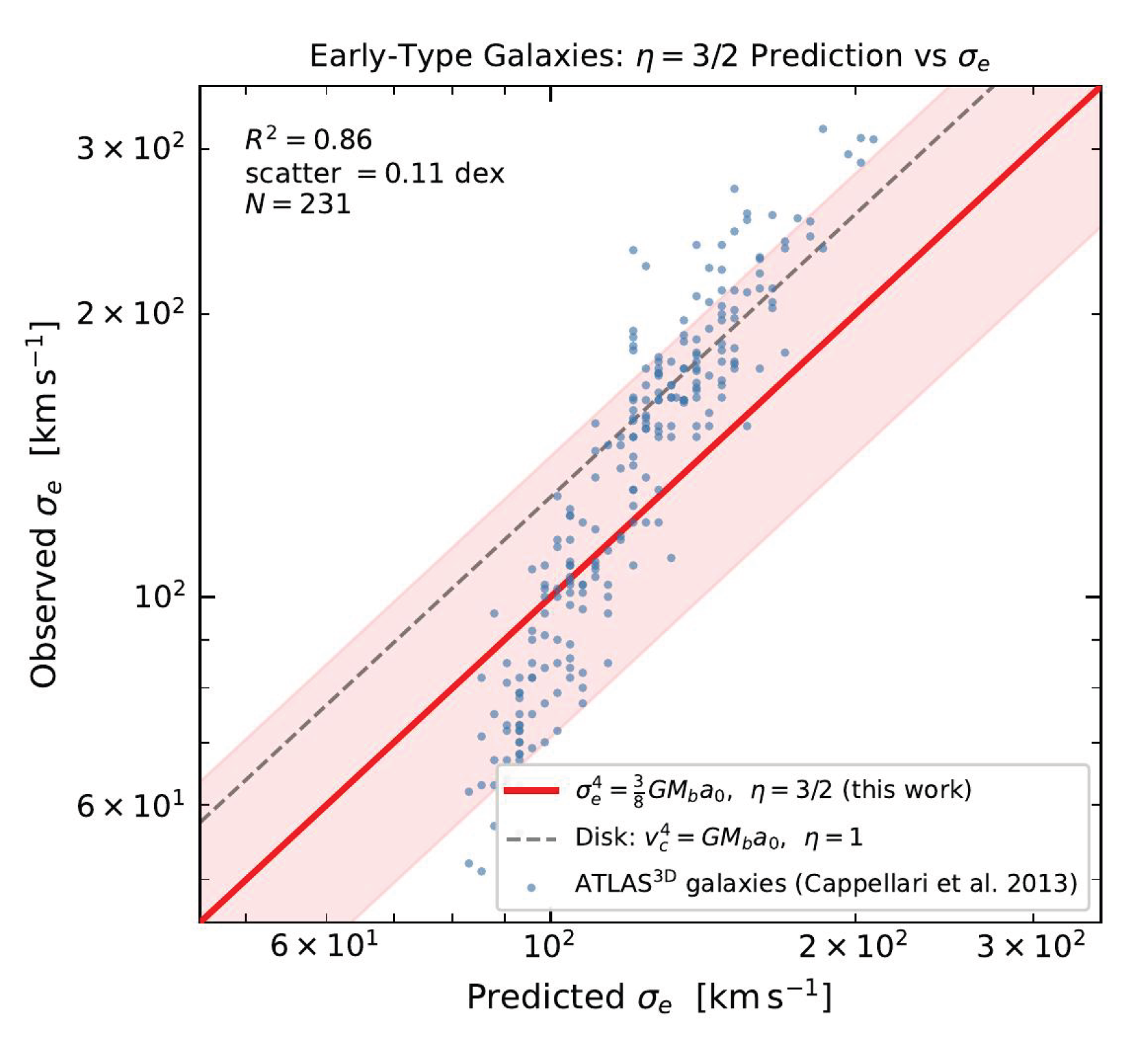
Figure 3 shows the predicted from Equation (41) compared to observed effective velocity dispersions for 231 early-type galaxies from the full ATLAS survey [23], covering the mass range –.
The correlation has () with scatter 0.105 dex about the 1:1 line and mean offset 0.039 dex—the prediction is essentially unbiased across the full mass range. The (disk) prediction systematically underpredicts , confirming that the branch is physically appropriate for isotropic pressure-supported systems.
A systematic uncertainty limits the precision with which the coefficient itself can be tested: the stellar masses adopt a Chabrier IMF, and a Salpeter-scale shift ( dex in ) would move the predicted by the same amount ( dex in ). A fully quantitative discrimination between the coefficient and nearby alternatives requires control of the mass-to-light ratio below this level together with individual Jeans modelling.
8. Discussion
8.1. Physical Picture
The construction developed here proposes that the outer regions of galaxies enter a distinct statistical regime when the local Newtonian acceleration falls below the cosmological scale . In this regime the number of accessible phase-space configurations grows as , yielding a logarithmic entropy regardless of the precise value of . This logarithmic entropy, via the potential of mean force, produces an effective potential whose amplitude is fixed by the depth of the Newtonian potential well at the transition radius. No new matter component, no modification of the gravitational field equations, and no free dynamical parameter is introduced.
8.2. Why Does the Statistical Regime Activate at ?
Two physical considerations motivate the appearance of the same transition scale.
Binding-energy threshold. The Newtonian binding energy per unit mass at is . This is the gravitational potential energy at the edge of local gravitational dominance—the point beyond which orbits become weakly bound enough that the accessible Keplerian phase-space volume becomes dynamically relevant.
Broader context. A de Sitter universe with Hubble rate possesses a cosmological horizon and an associated Gibbons–Hawking temperature [33] . Although the present framework is entirely classical, this suggests that may mark the onset of cosmological phase-space accessibility in a deeper quantum-gravitational sense.
8.3. CMB Safety and Domain of Activation
The framework is expected to leave early-universe linear perturbation physics approximately unchanged because its derivation presupposes virialized Keplerian structure. The entire chain in Equation (18) presupposes an orbit, a radial action integral, and a virialized gravitational system—none of which apply to the photon-baryon plasma at recombination. The entropic correction activates only after structure formation and virialization, when inside a bound, relaxed gravitational system. This distinguishes the present approach from modifications of the gravitational field equations, which necessarily affect linear perturbation theory [34].
8.4. Relation to MOND
MOND [8,9,10] reproduces flat rotation curves and the BTFR for the same phenomenological reasons as the present framework. The key differences are: (i) MOND modifies the gravitational or inertial law at the level of the equations of motion, whereas the present framework interprets the additional acceleration as an entropic contribution without modifying field equations; (ii) the present framework identifies a specific microscopic origin for the acceleration scale in the phase-space geometry of the potential and its relationship to ; (iii) the additional acceleration here arises as an effective statistical contribution associated with virialized Keplerian systems, rather than from a modification of the fundamental gravitational field equations. Because the construction is formulated only after the emergence of bound gravitational structures, its expected cosmological domain of applicability differs from that of relativistic MOND theories.
8.5. Relation to Verlinde’s Emergent Gravity
Verlinde [12,13] proposed that gravity and dark matter are emergent phenomena arising from entropic considerations. The present framework shares the entropic interpretation but differs in its microscopic foundation: the logarithmic entropy here is derived from the classical phase-space geometry of the potential rather than from the holographic entropy of de Sitter space. Both frameworks make similar predictions at the galactic scale and both require further development to address cluster and cosmological scales [14].
8.6. Limitations and Open Questions
Microscopic completeness. The phase-space derivation identifies from single-particle Keplerian orbits. A complete treatment requires showing that this scaling survives many-body self-gravitating dynamics, including incomplete relaxation and non-spherical geometries.
Galaxy clusters. The framework has been developed for isolated, virialized spiral galaxies. Whether the same phase-space counting applies to triaxial, gas-pressure-supported cluster systems, and whether it can account for the residual mass discrepancy in clusters such as the Bullet Cluster [20,21], requires separate analysis.
Intermediate structure formation. Between recombination and full virialization the framework’s status is genuinely ambiguous. The precise redshift and density threshold at which the entropic correction switches on, and its effect on the matter power spectrum [24] at –5, are open questions.
Outer cut-off. The logarithmic potential must be truncated at some scale to avoid divergent total mass. Its derivation from the underlying physics is an open problem.
Derivation of the effective energy scale. The identification is physically motivated, but a derivation from a microscopic statistical mechanics of the cosmological environment remains an open problem.
9. Conclusions
We have shown that a logarithmic radial entropy follows directly from the classical phase-space geometry of the Keplerian gravitational potential, without assuming flat rotation curves. The effective potential then follows from the potential of mean force after integrating out internal Keplerian phase-space degrees of freedom, with effective energy scale fixed by the depth of the Newtonian potential well at the cosmological transition radius. The central chain of reasoning is
Three parameter-free comparisons against real data confirm the predicted scalings:
- BTFR: 126 SPARC galaxies, scatter 0.066 dex;
- Transition radius scaling : 47 SPARC galaxies, ;
- Early-type galaxy velocity dispersion : 231 ATLAS galaxies, .
The last result is a parameter-free prediction with a specific, testable coefficient whose geometric origin—the branching between disk () and spheroidal () systems—is a structurally distinctive feature of the present construction. Its normalisation () differs from the deep-MOND isothermal value ( for the line-of-sight dispersion) and is offered as a falsifiable alternative. The framework is expected to leave early-universe linear perturbation physics approximately unchanged because its derivation presupposes virialized Keplerian structure, distinguishing it from modifications of the gravitational field equations. The principal open questions for future work are the behaviour in the quasi-linear structure formation regime, the application to galaxy clusters, and the derivation of and from first principles.
Author Contributions
Conceptualization, Y.H.; methodology, Y.H.; formal analysis, Y.H.; investigation, Y.H.; writing—original draft preparation, Y.H.; writing—review and editing, Y.H.; visualization, Y.H. The author has read and agreed to the published version of the manuscript.
Funding
This research received no external funding.
Data Availability Statement
Conflicts of Interest
The author declares no conflicts of interest.
References
- Rubin, V.C.; Ford, W.K. Rotation of the Andromeda Nebula from a Spectroscopic Survey of Emission Regions. Astrophys. J. 1970, 159, 379–391. [Google Scholar] [CrossRef]
- Rubin, V.C.; Ford, W.K.; Thonnard, N. Rotational Properties of 21 Sc Galaxies with a Large Range of Luminosities and Radii. Astrophys. J. 1980, 238, 471–487. [Google Scholar] [CrossRef]
- Bertone, G.; Hooper, D.; Silk, J. Particle Dark Matter: Evidence, Candidates and Constraints. Phys. Rep. 2005, 405, 279–390. [Google Scholar] [CrossRef]
- Tully, R.B.; Fisher, J.R. A New Method of Determining Distances to Galaxies. Astron. Astrophys. 1977, 54, 661–673. [Google Scholar]
- McGaugh, S.S. The Baryonic Tully–Fisher Relation of Gas-Rich Galaxies as a Test of ΛCDM and MOND. Astron. J. 2012, 143, 40. [Google Scholar] [CrossRef]
- McGaugh, S.S.; Lelli, F.; Schombert, J.M. Radial Acceleration Relation in Rotationally Supported Galaxies. Phys. Rev. Lett. 2016, 117, 201101. [Google Scholar] [CrossRef] [PubMed]
- Lelli, F.; McGaugh, S.S.; Schombert, J.M.; Pawlowski, M.S. One Law to Rule Them All: The Radial Acceleration Relation of Galaxies. Astrophys. J. 2017, 836, 152. [Google Scholar] [CrossRef]
- Milgrom, M. A Modification of the Newtonian Dynamics as a Possible Alternative to the Hidden Mass Hypothesis. Astrophys. J. 1983, 270, 365–370. [Google Scholar] [CrossRef]
- Sanders, R.H.; McGaugh, S.S. Modified Newtonian Dynamics as an Alternative to Dark Matter. Annu. Rev. Astron. Astrophys. 2002, 40, 263–317. [Google Scholar] [CrossRef]
- Famaey, B.; McGaugh, S.S. Modified Newtonian Dynamics (MOND): Observational Phenomenology and Relativistic Extensions. Living Rev. Relativ. 2012, 15, 10. [Google Scholar] [CrossRef] [PubMed]
- McGaugh, S.S.; Milgrom, M. Andromeda Dwarfs in Light of MOND. Astrophys. J. 2013, 766, 22. [Google Scholar] [CrossRef]
- Verlinde, E. On the Origin of Gravity and the Laws of Newton. J. High Energy Phys. 2011, 2011, 29. [Google Scholar] [CrossRef]
- Verlinde, E. Emergent Gravity and the Dark Universe. SciPost Phys. 2017, 2, 016. [Google Scholar] [CrossRef]
- Hossenfelder, S. Covariant Version of Verlinde’s Emergent Gravity. Phys. Rev. D. 2017, 95, 124018. [Google Scholar] [CrossRef]
- Jacobson, T. Thermodynamics of Spacetime: The Einstein Equation of State. Phys. Rev. Lett. 1995, 75, 1260–1263. [Google Scholar] [CrossRef] [PubMed]
- Padmanabhan, T. Thermodynamical Aspects of Gravity: New Insights. Rep. Prog. Phys. 2010, 73, 046901. [Google Scholar] [CrossRef]
- Bekenstein, J.D. Relativistic Gravitation Theory for the Modified Newtonian Dynamics Paradigm. Phys. Rev. D. 2004, 70, 083509. [Google Scholar] [CrossRef]
- Binney, J.; Tremaine, S. Galactic Dynamics, 2nd ed.; Princeton University Press: Princeton, NJ, USA, 2008. [Google Scholar]
- Bartelmann, M.; Schneider, P. Weak Gravitational Lensing. Phys. Rep. 2001, 340, 291–472. [Google Scholar] [CrossRef]
- Markevitch, M.; Gonzalez, A.H.; Clowe, D.; Vikhlinin, A.; Forman, W.; Jones, C.; Murray, S.; Tucker, W. Direct Constraints on the Dark Matter Self-Interaction Cross Section from the Merging Galaxy Cluster 1E 0657-56. Astrophys. J. 2004, 606, 819–824. [Google Scholar] [CrossRef]
- Clowe, D.; Bradač, M.; Gonzalez, A.H.; Markevitch, M.; Randall, S.W.; Jones, C.; Zaritsky, D. A Direct Empirical Proof of the Existence of Dark Matter. Astrophys. J. 2006, 648, L109–L113. [Google Scholar] [CrossRef]
- Aghanim; N.; et al. (Planck Collaboration); et al. Planck 2018 Results. VI. Cosmological Parameters. Astron. Astrophys. 2020, 641, A6. [Google Scholar] [CrossRef]
- Cappellari, M.; et al. The ATLAS3D Project – XX. Mass–Size and Mass–σ Distributions of Early-Type Galaxies. Mon. Not. R. Astron. Soc. 2013, 432, 1862–1893. [Google Scholar] [CrossRef]
- Springel, V.; Frenk, C.S.; White, S.D.M. The Large-Scale Structure of the Universe. Nature 2006, 440, 1137–1144. [Google Scholar] [CrossRef] [PubMed]
- Goldstein, H.; Poole, C.; Safko, J. Classical Mechanics, 3rd ed.; Addison-Wesley: San Francisco, CA, USA, 2002. [Google Scholar]
- Landau, L.D.; Lifshitz, E.M. Mechanics, 3rd ed.; Butterworth-Heinemann: Oxford, UK, 1976. [Google Scholar]
- Arnold, V.I. Mathematical Methods of Classical Mechanics, 2nd ed.; Springer: New York, NY, USA, 1989. [Google Scholar]
- Griffiths, D.J.; Schroeter, D.F. Introduction to Quantum Mechanics, 3rd ed.; Cambridge University Press: Cambridge, UK, 2018. [Google Scholar]
- Landau, L.D.; Lifshitz, E.M. Quantum Mechanics: Non-Relativistic Theory, 3rd ed.; Butterworth-Heinemann: Oxford, UK, 1977. [Google Scholar]
- Chandler, D. Introduction to Modern Statistical Mechanics; Oxford University Press: New York, NY, USA, 1987. [Google Scholar]
- Zwanzig, R. Nonequilibrium Statistical Mechanics; Oxford University Press: New York, NY, USA, 2001. [Google Scholar]
- Born, M.; Oppenheimer, R. Zur Quantentheorie der Molekeln. Ann. Phys. 1927, 389, 457–484. [Google Scholar] [CrossRef]
- Gibbons, G.W.; Hawking, S.W. Cosmological Event Horizons, Thermodynamics, and Particle Creation. Phys. Rev. D. 1977, 15, 2738–2751. [Google Scholar] [CrossRef]
- Clifton, T.; Ferreira, P.G.; Padilla, A.; Skordis, C. Modified Gravity and Cosmology. Phys. Rep. 2012, 513, 1–189. [Google Scholar] [CrossRef]
Figure 1.
Baryonic Tully–Fisher relation for 126 SPARC galaxies [6,7] spanning four decades in baryonic mass (–). Baryonic masses are computed as with [6] for the Spitzer 3.6 m band, plus the H i gas mass. Red line: the parameter-free theoretical prediction , where [6] is identified with . Scatter: 0.066 dex; mean offset: 0.040 dex; , no fitted parameters.
Figure 1.
Baryonic Tully–Fisher relation for 126 SPARC galaxies [6,7] spanning four decades in baryonic mass (–). Baryonic masses are computed as with [6] for the Spitzer 3.6 m band, plus the H i gas mass. Red line: the parameter-free theoretical prediction , where [6] is identified with . Scatter: 0.066 dex; mean offset: 0.040 dex; , no fitted parameters.
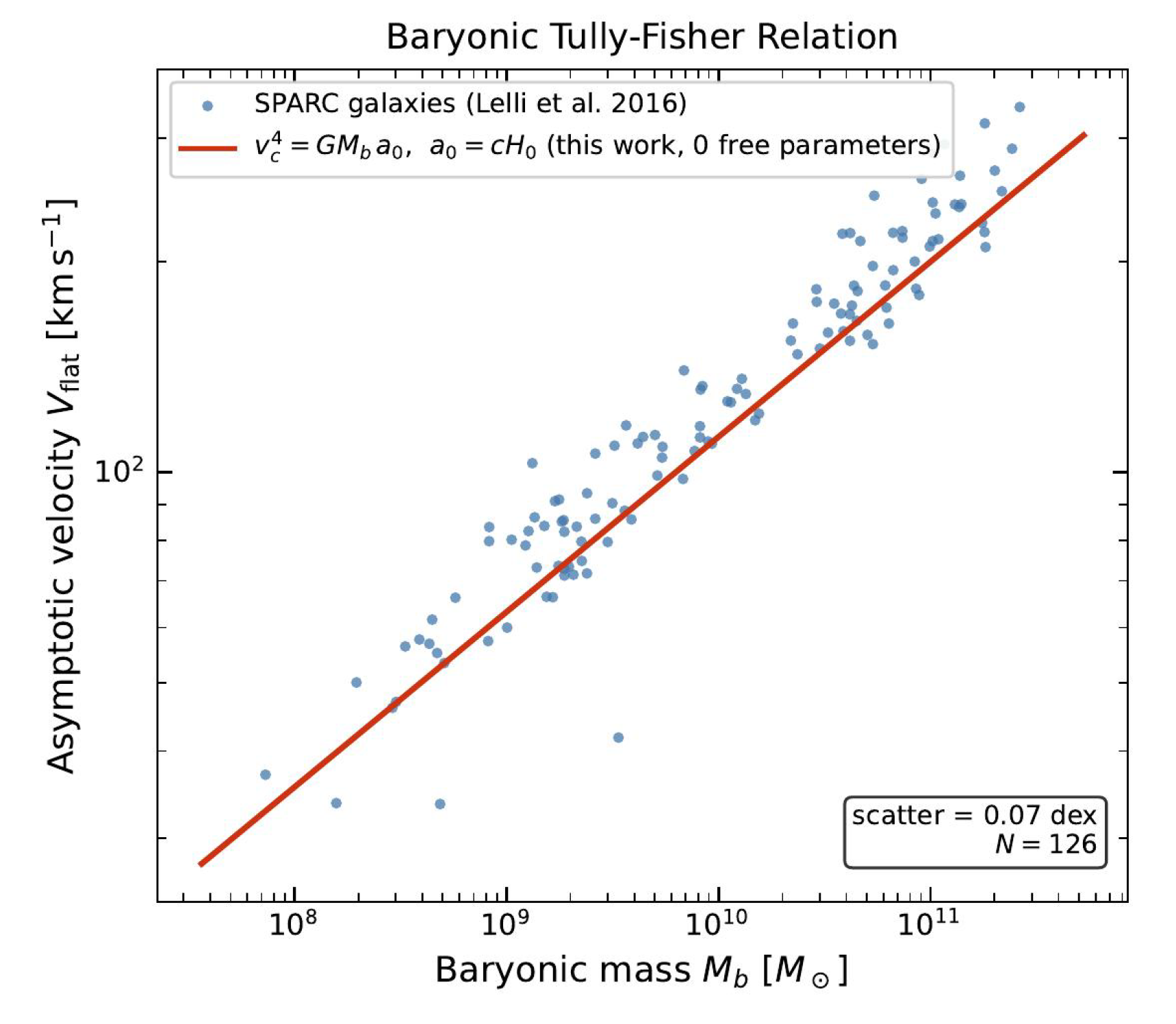
Figure 2.
Predicted vs. observed rotation curve flattening radius for 47 SPARC galaxies [6,7]. Horizontal axis: the parameter-free prediction . Vertical axis: observed , the radius at which the rotation curve reaches its asymptotic value to within 5%. Red line: best-fit proportionality ; shaded band: dex. Dashed line: 1:1 reference. Statistics: , , scatter 0.22 dex, no fitted parameters in the slope.
Figure 2.
Predicted vs. observed rotation curve flattening radius for 47 SPARC galaxies [6,7]. Horizontal axis: the parameter-free prediction . Vertical axis: observed , the radius at which the rotation curve reaches its asymptotic value to within 5%. Red line: best-fit proportionality ; shaded band: dex. Dashed line: 1:1 reference. Statistics: , , scatter 0.22 dex, no fitted parameters in the slope.
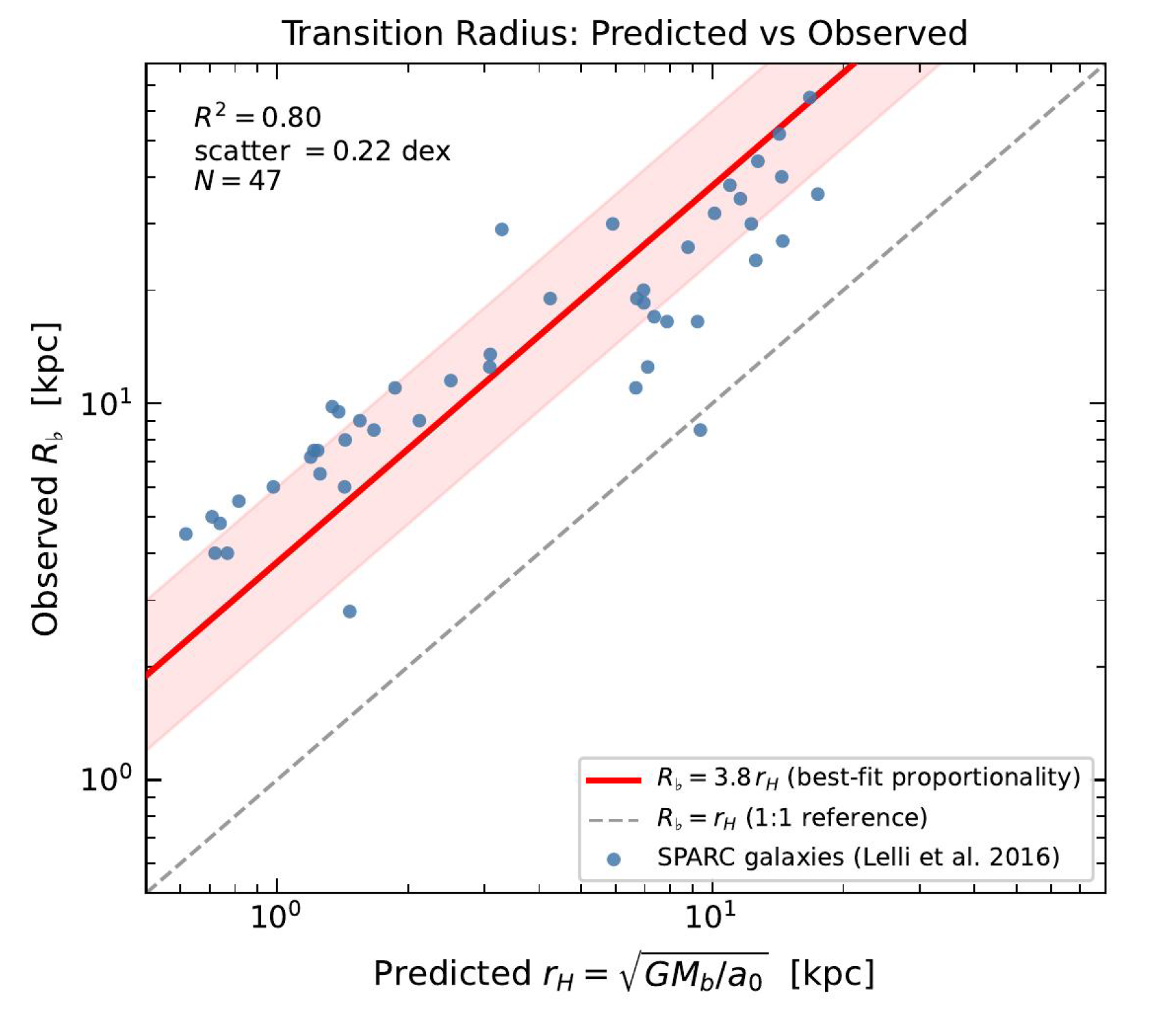
Figure 3.
Predicted vs. observed line-of-sight velocity dispersion for 231 early-type galaxies from the full ATLAS survey [23]. Stellar masses from JAM dynamical modelling with a Chabrier IMF; is the effective velocity dispersion within the half-light radius . Red solid line: the parameter-free prediction (). Shaded band: dex. Black dashed line: disk prediction (), which systematically underpredicts . Statistics: , scatter dex, mean offset dex, , no fitted parameters.
Figure 3.
Predicted vs. observed line-of-sight velocity dispersion for 231 early-type galaxies from the full ATLAS survey [23]. Stellar masses from JAM dynamical modelling with a Chabrier IMF; is the effective velocity dispersion within the half-light radius . Red solid line: the parameter-free prediction (). Shaded band: dex. Black dashed line: disk prediction (), which systematically underpredicts . Statistics: , scatter dex, mean offset dex, , no fitted parameters.
Disclaimer/Publisher’s Note: The statements, opinions and data contained in all publications are solely those of the individual author(s) and contributor(s) and not of MDPI and/or the editor(s). MDPI and/or the editor(s) disclaim responsibility for any injury to people or property resulting from any ideas, methods, instructions or products referred to in the content. |
© 2026 by the authors. Licensee MDPI, Basel, Switzerland. This article is an open access article distributed under the terms and conditions of the Creative Commons Attribution (CC BY) license (http://creativecommons.org/licenses/by/4.0/).
Copyright: This open access article is published under a Creative Commons CC BY 4.0 license, which permit the free download, distribution, and reuse, provided that the author and preprint are cited in any reuse.


