

Submitted:
13 July 2026
Posted:
15 July 2026
You are already at the latest version
Abstract
Dimethyl sulfoxide (DMSO) is a polar aprotic solvent commonly used as a cryoprotectant, permeability enhancer, and laboratory vehicle. Its biological effects vary across experimental and clinical settings and should not be interpreted as evidence of therapeutic benefit. This narrative review evaluates DMSO in membrane biophysics, inflammatory and cellular stress responses, interstitial cystitis/bladder pain syndrome (IC/BPS), topical and ocular delivery, extravasation care, cryopreservation, and safety. Evidence is interpreted based on study design and clinical relevance across application domains, as guidelines, randomized or prospective studies, systematic reviews, real-world reports, formulation studies, case reports, animal experiments, and in vitro mechanistic studies do not support consistent inference. DMSO is regularly noted as an intravesical treatment in IC and BPS reports. However, its response is influenced by phenotype, comparator regimen, instillation protocol, and outcome criteria. Topical, ocular, extravasation related, and cell product uses have more limited evidence, largely due to formulation, coadministered drugs, or handling conditions. Experimental data show that DMSO changes membrane organization, protein environment, inflammatory signaling, mitochondrial function, and assay readouts under controlled settings. Clinical safety data are evaluated separately from laboratory toxicity signals. Overall, DMSO is a bioactive solvent. Its effects depend on route, exposure conditions, and experimental context.
Keywords:
dimethyl sulfoxide
; interstitial cystitis/bladder pain syndrome
; membrane permeability
; cryopreservation
; extravasation
; safety
1. Introduction
Dimethyl sulfoxide (DMSO) is an amphiphilic organosulfur compound widely used as a solvent, cryoprotectant, and permeability enhancer in biological and clinical research [1]. Its physicochemical properties enable broad utility but also introduce interpretive challenges. Beyond its role as an inert vehicle, DMSO exerts measurable biological effects that may influence experimental outcomes and should not be conflated with therapeutic efficacy [2]. This duality necessitates careful separation of technical, mechanistic, and clinical interpretations across application domains.
DMSO use spans multiple biomedical contexts with distinct evidentiary structures. In IC/BPS, intravesical administration is the most clinically established application, though effects vary with patient phenotype, instillation regimen, and outcome definition [3]. Topical and ocular applications are primarily formulation-dependent and remain limited by heterogeneous clinical validation [4]. In cell therapy and cryopreservation, DMSO functions as a process reagent, defined by post-thaw viability, functional recovery, and product integrity [5]. These divergent use cases indicate that DMSO should be evaluated within route-specific and purpose-specific frameworks rather than as a unified intervention [6].
A key challenge in interpreting DMSO-related research is the tendency to conflate solvent-associated biological activity observed in experimental systems with therapeutic effects in clinical settings. Controlled experiments show that DMSO alters membrane organization, protein environment, and cellular signaling under defined conditions [7]. However, these mechanistic effects do not directly translate into clinical benefits. Human outcomes are influenced by tissue complexity, exposure time, formulation composition, and physiological variation [8]. Therefore, safety and efficacy signals should be interpreted separately across laboratory, clinical, and product handling settings. Each domain operates under fundamentally different exposure constraints and outcome metrics [9].
In this narrative review, we synthesized literature from PubMed, Web of Science, and Scopus up to 10 June 2026. We covered mechanistic, clinical, formulation related, and cryopreservation applications of DMSO. Animal and in vitro studies were considered in relation to mechanistic plausibility and methodological constraints, rather than as direct indicators of clinical efficacy. By integrating findings across these domains, we addressed inconsistencies in how DMSO related results are interpreted when translated between experimental systems and clinical contexts. We paid particular attention to differences in exposure conditions, study design, and outcome definitions that shape interpretability across settings. Overall, this work aims to provide a clearer basis for distinguishing mechanistic effects, delivery related phenomena, and clinically relevant outcomes in DMSO research.
2. Molecular Basis of Dmso Activity
2.1. Membrane and Protein-Level Interactions
In model membrane systems, DMSO interacts with lipid assemblies and alters membrane properties in a concentration dependent manner [1]. Microfluidic studies further show that cell type and trapping conditions affect water and DMSO transport across membranes [7]. These findings demonstrate that DMSO modifies barrier properties under controlled conditions. However, this behavior remains context dependent and cannot be extrapolated to diseased human tissues [10].
Water mediated interfacial dynamics provide a mechanistic basis for these effects. Liposome studies report DMSO associated alterations in bilayer structure and hydration related properties. Model bilayer systems further link DMSO permeation and pore formation to interfacial water behavior [11]. In addition, dehydration and stress based models demonstrate that lipid DMSO interactions vary under environmental constraints [10]. Evidence indicates that these results establish strong mechanistic plausibility. However, they remain limited to simplified systems and do not predict clinical outcomes such as symptom response, tissue repair, or treatment durability.
Beyond lipid assemblies, DMSO also influences protein structure and binding behavior in biochemical systems [12]. In drug discovery and mechanistic assays, solvent induced changes in protein conformation, stability, or ligand binding environments may confound interpretation if vehicle controls are not properly matched [13]. Recent nerve growth factor studies indicate that DMSO can directly affect receptor binding environments. Evidence indicates that the solvent participates in biochemical interactions rather than acting as a passive carrier. Accordingly, DMSO concentration should be explicitly reported and controlled across experimental arms. In screening and fragment based assays, solubility limitations often require elevated DMSO concentrations. Therefore, observed effects reflect combined contributions of compound, solvent, and biological system [12]. DMSO should be treated as an active experimental variable rather than background noise, particularly in mechanistic or high throughput contexts [13].
2.2. Redox, Inflammatory, and Cellular Stress Responses
At the cellular signaling level, DMSO induces measurable changes in inflammatory and stress related pathways under experimental conditions. Human synoviocyte models demonstrate that DMSO modifies inflammatory mediator release. Hepatocyte derived systems show transcriptional and epigenetic changes following exposure [8]. These results indicate that DMSO can influence cellular state even at concentrations commonly used as solvents [14]. However, clinical relevance remains unestablished. These effects should not be interpreted as evidence of therapeutic or disease modifying activity.
Further evidence highlights solvent dependent sensitivity in protein aggregation and cytotoxicity systems. Low dose DMSO has been reported to accelerate alpha synuclein aggregation in experimental models. Amyloid beta cytotoxicity assays demonstrate strong dependence on solvent composition and vehicle matching [15]. These findings indicate that aggregation based and toxicity based systems are particularly sensitive to solvent conditions [16]. Therefore, explicit vehicle controls and standardized preparation protocols are required to avoid misinterpretation of mechanistic outcomes. These observations should not be extrapolated to clinical neurotoxicity. They should instead be interpreted as assay level sensitivity to solvent environment [16].
At the system level, DMSO affects differentiation and organ specific cellular behavior in a context dependent manner. DMSO based differentiation protocols alter mitochondrial activity and inflammatory states in immune cell systems. Bladder smooth muscle studies suggest additional pharmacological effects beyond permeability modulation, including acetylcholinesterase related mechanisms [17]. These effects remain system specific and do not imply generalized therapeutic efficacy [18]. They reinforce that DMSO cannot be assumed to be biologically inert in cellular or organ level experimental models [17].
Collectively, evidence across signaling, aggregation, and system level models converges on a consistent interpretation. Reports suggest that DMSO exerts measurable biological effects that are highly dependent on concentration, exposure conditions, and experimental context [14]. Therefore, DMSO related outcomes should be interpreted as constraints on experimental design and assay interpretation rather than indicators of clinical benefit [16]. The overall relationships between these effects are summarized in Figure 1 [18].
3. Clinical Findings in Interstitial Cystitis/Bladder Pain Syndrome
3.1. Clinical Positioning and Clinical Use
DMSO serves as an intravesical option for IC/BPS, mainly in selected cases. The 2022 American Urological Association guidelines list DMSO among bladder-directed therapies. These guidelines emphasize individualized symptom-based management [3]. Recent consensus statements describe intravesical therapies as part of multimodal rather than monotherapy regimens [19]. Earlier reviews also placed DMSO within a stepwise treatment context, not as universal first-line care [20].
In practice, DMSO use depends on patient characteristics, prior treatments, instillation protocols, and outcome measures [3]. Its presence in clinical documents reflects clinical experience rather than defined molecular mechanisms [19]. Therefore, DMSO is not used uniformly across all bladder pain patients. It mainly provides symptom control in selected individuals [20]. Reviews of intravesical IC/BPS therapy emphasize that treatment selection should consider symptom burden, prior failure, and patient tolerance [20].
3.2. Phenotype-Related Treatment Response
Available evidence suggests that intravesical DMSO response varies across patient subgroups. The Japanese phase III study and follow-up analyses indicate that patients with Hunner lesions and higher O'Leary-Sant scores benefit more from 50% DMSO instillation [21]. Real-world data also support its use mainly in refractory Hunner-type disease, not in all IC/BPS patients [22]. A post hoc analysis of KRP-116D further supports O'Leary-Sant scoring for evaluating response in Hunner-type IC/BPS [23].
A systematic review and meta-analysis report symptom improvement after DMSO treatment. However, results vary by study design, patient selection, control treatments, and outcome measures [20]. Due to this variability, pooled results should be interpreted with caution [21]. Differences in patient type and symptom scales make direct comparison across studies difficult [22]. The recent meta-analysis also noted that protocol heterogeneity limits evidence quality [20].
Overall, treatment response is not uniform across IC/BPS populations [21]. Patients with Hunner disease, non-Hunner disease, or combination bladder instillations are not comparable groups when interpreting outcomes [20,22]. A retrospective phenotype-focused study found clearer benefit in Hunner lesion than non-Hunner IC/BPS, supporting this distinction [22].
3.3. Variability Across Studies and Treatment Regimens
Studies on IC/BPS show considerable variation in treatment protocols and study design. Many comparative intravesical studies combine DMSO with heparin, bupivacaine, or triamcinolone, making it hard to isolate each component's effect [24]. Other combination instillation studies suggest that symptom improvement may come from multiple agents rather than DMSO alone [25,26]. Comparative studies of DMSO versus bupivacaine-heparin-triamcinolone further illustrate how regimen composition influences interpretation [24].
Thus, symptom changes in clinical practice may reflect several factors, including local anesthetic effects, anti-inflammatory agents, barrier effects, or natural disease activity changes [24]. This makes it difficult to attribute outcomes specifically to DMSO in non-standardized study designs [25]. Such attribution is especially limited when co-administered drugs have independent effects on pain, inflammation, or urothelial barrier symptoms [24].
Therefore, intravesical DMSO should always be evaluated with a clear description of whether it is used alone or as part of a combination regimen [24]. Review articles can summarize available studies, but design differences limit direct comparison [20]. Results should be interpreted together with patient type, treatment components, and outcome definitions [26]. Future summaries should separate monotherapy, combination instillation, and post-procedural adjunctive use whenever possible [20].
3.4. Interpretation of Controlled and Randomized Studies
Randomized and prospective studies provide more structured data but also show key methodological differences. A comparative trial using DMSO, bupivacaine, triamcinolone, and heparin highlights the difficulty of assigning effects to a single agent in multi-drug regimens [24]. In contrast, the Japanese randomized double-blind phase III study evaluated standardized 50% DMSO in a more uniform cohort, allowing clearer DMSO-specific effect assessment [21]. This distinction matters because standardized single-agent trials address efficacy attribution more directly than pragmatic combination regimens [23].
These studies address different clinical questions and should not be directly compared without considering differences in treatment composition, design, and outcome measurement [24]. Multi-agent studies reflect routine practice, while single-agent trials provide clearer attribution but may represent more selected patient populations [21]. Both forms of evidence are useful, but they answer different questions: clinical utility in practice versus treatment-specific effect.
Outcome assessment is also affected by measurement timing, such as immediately after instillation or during longer follow-up [21]. Without consistent reporting of treatment frequency, dwell time, concurrent medication, and baseline symptom severity, short-term changes may be mistaken for sustained improvement [24]. The use of validated instruments, including the O'Leary-Sant index and global response assessment, improves comparability but does not remove protocol-related heterogeneity [23].
3.5. Research Needs and Clinical Perspective
Future studies in IC/BPS should focus on clearer patient classification and more standardized reporting [21]. Important variables include lesion type (Hunner vs non-Hunner), baseline symptom severity, DMSO concentration, dwell time, treatment frequency, comparator treatments, additional medications, and follow-up duration [22]. Recent evidence synthesis also supports separating safety and efficacy outcomes rather than treating overall symptom improvement as a single endpoint [20].
Recent clinical discussions place DMSO within a broader set of bladder-directed therapies rather than as a standalone option [27]. The main issue in current research is not a lack of studies but inconsistency in patient grouping and outcome reporting [28]. This limitation aligns with older intravesical-treatment reviews, which emphasized variability in treatment schedules and response criteria [20].
Experimental models help explain inflammatory and epithelial changes in IC/BPS, especially in Hunner-type disease [29]. However, these models mainly provide mechanistic insight and cannot replace clinical data when evaluating treatment effectiveness. They are useful for generating hypotheses and guiding clinical study design [20]. Clinical interpretation should therefore prioritize patient-level outcomes while using mechanistic findings to refine phenotype-based hypotheses.
Overall, the main clinical question is not whether DMSO has biological activity, but which patient groups experience sustained symptom improvement under clearly defined treatment conditions [21]. Distinguishing between short-term relief, long-term response, and treatment tolerability remains essential for future research design [20]. PubMed-indexed systematic evidence supports this cautious interpretation because pooled findings remain dependent on study quality and clinical heterogeneity [20].
4. Topical, Ocular, and Extravasation-Related Clinical Uses
4.1. Topical and Ocular Delivery
Topical and ocular uses of dimethyl sulfoxide (DMSO) mainly relate to drug delivery rather than confirmed therapeutic effects. In ophthalmic studies, DMSO is generally discussed as a vehicle or adjunct. Its performance depends on formulation composition, target tissue, and the endpoint evaluated [4]. Dermatology reports also focus on specific formulations rather than broad efficacy across skin conditions [5]. Studies on pain or pruritus describe symptom relief but do not show consistent disease-modifying effects [30].
A consistent observation is that improved drug delivery in one formulation does not always translate into clinical benefit in other indications. In ocular use, the key issue is whether a DMSO-containing formulation can improve local drug exposure without causing irritation or reducing tissue tolerance [4]. In dermatologic applications, outcomes depend on basic formulation factors such as concentration, co-administered compounds, vehicle composition, and comparator treatments [5]. Therefore, topical and ocular applications should be interpreted within each specific preparation rather than as general treatment strategies [30]. Reviews of dermatologic DMSO also emphasize that proposed benefits are condition-specific and require better controlled clinical evidence [5,30].
4.2. Extravasation Management
Extravasation management represents a clinical setting where DMSO is used as part of supportive care rather than as primary treatment. Oncology pharmacy references include topical DMSO as one option for selected vesicant injuries. Current practice emphasizes early recognition, prevention, local measures, and specific antidotes such as dexrazoxane when appropriate [31]. In this context, DMSO functions as one component within a broader management approach [32]. Consensus guidance on antineoplastic extravasation also stresses drug-specific management rather than a uniform antidote strategy [31].
Clinical decisions depend on several practical factors, including extravasated drug type, estimated volume, affected tissue site, time to recognition, local tissue condition, and antidote availability [31]. These factors explain why the role of DMSO cannot be generalized across different drugs or clinical scenarios. Its use is therefore dependent on clinical protocols and supportive-care pathways rather than acting as an independent treatment [32]. Reviews of chemotherapy extravasation management consistently identify early assessment and agent-specific intervention as central outcome determinants [31,32].
Case reports and experimental studies further illustrate the limitations of extrapolation. Severe tissue injury following platinum extravasation highlights the clinical impact of local toxicity and the importance of early intervention [33]. Animal studies also show that antidotal treatment responses vary depending on the drug and tissue environment [34]. While case reports provide useful clinical detail, they cannot establish comparative effectiveness across different vesicants. Experimental models provide mechanistic insight, but their relevance depends on alignment with clinical treatment protocols [33]. Recent case-based literature continues to show that delayed recognition can worsen tissue injury, reinforcing the need for prevention and rapid response [35].
4.3. Interpretation Across Local Applications
Recent clinical reports and comparative studies reinforce that extravasation management relies on early detection and drug-specific treatment rather than delayed or nonspecific topical approaches [35]. A pilot study using 30% DMSO cream with topical amphotericin B shows feasibility in a defined dermatologic setting. However, these results cannot be directly extended to ocular conditions, pain management, or oncology-related extravasation care [36].
Across all local uses, factors such as formulation design, tissue characteristics, comparator treatments, and tolerability remain the main determinants of outcome interpretation [4]. A DMSO-containing topical preparation designed for one indication cannot be assumed applicable to other clinical settings without separate supporting data [5]. Therefore, delivery effects, supportive-care use, and therapeutic efficacy should be considered separately when interpreting the literature [36]. Human safety reviews also support separating local tolerability from systemic or concentration-dependent adverse reactions [37].
Overall, these studies show that the clinical role of DMSO in local applications is highly context-specific [4]. Its use is best understood within each defined clinical setting rather than as a general topical therapeutic agent [31]. A summary of the clinical applications and interpretative considerations across local uses is provided in Table 1 [36].
5. Dmso in Cryopreservation
5.1. Dmso as a Cryoprotectant and Functional Role in Cell Preservation
DMSO has long been used in cryopreservation because it enters cells and reduces ice-related injury during freezing [2]. Recent studies describe DMSO as effective but not optimal, since reduced or DMSO-free protocols must preserve post-thaw cell function while lowering exposure [38]. In hematopoietic products, controlled studies show that lower DMSO concentrations can be used in some settings. However, the main outcomes assessed are cell viability, recovery, functional activity, and post-thaw performance rather than clinical therapeutic effect in recipients [6].
In this context, DMSO should be viewed as a component used during cell processing rather than a treatment for patients [2]. Its clinical relevance is indirect, as it affects final cell product quality through preservation efficiency and residual compound exposure. This avoids the misunderstanding that a cryoprotectant itself has therapeutic effects [6]. Therefore, studies in this area mainly focus on post-thaw function, product quality, infusion tolerance, and processing performance rather than only on concentration levels [38].
5.2. Reduced-Dmso and Dmso-Free Approaches in Different Cell Products
DMSO-free preservation solutions for hematopoietic grafts are being developed, as infusion reactions and residual DMSO exposure remain clinical concerns [39]. Studies on immune-cell therapies show that successful translation depends on cell type, manufacturing process, quality release criteria, and post-thaw functional testing [40]. These findings suggest that reduced-DMSO or DMSO-free methods cannot be evaluated without considering the final cell product performance [41].
Across different cell types, including stem cells, immune cells, cardiomyocytes, and tissue constructs, preservation strategies vary significantly [39]. A reduction in DMSO is only meaningful if cells maintain survival, recovery, phenotype stability, functional activity, and therapeutic potential [42]. In contrast, complete DMSO removal must still ensure that the biological function of the product is preserved [40]. Therefore, comparisons should not be simplified to "DMSO versus no DMSO," but should focus on whether a preservation method maintains acceptable product quality [43].
Low-DMSO preservation of peripheral blood stem cells has been shown to work in newer protocols, while induced pluripotent stem cell-derived cardiomyocytes extend this evaluation to more sensitive functional systems [44]. Preservation studies in nerve tissue and trehalose-based methods further show that different biological products have different storage requirements [43]. Cell survival alone is not sufficient if functional properties such as differentiation ability, electrical activity, or structural integrity are lost [45]. These results support evaluating preservation methods by cell type rather than applying a universal replacement approach [46].
5.3. Infusion Safety and Practical Handling Considerations
Infusion-related reactions remain a practical issue in cell therapy, and comparative studies link these events to DMSO level, product volume, and patient sensitivity [9]. This supports strategies such as dose reduction, washing, dilution, or alternative cryoprotectants when post-thaw cell function is preserved [6]. However, this does not mean that DMSO itself has therapeutic effects; its role remains limited to cell processing and preservation [39]. Reviews of cryopreserved hematopoietic grafts describe DMSO-related reactions ranging from mild gastrointestinal symptoms to cardiovascular or neurological complications [37].
A key practical issue is balancing preservation efficiency with residual exposure after infusion [39]. Protocols that reduce DMSO but damage cell recovery or function may not improve overall treatment outcomes [40]. On the other hand, protocols that maintain cell quality while lowering exposure may improve tolerability without changing the therapeutic effect of the cells themselves [43]. Automated washing or dilution systems have been evaluated to reduce DMSO exposure while preserving clinically relevant cell recovery [47,48,49].
Therefore, studies in this field should report both cell performance outcomes and exposure-related outcomes [6]. Focusing only on DMSO concentration is not sufficient, because clinical relevance depends on how well the preservation method maintains cell function together with acceptable safety after infusion [44]. Pediatric and adult infusion studies also indicate that adverse events depend on product characteristics and patient factors, not DMSO concentration alone [6,9].
6. Safety, Regulatory Boundaries, and Cautious Reading
6.1. Different Safety Profiles Across Clinical Use, Experiments, and Model Studies
Safety findings from clinical use, laboratory experiments, and model studies should be considered separately because they describe different observation types [9]. In clinical settings, safety outcomes depend on route of administration, preparation, infusion volume, residual cryoprotectant exposure, and patient-related factors [50,51]. In laboratory studies, non-growth-inhibitory DMSO concentrations have been reported to change microbial gene expression and epigenetic profiles. Zebrafish and mammalian cell studies also show developmental, physiological, and cellular changes under defined exposure conditions [52].
Taken together, these results show that DMSO can affect biological processes under experimental conditions. However, these effects cannot be directly translated into clinical risk without considering exposure conditions [50]. Misinterpretation may occur when experimental findings are directly applied to clinical safety, or when solvent effects are ignored in experimental design [51]. Therefore, clear reporting of administration route, concentration, exposure time, biological context, and endpoints is necessary for proper assessment [52].
Different types of safety outcomes should also be evaluated separately [9]. Odor, irritation, infusion-related reactions, assay interference, gene expression changes, and developmental effects reflect different biological response levels and should not be combined into a single safety measure [50]. In this context, intravesical use mainly relates to local bladder tolerability, cell therapy infusion relates to residual solvent exposure and patient susceptibility, and laboratory vehicle exposure relates to experimental reliability. Keeping these aspects separate improves clarity and reduces overinterpretation across different exposure settings [52].
6.2. Differences in Exposure Conditions and Study Comparability
Safety interpretation also depends on differences in exposure conditions such as dose, duration, and biological setting [9]. Intravesical instillation, topical application, ocular use, extravasation management, and cell-product infusion involve different exposure conditions. They should not be directly compared using the same safety assumptions [50,51]. Experimental studies reporting transcriptional, developmental, or cellular changes are most informative when they clearly describe concentration, exposure duration, and measured outcomes [52].
These findings support better reporting of experimental conditions and vehicle controls. However, they should not be used alone to compare or rank clinical applications [50]. Similarly, the absence of serious toxicity in one exposure route does not imply safety in other unrelated routes [51]. Each application should therefore be evaluated within its own specific context [52].
6.3. Summary of Evidence Mapping and Implications for Interpretation
Table 2 summarizes findings from clinical studies, experimental models, in vitro studies, and product-handling research across different application areas [38]. This classification helps distinguish between mechanistic findings, delivery-related effects, cryopreservation outcomes, and clinical observations [20].
Rather than serving as a decision-making tool, the table provides a structured overview of how different study types should be interpreted [3]. It highlights variability in study strength, including well-established clinical evidence, preliminary findings, and results not directly comparable across applications [20]. Within this framework, IC/BPS represents the most established clinical application, while topical and ocular uses are largely formulation-dependent [38]. Extravasation management follows protocol-based clinical practice, and cryopreservation primarily relates to product handling [50].
7. Study Limitations
The available studies show three main limitations [21]. First, IC/BPS studies differ in patient subtype, treatment regimen, instillation schedule, and outcome measures, making direct comparison difficult [1]. Second, experimental studies using membrane, protein, cell, and animal models provide useful mechanistic information but cannot directly predict clinical outcomes [10]. Third, DMSO is used differently across intravesical therapy, topical and ocular preparations, extravasation management, cryopreservation, and laboratory use. Therefore, results from one setting cannot be directly applied to another [50].
These differences suggest that results should be interpreted within each study context [21]. It is important not to mix experimental biological effects with clinical effects observed in patients [1]. Future studies should better define patient subgroups in IC/BPS, use standardized outcome measures, and clearly report treatment details such as dose, schedule, and follow-up time. In laboratory studies, solvent concentration and control conditions should always be clearly stated [38]. In cryopreservation studies, both cell survival and post-thaw function should be evaluated [50].
8. Conclusions
Intravesical DMSO has the most consistent clinical support in IC/BPS, especially in well-defined patient groups with clear treatment protocols and outcome measures. Other uses, including topical, ocular, extravasation-related, and cell-product applications, are supported mainly by early or context-specific studies.
Overall, current findings do not support a single unified effect of DMSO across all applications. Its biological and clinical effects vary depending on how it is applied and under what conditions it is studied. For this reason, each application should be evaluated separately using appropriate study designs and endpoints.
Author Contributions
Conceptualization, J.W.; writing-original draft preparation, Z.H.; writing-review and editing, Z.H.; supervision, J.W.; funding acquisition, J.W. All authors have read and agreed to the published version of the manuscript.
Funding
This work was sponsored by Shanghai Pujiang Programme (23PJD065) and the National Natural Science Foundation of China (NSFC21507099).
Institutional Review Board Statement
Not applicable.
Informed Consent Statement
Not applicable.
Data Availability Statement
No new data were created or analyzed in this review. Data sharing was not applicable to this article.
Conflicts of Interest
The authors declare no conflict of interest.
References
- Malajczuk, C.J.; Stachura, S.S.; Hendry, J.O.; Mancera, R.L. Redefining the Molecular Interplay between Dimethyl Sulfoxide, Lipid Bilayers, and Dehydration. J. Phys. Chem. B 2022, 126, 2513–2529. [Google Scholar] [CrossRef] [PubMed]
- Whaley, D.; Damyar, K.; Witek, R.P.; Mendoza, A.; Alexander, M.; Lakey, J.R. Cryopreservation: An Overview of Principles and Cell-Specific Considerations. Cell Transplant. 2021, 30, 963689721999617. [Google Scholar] [CrossRef] [PubMed]
- Clemens, J.Q.; Erickson, D.R.; Varela, N.P.; Lai, H.H. Diagnosis and Treatment of Interstitial Cystitis/Bladder Pain Syndrome. J. Urol. 2022, 208, 34–42. [Google Scholar] [CrossRef] [PubMed]
- Hoang, C.; Nguyen, A.K.; Nguyen, T.Q.; Fang, W.; Han, B.; Hoang, B.X.; Tran, H.D. Application of Dimethyl Sulfoxide as a Therapeutic Agent and Drug Vehicle for Eye Diseases. J. Ocul. Pharmacol. Ther. 2021, 37, 441–451. [Google Scholar] [CrossRef] [PubMed]
- Karim, M.; Boikess, R.S.; Schwartz, R.A.; Cohen, P.J. Dimethyl sulfoxide (DMSO): a solvent that may solve selected cutaneous clinical challenges. Arch. Dermatol. Res. 2023, 315, 1465–1472. [Google Scholar] [CrossRef] [PubMed]
- Bennett, B.; Hanotaux, J.; Pasala, A.R.; Hasan, T.; Hassan, D.; Shor, R.; Allan, D.S.; Maganti, H.B. Impact of lower concentrations of dimethyl sulfoxide on cryopreservation of autologous hematopoietic stem cells: a systematic review and meta-analysis of controlled clinical studies. Cytotherapy 2024, 26, 482–489. [Google Scholar] [CrossRef] [PubMed]
- Tseng, H.Y.; Chen, C.J.; Wu, Z.L.; Ye, Y.M.; Huang, G.Z. The non-contact-based determination of the membrane permeability to water and dimethyl sulfoxide of cells virtually trapped in a self-induced micro-vortex. Lab Chip 2022, 22, 354–366. [Google Scholar] [CrossRef] [PubMed]
- Gallardo-Villagrán, M.; Paulus, L.; Leger, D.Y.; Therrien, B.; Liagre, B. Dimethyl Sulfoxide: A Bio-Friendly or Bio-Hazard Chemical? The Effect of DMSO in Human Fibroblast-like Synoviocytes. Molecules 2022, 27. [Google Scholar] [CrossRef] [PubMed]
- Ikeda, K.; Minakawa, K.; Yamahara, K.; Yamada-Fujiwara, M.; Okuyama, Y.; Fujiwara, S.I.; Yamazaki, R.; Kanamori, H.; Iseki, T.; Nagamura-Inoue, T.; et al. Comparison of cryoprotectants in hematopoietic cell infusion-related adverse events. Transfusion 2022, 62, 1280–1288. [Google Scholar] [CrossRef] [PubMed]
- Sahu, S.; Garg, A.; Saini, R.; Debnath, A. Interface Water Assists in Dimethyl Sulfoxide Crossing and Poration in Model Bilayer. Langmuir 2024, 40, 5764–5775. [Google Scholar] [CrossRef] [PubMed]
- Amaral, L.M.P.F.; Rangel, M.; Bastos, M. Effect of DMSO on Structural Properties of DMPC and DPPC Liposome Suspensions. J. Funct. Biomater. 2024, 15. [Google Scholar] [CrossRef] [PubMed]
- Paoletti, F.; Goričan, T.; Cassetta, A.; Grdadolnik, J.; Toporash, M.; Lamba, D.; Golič Grdadolnik, S.; Covaceuszach, S. Unveiling the Solvent Effect: DMSO Interaction with Human Nerve Growth Factor and Its Implications for Drug Discovery. Molecules 2025, 30. [Google Scholar] [CrossRef] [PubMed]
- Baybekov, S.; Marcou, G.; Ramos, P.; Saurel, O.; Galzi, J.L.; Varnek, A. DMSO Solubility Assessment for Fragment-Based Screening. Molecules 2021, 26. [Google Scholar] [CrossRef] [PubMed]
- Dubois-Pot-Schneider, H.; Aninat, C.; Kattler, K.; Fekir, K.; Jarnouen, K.; Cerec, V.; Glaise, D.; Salhab, A.; Gasparoni, G.; Takashi, K.; et al. Transcriptional and Epigenetic Consequences of DMSO Treatment on HepaRG Cells. Cells 2022, 11. [Google Scholar] [CrossRef] [PubMed]
- Reimer, L.; Haikal, C.; Gram, H.; Theologidis, V.; Kovacs, G.; Ruesink, H.; Baun, A.; Nielsen, J.; Otzen, D.E.; Li, J.Y.; et al. Low dose DMSO treatment induces oligomerization and accelerates aggregation of α-synuclein. Sci. Rep. 2022, 12, 3737. [Google Scholar] [CrossRef] [PubMed]
- Fu, Y.; Zhang, J.; Yang, C.; Wang, Y.; Yang, Y.; Qiu, P.; Xie, W.; Zhang, S.; Lǚ, T. Effects of Solvent Dimethyl Sulfoxide Invites a Rethink of Its Application in Amyloid Beta Cytotoxicity. Int. J. Toxicol. 2025, 44, 297–313. [Google Scholar] [CrossRef] [PubMed]
- Jougleux, J.L.; Léger, J.L.; Djeungoue-Petga, M.A.; Roy, P.; Soucy, M.N.; Veilleux, V.; Hébert, M.P.A.; Hebert-Chatelain, E.; Boudreau, L.H. Evaluating the mitochondrial activity and inflammatory state of dimethyl sulfoxide differentiated PLB-985 cells. Mol. Immunol. 2021, 135, 1–11. [Google Scholar] [CrossRef] [PubMed]
- Obara, K.; Matsuoka, Y.; Iwata, N.; Abe, Y.; Ikegami, Y.; Fujii, A.; Yoshioka, K.; Tanaka, Y. Dimethyl Sulfoxide Enhances Acetylcholine-Induced Contractions in Rat Urinary Bladder Smooth Muscle by Inhibiting Acetylcholinesterase Activities. Biol. Pharm. Bull. 2023, 46, 354–358. [Google Scholar] [CrossRef] [PubMed]
- Buford, K.; Peters, K.M.; Riedl, C.; Mishra, N.N.; Jacques, W.J.; Lovász, S.; Pinto, R.A.; Birder, L. Global Consensus on Interstitial Cystitis/Bladder Pain Syndrome: An Update on Therapeutic Treatments. Neurourol. Urodyn. 2026, 45, 46–53. [Google Scholar] [CrossRef] [PubMed]
- Li, H.R.; Shen, S.H.; Gao, X.S.; Peng, L.; Luo, D.Y. The Efficacy and Safety of Dimethyl Sulfoxide Into the Bladder for the Treatment of Interstitial Cystitis/Bladder Pain Syndrome: A Systematic Review and Meta-Analysis. Neurourol. Urodyn. 2025, 44, 1036–1046. [Google Scholar] [CrossRef] [PubMed]
- Yoshimura, N.; Homma, Y.; Tomoe, H.; Otsuka, A.; Kitta, T.; Masumori, N.; Akiyama, Y.; Niimi, A.; Mitsui, T.; Nanri, M.; et al. Efficacy and safety of intravesical instillation of KRP-116D (50% dimethyl sulfoxide solution) for interstitial cystitis/bladder pain syndrome in Japanese patients: A multicenter, randomized, double-blind, placebo-controlled, clinical study. Int. J. Urol. 2021, 28, 545–553. [Google Scholar] [CrossRef] [PubMed]
- Akiyama, Y.; Niimi, A.; Nomiya, A.; Taguchi, S.; Yamada, Y.; Sato, Y.; Kawai, T.; Yamada, D.; Kume, H.; Homma, Y. Efficacy and safety of intravesical dimethyl sulfoxide treatment for patients with refractory Hunner-type interstitial cystitis: Real-world data postofficial approval in Japan. Int. J. Urol. 2024, 31, 111–118. [Google Scholar] [CrossRef] [PubMed]
- Yoshimura, N.; Uno, T.; Sasaki, M.; Ohinata, A.; Nawata, S.; Ueda, T. The O'Leary-Sant Interstitial Cystitis Symptom Index is a clinically useful indicator of treatment outcome in patients with interstitial cystitis/bladder pain syndrome with Hunner lesions: A post hoc analysis of the Japanese phase III trial of KRP-116D, 50% dimethyl sulfoxide solution. Int. J. Urol. 2022, 29, 289–296. [Google Scholar] [CrossRef] [PubMed]
- Moss, N.P.; Chill, H.H.; Sand, P.K.; Chang, C.; Goldberg, R.P.; Gafni-Kane, A. A prospective, randomized trial comparing intravesical dimethyl sulfoxide (DMSO) to bupivacaine, triamcinolone, and heparin (BTH), for newly diagnosed interstitial cystitis/painful bladder syndrome (IC/PBS). Neurourol. Urodyn. 2023, 42, 615–622. [Google Scholar] [CrossRef] [PubMed]
- Sogutdelen, E.; Citamak, B. Efficacy of intravesical cocktail therapy with or without dimethyl sulphoxide in interstitial cystitis. Cent. Eur. J. Urol. 2022, 75, 299–304. [Google Scholar] [CrossRef] [PubMed]
- Keane, J.; Young, N.; Goh, J.; Atherton, M.; Yin, J.; Moore, K.; Hall, P.; Higgs, P.; Leitch, A.; Lee, J.; et al. A comparison of two intravesical bladder instillations for interstitial cystitis/bladder pain syndrome. Eur. J. Obstet. Gynecol. Reprod. Biol. 2021, 256, 230–234. [Google Scholar] [CrossRef] [PubMed]
- Jia, Y.; Zhang, Y.; Wang, B.; Shi, J. Effects of intravesical cocktail instillation on outcomes and serum pain factors of patients with bladder pain syndrome. BioMed Pap. Med. Fac. Univ. Palacky. Olomouc Czech. Repub. 2025. [Google Scholar] [CrossRef] [PubMed]
- Dias, D.; Mendes, P.A.; Oliveira, P.D.; Pinto, R.A. What is in the pipeline for new treatments for bladder pain syndrome/ interstitial cystitis? Curr. Opin. Urol. 2024, 34, 58–63. [Google Scholar] [CrossRef] [PubMed]
- Akiyama, Y.; Luo, Y. Animal Models of Hunner-Type Interstitial Cystitis. Int. J. Urol. 2026, 33, e70487. [Google Scholar] [CrossRef] [PubMed]
- Anzelc, M.; Burkhart, C.G. DMSO: an aid to combat pain and pruritus. Dermatol. Online J. 2021, 27. [Google Scholar] [CrossRef] [PubMed]
- Albert-Marí, A.; Jiménez-Pulido, I.; José-Ruiz, B.S.; Conde-Estévez, D.; Gil-Lemus, M.Á.; Cercós-Lletí, A.C.; Esteban-Mensua, M.J.; Díaz-Carrasco, M.S. Antineoplastic extravasation management: Consensus of the Spanish Oncology Pharmacy Group (GEDEFO). J. Oncol. Pharm. Pract. 2022, 28, 1170–1181. [Google Scholar] [CrossRef] [PubMed]
- Duminuco, A.; Novello, G.; Mauro, E.; Scalisi, E.; Del Fabro, V.; Sambataro, D.; Palumbo, G.; Di Raimondo, F.; Romeo, D. Chemotherapy extravasation: diagnosis, prevention and management. J. Chemother. 2026, 38, 125–137. [Google Scholar] [CrossRef] [PubMed]
- Braam, A.M.; Wondergem, M.; Crul, M. Severe Tissue Necrosis after Low-Concentration Cisplatin Extravasation: A Case Report and Review of Expert Guidelines and Literature. Case Rep. Oncol. 2022, 15, 902–908. [Google Scholar] [CrossRef] [PubMed]
- Keritam, O.; Juhasz, V.; Schöfer, C.; Thallinger, C.; Aretin, M.B.; Schabbauer, G.; Breuss, J.; Unseld, M.; Uhrin, P. Determination of Extravasation Effects of Nal-Iri and Trabectedin and Evaluation of Treatment Options for Trabectedin Extravasation in a Preclinical Animal Model. Front Pharmacol. 2022, 13, 875695. [Google Scholar] [CrossRef] [PubMed]
- Ghaffary, S.; Gholami, N.; Samankan, S.; Pourkarim, F. Delayed presentation of vincristine extravasation. J. Oncol. Pharm. Pract. 2023, 29, 2023–2026. [Google Scholar] [CrossRef] [PubMed]
- Leeyaphan, C.; Suiwongsa, B.; Komesmuneeborirak, P.; Kiratiwongwan, R.; Wongdama, S.; Prasong, W.; Supcharoenkul, S.; Bunyaratavej, S. Effectiveness and safety of topical amphotericin B in 30% dimethyl sulfoxide cream versus 30% dimethyl sulfoxide cream for nondermatophyte onychomycosis treatment: A pilot study. Indian J. Dermatol. Venereol. Leprol. 2022, 88, 494–499. [Google Scholar] [CrossRef] [PubMed]
- Niebergall-Roth, E.; Kluth, M.A. Dimethyl sulfoxide in cryopreserved mesenchymal stromal cell therapy products: is there a safety risk to patients? J. Transl. Med. 2025, 23, 932. [Google Scholar] [CrossRef] [PubMed]
- Murray, K.A.; Gibson, M.I. Chemical approaches to cryopreservation. Nat. Rev. Chem. 2022, 6, 579–593. [Google Scholar] [CrossRef] [PubMed]
- Kaushal, R.; Jahan, S.; McGregor, C.; Pineault, N. Dimethyl sulfoxide-free cryopreservation solutions for hematopoietic stem cell grafts. Cytotherapy 2022, 24, 272–281. [Google Scholar] [CrossRef] [PubMed]
- Yao, X.; Matosevic, S. Cryopreservation of NK and T Cells Without DMSO for Adoptive Cell-Based Immunotherapy. BioDrugs 2021, 35, 529–545. [Google Scholar] [CrossRef] [PubMed]
- Roesch, A.; Windisch, R.; Wichmann, C.; Kersten, G.; Menzen, T. Evaluation of dimethyl sulfoxide-free formulations for cryopreservation of human T cells. J. Pharm. Sci. 2026, 115, 104223. [Google Scholar] [CrossRef] [PubMed]
- Dobruskin, M.; Toner, G.; Kander, R. Cryopreservation practices in clinical and preclinical iPSC-based cell therapies: Current challenges and future directions. Biotechnol. Prog. 2025, 41, e70031. [Google Scholar] [CrossRef] [PubMed]
- Mallya, A.S.; Burrows, T.; Hsieh, J.; Louwagie, T.; Dutton, J.R.; Ogle, B.M.; Hubel, A. DMSO-free cryopreservation of hiPSC-derived cardiomyocytes: low temperature characterization and protocol development. Stem Cell Res. Ther. 2025, 16, 301. [Google Scholar] [CrossRef] [PubMed]
- Guo, Z.; He, M.X.; Zhang, Y.H.; Jiang, Q.; Wang, Q. Development of Novel Low-DMSO Cryoprotectant for Peripheral Blood Stem Cell Preservation. J. Vis. Exp. 2025. [Google Scholar] [CrossRef] [PubMed]
- Nieto-Nicolau, N.; López-Chicón, P.; Torrico, C.; Bolívar, S.; Contreras-Carreton, E.; Udina, E.; Navarro, X.; Casaroli-Marano, R.P.; Fariñas, O.; Vilarrodona, A. Off-the-Shelf" Nerve Matrix Preservation. Biopreserv Biobank 2022, 20, 48–58. [Google Scholar] [CrossRef] [PubMed]
- Murray, A.; Kilbride, P.; Gibson, M.I. Trehalose in cryopreservation. Applications, mechanisms and intracellular delivery opportunities. RSC Med. Chem. 2024, 15, 2980–2995. [Google Scholar] [CrossRef] [PubMed]
- Santurette, C.C.; Charron, M.; Bouyer, S.; Houze, P.; Binninger, S.; Lavergne, A.; Mercier, M.; Giraud, C. Study of a new device for washing and concentrating cryopreserved hematopoietic stem cells and mononuclear cells: a single center experience. Cytotherapy 2022, 24, 86–92. [Google Scholar] [CrossRef] [PubMed]
- Jandova, M.; Mericka, P.; Gregor, J.; Lanska, M.; Bezrouk, A.; Cizkova, D.; Radocha, J. Post-thaw dimethyl sulfoxide reduction in autologous peripheral blood progenitor cell suspensions. Hematol. Transfus. Cell Ther. 2025, 47, 103965. [Google Scholar] [CrossRef] [PubMed]
- Rallon, T.; Moine-Picard, C.; Dedier, M.; Mebarki, M.; Faivre, L.; Cornu, S.; Deniaux, M.; Robert, I.; Larghero, J.; Cras, A.; et al. Real-world comparison of COBE2991 and LOVO Med devices for the post-thaw washing of peripheral blood stem cells and donor lymphocyte infusions. Cytotherapy 2026, 28, 102037. [Google Scholar] [CrossRef] [PubMed]
- Tunçer, S.; Gurbanov, R. Non-growth inhibitory doses of dimethyl sulfoxide alter gene expression and epigenetic pattern of bacteria. Appl. Microbiol. Biotechnol. 2023, 107, 299–312. [Google Scholar] [CrossRef] [PubMed]
- Gomes, G.; Andrade, A.C.S.; Vieira, P.C.; Spineli, M.N.; Costa, M.L.; Mermelstein, C. DMSO induces major morphological and physiological alterations in zebrafish embryos. PLoS ONE 2025, 20, e0330348. [Google Scholar] [CrossRef] [PubMed]
- Hassan, S.N.; Ahmad, F. CONSIDERING DIMETHYL SULFOXIDE SOLVENT TOXICITY TO MAMMALIAN CELLS AND ITS BIOLOGICAL EFFECTS. Exp. Oncol. 2024, 46, 174–178. [Google Scholar] [CrossRef] [PubMed]
Figure 1.
Overview of the physicochemical properties, biological effects, and clinical applications of DMSO. The figure summarizes its molecular characteristics, effects on membrane structure and cellular responses, and major clinical applications, including intravesical use in IC/BPS, topical and ocular delivery, extravasation management, and cryopreservation, together with associated safety considerations.
Figure 1.
Overview of the physicochemical properties, biological effects, and clinical applications of DMSO. The figure summarizes its molecular characteristics, effects on membrane structure and cellular responses, and major clinical applications, including intravesical use in IC/BPS, topical and ocular delivery, extravasation management, and cryopreservation, together with associated safety considerations.
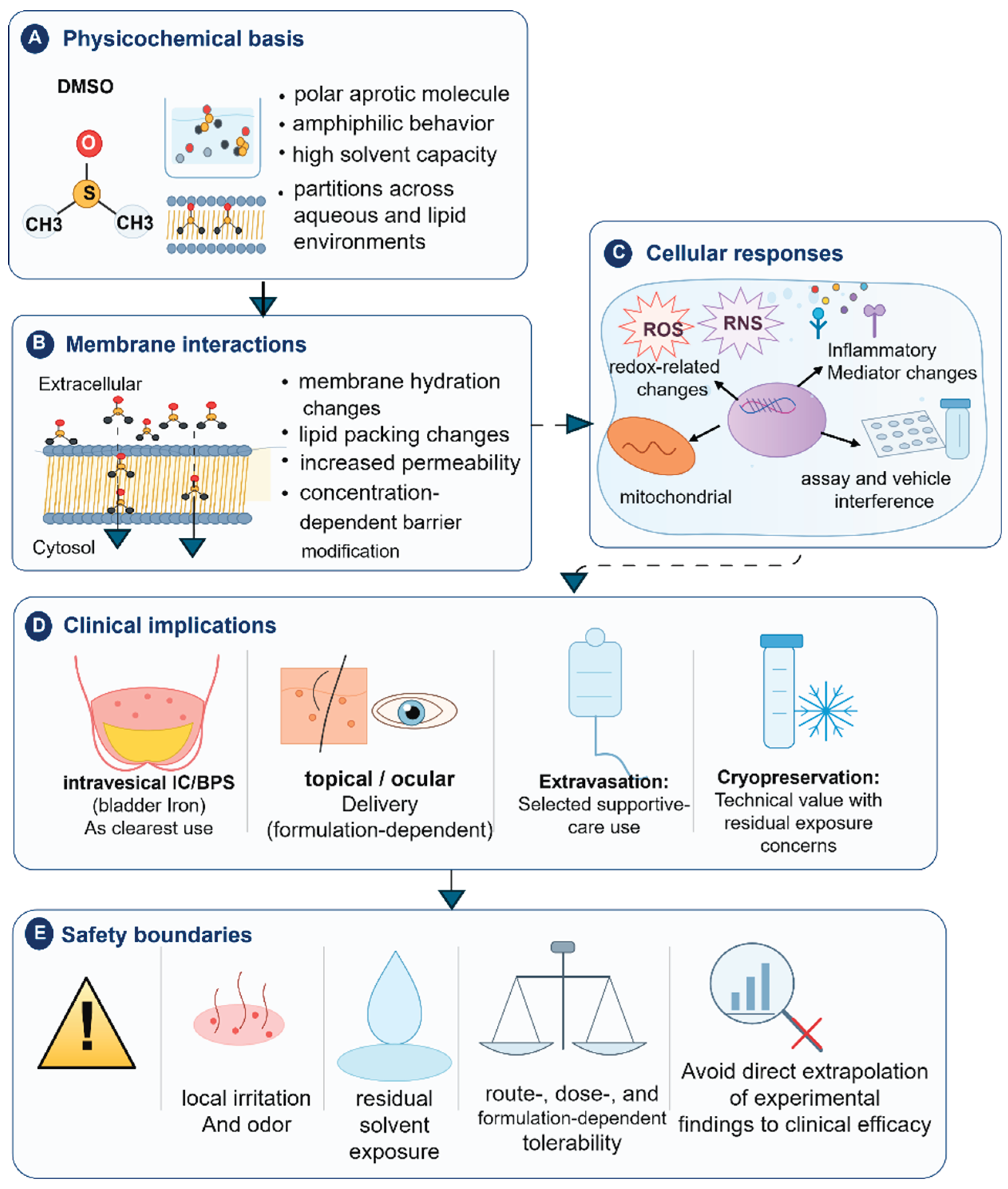

Table 1.
Clinical relevance, limitations, and interpretation of selected DMSO applications.
| Applicatio | Evidence base | Clinical relevance | Main limitation | Recommended interpretation | Clinical implication |
|---|---|---|---|---|---|
| IC/BPS intravesical therapy | Clinical guidelines, randomized trials, meta-analyses, and real-world studies | Observational evidence in selected patient subgroups with heterogeneous response | Response depends on phenotype, treatment regimen, and comparator choice | Use as a bladder-directed treatment option in selected patients | Observational evidence in selected subgroups |
| Dermatologic or ocular delivery | Formulation-based and limited clinical studies | Preliminary formulation-specific evidence; broad efficacy not established | Patient benefit not consistently established across indications | Delivery effects should not be equated with therapeutic efficacy | Preliminary evidence |
| Chemotherapy extravasation | Clinical guidance, case reports, and preclinical studies | Preliminary supportive evidence in selected vesicant settings | Drug-specific protocols required in modern management | Use as protocol-based supportive care only | Preliminary evidence |
| Cell therapy cryopreservation | Product-specific cryopreservation and reduced-DMSO studies | Observational technical-handling evidence for post-thaw function | Residual exposure must be balanced with post-thaw function | Treat as product-handling tool rather than therapy | Observational evidence for technical handling |
Table 2.
Summary of clinical and experimental findings across DMSO applications.
| Application | Study types | Observed findings | Main issue | Practical use | Clinical outcome |
|---|---|---|---|---|---|
| Membrane and permeability effects | Membrane, lipid bilayer, and protein studies | Changes in membrane structure, hydration, and permeability | Findings limited to model systems | Used for mechanistic understanding | No direct clinical correlation |
| Vehicle and assay effects | Protein, cell, and screening studies | Changes in assay readouts and cell responses depending on solvent conditions | Vehicle can influence experimental results | Requires proper vehicle control | In vitro relevance only |
| IC/BPS intravesical therapy | Clinical studies, randomized trials, meta-analyses, real-world studies | Variable responses in selected patient groups | Differences in patient type, protocol, outcome measures | Used in selected bladder-directed cases | Benefit observed in selected subgroups |
| Topical and ocular delivery | Formulation studies, limited clinical reports | Local delivery depends on formulation; no broad efficacy confirmed | Strong dependence on formulation | Preparation-specific use only | Early-stage findings |
| Chemotherapy extravasation | Clinical guidance, case reports, preclinical studies | Supportive use in selected injury cases | Protocol- and drug-dependent management | Part of supportive care | Limited clinical support |
| Cell therapy cryopreservation | Product-specific studies, reduced-DMSO protocols | Post-thaw recovery and functional performance | Balance between preservation and residual exposure | Cell processing method | Technical utility |
| Safety considerations | Infusion, animal, microbial, and cell studies | Effects vary by route, dose, and exposure time | Different exposure routes not directly comparable | Assess per application context | No unified clinical safety profile |
Disclaimer/Publisher’s Note: The statements, opinions and data contained in all publications are solely those of the individual author(s) and contributor(s) and not of MDPI and/or the editor(s). MDPI and/or the editor(s) disclaim responsibility for any injury to people or property resulting from any ideas, methods, instructions or products referred to in the content. |
© 2026 by the authors. Licensee MDPI, Basel, Switzerland. This article is an open access article distributed under the terms and conditions of the Creative Commons Attribution (CC BY) license (http://creativecommons.org/licenses/by/4.0/).
Copyright: This open access article is published under a Creative Commons CC BY 4.0 license, which permit the free download, distribution, and reuse, provided that the author and preprint are cited in any reuse.


