

Submitted:
13 July 2026
Posted:
14 July 2026
You are already at the latest version
Abstract
Polysomnography (PSG) remains the clinical gold standard for sleep staging, but its cost, obtrusiveness, and dependence on laboratory settings limit its scalability and ecological validity. Wearable devices that acquire photoplethysmography (PPG), accelerometry (ACC), skin temperature, and derived cardiovascular features offer an unobtrusive alternative, and a rapidly growing body of work has applied machine learning and deep learning to translate these signals into sleep stage predictions. The resulting literature is, however, highly heterogeneous in its input modalities, model architectures, datasets, and evaluation protocols, which complicates direct comparison and obscures the field’s true state of progress. This systematic review analyzes 34 studies published between 2018 and 2026, identified through a structured search of five scientific databases and screened according to PRISMA-consistent criteria. We organize the reviewed work into a taxonomy of three modeling paradigms— traditional machine learning with handcrafted features, end-to-end deep learning (CNN-based, temporal sequence, and hybrid CNN–RNN architectures), and transfer learning — and we characterize the benchmark datasets and recording devices on which they are evaluated. We further consolidate reported performance by classification granularity, explicitly separating evaluation protocols, and we analyze cross-dataset generalization, recurring error patterns, and modality effects. Across the corpus, binary sleep–wake accuracy exceeds 90% with richer signals, three-class agreement reaches Cohen’s κ ≈ 0.66–0.73 with multimodal input, and the best cross-subject four-class PPG models plateau at κ ≈ 0.74–0.78 (accuracy ≈ 84%) on MESA, while five-class staging remains the weakest, limited chiefly by N1 detection. Deep sleep, REM, and N1 are consistently the hardest stages, intra-subject evaluation systematically inflates reported agreement, and zero-shot transfer to structurally different consumer wearables remains the principal unsolved problem. We conclude that robust domain generalization, standardized wearable-specific benchmarks, and label-efficient learning are the key priorities for translating wearable sleep staging into reliable, clinically applicable monitoring.
Keywords:
sleep stage detection
; wearable devices
; photoplethysmography
; accelerometry
; deep learning
; systematic review
1. Introduction
Sleep is a complex and dynamic physiological process that plays a critical role in cognitive function, emotional regulation, metabolic balance, and overall health. Disruptions in sleep quantity or architecture are associated with a broad spectrum of adverse outcomes, including cardiovascular disease, metabolic dysfunction, neurodegenerative disorders, and impaired cognitive performance [1]. A comprehensive understanding of sleep architecture—the sequential organization of wakefulness, rapid eye movement (REM) sleep, and non-REM stages (N1, N2, N3)—is essential for both clinical diagnosis and scientific research [2]. Accurate identification of these stages is particularly important for detecting sleep disorders such as insomnia, sleep apnea, and narcolepsy, as well as for evaluating therapeutic interventions [3].
PSG remains the clinical gold standard for sleep staging, providing rich multimodal physiological measurements including electroencephalography (EEG), electrooculography (EOG), and electromyography (EMG). Despite its diagnostic precision, PSG is constrained by several practical limitations: it requires specialized equipment and trained personnel, incurs substantial costs, and is typically conducted in controlled laboratory environments that may disrupt natural sleep patterns. These factors limit its scalability and ecological validity, motivating the development of more accessible and unobtrusive sleep monitoring solutions [4].
Against this backdrop, wearable devices have emerged as a promising alternative for sleep monitoring. These devices enable non-invasive, continuous acquisition of physiological signals such as heart rate, ACC, skin temperature, and PPG, facilitating sleep assessment in real-world settings [5]. However, translating wearable-derived signals into accurate sleep stage predictions remains challenging. Variability in sensor placement, signal noise, inter-individual physiological differences, and the indirect relationship between peripheral signals (e.g., PPG) and neural activity introduce significant uncertainty, often leading to inconsistent performance across studies [6].
To address these challenges, a wide range of computational approaches has been proposed. These include traditional machine learning methods, such as support vector machines (SVMs) and random forests, as well as advanced deep learning architectures, including convolutional neural networks (CNNs), recurrent neural networks (RNNs), and transformer-based models. These approaches differ substantially in terms of input modalities, feature engineering strategies, temporal modeling techniques, and evaluation protocols. While significant progress has been achieved, the literature remains highly heterogeneous, complicating direct comparisons and limiting the ability to establish best practices for wearable-based sleep staging.
Alongside algorithmic developments, a diverse ecosystem of wearable devices has been explored, varying in form factor, sensing modalities, and intended use cases [7]. Common categories include wrist-worn devices (e.g., smartwatches and fitness trackers), finger-based sensors (e.g., ring devices), chest-mounted or patch-based systems, head- or ear-centered devices, and leg-worn wearables. Wrist-worn devices remain the most widely adopted due to their convenience and user compliance, typically combining ACC and PPG signals. Finger-based wearables often provide higher-quality PPG signals and improved heart rate variability estimation owing to greater tissue perfusion at the fingertip, while chest-mounted systems offer more accurate cardiac and respiratory measurements. Head- and ear-based devices, although less common, enable closer proximity to neural activity and may incorporate EEG or EEG-proxy signals, allowing for richer representations of sleep physiology. Leg-worn devices represent an emerging category that captures bilateral movement dynamics through inertial measurement units — including accelerometers and gyroscopes — alongside PPG and skin temperature signals, and are particularly relevant for pediatric populations and patients with periodic limb movement disorders [8,9].
Several recent reviews have investigated sleep stage classification from related perspectives, including wearable sensing technologies, artificial intelligence methods, deep learning architectures, and modality-specific analyzes [10,11,12,13,14]. However, these studies generally lack a focused and systematic synthesis of computational models specifically designed for wearable devices that rely on PPG, ACC, skin temperature, and derived cardiovascular signals. Our companion review [15] provides a broader perspective on wearable sleep technologies and their clinical applications; the present work complements it by offering a detailed algorithmic and methodological analysis. Figure 1 provides an overview of the corpus by publication year, signal modality, benchmark dataset, model type, and sensor placement.
The present review addresses that gap by providing a systematic analysis of recent advances in wearable-based sleep stage detection, with emphasis on PPG, ACC, skin temperature, and cardiovascular derivatives such as heart rate and HRV. We categorize and compare the computational approaches proposed in the literature, characterize the datasets and devices used, and critically examine evaluation protocols and their implications for reported performance. The overarching goal is to offer a structured reference for researchers and practitioners working toward robust, scalable, and clinically applicable wearable sleep monitoring.
This paper is organized as follows. Section 2 describes the systematic review methodology, including the search strategy, study selection criteria, and screening process. Section 3 presents a comprehensive taxonomy of computational approaches for wearable-based sleep staging, covering traditional machine learning methods, end-to-end deep learning architectures, and transfer learning strategies. Section 4 and the corresponding dataset section provide a detailed overview of the datasets and recording devices used in the literature, highlighting their characteristics and relevance to real-world applications. Section 5 summarizes and compares the performance of existing models across different classification settings and evaluation protocols. Finally, Section 6 discusses key findings, methodological challenges, and limitations, and outlines future research directions for improving the robustness, generalization, and clinical applicability of wearable-based sleep stage detection systems.
Abbreviations used in this paper:
- PSG: Polysomnography
- PPG: Photoplethysmography
- ACC: Accelerometry
- HRV: Heart Rate Variability
- AASM: American Academy of Sleep Medicine
- R&K: Rechtschaffen and Kales
- CNN: Convolutional Neural Network
- RNN: Recurrent Neural Network
- LSTM: Long Short-Term Memory
- GRU: Gated Recurrent Unit
2. Search Strategy and Study Selection
This systematic review was conducted to identify and analyze recent advances in sleep stage detection using wearable physiological signals, with a particular focus on PPG, accelerometry, and derived cardiovascular features. A comprehensive literature search was performed across five scientific databases — IEEE Xplore, PubMed, Scopus, Web of Science, and Google Scholar — to ensure broad coverage of both engineering-oriented and clinically focused research.
The search was carried out using combinations of keywords drawn from two conceptual domains: sleep staging and wearable sensing. Core search terms included “sleep stage classification”, “sleep staging”, “sleep scoring”, “wearable devices”, “smartwatch”, “photoplethysmography”, “PPG”, “actigraphy”, “accelerometry”, “heart rate variability”, and “deep learning”, combined using Boolean operators (AND, OR). The search was restricted to publications written in English and covered the period from 2018 to 2026, reflecting the rapid growth of wearable-based sleep staging research following the widespread adoption of consumer physiological sensors.
Studies were included in the review if they met all of the following criteria: (i) physiological signals were acquired from wearable or wearable-compatible devices, including PPG, ACC, heart rate, or derived cardiovascular features; (ii) machine learning or deep learning methods were applied for sleep stage classification; (iii) model performance was validated against expert-annotated PSG as the reference standard; and (iv) sufficient methodological and experimental detail was reported to enable assessment of the study design and results. Studies were excluded if they relied exclusively on EEG-based sleep staging without any wearable component, if they were review articles, editorials, or conference abstracts without full methodological reporting, or if they lacked a quantitative performance evaluation.
The selection process followed a structured multi-stage screening procedure consistent with systematic review guidelines. After removing duplicate records, titles and abstracts were screened independently to eliminate clearly irrelevant studies. The remaining candidates were assessed through full-text review to confirm eligibility against the inclusion and exclusion criteria described above. Additional relevant studies were identified through backward citation tracking of included papers and forward citation tracking of seminal works in the field. Following this process, a final set of 34 studies was selected for detailed analysis, spanning the period from 2018 to 2026 and covering a range of sensing modalities, model architectures, and evaluation protocols. These studies form the basis of the taxonomy presented in Section 3 and the comparative evaluation in Section 5. The full selection process is illustrated in Figure 2.
3. Modeling Approaches for Automated Sleep Staging
Automated sleep staging has been addressed through a broad spectrum of modeling strategies that differ fundamentally in how signal representations are constructed, how temporal dependencies are captured, and how well models generalize across subjects, sensors, and datasets. Existing approaches can be broadly categorized into traditional machine learning pipelines that rely on handcrafted features and classical classifiers, and also end-to-end deep learning frameworks that learn representations directly from raw or minimally processed signals, and also transfer learning strategies designed to improve robustness across sensing modalities and recording conditions. The following sections review these modeling paradigms, highlighting their architectural principles, representational assumptions, and evolution toward more scalable and generalizable sleep staging systems. Figure 3 presents the resulting taxonomy.
3.1. Traditional Machine Learning Models
Traditional machine learning based sleep staging methods typically follow a two-stage pipeline consisting of handcrafted feature extraction from physiological or wearable signals and subsequent classification using classical machine learning models. In this paradigm, signal processing is essential for deriving informative representations, and model performance is largely determined by the quality, diversity, and selection of handcrafted features rather than end-to-end representation learning frameworks.
Early work in this category explored PPG-based sleep staging frameworks in which handcrafted features primarily statistical, temporal, and nonlinear characteristics extracted from PPG signals are classified using SVMs with polynomial kernels for multi-stage sleep classification [16]. Other studies have adopted a more extensive feature engineering pipeline by extracting a large set of handcrafted PPG features and subsequently applying feature selection using statistical significance testing and model-based selection to retain the most informative features, followed by classification with ensemble learning methods such as Random Forest, LightGBM, and XGBoost [17]. A lightweight variant of this approach uses only PPG-derived heart rate and HRV features alongside activity counts as input to an XGBoost classifier for binary sleep–wake discrimination, demonstrating that compact gradient boosting pipelines remain competitive in resource-constrained wearable deployment scenarios [18]. Explainable machine learning approaches have further combined fused statistical, temporal, and nonlinear dynamical features derived from PPG pulse waves with Random Forest classifiers, while employing recursive feature elimination to reduce feature dimensionality, improve computational efficiency, and enhance model interpretability [19].
Beyond PPG-only pipelines, multimodal approaches have leveraged accelerometer- and heart rate-derived features capturing body motion, local heart rate variability, and circadian rhythm proxies, evaluated using multiple classifiers including logistic regression, k-nearest neighbors, random forest, and neural networks [20]. A related multimodal pipeline extracts time- and frequency-domain descriptors from both physiological and motion-related signals and evaluates a broad range of classifiers including bagging ensembles with decision tree base learners, SVMs, hidden Markov models, and LSTM networks within the same feature-driven paradigm, highlighting the comparative role of classical and hybrid learning strategies in sleep staging [21]. More comprehensive multimodal approaches incorporate actigraphy-based motion features alongside heart rate variability and respiration rate variability, and evaluate classical classifiers (SVM, Random Forest, XGBoost) as well as sequence-based architectures such as LSTM and temporal convolutional networks [22]. In addition, a related study investigated sleep stage classification using features extracted from PPG and skin temperature signals, where statistical descriptors computed over 30-second segments were used to train an Extra Trees classifier [23].
3.2. End-to-End Deep Learning Models
End-to-end deep learning models directly learn discriminative representations from raw or minimally processed physiological signals, eliminating the need for handcrafted feature extraction and enabling scalable, data-driven sleep staging through diverse architectural paradigms. These paradigms include convolutional models that capture local temporal and morphological patterns, sequence-based temporal architectures that model long-range dependencies across sleep epochs, and hybrid CNN–RNN frameworks that integrate spatial feature extraction with temporal sequence modeling within a unified end-to-end pipeline.
3.2.1. CNN-Based Models
CNN-based sleep staging approaches primarily employ convolutional architectures to hierarchically extract patterns and features, capturing both local and multi-scale structures and enabling end-to-end learning of informative representations for sleep classification.
Among these, SleepPPG-Net is a widely used CNN-based architecture for PPG-based sleep staging, employing residual convolutional blocks for feature extraction and a temporal convolutional network to capture long-range dependencies across sleep epochs [24]. Extensions of SleepPPG-Net generalize the framework to varying sensing conditions and operational constraints, including wrist-worn PPG signals and energy-efficient acquisition schemes, while retaining the convolutional–temporal architecture to improve robustness and support wearable deployment [25,26]. More recent CNN-based models, such as SleepPPG-Net2, build upon the original architecture by retaining residual convolutional feature extraction and temporal convolutional modules, while incorporating Domain Shifts with Uncertainty (DSU) layers to enhance cross-dataset generalization, improve robustness to sensor variability, and better handle differences in recording conditions [27].
Beyond this family of models, several studies have proposed fully convolutional temporal architectures that rely on encoder–decoder designs to model long-range dependencies without recurrent layers. Residual U-Net–based models leverage hierarchical downsampling and skip connections to learn robust representations directly from raw PPG or multimodal wearable signals and facilitate generalization across sensor configurations and datasets [28,29,30].
Other CNN-based models further improve feature learning using different architectures and interpretability methods. InsightSleepNet integrates Inception-style convolutional modules, local attention, and temporal convolutional networks to provide interpretable predictions from continuous PPG signals [31].
Complementary approaches introduce dual-stream convolutional encoders with cross-attention mechanisms to fuse PPG with auxiliary or derived modalities, enabling more effective exploitation of complementary physiological information for sleep staging [32].
A disentangled representation learning framework, DSleepNet, has been proposed for sleep stage classification. The model is built on a deep neural architecture that explicitly separates latent representations into personal-attribute-specific and personal-attribute-agnostic components using probabilistic encoders. The personal-attribute-agnostic (PA-agnostic) feature space is designed to reduce sensitivity to inter-subject variability and improve generalization across unseen populations. Furthermore, an independent excitation mechanism is introduced in the latent space to decorrelate these two representations before classification, enhancing feature disentanglement and improving robustness in cross-subject sleep staging tasks [33].
3.2.2. Temporal Sequence Modeling Architectures
Sequence modeling architectures explicitly capture temporal dependencies across consecutive sleep epochs using recurrent or temporal deep learning models, enabling robust modeling of long-term sleep dynamics and stage transitions. Early RNN-based frameworks for sleep staging processed sequences of epochs using handcrafted features extracted from accelerometer and PPG signals as input to recurrent layers, effectively modeling temporal dependencies across the night [34]. Building on this, later approaches combined convolutional encoders with bidirectional LSTM decoders to extract local features from raw physiological signals while simultaneously capturing temporal dependencies across epochs [35].
Subsequent developments introduced sequence to sequence LSTM architectures that process raw wearable signals including accelerometer, heart rate, and HRV-derived features to learn end-to-end temporal representations for sleep staging, enabling robust prediction of stage transitions over the course of the night [36,37]. Extending this paradigm, a bidirectional multi-level LSTM framework operates on HRV features extracted from inter-beat intervals derived from PPG or ECG signals, employing stacked bidirectional layers to capture hierarchical temporal dependencies. A transfer learning strategy is further incorporated to adapt ECG-based temporal representations to PPG-based sleep staging, enabling cross-modal feature reuse within a unified recurrent framework [38]. Hybrid fusion architectures have further extended sequence modeling by integrating multiple input modalities such as cardiac and movement signals at different stages of the temporal pipeline, allowing networks to jointly learn complementary representations and capture richer sequential dependencies [39].
More recently, self-supervised sequence modeling approaches have been introduced to reduce reliance on labeled data while preserving long-range temporal modeling capabilities. The LTA2V framework learns contextual representations from extended accelerometer sequences using global positional encoding, effectively capturing long-term temporal patterns during pre-training. These representations can subsequently be fine-tuned for sleep–wake classification, demonstrating strong generalization across multiple datasets and highlighting the potential of self-supervised temporal learning for large-scale, label-scarce sleep monitoring applications [40].
In addition to recurrent architectures, state-space sequence models have recently emerged as an alternative paradigm for efficient long-range temporal modeling. A Mamba-based architecture represents multimodal physiological signals as sequential feature vectors over time windows, processed through a bidirectional Mamba block that captures both forward and backward temporal dependencies. Epoch-level sleep stage predictions are obtained by aggregating window-level outputs through a final classification layer, enabling efficient modeling of long-range physiological dynamics without the computational overhead of attention-based transformers [41].
3.2.3. Hybrid CNN–RNN Architectures
Hybrid CNN–RNN architectures integrate convolutional layers for extracting local intra-epoch features with recurrent layers that model temporal dependencies across consecutive sleep epochs, enabling simultaneous learning of hierarchical signal representations and long-term sleep dynamics.
Early work within this paradigm employed CNN-based feature extractors operating on PPG signals, followed by GRU layers to capture sequential dependencies between adjacent epochs [42]. Building on this foundation, later frameworks enhanced temporal modeling capacity by combining CNN encoders with bidirectional LSTM layers and incorporating multiple input modalities—such as PPG and respiratory signals—to jointly learn complementary spatial and temporal representations for home-based sleep monitoring [43]. In parallel, computationally efficient hybrid architectures have been proposed that emphasize lightweight design while preserving temporal modeling capabilities. These models employ residual convolutional blocks with progressively increasing channels and interleaved max-pooling to extract compact feature representations, followed by recurrent classifiers composed of stacked bidirectional GRUs with skip connections, enabling effective sequence modeling without increasing computational complexity or receptive field size [44].
More recent multimodal hybrid frameworks further extend CNN–RNN designs by integrating advanced fusion strategies and representation learning mechanisms. A CNN–BiLSTM based sleep–wake classification framework has been proposed that processes raw multimodal physiological signals through convolutional layers for local feature extraction, followed by bidirectional LSTM layers to capture long-range temporal dependencies across sequential windows. This architecture supports both early and late fusion strategies, enabling flexible integration of complementary physiological modalities and improving temporal modeling performance in sleep staging tasks [8].
In addition, semi-supervised hybrid architectures have been introduced to reduce dependence on labeled data while improving robustness across subjects. One such framework employs multi-branch CNN encoders to extract representations from different physiological signal streams, which are then concatenated and passed through a dilated convolutional sequence model to capture long-range temporal dependencies across sleep epochs. A contrastive learning module is further incorporated to refine latent CNN representations before temporal modeling, enhancing discriminative power and improving generalization to inter-subject variability. The final classification is performed using a CNN-based predictor operating on the learned temporal representations [45].
Another recent development, LMA-SleepNet, introduces a multimodal sleep staging framework based on low-power mechanoacoustic (LMA) signals. The model processes raw triaxial LMA signals to extract respiratory and cardiac-related representations using a 1D residual convolutional network. These features are further refined through an autoencoder-based embedding module that enhances latent representation quality and interpretability. Temporal dependencies across sleep stages are modeled using a bidirectional LSTM layer, which captures sequential physiological transitions, while the final classification layer maps these representations to sleep stage labels in an end-to-end manner [46].
3.3. Transfer Learning
Transfer learning approaches for sleep staging focus on adapting models trained on large-scale source datasets or sensing modalities to new target domains, sensors, or signal configurations in order to improve generalization.
Early transfer learning frameworks relied on deep recurrent neural networks trained on ECG-derived representations, which were subsequently adapted to wrist-worn PPG data by reusing learned temporal dynamics and fine-tuning recurrent layers on target-domain features, such as heart rate variability [47]. Related work extended this paradigm by transferring models trained on ECG-based cardiorespiratory coupling spectrograms to wrist-worn PPG signals, demonstrating the feasibility of cross-modality adaptation through shared temporal representations learned at the sequence level [48].
4. Datasets for Automated Sleep Staging
The development and evaluation of automated sleep stage detection models using wearable technology rely heavily on the availability of high-quality annotated sleep datasets. Most studies validate their approaches against expert-labeled PSG, which serves as the reference standard for sleep staging. However, the datasets used in the literature vary widely in terms of sensor configurations, population characteristics, sleep stage definitions, and recording environments.
A summary of the datasets and corresponding recording devices used across the reviewed studies is provided in Table 1. To provide deeper insight, each dataset is further described in dedicated subsections, highlighting its characteristics, data acquisition setup, and relevance to wearable-based sleep staging research.
4.1. MESA Dataset
The Multi-Ethnic Study of Atherosclerosis (MESA) Sleep Dataset is a large-scale, community-based PSG dataset designed to investigate the relationship between sleep disorders and cardiovascular health across diverse populations. It includes overnight recordings from 2,056 subjects aged between 54 and 93 years, with a mean age of approximately 69 years and a balanced gender distribution. Each recording spans roughly 10 hours and is segmented into 30-second epochs according to the American Academy of Sleep Medicine (AASM) scoring manual. The dataset provides multimodal physiological signals, including finger-based PPG, ECG (Lead-II at 256 Hz), respiratory signals, and oxygen saturation, all synchronized with expert-annotated sleep stages (Wake, NREM1, NREM2, NREM3, REM) [49,50].
4.2. CFS Dataset
The Cleveland Family Study (CFS) is a longitudinal dataset focusing on genetic and familial factors influencing sleep disorders, particularly obstructive sleep apnea. It includes PSG recordings from 320 subjects with a median age of 42 years. Each subject contributes approximately 10 hours of sleep data, segmented into 30-second epochs, resulting in approximately 370,000 labeled windows. The dataset contains PPG signals sampled at 256 Hz, along with other PSG modalities. Sleep stages are annotated into six classes based on the Rechtschaffen and Kales (R&K) criteria by expert scorers [49,51].
4.3. CAP Dataset
The Cyclic Alternating Pattern (CAP) Sleep Dataset is a clinically oriented dataset designed to study sleep instability and microstructure. It includes PSG recordings from 84 subjects selected from a larger pool of 108 recordings, focusing on those with available high-quality PPG signals sampled at 128 Hz. Subjects exhibit a variety of sleep disorders, including insomnia, REM behavior disorder, nocturnal frontal lobe epilepsy, and other neurological conditions. Each recording lasts approximately 9 hours and is annotated into six sleep stages according to the R&K standard. In addition to standard sleep staging, the dataset captures cyclic alternating patterns, which are markers of sleep instability within NREM sleep [52].
4.4. DualSleep Dataset
The DualSleep Dataset is a wearable-based dataset that combines motion sensing with PSG-derived annotations. It consists of 29 participants (17 female, 12 male) aged between 17 and 70 years. Each subject is equipped with two tri-axial accelerometers placed on the thigh and lower back, recording movement data at 50 Hz. Sleep stage labels are obtained from synchronized PSG recordings, ensuring high-quality ground truth. The dataset includes both healthy individuals and subjects referred to sleep clinics, providing variability in sleep behavior [53].
4.5. DREAMT Dataset
The DREAMT Dataset is a multimodal wearable dataset designed for real-time sleep stage estimation in naturalistic environments. It includes 100 subjects recorded using the Empatica E4 wristband, which captures ACC, blood volume pulse (BVP), heart rate, and skin temperature signals. The participants span a wide age range (21–86 years), with a significant proportion suffering from sleep disorders such as obstructive sleep apnea and restless legs syndrome. Sleep stages are derived from PSG references and aligned with wearable signals. The dataset reflects real-world conditions, including noise and variability in sensor signals, making it highly relevant for developing robust wearable-based sleep staging algorithms [54].
4.6. Apple Watch Dataset
The Apple Watch Dataset is a wearable-focused dataset collected using Apple Watch devices from 31 healthy subjects. It includes accelerometer and heart rate data, along with PSG-derived sleep stage annotations. Participants are relatively young (mean age 29 years), and recordings were performed under controlled laboratory conditions. The heart rate is derived from PPG measurements and provided at irregular intervals (2–5 seconds), requiring preprocessing for time alignment. The dataset is commonly used for evaluating lightweight and real-time sleep staging models based on consumer-grade wearable devices [55].
4.7. Charité Hospital Dataset
The Charité Hospital Sleep Dataset is a clinical PSG dataset collected from 10 participants diagnosed with sleep-disordered breathing. Each recording spans between 6.8 and 10.1 hours and includes a comprehensive set of physiological signals, such as EEG (C3-A2, C4-A1), ECG, PPG, EOG, respiratory effort, airflow, and oxygen saturation. Sleep stages are annotated in 30-second epochs according to AASM guidelines by expert physiologists, resulting in 9,394 labeled epochs [56].
4.8. STAGES Dataset
The Stanford Technological Analytics and Genomics in Sleep (STAGES) Study integrates wearable sensor data with PSG recordings. Data were collected using the Amazfit Arc device, which records tri-axial ACC and PPG at 25 Hz. After quality control, 35 high-quality recordings were retained. Sleep stages are annotated according to AASM guidelines. Two dataset variants are defined: STAGES Arc (wearable-only signals) and STAGES PSG (combination of wearable ACC and PSG-derived PPG) [29].
4.9. TBI Dataset
The Traumatic Brain Injury (TBI) Sleep Dataset includes PSG and wearable recordings from 271 participants undergoing rehabilitation after traumatic brain injury. Accelerometer data are recorded at 100 Hz using a GT3X actigraph, while PPG signals are extracted from PSG recordings. Sleep stages are annotated according to AASM criteria. The dataset captures abnormal sleep patterns associated with neurological injury, making it valuable for studying sleep disturbances and evaluating model robustness in non-standard populations [29].
4.10. Amazfit Health Dataset
The Amazfit Health Study Dataset is a wearable-based sleep dataset collected using a wrist-worn device developed by Huami (Amazfit), which records tri-axial accelerometer signals at 25 Hz and PPG signals at 50 Hz. Data were acquired simultaneously with PSG, enabling accurate sleep stage annotation based on AASM guidelines. After quality control, 35 overnight recordings were retained from the initial cohort due to issues such as signal instability and short durations. The dataset provides synchronized multimodal signals aligned with PSG annotations and reflects realistic wearable conditions, making it suitable for evaluating the robustness and generalization of sleep staging models [29].
4.11. Henri et al. Dataset
The Henri et al. Sleep PSG Dataset comprises 933 full-night PSG recordings collected from patients suspected of obstructive sleep apnea. PPG signals are recorded at 256 Hz and downsampled to 64 Hz for computational efficiency. Sleep stages are annotated in 30-second epochs by expert scorers. The dataset is notable for its large size and clinical relevance, making it suitable for training deep learning models for PPG-based sleep staging [57].
4.12. SHHS Dataset
The Sleep Heart Health Study (SHHS) is a large epidemiological PSG dataset used to study the relationship between sleep and cardiovascular diseases. Although it does not include PPG signals, it provides ECG recordings sampled at 512 Hz. Each recording is standardized to approximately 10 hours and annotated according to AASM guidelines. SHHS is commonly used for pretraining models and transfer learning due to its large scale [58].
4.13. Duke University Dataset
The Duke University Sleep Dataset is a multimodal clinical dataset comprising 100 overnight PSG recordings, each lasting approximately seven hours. In addition to PSG, participants wore an Empatica E4 wristband that captured PPG, tri-axial ACC, electrodermal activity, and skin temperature. Derived features such as heart rate and inter-beat intervals were obtained from the PPG signal. All signals were resampled to 64 Hz and synchronized with expert-annotated sleep stages scored in 30-second epochs according to AASM criteria. The dataset supports the development of multimodal and sensor fusion approaches for sleep staging [23].
4.14. SIESTA Dataset
The SIESTA Sleep Dataset is a large, multi-center European PSG dataset collected from both healthy individuals and patients with sleep disorders. It includes recordings from multiple countries and spans a wide age range (20–95 years). Sleep stages are annotated using both R&K and AASM criteria by multiple expert scorers. Later extensions include wearable PPG and accelerometer signals synchronized with PSG, making it valuable for cross-population generalization studies [59].
4.15. UCI Sleep Center Dataset
The UCI Sleep Center dataset consists of de-identified overnight PSG recordings collected at the University of California, Irvine (UCI) Sleep Center under standardized in-lab sleep study protocols following AASM guidelines. The recordings were acquired using a Natus SleepWorks PSG system and exported in EDF format, preserving diagnostic information and full physiological signals. The dataset includes 123 subjects, with 48 diagnosed with obstructive sleep apnea (OSA) and the remaining subjects diagnosed with non-respiratory sleep disorders. Sleep stages were manually annotated in 30-second epochs by trained polysomnography technologists and reviewed by a board-certified sleep physician. The dataset contains raw PPG signals from a finger pulse oximeter, along with respiratory airflow and thoracoabdominal effort signals, all extracted directly from PSG recordings without additional artifact removal, and resampled from 512 Hz to 64 Hz for computational efficiency [43].
4.16. ETSF Dataset
The Emory Twin Study Follow-up (ETSF) Dataset combines PSG, ECG, PPG, and accelerometer signals from 105 subjects. Sleep stages are annotated in 30-second epochs and often aggregated into four sleep classes. The dataset introduces longer temporal windows (e.g., 5-minute segments) to improve cardiovascular feature extraction, making it particularly useful for studying autonomic dynamics during sleep [48].
4.17. SOMNIA Dataset
The SOMNIA Dataset combines polysomnography recordings with synchronized wearable signals, including PPG at 32 Hz and tri-axial ACC at 128 Hz. Data were collected using a wrist-worn device and aligned with PSG recordings restricted to the sleep period. Sleep stages were annotated in 30-second epochs according to AASM guidelines with high inter-rater reliability. The dataset is widely used for developing and validating wearable-based sleep staging models due to its balance between clinical accuracy and real-world applicability [60].
4.18. ABC Dataset
The ABC Sleep Dataset includes PSG recordings from 49 patients with obesity and severe obstructive sleep apnea. PPG signals are recorded at 256 Hz, and sleep stages are annotated according to AASM guidelines [61].
4.19. HomePAP Dataset
The HomePAP Study Dataset consists of PSG recordings from 118 patients with suspected moderate-to-severe sleep apnea. Data were collected across multiple clinical sites, leading to variability in PPG sampling rates (25–256 Hz). Sleep stages are manually annotated, making the dataset suitable for testing model robustness across heterogeneous conditions [62].
4.20. CinC Dataset
The PhysioNet/CinC Challenge databases refer to a collection of large-scale, publicly available physiological datasets released through the annual Computing in Cardiology (CinC) and PhysioNet challenges. These datasets are designed to benchmark and advance signal processing and machine learning methods in biomedical engineering, particularly for sleep analysis, cardiac monitoring, and physiological time-series classification. Depending on the specific challenge year, the databases typically include multimodal biosignals such as electrocardiography (ECG), PPG, respiratory signals, and sometimes ACC, often recorded under ambulatory or clinical conditions. The data are provided with expert-annotated reference labels (e.g., sleep stages, arrhythmias, or clinical events), enabling standardized evaluation across studies. These datasets have become a widely adopted benchmark in wearable and sleep research due to their diversity, scale, and open-access nature [63].
4.21. SKH Dataset
The dataset collected at Shin Kong Wu Ho-Su Memorial Hospital (SKH) comprises overnight PSG recordings from 416 adult subjects who underwent their first sleep assessment between 2009 and 2016. Continuous PPG signals were extracted from the PSG recordings, with inclusion limited to subjects having more than 4 hours of sleep duration, ensuring sufficient data for analysis [35].
4.22. SLEEPAI Dataset
The SLEEPAI Dataset includes 50 PSG recordings collected at the Sieratzki-Sagol Institute for Sleep Medicine of the Tel Aviv Sourasky Medical Center, Israel, from both obstructive sleep apnea (OSA) and non-OSA patients. The recorded data include full PSG signals as well as wrist-worn PPG signals acquired using an oximeter at 75 Hz, enabling synchronized cardiovascular and sleep measurements. The dataset therefore contains multimodal physiological signals, primarily PSG biosignals and PPG-derived pulse waveforms, along with expert sleep stage annotations based on AASM guidelines, providing high-quality labeled time-series data for sleep staging [27].
4.23. MrOS Dataset
The MrOS Sleep Study Dataset is a large multi-site cohort study including PSG, actigraphy, and cardiac-derived measurements collected from community-dwelling older men aged 65 years and above. The recorded data include PSG physiological signals such as EEG, EOG, EMG, ECG, respiratory parameters, and oxygen saturation, as well as wrist-worn actigraphy signals capturing long-term motion activity at 60-second resolution. Cardiac-derived features extracted from ECG signals include heart rate metrics and variability measures. All signals were temporally aligned and resampled to 30-second epochs to match PSG sleep stage annotations. Sleep staging was performed using centralized expert scoring, providing multimodal synchronized time-series data combining PSG, actigraphy, and cardiovascular information [64].
4.24. Brazil Dataset Collection
The Brazilian dataset collection comprises data from three sleep studies conducted at the Instituto do Sono in São Paulo, Brazil, with a total of 1,430 participants. All studies were approved by the local ethics committees, and informed consent was obtained from all participants prior to data collection. Each study involved overnight PSG recordings with comprehensive physiological monitoring, including EEG, EOG, EMG, ECG, airflow, respiratory effort, snoring, body position, arterial oxygen saturation, and pulse rate. Sleep stages and respiratory events were manually scored by trained sleep specialists according to AASM guidelines. In addition to PSG, participants wore Samsung Galaxy smartwatch devices that recorded tri-axial accelerometer and PPG signals, with sampling rates varying between 20 Hz and 100 Hz depending on the study protocol and device version. The wearable devices also enabled additional physiological measurements such as heart rate and oxygen saturation through integrated multi-sensor technology, and raw signals were accessed using the Samsung Privileged Health SDK.
The collection includes three distinct studies: Episono (Epidemiological Sleep Study), Sono, and The Sleep Clinical Study (SCS). The Episono study is a population-based epidemiological investigation conducted periodically in São Paulo to evaluate sleep quality and the prevalence of sleep disorders in a representative urban population. The Sono study was designed to capture large-scale real-world sleep data for the development of automated wearable-based sleep monitoring systems, incorporating multiple generations of Samsung smartwatches and allowing up to three nights of recording for a subset of participants. The Sleep Clinical Study (SCS) is a more recent clinical study conducted between 2023 and 2024, focusing on adult participants with and without sleep-disordered breathing under controlled clinical conditions with synchronized PSG and wearable recordings. Across all three studies, standardized PSG acquisition protocols and AASM-based sleep scoring ensure high-quality ground-truth annotations, making this combined dataset a robust resource for developing and evaluating wearable-based sleep staging models in both population-based and clinical environments [34].
4.25. SMS Dataset
The SMS dataset was collected using the Empatica E4 wristband and includes blood volume pulse, ACC, electrodermal activity, and skin temperature signals. Recordings were obtained from multiple subjects in real-world conditions and used to investigate multimodal wearable-based sleep staging [30].
4.26. ANNE Wearable Sleep Dataset
The ANNE Wearable Sleep Dataset consists of overnight recordings from 357 adult subjects collected using the ANNE One wearable sensor system in conjunction with gold-standard PSG at the Sunnybrook Health Sciences Centre in Toronto, Canada. PSG recordings were annotated in 30-second epochs according to AASM guidelines. The wearable device captures multimodal physiological signals, including cardiac-related measurements (e.g., ECG-aligned signals) and motion-related data, enabling wearable-based sleep analysis. The dataset comprises approximately 2,914 hours of synchronized recordings and includes a diverse population with varying sleep characteristics, making it suitable for evaluating robust and generalizable sleep staging models under realistic wearable sensing conditions [41].
4.27. LMA Wearable Sleep Dataset
The low-power multimodal mechanoacoustic (LMA) Wearable Sleep Dataset comprises 43 overnight recordings from 35 adult subjects collected in a clinical sleep laboratory at Carle Foundation Hospital, Urbana, USA. The cohort includes 26 healthy individuals and 9 subjects with sleep apnea, covering a wide age range (19–75 years) and diverse body mass index (BMI) categories. Data were acquired using a clinical polysomnography (PSG) system alongside a wearable LMA sensor. PSG recordings include standard multimodal signals such as EEG (F4, C4, O2), electrooculography (EOG), electromyography (EMG), electrocardiography (ECG), respiratory airflow, pulse oximetry, and thoracoabdominal movement, with sleep stages annotated in 30-second epochs according to AASM guidelines [46].
4.28. Northwestern Multimodal Sleep Dataset
This dataset was approved by the Northwestern University Institutional Review Board and collected at the Northwestern Memorial Hospital Sleep Disorders Center. Participants underwent one overnight PSG recording combined with multimodal wearable monitoring, spanning approximately 8 hours. PSG recordings were acquired using the Polysmith v8.0 system (Nihon-Kohden), serving as the gold standard for sleep stage annotation. During the study, participants simultaneously wore three sensor configurations: (1) a proposed wearable set including accelerometer, electrocardiography (ECG), and skin temperature sensors, (2) a control wearable actigraphy device, and (3) the PSG system [21].
4.29. Ring–Muse Sleep Dataset
The Smart Ring–Muse Sleep Dataset includes recordings from 12 healthy volunteers who contributed a total of 22 nights of sleep data collected in daily-life conditions. A commercial smart ring was used to record PPG signals at a sampling rate of 100 Hz, while sleep stage annotations were obtained using the Muse S headband, which provides EEG-based sleep staging with substantial agreement with expert scorers. Among the collected data, 12 nights were recorded as unlabeled PPG signals from all participants, while 10 additional nights included synchronized labeled sleep stages from a subset of 10 volunteers [45].
4.30. Eindhoven Sleep Dataset
The Eindhoven Sleep Dataset was collected in 2014–2015 in Eindhoven, the Netherlands, and approved by the Internal Committee of Biomedical Experiments of Philips Research in accordance with the Declaration of Helsinki. The dataset includes 101 overnight recordings from 60 healthy participants with no history of neurological, cardiovascular, psychiatric, pulmonary, endocrinological, or sleep disorders, and without use of sleep, antidepressant, cardiovascular medications, or substance abuse. Each participant underwent one or two nights of PSG recorded in a hotel setting, following the AASM guidelines for sleep staging. In addition to standard PSG signals, participants wore a CE-marked wrist-worn device on the non-dominant hand that recorded PPG and tri-axial accelerometer signals. Sleep stages were manually annotated by trained sleep technicians according to AASM criteria [38].
4.31. RestEaze Wearable Sleep Dataset
The RestEaze Wearable Sleep Dataset consists of overnight recordings from 14 children collected between January 2024 and February 2025 using a leg-worn wearable system designed for sleep monitoring. Participants were community-dwelling children aged 5–18 years. The RestEaze system captures multimodal physiological and movement signals, including PPG, tri-axial ACC, gyroscope (angular velocity), and skin temperature, with sensors placed on both legs to capture bilateral movement dynamics. PPG signals reflect blood volume changes for cardiovascular estimation, while inertial sensors capture linear and angular motion relevant to sleep fragmentation and arousals. Sleep stage annotations were derived from concurrently recorded EEG and manually scored by trained experts according to standard sleep staging criteria. Signals were sampled at 25 Hz for PPG, ACC, and gyroscope, and at 0.2 Hz for temperature. The dataset provides subject-wise split cross-validation and includes approximately 7.25 hours of sleep per night on average, with high sleep efficiency [8].
Overall, the diversity of datasets highlights both the progress and the challenges in wearable sleep staging research. Large clinical datasets such as MESA and SHHS provide strong benchmarks for algorithm development, while wearable-specific datasets are essential for evaluating real-world deployment. Future efforts toward standardized wearable datasets with open access and consistent evaluation protocols would significantly enhance comparability and accelerate progress in the field. The inclusion of novel wearable platforms including mechanoacoustic sensors [46], leg-worn inertial devices [8], and smart ring PPG systems [45] — further reflects the expanding diversity of sensing modalities explored in the field.
5. Comparative Analysis of Model Performance
Direct numerical comparison across the reviewed models is complicated by three sources of heterogeneity. First, the classification granularity ranges from binary sleep–wake discrimination to five-class AASM staging, and accuracy and Cohen’s are only meaningfully comparable within the same number of classes. Second, the evaluation protocol varies widely: subject-dependent (intra-subject) splits, subject-independent splits within a single dataset (cross-subject), and cross-dataset designs (leave-one-dataset-out or transfer learning). Intra-subject protocols yield systematically optimistic estimates, so figures obtained under such protocols are not directly comparable to cross-subject or cross-dataset results. Third, the reported metrics differ — accuracy, Cohen’s , macro- or weighted-F1, MCC, sensitivity/specificity, and AUC — and are computed on datasets with very different class priors. These sources of variability are visually summarized in Figure 4, which consolidates reported performances across studies.
For these reasons we organize the comparison primarily by classification granularity and, within each, distinguish the evaluation protocol. A dedicated subsection then consolidates cross-dataset generalization, and a final subsection summarizes recurring error patterns and modality effects. A further caveat concerns cohort composition: clinical or disordered populations (obstructive sleep apnoea, REM-behavior disorder, parasomnia, pediatric ADHD) tend to depress performance relative to healthy young adults. Unless otherwise stated, the figures below correspond to the best configuration each study reported for the stated task.
5.1. Binary Sleep–Wake Classification
Binary sleep–wake discrimination is the easiest task and produces the highest headline accuracies, but the recurring weakness across nearly all models is poor wake detection (low specificity) under the natural 80:20 sleep:wake imbalance. Under cross-subject evaluation, the strongest reported result is Kazemi et al. [43], whose CNN–BiLSTM reached 93.1% accuracy and = 0.78 using PPG together with respiratory-flow and respiratory-effort channels on a single institutional dataset. Fonseca et al. [44] reported a comparable 93.8% accuracy ( = 0.712, sensitivity 78.7%, specificity 97.0%) for their PPG–NN on a large held-out set, and Du et al. [46] obtained 91.9% accuracy, F1 = 95.0% and = 0.71 for wake/sleep from a mechanoacoustic sensor. Wulterkens et al. [37] reported a comparable 91.5% accuracy and = 0.66 (sensitivity 73.1%, specificity 94.6%) using HRV features plus activity counts on a large clinical hold-out. For the pediatric leg-worn setting, Anwar et al. [8] reported the best generalization, with the late-fusion CNN–BiLSTM reaching ROC–AUC 90.94%, F1 90.75% and 83.36% specificity at 85% sensitivity (F1 rising to 92.23% after temporal label smoothing).
A second tier of cross-subject models clusters around 77–86% accuracy with markedly lower , reflecting the imbalance penalty. Li et al. [48] reached 85.55% accuracy but only = 0.480 for wake-versus-sleep (PPG + actigraphy, transfer-learned). Markov et al. [17] reported 79.97% accuracy, F1 = 81.40%, MCC = 0.61 and AUC = 0.8798 on the ADASYN-balanced CAP set — a configuration that traded a little sensitivity for far better wake detection than the unbalanced model (specificity 71.31% versus 23.85%). Almeida et al. [18] obtained 77.62% accuracy and F1 = 83.88% with XGBoost on MESA, but only = 0.480 and specificity 53.66%, again exposing the wake-detection problem. Accelerometer-only and consumer-device approaches sit lower still: Walch et al. [20] reached roughly 90% accuracy but = 0.455 (AUC = 0.878) on the Apple Watch cohort, Logacjov et al. (LTA2V) [40] averaged F1 = 73.8%, specificity 55.6%, sensitivity 93.4% and AUC = 0.871 across three accelerometer datasets, and Boe et al. [21] reported wake recall 74.4% and sleep recall 90.0% (AUROC ≈ 0.87) from a minimal accelerometer + ECG + temperature set. Smarandache et al. [19] reported 82.56% accuracy and F1 = 75.40%, but under a pooled intra-subject protocol that is expected to be optimistic relative to the cross-subject figures above.
5.2. Three-Class Staging (Wake / NREM / REM)
For three-class staging the best cross-subject results come from multimodal or clinical-grade inputs. Zhang et al. [41] reported the highest figures, with a Mamba-based ensemble reaching 84.02% balanced accuracy and = 0.729 (rising to 87.67% / = 0.791 on a young healthy subset). Du et al. [46] achieved 83.8% accuracy and = 0.67, and Kazemi et al. [43] reached 83.0% accuracy and = 0.66. Korkalainen et al. [42] obtained 80.1% accuracy and = 0.65 from raw finger-PPG alone. Among cardiac-and-movement fusion models, Zhai et al. (Ubi-SleepNet) [39] reported their best on MESA at 80.3% accuracy, = 0.656 and mean F1 = 72.9% (ACT-HRS), dropping to 78.2% / = 0.52 on the consumer Apple Watch data; Song et al. (SLAMSS) [36] reported 79% accuracy, weighted F1 = 0.80 and MCC = 0.66 on MESA and 77% / MCC = 0.63 on MrOS.
Fonseca et al. [44] reported a high 87.4% accuracy ( = 0.716), though the combined N1–N2 class and class priors make accuracy less comparable than here. Wulterkens et al. [37] reported a similar 85.2% accuracy and = 0.68 on a subject-independent clinical hold-out using HRV features plus actigraphy. Limbaga et al. [28] reached 0.808 accuracy and F1 = 0.805 on MESA for their (light/deep/REM) three-class variant. Li et al. [48] obtained 77.08% accuracy and = 0.497 (PPG + actigraphy), and Walch et al. [20] reported the weakest agreement at roughly 72% accuracy with between 0.277 and 0.302. As under the binary task, Motin et al. [16] (82.62% accuracy, random forest) and Smarandache et al. [19] (77.79% accuracy) used pooled or intra-subject splits and should be read as optimistic relative to the cross-subject entries.
5.3. Four-Class Staging (Wake / Light / Deep / REM)
Four-class staging is the most heavily studied setting, and a clear pattern emerges: end-to-end deep models operating on raw PPG converge to ≈ 0.72–0.78 (accuracy ≈ 84%) under cross-subject evaluation on MESA. InsightSleepNet [31] reached 84.2% accuracy and = 0.742 on MESA (up to 86.1% / = 0.777 after energy-score rejection). SleepPPG-Net [24] reported a median = 0.75 and 84% accuracy, and SleepPPG-Net2 [27] matched this on its MESA source domain (per-patient = 0.75). Wang et al. [32] improved on the single-stream SleepPPG-Net baseline (0.783 / = 0.675) using a dual-stream design, reaching 0.833 accuracy and = 0.745 with PPG + augmented-PPG, essentially matching the PPG + real-ECG upper bound (0.829 / 0.739). Quino et al. [25] reported 0.82 accuracy and = 0.72 with a 10-hour PPG super-window, degrading to 0.75 / = 0.60 for the wearable-emulating short-segment configuration. Constantin et al. [26] obtained 78.5% / = 0.67 (rising to 80.0% / = 0.69 when an actigraphy branch was added in ActiSleepPPGNet).
A middle band of HRV-, multimodal- and transfer-based models reports ≈ 0.54–0.70. Kazemi et al. [43] reached 79.8% / = 0.70 with rich PPG + respiration + effort input; Fonseca et al. [44] reported 77.8% / = 0.638; Wulterkens et al. [37], using the same HRV-feature-plus-actigraphy approach on a large clinical population, reported 76.4% / = 0.62; Olsen et al. [29] reached 0.76 / = 0.64 (combined ACC + PPG on STAGES-PSG); and the two Radha studies reached = 0.65 / 76.36% [47] and = 0.61 / 76.30% [38]. Chih et al. (MTL) [35] reported 77.5% / = 0.643 on a private PPG database (and 69.76% / = 0.545 on CAP), achieving this with roughly 7.5× fewer parameters than comparable models. Zhang et al. [41] reported 75.30% / = 0.615, and Silva et al. [34] 70.7% / = 0.56.
The lowest four-class agreement comes from accelerometer/HRV-only inputs, small or disordered cohorts, and semi-supervised low-label regimes. Wang et al. (FASL) [45], designed for the small-labeled-data setting, reported 70.47% accuracy, F1 = 66.08% and = 0.642 on MESA with only 200 labeled nights. Korkalainen et al. [42] reached 68.5% / = 0.54; Gnarra et al. [30] 0.69 / = 0.50 (wrist E4); and Li et al. [48] 68.62% / = 0.44. Smarandache et al. [19] (69.20% / F1 = 68.10%) and Buaruk et al. [23] again illustrate the protocol gap: Buaruk’s subject-independent combined-modality result was only 0.52 accuracy, whereas the subject-dependent (intra-subject) skin-temperature model reached 0.85.
5.4. Five-Class Staging (Wake / N1 / N2 / N3 / REM)
Five-class AASM staging is attempted by relatively few wearable studies and yields the lowest agreement, with N1 being the dominant failure mode. The best result is Kazemi et al. [43] at 77.0% accuracy and = 0.67, but achieved with a rich PPG + respiratory-effort montage rather than a minimal wearable. Zhang et al. [41] reported 65.11% balanced accuracy and = 0.532 (69.41% / = 0.598 on a healthy subset), and Korkalainen et al. [42] 64.1% / = 0.51, noting N1 recall of only 0.13. Krauss et al. [22] reported a median MCC of 0.51 for their best (LSTM) model on MESA. Under an intra-subject protocol, Buaruk et al. [23] reached 0.77 accuracy (skin temperature), versus only 0.40 under the subject-independent split — the clearest single illustration of how strongly the evaluation protocol inflates reported five-class numbers.
5.5. Cross-Dataset Generalization
Cross-dataset evaluation is the most stringent test of wearable applicability and separates the models most sharply. The strongest demonstrated generalization is SleepPPG-Net2 [27], explicitly designed for multi-source-domain training: from a MESA source (per-patient = 0.75) it held = 0.74 on CFS, 0.69 on ABC and HomePAP, 0.66 on the wrist-worn SLEEPAI set, and 0.57 on CAP, improving cross-dataset by 1–19% over the benchmarks, with the largest gains on the hardest domains. The original SleepPPG-Net [24] generalized from MESA to CFS at = 0.67 with no adaptation, recovering to = 0.74 after transfer learning on roughly 120 target subjects. Constantin et al. [26] showed that fingertip-trained models transfer to wrist PPG with little loss (78.1% / = 0.68, only 2% below the fingertip result) but collapse on an arrhythmia cohort (68.1% / = 0.50), exposing a heavy reliance on regular heart-rate patterns.
The two Radha studies [38][47] demonstrated SIESTA to Eindhoven transfer across both a sensor change (ECG→PPG) and an annotation-standard change (R&K→AASM), with combined-layer retraining reaching = 0.65 (76.36% accuracy) on the Eindhoven PPG hold-out, above both the ECG-trained ( = 0.57) and PPG-trained ( = 0.55) baselines. Li et al. [48] similarly found that transfer from SHHS to the ETSF wristband improved accuracy by 1–4 points over the unadapted cross-dataset model. Song et al. (SLAMSS) [36] raised Apple Watch three-class accuracy from 62.9% (trained from scratch) to 64.6% via MESA pretraining, and Wang et al. (FASL) [45] reached 69.60% / = 0.602 on a self-collected smart-ring set after MESA pretraining plus minimal fine-tuning.
In contrast, zero-shot transfer to dissimilar consumer devices is markedly weaker. Olsen et al. [29] reported 0.69 / = 0.58 on a fully held-out Amazfit consumer wrist device, while Zhai et al. (DSleepNet) [33] — despite consistent within-MESA gains — saw performance collapse on the Apple Watch set (mean F1 ≈28–35%, ≈0.04–0.08) for all models, attributed to large device and signal-source domain gaps. A revealing outlier is Walch et al. [20], whose on the unseen MESA set actually exceeded its within-Apple-Watch , which the authors attributed to differences in data acquisition and to wake being more movement-associated in the MESA cohort. The overall picture is that transfer learning with even modest target data (roughly 50–120 subjects) recovers most of the cross-dataset gap, whereas zero-shot deployment to a structurally different consumer wearable remains the principal unsolved problem.
5.6. Recurring Error Patterns and Modality Effects
Several patterns recur regardless of architecture. Deep sleep (N3) and REM are consistently the hardest stages, with deep sleep frequently confused with light sleep — for example, Wang et al. [32] reported 37.5% of deep-sleep epochs misclassified as light, and the SleepPPG-Net family [24][31][25] repeatedly noted deep-sleep underestimation. In five-class settings N1 is effectively unrecoverable (recall 0.13 in Korkalainen et al. [42]). In binary settings the dominant failure is wake under-detection (low specificity) driven by class imbalance, seen across Almeida et al. [18] (specificity 53.66%), Markov et al. [17] (23.85% before balancing), Walch et al. [20], and Logacjov et al. [40].
Evaluation protocol exerts a large and systematic effect: intra-subject or subject-dependent splits inflate agreement relative to cross-subject splits, as quantified directly within single studies by Buaruk et al. [23] (three-class accuracy 0.55 cross-subject versus 0.87 subject-dependent), Du et al. [46], Motin et al. [16], Boe et al. [21], and Limbaga et al. [28] (within-subject F1 of 0.84–0.90), several of whom explicitly flag their figures as optimistic.
Modality effects are also consistent. PPG is the single most informative signal for staging and is uniquely able to detect REM, with BVP/PPG giving the largest single-modality gain in ablations (Olsen et al. [29]; Gnarra et al. [30]). Accelerometer/motion is best for wake detection and reduces false positives to wake (Olsen et al. [29]; in the motion-dominated pediatric set of Anwar et al. [8] the gyroscope alone outperformed PPG for sleep/wake). Respiratory information aids deep-sleep differentiation (RRV in Krauss et al. [22] and Du et al. [46]), while HRV is the most valuable add-on for deep-learning models on MESA (Krauss et al. report roughly +12.9 F1 points from adding HRV to actigraphy). Finally, performance degrades with sleep-disorder severity, older age and male sex — Attia et al. [27] traced the low CAP result largely to REM-behavior-disorder patients (44% of REM misclassified as wake), and Gnarra et al. [30] found insomnia and parasomnia cohorts the weakest. Wulterkens et al. [37] similarly found REM-parasomnia patients harder than non-REM parasomnias ( = 0.55 versus 0.69) but, atypically, staged children and adolescents more accurately than adults (four-class = 0.66 versus the overall 0.62).
Taken together, the best cross-subject four-class PPG performance plateaus at roughly = 0.74–0.78 and 84% accuracy on MESA, three-class performance reaches ≈ 0.66–0.73 with multimodal input, and binary performance exceeds 90% accuracy when richer signals are available; robust generalization to unseen consumer wearables, together with reliable deep-sleep, REM and N1 detection, remains the central open challenge for the field.
6. Discussion
This review synthesizes 34 studies on wearable-based sleep stage detection, spanning traditional machine learning pipelines, end-to-end deep learning architectures, and transfer learning strategies. Taken together, the literature reveals a field that has matured rapidly in modeling sophistication yet remains constrained by heterogeneous evaluation practices and an unresolved generalization gap. In this section we draw out the principal findings, examine the methodological challenges that limit comparability and deployment, acknowledge the limitations of the review itself, and outline directions for future research.
6.1. Principal Findings
Three consistent patterns emerge across the reviewed work. First, reported performance is bounded by classification granularity in a predictable way. Binary sleep–wake discrimination is the easiest task and exceeds 90% accuracy when richer signals are available [43,44,46], three-class (wake/NREM/REM) staging reaches – with multimodal or clinical-grade input [41,43,46], and the best cross-subject four-class models operating on raw PPG converge to – and roughly 84% accuracy on MESA [24,27,31,32]. Five-class AASM staging is attempted by comparatively few wearable studies and yields the lowest agreement, with N1 being the dominant failure mode [41,42,43]. This ceiling appears to reflect an intrinsic limit on the sleep information recoverable from peripheral signals rather than a shortcoming of any single architecture, since markedly different model families converge to similar performance.
Second, no single modeling paradigm dominates. End-to-end deep models that learn directly from raw PPG — particularly the SleepPPG-Net family and its convolutional–temporal successors [24,27,31] — represent the strongest and most widely adopted line of work, but well-engineered classical pipelines remain competitive in resource-constrained settings, with compact gradient boosting models achieving viable sleep–wake performance at a fraction of the computational cost [17,18]. Emerging paradigms such as state-space (Mamba) sequence models [41], self-supervised temporal pre-training [40], and semi-supervised contrastive frameworks [45] point toward more label- and compute-efficient alternatives without sacrificing accuracy.
Third, modality and cohort effects are remarkably consistent across studies. PPG is the single most informative signal and is uniquely able to detect REM, accelerometry is most valuable for wake detection and for suppressing false positives to wake, and respiratory information and HRV provide complementary gains for deep-sleep differentiation [22,29,30,46]. Performance also degrades systematically with sleep-disorder severity, older age, and male sex, with REM-behavior-disorder and parasomnia cohorts among the hardest [27,30,37].
6.2. Methodological Challenges
The most pervasive obstacle to interpreting this literature is heterogeneity in evaluation. As detailed in Section 5, studies differ in classification granularity, evaluation protocol, reported metrics, and cohort composition, and these axes interact in ways that make headline numbers difficult to compare. The evaluation protocol in particular exerts a large and systematic effect: intra-subject or subject-dependent splits inflate agreement relative to subject-independent splits, sometimes dramatically. The clearest illustrations come from within single studies, where subject-dependent three-class accuracy reached 0.87 against only 0.55 under a cross-subject split [23], and several authors explicitly flag their within-subject figures as optimistic [16,21,28]. Reporting conventions compound the problem: accuracy, Cohen’s , macro- or weighted-F1, MCC, and AUC are used inconsistently and computed on datasets with very different class priors, so that a high accuracy under the natural ∼80:20 sleep:wake imbalance can coexist with poor wake detection [17,18].
A second challenge is dataset and device imbalance. The corpus leans heavily on a small number of large clinical datasets — most notably MESA and SHHS — recorded with finger pulse oximeters, which provide strong and reproducible benchmarks but do not reflect the signal quality, motion artifacts, and form factors of consumer wrist-worn and ring-based devices. Wearable-specific datasets remain comparatively scarce, fragmented, and often privately held, which limits both external validity and reproducibility. The recent appearance of novel platforms such as mechanoacoustic sensors [46], leg-worn inertial systems [8], and smart-ring PPG [45] expands the diversity of sensing modalities but further fragments the evaluation landscape.
6.3. Generalization and Real-World Deployment
Cross-dataset evaluation is the most stringent test of wearable applicability and separates models most sharply. Transfer learning with even modest target data (roughly 50–120 subjects) recovers most of the cross-dataset gap: domain-aware training and fine-tuning have been shown to preserve four-class agreement across sensor and annotation-standard changes [24,27,38,48]. By contrast, zero-shot transfer to structurally different consumer wearables remains markedly weaker and occasionally collapses entirely, as observed when models trained on finger-oximeter data were applied without adaptation to smartwatch data [29,33]. This gap is the central barrier to real-world deployment: the very devices most attractive for population-scale, at- home monitoring are those on which current models are least reliable. Closing it will require methods that are robust to domain shift by design — through uncertainty modeling, representation disentanglement, and explicit multi-source-domain training — rather than relying on target-domain labels that are expensive to obtain at scale.
6.4. Limitations of This Review
Several limitations should be noted. The search was restricted to English-language publications from 2018 to 2026 and to studies that validated against expert-annotated PSG with quantitative reporting, which may exclude relevant non-English work, very recent preprints, and studies using alternative reference standards. As a qualitative, narrative synthesis we did not perform a formal meta-analysis or pooled effect-size estimation; the heterogeneity in protocols and metrics described above would in any case make such pooling unreliable, and the comparative figures reported here should be read as indicative rather than as statistically harmonized estimates. Finally, because many studies report only their best configuration, there is a potential for optimism bias in the aggregated picture.
6.5. Future Directions
Progress will depend less on incremental architectural novelty than on addressing the structural problems identified above. We highlight four priorities. First, the field needs standardized, openly available wearable-specific benchmarks with consistent evaluation protocols, subject-independent splits, and harmonized metric reporting, so that results become directly comparable across studies. Second, robust domain generalization to unseen consumer devices — the principal open problem — should be treated as a primary objective, drawing on uncertainty- aware and disentangled representations and multi-source-domain training [27,33]. Third, label-efficient learning through self- supervised and semi-supervised methods [40,45] is essential given the cost of expert PSG annotation and the abundance of unlabeled wearable recordings. Fourth, the persistent weaknesses in deep-sleep, REM, and N1 detection, together with the demonstrated degradation on disordered, older, and male cohorts, call for explicit attention to clinical validity and demographic fairness, alongside continued work on model interpretability to support clinical trust [19,31].
7. Conclusion
Wearable-based sleep staging has advanced substantially, with the best cross-subject four-class PPG models reaching – and binary models exceeding 90% accuracy under favorable conditions. Yet the field’s true progress is partly obscured by heterogeneous evaluation, and its central limitation — reliable generalization to the consumer devices that motivate the work — remains unsolved. Standardized benchmarking, domain-robust modeling, label-efficient learning, and rigorous attention to clinical and demographic validity are the steps most likely to translate wearable sleep monitoring from promising research prototypes into dependable, deployable tools.
Acknowledgments
JG and OA were supported by the consortium grant Trajectories of Affective Disorders from the German Research Foundation (DFG) SFB/TRR 393 (project grant no 521379614).
References
- Kong, J.; Zhou, L.; Li, X.; Ren, Q. Sleep disorders affect cognitive function in adults: an overview of systematic reviews and meta-analyses. Sleep Biol. Rhythm. 2023, 21, 133–142. [Google Scholar] [CrossRef]
- Carskadon, M.A.; Dement, W.C.; et al. Normal human sleep: an overview. Princ. Pract. Sleep Med. 2005, 4, 13–23. [Google Scholar] [CrossRef]
- Chokroverty, S. Overview of sleep & sleep disorders. Indian J. Med. Res. 2010, 131, 126–140. [Google Scholar] [PubMed]
- Bloch, K.E. Polysomnography: a systematic review. Technol. Health Care 1997, 5, 285–305. [Google Scholar] [CrossRef] [PubMed]
- De Zambotti, M.; Cellini, N.; Goldstone, A.; Colrain, I.M.; Baker, F.C. Wearable sleep technology in clinical and research settings. Med. Sci. Sports Exerc. 2019, 51, 1538. [Google Scholar] [CrossRef] [PubMed]
- Shelgikar, A.V.; Anderson, P.F.; Stephens, M.R. Sleep tracking, wearable technology, and opportunities for research and clinical care. Chest 2016, 150, 732–743. [Google Scholar] [CrossRef] [PubMed]
- Robbins, R.; Weaver, M.D.; Sullivan, J.P.; Quan, S.F.; Gilmore, K.; Shaw, S.; Benz, A.; Qadri, S.; Barger, L.K.; Czeisler, C.A.; et al. Accuracy of three commercial wearable devices for sleep tracking in healthy adults. Sensors 2024, 24, 6532. [Google Scholar] [CrossRef] [PubMed]
- Anwar, Y.; Bansal, K.; Kucukosmanoglu, M.; Dang, Q.; Feltch, C.; Brooks, J.; Banerjee, N. Sleep awake detection from leg-worn wearables using deep sensor fusion. Sci. Rep. 2026. [Google Scholar] [CrossRef]
- Birrer, V.; Elgendi, M.; Lambercy, O.; Menon, C. Evaluating reliability in wearable devices for sleep staging. npj Digit. Med. 2024, 7, 74. [Google Scholar] [CrossRef] [PubMed]
- Imtiaz, S.A.; Rodriguez-Villegas, E. A Systematic Review of Sensing Technologies for Wearable Sleep Staging. Sensors 2021, 21, 1562. [Google Scholar] [CrossRef] [PubMed]
- Wara, T.U.; Fahad, A.H.; Das, A.S.; Shawon, M.M.H. Systematic Review on Sleep Stage Classification and Sleep Disorder Detection Using Artificial Intelligence. Heliyon 2025, 11. [Google Scholar] [CrossRef]
- Deep Learning for Sleep Staging (2018–2023): A State-of-the-Art Survey. Technical report. National Science Foundation / University, 2023.
- Smith, J.; et al. Actigraphy for Sleep Stage Estimation: A Systematic Review. J. Sleep Res. 2024. [Google Scholar] [CrossRef] [PubMed]
- Brown, A.; et al. Sleep Assessment Using EEG-Based Wearables: A Systematic Review. In Sleep Medicine; 2024. [Google Scholar]
- Abbasi, Z.; OstadSharif Memar, M.; Hamavar, R.; Steingraeber, N.; Shahshahani, R.; Gross, J.; Abbasi, O. Wearable Sleep Staging: From Neurophysiology to Clinical Translation—A Comprehensive Review. Preprints 2026. [Google Scholar] [CrossRef]
- Motin, M.A.; Karmakar, C.; Palaniswami, M.; Penzel, T.; Kumar, D. Multi-stage sleep classification using photoplethysmographic sensor. R. Soc. Open Sci. 2023, 10, 221517. [Google Scholar] [CrossRef] [PubMed]
- Markov, K.; Elgendi, M.; Birrer, V.; Menon, C. Interpretable feature-based machine learning for automatic sleep detection using photoplethysmography. npj Biosensing 2025, 2, 24. [Google Scholar] [CrossRef]
- Almeida, D.; Dias, F.; Toledo, M.; Cardenas, D.; Oliveira, F.; Ribeiro, E.; Krieger, J.; Gutierrez, M. A machine-learning sleep-wake classification model using a reduced number of features derived from photoplethysmography and activity signals. arXiv 2023, arXiv:2308.05759. [Google Scholar]
- Smarandache, F.; Akula, S.; Alzahrani, S.I.; Arslan, F.; Ijaz, A. PPG-Based Sleep Stage Classification Using Pulse Wave Feature Fusion and Explainable AI; Infinite Study 2025. [CrossRef]
- Walch, O.; Huang, Y.; Forger, D.; Goldstein, C. Sleep stage prediction with raw acceleration and photoplethysmography heart rate data derived from a consumer wearable device. Sleep 2019, 42, zsz180. [Google Scholar] [CrossRef] [PubMed]
- Boe, A.; McGee Koch, L.; O’Brien, M.; Shawen, N.; Rogers, J.; Lieber, R.; Reid, K.; Zee, P.; Jayaraman, A. Automating sleep stage classification using wireless, wearable sensors. npj Digit. Med. 2019, 2, 131. [Google Scholar] [CrossRef]
- Krauss, D.; Richer, R.; Küderle, A.; Jukic, J.; German, A.; Leutheuser, H.; Regensburger, M.; Winkler, J.; Eskofier, B.M. Incorporating respiratory signals for machine learning-based multimodal sleep stage classification: a large-scale benchmark study with actigraphy and heart rate variability. Sleep 2025, zsaf091. [Google Scholar] [PubMed]
- Buaruk, S.; Thanaviratananich, S.; Treesuthacheep, P.; Deepaisarn, S. Feature Extraction for Machine Learning-Based Sleep Stage Classification Using PPG-Derived Parameters and Skin Temperature. In Proceedings of the Proceedings of the 2024 Asia Pacific Signal and Information Processing Association Annual Summit and Conference (APSIPA ASC); IEEE, 2024; pp. 1–6. [Google Scholar]
- Kotzen, K.; Charlton, P.H.; Salabi, S.; Amar, L.; Landesberg, A.; Behar, J.A. SleepPPG-Net: A deep learning algorithm for robust sleep staging from continuous photoplethysmography. IEEE J. Biomed. Health Inform. 2022, 27, 924–932. [Google Scholar]
- Quino, J.A.; Cardenas, D.A.; Toledo, M.A.; Dias, F.M.; Ribeiro, E.; Krieger, J.E.; Gutierrez, M.A. Optimizing Photoplethysmography-Based Sleep Staging Models by Leveraging Temporal Context for Wearable Devices Applications. arXiv 2024, arXiv:2410.00693. [Google Scholar]
- Constantin, L.; Aguet, C.; Van Zaen, J.; Lemkaddem, A.; Jeanningros, L.; De Jaegere, K.; Ott, S.R.; Brill, A.K.; Horvath, C.M.; Thiran, J.P.; et al. PPG-Based Sleep Staging Using SleepPPGNet: Extension to Wearables, Improvements, Limitations. In Proceedings of the 2024 46th Annual International Conference of the IEEE Engineering in Medicine and Biology Society (EMBC); IEEE, 2024; pp. 1–4. [Google Scholar]
- Attia, S.; Hershkovich, R.S.; Tabakhov, A.; Ang, A.; Oksenberg, A.; Tauman, R.; Behar, J.A. SleepPPG-Net2: Deep learning generalization for sleep staging from photoplethysmography. Physiol. Meas. 2025, 46, 125001. [Google Scholar] [CrossRef]
- Limbaga, N.J.; He, H.; de Oliveira Filho, J.I.; Salama, K.N. Cross-Sensor Transferability of a Deep Residual U-Net for Sleep Staging Using Temporal Low-Frequency Photoplethysmography. IEEE Sensors Letters, 2025. [Google Scholar]
- Olsen, M.; Zeitzer, J.M.; Richardson, R.N.; Davidenko, P.; Jennum, P.J.; Sørensen, H.B.; Mignot, E. A flexible deep learning architecture for temporal sleep stage classification using accelerometry and photoplethysmography. IEEE Trans. Biomed. Eng. 2022, 70, 228–237. [Google Scholar] [CrossRef] [PubMed]
- Gnarra, O.; Massaro, C.; Warncke, J.D.; Nef, T.; Schmidt, M.; Paez-Granados, D. Sleep Stage Classification from Wristband Sensor Data in Patients with Sleep Disorders. In Proceedings of the 2025 IEEE EMBS International Conference on Biomedical and Health Informatics (BHI); IEEE, 2025; pp. 1–7. [Google Scholar]
- Nam, B.; Bark, B.; Lee, J.; Kim, I.Y. InsightSleepNet: the interpretable and uncertainty-aware deep learning network for sleep staging using continuous Photoplethysmography. BMC Med. Inform. Decis. Mak. 2024, 24, 50. [Google Scholar] [CrossRef] [PubMed]
- Wang, J.; Guan, Y.; Chen, C.; Zhou, L.; Yang, L.T.; Gu, S. On Improving PPG-Based Sleep Staging: A Pilot Study. arXiv 2025, arXiv:2508.02689. [Google Scholar]
- Zhai, B.; Duan, H.; Guan, Y.; Phan, H.; Woo, W. DsleepNet: Disentanglement learning for personal attribute-agnostic three-stage sleep classification using wearable sensing data. IEEE J. Biomed. Health Inform. 2025. [Google Scholar] [CrossRef]
- Silva, F.B.; Uribe, L.F.; Cepeda, F.X.; Alquati, V.F.; Guimarães, J.P.; Silva, Y.G.; Dos Santos, O.L.; de Oliveira, A.A.; de Aguiar, G.H.; Andersen, M.L.; et al. Sleep staging algorithm based on smartwatch sensors for healthy and sleep apnea populations. Sleep Med. 2024, 119, 535–548. [Google Scholar] [CrossRef] [PubMed]
- Chih, H.Y.; Ahmed, T.; Chiu, A.P.; Liu, Y.T.; Kuo, H.F.; Yang, A.C.; Lien, D.H. Multitask learning for automated sleep staging and wearable technology integration. Adv. Intell. Syst. 2024, 6, 2300270. [Google Scholar] [CrossRef]
- Song, T.A.; Chowdhury, S.R.; Malekzadeh, M.; Harrison, S.; Hoge, T.B.; Redline, S.; Stone, K.L.; Saxena, R.; Purcell, S.M.; Dutta, J. AI-Driven sleep staging from actigraphy and heart rate. PLoS ONE 2023, 18, e0285703. [Google Scholar] [CrossRef] [PubMed]
- Wulterkens, B.M.; Fonseca, P.; Hermans, L.W.; Ross, M.; Cerny, A.; Anderer, P.; Long, X.; van Dijk, J.P.; Vandenbussche, N.; Pillen, S.; et al. It is all in the wrist: Wearable sleep staging in a clinical population versus reference polysomnography. Nat. Sci. Sleep 2021, 885–897. [Google Scholar] [CrossRef] [PubMed]
- Radha, M.; Fonseca, P.; Ross, M.; Cerny, A.; Anderer, P.; Aarts, R. LSTM knowledge transfer for HRV-based sleep staging. arXiv 2018, arXiv:1809.06221. [Google Scholar]
- Zhai, B.; Guan, Y.; Catt, M.; Plötz, T. Ubi-SleepNet: advanced multimodal fusion techniques for three-stage sleep classification using ubiquitous sensing. Proc. ACM Interact. Mob. Wearable Ubiquitous Technol. 2021, 5, 1–33. [Google Scholar] [CrossRef]
- Logacjov, A.; Bach, K.; Mork, P.J. Long-term self-supervised learning for accelerometer-based sleep–wake recognition. Eng. Appl. Artif. Intell. 2025, 141, 109758. [Google Scholar] [CrossRef]
- Zhang, A.; He-Mo, A.; Yin, R.; Li, C.; Tang, Y.; Gurve, D.; van der Horst, V.; Buchman, A.; Ghahjaverestan, N.; Goubran, M.; et al. Mamba-based Deep Learning Approach for Sleep Staging on a Wireless Multimodal Wearable System Without Electroencephalography. Sleep 2026. zsag022. [Google Scholar] [PubMed]
- Korkalainen, H.; Aakko, J.; Duce, B.; Kainulainen, S.; Leino, A.; Nikkonen, S.; Afara, I.O.; Myllymaa, S.; Töyräs, J.; Leppänen, T. Deep learning enables sleep staging from photoplethysmogram for patients with suspected sleep apnea. Sleep 2020, 43, zsaa098. [Google Scholar] [CrossRef] [PubMed]
- Kazemi, K.; Abiri, A.; Zhou, Y.; Rahmani, A.; Khayat, R.N.; Liljeberg, P.; Khine, M. Improved sleep stage predictions by deep learning of photoplethysmogram and respiration patterns. Comput. Biol. Med. 2024, 179, 108679. [Google Scholar] [CrossRef] [PubMed]
- Fonseca, P.; Ross, M.; Cerny, A.; Anderer, P.; van Meulen, F.; Janssen, H.; Pijpers, A.; Dujardin, S.; van Hirtum, P.; van Gilst, M.; et al. A computationally efficient algorithm for wearable sleep staging in clinical populations. Sci. Rep. 2023, 13, 9182. [Google Scholar] [CrossRef] [PubMed]
- Wang, Q.; Zhang, Z.; Zhu, G.; Yao, Y.; Wang, Z.; Wang, Y.; Fu, Y.; Song, Y.; Zhao, D.; Ma, H. Semi-supervised Contrastive Learning for Reliable Sleep Staging with Small Labeled Photoplethysmography Data. Proc. ACM Interact. Mob. Wearable Ubiquitous Technol. 2025, 9, 1–32. [Google Scholar] [CrossRef] [PubMed]
- Du, Y.; Gu, J.; Duan, S.; Trueb, J.; Tzavelis, A.; Shin, H.; Arafa, H.; Li, X.; Huang, Y.; Carr, A.; et al. A skin-interfaced wireless wearable device and data analytics approach for sleep-stage and disorder detection. Proc. Natl. Acad. Sci. 2025, 122, e2501220122. [Google Scholar] [CrossRef] [PubMed]
- Radha, M.; Fonseca, P.; Moreau, A.; Ross, M.; Cerny, A.; Anderer, P.; Long, X.; Aarts, R.M. A deep transfer learning approach for wearable sleep stage classification with photoplethysmography. npj Digit. Med. 2021, 4, 135. [Google Scholar] [CrossRef] [PubMed]
- Li, Q.; Li, Q.; Cakmak, A.S.; Da Poian, G.; Bliwise, D.L.; Vaccarino, V.; Shah, A.J.; Clifford, G.D. Transfer learning from ECG to PPG for improved sleep staging from wrist-worn wearables. Physiol. Meas. 2021, 42, 044004. [Google Scholar] [CrossRef]
- Zhang, G.Q.; Cui, L.; Mueller, R.; Tao, S.; Kim, M.; Rueschman, M.; et al. The National Sleep Research Resource: towards a sleep data commons. J. Am. Med. Inform. Assoc. 2018, 25, 1351–1358. [Google Scholar] [CrossRef] [PubMed]
- Chen, X.; Wang, R.; Zee, P.; Lutsey, P.; Javaheri, S.; Alcántara, C.; et al. Racial/ethnic differences in sleep disturbances: the Multi-Ethnic Study of Atherosclerosis (MESA). Sleep 2015, 38, 877–888. [Google Scholar] [PubMed]
- Redline, S.; Tishler, P.V.; Tosteson, T.D.; Williamson, J.; Kump, K.; Browner, I.; et al. The familial aggregation of obstructive sleep apnea. Am. J. Respir. Crit. Care Med. 1995, 151, 682–687. [Google Scholar] [CrossRef] [PubMed]
- Terzano, M.G.; Parrino, L.; Smerieri, A.; Chervin, R.; Chokroverty, S.; Guilleminault, C.; et al. Atlas, rules, and recording techniques for the scoring of cyclic alternating pattern (CAP) in human sleep. Sleep Med. 2002, 3, 187–199. [Google Scholar] [CrossRef] [PubMed]
- Logacjov, A.; Skarpsno, E.S.; Kongsvold, A.; Bach, K.; Mork, P.J. A machine learning model for predicting sleep and wakefulness based on accelerometry, skin temperature and contextual information. Nat. Sci. Sleep 2024, 16, 699–710. [Google Scholar] [CrossRef] [PubMed]
- Wang, K.; Yang, J.; Shetty, A.; Dunn, J. DREAMT: Dataset for Real-time Sleep Stage Estimation Using Multisensor Wearable Technology; 2024. [Google Scholar] [CrossRef]
- Walch, O. Motion and Heart Rate from a Wrist-Worn Wearable and Labeled Sleep from Polysomnography. 2019. [Google Scholar] [CrossRef]
- Karmakar, C.; Khandoker, A.; Penzel, T.; Schöbel, C.; Palaniswami, M. Detection of respiratory arousals using photoplethysmography (PPG) signal in sleep apnea patients. IEEE J. Biomed. Health Inform. 2014, 18, 1065–1073. [Google Scholar] [CrossRef] [PubMed]
- Korkalainen, H.; Aakko, J.; Duce, B.; Kainulainen, S.; Leino, A.; Nikkonen, S.; et al. Deep learning enables sleep staging from photoplethysmogram for patients with suspected sleep apnea. Sleep 2020, 43, zsaa098. [Google Scholar] [CrossRef] [PubMed]
- Quan, S.F.; Howard, B.V.; Iber, C.; Kiley, J.P.; Nieto, F.J.; O’Connor, G.T.; et al. The Sleep Heart Health Study: design, rationale, and methods. Sleep 1997, 20, 1077–1085. [Google Scholar] [CrossRef] [PubMed]
- Klösch, G.; Kemp, B.; Penzel, T.; Schlögl, A.; Rappelsberger, P.; Trenker, E.; et al. The SIESTA project polygraphic and clinical database. IEEE Eng. Med. Biol. Mag. 2001, 20, 51–57. [Google Scholar] [CrossRef] [PubMed]
- van Gilst, M.M.; van Dijk, J.P.; Krijn, R.; et al. Protocol of the SOMNIA project: an observational study to create a neurophysiological database for advanced clinical sleep monitoring. BMJ Open 2019, 9. [Google Scholar] [CrossRef] [PubMed]
- Bakker, J.P.; Tavakkoli, A.; Rueschman, M.; Wang, W.; Andrews, R.; Malhotra, A.; et al. Gastric Banding Surgery versus Continuous Positive Airway Pressure for Obstructive Sleep Apnea. Am. J. Respir. Crit. Care Med. 2018, 197, 1080–1083. [Google Scholar] [CrossRef] [PubMed]
- Rosen, C.L.; Auckley, D.; Benca, R.; Foldvary-Schaefer, N.; Iber, C.; Kapur, V.; et al. A Multisite Randomized Trial of Portable Sleep Studies and Positive Airway Pressure Autotitration Versus Laboratory-Based Polysomnography. Sleep 2012, 35, 757–767. [Google Scholar] [CrossRef] [PubMed]
- Goldberger, A.L.; Amaral, L.A.N.; Glass, L.; Hausdorff, J.M.; Ivanov, P.C.; Mark, R.G.; Mietus, J.E.; Moody, G.B.; Peng, C.K.; Stanley, H.E. PhysioNet: components of a new research resource for complex physiologic signals. Circulation 2000, 101, e215–e220. [Google Scholar] [CrossRef] [PubMed]
- Blackwell, T.; Yaffe, K.; Ancoli-Israel, S.; Redline, S.; Ensrud, K.E.; Stefanick, M.L.; Laffan, A.; Stone, K.L. Associations between sleep architecture and sleep-disordered breathing and cognition in older community-dwelling men: the Osteoporotic Fractures in Men Sleep Study. J. Am. Geriatr. Soc. 2011, 59, 2217–2225. [Google Scholar] [CrossRef] [PubMed]
Figure 1.
Overview of the reviewed literature on wearable-based sleep stage detection across 34 included studies. (A) Distribution of included studies by publication year, showing a clear upward trend from 2018 to 2026. (B) Input signal modality distribution. (C) Relative frequency of benchmark datasets used across the reviewed studies; "Other" aggregates datasets referenced in fewer than two studies. (D) Distribution of modeling approaches employed in the reviewed studies, categorized into CNN-based, RNN-based, Hybrid CNN–RNN, and Traditional ML paradigms. (E) Proportional breakdown of wearable sensor placement types, illustrating the prevalence of finger oximeters relative to consumer-grade wrist-worn and ring-based devices.
Figure 1.
Overview of the reviewed literature on wearable-based sleep stage detection across 34 included studies. (A) Distribution of included studies by publication year, showing a clear upward trend from 2018 to 2026. (B) Input signal modality distribution. (C) Relative frequency of benchmark datasets used across the reviewed studies; "Other" aggregates datasets referenced in fewer than two studies. (D) Distribution of modeling approaches employed in the reviewed studies, categorized into CNN-based, RNN-based, Hybrid CNN–RNN, and Traditional ML paradigms. (E) Proportional breakdown of wearable sensor placement types, illustrating the prevalence of finger oximeters relative to consumer-grade wrist-worn and ring-based devices.
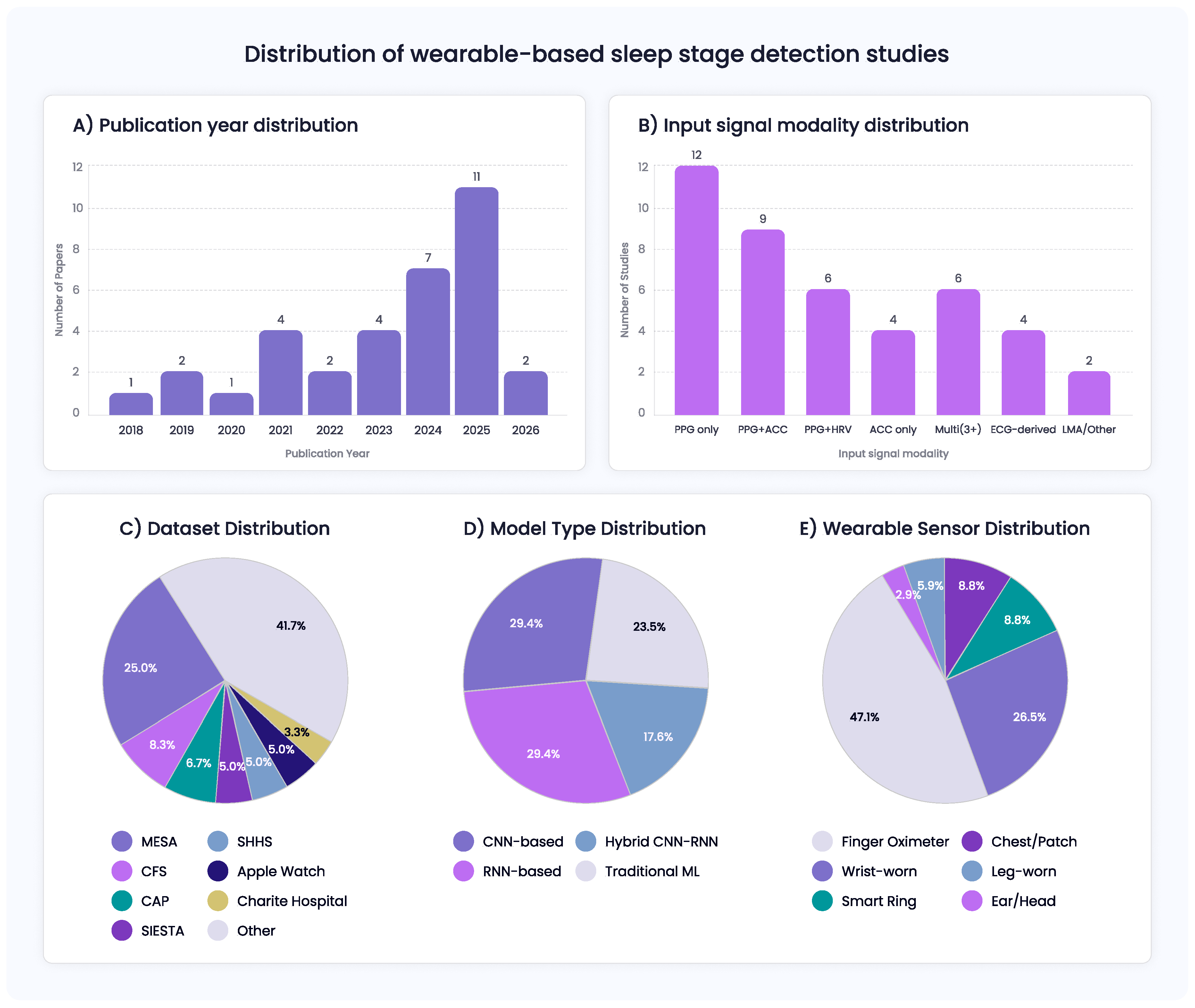
Figure 2.
PRISMA diagram illustrating the study selection process for the systematic review on wearable-based sleep stage detection. A total of 220 records were identified through database searches across IEEE Xplore, PubMed, Scopus, Web of Science, and Google Scholar. Following the removal of 64 duplicates, 156 records remained and were screened based on title and abstract, of which 30 were excluded due to irrelevant topic or non-English language. The remaining 126 full-text articles were assessed for eligibility, and 92 were subsequently excluded for the following reasons: no wearable physiological signal used (n = 50), no polysomnography (PSG) reference standard reported (n = 20), no quantitative performance evaluation provided (n = 12), or classified as a review or editorial (n = 10). A final total of 34 studies were included in the systematic review, covering the period 2018 to 2026.
Figure 2.
PRISMA diagram illustrating the study selection process for the systematic review on wearable-based sleep stage detection. A total of 220 records were identified through database searches across IEEE Xplore, PubMed, Scopus, Web of Science, and Google Scholar. Following the removal of 64 duplicates, 156 records remained and were screened based on title and abstract, of which 30 were excluded due to irrelevant topic or non-English language. The remaining 126 full-text articles were assessed for eligibility, and 92 were subsequently excluded for the following reasons: no wearable physiological signal used (n = 50), no polysomnography (PSG) reference standard reported (n = 20), no quantitative performance evaluation provided (n = 12), or classified as a review or editorial (n = 10). A final total of 34 studies were included in the systematic review, covering the period 2018 to 2026.
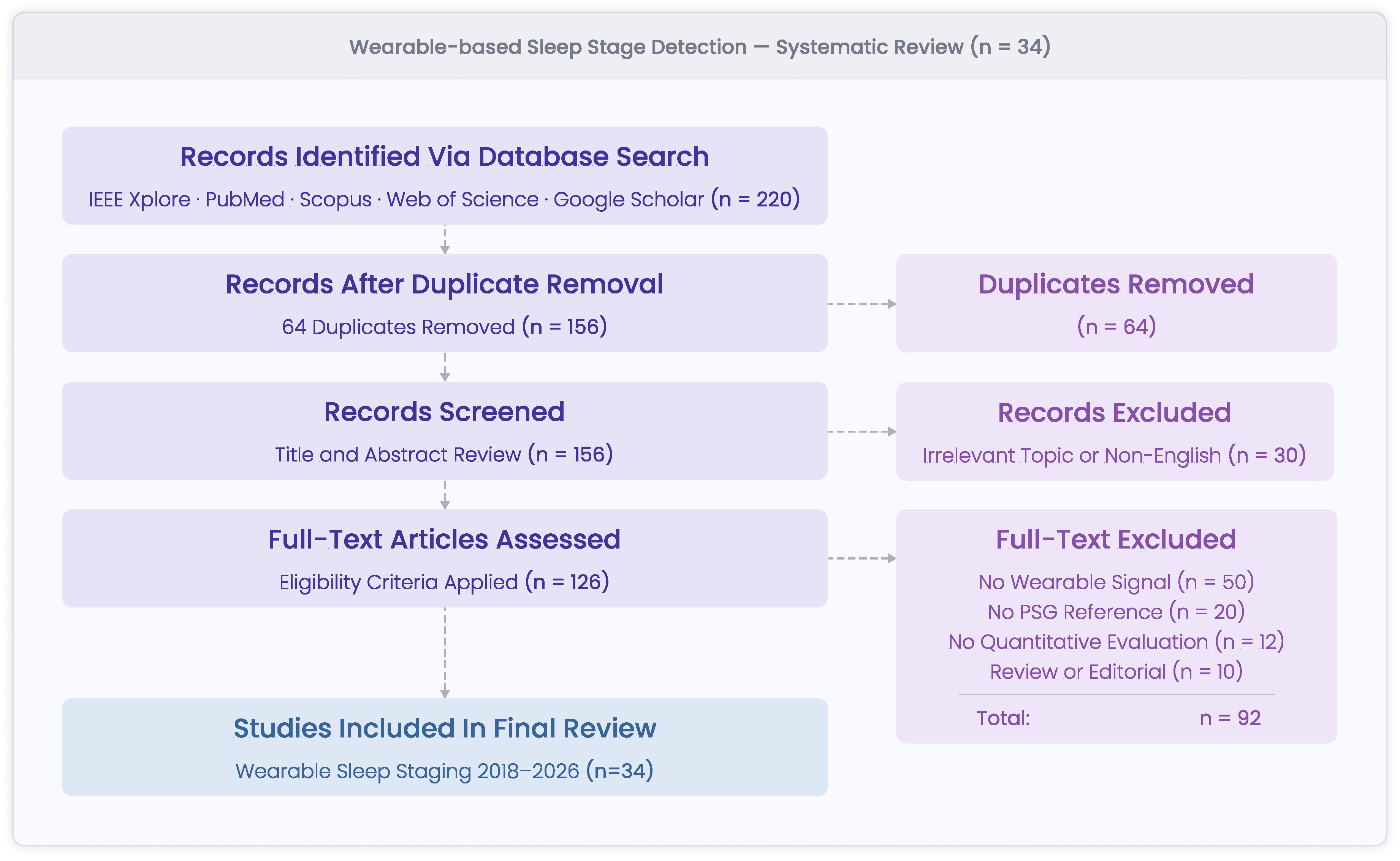
Figure 3.
Taxonomy of computational approaches for wearable-based sleep stage detection across 34 reviewed studies (2018–2026). Three top-level modeling paradigms are identified: Traditional Machine Learning (n = 8), End-to-End Deep Learning (n = 22), and Transfer Learning (n = 4). The End-to-End Deep Learning branch is further subdivided into three architectural families: CNN-based models, Temporal sequence modeling approaches, and Hybrid CNN–RNN frameworks.
Figure 3.
Taxonomy of computational approaches for wearable-based sleep stage detection across 34 reviewed studies (2018–2026). Three top-level modeling paradigms are identified: Traditional Machine Learning (n = 8), End-to-End Deep Learning (n = 22), and Transfer Learning (n = 4). The End-to-End Deep Learning branch is further subdivided into three architectural families: CNN-based models, Temporal sequence modeling approaches, and Hybrid CNN–RNN frameworks.
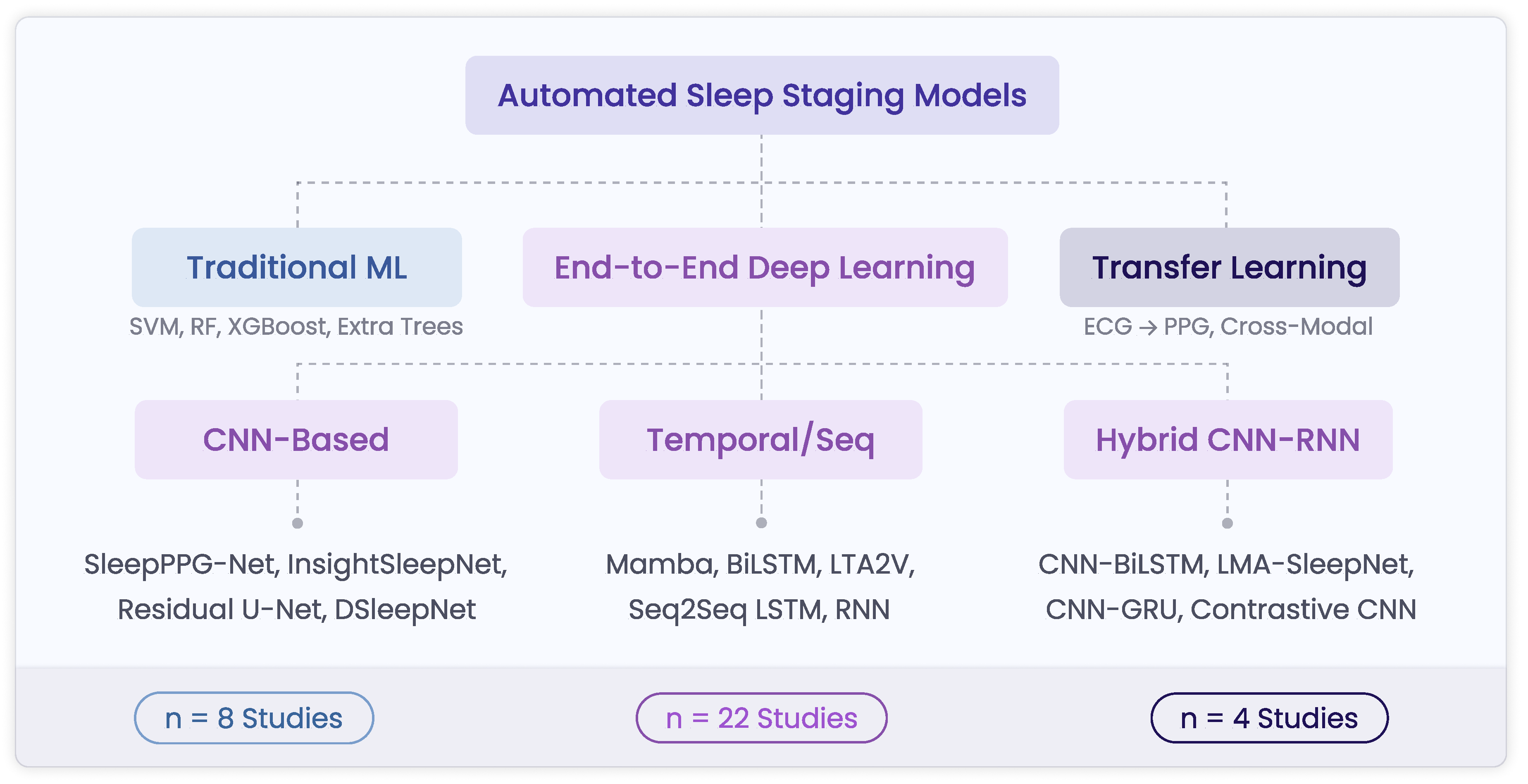
Figure 4.
Heatmap summarizing the reported performance of wearable-based sleep staging methods across different studies, datasets, and classification settings. Each column represents a unique study–dataset configuration, with the study name shown at the top of each column and the corresponding dataset indicated below it. Rows correspond to 2-, 3-, 4-, and 5-stage sleep classification tasks. Cell values indicate reported accuracy (%) or F1-score (%), with darker colors representing higher performance. Curly braces group configurations originating from the same study, and study labels are colored according to methodological category (deep learning or machine learning). Empty cells indicate that a particular classification setting was not reported.
Figure 4.
Heatmap summarizing the reported performance of wearable-based sleep staging methods across different studies, datasets, and classification settings. Each column represents a unique study–dataset configuration, with the study name shown at the top of each column and the corresponding dataset indicated below it. Rows correspond to 2-, 3-, 4-, and 5-stage sleep classification tasks. Cell values indicate reported accuracy (%) or F1-score (%), with darker colors representing higher performance. Curly braces group configurations originating from the same study, and study labels are colored according to methodological category (deep learning or machine learning). Empty cells indicate that a particular classification setting was not reported.
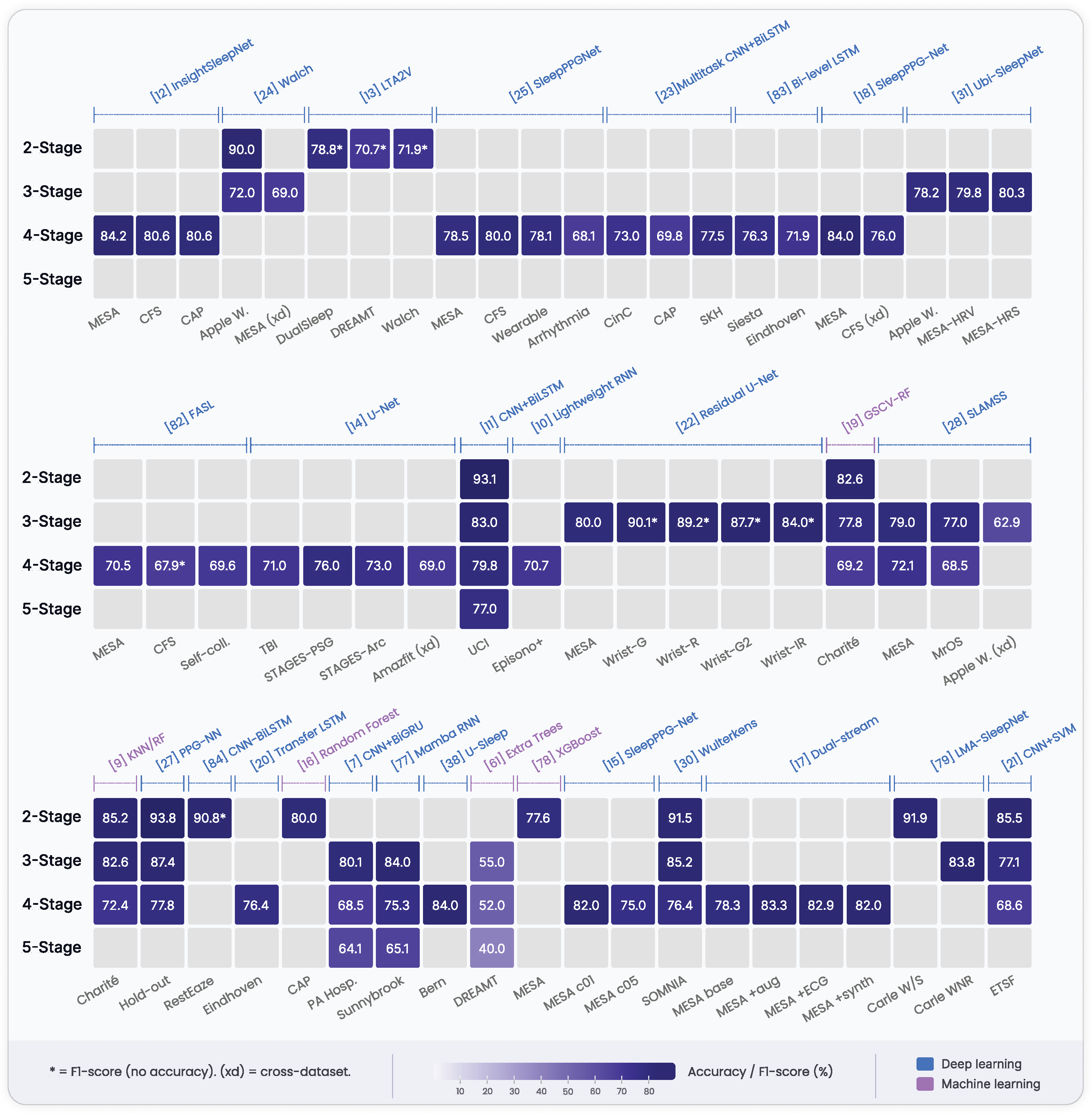

Table 1.
Summary of datasets and recording devices used in wearable-based sleep staging studies.
| # | Ref. | Dataset | Device | # | Ref. | Dataset | Device |
|---|---|---|---|---|---|---|---|
| 1 | [31] | MESA, CFS, CAP | Finger pulse oximeter | 18 | [23] | Duke University | Empatica E4 wristband |
| 2 | [41] | ANNE | ANNE One | 19 | [29] | STAGES, TBI, Health | Wrist-worn device |
| 3 | [16] | Charité Hospital | Finger pulse oximeter | 20 | [47] | SIESTA | Wrist-worn sensor |
| 4 | [18] | MESA | Finger pulse oximeter | 21 | [22] | MESA | Finger pulse oximeter |
| 5 | [24] | SHHS, MESA, CFS | Finger pulse oximeter | 22 | [39] | Apple Watch, MESA | Apple smartwatch |
| 6 | [32] | MESA | Finger pulse oximeter | 23 | [34] | Brazil Collection | Samsung smartwatch |
| 7 | [43] | UCI Sleep Center | Finger pulse oximeter | 24 | [25] | MESA | Finger pulse oximeter |
| 8 | [33] | MESA, Apple Watch | Apple smartwatch | 25 | [17] | CAP | PSG-integrated oximeter |
| 9 | [45] | CFS, MESA, Ring–Muse |
Smart ring | 26 | [19] | Charité Hospital | Finger pulse oximeter |
| 10 | [46] | LMA Dataset | Wearable LMA sensor | 27 | [48] | ETSF | Empatica E4 wristband |
| 11 | [36] | MESA, MROS | Wrist-worn device | 28 | [28] | MESA | Finger pulse oximeter |
| 12 | [37] | SOMNIA | Wrist-worn sensor | 29 | [35] | MESA, CinC, CAP, SKH | Finger pulse oximeter |
| 13 | [38] | SIESTA, Eindhoven | Wrist-worn device | 30 | [20] | Apple Watch, MESA | Apple smartwatch |
| 14 | [40] | DualSleep, DREAMT, Walch |
Wrist-worn device | 31 | [26] | SHHS, MESA, CFS | Finger pulse oximeter |
| 15 | [21] | Northwestern | Multimodal wearable | 32 | [44] | SIESTA | Wrist-worn sensor |
| 16 | [8] | RestEaze | Leg-worn device | 33 | [27] | SHHS, MESA, CFS, ABC, HomePAP, CAP, SLEEPAI |
Finger pulse oximeter |
| 17 | [42] | Henri et al. dataset | Finger pulse oximeter | 34 | [30] | SMS | Empatica E4 wristband |
Disclaimer/Publisher’s Note: The statements, opinions and data contained in all publications are solely those of the individual author(s) and contributor(s) and not of MDPI and/or the editor(s). MDPI and/or the editor(s) disclaim responsibility for any injury to people or property resulting from any ideas, methods, instructions or products referred to in the content. |
© 2026 by the authors. Licensee MDPI, Basel, Switzerland. This article is an open access article distributed under the terms and conditions of the Creative Commons Attribution (CC BY) license (http://creativecommons.org/licenses/by/4.0/).
Copyright: This open access article is published under a Creative Commons CC BY 4.0 license, which permit the free download, distribution, and reuse, provided that the author and preprint are cited in any reuse.


