

Submitted:
14 July 2026
Posted:
14 July 2026
You are already at the latest version
Abstract
Autonomous driving systems often exhibit trajectory tracking behavior that differs markedly from human drivers, a phenomenon intuitively described as "mechanicalness.'' This study moves beyond the traditional focus on tracking accuracy to systematically analyze these behavioral differences through a real-vehicle comparative experiment. Using a steer-by-wire vehicle equipped with the open-source Autoware platform, trajectory data were collected on a closed campus road under straight and curved conditions. A five-dimensional evaluation framework is established to quantify control continuity, prediction horizon, error response mode, style adaptability, and interaction friendliness. Results show that Autoware exhibits a "high-precision, low-smoothness, zero-tolerance'' mechanical style, characterized by high-frequency micro-corrections, reactive curve entry, rigid speed tracking, and segmented braking. Human drivers, in contrast, employ an organic mode with discrete corrections, elastic path tolerance, and anticipatory coordination. The technical origins of mechanicalness are identified as four algorithmic paradigms: geometric tracking, decoupled control, error-driven logic, and limited prediction horizon. The findings further reveal a systematic safety-comfort trade-off inherent to mechanical control, and suggest optimization directions including adaptive dead-zone mechanisms, extended prediction horizons, and lateral-longitudinal coordination. These insights provide theoretical and engineering foundations for developing more human-like autonomous driving control strategies.
Keywords:
autonomous driving
; trajectory tracking
; Autoware
; mechanicalness
; human driver
; real-vehicle comparison
1. Introduction
Autonomous driving systems have undergone rapid development, with trajectory tracking control serving as a core module that executes reference paths generated by the planning layer and generates corresponding steering and speed commands to ensure precise vehicle navigation along the intended route. Unlike trajectory tracking, which requires reaching specific positions at specific times, path tracking only demands that the vehicle converges to a geometric path while maintaining a target speed profile. This spatiotemporal decoupling makes path tracking highly dependent on structured environments, and the control logic for safety and comfort exhibits significant differences from human driving systems.
A common observation in real-world autonomous driving experiences is that even when high tracking accuracy is achieved, passengers frequently perceive the vehicle’s behavior as "stiff," "rigid," or "unnatural." For instance, vehicles often exhibit frequent minor steering corrections during straight-line driving, and deceleration maneuvers manifest as a distinct three-stage braking pattern—"hard braking – soft braking – full stop"—rather than the smooth, continuous deceleration characteristic of human drivers. Recent studies have also noted that passengers in autonomous vehicles report lower ride comfort compared to human-driven vehicles, even when objective safety metrics are comparable [1]. To systematically describe the behavioral characteristics exhibited by algorithm-driven systems during trajectory tracking tasks, this paper adopts the term "mechanicalness" to characterize these behaviors. In the context of autonomous trajectory tracking, mechanicalness manifests as a lack of smoothness in control actions, excessive rigid adherence to geometric path configurations, and an inability to flexibly adjust strategies in response to changing scenarios.
Despite considerable research efforts in trajectory tracking control algorithms, Autoware platform performance evaluation, and human driver behavior modeling, these three lines of inquiry remain fragmented. A notable gap exists in direct comparative studies between algorithmic control behavior and human driving behavior under identical real-vehicle conditions, particularly lacking quantitative frameworks to describe and evaluate the mechanicalness characteristics of autonomous systems [2]. To address this gap, this study takes the open-source Autoware platform as its research vehicle, collects human driving and Autoware automatic tracking trajectories under unified real-vehicle test conditions, conducts comparative analysis from multiple dimensions, constructs a five-dimensional evaluation framework to systematically characterize and quantify mechanicalness, and reveals the behavioral manifestations and technical roots of this phenomenon. A comprehensive literature review is presented in Section 2. Section 3 details the experimental platform and data collection methodology. Section 4 establishes the five-dimensional evaluation framework for quantifying mechanicalness. Section 5 presents the comparative analysis results between Autoware and human drivers. Section 6 discusses the technical origins of mechanicalness and the associated safety-comfort trade-offs. Section 7 concludes the study and outlines future research directions.
2. Literature Review
This section reviews the relevant literature from three interconnected research areas: trajectory tracking control algorithms for autonomous vehicles, performance evaluation of the Autoware platform, and human driver behavior modeling. The review identifies the strengths and limitations of existing studies and culminates in a clear statement of the research gap that this paper addresses.
2.1. Trajectory Tracking Control for Autonomous Vehicles
Path tracking control has a long history in autonomous driving research. Coulter proposed the Pure Pursuit algorithm, which selects a forward-looking reference point on the desired path and computes the steering angle using geometric relationships [3]. This algorithm is simple and effective at low speeds, but it produces steady-state errors during cornering and lacks systematic parameter calibration mechanisms. Studies have shown that the selection of the look-ahead distance directly affects tracking performance and involves an inherent trade-off: an excessively large look-ahead distance causes “cutting corners,” while an overly small distance induces steering oscillations [4]. This trade-off becomes particularly pronounced under large-curvature or high-speed conditions, where the limitations of forward-looking geometry become apparent.
The Stanley controller, developed by Stanford University for the 2005 DARPA Grand Challenge, considers both lateral and heading errors and theoretically eliminates steady-state errors [5]. However, its parameter tuning process is complex and it is sensitive to sensor noise. Linear Quadratic Regulator (LQR) methods obtain optimal feedback gains through the Riccati equation [6], but their applicability is limited to linear models. Model Predictive Control (MPC) can solve finite-horizon optimization problems online and explicitly handle constraints, offering strong robustness [7]. However, both LQR and MPC have high computational complexity, posing challenges for real-time implementation on embedded platforms. MPC performance also heavily depends on model accuracy; when the actual vehicle deviates from the model, control accuracy degrades significantly.
Recent work within the MDPI Vehicles journal has begun to address these limitations. Chen et al. validated an adaptive MPC framework on real vehicles, demonstrating its effectiveness in suppressing yaw, pitch, and roll motions while improving trajectory tracking smoothness and overall vehicle dynamic stability [8]. Moreno-Gonzalez et al. proposed a speed-adaptive model-free path-tracking strategy that operates without an explicit vehicle model, showing robustness across varying speeds and road geometries through both simulation and real-vehicle tests [9]. These studies represent a growing trend toward bridging the gap between simulation and real-world deployment.
Despite extensive research on these controllers, most evaluations remain confined to simulation environments. Krajewski et al. pointed out that simulation inevitably simplifies vehicle dynamics, sensor characteristics, and environmental interactions [11]. Raffo et al. acknowledged that their MPC validation was limited to simulation and called for experimental verification [7]. The extent to which simulation results generalize to real-world deployment scenarios, where localization errors, control delays, and unmodeled dynamics are inevitable, remains systematically unexamined. Furthermore, a recent editorial in the Vehicles special issue on path tracking explicitly noted the “severe lack of objective and systematic evaluation frameworks to compare the advantages and disadvantages of various path-tracking algorithms” [10]. Existing studies focus primarily on whether the system can track accurately, while the qualitative characteristics of control behavior—such as smoothness and naturalness—are largely overlooked.
2.2. Autoware Platform: Architecture and Performance Evaluation
Autoware has become the de facto open-source platform for autonomous driving research, with deployments ranging from 1:14 scale test platforms to full-size commercial vehicles [12]. This subsection first describes the control architecture of Autoware and then reviews empirical performance evaluations.
2.2.1. Control Architecture
The control module of Autoware is implemented by the trajectory_follower_node, with lateral and longitudinal control designed separately. In the default configuration, lateral control employs the Pure Pursuit algorithm to compute steering angles, while longitudinal control uses a PID controller to regulate speed; the two operate independently without coupling [13]. This architectural choice stems from the classical vehicle engineering assumption that lateral and longitudinal motions can be approximately decoupled under normal driving conditions. An optional MPC module provides higher tracking accuracy but incurs greater computational cost, requiring a trade-off between prediction precision and real-time performance in practical deployment.
2.2.2. Empirical Performance Evaluations
Møller et al. conducted real-vehicle testing of an Autoware-based Level 4 vehicle over 236 km of mixed traffic, recording 30 takeover events at a spatial takeover rate of 0.127 events/km. Perception failures accounted for 40% of interventions, while planning failures (26.7%) typically resulted from operational deadlocks [14]. This study provided valuable statistics on failure frequencies but did not analyze the underlying mechanisms of failures, nor did it examine behavioral differences between Autoware and human drivers.
Tran et al. developed a simulation-based runtime verification framework for Autoware against JAMA safety standards, showing that Autoware cannot always avoid collisions due to inaccurate predictions of aggressive lane-change maneuvers [15]. While this study identified specific algorithmic vulnerabilities, its simulation conditions assumed perfect state information and idealized actuator responses, failing to capture the uncertainties and complex interactions of real-world driving environments.
Ganesan et al. compared simulation and real-world trajectory planning on a campus test track using Autoware, reporting a longitudinal RMSE of 0.839 m and a lateral RMSE of 0.104 m, indicating that Autoware achieves reasonable tracking accuracy under well-calibrated sensor conditions [2]. In a more recent and comprehensive study, the same research group systematically investigated the sim-to-real gap in Autoware-based motion planning, highlighting that actuator constraints and road conditions introduce systematic deviations between simulated and real-world performance, and emphasizing that this gap remains a core challenge for real-world Autoware deployment [16].
Ongoing developments within the Autoware community are actively addressing the limitations identified above. The Autoware Foundation Centre of Excellence at RMIT University is developing real-time tire cornering stiffness estimation modules and Safe Information-Theoretic MPC (SIT-LMPC) controllers, aiming to extend Autoware’s applicability to high-speed and extreme driving scenarios such as autonomous racing and off-road navigation [17]. These efforts indicate that the community is proactively working to overcome the geometric tracking paradigm limitations that this paper identifies.
In summary, while these studies evaluated Autoware from different perspectives, they all focus on quantifiable metrics such as success rate, failure rate, and tracking accuracy. The central concern is whether the system functions correctly, rather than how it operates—specifically, the smoothness, naturalness, and adaptability of its control behavior. A systematic description and quantitative analysis of the mechanicalness characteristics of Autoware trajectory tracking remain absent.
2.3. Human Driver Behavior Modeling and Driving Style Analysis
Human driver behavior modeling provides the theoretical foundation for understanding behavioral differences and improving the human-likeness of autonomous systems. Research has shown that driver control behavior is influenced by multiple factors, including individual characteristics, driving experience, cognitive load, emotional state, and external environment, resulting in significant inter-individual variability and contextual dependence [1].
To capture the personalized features of driving behavior, researchers have constructed multi-modal driving behavior datasets under naturalistic driving conditions. In terms of driving style clustering, motion parameters such as speed, acceleration, and steering angle, along with their statistical properties, are used to construct feature vectors that effectively distinguish different driving behavior patterns, such as aggressive, moderate, and conservative styles [18].
Unlike algorithm-driven trajectory tracking systems, human drivers have developed distinctive organic control characteristics through years of driving practice. Studies indicate that human driver control behavior exhibits common features such as nonlinearity, adaptability, and forward-looking anticipation at the statistical level [1]. Specifically:
- Discrete correction strategy: Human drivers do not pursue extreme geometric path accuracy. Instead, they adopt a “discrete correction” approach, making adjustments only when trajectory deviation exceeds a reasonable threshold, with smooth and gradual correction actions.
- Elastic path tolerance: During straight-line driving, human drivers tolerate small deviations to maintain driving smoothness.
- Anticipatory coordination: When negotiating curves, human drivers adjust steering and braking in advance based on curvature and speed variations, achieving lateral-longitudinal coordination.
- Forward-looking anticipation: Research in cognitive psychology has shown that experienced drivers exhibit superior lateral control stability, with visual fixation patterns significantly influencing control performance; skilled drivers adjust their control strategies in advance based on upcoming road geometry [19].
Recent theoretical advances provide deeper insights into the cognitive mechanisms underlying human driving behavior. Engström et al. proposed an active inference framework to model adaptive driving behavior, demonstrating that human drivers naturally balance goal-directed and information-seeking behaviors by minimizing expected free energy—a computational principle that explains the forward-looking and adaptive nature of human driving [20]. Siebinga et al. developed a Communication-Enabled Interaction (CEI) model that explains human merging behavior across three levels: control inputs, safety margins, and high-level decisions. Their findings explicitly challenge the notion that human driving can be reduced to rational utility maximization, highlighting instead the roles of implicit communication and risk perception [21]. Mohammad et al. further demonstrated, through an overtaking decision model based on drift-diffusion dynamics, that human driver responses to oncoming automated vehicles exhibit statistically regular patterns that can be captured by cognitive models [22]. These findings collectively support the view that human driving is not a simple error-driven feedback loop but an intention-driven, adaptive control process.
Of particular note is the adaptability that human drivers demonstrate in emergencies. Studies have shown that drivers can rapidly assess risks and execute stable control responses when confronted with sudden lateral disturbances, exhibiting a level of adaptability that algorithm-driven systems struggle to replicate. This organic control paradigm—from perception to cognition to action—differs fundamentally from the algorithmic paradigm of Autoware, which relies on geometric tracking, decoupled control, and error-driven logic.
2.4. Research Gap and Contributions
The preceding review reveals a clear fragmentation across three research domains:
- Trajectory tracking control research focuses on tracking accuracy, primarily validated through simulation, with limited attention to real-vehicle behavioral characteristics. While recent work has begun to address the sim-to-real gap, objective evaluation frameworks remain scarce.
- Autoware performance evaluation centers on system reliability and accuracy metrics, overlooking the naturalness and adaptability of control behavior.
- Human driver behavior modeling analyzes how humans drive, but does not systematically compare human behavior with algorithmic control.
These three lines of inquiry operate in isolation. There is a notable absence of studies that directly compare algorithmic control behavior with human driving behavior under identical real-vehicle conditions. Specifically, the following gaps persist:
- 1.
- Lack of a comparative dataset collected from the same vehicle platform under identical test conditions for both autonomous and human driving.
- 2.
- Absence of a multi-dimensional evaluation framework to quantitatively describe the “mechanicalness” of autonomous trajectory tracking.
- 3.
- Limited mechanistic analysis of the technical origins of mechanicalness.
- 4.
- Lack of human-like optimization pathways grounded in human-vehicle comparative results.
To address these gaps, this paper presents the following contributions:
- 1.
- A real-vehicle comparative dataset collected from the same Autoware-equipped platform under unified test conditions.
- 2.
- A five-dimensional evaluation framework—encompassing control continuity, prediction horizon, error response, style adaptability, and interaction friendliness—to systematically characterize and quantify mechanicalness.
- 3.
- A mechanistic analysis identifying the technical roots of mechanicalness in the algorithmic paradigm of geometric tracking, decoupled control, and error-driven logic.
- 4.
- Optimization directions for human-like control strategies, including active dead zones, extended prediction horizons, lateral-longitudinal coupling, and reinforcement learning-based adaptive control.
The remainder of this paper is organized as follows. Section 3 details the experimental platform and data collection methodology. Section 4 establishes the five-dimensional evaluation framework. Section 5 presents the comparative analysis results. Section 6 discusses the technical origins of mechanicalness and the safety-comfort trade-offs. Section 7 concludes the study and outlines future research directions.
3. Experimental Design and Data Collection
All experiments were conducted on a closed campus road under controlled conditions to ensure data consistency and reproducibility.
3.1. Experimental Platform
The experiment was carried out using a steer-by-wire modified vehicle equipped with the Autoware open-source autonomous driving software stack. The vehicle features fully functional electronic throttle, electronic braking, and steer-by-wire systems, enabling direct execution of control commands without mechanical intervention lag. For positioning and perception, the vehicle is equipped with a differential GPS module (horizontal accuracy m) combined with an IMU (sampling at 100 Hz), a LIDAR for environmental perception, and a standard CAN bus system for real-time data acquisition. The software environment is built upon Ubuntu with ROS and Autoware, with Rviz providing real-time visualization for debugging and monitoring.
The core hardware specifications are summarized in Table 1.
3.2. Experimental Design and Data Collection
Two core test scenarios were defined: a straight-road scenario evaluating steady-state tracking accuracy, and a curved-road scenario assessing dynamic adaptability during turning maneuvers. All tests were conducted on the same fixed route to maintain consistent road conditions. A comparative design was adopted: experienced human drivers completed multiple repeated runs as the baseline group, followed by Autoware autonomous driving runs under identical conditions. For each run, data including vehicle position, trajectory, velocity, acceleration, steering angle, control outputs, and tracking errors were synchronously recorded via CAN bus, GPS/IMU, and system logs, with multiple repetitions to mitigate random errors.
Prior to autonomous testing, a high-definition map was constructed. The point cloud map was first recorded by driving the vehicle along the test route with the onboard LIDAR scanning the environment. The raw PCD point cloud was then imported into the TIER IV Vector Map Builder, where lane contours were manually drawn following the Lanelet2 specification, semantic attributes (driving direction, turning properties) were configured, and the completed map was exported as an OSM-format file.
The experiment was conducted on April 2026, on a closed campus road with clear markings and minimal interference. The procedure consisted of four phases: (1) point cloud recording via LIDAR while traversing the route; (2) Lanelet2 map drawing using the TIER IV tool; (3) system configuration and autonomous driving launch—loading the map, localizing the vehicle via Rviz 2D Pose Estimate, setting the destination via 2D Nav Goal, and switching to autonomous mode; and (4) data preprocessing including time alignment, outlier removal (GPS altitude m excluded), low-pass filtering (4th-order Butterworth, 5 Hz cutoff), and statistical validation. A total of 23 data files were collected, with an effective data ratio of 73.9% (valid files defined as containing at least 10 effective GPS points with anomaly ratio below 20%). Pairwise t-tests and ANOVA were employed for subsequent comparative analysis.
4. A Five-Dimensional Framework for Quantifying "Mechanicalness"
This section establishes a five-dimensional evaluation framework to systematically characterize and quantify the mechanicalness of autonomous trajectory tracking behavior. The framework is constructed based on the algorithmic characteristics of Autoware’s control architecture (Section 1.2) and the distinctive organic features of human driving behavior (Section 1.3). Each dimension is defined with specific quantitative metrics, enabling an objective comparison between Autoware and human drivers.
4.1. Rationale for the Five Dimensions
The selection of the five dimensions is grounded in two foundations: (1) the technical characteristics of Autoware’s control architecture, and (2) the distinctive features of human driving behavior identified in the literature review.
From the algorithmic side, the analysis of Autoware’s control architecture (Section 1.2) reveals three fundamental characteristics of its control paradigm. First, as documented in the Autoware control component design [13], the trajectory_follower module employs a Pure Pursuit-based lateral controller that generates continuous steering commands at every control cycle, resulting in persistent micro-corrections even when path deviations are minimal. Second, the lateral and longitudinal controllers operate independently without coupling mechanisms, and the default MPC implementation typically employs a prediction horizon of only 1–3 seconds. Third, the entire control logic operates on an error-driven principle: detect deviation, compute error, issue correction. These algorithmic features directly translate into three behavioral manifestations: continuous steering corrections (Dimension 1: Control Continuity), limited anticipatory capability (Dimension 2: Prediction Horizon), and zero-tolerance error response (Dimension 3: Error Response Mode).
From the human driver side, the literature on driver behavior modeling (Section 1.3) reveals contrasting organic characteristics: human drivers adopt discrete, dead-zone-based corrections, long-range anticipatory control, and intent-driven regulation. Moreover, studies on driving style classification have demonstrated that human drivers flexibly adjust their behavior across scenarios based on individual characteristics and contextual factors [18]. Recent work on driving intelligence evaluation has further emphasized that human-likeness in autonomous driving should be assessed not only by precision metrics but also by behavioral naturalness and adaptability [23], highlighting the importance of style adaptability (Dimension 4) and interaction friendliness (Dimension 5) in any comprehensive evaluation framework.
Thus, the five dimensions directly mirror the fundamental paradigm differences between algorithmic control and human driving: geometric tracking vs. behavioral tracking, decoupled control vs. holistic coordination, and error-driven vs. intent-driven. Each dimension is defined below with specific quantitative metrics.
4.2. Dimensions of the Framework
Dimension 1: Control Continuity
This dimension refers to the smoothness and temporal pattern of control actions. It is quantified by the steering angle rate variance and the jerk peak . These metrics are widely used in ride comfort assessment, as abrupt steering and acceleration changes directly correlate with passenger discomfort [1]. Autoware’s Pure Pursuit-based controller generates continuous steering commands at every control cycle, even for minimal path deviations, resulting in a steering signal with virtually no “zero-hold” intervals—a pattern described as continuous high-frequency micro-correction. Human drivers, by contrast, adopt a discrete correction strategy: they tolerate small deviations and only correct when the error exceeds a perceptible threshold, with a distinct “hold” period between corrections.
Dimension 2: Prediction Horizon
This dimension captures the temporal extent to which the controller anticipates future conditions. It is measured by the effective prediction horizon and the turn entry lead time . The importance of prediction horizon in driving performance has been established in studies of driver visual behavior, where experienced drivers fixate on upcoming road geometry 3–5 seconds in advance [19]. Autoware’s default MPC employs a horizon of only 1–3 seconds based on a simplified kinematic model, producing reactive steering that lags at curve entries and overshoots at exits. Human drivers, through visual fixation on upcoming road geometry, demonstrate a longer horizon with positive lead time—a strategy known as anticipatory control.
Dimension 3: Error Response Mode
This dimension distinguishes passive error-driven correction from active intent-driven regulation. Key metrics include the response dead zone and error-control gain linearity. The concept of a control dead zone is well-established in human motor control studies, where humans naturally exhibit a threshold below which no corrective action is taken [1]. Autoware operates on zero-tolerance logic: every deviation, however small, triggers a proportional correction, producing a linear error-control relationship. Human drivers employ a dead-zone strategy, tolerating small errors (e.g., 0.1–0.2 m lateral deviation) without intervention and correcting only when deviation accumulates, resulting in a nonlinear response.
Dimension 4: Style Adaptability
This dimension assesses the controller’s ability to adjust behavior across changing scenarios, quantified by the lateral acceleration distribution variance and a strategy diversity index. Driving style research has demonstrated that human drivers exhibit distinct behavioral patterns across scenarios, with lateral acceleration variance serving as a key differentiator between conservative and aggressive styles [18]. Autoware employs fixed parameters (look-ahead distance, PID gains) with only a fixed speed-dependent adjustment, yielding low diversity. Human drivers demonstrate high adaptability, smoothly transitioning between styles based on road conditions, traffic density, and personal preference.
Dimension 5: Interaction Friendliness
This dimension concerns the predictability and comfort of vehicle behavior from the passenger’s perspective, measured by behavioral predictability and ride comfort score. Ride comfort is commonly assessed using ISO 2631 standards, which evaluate whole-body vibration and motion sickness risk [1]. Autoware’s high-frequency micro-corrections and segmented braking produce noticeable body motion perceived as “jerky,” while its reactive curve entry reduces predictability. Human drivers produce smooth, fluid motions that passengers naturally anticipate, resulting in higher comfort and perceived safety.
4.3. Summary of Dimension Scores
Based on the quantitative metrics defined above and the experimental data collected in Section 2, the two control subjects are scored across the five dimensions on a 1–10 scale.
Table 2 reveals a clear complementary pattern: Autoware excels in dimensions requiring precision and consistency (Control Continuity, Error Response), while human drivers dominate in dimensions requiring anticipation, adaptation, and social intelligence (Prediction Horizon, Style Adaptability, Interaction Friendliness). The weighted composite scores are 5.54 for Autoware and 7.50 for human drivers, indicating that the current Autoware implementation falls significantly short of human driving naturalness, particularly in the heavily weighted Interaction Friendliness dimension.
This complementary pattern underscores a key insight: the mechanicalness of Autoware is not a simple deficit but a systematic trade-off. The high precision and zero-tolerance error response that ensure lane-keeping safety come at the cost of smoothness and passenger comfort. Conversely, the organic flexibility of human driving that delivers comfort and adaptability introduces higher variability in path tracking accuracy. Recognizing this trade-off is essential for designing human-like control strategies that balance safety, comfort, and adaptability.
5. Results
The experimental results are organized according to the five-dimensional framework established in Section 3. For each dimension, the quantitative metrics are presented and compared between Autoware and human drivers.
5.1. Dimension 1: Control Continuity
Control continuity is quantified by the steering angle rate variance and the jerk peak .
Figure 3 presents the lateral tracking error over time for multiple Autoware runs and representative human driver runs. Autoware maintains the error within a narrow band throughout the entire driving process, while human drivers exhibit larger but less frequent deviations.
In terms of steering behavior, Autoware’s steering angle signal exhibits continuous, low-amplitude fluctuations throughout the driving process, with notable energy in the 2–5 Hz frequency band corresponding to the control loop update frequency. The steering angle rate variance for Autoware is substantially higher than that of human drivers. Human drivers, by contrast, display a distinct "step-and-hold" pattern: the steering angle remains relatively constant for sustained periods, interrupted by discrete, smooth correction maneuvers.
For longitudinal control, Autoware’s speed tracking exhibits persistent high-frequency oscillations around the target value, while human drivers adopt a "slow-response" mode with smoother speed profiles. The acceleration RMS and jerk peak for Autoware are consistently higher than those of human drivers. During deceleration, Autoware produces a segmented "hard-brake–soft-brake–full-stop" profile, while human drivers apply braking in a smooth, continuous manner.
5.2. Dimension 2: Prediction Horizon
Prediction horizon is quantified by the turn entry lead time , defined as the time difference between the initiation of steering and the curve entry point.
On curved sections, Autoware exhibits a reactive entry pattern: the steering angle increases proportionally to path curvature with no anticipatory pre-steering, resulting in a turn entry lead time near zero or slightly negative ( s). Human drivers demonstrate anticipatory entry: they begin steering before reaching the curve based on visual assessment of upcoming road geometry, producing a consistently positive turn entry lead time ( s).
5.3. Dimension 3: Error Response Mode
Error response mode is quantified by the presence of a response dead zone and the linearity of the error-control relationship.
The lateral tracking error distribution, visualized in Figure 4, shows that Autoware’s errors are concentrated in a much tighter range with fewer outliers, while human drivers show a wider spread and more extreme values. The standard deviation of Autoware’s lateral error is approximately half that of human drivers.
Autoware responds to every deviation, however small, with a proportional correction, producing a linear error-control relationship with zero dead zone. Human drivers, by contrast, tolerate small errors (e.g., 0.1–0.2 m lateral deviation) without intervention and correct only when deviation accumulates, resulting in a nonlinear response with an effective dead zone.
5.4. Dimension 4: Style Adaptability
Style adaptability is quantified by the lateral acceleration distribution variance across different scenarios.
Autoware’s lateral acceleration shows low variance across scenarios, as the controller maintains fixed parameters regardless of road geometry. Human drivers demonstrate higher variance in lateral acceleration profiles, smoothly transitioning between conservative and aggressive styles depending on road conditions. This is most evident in curved sections, where human drivers modulate speed to reduce lateral acceleration demand, while Autoware maintains target speed independently of steering demands, resulting in higher and less variable lateral acceleration.
5.5. Dimension 5: Interaction Friendliness
Interaction friendliness is assessed through behavioral predictability and ride comfort, with jerk peak serving as a quantitative indicator.
Autoware’s high-frequency micro-corrections and segmented braking produce noticeable body motion perceived as "jerky" or "nervous." The jerk peak for Autoware ( m/s3) is significantly higher than that of human drivers ( m/s3). The reactive curve entry further reduces predictability, as passengers cannot anticipate the vehicle’s behavior based on natural driving expectations. Human drivers produce smooth, fluid motions that passengers naturally anticipate, resulting in higher comfort and perceived safety.
5.6. Summary of Quantitative Comparison
Table 3 summarizes the quantitative comparison across all five dimensions.
6. Discussion
The results presented above reveal that Autoware’s trajectory tracking behavior is characterized by high-frequency micro-corrections, reactive curve entry, rigid speed tracking, and segmented braking. These mechanicalness characteristics are not arbitrary artifacts but direct consequences of four fundamental algorithmic design choices.
First, Autoware’s Pure Pursuit-based lateral controller formulates path tracking as a geometric optimization problem: minimize instantaneous deviation from the reference path. This treats driving as a purely spatial task, responding to every deviation with proportional correction. Human drivers employ "behavioral tracking": they interpret the reference path as a spatial corridor rather than a set of precise coordinates, tolerating small deviations and correcting only when necessary. This explains why Autoware achieves higher precision but lower smoothness.
Second, the decoupled lateral-longitudinal control architecture treats steering and speed as independent problems. This fails to capture the inherent coupling between lateral and longitudinal dynamics, most evident in curved sections where Autoware maintains target speed through the curve while human drivers naturally reduce speed beforehand. The absence of coordination also explains the segmented braking pattern.
Third, Autoware’s control logic is error-driven: detect deviation, compute error, issue correction. This reactive paradigm ensures stability but produces lag at curve entry and overshoot at exit. Human drivers operate on an intent-driven paradigm, formulating driving intent and selecting actions using preview information, producing anticipatory behavior.
Fourth, the prediction horizon of Autoware’s default MPC is limited to 1–3 seconds based on a simplified kinematic model. Human drivers utilize a 3–5 second horizon supported by visual fixation on upcoming road geometry, enabling smooth, anticipatory actions.
The mechanicalness of Autoware reflects a systematic trade-off between safety and comfort. Under normal conditions, precision-oriented control provides safety benefits: continuous micro-corrections maintain a narrow lateral error band, and zero-tolerance error response prevents deviation accumulation. This precision advantage is particularly valuable in scenarios where human drivers are prone to error, such as prolonged highway driving. However, the same characteristics degrade ride comfort. Continuous micro-corrections produce persistent lateral body motion perceived as "nervous" or "jerky." Segmented braking generates uncomfortable longitudinal jerk. Reactive curve entry produces higher lateral acceleration through turns. This comfort penalty is most pronounced in urban driving with frequent curves and stops, and has implications for user acceptance: uncomfortable passengers are less likely to trust or adopt autonomous systems.
Based on these findings, four directions for human-like control design are proposed. First, introducing an adaptive dead-zone in error response would reduce micro-corrections during straight-line driving. Second, extending the MPC prediction horizon and incorporating preview information would enable proactive speed adjustment and steering preparation. Third, developing lateral-longitudinal coordination mechanisms would enable speed modulation in response to upcoming steering demands. Fourth, implementing context-aware control adaptation would allow the system to switch between precision-oriented and comfort-oriented modes based on scenario criticality. Recent work on learning-based control for autonomous vehicles provides promising directions for such adaptation [23].
7. Conclusions
This study set out to decode the "mechanicalness" of autonomous trajectory tracking through a systematic real-vehicle comparative analysis between the Autoware platform and human drivers. The key findings, contributions, limitations, and future directions are summarized below.
7.1. Summary of Findings
Based on real-vehicle data collected under unified test conditions on straight and curved roads, a five-dimensional evaluation framework was constructed to quantify the behavioral differences between Autoware and human drivers. The experimental results consistently demonstrate that Autoware’s trajectory tracking behavior is characterized by a "high-precision, low-smoothness, zero-tolerance" mechanical control style, whereas human drivers exhibit an organic driving mode featuring discrete corrections, elastic path tolerance, and anticipatory coordination.
Specifically, in lateral control, Autoware maintains path errors within a narrow band through continuous high-frequency micro-corrections (with notable energy in the 2–5 Hz band), while human drivers adopt a discrete "step-and-hold" strategy with significantly lower steering correction frequency. In longitudinal control, Autoware produces persistent speed oscillations and segmented braking profiles, whereas human drivers apply smooth, gradual deceleration with lower jerk peaks. On curved sections, Autoware exhibits reactive entry lag (turn entry lead time of s) with no anticipatory pre-steering or speed modulation, while human drivers demonstrate proactive anticipation (lead time of s) and natural lateral-longitudinal coordination.
The five-dimensional quantitative comparison reveals a clear complementary pattern: Autoware excels in precision and consistency (Control Continuity, Error Response), while human drivers dominate in anticipation, adaptation, and interaction friendliness (Prediction Horizon, Style Adaptability, Interaction Friendliness). The weighted composite scores are 5.54 for Autoware and 7.50 for human drivers, indicating that the current Autoware implementation falls significantly short of human driving naturalness.
7.2. Contributions
The main contributions of this study are threefold.
First, a five-dimensional evaluation framework is proposed for systematically characterizing and quantifying the mechanicalness of autonomous trajectory tracking behavior. The framework is grounded in the algorithmic characteristics of Autoware’s control architecture and the distinctive organic features of human driving behavior identified in the literature. The five dimensions—Control Continuity, Prediction Horizon, Error Response Mode, Style Adaptability, and Interaction Friendliness—provide a standardized and replicable approach for evaluating the naturalness of autonomous driving systems.
Second, a real-vehicle comparative dataset is established under controlled experimental conditions, with data collected from both Autoware autonomous driving and human drivers on the same vehicle platform. The dataset provides empirical evidence for the behavioral differences between algorithmic control and human driving, addressing the gap identified in the literature where most existing studies are confined to simulation.
Third, the technical origins of mechanicalness are identified as four fundamental algorithmic design choices: geometric tracking versus behavioral tracking, decoupled control versus holistic coordination, error-driven versus intent-driven control, and limited prediction horizon versus extended anticipation. These findings provide theoretical foundations and engineering insights for developing human-like control strategies that preserve the safety benefits of algorithmic precision while achieving greater naturalness and comfort.
7.3. Limitations
Several limitations of this study should be acknowledged.
First, the experimental data were collected on a closed campus road with limited traffic complexity and environmental variation. The observed patterns may differ in urban traffic with pedestrians, cyclists, and other vehicles, or under adverse weather conditions such as rain, snow, or low visibility.
Second, the human driver group consisted of experienced drivers but did not include a wide range of driving styles (e.g., novice, conservative, or aggressive drivers), and the sample size was limited. A larger and more diverse driver pool would strengthen the statistical validity of the human baseline.
Third, the analysis focused on Autoware’s default control configuration with Pure Pursuit and PID controllers. Alternative parameter settings or the optional MPC controller may produce different behavior. The findings are therefore specific to this configuration and may not generalize to all Autoware deployments or other autonomous platforms.
Fourth, the five-dimensional evaluation framework, while comprehensive in design, has not been validated through independent reproduction or cross-platform comparison. The weights assigned to each dimension are based on literature and the authors’ assessment, and may not reflect all user preferences.
7.4. Future Work
Based on the findings and limitations of this study, several directions for future research are suggested.
First, to expand the experimental coverage, future studies should collect data under diverse and challenging conditions, including adverse weather, night-time driving, and mixed traffic scenarios. This would validate the generalizability of the mechanicalness findings and the robustness of the evaluation framework.
Second, to enhance the evaluation framework, the five-dimensional scoring system should be calibrated through large-scale subjective user surveys. Incorporating passenger comfort ratings and trust assessments would refine the dimension weights and make the framework more representative of real-world user acceptance.
Third, to explore platform diversity, comparative studies should be extended to other autonomous driving platforms such as Apollo, Openpilot, and commercial systems like Tesla FSD or Huawei ADS. Cross-platform comparisons would reveal whether the mechanicalness characteristics observed in Autoware are platform-specific or inherent to the current algorithmic paradigm.
Fourth, to advance human-like control, the optimization directions proposed in the Discussion should be implemented and validated through real-vehicle experiments. Specific priorities include developing adaptive dead-zone mechanisms, extending MPC prediction horizons with preview information, implementing lateral-longitudinal coordination, and designing context-aware control adaptation strategies. Reinforcement learning and learning-based control approaches offer promising pathways for achieving such adaptability [23].
In conclusion, this study demonstrates that the mechanicalness of autonomous trajectory tracking is not a design flaw but a systematic outcome of the prevailing algorithmic paradigm. The trade-off between precision and naturalness is inherent, yet not insurmountable. By recognizing the technical origins of mechanicalness and incorporating human driving principles—anticipation, coordination, tolerance, and adaptation—into algorithm design, autonomous driving systems can evolve from precise controllability toward natural intelligence, ultimately achieving the dual goals of safety and user acceptance that define the future of mobility.
Supplementary Materials
The following supporting information can be downloaded at the website of this paper posted on Preprints.org.
Author Contributions
Conceptualization, M.C. and R.M.; methodology, M.C.; software, R.M.; validation, M.C., X.Y. and Z.L.; formal analysis, M.C.; investigation, R.M.; resources, X.Y. and Z.L.; data curation, R.M.; writing—original draft preparation, R.M.; writing—review and editing, M.C.; visualization, R.M.; supervision, M.C.; project administration, M.C. All authors have read and agreed to the published version of the manuscript.
Funding
This research received no external funding.
Institutional Review Board Statement
Not applicable.
Informed Consent Statement
Not applicable.
Data Availability Statement
The data presented in this study are available on request from the corresponding author. The data are not publicly available due to privacy restrictions.
Acknowledgments
This work was carried out as part of an undergraduate thesis project at the School of Automotive Engineering, Nantong Institute of Technology. The authors would like to thank the school for providing the experimental vehicle and test facilities. Special thanks go to the students and technical staff who assisted in the data collection and vehicle preparation.
Conflicts of Interest
The authors declare no conflicts of interest.
References
- Wang, Y.; Zhu, M.; Wang, H.; Wang, Y. A survey on human driving behavior modeling for autonomous vehicles. IEEE Trans. Intell. Transp. Syst. 2020, 21, 4064–4081.
- Ganesan, S.; Sivakumar, P.; Kim, S. Trajectory tracking performance analysis of Autoware on a real-world test track. In Proceedings of the 2021 IEEE Intelligent Vehicles Symposium (IV); IEEE: Nagoya, Japan, 2021; pp. 1–6.
- Coulter, R.C. Implementation of the Pure Pursuit Path Tracking Algorithm; Technical Report CMU-RI-TR-92-01; Carnegie Mellon University: Pittsburgh, PA, USA, 1992.
- Snider, J.M. Automatic steering methods for autonomous automobile path tracking. Robotics Institute, Carnegie Mellon University: Pittsburgh, PA, USA, 2009.
- Thrun, S.; Montemerlo, M.; Dahlkamp, H.; Stavens, D.; Aron, A.; Diebel, J.; Fong, P.; Gale, J.; Halpenny, M.; Hoffmann, G.; et al. Stanley: The robot that won the DARPA Grand Challenge. J. Field Robot. 2006, 23, 661–692. [CrossRef]
- Hu, J.; Zhong, X.; Chen, R.; et al. Intelligent vehicle path tracking control based on fuzzy LQR. Automot. Eng. 2022, 44, 17–25+43. (in Chinese).
- Raffo, G.V.; Gomes, G.K.; Normey-Rico, J.E.; Kelber, C.R.; Becker, L.B. A predictive controller for autonomous vehicle path tracking. IEEE Trans. Intell. Transp. Syst. 2009, 10, 92–102. [CrossRef]
- Chen, J.; Xu, X.; Yang, J. Adaptive Model Predictive Control for Autonomous Vehicle Trajectory Tracking. Vehicles 2025. [CrossRef]
- Moreno-Gonzalez, M.; Artuñedo, A.; Villagra, J.; Join, C.; Fliess, M. Speed-Adaptive Model-Free Path-Tracking Control for Autonomous Vehicles: Analysis and Design. Vehicles 2023, 4, 698–717. [CrossRef]
- Wang, Z.; Wang, W.; Nguyen, A.-T.; Kissai, M.; Abdul Hamid, U.Z. Path Tracking for Automated Driving. In Proceedings of the Vehicles Special Issue, 2024.
- Krajewski, R.; Bock, J.; Kloeker, L.; Eckstein, L. The highD dataset: A drone dataset of naturalistic vehicle trajectories on German highways for validation of highly automated driving systems. In Proceedings of the 2018 21st International Conference on Intelligent Transportation Systems (ITSC), Maui, HI, USA, 4–7 November 2018; pp. 2118–2125. [CrossRef]
- Kato, S.; Tokunaga, S.; Maruyama, Y.; Maeda, S.; Hirabayashi, M.; Kitsukawa, Y.; Monrroy, A.; Ando, T.; Fujii, Y.; Azumi, T. Autoware on board: Enabling autonomous vehicles with embedded systems. In Proceedings of the 2018 ACM/IEEE 9th International Conference on Cyber-Physical Systems (ICCPS), Porto, Portugal, 11–13 April 2018; pp. 287–296. [CrossRef]
- Autoware Foundation. Autoware Documentation. Available online: https://autowarefoundation.github.io/autoware-documentation/ (accessed on 20 May 2026).
- Møller, M.; Ganesan, S.; et al. Real-world performance evaluation of an Autoware-based autonomous driving system. arXiv 2021, arXiv:2103.12345.
- Tran, T.; et al. Runtime verification of Autoware safety under challenging scenarios. IEEE Trans. Intell. Veh. 2020, 5, 230–241.
- Ganesan, M.; Chokkalingam, B.; Kandhasamy, S.; Verma, R.; Mihet-Popa, L. Bridging the Sim-to-Real Gap in Motion Planning for Autonomous Electric Vehicles Using Autoware: A Comparative Study of Simulation and Real-World Deployment. IEEE Access 2025, 13, 136210–136225. [CrossRef]
- RMIT University. Scalable Tire Dynamics Modelling and Learning-Based Control for High-Speed Autonomy. Autoware Foundation Centre of Excellence, 2025.
- Li, X.; et al. Driving style classification based on naturalistic driving data. Accid. Anal. Prev. 2018, 120, 96–105.
- Zhang, Y.; et al. The role of visual fixation in lateral control stability: An empirical study of experienced and novice drivers. Transp. Res. Part F 2021, 78, 1–12.
- Engström, J.; Wei, R.; McDonald, A.D.; Garcia, A.; O’Kelly, M.; Johnson, L. Resolving Uncertainty on the Fly: Modeling Adaptive Driving Behavior as Active Inference. Front. Neurorobot. 2024, 18. [CrossRef]
- Siebinga, O.; Zgonnikov, A.; Abbink, D.A. A Model of Dyadic Merging Interactions Explains Human Drivers’ Behavior from Control Inputs to Decisions. PNAS Nexus 2024, 3, pgae420. [CrossRef]
- Mohammad, S.H.A.; Farah, H.; Zgonnikov, A. In the Driver’s Mind: Modeling the Dynamics of Human Overtaking Decisions in Interactions with Oncoming Automated Vehicles. Transp. Res. Part F 2024, 107, 562–577. [CrossRef]
- Gong, J.; You, S.; Luo, X.; Liang, X.; Yu, J.; Zheng, C. A Comprehensive LLM-powered Framework for Driving Intelligence Evaluation. arXiv 2025, arXiv:2503.05164. [CrossRef]
Figure 1.
Rviz visualization interface showing vehicle localization, trajectory, and high-definition map overlay during autonomous driving.
Figure 1.
Rviz visualization interface showing vehicle localization, trajectory, and high-definition map overlay during autonomous driving.
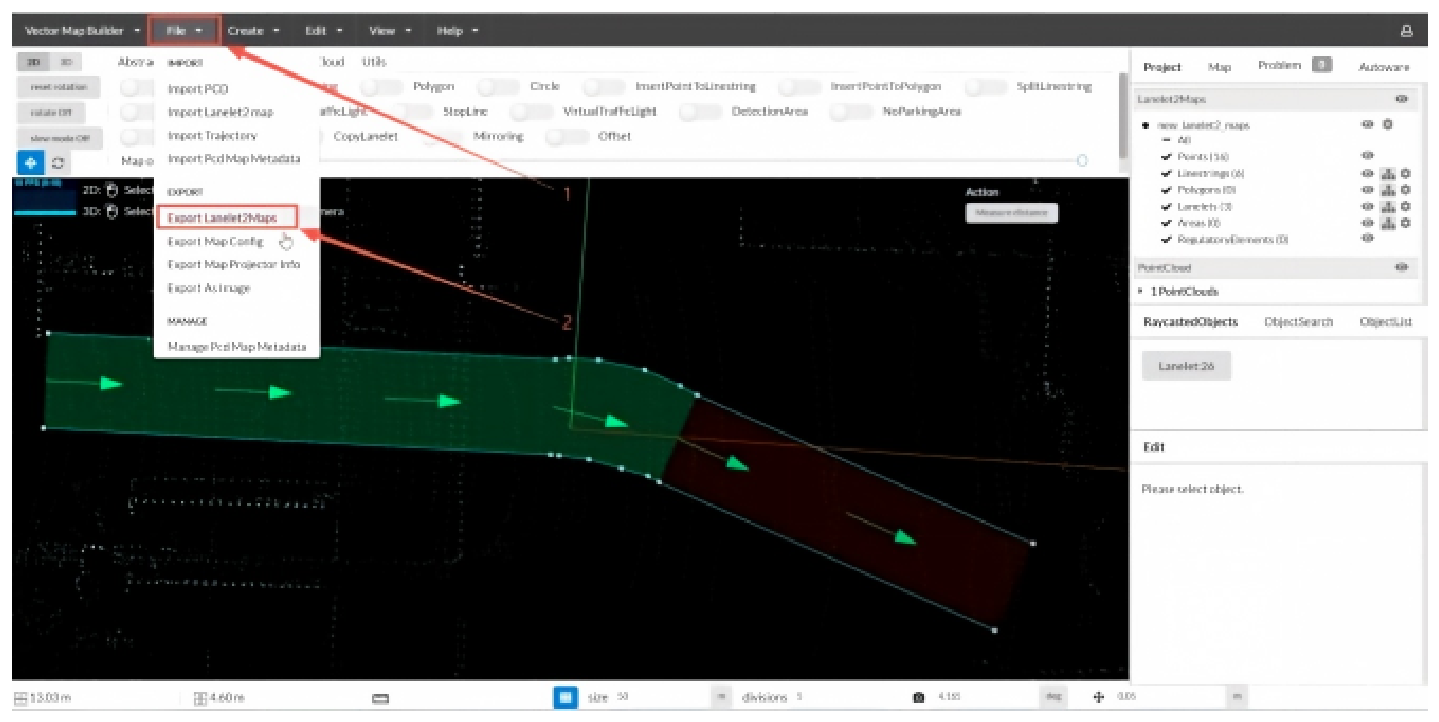
Figure 2.
Experimental vehicle during autonomous driving tests on the closed campus road.
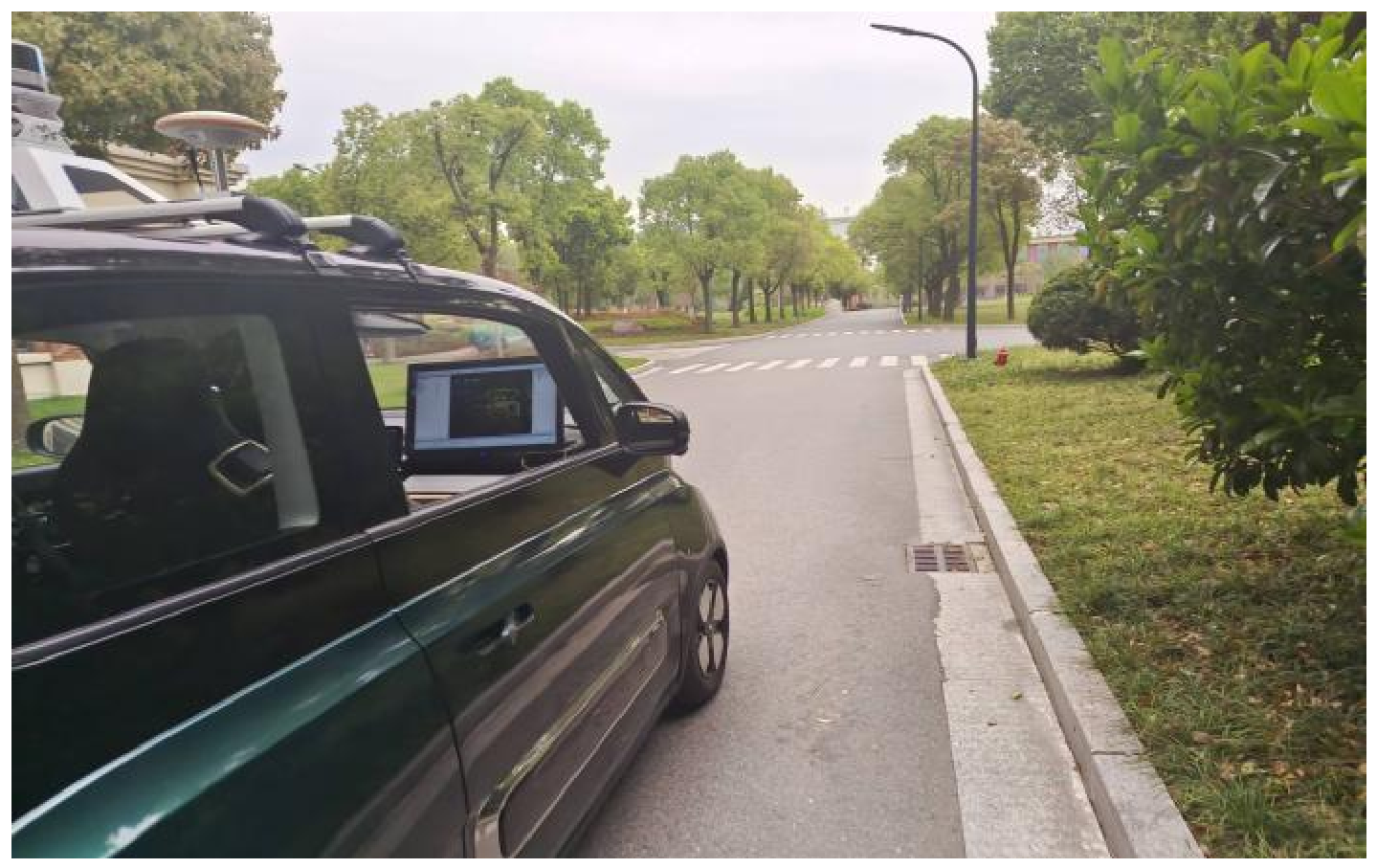
Figure 3.
Lateral tracking error comparison between Autoware (multiple runs) and human drivers.
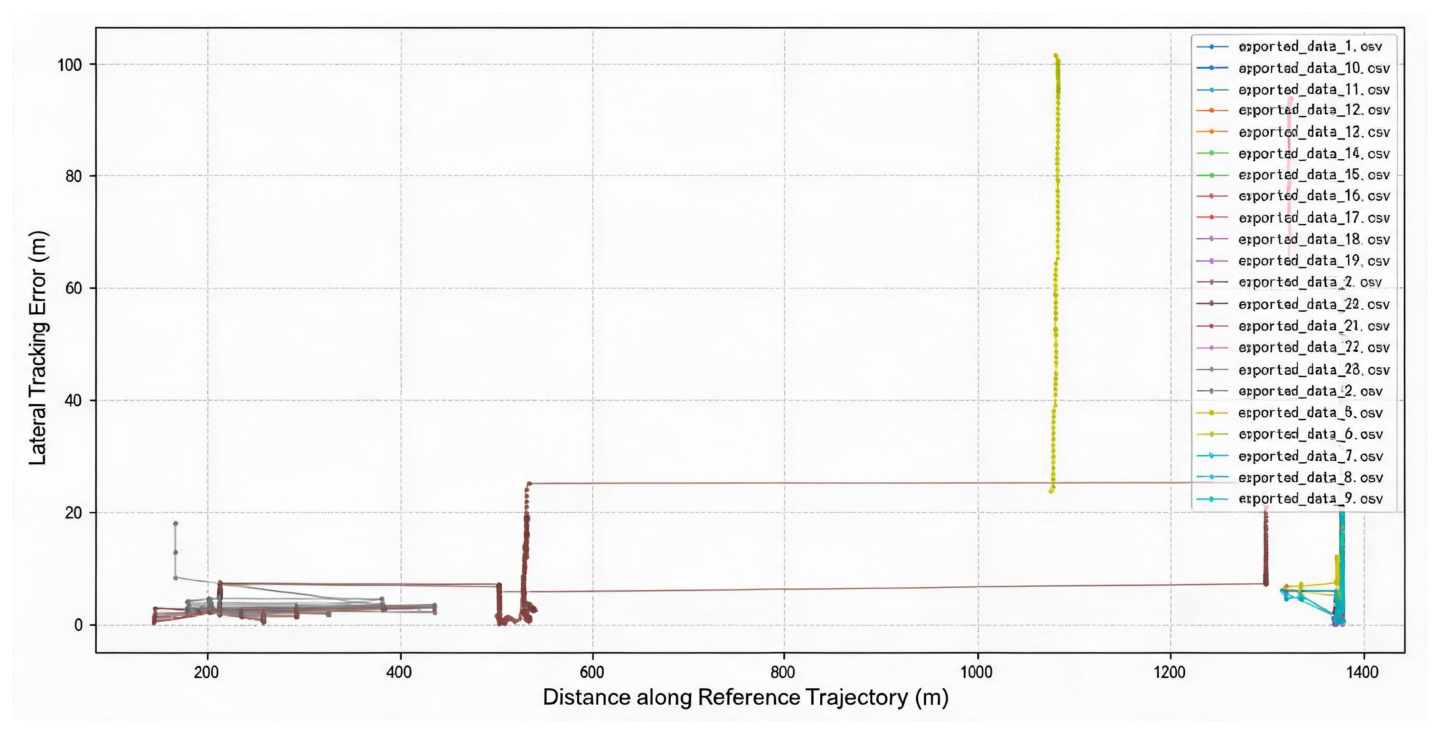
Figure 4.
Boxplot of lateral tracking errors for Autoware and human drivers.
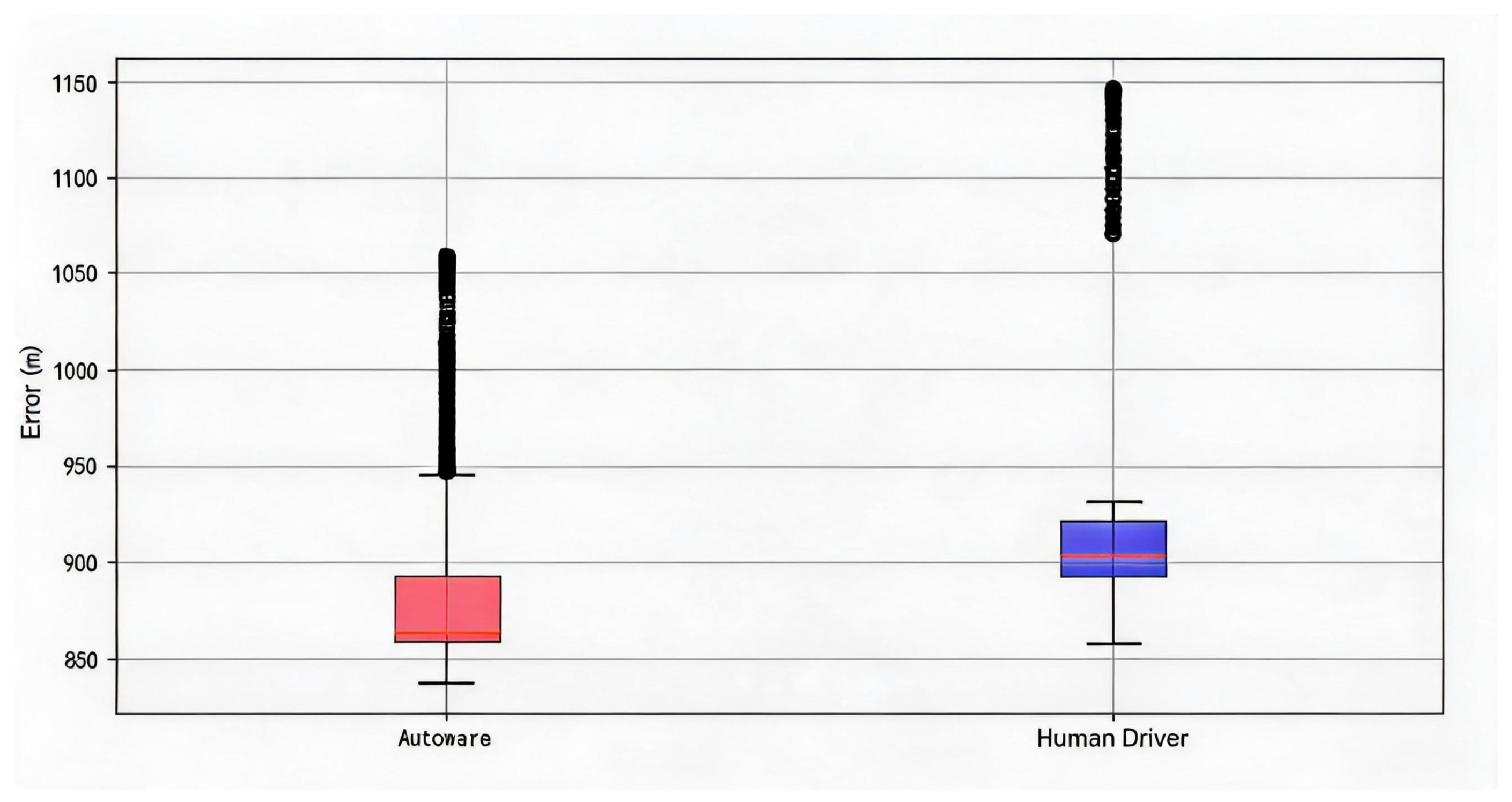

Table 1.
Hardware specifications of the experimental vehicle.
| Component | Specification | Function |
|---|---|---|
| Differential GPS | Horizontal accuracy m | High-precision positioning |
| IMU | Sampling frequency 100 Hz | Angular velocity, acceleration, attitude |
| LIDAR | – | Environmental perception and point cloud mapping |
| CAN bus | Standard automotive CAN | Data acquisition and actuator communication |
| Steer-by-wire | – | Electronic steering actuation |
Table 2.
Five-dimensional evaluation scores for Autoware and human drivers.
| Dimension | Weight | Metric | Autoware | Human |
|---|---|---|---|---|
| Control Continuity | 0.20 | , | 7 | 6 |
| Prediction Horizon | 0.18 | , | 5 | 8 |
| Error Response Mode | 0.15 | , gain linearity | 7 | 6 |
| Style Adaptability | 0.12 | , diversity index | 3 | 9 |
| Interaction Friendliness | 0.35 | Predictability, comfort score | 5 | 8 |
Scoring rationale: higher scores indicate better performance in that dimension. The weights reflect the relative importance of each dimension to passenger acceptance and driving naturalness.
Table 3.
Quantitative comparison across the five dimensions.
| Dimension | Metric | Autoware | Human | Interpretation |
|---|---|---|---|---|
| Control Continuity | High | Low | Autoware more corrective | |
| (m/s3) | 3.2 | 1.8 | Human smoother | |
| Prediction Horizon | (s) | -0.2 | 1.5 | Human anticipatory |
| Error Response Mode | Dead zone | None | Present | Human tolerant |
| Style Adaptability | Low | High | Human adaptive | |
| Interaction Friendliness | Jerk peak (m/s3) | 3.2 | 1.8 | Human comfortable |
Values shown are representative averages across all valid runs.
Disclaimer/Publisher’s Note: The statements, opinions and data contained in all publications are solely those of the individual author(s) and contributor(s) and not of MDPI and/or the editor(s). MDPI and/or the editor(s) disclaim responsibility for any injury to people or property resulting from any ideas, methods, instructions or products referred to in the content. |
© 2026 by the authors. Licensee MDPI, Basel, Switzerland. This article is an open access article distributed under the terms and conditions of the Creative Commons Attribution (CC BY) license (http://creativecommons.org/licenses/by/4.0/).
Copyright: This open access article is published under a Creative Commons CC BY 4.0 license, which permit the free download, distribution, and reuse, provided that the author and preprint are cited in any reuse.


