
Submitted:
12 July 2026
Posted:
14 July 2026
You are already at the latest version
Abstract
The biological nitrogen fixation of black locust (Robinia pseudoacacia L.) is an important factor that allows the trees to survive under adverse environmental and nutrient-poor soil conditions. Due to the open-cast mining activities, large areas in the Lusatian region in eastern Germany were left unproductive with a very nutrient-poor soil with a low amount of nitrogen (N), phosphorous (P) and no organic matter. The symbiotic N2 fixation of Robinia pseudoacacia L. has been investigated using the natural 15N abundance method. Moreover, the C:N:P ratio of soil and plants was determined. In addition, the impact of low soil P nutrition on nitrogen fixation was investigated. The N and P increased with the age of the tree plantation, but no relation was found between the carbon content and the age of the trees. Previous studies have seen an increase in soil N and P with the age of Robinia pseudoacacia L. The desorption of P was higher in the oldest plantation site, which is related to the plant availability of P. Results from the NdfA% show that about 98% and 88% of N were derived from the air by the plants planted in the reference zero site and the oldest plantation site, respectively. This slight difference in nitrogen fixation indicates that P has less impact on the nitrogen fixation of Robinia pseudoacacia L. Hence, more long-term research is required to examine the P uptake of plants from low P soil and how plants manage the biological N fixation with low soil P.
Keywords:
phosphorus
; biological nitrogen fixation
; 15N abundance method
; Robinia pseudoacacia L.
; land reclamation
; post-mining sites
1. Introduction
Short-rotation forestry and agroforestry for biomass production became an important land-use option in agricultural landscapes. The planting of fast-growing trees for bioenergy can be an alternative land-use option on marginal land, where economically effective crop production is limited (Grünewald 2006, Veste and Böhm, 2018).
As Robinia pseudoacacia L. has greater adaptability to grow in nutrient-poor sandy and dry soil (Grünewald et al. 2009, Matos et al. 2012), it was considered a better choice for planting this tree species from 1995 to 2006 as short rotation coppice (SRC) for soil reclamation purposes. Is not only morphological and ecophysiological adapted to drought conditions by reducing transpiration (Veste and Kriebitzsch 2013, Mantovani et al. 2014), Robinia pseudoacacia L. is even able to increase the biological N fixation (BNF) under water limitation (Wurzburger and Miniat (2013), Mantovani et al. 2015). Furthermore, it has been shown that the plantation of Robinia pseudoacacia L. can significantly increase the N content in the soil through its nitrogen fixation property.
Soil carbon (C), nitrogen (N) and phosphorous (P) are essential components that are linked to nutrient limitation and plant productivity in terrestrial ecosystems (Jiao et al. 2019). In general, plant, soil, and soil microbial ratio impact the nutrient cycle that influences the primary production of plants and controls the food-web dynamics in terrestrial ecosystems (Chen and Chen 2021). The stoichiometry of soil and plants C, N and P are intensely interlinked and help to understand the ecological processes of nutrient circulation, how the ecosystem responds to this circulation, and the disturbances in the ecosystem with climate change (Jiao et al. 2019; Fan et al. 2015). Soil organic carbon (SOC) is a crucial component directly related to soil fertility, whereas soil N and P are essential growth-limiting plant nutrients. In plants' primary and secondary metabolism, N is an essential element for plants' operational process and metabolism (Veste and Böhm 2018). It includes amino acids and proteins in all enzymes, nucleotides, nucleic acids, and many low molecular substances essential for growth and adaptation. In a plant-animal life cycle, 90% of P is in the soils and agriculture, and P is also considered as one of the main limiting elements (Shen et al. 2011, Jiang et al. 2015, Gypser and Veste 2019, Gypser 2020). Lack of soil P can affect plant growth negatively, reducing crop yields, as well as the plant appears stunted with dark green foliage and reduced leaf surface area (Malhotra et al. 2018; Nanda et al. 2020). Kanzler et al. (2015) showed that P-fertilization enhance tree growth of Robina pseudoacacia in the postmining area. Plant uptake of P depends both on soil and plant properties, and soil serves as the principal reservoir of P in terrestrial systems, but the amount of P immediately available to plants is less than 0.1% (Randriamanantsoa et al. 2015). In low P soil systems plants developed different physiological and morphological adaptation to overcome the limited P bioavailability by mobilization of mineral bound P (Lambers et al. 2008, Muller et al. 2023).
The P status of soil and its sorption properties can significantly impact biological N fixation, a process in which N-fixing microorganisms convert atmospheric N into a form that plants can use. Low P availability can limit the growth and activity of symbiontic N-fixing microorganisms while the physiological process of BNF requires phosphate-rich metabolites. Additionally, the sorption properties of soil can affect the availability of both P and N, with high P sorption leading to low P and N availability and vice versa.
In this study, with the leaves analysis of Robinia pseudoacacia from the post-lignite mining area, the C:N:P stoichiometry was compared with the soil (results obtained from Hashar et al. 2020). At the same time, the biological N fixation was calculated using the natural 15N abundance method to observe impacts on biological nitrogen fixation (BNF) of black locust (Robinia pseudoacacia L.) in that area.
2. Materials and Methods
2.1. Study Sites
The study sites were located in the Lusatian mining district in Welzow-Süd (23 km southwest of Cottbus, SE Brandenburg, Germany). The region is characterised by a transitional atlantic to continental climate. It is considered one of the driest regions in Germany (Gypser et al. 2015). Long-term (1991–2020) average annual precipitation at the climate station Cottbus (ID 880; 51°46′33″ N, 14°19′3″ E, 69 m.a.s.l.) is 566 mm, with a clear peak during the summer season. The average annual temperature for the same period is 10.1 °C, whereby during the winter months, temperatures reach the point of freezing while the summer is warm. In recent years the area faces extreme weather conditions with reduced water availability during summer, negatively impacting the forest ecosystem.
2.2. Land Use and Soils
The soil is overburdened and dominated by sandy to loamy sands as well as contains gravel, mining particles and recently formed organic matter derived from trees (Robinia pseudoacacia L., Populus tremula L., Quercus robur) which have been planted for reclamation purposes in different times (Gypser et al. 2015; Slazak and Freese 2015). The soil can be characterised by a heterogeneous mixture of tertiary and quaternary contents of sandy and unstructured material excavated from great depth during mining activities (Gerwin et al. 2009; Gypser et al. 2016; Krümmelbein et al. 2012).
2.3. Experimental Set-Up
The whole experimental area can be divided into five main experimental sites (
Figure 1 according to their age: (1) Nelder plant experiment (2006), (2) Short-rotation Bioenergy forest (2006), (3) Agroforestry system (2005), (4) Chicken creek or "Hühnerwasser" (reference zero) (2004), and the oldest (5) Fertilised agroforestry system (1995).
In Site 5 (S5), Robinia pseudoacacia L. was planted in a single-row design with a space of 1.9×0.8 m between the rows (Slazak and Freese 2015). Site 4 (S4) is an artificially constructed catchment. It was built in 2004-2005 by restoring a small stream destroyed by mining activities in the 1980s (Schaaf et al. 2018). This catchment can be considered as "point zero" as no attempts and measurements were taken to restore, e.g. planting, amelioration or fertilisation, to allow natural succession and undisturbed development (Gerwin et al. 2009, Schaaf et al. 2011). By 2010, vegetation had been developed quickly, covering around 60%, and vascular species are about 39% of the catchment area (Elmer et al. 2011; Schaaf et al. 2018).
2.4. Sample Collection and Preparation
Leaves samples were collected from fourteen different locations from the stated five experimental sites above, including nitrogen-fixing Robinia pseudoacacia L. and reference trees (Quercus robur (Red oak) and Populus tremula L.) to determine stable isotope. Each nitrogen-fixing tree contained five replicates, and the reference tree had three replicates. General guidelines were followed during leaf sampling, and approximately 10-12 mature and healthy leaflets were collected from each sampled tree's lower and middle crown. Since the trees were planted at different times, there may be some variation in tree height from one sampling site. All leaves were photosynthetically active and collected from the sunny canopy, representing the average planting condition. Leaves damaged by disease, insects, weather or mechanical injury and showed any evidence of fungal infection were excluded. All leaves were collected separately, placed in a dry envelope, and labelled immediately to avoid contamination and to remember the sample of the representative area. After proper sampling, all leaves were taken to the laboratory and left overnight in the drying oven at 80°C to remove all moisture from the leaves. The dried leaves sample (including stem) were cut into smaller fractions and then grinded with a rotor speed mill "Fritsch pulrerisetle 14" following three steps (firstly, 2 mm sieve, then 0.5 mm sieve and finally 0.08 mm sieve) to get a fine homogeneous powder. All the prepared samples were then stored in separate glass containers with labels for later laboratory analysis.
2.5. Chemical Analysis
2.5.1. Determination of total C, N and Sulfur (S)
In this experiment, the determination of leaf C, N and S was done using VARIO micro Cube (Elemental Instruments, Hanau, Germany), which has been developed for the fully automatic analysis process. The determination methods based on the oxidative combustion of the material and thermal conductivity measurement are used to detect C, N and S, where the Helium (He) is used as a carrier and flushing gas (Schaff and Franke 2019).
2.5.2. Leaf Digestion
Acid digestion bombs were used to digest the leaf samples. With the strong mineral acids inside the pressure bomb at a temperature above the standard boiling points, complete sample digestion is possible, which would react slowly or incompletely at atmospheric pressure. These acid digestion vessels or bombs are mainly variations of hydrothermal reactors that are used to dissolve/digest samples with strong acids and are made up of SS316 with a PTFE/Teflon liner and a cap inside. The complete set is put inside a heater/oven to complete digestion (Matusiewicz 2017; Schaff and Franke 2019).
2.5.3. Isotopic Determination of C and N
The isotope ratio mass spectrometry (IRMS) allows the accurate measurement of a slight difference in abundances of the isotopes of 13C/12C and 15N/14N. There are several types of IRMS, and the primary type of this instrument with broad applicability with a different range of materials is the Elemental Analyzer IRMS (EA-IRMS). After preparing the sample, the isotopes of 15N/14N and 13C/12C were analysed with the help of EA-IRMS.
2.5.4. Estimation of BNF with the Natural 15N Abundance Method
In this study the BNF of Legume-Rhizobium symbioses was calculated using the natural 15N abundance method because of its easy applicability at any field site without further 15N labelling (Boddey et al. 2000; Russow et al. 2005). Determination of BNF with 15N method of legume-Rhizobium symbioses was introduced by McAuliffe et al. (1958), which was originally a dilution technique of 15N where an artificial tracing is done with plant-available N pool and 15N (Russow et al. 2005). However, this method has different variations, which have been described by Russow and Faust (1990), Cadisch et al. (2000), Wood and McNeill (1993), and Peoples et al. (1989). With the use of the natural 15N abundance method, the fraction of N2 that the plants have taken up from the air can be calculated where the δ15N enrichment in the soil in comparison to N derived from the air is used as a tracer for 15N (Veste and Böhm 2018; Russow et al. 2005).
Nitrogen has two predominant stable isotopes, e.g. lighter 14N and comparatively heavier 15N, and their proportion in the air is nearly constant at 99.634% and 0.366% for 14N and 15N, respectively (Russow et al. 2005). In the air, the ratio of 15N/14N always remains constant (0.0036765), which makes it possible to use atmospheric N2 as a standard for the determination of 15N with the help of a continuous flow isotope ratio mass spectrometer. Generally, all biochemical, physiological or biogeochemical conversion processes discriminate against the heavier isotope 15N. Therefore, the lighter isotope is preferred for conversion. Thus, the difference in 15N atom percentage (atom%) or natural abundance between two experimental setups provides information about the movement of N atoms in the experimental system (He et al. 2009). In this experiment, the nitrogen isotope fractions (15N/14N) with the isotope Mass Spectrometer and the natural 15N abundances (unit promill, ‰) were calculated using the equation after Russow et al. (2004):
Here, Rs is the (15N/14N) ratio of the sample, and Ro is the (15N/14N) ratio of the atmospheric nitrogen. As the δ15N signature of nitrogen derived from soil (NdfS) is generally enriched in comparison to the nitrogen derived from the atmosphere (NdfA), the 15N enrichment in the soil is used as a natural tracer (Mantovani et al. 2015; Russow et al. 2004). Using a two-pool model, the NdfA can be calculated with the quotient of natural 15N abundances of the N2-fixing plant and a reference of the soil N pool. In this study, we used the following equation to calculate nitrogen derived from the atmosphere (NdfA) from Russow et al. (2004).
Here, δf – δ15N of the N2-fixing plant in ‰, δr – δ15N of the reference sample in ‰, and δb – isotopic shift against air's δ15N signature by the BNF itself. An isotopic shift of 0.65 was used to avoid an overestimation in our calculation. The NdfA% from equation (2) provides the relative values of BNF and does not provide the actual nitrogen input into the ecosystem.
3. Results
3.1. Leaf CNP Content and Their Ratio Stoichiometry
The average C content in leaves from all experimental areas ranged between 471.46 g Kg-1 to 437.16 g Kg-1. The lowest average C content in Robinia pseudoacacia trees has been obtained from the agroforestry area in S3 (Figure 2), with a carbon content of 437.16 g Kg-1. The average C content in Robinia pseudoacacia trees was slightly higher than that in the reference trees (Figure 3).
The average N content for Robinia pseudoacacia trees ranged from 28.85 g Kg-1 to 25.02 g Kg-1. The highest average N content of 28.85 g Kg-1 was obtained from the energy forest system, and the lowest, 25.02 g Kg-1, was obtained from the Nelder plant experiment. The oldest plantation site (S5) also has lower N content than the younger S2, S3 and S4 sites.
The average P content for Robinia pseudoacacia L. trees ranged from 0.91 to 1.51 g Kg-1, and the P content increased with the age of the tree plantation. In the youngest site, the average P content was 1.19 g Kg-1, which increased by 9% in S5 and 3.6% in S4. The lowest average P content was obtained from S3.
The highest average C:P value has been obtained from the younger agroforestry site (S3) is 480.4, and the lowest average value obtained from the oldest plantation site (S5) is 309.47. On the other hand, the C:P ratio in the reference trees was always lower than in the Robinia pseudoacacia trees and in S5, the value was 229.78 for reference trees. The highest average C:N ratio has been obtained from the oldest plantation site, which is 17.15, and the lowest average value obtained from S3 is 16.27. The average N:P ratios in Robinia pseudoacacia trees ranged between 29.67 and 17.05. The lowest value has been obtained from the oldest plantation site, and the highest average value has been obtained from S3. On the other hand, the N:P ratios in the reference trees from all the sites ranged between 10.97 and 13.76. The soil sample data for the same experimental sites is obtained from Hashar et al. (2023) and Slazak and Freese (2015).
3.2. Percentage N Derived from the Atmosphere
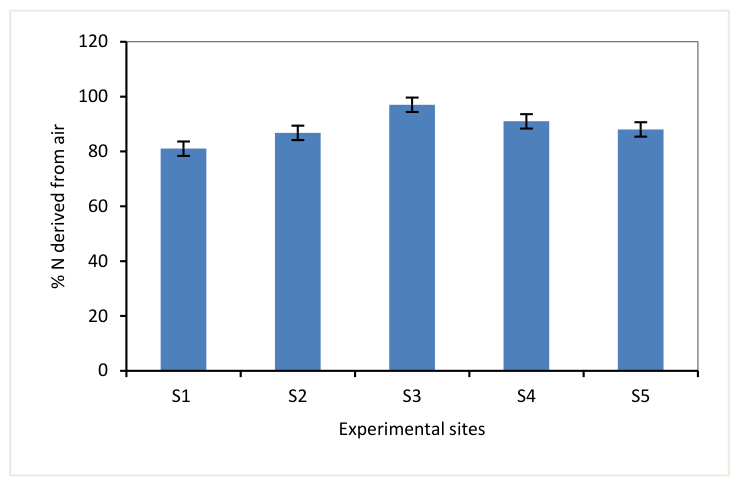
The ẟ15N values of the Robinia pseudoacacia L. trees ranged from -0.49 to 1.31‰, and for non-nitrogen fixing trees, the values ranged from -7.01 to -2.14‰, and a slight difference in the values of ẟ15N signature has been found with the succession ages of Robinia pseudoacacia L. trees. In the ẟ15N signature, the lowest values have always been obtained from the non-nitrogen fixing trees, and the average value was -3.34‰ (Figure 4). On the other hand, the nitrogen-fixing Robinia pseudoacacia L. always had higher ẟ15N values than the non-nitrogen-fixing trees, and the average values from different sites ranged between -0.46 ~ 0.55‰. The measured ẟ15N values of the leaves sample in this experiment were used in equation (3) as ẟr for calculating the percentage of N derived from atmospheric N-fixation (Ndfa %) with the 15N abundance method. The calculated percentage of nitrogen derived from the atmosphere for the Robinia pseudoacacia L. trees ranged between 78-98% (Figure 5). It differed with the ages of the Robinia pseudoacacia L. Higher nitrogen fixation has been found from the chicken creek area (S4). In the oldest site (S5), the percentage of nitrogen derived from the air has decreased by 10% compared to the younger S4. On the other hand, the lowest nitrogen value derived from the air has been obtained from S1 (Figure 4).
3.3. Carbon Isotopic Composition
The efficiency of water use and the trees' stomata opening were determined with the measured differences in ẟ13C isotopic composition. No significant difference has been obtained in the ẟ13C within the different sites and trees and the ages of the trees. The ẟ13C values from all sites were negative, ranging from -26.06 to -27.70‰.
4. Discussion
4.1. Leaves CNP Content and Stoichiometry
In this study, it has been found that the leaf carbon content did not have any significant correlation within the sites and did not affect the ages of the trees as the leaf biomass productions in the trees were not different. According to Su and Shangguan (2021), the leaf carbon content does not affect the ages of tree succession because plant carbon is a skeletal element and does not directly participate in plant production. Also, carbon content in different plants does not vary significantly. Zhang et al. (2019) found that organic carbon (OC) content in Robinia pseudoacacia L. leaves and understory biomass was not influenced by the age of the tree plantation where the successional ages were 10, 15, 25, and 35 years. Nevertheless, Robinia pseudoacacia L. had a higher carbon content than the understory vegetation in the experiment of Zhang et al. (2019). The slight difference in carbon content in the leaves in this experiment may be due to the climatic conditions, the difference in vegetation, and the sampling periods. On the other hand, Veste and Böhm (2018) described that the limiting factor controls the functional equilibrium within the biomass compartment and carbon allocation in plants and is different within the tree species. As a result, the plant's yield potential is related to the photosynthetic fixation of carbon dioxide (CO2) per unit area of the leaves and its priority to allocate into the harvested stems.
The nitrogen content in the leaves of Robinia pseudoacacia L. was negatively correlated with the trees' increasing ages. This finding indicates that the mature trees' photosynthetic rate has decreased with the increasing ages of Robinia pseudoacacia L. According to Poorter and Bongers (2006), the ageing plant's growth rate tends to slow down, and nutrient competitiveness is required to decrease the growth performance. According to the findings of Zhang et al. (2019), the total nitrogen content in Robinia pseudoacacia L. trees was significantly higher than the understory biomass. At the same time, the nitrogen content in leaves in his findings increased with the succession age of both types of plants. Su and Shangguan (2021) showed that the nitrogen content in leaves decreased with the increase in stand quality index, where the stand quality index was evaluated considering the average height, average diameter at breast height, stand density of Robinia pseudoacacia L. trees and quality of understory biomass. Mantovani et al. (2015) worked on soil water limitation effects on Robinia pseudoacacia L. in the post-mining area in northeastern Germany and found that the average nitrogen content in leaves of Robinia pseudoacacia L. varied between 2.8% to 3.0%, and the drought stress did not influence it. Su and Shangguan (2021) described that the significant decrease of the leaf's N with the increasing ages of the plants increases the stand quality index of the plants. On the other hand, in our experiment, the average N concentration in the leaves of Robinia pseudoacacia L. was higher than in the reference trees. The reason is that Robinia pseudoacacia L. is a leguminous plant and can rapidly fix N from the atmosphere with the association of Rhizobium. Furthermore, in the young Robinia pseudoacacia L. trees, the root system becomes more mature and developed, which helps in the higher ability of N fixation of the trees and increases the concentration of N in the leaves in the recovery phage. Tian et al. (2017) and Zhang et al. (2019) reported that with the increase of the biomass content in the young Robinia pseudoacacia L. trees, the trees needed more nitrogen-rich substances, e.g. enzymes, transport protein, and amino acid, which results to allocate higher N concentration in the leaves.
The P content in the leaves tends to increase with the trees' succession ages, representing the higher photosynthetic rate in the trees with the increasing tree ages. This finding is opposite to the findings of Zhang et al. (2019), and Su and Shangguan (2021), where the P content decreased with the succession ages of Robinia pseudoacacia L. Su and Shangguan (2021) also reported that the leaves' P content in 8 and 25-year ages of Robinia pseudoacacia L. was higher than the P content in 15 years' ages of Robinia pseudoacacia L. In contrast, Zhang et al. (2019) have reported that the total phosphorous (TP) content in Robinia pseudoacacia L. leaves increased with successional age and decreased with the successional ages of understory biomass. There was no statistical significance among some sites in Zhang et al. (2019). However, Bai et al. (2019) suggested that the increase of P with the plant ages indicates a faster growth rate and more substantial resource competitive ability. Therefore, it can be said that the matured trees tend to have a higher amount of P accumulation in the leaves for the higher N fixation.
It has been found that the N and P content in leaves in the Nelder plant experiment was always lower than the other experimental sites. This might be a reason that in the Nelder plant experiment, the competition for nutrition and resources is higher among the trees, affecting the trees' growth and the N and P concentration of the leaves. This also affects the fixation of nitrogen in the Robinia pseudoacacia L. trees. There is a slight increase in the C:N ratio in the leaves sample. This indicates that no significant increase in the N concentration with the undifferentiated C concentration has occurred with the ages of the trees. Yang and Luo (2011) have also reported an increase in the C:N ratio in plant tissue, which resulted from increasing the proportion of woody biomass during the substantial stand development and a shift in biomass dominance from photosynthetic to structural tissues. However, the experimental results of Fan et al. (2015), Cao and Chen (2017) and Zhang et al. (2019) have found a significant decrease in the C:N ratio in the leguminous plants with the afforestation ages as the N concentration in the leaves increases with the increased amount of N fixation.
Generally, in plants, the C:N and C:P ratios are used to indicate the ability of plants to photosynthetic fixation of C through N or P accumulation. On the other hand, the N:P ratio is used to study plant nutrient limitations in different adverse environments (Prado and Silva 2017). The ratio of leaf N and P in plants is used as an indicator of vegetation composition and nutrient limitation at the community level. For example, the N:P ratio in leaves indicates a limitation of N if N:P ratios < 14 and a P limitation when the N:P ratios > 16 in the ecosystem, whereas a leaf N:P ratio between 14 and 16 represents that the plant growth is limited by both N and P. (Fan et al. 2015; Prado and Silva 2017; Zhang et al. 2019; Dong et al. 2021). In this study, the N:P ratio decreased both in Robinia pseudoacacia L. trees and in reference trees with increasing ages. It has been studied that there is a negative correlation between the growth of the plants and the N:P ratio in the plants and leaf level (Fan et al. 2015; Su and Shangguan 2021). The average N:P ratios are higher than 16, indicating a strong P limitation for the Robinia pseudoacacia L. trees, and N limitation is gradually weakened. The growth of Robinia pseudoacacia L. trees in this region was mainly restricted by P as the post-mining area has very low soil P content, but the growth restriction due to N is weakened by the strong N fixation ability of the Robinia pseudoacacia L. trees. However, with the increasing ages of Robinia pseudoacacia L., this ratio is decreasing, which indicates that the limitation of P is declining with the growing ages of the trees, and they can absorb more P from the soil.
On the other hand, the N:P ratio in the reference trees is 10.97 in the youngest site (S1) and 17.58 in the oldest site (S5). This finding indicates that the limitation of N in the reference trees in S1 is due to the inability to fix atmospheric N. Also, the reference trees in S5 have both N and P limitations. Huang et al. (2013) reported from their findings that understory species had more ability to obtain P from the soil than dominant tree species. With this finding, it can be interpreted that in S1, the reference trees have a higher ability to absorb P from the soil than the Robinia pseudoacacia L. trees, resulting in less P and limiting them in the post-mining soil.
4.2. Soil and Leaves C:N:P Stoichiometry
The C, N and P content in the plant impacts the soil C:N:P stoichiometry, and at the same time, they can regulate the nutrient content in the soil. According to Wang et al. (2009) and Zhang et al. (2019), the plants provide plenty of substances through the litterfall and rhizodeposition, increasing the soil's nutrient content. Determination of the stoichiometry in plant-litter-soil systems explains the complex relationship among them, such as the mechanism of the tree species and vegetation composition to influence C and nutrient (N and P) redistribution between the plant, litter and soil, as well as the effects of N and P-limitation in different trees (Dong et al. 2021). From Slazak and Freese (2015) and Hashar et al. (2023), it has been found that TN, TOC and P in the soil are increasing in the post-mining area with the afforestation age of the Robinia pseudoacacia L. trees. This might result from high litterfall and other substances from the trees to the soil, which substantially increases the source of soil nutrients. On the other hand, the change in irradiance, ambient temperature, soil moisture, and the input of organic matter can change the soil pH and nutritional status of the post-mining soil. At the same time, the soil microorganism can fix the exogenous C, N and P input from the trees. The sum of (Alox + Feox) is higher in the oldest plantation site. Slazak and Freese (2015) and Hashar et al. (2023) have also reported that the soil in the post-mining area contains a high amount of Alox and Feox that can fix the soil P and make them unavailable for plant use. Results from the leaves analysis in this study represent that the P content in the leaves increased with the age of the Robinia pseudoacacia L. trees. Although the soil in the oldest plantation site contains a high amount of Alox and Feox, the plants are able to uptake P from the soil. The reason might be the input of organic matter (OM) from the plants that help to enrich the P pool in the upper soil layer and translocate the P on the upper layer in the plant P pool. This can be assumed from the root system of the Robinia pseudoacacia L. trees. The root system is very shallow (Hashar et al. 2023), which means that the trees managed to uptake the nutrition, especially P, for growth from the upper soil layer. The soil C:P ratio decreased with the afforestation age, whereas N:P increased with the afforestation age. This might be the reason that the increasing ratio of C and N is higher than the P in the soil, which represents that the soil has a P limitation for the afforested plant species. Bell et al. (2014) and Zhang et al. (2019) have also reported a strong negative correlation between the N:P ratio of the soil and available P for the plants. An increase in the N:P ratio in the soil decreases the nutrient and P availability of the plants from the soil. Bell et al. (2014) have also reported that insufficient P supplies from the soil may negatively affect the N-fixation of the Robinia pseudoacacia L. trees, substantially increasing the N:P ratio in the soil. This perfectly matches our findings that the increase in N:P ratio with the growth of afforestation age decreased the N-fixation of Robinia pseudoacacia L. trees. As a result, the N fixation of the youngest Robinia pseudoacacia L. trees is higher than the oldest plantation site. On the other hand, Zhang et al. (2019) found that Robinia pseudoacacia L. trees with a higher N:P ratio show a decreasing growth rate. Meanwhile, in our study, the increasing ages of Robinia pseudoacacia L. trees show decreasing N:P ratios, reflecting the higher growth rate of the trees. There should be a positive correlation between the soil N:P ratio and the leaves N:P ratio for the stable return and resorption of P and N between plants and soil (Zhang et al. 2019). However, in our study, the soil N:P ratios and the leaves N:P ratios are negatively correlated, indicating that no stable relationship has been established yet with the P and N resorption into the soil from the trees in the post-mining area. This might be a reason for the high content of Alox and Feox, which can fix the P into the soil, resulting in less available P for the plant's uptake.
In general, OC in the soil is positively related to the N and P content of the leaves as it is mainly derived from the breakdown of amino acids through microbial activity. Still, it does not correlate with the carbon content of the leaves. From the study of Slazak and Freese (2015) and Hashar et al. (2023), it has been found that the OC in the oldest plantation site was higher than in the youngest plantation site. This increase of OC in the soil may result from high litterfall from the Robinia pseudoacacia L. trees and their microbial decomposition, which could eventually increase the P and N concentrations in the soil. The higher value of Pox on the upper 0-10 cm soil layer has been found by Slazak and Freese (2015) and Hashar et al. (2023), which could be a result of the presence of native organic matter (OM) and humic substances. The mineralisation of OM can mobilise the P and increase its availability to plants (Von Wandruszka 2006).
Thus, it can be said that the plantation of Robinia pseudoacacia L. trees in the post-mining area has a positive impact on the C:N:P stoichiometry of soil. Both the soil and the plants C:N:P stoichiometry have relationships and impacts each other. A strong relationship between the C:P, N:P ratios of the soil and the plants with the growth of the Robinia pseudoacacia L. trees is also observed. This ratio can reflect the concentration and availability of P in soil and plants. It has been reported that the concentrations and availability of P from the soil to plants can create the inhibition of the synthesis of P-containing compounds, e.g. DNA, RNA, ATP, NADPH, and NADP+, which can have a negative impact on the physiological activity in plants, fixation of N, photosynthesis etc. that can alter the growth of the plants (Zhang et al. 2019).
4.3. Soil P Desorption and Leaf P Content
The soil P desorption was higher in the oldest plantation site on the upper soil layer (Slazak and Freese 2015; Hashar et al. 2023). The amount of P in the leaves sample was also higher in the oldest plantation site. This may be the reason that the maximal amount of desorption rate and the actual plant uptake of P are similar. Koopmans et al. (2004) have also suggested that the kinetics of P desorption can limit plant growth as it is related to the plant uptake of P. Slazak and Freese (2015) reported from his relative P desorption that the desorption of P was time-dependent and slowed down with time due to the soil properties with the content of high amount of amorphous Alox and Feox in it. Slazak and Freese (2015) also suggested that it would require a more extended period to complete the desorption of P from the soil. However, the P content in the leaves sample was relatively higher than the desorption of soil P. This might be why plant roots have some mechanism to uptake more P from the soil. He et al. (1994) have reported, after determining desorption characteristics and plant availability of phosphate sorbed by some essential variable-charge minerals, including kaolinite, goethite and amorphous Al oxides, that plants can increase P desorption to uptake it from the soil, even the non-exchangeable P fraction of residual P pool through root activity. The author also suggested that depending upon the sorption saturation and soil conditions, both the permanent-charge minerals and the variable-charge minerals in soil could be either P sinks or P sources for plants. Plant root exudates can greatly enhance the weathering of primary minerals and mobilise phosphate that has been sorbed to soil particles (Lambers et al. 2008, Muller 2023). Furthermore Lambers et al. (2008) also reported that ectomycorrhizas and ericoid mycorrhizas could frequently occur in organic soils that help to uptake more P from the soil. So, it can be said that even low plant-available P with the low desorption amount of P in the post-mining soil, the nitrogen-fixing Robinia pseudoacacia L. trees managed to uptake a higher amount of P and managed to adapt ecophysiologically.
4.4. Percentage of N Derived from the Atmosphere
Figure represents the 15N abundance of nitrogen-fixing Robinia pseudoacacia L. and non-nitrogen-fixing trees. The lowest values ẟ15N signature have been obtained from the non-nitrogen-fixing trees. This is because they cannot fix the atmospheric N and solely depend on the soil to meet their N requirement, which results in isotope discrimination. On the other hand, the ẟ15N values for the nitrogen-fixing trees were close to 0 and ranged between 0.58 to -0.04‰, which was relatively higher than the non-nitrogen-fixing trees. This is because the nitrogen-fixing Robinia pseudoacacia L. trees can fix the atmospheric N and get a high proportion of N from the air with the symbiosis of Rhizobium. The N fixation property of these trees makes them able to grow in the nutrient-poor, nitrogen-deficient soil, and at the same time, they can produce a high amount of biomass. Similar results have also been obtained by Veste et al. (2013), who worked with the BNF of Robinia pseudoacacia L. in the post-mining area in Welzow, Lusatia. In his findings, the ẟ15N values for non-nitrogen fixing trees were approximately -7‰, and for nitrogen-fixing, Robinia pseudoacacia L. was nearly zero promille. In the experiment of Mantovani et al. (2015), the ẟ15N values ranged between -0.82‰ to +0.22‰ for Robinia pseudoacacia L. trees in the high water amount to low water amount irrigation regime in the post-mining area in Welzow, Cottbus. Marron et al. (2018) have found ẟ15N value -1.13 (± 0.12) ‰ for the Robinia pseudoacacia L. leaves after 19 weeks of the seedling. He also found the NdfA% from the 15N abundance method that more than half of the N was assimilated by the Robinia pseudoacacia L. trees of all ages, with values ranging from 58.6 to 76%. The calculated results of the N derived from the air (NdfA%) for the Robinia pseudoacacia L. trees ranged between 78~98%. It means Robinia pseudoacacia L. trees obtained a high proportion of their N from the atmosphere rather than soil and accumulated more N in the leaves (25.02~28.85 g Kg-1) than the reference trees (lowest average value 15.50 g Kg-1). Thus, BNF is the main N input pathway for the trees. Veste et al. (2013) have reported after investigating on Robinia pseudoacacia L. as short rotation coppices of different ages on re-cultivated areas of the Welzow-Süd open-cast mine that the estimated percentage of BNF-derived N in the leaves of the Robinia pseudoacacia L. ranges from black locust are between 63 and 83 % and a comparable study resulted in a BNF of 65 to 90 %. Robinia pseudoacacia L. can store more N in their leaves through an N fixation mechanism than the non-nitrogen-fixing trees. As a result, the high amount of litterfall from these trees can contribute significantly to the accumulation of C, N and humus formation in nutrient-poor soils (Veste et al. 2013, Veste and Böhm 2018).
The measured ẟ13C values from all sites ranged between -26.06 to -27.70‰. This finding indicates that the water use efficiency and stomata opening were not affected by drought stress. Also, there should not be an effect on N fixation of this difference in ẟ13C isotopic composition. However, Mantovani et al. (2015) have also found nearly similar values of ẟ13C isotopic composition for Robinia pseudoacacia L. trees. Mantovani et al. (2015) found that the ẟ13C isotopic composition values in the low water amount irrigation treatment regime were -26.2‰ ± 0.17, while in the high water irrigated regime, the value was -28.03‰ ± 0.59 in the same post-mining area. Under dry conditions in 2015 Veste and Halke (2017) measure ẟ13C of 25,95 ‰± 1,24 in Welzow Süd, where as in agroforestry with ground water connection the ẟ13C was -28.70 ‰ ± 0.8.
In general, there is a strong relationship between plant δ13C values and soil water conditions, which can be used as a powerful tool for the water use efficiency of plants and stomata opening (Jucker et al. 2017). When precipitation is reduced, plants tend to absorb heavier 13C as the stomata get closed, leading to less negative δ13C values than plants with better water use efficiency (Yan et al. 2020). Under low water conditions, the plants reduce their stomatal conductance, leading to high water use efficiency and low intercellular CO2 that results in lower discrimination against 13CO2 during photosynthesis, leading to the increase of foliage δ13C. Therefore, the δ13C values are used as an indicator of drought stress of plants (Mariotte et al. 2013; Jucker et al. 2017; Yan et al. 2020). Mantovani et al. (2015) has reported that the low-water short-term drought-exposed trees (Robinia pseudoacacia L.) have slightly higher δ13C values than well-watered short-term drought-exposed trees (Robinia pseudoacacia). However, the leaf N content did not influence the drought stress in the post-mining area. Also, low soil water content reduces the soil N availability, which is fulfilled through symbiotic nitrogen fixation and causes increased nodule biomass in legumes (Mantovani et al. 2015). Veste and Böhm (2018) have also reported the same results for Robinia pseudoacacia L. trees under drought stress.
4.5. Soil C:N:P Ratio and Effect on BNF
In the soil, the content of N, OC and P increased with the ages of the plantation of Robinia pseudoacacia L. trees. However, BNF was not influenced by the soil N, P content. This can be clearly understood by comparing the N fixation of the location of the chicken creek area (S4) and the oldest plantation site (S5). It has been described above that the S4 was regarded as "reference zero" as no attempts and measurements were taken for the restoration. As a result, the soil P in the S5 was relatively higher than in the S4 site. On the other hand, the BNF of these areas was nearly the same. This finding indicates that the soil P in the post-mining area did not impact BNF. P influences nodule development, and inadequate P hinders the growth of the root, photosynthesis, translocation of sugars and other vital processes that directly or indirectly influence N fixation by legume plants, and it plays an essential role in N-fixing plants as they have high ATP demand for the nitrogenase reaction (Cooper and Scherer 2012). Thus, P deficiency negatively impacts the energy status of legume nodules as they require more P for their development, signal transduction, and phospholipids in bacteroids (Cooper and Scherer 2012). This higher demand for P in N-fixing plants than in other non-N-fixing plants is sometimes satisfied by mycorrhizal colonisation of the legume (Cooper and Scherer 2012). Ectomycorrhizal and ericoid mycorrhizal have access to additional chemical pools of P as they release phosphatases, which increase the availability of organic P, or they can exude carboxylates that also increase the availability of sparingly soluble P (Lambers et al. 2008). In our experimental site, it can be assumed that the N-fixing Robinia pseudoacacia L. trees were able to manage their high demand of P from soil and did not affect the N fixation with P deficiency.
5. Conclusions
After studying all the experimental data and comparing it with experimental soil analysis from other studies, it can be said that the establishment of Robinia pseudoacacia L. trees was a better choice for reclamation of the post-lignite mining area. The C:N:P stoichiometry of plant and soil data represents a limitation of P nutrients for the nitrogen-fixing plants and both N and P limitations for non-nitrogen-fixing plants. The soil has a very low amount of available plant P. Still, this low amount of soil P did not significantly impact the BNF of the Robinia pseudoacacia L. trees. Due to the open-cast mining activities in the experimental sites, the biogeochemical properties and ecosystem of the soil can be characterised by the initial soil development. As the sites were inferior with soil N, the Robinia pseudoacacia L. trees largely depended on the atmospheric N from the air. As a result, the biological fixation of nitrogen was the primary input of N for the trees. However, the soil and plant leaf data analysis suggest that both the N and P are increasing in the soil and leaf with the ages of the Robinia pseudoacacia L. trees. As a result, the plantation of these trees can help to improve soil nutrients. However, with low soil P desorption and low plant-available P, plants did not show significant variance in BNF. As a result, further experimental research is needed to observe any further impacts of P on the nitrogen fixation of Robinia pseudoacacia L. trees.
Author Contributions
Conceptualization, Dirk Freese; methodology, Dirk Freese, Maik Veste, Shamima Nasrin, and Mohammad Rafiul Hashar; validation, Dirk Freese, and Maik Veste; formal analysis, Shamima Nasrin, and Mohammad Rafiul Hashar; investigation, Shamima Nasrin, and Mohammad Rafiul Hashar; resources, Dirk Freese, and Maik Veste; data curation, Shamima Nasrin, and Mohammad Rafiul Hashar; writing—original draft preparation, Shamima Nasrin, and Mohammad Rafiul Hashar; writing—review and editing, Dirk Freese, Maik Veste, Shamima Nasrin, and Mohammad Rafiul Hashar; visualization, Shamima Nasrin, and Mohammad Rafiul Hashar; supervision, Dirk Freese, and Maik Veste; project administration, Dirk Freese, and Maik Veste; funding acquisition, Dirk Freese, and Maik Veste.
Funding
Maik Veste reports financial support was provided by Lausitz Energie Bergbau AG (LEAG). Dirk Freese reports financial support and equipment, drugs, or supplies were provided by Bundesministerium für Bildung und Forschung (BMBF). Maik Veste reports a relationship with Lausitz Energie Bergbau AG (LEAG) that includes: funding grants. Dirk Freese reports a relationship with Bundesministerium für Bildung und Forschung that includes: funding grants. If there are other authors, they declare that they have no known competing financial interests or personal relationships that could have appeared to influence the work reported in this paper.
Data Availability Statement
The data presented in this study are available on request from the corresponding author due to legal reasons.
Acknowledgments
We are grateful to our lab assistants Denis Henning and Regina Müller, for creating a friendly environment during our lab work.
Conflicts of Interest
The authors declare no conflicts of interest.
References
- Bai, X.; Wang, B.; An, S.; Zeng, Q.; Zhang, H. Response of forest species to C:N:P in the plant-litter-soil system and stoichiometric homeostasis of plant tissues during afforestation on the Loess Plateau, China. CATENA 2019, 183, 104186. [Google Scholar] [CrossRef]
- Bell, C.; Carrillo, Y.; Boot, C. M.; Rocca, J. D.; Pendall, E.; Wallenstein, M. D. Rhizosphere stoichiometry: are C:N:P ratios of plants, soils, and enzymes conserved at the plant species-level? New Phytol. 2013, 201(2), 505–517. [Google Scholar] [CrossRef] [PubMed]
- Blombäck, K.; Bolster, C.H.; Lindsjö, A.; Hesse, K.; Linefur, H.; Parvage, M.M. Comparing measures for determination of phosphorus saturation as a method to estimate dissolved P in soil solution. Geoderma 2021, Volume 383, 114708. [Google Scholar] [CrossRef]
- Borggaard, O.K.; Jdrgensen, S.S.; Moberg, J.P.; Raben-Lange, B. Influence of organic matter on phosphate adsorption by aluminium and iron oxides in sandy soils. J. Soil Sci. 1990, 41, 443–449. [Google Scholar] [CrossRef]
- Brust, G.E. Management Strategies for Organic Vegetable Fertility, Chapter 9. In Safety and Practice for Organic Food; 2019; pp. Pages 193–212. [Google Scholar] [CrossRef]
- Bungart, R.; Bens, O.; Hüttl, R. F. Production of bioenergy in post-mining landscapes in Lusatia Perspectives and challenges for alternative land use systems. Ecol. Eng. 2000, 16, S5–S16. [Google Scholar] [CrossRef]
- Cao, Y.; Chen, Y. Coupling of plant and soil C:N:P stoichiometry in black locust (Robinia pseudoacacia) plantations on the Loess Plateau, China. Trees 2017, 31(5), 1559–1570. [Google Scholar] [CrossRef]
- Chen, X.; Chen, H. Y. H. Plant mixture balances terrestrial ecosystem C:N:P stoichiometry. Nat. Commun. 2021, 12(1). [Google Scholar] [CrossRef] [PubMed]
- Cornell, R.M.; Schwertmann, U. The iron oxides. Structure, Properties, Reactions, Occurrences and Uses; VCH Publishers: Weinheim, Germany, 1996. [Google Scholar]
- Cravotta, C.; Brady, K.; Rose, A.; Douds, J.B. Corpus ID: 53308009; Frequency Distribution of the pH of Coal-Mine Drainage in Pennsylvania. 1999.
- Dong, C.; Qiao, Y.; Cao, Y.; Chen, Y.; Wu, X.; Xue, W. Seasonal Variations in Carbon, Nitrogen, and Phosphorus Stoichiometry of a Robinia pseudoacacia Plantation on the Loess Hilly Region, China. Forests 2021, 12(2), 214. [Google Scholar] [CrossRef]
- Elmer, M.; Schaaf, W.; Biemelt, D.; Gerwin, W.; Huettl, R.F. Ecosystem Development: The Constructed Catchment "Chicken Creek" – initial ecosystem development 2005-2010; Brandenburg University of Technology Cottbus: Cottbus, Germany, 2011. [Google Scholar]
- Fan, H.; Wu, J.; Liu, W.; Yuan, Y.; Hu, L.; Cai, Q. Linkages of plant and soil C:N:P stoichiometry and their relationships to forest growth in subtropical plantations. Plant Soil 2015, 392(1–2), 127–138. [Google Scholar] [CrossRef]
- Freese, D.; Lookman, R.; Merckx, R.; Van Riemsdijk, W.H. New method for the assessment of long term phosphate desorption from the soil. Soil Sci. Soc. Am. J. 1995, 59(5), 1295–300. [Google Scholar] [CrossRef]
- Freese, D.; Van der Zee, S. E. A. T. M.; Van Riemsdijk, W. H. Comparison of different models for phosphate sorption as a function of the iron and aluminium oxides of soils. J. Soil Sci. 1992, 43, 729–738. [Google Scholar] [CrossRef]
- Freese, D.; Van Riemsdijk, W.H.; Van der Zee, S.E.A.T.M. Modelling Phosphate –sorption kinetics in acid soils. Eur. J. Soil Sci. 1995, 46, 239–245. [Google Scholar] [CrossRef]
- Fukumasu, J.; Poeplau, C.; Coucheney, E.; Jarvis, N.; Klöffel, T.; Koestel, J.; Kätterer, T.; Nimblad, S.D.; Wetterlind, J.; Larsbo, M. Oxalate-extractable aluminum alongside carbon inputs may be a major determinant for organic carbon content in agricultural topsoils in humid continental climate. Geoderma 2021, 402, 115345. [Google Scholar] [CrossRef]
- Gasparatos, D.; Haidouti, C.; Haroulis, A.; Tsaousidou, P. Estimation of Phosphorus Status of Soil Fe-Enriched Concretions with the Acid Ammonium Oxalate Method. Commun. Soil Sci. Plant Anal. 2006, 37, 2375–2387. [Google Scholar] [CrossRef]
- Gerwin, W.; Schaaf, W.; Veste, M.; Hüttl, R. The artificial catchment 'Chicken Creek' ('Hühnerwasser') as a tool for understanding the interactions of processes and structures of initial ecosystem development. Work. Pap. Finn. For. Res. Inst. 2009, Vol. 128. [Google Scholar]
- González, I.; Sixto, H.; Rodríguez-Soalleiro, R.; Oliveira, N. Nutrient Contribution of Litterfall in a Short Rotation Plantation of Pure or Mixed Plots of Populus alba L. and Robinia pseudoacacia L. Forests 2020, 11(11), 1133. [Google Scholar] [CrossRef]
- Grünewald, H.; Brandt, B.K.V.; Schneider, B.U.; Bens, O.; Kendzia, G.; Hüttl, R.F. Agroforestry systems for the production of woody biomass for energy transformation purposes. Ecol. Eng. 2007, 29, 319–328. [Google Scholar] [CrossRef]
- Grünewald, H.; Böhm, C.; Quinkenstein, A.; Grundmann, P.; Eberts, J.; Wühlisch, G. Robinia pseudoacacia L. A lesser known tree species for biomass production. BioEnergy Res. 2009, 2, 123–133. [Google Scholar] [CrossRef]
- Gypser, S. Identification of phosphate adsorption mechanisms on Fe- and Al-hydroxides and the influence of inorganic and organic compounds to reduce long-term phosphorus fixation on mineral surfaces. PhD thesis, Brandenburg University of Technology Cottbus–Senftenberg, Cottbus, Germany, 2020. Retrieved from urn: nbn:de: kobv:co1-opus4-51311. [Google Scholar]
- Gypser, S.; Schütze, E.; Freese, D. Crystallisation of single and binary iron- and aluminum hydroxides affect phosphorus desorption. J. Plant Nutr. Soil Sci. 2019, 182, 741–750. [Google Scholar] [CrossRef]
- Gypser, S.; Veste, M.; Fischer, T.; Lange, P. Formation of soil lichen crusts at reclaimed post-mining sites, Lower Lusatia, North-east Germany. Graph. Scr. 2015, 12. [Google Scholar]
- Gypser, S.; Veste, M.; Fischer, T.; Lange, P. Infiltration and water retention of biological soil crusts on reclaimed soils of former open-cast lignite mining sites in Brandenburg, north-east Germany. J. Hydrol. Hydromech. 2016, 64, 1–11. [Google Scholar] [CrossRef]
- Gypser, S.; Veste, M. Importance of P limitation for the C:N:P ratio in Robinia plantations on marginal sites. Verhandlungen GfÖ 2019, 49, 82. [Google Scholar] [CrossRef]
- Hashar, M.R.; Nasrin, S.; Freese, D.; Veste, M. Study of phosphorus status and sorption properties in reclaimed lignite mine soils under different age stands of Robinia pseudoacacia L. in Welzow, Germany. Authorea 2023. [Google Scholar] [CrossRef] [PubMed]
- He, Z.L.; Yang, X.; Yuan, K.N.; Zhu, Z.X. Desorption and plant-availability of phosphate sorbed by some important minerals. Plant Soil 1994, 162(1), 89–97. [Google Scholar] [CrossRef]
- Jiang, X.; Bol, R.; Willbold, S.; Vereecken, H.; Klumpp, E. Speciation and distribution of P associated with Fe and Al oxides in aggregate-sized fraction of an arable soil. Biogeosciences 2015, 12, 6443–6452. [Google Scholar] [CrossRef]
- Jiao, S.; Li, J.; Li, Y.; Jia, J.; Xu, Z. Soil C, N, and P distribution as affected by plant communities in the Yellow River Delta, China. PLoS ONE 2019, 14(12), e0226887. [Google Scholar] [CrossRef] [PubMed]
- Jucker, T.; Grossiord, C.; Bonal, D.; Bouriaud, O.; Gessler, A.; Coomes, D. A. Detecting the fingerprint of drought across Europe's forests: do carbon isotope ratios and stem growth rates tell similar stories? For. Ecosyst. 2017, 4(1). [Google Scholar] [CrossRef]
- Kanzler, M.; Böhm, C.; Freese, D. Impact of P fertilisation on the growth performance of black locust. Robinia pseudoacacia L.) in a lignite post-mining area in Germany 2015. [Google Scholar] [CrossRef]
- Kanzler, M.; Böhm, C.; Freese, D. The development of soil organic carbon under young black locust (Robinia pseudoacacia L.) trees at a post-mining landscape in eastern Germany. New For. 2021, 52, 47–68. [Google Scholar] [CrossRef]
- Koopmans, G. F.; Chardon, W. J.; de Willigen, P.; van Riemsdijk, W. H. Phosphorus Desorption Dynamics in Soil and the Link to a Dynamic Concept of Bioavailability. J. Environ. Qual. 2004, 33, 1393. [Google Scholar] [CrossRef] [PubMed]
- Koopmans, G. F.; Van der Zeeuw, M.E.; Romkens, P.F.A.M.; Chardon, W.J.; Oenema, O. Identification and characterisation of phosphorus-rich sandy soils. NJAS—Wageningen J. Life Sci. 2001, vol. 49(no. 4), 369–384. [Google Scholar] [CrossRef]
- Krümmelbein, J.; Bens, O.; Raab, T.; Anne Naeth, M. A history of lignite coal mining and reclamation practices in Lusatia, eastern Germany. Can. J. Soil Sci. 2012, 92(1), 53–66. [Google Scholar] [CrossRef]
- Lambers, H.; Chapin, F.S.; Pons, T.L. Plant Physiological Ecology 2nd Edition; 2008. [Google Scholar] [CrossRef]
- Lookman, R.; Freese, D.; Merckx, R.; Vlassak, K.; Van Riemsdijk, W.H. Long-Term Kinetics of Phosphate Release from Soil. Am. Chem. Soc. Environ. Sci. Technol. 1995, vol 29, no 6. [Google Scholar] [CrossRef] [PubMed]
- Lookman, R.; Vandeweert, N.; Merckx, R.; Vlassak, K. Geostatistical assessment of the regional distribution of phosphate sorption capacity parameters (FeOX and AlOX) in northern Belgium. Geoderma 1995, 66, 285–296. [Google Scholar] [CrossRef]
- Malhotra, H.; Vandana, S.S.; Pandey, R. Phosphorus Nutrition: Plant Growth in Response to Deficiency and Excess; 2018. [Google Scholar] [CrossRef]
- Mantovani, D.; Veste, M.; Boldt-Burisch, K.; Fritsch, S.; Koning, L. A.; Freese, D. Carbon allocation, nodulation, and biological nitrogen fixation of black locust (Robinia pseudoacacia L.) under soil water limitation. Ann. For. Res. 2015, 58(2), 259–274. [Google Scholar] [CrossRef]
- Mantovani, D.; Veste, M.; Freese, D. Black locust (Robinia pseudoacacia L.) ecophysiological and morphological adaptations to drought and their consequence on biomass production and water-use efficiency. N. Z. J. For. Sci. 2014, 29. [Google Scholar] [CrossRef]
- Mariotte, P.; Vandenberghe, C.; Kardol, P.; Hagedorn, F.; Buttler, A. Subordinate plant species enhance community resistance against drought in semi-natural grasslands. J. Ecol. 2013, 101(3), 763–773. [Google Scholar] [CrossRef]
- Matos, E. S.; Freese, D.; Böhm, C.; Quinkenstein, A.; Hüttl, R. F. Organic matter dynamics in reclaimed lignite mine soils under Robinia pseudoacacia L. plantations of different ages in Germany. Commun. Soil Sci. Plant Anal. 2012, 43(5), 745–755. [Google Scholar] [CrossRef]
- Matos, E. S.; Freese, D.; Slazak, A.; Bachmann, U.; Veste, M.; Hüttl, R.F. Organic-carbon and nitrogen stocks and organic carbon fractions in soil under mixed pine and oak forest stands of different ages in NE Germany. J. Plant Nutr. Soil Sci. 2010, vol. 173(no. 5), 654–661. [Google Scholar] [CrossRef]
- Matusiewicz, H. Sample Preparation for Inorganic Trace Element Analysis. Phys. Sci. Rev. 2017, 2(5). [Google Scholar] [CrossRef]
- Mckeague, J.A.; Day, J.H. Dithionite and oxalate extractable Fe and Al as aids in differentiating various classes of soils. In Soil Research Institute, Canada Department of Agriculture; Ottawa, 1965. [Google Scholar] [CrossRef]
- Moazed, H.; Hoseini, Y.; Naseri, A.A.; Abbasi, F. Determining Phosphorus Adsorption Isotherm in Soil and its Relation to Soil Characteristics. Int. J. Soil Sci. 2010, 5, 131–139. [Google Scholar] [CrossRef]
- Muller, K.; Veste, M.; Privett, S.; Strauss, P.; Makunga, N.; Griebenow, S.; Valentine, A. Proteaceae species show different strategies for phosphorus acquisition and utilisation in P poor soils in the Mediterranean-type Fynbos ecosystem. Flora 2023, 306, 152362. [Google Scholar] [CrossRef]
- Murphy, J.; Riley, J.P. A modified single solution method for the determination of phosphate in natural waters. Anal. Chim. Acta 1962, vol. 27, 31–36. [Google Scholar] [CrossRef]
- Nanda, M.; Kansal, A.; Cordell, D. Managing agricultural vulnerability to phosphorus scarcity through bottom-up assessment of regional-scale opportunities. Agric. Syst. 2020, 184, 102910. [Google Scholar] [CrossRef]
- Pautler, M.C.; Sims, J.T. Relationships between soil test phosphorus, soluble phosphorus, and phosphorus saturation in Delaware soils. Soil Sci. Soc. Am. J. 2000, 64, 765–773. [Google Scholar] [CrossRef]
- Poorter, L.; Bongers, F. Leaf traits are good predictors of plant performance across 53 rain forest species. Ecology 2006, 87(7), 1733–1743. [Google Scholar] [CrossRef]
- Prado, R.D.M.; Silva, G.P.D. Ecological Response to Global Change: Changes in C:N:P Stoichiometry in Environmental Adaptations of Plants. In Plant Ecology - Traditional Approaches to Recent Trends; Published, 2017. [Google Scholar] [CrossRef]
- Randriamanantsoa, L.; Frossard, E.; Oberson, A.; Bünemann, E.K. Gross organic phosphorus mineralisation rates can be assessed in a Ferralsol using an isotopic dilution method. Geoderma 2015, 257–258, 86–93. [Google Scholar] [CrossRef]
- Renneson, M.; Vandenberghe, C.; Dufey, J.; Marcoen, J.M.; Bock, L.; Colinet, G. Degree of phosphorus saturation in agricultural loamy soils with a near-neutral pH: Degree of phosphorus saturation in loamy soils. Eur. J. Soil Sci. 2015, 66, 33–41. [Google Scholar] [CrossRef]
- Russow, R.; Veste, M.; Littmann, T. Using the natural15N abundance to assess the main nitrogen inputs into the sand dune area of the north-western Negev desert (Israel). Isot. Environ. Health Stud. 2004, 40(1), 57–67. [Google Scholar] [CrossRef] [PubMed]
- Russow, R.; Veste, M.; Böhme, F. A natural 15N approach to determine the biological fixation of atmospheric nitrogen by biological soil crusts of the Negev desert. Rapid Commun. Mass Spectrom. 2005, 19(23), 3451–3456. [Google Scholar] [CrossRef] [PubMed]
- Sample, E.C.; Soper, R.J.; Racz, G.J. Reaction of phosphate fertiliser in soil. In The Role of Phosphorus in Agriculture; American Society of Agronomy, 1980; pp. 263–310. [Google Scholar]
- Schaaf, W.; Franke, G. Bodenkundliches Laborpraktikum ws 18-19, Lehrstuhl Bodenschutz und Rekultivierung; Brandenburg University of Technology Cottbus-Senftenberg: Cottbus, Germany, 2019. [Google Scholar]
- Schaaf, W.; Hinz, C.; Gerwin, W.; Markus, K.; Zaplata, M.K.; Huettl, R.F. Ecosystem Development in the Constructed Catchment “Chicken Creek”. 2018, 3. [Google Scholar] [CrossRef]
- Schaaf, W.; Bens, B.; Fischer, A.; Gerke, H.H.; Gerwin, W.; Grünewald, U.; Holländer, H.M.; Kögel-Knabner, I.; Mutz, M.; Schloter, M.; Schulin, R.; Veste, M.; Winter, S.; Hüttl, R.F. Patterns and processes of initial terrestrial-ecosystem development. J. Plant Nutr. Soil Sci. 2011, 174(2), 229–239. [Google Scholar] [CrossRef]
- Schlichting, E.; Blume, H.P.; Stahr, K.C. Bodenkundliches Praktikum, 2. Auflage ed; Blackwell WissenschaftsVerlag: Berlin, 1995. [Google Scholar]
- Shang, C.; Zelazny, L.W. Selective Dissolution Techniques for Mineral Analysis of Soils and Sediments. In SSSA Book Series; Ulery, A.L., Richard Drees, L., Eds.; American Society of Agronomy and Soil Science Society of America: Madison, WI, USA, 2008; pp. 33–80. [Google Scholar] [CrossRef]
- Shen, J.; Yuan, L.; Zhang, J.; Li, H.; Bai, Z.; Chen, X.; Zhang, W.; Zhang, F. Phosphorus Dynamics: From Soil to Plant. Plant Physiol. 2011, 156, 997–1005. [Google Scholar] [CrossRef] [PubMed]
- Slazak, A.; Freese, D. Phosphorus Sorption Kinetics in Reclaimed Lignite Mine Soils under Different Age Stands of Robinia pseudoacacia L. in Northeast Germany. Appl. Environ. Soil Sci. 2015, 2015, 1–19. [Google Scholar] [CrossRef]
- Su, B.; Shangguan, Z. Response of water use efficiency and plant-soil C:N:P stoichiometry to stand quality in Robinia pseudoacacia on the Loess Plateau of China. CATENA 2021, 206, 105571. [Google Scholar] [CrossRef]
- Szara, E.; Sosulski, T. The use of phosphorus sorption parameters in the monitoring of potential emissions of this component from the arable lands. Rocz. Glebozn. Soil Sci. Annu. 2012, Vol. 63 No 3, 2430. [Google Scholar] [CrossRef]
- Tamungang, N.E.B.; Mvondo-Zé, A.D.; Ghogomu, J.N.; Mofor, N.A. Evaluation of phosphorus sorption characteristics of soils from the Bambouto sequence (West Cameroon). Int. J. Biol. Chem. Sci. 2016. [Google Scholar] [CrossRef]
- Tyrolová, Y.; Výborná, A. Effect of the stage of maturity on the leaf percentage of lucerne and the effect of additives on silage characteristics. Czech. J. Anim. Sci. 2008, 53(No. 8), 329–334. [Google Scholar] [CrossRef]
- USDA. Natural Resources Conservation Service. Carbon to Nitrogen Ratios in Cropping Systems, United States Department of Agriculture. In soils.usda.gov/sqi.; Accessed; 2011; (accessed on 02 April 2023). [Google Scholar]
- Van der Zee, S.E.A.T.M. Reaction kinetics and transport in soil: compatibility and differences between some simple models. Transp. Porous Media 1991, vol. 6(no. 5-6), 703–737. [Google Scholar] [CrossRef]
- Van der Zee, S.E.A.T.M.; Van Riemsdijk, W.H. Model for long term phosphate reaction kinetics in soil. J. Environ. Qual. 1988, vol. 17(no. 1), 35–41. [Google Scholar] [CrossRef]
- Van der Zee, S.E.A.T.M.; Fokkink, G.J.; Van Riemsdijk, W.H. A new technique for assessment of reversibly adsorbed phosphate. Sci. Soc. Am. J. 1987, 51, 599–604. [Google Scholar] [CrossRef]
- Van der Zee, S.E.A.T.M.; Van Riemsdijk, W.H. Sorption kinetics and transport of phosphate in sandy soil. Geoderma 1986, 38, 293–309. [Google Scholar] [CrossRef]
- Veste, M.; Böhm, C. (Eds.) Agrarholz – Schnellwachsende Bäume in der Landwirtschaft; 2018. [Google Scholar] [CrossRef]
- Veste, M.; Böhm, C.; Quinkenstein, A.; Freese, D. Biologische Stickstoff-Fixierung der Robinie. AFZ-Der Wald 2013, 2/2013, 40–42. [Google Scholar]
- Veste, M.; Kriebitzsch, W.-U. Einfluss von Trockenstress auf Photosynthese, Transpiration und Wachstum junger Robinien (Robinia pseudoacacia L.). Forstarchiv 2013, 84, 35–42. [Google Scholar] [CrossRef]
- Veste, M.; Halke, C. Ökophysiologische Plastizität der Photosynthese von Robinien (Robinia pseudoacacia L.) und Hybrid-Pappeln (Populus nigra L. × P. maximowiczii Henry) bei Hitzestress und Sommertrockenheit in der Niederlausitz. In Bäume in der Land(wirt)schaft – von der Theorie in die Praxis 5. Agroforstforum, Tagungsband; Böhm, C., Ed.; Cottbus, 2017; pp. S 144–157. [Google Scholar]
- Von Wandruszka, R. Phosphorus retention in calcareous soils and the effect of organic matter on its mobility. Geochem. Trans. 2006, 7(1). [Google Scholar] [CrossRef] [PubMed]
- Wang, G.; Liu, G.; Xu, M. Above- and belowground dynamics of plant community succession following abandonment of farmland on the Loess Plateau, China. Plant Soil 2009, 316(1–2), 227–239. [Google Scholar] [CrossRef]
- Wurzburger, N.; Miniat, C.F. Drought enhances symbiotic dinitrogen fixation and competitive ability of a temperate forest tree. Oecologia 2013, 174(4), 1117–1126. [Google Scholar] [CrossRef] [PubMed]
- Yan, G.; Han, S.; Zhou, M.; Sun, W.; Huang, B.; Wang, H.; Xing, Y.; Wang, Q. Variations in the natural 13C and 15N abundance of plants and soils under long-term N addition and precipitation reduction: interpretation of C and N dynamics. For. Ecosyst. 2020, 7(1). [Google Scholar] [CrossRef]
- Yang, X.; Chen, X.; Yang, X. Effect of organic matter on phosphorus adsorption and desorption in a black soil from Northeast China. Soil Tillage Res. 2019, 187, 85–91. [Google Scholar] [CrossRef]
- Yu, W.; Ding, X.; Xue, S.; Li, S.; Liao, X.; Wang, R. Effects of organic-matter application on phosphorus adsorption of three soil parent materials. J. Soil Sci. Plant Nutr. 2013, 0–0. [Google Scholar] [CrossRef]
- Zhang, W.; Liu, W.; Xu, M.; Deng, J.; Han, X.; Yang, G.; Feng, Y.; Ren, G. Response of forest growth to C:N:P stoichiometry in plants and soils during Robinia pseudoacacia afforestation on the Loess Plateau, China. Geoderma 2019, 337, 280–289. [Google Scholar] [CrossRef]
Figure 1.
Location map and B aerial photos (Source: Google Earth) of the five study sites (according to their establishment newest to oldest): (1) Nelder plant experiment, (2) Short rotation bioenergy plantation (3) Agroforestry system, (4) Experimental site "Hühnerwasser" (Chicken Creek), and (5) fertilised agroforestry system.
Figure 1.
Location map and B aerial photos (Source: Google Earth) of the five study sites (according to their establishment newest to oldest): (1) Nelder plant experiment, (2) Short rotation bioenergy plantation (3) Agroforestry system, (4) Experimental site "Hühnerwasser" (Chicken Creek), and (5) fertilised agroforestry system.
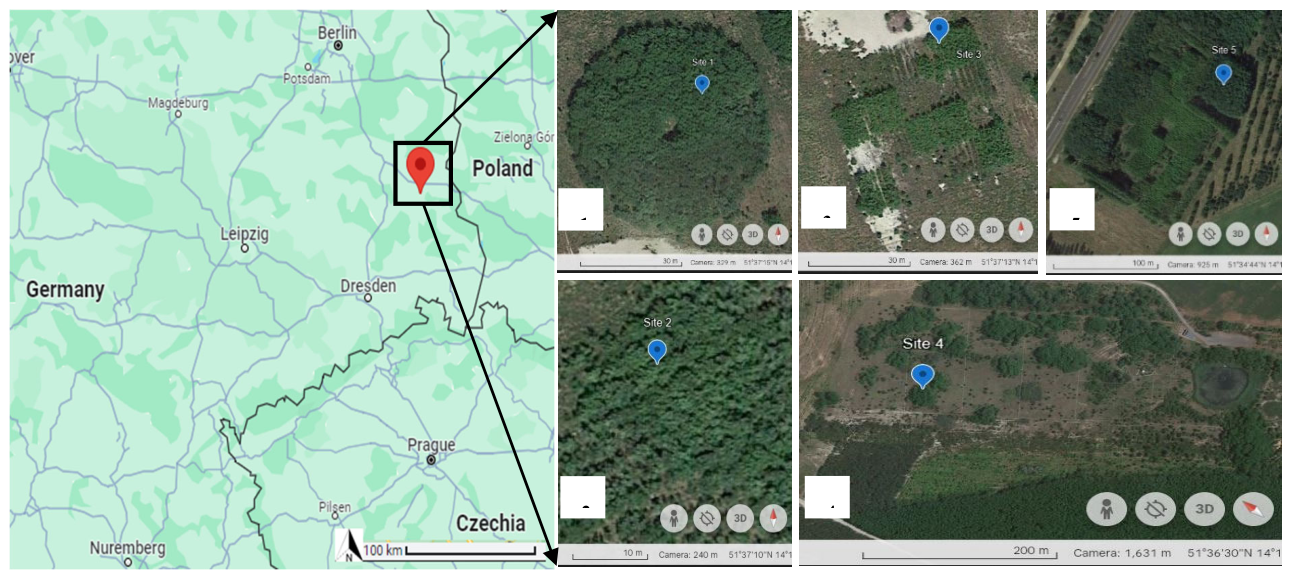
Figure 2.
Carbon (a), nitrogen (b) and phosphor (c) content (mean +/- SD) in leaves of Robina pseudoacacia and (ref = reference trees at the site), for location see Fig.
Figure 2.
Carbon (a), nitrogen (b) and phosphor (c) content (mean +/- SD) in leaves of Robina pseudoacacia and (ref = reference trees at the site), for location see Fig.
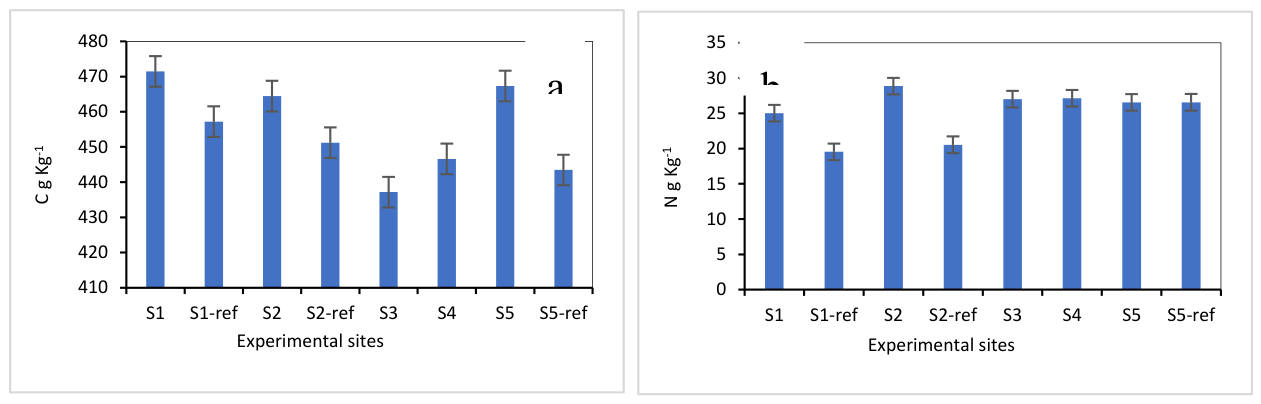
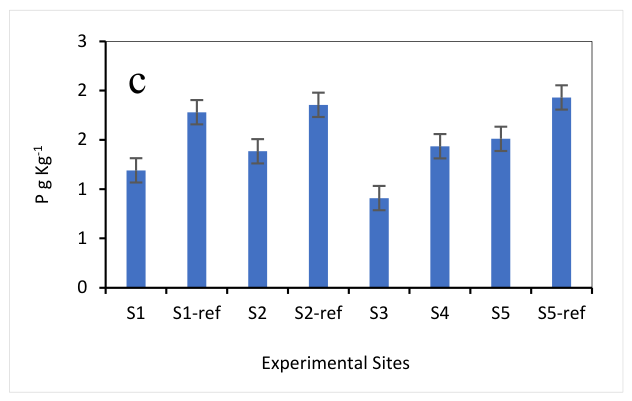
Figure 3.
Soil and leaves samples CNP ratio and comparison.
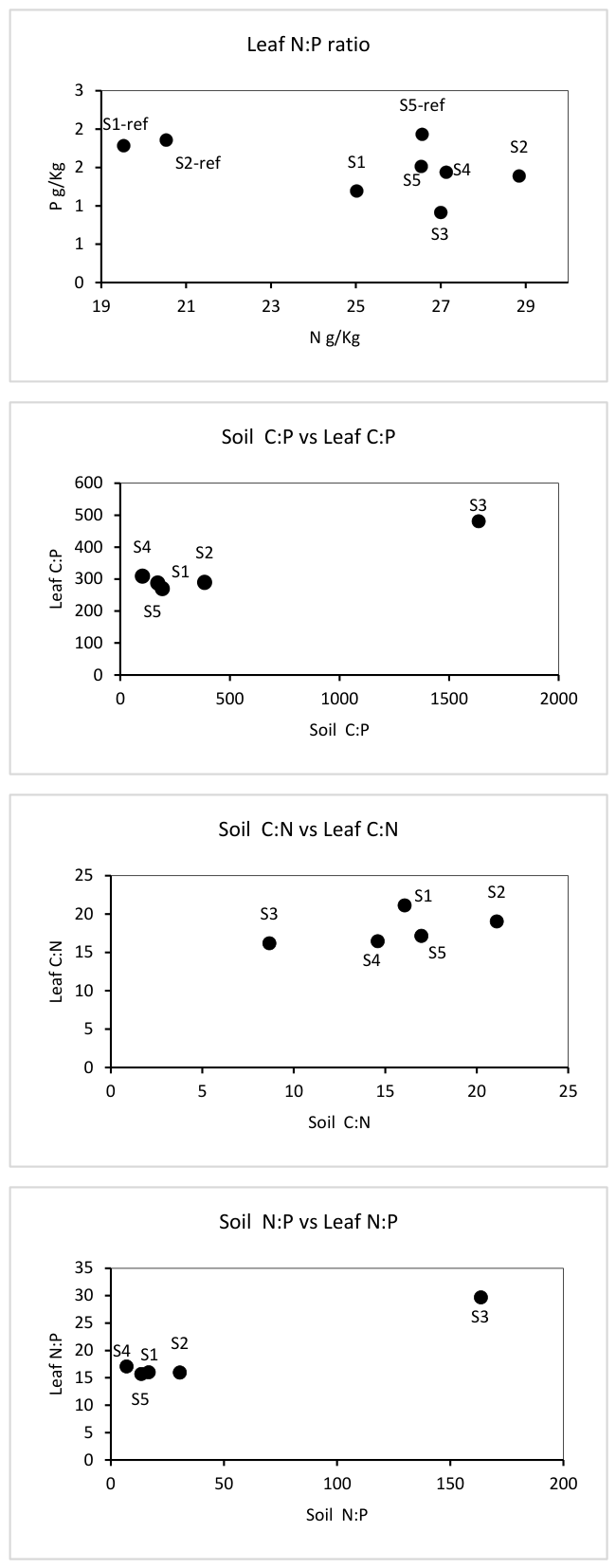
Figure 4.
Natural 15N abundance in ẟ15N for N fixing Robinia psedoacacia L. and Non-N-Fixing reference trees.
Figure 4.
Natural 15N abundance in ẟ15N for N fixing Robinia psedoacacia L. and Non-N-Fixing reference trees.
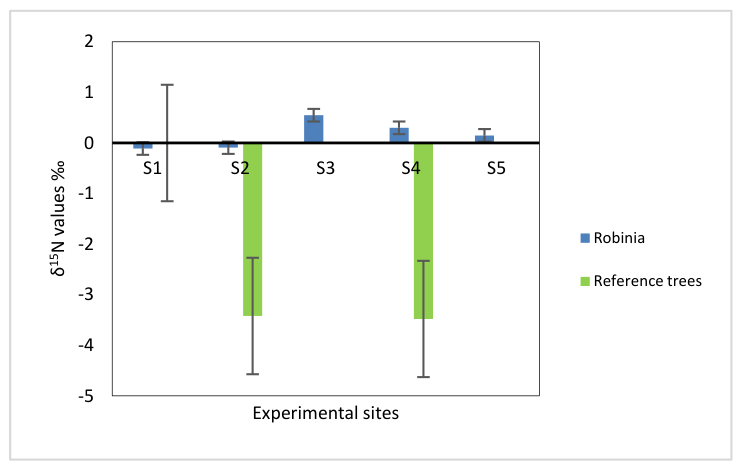
Figure 5.
Percentage of N derived from the air (NdfA%) and Natural 15N abundance in ẟ15N for N fixing Robinia psedoacacia L. and reference trees.
Figure 5.
Percentage of N derived from the air (NdfA%) and Natural 15N abundance in ẟ15N for N fixing Robinia psedoacacia L. and reference trees.
Disclaimer/Publisher’s Note: The statements, opinions and data contained in all publications are solely those of the individual author(s) and contributor(s) and not of MDPI and/or the editor(s). MDPI and/or the editor(s) disclaim responsibility for any injury to people or property resulting from any ideas, methods, instructions or products referred to in the content. |
© 2026 by the authors. Licensee MDPI, Basel, Switzerland. This article is an open access article distributed under the terms and conditions of the Creative Commons Attribution (CC BY) license (http://creativecommons.org/licenses/by/4.0/).
Copyright: This open access article is published under a Creative Commons CC BY 4.0 license, which permit the free download, distribution, and reuse, provided that the author and preprint are cited in any reuse.


