

Submitted:
11 July 2026
Posted:
14 July 2026
You are already at the latest version
Abstract
Creatine monohydrate is among the most evidence-supported ergogenic aids in adults, but its use by adolescent athletes remains controversial because age-specific trials are sparse. This critical narrative review evaluated performance effects, safety, and conditions for responsible use in adolescent athletes. PubMed/MEDLINE, Google Scholar, Semantic Scholar, the Cochrane Library, and ClinicalTrials.gov were searched from 1992 through 19 June 2026, with reference-list screening. Direct sport-specific evidence remains limited, heterogeneous, short term, and predominantly male. Trials in soccer, swimming, basketball, weightlifting, and rehabilitation suggest possible improvements in power, repeated-sprint performance, jumping, selected technical outcomes, and recovery-related measures; however, small samples and narrow endpoints preclude conclusions about overall competitive performance. A 32-week uncontrolled cohort in female football players found no clinically meaningful biochemical safety signal, whereas a single high-dose loading case reported acute kidney injury; neither design can estimate causal risk. Controlled studies have not shown consistent clinically important adverse effects at studied doses, yet long-term safety, sex- and maturation-specific responses, and uncommon events remain insufficiently characterized. Creatine should therefore be neither routinely recommended nor categorically prohibited. Consideration should be restricted to mature, trained adolescents after dietary, medical, psychosocial, and product-quality assessment, family involvement, qualified supervision, conservative dosing, and planned follow-up.
Keywords:
adolescent athletes
; creatine monohydrate
; dietary supplements
; ergogenic aids
; sports nutrition
; safety
1. Introduction
Creatine is a nitrogen-containing compound synthesized endogenously from arginine, glycine, and methionine and obtained through foods of animal origin. Approximately 95% of the body pool is located in skeletal muscle, where free creatine and phosphocreatine (PCr) form a spatial and temporal energy-buffering system that supports rapid adenosine triphosphate (ATP) resynthesis during brief, intense, and repeated contractions [1]. Foundational supplementation studies demonstrated that oral creatine can increase intramuscular total creatine and PCr availability and accelerate PCr resynthesis, providing a biologically plausible basis for improved performance when recovery between high-intensity efforts is incomplete [2,3,4,5].
In adults, creatine monohydrate is one of the most extensively investigated sports supplements. Position stands, consensus statements, and reviews support benefits for maximal strength, power, training capacity, lean mass accrued with resistance training, and repeated high-intensity performance; the effect is less consistent for steady-state endurance and depends on the task, training status, dosing strategy, and individual response [6,7,8,9,10,11,12]. Beyond sport performance, systematic and narrative reviews have examined cognitive, neuromuscular, and clinical applications [13,14,15,16]; these lines of evidence are outcome- and population-specific and should not be used to infer routine benefit in healthy adolescent athletes. Although creatine is one of the most extensively studied ergogenic aids in adults, translating these findings to adolescent athletes requires caution because physiological maturation, training status, and the scarcity of age-specific trials limit direct comparison.
Adolescence presents a distinct decision context. Growth and maturation, variable training age, changing dietary requirements, parental responsibility, body-image pressures, and exposure to commercial supplement messages can all affect the balance of benefit and risk. In addition, adolescents may use multi-ingredient pre-workout products or combine supplements without disclosing them, making it difficult to attribute an adverse event to creatine monohydrate itself [17,18,19]. Recent reviews of nutritional strategies in young athletes emphasize that promising effects of creatine and other bioactive compounds do not constitute sufficient evidence for routine pediatric use, and that individualization and qualified supervision remain central [20].
Supplement use should also be interpreted within the athlete's total diet and health behavior. In adolescents, a high prevalence of supplement consumption can coexist with low adherence to healthy dietary patterns and limited professional supervision [21]. Accordingly, correcting energy intake, carbohydrate availability, protein distribution, hydration, sleep, and training design is usually more consequential than adding a supplement [22,23,24]. At the same time, blanket prohibition may drive use underground and forgo an opportunity for education, product-quality control, and clinical screening. High-performance guidance recognizes creatine monohydrate as an evidence-based supplement for specific adult sport scenarios, but it also requires a risk-managed, food-first framework [8,25].
The purpose of this critical narrative review was therefore to examine the performance effects and safety of creatine monohydrate in adolescent athletes and to define conditions under which its use might be considered responsibly. A central objective was to distinguish direct evidence from healthy adolescent athletes from age-adjacent athletic studies, pediatric clinical evidence, and extrapolation from adults. This distinction is necessary to avoid both overstatement of efficacy and overstatement of risk.
2. Materials and Methods
2.1. Review Design and Reporting Approach
A critical narrative review with a structured literature search was conducted. This design was selected because the question required integration of mechanistic, performance, clinical, behavioral, and practical evidence rather than estimation of a single pooled effect. Manuscript development was informed by the SANRA (Scale for the Assessment of Narrative Review Articles) domains for narrative reviews, including justification of importance, an explicit objective, description of the search, appropriate referencing, scientific reasoning, and presentation of relevant data [26]. The review was also framed using the typology of Grant and Booth, which differentiates narrative, systematic, and scoping approaches by purpose and method [27].
2.2. Literature Search
The primary search source was PubMed/MEDLINE. Google Scholar and Semantic Scholar were used for forward and backward citation tracking and for identifying additional records, while the Cochrane Library was consulted for relevant reviews and controlled trials. ClinicalTrials.gov was searched to identify ongoing or unpublished adolescent- and female-athlete studies; registry records without posted results were used only to characterize research gaps, not as evidence of efficacy or safety. Reference lists of reviews, consensus statements, position stands, and eligible trials were screened manually. The search covered 1 January 1992 to 19 June 2026; 1992 was selected as the starting point because the study by Harris et al. [2] was a landmark in the modern experimental literature on oral creatine loading. A focused update for 2020-19 June 2026 was performed to capture recent adolescent, safety, sex-specific, and psychosocial evidence. Search concepts and operational purposes are summarized in Table 1.
2.3. Eligibility and Evidence Hierarchy
Human studies were prioritized when creatine monohydrate was the principal intervention and participants were adolescent athletes or physically active youth. Studies with mixed adolescent and young-adult samples were retained when they were directly relevant, but were classified as age-adjacent rather than purely adolescent evidence. Pediatric clinical trials were included for information on supervised exposure and tolerability, not as direct justification for ergogenic use in healthy athletes. Adult studies and consensus documents were included only when needed to explain mechanism, contextualize safety, or clarify practical issues.
Animal and in vitro studies without a direct translational purpose, opinion articles lacking a transparent evidentiary basis, and multi-ingredient products in which the effect of creatine could not be isolated were excluded from the core synthesis. Evidence was interpreted in four tiers: (1) direct controlled evidence in healthy adolescent athletes; (2) age-adjacent athletic evidence; (3) indirect pediatric clinical evidence; and (4) adult mechanistic, efficacy, or safety evidence. Statements in this review identify the relevant tier when extrapolation could otherwise be misleading.
2.4. Data Organization and Synthesis
For eligible studies, the following information was organized qualitatively: design, participant characteristics, sport or clinical context, creatine dose and duration, comparator, performance outcomes, safety outcomes, and major limitations. No formal risk-of-bias instrument, duplicate screening, meta-analysis, or certainty grading was undertaken because of the narrative design and substantial heterogeneity in populations, protocols, and outcomes. Greater interpretive weight was nevertheless given to randomized or controlled trials, systematic reviews, and consensus documents than to uncontrolled observations. The resulting synthesis was deliberately conservative: a favorable change in a laboratory or sport-specific test was not treated as proof of improved overall competitive performance.
3. Evidence Synthesis
3.1. Scope and Certainty of the Evidence
The evidence base is asymmetric. Adult efficacy and safety have been studied extensively, whereas direct trials in adolescent athletes remain few, generally small, short, and concentrated in male soccer players, swimmers, basketball players, and strength-trained samples. Reviews focused on youth consistently describe the evidence as promising but insufficient for routine or universal recommendation [18,19,28]. A recent systematic safety review likewise found no consistent renal, hepatic, or cardiometabolic signal in the available adolescent literature, while emphasizing the limited number and duration of studies and the need for longer prospective surveillance [29]. The focused update did not identify a newer adolescent-specific systematic review that superseded these syntheses; instead, it located additional individual trials, a longer observational cohort, and a clinically relevant case report that refine rather than resolve uncertainty.
Current evidence does not indicate a consistent short-term safety concern in adolescents; however, the limited number, size, and duration of available studies prevent firm conclusions regarding long-term safety, rare adverse events, sex-specific responses, maturation-related differences, or optimal dosing strategies. Figure 1 summarizes this balance between reassuring short-term findings and the persistent uncertainty resulting from the limited availability of adolescent-specific evidence.
3.2. Mechanistic Rationale and Limits of Extrapolation
The mechanistic rationale in adolescents is expected to resemble that in adults: increasing the muscle creatine pool can improve the availability of PCr for rapid ATP resynthesis, particularly during repeated brief efforts and during recovery between bouts [1,2,3,4]. This mechanism is compatible with sprinting, jumping, repeated accelerations, resistance exercise, and other actions in which the phosphagen system contributes substantially. Creatine may also support greater training volume or quality over time, which can indirectly influence adaptation [7,11].
Mechanistic plausibility does not establish the magnitude of benefit in adolescents. Baseline muscle creatine, habitual meat and fish intake, body mass, training status, sex, maturation, protocol adherence, and the specificity of the performance test can all influence response. Moreover, improvements in laboratory-based performance tests may not necessarily translate into meaningful changes in competition performance, tactical decision making, or long-term athletic development.
3.3. Sports Performance
3.3.1. Soccer
Soccer contains repeated accelerations, sprints, jumps, and high-power actions separated by incomplete recovery, making it a plausible sport for creatine supplementation. In one early trial, Ostojic studied 20 young male soccer players (mean age approximately 16.6 years) using 30 g/day for 7 days and reported improvements in selected soccer-specific performance tests, although the brief intervention, small sample, and multiple outcomes limit precision [30]. Mohebbi et al. [31] then used a double-blind, 7-day loading protocol in 17 young players (17.18 +/- 1.37 years); repeated-sprint and dribbling times improved relative to placebo, whereas shooting accuracy did not. The small sample, brief exposure, multiple sport-specific outcomes, and limited reporting by current standards require cautious interpretation. Yanez-Silva et al. [32] later randomized 19 elite male youth players (17.0 ± 0.5 years) to 0.03 g/kg/day for 14 days or placebo and observed increases in Wingate peak and mean power in the creatine group.
Huerta Ojeda et al. [33] evaluated 28 players (17.1 +/- 0.9 years) with a matched, double-blind, placebo-controlled design. After 14 days at 0.3 g/kg/day, the creatine group showed higher movement velocity and power in a half-squat task performed after a repeated-sprint fatigue protocol. A critical dosing clarification is required: 0.3 g/kg/day is ten times the 0.03 g/kg/day used by Yanez-Silva et al. [32] Despite being described as a low dose in the article title, it corresponds to a conventional loading-level intake in adult practice. These protocols should therefore not be treated as equivalent or combined under a single label.
A systematic review published in Retos identified only six soccer studies and documented substantial heterogeneity in dose, intervention period, respiratory outcomes, jump performance, anaerobic power, technical skill, speed, and change-of-direction testing [34]. Additional soccer research has examined short-term supplementation during reduced off-season training and longer supplementation in young semi-professional players [35,36]. Collectively, these studies suggest potential benefits for repeated-sprint ability, anaerobic power, and selected soccer-specific performance outcomes. However, the small sample sizes, short supplementation periods, heterogeneous dosing protocols, and reliance on laboratory or sport-specific outcomes limit confidence in the magnitude and generalizability of these findings, reinforcing the need to distinguish favorable changes in specific performance tests from consistent improvements in overall soccer performance. An additional randomized trial in elite soccer players aged 16–21 years was designed around airway safety rather than performance; its mixed adolescent/young-adult age range also illustrates why some commonly cited soccer evidence is age-adjacent rather than strictly adolescent [37].
3.3.2. Swimming
Swimming studies are heterogeneous and show outcome dependence. Grindstaff et al. [38] randomized 18 junior competitive swimmers to 21 g/day of creatine or placebo for 9 days. The creatine group improved selected components of repeated 100 m sprint performance and arm-ergometer work, suggesting possible value when efforts are repeated with short recovery. By contrast, Dawson et al. [39] studied 20 junior swimmers (16.4 +/- 1.8 years) using 20 g/day for 5 days followed by 5 g/day for 22 days. Single 50 m and 100 m pool sprints did not improve, although total work on a swim bench increased.
An age-adjacent trial in 22 elite swimmers reported a modest pre-post improvement in maximal interval-session times after 25 g/day for 4 days; after a subsequent 2-month period of 5 g/day or placebo, neither group showed further improvement [40]. Because participant ages were not reported clearly enough to classify the sample as adolescent-only and the acute phase was not a conventional parallel placebo comparison, this study is best interpreted as age-adjacent evidence rather than direct adolescent evidence. Other junior swimming studies reported changes in selected anaerobic or hydrodynamic outcomes without a consistent pattern of improved competitive swimming performance [41,42]. Differences in event duration, starting stores, stroke mechanics, test-retest reliability, sex composition, and whether the task involved a single sprint or repeated efforts may explain part of the inconsistency. The swimming literature therefore supports task-specific performance benefits but not a general claim that creatine improves all youth swimming performance.
Creatine has also been examined as an adjunct during rehabilitation rather than as a pure ergogenic intervention. In a randomized, double-blind study of 18 injured adolescent fin swimmers, 20 g/day for 5 days followed by 5 g/day for 37 days was added to immobilization and structured rehabilitation. Compared with placebo, the creatine group had smaller segmental lean-mass loss during immobilization and faster improvements in plantar-flexion torque and pain, with a lower early creatine-kinase rise and no reported side effects [43]. The very small specialized sample, co-intervention, multiple outcomes, and absence of a healthy uninjured comparator mean that this study supports a rehabilitation hypothesis, not routine performance use.
3.3.3. Basketball and Strength-Based Contexts
In 23 male under-16 basketball players, Vargas-Molina et al. [44] compared 0.1 g/kg/day of creatine plus an 8-week resistance and plyometric program with the same training program without supplementation. Both groups improved several jump outcomes, while a group-by-time interaction favored creatine for the Abalakov jump and points per game. The open-label design, non-supplemented control, small sample, and concurrent training intervention limit attribution of all changes to creatine.
Wu et al. [45] used a randomized counterbalanced crossover design in 40 male basketball players aged 13-14 years. A short protocol of 0.3 g/kg/day for 5 days plus 0.1 g/kg before testing improved selected dribbling, passing, and shooting outcomes, particularly under cognitive-motor dual-task conditions. This is novel direct adolescent evidence, but the acute high-dose protocol, single-sex sample, and highly specific tasks restrict generalizability and do not establish longer-term competitive benefit.
A double-blind trial in 34 young male weightlifters used 0.3 g/kg/day for 7 days followed by 0.03 g/kg/day for 21 days during resistance training. Strength and body mass increased, while measured blood and urine markers remained within clinical reference ranges despite small between-group changes in selected variables [46]. Because the publication describes a young sample without clearly establishing that all participants were minors, this study is best treated as age-adjacent evidence. Table 2 summarizes the principal controlled studies and their interpretive limits.
3.4. Safety and Tolerability
3.4.1. Renal, Hepatic, and Cardiometabolic Outcomes
A 2025 real-world single-arm cohort provides the longest athlete-specific exposure located in the update. Seventy-one female football players from U17, U20, and professional squads received 20 g/day for 7 days and 5 g/day thereafter across a 32-week competitive season. Renal, hepatic, hematological, and cardiometabolic markers showed only clinically minor fluctuations, with no clinically meaningful renal or hepatic derangement; creatine-kinase variability was interpreted in the context of training load [47]. Although this study adds valuable female-athlete and season-long data, its single-arm design, mixed age categories, and biochemical endpoints prevent adolescent-only causal safety conclusions.
Conversely, a 2025 case report described biopsy-confirmed acute kidney injury with cast nephropathy in a 17-year-old male after a 6-day high-dose creatine-loading regimen [48]. As an isolated case, it cannot estimate incidence or establish risk at customary supervised doses; however, it supports avoiding aggressive loading in minors and reinforces the need for prompt medical evaluation when renal symptoms or abnormal laboratory findings occur. Serum creatinine should be interpreted alongside the clinical context and, when appropriate, complementary markers such as cystatin C and urinalysis.
The accumulated adult literature does not support the claim that creatine monohydrate at customary studied doses causes renal, hepatic, or cardiometabolic injury in healthy individuals [7,49,50]. A recent systematic review and meta-analysis found a small increase in serum creatinine without a significant reduction in glomerular filtration, a pattern compatible with increased creatine turnover rather than structural kidney injury [51]. Reviews focused on the kidney similarly emphasize that serum creatinine alone can be misleading in a muscular athlete who uses creatine [52]. Recent publications have also mapped the safety evidence base and analyzed the prevalence of reported side effects across clinical trials; together with a lifespan-oriented commentary, they emphasize the breadth of studied exposure but do not resolve long-term adolescent uncertainty [53,54,55]. These population-level data are broadly reassuring but do not invalidate the need to investigate rare individual events, particularly after high-dose use.
Clinical interpretation should therefore integrate baseline kidney history, hydration status, muscle mass, dose, symptoms, urinalysis, and alternative filtration markers when indicated. Earlier controlled and longitudinal adult work is broadly reassuring [56,57,58], but this does not eliminate the need for caution in adolescents with known kidney disease, liver disease, unexplained abnormal laboratory findings, or concurrent medications that affect renal function. In healthy adolescents, the central limitation is inadequate long-term observation rather than a demonstrated pattern of organ toxicity [29].
3.4.2. Gastrointestinal Tolerance, Body Mass, Hydration, and Cramps
Gastrointestinal discomfort is most likely when a large amount is consumed at once, particularly during rapid loading. Dividing the daily dose and avoiding unnecessarily aggressive protocols may improve tolerance. A loading phase is not required to increase tissue stores; slower maintenance dosing can achieve saturation over a longer interval [7,50]. The adolescent acute-kidney-injury case after 6 days of high-dose loading adds a pragmatic reason to avoid aggressive loading in minors [48], although a single case cannot quantify risk at customary supervised doses. Early body-mass gain is common and is generally attributed to increased intracellular water and, over longer periods with training, potentially greater lean-mass accrual. This change may be advantageous in some sports but undesirable in weight-category or weight-sensitive contexts, making the sport-specific trade-off important.
Current adult evidence does not support a consistent increase in dehydration, heat illness, or muscle cramping with creatine monohydrate [7,49,59]. Nevertheless, creatine is not a hydration strategy, and adolescent athletes still require individualized fluid, electrolyte, acclimatization, and heat-management plans. Because youth-specific surveillance is limited, clinicians should avoid converting the reassuring adult literature into a claim of zero risk in every adolescent setting.
3.4.3. Respiratory Considerations
The principal direct respiratory signal comes from Simpson et al. [37] in 19 elite soccer players aged 16-21 years, a standard loading and maintenance protocol produced a mild unfavorable trend in fractional exhaled nitric oxide, with concern greatest among participants with allergic sensitization; lung function and airway responsiveness did not establish a general contraindication. The finding is hypothesis-generating because the sample was small, the age range crossed adolescence and young adulthood, and the interaction narrowly missed conventional statistical significance. Persistent respiratory symptoms, poorly controlled asthma, or allergic airway disease should therefore prompt individualized medical review rather than automatic exclusion of all athletes.
3.4.4. Hormonal Effects and Hair Loss
Concern about hair loss largely originated from a small study in college-aged rugby players that observed an increase in the dihydrotestosterone-to-testosterone ratio after loading; the study did not measure hair loss or follicle health [60]. A 12-week randomized controlled trial that directly assessed hair-related outcomes did not support a causal effect of creatine on hair loss [61]. The most defensible communication is therefore that current evidence does not establish creatine-induced alopecia, while acknowledging that long-term adolescent-specific data in genetically predisposed individuals are unavailable.
3.4.5. Long-Term Safety, Sex, and Maturation
No consistent clinically important adverse pattern has emerged from the available controlled youth studies, but absence of a signal in small short trials is not equivalent to proof of long-term safety. A 32-week cohort of female football players extends observation beyond most youth trials but remains single-arm and includes U17, U20, and professional categories, preventing an adolescent-only causal estimate [47]. A 2025 systematic review of 27 studies in active females found performance effects inconclusive and highlighted heterogeneity and inadequate attention to female physiology; it was not adolescent-specific [62]. The isolated adolescent acute-kidney-injury case [48] shows why rare-event surveillance remains necessary, but it cannot quantify incidence or overturn the broader controlled evidence. Most sport studies have enrolled boys or young men, rarely stratified by biological maturation, and were not powered to detect uncommon adverse events. Evidence is particularly sparse in prepubertal children, for whom performance supplementation cannot be justified from the present literature. Future work must report sex, maturation stage, baseline diet, medical history, co-supplement use, and adverse-event monitoring with substantially longer follow-up. These safety domains support a precautionary rather than prohibitive interpretation: creatine use in adolescents should be considered in relation to respiratory history, endocrine concerns, renal risk, sex-specific evidence gaps, and maturational status. The practical interpretation of these considerations is summarized in Table 3.
3.5. Pediatric Clinical Evidence and Limits of Extrapolation
Creatine has been administered under medical supervision to children and adolescents with Duchenne muscular dystrophy, juvenile dermatomyositis, facioscapulohumeral muscular dystrophy, and other muscle disorders [63,64,65,66,67]. This literature provides useful information about supervised exposure and short-term tolerability, but it is indirect for healthy sport participants. Therapeutic indications, baseline disease, concomitant treatment, dose selection, benefit thresholds, and follow-up differ fundamentally from elective ergogenic supplementation.
Two additional controlled pediatric studies broaden the supervised-exposure evidence but remain indirect for sport. In adolescent females with SSRI (selective serotonin reuptake inhibitor) resistant depression, an 8-week placebo-controlled dose-ranging trial (2, 4, or 10 g/day) demonstrated brain PCr target engagement without a between-group signal in adverse events, weight gain, or serum creatinine [68]. In childhood myositis, a 6-month randomized double-blind feasibility trial found creatine feasible and generally well tolerated but did not establish a clear functional benefit [69]. Disease context, concurrent treatment, small samples, and non-athletic outcomes prevent direct transfer to healthy adolescent athletes.
Clinical pediatric exposure should therefore neither be ignored nor used as a shortcut to routine sport recommendation. Its strongest contribution is to show that creatine is not intrinsically incompatible with pediatric care when prescribed for a defined indication and monitored appropriately. It does not establish that a healthy adolescent athlete will obtain a meaningful performance benefit, that the same protocol should be used, or that unsupervised long-term consumption is safe.
3.6. Dietary, Psychosocial, and Product-Quality Considerations
The decision to use creatine is partly behavioral. Among Australian boys aged 14-16 years, use of muscle-building supplements, including creatine, was associated with weight training, sports engagement, and stronger orientation toward muscularity [70]. In a prospective Canadian sample of adolescents and young adults, creatine use was associated with later muscle-dysmorphia symptomatology after adjustment for baseline symptoms and other substance use [71]. These findings are associations, not evidence that creatine causes muscle dysmorphia. They do, however, justify screening the motivation for use, appearance intolerance, compulsive training, eating-disorder symptoms, and concurrent use of other performance or weight-control products.
Other adolescent studies have linked protein, creatine, and dieting-supplement use with exercise participation and eating-disorder risk factors [72], while older surveys documented substantial unsupervised creatine use among youth athletes [73,74]. The nutrition assessment should therefore precede the supplement decision. The EduALI findings are especially relevant: frequent supplement use can coexist with poor overall dietary quality and low professional involvement [21]. Creatine should never be used to compensate for chronic low energy availability, inadequate carbohydrate intake, insufficient protein from food, dehydration, or poor sleep.
Product selection is also a safety intervention. The most defensible option, when use is considered, is single-ingredient creatine monohydrate from a batch-tested or third-party-certified source. Multi-ingredient pre-workouts, proprietary blends, stimulant combinations, and products purchased through uncertain online channels introduce contamination, adulteration, and attribution risks that are separate from creatine monohydrate itself [8,25].
4. Practical Decision Framework
Creatine should not be the first response to ordinary fatigue, inconsistent training, or an unstructured diet. Consideration is most defensible in an adolescent who has sufficient sport and decision-making maturity, participates in structured high-intensity or strength-power training, has a realistic performance objective, and has already addressed energy intake, carbohydrate availability, protein, hydration, sleep, and recovery. Family involvement is essential because the athlete is a minor, and the supervising professional should be competent in adolescent sports nutrition and aware of the athlete's medical context.
Before use, screening should include kidney and liver history, recurrent dehydration or heat illness, gastrointestinal disease, asthma or persistent respiratory symptoms, medications, prior adverse reactions, and all other supplements. Equally important are motivation, body image, eating behavior, rapid weight-change practices, and pressure from coaches, peers, or social media. Concerning finding should lead to correction, deferral, or referral rather than simple clearance.
No adolescent-specific optimal dose has been established. Adult protocols commonly use either a loading phase of approximately 0.3 g/kg/day for 5-7 days followed by 3-5 g/day, or a slower strategy of approximately 3-5 g/day without loading [7,50]. Direct adolescent trials have used markedly different protocols, from 0.03 g/kg/day to 0.3 g/kg/day, and the evidence does not identify which strategy offers the best benefit-risk balance. Where a qualified clinician elects to proceed, a conservative strategy without aggressive loading may be easier to tolerate and monitor, but this is an extrapolated risk-management preference rather than a validated pediatric prescription. The reported acute kidney injury in a 17-year-old followed a 6-day high-dose loading regimen [48]; this supports avoiding aggressive loading but does not establish harm from customary lower dosing.
Monitoring should be prospective and purpose driven. The athlete and family should know the target outcome, expected time frame, possible early body-mass change, common gastrointestinal symptoms, stopping criteria, and planned reassessment. Prompt cessation and medical assessment are warranted for flank pain, reduced urine output, edema, persistent vomiting, unexplained weakness, or clinically important laboratory abnormalities. Continued use is difficult to justify when there is no meaningful benefit, adherence is poor, adverse symptoms arise, the athlete begins stacking products, or the original performance objective no longer exists. Figure 2 presents a conceptual framework for this process.
5. Limitations and Research Priorities
This review has limitations inherent to its narrative design. It did not use duplicate screening, a formal risk-of-bias instrument, certainty grading, or meta-analysis. Study selection may have been influenced by accessibility and perceived relevance, and publication bias cannot be excluded. Search platforms used for citation tracking are not equivalent to bibliographic databases, and no exhaustive record count was produced. The heterogeneity of sport, age, maturation, dose, duration, diet, and outcome further prevents a single summary estimate.
The underlying evidence also has important limitations. Most direct studies are underpowered for safety, emphasize short-term performance tests, and enroll boys. Few studies report pubertal stage, dietary creatine, habitual supplement use, energy availability, or adherence verified with objective methods. Adverse-event reporting is often secondary, follow-up is too short to assess uncommon or delayed outcomes, and competition-level outcomes are rarely prespecified. Newer evidence broadens the picture but does not eliminate design limitations: the 32-week female-football study was uncontrolled and mixed age [47], whereas the renal report is a single case unable to estimate incidence or causality at customary dosing [48]. These limitations mean that both enthusiastic recommendation and categorical prohibition exceed the available evidence.
Future research should move beyond small efficacy demonstrations. Multicenter, preregistered trials should stratify by sex and maturation, use placebo control and concealed allocation where feasible, report protocol adherence and baseline diet, and include clinically meaningful performance outcomes alongside a predefined safety panel. ClinicalTrials.gov lists a female-football program with a short randomized U20 experiment and longer seasonal safety follow-up (NCT06250556); at the search cutoff, the registry did not provide posted results for the randomized performance component [75]. Longitudinal registries could complement trials by examining uncommon events, supplement stacking, product quality, and trajectories of body image and eating behavior. Table 4 outlines minimum priorities.
6. Conclusions
Creatine monohydrate has a strong mechanistic foundation and a substantial adult evidence base, but direct evidence in adolescent athletes remains limited, heterogeneous, short term, and predominantly male. Updated evidence adds a small adolescent soccer trial, a rehabilitation RCT, a 32-week female-football cohort, and a high-dose acute-kidney-injury case, but these designs remain too limited to establish universal benefit or a precise risk estimate [31,43,47,48]. Controlled youth studies suggest possible benefits for power, repeated high-intensity efforts, jumping, selected technical tasks, and rehabilitation-related outcomes; they do not establish universal benefit or improved overall competitive performance. The available studies have not shown a consistent pattern of clinically important harm, yet long-term safety, uncommon events, sex-specific responses, maturation effects, and optimal adolescent dosing remain insufficiently characterized.
The most defensible position is therefore conditional rather than permissive or prohibitive. Creatine should not be recommended routinely, used to compensate for poor nutrition or recovery, or consumed through uncertain multi-ingredient products. It may be considered for a selected mature and well-trained adolescent after a clear performance rationale, dietary and medical assessment, psychosocial screening, family involvement, qualified professional supervision, certified single-ingredient product selection, conservative non-loading dosing, explicit stopping criteria, and planned follow-up. This approach preserves scientific caution while reducing the risks of unsupervised use and misinformation.
Author Contributions
Conceptualization, A.F.-D.; methodology, A.F.-D.; investigation, A.F.-D. and M.A.O.; data curation, A.F.-D. and M.A.O.; formal analysis, A.F.-D.; writing—original draft preparation, A.F.-D.; writing—review and editing, A.F.-D., C.F.H., M.A.O., F.M.-V., E.G.-C., I.M.-M., R.Y.-S., A.C.-P. and D.B.-G.; visualization, A.F.-D. and F.M.-V.; supervision, A.F.-D.; project administration, A.F.-D. All authors have read and agreed to the published version of the manuscript.
Funding
This research received no external funding.
Institutional Review Board Statement
Not applicable.
Informed Consent Statement
Not applicable.
Data Availability Statement
No new data were created or analyzed in this study. Data sharing is not applicable to this article.
Acknowledgments
During the preparation of this manuscript, the authors used ChatGPT (OpenAI, San Francisco, CA, USA) to support English-language editing, structural refinement, figure drafting, and bibliographic consistency checks. The authors reviewed and edited all AI-assisted output and take full responsibility for the content of this publication.
Conflicts of Interest
the authors declare no conflicts of interest.
Abbreviations
The following abbreviations are used in this manuscript:
| AKI | Acute kidney injury |
| ATP | Adenosine triphosphate |
| DHT | Dihydrotestosterone |
| GFR | Glomerular filtration rate |
| PCr | Phosphocreatine |
| RCT | Randomized controlled trial |
| SANRA | Scale for the Assessment of Narrative Review Articles |
| SSRI | Selective serotonin reuptake inhibitor |
References
- Wyss, M.; Kaddurah-Daouk, R. Creatine and creatinine metabolism. Physiol. Rev. 2000, 80, 1107–1213. [Google Scholar] [CrossRef]
- Harris, R.C.; Soderlund, K.; Hultman, E. Elevation of creatine in resting and exercised muscle of normal subjects by creatine supplementation. Clin. Sci. 1992, 83, 367–374. [Google Scholar] [CrossRef] [PubMed]
- Greenhaff, P.L.; Bodin, K.; Soderlund, K.; Hultman, E. Effect of oral creatine supplementation on skeletal muscle phosphocreatine resynthesis. Am. J. Physiol. 1994, 266, E725–E730. [Google Scholar] [CrossRef] [PubMed]
- Hultman, E.; Soderlund, K.; Timmons, J.A.; Cederblad, G.; Greenhaff, P.L. Muscle creatine loading in men. J. Appl. Physiol. 1996, 81, 232–237. [Google Scholar] [CrossRef] [PubMed]
- Balsom, P.D.; Ekblom, B.; Soderlund, K.; Sjodin, B. Creatine supplementation and dynamic high-intensity intermittent exercise. Scand. J. Med. Sci. Sports 1993, 3, 143–149. [Google Scholar] [CrossRef]
- Buford, T.W.; Kreider, R.B.; Stout, J.R.; Greenwood, M.; Campbell, B.; Spano, M.; Ziegenfuss, T.; Lopez, H.; Landis, J.; Antonio, J. International Society of Sports Nutrition position stand: Creatine supplementation and exercise. J. Int. Soc. Sports Nutr. 2007, 4, 6. [Google Scholar] [CrossRef] [PubMed]
- Kreider, R.B.; Kalman, D.S.; Antonio, J.; Ziegenfuss, T.N.; Wildman, R.; Collins, R.; Candow, D.G.; Kleiner, S.M.; Almada, A.L.; Lopez, H.L. International Society of Sports Nutrition position stand: Safety and efficacy of creatine supplementation in exercise, sport, and medicine. J. Int. Soc. Sports Nutr. 2017, 14, 18. [Google Scholar] [CrossRef] [PubMed]
- Maughan, R.J.; Burke, L.M.; Dvorak, J.; Larson-Meyer, D.E.; Peeling, P.; Phillips, S.M.; Rawson, E.S.; Walsh, N.P.; Garthe, I.; Geyer, H.; et al. IOC consensus statement: Dietary supplements and the high-performance athlete. Br. J. Sports Med. 2018, 52, 439–455. [Google Scholar] [CrossRef] [PubMed]
- Balsom, P.D.; Soderlund, K.; Ekblom, B. Creatine in humans with special reference to creatine supplementation. Sports Med. 1994, 18, 268–280. [Google Scholar] [CrossRef] [PubMed]
- Butts, J.; Jacobs, B.; Silvis, M. Creatine use in sports. Sports Health 2018, 10, 31–34. [Google Scholar] [CrossRef] [PubMed]
- Wax, B.; Kerksick, C.M.; Jagim, A.R.; Mayo, J.J.; Lyons, B.C.; Kreider, R.B. Creatine for exercise and sports performance, with recovery considerations for healthy populations. Nutrients 2021, 13, 1915. [Google Scholar] [CrossRef] [PubMed]
- Forbes, S.C.; Candow, D.G.; Neto, J.H.F.; Kennedy, M.D.; Forbes, J.L.; Machado, M.; Bustillo, E.; Gomez-Lopez, J.; Zapata, A.; Antonio, J. Creatine supplementation and endurance performance: Surges and sprints to win the race. J. Int. Soc. Sports Nutr. 2023, 20, 2204071. [Google Scholar] [CrossRef] [PubMed]
- Avgerinos, K.I.; Spyrou, N.; Bougioukas, K.I.; Kapogiannis, D. Effects of creatine supplementation on cognitive function of healthy individuals: A systematic review of randomized controlled trials. Exp. Gerontol. 2018, 108, 166–173. [Google Scholar] [CrossRef] [PubMed]
- Balestrino, M.; Adriano, E. Beyond sports: Efficacy and safety of creatine supplementation in pathological or paraphysiological conditions of brain and muscle. Med. Res. Rev. 2019, 39, 2427–2459. [Google Scholar] [CrossRef] [PubMed]
- Roschel, H.; Gualano, B.; Ostojic, S.M.; Rawson, E.S. Creatine supplementation and brain health. Nutrients 2021, 13, 586. [Google Scholar] [CrossRef] [PubMed]
- Xu, C.; Bi, S.; Zhang, W.; Luo, L. The effects of creatine supplementation on cognitive function in adults: A systematic review and meta-analysis. Front. Nutr. 2024, 11, 1424972. [Google Scholar] [CrossRef] [PubMed]
- Jagim, A.R.; Stecker, R.A.; Harty, P.S.; Erickson, J.L.; Kerksick, C.M. Safety of creatine supplementation in active adolescents and youth: A brief review. Front. Nutr. 2018, 5, 115. [Google Scholar] [CrossRef] [PubMed]
- Jagim, A.R.; Kerksick, C.M. Creatine supplementation in children and adolescents. Nutrients 2021, 13, 664. [Google Scholar] [CrossRef] [PubMed]
- Metzger, G.A.; Minneci, P.C.; Gehred, A.; Day, A.J.; Klingele, K.E. Creatine supplementation in the pediatric and adolescent athlete: A literature review. J. Orthop. 2023, 38, 73–78. [Google Scholar] [CrossRef] [PubMed]
- De Zan, D.; Eletti, F.; Fiore, G.; Di Girolamo, E.; Bozzini, G.G.M.; Perico, V.; Tosi, M.; Norsa, L.; Zuccotti, G.; Verduci, E. Use of nutritional strategies, bioactive compounds, and dietary supplements in young athletes: From evidence to potential risks-A narrative review. Nutrients 2025, 17, 2194. [Google Scholar] [CrossRef] [PubMed]
- Lotti, S.; Tristan Asensi, M.; Creti, D.; Mollo, E.; Sarti, A.; Sciattella, F.; Dinu, M.; Colombini, B.; Rizzo, L.; Sofi, F. High use of dietary supplements and low adherence to the Mediterranean diet among Italian adolescents: Results from the EduALI Project. Nutrients 2025, 17, 2213. [Google Scholar] [CrossRef] [PubMed]
- Capra, M.E. Nutrition for children and adolescents who practice sport. Nutrients 2024, 16, 2803. [Google Scholar] [CrossRef] [PubMed]
- Thomas, D.T.; Erdman, K.A.; Burke, L.M. Position of the Academy of Nutrition and Dietetics, Dietitians of Canada, and the American College of Sports Medicine: Nutrition and athletic performance. J. Acad. Nutr. Diet. 2016, 116, 501–528. [Google Scholar] [CrossRef] [PubMed]
- American Academy of Pediatrics. Performance-Enhancing Sports Supplements. Available online: https://www.healthychildren.org/English/healthy-living/sports/Pages/Performance-Enhancing-Substances.aspx (accessed on 31 May 2026).
- Australian Institute of Sport. AIS Sports Supplement Framework: Creatine Monohydrate. Available online: https://www.ausport.gov.au/ais/nutrition/supplements/group_a/performance-supplements/creatine (accessed on 31 May 2026).
- Baethge, C.; Goldbeck-Wood, S.; Mertens, S. SANRA-A scale for the quality assessment of narrative review articles. Res. Integr. Peer Rev. 2019, 4, 5. [Google Scholar] [CrossRef] [PubMed]
- Grant, M.J.; Booth, A. A typology of reviews: An analysis of 14 review types and associated methodologies. Health Inf. Libr. J. 2009, 26, 91–108. [Google Scholar] [CrossRef] [PubMed]
- Ortiz-Barroso, G.S. Effect of creatine supplementation on muscular function and physical performance in children and adolescents: A literature review. Arch. Latinoam. Nutr. 2024, 74. [Google Scholar] [CrossRef]
- Rubinchuk, A.; Dulkoski, Z.; Persaud, N.A.; Wallen, M. Evaluating the safety of creatine monohydrate in adolescents: A systematic review of renal, hepatic, and cardiometabolic outcomes. Cureus 2026, 18, e106808. [Google Scholar] [CrossRef] [PubMed]
- Ostojic, S.M. Creatine supplementation in young soccer players. Int. J. Sport Nutr. Exerc. Metab. 2004, 14, 95–103. [Google Scholar] [CrossRef] [PubMed]
- Mohebbi, H.; Rahnama, N.; Moghadassi, M.; Ranjbar, K. Effect of creatine supplementation on sprint and skill performance in young soccer players. Middle-East J. Sci. Res. 2012, 12, 397–401. [Google Scholar] [CrossRef]
- Yanez-Silva, A.; Buzzachera, C.F.; Picarro, I.D.C.; Januario, R.S.B.; Ferreira, L.H.B.; McAnulty, S.R.; Utter, A.C.; Souza-Junior, T.P. Effect of low dose, short-term creatine supplementation on muscle power output in elite youth soccer players. J. Int. Soc. Sports Nutr. 2017, 14, 5. [Google Scholar] [CrossRef] [PubMed]
- Huerta Ojeda, A.; Jofre-Saldia, E.; Torres-Banduc, M.; Galdames Maliqueo, S.; Barahona-Fuentes, G.; Cofre Acevedo, C.; Lizana Romero, G.; de Villa Garduno, R.; Riquelme Vera, G.; Vera Paredes, P.; et al. Effects of a low dose of orally administered creatine monohydrate on post-fatigue muscle power in young soccer players. Nutrients 2024, 16, 1324. [Google Scholar] [CrossRef] [PubMed]
- Monsalve Guevara, V.; Montalva-Valenzuela, F.; Andrades-Ramirez, O.; Narrea Vargas, J.J.; Flores, I.; Castillo-Paredes, A. Futbol y creatina, una revision sistematica (Soccer and creatine, a systematic review). Retos 2024, 51, 763–770. [Google Scholar] [CrossRef]
- Valenta, S.; Psotta, R.; Hrabal, J. The effects of creatine supplementation on single and intermittent anaerobic exercises and body composition during reduced training in soccer players. Acta Salus Vitae 2022, 10, 58–71. [Google Scholar] [CrossRef]
- Palma-Pulido, L.H.; Guio-Bacares, J.A.; Palacios-Ruales, Y.M.; Bonilla, D.A. Creatine monohydrate supplementation reduces muscle damage and player load index in young semi-professional Colombian football players. J. Int. Soc. Sports Nutr. 2025, 22, 2533655. [Google Scholar] [CrossRef]
- Simpson, A.J.; Horne, S.; Sharp, P.; Sharps, R.; Kippelen, P. Effect of creatine supplementation on the airways of youth elite soccer players. Med. Sci. Sports Exerc. 2019, 51, 1582–1590. [Google Scholar] [CrossRef] [PubMed]
- Grindstaff, P.D.; Kreider, R.; Bishop, R.; Wilson, M.; Wood, L.; Alexander, C.; Almada, A. Effects of creatine supplementation on repetitive sprint performance and body composition in competitive swimmers. Int. J. Sport Nutr. 1997, 7, 330–346. [Google Scholar] [CrossRef] [PubMed]
- Dawson, B.; Vladich, T.; Blanksby, B.A. Effects of 4 weeks of creatine supplementation in junior swimmers on freestyle sprint and swim bench performance. J. Strength Cond. Res. 2002, 16, 485–490. [Google Scholar] [CrossRef] [PubMed]
- Theodorou, A.S.; Cooke, C.B.; King, R.F.; Hood, C.; Denison, T.; Wainwright, B.G.; Havenetidis, K. The effect of longer-term creatine supplementation on elite swimming performance after an acute creatine loading. J. Sports Sci. 1999, 17, 853–859. [Google Scholar] [CrossRef] [PubMed]
- Silva, A.J.; Machado Reis, V.; Guidetti, L.; Bessone Alves, F.; Mota, P.; Freitas, J.; Baldari, C. Effect of creatine on swimming velocity, body composition and hydrodynamic variables. J. Sports Med. Phys. Fit. 2007, 47, 58–64. [Google Scholar] [CrossRef]
- Juhasz, I.; Gyore, I.; Csende, Z.; Racz, L.; Tihanyi, J. Creatine supplementation improves the anaerobic performance of elite junior fin swimmers. Acta Physiol. Hung. 2009, 96, 325–336. [Google Scholar] [CrossRef] [PubMed]
- Juhasz, I.; Plachy Kopkane, J.; Hajdu, P.; Szalay, G.; Kopper, B.; Tihanyi, J. Creatine supplementation supports the rehabilitation of adolescent fin swimmers in tendon overuse injury cases. J. Sports Sci. Med. 2018, 17, 279–288. [Google Scholar] [PubMed]
- Vargas-Molina, S.; Garcia-Sillero, M.; Kreider, R.B.; Salinas, E.; Petro, J.L.; Benitez-Porres, J.; Bonilla, D.A. A randomized open-labeled study to examine the effects of creatine monohydrate and combined training on jump and scoring performance in young basketball players. J. Int. Soc. Sports Nutr. 2022, 19, 529–542. [Google Scholar] [CrossRef] [PubMed]
- Wu, J.; Qiu, P.; Li, Y. Acute creatine supplementation enhances technical performance in adolescent basketball players under cognitive-motor dual-task condition. J. Int. Soc. Sports Nutr. 2025, 22, 2542369. [Google Scholar] [CrossRef] [PubMed]
- Almeida, D.; Pereira, R.; Borges, E.Q.; Rawson, E.S.; Rocha, L.S.; Machado, M. Creatine supplementation improves physical performance, without negative effects on health markers, in young weightlifters. J. Sci. Sport Exerc. 2022, 4, 255–265. [Google Scholar] [CrossRef]
- Garcia, M.P.; Longobardi, I.; Saito, T.; Miranda, M.S.; Roschel, H.; Gualano, B. Safety of long-term creatine supplementation in women's football players: A real-world in-season study. J. Int. Soc. Sports Nutr. 2025, 22, 2591782. [Google Scholar] [CrossRef] [PubMed]
- Filler, G.; Maung, E.; Diaz Gonzalez de Ferris, M.E.; Chan, N.G.; Sharma, A.P. Acute kidney injury with cast nephropathy following creatine loading in a 17-year-old. Pediatr. Nephrol. 2025, 40, 3089–3092. [Google Scholar] [CrossRef] [PubMed]
- Antonio, J.; Candow, D.G.; Forbes, S.C.; Gualano, B.; Jagim, A.R.; Kreider, R.B.; Rawson, E.S.; Smith-Ryan, A.E.; VanDusseldorp, T.A.; Willoughby, D.S.; et al. Common questions and misconceptions about creatine supplementation: What does the scientific evidence really show? J. Int. Soc. Sports Nutr. 2021, 18, 13. [Google Scholar] [CrossRef] [PubMed]
- Kreider, R.B.; Jager, R. Bioavailability, efficacy, safety, and regulatory status of creatine and related compounds: A critical review. Nutrients 2022, 14, 1035. [Google Scholar] [CrossRef] [PubMed]
- Naeini, E.K.; Eskandari, M.; Mortazavi, M.; Gholaminejad, A.; Karevan, N. Effect of creatine supplementation on kidney function: A systematic review and meta-analysis. BMC Nephrol. 2025, 26, 622. [Google Scholar] [CrossRef] [PubMed]
- Longobardi, I.; Gualano, B.; Seguro, A.C.; Roschel, H. Is it time for a requiem for creatine supplementation-induced kidney failure? A narrative review. Nutrients 2023, 15, 1466. [Google Scholar] [CrossRef] [PubMed]
- Bonilla, D.A.; Gonzalez, D.E.; Humeres, G.; Chun, J.; Hines, K.; Gil, A.; Kreider, R.B. Safety of creatine supplementation: A scientometrics analysis on the impact of the "Creatine for Health" initiative and introduction to CREAS. J. Int. Soc. Sports Nutr. 2025, 22, 2533692. [Google Scholar] [CrossRef]
- Gonzalez, D.E.; Hines, K.; Gil, A.; Bonilla, D.A.; Kreider, R.B. Safety of creatine supplementation: Analysis of the prevalence of reported side effects in clinical trials. J. Int. Soc. Sports Nutr. 2025, 22, 2533687. [Google Scholar] [CrossRef]
- Kreider, R.B.; Jagim, A.R.; Antonio, J.; Kalman, D.S.; Kerksick, C.M.; Stout, J.R.; Wildman, R.; Collins, R.; Bonilla, D.A. Creatine supplementation is safe, beneficial throughout the lifespan, and should not be restricted. Front. Nutr. 2025, 12, 1578564. [Google Scholar] [CrossRef] [PubMed]
- Persky, A.M.; Rawson, E.S. Safety of creatine supplementation. Subcell. Biochem. 2007, 46, 275–289. [Google Scholar] [CrossRef] [PubMed]
- Poortmans, J.R.; Francaux, M. Long-term oral creatine supplementation does not impair renal function in healthy athletes. Med. Sci. Sports Exerc. 1999, 31, 1108–1110. [Google Scholar] [CrossRef] [PubMed]
- Vega, J.; Huidobro, J.P. Effects of creatine supplementation on renal function. Rev. Med. Chil. 2019, 147, 628–633. [Google Scholar] [CrossRef] [PubMed]
- Antonio, J.; Brown, A.F.; Candow, D.G.; Chilibeck, P.D.; Ellery, S.J.; Forbes, S.C.; Gualano, B.; Jagim, A.R.; Kerksick, C.M.; Kreider, R.B.; et al. Part II. Common questions and misconceptions about creatine supplementation: What does the scientific evidence really show? J. Int. Soc. Sports Nutr. 2025, 22, 2441760. [Google Scholar] [CrossRef] [PubMed]
- van der Merwe, J.; Brooks, N.E.; Myburgh, K.H. Three weeks of creatine monohydrate supplementation affects dihydrotestosterone to testosterone ratio in college-aged rugby players. Clin. J. Sport Med. 2009, 19, 399–404. [Google Scholar] [CrossRef] [PubMed]
- Lak, M.; Forbes, S.C.; Ashtary-Larky, D.; Dadkhahfar, S.; Robati, R.M.; Nezakati, F.; Khajevandi, M.; Naseri, S.; Gerafiani, A.; Haghighat, N.; et al. Does creatine cause hair loss? A 12-week randomized controlled trial. J. Int. Soc. Sports Nutr. 2025, 22, 2495229. [Google Scholar] [CrossRef] [PubMed]
- Tam, R.; Mitchell, L.; Forsyth, A. Does creatine supplementation enhance performance in active females? A systematic review. Nutrients 2025, 17, 238. [Google Scholar] [CrossRef] [PubMed]
- Escolar, D.M.; Buyse, G.; Henricson, E.; Leshner, R.; Florence, J.; Mayhew, J.; et al. CINRG randomized controlled trial of creatine and glutamine in Duchenne muscular dystrophy. Ann. Neurol. 2005, 58, 151–155. [Google Scholar] [CrossRef] [PubMed]
- Tarnopolsky, M.A.; Mahoney, D.J.; Vajsar, J.; Rodriguez, C.; Doherty, T.J.; Roy, B.D.; et al. Creatine monohydrate enhances strength and body composition in Duchenne muscular dystrophy. Neurology 2004, 62, 1771–1777. [Google Scholar] [CrossRef] [PubMed]
- Solis, M.Y.; Hayashi, A.P.; Artioli, G.G.; Roschel, H.; Sapienza, M.T.; Otaduy, M.C.G.; et al. Efficacy and safety of creatine supplementation in juvenile dermatomyositis: A randomized, double-blind, placebo-controlled crossover trial. Muscle Nerve 2016, 53, 58–66. [Google Scholar] [CrossRef] [PubMed]
- Kley, R.A.; Tarnopolsky, M.A.; Vorgerd, M. Creatine for treating muscle disorders. Cochrane Database Syst. Rev. 2013, CD004760. [Google Scholar] [CrossRef] [PubMed]
- Woodcock, I.R.; de Valle, K.; Cairns, A.; Davidson, Z.E.; Kean, M.; Varma, N.; Grobler, A.; Metz, D.; Carroll, K.; Dilek, N.; et al. Effect of creatine monohydrate on motor function in children with facioscapulohumeral muscular dystrophy: A multicenter, randomized, double-blind placebo-controlled crossover trial. Pharmacotherapy 2025, 45, 341–351. [Google Scholar] [CrossRef] [PubMed]
- Kondo, D.G.; Forrest, L.N.; Shi, X.; Sung, Y.H.; Hellem, T.L.; Huber, R.S.; Renshaw, P.F. Creatine target engagement with brain bioenergetics: A dose-ranging phosphorus-31 magnetic resonance spectroscopy study of adolescent females with SSRI-resistant depression. Amino Acids 2016, 48, 1941–1954. [Google Scholar] [CrossRef] [PubMed]
- Dover, S.; Stephens, S.; Schneiderman, J.E.; Pullenayegum, E.; Wells, G.D.; Levy, D.M.; Marcuz, J.A.; Whitney, K.; Schulze, A.; Tein, I.; Feldman, B.M. The effect of creatine supplementation on muscle function in childhood myositis: A randomized, double-blind, placebo-controlled feasibility study. J. Rheumatol. 2021, 48, 434–441. [Google Scholar] [CrossRef] [PubMed]
- Yager, Z.; McLean, S. Muscle building supplement use in Australian adolescent boys: Relationships with body image, weight lifting, and sports engagement. BMC Pediatr. 2020, 20, 89. [Google Scholar] [CrossRef] [PubMed]
- Ganson, K.T.; Testa, A.; Nagata, J.M. Creatine monohydrate use is prospectively associated with muscle dysmorphia symptomatology. Eat. Behav. 2024, 54, 101910. [Google Scholar] [CrossRef] [PubMed]
- Svantorp-Tveiten, K.M.E.; Friborg, O.; Torstveit, M.K.; Mathisen, T.F.; Sundgot-Borgen, C.; Rosenvinge, J.H.; Bratland-Sanda, S.; Pettersen, G.; Sundgot-Borgen, J. Protein, creatine, and dieting supplements among adolescents: Use and associations with eating disorder risk factors, exercise and sports participation, and immigrant status. Front. Sports Act. Living 2021, 3, 727372. [Google Scholar] [CrossRef] [PubMed]
- Metzl, J.D.; Small, E.; Levine, S.R.; Gershel, J.C. Creatine use among young athletes. Pediatrics 2001, 108, 421–425. [Google Scholar] [CrossRef] [PubMed]
- Smith, J.; Dahm, D.L. Creatine use among a select population of high school athletes. Mayo Clin. Proc. 2000, 75, 1257–1263. [Google Scholar] [CrossRef] [PubMed]
- ClinicalTrials.gov. Creatine Supplementation for Female Football (NCT06250556). Available online: https://clinicaltrials.gov/study/NCT06250556 (accessed on 19 June 2026).
Figure 1.
Critical interpretation of the available evidence. Direct studies provide signals of benefit for selected high-intensity and technical outcomes, but small samples, short follow-up, and limited representation of female athletes and maturation stages restrict certainty. Adult safety evidence is informative but cannot substitute for long-term adolescent data.
Figure 1.
Critical interpretation of the available evidence. Direct studies provide signals of benefit for selected high-intensity and technical outcomes, but small samples, short follow-up, and limited representation of female athletes and maturation stages restrict certainty. Adult safety evidence is informative but cannot substitute for long-term adolescent data.
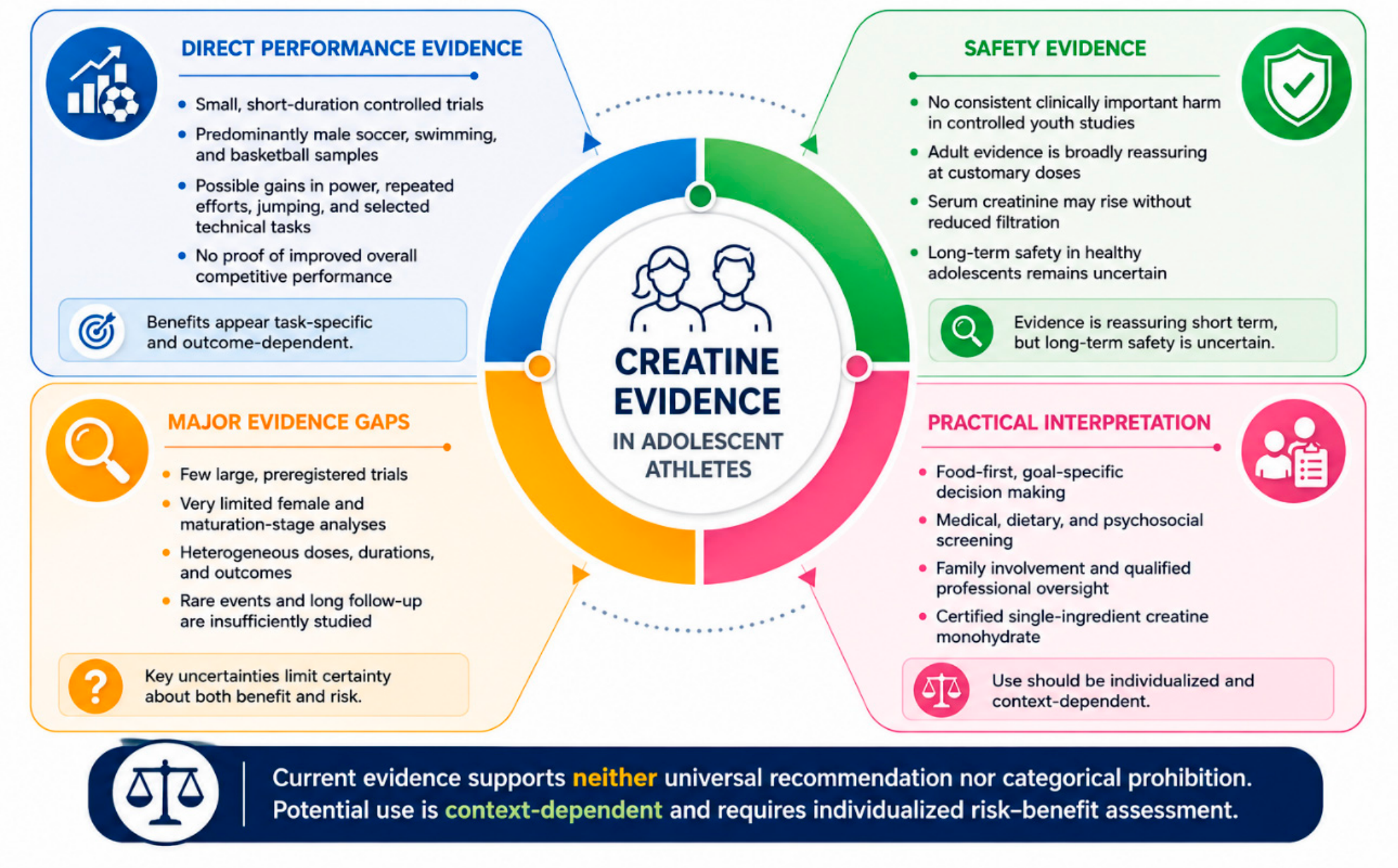
Figure 2.
Conceptual decision framework for responsible consideration of creatine monohydrate in adolescent athletes. The framework prioritizes purpose, sport maturity, medical and dietary screening, psychosocial assessment, family involvement, product certification, and follow-up. It is not a validated clinical algorithm and does not replace individualized medical or nutrition assessment.
Figure 2.
Conceptual decision framework for responsible consideration of creatine monohydrate in adolescent athletes. The framework prioritizes purpose, sport maturity, medical and dietary screening, psychosocial assessment, family involvement, product certification, and follow-up. It is not a validated clinical algorithm and does not replace individualized medical or nutrition assessment.
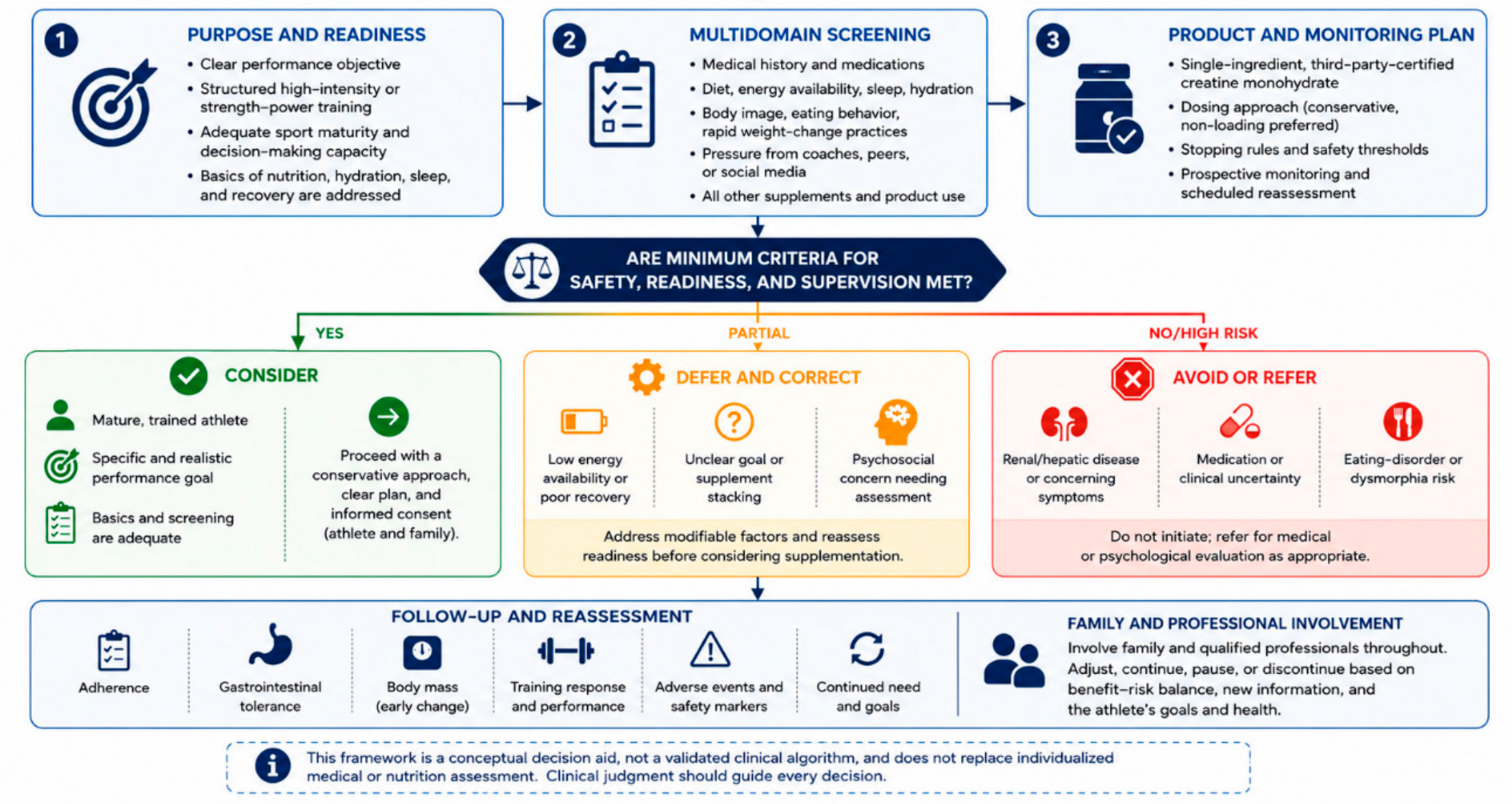

Table 1.
Structured search domains and operational criteria.
| Domain | Core concepts and example terms | Sources | Operational purpose |
| Sport performance | (creatine OR creatine monohydrate) AND (adolescent OR youth OR young athlete) AND (sport OR soccer OR swimming OR basketball OR power OR sprint) | PubMed/MEDLINE; Google Scholar; Semantic Scholar | Identify trials and applied studies in adolescent athletes or closely age-adjacent athletic samples. |
| Safety | (creatine OR creatine monohydrate) AND (safety OR adverse effects OR kidney OR liver OR gastrointestinal OR dehydration OR cramps OR testosterone OR DHT OR alopecia) | PubMed/MEDLINE; Google Scholar; Semantic Scholar; Cochrane Library | Evaluate clinical markers, reported adverse events, and domains commonly raised in practice. |
| Foundational evidence | (creatine supplementation OR creatine loading) AND (phosphocreatine OR ATP OR repeated sprint OR high-intensity exercise OR muscle creatine) | PubMed/MEDLINE; manual reference screening | Establish mechanism and the adult evidence from which youth claims are often extrapolated. |
| Pediatric clinical evidence | (creatine OR creatine monohydrate) AND (pediatric OR child OR adolescent) AND (muscular dystrophy OR dermatomyositis OR neuromuscular) | PubMed/MEDLINE; Cochrane Library | Assess supervised pediatric exposure while explicitly separating therapeutic contexts from sport use in healthy adolescents. |
| Focused update, 2020-19 June 2026 | (creatine OR creatine monohydrate) AND (adolescent athlete OR youth athlete OR safety OR systematic review OR trial OR body image OR female athlete) | All sources plus citation tracking | Capture recent reviews, controlled studies, safety syntheses, sex-specific evidence, and psychosocial evidence. |
| Grey literature and ongoing studies | (creatine OR creatine monohydrate) AND (adolescent OR youth OR female athlete OR football) AND (trial OR registry OR protocol) | ClinicalTrials.gov; citation tracking | Identify ongoing or unpublished studies and map evidence gaps; registry records without posted results were not used to infer efficacy or safety. |
Note: Search terms were adapted to the syntax of each source. This was a structured narrative search rather than an exhaustive systematic-review strategy; therefore, no PRISMA flow diagram or pooled estimate was produced. ClinicalTrials.gov and other grey-literature sources were used to map ongoing work; records without posted results were not included as outcome evidence.
Table 2.
Selected studies of creatine monohydrate in adolescent or age-adjacent athletic populations.
Table 2.
Selected studies of creatine monohydrate in adolescent or age-adjacent athletic populations.
| Study | Population and design | Protocol | Main findings and key limitation |
| Ostojic [30] | 20 young male soccer players; applied controlled trial; mean age approximately 16.6 y. | 30 g/day (3 x 10 g) for 7 days. | Selected soccer-specific tests improved. Small sample, brief exposure, and multiple outcomes limit precision. |
| Mohebbi et al. [31] | 17 young male soccer players; double-blind placebo-controlled trial; 17.18 +/- 1.37 y. | 20 g/day (4 x 5 g) for 7 days. | Repeated-sprint and dribbling times improved; shooting accuracy did not. Very small sample, brief loading, and limited reporting by current standards. |
| Yanez-Silva et al. [32] | 19 elite male youth soccer players; matched, double-blind, placebo controlled; 17.0 +/- 0.5 y. | 0.03 g/kg/day for 14 days. | Wingate peak and mean power increased. Small sample and laboratory endpoint; no season-level outcome. |
| Huerta Ojeda et al. [33] | 28 young soccer players; matched, double-blind, placebo controlled; 17.1 +/- 0.9 y. | 0.3 g/kg/day for 14 days. | Higher post-fatigue half-squat velocity/power. Dose was loading-level and tenfold higher than Yanez-Silva; follow-up was short. |
| Grindstaff et al. [38] | 18 male and female junior competitive swimmers; randomized double blind. | 21 g/day for 9 days. | Selected repeated-sprint and arm-ergometer outcomes improved. Very small mixed-sex sample and brief protocol. |
| Dawson et al. [39] | 20 junior swimmers (10 female, 10 male); matched placebo control; 16.4 +/- 1.8 y. | 20 g/day for 5 days, then 5 g/day for 22 days. | No improvement in single pool sprints; swim-bench work increased. Demonstrates outcome specificity. |
| Theodorou et al. [40] | 22 elite swimmers; acute pre-post loading followed by longer-term creatine or placebo; age-adjacent classification. | 25 g/day for 4 days, then 5 g/day or placebo for 2 months. | Maximal interval times improved after acute loading, with no further 2-month improvement. Ages were not clearly adolescent-only and acute phase lacked a parallel placebo comparison. |
| Juhasz et al. [43] | 18 injured adolescent fin swimmers; randomized double-blind placebo-controlled rehabilitation study. | 20 g/day for 5 days, then 5 g/day for 37 days, alongside immobilization and rehabilitation. | Smaller lean-mass loss and faster torque/pain recovery. Tiny, specialized sample and co-intervention support rehabilitation, not routine ergogenic use. |
| Vargas-Molina et al. [44] | 23 male U16 basketball players; randomized open-label. | 0.1 g/kg/day plus 8 weeks of resistance and plyometric training. | Abalakov jump and points/game favored creatine. Open label, no placebo, and training co-intervention limit causal attribution. |
| Wu et al. [45] | 40 male basketball players; randomized counterbalanced crossover; 13-14 y. | 0.3 g/kg/day for 5 days plus 0.1 g/kg before testing; 4-week washout. | Selected technical tasks improved, especially under dual task. Acute high-dose protocol and narrow sample. |
| Almeida et al. [46] | 34 young male weightlifters; randomized double-blind placebo controlled; age-adjacent classification. | 0.3 g/kg/day for 7 days, then 0.03 g/kg/day for 21 days, with resistance training. | Strength increased and biomarkers remained within reference ranges. Adolescent status was not clearly established for all participants. |
| Simpson et al. [37] | 19 elite soccer players; randomized double-blind placebo controlled; 16-21 y. | 0.3 g/kg/day for 1 week, then 5 g/day for 7 weeks. | Safety-focused; mild unfavorable airway-inflammation trend. Mixed adolescent/young-adult sample; not a performance trial. |
Note: Direct evidence refers to samples clearly composed of adolescent athletes. Age-adjacent evidence includes mixed or incompletely specified young populations. Doses are reported as used in the original studies and should not be interpreted as a universal adolescent prescription.
Table 3.
Safety domains and implications for adolescent athletes.
| Domain | What the evidence supports | What remains uncertain | Practical implication |
| Renal and biochemical markers | Adult trials and reviews are broadly reassuring; serum creatinine can rise without reduced filtration. A 32-week female-football cohort found no clinically meaningful biochemical derangement [47]. | Long-term adolescent exposure, pre-existing disease, uncommon events, and interpretation across maturation stages. A single 17-year-old acute-kidney-injury case after high-dose loading cannot estimate incidence [48]. | Screen medical history; avoid aggressive loading and unsupervised use with renal disease or unexplained abnormalities; stop and seek medical review for flank pain, reduced urine output, edema, or marked laboratory change; interpret creatinine in context. |
| Hepatic and cardiometabolic | No consistent clinically important deterioration has been identified in healthy studied populations. | Long follow-up in healthy adolescents and interactions with medications or other supplements. | Use clinical judgment in athletes with liver disease, metabolic disease, or poly-supplement use. |
| Gastrointestinal and body mass | Symptoms are usually mild and dose related; early body-mass gain is expected in some users. | Tolerance of different youth protocols and consequences in weight-sensitive sports. | Avoid unnecessarily large single doses; discuss the performance trade-off of body-mass change. |
| Hydration, cramps, and heat | Adult evidence does not show a consistent increase in dehydration or cramping. | Youth-specific monitoring in extreme heat and prolonged competition. | Maintain independent hydration, electrolyte, heat-acclimation, and illness plans. |
| Respiratory and allergy | One small mixed-age soccer trial reported a mild unfavorable airway-inflammation trend, especially with allergic sensitization. | Replication, clinical importance, and relevance to adolescents with asthma. | Review persistent symptoms or poorly controlled asthma; refer when uncertainty is clinically relevant. |
| Hormonal and hair | A DHT ratio signal did not measure hair loss; a later RCT did not support follicular harm. | Long-term adolescent data and genetically susceptible groups. | Correct misinformation without claiming absolute certainty; document relevant history if concern is high. |
| Long-term, sex, and maturation | A 32-week female-football cohort was biochemically reassuring, and a female-performance systematic review found no consistent effect across heterogeneous studies [47,62]. | Adolescent-only causal safety, menstrual and maturation interactions, rare events, and sustained use across seasons. | Do not generalize male or adult data; document sex, maturation, menstrual health when relevant, dose, co-supplements, and duration. |
| Psychosocial and product-related | Supplement use can cluster with muscularity concerns, restrictive behaviors, and use of other products. | Direction of causality and the effect of supervised versus unsupervised use. | Screen motivation, body image, eating behavior, and product source; avoid multi-ingredient or uncertified products. |
Note: These implications are intended as a risk-management framework, not as evidence that monitoring prevents all adverse events. Medical evaluation or clinical referral is appropriate when underlying disease, persistent or unexplained symptoms, potential drug–supplement interactions, or psychosocial risk are present.
Table 4.
Research priorities for creatine studies in adolescent athletes.
| Domain | Current limitation | Minimum design feature | Priority outcomes |
| Participant characterization | Chronological age is often reported without maturation or training age. | Report sex, pubertal/maturation status, training age, sport level, diet, and co-supplement use. | Effect modification, responder profiles, external validity. |
| Dose and exposure | Protocols range from 0.03 to 0.3 g/kg/day and are described inconsistently. | Predefine dose rationale, verify adherence, report product analysis, and compare loading versus non-loading approaches. | Dose-response, tolerability, body-mass change, time to benefit. |
| Performance | Small samples and narrow laboratory or technical tests. | Adequately powered placebo-controlled trials with preregistered primary outcomes. | Repeated-sprint ability, strength/power, validated sport tasks, training quality, competition-relevant outcomes. |
| Safety | Adverse events are usually secondary and follow-up is brief. One mixed-age 32-week cohort and one case report cannot define causal or rare-event risk [47,48]. | Predefined adverse-event collection, clinically interpreted renal/hepatic markers, adjudication of serious events, and longer controlled follow-up. | Uncommon events, symptom burden, kidney filtration, liver and cardiometabolic markers, respiratory outcomes. |
| Sex and maturation | Female and prepubertal data are very limited; the available female cohort is mixed-age and uncontrolled, and the female systematic review is not adolescent-specific [47,62]. | Recruit balanced samples and analyze sex and maturation interactions without treating adolescents as homogeneous. | Efficacy, menstrual health, growth-related outcomes, tolerability. |
| Psychosocial and product quality | Motivation, body image, stacking, and contamination are rarely integrated. | Measure body-image/eating-risk variables and verify third-party product certification. | Behavioral trajectories, hidden ingredients, supervised versus unsupervised use. |
| Long-term implementation | No robust adolescent-only evidence on sustained use across seasons; one 32-week cohort is single-arm [47]. | Prospective controlled cohorts or registries with standardized exposure and outcome definitions, completion of registered studies, and public reporting of results [75]. | Persistence of benefit, stopping behavior, adherence, rare adverse events, educational impact. |
The listed features are intended to improve interpretability and clinical relevance. They do not imply that a single trial must address every domain.
Disclaimer/Publisher’s Note: The statements, opinions and data contained in all publications are solely those of the individual author(s) and contributor(s) and not of MDPI and/or the editor(s). MDPI and/or the editor(s) disclaim responsibility for any injury to people or property resulting from any ideas, methods, instructions or products referred to in the content. |
© 2026 by the authors. Licensee MDPI, Basel, Switzerland. This article is an open access article distributed under the terms and conditions of the Creative Commons Attribution (CC BY) license.
Copyright: This open access article is published under a Creative Commons CC BY 4.0 license, which permit the free download, distribution, and reuse, provided that the author and preprint are cited in any reuse.


