

Submitted:
13 July 2026
Posted:
14 July 2026
You are already at the latest version
Abstract
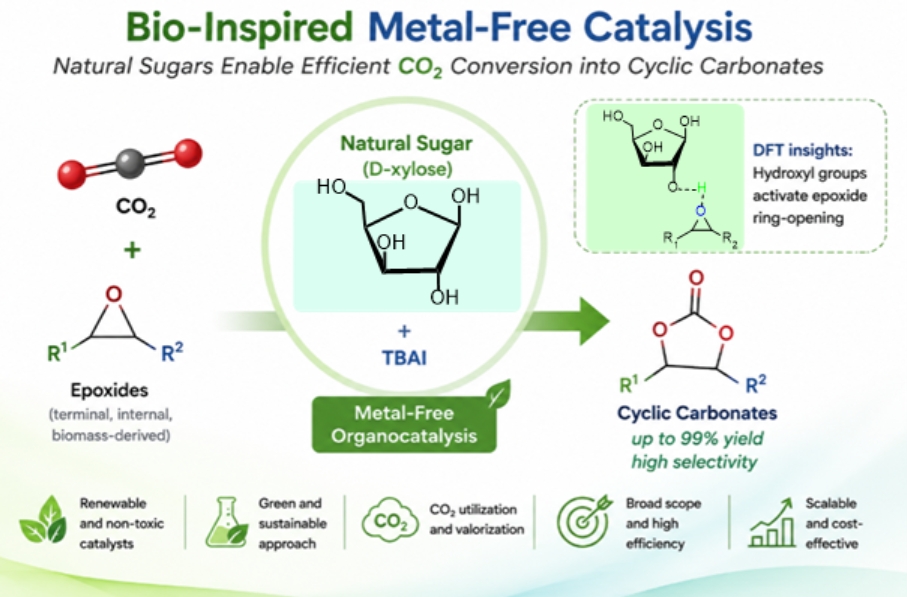
The consistent increase of atmospheric CO2 concentration, mostly driven by the global combustion of fossil fuels, is nowadays considered the major contributor to making many environmental challenges much more severe, like climate change and global warming. Attending to this issue requires innovative strategies that transform CO2 into a valuable resource. In this work, we report a sustainable and fully metal-free approach for the synthesis of cyclic carbonates via the direct coupling of CO2 with epoxides, using natural sugars as readily available, non-toxic organocatalysts in combination with tetrabutylammonium iodide (TBAI) as cocatalyst. Seven representative mono- and disaccharides were screened employing styrene oxide as a model substrate under mild reaction conditions (80 °C, 20 bar CO2, 2 h). Among them, D-xylose exhibited the best catalytic performance. The robustness of this catalytic system was further demonstrated through the efficient transformation of a wide range of terminal, internal, and biomass-derived epoxides into their corresponding cyclic carbonates with high yields and selectivity (up to 99%). Additionally, a set of computational simulations based on density functional theory (DFT) calculations was carried out to gain insight into the atomistic mechanisms involved in this chemical transformation. We identified that the hydroxyl groups of the sugar catalyst play a pivotal role in activating the epoxy ring-opening process, leading to cyclic carbonate formation. This bio-inspired strategy provides a green, cost-effective, and scalable pathway to produce key precursors for organic chemistry, contributing to the development of a circular carbon economy and the advancement of sustainable chemistry.
Keywords:
cyclic carbonates
; CO2
; epoxides
; organocatalysis
; sugars
1. Introduction
The increasing levels of atmospheric carbon dioxide (CO2), primarily associated with different anthropogenic activities like fossil fuel burning, have significantly contributed to producing environmental damage such as global warming and climate change [1,2]. This greenhouse gas intensifies the natural greenhouse effect by trapping the infrared radiation re-emitted from the Earth's surface, leading to a rise in the global temperature, producing more frequent and severe weather events, ocean acidification, and disruption of ecosystems [3,4,5]. This situation has recently encouraged the need for effective mitigation strategies able to appease the above mentioned environmental consequences [3,6,7,8]. In this context, the development of mitigation strategies has taken two principal directions: carbon capture and carbon utilization [9,10,11]. The latter, integrated under the concept of Carbon Capture and Utilization (CCU), focuses on converting CO2 into high value-added chemical products, contributing to a carbon-based circular economy [12,13,14]. CO2, despite its environmental drawbacks, is an abundant, inexpensive, non-flammable, non-toxic, and renewable C1 building block [15,16,17]. Its low reactivity due to its inherent thermodynamic stability presents a synthetic challenge, but also an opportunity, since under appropriate catalytic systems, it can be transformed into simple molecules such as formic acid [18] or methanol [19], and functionalized chemical products such as formamides [20] and cyclic carbonates [21,22]. These transformations simultaneously support the valorization of a problematic greenhouse gas and also advance the goals of green chemistry and sustainability.
One of the most efficient and direct routes within this framework is the conversion of CO2 into cyclic carbonates through its reaction with epoxides [23,24,25]. This transformation is noteworthy for its absence of byproduct formation, operation under relatively mild conditions, and the ability to yield compounds with a broad industrial applicability. Cyclic carbonates are used as green solvents [26,27,28], electrolytes for lithium-ion batteries [29,30], and as monomers to produce non-isocyanate polyurethanes (NIPUs) [31,32]. The functional diversity of these compounds, combined with their growing demand, positions them as strategic products in the contemporary chemical industry.
The success of the synthesis of cyclic carbonates from epoxides and CO2 relies heavily on the development of highly efficient catalytic systems. Over the past decades, numerous catalyst systems have been reported as metal-based systems [33,34,35], organocatalysts [36,37,38,39,40], hybrid materials like MOFs [41,42,43,44], ionic liquids [15,45,46,47,48], and quaternary ammonium salts [49,50,51]. It is important to mention that although metal-based catalysts often exhibit excellent catalytic performance for this transformation, they typically involve the use of scarce or toxic metals and require complex synthetic procedures. MOFs, for instance, can also demand elaborate synthesis protocols and may present limitations in recyclability. In contrast, bifunctional organocatalysts have emerged as appealing alternatives capable of simultaneously activating both the epoxide and CO2 under milder, metal-free conditions [37,52,53,54]. However, most of the organocatalysts developed to date still suffer from key sustainability drawbacks, as their synthesis typically involves multiple steps, extensive use of organic solvents, and structures derived from petrochemical sources, which hinder biodegradability and increase production costs.
These limitations have encouraged the search for simpler, more accessible, and environmentally friendly catalytic systems. In this context, naturally derived catalysts offer a promising solution [55,56]. In particular, polysaccharides, which are renewable, non-toxic compounds rich in hydroxyl groups that can form hydrogen bonds, have been barely explored as primary organocatalysts for this transformation [57,58,59,60]. These polymers, which possess multiple hydroxyl functionalities and a well-defined three-dimensional structure, can activate epoxides through hydrogen bonding interactions; nevertheless, they generally require prior chemical modification to function as efficient organocatalysts. From this perspective, mono- and disaccharides can be used directly in the synthesis of cyclic carbonates, as their simpler structures provide accessible functional groups that can participate in the catalytic process without requiring prior derivatization, which allows the elimination of intermediate synthetic steps and the use of organic solvents, fully aligning with the principles of green chemistry. This bio-inspired approach simplifies catalytic design and promotes a completely metal-free pathway for CO2 valorization.
In the past two decades, sugars have emerged as valuable building blocks for the development of solid acid catalysts within the framework of sustainable catalysis. However, most research has focused on the use of sugars as precursors of heterogeneous catalysts rather than as homogeneous catalysts, employing partial carbonization and the introduction of acidic functional groups (−SO3H, −COOH, −OH) through sulfonation [61,62,63,64]. This approach has been validated by numerous studies in which materials derived from glucose or sucrose have shown high catalytic efficiency in esterification reactions of fatty acids for biodiesel production, along with good thermal stability and reusability [65,66,67]. Similarly, these carbon-based catalysts have been successfully applied in glycerol acetalization/ketalization reactions, standing out for their high acidity and versatility toward different carbonyl substrates [68].
Given the exceptional catalytic activity shown by sugars, this study proposes an alternative approach to CO2 utilization by focusing on the direct use of carbohydrates as primary catalysts. Unlike conventional strategies that rely on metal-based or synthetically complex catalysts, this work experimentally evaluates the performance of natural, commercially available, unmodified sugars. The goal is to demonstrate that, under optimized conditions, these simple compounds can effectively promote the conversion of epoxides into cyclic carbonates, offering a practical, cost-effective, and environmentally conscious solution. To explore this possibility, seven representative mono- and disaccharides were selected (Figure 1), covering various structural families: three pentoses (xylose, ribose, and arabinose), two hexoses (glucose and fructose), and two disaccharides (lactose and sucrose). These compounds were evaluated in combination with tetrabutylammonium iodide (TBAI) as a catalyst system in the reaction between various epoxides and CO2, under mild temperature (80 °C) and pressure (20 bar) conditions. To this end, a computational approach was employed to elucidate and identify key intermediate species involved in this chemical transformation. This proposal represents a novel contribution in the pursuit of more accessible and sustainable catalytic pathways.
2. Materials and Methods
2.1. General Procedures and Techniques
All chemical reagents were purchased from commercial suppliers and used without further purification. Reactions involving CO2 were carried out in a stainless-steel reactor equipped with a magnetic stir bar. Solvents, including hexane and ethyl acetate (EtOAc), were dried prior to use over sodium wire. Deuterated solvents were stored over activated 4 Å molecular sieves and degassed by multiple freeze–thaw cycles. 1H and 13C{1H} NMR spectra were recorded on a Varian Inova FT-500 spectrometer and referenced to the residual signals of the deuterated solvents. Chemical shifts (δ) are reported in parts per million (ppm) relative to tetramethylsilane (TMS, δ = 0). Coupling constants (J) are given in Hertz (Hz). Signal multiplicities are reported as brs (broad singlet), s (singlet), d (doublet), t (triplet), dd (double doublet), and m (multiplet).
2.2. General Procedure to Optimize Reaction Conditions for the Preparation of Styrene Carbonate
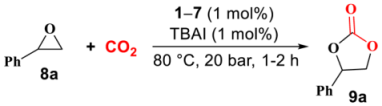
Styrene oxide, 8a (1.7 mmol), mono-/disaccharide 1-7 (0.017 mmol) and TBAI (0.017 mmol) were placed in a 50 mL stainless-steel reactor equipped with a magnetic stir bar. The reaction mixture was stirred at 80 °C under a CO2 pressure of 20 bar for 1–2 h. The conversion of styrene oxide 8a into styrene carbonate 9a was monitored by 1H NMR spectroscopy.
2.3. General Procedure for the Synthesis of Cyclic Carbonates
To synthesize cyclic carbonates, the respective epoxide (1.7 mmol), the selected catalyst 1 (0.017-0.085 mmol) and TBAI (0.017-0.085 mmol) were placed in a 50 mL stainless-steel reactor equipped with a magnetic stir bar and connected to a high-pressure CO2 line. The reaction mixture was heated to 80–100 °C using a stirring hot plate and pressurized to 20 bar CO2 with continuous stirring for 1–72 h. After the designated reaction time, the reactor was cooled down to room temperature over 1 h, and the pressure was gradually released via controlled depressurization. The conversion of the epoxide to the corresponding cyclic carbonate was determined by 1H NMR spectroscopy. The reaction mixture was filtered through a plug of silica, eluting with CH2Cl2 to remove the catalyst. The filtrate was concentrated under reduced pressure to afford either the pure cyclic carbonate or a mixture of cyclic carbonate and unreacted epoxide. When necessary, the product was further purified by flash chromatography using a gradient solvent system of hexane and ethyl acetate (hexane/EtOAc: 9:1, 6:1, 3:1, 1:1, or only EtOAc) to isolate the pure cyclic carbonate.
2.4. Recyclability Study
To evaluate the recyclability and stability of the catalytic system, styrene oxide 8a, catalyst 1, and TBAI were used under the previously optimized reaction conditions. Epoxide 8a (1.7 mmol), organocatalyst 1 (0.017 mmol), and TBAI (0.017 mmol) were introduced into a reactor connected to a high-pressure CO2 line. The reaction mixture was heated to 80 °C, pressurized to 20 bar of CO2, and stirred for 2 h. After completion, the reactor was cooled to room temperature over 1 h, followed by careful and gradual depressurization. Conversion of the epoxide into the corresponding cyclic carbonate was monitored by 1H NMR analysis of an aliquot. Catalyst 1 and TBAI were recovered by precipitation with Et2O, followed by centrifugation of the reaction mixture. The isolated catalytic system was then dried under vacuum at 80 °C for 7 h before reusing in the next catalytic cycle. This procedure was repeated for each recycling cycle.
2.5. Computational Details
All computational results presented here have been obtained by using the latest ORCA quantum chemistry package release (version 6.1.1) [69,70]. The electronic structure of the selected molecular models was mainly described at B3LYP [71,72,73] and ma-def2-svp [74,75] level, including dispersion effects through the D4 [76] Grimme scheme. The initial interaction between the epoxy substrate and the sugar catalyst was determined by using a docker procedure computed at GFN2-xTB [77] level. The reactive path was determined by computing the minimum energy path (MEP) that connects reactive and product configuration states, which were initially prepared at GFN2-xTB and subsequently pre-optimized at B3LYP D4 ma-def2-svp level. The converged MEP was computed through a modified and efficient climbing-image nudged elastic band (CI-NEB) method implemented in the ORCA package called NEB-TS [70,78]. This method combines a versatile CI-NEB algorithm with an efficient transition state searcher [78]. The IDDP method was used to interpolate the initial images to start MEP convergence cycles and TS searching process. All the found stationary and transition states were extensively verified by performing frequency analysis calculations. Gibbs free energy (ΔG) was also computed, incorporating the zero-point energy (ZPE) term and all the remaining thermal contributions. A refined activation (ΔG‡) and reaction (ΔGR) energies was finally computed at both ωB97M-V [79] and DLPNO-CCSD(T) [80,81] def2-tzvpp level to produce more accurate values.
3. Results and Discussion
3.1. Catalytic Results for the Preparation of Different Cyclic Carbonates
Initially, the catalytic activity of the mono-/disaccharides 1–7 was evaluated using styrene oxide (8a) as a model substrate to characterize this chemical transformation (Table 1). The experiments were conducted under solvent-free conditions at 80 °C and 20 bar CO2 pressure for 1 or 2 h using 1 mol% of both catalysts (sugar and TBAI), respectively. TBAI was selected as cocatalyst because quaternary ammonium iodides have consistently shown superior activity compared to their bromide and chloride analogs in the cycloaddition of CO2 to epoxides. This superior performance is generally attributed to the higher nucleophilicity of iodide, which promotes the ring-opening of the epoxide, a key step in the catalytic cycle [82,83]. Under these experimental conditions, the pentoses achieved excellent catalytic conversions, larger than 90%, with D-xylose (1) showing the highest performance (Table 1, entries 1-3). Among the hexoses, D-fructose (4) exhibited higher activity than D-glucose (5) for the formation of styrene carbonate, 9b (Table 1, entries 4 and 5). This difference may be attributed to steric factors, in which fructose adopts a five-membered furanose ring, a less sterically hindered environment, with more accessible hydroxyl groups to interact with the oxygen atom of the epoxide through hydrogen bonding, whereas glucose, in its six-membered pyranose form, presents greater steric hindrance that limits its catalytic reactivity. A similar behavior was observed for the disaccharides D-lactose (6) and D-sucrose (7) (Table 1, entries 6 and 7), where the presence of two interconnected monosaccharide units and multiple ring systems further increased steric congestion, leading to a marked diminution in catalytic activity. Based on these catalytic results, D-xylose (1) was identified as the most active catalyst. In addition, the reaction time was increased to 2 hours to obtain a quantitative conversion (Table 1, entry 8). Control experiments revealed that both organocatalyst 1 and TBAI required the presence of the other catalyst component to display significant catalytic activity under these reaction conditions (Table 1, entries 9 and 10). After that, the preparation of 9a was carried out at 1 bar; however, a low conversion was obtained (Table 1, entry 11), indicating that a higher CO2 pressure was required to efficiently carry out this catalytic transformation. Finally, the reaction was successfully scaled up using 17.0 mmol of 8a, and an excellent conversion was also obtained under these conditions (Table 1, entry 12), demonstrating the scalability of the catalytic protocol (Figure S33).
Then, we decided to perform this chemical conversion on ten monosubstituted epoxides (8a–k) into their corresponding cyclic carbonates (9a–k) using catalyst 1 and TBAI under the same reaction conditions previously described to demonstrate the versatility of this catalyst system (Figure 2). The formation of cyclic carbonates was confirmed by 1H and 13C{1H} NMR spectroscopy. As shown in Figure 2, the epoxides were effectively converted to their corresponding cyclic carbonates with excellent yields. It is relevant to comment that no polycarbonate formation was observed under these conditions, resulting in selectivities up to 99% for cyclic carbonate production. D-xylose proved to have elevated efficiency in the preparation of a set of cyclic carbonates bearing different functional groups, including aryl (9a), alkyl (9b-e), alcohol (9f), chloride (9g), alkene (9h), alkyne (9i), and ether (9j and 9k), achieving almost complete conversion within 2 h in most cases. It is worth highlighting that the synthesis of bis-cyclic carbonate 9k is particularly interesting, as it serves as a precursor for the production of NIPUs through reaction with diamines [84,85,86]. These findings demonstrate the broad functional group tolerance of catalyst 1 and its effectiveness in promoting the synthesis of diverse cyclic carbonates.
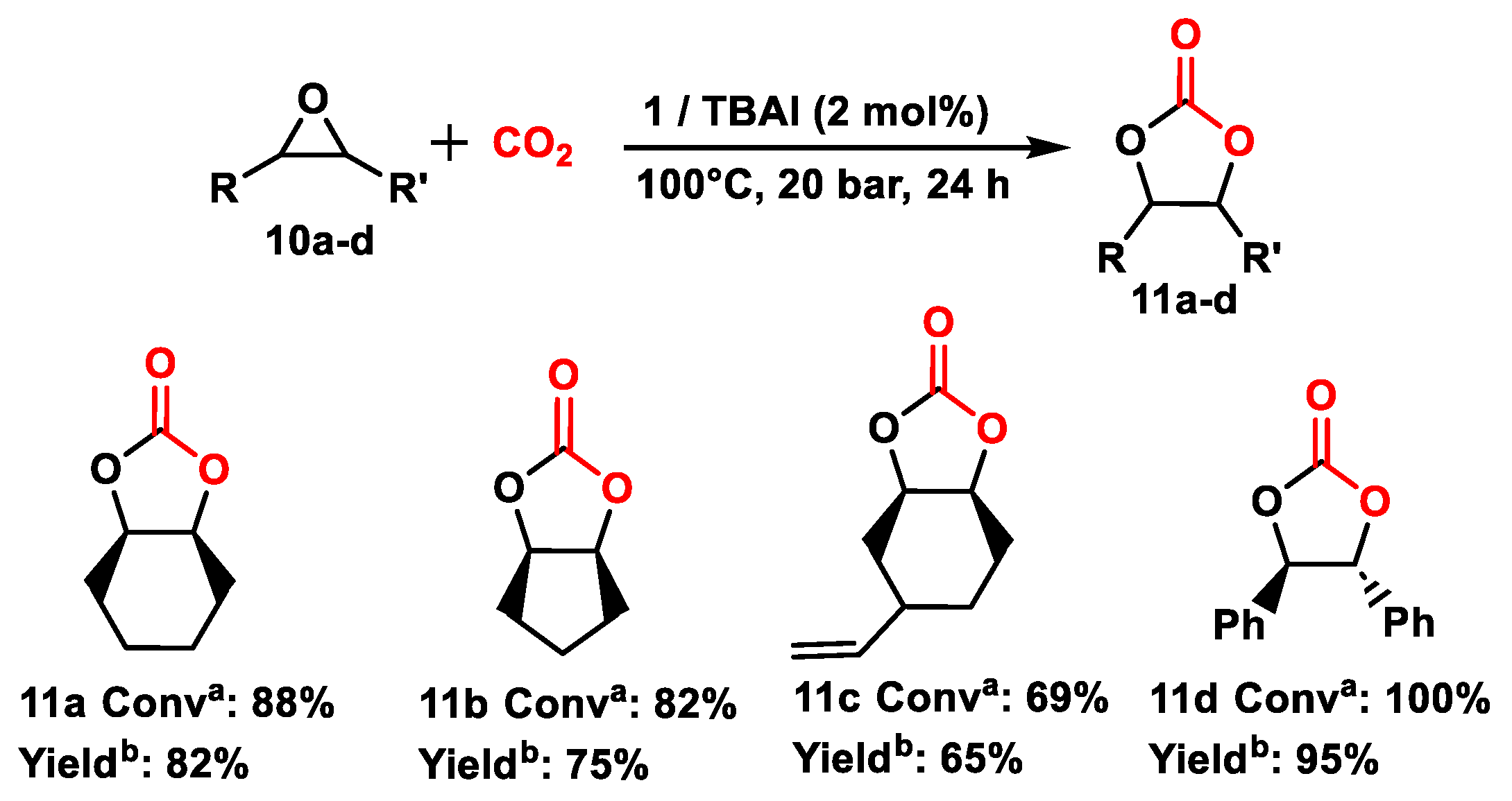
The catalytic performance of organocatalyst 1 and TBAI was further evaluated using internal epoxides (Figure 3), which are generally more challenging to transform into cyclic carbonates than terminal epoxides. To achieve high conversions, more stringent reaction conditions were required (100 °C, 20 bar CO2, 24 h, and 2 mol% of the catalyst system). It is important to note that this catalyst system efficiently promoted the formation of a broad range of disubstituted cyclic carbonates (11a-d) in good to excellent yields, with selectivities consistently exceeding 99%. Remarkably, high selectivity was maintained even for cyclohexene oxide (10a), a challenging substrate because it usually forms polycarbonates [87,88,89]. Cyclohexene (11a) and cyclopentene carbonate (11b) were synthesized in high isolated yields of 82% and 75%, respectively, from the corresponding internal epoxides, 10a and 10b. In addition, the preparation of 3-vinylcyclohexene carbonate (11c) was achieved with excellent efficiency. It is worth noting that this product was obtained as a mixture of diastereoisomers, as evidenced by the appearance of two distinct carbonyl signals in its respective 13C{1H} NMR spectrum (Figure S28). Additionally, trans-stilbene carbonate (11d) was obtained in excellent yield. Finally, NMR spectroscopic analysis confirmed that compounds 11a–d were formed with complete retention of the stereochemistry of the starting epoxides (Figures S23−S30).
Following the successful application of catalyst 1 and TBAI in the formation of mono- and disubstituted cyclic carbonates, we then conducted our efforts towards the preparation of a terpene-derived product, which represents a more challenging substrate due to its trisubstituted nature. In this context, the carvone-based endo-cyclic carbonate (13) was synthesized starting from the biomass-derived epoxide precursor (12) (Scheme 1). The reaction was performed under optimized conditions at 100 °C and 20 bar of CO2 over 72 h, employing 5 mol% of the catalyst. Under these conditions, the compound 13 was isolated in a remarkable 82% yield (Figures S31 and S32). Special attention was required during the purification process, as the formation of the corresponding diol by hydrolysis of the carbonate has been previously reported [90], which can complicate the isolation of the pure product.
Afterward, we decided to investigate the reusability of catalyst 1 in this catalytic process following a methodology previously reported in the literature [31]. Styrene oxide 8a was employed as substrate under the previously optimized reaction conditions. Thus, epoxide 8a, organocatalyst 1, and TBAI were introduced into the reactor at 80 °C under 20 bar of CO2 for 2 h. The conversion of epoxide 8a into the corresponding cyclic carbonate 9a was monitored by 1H NMR spectroscopy. Fresh epoxide 8a and the recovered catalytic system 1/TBAI from the previous cycle were subsequently introduced into the reactor to maintain the catalyst loading constant at 1 mol%. As shown in Figure S34, catalytic activity did not decrease significantly over six consecutive cycles, demonstrating that catalyst 1 retained its effectiveness after repeated reuse. In addition, the 1H NMR spectrum of the recovered catalytic system 1/TBAI showed no structural modifications compared with that obtained in the first catalytic cycle (see Figure S35 for further details).
3.2. Reactive Path Computed at DFT Level
As it was previously mentioned, D-xylose (1) was identified as the best sugar catalyst to convert different epoxide substrates to their respective cyclic carbonates. To gain a molecular insight into the associated mechanisms of this chemical transformation, a set of computational simulations based on density functional theory (DFT) method were carried out. Epichlorohydrin (8g) and cyclopentene oxide (10b) were selected as representative molecular models of monosubstituted (terminal) and disubstituted (internal) epoxide substrates, respectively. The molecular mechanisms that connect each substrate with its respective cyclic carbonate was determined by computing the minimum energy path (MEP) along the potential energy surface (PES) through an efficient and modified climbing-image nudged elastic band (CI-NEB) method implemented in ORCA called NEB-TS (see computational details section). This method connects the initial and final configuration states through a set of images (or replicas), which are initially interpolated (IDDP method) and used to find potential intermediate and transition state species along with the respective PES. To build the initial configuration state, a pre-screening methodology based on a docker procedure was carried out at GNF2-xTB level to determine the best molecular configuration which reduce the interaction energy between the D-xylose catalyst and the respective epoxide substrate (see Figure S36). Then, this initial configuration state was completed by adding the CO2 molecule and iodide anion as co-catalysts (see structure A, Figure 4 and Figure S40).
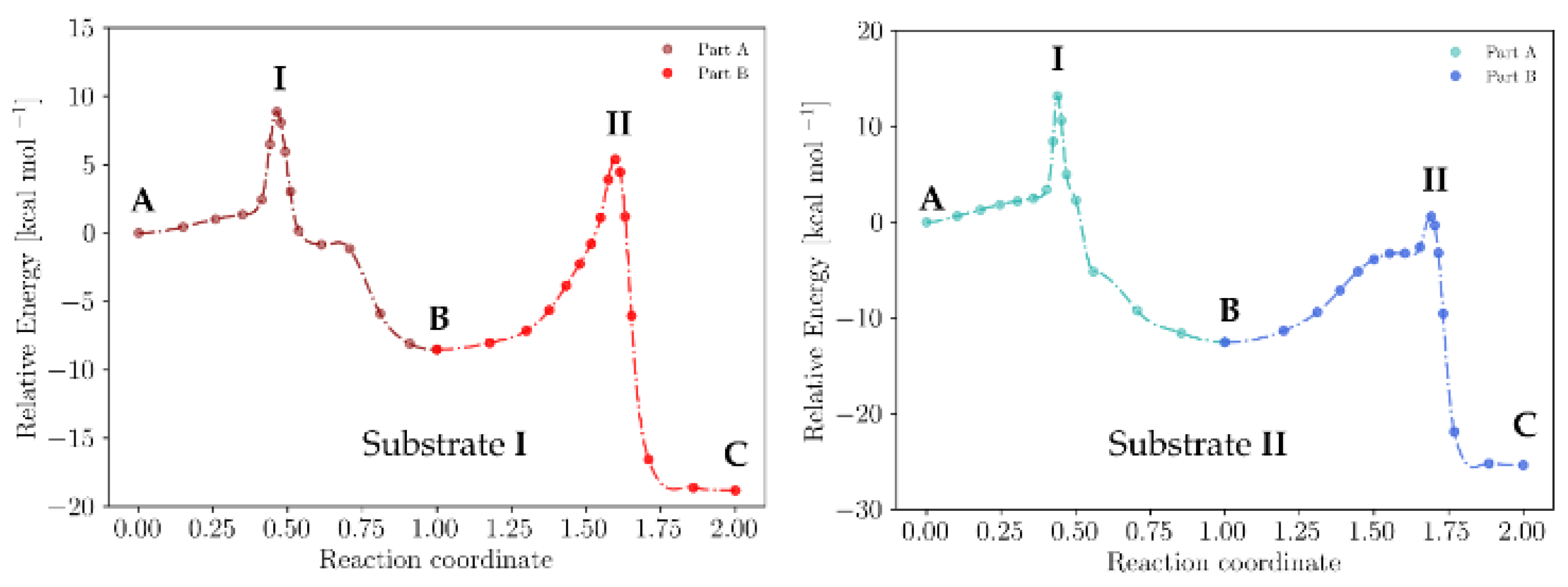
On the other hand, the final configuration state was built by modifying the initial configuration state coordinates necessary to generate the respective cyclic carbonate (see structure C, Figure 4 and Figure S40). Both ending (or extreme) points for each system were then optimized at B3LYP D4 ma-def2-svp level. The final MEP for each system was obtained after a set preliminary NEB-TS calculation (see NEB-TS rounds in Figures S37–S39). The respective energetic profile on the final MEP associated with each reactive system is shown in Figure 5. On the left and right panels, the energetic profiles associated with the epichlorohydrin and cyclopentene oxide transformation are shown, respectively. Both profiles are characterized by the presence of a single intermediate specie (structure B, Fig. 5) and two transition states (structures I and II, Figure 5). Specifically, the relative activation barriers computed for the epichlorohydrin transformation were 6.49 and 7.41 kcal mol-1. Furthermore, the relative activation barrier computed for the cyclopentene oxide transformation were 9.75, and 2.77 kcal mol-1, respectively (Table S1). For both systems, the reaction energy was negative (exothermic) −14.86 kcal mol-1 (epichlorohydrin) and −20.51 kcal mol-1 (cyclopentene oxide). A refined energy calculation on the B3LYP D4 def2-svp structure was also carried out at ωB97M-V def2-tzvpp and DLPNO-CCSD(T) def2-tzvpp level (Table S1), respectively. The obtained DLPNO-CCSD(T) values for epichlorohydrin transformation were 9.75, 15.38 kcal mol-1, and −12.83 kcal mol-1 for the activation and reaction energies, respectively. The respective DLPNO-CCSD(T) values for the cyclopentene oxide transformation were 15.36, 12.30 and −17.40 kcal mol-1. These refined energies compute a higher barrier for the internal epoxy transformations, which correspond to the first step associated with the ring-opening process.
The molecular sequence of computed elementary reaction steps associated with the epichlorohydrine and cyclopentene oxide transformation are shown in Figure 4 and Figure S40, respectively. In both cases, the computed reactive mechanism is characterized by an initial epoxy ring-opening process assisted by the sugar catalyst and the iodide anion of TBAI. Firstly, the iodine anion attacks the epoxy ring, causing its opening, which is simultaneously assisted by several H-bonds from the sugar catalysts involving the hydroxyl group and the oxygen atom of the epoxide. This generates the first carbonate intermediate species (structure B, Figure 4 and Figure S40). Finally, the carbonate intermediate attacks the epoxy carbon atom, releasing the iodine anion to produce the final product: the respective cyclic carbonate. The reactive path computed for both substrates follows similar intermediates and transition states, showing that this computed mechanism is general for mono- (terminal) and disubstituted (internal) epoxide substrates. It is important to highlight that this mechanism is slightly different from our previously reported work associated with ionic liquids (ILs) as organocatalysts, where ILs catalyzed the epoxy ring-opening process through a full proton-transfer event by forming an iodide-alcohol intermediate [15].
The CO2 activation degree was also estimated by computing its bond angle along the reaction path. Figure 5 and Figure S40 trace the CO2 bond angle on the key found structures: stationary points (A, B, and C) and transition states (I and II). Initially, the CO2 molecule shows a weak interaction with the epoxy oxygen, showing a bond angle close to the linearity ~178 (structure A, Figure 4 and Figure S40). Then, the interaction becomes stronger when the CO2 is incorporated as carbonate group on the epoxy structure, modifying its angle from ~178 to 136.5 (structure A to B, Figure 4 and Figure S40). Finally, CO2 bond angle is modified to its final geometry when the cyclic carbonate (structure B to C, Figure 4 and Figure S40) is formed.
Based on these theoretical findings, we propose a molecular mechanism for the synthesis of cyclic carbonates catalyzed by D-xylose (1) starting from the epoxide substrate and CO2 (Scheme 2). Initially, the epoxide substrate is activated by a hydrogen bond established between its oxygen atom and the sugar hydroxyl (−OH) group. This initial activation assists the nucleophilic attack of the iodide anion (from TBAI) on the epoxide ring by producing its opening and the carbon dioxide incorporation to produce a carboxyl intermediate. Subsequently, this intermediate quickly cyclizes to obtain the final cyclic carbonate product.
5. Conclusions
This study demonstrates a sustainable, metal-free strategy for the efficient conversion of CO2 into value-added cyclic carbonates by using metal-free natural sugars as organocatalysts. Among the seven mono- and disaccharides evaluated, D-xylose (1) exhibited the best catalytic performance, achieving quantitative conversions and excellent selectivities under mild reaction conditions (80−100 °C, 20 bar, and 2−72 h). The catalytic system, in combination with TBAI, showed remarkable versatility by effectively transforming a broad range of terminal, internal, and biomass-derived epoxides into cyclic carbonates, with selectivities consistently above 99%. This approach eliminates the need to use toxic or scarce metals and avoids complex synthetic procedures, fully aligning with the principles of green chemistry. A mechanistic proposal was also elaborated through computational simulation based on density functional theory (DFT). The computed molecular mechanisms show that D-xylose catalyzes this chemical transformation by establishing several H-bonds between the hydroxyl (−OH) group and the epoxy oxygen atom, allowing the epoxy ring opening process along with the carbon dioxide incorporation and the ensuing cyclic carbonate formation.
Overall, this work provides a simple, cost-effective, and scalable pathway for the valorization of CO2, offering a practical synthetic route to produce key precursors for organic chemistry by combining renewable feedstocks and a bio-inspired catalytic design. This methodology contributes to the advancement of a circular carbon economy and represents a step forward in sustainable chemistry.
Supplementary Materials
The following supporting information can be downloaded at the website of this paper posted on Preprints.org, Figure S1. 1H-NMR spectrum of 4-phenyl-1,3-dioxolan-2-one 9a in CDCl3; Figure S2. 13C{1H}NMR spectrum of 4-phenyl-1,3-dioxolan-2-one 9a in CDCl3; Figure S3. 1H-NMR spectrum of 4-methyl-1,3-dioxolan-2-one 9b in CDCl3; Figure S4. 13C{1H}NMR spectrum of 4-methyl-1,3-dioxolan-2-one 9b in CDCl3; Figure S5. 1H-NMR spectrum of 4-ethyl-1,3-dioxolan-2-one 9c in CDCl3; Figure S6. 13C{1H}NMR spectrum of 4-ethyl-1,3-dioxolan-2-one 9c in CDCl3; Figure S7. 1H-NMR spectrum of 4-butyl-1,3-dioxolan-2-one 9d in CDCl3; Figure S8. 13C{1H}NMR spectrum of 4-butyl-1,3-dioxolan-2-one 9d in CDCl3; Figure S9. 1H-NMR spectrum of 4-octyl-1,3-dioxolan-2-one 9e in CDCl3; Figure S10. 13C{1H}NMR spectrum of 4-octyl-1,3-dioxolan-2-one 9e in CDCl3; Figure S11. 1H-NMR spectrum of 44-(hydroxymethyl)-1,3-dioxolan-2-one 9f in DMSO-d6; Figure S12. 13C{1H}NMR spectrum of 4-(hydroxymethyl)-1,3-dioxolan-2-one 9f in DMSO-d6; Figure S13. 1H-NMR spectrum of 4-(chloromethyl)-1,3-dioxolan-2-one 9g in CDCl3; Figure S14. 13C{1H}NMR spectrum of 4-(chloromethyl)-1,3-dioxolan-2-one 9g in CDCl3; Figure S15. 1H-NMR spectrum of 4-((allyloxy)methyl)-1,3-dioxolan-2-one 9h in CDCl3; Figure S16. 13C{1H}NMR spectrum of 4-((allyloxy)methyl)-1,3-dioxolan-2-one 9h in CDCl3; Figure S17. 1H-NMR spectrum of 4-(phenoxymethyl)-1,3-dioxolan-2-one 9i in CDCl3; Figure S18. 13C{1H}NMR spectrum of 4-(phenoxymethyl)-1,3-dioxolan-2-one 9i in CDCl3; Figure S19. 1H-NMR spectrum of 4-(phenoxymethyl)-1,3-dioxolan-2-one 9j in CDCl3; Figure S20. 13C{1H}NMR 4-(phenoxymethyl)-1,3-dioxolan-2-one 9j in CDCl3; Figure S21. 1H-NMR spectrum of 4,4'-((butane-1,4-iylbis(oxy))bis(methylene))bis(1,3-dioxolan-2-one) 9k in CDCl3; Figure S22. 13C{1H}NMR spectrum of 4,4'-((butane-1,4-iylbis(oxy))bis(methylene))bis(1,3-dioxolan-2-one) 9k in CDCl3; Figure S23. 1H-NMR spectrum of (3aR,7aS)-hexahydrobenzo[d][1,3]dioxol-2-one 11a in CDCl3; Figure S24. 13C{1H}NMR spectrum of (3aR,7aS)-hexahydrobenzo[d][1,3]dioxol-2-one 11a in CDCl3; Figure S25. 1H-NMR spectrum of (3aR,6aS)-tetrahydro-4H-cyclopenta[d][1,3]dioxol-2-one 11b in CDCl3; Figure S26. 13C{1H}NMR spectrum of (3aR,6aS)-tetrahydro-4H-cyclopenta[d][1,3]dioxol-2-one 11b in CDCl3; Figure S27. 1H-NMR spectrum of (3aR,7aS)-5-vinylhexahydrobenzo[d][1,3]dioxol-2-one 11c in CDCl3; Figure S28. 13C{1H}NMR spectrum of (3aR,7aS)-5-vinylhexahydrobenzo[d][1,3]dioxol-2-one 11c in CDCl3; Figure S29. 1H-NMR spectrum of 4,5-diphenyl-1,3-dioxolan-2-one 11d in CDCl3; Figure S30. 13C{1H}NMR spectrum of 4,5-diphenyl-1,3-dioxolan-2-one 11d in CDCl3; Figure S31. 1H-NMR spectrum of 3a-methyl-6-(prop-1-en-2-yl)tetrahydrobenzo[d][1,3]dioxole-2,4(3aH)-dione 13 in CDCl3; Figure S32. 13C{1H}NMR spectrum of 3a-methyl-6-(prop-1-en-2-yl)tetrahydrobenzo[d][1,3]dioxole-2,4(3aH)-dione 13 in CDCl3; Figure S33. 1H-NMR spectrum of the crude product 4-phenyl-1,3-dioxolan-2-one 9a in CD3OD under the scaled-up reaction conditions. Figure S34. Reusability study of catalytic system 1/TBAI in the preparation of 9a over six consecutive catalytic cycles under the optimized reaction conditions. Figure S35. Stacked 1H-NMR spectrum in CD3OD. Comparation of the catalytic system before the reaction (a) and after six consecutive catalytic cycles (b); Figure S35. Docking procedure at GFN2-xTB level to describe D-xylosa-epoxy substrate interaction; Figure S36. Initial convergence cycle for the NEB-TS procedure for epichlorohydrin and cyclopentene oxide transformation; Figure S38. Final convergence cycle for the NEB-TS procedure for epichlorohydrin transformation; Figure S39. Final convergence cycle for the NEB-TS procedure for cyclopentene oxide transformation; Figure S40. Molecular mechanism proposed for the cyclopentene oxide transformation.
Author Contributions
Investigation, Formal analysis, Methodology. V. C.-T., M. N., E. F.-P. and G. L. M.; Resources, F. d.-M.; Conceptualization, Supervision, Validation, Writing – original draft, O. A. D.-G. and F. W.; Funding acquisition, Project administration, Visualization, Writing – review & editing, A. L.-S. and, J. M.
Funding
The authors gratefully acknowledge the financial support from the Ministerio de Ciencia, Innovación y Universidades/Agencia Estatal de Investigación (Spain) and Fondo Europeo de Desarrollo Regional (FEDER, UE), MICIU/AEI/10.13039/501100011033 (Grants PID2023-147240OB-I00, RED2022-134287-T), Junta de Comunidades de Castilla-La Mancha and Fondo Social de Desarrollo Regional (FEDER, UE) (Grants SBPLY/23/180225/000094 and SBPLY/24/180225/000057) and Universidad de Castilla-La Mancha (Grant 2025-GRIN-38324. J.M. is grateful FONDECYT Iniciación fellowship 11230124. O. A. D.-G thanks the support of the Patagón supercomputer of Universidad Austral de Chile (FONDEQUIP EQM180042).
Data Availability Statement
The original contributions presented in this study are included in the article/Supplementary Materials. Further inquiries can be directed to the corresponding authors.
Conflicts of Interest
The authors declare no conflicts of interest.
References
- Available online: Https://Gml.Noaa.Gov/Aggi/.
- Hossain, M.F. Extreme Level of CO2 Accumulation into the Atmosphere Due to the Unequal Global Carbon Emission and Sequestration. Water Air Soil Pollut. 2022, 233, 105. [Google Scholar] [CrossRef]
- Nunes, L.J.R. The Rising Threat of Atmospheric CO2: A Review on the Causes, Impacts, and Mitigation Strategies. Environments 2023, 10, 66. [Google Scholar] [CrossRef]
- Wagner, A.; Sahm, C.D.; Reisner, E. Towards Molecular Understanding of Local Chemical Environment Effects in Electro-and Photocatalytic CO2 Reduction. Nat. Catal. 2020, 3, 775–786. [Google Scholar] [CrossRef]
- Kabir, M.; Habiba, U.E.; Khan, W.; Shah, A.; Rahim, S.; De los Rios-Escalante, P.R.; Farooqi, Z.-U.-R.; Ali, L.; Shafiq, M. Climate Change Due to Increasing Concentration of Carbon Dioxide and Its Impacts on Environment in 21st Century; a Mini Review. J. King Saud. Univ. Sci. 2023, 35, 102693. [Google Scholar] [CrossRef]
- Crippa, M.; Guizzardi, D.; Pagani, F.; Banja, M.; Muntean, M.; Schaaf, E.; Becker, W.; Monforti-Ferrario, F.; Quadrelli, R.; Risquez Martin, A. GHG Emissions of All World Countries. Publ. Off. Eur. Union Luxemb. 2023, 10, 953322. [Google Scholar] [CrossRef]
- Fawzy, S.; Osman, A.I.; Doran, J.; Rooney, D.W. Strategies for Mitigation of Climate Change: A Review. Environ. Chem. Lett. 2020, 18, 2069–2094. [Google Scholar] [CrossRef]
- Geweda, A.E.; Zayed, M.E.; Khan, M.Y.; Alquaity, A.B.S. Mitigating CO2 Emissions: A Review on Emerging Technologies/Strategies for CO2 Capture. J. Energy Inst. 2025, 118, 101911. [Google Scholar] [CrossRef]
- Lin, Q.; Zhang, X.; Wang, T.; Zheng, C.; Gao, X. Technical Perspective of Carbon Capture, Utilization, and Storage. Engineering 2022, 14, 27–32. [Google Scholar] [CrossRef]
- Chai, S.Y.W.; Ngu, L.H.; How, B.S. Review of Carbon Capture Absorbents for CO2 Utilization. Greenh. Gases Sci. Technol. 2022, 12, 394–427. [Google Scholar] [CrossRef]
- Leonzio, G.; Shah, N. Recent Advancements and Challenges in Carbon Capture, Utilization and Storage. Curr. Opin. Green Sustain. Chem. 2024, 46, 100895. [Google Scholar] [CrossRef]
- Sankaran, K. Turning Black to Green: Circular Economy of Industrial Carbon Emissions. Energy Sustain. Dev. 2023, 74, 463–470. [Google Scholar] [CrossRef]
- Pires da Mata Costa, L.; Micheline Vaz de Miranda, D.; Couto de Oliveira, A.C.; Falcon, L.; Stella Silva Pimenta, M.; Guilherme Bessa, I.; Juarez Wouters, S.; Andrade, M.H.S.; Pinto, J.C. Capture and Reuse of Carbon Dioxide (CO2) for a Plastics Circular Economy: A Review. Processes 2021, 9, 759. [Google Scholar] [CrossRef]
- Peres, C.B.; Resende, P.M.R.; Nunes, L.J.R.; Morais, L.C. de Advances in Carbon Capture and Use (CCU) Technologies: A Comprehensive Review and CO2 Mitigation Potential Analysis. Clean Technol. 2022, 4, 1193–1207. [Google Scholar] [CrossRef]
- Francés-Poveda, E.; Navarro, M.; Beroíza-Duhart, M.; Mahecha, G.L.; Urzúa, J.I.; Valenzuela, M.L.; de la Cruz-Martínez, F.; Douglas-Gallardo, O.A.; Werlinger, F.; Lara-Sánchez, A.; et al. Effective One-Component Organocatalysts for Eco-Friendly Production of Cyclic Carbonates. Reactions 2025, 6, 8. [Google Scholar] [CrossRef]
- Yang, W.; Qiu, S.; Zhang, J.; Cheng, Z.; Song, L.; Hu, Y. Innovative Design and Green Synthesis of Bio-Based Non-Isocyanate Polyurethanes: Efficient Combination of Cardanol and Carbon Dioxide with High Fire Safety and Robust Adhesion. Chem. Eng. J. 2024, 482, 148846. [Google Scholar] [CrossRef]
- Tian, J.; Wang, Z.; Cui, S. Progress in the Green Catalytic Conversion of Carbon Dioxide and Renewable Feedstocks into Bio-Based Polymers. In Advances in Bioenergy; Elsevier, 2025; Vol. 10, pp. 187–218. [Google Scholar]
- Liu, X.; Zhong, H.; Wang, C.; He, D.; Jin, F. CO2 Reduction into Formic Acid under Hydrothermal Conditions: A Mini Review. Energy Sci. Eng. 2022, 10, 1601–1613. [Google Scholar] [CrossRef]
- Xie, S.; Zhang, W.; Lan, X.; Lin, H. CO2 Reduction to Methanol in the Liquid Phase: A Review. ChemSusChem 2020, 13, 6141–6159. [Google Scholar] [CrossRef] [PubMed]
- Beyazay, T.; Martin, W.F.; Tuysuz, H. Direct Synthesis of Formamide from CO2 and H2O with Nickel–Iron Nitride Heterostructures under Mild Hydrothermal Conditions. J. Am. Chem. Soc. 2023, 145, 19768–19779. [Google Scholar] [CrossRef] [PubMed]
- Mishra, V.; Peter, S.C. A Comprehensive Overview of the Catalytic Pathway for CO2 Utilization with Epoxide to Cyclic Carbonate. Chem Catal. 2024, 4, 100796. [Google Scholar] [CrossRef]
- Bhat, G.A.; Darensbourg, D.J. Progress in the Catalytic Reactions of CO2 and Epoxides to Selectively Provide Cyclic or Polymeric Carbonates. Green Chem. 2022, 24, 5007–5034. [Google Scholar] [CrossRef]
- Claver, C.; Yeamin, M. Bin; Reguero, M.; Masdeu-Bultó, A.M. Recent Advances in the Use of Catalysts Based on Natural Products for the Conversion of CO2 into Cyclic Carbonates. Green Chem. 2020, 22, 7665–7706. [Google Scholar] [CrossRef]
- Prasad, D.; Patil, K.N.; Chaudhari, N.K.; Kim, H.; Nagaraja, B.M.; Jadhav, A.H. Paving Way for Sustainable Earth-Abundant Metal Based Catalysts for Chemical Fixation of CO2 into Epoxides for Cyclic Carbonate Formation. Catal. Rev. 2022, 64, 356–443. [Google Scholar]
- Wang, B.; Wang, L.; Lin, J.; Xia, C.; Sun, W. Multifunctional Zn-N4 Catalysts for the Coupling of CO2 with Epoxides into Cyclic Carbonates. ACS Catal. 2023, 13, 10386–10393. [Google Scholar] [CrossRef]
- Pescarmona, P.P. Cyclic Carbonates Synthesised from CO2: Applications, Challenges and Recent Research Trends. Curr. Opin. Green Sustain. Chem. 2021, 29, 100457. [Google Scholar] [CrossRef]
- Mundo, F.; Caillol, S.; Ladmiral, V.; Meier, M.A.R. On Sustainability Aspects of the Synthesis of Five-Membered Cyclic Carbonates. ACS Sustain. Chem. Eng. 2024, 12, 6452–6466. [Google Scholar] [CrossRef]
- Trapasso, G.; Aricò, F. Organic Carbonates as Green Media: From Laboratory Syntheses to Industrial Applications. Green Chem. 2025, 27, 6925–6966. [Google Scholar] [CrossRef]
- Qian, Y.; Chu, Y.; Zheng, Z.; Shadike, Z.; Han, B.; Xiang, S.; Kang, Y.; Hu, S.; Cao, C.; Zhong, L. A New Cyclic Carbonate Enables High Power/Low Temperature Lithium-Ion Batteries. Energy Storage Mater. 2022, 45, 14–23. [Google Scholar] [CrossRef]
- He, M.; Su, C.-C.; Peebles, C.; Zhang, Z. The Impact of Different Substituents in Fluorinated Cyclic Carbonates in the Performance of High Voltage Lithium-Ion Battery Electrolyte. J. Electrochem. Soc. 2021, 168, 10505. [Google Scholar] [CrossRef]
- Werlinger, F.; Caballero, M.P.; Trofymchuk, O.S.; Flores, M.E.; Moreno-Villoslada, I.; Cruz-Martínez, F. de la; Castro-Osma, J.A.; Tejeda, J.; Martínez, J.; Lara-Sánchez, A. Turning Waste into Resources. Efficient Synthesis of Biopolyurethanes from Used Cooking Oils and CO2. J. CO2 Util. 2024, 79, 102659. [Google Scholar] [CrossRef]
- Turnaturi, R.; Zagni, C.; Patamia, V.; Barbera, V.; Floresta, G.; Rescifina, A. CO2-Derived Non-Isocyanate Polyurethanes (NIPUs) and Their Potential Applications. Green Chem. 2023, 25, 9574–9602. [Google Scholar] [CrossRef]
- Al-Qaisi, F.M.; Qaroush, A.K.; Okashah, I.K.; Eftaiha, A.F.; Vasko, P.; Alsoubani, F.; Repo, T. The Use of Sustainable Transition Metals for the Cycloaddition of Epoxides and CO2 under Mild Reaction Conditions. Eur. J. Inorg. Chem. 2023, 26, e202200357. [Google Scholar] [CrossRef]
- Paradiso, V.; Capaccio, V.; Lamparelli, D.H.; Capacchione, C. Metal Complexes Bearing Sulfur-Containing Ligands as Catalysts in the Reaction of CO2 with Epoxides. Catalysts 2020, 10, 825. [Google Scholar] [CrossRef]
- Cao, H.; Liu, S.; Wang, X. Environmentally Benign Metal Catalyst for the Ring-Opening Copolymerization of Epoxide and CO2: State-of-the-Art, Opportunities, and Challenges. Green Chem. Eng. 2022, 3, 111–124. [Google Scholar] [CrossRef]
- Guo, L.; Lamb, K.J.; North, M. Recent Developments in Organocatalysed Transformations of Epoxides and Carbon Dioxide into Cyclic Carbonates. Green Chem. 2021, 23, 77–118. [Google Scholar] [CrossRef]
- de Almeida Bezerra, W.; Milani, J.L.S.; de Jesus Franco, C.H.; Martins, F.T.; de Fátima, Â.; da Mata, Á.F.A.; das Chagas, R.P. Bis-Benzimidazolium Salts as Bifunctional Organocatalysts for the Cycloaddition of CO2 with Epoxides. Mol. Catal. 2022, 530, 112632. [Google Scholar] [CrossRef]
- Faizan, M.; Srivastav, N.; Pawar, R. Azaboratrane as an Exceptionally Potential Organocatalyst for the Activation of CO2 and Coupling with Epoxide. Mol. Catal. 2022, 521, 112201. [Google Scholar] [CrossRef]
- Fonseca-López, D.; Ezenarro-Salcedo, D.; Zapata-Rivera, J.; Rojas, R.S.; Hurtado, J.J. Salophen-Type Organocatalysts for the Cycloaddition of CO2 and Epoxides under Solvent, Halide, and Metal-Free Conditions. ACS Omega 2024, 9, 19385–19394. [Google Scholar] [CrossRef] [PubMed]
- Theerathanagorn, T.; Vidal-López, A.; Comas-Vives, A.; Poater, A.; D′ Elia, V. Cycloaddition of CO2 to Epoxides “around Water”: A Strategy to Apply and Recycle Efficient Water-Soluble Bio-Based Organocatalysts in Biphasic Media. Green Chem. 2023, 25, 4336–4349. [Google Scholar] [CrossRef]
- Bondarenko, G.N.; Ganina, O.G.; Lysova, A.A.; Fedin, V.P.; Beletskaya, I.P. Cyclic Carbonates Synthesis from Epoxides and CO2 over NIIC-10 Metal-Organic Frameworks. J. CO2 Util. 2021, 53, 101718. [Google Scholar] [CrossRef]
- Zhai, G.; Liu, Y.; Lei, L.; Wang, J.; Wang, Z.; Zheng, Z.; Wang, P.; Cheng, H.; Dai, Y.; Huang, B. Light-Promoted CO2 Conversion from Epoxides to Cyclic Carbonates at Ambient Conditions over a Bi-Based Metal–Organic Framework. ACS Catal. 2021, 11, 1988–1994. [Google Scholar] [CrossRef]
- Gupta, A.K.; Guha, N.; Krishnan, S.; Mathur, P.; Rai, D.K. A Three-Dimensional Cu (II)-MOF with Lewis Acid− Base Dual Functional Sites for Chemical Fixation of CO2 via Cyclic Carbonate Synthesis. J. CO2 Util. 2020, 39, 101173. [Google Scholar] [CrossRef]
- Khattak, Z.A.K.; Ahmad, N.; Younus, H.A.; Ullah, H.; Yu, B.; Munawar, K.S.; Ashfaq, M.; Yaseen, M.; Danish, M.; Al-Abri, M.; et al. Ambient Conversion of CO2 and Epoxides to Cyclic Carbonates Using 3D Amide-Functionalized MOFs. Catal. Sci. Technol. 2024, 14, 1888–1901. [Google Scholar] [CrossRef]
- Qu, Y.; Chen, Y.; Sun, J. Conversion of CO2 with Epoxides to Cyclic Carbonates Catalyzed by Amino Acid Ionic Liquids at Room Temperature. J. CO2 Util. 2022, 56, 101840. [Google Scholar] [CrossRef]
- Comin, E.; Aquino, A.S.; Favero, C.; Mignoni, M.L.; de Souza, R.F.; de Souza, M.O.; Pergher, S.B.C.; da Silva Campos, C.X.; Bernardo-Gusmão, K. Cyclic Carbonate Synthesis via Cycloaddition of CO2 and Epoxides Catalysed by Beta Zeolites Containing Alkyl Imidazolium Ionic Liquids Used as Structure-Directing Agents. Mol. Catal. 2022, 530, 112624. [Google Scholar] [CrossRef]
- Norouzi, F.; Abdolmaleki, A. CO2 Conversion into Carbonate Using Pyridinium-Based Ionic Liquids under Mild Conditions. Fuel 2023, 334, 126641. [Google Scholar] [CrossRef]
- Wang, Y.; Liu, Y.; Su, Q.; Li, Y.; Deng, L.; Dong, L.; Fu, M.; Liu, S.; Cheng, W. Poly (Ionic Liquid) Materials Tailored by Carboxyl Groups for the Gas Phase-Conversion of Epoxide and CO2 into Cyclic Carbonates. J. CO2 Util. 2022, 60, 101976. [Google Scholar] [CrossRef]
- Kim, D.; Subramanian, S.; Thirion, D.; Song, Y.; Jamal, A.; Otaibi, M.S.; Yavuz, C.T. Quaternary Ammonium Salt Grafted Nanoporous Covalent Organic Polymer for Atmospheric CO2 Fixation and Cyclic Carbonate Formation. Catal. Today 2020, 356, 527–534. [Google Scholar] [CrossRef]
- Sarkar, S.; Ghosh, S.; Sani, R.; Seth, J.; Khan, A.; Islam, S.M. Covalent Immobilization of Quaternary Ammonium Salts on Covalent Organic Framework: Sustainable Intensification Strategy for the Synthesis of Cyclic Carbonates from CO2. ACS Sustain. Chem. Eng. 2023, 11, 14422–14434. [Google Scholar] [CrossRef]
- Neto, B.A.D.; Souza, R.Y. de; Dupont, J. Can Any Basic/Nucleophile Quaternary Salt Promote the Carbonatation of Epoxides? A Review. ACS Omega 2025, 10, e03990. [Google Scholar] [CrossRef]
- Zhang, F.; Bulut, S.; Shen, X.; Dong, M.; Wang, Y.; Cheng, X.; Liu, H.; Han, B. Halogen-Free Fixation of Carbon Dioxide into Cyclic Carbonates via Bifunctional Organocatalysts. Green Chem. 2021, 23, 1147–1153. [Google Scholar] [CrossRef]
- Martínez, J.; de la Cruz-Martínez, F.; de Sarasa Buchaca, M.M.; Caballero, M.P.; Ojeda-Amador, R.M.; Salvador, M.D.; Fregapane, G.; Tejeda, J.; Castro-Osma, J.A.; Lara-Sánchez, A. Valorization of Agricultural Waste and CO2 into Bioderived Cyclic Carbonates. J. Environ. Chem. Eng. 2021, 9, 105464. [Google Scholar] [CrossRef]
- Mesías-Salazar, Á.; Rojas, R.S.; Carrillo-Hermosilla, F.; Martínez, J.; Antiñolo, A.; Trofymchuk, O.S.; Nachtigall, F.M.; Santos, L.S.; Daniliuc, C.G. Guanidinium Iodide Salts as Single Component Catalysts for CO2 to Epoxide Fixation. New J. Chem. 2024, 48, 105–111. [Google Scholar] [CrossRef]
- Cárdenas-Toledo, V.; Francés-Poveda, E.; Barrientos-Barichivic, F.; Valenzuela, J.; Douglas-Gallardo, O.A.; Flores, M.E.; Lara-Sánchez, A.; Trofymchuk, O.S.; Werlinger, F.; Martínez, J. Amino Acids as Eco-Friendly Bio-Organocatalysts in ROCOP for the Preparation of Biobased Oligomers from Fatty Acid Epoxides and Waste Sunflower Oil. J. Catal. 2025, 442, 115903. [Google Scholar] [CrossRef]
- Werlinger, F.; Caprile, R.; Cárdenas-Toledo, V.; Tarraff, B.; Mesías-Salazar, Á.; Rojas, R.S.; Martínez, J.; Trofymchuk, O.S.; Flores, M.E. Approach to Circular Chemistry Preparing New Polyesters from Olive Oil. ACS Omega 2023, 8, 21540–21548. [Google Scholar] [CrossRef] [PubMed]
- Trojanowska, D.; Monie, F.; Perotto, G.; Athanassiou, A.; Grignard, B.; Grau, E.; Vidil, T.; Cramail, H.; Detrembleur, C. Valorization of Waste Biomass for the Fabrication of Isocyanate-Free Polyurethane Foams. Green Chem. 2024, 26, 8383–8394. [Google Scholar] [CrossRef]
- Idrissi, N.E.; Aitbella, H.; Merle, N.; Cazaux, F.; Prates Ramalho, J.P.; Belachemi, L.; Kaddami, H.; Zinck, P. Cellulose Nanocrystals-Supported Organocatalyst for the Synthesis of Cyclic Carbonates via Cycloaddition of Carbon Dioxide to Epoxide. Carbohydr. Polym. 2025, 364, 123762. [Google Scholar] [CrossRef] [PubMed]
- Nazeri, M.T.; Ramezani, M.; Javanbakht, S.; Shaabani, A. Chemical CO2 Fixation Using a Green Biocatalytic System Based on Ugi Conjugated Cobalt Phthalocyanine on Cellulose. Sustain. Energy Fuels 2022, 6, 5134–5145. [Google Scholar] [CrossRef]
- Parodi, A.; Vagnoni, M.; Frontali, L.; Albonetti, C.; De Giorgio, F.; Mezzi, A.; Petri, E.; Samorì, C.; Soavi, F.; Ruani, G.; et al. Bifunctional Heterogeneous Catalysts from Biomass and Waste Polysaccharides for the Conversion of CO2 into Cyclic Carbonates. J. Mater. Chem. A Mater. 2022, 11, 775–788. [Google Scholar]
- Masteri-Farahani, M.; Ghahremani, M.; Niakan, M. Sulfonic Acid Functionalized Support Materials as Efficient Solid Acid Catalysts for 5-Hydroxymethylfurfural Production from Sugars. Energy Fuels 2025, 39, 15225–15241. [Google Scholar]
- Deris, N.H.; Rashid, U.; Soltani, S.; Choong, T.S.; Nehdi, I.A. Study the Effect of Various Sulfonation Methods on Catalytic Activity of Carbohydrate-Derived Catalysts for Ester Production. Catalysts 2020, 10, 638. [Google Scholar] [CrossRef]
- Deandra, P.P.; Santoso, H.; Witono, J.R.B. Carbon Based Sulfonated Catalyst as an Environment Friendly Material: A Review. AIP Conf. Proc. 2022, 2470, 40006. [Google Scholar] [CrossRef]
- Perez, G.A.P.; Dumont, M.-J. Polyvinyl Sulfonated Catalyst and the Effect of Sulfonic Sites on the Dehydration of Carbohydrates. Chem. Eng. J. 2021, 419, 129573. [Google Scholar] [CrossRef]
- Rokhum, S.L.; Changmai, B.; Kress, T.; Wheatley, A.E.H. A One-Pot Route to Tunable Sugar-Derived Sulfonated Carbon Catalysts for Sustainable Production of Biodiesel by Fatty Acid Esterification. Renew. Energy 2022, 184, 908–919. [Google Scholar] [CrossRef]
- Hosseini, S.; Janaun, J.; Choong, T.S.Y. Feasibility of Honeycomb Monolith Supported Sugar Catalyst to Produce Biodiesel from Palm Fatty Acid Distillate (PFAD). Process Saf. Environ. Prot. 2015, 98, 285–295. [Google Scholar] [CrossRef]
- Dias, A.P.S.; Saraiva, N.; Rijo, B.; Pereira, M.F.C.; Santos, L.F.; Galhano, R.; Paulo, I. Sugar Derived Hydrochar Catalysts for Enhanced Biodiesel Production via Esterification. Fuel 2024, 374, 132459. [Google Scholar] [CrossRef]
- Prabhakar, P.S.; Dutta, S. Ketalization of Carbohydrate-Derived Levulinic Esters Using Cellulose Sulfuric Acid as a Heterogeneous Catalyst: A Closed-Loop Biorefinery Approach. RSC Adv. 2025, 15, 11301–11307. [Google Scholar] [CrossRef] [PubMed]
- Neese, F. The ORCA Program System. WIREs Comput. Mol. Sci. 2012, 2, 73–78. [Google Scholar]
- Neese, F. Software Update: The ORCA Program System—Version 6.0. WIREs Comput. Mol. Sci. 2025, 15, e70019. [Google Scholar] [CrossRef]
- Stephens, P.J.; Devlin, F.J.; Chabalowski, C.F.; Frisch, M.J. Ab Initio Calculation of Vibrational Absorption and Circular Dichroism Spectra Using Density Functional Force Fields. J. Phys. Chem. 1994, 98, 11623–11627. [Google Scholar] [CrossRef]
- Lee, C.; Yang, W.; Parr, R.G. Development of the Colle-Salvetti Correlation-Energy Formula into a Functional of the Electron Density. Phys. Rev. B 1988, 37, 785. [Google Scholar] [CrossRef]
- Becke, A.D. Density-functional Thermochemistry. III. The Role of Exact Exchange. J. Chem. Phys. 1993, 98, 5648–5652. [Google Scholar] [CrossRef]
- Weigend, F.; Ahlrichs, R. Balanced Basis Sets of Split Valence, Triple Zeta Valence and Quadruple Zeta Valence Quality for H to Rn: Design and Assessment of Accuracy. Phys. Chem. Chem. Phys. 2005, 7, 3297–3305. [Google Scholar] [CrossRef] [PubMed]
- Weigend, F. Accurate Coulomb-Fitting Basis Sets for H to Rn. Phys. Chem. Chem. Phys. 2006, 8, 1057–1065. [Google Scholar] [CrossRef] [PubMed]
- Caldeweyher, E.; Ehlert, S.; Hansen, A.; Neugebauer, H.; Spicher, S.; Bannwarth, C.; Grimme, S. A Generally Applicable Atomic-Charge Dependent London Dispersion Correction. J. Chem. Phys. 2019, 150, 154122. [Google Scholar] [CrossRef] [PubMed]
- Bannwarth, C.; Ehlert, S.; Grimme, S. GFN2-XTB—An Accurate and Broadly Parametrized Self-Consistent Tight-Binding Quantum Chemical Method with Multipole Electrostatics and Density-Dependent Dispersion Contributions. J. Chem. Theory Comput. 2019, 15, 1652–1671. [Google Scholar] [CrossRef] [PubMed]
- Ásgeirsson, V.; Birgisson, B.O.; Bjornsson, R.; Becker, U.; Neese, F.; Riplinger, C.; Jónsson, H. Nudged Elastic Band Method for Molecular Reactions Using Energy-Weighted Springs Combined with Eigenvector Following. J. Chem. Theory Comput. 2021, 17, 4929–4945. [Google Scholar] [CrossRef] [PubMed]
- Mardirossian, N.; Head-Gordon, M. ΩB97M-V: A Combinatorially Optimized, Range-Separated Hybrid, Meta-GGA Density Functional with VV10 Nonlocal Correlation. J. Chem. Phys. 2016, 144, 214110. [Google Scholar] [CrossRef] [PubMed]
- Altun, A.; Riplinger, C.; Neese, F.; Bistoni, G. Exploring the Accuracy Limits of PNO-Based Local Coupled-Cluster Calculations for Transition-Metal Complexes. J. Chem. Theory Comput. 2023, 19, 2039–2047. [Google Scholar] [CrossRef] [PubMed]
- Riplinger, C.; Neese, F. An Efficient and near Linear Scaling Pair Natural Orbital Based Local Coupled Cluster Method. J. Chem. Phys. 2013, 138, 034106. [Google Scholar] [CrossRef] [PubMed]
- Li, J.; Tao, S.; Chen, F.; Li, M.; Liu, N. N-Heterocyclic Carbene-Pyridine Ligand Coordinated Mo(II) Complexes Catalyzed Synthesis of Cyclic Carbonates from Carbon Dioxide and Epoxides. J. CO2 Util. 2023, 69, 102384. [Google Scholar] [CrossRef]
- Hoseini, K.S.; Razaghi, M.; Nouri, T.; Khorasani, M. Direct Coupling of CO2 with Epoxides Catalyzed by Lanthanum(III) Supported on Magnetic Mesoporous Organosilica Nanoparticles. Sci. Rep. 2023, 13, 5521. [Google Scholar] [CrossRef] [PubMed]
- Martínez de Sarasa Buchaca, M.; de la Cruz-Martínez, F.; Francés-Poveda, E.; Fernández-Baeza, J.; Sánchez-Barba, L.F.; Garcés, A.; Castro-Osma, J.A.; Lara-Sánchez, A. Synthesis of Nonisocyanate Poly(Hydroxy)Urethanes from Bis(Cyclic Carbonates) and Polyamines. Polymers 2022, 14, 2719. [Google Scholar] [CrossRef] [PubMed]
- Martínez, J.; de la Cruz-Martínez, F.; Martínez de Sarasa Buchaca, M.; Fernández-Baeza, J.; Sánchez-Barba, L.F.; North, M.; Castro-Osma, J.A.; Lara-Sánchez, A. Efficient Synthesis of Cyclic Carbonates from Unsaturated Acids and Carbon Dioxide and Their Application in the Synthesis of Biobased Polyurethanes. Chempluschem 2021, 86, 460–468. [Google Scholar] [CrossRef] [PubMed]
- Pronoitis, C.; Hakkarainen, M.; Odelius, K. Structurally Diverse and Recyclable Isocyanate-Free Polyurethane Networks from CO2-Derived Cyclic Carbonates. ACS Sustain. Chem. Eng. 2022, 10, 2522–2531. [Google Scholar] [CrossRef]
- Huang, J.; Shen, B. Catalytic Copolymerization of Carbon Dioxide and Cyclohexene Oxide by a Trinuclear Cyclohexane-Bridged Tetradentate Schiff Base Chromium Complex. Polym. Chem. 2024, 15, 4519–4528. [Google Scholar] [CrossRef]
- Chiarcos, R.; Sparnacci, K.; Antonioli, D.; Carroccio, S.C.; Curcuruto, G.; Po, R.; Biagini, P.; Losio, S.; Laus, M. Copolymerization of CO2 and Cyclohexene Oxide in the Presence of Functional Transfer Agents Provides Telechelic Polycarbonates: Synthesis of CO2-Containing Macromonomers and Macroinitiators. Macromol. Chem. Phys. 2025, 226, 2400383. [Google Scholar]
- Sobrino, S.; Navarro, M.; Fernández-Baeza, J.; Sánchez-Barba, L.F.; Lara-Sánchez, A.; Garcés, A.; Castro-Osma, J.A.; Rodríguez, A.M. Efficient Production of Poly (Cyclohexene Carbonate) via ROCOP of Cyclohexene Oxide and CO2 Mediated by NNO-Scorpionate Zinc Complexes. Polymers 2020, 12, 2148. [Google Scholar] [CrossRef] [PubMed]
- de la Cruz-Martínez, F.; Martínez de Sarasa Buchaca, M.; Martínez, J.; Fernández-Baeza, J.; Sánchez-Barba, L.F.; Rodríguez-Diéguez, A.; Castro-Osma, J.A.; Lara-Sánchez, A. Synthesis of Bio-Derived Cyclic Carbonates from Renewable Resources. ACS Sustain. Chem. Eng. 2019, 7, 20126–20138. [Google Scholar] [CrossRef]
Figure 1.
Mono-/disaccharides evaluated as primary catalysts for the synthesis of cyclic carbonates from epoxides and CO2: (1) D-(+)-xylose, (2) D-(-)-ribose, (3) D-(-)-arabinose, (4) D-(-)-fructose, (5) D-(+)-glucose, (6) D-(+)-lactose, and (7) D-(+)-sucrose.
Figure 1.
Mono-/disaccharides evaluated as primary catalysts for the synthesis of cyclic carbonates from epoxides and CO2: (1) D-(+)-xylose, (2) D-(-)-ribose, (3) D-(-)-arabinose, (4) D-(-)-fructose, (5) D-(+)-glucose, (6) D-(+)-lactose, and (7) D-(+)-sucrose.
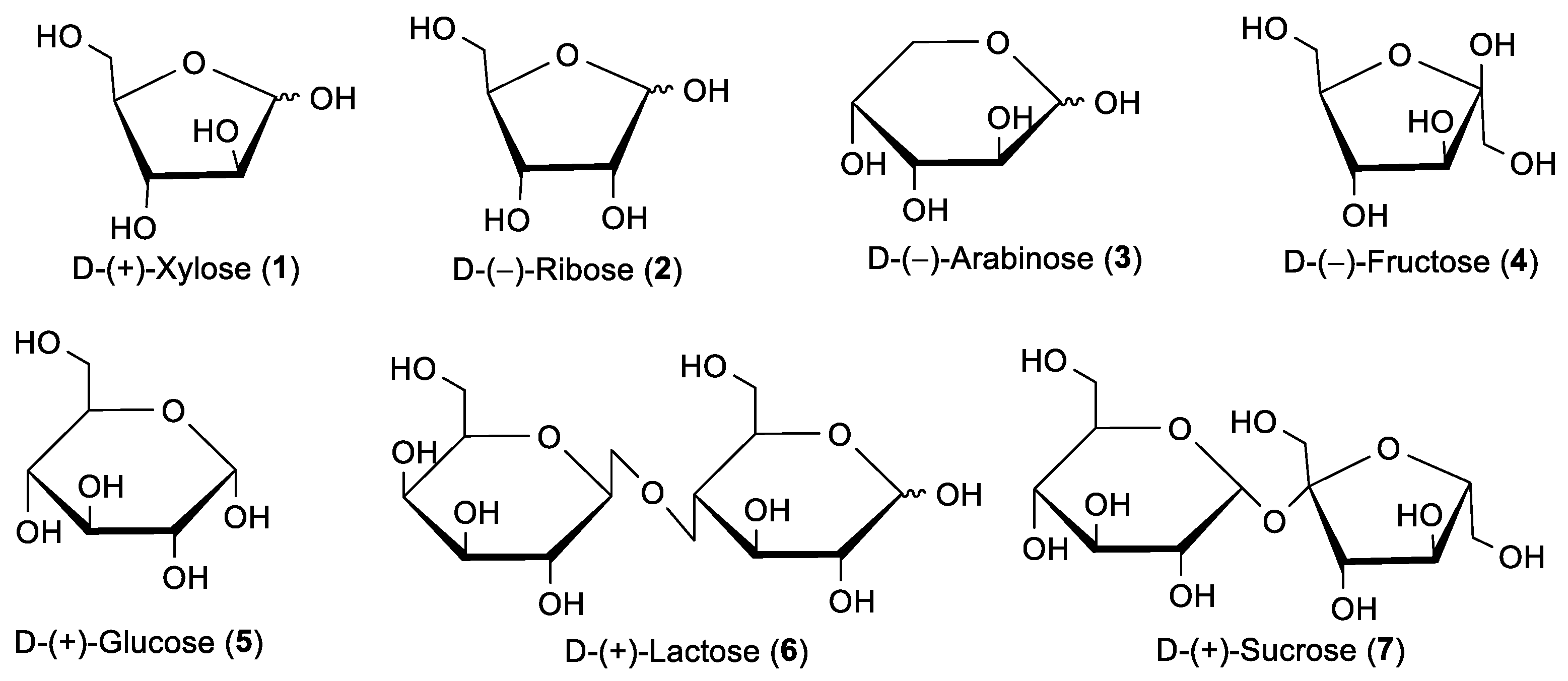
Figure 2.
Cyclic carbonates 9a–k obtained from their corresponding epoxides 8a–k using catalyst 1 and TBAI as catalyst system. Selectivity toward the cyclic carbonate was determined by 1H NMR spectroscopy of the crude reaction mixture and was >99% in all cases. [a] Conversion determined by 1H NMR of the reaction mixture. [b] Isolated yield of the purified cyclic carbonate.
Figure 2.
Cyclic carbonates 9a–k obtained from their corresponding epoxides 8a–k using catalyst 1 and TBAI as catalyst system. Selectivity toward the cyclic carbonate was determined by 1H NMR spectroscopy of the crude reaction mixture and was >99% in all cases. [a] Conversion determined by 1H NMR of the reaction mixture. [b] Isolated yield of the purified cyclic carbonate.
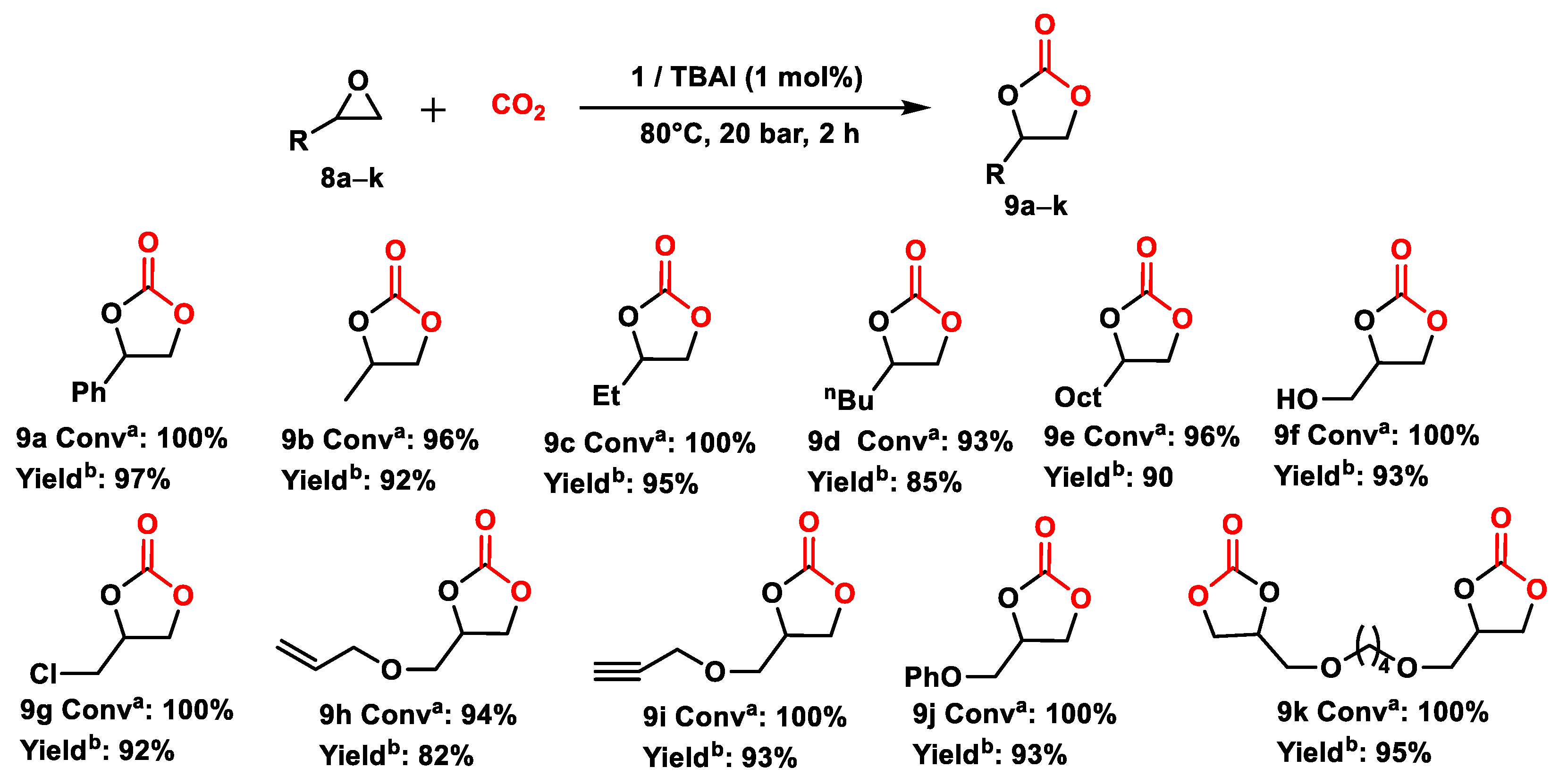
Figure 3.
Cyclic carbonates 11a–d were synthesized from their corresponding epoxides 10a–d using catalyst 1 and TBAI. Selectivity for the cyclic carbonate was determined by 1H NMR spectroscopy of the crude reaction mixture and found to be >99% in all cases. [a] Conversion determined by 1H NMR spectroscopy of the reaction mixture. [b] Isolated yield of the purified cyclic carbonate.
Figure 3.
Cyclic carbonates 11a–d were synthesized from their corresponding epoxides 10a–d using catalyst 1 and TBAI. Selectivity for the cyclic carbonate was determined by 1H NMR spectroscopy of the crude reaction mixture and found to be >99% in all cases. [a] Conversion determined by 1H NMR spectroscopy of the reaction mixture. [b] Isolated yield of the purified cyclic carbonate.
Scheme 1.
Synthesis of carvone-derived cyclic carbonate 13 catalyzed by catalyst 1 and TBAI. cases. [a] Conversion determined by 1H-NMR of the reaction mixture. [b] Isolated yield from purified cyclic carbonate.
Scheme 1.
Synthesis of carvone-derived cyclic carbonate 13 catalyzed by catalyst 1 and TBAI. cases. [a] Conversion determined by 1H-NMR of the reaction mixture. [b] Isolated yield from purified cyclic carbonate.
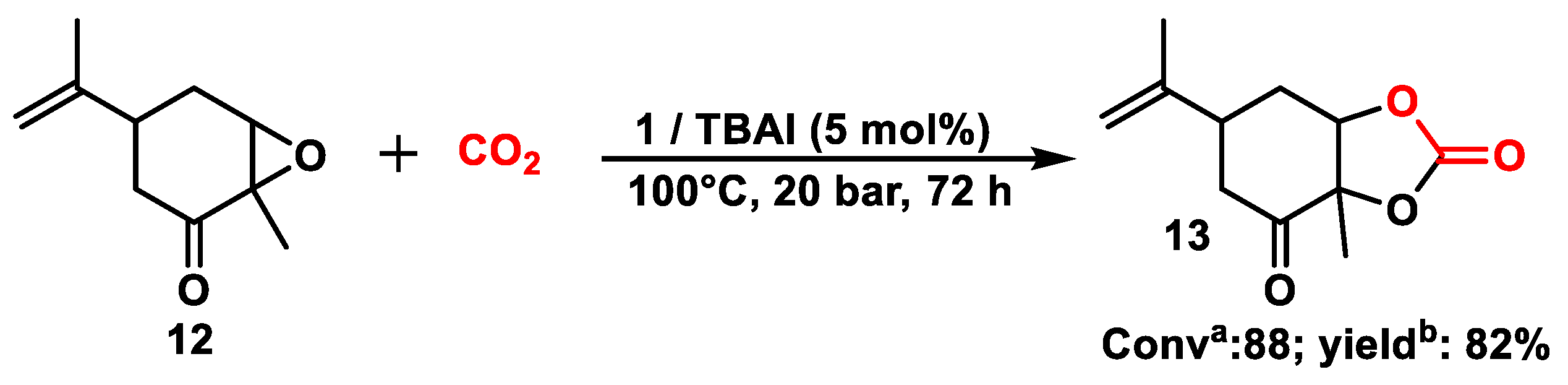
Figure 4.
Reaction mechanism determined for the chemical transformation of epichlorohydrine (8g) into its respective cyclic carbonate (9g). A set of bond lengths (numbers with superscript d) and bond angles (numbers with superscript a) have been highlighted with different colors for the respective stationery (A, B, and C) and saddle (I and II) points. Each stationery and saddle point directly correlates with the points shown in the energetic profile in Figure 5 (left Panel). H-bonds established between the oxygen atom from the epoxide moiety and the acidic proton of the sugar are highlighted in light green. Breaking and making bonds involving oxygen, iodide, and carbon atoms are highlighted in red, violet, and grey colors, respectively. All the distances are expressed in Å.
Figure 4.
Reaction mechanism determined for the chemical transformation of epichlorohydrine (8g) into its respective cyclic carbonate (9g). A set of bond lengths (numbers with superscript d) and bond angles (numbers with superscript a) have been highlighted with different colors for the respective stationery (A, B, and C) and saddle (I and II) points. Each stationery and saddle point directly correlates with the points shown in the energetic profile in Figure 5 (left Panel). H-bonds established between the oxygen atom from the epoxide moiety and the acidic proton of the sugar are highlighted in light green. Breaking and making bonds involving oxygen, iodide, and carbon atoms are highlighted in red, violet, and grey colors, respectively. All the distances are expressed in Å.
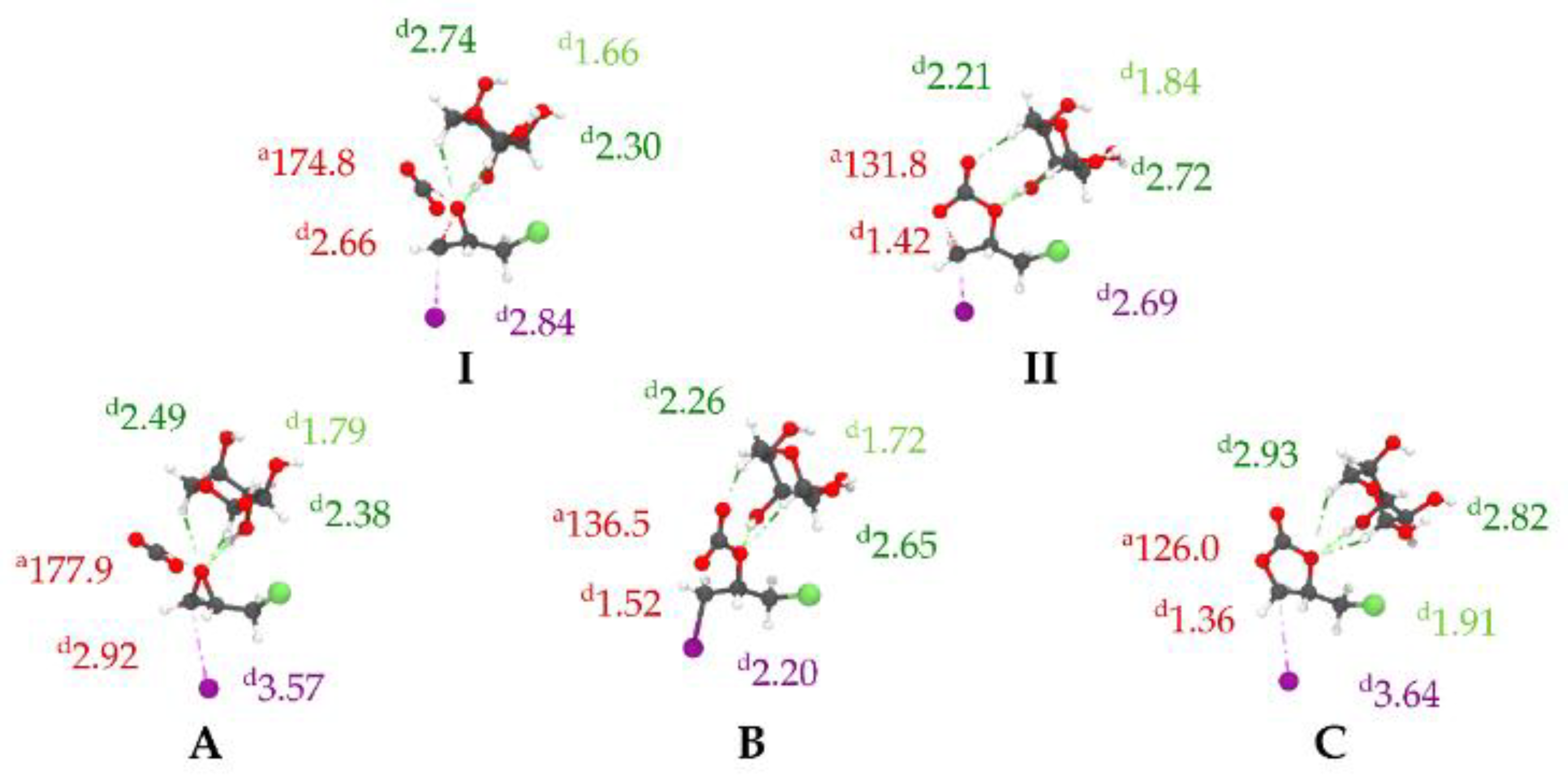
Figure 5.
Energetic profile computed for epichlorohydrin (red line) (8g to 9g, Figure 2), and cyclopentene oxide (blue line) transformations (10b to 11b, Figure 3) through NEB-TS procedure at DFT (B3LYP D4 ma-def2-svp) level.
Scheme 2.
Plausible mechanism for the synthesis of cyclic carbonates catalyzed by D-Xylose (1) and TBAI. For clarity purposes, hydrogen-bonding interactions are depicted only for one hydroxyl group of sugar.
Scheme 2.
Plausible mechanism for the synthesis of cyclic carbonates catalyzed by D-Xylose (1) and TBAI. For clarity purposes, hydrogen-bonding interactions are depicted only for one hydroxyl group of sugar.
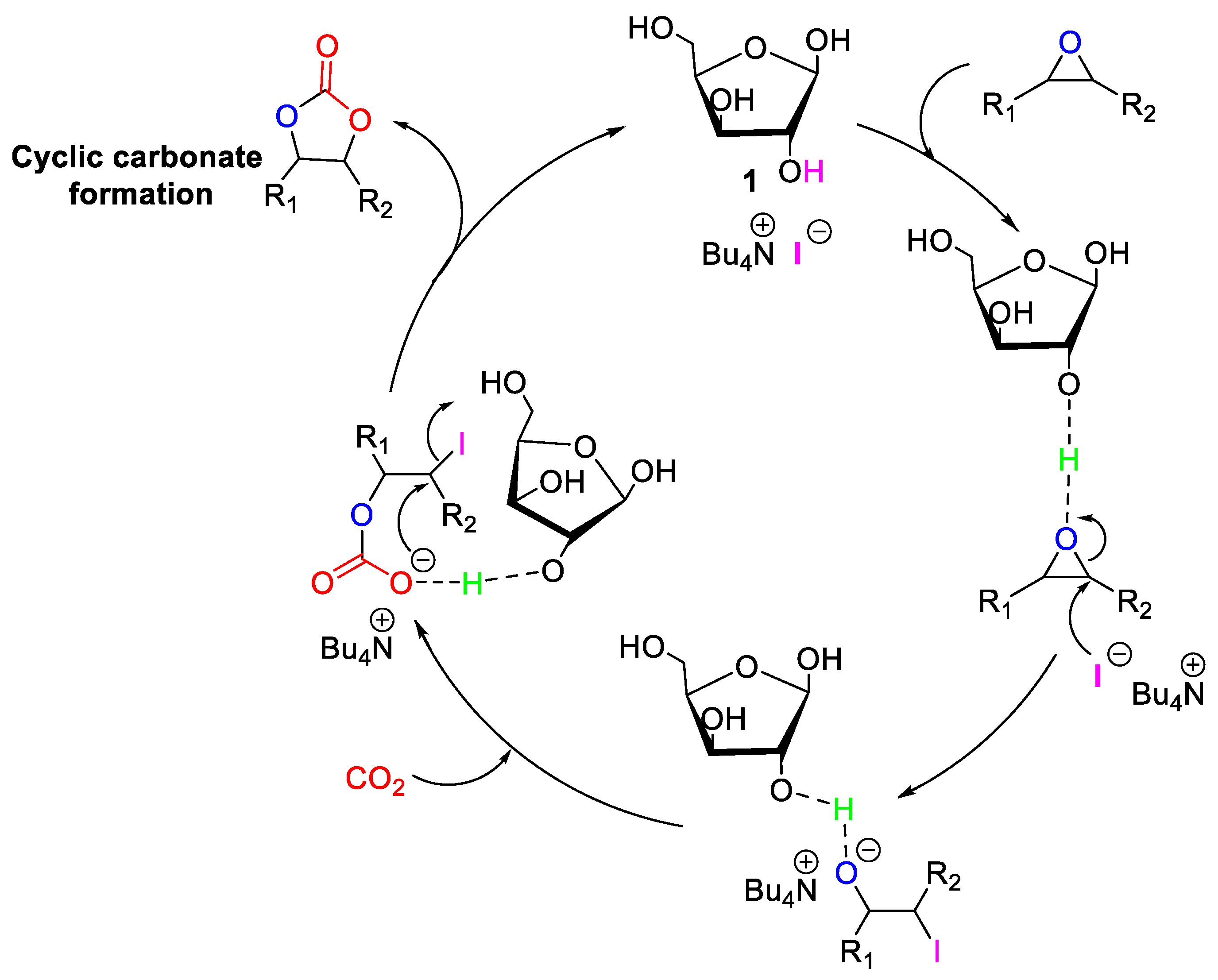

Table 1.
Conversion of styrene oxide 8a into styrene carbonate 9a using organocatalysts 1-7 and TBAI.1.
Table 1.
Conversion of styrene oxide 8a into styrene carbonate 9a using organocatalysts 1-7 and TBAI.1.
 | ||||
| Entry | Catalyst | Time (h) | Conversion (%) 2 | TOF 3 |
| 1 | 1 | 1 | 93 | 93 |
| 2 | 2 | 1 | 90 | 90 |
| 3 | 3 | 1 | 91 | 91 |
| 4 | 4 | 1 | 90 | 90 |
| 5 | 5 | 1 | 78 | 78 |
| 6 | 6 | 1 | 48 | 48 |
| 7 | 7 | 1 | 69 | 69 |
| 8 | 1 | 2 | 100 (97) 4 | 50 |
| 9 5 | 1 | 2 | Traces | - |
| 10 6 | - | 2 | 20 | 10 |
| 11 7 | 1 | 2 | 10 | 5 |
| 12 8 | 1 | 2 | 100 | 50 |
1 Reactions were carried out at 80 °C and 20 bar CO2 pressure for 1 or 2 h using 8a (1.7 mmol), 1 mol% of catalyst 1–7 and TBAI in the absence of solvent. 2 Conversion was determined by 1H-NMR spectroscopy of the crude reaction mixture. 3 TOF = moles of product/(moles of catalyst·time). 4 Isolated yield from purified styrene carbonate, 9b. 5 Reaction was carried out in the absence of TBAI. 6 Reaction was carried out in the absence of the selected sugar catalyst. 7 Reaction carried out at 1 bar. 8 Reaction was carried out using 17.0 mmol of 8a.
Disclaimer/Publisher’s Note: The statements, opinions and data contained in all publications are solely those of the individual author(s) and contributor(s) and not of MDPI and/or the editor(s). MDPI and/or the editor(s) disclaim responsibility for any injury to people or property resulting from any ideas, methods, instructions or products referred to in the content. |
© 2026 by the authors. Licensee MDPI, Basel, Switzerland. This article is an open access article distributed under the terms and conditions of the Creative Commons Attribution (CC BY) license (http://creativecommons.org/licenses/by/4.0/).
Copyright: This open access article is published under a Creative Commons CC BY 4.0 license, which permit the free download, distribution, and reuse, provided that the author and preprint are cited in any reuse.


