
Submitted:
11 July 2026
Posted:
14 July 2026
You are already at the latest version
Abstract
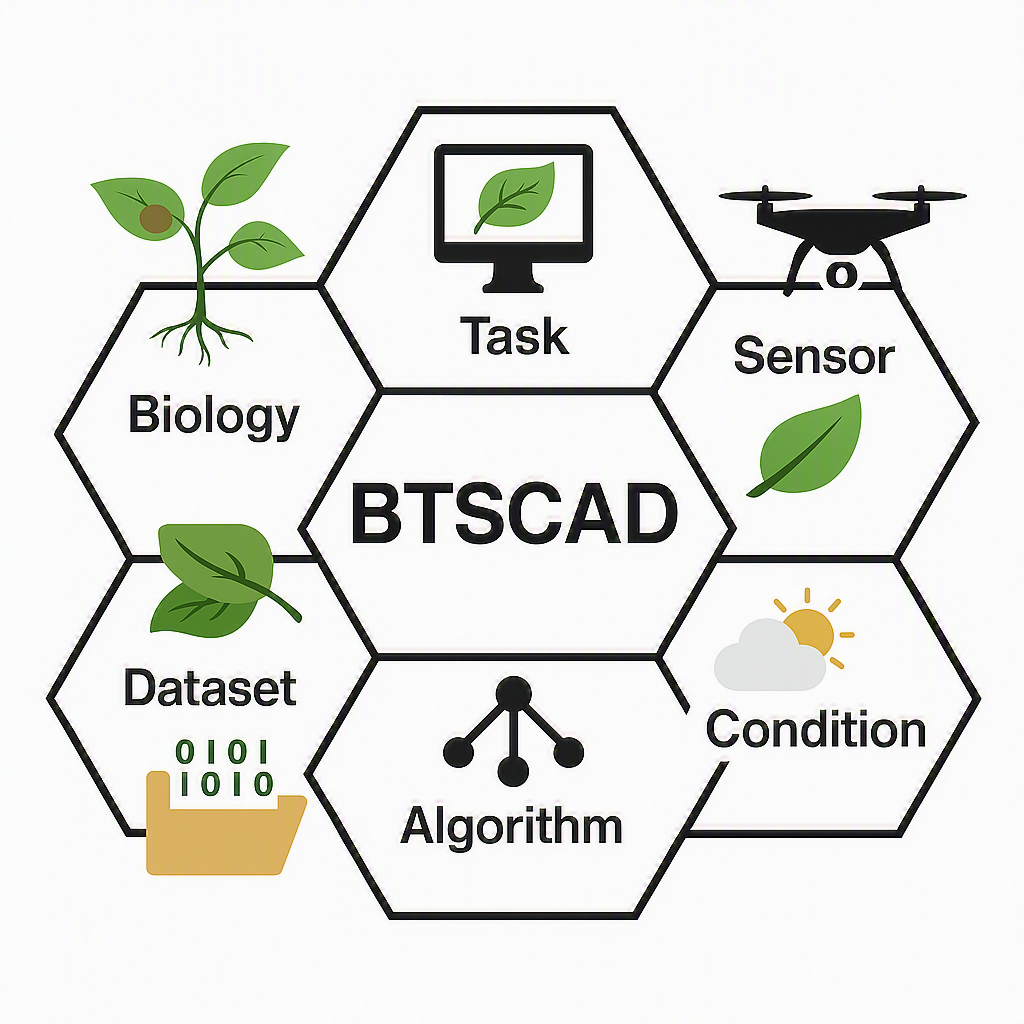
Plant diseases lead to substantial yield losses and pose a persistent threat to global food security, creating an urgent demand for high-throughput, accurate, scalable, and non-destructive disease monitoring approaches. Remote sensing has emerged as a powerful tool, yet progress in plant disease detection remains fragmented across various disciplines, tasks, sensing methods, and data modalities. This review introduces a hex- view perspective to synthesise remote sensing–based plant disease detection within a cohesive conceptual framework. Instead of treating sensing technologies, algorithms, and datasets independently, the hex-view incorporates six interconnected dimensions that jointly capture how biological processes, measurement scale, and data characteristics constrain disease detectability, including when detection is possible and how reliably it can be achieved. The hex-view framework comprises six interconnected dimensions and forms an integrated framework called BTSCAD: (1) Biology (B): Plant-pathogen interactions constituting the biological foundation of disease development and expression. (2) Task (T): The diverse disease detection tasks and their corresponding research objectives. (3) Sensor (S): The sensing modalities that define the data acquisition type and richness of captured information. (4) Condition (C): The environmental conditions, sensing platforms, and spatial scales that shape disease observations and bridge controlled experiments and real-world deployment across leaf, canopy, plot and regional scales. (5) Algorithm (A): The classical and state-of-the-art data analysis algorithms used to extract disease-related information from sensor data. (6) Dataset (D): The data sources that underpin model development, evaluation, and generalisability. The hex-view perspective provides a clear framework for interpreting previous research and identifying future research directions. This review lays a structured foundation for developing robust, interpretable, and transferable disease detection systems, supporting advancements in precision agriculture, high-throughput phenotyping, and sustainable crop production.
Keywords:
remote sensing
; plant disease detection
; machine learning
; deep learning
; multispectral imaging
; hyperspectral imaging
; LiDAR sensing
Copyright: This open access article is published under a Creative Commons CC BY 4.0 license, which permit the free download, distribution, and reuse, provided that the author and preprint are cited in any reuse.


