

Submitted:
11 July 2026
Posted:
14 July 2026
Read the latest preprint version here
Abstract
Exceptional points (EPs) offer new paradigms in non-Hermitian physics, but their realization has long relied on active gain-and-loss mechanisms. In Parts I and II, we established that clusters of innumerable EP loci can be achieved within purely real-parameter passive systems under single-fixed and semi-infinite boundaries. However, extending this framework to double-ended boundaries introduces highly coupled transcendental boundary conditions, thereby increasing the complexity of the conventional exact tracking. This study addresses this challenge by considering a both-fixed two-degree-of-freedom (2DOF) passive system. Through rigorous algebraic proofs, we achieve an analytical mapping of the global coalescing trajectories, specifically encompassing the complex degenerate roots (loci of EPs) and real double roots (loci of critical damping points) within a purely real state-space via discrete boundary points. We demonstrate that the dual-boundary constraints fundamentally morph the topologies of the EP clusters, giving rise to novel localized phase transitions and critical damping loci. These exact analytical boundaries reveal that dual confinement acts not as a restriction but as an unprecedented design flexibility to precisely manipulate non-Hermitian singularities, even under purely real-parameter passive conditions. Our exact formulation provides a foundational theoretical framework that is potentially applicable to the environmentally robust passive tuning of next-generation device architectures, ranging from micro-scale electromechanical resonators to high-frequency communication components, offering a passive alternative to mitigate the instabilities inherent in conventional active non-Hermitian systems.
Keywords:
exceptional point
; critical damping
; analytical exact solution
; purely real parameter
; passive system
; innumerable loci
; fixed-fixed 2DOF damped system
The manifestation of exceptional points (EPs) in non-Hermitian systems [1,2,3,4,5,6,7,8,9,10,11,12,13,14,15,16,17,18,19,20,21,22,23,24,25,26,27,28,29,30,31,32,33,34,35,36,37,38,39,40] has revolutionized our understanding of singularity physics, offering unprecedented mechanisms for enhanced sensing, asymmetric wave propagation, and topological phase transitions. While conventional implementations remain intrinsically plagued by the instabilities of active elements or non-physical constraints, the preceding installments of this series [41,42] strongly overcame these hurdles. By establishing a unified mathematical paradigm, we demonstrated that an infinite clustering of EP loci naturally emerges within strictly passive real-parameter environments under open or semi-infinite configurations.
Despite this theoretical breakthrough, translating these passive EP manifolds into closed-loop practical architectures poses an entirely different mathematical approach. The imposition of dual-boundary constraints significantly morphs the system, demanding the resolution of highly coupled transcendental equations. This structural transition removes the relatively straightforward algebraic tractability of the previous parts, elevating the mathematical formulation to an unprecedented level of complexity, which has long served as a barrier to analytical exploration.
To address this analytical difficulty, this study introduces a novel framework that reduces and transforms complex transcendental boundary conditions into an algebraically tractable formulation. To maintain theoretical continuity with the foundational framework established in Part I [41], we recall the underlying linear coupling manifold in which the stiffness, damping, and mass ratios are precisely intertwined. The structural topology of the passive EP clusters is strictly governed by the characteristic equation of the 2DOF damped system, which is formulated based on these intrinsic coupling dependencies. The linear characteristics of the present both-fixed system still obey the fundamental governing relation . Here, represents the characteristic matrix of the fixed-fixed 2DOF damped system (Figure 1a), and the coordinate field is represented by the physical amplitude vector =, where and designate the respective displacements of the primary and secondary substructures. To embed the mathematical complexity introduced by the dual extremities seamlessly, the modified characteristic matrix is explicitly expanded as follows:
In Eq. (1), denotes the eigenvalue, while and represent the intrinsic damping ratio and un-damped natural frequency of the primary substructure, respectively. The linear coupling manifolds, and , are explicitly formulated as mathematical functions parameterized by the constant mass ratio (), primary damping ratio (), and arbitrary design constants and . These parameters dictate the physical coupling dynamics acting directly between the primary and secondary substructures.
Accordingly, the linear coupling manifolds governing the both-fixed 2DOF damped system, which rigorously characterizes the physical coupling dynamics acting directly between the primary and secondary mass substructures, are explicitly defined as follows:
In Eq. (2), the coefficient is expressed as the sum of , , and , where and are further structurally partitioned into and , respectively. The manifolds and defined in Eq. (2) explicitly elucidate the physical interactions between the two masses of the2DOF damped system, as illustrated in Figure 1a. Eq. (2) is applicable to general cases where and , and the linear coupling manifold consistently takes positive values.
Eq. (2) becomes mathematically ill-defined as in the denominator approaches zero; thus, the linear coupled manifolds and for the doubly supported 2DOF damped system must be determined across three special cases. The linear coupled manifolds corresponding to the special case can be defined as follows:
In Eq. (2), a discontinuity occurs in the coexisting trajectory of EPs and critical damping points (CCs) when . and in Eq. (3) possess constant values and are defined as discrete points that bridge these discontinuous trajectories into a single, continuous path. The second special case occurs under the condition . This represents a region that cannot be defined by Eq. (2) (Figure 2), and the corresponding linear manifolds are formulated as follows:
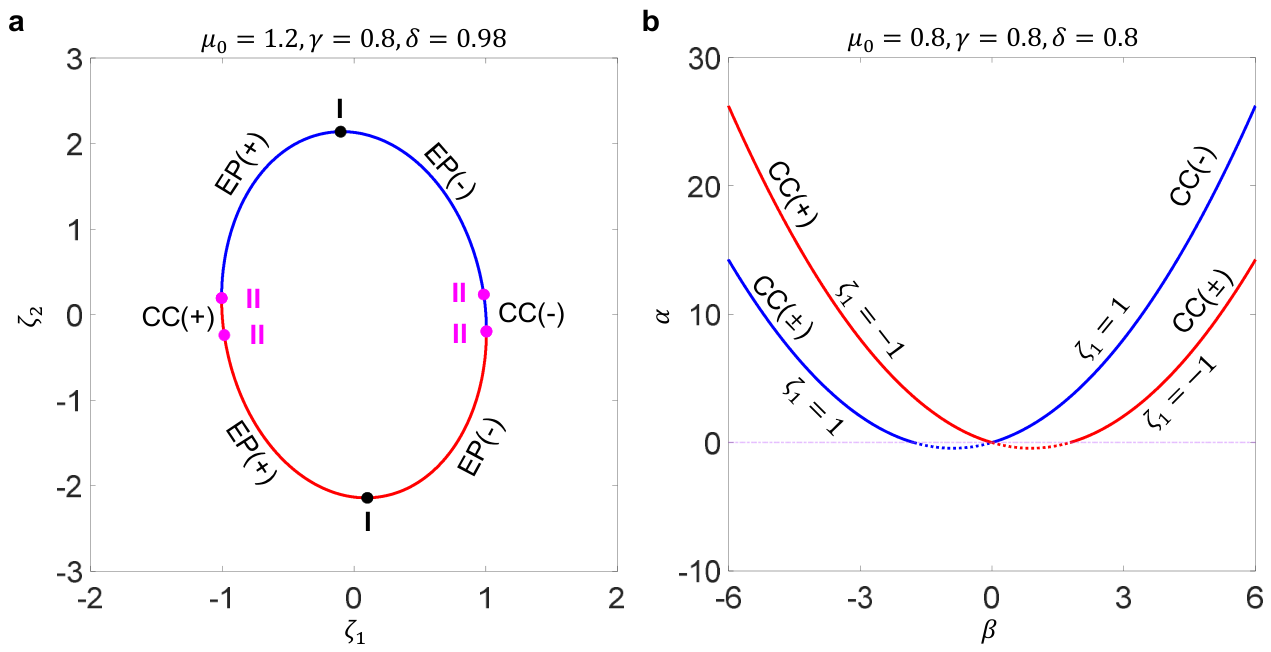
When applying Eq. (2), the elliptic equation becomes ill-defined. However, Eq. (4), which serves as the exception to Eq. (2), is represented as an ellipse in the – plane (Figure 3a), in turn allowing the boundary to be successfully defined by the elliptic equation. The final special condition appears under the constraint , and the corresponding linear manifolds for this condition are expressed as follows:
In Eq. (5), represents one of the constants , , or . When takes an arbitrary constant value, can be explicitly defined, manifesting as a parabola as illustrated in Figure 3b. However, this special case exhibits no exceptional singularities, revealing only a parabolic trajectory composed entirely of CCs.
The stiffness components (, ) and damping coefficients (, ) associated with the secondary mass can be explicitly defined as functions of the primary system's mass (), stiffness (), and damping coefficient () through a linear coupling manifold ( and ) and arbitrary constants ( and ). In the - plane, the parameter , which determines the trajectories of exceptional singularities and CCs, is explicitly defined as a function of the mass and damping ratios of the primary system through the linear coupling manifolds.
The boundaries of topological phase transitions, which demarcate complex degenerate roots from real double roots, do not exhibit a straightforward mathematical boundary, as defined in Parts I and II [41,42]. Although the system can be structurally treated as a simple fixed support, applying the conventional resultant method to determine continuous boundaries is conjectured to yield a 192nd-order polynomial, making it extremely challenging to isolate and identify the physically valid roots from the spurious roots. Therefore, as an alternative approach, we reformulated the mathematical challenge by identifying the boundaries using discrete points rather than continuous boundary lines (Figure 1b). The boundary points of the upper and lower bounds can be determined by a fourth-order polynomial for the dimensionless roots () derived from Eq. (1), defined as
In this equation, the coefficients , , , and represent , , , and , respectively. The discrete points that rigorously demarcate the boundaries of the topological phase transitions are uniquely defined through the mathematical framework of the resultant by utilizing the characteristic equation of Eq. (6). Due to the inherent complexity of the derivation process and resulting expressions, the boundaries of the phase transitions were formulated in the form of a resultant as follows:
Owing to the highly intricate nature of the algebraic derivations, the step-by-step computational process for defining these phase boundaries is detailed in the Supplementary Information (SI); furthermore, the explicit definitions of the coefficients – and – employed in Eq. (7) are presented in the Methods section. Consequently, the resultant of Eq. (7) yields a 12th-order polynomial with respect to . Because this polynomial simultaneously contains both extraneous and physically meaningful roots, the extraneous roots must be rigorously eliminated. The constraint to distinguish these solutions requires that be a real number; furthermore, upon substitution into the linear coupling manifolds and , must yield a positive real value, while must remain real. The specific values satisfying these conditions constitute the discrete points that demarcate the phase transition boundary where an EP transitions into a CC, within the trajectory where countless EPs and CCs coexist.
The points corresponding to the purely imaginary degenerate roots act as boundary points that distinguish between the purely negative and purely positive real parts of the complex degenerate roots along the trajectory, where numerous EPs and CCs coexist. The discrete points of the purely imaginary degenerate roots, which distinguish between the structural loss and gain of the EPs, are defined as follows:
In this equation, choosing the minus sign in the second compound sign yields a purely imaginary degenerate root point with an EP. Based on these discrete points, complex degenerate roots possessing purely negative real parts (structural loss) are distinctly demarcated from those possessing purely positive real parts (structural gain).
Unlike previous studies [41,42], where the present both-fixed 2DOF damped system allows for the analytical derivation of the discrete points where topological phase transitions occur along the coexisting trajectory of EPs and CCs, explicitly identifying the algebraic discrete points that define the boundaries of critical damping remains highly challenging. This analytical difficulty is primarily attributed to the fact that the coexisting trajectories extend asymptotically towards infinity (Figure 2), causing the underlying elliptic equations to fail to converge. Nevertheless, under the conditions of and , the exact coincidence of the discrete points determined using our proposed Eq. (7) with the topological phase transition boundaries and the trajectory of pure imaginary degenerate roots from the previous work [41] directly signifies a topologically invariant mapping (Figure 1b).
The trajectory-dependent topological maps are systematically generalized into approximately six distinct cases (Figure 2 and Expanded Data Figure 1), representing the most dominant trajectories observed across a wide range of physical conditions. Rather than being confined to specific boundary parameters, these categorized regimes comprehensively encompass the universal behavior of coexisting EPs and critical damping thresholds. Consequently, this robust classification serves as a definitive framework for predicting non-Hermitian phase transitions under both-fixed 2DOF damped systems.
This systematic classification offers a unified perspective on the intricate spectral behaviors inherent in the system. As visually demonstrated in the quantitative mappings, Eq. (2) serves as the primary governing expression that seamlessly outlines the macroscopic geometric flow, encompassing the complex geometric relationships on a single plane, where the coupled state () trajectory and independent structural loss () and gain () curves are simultaneously superimposed. However, the subtle localized discontinuity emerging precisely at the boundary () demands a more delicate mathematical resolution. By introducing Eq. (3) to rigorously govern these singular points, our framework ensures a continuous and harmonious progression across the entire parametric domain. Consequently, the six generalized trajectories detailed in Figure 2 and Expanded Data Figure 1 transcend mere descriptive plots; they establish an exhaustive, mathematically complete phase space that elegantly maps out the coexisting domains of EPs and critical damping thresholds, leaving no analytical ambiguities unresolved.
Unlike the macroscopic geometric flow governed by Eq. (2), Figure 3 illustrates the highly unique topological landscapes that emerge exclusively under the singular boundaries defined by Eqs. (4) and (5). Within the elliptic framework of Eq. (4), the system exhibits a distinct spatial bifurcation centered around the purely imaginary degenerate root point: the parameter space is divided into a left region of structural gain (positive real parts) and right region of structural loss (negative real parts), while the critical damping thresholds are strictly bounded between these topological phase-transition limits. Concurrently, the case governed by Eq. (5) reveals a perfectly symmetric critical damping landscape in which only real-valued parametric solutions are physically permissible, allowing the unphysical imaginary domains to be naturally neglected. By explicitly mapping these exceptional configurations, our framework proves that even the most constrained subdomains of the non-Hermitian system remain under strict algebraic governance, completing the entire physical picture.
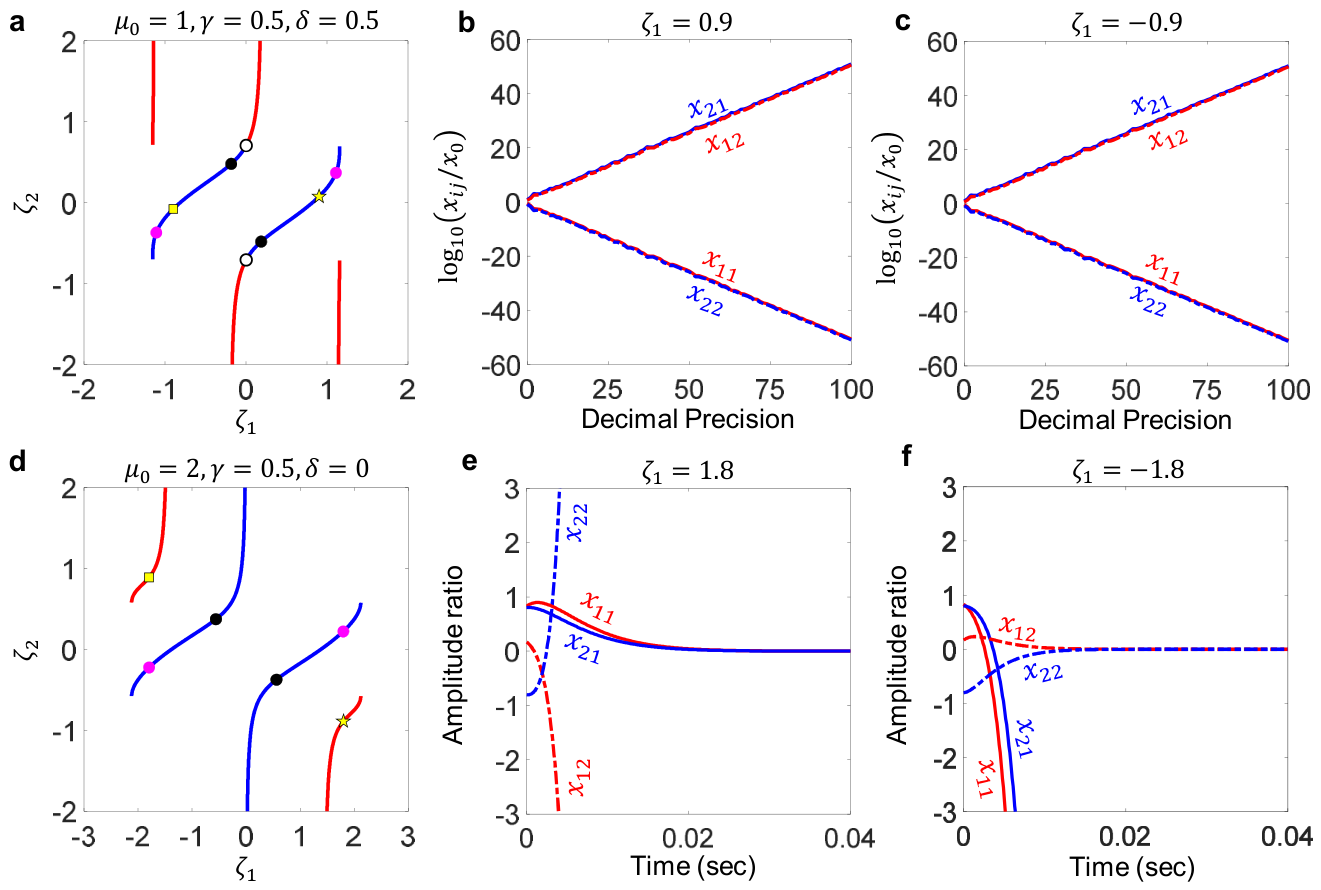
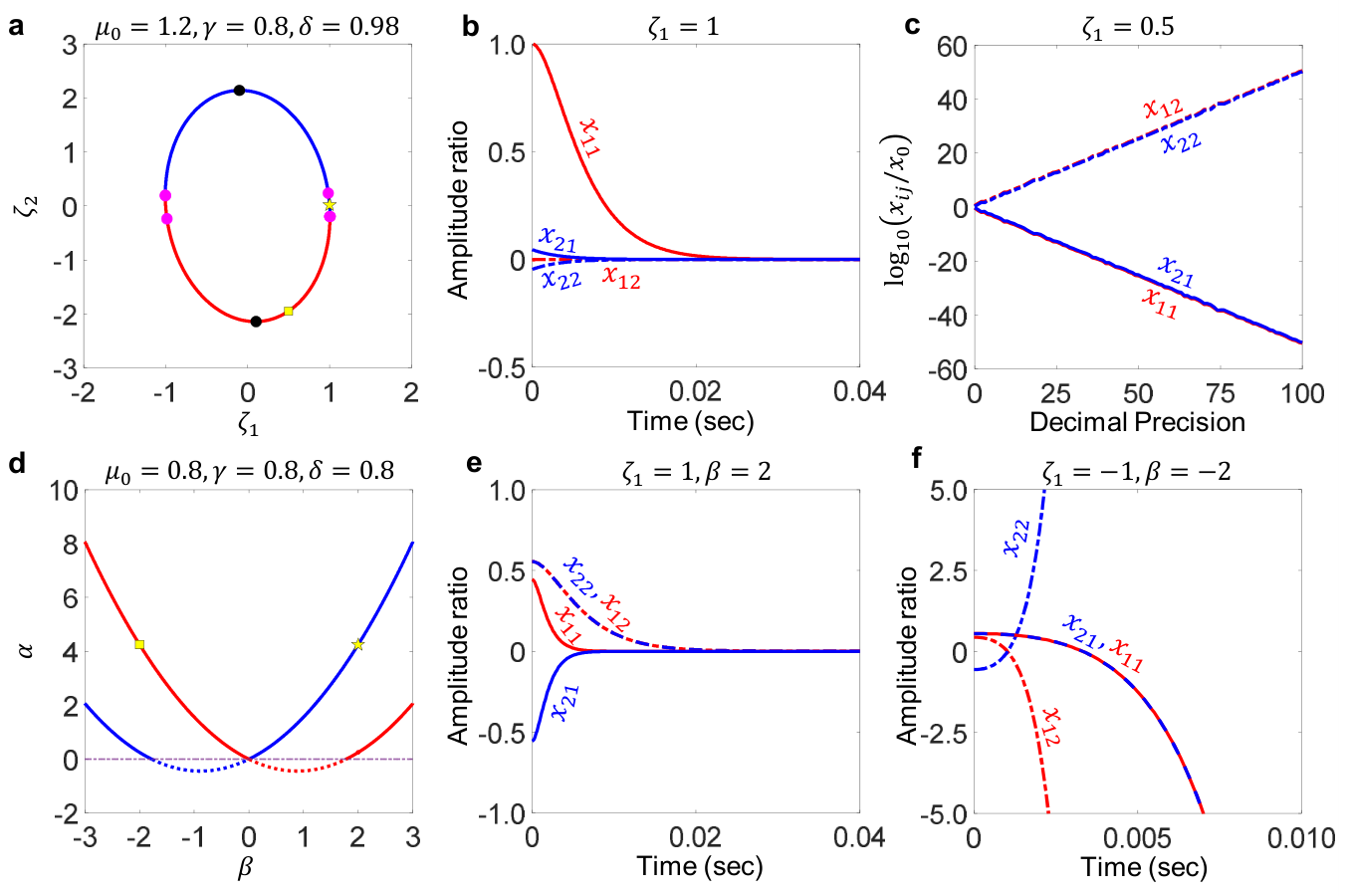
Expanded Data Figure 2 and Expanded Data Figure 3 provide a definitive validation of our established algebraic framework by demonstrating the precise physical manifestation of EPs and critical damping thresholds. To rigorously verify the methodology against theoretical assumptions, we analyzed the sensitivity of purely real parameters to the finest decimal precision, which revealed dramatic exponential signal amplification at the EPs and distinct time-domain hallmarks at the critical damping transitions. To ensure the absolute reproducibility and mathematical robustness of these phenomena, an extensive suite of eight independent, purely real parameter configurations is detailed in the latter section of the Supplementary Information. This meticulous cross-verification demonstrates that our analytical predictions remain structurally invariant and fully reproducible under arbitrary high-precision numerical implementations.
In conclusion, the systematic framework established herein provides definitive and comprehensive governance over both-fixed 2DOF non-Hermitian systems, successfully charting the complete topological phase space without leaving any analytical blind spots. By seamlessly integrating the primary macroscopic trajectories of Eq. (2) with the delicate local boundary control of Eq. (3), our approach elegantly captures the coexisting geometric relationship where the coupled state () and independent structural loss () and gain () configurations are simultaneously superimposed on a single plane—a rigorous continuous progression that is further validated across the highly constrained special boundaries of Eqs. (4) and (5). This robust mathematical closure firmly establishes an immutable foundation for subsequent empirical validation and next-generation industrial configurations. Specifically, the ability to tailor exact EPs and symmetrical convergent–divergent critical damping thresholds offers transformative design guidelines for high-precision mechanical metamaterials, ultrasensitive structural health monitoring sensors, advanced vibration isolation in semiconductor manufacturing, and adaptive flutter control in aerospace engineering, ultimately bridging the gap between non-Hermitian physics and scalable engineering applications.
Methods
To rigorously map the topological attributes of both EPs and critical damping thresholds, high-fidelity numerical computations were performed using a variable-precision arithmetic (VPA) architecture in MATLAB R2021b, reaching an extraordinary accuracy threshold of over 256 significant figures. This computational engine yielded a resolution in which the deviation between the imaginary components of paired roots diminished beyond 100 decimal digits, satisfying the stringent baseline required to confirm absolute degeneracy. Concurrently, this enabled the precise investigation of purely real-parameter arrays with 100-digit decimal precision. To maintain strict algorithmic continuity, the resolved roots were systematically organized: complex degenerate roots were ordered by ascending magnitude, whereas real double roots were sorted by ascending real values.
Mathematical Characterization of System Coefficients
The individual elements – and – constituting the resultant matrix in Eq. (7) can be defined analytically as follows:
Supplementary Materials
The following supporting information can be downloaded at the website of this paper posted on Preprints.org.
Author Contributions
Jung Woo Lee conceived the study and led the conceptualization of the L-surface framework. Jung Woo Lee and Jin Kim jointly performed the formal theoretical analysis to identify and characterize the properties of EPs within the L-surface. Jin Kim carried out the systematic investigation and performed the high-precision numerical computations. Jung Woo Lee wrote the manuscript and provided overall supervision of the project. All authors discussed the results and commented on the final manuscript.
Conflicts of Interest
Jung Woo Lee and Jin Kim are the inventors of the patent application filed by Kyonggi University related to this work (Korean Patent Application No. 10-2026-0124097).
References
- Wang, C.; Sweeney, W. R.; Stone, A. D.; Yang, L. Coherent perfect absorption at an exceptional point. Science 2021, 373, 1261–1265. [Google Scholar] [CrossRef] [PubMed]
- Ergoktas, M. S.; et al. Topological engineering of terahertz light using electrically tunable exceptional point singularities. Science 2022, 376, 184–188. [Google Scholar] [CrossRef] [PubMed]
- Song, Q.; Odeh, M.; Zúñiga-Pérez, J.; Kanté, B.; Genevet, P. Plasmonic topological metasurface by encircling an exceptional point. Science 2021, 373, 1133–1137. [Google Scholar] [CrossRef] [PubMed]
- Qin, H.; et al. Sphere of arbitrarily polarized exceptional points with a single planar metasurface. Nat. Commun. 2025, 16, 2656. [Google Scholar] [CrossRef] [PubMed]
- Zhang, M.; et al. Quantum noise theory of exceptional point amplifying sensors. Phys. Rev. Lett. 2019, 123, 180501. [Google Scholar] [CrossRef] [PubMed]
- Lu, Y. -W.; Li, W.; Wang, X. -H. Quantum and classical exceptional points at the nanoscale: Properties and applications. ACS Nano 2025, 19, 17953–17978. [Google Scholar] [CrossRef] [PubMed]
- Doppler, J.; et al. Dynamically encircling an exceptional point for asymmetric mode switching. Nature 2016, 537, 76–79. [Google Scholar] [CrossRef] [PubMed]
- Kononchuk, R.; Cai, J.; Ellis, F.; Thevamaran, R.; Kottos, T. Exceptional-point-based accelerometers with enhanced signal-to-noise ratio. Nature 2022, 607, 697–702. [Google Scholar] [CrossRef] [PubMed]
- Yoon, J. W.; et al. Time-asymmetric loop around an exceptional point over the full optical communications band. Nature 2018, 562, 86–90. [Google Scholar] [CrossRef] [PubMed]
- Lai, Y. -H.; Lu, Y. -K.; Suh, M. -G.; Yuan, Z.; Vahala, K. Observation of the exceptional-point-enhanced Sagnac effect. Nature 2019, 576, 65–69. [Google Scholar] [CrossRef] [PubMed]
- Hasanli, S.; Hasan, M.; Yoon, H.; Lee, S.; Kim, S. Exceptional points in a passive strip waveguide. Nanophotonics 2025, 14, 1301–1309. [Google Scholar] [CrossRef] [PubMed]
- Peng, B.; et al. Loss-induced suppression and revival of lasing. Science 2014, 346, 328–332. [Google Scholar] [CrossRef] [PubMed]
- Zhen, B.; et al. Spawning rings of exceptional points out of Dirac cones. Nature 2015, 525, 354–358. [Google Scholar] [CrossRef] [PubMed]
- Chen, D. -Y.; Dong, L.; Huang, Q. -A. Inductor-capacitor passive wireless sensors using nonlinear parity-time symmetric configurations. Nat. Commun. 2024, 15, 9312. [Google Scholar] [CrossRef] [PubMed]
- Chang, L.; et al. Parity–time symmetry and variable optical isolation in active–passive-coupled microresonators. Nat. Photonics 2014, 8, 524–529. [Google Scholar] [CrossRef]
- Wiersig, J. Prospects and fundamental limits in exceptional point-based sensing. Nat. commun. 2020, 11, 2454. [Google Scholar] [CrossRef] [PubMed]
- Suntharalingam, A.; Fernández-Alcázar, L.; Kononchuk, R.; Kottos, T. Noise resilient exceptional-point voltmeters enabled by oscillation quenching phenomena. Nat. Commun. 2023, 14, 5515. [Google Scholar] [CrossRef] [PubMed]
- Hodaei, H.; et al. Enhanced sensitivity at higher-order exceptional points. Nature 2017, 548, 187–191. [Google Scholar] [CrossRef] [PubMed]
- Chen, W.; Özdemir, Ş. K.; Zhao, G.; Wiersig, J.; Yang, L. Exceptional points enhance sensing in an optical microcavity. Nature 2017, 548, 192–196. [Google Scholar] [CrossRef] [PubMed]
- Zhou, H.; et al. Observation of bulk Fermi arc and polarization half charge from paired exceptional points. Science 2018, 359(6379), 1009–1012. [Google Scholar] [CrossRef] [PubMed]
- Wang, H.; et al. Exceptional sensitivity near the bistable transition point of a hybrid quantum system. Nat. Phys. 2026, 22, 577–583. [Google Scholar] [CrossRef]
- Zhang, D.; Luo, X. -Q.; Wang, Y. -P.; Li, T. -F.; You, J. Q. Observation of the exceptional point in cavity magnon-polaritons. Nat. commun. 2017, 8, 1368. [Google Scholar] [CrossRef] [PubMed]
- Chen, Y. -Y.; et al. Quantum tomography of a third-order exceptional point in a dissipative trapped ion. Nat. Commun. 2025, 16, 7478. [Google Scholar] [CrossRef] [PubMed]
- Zhang, J.; et al. Exceptional point and hysteresis trajectories in cold Rydberg atomic gases. Nat. Commun. 2025, 16, 3511. [Google Scholar] [CrossRef] [PubMed]
- Patolsky, F.; Zheng, G.; Lieber, C. M. Nanowire sensors for medicine and the life sciences. Nanomedicine 2006, 1, 51–65. [Google Scholar] [CrossRef] [PubMed]
- Assawaworrarit, S.; Yu, X.; Fan, S. Robust wireless power transfer using a nonlinear parity–time-symmetric circuit. Nature 2017, 546, 387–390. [Google Scholar] [CrossRef] [PubMed]
- Miri, M. -A.; Alu, A. Exceptional points in optics and photonics. Science 2019, 363, eaar7709. [Google Scholar] [CrossRef] [PubMed]
- Lee, H.; et al. Chiral exceptional point enhanced active tuning and nonreciprocity in micro-resonators. Light Sci. Appl. 2025, 14, 45. [Google Scholar] [CrossRef] [PubMed]
- El-Ganainy, R.; et al. Non-Hermitian physics and PT symmetry. Nat. Phys. 2018, 14, 11–19. [Google Scholar] [CrossRef]
- Lau, H. -K.; Clerk, A. A. Fundamental limits and non-reciprocal approaches in non-Hermitian quantum sensing. Nat. commun. 2018, 9, 4320. [Google Scholar] [CrossRef] [PubMed]
- Bender, C. M. Making sense of non-Hermitian Hamiltonians. Rep. Prog. Phys. 2007, 70, 947–1018. [Google Scholar] [CrossRef]
- Wu, Y.; et al. Observation of parity-time symmetry breaking in a single-spin system. Science 2019, 364, 878–880. [Google Scholar] [CrossRef] [PubMed]
- Guo, A.; et al. Observation of PT-symmetry breaking in complex optical potentials. Phys. Rev. Lett. 2009, 103 093902. [Google Scholar]
- Hussein, M. I. Theory of damped Bloch waves in elastic media. Phys. Rev. B 2009, 80, 212301. [Google Scholar] [CrossRef]
- Ding, K.; Fang, C.; Ma, G. Non-Hermitian topology and exceptional-point geometries. Nat. Rev. Phys. 2022, 4, 745–760. [Google Scholar] [CrossRef]
- Brandenbourger, M.; Locsin, X.; Lerner, E.; Coulais, C. Non-reciprocal robotic metamaterials. Nat. commun. 2019, 10, 4608. [Google Scholar] [CrossRef] [PubMed]
- Ghatak, A.; Brandenbourger, M.; Van Wezel, J.; Coulais, C. Observation of non-Hermitian topology and its bulk–edge correspondence in an active mechanical metamaterial. Proc. Natl. Acad. Sci. USA 2020, 117, 29561–29568. [Google Scholar] [CrossRef] [PubMed]
- Bergholtz, E. J.; Budich, J. C.; Kunst, F. K. Exceptional topology of non-Hermitian systems. Rev. Mod. Phys. 2021, 93, 015005. [Google Scholar] [CrossRef]
- Heiss, W. D. The physics of exceptional points. J. Phys. A Math. Theor. 2012, 45, 444016. [Google Scholar] [CrossRef]
- Cummer, S. A.; Christensen, J.; Alù, A. Controlling sound with acoustic metamaterials. Nat. Rev. Mater. 2016, 1, 1–13. [Google Scholar] [CrossRef]
- Kim, J.; Lee, J.W. Preprints ID; Clusters of loci of innumerable exceptional points in purely real-parameter passive systems: I. Fixed-free 2DOF model. 2026; p. 222548.
- Kim, J.; Lee, J.W. Clusters of exceptional point loci in semi-definite passive systems with purely real parameters: II. Mathematical generalization. Preprints ID 2026, 222552. [Google Scholar]
Figure 1.
Topological Invariant Mapping. a. The algebraic manifolds couple the two stiffness and two damping coefficients of the substructure system as functions of the primary system’s parameters in a both-fixed 2DOF damped system. Specifically, while the mapping of and onto the primary parameters (, ) constitutes a continuous functional relationship (, ), the mapping of and yields invariant constants (, ). b. Symmetric pairs of trajectories coexisting with infinite EPs and CCs for constant mass ratios (=1, 5, 10, 50). Trajectories with discrete points denote the coexistence of EPs and CCs, whereas trajectories without discrete points represent pure critical damping states. Here, the trajectories without discrete points are defined as the CCs possessing a pair of negative and positive real double roots. Based on the pure imaginary degenerate roots (black marker), both the complex degenerate roots and real double roots exhibit a purely negative real part in the upper region and purely positive real part in the lower region. The states bounded within the two discrete points (magenta marker) representing the phase transition boundaries exhibit distinctive EP topological characteristics, while the remaining trajectories strictly follow critical damping behaviors. The fact that the discrete points derived under the conditions of and perfectly coincide with the boundary trajectories from previous studies [41] clearly demonstrates the mathematical rigor of our discrete point identification.
Figure 1.
Topological Invariant Mapping. a. The algebraic manifolds couple the two stiffness and two damping coefficients of the substructure system as functions of the primary system’s parameters in a both-fixed 2DOF damped system. Specifically, while the mapping of and onto the primary parameters (, ) constitutes a continuous functional relationship (, ), the mapping of and yields invariant constants (, ). b. Symmetric pairs of trajectories coexisting with infinite EPs and CCs for constant mass ratios (=1, 5, 10, 50). Trajectories with discrete points denote the coexistence of EPs and CCs, whereas trajectories without discrete points represent pure critical damping states. Here, the trajectories without discrete points are defined as the CCs possessing a pair of negative and positive real double roots. Based on the pure imaginary degenerate roots (black marker), both the complex degenerate roots and real double roots exhibit a purely negative real part in the upper region and purely positive real part in the lower region. The states bounded within the two discrete points (magenta marker) representing the phase transition boundaries exhibit distinctive EP topological characteristics, while the remaining trajectories strictly follow critical damping behaviors. The fact that the discrete points derived under the conditions of and perfectly coincide with the boundary trajectories from previous studies [41] clearly demonstrates the mathematical rigor of our discrete point identification.
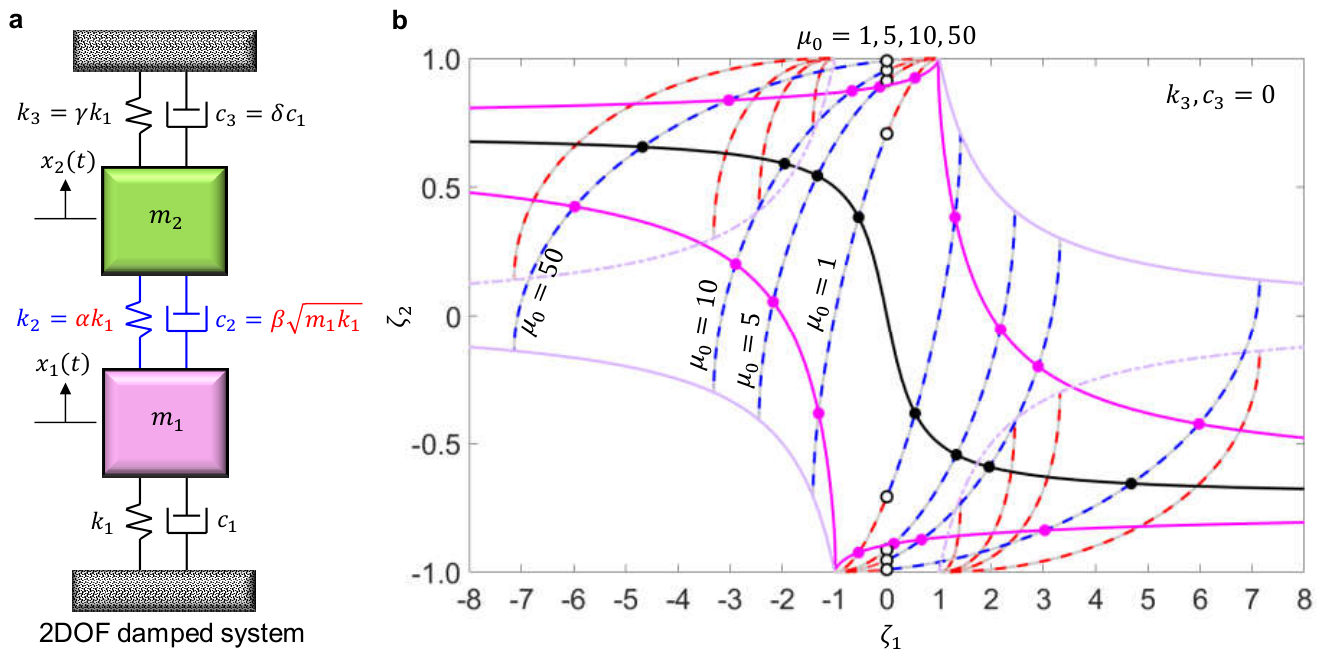
Figure 2.
Quantitative Topological Mapping via Eqs. (2) and (3). a. Eq. (2) serves as the most governing expression that dictates the general topological mapping of the system. While the continuous geometric trajectories generally flow seamlessly under this framework, a localized mathematical discontinuity emerges precisely at the threshold of =0. This disruption manifests exclusively when the trajectory—wherein the EPs and CCs coexist—crosses =0. Although these localized discontinuous points cannot be fully resolved by the general expression of Eq. (2) alone, they are rigorously identified and governed by Eq. (3), which explicitly characterizes these unique special cases. Here, CC denotes critical damping, and EP represents the exceptional point. Regarding the spectral characteristics, the minus (-) and plus (+) signs signify purely negative and purely positive real parts, respectively, while the compound sign (±) designates a coupled state possessing one negative and one positive real part simultaneously.
Figure 2.
Quantitative Topological Mapping via Eqs. (2) and (3). a. Eq. (2) serves as the most governing expression that dictates the general topological mapping of the system. While the continuous geometric trajectories generally flow seamlessly under this framework, a localized mathematical discontinuity emerges precisely at the threshold of =0. This disruption manifests exclusively when the trajectory—wherein the EPs and CCs coexist—crosses =0. Although these localized discontinuous points cannot be fully resolved by the general expression of Eq. (2) alone, they are rigorously identified and governed by Eq. (3), which explicitly characterizes these unique special cases. Here, CC denotes critical damping, and EP represents the exceptional point. Regarding the spectral characteristics, the minus (-) and plus (+) signs signify purely negative and purely positive real parts, respectively, while the compound sign (±) designates a coupled state possessing one negative and one positive real part simultaneously.
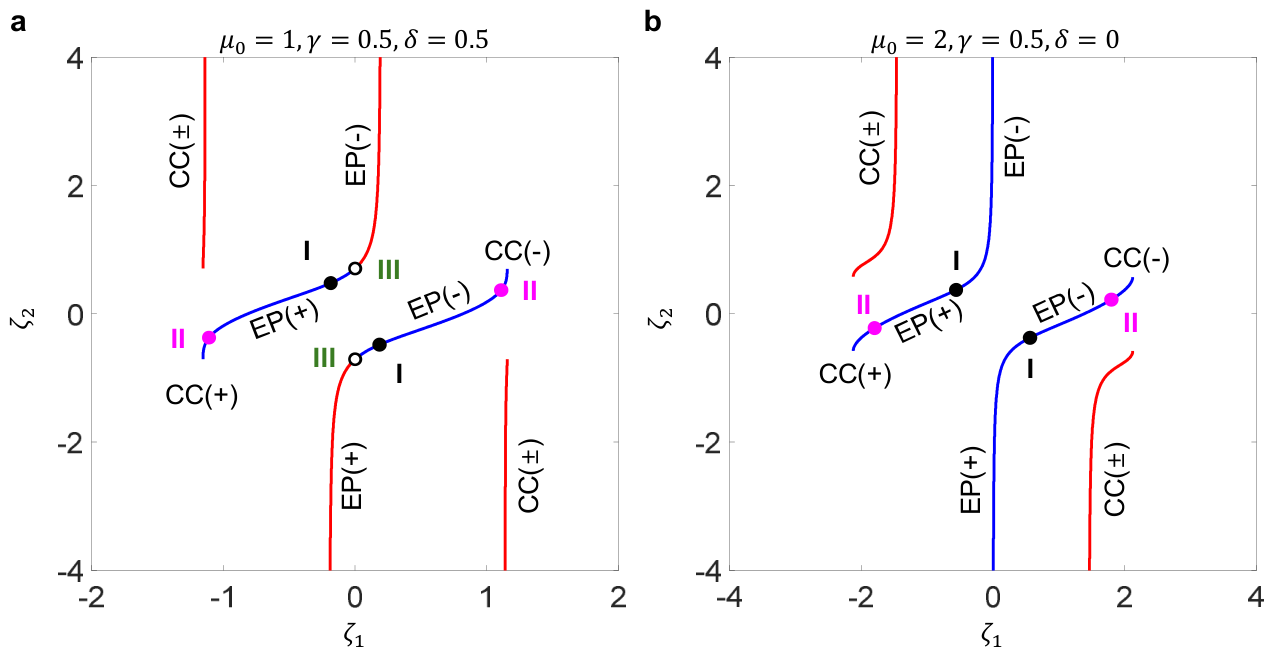
Figure 3.
Topological Mapping for the special cases (Eqs. (4) and (5)). a. Trajectories of EPs and CCs for the special case of Eq. (4). In this special case, where the elliptic equation holds, the trajectories are characterized relative to the discrete point (I) of the purely imaginary degenerate root: the left region forms complex degenerate roots with positive real parts, whereas the right region exhibits complex degenerate roots with negative real parts. Simultaneously, real double roots are formed under specific conditions bounded between the left and right topological phase-transition boundary points (II). b. Trajectories of CCs for the special case of Eq. (5). In this case, only the critically damped state exists, exhibiting left–right symmetry with respect to . Only the conditions for are permissible, and because the real-valued parameter conditions are satisfied for , the dashed lines for can be neglected.
Figure 3.
Topological Mapping for the special cases (Eqs. (4) and (5)). a. Trajectories of EPs and CCs for the special case of Eq. (4). In this special case, where the elliptic equation holds, the trajectories are characterized relative to the discrete point (I) of the purely imaginary degenerate root: the left region forms complex degenerate roots with positive real parts, whereas the right region exhibits complex degenerate roots with negative real parts. Simultaneously, real double roots are formed under specific conditions bounded between the left and right topological phase-transition boundary points (II). b. Trajectories of CCs for the special case of Eq. (5). In this case, only the critically damped state exists, exhibiting left–right symmetry with respect to . Only the conditions for are permissible, and because the real-valued parameter conditions are satisfied for , the dashed lines for can be neglected.
Expanded Data Figure 1.
Trajectories of EPs and CCs. Highly generalized trajectories of EPs and CCs were obtained using Eq. (2). Six distinct types are classified as the most general forms, encompassing panels a, b, c, and d, and the two major types illustrated in Figure 2.
Expanded Data Figure 1.
Trajectories of EPs and CCs. Highly generalized trajectories of EPs and CCs were obtained using Eq. (2). Six distinct types are classified as the most general forms, encompassing panels a, b, c, and d, and the two major types illustrated in Figure 2.
Expanded Data Figure 2.
Identification of EPs and CCs: By selecting arbitrary points along the representative trajectories presented in Figure 2, the emergence of EPs and critical damping characteristics was rigorously identified. The two points in panel a represent EPs. In panels b (star marker) and c (square marker), the amplitude ratio relative to exhibits a linear increase on a logarithmic scale, which serves as a distinct physical signature inherent to EPs. The two points in panel d (star and square markers) denote the CCs, with their corresponding time-domain signals presented in panels e and f. Based on these two temporal signals, it can be explicitly confirmed that the trajectory possesses a pair of positive and negative real double roots, within a parameter precision of three decimal places.
Expanded Data Figure 2.
Identification of EPs and CCs: By selecting arbitrary points along the representative trajectories presented in Figure 2, the emergence of EPs and critical damping characteristics was rigorously identified. The two points in panel a represent EPs. In panels b (star marker) and c (square marker), the amplitude ratio relative to exhibits a linear increase on a logarithmic scale, which serves as a distinct physical signature inherent to EPs. The two points in panel d (star and square markers) denote the CCs, with their corresponding time-domain signals presented in panels e and f. Based on these two temporal signals, it can be explicitly confirmed that the trajectory possesses a pair of positive and negative real double roots, within a parameter precision of three decimal places.
Expanded Data Figure 3.
Identification of special cases. a. It was rigorously determined that the special case manifests its unique characteristics at an arbitrary point where the EP and CC coexist. This is explicitly demonstrated by the time-domain signal for critical damping in panel b (star marker) and linear signal amplification behavior depending on the parameter precision in panel c. Panel d represents a special case in which only critical damping exists, displaying time-domain signals for a symmetric pair of roots characterized by energy dissipation (panel e) and divergence (panel f).
Expanded Data Figure 3.
Identification of special cases. a. It was rigorously determined that the special case manifests its unique characteristics at an arbitrary point where the EP and CC coexist. This is explicitly demonstrated by the time-domain signal for critical damping in panel b (star marker) and linear signal amplification behavior depending on the parameter precision in panel c. Panel d represents a special case in which only critical damping exists, displaying time-domain signals for a symmetric pair of roots characterized by energy dissipation (panel e) and divergence (panel f).
Disclaimer/Publisher’s Note: The statements, opinions and data contained in all publications are solely those of the individual author(s) and contributor(s) and not of MDPI and/or the editor(s). MDPI and/or the editor(s) disclaim responsibility for any injury to people or property resulting from any ideas, methods, instructions or products referred to in the content. |
© 2026 by the authors. Licensee MDPI, Basel, Switzerland. This article is an open access article distributed under the terms and conditions of the Creative Commons Attribution (CC BY) license (http://creativecommons.org/licenses/by/4.0/).
Copyright: This open access article is published under a Creative Commons CC BY 4.0 license, which permit the free download, distribution, and reuse, provided that the author and preprint are cited in any reuse.