

Submitted:
10 July 2026
Posted:
14 July 2026
You are already at the latest version
Abstract
Most AI-hardware research focuses on reducing the cost of inference: moving memory closer to compute, reducing data movement, and performing operations inside or near memory. Physical Spatial AI raises an additional question: once spatial or physical evidence exists, must a machine always build a richer model before acting, or can it sometimes produce a safe first action through a simpler local rule? The Pallottoliere/Abacus Paradox states that, for some embodied problems, a low-bit local rule may outperform an advanced AI accelerator in the time and energy needed to deliver the first useful physical action. The reason is not that simple logic is more intelligent than neural inference, but that the immediate physical answer is often lower-dimensional than the perceptual model. This Short Note frames the paradox as a complementarity principle, not as a replacement of inference.
Keywords:
physical AI
; spatial AI
; embodied intelligence
; low-bit decision
; local reflex
; edge control
; first safe action
; bounded action
; energy-proportional intelligence
; compute-in-memory
; EROIE
1. Introduction
The rapid progress of AI hardware has focused on accelerating inference: moving memory closer to compute, reducing data movement, and performing multiply-accumulate operations inside or near memory [1,2,3,4]. This direction is essential for large models, rich perception, and complex planning. However, Physical Spatial AI—the domain in which machines move, stop, recover and stay safe in physical space—raises a distinct question: once spatial or physical evidence exists, must a machine always build a richer model before acting, or can it sometimes produce a safe first action through a simpler local rule?
Figure 1.
Pallottoliere / abacus as a metaphor for low-bit physical decision logic.
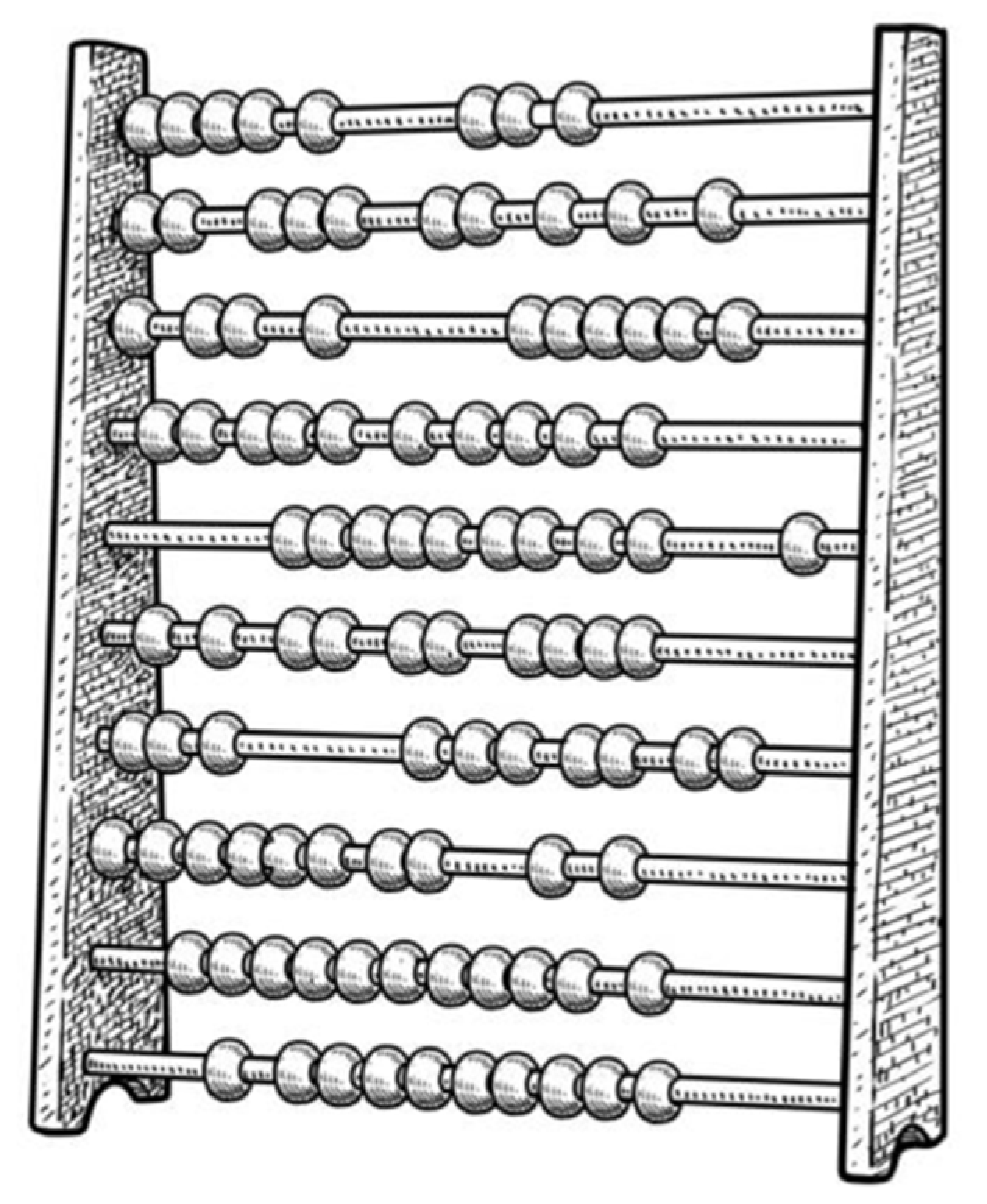
This Short Note introduces the Pallottoliere/Abacus Paradox: for some embodied problems, a low-bit local rule may outperform an advanced AI accelerator in the time and energy needed to deliver the first useful physical action. The aim is not to replace inference, but to identify where inference is not yet necessary.
2. The Paradox
The Pallottoliere/Abacus Paradox can be stated as:
“For some Physical Spatial AI problems, the ‘pallottoliere’ beats the neural accelerator because it solves the smaller problem first.”
The point is not that simple logic is more intelligent than AI. The point is that the useful physical answer is often lower-dimensional than the perceptual model. A robot, vehicle, drone, machine, sensor network, or spatial computer does not always need full scene interpretation before taking a first safe action. In many cases the urgent question is narrower: is there a local physical event requiring bounded action now?
3. Two Different Paths
The dominant AI-hardware path can be summarized as an inference-first path:
sensing → encoding → model inference → reconstruction or classification → policy decision → actuation
This path is necessary when the task requires rich representation: semantic understanding, long-horizon planning, object recognition, full 3D reconstruction, or complex scene reasoning.
Physical Spatial AI also needs a local reflex path:
sensing → low-bit event → safety check → bounded first action → measured response → compact action record
This second path does not replace inference. It acts only when the first useful physical answer is simple enough, local enough, and safe enough to be decided before full inference. The inference-first path asks: what is the world? The local reflex path asks: what must be done safely now?
The paradox is therefore a complementarity statement: AI hardware reduces the cost of thinking, while a local reflex layer reduces the need to think before the first safe action.
4. Examples
Table 1 gives examples of events that can be handled by a local reflex action.
5. The Metric Shift
The usual AI-hardware metrics are TOPS, MAC latency, memory bandwidth, inference energy, accuracy, and model throughput. They remain important, but they are incomplete for Physical Spatial AI.
For embodied systems, the more relevant metric is time and energy to first useful physical action, including sensing, local decision, safety checking, actuation, measured response, and traceability. A faster neural accelerator may reduce inference time, but it does not automatically reduce the time to a safe physical action if the system still waits for full reconstruction, remote arbitration, communication, or a global control loop. Exact values depend on implementation; the principle is that the first bounded action can often require fewer variables, fewer data transfers, less energy, and less time than the first complete interpretation.
EROIE – Energy Returned on Invested Energy for Embodied Intelligence – means useful physical value per unit of invested control energy: energy preserved, damage avoided, mission time extended, unsafe behavior prevented, or diagnostic evidence generated [7].
6. Complementarity with AI Hardware Acceleration
The Pallottoliere/Abacus Paradox is not an argument against advanced AI hardware. It is a boundary statement. Compute-in-memory, AI accelerators, neuromorphic processors, GPUs, NPUs, and memory-centric architectures reduce the cost of inference when the task requires computation over high-dimensional representations.
The local reflex layer addresses a different problem: it decides when full inference is not yet necessary for the first safe action.
In compact form:
- Compute-in-memory reduces the cost of thinking.
- A local reflex layer reduces the need to think before the first safe action.
One improves inference. The other improves physical responsiveness. One optimizes representation. The other optimizes action under urgency. In Physical Spatial AI, these functions should be designed as complementary layers, not as competitors.
As systems scale to more sensors, actuators, edge nodes, robots, vehicles, machines, and spatial events, the number of local events not requiring full inference grows. The pallottoliere is therefore not a nostalgic metaphor. It becomes a design principle for energy-proportional physical intelligence.
7. Conclusions
In Physical Spatial AI, the first useful answer is often not a better model, but a small, bounded, local, observable, and explainable action.
Sometimes the fastest route to intelligence in the physical world is not deeper inference, but the correct low-bit reflex delivered at the right place, at the right time, and within the right safety envelope.
Author Contributions
Conceptualization, methodology, writing – original draft preparation, writing – review and editing, visualization, project administration: P.P.
Funding
This research was supported by the European Commission (Grant numbers: 101069782 and 101216680).
Data Availability
No new datasets were generated or analysed for this conceptual article.
Acknowledgments
Supported by the European Commission URBANE, grant no. 101069782, and by STEEL ALIVE, grant no. 101216680.
Conflicts of Interest
The author is employed by Interactive Fully Electrical Vehicles (IFEVS). The author declares that the research was conducted in the absence of any commercial or financial relationships that could be construed as a potential conflict of interest.
References
- Sebastian, A.; Le Gallo, M.; Khaddam-Aljameh, R.; Eleftheriou, E. Memory devices and applications for in-memory computing. Nat. Nanotechnol. 2020, 15, 529–544. [Google Scholar] [CrossRef] [PubMed]
- Wan, W.; et al. A compute-in-memory chip based on resistive random-access memory. Nature 2022, 608, 504–512. [Google Scholar] [CrossRef] [PubMed]
- Davies, M.; et al. Loihi: A Neuromorphic Manycore Processor with On-Chip Learning. IEEE Micro 2018, 38(1), 82–99. [Google Scholar] [CrossRef]
- Roy, K.; Jaiswal, A.; Panda, P. Towards spike-based machine intelligence with neuromorphic computing. Nature 2019, 575, 607–617. [Google Scholar] [CrossRef] [PubMed]
- Fotowat, H.; et al. A Novel Neuronal Pathway for Visually Guided Escape in Drosophila melanogaster. J. Neurophysiol. 2009, 102, 875–885. [Google Scholar] [CrossRef] [PubMed]
- Card, G.; Dickinson, M. H. Visually mediated motor planning in the escape response of Drosophila. Curr. Biol. 2008, 18(17), 1300–1307. [Google Scholar] [CrossRef] [PubMed]
- Perlo, P.; Dalmasso, M.; Penserini, D.; Pozzato, S. Physical AI as Seen from Nature: A Reflex-Policy Layered Architecture for Energy-Proportional Embodied Intelligence. Preprints 2026, 2026060573. [Google Scholar] [CrossRef]

Table 1.
Examples of spatial and physical events and their local reflex responses.
| Event | Reflex action and first-action meaning |
|---|---|
| Looming obstacle | optical expansion + range/IMU check → slow or stop; avoid collision before full reconstruction |
| Shock / impact | MEMS threshold → inhibit actuator or enter fallback; protect the system before interpretation |
| Pose jump | pose-delta threshold → reject update; avoid corrupting the spatial model |
| Low texture | counter → request keyframe, slow, or aggregate evidence; avoid useless reconstruction cycles |
| Sensor saturation | range exceeded → quarantine or fallback; avoid acting on invalid evidence |
| Thermal over-limit | threshold crossing → reduce load or enter safe mode; prevent damage before global optimization |
| Actuator anomaly | local mismatch flag → limit motion or request supervision; preserve safety before diagnosis |
Disclaimer/Publisher’s Note: The statements, opinions and data contained in all publications are solely those of the individual author(s) and contributor(s) and not of MDPI and/or the editor(s). MDPI and/or the editor(s) disclaim responsibility for any injury to people or property resulting from any ideas, methods, instructions or products referred to in the content. |
© 2026 by the authors. Licensee MDPI, Basel, Switzerland. This article is an open access article distributed under the terms and conditions of the Creative Commons Attribution (CC BY) license (http://creativecommons.org/licenses/by/4.0/).
Copyright: This open access article is published under a Creative Commons CC BY 4.0 license, which permit the free download, distribution, and reuse, provided that the author and preprint are cited in any reuse.