

Submitted:
10 July 2026
Posted:
14 July 2026
You are already at the latest version
Abstract
As the global population ages rapidly, demand for safe and effective strategies to promote healthy aging grows markedly. Natural bioactive compounds, with favorable biosafety profiles and multi-target regulatory properties, have become a core focus in developing anti-aging functional foods and nutraceuticals. Amid the search for novel sustainable bioresources, edible insects emerge as promising anti-aging candidates for their rich species diversity, scalable production, low environmental footprint, and abundant unique bioactive components such as functional proteins and bioactive peptides. Based on bibliometric analysis of 500 eligible publications spanning two decades, this review systematically identifies 32 anti-aging insect species across seven orders, classifies their bioactive components into five major categories, summarizes green extraction technologies, and evaluates their in vitro and in vivo anti-aging activities centered on oxidative stress and inflammatory regulation, while outlining the field’s trajectory from basic mechanistic research to functional application. It further highlights core challenges including fragmented research frameworks and insufficient robust in vivo validation. Finally, it recommends integrating established food science and medical methodologies with emerging technologies such as omics, artificial intelligence, and advanced delivery systems to advance future research paradigms. These efforts could provide a strong theoretical foundation for the efficient and sustainable use of insect resources in anti-aging applications.
Keywords:
edible insects
; anti-aging
; bioactive compounds
; preparation methods
; mechanisms of action
1. Introduction
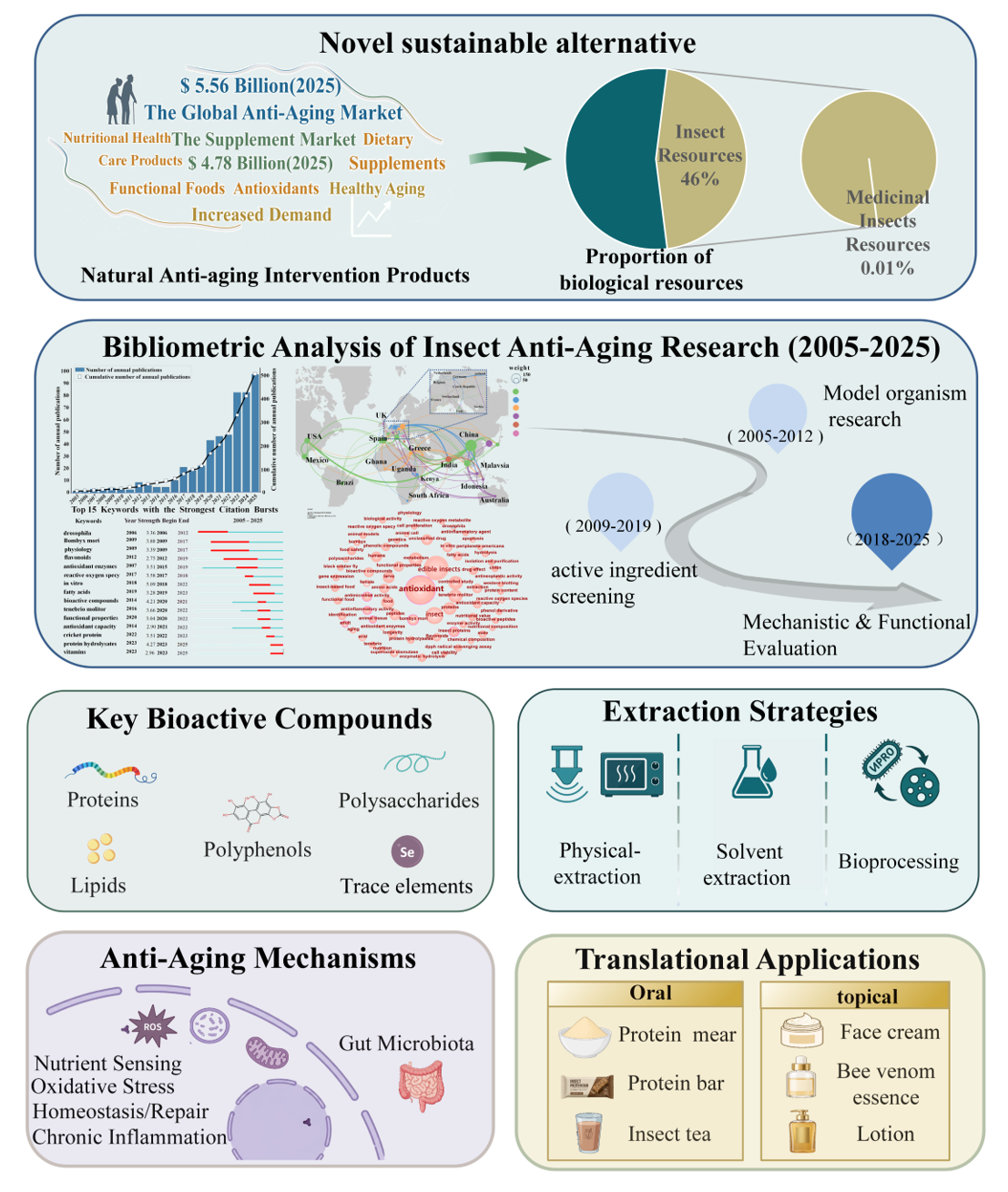
The rapid aging of the global population, coupled with growing public health awareness, is fueling the swift expansion of the anti-aging market [1]. Currently, most natural anti-aging interventions focus on nutritional health products, dietary supplements, functional foods, and natural antioxidants. Market forecasts predict the global anti-aging market will maintain sustained growth [2], with the supplement segment occupying a dominant market share [3], highlighting the significant commercial potential of natural bioactive compounds for promoting healthy aging Thanks to their key advantages—low toxicity, few side effects, and multi-target regulatory effects—natural medicines have become a central research focus for innovative anti-aging strategies. At present, research and development largely center on plant-based resources. While plant extracts can deliver anti-aging benefits by influencing processes such as oxidative stress and chronic inflammation [4], limited supplies and long cultivation periods [5] severely hamper their ability to meet rising market demand. As a result, resource scarcity is now a major bottleneck constraining the sustainable development of the anti-aging industry. This situation underscores the urgent need to identify sustainable and readily available alternative natural resources. As the most species-diverse and biomass-abundant organisms on Earth, insects possess several advantageous characteristics, including rapid reproductive cycles [6], low carbon footprints [7], low breeding costs [8], and high resource conversion efficiency [7]. Owing to these advantages, insects have attracted increasing attention as promising resources for the development of natural anti-aging products. In addition, numerous insect species and their tissues are rich in a wide range of bioactive compounds, further highlighting their potential for anti-aging applications. For example, royal jelly, which is enriched with fatty acids, proteins, and other bioactive components, has been shown to improve antioxidant status and delay cellular senescence [9]. Similarly, polysaccharides extracted from Periplaneta americana Linnaeus can regulate immune function and suppress inflammatory responses, thereby providing novel targets for anti-aging research [10]. Moreover, insect resources are not constrained by seasonal or geographical limitations and can be continuously supplied through industrial-scale breeding systems. This stable production capacity can effectively alleviate the shortage of natural anti-aging raw materials [11]. Therefore, the systematic exploration of insect-derived bioactive substances may not only expand the resource base for natural anti-aging agents but also provide new perspectives for the sustainable development of the anti-aging industry.
The use of insects in anti-aging interventions is not a new area of research; it has long been rooted in traditional practices and empirical knowledge. Classical Chinese medical texts describe Cordyceps sinensis as a remedy that "nourishes deficiencies and enhances vital energy," underscoring its historical role in delaying aging and boosting immune function for thousands of years [12]. Similarly, silkworm pupae have been traditionally used as both food and medicine in dietary therapies throughout East Asian countries, including Japan and South Korea, to combat physical weakness and slow aging [13]. These widespread, cross-cultural applications offer valuable empirical evidence and a strong historical basis for modern research on insect-based anti-aging strategies. With rapid advances in omics technologies and molecular biology, research on insect-derived anti-aging substances has evolved from traditional empirical use to systematic scientific validation. Growing evidence has illuminated the molecular mechanisms behind the anti-aging effects of insect-derived bioactive compounds. For instance, extracts from Tenebrio molitor Linnaeus have been shown to delay cellular aging by upregulating proteins such as SIRT1 [14]. Additionally, hydrolysates from Schistocerca gregaria Forskal have demonstrated stronger free radical scavenging activity than several common plant-based antioxidants [15]. Together, these findings provide strong scientific support for the effectiveness of insect-based anti-aging strategies and lay a solid foundation for targeted compound screening and improved preparation technologies.
Despite notable progress in insect-based anti-aging research, significant gaps remain in both scientific understanding and industrial application. Insects account for roughly 46% of all known species on Earth [16]. However, a systematic review by the Food and Agriculture Organization of the United Nations (FAO) and Wageningen University found that only about 2,000 insect species are considered edible worldwide [17]. Strikingly, less than 0.01% of all insect species have been thoroughly studied or used for medicinal purposes [18], reflecting the underutilization of this vast resource. Furthermore, current research is fragmented and lacks systematic criteria for selecting key insect species, which hinders the coordinated application of findings. Existing studies on the anti-aging mechanisms of insect-derived bioactive compounds also remain limited, and a comprehensive research framework that addresses multiple biological targets and signaling pathways has yet to be established. Furthermore, a significant disconnect between laboratory research and commercial production severely limits the industrial transformation and practical application of related research achievements. In addition to these constraints, unresolved issues such as unclear structure-activity relationships, insufficient in vivo validation, and the absence of standardized quality control systems further hinder the industrial transformation and large-scale application of insect-derived anti-aging resources. In this context, the present study employs bibliometric visualization methods to systematically map the overall research landscape of insect-based anti-aging fields. This research synthesizes existing data on anti-aging insect species and their bioactive components, delves into their underlying anti-aging molecular mechanisms, assesses their industrial application potential, and proposes targeted optimization and development strategies. The study aims to provide a robust theoretical foundation and practical guidance for the further exploration of insect-derived anti-aging resources and the effective industrial translation of relevant scientific research achievements.
2. Visual Analysis of Anti-Aging Research in Insects
To systematically clarify the current state and evolving trends in insect-based anti-aging research, this study conducted a bibliometric visual analysis of relevant literature published between January 2005 and December 2025, using the Web of Science, Scopus, and PubMed databases. The study aimed to identify core research hotspots, developmental trends, and emerging topics in this field. The analysis was performed with CiteSpace 6.4 R1. Time slicing covered January 1, 2005 to December 31, 2025, with one-year slices. Within each slice, links were built based on cosine intensity. The screening criterion used the g-index with k = 25, and the pruning strategy was Pathfinder plus Pruning Sliced Networks. Node types included Author, Keyword, Institution, Country, Reference, Cited Author, and Cited Journal, with the inclusion criterion defined by g-index (k = 25). Inclusion criteria were English-language articles only, limited to research articles and reviews, published between January 2005 and December 2025. Retrieval was defined as: TS = ((insect* OR arthropod*) AND ("anti-aging" OR "lifespan extension" OR "senescence delay") AND (polyphenol* OR "antimicrobial peptide" OR chitin) AND (autophagy OR "oxidative stress" OR telomerase)) NOT TS=("animal*" OR "plant*"). Exclusion criteria were letters, news items, conference abstracts/papers, editorial materials, and book chapters; unpublished grey literature; retracted publications and duplicates; and documents lacking information essential for bibliometric analysis. After relevance screening and deduplication, 500 eligible publications were obtained in total, comprising 249 from Scopus, 246 from Web of Science, and 5 from PubMed. These publications involved 2,097 authors, 949 institutions, and 78 countries/regions.
Based on the final dataset, statistical analysis of annual publication output showed that the field has developed rapidly. In 2005, only two relevant papers were published. After 2016, the field entered a rapid growth phase, with annual publications exceeding 20 in 2017 and peaking at 81 in 2022. Growth slowed between 2020 and 2022, likely due to experimental and publication delays caused by the COVID-19 pandemic. However, the trend quickly rebounded, with 91 papers published in 2025. Overall, cumulative publications have increased exponentially, highlighting insect-based anti-aging research as a rising hotspot at the intersection of food science, nutrition, and geriatric medicine (Figure 1).
High-frequency keywords (aging, longevity, metabolism, oxidative stress, antioxidant activity, bioactive compounds, protein hydrolysate, T. molitor, Bombyx mori Linnaeus) reveal the core focus of current research: insect-derived antioxidant peptides and bioactive compounds delay aging by regulating oxidative stress and improving metabolic pathways. Among the investigated insect resources, T. molitor and Bombyx mori Linnaeus are the most representative edible insect species. Their protein hydrolysates and intrinsic antioxidant components have been widely adopted for in vitro
and in vivo validation of anti-aging mechanisms [19]. Global bibliometric distribution analysis further shows that China occupies a core research position in this field and has established close academic cooperation with the United States, Mexico, Brazil, Spain, and other countries.
Keyword emergence and cluster analyses clearly reveal the evolutionary trajectory of research content in this field. Over the past two decades, insect-based anti-aging research has gradually expanded its research scope from the analysis of basic nutritional components to the multidimensional exploration of biological activity mechanisms. Early investigations in this field were primarily centered on the screening of model organisms and the elucidation of fundamental anti-aging mechanisms, whereas subsequent research phases increasingly emphasized the identification of bioactive compounds and the evaluation of their functional properties. In recent years, research topics such as antioxidant activity, protein hydrolysates, and functional foods have emerged as prominent keywords, reflecting the coordinated advancement of both fundamental and applied research. Cluster analysis further categorized current research hotspots into several major thematic domains, including anti-inflammatory responses, oxidative stress, α-tocopherol, protein hydrolysates, and functional foods. Collectively, the evolution of research priorities demonstrates a clear transition from preliminary model establishment and mechanistic exploration toward comprehensive mechanistic elucidation and industrial translation. Notably, during the past five years, research emphasis has progressively shifted from basic mechanistic studies to functional evaluation and product-oriented development. Furthermore, the increasing prominence of protein hydrolysates and vitamin-related research suggests that the targeted delivery and precision application of insect-derived bioactive peptides are likely to emerge as key frontier directions in anti-aging research over the next 2–3 years.
3. Bioactive Anti-Aging Components of Insects and Corresponding Extraction Technologies
This section may be divided by subheadings. It should provide a concise and precise description of the experimental results, their interpretation, and the experimental conclusions that can be drawn.As one of the most diverse and resource-rich biological groups on Earth, insects contain a wide array of substances with potential anti-aging properties. However, the composition and distribution of these bioactive compounds vary significantly among insect species. Consequently, targeted extraction methods and optimized processing technologies are necessary to efficiently isolate and utilize specific bioactive components (Figure 2).
Anti-aging insects refer to insect species that are rich in bioactive compounds, including proteins and peptides [20], lipids [21], polyphenols [22], polysaccharides, and trace elements. These bioactive constituents can delay aging and promote a healthy lifespan through multiple regulatory mechanisms, thereby demonstrating considerable potential for applications in functional foods [23], skincare products [24], and dietary supplements [25]. To date, insects belonging to seven orders, namely Coleoptera, Orthoptera, Hymenoptera, Lepidoptera, Blattodea, Hemiptera, and Diptera, have been scientifically reported to exhibit significant anti-aging potential, with 32 species having been explicitly identified and investigated refer to Figure 2 and Supplementary Table 1. Well-documented insect species with solid anti-aging evidence include B. mori, A. mellifera, Hermetia illucens Linnaeus, T. molitor, Acheta domesticus Linnaeus, Schistocerca gregaria Forskål, and Macrotermes subhylanus Rambur [26,27,28]. China has a long-standing tradition of utilizing insect resources for health maintenance and disease intervention. Multiple traditional medicinal and edible insects, such as silkworm pupae, Apis mellifera Linnaeus larvae, and T. molitor, have been validated for anti-aging efficacy in modern pharmacological studies.In terms of Coleoptera, T. molitor protein concentrates exerted protective effects in aging mouse models by enhancing antioxidant capacity, alleviating inflammatory responses, and improving intestinal health [23]. For Orthoptera, protein hydrolysates derived from A. domesticus produced bioactive peptides with prominent antioxidant activities [29]. In terms of Hymenoptera, A. mellifera has well-defined anti-aging mechanisms, endowing it with great potential for translational research and industrial transformation [27]. As a typical Lepidoptera insects, B. mori serves as an excellent source of antioxidant peptide [20]. Additionally, representative of H. illucens, as an emerging insect resource, contains unique metabolites that providenovel insights for anti-aging research [30].
3.2 Anti-aging active ingredients
Insect-derived active ingredients with anti-aging potential can be classified into five major categories: proteins, lipids, polyphenols, polysaccharides, and trace elements Table 1.
3.2.1. Proteins and Peptides
Insects possess a total protein content ranging from 35% to 60% of their dry weight and 10% to 25% of their fresh weight, which is considerably higher than that found in traditional grains and legumes. Specifically, Orthoptera insects display particularly high protein levels, with their protein content peaking at approximately 60% on a dry weight basis [45]. These insect proteins contain all essential amino acids required for human metabolism and nutrition, featuring high digestibility and absorbability. Beyond basal nutritional support, enzymatic hydrolysis acts as a critical step to unlock and amplify the direct anti-aging bioactivity of insect proteins: intact insect proteins already exhibit direct anti-senescence capacity, as demonstrated by the prominent inhibitory effect of major royal jelly proteins on senescence in human embryonic lung fibroblasts (HFL-I) [46]. Insect-derived complete proteins can be degraded into protein hydrolysates via enzymatic hydrolysis, and the antioxidant, anti-inflammatory, and anti-aging bioactivities of such hydrolysates have been widely validated in multiple insect species. At the cellular level, B. mori sericin protein hydrolysate alleviated cellular senescence in human dermal fibroblasts. It reduced intracellular reactive oxygen species (ROS) accumulation, upregulated the expression of superoxide dismutase 2 (SOD2) and catalase
(CAT), mitigated oxidative damage, and restored extracellular matrix homeostasis [47]. Similarly, H.
illucens alleviated cellular senescence in human dermal fibroblasts. It reduced intracellular reactive
ROS accumulation, upregulated the expression of SOD2 and CAT, mitigated oxidative damage, and
restored extracellular matrix homeostasis [48]. studies further verified that aqueous protein
hydrolysates from T. molitor and Protaetia brevitarsis seulensis Kolbe alleviated intestinal inflammation
and improved cognitive performance in aged mice through anti-inflammatory modulation [14].
Insect-derived bioactive peptides act as the core functional units driving anti-aging effects and
are classified into two primary categories: antioxidant peptides and immunomodulatory peptides.
Antioxidant peptides directly counteract age-related oxidative damage by scavenging excess reactive
species and blocking oxidative cascade reactions. Two representative fragments, SWFVTPF and
NDVLFF, identified from B. mori pupal hydrolysates, exhibit robust comprehensive antioxidant
capacity that counteracts macromolecular damage accumulated during aging [20]. The anti-aging
activity profile of peptide products can be optimized via enzyme selection: hydrolysates prepared
with Alcalase and Prolyve exert stronger free radical scavenging efficacy due to their abundant lowmolecular-
weight peptides, while Flavourzyme-generated hydrolysates show superior iron-reducing
capacity [20]. As a core subtype of immunomodulatory peptides, antimicrobial peptides primarily
exert their anti-aging effects through multiple mechanisms, including regulation of gut microbiota
homeostasis and suppression of chronic inflammation [49]. In LPS-induced macrophage experiments,
cecropin antimicrobial peptides specifically bound to LPS, thereby markedly downregulating the
expression of pro-inflammatory factors and related genes and alleviating inflammatory damage [50].
Currently, anti-aging research on insect proteins mostly focuses on activity validation of enzymatic
hydrolysates, and systematic studies on their structure-activity relationships and in vivo action
mechanisms still need to be further expanded.
3.2.2. Lipids
Lipid metabolic disorders are closely associated with fundamental mechanisms of aging,
particularly oxidative stress and chronic inflammation, and therefore represent important
therapeutic targets for the prevention and treatment of aging and age-related diseases [51]. In insects,
lipids are the second most abundant class of functional nutrients after proteins and can be broadly
categorized into fatty acids, wax esters, and phospholipids. Among these components, fatty acids
constitute the major bioactive fraction, with unsaturated fatty acids contributing predominantly to
anti-aging activity [25]. Specifically, distinct fatty acid profiles endow different insect lipids with
differentiated anti-aging action pathways: lipids from H. illucens larvae, enriched in lauric acid, oleic
acid and linoleic acid, focus on cutaneous aging by repairing the epidermal barrier and mitigating
local oxidative and inflammatory damage [24]; in contrast, lipids from B. mori and Philosamia
cynthiaricini Boisduval, which are abundant in α-linolenic acid and have an n-6/n-3 ratio close to the
optimal nutritional range, exert systemic anti-aging effects by maintaining whole-body lipid
homeostasis [21,51]. Beyond fatty acids, specialized lipid components further expand the application
boundaries of insect lipids: the wax ester fraction MUD1 from A. mellifera beeswax by-products
protects human dermal fibroblasts from oxidant-induced damage [52], and insect-derived
polyunsaturated fatty acid-phospholipid complexes combine enhanced antioxidant activity with
favorable emulsifying properties, showing great potential for anti-aging dietary supplements and
nutritional fortifiers [25].
3.2.3. Polyphenols
Insects are rich in diverse bioactive polyphenols, mainly encompassing 4-hydroxybenzoic acid,
p-hydroxycinnamic acid, ferulic acid, eugenic acid, and flavonoids [38]. These polyphenols are
primarily acquired via food chain accumulation and distributed across the insect cuticle, defensive
glands and gut, performing dual biological functions in organismal defense and anti-aging regulation
[37]. Polyphenolic compounds derived from insects possess significant antioxidant activity and exert anti-aging effects by scavenging excess free radicals in the body and alleviating oxidative stressinduced
cellular damage. The polyphenolic components of the ethanol extract of Holotrichia parallela
Motschulsky exhibit antioxidant activity [22]. Beyond systemic antioxidant protection, insect
polyphenols further exert targeted intervention effects on tissue-specific aging phenotypes, with skin
photoaging improvement being the most well-validated application direction. Tpolyphenols
extracted from A. domesticus extracts suppress the activities of collagenase and elastase to attenuate
collagen degradation. These compounds also upregulate the TGF-β1 signaling pathway to facilitate
collagen synthesis. Such dual regulatory effects effectively alleviate photoaging and diminish wrinkle
formation, endowing insect polyphenols with great application potential in anti-aging cosmetic
development [53]. Tpolyphenols extracted from A. domesticus extracts suppress the activities of
collagenase and elastase to attenuate collagen degradation. These compounds also upregulate the
TGF-β1 signaling pathway to facilitate collagen synthesis. Such dual regulatory effects effectively
alleviate photoaging and diminish wrinkle formation, endowing insect polyphenols with great
application potential in anti-aging cosmetic development
3.2.4. Polysaccharides
Insect polysaccharides fall into two major classes: structural polysaccharides and functional
polysaccharides. Functional polysaccharides, typically exemplified by the CP70 polysaccharide from
Paecilomyces cicadae (Miq.) Samson, freely distributed in insect hemolymph, body cavities, and
secretions, and exhibit diverse biological activities. The CP70 polysaccharide isolated from
Paecilomyces cicadae upregulated the mRNA levels of catalase, superoxide dismutase 1, and nucleic
acid oxidation damage repair enzyme in Drosophila melanogaster. Such modulation enhanced the
activities of catalase and glutathione peroxidase, decreased the content of malondialdehyde, a key
marker of lipid peroxidation, and ultimately strengthened cellular antioxidant defense. These
beneficial effects effectively prolonged the healthy lifespan of fruit flies [39]. Glycosaminoglycans
(GAGs) extracted from C. molossus exert mitigated oxidative damage and inhibit inflammatory
responses in aged rat models. The multi-target regulatory effects conferedr cardioprotective and
antithrombotic functions, thereby delaying multi-organ aging progression [40]. Chitin and its
deacetylated product chitosan are typical structural polysaccharides of insect origin. Both
biomaterials are polymerized by N-acetyl-D-glucosamine through β-1,4 glycosidic linkages [11], and
insects constitute the predominant renewable source of terrestrial chitin. Chitosan derived from C.
bilineata larvae alleviated oxidative stress in D-galactose-induced aging mice [41]. Collectively, insect
polysaccharides exert anti-aging effects through multiple complementary pathways, highlighting
their considerable development potential in anti-aging functional products.
3.2.5. Trace Elements
Trace elements are essential nutrients for sustaining human physiological homeostasis. They
participate in and regulate core biological processes, including metabolism, immune modulation,
hormone synthesis, and signal transduction. The disruption of trace element homeostasis closely
correlates with elevated oxidative stress, persistent chronic inflammation, and accelerated cellular
senescence [54]. Insects contain abundant macroelements ,and trace elements, mainly covering iron,
zinc, potassium, sodium, calcium, phosphorus, magnesium, manganese, and copper. Among these
mineral components, zinc, copper, and selenium serve as the key functional substances mediating
the anti-aging bioactivities of insects [55]. Studies have confirmed that the larvae of the giant blowfly
Chrysomya megacephala Fabricius, T. molitor, and other insects, have short growth cycles and high
reproductive efficiency [44,56]. These insect species efficiently utilize inorganic aquaculture waste
and biotransform inorganic selenium into organic selenium. This bioconversion process markedly
improves selenium bioavailability and enhances its anti-aging capacity, suggesting that insects can
serve as a high-quality and sustainable trace element source for the development of anti-aging
functional.
3.3. Extraction Processes for Anti-Aging Active Ingredients
Based on the physicochemical characteristics of target active ingredients, current extraction techniques are primarily divided into three categories: physical-assisted extraction, solvent extraction, and bioprocessing (Figure 3).
In order to destabilize insect cellular structures, improve mass transfer efficiency, and facilitate the release of specific bioactive substances, physical-assisted extraction uses external physical treatments including ultrasound, microwaves, and high pressure. Each technique possesses distinct mechanistic properties and application advantages. Among these methods, ultrasonic-assisted extraction is especially useful for removing heat-sensitive materials such as proteins, peptides, polysaccharides, and polyphenols because it uses high-frequency vibrations and cavitation effects to break down cell structures [57]. The foundation of microwave-assisted extraction (MAE) is the quick and targeted heating of polar molecules using microwave energy. High-pressure-assisted extraction (HHP-E) uses ultra-high pressures between 100 and 600 MPa to break down cell walls. Accumulated experimental evidence verifies the extraction efficacy of these methods for insect anti-aging components. Applying ultrasonic-assisted extraction to proteins from T. molitor larvae under alkaline conditions not only greatly boosts protein yield but also decreases protein particle size, encourages the unfolding of protein spatial structures, and improves the exposure of functional amino acid residues [58]. Additionally, by exposing more proteolytic cleavage sites and unfolding protein structures, ultrasonic pretreatment greatly increases the hydrolytic effectiveness of later proteases like Alcalase. Consequently, the resultant hydrolysates show higher iron-chelating activity and improved DPPH radical scavenging capacity [59]. For MAE, compared to those made using traditional extraction techniques, phenolic extracts from T. molitor obtained using MAE have larger phenolic contents and stronger antioxidant activity. A polysaccharide yield of 14.89 ± 0.68% was obtained during the extraction of polysaccharides from Cordyceps militaris under optimized HHP-E conditions. Additionally, during the extraction of insect oil from A. domesticus and T. molitor, this method greatly boosted the quantity of advantageous fatty acids and improved antioxidant activity [60]. Mechanistically, all physical-assisted extraction methods enhance extraction efficiency via cell wall disruption and intensified mass transfer, and their commonly used aqueous systems also confer environmental benefits. However, they face notable scale-up limitations: prolonged ultrasound may degrade macromolecular actives; microwaves carry thermal damage risks to heat-sensitive components; high-pressure equipment requires high upfront investment and stringent safety controls.
3.3.2. Solvent Extraction
One of the most well-known and popular methods for separating natural compounds is solvent extraction. This approach, which is based on the idea that "like dissolves like," provides a straightforward operational procedure, adaptable parameter adjustment, and wide application from laboratory study to industrial-scale production [61]. Solvents are categorized by polarity to match target compound solubility. Polar solvents, such as ethanol, water, and their mixed systems, are mainly used for the extraction of water-soluble components, while nonpolar solvents, such n-hexane and chloroform, are frequently used to extract lipid-soluble molecules. Ethanol and aqueous ethanol solutions have proven to be highly effective in extracting proteins and co-extracting total phenolic compounds from T. molitor and other insect-derived materials. As a result, the extracts that are produced show improved DPPH radical scavenging activity [62]. Despite the technological maturity of conventional solvent extraction, the use of traditional organic solvents may lead to solvent residue risks, while thermal treatment during the extraction process can easily induce the degradation of heat-sensitive bioactive compounds. To address these limitations, green extraction technologies have rapidly developed in recent years, particularly supercritical CO2 extraction and deep eutectic solvent-based extraction.Supercritical fluid extraction (SFE) utilizes supercritical CO2 as the extraction medium to selectively isolate lipid-soluble bioactive compounds from insects under low-temperature conditions. This approach effectively minimizes the thermal degradation of target bioactive substances [63]. In addition, emerging green solvents, such as deep eutectic solvents (DESs) and ionic liquids, have provided new strategies for the environmentally friendly and efficient extraction of anti-aging bioactive compounds from insect resources [64].
3.3.3. Bioprocessing
Biological extraction is an eco-friendly and mild preparation technology that adopts enzymes and microorganisms as biocatalysts. Extracts obtained via this approach retain superior bioactivities, including antioxidant capacity, angiotensin-converting enzyme inhibitory activity, and anti-skin-aging properties [65,66]. This technology is mainly implemented through three complementary routes: enzymatic extraction, microbial fermentation, and in vitro simulated gastrointestinal digestion. Enzymatic extraction techniques are divided into three primary types: single-enzyme treatment, dual- or multi-enzyme synergistic treatment, and continuous stepwise enzymatic hydrolysis [48]. Microbial fermentation relies on microbe-secreted enzymes to degrade insect substrates and transform active components, realizing extraction and bioactivity modification in one step. In vitro simulated gastrointestinal digestion mimics the sequential physiological environments of the human oral cavity, stomach and small intestine, to assess the bioactivity of insect-derived components under physiological conditions. Substantial experimental evidence confirms the performance of biological extraction in preparing insect anti-aging active ingredients. For enzymatic extraction, the key operational parameters for single-enzyme treatment cover a hydrolysis temperature range of 50-60°C, an optimal pH of 8.0 for Alcalase, an enzyme-to-substrate ratio of 0.5%–4% (w/w), and a reaction duration of 1–24 h. Enzymatic hydrolysis of proteins derived from T. molitor and Alphitobius diaperinus Panzer efficiently generates bioactive peptides, and the resulting hydrolysates exhibited significantly improved antioxidant activity relative to raw proteins [67]. Dual- or multi-enzyme synergistic treatment, typically combining Alcalase and Flavourzyme, markedly elevates the degree of hydrolysis. Such synergistic enzymatic reactions yield products with higher contents of total free amino acids and stronger antioxidant activity compared with single-enzyme treatment. In terms of microbial fermentation, proteases secreted by Bacillus subtilis and Bacillus licheniformis can efficiently degrade the chitinous exoskeleton of H. illucens larvae [11]. Additionally fermentation of H. illucens larvae oil using Lactobacillus gasseri and other microorganisms can improve skin permeability, reduce the risk of sensitization, and enrich the product with anti-aging bioactive compounds [22]. In vitro simulated gastrointestinal digestion mimics the sequential physiological environments of the human oral cavity, stomach, and small intestine. Digestion products derived from Gryllodes sigillatus Walker and T. molitor obtained through this simulation system exhibited potent DPPH and ABTS radical scavenging abilities, as well as prominent inhibitory effects on COX-2 and LOX activities [31].
4. Potential Mechanisms of Action for Insect-Derived Anti-Aging Agents
Insects and their bioactive derivatives can synergistically influence the progression of aging by targeting multiple molecular pathways and signaling mechanisms. The primary mechanisms include regulating nutrient-sensing pathways, reducing oxidative stress, inhibiting inflammatory responses, maintaining cellular homeostasis, and altering the composition of gut microbiota (Figure 4).
4.1. Effects on Nutritional Sensing
The nutrient-sensing network functions as a central hub governing cellular metabolism and aging, whose core signaling pathways mainly include the AMPK/SIRT axis, insulin/IGF-1 (IIS) pathway, and mTOR pathway. AMPK acts as a pivotal cellular energy sensor, whereas SIRT1 modulates metabolic processes and stress responses [68].
4.2. Alleviation of Oxidative Stress
Oxidative stress arises from excessive accumulation of reactive oxygen species (ROS) during aging, which overwhelms the endogenous antioxidant defense system and disrupts cellular redox homeostasis. This imbalance ultimately triggers oxidative damage to key biological macromolecules, including DNA, lipids, and proteins [72]. Insect-derived extracts alleviate oxidative stress by boosting SOD activity, inactivating lipoxygenases, and chelating metal ions [73]. In terms of endogenous antioxidant enzyme modulation, insect-derived bioactive components upregulate antioxidant enzyme expression and activity, with supporting evidence from signaling pathway and in vivo studies. Larval royal jelly protein hydrolysate QBLE activates the Nrf2/Keap1 pathway, which further upregulates downstream SOD and CAT expression and lessens lipid peroxidation products [30]. Consistently, extracts of T. molitor and H. illucens significantly increase the activities of antioxidant enzymes including SOD in the brain and intestinal tissues of aged mice.; the major protein in royal jelly can improve Alzheimer’s disease symptoms by upregulating SOD1 expression and reducing ROS, RNS, and malondialdehyde levels [74]. In terms of direct antioxidant actions, insect-derived peptides and extracts function via lipoxygenase inhibition, metal ion chelation and reducing capacity.. The synthetic peptide FDPFPK derived from S. gregaria displays direct in vitro lipoxygenase inhibitory activity, with an IC50 of 2.85 mg/mL [27]. Hydrophobic amino acid-enriched peptides, including LSPLYE, AGVL, and VAAV were isolated from hydrolysates of Gryllus bimaculatus De Geer. Their high hydrophobicity, ranging from 50% to 100%, is strongly correlated with metal chelating capacity [29]. The aqueous extract of A. domesticus exhibited iron-reducing capacity with an EC₁ value of 12.1 µM FeSO₄/mg [54]. Collectively, insect-derived bioactive components act on multiple targets of oxidative stress through the above pathways, jointly constructing an antioxidant defense system to counteract age-related oxidative damage.
4.3. Alleviating Inflammation
Chronic low-grade inflammation constitutes a core hallmark of aging and is tightly linked to multiple age-associated disorders. COX-2, LOX, and MMPs are pivotal enzymes mediating inflammatory cascades, while NF-κB and MAPK signaling pathways function as core regulatory axes to modulate senescence-associated secretory phenotypes and pro-inflammatory factor expression [47]. Insect-derived bioactive compounds exert synergistic antioxidant and anti-inflammatory effects, enabling multi-target intervention against the core pathological mechanisms underlying inflammatory aging [31]. Two interconnected intervention modes underpin their protective effects: direct suppression of pro-inflammatory enzymes and signaling cascades, and interruption of the oxidative stress-inflammation vicious cycle. First, insect bioactive components directly restrain inflammatory responses by inhibiting pro-inflammatory enzymes and blocking upstream inflammatory signaling pathways. Peptide fractions from T. molitor, S. gregaria, and Gryllodes sigillatus Walker, obtained via simulated gastrointestinal digestion, significantly and concurrently inhibit LOX and COX-2 enzymatic activities, thereby forming a synergistic regulatory network linking antioxidant and anti-inflammatory actions [31]. In the UVB-induced skin photoaging model, larval extracts from Trypoxylus dichotomus Linnaeus, P. brevitarsis, T. molitor and G. bimaculatus effectively suppress the expression of MMP-1 and MMP-9, thereby protecting dermal collagen from photoaging damage [73]. G. bimaculatus extract markedly alleviates alcohol-induced intestinal and hepatic injury by suppressing ROS-mediated oxidative stress and blocking the LPS/TLR4/MAPK signaling cascade [75]. OPA, a low-molecular-weight oligosaccharide purified from the ethanol extraction residues of P. americana, markedly inhibits the activation of the TLR4/MAPK/NF-κB signaling cascade, downregulates TLR4 protein expression, and suppresses the phosphorylation levels of p65, p38, JNK, and ERK1/2 [76]. Second, insect-derived bioactive compounds block oxidative signal-induced NF-κB activation at the source by scavenging excess free radicals and elevating the activities of endogenous antioxidant enzymes, including SOD and CAT, thereby disrupting the vicious cycle linking oxidative stress and inflammation [77]. Collectively, insect bioactive compounds target inflammatory enzymes, core inflammatory signaling axes and upstream oxidative triggers simultaneously, forming a multi-targeted intervention system to alleviate chronic low-grade inflammation and retard inflammatory aging.
4.4. Maintenance of Cellular Homeostasis and Repair Capacity
Maintaining intracellular homeostasis and efficient damage repair systems is vital for preserving organelle integrity, resisting cellular stress, and delaying aging [78]. During aging, progressive disruption of cellular homeostasis is driven primarily by two interconnected processes: mitochondrial dysfunction and declining autophagic capacity, both of which accelerate cellular senescence. Insect-derived bioactive compounds exert anti-aging effects through various regulatory mechanisms, including enhancing mitochondrial function and sustaining autophagic homeostasis. Mitochondrial dysfunction is mainly characterized by accumulated mtDNA mutations, disrupted protein balance, impaired mitochondrial renewal, and abnormal mitochondrial dynamics. Insect-derived bioactive components mitigate these impairments to maintain mitochondrial integrity and function. Royal jelly helps protect mitochondrial function, promotes mitochondrial biogenesis, and activates the AMPK/SIRT signaling pathway to support mitochondrial biosynthesis [79]. In B. mori, FOXO-mediated overexpression of the OSER1 protein boosts resistance to oxidative stress and starvation by maintaining mitochondrial morphological and functional stability, thereby prolonging organismal lifespan [80]. Autophagic capacity gradually declines with age, leading to the buildup of damaged cellular components and accelerated cellular senescence [81]. Modulation of autophagy serves as a crucial mechanism underlying the anti-aging effects of insect-derived bioactive compounds. Insect-derived bioactive compounds slow the progression of aging by modulating autophagy. Notably, the lifespan-extending effect of queen larval protein hydrolysate QBLE is closely linked to the upregulation of core autophagy-related genes Atg8a and Atg5 [27].
4.5. Effects on the Gut Microbiome
The progression of aging is closely linked to the diversity of gut microbiota. Dysbiosis of gut microbes increases intestinal barrier permeability, triggers endocrine disturbances and immune dysfunction, and ultimately exacerbates age-associated tissue damage [78]. Insect-derived proteins, peptides, polysaccharides, and bioactive extracts can be metabolized by gut microbes, remodeling the intestinal microbial composition by selectively enriching beneficial bacteria and suppressing the growth of pathogenic strains. First, insect-derived bioactive substances counteract age-related microbial dysbiosis by modulating community composition. These components can be metabolized by gut microbes, and function to selectively enrich beneficial bacteria while suppressing pathogenic strains. T. molitor protein improves gut health in D-galactose-induced aging mice by significantly increasing the abundance of the CHA01 strain and supporting the restoration of gut microbial diversity [23]. Notably, functional evidence from Drosophila melanogaster verifies the microbiota-dependent anti-aging effect: moderate induction of the antimicrobial peptide Drosocin substantially prolongs lifespan and delays intestinal barrier senescence, and these longevity-promoting effects are abolished upon microbial depletion, confirming that insect antimicrobial peptides exert indirect anti-aging actions by modulating host symbiotic microbiota [82]. Second, insect bioactive compounds attenuate age-associated intestinal damage by reinforcing intestinal barrier integrity and inhibiting inflammatory responses. Insect bioactive compounds also confer anti-aging benefits by reinforcing intestinal barrier integrity. Extracts from P. brevitarsis and T. molitor alleviate intestinal inflammation in aged mice by upregulating the tight junction proteins ZO-1 and Claudin-5, downregulating MMP-2, and inhibiting the pro-inflammatory mediators EDN and CCL11 [14]. Consistently, P. americana aqueous extracts mitigate inflammatory responses through the suppression of the TLR4/MyD88/NF-κB cascade, upregulate Occludin-1 and ZO-1 to restore intestinal barrier function, and reshape gut microbiota structure, thereby restraining pathogenic bacteria and promoting the growth of beneficial microflora [83]. Collectively, insect-derived agents target multiple nodes along the gut microbiota-intestinal barrier axis, ameliorating age-related intestinal homeostasis disruption at both microbial and cellular levels to delay the aging process.
5. Potential Applications of Insects and Their Bioactive Compounds in Anti-Aging
As a novel and sustainable source of natural functional ingredients, insects contain abundant bioactive substances such as proteins, bioactive peptides, chitin, and phenolic compounds. These substances exert anti-aging effects through multiple mechanisms and demonstrate significant potential for use in both oral and topical formulations (Figure 5).
5.1.1. Functional Foods
The development of insect-derived functional foods has expanded from traditional beverages to
the fields of modern nutritional fortification and precision intervention. Among ready-to-eat
products, insect tea is a traditional beverage in the ethnic minority regions of southwest China. Rich
in tea polyphenols, it improves multi-organ indices and reduces inflammatory cytokine levels in a Dgalactose-
induced mouse model of aging, making it one of the few traditional functional foods that
already exists in a mature, ready-to-consume form [84]. T. molitor protein has been processed into
ready-to-eat products such as protein bars and vegetable soups, demonstrating efficacy in improving
physiological indicators and gut health in aged mouse models [23] (Supplementary Figure S2),
thereby providing a sustainable protein supplementation option for elderly individuals with
sarcopenia. In the development of medical foods, extracts from Oecophylla smaragdina Fabricius and
insect-derived ingredients such as B. mori and A. mellifera are being developed as adjunctive
interventions for age-related chronic diseases such as hypertension [32], Parkinson’s disease [85], and
Alzheimer’s disease [86,87,88]; most are currently in the formulation development and animal
efficacy validation stages.
5.1.2. Dietary Supplements
Dietary supplements represent a key area of development for the concentration and
standardization of bioactive compounds derived from insects, and a number of high-potential
candidate ingredients have already emerged. Royal jelly is the most commercially developed product
in this field, with a conventional dosage forms such as capsules, tablets, and oral solutions are widely
available on the market; development of QBLE, a hydrolyzed larval protein derived from royal jelly,
is also progressing steadily. In addition, various bioactive molecules are derived from efficacy
validation to product commercialization. For example, extracts from T. molitor and P. brevitarsis are
being developed as neuroprotective supplements [14]; selenium-enriched T. molitor peptides, due to
their enhanced immunomodulatory activity, hold potential as high-end immune support products44;
IDA, discovered in the fed milk of R. labralis, represents a new generation of precision supplements
targeting longevity regulatory pathways such as AMPK and SIRT72 (Supplementary Figure S2).
Although the bioactivity of these raw materials has been validated in experimental models, their
industrialization remains constrained by formulation development and long-term safety assessments;
they are currently in the transition phase from raw materials to standardized end products.
5.2. Topical Anti-Aging Products
5.2.1. Protective Products
Insect-derived active ingredients have demonstrated significant protective potential against UV-induced skin damage. Silkworm pupa peptides alleviate the process of photoaging by reducing oxidative stress and regulating immune function [13] (Supplementary Figure S2), while fermented H. illucens larval oil is better suited for the development of age-friendly skincare products [24]. However, these ingredients are currently in the raw material validation stage, with no commercial products yet available on the market, and clinical evidence of their photoprotective efficacy in humans remains to be accumulated.
5.2.2. Repair Products
Collagen degradation is a key factor in the development of wrinkles and skin laxity. Multiple studies have confirmed that insect extracts can effectively inhibit key enzymes responsible for the breakdown of collagen and elastin. At the raw material level, A. domesticus water extracts possess dual functions: inhibiting MMP-1-mediated collagen degradation and promoting TGF-β1-mediated collagen synthesis, without causing skin irritation [89]; A. mellifera larva protein and its hydrolysate also demonstrate excellent anti-collagenase and anti-hyaluronidase activity [65] (Supplementary Figure S2). At the product level, bee venom serums have shown clear efficacy in reducing wrinkle area, number, and depth in clinical studies involving healthy women [90]; cosmetic formulations containing T. molitor oil have been incorporated into anti-wrinkle patents.
6. Challenges and Future Prospects
As the most diverse and renewable biological taxon on Earth, insects offer a promising alternative to conventional anti-aging resources [14] and show significant potential for use in functional foods, nutritional supplements, and cosmetics. Bibliometric analyses reveal that research in this field has grown rapidly since 2013, with the annual number of publications reaching 81 in 2022. This trend indicates that insect-derived anti-aging research has become a burgeoning interdisciplinary frontier connecting food science and geroscience. Recently, increasing attention has focused on key bioactive compounds isolated from insects, such as proteins and peptides [13], lipids [22], polyphenols [84], polysaccharides [39], and trace elements [44]. Researchers have systematically studied their extraction and purification methods, structural characteristics, and anti-aging activities. Additionally, edible insects offer several practical advantages, including broad distribution, low breeding costs, and rapid reproductive rates. These features, combined with their diverse biological activities, allow edible insects to deliver multiple anti-aging effects, including antioxidant defense, anti-inflammatory action, immune regulation, promotion of collagen synthesis, and modulation of the gut microbiota. As a result, insect-derived bioactive compounds present strong potential for large-scale development and industrial application. Despite the substantial progress achieved in elucidating the anti-aging properties of edible insects, several challenges continue to hinder further research and industrial translation.
6.1. Germplasm Mining Bottlenecks and Screening Strategies
Significant limitations remain in the exploration of insect resources for anti-aging applications. To date, only 32 insect species have been characterized with respect to their anti-aging mechanisms and related bioactive constituents, whereas numerous other species with potential anti-aging properties have yet to undergo systematic bioactivity screening and component identification. As a result, the developmental potential of insect resources remains largely untapped (Supplementary Table S1).
To bridge this gap and fully unlock the anti-aging potential of insect germplasm resources, conventional low-throughput empirical screening has become a key rate-limiting step. A technology-integrated pipeline encompassing multi-omics profiling [91], network pharmacology [92], artificial intelligence [93] and high-throughput screening in model organisms [94] is thus required for efficient, large-scale mining of bioactive insect candidates. At the experimental profiling level, integrated metabolomic and proteomic analyses enable systematic compositional mapping of diverse edible insect species, facilitating the precise identification of core bioactive constituents including flavonoids, polyphenols, peptides, and polysaccharides. When coupled with network pharmacology approaches, these identified molecules can be mapped to canonical anti-aging signaling hubs — including FOXO, SIRT1, Nrf2, mTOR, and AMPK [95] — enabling the prioritization of elite insect species with broad target coverage and synergistic component interactions. Complementing experimental component screening, in silico frameworks leveraging the i5K genome database, insect transcriptomic resources, and artificial intelligence enable high-throughput virtual evaluation of underexplored insect taxa. This two-pronged strategy markedly accelerates the prediction of anti-aging potential for insect-derived bioactive components, overcoming the throughput limitations of conventional trial-and-error screening and enabling efficient exploitation of insect genetic resources [91].
6.2. Quality Stability Bottlenecks and Optimization Strategies
Ensuring the quality and stability of insect-derived products remains a major challenge. The composition and concentration of insect-derived bioactive compounds are influenced by numerous factors, including species, strains, feed formulations, developmental stages, breeding environments, and processing techniques. As a result, substantial batch-to-batch variability frequently occurs, creating a significant obstacle to the standardized production and rigorous quality control of insect-based pharmaceuticals and functional health products [48]. For example, the qualitative and quantitative profiles of polyphenols in A. domesticus and T. molitor are highly dependent on dietary conditions. Even individuals belonging to the same insect species may exhibit marked differences in the composition of polyphenols and phenolic derivatives [38]. In addition to compositional instability, the biological stability of insect-derived bioactive compounds also remains problematic. Key active substances, such as peptides and polysaccharides, are highly susceptible to gastrointestinal degradation and oxidative inactivation on the skin surface, which may significantly reduce their bioavailability and therapeutic efficacy. Therefore, advanced delivery technologies, including nanoencapsulation [9] and liposomal carrier systems, are considered essential for improving their structural stability and biological activity. However, current research on the structural modification and technical optimization of these delivery systems is still limited, thereby restricting their practical industrial application and large-scale commercialization. Accordingly, future research must adopt a multi-pronged, system-level approach.
First, a processing–property–activity relationship framework [96] — analogous to the well-established “process–structure–function” matrix for other biopolymers — should be established for insect-derived bioactive compounds. This framework will enable systematic deciphering of the molecular drivers underlying compositional variability, shifting quality control from passive end-point detection to proactive upstream process design. Second, elucidating the precise molecular degradation pathways (e.g., enzymatic cleavage sites in the gastrointestinal tract, pH-dependent hydrolysis patterns) of insect-derived peptides and polysaccharides is a prerequisite for rational stabilization strategies, such as site-specific amino acid substitution or targeted chemical modification [97]. While these approaches have been successfully implemented for synthetic and food-derived bioactive peptides, their application to insect-derived anti-aging peptides remains largely unexplored and warrants systematic investigation. Third, the delivery efficiency of bioactive compounds needs further optimization. Advanced self-assembly and nanocarrier technologies can be utilized to construct innovative delivery and controlled-release systems. Such strategies effectively improve the bioavailability and anti-aging efficacy of insect bioactive compounds, realize personalized nutritional supplementation [98], and resolve the technical challenges of component degradation and inactivation.
6.3. Mechanistic Research Bottlenecks and Translational Innovation Strategies
Current mechanistic studies on insect-derived anti-aging compounds are still underdeveloped. Most existing research primarily focuses on observing aging-related phenotypic changes [14], while the underlying molecular targets remain unclear and lack experimental validation. Furthermore, the biological functions of key regulatory genes are poorly understood, as advanced genetic techniques such as gene knockouts and overexpression analyses have not been widely applied. As a result, most investigations into the anti-aging mechanisms of insect-derived bioactive compounds are largely limited to phenotypic characterization. This limitation impedes the development of a comprehensive theoretical framework for precise regulatory intervention and mechanistic understanding.
To address these limitations, future research should establish a rigorous stepwise pipeline to bridge the gap between phenotypic observation and translational application, rather than relying on fragmented trial-and-error studies. Activity-guided fractionation combined with high-resolution mass spectrometry [92] and nuclear magnetic resonance spectroscopy [10] is required to identify exact bioactive molecules, followed by advanced chemical biology approaches to elucidate their direct protein targets, elevating mechanistic understanding from pathway-level correlation to precise binding interactions. CRISPR/Cas9-mediated gene knockout in representative model organisms should be applied to verify the functional necessity of identified targets, providing definitive causal evidence linking target modulation to anti-aging efficacy. Building on validated mechanistic findings, AI-assisted in silico screening, CRISPR gene editing, and sericin/chitosan hydrogel encapsulation can be integrated to construct intelligent implantable “cell factories” for sustained and tunable release of anti-aging effectors in vivo [9]. A tiered in vivo assessment framework covering accelerated aging models and naturally senescent/progeroid models should be adopted, with multi-dimensional phenotyping and head-to-head comparison to robustly support the development of next-generation anti-aging products [14,23]. This sequential, evidence-based pipeline can systematically resolve the current mechanistic ambiguities in insect anti-aging research, laying a solid scientific foundation for the rational development and clinical translation of high-value insect-derived anti-aging products
6.4. Extraction Technology Bottlenecks and Industrial Scale-Up Strategies
One of the major challenges facing current extraction technologies is the substantial gap between laboratory-scale research and industrial-scale production. Conventional extraction methods, such as water extraction and ethanol precipitation, often exhibit low extraction efficiency and high impurity levels, limiting their suitability for large-scale manufacturing. To overcome these limitations, several emerging green extraction technologies, including microwave-assisted extraction, ultrasonic-assisted extraction, and supercritical CO₂ extraction, have been introduced into this field. However, these advanced approaches still face significant challenges, particularly inadequate process optimization and insufficient standardization [99]. Furthermore, most existing extraction and purification protocols apply only to small-scale laboratory preparation, limiting their direct translation into industrial production systems. As a result, standardized manufacturing procedures capable of ensuring stable product quality, high experimental reproducibility, and effective quality control have not yet been fully established [100]. To address these systemic limitations and bridge the lab-to-industry translation gap, isolated improvements to individual equipment parameters are far from sufficient; instead, a three-dimensional upgrade covering process concept, optimization methodology and production mode is required.
First, the single-target extraction paradigm should be replaced by a “biorefinery” concept. A sequential fractionation workflow that recovers lipids, proteins, polysaccharides and chitin in turn from the same biomass can generate multiple high-value product streams, which has proven economically viable in microalgae and agricultural [101] residue processing and represents a key R&D direction for high-biomass insect species such as T. molitor. Second, empirical one-factor-at-a-time experimentation should be replaced by a data-driven optimization framework. Response surface methodology [102], artificial neural networks [103] and kinetic modeling should be systematically applied to quantify multi-variable interactions and critical engineering parameters, filling the current gap in process scale-up data for insect bioactive extraction.
6.5. Safety Control Bottlenecks and Precision Mitigation Strategies
Product development and safety management remain relatively underdeveloped. Current research has primarily focused on crude extracts, hydrolysates, and purified peptides, whereas commercially applicable products, such as topical creams, essences, serums, oral tablets, capsules, and functional beverages, are still insufficiently developed [104]. Consequently, the industrial translation and market application of insect-derived anti-aging compounds remain limited. At the same time, several potential safety concerns have not yet been fully addressed. For example, insect proteins such as tropomyosin and arginine kinase share more than 60% sequence homology with allergens derived from crustaceans and dust mites, thereby increasing the risk of cross-allergic reactions [105]. In addition, heavy metal contamination, pesticide residues, and microbial pollution require strict monitoring through standardized breeding practices and rigorous processing procedures [106]. These multi-faceted safety hazards represent full-chain challenges spanning breeding, processing and final product formulation, and cannot be reliably mitigated by conventional end-point batch testing alone.
Allergenicity and contaminant risks represent core safety barriers for the industrialization of insect-derived products, necessitating a full-chain tiered precision control framework rather than sole reliance on terminal batch testing. For allergenicity control, in silico deimmunization tools and epitope mapping guide targeted site-directed mutagenesis or enzymatic clipping of major allergens such as tropomyosin and arginine kinase at the source level, reducing immunoreactivity while requiring validation of preserved native protein bioactivity [107]. During downstream processing, aptamer-based affinity chromatography and immobilized metal affinity chromatography enable highly selective removal of trace residual allergens from complex hydrolysates, outperforming conventional solubility-based fractionation. In final product formulations, epitope masking strategies including polysaccharide covalent conjugation and inert polymer encapsulation, adapted from pharmaceutical protein immunogenicity reduction approaches, physically shield immunoreactive sites to provide an additional safety layer for both oral and topical applications [108]. For chemical and microbial safety, integrated sensor networks comprising surface-enhanced Raman spectroscopy [109], laser-induced breakdown spectroscopy [108] and electronic nose [110] systems enable real-time, non-destructive contamination monitoring at key production nodes, with strong translational foundations from proven applications in environmental monitoring and advanced manufacturing. At the feed source, low-dose functional additives such as modified zeolites and engineered biochar selectively sequester heavy metals and organic contaminants in substrates, proactively blocking their bioaccumulation in insect tissues before entry into the production chain [111]. Furthermore, machine learning models integrated with real-time process data enable probabilistic forecasting of microbial proliferation risks [112], triggering pre-emptive interventions and upgrading safety management from passive end-point testing to active predictive control.
7. Conclusions
With the progressive aging of the global population, exploring safe, efficacious, and sustainable anti-aging interventions has become a major focus in life sciences and public health. Insects, the most diverse and renewable biological resource on the planet, are evolving from traditional food sources into promising subjects for anti-aging research. Bioactive components derived from insects—including proteins, peptides, polyphenols, and polysaccharides—demonstrate strong anti-aging effects by modulating nutrient-sensing pathways, reducing oxidative stress, alleviating inflammation-induced senescence, and maintaining cellular balance. These multifunctional compounds provide synergistic, multi-target regulatory actions that align well with the complex nature of aging, making them highly promising for both oral and topical anti-aging applications. However, significant challenges remain in translating insect bioactive ingredients into clinical and industrial use. Progress in this field will require standardized clinical trials, unified systems for preparing active compounds, and a deeper understanding of their molecular mechanisms. Continued advancements in insect-based anti-aging research will not only offer safe, natural approaches to promote healthy aging but also open new paths for developing sustainable, environmentally friendly health industries
Supplementary Materials
The following supporting information can be downloaded at the website of this paper posted on Preprints.org. Figure S1: Bibliometric visualization map; Figure S2: Multi-scenario Application of Insect-derived Active Ingredients in Anti-aging Intervention; Table S1: A Systematic Overview of Anti-Aging Insects: Active Ingredients, Extraction Methods, and Experimental Models.
Author Contributions
For research articles with several authors, a short paragraph specifying their individual contributions must be provided. The following statements should be used Conceptualization, Zishu Dong; methodology, Hongning Liu; software, Lixin Zhou; validation, Weina Wang, Hongyu Lai, and Qi Liao; formal analysis, Jinxin Liu.; investigation, Minghui Zhao; data curation, Weina Wang; writing—original draft preparation, Minghui Zhao and Weina Wang; writing—review and editing, Miao Ouyang and Zishu Dong; visualization, Hongyu Lai; supervision, Gang Ren; project administration, Miao Ouyang; funding acquisition, Zishu Dong. All authors have read and agreed to the published version of the manuscript.
Funding
This research was funded by Project supported by the Natural Science Foundation of Jiangxi Province (20242BAB20269); Jiangxi Provincial Administration of Traditional Chinese Medicine Science and Technology Plan Project (2025022511); The Science and Technology Project of Jiangxi Provincial Health Commission (No. 202311135); Doctoral Initiation Fund of Jiangxi University of Chinese Medicine (NO. 2024BSZR004).
Data Availability Statement
This article is a review and does not include new experimental data. All data cited and discussed in the manuscript are derived from previously published studies, which are appropriately referenced throughout the text. No new datasets were generated or analyzed during the preparation of this work.
Acknowledgments
Artificial intelligence and Generic Diagramming Platform were used to assist with the creation of the figures in this paper, all analysis, judgments, and conclusions were independently conducted by the author.
Conflicts of Interest
There are no conflicts to declare
Abbreviations
The following abbreviations are used in this manuscript:
| CAT | Catalase |
| COX-2 | Cyclooxygenase-2 |
| GSH-Px | Glutathione peroxidase |
| HDAC | Histone deacetylase |
| IIS | Insulin/insulin-like growth factor signaling pathway |
| LOX | Lipoxygenase |
| MDA | Malondialdehyde |
| MMP-1 | Matrix metalloproteinase-1 |
| Nrf2 | Nuclear factor erythroid 2-related factor 2 |
| ROS | Reactive oxygen species |
| SOD | Superoxide dismutase |
| TGF-β1 | Transforming growth factor-β1 |
| TOR | Target of rapamycin |
| ↑ | Upregulation/enhancement |
| ↓ | Inhibition/reduction |
References
- Shen, M.; Yu, X.; Wu, S.; Qiu, J.; Wang, R.; Li, K.; Zhang, Q. Potential role of dietary whole grains in Alzheimer's disease: bioactive components, mechanistic insights, and epidemiological evidence. Trends Food Sci. Technol. 2025, 163, 105182. [Google Scholar] [CrossRef]
- Suvedi, D.; Kumar, A.; Kalia, S.; Kumar, A.; Koul, S.; James, A.; Kumar, D.; Nagraik, R.; Gulilat, H. Aging and herbal interventions: Mechanistic insights and therapeutic potential. J. Cosmet. Dermatol. 2025, 24, e70335. [Google Scholar] [CrossRef] [PubMed]
- Ding, F.; Yu, Y.; Zhang, Y.; Wei, S.; Han, J.H.; Li, Z.; Jiang, H.-B.; Ryu, D.; Park, W.; Ha, K.-T.; Geng, L. Harnessing nutrients and natural products for sustainable drug development against aging. Front. Pharmacol. 2025, 16, 1579266. [Google Scholar] [CrossRef] [PubMed]
- Zhu, F.; Qu, L.; Xu, R.; Yuan, Y.; Zhang, S.; Chen, Y. Synergistic anti-photoaging and anti-inflammatory effects of Eucommia ulmoides, Styphnolobium japonicum, and Portulaca oleracea extracts via TGF-β/Smad/IL-17 pathway. Chem. Biol. Technol. Agric. 2025, 12, 139. [Google Scholar] [CrossRef]
- Kong, C.; Yang, Y.; Qi, T.C.; Zhang, S.Y. Predictive genetic circuit design for phenotype reprogramming in plants. Nat. Commun. 2025, 16, 715. [Google Scholar] [CrossRef] [PubMed]
- Ohler, K.; Schreiner, V.C.; Link, M.; Liess, M.; Schäfer, R.B. Land use changes biomass and temporal patterns of insect cross-ecosystem flows. Glob. Chang. Biol. 2023, 29, 81–96. [Google Scholar] [PubMed]
- Brai, A.; Pasqualini, C.; Poggialini, F.; Vagaggini, C.; Dreassi, E. Insects as Source of Nutraceuticals with Antioxidant, Antihypertensive, and Antidiabetic Properties: Focus on the Species Approved in Europe up to 2024. Foods 2025, 14, 1383. [Google Scholar] [CrossRef] [PubMed]
- Bansal, R.; Rijal, J.; Haviland, D.; Gyawaly, S.; Wilson, H. A low cost and labor-efficient method for rearing an invasive beetle, Carpophilus truncatus (Coleoptera: Nitidulidae). J. Econ. Entomol. 2025, 118, 291–297. [Google Scholar] [CrossRef] [PubMed]
- Tao, J.; Bi, Y.; Luo, S.; Quan, S.; He, J.; Dong, P.; Tian, W.; Fang, X. Chitosan nanoparticles loaded with royal jelly: Characterization, antioxidant, antibacterial activities and in vitro digestion. Int. J. Biol. Macromol. 2024, 280, 136155. [Google Scholar] [CrossRef] [PubMed]
- Xiao, X.; Zhu, A.; He, G.; Tokula, S.; Yang, Y.; Yang, Q.; Liu, Y.; Hu, H.; Song, Q. A polysaccharide from Periplaneta americana promotes macrophage M2 polarization, exhibiting anti-inflammatory and wound-healing activities. Int. J. Biol. Macromol. 2024, 281, 135836. [Google Scholar] [CrossRef] [PubMed]
- Tan, Y.N.; Chin, Y.L.; Chen, W.N. Comparison of sustainable lipid and protein removal methods for the isolation of insect chitin from black soldier fly exoskeleton. ACS Food Sci. Technol. 2021, 1, 698–706. [Google Scholar] [CrossRef]
- He, M.; Wang, T.; Tang, C.; Xiao, M.; Pu, X.; Qi, J.; Li, Y.; Li, X. Metabolomics and Transcriptomics Reveal the Effects of Different Fermentation Times on Antioxidant Activities of Ophiocordyceps sinensis. J. Fungi 2025, 11, 51. [Google Scholar] [CrossRef]
- Lin, X.; Fan, Y.; Li, L.; Chen, J.; Huang, S.; Yue, W.; Wu, X. The Protective Effects of Silkworm (Bombyx mori) Pupae Peptides on UV-Induced Skin Photoaging in Mice. Foods 2024, 13, 1971. [Google Scholar] [CrossRef] [PubMed]
- Tran, N.B.; Lee, H.; Lee, S.-J. Protective effects of Tenebrio molitor and Protaetia brevitarsis seulensis extracts on aging: Regulation of blood–brain barrier, amyloid β plaques, and intestinal inflammation in D-galactose-induced aging mice. J. Funct. Foods 2024, 119, 106333. [Google Scholar] [CrossRef]
- Zielińska, E.; Baraniak, B.; Karaś, M. Antioxidant and Anti-Inflammatory Activities of Hydrolysates and Peptide Fractions Obtained by Enzymatic Hydrolysis of Selected Heat-Treated Edible Insects. Nutrients 2017, 9, 970. [Google Scholar] [CrossRef] [PubMed]
- Li, X.; Yang, D.; Wang, L.; Wiens, J.J. The past and future of known biodiversity: Rates, patterns, and projections of new species over time. Sci. Adv. 2025, 11, eadz3071. [Google Scholar] [CrossRef] [PubMed]
- van Huis, A. Prospects of insects as food and feed. Org. Agr. 2021, 11, 301–308. [Google Scholar]
- Siddiqui, S.A.; Li, C.; Aidoo, O.F.; Fernando, I.; Haddad, M.A.; Pereira, J.A.M.; Blinov, A.; Golik, A.; Câmara, J.S. Unravelling the potential of insects for medicinal purposes – A comprehensive review. Heliyon 2023, 9, e15938. [Google Scholar] [CrossRef] [PubMed]
- Tobolková, B.; Takác, P.; Mangová, B.; Kozánek, M. A comparative study of colour characteristics of thermally/non-thermally treated mealworm larvae (Tenebrio molitor) by means of UV/Vis spectroscopy and multivariate analysis. J. Food Meas. Charact. 2021, 15, 3791–3799. [Google Scholar] [CrossRef]
- Cermeño, M.; Bascón, C.; Amigo-Benavent, M.; Felix, M.; FitzGerald, R.J. Identification of peptides from edible silkworm pupae (Bombyx mori) protein hydrolysates with antioxidant activity. J. Funct. Foods 2022, 92, 105052. [Google Scholar] [CrossRef]
- Tangsanthatkun, J.; Peanparkdee, M.; Katekhong, W.; Harnsilawat, T.; Tan, C.P.; Klinkesorn, U. Application of Aqueous Saline Process to Extract Silkworm Pupae Oil (Bombyx mori): Process Optimization and Composition Analysis. Foods 2022, 11, 291. [Google Scholar] [CrossRef] [PubMed]
- Liu, S.F.; Sun, J.; Yu, L.N.; Zhang, C.S.; Bi, J.; Zhu, F.; Qu, M.J.; Yang, Q.L. Antioxidant activity and phenolic compounds of Holotrichia parallela Motschulsky extracts. Food Chem. 2012, 134, 1885–1891. [Google Scholar] [CrossRef] [PubMed]
- Anusha, S.; Negi, P.S. Tenebrio molitor (Mealworm) protein as a sustainable dietary strategy to improve health span in D-galactose-induced aged mice. Int. J. Biol. Macromol. 2024, 281, 136610. [Google Scholar] [CrossRef] [PubMed]
- Hwang, D.; Goo, T.W.; Lee, S.H.; Yun, E.Y. Skin Anti-Aging Potential through Whitening and Wrinkle Improvement Using Fermented Oil Derived from Hermetia illucens Larvae. Int. J. Mol. Sci. 2024, 25, 2736. [Google Scholar] [CrossRef] [PubMed]
- Ochiai, M.; Komiya, Y. Detection of edible insect derived phospholipids with polyunsaturated fatty acids by thin-layer chromatography, gas chromatography, and enzymatic methods. J. Food Compos. Anal. 2021, 99, 103869. [Google Scholar] [CrossRef]
- Nojima, Y. Characterization of Heat Shock Protein 60 as an Interacting Partner of Superoxide Dismutase 2 in the Silkworm, Bombyx mori, and Its Response to the Molting Hormone, 20-Hydroxyecdysone. Antioxidants 2021, 10, 1385. [Google Scholar] [CrossRef] [PubMed]
- Pang, L.L.; Wang, D.Y.; Liu, H.S.; Zhang, M.; Yang, X.B.; Lu, Q.; Liu, R. Antioxidant and anti-aging effect of queen bee larvae (Apis mellifera) protein hydrolysates in Drosophila melanogaster. Int. J. Biol. Macromol. 2025, 318, 144306. [Google Scholar] [CrossRef] [PubMed]
- Praseatsook, K.; Vachiraarunwong, A.; Taya, S.; Setthaya, P.; Sato, K.; Wanibuchi, H.; Wongpoomchai, R.; Dejkriengkraikul, P.; Gi, M.; Yodkeree, S. Anticancer and Antioxidant Effects of Bioactive Peptides from Black Soldier Fly Larvae (Hermetia illucens). Nutrients 2025, 17, 645. [Google Scholar] [CrossRef] [PubMed]
- Fashakin, O.O.; Tangjaidee, P.; Unban, K.; Klangpetch, W.; Khumsap, T.; Sringarm, K.; Rawdkuen, S.; Phongthai, S. Isolation and Identification of Antioxidant Peptides Derived from Cricket (Gryllus bimaculatus) Protein Fractions. Insects 2023, 14, 674. [Google Scholar] [CrossRef] [PubMed]
- Riolo, K.; Rotondo, A.; La Torre, G.L.; Marino, Y.; Franco, G.A.; Crupi, R.; Fusco, R.; Di Paola, R.; Oliva, S.; De Marco, G. Cytoprotective and Antioxidant Effects of Hydrolysates from Black Soldier Fly (Hermetia illucens). Antioxidants 2023, 12, 519. [Google Scholar] [CrossRef] [PubMed]
- Zielinska, E.; Baraniak, B.; Karas, M. Identification of antioxidant and anti-inflammatory peptides obtained by simulated gastrointestinal digestion of three edible insects species (Gryllodes sigillatus, Tenebrio molitor, Schistocerca gragaria). Int. J. Food Sci. Technol. 2018, 53, 2542–2551. [Google Scholar]
- Pattarayingsakul, W.; Nilavongse, A.; Reamtong, O.; Chittavanich, P.; Mungsantisuk, I.; Mathong, Y.; Prasitwuttisak, W.; Panbangred, W. Angiotensin-converting enzyme inhibitory and antioxidant peptides from digestion of larvae and pupae of Asian weaver ant, Oecophylla smaragdina, Fabricius. J. Sci. Food Agric. 2017, 97, 3133–3140. [Google Scholar] [CrossRef] [PubMed]
- Lu, J.X.; Guo, Y.W.; Muhmood, A.; Zeng, B.; Qiu, Y.Z.; Wang, P.; Ren, L.H. Probing the antioxidant activity of functional proteins and bioactive peptides in Hermetia illucens larvae fed with food wastes. Sci. Rep. 2022, 12, 2799. [Google Scholar] [CrossRef] [PubMed]
- Zhu, D.; Huang, X.W.; Tu, F.; Wang, C.W.; Yang, F. Preparation, antioxidant activity evaluation, and identification of antioxidant peptide from black soldier fly (Hermetia illucens L.) larvae. J. Food Biochem. 2020, 44, e13186. [Google Scholar] [CrossRef] [PubMed]
- Xin, X.X.; Chen, Y.; Chen, D.; Xiao, F.; Parnell, L.D.; Zhao, J.; Liu, L.; Ordovas, J.M.; Lai, C.Q.; Shen, L.R. Supplementation with Major Royal-Jelly Proteins Increases Lifespan, Feeding, and Fecundity in Drosophila. J. Agric. Food Chem. 2016, 64, 5803–5812. [Google Scholar] [CrossRef] [PubMed]
- Honda, Y.; Araki, Y.; Hata, T.; Ichihara, K.; Ito, M.; Tanaka, M.; Honda, S. 10-Hydroxy-2-decenoic Acid, the Major Lipid Component of Royal Jelly, Extends the Lifespan of Caenorhabditis elegans through Dietary Restriction and Target of Rapamycin Signaling. J. Aging Res. 2015, 2015, 425261. [Google Scholar] [CrossRef] [PubMed]
- Sabira, O.; Vignesh, A.R.; Ajaykumar, A.P.; Varma, S.R.; Jayaraj, K.N.; Sebastin, M.; Nikhila, K.; Babu, A.; Rasheed, V.A.; Binitha, V.S. The Chemical Composition and Antimitotic, Antioxidant, Antibacterial and Cytotoxic Properties of the Defensive Gland Extract of the Beetle, Luprops tristis Fabricius. Molecules 2022, 27, 7476. [Google Scholar] [CrossRef] [PubMed]
- Nino, M.C.; Reddivari, L.; Ferruzzi, M.G.; Liceaga, A.M. Targeted Phenolic Characterization and Antioxidant Bioactivity of Extracts from Edible Acheta domesticus. Foods 2021, 10, 2295. [Google Scholar] [CrossRef] [PubMed]
- Zhu, Y.L.; Yu, X.F.; Ge, Q.; Li, J.; Wang, D.J.; Wei, Y.; Ouyang, Z. Antioxidant and anti-aging activities of polysaccharides from Cordyceps cicadae. Int. J. Biol. Macromol. 2020, 157, 394–400. [Google Scholar] [CrossRef] [PubMed]
- Ahn, M.Y.; Kim, B.J.; Kim, H.J.; Hwang, J.S.; Jung, Y.S.; Park, K.K. Anti-aging effect and gene expression profiling of dung beetle glycosaminoglycan in aged rats. Biomater. Res. 2017, 21, 5. [Google Scholar] [CrossRef] [PubMed]
- Wu, S.J.; Lu, M.S.; Wang, S.J. Antiageing activities of water-soluble chitosan from Clanis bilineata larvae. Int. J. Biol. Macromol. 2017, 102, 376–379. [Google Scholar] [CrossRef] [PubMed]
- Di Mattia, C.; Battista, N.; Sacchetti, G.; Serafini, M. Antioxidant Activities in vitro of Water and Liposoluble Extracts Obtained by Different Species of Edible Insects and Invertebrates. Front. Nutr. 2019, 6, 106. [Google Scholar] [CrossRef] [PubMed]
- Dutta, P.; Dey, T.; Dihingia, A.; Manna, P.; Kalita, J. Antioxidant and glucose metabolizing potential of edible insect, Brachytrupes orientalis via modulating Nrf2/AMPK/GLUT4 signaling pathway. Biomed. Pharmacother. 2017, 95, 556–563. [Google Scholar] [CrossRef] [PubMed]
- Dong, Z.; Lin, Y.Y.; Wu, H.; Zhang, M.M. Selenium accumulation in protein fractions of Tenebrio molitor larvae and the antioxidant and immunoregulatory activity of protein hydrolysates. Food Chem. 2021, 334, 127475. [Google Scholar] [CrossRef] [PubMed]
- de Matos, F.M.; Novelli, P.K.; de Castro, R.J.S. Enzymatic hydrolysis of black cricket (Gryllus assimilis) proteins positively affects their antioxidant properties. J. Food Sci. 2021, 86, 571–578. [Google Scholar] [CrossRef] [PubMed]
- Jiang, C.M.; Liu, X.; Li, C.X.; Qian, H.C.; Chen, D.; Lai, C.Q.; Shen, L.R. Anti-senescence effect and molecular mechanism of the major royal jelly proteins on human embryonic lung fibroblast (HFL-I) cell line. J. Zhejiang Univ.-Sci. B. 2018, 19, 960–972. [Google Scholar] [CrossRef] [PubMed]
- Cheng, J.L.; Bao, G.; Lin, D.M.; Wang, H.L.; Yang, Y.F.; Chen, Y.B.; Ning, M.Y.; Ye, J.; Liu, Y.L. Silk Fibroin Counteracts Fibroblast Senescence to Restore ECM Homeostasis in Aged Skin. Bioact. Mater. 2026, 58, 666–684. [Google Scholar] [CrossRef] [PubMed]
- Riolo, K.; Franco, G.A.; Marino, Y.; Ferreri, A.; Oliva, S.; Parrino, V.; Savastano, D.; Cuzzocrea, S.; Gugliandolo, E.; Giannetto, A. Protein hydrolysates from Hermetia illucens trigger cellular responses to cope with LPS-induced inflammation and oxidative stress in L-929 cells. Anim. Cells Syst. 2025, 29, 1–12. [Google Scholar]
- Hanson, M.A.; Lemaitre, B. Antimicrobial peptides do not directly contribute to aging in Drosophila, but improve lifespan by preventing dysbiosis. Dis. Model. Mech. 2023, 16, dmm049965. [Google Scholar] [CrossRef] [PubMed]
- Kim, J.; Jacob, B.; Jang, M.; Kwak, C.; Lee, Y.; Son, K.; Lee, S.; Jung, I.D.; Jeong, M.S.; Kwon, S.H. Development of a novel short 12-meric papiliocin-derived peptide that is effective against Gram-negative sepsis. Sci. Rep. 2019, 9, 3817. [Google Scholar] [CrossRef] [PubMed]
- Mentang, F.; Maita, M.; Ushio, H.; Ohshima, T. Efficacy of silkworm (Bombyx mori L.) chrysalis oil as a lipid source in adult Wistar rats. Food Chem. 2011, 127, 899–904. [Google Scholar] [CrossRef] [PubMed]
- Giampieri, F.; Gasparrini, M.; Forbes-Hernández, T.Y.; Manna, P.P.; Zhang, J.J.; Reboredo-Rodríguez, P.; Cianciosi, D.; Quiles, J.L.; Fernández-Piñar, C.T.; Orantes-Bermejo, F.J. Beeswax by-Products Efficiently Counteract the Oxidative Damage Induced by an Oxidant Agent in Human Dermal Fibroblasts. Int. J. Mol. Sci. 2018, 19, 2842. [Google Scholar] [CrossRef] [PubMed]
- Yeerong, K.; Sriyab, S.; Somwongin, S.; Punyoyai, C.; Chantawannakul, P.; Anuchapreeda, S.; Prommaban, A.; Chaiyana, W. Skin irritation and potential antioxidant, anti-collagenase, and anti-elastase activities of edible insect extracts. Sci. Rep. 2021, 11, 22954. [Google Scholar] [CrossRef] [PubMed]
- Liu, Q.; Wang, Y.; Wan, Y.; Liang, Y.; Tan, Y.; Wei, M.; Hou, T. Selenium- and/or Zinc-Enriched Egg Diet Improves Oxidative Damage and Regulates Gut Microbiota in D-Gal-Induced Aging Mice. Nutrients 2024, 16, 512. [Google Scholar] [CrossRef] [PubMed]
- Mwanza, S.S.; Mudalungu, C.M.; Kimani, N.M.; Mokaya, H.O.; Ochieng, B.O.; Juma, S.; Tanga, C.M. Nutritional and antioxidant properties of two species of edible scarab beetles (Cetonia aurata and Oryctes rhinoceros). J. Insects Food Feed. 2024, 11, 353–372. [Google Scholar] [CrossRef]
- Peng, R.J.; Zheng, C.; Yang, Z.B.; Xu, X.X.; Wong, M.H.; Man, Y.B.; Cheng, Z. Selenium toxicity and bioaccumulation in selenium-enriched fly (Chrysomya megacephala) maggots. Environ. Geochem. Heal. 2023, 45, 4493–4503. [Google Scholar] [CrossRef]
- Phuangjit, U.; Klinkesorn, U.; Tan, C.P.; Katekhong, W. Enhancing silkworm protein yield, extraction efficiency, structure, functionality, and antioxidant activity using ultrasound-, microwave-, and freeze-thaw-assisted methods. J. Sci. Food Agric. 2024, 104, 383–390. [Google Scholar] [PubMed]
- Zhang, F.X.; Sun, Z.G.; Li, X.; Kong, B.H.; Sun, F.D.; Cao, C.A.; Chen, Q.; Zhang, H.W.; Liu, Q. Ultrasound-assisted alkaline extraction of protein from Tenebrio molitor larvae: Extraction kinetics, physiochemical, and functional traits. Ultrason. Sonochem. 2023, 95, 106379. [Google Scholar] [CrossRef] [PubMed]
- Mintah, B.K.; He, R.H.; Dabbour, M.; Golly, M.K.; Agyekum, A.A.; Ma, H.L. Effect of sonication pretreatment parameters and their optimization on the antioxidant activity of Hermetia illucens larvae meal protein hydrolysates. J. Food Process. Preserv. 2019, 43, e14093. [Google Scholar] [CrossRef]
- Ugur, A.E.; Bolat, B.; Oztop, M.H.; Alpas, H. Effects of High Hydrostatic Pressure (HHP) Processing and Temperature on Physicochemical Characterization of Insect Oils Extracted from Acheta domesticus (House Cricket) and Tenebrio molitor (Yellow Mealworm). Waste Biomass Valoriz. 2021, 12, 4277–4286. [Google Scholar]
- Zhang, Q.W.; Lin, L.G.; Ye, W.C. Techniques for extraction and isolation of natural products: a comprehensive review. Chin. Med. 2018, 13, 20. [Google Scholar] [CrossRef] [PubMed]
- Abutaha, N.; Al-Mekhlafi, F.A. Green Solvent-Based Extraction of Lipids and Proteins from Tenebrio molitor: A Sustainable Approach and Cytotoxic Activity. Food Sci. Anim. Resour. 2025, 45, 807–820. [Google Scholar] [CrossRef] [PubMed]
- Eze, F.N.; Muangrat, R.; Jirarattanarangsri, W.; Siriwoharn, T.; Chalermchat, Y. Towards sustainable production of edible cricket protein concentrates: Impact of different defatting pre-treatments and extraction methods on the structural, physicochemical, and techno-functional properties of Acheta domesticus L. proteins. Int. J. Biol. Macromol. 2025, 322, 146929. [Google Scholar] [CrossRef] [PubMed]
- Rosa, G.P.; Barreto, M.C.; Seca, A.M.L.; Pinto, D.C.G.A. Ionic Liquids and Deep Eutectic Solvents for Polyphenol Extraction: Opportunities and Limitations. Int. J. Mol. Sci. 2026, 27, 3538. [Google Scholar] [CrossRef] [PubMed]
- Thuraphan, P.; Suang, S.; Bunrod, A.; Kanjanakawinkul, W.; Chaiyana, W. Potential of Bioactive Protein and Protein Hydrolysate from Apis mellifera Larvae as Cosmeceutical Active Ingredients for Anti-Skin Aging. Pharmaceuticals 2024, 17, 679. [Google Scholar] [CrossRef] [PubMed]
- Marin-Morales, M.S.; Ibarra-Herrera, C.C.; Luna-Vital, D.A.; Monribot-Villanueva, J.L.; Guerrero-Analco, J.A. Biological activity of extracts and hydrolysates from early- and adult-stage edible grasshopper Sphenarium purpurascens. Front. Nutr. 2022, 9, 1028543. [Google Scholar] [CrossRef] [PubMed]
- Sousa, P.; Borges, S.; Pintado, M. Enzymatic hydrolysis of insect Alphitobius diaperinus towards the development of bioactive peptide hydrolysates. Food Funct. 2020, 11, 3539–3548. [Google Scholar] [CrossRef] [PubMed]
- Zhu, A.N.; Duan, Z.G.; Chen, Y.R.; Zhu, C.H.; Fan, D.D. Ginsenoside Rh4 delays skeletal muscle aging through SIRT1 pathway. Phytomedicine 2023, 118, 154906. [Google Scholar] [CrossRef] [PubMed]
- Tran, N.B.; Lee, H.; Ji, M.G.; Hoang, L.N.; Lee, S.J. The synergistic extract of Zophobas atratus and Tenebrio molitor regulates neuroplasticity and oxidative stress in a scopolamine-induced cognitive impairment model. Front. Aging Neurosci. 2025, 17, 1566621. [Google Scholar] [CrossRef] [PubMed]
- Wang, X.X.; Cook, L.F.; Grasso, L.M.; Cao, M.; Dong, Y.Q. Royal Jelly-Mediated Prolongevity and Stress Resistance in Caenorhabditis elegans Is Possibly Modulated by the Interplays of DAF-16, SIR-2.1, HCF-1, and 14-3-3 Proteins. J. Gerontol. A Biol. Sci. Med. Sci. 2015, 70, 827–838. [Google Scholar] [PubMed]
- Peng, X.; Khan, Z.; Dong, Y.A.; Xing, L.X. Oral Transfer of Anti-Aging Substances: Key Chemical Found in Reproductive Caste of Termites. Int. J. Mol. Sci. 2025, 26, 1543. [Google Scholar] [CrossRef] [PubMed]
- Meng, J.; Lv, Z.Y.; Wang, Y.Y.; Chen, C. Identification of the redox-stress signaling threshold (RST): Increased RST helps to delay aging in C. elegans. Free Radic. Biol. Med. 2021, 178, 54–58. [Google Scholar] [PubMed]
- Im, A.R.; Ji, K.Y.; Park, I.; Lee, J.Y.; Kim, K.M.; Na, M.; Chae, S. Anti-Photoaging Effects of Four Insect Extracts by Downregulating Matrix Metalloproteinase Expression via Mitogen-Activated Protein Kinase-Dependent Signaling. Nutrients 2019, 11, 1159. [Google Scholar] [CrossRef] [PubMed]
- Pan, Y.M.; Xu, J.Q.; Chen, C.; Chen, F.M.; Jin, P.; Zhu, K.Y.; Hu, C.Y.W.; You, M.M.; Chen, M.L.; Hu, F.L. Royal Jelly Reduces Cholesterol Levels, Ameliorates Aβ Pathology and Enhances Neuronal Metabolic Activities in a Rabbit Model of Alzheimer's Disease. Front. Aging Neurosci. 2018, 10, 50. [Google Scholar] [CrossRef] [PubMed]
- Hwang, B.B.; Chang, M.H.; Lee, J.H.; Heo, W.; Kim, J.K.; Pan, J.H.; Kim, Y.J.; Kim, J.H. The Edible Insect Gryllus bimaculatus Protects against Gut-Derived Inflammatory Responses and Liver Damage in Mice after Acute Alcohol Exposure. Nutrients 2019, 11, 857. [Google Scholar] [CrossRef] [PubMed]
- Lu, K.M.; Zhou, J.; Deng, J.; Li, Y.J.; Wu, C.F.; Bao, J.K. Periplaneta americana Oligosaccharides Exert Anti-Inflammatory Activity through Immunoregulation and Modulation of Gut Microbiota in Acute Colitis Mice Model. Molecules 2021, 26, 1718. [Google Scholar] [CrossRef] [PubMed]
- Sun, X.Y.; Zhang, Z.Y.; Qu, J.Y.; Yao, D.Y.; Sun, Z.Y.; Zhou, J.Y.; Xie, J.Y.; Zhou, M.Y.; Yang, X.D.; Wang, L. Structural and Functional Profiling of Water-Extracted Polypeptides from Periplaneta americana: A Multifunctional Cosmetic Bioactive Agent with Antioxidative and Anti-Inflammatory Properties. Molecules 2025, 30, 2901. [Google Scholar] [CrossRef] [PubMed]
- López-Otin, C.; Blasco, M.A.; Partridge, L.; Serrano, M.; Kroemer, G. Hallmarks of aging: An expanding universe. Cell. 2023, 186, 243–278. [Google Scholar] [CrossRef] [PubMed]
- Zhang, X.; Wei, J.T.; Liao, S.C.; Huang, L.L.; Bai, Z.K.; Hu, Y.; Yang, C.Y.; Zhong, B.; Gu, Y.S.; Li, B.; Wang, J.H. Major Royal Jelly Proteins promote C2C12 myotubes differentiation by improving mitochondrial function. Front. Nutr. 2026, 12, 1636751. [Google Scholar] [CrossRef] [PubMed]
- Song, J.B.; Li, Z.Q.; Zhou, L.; Chen, X.; Sew, W.Q.G.; Herranz, H.; Ye, Z.L.; Olsen, J.V.; Li, Y.; Nygaard, M.; Christensen, K.; Tong, X.L.; Bohr, V.A.; Rasmussen, L.J.; Dai, F.Y. FOXO-regulated OSER1 reduces oxidative stress and extends lifespan in multiple species. Nat. Commun. 2024, 15, 7144. [Google Scholar] [CrossRef] [PubMed]
- Zuo, S.Q.; Li, C.; Liu, Y.L.; Tan, Y.H.; Wan, X.; Xu, T.; Li, Q.; Wang, L.; Wu, Y.L.; Deng, F.M.; Tang, B. Cordycepin inhibits cell senescence by ameliorating lysosomal dysfunction and inducing autophagy through the AMPK and mTOR-p70S6K pathway. FEBS Open Bio 2021, 11, 2705–2714. [Google Scholar] [CrossRef] [PubMed]
- Obata, F.; Fons, C.O.; Gould, A.P. Early-life exposure to low-dose oxidants can increase longevity via microbiome remodelling in Drosophila. Nat. Commun. 2018, 9, 975. [Google Scholar] [CrossRef] [PubMed]
- Wang, Y.; Ni, F.; Wu, G.; Xiao, H.; Yang, Z.; Zhang, C.; Zhao, H.; Liu, H. Active ingredients isolated from Periplaneta americana L. inhibit the inflammation of the colonic mucosa and regulate the gut microbiota in DSS-induced ulcerative colitis in mice. Front. Pharmacol. 2025, 16, 1615989. [Google Scholar] [CrossRef] [PubMed]
- Zhu, K.; Zeng, X.F.; Tan, F.; Li, W.F.; Li, C.; Song, Y.R.; Zhao, X. Effect of insect tea on D-galactose-induced oxidation in mice and its mechanisms. Food Sci. Nutr. 2019, 7, 4105–4115. [Google Scholar] [CrossRef] [PubMed]
- Ambaryan, A.V.; Kovalzon, V.M.; Ushakova, N.A. The aqueous extract of Ulomoides dermestoides larvae counteract motor and cognitive disfunction in a neurotoxic model of Parkinson’s disease. Neurosci. Behav. Physiol. 2023, 53, 647–654. [Google Scholar] [CrossRef]
- Li, S.; Jin, Y.Y.; Wang, C.; Chen, J.; Yu, W.; Jin, Y.F.; Lv, Z.B. Effects of a 15-amino-acid isoform of amyloid-β expressed by silkworm pupae on B6C3-Tg Alzheimer's disease transgenic mice. J. Biotechnol. 2019, 296, 83–92. [Google Scholar] [CrossRef] [PubMed]
- Ye, M.; Chung, H.S.; Lee, C.; Yoon, M.S.; Yu, A.R.; Kim, J.S.; Hwang, D.S.; Shim, I.; Bay, H. Neuroprotective effects of bee venom phospholipase A2 in the 3xTg AD mouse model of Alzheimer's disease. J. Neuroinflammation 2016, 13, 10. [Google Scholar] [CrossRef] [PubMed]
- Zhou, Y.F.; Yang, X.; Hong, C.H.; Guan, T.F.; Xiao, P.Y.; Yang, Y.S.; Zhang, C.G.; He, Z.C. Periplaneta americana Extract Protects Glutamate-Induced Nerve Cell Damage by Inhibiting N-Methyl-D-Aspartate Receptor Activation. Biology 2025, 14, 193. [Google Scholar] [CrossRef] [PubMed]
- Yeerong, K.; Chantawannakul, P.; Anuchapreeda, S.; Rades, T.; Müllertz, A.; Chaiyana, W. Acheta domesticus: A Natural Source of Anti-Skin-Aging Ingredients for Cosmetic Applications. Pharmaceuticals-Base 2024, 17, 346. [Google Scholar] [CrossRef]
- He, S.M.; Hong, I.P.; Woo, S.O.; Chun, S.N.; Park, K.K.; Nicholls, Y.M.; Pak, S.C. The beneficial effects of honeybee-venom serum on facial wrinkles in humans. Clin. Interv. Aging 2015, 10, 84940. [Google Scholar]
- Zhang, E.M.; Ji, X.; Ouyang, F.; Lei, Y.; Deng, S.; Rong, H.B.; Deng, X.E.; Shen, H. A minireview of the medicinal and edible insects from the traditional Chinese medicine (TCM). Front. Pharmacol. 2023, 14, 1125600. [Google Scholar] [CrossRef] [PubMed]
- Zhang, L.M.; Cao, K.X.; Yang, X.Z.; Zhou, S.W.; Mwangi, J.; Wang, C.Y.; Chen, Y.F.; Zhang, C.C.; Wang, Z.Y.; Zhao, M. Discovery of insect Blaps rhynchoptera Fairmaire extracts with anti-tyrosinase activity and anti-melanin deposition. Front. Pharmacol. 2025, 16, 1595534. [Google Scholar] [CrossRef] [PubMed]
- Zhang, M.Y.; Wu, J.; Zhang, J.; Wang, F.; Wang, Y.C.; Lei, X.J.; Wang, Y.P.; Zhang, J. Biotechnological advances in key regulatory genes of phenylpropanoid and terpenoid biosynthesis pathways in Panax ginseng: Current insights and future prospects. Biotechnol. Adv. 2026, 88, 108840. [Google Scholar] [CrossRef] [PubMed]
- Christian, C. J.; Benian, G. M. Animal Models of Sarcopenia. Aging Cell 2020, 19, e13223. [Google Scholar] [CrossRef] [PubMed]
- Lee, C.H.; Lee, S.-H. Research progress on anti-aging with natural products: From pathway modulation to AI-driven discovery. Biomolecules 2025, 15, 1384. [Google Scholar] [CrossRef] [PubMed]
- Numata, K. The Biology of Natural Polymers Accelerates and Expands the Science of Biomacromolecules: A Focus on Structural Proteins. Biomacromolecules 2025, 26, 1393–1403. [Google Scholar] [CrossRef] [PubMed]
- Emeh, P.; Englund, M.; Harun, S.; Santisteban Valencia, Z.; Revell, J.; Hugerth, A.; Davies, N.; Bergström, C. A. S. Impact of Chemical Structure, Lipidation and Formulation on Luminal Stability and Intestinal Absorption of GLP-1 Analogues. J. Control. Release 2025, 386, 114144. [Google Scholar] [CrossRef] [PubMed]
- Fang, C.; Zhao, Y.; Yang, H.; Fan, D.; Deng, J. Dietary ginsenosides for longevity: From biosynthesis and bioactive potential to functional food applications. Crit. Rev. Food Sci. Nutr. 2026, 1–19. [Google Scholar] [CrossRef] [PubMed]
- Muñoz-Seijas, N.; Fernandes, H.; Fernández, B.; Domínguez, J.M.; Salgado, J.M. Eco-friendly technologies for obtaining antioxidant compounds and protein hydrolysates from edible insect Tenebrio molitor beetles. Food Chem. 2025, 464, 141726. [Google Scholar] [CrossRef] [PubMed]
- Zhang, M.Y.; Wu, J.; Zhang, J.; Wang, F.; Wang, Y.C.; Lei, X.J.; Wang, Y.P.; Zhang, J. Biotechnological advances in key regulatory genes of phenylpropanoid and terpenoid biosynthesis pathways in Panax ginseng: Current insights and future prospects. Biotechnol. Adv. 2026, 88, 108840. [Google Scholar] [CrossRef] [PubMed]
- Del Prete, F.; Sansone, F.; Fortunato, F.; Esposito, T.; Mencherini, T.; Di Serio, A.; Ronga, D.; Aquino, R. P. Cascade Biorefinery of Chlorella vulgaris: Optimized Extraction Sequencing for Sustainable Whole-Biomass Valorization. ACS Sustain. Chem. Eng. 2026, 14, 6455–6470. [Google Scholar] [CrossRef] [PubMed]
- Gharibzahedi, S.M.T.; Altintas, Z. Ultrasound-Assisted Alcoholic Extraction of Lesser Mealworm Larvae Oil: Process Optimization, Physicochemical Characteristics, and Energy Consumption. Antioxidants 2022, 11, 1943. [Google Scholar] [CrossRef] [PubMed]
- Kuvendziev, S.; Dimitrievska, I.; Stojchevski, M.; Marinkovski, M. ANN modeling and RSM optimization of ultrasound-assisted extraction of protodioscin-rich extracts from Tribulus terrestris L. Ultrason. Sonochemistry 2024, 111, 107141. [Google Scholar] [CrossRef]
- Ma, Z.D.; Mondor, M.; Goycoolea Valencia, F.G.; Hernández-Álvarez, A.J. Current state of insect proteins: Extraction technologies, bioactive peptides and allergenicity of edible insect proteins. Food Funct. 2023, 14, 8129–8156. [Google Scholar] [CrossRef] [PubMed]
- Purschke, B.; Tanzmeister, H.; Meinlschmidt, P.; Baumgartner, S.; Lauter, K.; Jäger, H. Recovery of soluble proteins from migratory locust (Locusta migratoria) and characterisation of their compositional and techno-functional properties. Food Res. Int. 2018, 106, 271–279. [Google Scholar] [CrossRef] [PubMed]
- Aydin, B.; Aydogan, Z.; Yildirim, Ö.Ç.; Yuca, H.; Arslan, M.E.; Atila, A.; Göger, G.; Demirci, B.; Waiswa, D.; Taser, A.; Incekara, Ü.; Karakaya, S. Elemental, fatty acid, volatile and amino acid profiles coupled with antidiabetic, antioxidant, and enzyme inhibitory activities of selected edible insects from Uganda. Eur. Food Res. Technol. 2026, 252, 162. [Google Scholar] [CrossRef]
- Günal-Köroglu, D.; Karabulut, G.; Ozkan, G.; Yilmaz, H.; Gültekin-Subasi, B.; Capanoglu, E. Allergenicity of Alternative Proteins: Reduction Mechanisms and Processing Strategies. J. Agric. Food Chem. 2025, 73, 7522–7546. [Google Scholar] [CrossRef] [PubMed]
- Zhang, C.; Wu, Y.; Zheng, S.; Meng, X.; Gao, J.; Li, X.; Chen, H.B. A new perspective on the regulation of food allergy: the tilt from a single component to a multi-component system. Food Chem. 2025, 492, 145349. [Google Scholar] [CrossRef] [PubMed]
- Xue, R.-S.; Dai, J.-Y.; Wang, X.-J.; Chen, M.-Y. Research Progress of Surface-Enhanced Raman Scattering (SERS) Technology in Food, Biomedical, and Environmental Monitoring. Photonics 2025, 12, 809. [Google Scholar] [CrossRef] [PubMed]
- Girmatsion, M.; Tang, X.Q.; Zhang, Q.; Li, P.W. Progress in machine learning-supported electronic nose and hyperspectral imaging technologies for food safety assessment: A review. Food Res. Int. 2025, 209, 116285. [Google Scholar] [CrossRef] [PubMed]
- Kazemi, M. Biochar in Animal Agriculture: Enhancing Health, Efficiency and Environmental Sustainability. Vet. Med. Sci. 2025, 11, e70629. [Google Scholar] [CrossRef] [PubMed]
- Tarlak, F.; Simsek, B.B.; Sahin, M.; Perez-Rodriguez, F. Next-Generation Predictive Microbiology: A Software Platform Combining Two-Step, One-Step and Machine Learning Modelling. Foods 2025, 14, 3158. [Google Scholar] [CrossRef] [PubMed]
Figure 1.
Bibliometric analysis of research trends in insect anti-aging studies .
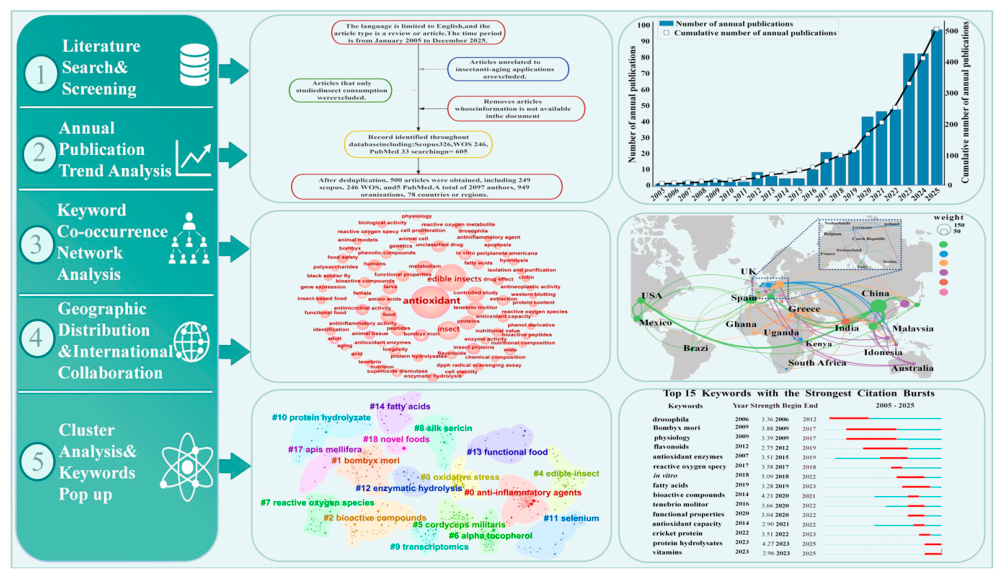
Figure 2.
The classification of insect species with clear anti-aging potential screened through literature in seven orders.3.1 Anti-aging insect species.
Figure 2.
The classification of insect species with clear anti-aging potential screened through literature in seven orders.3.1 Anti-aging insect species.
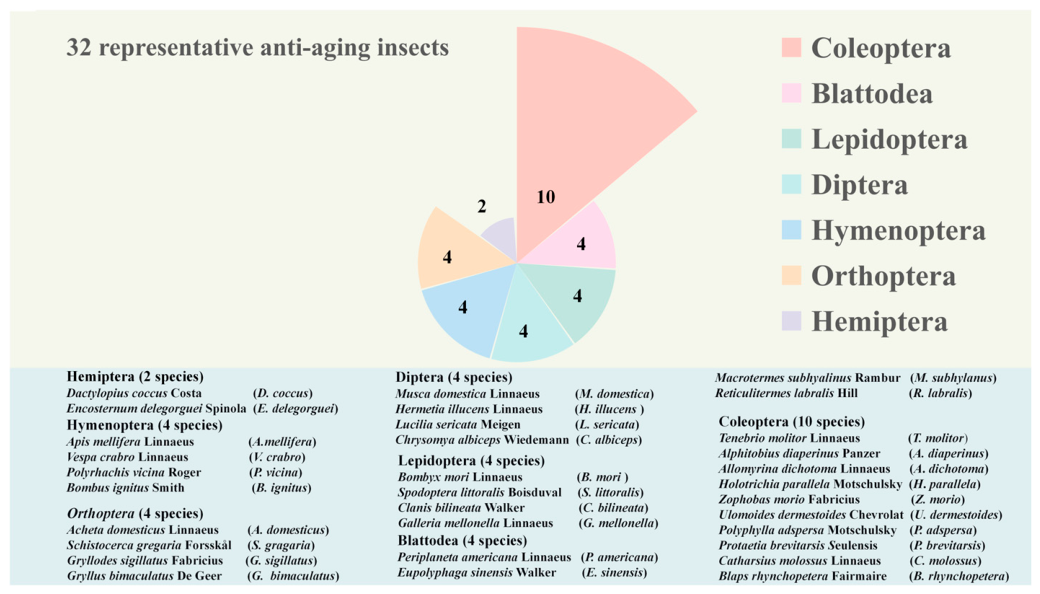
Figure 3.
Preparation and extraction flow of insect-derived anti-aging ingredients.3.3.1 Physically assisted extraction.
Figure 3.
Preparation and extraction flow of insect-derived anti-aging ingredients.3.3.1 Physically assisted extraction.
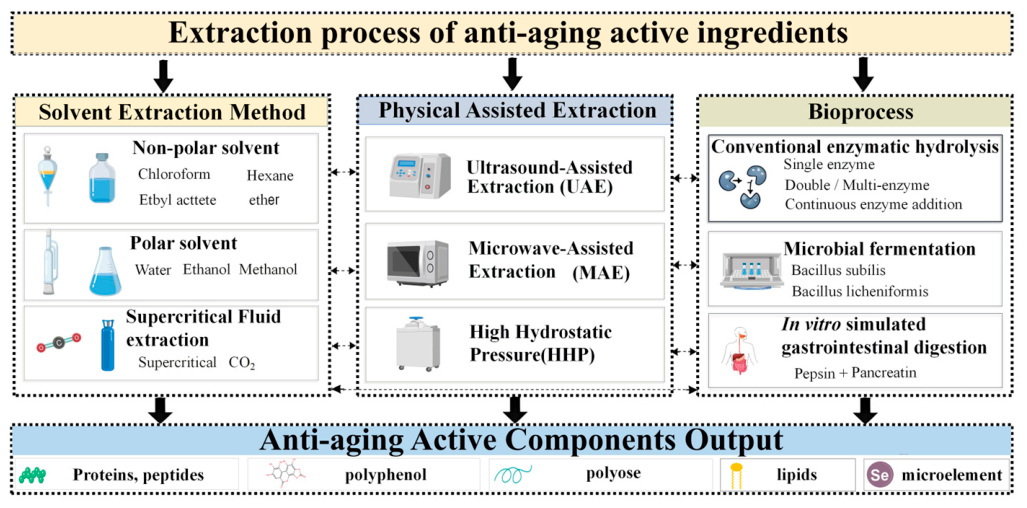
Figure 4.
Integrated multi-target and multi-pathway mechanisms of insect-derived bioactive components against aging.Collectively, they synergistically facilitate cellular energy metabolism and cognitive impairment in models. Insect-derived bioactive compounds exert anti-aging effects by targeting multiple nodes across these core nutrient-sensing pathways. First, insect-derived components regulate energy homeostasis and cerebral function via the AMPK/SIRT axis. Aqueous extracts derived from the combined powder of Zophobas atratus Fabricius and T. molitor efficiently activate the hippocampal AMPK signaling pathway via increasing the p-AMPK/AMPK ratio [69]. In D-galactose-induced aging mice, extracts from T. molitor and P. brevitarsis restore the protein levels of SIRT1 and SIRT3 in the prefrontal cortex and hippocampus of aged mice to physiological ranges [14]. Second, The IIS pathway represents an evolutionarily conserved lifespan-extending mechanism in insects. Royal jelly, for example, suppresses IIS signaling through activating downstream transcription factors, including DAF-16 and FOXO [70]. Trophallactic fluid secreted by reproductive individuals of Reticulitermes labralis Hsia et Fan contains bioactive compounds that modulate the IIS pathway to mediate lifespan regulation [71]. Third, insect-derived protein hydrolysates delay senescence by inhibiting the PI3K/Akt/mTOR signaling cascade. QBLE, a proteolytic hydrolysate obtained from A. mellifera larval royal jelly, prolongs the lifespan of Drosophila melanogaster by restraining the PI3K/Akt/mTOR cascade and downregulating the expression of associated kinases and target genes [27]. Collectively, insect-derived bioactive agents cover all three core branches of the nutrient-sensing network, coordinating energy homeostasis maintenance and lifespan control to exert multi-dimensional anti-aging effects.
Figure 4.
Integrated multi-target and multi-pathway mechanisms of insect-derived bioactive components against aging.Collectively, they synergistically facilitate cellular energy metabolism and cognitive impairment in models. Insect-derived bioactive compounds exert anti-aging effects by targeting multiple nodes across these core nutrient-sensing pathways. First, insect-derived components regulate energy homeostasis and cerebral function via the AMPK/SIRT axis. Aqueous extracts derived from the combined powder of Zophobas atratus Fabricius and T. molitor efficiently activate the hippocampal AMPK signaling pathway via increasing the p-AMPK/AMPK ratio [69]. In D-galactose-induced aging mice, extracts from T. molitor and P. brevitarsis restore the protein levels of SIRT1 and SIRT3 in the prefrontal cortex and hippocampus of aged mice to physiological ranges [14]. Second, The IIS pathway represents an evolutionarily conserved lifespan-extending mechanism in insects. Royal jelly, for example, suppresses IIS signaling through activating downstream transcription factors, including DAF-16 and FOXO [70]. Trophallactic fluid secreted by reproductive individuals of Reticulitermes labralis Hsia et Fan contains bioactive compounds that modulate the IIS pathway to mediate lifespan regulation [71]. Third, insect-derived protein hydrolysates delay senescence by inhibiting the PI3K/Akt/mTOR signaling cascade. QBLE, a proteolytic hydrolysate obtained from A. mellifera larval royal jelly, prolongs the lifespan of Drosophila melanogaster by restraining the PI3K/Akt/mTOR cascade and downregulating the expression of associated kinases and target genes [27]. Collectively, insect-derived bioactive agents cover all three core branches of the nutrient-sensing network, coordinating energy homeostasis maintenance and lifespan control to exert multi-dimensional anti-aging effects.
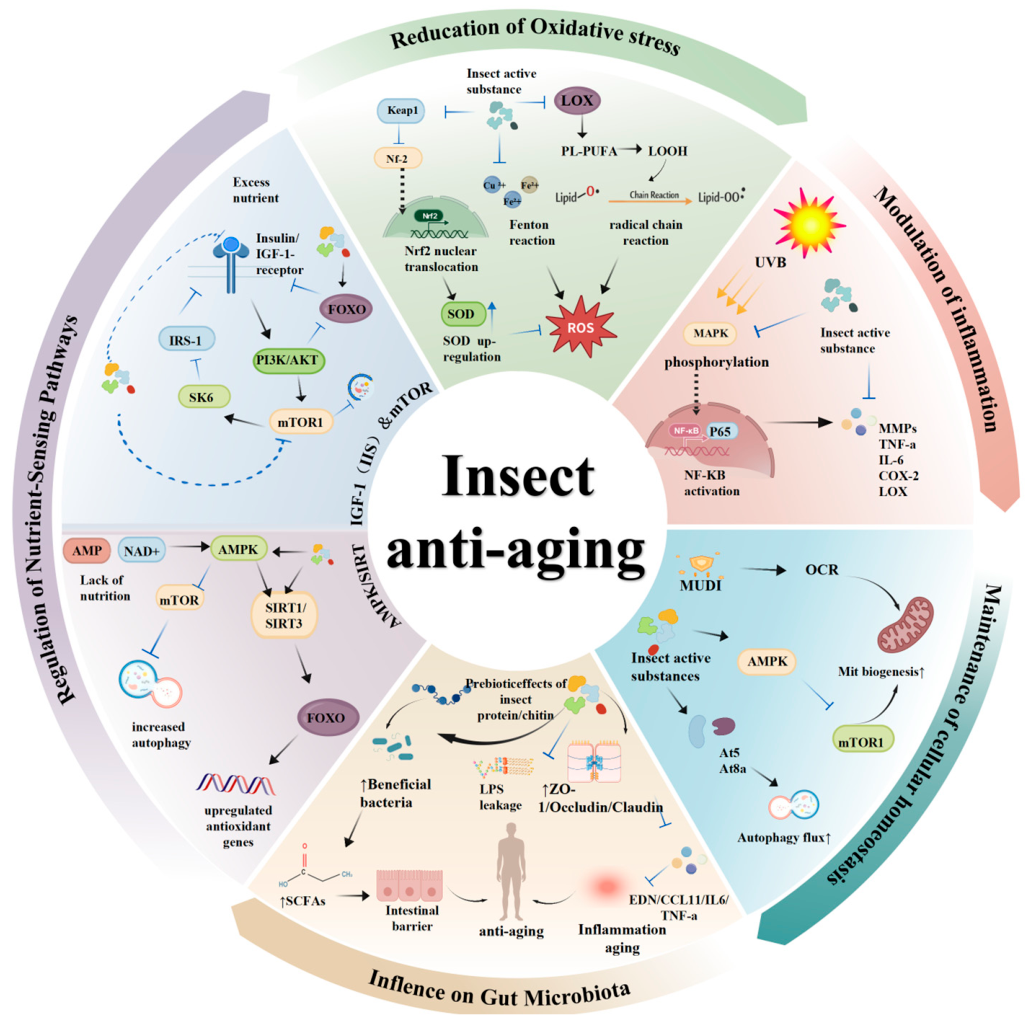
Figure 5.
Multi-scenario applications of insect-derived bioactive components in anti-aging intervention.5.1 Oral anti-aging products.
Figure 5.
Multi-scenario applications of insect-derived bioactive components in anti-aging intervention.5.1 Oral anti-aging products.
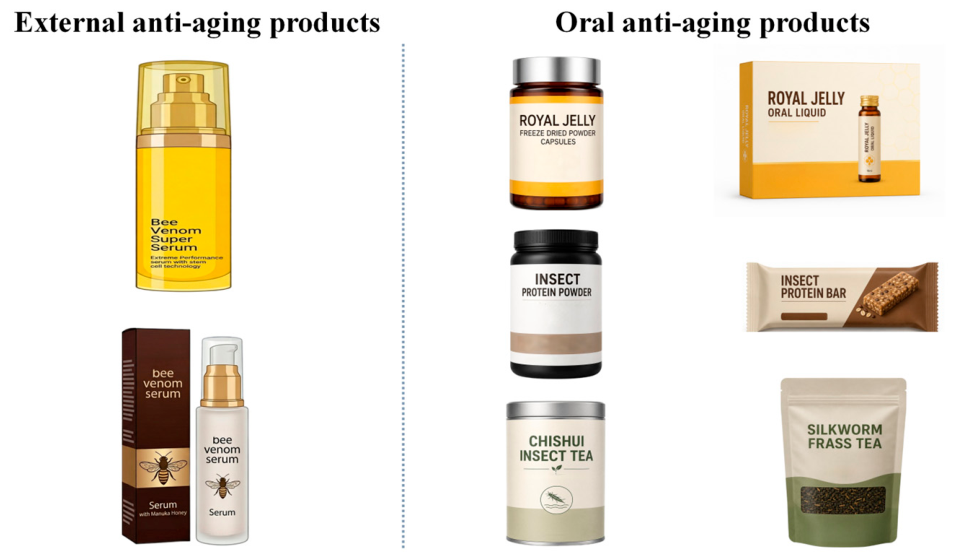

Table 1.
Functional substances and action mechanisms in common anti-ageing insect species.
| Bioactive components | Insects | Characteristic structure/sequence | Associated anti-aging phenotype/pathway | Ref. |
|---|---|---|---|---|
| Protein/Peptide | S. gregaria | FDPFPK | ABTS radical scavenging (EC₅₀ 0.08 mg/mL), DPPH radical scavenging (EC₅₀ 0.35 mg/mL), LOX ↓ (IC₅₀ 2.85 mg/mL) | [31] |
| AIGVGAIER | LOX ↓ (IC₅₀ 20.29 mg/mL),COX-2 ↓ (IC₅₀ 8.96 mg/mL) | [31] | ||
| Oecophylla smaragdina Fabricius | CTKKHKPNC | ABT Sradical scavenging | [32] | |
| H. illucens | GYGFGGGAGCLSMDTAGAHLNR, VVPSANRAMVGIVAGGGRIDKPILK, AGLQFPVGR, GFKDQIQDVFK etc. | ROS ↓, Nrf2 nuclear translocation ↑, ABTS/DPP hradical scavenging | [33,34] | |
| A. mellifera | MRJPs | IIS ↓, TOR ↓, EGF ↑ | [35] | |
| Lipids | A. mellifera | 10-HDA | IIS ↓, TOR ↓, EGF ↑, HDAC ↓ | [36] |
| H. illucens | PUFAs/MUFAs | Collagen synthesis ↑, tyrosinase activity ↓ | [24] | |
| Polyphenols | Luprops tristis fabricius | 2,5-dimethylhydroquinone; 1,3-dihydroxy-2-methylbenzene | DPPH, ABTS free radical scavenging | [37] |
| A. domesticus | 4-Hydroxybenzoic acid, p-Coumaric acid, ferulic acid and Syringic acid | MMP-1 ↓ (IC₅₀ 26 mg/mL), hyaluronidase ↓ (IC₅₀ 34 mg/mL), TGF-β1 ↑, ABTS radical scavenging (EC₅₀ 0.08 mg/mL) | [38] | |
| Polysaccharides | Paecilomyces cicadae (Miq.) Samson | CP70 | Lifespan ↑, CAT/SOD1/MTH ↑, MDA ↓ | [39] |
| Catharsius molossus Linnaeus | GAG | Antioxidant pathway, lipid metabolism regulation, matrix remodeling | [40] | |
| Clanis bilineata Tsingtauica | CBLSWSC | SOD ↑, GSH-Px ↑, MDA ↓ | [41] | |
| Trace elements | Brachytrupes orientalis Burmeister | Cu/Zn/Mn | Nrf2, AMPK | [42,43] |
| T. molitor | Se | GPx activity ↑, antioxidant defense ↑, immunomodulation ↑ | [44] |
Disclaimer/Publisher’s Note: The statements, opinions and data contained in all publications are solely those of the individual author(s) and contributor(s) and not of MDPI and/or the editor(s). MDPI and/or the editor(s) disclaim responsibility for any injury to people or property resulting from any ideas, methods, instructions or products referred to in the content. |
© 2026 by the authors. Licensee MDPI, Basel, Switzerland. This article is an open access article distributed under the terms and conditions of the Creative Commons Attribution (CC BY) license (http://creativecommons.org/licenses/by/4.0/).
Copyright: This open access article is published under a Creative Commons CC BY 4.0 license, which permit the free download, distribution, and reuse, provided that the author and preprint are cited in any reuse.