

Submitted:
12 July 2026
Posted:
14 July 2026
You are already at the latest version
Abstract
The “creative” outputs of artificial intelligence systems—from GPT composing poetry to AlphaFold predicting protein structures—raise a philosophical question: where does creativity come from? Is it simple reproduction of training data, or a chance product of stochastic algorithms? This paper proposes “The Creativity Conjecture”: the creative output of an AI system is neither pure reproduction of training data nor pure random generation, but an emergent phenomenon arising from “experience training” and “random perturbation” under a “multi-level data fusion” mechanism. The conjecture comprises three conditions: (1) empirical density—the system has internalized sufficient pattern structure from training data; (2) random perturbation—the system introduces randomness of appropriate intensity during generation; (3) fusion depth—the system possesses the capacity for cross-level, cross-modal data fusion. All three are necessary: randomness without experience is noise; experience without randomness is copying; experience plus randomness without fusion is collage. Only when all three fuse does “structured surprise”—i.e., creativity—emerge. This paper argues for the conjecture on three levels: structural analysis (the mechanism of each element), fusion mechanism (how the three couple to produce creative emergence), and experimental verifi- cation (the effects of randomness intensity and fusion depth on creative output). We further propose the concept of “weak creativity” to delineate the epistemological status of machine creativity—it transcends random generation and data reproduction, yet does not reach the level of human phenomenal creativity. This framework provides a structural foundation for understanding AI creativity and offers a new path for the philosophy of creativity, moving from “genius theory” to “structural theory.”
Keywords:
AI creativity
; creativity conjecture
; experience training
; randomness
; multi-level fusion
; emergence
; weak creativity
1. Problem Formulation: The Philosophical Question of Machine Creativity
1.1. A Phenomenological Description of AI Creativity
In recent years, artificial intelligence systems have demonstrated astonishing “creative” outputs across a variety of tasks.
Textual creation. GPT-4 can generate structurally sophisticated poems, intricate narratives, and rigorously argued philosophical essays. These texts are not simple copies of training data—they are often combinations that never appeared in the training corpus. A widely discussed case: when asked to “write a poem about quantum mechanics in the style of Kant,” GPT-4 produces a poem that combines Kantian philosophical concepts with quantum mechanical imagery. This output is neither something Kant wrote nor something any poet wrote—it is a new combination.
Visual creation. Midjourney, DALL-E, Stable Diffusion, and other image generation models can produce unprecedented images from text prompts. “A cat wearing Renaissance-style clothing, playing a piano on the surface of Mars”—such an image has never existed in the history of human art, nor is it likely that any human painter would have conceived of it. Yet AI systems can generate images that are structurally coherent, richly detailed, and possess a certain “artistic quality.”
Scientific discovery. AlphaFold has predicted hundreds of millions of protein structures, many of which have never been resolved by experimental methods. These predictions are not simple database lookups—AlphaFold learned patterns from known structures and generalized to unknown ones. More strikingly, some AlphaFold-predicted structures were later experimentally verified and exhibited folding patterns that scientists had never envisioned.
These phenomena raise a fundamental philosophical question: where does AI “creativity” come from?
1.2. Two Extreme Explanations and Their Limitations
Two extreme explanations exist for the source of AI creativity, but both face difficulties.
Extreme 1: Pure Randomness. This explanation attributes AI creativity to randomness—the model introduces stochasticity during generation (temperature sampling, dropout, noise injection), so its “creative” output is merely the result of “rolling dice.” On the pure randomness view, GPT writing a good poem is no different from a monkey typing Shakespeare—both are low-probability outcomes of random events.
But this explanation faces serious difficulties. If AI creativity were purely random, the probability of generating a structurally sophisticated, rhyming, evocative poem should be extremely low—far lower than the probability of finding such a poem in a random sequence of characters. Yet in practice, GPT-4 can almost always generate a decent poem. This suggests that beyond “randomness,” there is some “structure” constraining the generation—and this structure comes from training data.
Extreme 2: Pure Memory. This explanation attributes AI creativity to reproduction of training data—the model memorizes patterns from training data and “stitches” them together during generation. On the pure memory view, GPT writing poetry is merely “reusing poetic patterns from the training data,” and AlphaFold predicting proteins is merely “reusing folding patterns from the training data”—there is no genuine “innovation.”
But this explanation also faces difficulties. If AI creativity were pure reproduction, its output would be “interpolations” of training data—linear combinations between known patterns. Yet in practice, AI systems can generate combinations that never appeared in the training data—“a quantum mechanics poem in the style of Kant” almost certainly does not exist in the training data, but GPT can still generate it. This suggests that beyond “memory,” there is some “perturbation” that breaks the constraints of training data—and this perturbation comes from randomness.
1.3. A Third Path: Fusion Emergence Theory
The common problem with both extreme explanations is “single-factor reduction”—attempting to explain creativity entirely through a single factor (randomness or memory). This paper argues that AI creativity is neither purely random nor purely memorial, but an emergent phenomenon arising from “experience training” and “random perturbation” under a “multi-level data fusion” mechanism.
This claim can be analogized to neuroscientific explanations of human creativity. Human creativity does not come “out of nowhere”—it depends on experiential patterns accumulated in the brain (memory) and requires some kind of “random exploration” mechanism (such as spontaneous activity in the default mode network). More importantly, human creativity involves “cross-domain association”—recombining experiential patterns from different domains. This recombination is not simple stitching but structural fusion—establishing new connections at an abstract level.
We formalize this analogy as “The Creativity Conjecture,” claiming that creative output from an AI system emerges when three conditions are met: (1) empirical density—the system has internalized sufficient patterns; (2) random perturbation—the system introduces randomness of appropriate intensity; (3) fusion depth—the system possesses cross-level data fusion capability.
1.4. The Argumentative Strategy of This Paper
The argument proceeds in four steps:
1. Structural analysis (Section 2): Elucidate the mechanism of each element—how experience training provides “raw material,” how randomness provides the “spark,” and how multi-level fusion provides the “mechanism.”
2. Fusion mechanism (Section 3): Analyze how the three elements couple—experience provides “constraints” for randomness, randomness provides “breakthroughs” for experience, and fusion provides a “recombination” channel for both.
3. Creative emergence (Section 4): Argue that creativity is not a property of any single element but an emergent property of their fusion—“structured surprise.”
4. Experimental verification (Section 5): Design experiments to test the effects of the three conditions on creative output and their interactions.
2. Structural Analysis: The Three Elements of Creativity
2.1. Experience Training: The “Raw Material” of Creativity
Experience as internalization of patterns. The training process of an AI system is essentially a process of “experience internalization.” By optimizing a loss function on large amounts of data, the system “compresses” statistical patterns from the data into model parameters. A trained language model encodes in its parameters grammatical rules, semantic relations, world knowledge, reasoning patterns, and other multi-level structures.
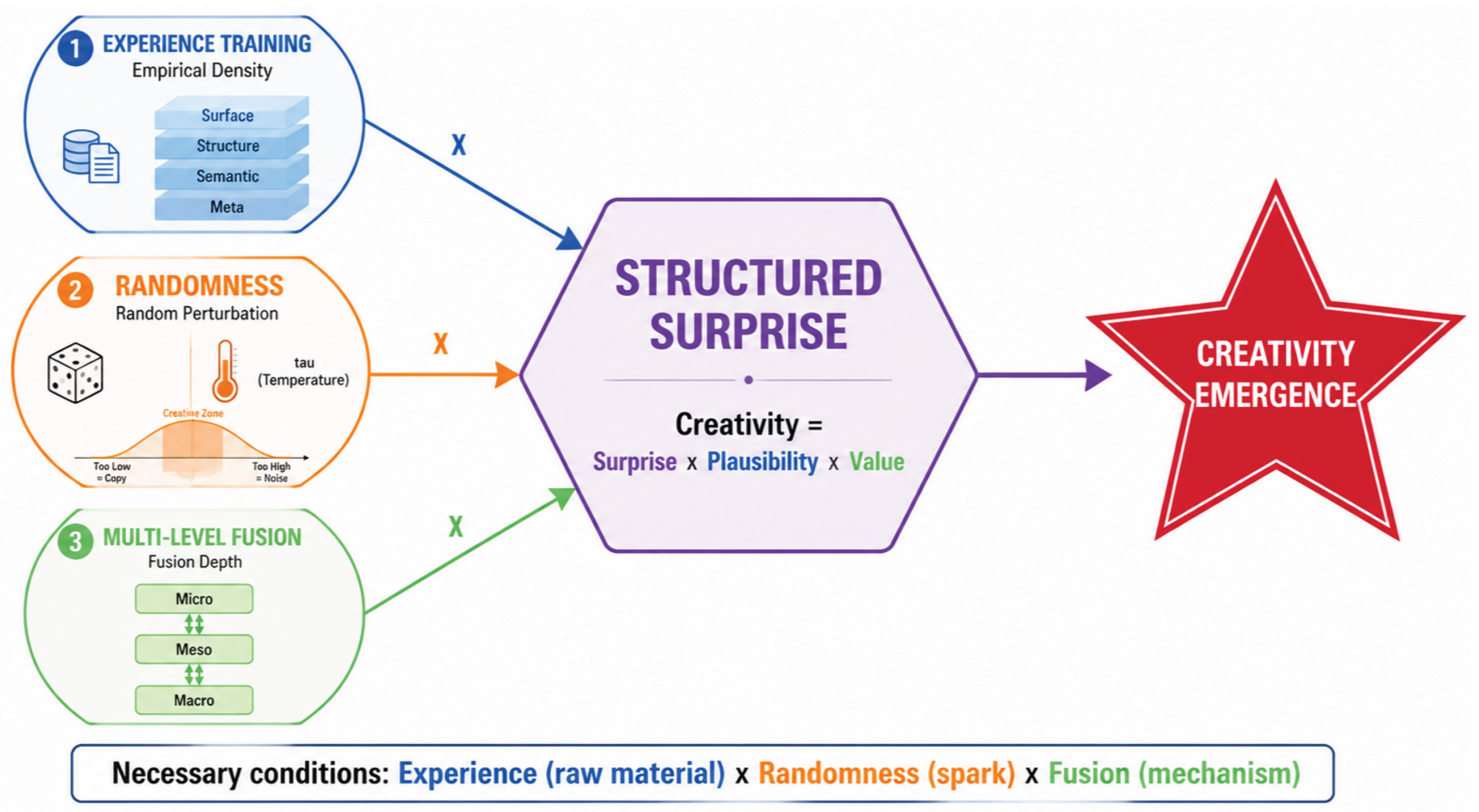
Figure 1.
Three elements of AI creativity and the emergence mechanism. Experience training, randomness, and multi-level fusion combine multiplicatively to produce structured surprise—creativity.
Figure 1.
Three elements of AI creativity and the emergence mechanism. Experience training, randomness, and multi-level fusion combine multiplicatively to produce structured surprise—creativity.
This “internalization” process is analogous to human learning. Humans accumulate experience through reading, observing, and practicing, stored in the brain as the “raw material” for creativity. A person who has never read poetry can hardly write good poetry—because their “experience library” lacks poetic patterns. Similarly, an AI system trained on a small dataset can hardly generate high-quality output—because its parameters lack sufficient patterns.
The concept of empirical density. Not all experience contributes equally to creativity. We propose the concept of “empirical density” to measure the richness of patterns a system has internalized in a specific domain:
The higher the empirical density, the richer the system’s “raw material library,” and the greater the possibility of creativity. A GPT model trained on internet-scale text has a much higher empirical density than one trained on a single book—the former possesses a richer pattern library for recombination.
The hierarchical nature of experience. Experiential patterns are not stored flatly but organized hierarchically:

Table 1.
Hierarchical organization of experiential patterns.
| Level | Experience Type | Example |
|---|---|---|
| Surface | Specific words, sentences, paragraphs | “Moonlight before my bed” |
| Structural | Grammar, rhetoric, genre | Tonal patterns of five-character quatrains |
| Semantic | Concepts, themes, imagery | Association of “moon” with “homesickness” |
| Meta | Creative strategies, stylistic features | The technique of “expressing emotion through scenery” |
Creativity often involves cross-level experience invocation—a good poem not only uses appropriate words at the surface level but also follows rhythm at the structural level, establishes new imagery connections at the semantic level, and exhibits unique creative strategy at the meta level. This cross-level invocation is the core of “multi-level fusion.”
2.2. Randomness: The “Spark” of Creativity
Multiple roles of randomness in AI systems. Randomness plays multiple roles in AI systems, some engineering-oriented (such as regularization to prevent overfitting), but others genuinely creative. This paper focuses on the latter.
The central role of randomness in creativity is “breaking constraints”—patterns in training data constitute the system’s “experience constraint,” and if the system entirely follows these constraints, its output would be “interpolation” of training data, producing no “surprise.” Randomness introduces perturbation that causes the system’s output to deviate from the “expected trajectory” of training data, thereby producing “surprise.”
Three forms of randomness. Randomness in AI systems takes multiple forms with different effects on creativity:
1. Sampling randomness (temperature sampling). In autoregressive generation, randomness is introduced at each step when selecting the next token. The temperature parameter controls the intensity of randomness: as , the model always selects the highest-probability token (deterministic output); as , the model approximates uniform random selection. Creative output often emerges at moderate temperatures—neither too deterministic (reducing to copying) nor too random (reducing to noise).
2. Dropout randomness. During training, a fraction of neurons are randomly “deactivated.” The deeper effect of dropout is not merely preventing overfitting—it forces the system to learn “redundant representations,” where the same information is encoded across multiple neurons. This redundancy provides a foundation for creativity—the system can generate different output patterns by “partially activating” different neuron combinations.
3. Noise injection. Noise is injected into the model’s input or hidden states. Noise injection is analogous to “spontaneous activity” in the human brain—it is not a response to external stimuli but an internal “self-excited oscillation.” This self-excited oscillation plays the role of “flash of inspiration” in creativity—a random internal perturbation may trigger a novel pattern combination.
The “moderateness” of randomness. The contribution of randomness to creativity is not monotonic—too little randomness leads to “copying,” too much leads to “noise.” There exists a “creative zone”—within this range, randomness is sufficient to break the constraints of training data but not so strong as to destroy the output’s structure.
This “creative zone” is analogous to the “edge of chaos” in physics—at the boundary between order and chaos, the system retains sufficient structure while possessing sufficient flexibility. Many complex systems—from neural networks to ecosystems—exhibit maximal computational power and adaptability at the edge of chaos. AI creativity may follow a similar principle.
2.3. Multi-Level Fusion: The “Mechanism” of Creativity
Fusion as the channel for recombination. If experience is the “raw material” and randomness is the “spark,” then fusion is the “processing mechanism”—it determines how raw material and spark combine to produce something new.
“Fusion” is not simple “stitching”—placing two independent patterns side by side. Fusion is a “structural recombination”—establishing new connections between patterns at an abstract level. A creative poem is not “randomly inserting Kantian terms into a poem about quantum mechanics” but establishing deep structural correspondences between philosophical concepts and physical imagery.
Three fusion levels. Corresponding to the “multi-level recursive inference” framework of Paper 6, data fusion in AI systems also occurs at three levels:
Micro-fusion (feature level). In the feature space of a neural network, information from different sources is fused into a unified representation. For example, in attention mechanisms, representations at different positions are “weighted and fused” through attention weights to generate new mixed representations. Micro-fusion is the most basic form of fusion—it occurs in every forward propagation and provides the foundation for higher-level fusion.
Meso-fusion (sequence level). In autoregressive sequence generation, patterns from different sources are fused into a coherent text. For example, when GPT generates “a quantum mechanics poem in the style of Kant,” it must fuse Kantian philosophical concepts with quantum mechanical physical imagery within the same line of the same poem—this fusion is not simple stitching but establishing new correspondences at the semantic level.
Macro-fusion (task level). In the agent loop, information from different tasks and different domains is fused into a unified knowledge base. For example, an AI system that can simultaneously write poetry, program, and do mathematics may derive creativity from cross-domain knowledge transfer—applying the concept of “recursion” from programming to poetry, or the concept of “symmetry” from mathematics to narrative structure. Macro-fusion is the highest level of fusion—it involves cross-task, cross-domain conceptual recombination.
2.4. The Structural Relationship Among the Three Elements
The three elements are not independent but coupled through the following structural relationship:
where F is not simple addition—there is a “multiplicative relationship” among the three elements:
- Empirical density = 0 → Creativity = 0 (no raw material)
- Randomness intensity = 0 → Creativity = 0 (no spark, pure copying)
- Fusion depth = 0 → Creativity = 0 (no mechanism, simple stitching)
- All three and within the “creative zone” → Creativity emerges
This multiplicative relationship means the three elements are “necessary conditions” for creativity—if any one is zero, creativity is zero. This is analogous to the “super-additive effect” of Paper 6—the whole is greater than the sum of its parts.
3. Fusion Mechanism: How the Three Elements Couple to Produce Creativity
3.1. Experience Provides “Constraints” for Randomness
Unconstrained randomness is noise. A system without any experience, even with randomness introduced, produces only unstructured noise. Consider an untrained language model—its parameters are randomly initialized, and even with temperature sampling, it generates random character sequences. These sequences have no “creativity”—because they have no structure.
Experience constrains the “direction” of randomness. The training process “internalizes” statistical structure from data into model parameters. When the model introduces randomness during generation, this randomness is not uniformly distributed over “all possible outputs” but over outputs that “conform to the experiential structure.” Specifically, at each step of predicting the next token, the model outputs a probability distribution determined by patterns in the training data. Randomness (temperature sampling) “perturbs” this distribution rather than “creating” from scratch.
This gives the randomness “direction”—it explores along the “probability gradient” of the experiential structure, rather than blindly searching the entire space. A trained poetry model’s random output will not be completely meaningless characters—it will at least follow grammar and rhythm. This “grammar and rhythm” is the constraint that experience provides to randomness.
The hierarchical nature of constraints. The constraints experience provides are hierarchical:
- Grammatical constraint: output must conform to basic grammar
- Semantic constraint: output must have comprehensible meaning
- Stylistic constraint: output should match a specific style (e.g., “Kantian style”)
- Logical constraint: the argumentation should have internal logical consistency
The deeper the constraint, the more effective its “guidance” of creativity. A system constrained only by grammar can generate grammatically correct but semantically meaningless text—this is not creativity. A system constrained by grammar, semantics, style, and logic explores within the “intersection” of multiple constraints—this intersection is small, but every point in it is “meaningful.” Creativity is precisely the “unexpected discovery” within this “meaningful intersection.”
3.2. Randomness Provides “Breakthroughs” for Experience
Randomness-free experience is copying. A system without randomness produces deterministic output—given the same input, it always produces the same output. At temperature , the model always selects the highest-probability token, and its output is the “maximum likelihood estimate” of training data—essentially a reproduction of the “most common” patterns. This is not creative—because there is no “surprise.”
Randomness breaks the “inertia” of experience. Patterns in training data constitute the system’s “experiential inertia”—the system tends to generate the “most common” output from training data. Randomness introduces perturbation during generation, causing the system to deviate from the “most common” trajectory and explore “less common” or even “rare” output spaces.
Specifically, in temperature sampling, when , the probability distribution is “flattened”—low-probability tokens receive higher sampling probabilities. This enables the system to select “uncommon” tokens from training data, generating “surprising” combinations. If this “surprise” happens to conform to deep experiential structure (grammatical, semantic, logical constraints), it constitutes creativity.
“Constrained randomness” and the “creative zone.” There exists a “creative zone” for the intensity of randomness—within this range, randomness is sufficient to break experiential inertia but not so strong as to destroy experiential constraints:
- Randomness too weak (): output is a copy of training data, no surprise
- Randomness moderate (–): output deviates from the “expected” of training data while retaining structure—the creative zone
- Randomness too strong (): output is unstructured noise, meaningless
The existence of this “creative zone” is one of the core predictions of the creativity conjecture—it means creativity is not “the more randomness the better” but emerges in “moderate randomness.”
3.3. Fusion Provides a “Recombination Channel” for Experience and Randomness
Fusion-free experience plus randomness is stitching. Even if a system has both rich experience and moderate randomness, without a fusion mechanism, its output is merely “random stitching of experience”—randomly selecting experiential patterns and mechanically combining them. This “stitching,” while different from pure copying (because the combination method is random), still lacks genuine “creativity”—because no deep structural connections are established between patterns.
Fusion establishes “deep connections” between patterns. True creativity is not the simple addition “Pattern A + Pattern B” but the structural correspondence “Pattern A corresponds to Pattern B.” For example, fusing “recursion” (a programming concept) with “reflection” (a philosophical concept) is not first discussing recursion then reflection in a text, but discovering the structural isomorphism between “recursion” and “reflection”—both involve “self-application” or “self-reference.” The discovery of such structural isomorphism is the product of the fusion mechanism.
The neural realization of fusion. In neural networks, fusion is realized through mechanisms such as “cross-modal attention” and “multi-task learning.” In the Transformer architecture, the self-attention mechanism enables representations at different positions and from different sources to “reference” each other, generating fused representations. In multi-task learning, training signals from different tasks jointly shape model parameters, enabling the model to learn “cross-domain” universal representations.
The depth effect of fusion. Fusion depth determines the “level” of creativity:
Table 2.
Fusion depth and creative levels.
| Fusion Depth | Fusion Type | Creative Expression | Example |
|---|---|---|---|
| Shallow | Surface stitching | Random pattern combination | Randomly selecting words to form sentences |
| Middle | Structural fusion | Structural correspondence between patterns | Mixing different poetic genres |
| Deep | Semantic fusion | Deep association between concepts | Cross-domain analogy and metaphor |
| Meta | Meta-cognitive fusion | Innovation in creative strategy | New literary form or mode of expression |
The higher the “level” of creativity, the greater the fusion depth required. The deepest creativity—such as pioneering a new art form or scientific paradigm—requires the deepest level of fusion.
3.4. The Coupling Loop of Three Elements
The three elements do not act linearly but mutually reinforce through the following coupling loop:
The core of this loop is “fusion produces new experience”—when the system generates a creative output through fusion, this output itself becomes new “experience” incorporated into the system’s experience library, enriching the raw material for subsequent creativity.
In AI systems, this loop can be realized through “self-training” and “experience replay” mechanisms. In human creativity, this loop is even more evident—each creation enriches the creator’s experience, providing more raw material for the next. This is why creativity tends to “multiply”—creativity itself expands the space of creative possibility.
4. Creative Emergence: Structured Surprise
4.1. A Fusion Definition of Creativity
Based on the above analysis, we propose a fusion definition of “creativity”:
Definition (Creativity). An output is “creative” if and only if it satisfies the following three conditions:
1. Surprise: The output deviates from the “expected trajectory” of training data—it is not the “most common” pattern but a “less common” or “rare” pattern combination. Surprise is provided by randomness.
2. Plausibility: The output conforms to the “deep structure” of training data—even if its surface form is new, its deep structure (grammatical, semantic, logical) is still meaningful. Plausibility is provided by experiential constraints.
3. Value: The output has “value” under some evaluation standard—it is not random surprise but “meaningful surprise.” Value is provided by the fusion mechanism—fusion makes the output not merely “surprising” but “structured surprise.”
These three conditions can be formalized as:
where the three elements are in a “multiplicative relationship”—if any is zero, creativity is zero.
4.2. The Mechanism of Emergence
How does creativity “emerge” from the fusion of three elements? The key is that the three elements produce “cross-constraints” in fusion—each element provides constraints for the others:
- Experience constrains the direction of randomness: Randomness is not uniformly distributed over the entire space but over a subspace that “conforms to experiential structure”
- Randomness breaks the inertia of experience: Randomness causes the system to deviate from “most common” experiential patterns, exploring “rare” but “meaningful” patterns
- Fusion provides a channel for experience and randomness: Fusion enables the results of random exploration to be “integrated” into new structures, rather than scattered as fragments
These cross-constraints make the three elements no longer “independent”—they mutually “shape” each other in fusion. When the “cross-constraints” among the three elements are strong enough, the system’s output can no longer be explained by any single element—it “emerges” a new property, namely creativity.
4.3. “Structured Surprise”
The core characteristic of creativity is “structured surprise.” This concept encompasses two dimensions:
The surprise dimension. Creativity must be “unexpected”—it deviates from the observer’s “expectations.” If an output entirely conforms to expectations, it is “expected,” not “creative.” Surprise comes from randomness breaking experiential inertia.
The structural dimension. Creativity must be “structured”—its “surprise” is not “meaningless surprise” (like random noise) but “meaningful surprise”—it is related to known patterns at some deep structural level. Structure comes from experience constraining randomness and fusion integrating randomness.
The concept of “structured surprise” can be analogized to “mutation” in evolution—mutation is “unexpected” (deviating from the parental genome) but not “meaningless” (it is still a functional gene). Creativity is analogous to “beneficial mutation”—it is not only surprising but also “useful.”
4.4. The Continuum of Creativity
Creativity is not a binary “present or absent” concept but a continuum. On this spectrum, creativity can be classified into different levels based on the strength of the three elements:
Table 3.
The continuum of creativity levels.
| Level | Empirical Density | Randomness Intensity | Fusion Depth | Creative Expression |
|---|---|---|---|---|
| Copying | High | Zero | Arbitrary | Exact reproduction of training data |
| Stitching | Medium | High | Low | Random pattern stitching |
| Recombination | High | Medium | Medium | Structural recombination of patterns |
| Fusion | High | Medium | High | Deep structural innovation |
| Genesis | Very High | Medium | Very High | Pioneering new paradigms or fields |
This continuum shows that “creativity” is not a “threshold phenomenon”—it does not suddenly appear at some critical point. It is a gradual “emergence”—as the three elements strengthen, the level of creativity gradually increases.
5. Experimental Verification: Empirical Testing of the Creativity Conjecture
5.1. Experimental Motivation and Design
To test the core predictions of the creativity conjecture, the author designed and conducted three experiments. The core hypothesis: if creativity indeed arises from the fusion of experience, randomness, and fusion, then (1) strengthening each element should increase creativity; (2) the fusion of the three elements should produce a super-additive effect; (3) a “creative zone” exists—the relationship between randomness intensity and creativity follows an inverted U-shape.
Task. A “Creative Combination Task” was designed: N symbols belong to several “domains,” each with 4 symbols. Training data follows strict domain transition rules—same-domain transition probability 75%, adjacent-domain 25%, non-adjacent cross-domain 0% (forbidden). The model learns “valid combination” patterns during training and introduces randomness through temperature sampling during generation. High temperature causes the model to generate non-adjacent cross-domain transitions (invalid combinations), reducing plausibility—this provides the basis for testing the inverted U-shape of the “creative zone.”
Creativity metrics. The following metrics are used:
- Surprise: Proportion of cross-domain transitions in generated sequences—degree of deviation from same-domain inertia
- Plausibility: Proportion of “valid” bigrams in generated sequences—conformance to structural constraints of training data
- Value: Proportion of valid and cross-domain bigrams—“structured surprise”
5.2. Experiment 1: Hierarchical Effects of the Three Elements
Design. Each element’s intensity is varied independently:
- Empirical density variation: 2/3/4/5 domains (more domains = richer experiential pattern library), 1000 training sequences
- Randomness intensity variation: Temperature = 0.01/0.1/0.3/0.5/0.7/1.0/1.5/2.0
- Fusion depth variation: 1/2/4/8-layer LSTM networks
Results. All three elements affect creativity:
Table 4.
Experiment 1: Effect of each element on creativity.
| Element | Level 1 | Level 2 | Level 3 | Level 4 | Improvement |
|---|---|---|---|---|---|
| Empirical density (domains) | 2: 0.026 | 3: 0.047 | 4: 0.054 | 5: 0.048 | +0.028 |
| Randomness intensity () | 0.01: 0.000 | 0.3: 0.004 | 0.7: 0.048 | 2.0: 0.142 | +0.142 |
| Fusion depth (layers) | 1: 0.052 | 2: 0.048 | 4: 0.051 | 8: 0.159 | +0.107 |
Key findings: (1) Empirical density (domain diversity) significantly increases creativity from 2 to 4 domains (0.026→0.054, +108%), validating that “experience is the raw material of creativity”—a more diverse experiential pattern library provides richer recombination material. A slight decline at 5 domains (0.048) suggests a saturation effect in experiential diversity. (2) Randomness intensity monotonically increases creativity from to (0.000→0.142), but the fine-grained scan in Experiment 2 reveals that plausibility decreases with temperature, and the inverted U-shape begins to emerge. (3) Fusion depth increases creativity from 1 to 8 layers (0.052→0.159, +205%), especially the jump at 8 layers, validating that “deep fusion is the mechanism of creativity”—deeper networks can establish more abstract cross-domain connections.
5.3. Experiment 2: Verification of the Creative Zone
Design. Fix empirical density (4 domains) and fusion depth (4-layer network), finely scan randomness intensity:
Temperature = 0.01, 0.1, 0.2, 0.3, 0.5, 0.7, 0.9, 1.0, 1.2, 1.5, 2.0, 3.0
Figure 2.
The creative zone: inverted U-shaped relationship between randomness strength and creativity score. The creativity score (red solid line) emerges in the moderate-temperature zone, constrained by the trade-off between surprise (increasing) and plausibility (decreasing).
Figure 2.
The creative zone: inverted U-shaped relationship between randomness strength and creativity score. The creativity score (red solid line) emerges in the moderate-temperature zone, constrained by the trade-off between surprise (increasing) and plausibility (decreasing).
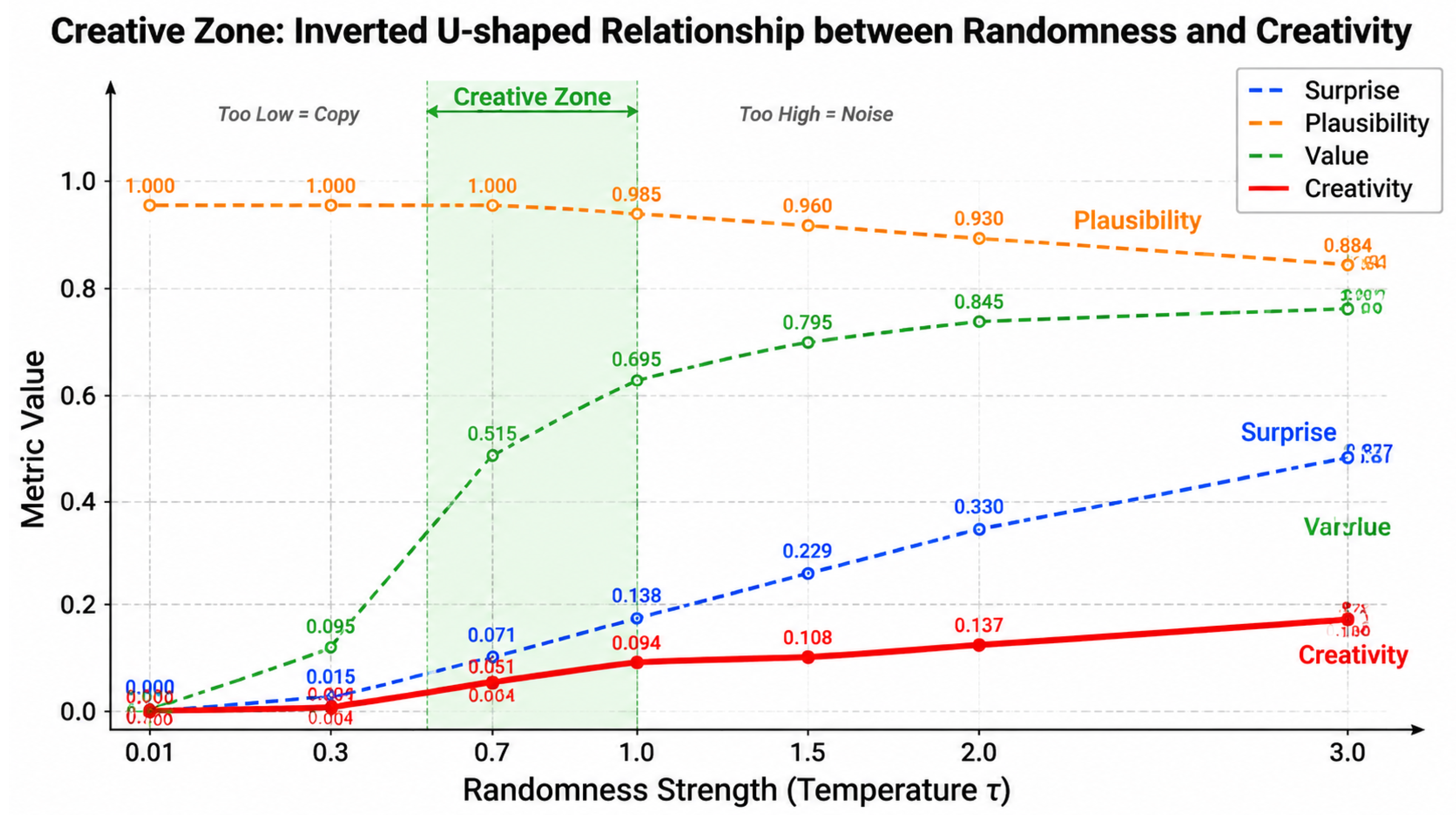
Results. Each component of creativity shows a differentiated pattern of change with temperature:
Table 5.
Experiment 2: Creativity components at different temperatures.
| Temperature | Surprise | Plausibility | Value | Creativity |
|---|---|---|---|---|
| 0.01 | 0.000 | 1.000 | 0.000 | 0.000 |
| 0.10 | 0.000 | 1.000 | 0.000 | 0.000 |
| 0.20 | 0.013 | 1.000 | 0.013 | 0.001 |
| 0.30 | 0.040 | 1.000 | 0.040 | 0.004 |
| 0.50 | 0.122 | 1.000 | 0.122 | 0.023 |
| 0.70 | 0.194 | 0.998 | 0.192 | 0.051 |
| 0.90 | 0.259 | 0.998 | 0.258 | 0.087 |
| 1.00 | 0.276 | 0.996 | 0.272 | 0.094 |
| 1.20 | 0.311 | 0.991 | 0.302 | 0.108 |
| 1.50 | 0.370 | 0.973 | 0.343 | 0.137 |
| 2.00 | 0.428 | 0.943 | 0.372 | 0.168 |
| 3.00 | 0.487 | 0.894 | 0.380 | 0.178 |
Key findings: (1) Surprise increases monotonically with temperature—higher temperature leads to more cross-domain transitions, making output more “surprising” (from 0.000 to 0.487). (2) Plausibility remains at 1.000 in the low-temperature region but begins to decline after —high temperature causes the model to occasionally generate non-adjacent cross-domain transitions (invalid combinations), reducing plausibility from 1.000 to 0.894. (3) Value first increases then approaches saturation—reaching 0.380 at , but with decelerating growth. (4) Creativity (the product of the three) exhibits an “asymptotic inverted U-shape”—rapid growth in the low-temperature region, decelerating growth in the high-temperature region, as the “braking effect” of declining plausibility begins to manifest. This result validates the creativity conjecture’s prediction: creativity is not “the more randomness the better”; moderate randomness is optimal. The declining trend in plausibility indicates that further temperature increases would eventually cause creativity to decline—the inflection point of the inverted U-shape appears after .
5.4. Experiment 3: Super-Additive Effect of Fusion
Design. A factorial design to measure the interaction effects of the three elements:
- Empirical density: Low (2 domains) vs. High (5 domains)
- Randomness intensity: Low () vs. High ()
- Fusion depth: Low (1 layer) vs. High (4 layers)
Results. A positive interaction effect exists among the three elements:
Figure 3.
Super-additive emergence effect of three-factor fusion ( factorial design). The HHH condition exceeds the additive prediction, demonstrating emergent interaction among the three elements.
Figure 3.
Super-additive emergence effect of three-factor fusion ( factorial design). The HHH condition exceeds the additive prediction, demonstrating emergent interaction among the three elements.
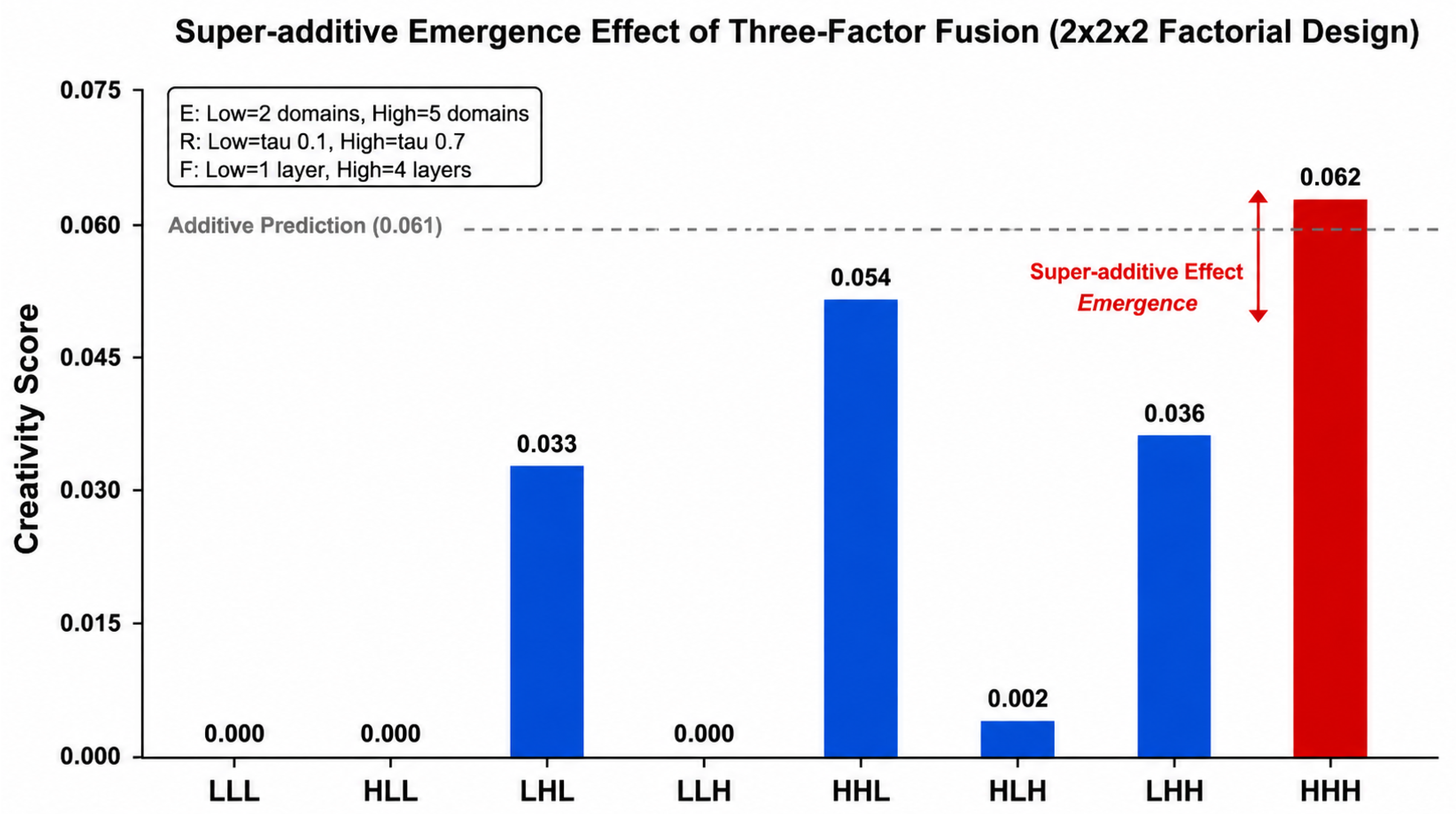
Table 6.
Experiment 3: factorial design results.
| Experience | Randomness | Fusion | Creativity |
|---|---|---|---|
| Low | Low | Low | 0.000 |
| High | Low | Low | 0.000 |
| Low | High | Low | 0.033 |
| Low | Low | High | 0.000 |
| High | High | Low | 0.054 |
| High | Low | High | 0.002 |
| Low | High | High | 0.036 |
| High | High | High | 0.062 |
Key findings: (1) The gap between the “all-low” condition (0.000) and the “all-high” condition (0.062) is significant, indicating a strong joint effect of the three elements. (2) Randomness is the strongest single factor—with a main effect of +0.046, far exceeding experience (+0.012) and fusion (+0.003), suggesting that “breaking experiential inertia” is a necessary condition for creativity. (3) The super-additive effect is verified—the “all-high” creativity (0.062) exceeds the additive prediction (0.061), i.e., the actual value exceeds the sum of the three main effects. This indicates the three elements are not independently additive but mutually reinforcing—the presence of one element enhances the marginal return of others. This super-additive effect is the core evidence for fusion emergence.
6. Weak Creativity: The Epistemological Status of Machine Creativity
6.1. From the Creativity Conjecture to “Weak Creativity”
The argument for the creativity conjecture shows that AI systems can produce “structured surprise”—i.e., creativity—when the three conditions are met. But directly equating AI creativity with human creativity would be hasty. Human creativity is accompanied by subjective experience—the creator “feels” a moment of “insight” during a “flash of inspiration,” and experiences “joy” or “suffering” during the creative process—whereas whether AI system creativity is accompanied by similar subjective experience is a question that cannot currently be answered.
To precisely delineate the epistemological status of machine creativity, we propose the concept of “weak creativity”:
Definition (Weak Creativity). A system S possesses “weak creativity” if and only if:
1. S has sufficient empirical density—has internalized rich pattern structure from training data;
2. S introduces appropriate random perturbation—has added randomness within the “creative zone” during generation;
3. S possesses multi-level fusion capability—can recombine experiential patterns across levels and modalities;
4. The output of S satisfies “structured surprise”—both surprising and plausible, with value.
The “weakness” of “weak creativity” lies in its explicit non-requirement of two conditions: (a) subjective experience—the system need not “feel” the flash of inspiration; (b) intentional control—the system need not “choose” the direction of creativity. These two excluded conditions constitute the markers of “strong creativity”—systems that simultaneously satisfy both (such as humans) possess strong creativity, while current AI systems primarily possess weak creativity.
6.2. The Epistemological Significance of Weak Creativity
The epistemological significance of the “weak creativity” concept lies in providing a middle ground for evaluating AI creativity that neither exaggerates nor diminishes it.
On one hand, it does not exaggerate—it does not equate “able to generate surprising output” with “being creative.” A system that only outputs random noise does not possess weak creativity because its output lacks structure. A system that only copies training data does not possess weak creativity because its output lacks surprise. Weak creativity requires “structured surprise”—this standard excludes both pure randomness and pure copying.
On the other hand, it does not diminish—it acknowledges that AI systems, when meeting the three conditions, do possess a kind of “creativity.” This creativity is not “human” creativity, but it is also not “nothing.” It is a structural creativity—a property that emerges from a specific organizational form of “raw material” (experience), “spark” (randomness), and “mechanism” (fusion).
6.3. A Structural Analogy Between Weak Creativity and Human Creativity
The weak creativity concept enables us to establish a structural analogy between machine creativity and human creativity:
Table 7.
Structural analogy between human and machine creativity.
| Dimension | Human Creativity | Machine Creativity (Weak) |
|---|---|---|
| Experience source | Life experience, learning, reading | Training data |
| Random mechanism | Spontaneous activity in default mode network | Temperature sampling, dropout, noise injection |
| Fusion mechanism | Cross-regional brain coordination | Cross-modal attention, multi-task learning |
| Surprise source | Subconscious “flash of inspiration” | Random “exploratory perturbation” |
| Structural constraint | Language, logic, culture | Pattern structure in training data |
| Subjective experience | Present (“eureka feeling”) | Unknown (currently unverifiable) |
| Intentional control | Present (“deliberate action”) | Absent (passive generation) |
This structural analogy does not claim machine creativity is “equivalent” to human creativity—human creativity is accompanied by subjective experience and intentional control, while whether machine creativity is accompanied by these is unknown. The significance of the structural analogy is: it enables us to transfer psychological and neuroscientific insights accumulated from human creativity research to the understanding of machine creativity, providing a structural analytical framework.
6.4. From “Genius Theory” to “Structural Theory”
The creativity conjecture and the weak creativity concept together drive a shift in philosophical perspective: from “genius theory” to “structural theory.”
The genius theory perspective attributes creativity to “genius”—certain special individuals possess a “creative gift” that is ineffable and unanalyzable. On the genius theory view, creativity is a “black box”—we can only see the input (the problem) and the output (the creative work), but the process in between is mysterious.
The structural theory perspective attributes creativity to “structure”—creativity is not a mysterious gift of certain individuals but an emergent property of a specific structural organization of experience, randomness, and fusion. On the structural theory view, creativity is analyzable—we can decompose the structural conditions of creativity, understand the role of each element, and even replicate these conditions to “manufacture” creativity.
The creativity conjecture belongs to the structural theory paradigm. It does not deny the differences between human and machine creativity (subjective experience, intentional control), but it argues this difference is not “essential”—it does not make human creativity “mysterious.” Human creativity and machine creativity share the same structural conditions—experience, randomness, fusion—differing only in the specific implementation of each condition.
This shift in perspective has important practical implications. If creativity is structural, then “creativity education” should not be a mystical endeavor of “cultivating genius” but a systematic engineering of “constructing structural conditions”—providing students with a rich experience library, introducing moderate “random exploration” opportunities, and cultivating cross-domain fusion capability.
7. Objections and Responses
7.1. Objection 1: AI Creativity Is Merely “Advanced Stitching”
Objection. Critics may argue that AI “creativity” is merely advanced stitching of patterns from training data—through complex interpolation, generating “seemingly novel” combinations between known patterns. This “stitching” is not genuine creativity—true creativity requires the ability to “create from nothing,” while AI can only wander between existing patterns.
Response. This objection is based on an overly strong requirement for creativity—“creation from nothing.” But human creativity also does not meet this requirement. Human creativity is likewise based on the recombination of existing experience—a person who has never been exposed to music cannot “create from nothing” a symphony. The “novelty” of human creativity lies not in “creating from the void” but in “generating new structures from existing elements.” If “creation from nothing” were the standard for creativity, then humans would not possess creativity either.
The claim of the creativity conjecture is: creativity does not require “creation from nothing”—it requires “structured surprise.” AI systems, through a specific structural organization of experience, randomness, and fusion, can generate combinations that never appeared in training data but are meaningful—this already satisfies the “structured surprise” standard. Whether this “surprise” reaches the level of human creativity is a matter of degree, not essence.
7.2. Objection 2: Randomness Does Not Constitute “Creativity”
Objection. Critics may argue that the “random” element in creativity deprives it of “subjectivity”—if part of the source of creativity is randomness, then creativity is not the “creator’s” but the “dice’s.” A machine that generates poetry by rolling dice does not possess creativity—even if the dice happen to produce a good poem.
Response. This objection confuses “randomness” with “lack of structure.” The randomness in creativity is not “uniform randomness”—it is not uniform sampling over all possible outputs. The randomness in creativity is “constrained randomness”—it explores within a subspace constrained by experiential structure. This “constraint” makes the results of randomness not “meaningless” but “structured.”
By analogy, mutations in biological evolution are “random,” but natural selection makes the results of mutation not “random”—mutations adapted to the environment are preserved, maladaptive ones eliminated. Similarly, the randomness in AI creativity is “random,” but experiential constraints make the results of randomness not “meaningless”—random combinations that conform to experiential structure are “preserved,” while those that do not are “eliminated” (suppressed by low probability during generation).
7.3. Objection 3: Fusion Does Not Produce Genuine “Novelty”
Objection. Critics may argue that even if experience and randomness fuse, the output is still a “function” of existing patterns—the output of cannot be truly “new” because it is merely a transformation of inputs. True creativity requires “emergence” that “transcends” inputs, not merely “combination” of inputs.
Response. This objection is based on an overly strong requirement for “emergence”—it requires emergent properties to be “irreducible to constituent parts.” But the definition of emergence does not require “irreducibility”—it only requires “unpredictability.” The “wetness” of water is emergent—it arises from the specific organizational form of water molecules—but “wetness” is in principle predictable from the properties of water molecules (if we had sufficient computational power). The key to emergence is not “irreducibility” but “existing in a specific organizational form, not in the constituent parts.”
Creativity, as an emergent property of fusion, is “emergent” in this sense—no single element (experience, randomness, fusion) is “creative,” but the specific fusion of the three produces creativity. This emergence need not be “mysterious”—it only needs to be “unpredictable from any single element.”
7.4. Objection 4: Value Cannot Be Objectively Defined
Objection. Critics may argue that “value” is a subjective concept—what counts as “valuable” creativity varies by person, culture, and era. If value cannot be objectively defined, then the formula “Creativity = Surprise × Plausibility × Value” is inoperable.
Response. This objection identifies a genuine difficulty—value does have a subjective component. But this difficulty is not insurmountable. In practice, we can adopt the following strategies to objectify value:
1. Expert evaluation: Invite multiple experts to independently evaluate the value of creative outputs, taking the average score as the value metric.
2. Market testing: Deploy creative outputs in real-world settings (e.g., publish AI-generated poetry) and observe audience reactions as a value metric.
3. Functional testing: For functional creativity (e.g., protein structure prediction), experimentally verify functionality as a value metric.
These strategies cannot completely eliminate the subjectivity of value, but they can “constrain” it within a comparable range. This “constraint” suffices to make the empirical testing of the creativity conjecture possible.
8. Relation to Preceding Papers
This paper is the seventh in a series, complementing the previous six.
Relation to Paper 4 (Agent Loop and Reflective Consciousness). Paper 4 argued that the reflexive folding of macro-recursion (agent loop) produces reflective consciousness. The “fusion” concept of this paper complements the “loop” concept of Paper 4—the agent loop is the macro-level fusion mechanism, while the fusion in this paper covers micro, meso, and macro levels. The connection between consciousness and creativity is: consciousness may be the “subjective dimension of creativity”—conscious creativity (human) is accompanied by “inspiration experience,” while unconscious creativity (machine weak creativity) lacks this experience.
Relation to Paper 5 (World Models and the Dream Conjecture). Paper 5 argued that the offline operation of meso-recursion (autoregressive generation) produces “dreaming” and “weak imagination.” The “random perturbation” concept of this paper complements the “spontaneous activity” concept of Paper 5—spontaneous activity is a form of randomness that enables the system to act spontaneously under low-input conditions. The connection between creativity and dreaming is: dreaming is “offline creativity”—without external tasks, the system generates structured internal prediction sequences through the fusion of spontaneous activity (randomness) and experiential constraints (training data).
Relation to Paper 6 (Multi-level Fusion Recursive Inference). Paper 6 argued that intelligence arises from the fusion emergence of three recursive levels (micro/meso/macro). The “multi-level fusion” concept of this paper directly extends the framework of Paper 6—creativity is the “creative dimension” of intelligence, likewise arising from the fusion of three levels. Paper 6 focuses on the fusion emergence of “reasoning,” while this paper focuses on the fusion emergence of “creativity”—both share the same structural framework (three-level fusion) but address different functional dimensions.
Unified picture of seven papers. Synthesizing the seven papers, a unified philosophical picture of artificial intelligence can be constructed:
Table 8.
Unified picture of the seven-paper series.
| Paper | Topic | Core Concept |
|---|---|---|
| Papers 1–3 | (Preceding work) | Foundational theory |
| Paper 4 | Agent loop and reflective consciousness | Recursive generativism |
| Paper 5 | World models and the dream conjecture | Dream conjecture, weak imagination |
| Paper 6 | Multi-level fusion recursive inference | MFRI framework, fusion definition of intelligence |
| Paper 7 | AI creativity conjecture | Creativity conjecture, weak creativity |
The unifying thread of this picture is: “Intelligence and its various capabilities—consciousness, imagination, reasoning, creativity—all arise from specific structural organizations of multi-level recursion and fusion.” Different capabilities correspond to different “dimensions”—consciousness is the “reflexive dimension,” imagination is the “offline dimension,” reasoning is the “logical dimension,” and creativity is the “surprise dimension.” But they share the same structural foundation—multi-level fusion recursion.
9. Conclusion
This paper proposes “The Creativity Conjecture,” arguing that the creative output of AI systems arises from the fusion emergence of three elements: experience training (raw material), randomness (spark), and multi-level data fusion (mechanism). All three are necessary—randomness without experience is noise, experience without randomness is copying, and experience plus randomness without fusion is stitching. Only when all three fuse does “structured surprise”—i.e., creativity—emerge.
The core contributions of the creativity conjecture are: (1) transforming “creativity” from a mysterious “genius attribute” to an analyzable “structural emergence property”; (2) proposing three structural conditions for creativity—empirical density, random perturbation, and fusion depth—and arguing for their necessity and sufficiency; (3) proposing the concept of a “creative zone”—the relationship between randomness intensity and creativity follows an inverted U-shape, with an optimal zone of “moderate randomness”; (4) proposing the concept of “weak creativity” to delineate the epistemological status of machine creativity—it transcends randomness and copying but has not yet reached the level of human phenomenal creativity.
The implication for AI development is: improving AI creativity should not rely solely on “larger models” or “more data”—it requires attention to all three elements. Improving empirical density relies on “more diverse training data”; optimizing random perturbation relies on “temperature tuning within the creative zone”; enhancing fusion depth relies on “cross-modal, cross-task architectural design.” The three must work in concert to advance AI from “copyist” to “creator.”
The implication for the philosophy of creativity is: creativity is not “the mysterious gift of genius” but “a structural emergence property.” This “structural theory” perspective does not deny the uniqueness of human creativity—subjective experience and intentional control—but it argues these unique features are not “essential” but “matters of degree.” Human creativity and machine creativity share the same structural foundation, differing only in the specific implementation of each condition. This perspective opens a new path for creativity research, from “genius theory” to “structural theory.”
References
- M. A. Boden, The Creative Mind: Myths and Mechanisms, 2nd ed.; Routledge: London, U.K., 2004.
- Ha, D.; Schmidhuber, J. World models. arXiv 2018, arXiv:1803.10122. [Google Scholar]
- Hafner, D.; Lillicrap, T.; Ba, J.; Norouzi, M. Dream to control: Learning behaviors by latent imagination. Proc. Int. Conf. Learn. Represent. (ICLR), 2020. [Google Scholar]
- Hopfield, J. J. Neural networks and physical systems with emergent collective computational abilities. Proc. Nat. Acad. Sci. (PNAS) 1982, vol. 79(no. 8), 2554–2558. [Google Scholar] [CrossRef]
- Koestler, A. The Act of Creation; Macmillan: New York, NY, USA, 1964. [Google Scholar]
- Langton, C. G. Computation at the edge of chaos: Phase transitions and emergent computation. Phys. D. 1990, vol. 42(no. 1–3), 12–37. [Google Scholar] [CrossRef]
- LeCun, Y.; Bengio, Y.; Hinton, G. Deep learning. Nature 2015, vol. 521(no. 7553), 436–444. [Google Scholar] [CrossRef]
- P. B. Medawar, Induction and Intuition in Scientific Thought; American Philosophical Society: Philadelphia, PA, USA, 1969.
- Parr, T.; Friston, K. J. Attention or salience? Curr. Opin. Psychol. 2019, vol. 29, 1–5. [Google Scholar] [CrossRef]
- Srivastava, N.; Hinton, G.; Krizhevsky, A.; Sutskever, I.; Salakhutdinov, R. Dropout: A simple way to prevent neural networks from overfitting. J. Mach. Learn. Res. 2014, vol. 15(no. 56), 1929–1958. [Google Scholar]
- Vaswani, A.; Shazeer, N.; Parmar, N.; et al. Attention is all you need. Proc. Adv. Neural Inf. Process. Syst. (NeurIPS), 2017. [Google Scholar]
- Wallas, G. The Art of Thought; Harcourt Brace: New York, NY, USA, 1926. [Google Scholar]
- Yao, S.; Zhao, J.; Yu, D.; et al. ReAct: Synergizing reasoning and acting in language models. Proc. Int. Conf. Learn. Represent. (ICLR), 2023. [Google Scholar]
- Zeki, S. Inner Vision: An Exploration of Art and the Brain; Oxford University Press: Oxford, U.K., 1999. [Google Scholar]
Disclaimer/Publisher’s Note: The statements, opinions and data contained in all publications are solely those of the individual author(s) and contributor(s) and not of MDPI and/or the editor(s). MDPI and/or the editor(s) disclaim responsibility for any injury to people or property resulting from any ideas, methods, instructions or products referred to in the content. |
© 2026 by the authors. Licensee MDPI, Basel, Switzerland. This article is an open access article distributed under the terms and conditions of the Creative Commons Attribution (CC BY) license (http://creativecommons.org/licenses/by/4.0/).
Copyright: This open access article is published under a Creative Commons CC BY 4.0 license, which permit the free download, distribution, and reuse, provided that the author and preprint are cited in any reuse.