
Submitted:
11 July 2026
Posted:
14 July 2026
You are already at the latest version
Abstract
Wheat stripe rust (yellow rust), a devastating disease caused by the phytopathogen Puccinia striiformis f. sp. tritici (Pst), poses a major threat to global wheat(Triticum aestivum L.) production. Under ongoing climate warming, the highly virulent Pst race CYR34 has become predominant in China and exhibits increased tolerance to elevated temperatures. Although temperature is known to influence Pst urediniospore germination, the molecular mechanisms underlying temperature sensitivity during this process remain poorly understood. In this study, we combined histological examinations with transcriptome sequencing across multiple temperature regimes to identify temperature-responsive genes and characterize the regulatory networks governing their expression in Pst. Urediniospore germination of three Pst races was tested; stronger heat tolerance was observed in CYR34-8 with 67.40%–77.40% germination at 9–16 °C. RNA-seq analysis identified 89 differentially expressed genes (DEGs) associated with temperature sensitivity, and their expression patterns were validated by qRT-PCR. The DEGs were significant enrichment in ubiquinone and other terpenoid-quinone biosynthesis, glycan degradation, and longevity-regulating pathways. Among these DEGs, ABC transporters, malate dehydrogenase, Hsp70, and class III lipases were identified as key regulatory factors linking heat stress responses to multiple metabolic pathways. CYR34-8 is characterized by a greater urediniospore germination capacity and a more complex transcriptional response across a broad temperature range.
Keywords:
wheat (Triticum aestivum L.)
; Puccinia striiformis f. sp. tritici
; urediniospore germination
; temperature sensitivity
; thermal adaptation
; RNA-seq
1. Introduction
Stripe (yellow) rust, caused by Puccinia striiformis f. sp. tritici (Pst), is a widely distributed and rapidly spreading airborne disease that severely affects global wheat production[1,2]. The prevalence of stripe rust is strongly dependent on cool and humid climatic conditions and it occurs in more than 60 countries worldwide, except Antarctica[3]. Recently, stripe rust has become increasingly prevalent in the northwest United States, Australia, India, and China[4,5,6,7]. Pst primarily completes its annual infection cycle on wheat during the asexual stage as urediniospores[8]. Although fungicides can effectively control the disease, their extensive use not only leads to environmental degradation but also accelerates pathogen virulence variation and the development of fungicide resistance in Pst[9,10]. Extensive field evidence indicates that breeding wheat cultivars with durable resistance is a long-term and effective strategy for managing stripe rust[10]. However, following the emergence of new Pst races with high virulence, resistant wheat varieties often lose their resistance within 2--5 years, becoming susceptible varieties and leading to severe and irreversible yield losses[11].
Global climate change has driven frequent genetic variations among phytopathogens, facilitating their adaptation to elevated temperatures[12]. Multiple field surveys have confirmed the emergence and spread of novel, highly virulent Pst races that have colonized new regions and exhibit greater high-temperature tolerance than traditional isolates[13,14]. Previous studies indicate that 13-16 ℃ represents the optimal temperature range for stripe rust development, which has been proposed as a limiting factor for its spread between the United States and Canada[15]. However, Pst isolates collected after 2000 in the eastern United States have been shown to adapt to a broader temperature range of 12-28 ℃[11,16]. The Longnan and Tianshui regions of Gansu Province are recognized as key epidemic and transmission centers of stripe rust in China[17,18]. Studies in these regions have shown that the overwintering altitude of Pst has increased by approximately 300 meters, whereas the over-summering altitude has decreased by 100-300 meters. In addition, the average temperature of the pathogen populations often exceeds 24℃, suggesting enhanced adaptation and pathogenicity under higher temperature conditions[19]. Since 2016, the emergence frequency of the new race G22-9 (CYR34) has increased rapidly from 0 to 34.85%, making it the dominant race in Gansu Province. This race exhibits greater pathogenicity, a broader virulence spectrum, and higher parasitic fitness compared with the prevailing physiological races CYR32 and CYR33[20,21].
As an obligate biotrophic fungus, Pst produces a series of specialized infection structures during wheat colonization, including germ tubes, substomatal vesicles, primary hyphae, secondary hyphae, haustorial mother cells and mature haustoria, which develop in a fixed sequential order[22]. Urediniospore germination and germ tube growth are critical prerequisites for successful Pst infection[23,24]. Urediniospores also serve as the primary overwintering form of Pst and remain metabolically active during winter[25]. As early as 1981, North American researchers developed a stripe rust prediction model using 7 °C as the base temperature for effective accumulated temperature required for urediniospore germination and infection[26,27]. Temperature not only influences urediospore germination and infection but is also closely associated with Pst variation. After germination and germ tube formation, cytoplasmic connections can form between different Pst races, enabling protoplasmic and molecular exchange — a key mechanism contributing to the emergence of new virulent races[28]. Additional studies in mountainous areas around Tianshui have shown that many local Pst races exhibit urediniospore multinucleation rates exceeding 1%, which may contribute to changes in pathogen pathogenicity[29,30].
Exploring how temperature modulates Pst pathogenicity and genetic variation is essential for understanding stripe rust epidemiology under climate change[31]. The rapid development of high-throughput sequencing technologies has greatly advanced genomic and transcriptomic research of this obligate biotrophic fungus, and whole-genome sequences of multiple Pst physiological races have been made available[32,33]. Since 2007, when Peng et al. first constructed a cDNA library from urediniospores of PST-70, a physiological race of Pst, transcriptomic approaches have been widely used to investigate urediniospore germination and infection processes[34,35,36]. Most current transcriptomic studies on Pst have focused on effector proteins and single nucleotide polymorphisms (SNPs) associated with pathogen-host interactions[37,38,39,40]. As the primary climatic factor influencing Pst overwintering, oversummering, and epidemic dynamics, temperature plays a central role in determining the global distribution and prevalence of stripe rust[3]. However, the molecular regulatory mechanisms underlying Pst urediniospore germination under temperature stress remain poorly understood. In this study, we aimed to identify co-expressed genes and characterize their regulatory networks associated with temperature sensitivity during Pst urediniospore germination. We found that thermal treatments at 9–16 °C applied for different durations activate thermotolerance-related molecular pathways in CYR34. A set of temperature-responsive DEGs was identified, providing insights into the molecular basis of temperature sensitivity in Pst.
2. Materials and Methods
2.1. Plant Materials, Fungus, and Breed
The susceptible wheat cultivar Mingxian 169 (MX169) and three dominant Chinese Pst races (CYR32, CYR33, CYR34) were provided by the Institute of Plant Protection, Gansu Academy of Agricultural Sciences (Lanzhou, China). To obtain fresh urediniospores, we inoculated MX169 seedlings with the three Pst races. Ten to fifteen wheat seeds were sown in 10 × 10 × 10 cm plastic pots, with an inter-seed distance of approximately 1.5 cm. Urediniospores were mixed with sterile water at a volume ratio of 1:6–9, and the mixture was gently stirred with an inoculation needle. The spore suspension containing floating urediniospores was used for seedling inoculation. After inoculation, seedlings were transferred to an artificial climate chamber and cultured at 15 ± 1 °C, 8000–12000 Lx light intensity and 70%–85% relative humidity. Fresh urediniospores were harvested 10–12 days post inoculation and stored at −80 °C for subsequent experiments.
2.2. Temperature Treatments and Histopathological
The Nylon membrane (10 μm) was used as the carrier that positioned atop a layer of water-saturated filter paper[30]. The urediniospores of CYR32-34 race were placed on Nylon membrane and incubated for 6 h, 10 h and 14 h at 9℃, 12℃, 14℃ and 16 ℃ respectively, and the germination of urediniospores was observed under the microscope. The criterion for germination was that the length of the germ tube of the urediniospores was greater than or equal to the radius of the urediniospores when examined microscopically. The urediniospores germination rate were calculated by randomly observing three visual fields under a microscope with a 20×.The germination rate of Urediniospore were evaluated using the following model:×100%, where y is the germination rate of Urediniospore, a is the germinating Urediniospore, b is the total Urediniospore[30].
2.3. RNA-seq
For transcriptome sequencing, we collected 36 RNA-seq samples corresponding to four temperature treatments, with three independent biological replicates per treatment. Total RNA was purified via the TRIzol method (Invitrogen, CA, USA), and residual genomic DNA was digested with 1 U/g DNase I (Thermo Fisher, MA, USA). RNA integrity and concentration were evaluated on an Agilent 2100 Bioanalyzer (Agilent Technologies, Waldbronn, CA). Thirty-six were used to construct paired-end (PE) cDNA libraries, which were sequenced on the Illumina HiSeq-2500 platform by BMKGENE (Beijing, China). All sequencing data met strict quality criteria: each library yielded over 4 Gb of raw reads. All libraries satisfied strict sequencing quality standards with an average Q30 ratio above 90% (Table S2). Raw sequence data were preprocessed with Trimmomatic (v.0.4) to remove adapter sequences and low-quality bases[41]. Processed clean reads were mapped to the public reference genome of Puccinia striiformis f. sp. tritici. genome (https://ftp.ncbi.nlm.nih.gov/genomes/all/GCA/001/191/645/GCA_001191645.1_P_striiformis_V1/GCA_001191645.1_P_striiformis_V1_genomic.gff.gz) using TopHat (v2.1.0). Subsequent transcript assembly was completed using Cufflinks (v2.2.1)and Cuffmerge (v2.2.1)[41]. The DEG analyses were evaluated using software DESeq2 (v1.51.0). Differential expression analysis was performed using DESeq2 v1.51.0. Genes with FDR < 0.05 and |log2 FC| > 2 were regarded as temperature-responsive DEGs[42].
2.4. Functional Annotation and Enrichment
Transcript functional annotation was conducted using BLASTx (E-value < 1e-5) against KEGG, Nr, KOG and Swiss-Prot databases. Gene Ontology (GO) annotations were obtained using the Blast2GO program. We performed enrichment analysis for GO terms and KEGG pathways, and items with FDR < 0.05 were considered statistically significant[43].
2.5. Identification of Chromosomes of DEGs
Identified DEGs were mapped to the Pst genome. These mapped DEGs were adopted as query sequences for use with BLASTN (with an E-value < 1E−50) against the predicted mRNA database of the Pst genome to search location information on chromosomes[44].
2.6. Protein-Protein Interaction (PPI) Network
Proteins encoded by identified DEGs were used to predicted protein-protein interactions (PPIs) based on the STRING database of the fugi (with an E-value< 1E−10) (http://string-db.org/). PPIs with combined confidence scores greater than 0.7 were selected[45] and visualized with CYTOSCAPE (v.2.8, http://cytoscape.org/)[46].
2.7. Prediction of Candidate Effector Proteins
Protein sequences translated from the 89 DEGs were retrieved for in effector characterization. Homology searching was carried out via BLASTP against the Pathogen-Host Interactions database (PHI-base 5, https://phi5.phi-base.org/) with an E-value threshold of 1×10⁻¹⁰ to retrieve homologous sequences of experimentally validated fungal virulence effectors. Two dedicated web servers were further deployed to predict secretory signatures of candidate polypeptides: SignalP 6.0 (https://services.healthtech.dtu.dk/services/SignalP-6.0/) was employed to identify canonical N-terminal secretory signal peptides, while TMHMM 2.0 (https://services.healthtech.dtu.dk/services/TMHMM-2.0/) was used to scan putative transmembrane helical domains within protein sequences
2.8. RNA-Seq Data Submission
The raw data have been submitted to the NCBI Sequence Read Archive (SRA) database under accession numbers from SRR34732539 to SRR34732574(Supplementary File 1).
2.9. Quantitative Reverse Transcription PCR (qRT-PCR)
Thirteen representative DEGs were chosen for qRT-PCR validation(Table S1). UltraSYBR Mixture (Kangwei, Beijing, China) and iQTM 5 (Bio-Rad, Hercules, CA, USA) were used for qRT-PCR analysis of all reactions according to the manufacturer’s instructions. Data were collected from three replicate experiments—the samples used for qRT-PCR were the same as those used for RNA-Seq, each consisting of at least three technical repeats. Negative controls that lacked templates were also included. Housekeeping genes EF-1α and ACT from Pst were served as reference genes for expression normalization. Data were collected from three independent biological replicates, each consisting of at least three reactions, and negative controls without templates were detected in case of contamination. The expression ratio of each gene was calculated by using the relative expression software tool of REST (v2.0.13)[47].
3. Results
3.1. Histopathological Observation of Urediniospore Germination Under Different Temperature Treatments
The germination of urediniospore from three prevalent Puccinia striiformis f. sp. tritici races in China, namely CYR32-11, CYR33-209, and CYR34-8, was evaluated under different temperature conditions. After 14 h of incubation, CYR32-11 showed the highest germination percentage at 9 °C (66.10%), followed by14 °C (54.73%) (Figure 1A). For CYR33-209, the maximum germination percentage was obtained at 12 °C (64.33%), which was significantly higher than that at 9 °C (P < 0.05) (Figure 1B). In contrast, CYR34-8 maintained consistently high germination percentages across 9 °C, 12 °C, 14 °C, and 16 °C, ranging from 67.40% to 77.40%, with no significant differences among temperatures (Figure 1C). Comparative analysis showed that CYR34-8 exhibited a higher overall germination capacity than the other two races across all tested temperatures (Figure 1D). Microscopic observations showed that CYR34-8 urediniospores formed germ tubes within 6 h at 16 °C (Figure 1E), which became markedly elongated by 10 h (Figure 1F) and exhibited germ tube anastomosis at 14 h (Figure 1G).
3.2. Transcriptional Responses of Puccinia striiformis f. sp. Tritici CYR34-8 to Gradient Temperatures
Principal component analysis (PCA) of 36 transcriptome samples from Puccinia striiformis f. sp. tritici race CYR34-8 confirmed robust consistency among biological replicates of each treatment group. Meanwhile, samples incubated at 14 °C and 16 °C clustered together (Figure S1), verifying that elevated temperature serves as the primary determinant of genome-wide gene expression variation. To further elucidate the molecular mechanisms underlying thermal adaptation in CYR34-8, transcriptome sequencing and differentially expression analysis were performed under different temperature treatments (12℃, 14℃, and 16℃), with the 9℃ treatment as the control. A total of 214, 349, and 493 differentially expressed genes (DEGs) were identified in the 12℃, 14℃, and 16℃ groups, respectively. The number of DEGs increased significantly with increasing temperature (Figure 2 A–C). To identify genes potentially involved in temperature-responsive regulation, an intersection analysis of DEGs from the different temperature comparisons was conducted. 89 shared DEGs were identified, which were considered key candidates associated with thermosensitive regulation (Figure 2 D).
3.3. Verification of RNA-Seq Analysis by qRT-PCR
To validate the RNA-Seq data, selected DEGs were verified by qRT-PCR. EF-1α and ACT were used as dual reference genes, and samples from 9℃ were used as the control, 13 DEGs with distinct expression patterns were randomly selected for validation (Figure 3A). The qRT-PCR results were highly consistent with the RNA-Seq (TMM-normalized FPKM) data, with a Pearson correlation coefficient of 0.7833 (P < 0.05) (Figure 3B).
3.4. Dynamic Expression Patterns of DEGs Under Temperature Gradients and Their Genome Distribution
To further investigate the temperature-dependent expression patterns of genes in Puccinia striiformis f. sp. tritici CYR34-8, DEGs were subjected to heatmap visualization and expression clustering analyses (Supplementary File 2). The heatmap revealed that 55.06% of the DEGs exhibited high expression at 9 °C and were down-regulated at 12 °C, whereas 41.57% were up-regulated at 14–16 °C (Figure 4A). Expression clustering analysis identified three major clusters. Cluster 1 comprised 50 genes whose expression decreased with increasing temperature and peaked at 9℃, suggesting potential roles in low-temperature adaptation. Cluster 2 contained 28 genes whose expression increased with temperature and reached maximum levels at 14–16℃, indicating possible involvement in high-temperature responses. Cluster 3 consisted of 11 genes exhibiting fluctuating expression patterns across temperatures, suggesting more complex regulatory mechanisms influenced by temperature and potentially other factors (Figure 4B). Further chromosomal localization analysis showed that these genes were widely distributed across 66 scaffolds throughout the genome, with no apparent clustering pattern (Figure 5).
3.5. Functional Dissection of Core Biological Pathways Enriched in Temperature-Regulated DEGs
To further clarify the functional roles of temperature-responsive differentially expressed genes (DEGs) in Puccinia striiformis f. sp. tritici race CYR34-8, KEGG pathway enrichment was performed(Table 1). A total of 10 KEGG pathways were significantly enriched (adjusted P-value < 0.05; Table 1), among which ubiquinone and other terpenoid-quinone biosynthesis (ko00130), other glycan degradation (ko00511), and longevity regulating pathway (ko04213) were the most prominent. Specifically, two DEGs, PSTG_00706 (minor allergen Cla) and PSTG_14805 (acyl-CoA ligase), were annotated in ko00130. Meanwhile, three heat shock protein, including PSTG_06964 (heat shock protein 78), PSTG_10205 (Hsp70), and PSTG_13593 (Hsp104), were mapped to the longevity regulating pathway (ko04213).
GO enrichment analysis was further conducted to classify the functions of these DEGs (Table S3). In the biological process (BP) category, DEGs were mainly enriched in DNA repair, phosphate ion transport, sulfur compound metabolism, protein maturation, and cell wall disassembly. In the cellular component (CC) category, the most significantly enriched terms were integral component of membrane, intrinsic component of membrane, and membrane. In molecular function (MF) category, DEGs were predominantly associated with oxidoreductase activity, hydrolase activity, ubiquitin protein ligase activity, and transmembrane transporter activity. GO enrichment profiles exhibited high consistency with KOG annotation (Figure S2).
3.6. Protein Interaction Network Dissection of Temperature-Regulated DEGs and Candidate Effector Screening
A STRING-based protein-protein interaction (PPI) network was constructed from 89 DEGs, of which 61 showed presented detectable protein interaction relationships (Figure 6). Four hub genes were identified: PSTG_14211 (red; ABC transporter; log₂FPKM=6.21), which is involved in transmembrane transport of multiple substrates and interacts with 19 genes; PSTG_07016 (green; malate dehydrogenase; log₂FPKM =5.50, which participates in the tricarboxylic acid cycle and central carbon metabolism and interacts with 12 genes; PSTG_08976 (blue; class 3 lipase; log₂FPKM =5.42), which catalyzes lipid hydrolysis and fatty acid metabolism and interacts with 12 genes; and PSTG_10205 (yellow, Hsp70 protein, log₂FPKM =5.94), a core molecular chaperone involved in protein folding and temperature stress adaptation, which connects to 11 genes. These genes were functionally grouped into temperature stress response (heat shock protein family), transmembrane transport, carbohydrate hydrolysis and metabolism, lipid metabolism, central carbon metabolism, and intracellular redox reaction processes. log₂FPKM values ranged from −4.60 to 12.22, suggesting that the four hub genes may act as connectors linking thermal response with diverse metabolic pathways. Notably, PSTG_00927, one of the interacting partners in this network, was further characterized via effector bioinformatic prediction. SignalP and TMHMM analyses verified that PSTG_00927 possesses canonical secretion signal and no transmembrane helices, and Effector PHI database identified it as a candidate effector protein (Figure S3,Supplementary File 3). This indicated PSTG_00927 may serve as a secreted effector coordinating heat stress response and host infection in CYR34 urediniospores.
4. Discussion
As global climate warming continues to reshape the geographical distribution and population structure of phytopathogenic fungi, temperature has become a decisive environmental factor influencing the survival, reproduction, and epidemic dynamics of Puccinia striiformis f. sp. tritici (Pst), the causal agent of wheat stripe rust[3,5,31,48]. Historically, Pst was characterized as a cool-adapted pathogen, with urediniospore germination and infection largely restricted under elevated temperatures [1,11]. However, emerging virulent Pst races, such as CYR34, have gradually dominated field populations across major wheat-growing regions in China, exhibiting markedly improved thermotolerance compared with traditional races[48,49,50]. Although previous transcriptomic studies of Pst have mainly focused on pathogen–host interactions, effector identification, and genetic variation[10,37,40,51], the molecular mechanisms underlying temperature sensitivity during urediniospore germination remain poorly understood. In the present study, we combined histological observations and RNA-seq to compare thermal adaptability among three representative Chinese yellow rust races and systematically characterize temperature-responsive genes and their regulatory networks in the dominant race CYR34.
Previous studies have demonstrated that temperature is the primary abiotic factor governing urediniospore germination, germ tube growth, and subsequent infection of Pst [3,8]. Early biological investigations confirmed that traditional Pst races prefer low-temperature environments, with germination capacity declining sharply when ambient temperatures exceed 14 °C[15,27]. However, field monitoring and phenotypic assays have revealed that newly emerged Pst races exhibit enhanced tolerance to higher temperatures compared with historical isolates [14]. Consistent with these findings, histological observations of urediniospore germination(Figure. 1) revealed obvious inter-racial divergence in temperature preference. The conventional races CYR32-11 and CYR33-209 reached their maximum germination rates at 9 °C and 12 °C, respectively, with the cool-adaptive characteristics of classic Pst populations. In contrast, CYR34-8 maintained stable and high germination rates across the entire 9–16 °C temperature range, with no significant differences among treatments. Microscopic observations further confirmed that CYR34-8 completed germ tube formation at 6 h, elongation at 10 h, and germ tube anastomosis at 14 h even at 16 °C. Germ tube anastomosis is known to facilitate heterokaryon formation and genetic recombination in rust fungi, thereby promoting the emergence of new virulent variants and increasing population genetic diversity[28,31]. The urediniospore germination assays in this study indicate that CYR34-8 possesses a broad thermal adaptability, which is consistent with observed field population dynamics[20,21]. Owing to its phenotypic advantages, this race has occupied broader ecological niches and gradually replaced traditional races across China under climate warming[21].
Transcriptional reprogramming is a fundamental strategy by which phytopathogenic fungi perceive and adapt to external temperature stress, and this mechanism has been partially explored in previous transcriptomic studies of Pst [40,52]. In line with this consensus, our RNA-seq analysis revealed that increasing temperature induced pronounced genome-wide transcriptional changes in CYR34 urediniospores. Using 9 °C as the baseline control, we identified 214, 349, and 493 differentially expressed genes (DEGs) at 12 °C, 14 °C, and 16 °C, respectively, demonstrating a progressive increase in the DEGs number with rising temperature(Figure 2). This positive correlation between temperature elevation and DEG abundance is a conserved stress-response pattern in filamentous fungi, reflecting the gradual enhancement of cellular adaptation to thermal stimuli [50]. Through intersection analysis of the three DEG sets, we identified 89 core temperature-responsive DEGs, which were clustered into three distinct expression profiles corresponding to low-temperature adaptation, high-temperature induction, and dual regulation by temperature and time (Figure 4). These DEGs were distributed across 66 scaffolds of the Pst genome, indicating that thermal adaptability is a complex quantitative trait governed by multiple dispersed genes rather than a single gene cluster. Collectively, these genes represent key candidate determinants underlying the broad thermal adaptability of CYR34-8.
Functional enrichment analyses based on KEGG (Table 1) and GO (Table S3) databases further revealed that the core temperature-responsive DEGs coordinately mediate the thermal adaptation of CYR34-8 through multiple interconnected biological pathways. Notably, the longevity-regulating pathway was significantly enriched, in which three key heat shock proteins, PSTG_06964 (Hsp78), PSTG_10205 (Hsp70), and PSTG_13593 (Hsp104), were identified. As conserved core components of the cellular protein quality control (PQC) machinery, these heat shock proteins play indispensable roles in maintaining proteostasis under heat stress[53,54]. Studies in model yeast have demonstrated that thermal stress induces the accumulation of misfolded proteins, and the Hsp70-Hsp104 chaperone system is essential for disaggregating stress-induced protein aggregates and restoring cellular function during recovery. Consistent with this conserved mechanism, the identified heat shock proteins in CYR34-8 likely function as core regulators that stabilize proteins, resolve misfolded aggregates, and maintain cellular homeostasis, thereby providing a molecular basis for the superior thermotolerance of the prevalent Pst race CYR34[55]. Meanwhile, the enriched ubiquinone and terpenoid-quinone biosynthesis pathway may facilitate reactive oxygen species (ROS) scavenging to alleviate oxidative damage induced by high temperature, whereas the glycan degradation pathway may support cell wall remodelling required for germ tube development and host infection under thermal stress conditions[56,57]. Consistently, GO enrichment analysis indicated activation of DNA repair, redox regulation, and ion transport processes, collectively contributing to the maintenance of genomic stability and intracellular homeostasis during temperature fluctuations.
Four hub proteins, including an ABC transporter (PSTG_14211), malate dehydrogenase (PSTG_07016), class 3 lipase (PSTG_08976), and Hsp70 protein (PSTG_10205), were identified via the protein-protein interaction (PPI) network (Figure 6). They act as central nodes linking thermal stress response with diverse metabolic pathways. ABC transporters are ubiquitous membrane proteins in phytopathogenic fungi and are responsible for transmembrane transport of ions, carbohydrates, and secondary metabolites, and they also participate in intracellular ion homeostasis and detoxification of harmful compounds [58,59]. Malate dehydrogenase, a key enzyme in the tricarboxylic acid cycle that fuels urediniospore germination and germ tube growth, undergoes temperature-dependent conformational changes that help maintain catalytic activity under elevated temperatures[60,61,62]. Class 3 lipases participate in lipid metabolism and modulate cell membrane fluidity, thereby facilitating adaptation to temperature fluctuations[63,64]. As a core molecular chaperone, Hsp70 interacts with a wide range of downstream client proteins and serves as a key regulator of the high-temperature response in CYR34[54]. PSTG_00927, a member of the Hsp70 interaction network, was screened as a high-confidence candidate effector with a full secretion signal and limited transmembrane domains. Previous work has proven that temperature rewrites the transcription of secreted effectors in virulent CYR34-8 to interfere with host immunity at elevated temperatures[40]. In line with this, our data suggest that temperature-mediated transcriptional reprogramming not only preserves intracellular homeostasis by relying on Hsp70 and other core metabolic and chaperone proteins, but also coordinates effector secretion to accelerate host tissue invasion.
To systematically illustrate the molecular regulatory network underlying temperature sensitivity and pathogenicity in CYR34-8 urediniospores, we constructed an integrated pathway model based on KEGG, GO, and PPI analysis. As shown in Figure 7, all 89 core DEGs were classified into seven interrelated functional modules according to their biological functions and expression patterns, collectively coordinating temperature adaptation and pathogenic variation in Pst race CYR34. Module 1 (heat stress sensing and proteostasis) and Module 2 (RNA processing factors) are predominantly activated at 12–16 °C. Multiple heat shock proteins and pre-mRNA splicing factors in these modules maintain protein stability and ensure proper transcription and translation regulation under elevated temperatures, serving as the first line of defense against thermal damage.[55,65]. Module 3 (redox balance and oxidative detoxification) mainly functions at 12–14 °C, where oxidases and glutathione S-transferase scavenge ROS and alleviate oxidative stress[66,67]. Module 4 (mitochondrial energy metabolism) is preferentially activated at 9 °C, providing sufficient ATP for urediniospore germination, germ tube extension, and haustorium mother cell formation[68]. Module 5(cell wall remodelling, ion and pH homeostasis) operates across the entire temperature range tested; ABC transporters and ion antiporters maintain intracellular homeostasis and nutrient uptake, thereby shortening the latent period of infection[69]. In addition, hydrolases and protein kinases in this module contribute to germ cell wall remodeling, germ tube elongation, and host tissue penetration. As an independent functional unit, Module 6 (energy metabolism and mitochondrial function) is preferentially activated at 9 °C, supplying sufficient ATP to support key physiological processes, including urediniospore germination, germ tube growth, and haustorium mother cell formation[70]. Module 7 (Growth, invasion-associated regulation, and genome plasticity) contains genes related to transposable elements and meiotic proteins, which may induce adaptive genomic variation and further enhance the pathogenic aggressiveness of Pst[71]. This integrated model demonstrates that elevated temperature sequentially activates multiple functional modules, collectively enhancing stress tolerance, metabolic fitness, and pathogenic potential of CYR34-8. Although the main regulatory roles of most hub genes and functional clusters have been elucidated, a substantial proportion of the 89 core temperature-responsive DEGs remain functionally uncharacterized and require further exploration.
5. Conclusions
In conclusion, Puccinia striiformis f. sp. tritici (CYR34) exhibits significantly stronger thermal adaptability during urediniospore germination than CYR32 and CYR33. A set of 89 scattered temperature-responsive differentially expressed genes confirms that its enhanced thermotolerance is a complex polygenic characteristic rather than monogenic-controlled. Four key hub proteins (ABC transporter, malate dehydrogenase, class 3 lipase, Hsp70) coordinate multiple metabolic cascades to maintain ion homeostasis, energy metabolism, membrane integrity and functional protein stability when exposed to thermal fluctuations. Collectively, this study establishes a comprehensive molecular blueprint for heat adaptation in virulent Pst isolates, clarifies the molecular drivers facilitating pathogen expansion and virulence variation amid climate change, and lays a theoretical foundation for mining resistance genes and developing targeted control strategies against heat-adapted stripe rust populations.
6. Patents
Two Chinese utility model patents supporting the experimental procedures of this study have been authorized, as listed below:
- Tao F, Wang C, Liu T, Zhou YH, Feng R. A wheat leaf dewaxing device. Chinese Utility Model Patent, Patent No. ZL 2021 2 2349939.7, Filing date: 27 September 2021, Grant publication date: 11 March 2022, Patentee: Gansu Agricultural University.
- Tao F, Wang ZY, Wang LT, Shao X, Song MN. A portable spore collector. Chinese Utility Model Patent, Patent No. ZL 2024 2 0332619.1, Filing date: 22 February 2024, Grant publication date: 15 October 2024, Patentee: Gansu Agricultural University.
Supplementary Materials
The following supporting information can be downloaded at the website of this paper posted on Preprints.org. Figure S1: Principal component analysis (PCA) of gene expression profiles across all 36 RNA-seq samples; Figure S2 KOG functional classification of shared temperature-responsive differentially expressed genes in Puccinia striiformis f. sp. tritici CYR34-8; Figure S3 Bioinformatic prediction of signal peptide and transmembrane helices for candidate effector PSTG_00927; Table S1: Primer of DEGs for qRT-PCR; Table S2: Q30 quality value of 36 RNA-seq samples from CYR34-8; Table S3: Significantly enriched GO term 89 DEGs of CYR34-8; Supplementary File 1 SRA submission information for transcriptome sequencing samples of CYR34-8 under thermal gradient treatments; Supplementary File 2 FPKM of the 89 thermally responsive DEGs under gradient temperature treatments; Supplementary File 3 PHI-database functional annotation and secretory characteristic prediction of 89 temperature-responsive DEGs from CYR34-8.
Author Contributions
Conceptualization, F.T.; methodology, F.T.; software, F.T; validation, F.T; formal analysis, F.T. and H.H.; investigation, F.T. H.H and H.T.; data curation, F.T., H.T and Y.P.Z.; writing—original draft preparation, F.T.; writing—review and editing, F.T., Y.P.Z. and X.K.K. ; visualization, F.T; supervision, F.T; project administration, F.T; funding acquisition, F.T. All authors have read and agreed to the published version of the manuscript.
Funding
This research was funded by by Fuxi Young Talents Program of Gansu Agricultural University (NO. GAUfx-04Y07); National Natural Science Foundation of China (NO. 32060595); Gansu Provincial Youth Fund Project (NO. 20JR10RA549).
Institutional Review Board Statement
Not applicable.
Informed Consent Statement
Not applicable.
Data Availability Statement
All data generated or analyzed during this study are publicly available and freely downloadable, including the RNA-Seq dataset deposited in NCBI BioProject (https://www.ncbi.nlm.nih.gov/bioproject/PRJNA1289099; registration date: 9-Jul-2025) and the supplementary information files attached to this manuscript.
Acknowledgments
I would like to express my deepest gratitude to Researcher Jia Qiuzhen of Gansu Academy of Agricultural Sciences, who generously provided valuable experimental materials to support this study. I also wish to acknowledge Kong Xinke, who devoted substantial time to revising this manuscript and offered constructive, insightful comments. In addition, I extend my sincere appreciation to all administrative leaders and faculty staff of the College of Plant Protection for their continuous support throughout the entire course of this research.
Conflicts of Interest
The authors declare that they have no conflicts of interest.
Abbreviations
The following abbreviations are used in this manuscript:
| Act | Actin |
| DEGs | Differentially expressed genes |
| EF | Elongation factor |
| FPKM | Fragments Per Kilobase of transcript per Million mapped reads |
| GST | Glutathione S-transferase |
| Hsp | Heat shock protein |
| Log₂FC | log₂fold change |
| Padj | Adjusted P-value |
| PHI | Pathogen-Host Interactions database |
| PPI | Protein-Protein Interaction |
| Pst | Puccinia striiformis f. sp. tritici |
| ROS | Reactive oxygen species |
| SRA | Sequence Read Archive |
References
- Line, R.F.; Qayoum, A. Virulence, aggressiveness, evolution and distribution of races of Puccinia striiformis (the cause of stripe of wheat) in North America, 1968–1987. Tech. Bull. (USA) 1992, 44. [Google Scholar]
- Wellings, C.R. Global status of stripe rust: a review of historical and current threats. Euphytica 2011, 179, 129–141. [Google Scholar] [CrossRef]
- Chen, X.M. Epidemiology and control of stripe rust [Puccinia striiformis f. sp. tritici] on wheat. Can. J. Plant Pathol. 2005, 27, 314–337. [Google Scholar] [CrossRef]
- Bai, Q.; Liu, T.; Wan, A.; Wang, M.N.; See, D.; Chen, X. Changes of Barley Stripe Rust Populations in the Unites States from 1993 to 2017. Phytopathology 2022, 112, 2391–2402. [Google Scholar] [CrossRef] [PubMed]
- Wellings, C.R.; Mcintosh, R.A. Puccinia striiformis f.sp. tritici in Australasia: pathogenic changes during the first 10 years. Plant Pathol. 2010, 39, 316–325. [Google Scholar] [CrossRef]
- Prashar, M.; Bhardwaj, S.C.; Jain, S.K.; Gangwar, O.P. Virulence diversity in Puccinia striiformis f.sp. tritici causing yellow rust on wheat (Triticum aestivum) in India. Indian Phytopathol. 2015, 68, 129–133. [Google Scholar]
- Li, Y.X.; Dai, J.C.; Zhang, T.X.; Wang, B.T.; Zhang, S.Y.; Wang, C.H.; Zhang, J.G.; Yao, Q.; Li, M.J.; Li, C.Y. Genomic analysis, trajectory tracking, and field surveys reveal sources and long-distance dispersal routes of wheat stripe rust pathogen in China. Plant Commun. 2023, 4, 174–188. [Google Scholar] [CrossRef]
- Couey, H.M.; Smith, F.G. Effect of cations on germination & germ tube development of Puccinia coronata uredospores. Plant Physiol. 1961, 36, 14–19. [Google Scholar] [CrossRef] [PubMed]
- Zhen-sheng, K.; Xiao-jie, W.; Jie, Z.; Chun-lei, T.; Li-li, H. Advances in Research of Pathogenicity and Virulence Variation of the Wheat stripe rust fungus Puccinia striiformis f. sp. tritici. Sci. Agric. Sin. 2015, 48, 15. [Google Scholar] [CrossRef]
- Sharma, R.C.; Nazari, K.; Amanov, A.; Ziyaev, Z.; Jalilov, A.U. Reduction of Winter Wheat Yield Losses Caused by Stripe Rust through Fungicide Management. J. Phytopathol. 2016, 164, 671–677. [Google Scholar] [CrossRef]
- Milus, E.A.; Kristensen, K.; Hovmøller, M.S. Evidence for increased aggressiveness in a recent widespread strain of Puccinia striiformis f. sp. tritici causing stripe rust of wheat. Phytopathology 2009, 99, 89–94. [Google Scholar] [CrossRef] [PubMed]
- Juliana Jiranek, I.F.M.; An, Ruby; Bruns, Emme; Metcalf, C Jessica E. Mechanistic models to meet the challenge of climate change in plant-pathogen systems. Biol. Sci. 2023, 378, 1471–2970. [Google Scholar] [CrossRef] [PubMed]
- Wellings, C.R. Puccinia striiformis in Australia: a review of the incursion, evolution, and adaptation of stripe rust in the period 1979–2006. Aust. J. Agric. Res. 2007, 58, 567–575. [Google Scholar] [CrossRef]
- Park, R.F. The role of temperature and rainfall in the epidemiology of Puccinia striiformis f.sp. tritici in the summer rainfall area of eastern Australia. Plant Pathol. 2010, 39, 416–423. [Google Scholar] [CrossRef]
- Margaret Newton, T.J. Stripe rust, puccinia glumarum, in Canada. Rev. Can. De Rech. 1936, 14, 89–108. [Google Scholar] [CrossRef]
- Chen, X.M.; Moore, M.; Milus, E.A.; Long, D.L.; Line, R.F.; Marshall, D.; Jackson, L. Wheat Stripe Rust Epidemics and Races of Puccinia striiformis f. sp. tritici in the United States in 2000. Plant Dis. 2007, 86, 39–46. [Google Scholar] [CrossRef] [PubMed]
- Gangming; Zhan; Hua; Zhuang; Fuping; Wang; Guorong; Wei; Lili; Huang. Population genetic diversity of Puccinia striiformis f. sp. tritici on different wheat varieties in Tianshui, Gansu Province. World J. Microb. Biot. 2013, 29, 173–181. [Google Scholar] [CrossRef] [PubMed]
- Ning-Hai, L.U.; Li-Min, W.U.; Jian-Feng, W.; Gang-Ming, Z.; Li-Li, H.; Zhen-Sheng, K. Population Genetic Diversity of Puccinia striiformis f.sp.tritici in Longnan of Gansu Province. J. Triticeae Crops 2012, 32, 366–369. [Google Scholar]
- Duan, X.; Tellier, A.; Wan, A.; Leconte, M.; De Vallavieille-Pope, C.; Enjalbert, J. Puccinia striiformis f.sp. tritici presents high diversity and recombination in the over-summering zone of Gansu, China. Mycologia 2010, 102, 44–53. [Google Scholar] [CrossRef]
- Bo, Z.; Qiuzhen, J.; Jin, H.; Shiqin, C.; Zhenyu, S.; Huisheng, L.; Xiaoming, W.; Shelin, J. Trends and Toxicity Analysis of New Strains G22-9 and G22-14 in Puccinia striiformis f.sp. tritici. Acta Agric. Boreali-Occident. Sin. 2015, 24, 125–130. [Google Scholar] [CrossRef]
- Bo, L.; Tai-Guo, L.; Zhen-Yu, Z.; Qiu-Zhen, J.; Bao-Tong, W.; Li, G.; Yun-Liang, P.; She-Lin, J.; Wan-Quan, C. Discovery and pathogenicity of CYR34, a new race of Puccinia striiformis f. sp. triticiin China. Acta Phytopathol. Sin. 2017, 47, 681–687. [Google Scholar] [CrossRef]
- Chong, J.; Harder, D.E. Ultrastructure of haustorium development in Puccinia coronata avenae. I. Cytochemistry and electron probe X-ray analysis of the haustorial neck ring. Can. J. Bot. 1980, 58, 2496–2505. [Google Scholar] [CrossRef]
- Nicholson, R. Adhesion of fungi to the plant surface: Prerequisite for pathogenesis; Springer US: MA, 1991; Volume 76, pp. 3–23. [Google Scholar] [CrossRef]
- Zhang, Y.H.; Huang, L.L.; Kang, Z.S. Study on germination condition of urediniospores of Puccinia striiformis f. sp. tritici. Mycosystema 2006, 25, 656–659. [Google Scholar] [CrossRef] [PubMed]
- Ma, L.J.; Qiao, J.X.; Kong, X.Y.; Xu, X.M.; Chen, X.M.; Hu, X.P. Effect of Low Temperature and Wheat Winter-Hardiness on Survival of Puccinia striiformis f. sp. tritici under Controlled Conditions. PLoS ONE 2015, 10, e0130691. [Google Scholar] [CrossRef] [PubMed]
- Coakley, S.M. Statistical models for predicting stripe rust on winter wheat in the Pacific Northwest. Phytopathology 1982, 73, 1539–1542. [Google Scholar] [CrossRef]
- Coakley, S.M.; Line, R.F. Quantitative relationships between climatic variables and stripe rust epidemics on winter wheat. Phytopathology 1981, 71, 461–467. [Google Scholar] [CrossRef]
- LITTLE, R.; MANNERS, J.G. Production of New Physiologic Races in Puccinia striiformis (Yellow Rust) by Heterokaryosis. Nature 1967, 213, 422–422. [Google Scholar] [CrossRef]
- Zhensheng, K.; Zhenqi, L.; Hongsheng, S. A New Isolate Produced by the Heterokaryosis of Wheat Stripe Rust. Acta Agric. Boreali-Occident. Sin. 1993, 19(1), 97–99. [Google Scholar]
- Qi, P.; Guanjun, F.; Yiping, Z.; Jia, L.; Fei, T. Effects of different altitudes on the germination of urediniospores of stripe rust pathogen Puccinia striiformis f. sp. tritici in Tianshui, Gansu. J. Plant Prot. 2023, 50, 306–315. [Google Scholar] [CrossRef]
- Mboup, M.; Bahri, B.; Leconte, M.; Vallavieille-Pope, C.D.; Kaltz, O.; Enjalbert, J.m. Genetic structure and local adaptation of European wheat yellow rust populations: the role of temperature-specific adaptation. Evol. Appl. 2012, 5, 341–352. [Google Scholar] [CrossRef] [PubMed]
- Cantu, D.; Govindarajulu, M.; Kozik, A.; Wang, M.; Chen, X.; Kojima, K.K.; Jurka, J.; Michelmore, R.W.; Dubcovsky, J. Next Generation Sequencing Provides Rapid Access to the Genome of Puccinia striiformis f. sp. tritici, the Causal Agent of Wheat Stripe Rust. PLoS ONE 2011, 6, e24230. [Google Scholar] [CrossRef] [PubMed]
- Zheng, W.; Huang, L.; Huang, J.; Wang, X.; Chen, X.; Zhao, J.; Guo, J.; Zhuang, H.; Qiu, C.; Liu, J. High genome heterozygosity and endemic genetic recombination in the wheat stripe rust fungus. Nat. Commun. 2013, 4, 2673. [Google Scholar] [CrossRef] [PubMed]
- Ling, P.; Wang, M.; Chen, X.; Campbell, K.G. Construction and characterization of a full-length cDNA library for the wheat stripe rust pathogen (Puccinia striiformis f. sp. tritici). Bmc Genom. 2007, 8, 145. [Google Scholar] [CrossRef] [PubMed]
- Zhang, Y.; Qu, Z.; Zheng, W.; Liu, B.; Wang, X.; Xue, X.; Xu, L.; Huang, L.; Han, Q.; Zhao, J. Stage-specific gene expression during urediniospore germination in Puccinia striiformis f. sp tritici. Bmc Genom. 2008, 9, 203. [Google Scholar] [CrossRef] [PubMed]
- Garnica, D.P.; Upadhyaya, N.M.; Dodds, P.N.; Rathjen, J.P. Strategies for Wheat Stripe Rust Pathogenicity Identified by Transcriptome Sequencing. PLoS ONE 2013, 8, e67150. [Google Scholar] [CrossRef] [PubMed]
- Cantu, D.; Segovia, V.; Maclean, D.; Bayles, R.; Chen, X.; Kamoun, S.; Dubcovsky, J.; Saunders, D.G.O.; Uauy, C. Genome analyses of the wheat yellow (stripe) rust pathogen Puccinia striiformis f. sp. tritici reveal polymorphic and haustorial expressed secreted proteins as candidate effectors. Bmc Genom. 2013, 14, 270. [Google Scholar] [CrossRef] [PubMed]
- Xia, C.J.; Wang, M.N.; Wan, A.; Jiwan, D.A.; See, D.R.; Chen, X.M. Association Analysis of SP-SNPs and Avirulence Genes in Puccinia striiformis f. sp. tritici, the Wheat Stripe Rust Pathogen. Am. J. Plant Ences 2016, 07, 126–137. [Google Scholar] [CrossRef]
- Chong, J.X.; Meinan, W.; Cornejo, O.E.; Jiwan, D.A.; See, D.R.; Xianming, C. Secretome Characterization and Correlation Analysis Reveal Putative Pathogenicity Mechanisms and Identify Candidate Avirulence Genes in the Wheat Stripe Rust Fungus Puccinia striiformis f. sp. tritici. Front Microbiol. 2017, 8, 2394. [Google Scholar] [CrossRef] [PubMed]
- Tao, F.; Hu, Y.S.; Su, C.; Li, J.; Guo, L.L.; Xu, X.M.; Chen, X.M.; Shang, H.S.; Hu, X.P. Revealing Differentially Expressed Genes and Identifying Effector Proteins of Puccinia striiformis f. sp. tritici in Response to High-Temperature Seedling Plant Resistance of Wheat Based on Transcriptome Sequencing. Msphere 2020, 5, e00096-00020. [Google Scholar] [CrossRef]
- Trapnell, C.; Roberts, A.; Goff, L.; Pertea, G.; Kim, D.; Kelley, D.R.; Pimentel, H.; Salzberg, S.L.; Rinn, J.L.; Pachter, L. Differential gene and transcript expression analysis of RNA-seq experiments with TopHat and Cufflinks. Nat. Protoc. 2012, 7, 562–578. [Google Scholar] [CrossRef] [PubMed]
- Benjamini, Y.; Hochberg, Y. Controlling the False Discovery Rate: A Practical and Powerful Approach to Multiple Testing. J. R. Stat. Soc. 1995, 57, 289–300. [Google Scholar] [CrossRef]
- Tao, F.; Wang, J.J.; Guo, Z.F.; Hu, J.J.; Xu, X.M.; Yang, J.R.; Chen, X.M.; Hu, X.P. Transcriptomic Analysis Reveal the Molecular Mechanisms of Wheat Higher-Temperature Seedling-Plant Resistance to Puccinia striiformis f.sp.tritici. Front Plant Sci. 2018, 9, 240. [Google Scholar] [CrossRef]
- Laudencia-Chingcuanco, D.L.; Stamova, B.S.; Lazo, G.R.; Cui, X.; Anderson, O.D. Analysis of the wheat endosperm transcriptome. J. Appl. Genet 2006, 47, 287–302. [Google Scholar] [CrossRef] [PubMed]
- Franceschini, A.; Szklarczyk, D.; Frankild, S.; Kuhn, M.; Simonovic, M.; Roth, A.; Lin, J.Y.; Minguez, P.; Bork, P.; von Mering, C. STRING v9.1: protein-protein interaction networks, with increased coverage and integration. Nucleic Acids Res. 2013, 41, 808–815. [Google Scholar] [CrossRef] [PubMed]
- Shannon, P.; Markiel, A.; Ozier, O. Cytoscape: A Software Environment for Integrated Models of Biomolecular Interaction Networks. Genome Res. 2003, 13, 2498–2504. [Google Scholar] [CrossRef] [PubMed]
- Pfaffl, M.W.; Hageleit, M. Validities of mRNA quantification using recombinant RNA and recombinant DNA external calibration curves in real-time RT-PCR. Biotechnol. Lett. 2001, 23, 275–282. [Google Scholar] [CrossRef]
- Lyon; Broders. Impact of climate change and race evolution on the epidemiology and ecology of stripe rust in central and eastern USA and Canada. Can. J. Plant Pathol. 2017, 39, 385–392. [Google Scholar] [CrossRef]
- Jin, H.; Qiuzhen, J.; Bo, Z.; Zhenyu, S.; Shelin, J. Epidemic forecasting of the new strains G22-9 (CYR34) and G22-14 of Puccinia striiformis f. sp tritici in wheat in Gansu Province. J. Plant Prot. 2018, 45, 101–108. [Google Scholar] [CrossRef]
- Wang, L.; Tang, X.; Wu, J.; Shen, C.; Dai, M.; Wang, Q.; Zeng, Q.; Kang, Z.; Wu, Y.; Han, D. Stripe rust resistance to a burgeoning Puccinia striiformis f. sp. tritici race CYR34 in current Chinese wheat cultivars for breeding and research. Euphytica 2019, 215, 68. [Google Scholar] [CrossRef]
- Chen, L.; Luo, Y.; Li, J.; Zhang, Z.; Wu, D. Comparative analysis of genome-wide transcriptional responses to continuous heat stress in Pleurotus tuoliensis. AMB Express 2023, 13, 121. [Google Scholar] [CrossRef] [PubMed]
- Dobon, A.; Bunting, D.C.E.; Cabrera-Quio, L.E.; Uauy, C.; Saunders, D.G.O. The host-pathogen interaction between wheat and yellow rust induces temporally coordinated waves of gene expression. Bmc Genom. 2016, 17, 380. [Google Scholar] [CrossRef]
- C.Y. Yuan, T.L.; Dong, Jiani; Yan, Bingyu; Chen, Tingxuan; Zhang, Yubin; Yan, Yuanhan; Cheng, Mengyu; Xue, Sitong. Integrated Transcriptomic and Metabolomic Analysis Reveals Molecular Signatures Associated with Natural Degeneration of Puccinia striiformis f. sp. tritici. Curr. Issues Mol. Biol. 2026, 48, 169. [Google Scholar] [CrossRef] [PubMed]
- 54. Witold Jaworek, M.S.; Cenini, Giovanna; Voos, Wolfgang. Elucidation of the interaction proteome of mitochondrial chaperone Hsp78 highlights its role in protein aggregation during heat stress. J. Biol. Chem. 2022, 298, 102494. [Google Scholar] [CrossRef] [PubMed]
- Anne Wentink, R. R.; Kampinga, Harm; Bukau, Bernd. Mechanisms and regulation of the Hsp70 chaperone network. Nat. Rev. Mol. Cell Biol. 2026, 27, 110–128. [Google Scholar] [CrossRef] [PubMed]
- Pramit Bhattacharjee, A.K.M. Hsp104-Hsp70-Hsp110 chaperones disintegrate kinase aggregates formed upon stress in Saccharomyces cerevisiae. Febs Lett. 2025, 599, 3685–3698. [Google Scholar] [CrossRef] [PubMed]
- Liu, M.; Lu, S. Plastoquinone and Ubiquinone in Plants: Biosynthesis, Physiological Function and Metabolic Engineering. Front Plant Sci. 2016, 7, 18980. [Google Scholar] [CrossRef] [PubMed]
- Lili Xu, L.G.; Yu, Hao. Label-Free Comparative Proteomics Analysis Revealed Heat Stress Responsive Mechanism in Hypsizygus marmoreus. Front Microbiol. 2021, 11, 541967. [Google Scholar] [CrossRef] [PubMed]
- De Waard, M. A. Significance of ABC transporters in fungicide sensitivity and resistance. Pestic. Sci. 1997, 51, 271–275. [Google Scholar] [CrossRef]
- M.L., O.; A.L., D.; J., C. Structural insights into ABC transporter mechanism. Curr. Opin. Struc Biol. 2009, 18, 726–733. [Google Scholar] [CrossRef] [PubMed]
- Kuhn, M.L.; Rakus, J.F.; Quenet, D. Acetylation, ADP-ribosylation and methylation of malate dehydrogenase. Essays Biochem 2024, 68, 199–212. [Google Scholar] [CrossRef] [PubMed]
- Divyanshu Shukla, J.M.; Morcos, Faruck; Potoyan, Davit A. Thermal Adaptation of Cytosolic Malate Dehydrogenase Revealed by Deep Learning and Coevolutionary Analysis. J. Chem. Theory Comput. 2025, 21, 3277–3287. [Google Scholar] [CrossRef] [PubMed]
- Pereira, C.S.; Coquille, S.; Brochier-Armanet, C.; Sterpone, F.; Madern, D. Unraveling the link between thermal adaptation and latent allostery in malate dehydrogenase from Methanococcales. J. Mol. Biol. 2026, 438, 169552. [Google Scholar] [CrossRef] [PubMed]
- Hajer, B.H.; Mouna, D.; Aida, K.; Maroua, D.; Philippe, M.; Imen, F.; Slim, A. Molecular and Structural Characterizations of Lipases from Chlorella by Functional Genomics. Mar. Drugs 2021, 19, 70. [Google Scholar] [CrossRef] [PubMed]
- Richter, M.; Segal, L.M.; Rocha, R.O.; Rokaya, N.; Queiroz, A.R.d.; Riekhof, W.R.; Roston, R.L.; Wilson, R.A. Membrane fluidity control by the Magnaporthe oryzae acyl-CoA binding protein sets the thermal range for host rice cell colonization. PLoS Pathog. 2024, 20, e1012738. [Google Scholar] [CrossRef] [PubMed]
- Albrecht, D.; Guthke, R.; Brakhage, A.A.; Kniemeyer, O. Integrative analysis of the heat shock response in Aspergillus fumigatus. Bmc Genom. 2010, 11, 32. [Google Scholar] [CrossRef] [PubMed]
- Zhang, Z.; Chen, Y.; Li, B.; Chen, T.; Tian, S. Reactive oxygen species: A generalist in regulating development and pathogenicity of phytopathogenic fungi. Comput. Struct. Biotechnol. J. 2020, 18, 3344–3349. [Google Scholar] [CrossRef] [PubMed]
- Shuang, Z.; Hong, H.; Chunsheng, W.; Shiwen, C.; Chengde, Y.; Fei, T. Identification, structural feature, and expression of the GST gene family in the physiological race CYR34 of Puccinia striiformis f. sp. tritici. J. Plant Prot. 2026, 53, 346–355. [Google Scholar] [CrossRef]
- Sheetz, J.B.; Chandrasekhar, S.; Rapé, M. Function and regulation of the mitochondrial stress response. Nat. Struct. Mol. Biol. 2026, 33, 382–393. [Google Scholar] [CrossRef] [PubMed]
- Lyu, L.; Bi, Y.; Li, S.; Xue, H.; Zhang, Z.; Prusky, D. Early Defense Responses Involved in Mitochondrial Energy Metabolism and Reactive Oxygen Species Accumulation in Harvested Muskmelons Infected by Trichothecium roseum. J. Agr. Food Chem. 2019, 67, 4337–4345. [Google Scholar] [CrossRef] [PubMed]
- Yuan, C.; Wang, M.; Skinner, D.; See, D.; Xia, C.; Guo, X.; Chen, X. Inheritance of Virulence, Construction of a Linkage Map, and Mapping Dominant Virulence Genes in Puccinia striiformis f. sp. tritici Through Characterization of a Sexual Population with Genotyping_by_Sequencing. Phytopathology 2018, 108, 133–141. [Google Scholar] [CrossRef]
Figure 1.
Temperature-dependent urediniospore germination in three Puccinia striiformis f. sp. tritici races. (A) Germination rate of CYR32-11 at different temperatures. (B) Germination rate of CYR33-209 at different temperatures. (C) Germination rate of CYR34-8 at different temperatures. (D) Comparison of germination rates among the three races under different temperatures. (E–G) Representative micrographs of urediniospore germination at 6, 10, and 14 h, respectively. Scale bars are indicated in each panel.
Figure 1.
Temperature-dependent urediniospore germination in three Puccinia striiformis f. sp. tritici races. (A) Germination rate of CYR32-11 at different temperatures. (B) Germination rate of CYR33-209 at different temperatures. (C) Germination rate of CYR34-8 at different temperatures. (D) Comparison of germination rates among the three races under different temperatures. (E–G) Representative micrographs of urediniospore germination at 6, 10, and 14 h, respectively. Scale bars are indicated in each panel.
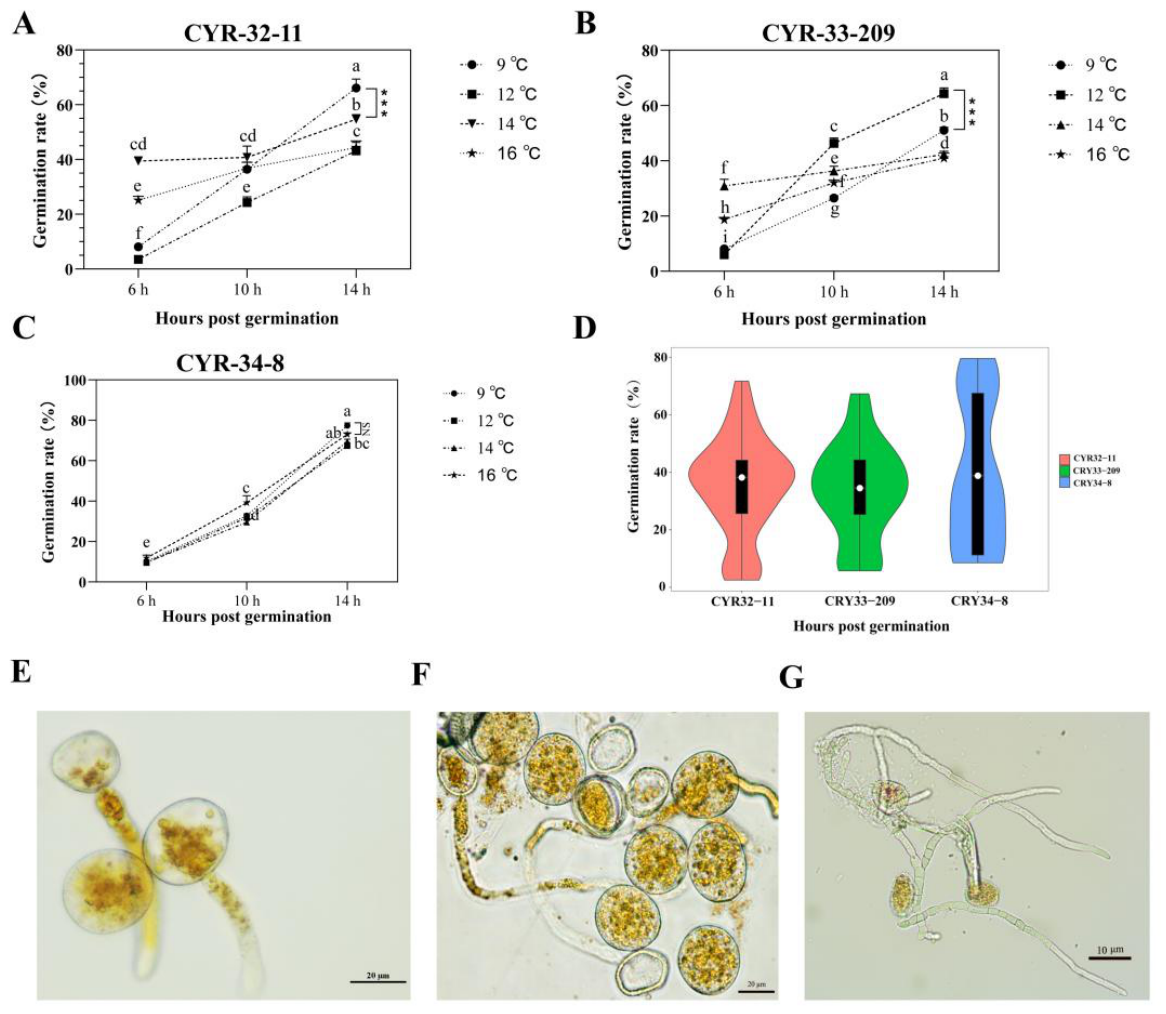
Figure 2.
Distribution of differentially expressed genes (DEGs) under different temperature treatments.(A) Distribution of DEGs in the 9℃ vs 12℃ comparison.(B) Distribution of DEGs in the 9℃ vs 14℃ comparison.(C) Distribution of DEGs in the 9℃ vs 16℃ comparison.(D) Distribution of DEGs in the 12℃, 14℃ and 16℃ groups relative to the 9℃ control.
Figure 2.
Distribution of differentially expressed genes (DEGs) under different temperature treatments.(A) Distribution of DEGs in the 9℃ vs 12℃ comparison.(B) Distribution of DEGs in the 9℃ vs 14℃ comparison.(C) Distribution of DEGs in the 9℃ vs 16℃ comparison.(D) Distribution of DEGs in the 12℃, 14℃ and 16℃ groups relative to the 9℃ control.
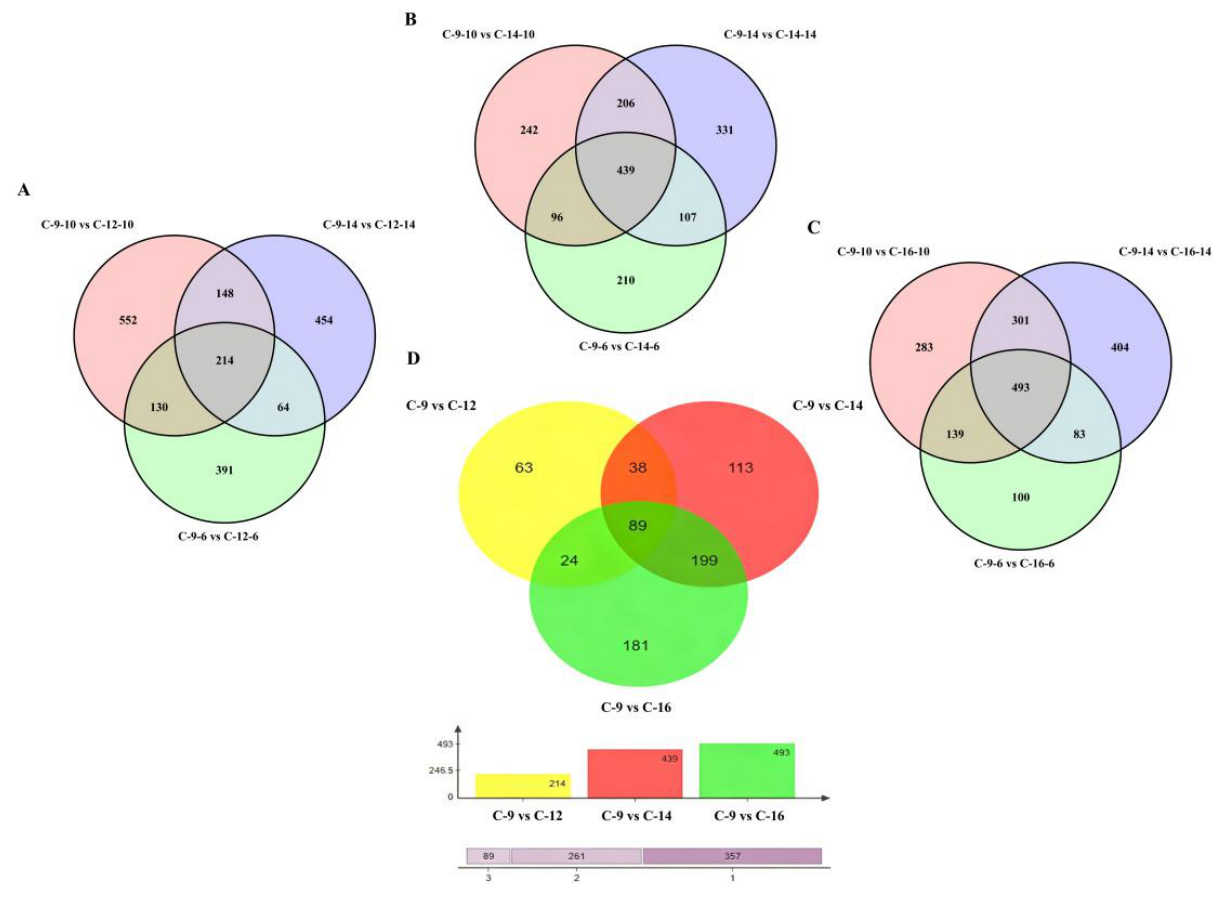
Figure 3.
Verification of RNA-Seq analysis by qRT-PCR. (A) Relative expression levels of 13 randomly selected transcripts verified by qRT-PCR. Checkerboard-patterned histograms represent relative gene expression levels determined by qRT-PCR, whereas chevron-patterned histograms represent TMM-FPKM values from RNA-Seq data. Error bars indicate the mean ± SE of three biological replicates. (B) Comparison of log₂FPKM of DEGs obtained from RNA-Seq and qRT-PCR.
Figure 3.
Verification of RNA-Seq analysis by qRT-PCR. (A) Relative expression levels of 13 randomly selected transcripts verified by qRT-PCR. Checkerboard-patterned histograms represent relative gene expression levels determined by qRT-PCR, whereas chevron-patterned histograms represent TMM-FPKM values from RNA-Seq data. Error bars indicate the mean ± SE of three biological replicates. (B) Comparison of log₂FPKM of DEGs obtained from RNA-Seq and qRT-PCR.
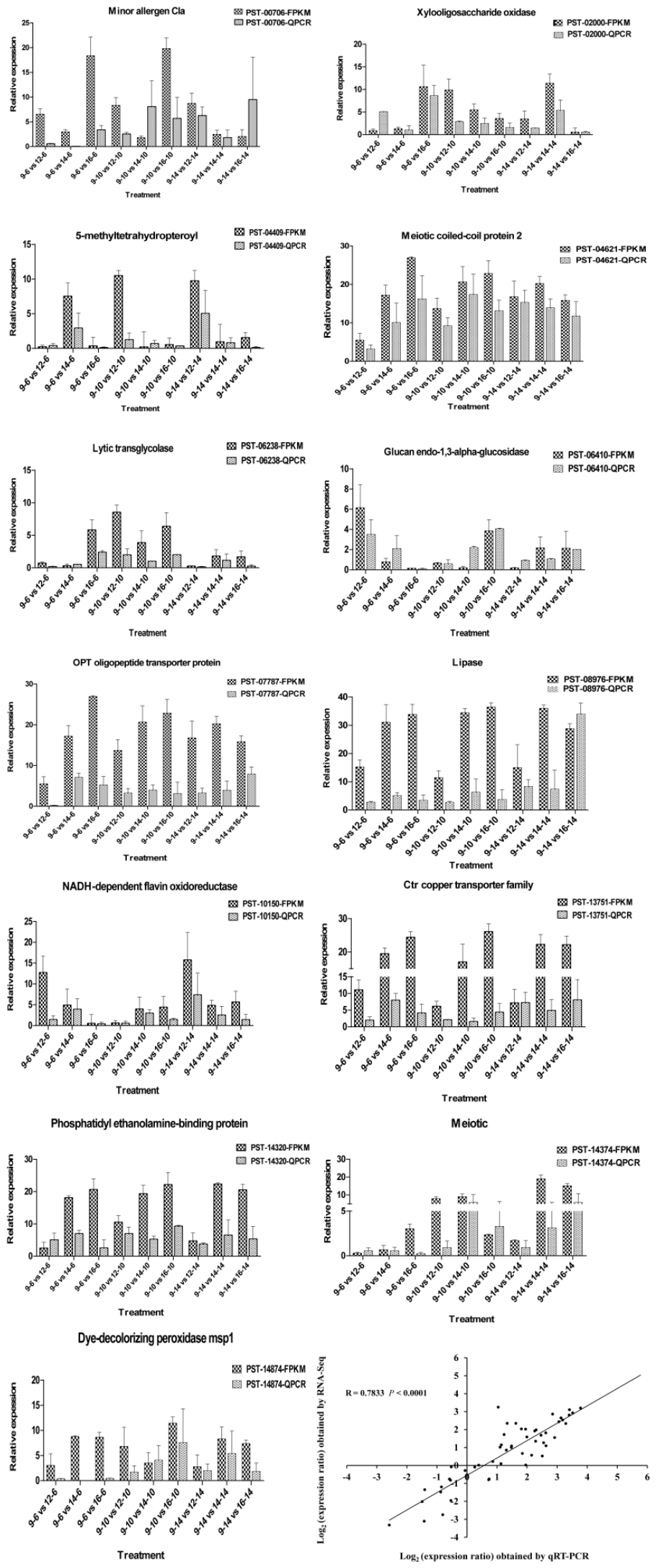
Figure 4.
Expression profiles and clustering analysis of DEGs in Puccinia striiformis f. sp. tritici race CYR34-8 under different temperature treatments. (A) Circular heatmap of 89 DEGs. Red indicates upregulated genes, green indicates downregulated genes; inner dendrogram shows gene clustering, outer ring displays gene IDs. (B) Three distinct expression clusters of DEGs.Pink lines represent individual gene expression trends, black lines denote the average expression pattern of each cluster (Cluster 1: 50 genes, Cluster 2: 28 genes, Cluster 3: 11 genes).
Figure 4.
Expression profiles and clustering analysis of DEGs in Puccinia striiformis f. sp. tritici race CYR34-8 under different temperature treatments. (A) Circular heatmap of 89 DEGs. Red indicates upregulated genes, green indicates downregulated genes; inner dendrogram shows gene clustering, outer ring displays gene IDs. (B) Three distinct expression clusters of DEGs.Pink lines represent individual gene expression trends, black lines denote the average expression pattern of each cluster (Cluster 1: 50 genes, Cluster 2: 28 genes, Cluster 3: 11 genes).
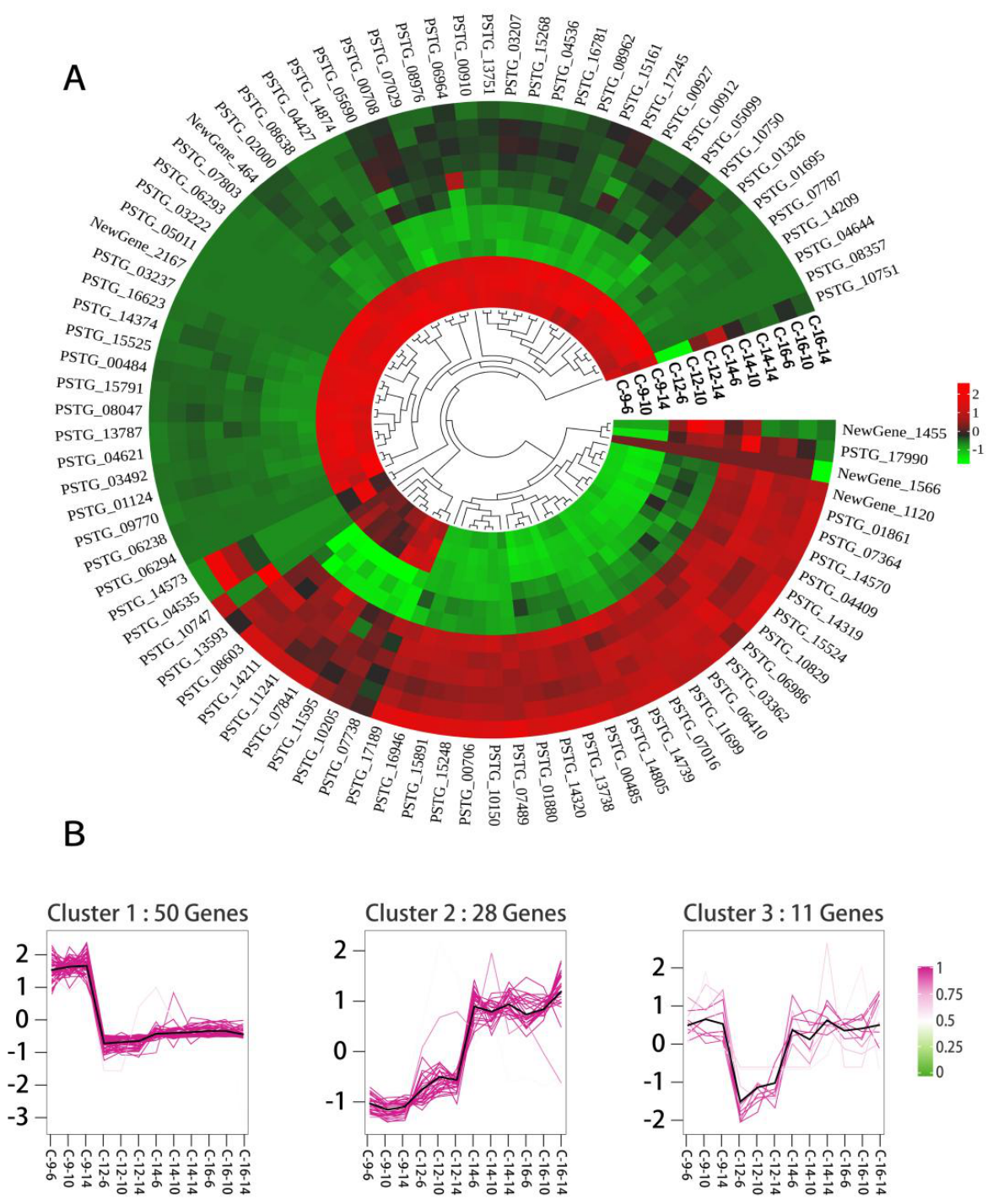
Figure 5.
Chromosomal distribution of temperature-responsive 89 DEGs in Puccinia striiformis f. sp. tritici race CYR34-8. Vertical green bars represent genome scaffolds of Pst; the left-side scale shows genomic physical distance (Mb). Red labels denote the positions of all 89 DEGs, which are randomly distributed across the genome.
Figure 5.
Chromosomal distribution of temperature-responsive 89 DEGs in Puccinia striiformis f. sp. tritici race CYR34-8. Vertical green bars represent genome scaffolds of Pst; the left-side scale shows genomic physical distance (Mb). Red labels denote the positions of all 89 DEGs, which are randomly distributed across the genome.
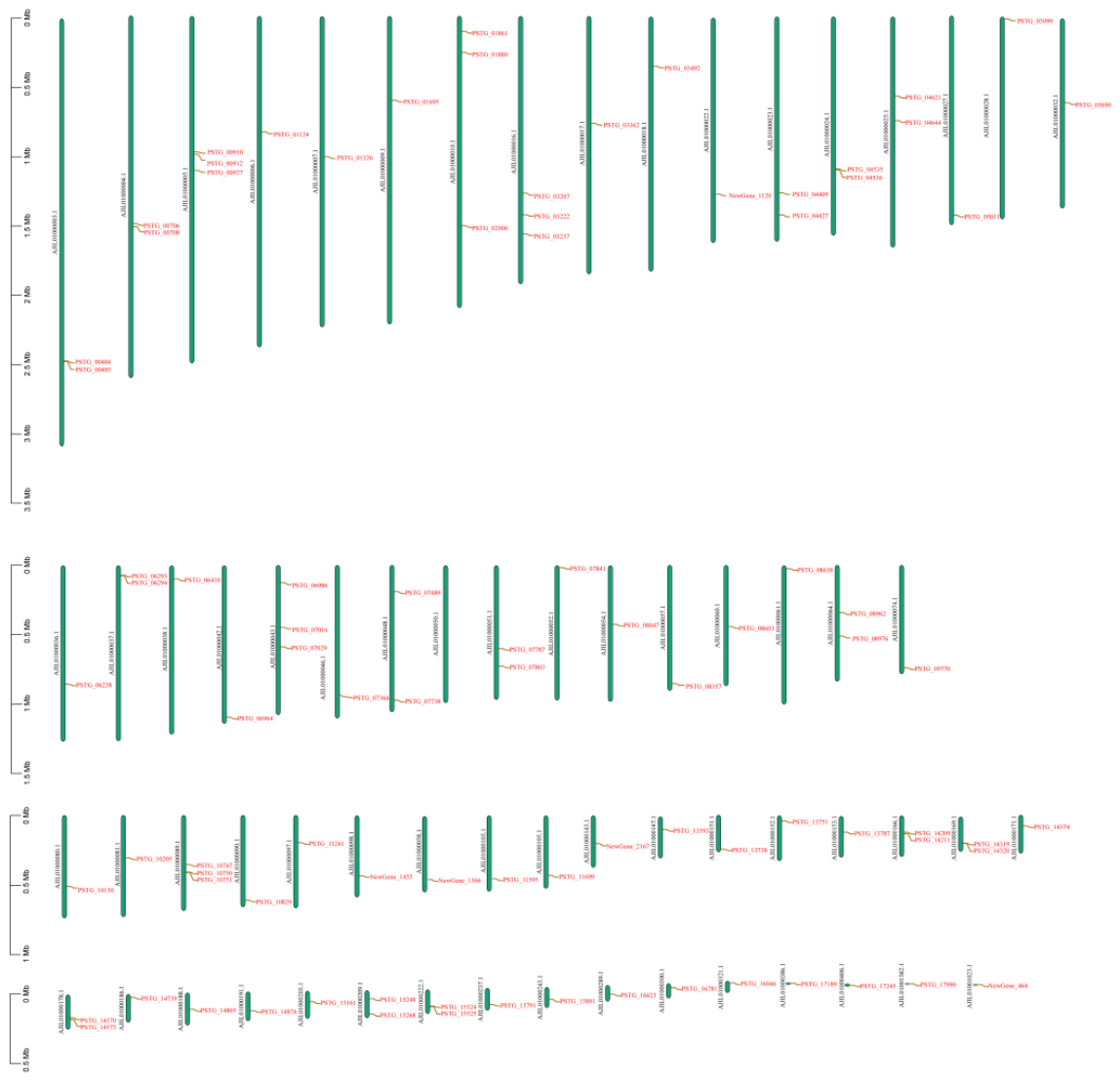
Figure 6.
Protein-protein interaction network of 89 DEGs responding to temperature fluctuations. Each node represents an individual DEG, and node color indicates the gene expression level (log₂FPKM). Node size is proportional to the interaction degree. Four key hub genes are highlighted in red, green, blue, and yellow, interacting with 19, 12, 12, and 11 partner genes, respectively. The PPI network was constructed using the STRING database and visualized with CYTOSCAPE software.
Figure 6.
Protein-protein interaction network of 89 DEGs responding to temperature fluctuations. Each node represents an individual DEG, and node color indicates the gene expression level (log₂FPKM). Node size is proportional to the interaction degree. Four key hub genes are highlighted in red, green, blue, and yellow, interacting with 19, 12, 12, and 11 partner genes, respectively. The PPI network was constructed using the STRING database and visualized with CYTOSCAPE software.
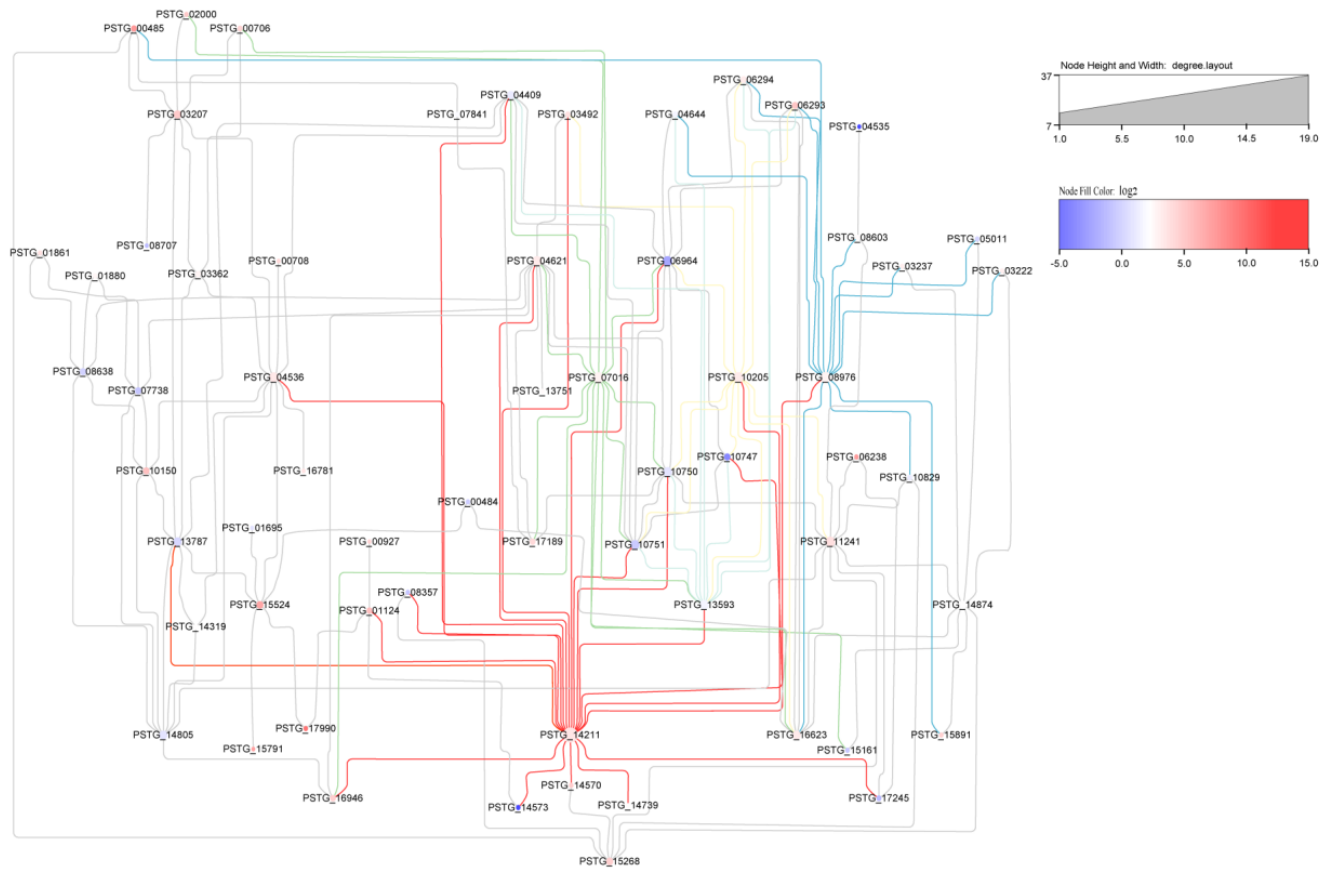
Figure 7.
A summary of the molecular pathways and cellular processes involved in temperature-dependent regulation of pathogenicity based on 89 DEGs in Puccinia striiformis f. sp. tritici. Left: Urediniospore treatments across 9–16 °C temperature gradient; Middle: Seven key functional pathways underlying heat adaptation, with major DEGs labelled in each cascade. color gradient represents gene expression levels (log₂FPKM).
Figure 7.
A summary of the molecular pathways and cellular processes involved in temperature-dependent regulation of pathogenicity based on 89 DEGs in Puccinia striiformis f. sp. tritici. Left: Urediniospore treatments across 9–16 °C temperature gradient; Middle: Seven key functional pathways underlying heat adaptation, with major DEGs labelled in each cascade. color gradient represents gene expression levels (log₂FPKM).
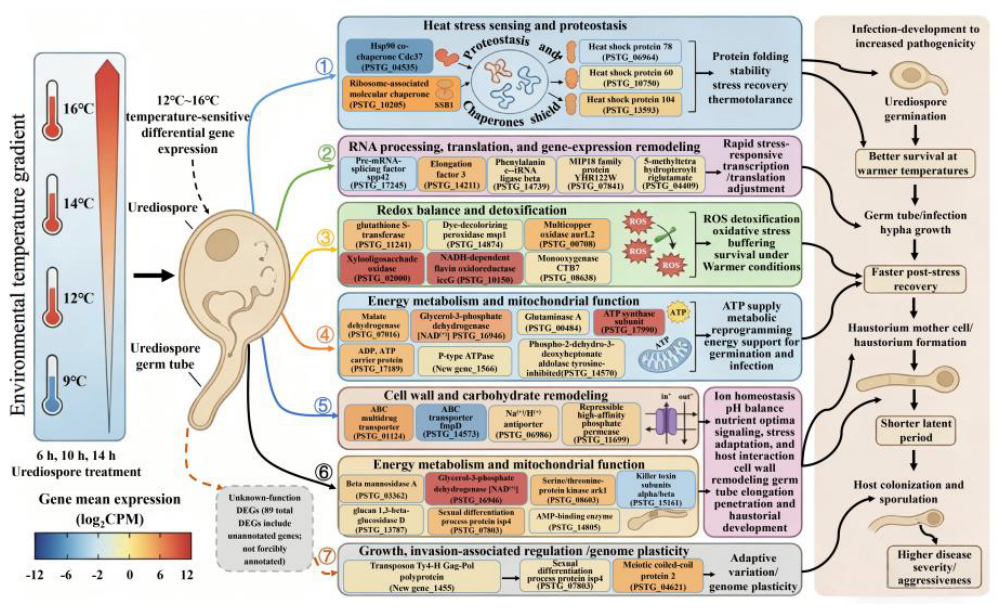

Table 1.
Significantly enriched KEGG pathways among 89 DEGs in Puccinia striiformis f. sp. tritici race CYR34-8.
Table 1.
Significantly enriched KEGG pathways among 89 DEGs in Puccinia striiformis f. sp. tritici race CYR34-8.
| Pathway | Pathway ID | Padj-value | DEGs with pathway annotation | All genes |
|---|---|---|---|---|
| Ubiquinone and other terpenoid-quinone biosynthesis | ko00130 | 0.001657 | 2 (PSTG_00706, PSTG_14805) | 9 |
| Other glycan degradation | ko00511 | 0.003528 | 2 (PSTG_02000, PSTG_03362) | 13 |
| Longevity regulating pathway | ko04213 | 0.004583 | 3 (PSTG_06964, PSTG_10205, PSTG_13593) | 49 |
| Legionellosis | ko05134 | 0.012886 | 2 (PSTG_10205, PSTG_10750) | 25 |
| ABC transporters | ko02010 | 0.0149469 | 2 (PSTG_01124, PSTG_14573) | 27 |
| Platinum drug resistance | ko01524 | 0.018286 | 2 (PSTG_11241, PSTG_13751) | 30 |
| Phenylpropanoid biosynthesis | ko00940 | 0.027790 | 1 (PSTG_14805) | 4 |
| Longevity regulating pathway - worm | ko04212 | 0.028554 | 2 (PSTG_10750, PSTG_11241) | 38 |
| Mineral absorption | ko04978 | 0.034621 | 1 (PSTG_13751) | 5 |
| Type I diabetes mellitus | ko04940 | 0.041405 | 1 (PSTG_10750) | 6 |
1 Padj-value represents adjusted P-value. “DEGs with pathway annotation” indicates the number and corresponding IDs of differentially expressed genes enriched in each pathway. “All genes” means the total number of all genes in the Pst genome annotated to the given KEGG pathway.
Disclaimer/Publisher’s Note: The statements, opinions and data contained in all publications are solely those of the individual author(s) and contributor(s) and not of MDPI and/or the editor(s). MDPI and/or the editor(s) disclaim responsibility for any injury to people or property resulting from any ideas, methods, instructions or products referred to in the content. |
© 2026 by the authors. Licensee MDPI, Basel, Switzerland. This article is an open access article distributed under the terms and conditions of the Creative Commons Attribution (CC BY) license (http://creativecommons.org/licenses/by/4.0/).
Copyright: This open access article is published under a Creative Commons CC BY 4.0 license, which permit the free download, distribution, and reuse, provided that the author and preprint are cited in any reuse.


