

Submitted:
11 July 2026
Posted:
13 July 2026
You are already at the latest version
Abstract
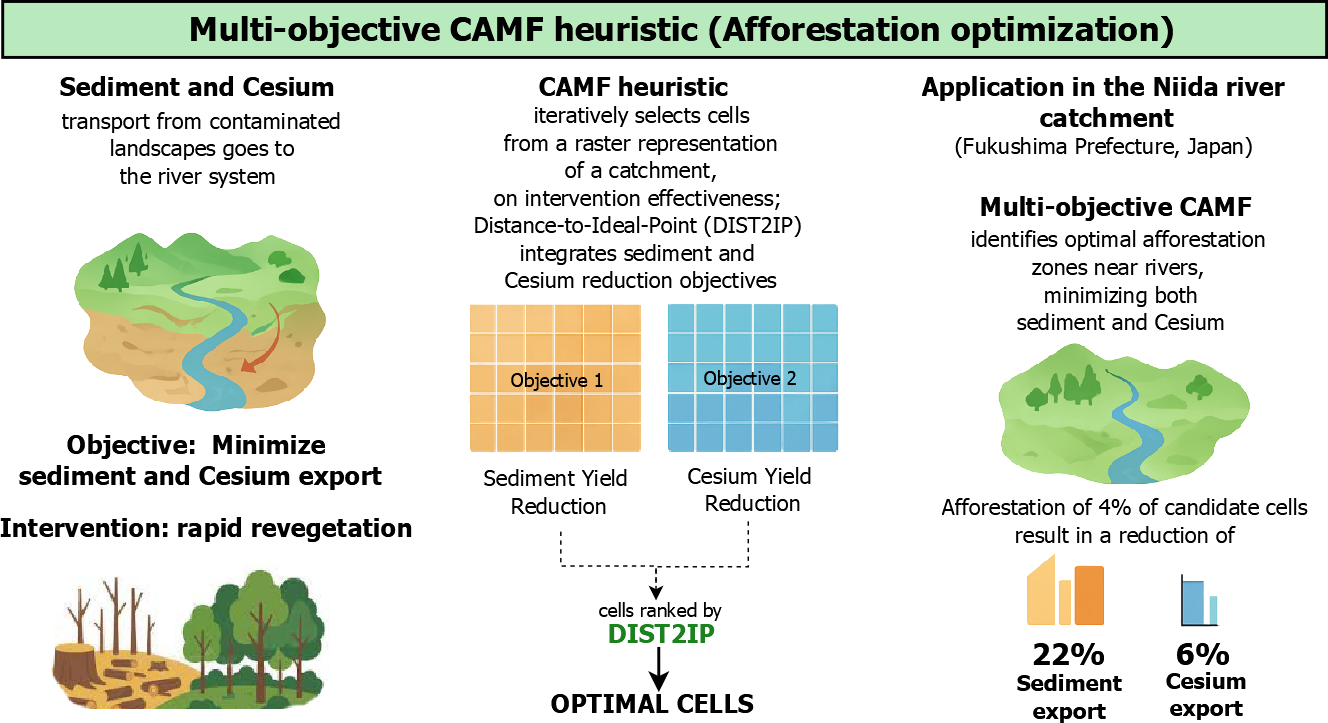
Afforestation can mitigate the export of water, sediment, and dissolved or adsorbed contaminants to river systems, but identifying effective intervention sites requires accounting for multiple flow-related criteria and their spatial interactions. This paper presents a multi-criteria heuristic approach that extends CAMF (Cellular Automata-based Heuristic for Minimizing Flow), originally designed to select cells from a rasterized landscape for interventions that minimize sediment yield at target sites. We integrated the Distance-to-Ideal-Point (DIST2IP) algorithm in CAMF, enabling the selection of cells where intervention can minimize two or more flows simultaneously. The multi-criteria CAMF was applied ex post to the radioactively contaminated Niida river catchment, Fukushima prefecture, Japan, to identify 1,000 cells within decontaminated zones where immediate afforestation would have maximally reduced both sediment and residual 137Cs export. The 1,000 best cells selected by DIST2IP, representing 4% of the decontaminated cells, would have reduced sediment export by 22% and 137Cs export by 6%. Selected cells are within the union of cells identified by the two single-criteria optimizations and are predominantly close to water bodies, confirming that blocking flow paths before they connect to the river system is most effective.
Keywords:
land degradation
; contaminant dispersion
; site location problem
; multi-criteria optimization
; spatial interaction
Copyright: This open access article is published under a Creative Commons CC BY 4.0 license, which permit the free download, distribution, and reuse, provided that the author and preprint are cited in any reuse.


