
Submitted:
12 July 2026
Posted:
13 July 2026
You are already at the latest version
Abstract
Advanced Air Mobility (AAM) is increasingly recognized as a promising approach for improving healthcare logistics, yet evidence remains fragmented across aviation, transportation, healthcare, and digital infrastructure. This study examined the operational, clinical, and institutional evidence to characterize the evolution of healthcare-focused AAM, identify dominant research themes, and determine critical knowledge gaps. The review followed PRISMA-ScR guidelines and combined bibliometric analysis, thematic synthesis, and semantic network analysis of 168 peer-reviewed studies published between 2015 and 2025 and retrieved from IEEE Xplore, ScienceDirect, Scopus, and Web of Science. The analysis identified six thematic clusters encompassing system design, healthcare logistics, biological specimen transport, emergency response, health equity, and digital infrastructure. Publication activity increased rapidly after 2020, emergency response represented the most mature research domain, and pharmaceutical logistics, longitudinal operational validation, and health equity remained comparatively underdeveloped. These findings demonstrate that healthcare-focused AAM functions as a sociotechnical system requiring coordinated advances in technology, governance, institutional integration, and equitable access to support clinically reliable and operationally sustainable healthcare delivery.
Keywords:
advanced air mobility
; healthcare logistics
; medical drone systems
; scoping review
; healthcare supply
1. Introduction
A delayed blood transfusion, an interrupted vaccine supply, or a slow emergency response in a remote community can mean the difference between life and death. As healthcare systems worldwide confront mounting pressures related to accessibility, resilience, and rapid service delivery, attention has increasingly turned toward emerging transportation technologies capable of overcoming geographic and infrastructural barriers. Among the most promising of these innovations is AAM, broadly defined as the integration of electric vertical takeoff and landing (eVTOL) aircraft, uncrewed aircraft systems (UAS), drones, and supporting digital infrastructure into transportation and logistics networks. Initially associated with passenger-oriented Urban Air Mobility (UAM), AAM has increasingly expanded into healthcare applications including emergency medical response, pharmaceutical distribution, blood and organ transport, laboratory logistics, and rural healthcare delivery [1]. Advances in automation, electric propulsion, artificial intelligence, and digital connectivity have further accelerated interest in healthcare AAM as a potentially transformative component of future healthcare systems.
Despite this growing momentum, the integration of AAM into healthcare systems remains fragmented, unevenly developed, and insufficiently understood. Existing scholarship is dispersed across aviation engineering, transportation systems, healthcare logistics, emergency medicine, airspace governance, and digital infrastructure studies, often operating in disciplinary silos with limited conceptual integration [2]. Much of the literature has concentrated on isolated technical questions such as drone routing optimization, emergency-response efficiency, battery performance, or airspace certification, while comparatively limited attention has been given to how these dimensions interact within broader healthcare systems. Furthermore, the field continues to evolve under overlapping terminologies including drones, UAS, UAM, and AAM, creating conceptual inconsistency and fragmented scholarly development. This fragmentation presents a significant problem because AAM in healthcare differs fundamentally from passenger mobility systems. Healthcare operations involve time-critical missions, biologically sensitive cargo, irregular demand patterns, ethical obligations, and highly regulated operational environments requiring coordinated integration across transportation systems, healthcare workflows, governance structures, and digital infrastructures.
The absence of a consolidated evidence base has important practical implications. Policymakers, healthcare administrators, transportation planners, and system designers increasingly face decisions regarding the adoption of aerial healthcare systems without a comprehensive understanding of where knowledge is concentrated, where conceptual and operational gaps persist, and how the field is evolving. Although previous reviews have examined drone healthcare applications or broader AAM developments independently, relatively limited scholarship has systematically synthesized the bibliometric evolution, thematic structure, and emerging research gaps of healthcare-focused AAM within a unified analytical framework. As publication activity has accelerated since 2020, the lack of such synthesis has become increasingly problematic, risking fragmented technological development disconnected from healthcare-system realities and long-term operational sustainability.
This study addresses that problem through a scoping review of peer-reviewed literature published between 2015 and 2025 on AAM applications in healthcare logistics, patient transport, and emergency medical response. Guided by PRISMA-ScR reporting standards, the review combines bibliometric analysis, thematic synthesis, and semantic network mapping to examine the intellectual evolution and conceptual structure of the field. Specifically, the study seeks to identify the dominant bibliometric patterns shaping aerial healthcare systems research, examine the major thematic areas and conceptual relationships defining the literature, and evaluate the critical research gaps and future priorities emerging from current scholarship. These objectives directly inform the study’s research questions: (1) What bibliometric patterns characterize the evolution of healthcare-focused AAM research between 2015 and 2025? (2) What major thematic areas and conceptual relationships define the existing literature on AAM applications in healthcare logistics, emergency response, and medical transport? and (3) What critical research gaps and future priorities emerge from the current body of healthcare-focused AAM scholarship?
By addressing these questions, the study contributes to the growing scholarly conversation on healthcare innovation, transportation systems, and aerial logistics by moving beyond isolated technological assessments toward a broader understanding of AAM as a sociotechnical healthcare system. In doing so, the review provides a consolidated evidence base capable of informing future research, governance frameworks, operational integration strategies, and policy development for clinically reliable, operationally sustainable, and socially equitable unscrewed aerial medical transport systems.
2. Methodology
Figure 1 illustrates the three-pillar methodological workflow underpinning this review. Each pillar, described in the subsections that follow, addresses a distinct but interrelated analytical objective: assembling a representative corpus through structured search and screening, quantifying the structural features of the literature through bibliometric mapping, and synthesizing its conceptual content through thematic and semantic analysis.
2.1. Scoping Review Design
This study employed a scoping review methodology to map the extent, range, and nature of evidence on AAM technologies applied to healthcare logistics and emergency response. The scoping review design was chosen because the field is interdisciplinary, rapidly evolving, and not yet consolidated enough for systematic review or meta-analysis. Consistent with the purpose of scoping reviews, the study aimed to chart the conceptual landscape of AAM-healthcare research, identify thematic clusters and disciplinary gaps, and generate evidence-based priorities for future inquiry rather than to synthesize effect estimates or evaluate intervention efficacy [3]. The review followed PRISMA extension for scoping reviews (PRISMA-ScR) reporting guidelines to ensure transparency and methodological accountability across all stages of the search, screening, and synthesis process.
The review was structured around the population-concept-context (PCC) framework recommended for scoping reviews. The population comprised healthcare systems, logistics networks, and emergency medical services engaged with or affected by aerial transport technologies. The concept encompassed AAM technologies, including eVTOL aircraft, UAS, and autonomous drones, applied to medical logistics, patient transport, and emergency response. The context spanned peer-reviewed literature published between January 2015 and December 2025 across engineering, transportation, healthcare, and policy domains. This PCC framing guided the development of the search strategy and eligibility criteria described in the subsections that follow.
2.1.1. Data and Search Strategy
The search strategy combined structured database querying and manual reference tracing to achieve broad and representative coverage across disciplines. Four data sources were selected to capture diverse perspectives across engineering, transportation, and healthcare: IEEE Xplore, Science Direct, Scopus, and Web of Science. This multi-database approach is consistent with best practices for comprehensive evidence mapping in emerging interdisciplinary fields [4]. Boolean operators were tailored to form the search string as:
(“UAS” OR “UAV” OR “eVTOL” OR “unmanned aircraft” OR “uncrewed aircraft” OR “unmanned aerial” OR “air mobility”) AND (“healthcare” OR “medical” OR “pharmaceutical”)
Although a substantial body of research exists on drone-enabled healthcare delivery and unmanned aircraft systems more broadly, the search strategy was intentionally designed to capture literature situated at the intersection of aerial mobility technologies and healthcare applications rather than restricting retrieval exclusively to studies explicitly labeled as “Advanced Air Mobility” (AAM). The inclusion of terms such as “UAS,” “UAV,” “eVTOL,” “unmanned aircraft,” “uncrewed aircraft,” and “air mobility” alongside “healthcare,” “medical,” and “pharmaceutical” allowed the review to capture the diverse and fragmented terminology characterizing this emerging field. This broader search approach was necessary because much of the healthcare-related literature predates the widespread adoption of the AAM terminology and continues to be published under parallel concepts including drone delivery, UAS operations, and Urban Air Mobility (UAM). Nevertheless, the review analytically interprets the retrieved studies through an AAM lens, conceptualizing AAM as a broader socio-technical framework involving low-altitude airspace integration, autonomous operations, digital infrastructure, regulatory modernization, and multimodal healthcare logistics integration. Consequently, the identified trends, thematic patterns, and research gaps are interpreted within the context of emerging healthcare-focused AAM systems rather than as isolated drone applications alone.
2.1.2. Screening and Selection
The screening process followed a multi-stage workflow documented using PRISMA-ScR reporting conventions. The workflow encompassed identification, screening, eligibility assessment, and inclusion. Records from all four databases were merged before automated and manual duplicate removal. Documents were screened in two stages: first by title and abstract against the eligibility criteria, and second by full-text review to confirm relevance and scope alignment. This two-stage approach is consistent with established scoping review practice and reduces the risk of irrelevant studies entering the synthesis [5].
2.1.3. Eligibility Criteria
Eligibility criteria were developed in accordance with the PCC framework and are summarized in Table 1. Eligible studies included peer-reviewed journal articles, conference proceedings, and doctoral dissertations that examined AAM or UAS applications in healthcare or medical logistics. Publications were required to be in English, have full-text availability, and fall within the period January 2015 to December 2025. Studies published outside the defined scope, duplicates, non-English publications, and grey literature including preprints, master’s theses, and reports were excluded. These criteria guided the assembly of a representative and thematically coherent corpus that formed the basis for subsequent bibliometric, thematic, and semantic analyses.
2.1.4. Inter-Rater Reliability and Structured Evidence Appraisal Framework
Inter-rater reliability (IRR) served as a quality assurance mechanism throughout study selection, thematic classification, and structured evidence appraisal to ensure consistency, transparency, and methodological rigor. Reviewer agreement was quantified using Cohen’s kappa coefficient, calculated as κ = (Po − Pᵉ)/(1 − Pᵉ), where Po represents the observed proportion of agreement between reviewers and Pᵉ represents the proportion expected by chance. Kappa values were interpreted according to the benchmarks proposed by Landis and Koch, with a minimum threshold of κ ≥ 0.70 established a priori as the criterion for acceptable agreement. All disagreements were documented in a structured discrepancy log that recorded the study identifier, the nature of the disagreement, the reviewers’ rationale, and the final resolution.
The IRR framework was implemented across three sequential stages. First, two subject matter experts (SMEs) independently screened all retrieved records by title and abstract against the PCC eligibility criteria. A third SME adjudicated disagreements before consensus records advanced to the software-assisted dual-filtering process. Second, the same SMEs independently conducted full-text eligibility assessments, with unresolved disagreements referred to the third SME for arbitration. Third, the three SMEs independently assigned each included study to a single thematic category based on its primary research focus, and consensus discussions resolved any classification discrepancies. As summarized in Table 2, Cohen’s kappa values ranged from 0.71 to 0.82, indicating substantial to almost perfect agreement across all three stages and exceeding the predefined acceptance threshold. These findings demonstrate that the eligibility criteria, screening protocol, and thematic coding framework were sufficiently well defined to produce reliable and reproducible reviewer judgments.
All included studies subsequently underwent a structured evidence appraisal that evaluated methodological rigor, contextual relevance, and contribution to the field. Consistent with scoping review methodology, the appraisal informed interpretive weighting during thematic synthesis rather than serving as an exclusion criterion. Modeling and simulation studies were evaluated for problem formulation, model appropriateness, transparency of assumptions, adequacy of input data, and reproducibility. Empirical and qualitative studies were assessed according to sampling strategy, data collection procedures, analytical rigor, and contextual validity, particularly their relevance to real-world healthcare logistics and emergency response. Review and conceptual studies were evaluated for theoretical coherence, comprehensiveness of literature coverage, and clarity in identifying research gaps. To minimize subjectivity, all three SMEs independently completed the evidence appraisal, and IRR was used to verify consistency in evaluative judgments. Structured consensus discussions resolved any remaining discrepancies before the final synthesis. Together, the integration of IRR, structured evidence appraisal, and documented consensus procedures strengthened the robustness, transparency, reproducibility, auditability, and credibility of the review.
2.2. Bibliometric Analysis
The bibliometric analysis provided a quantitative foundation for understanding the evolution, collaboration patterns, and productivity of research on AAM healthcare applications. This approach complemented the scoping review by identifying structural characteristics of the research landscape, specifically how publication activity, authorship trends, and geographic collaboration patterns have shaped the development of this emerging field [6].
2.2.1. Analytical Framework
The bibliometric methods quantified temporal growth, collaboration intensity, and geographic diversity within the curated corpus. These indicators revealed the maturity of the research domain, the degree of interdisciplinarity, and the level of international cooperation driving innovation in healthcare-focused AAM. The analysis followed established practices in scientometric research, integrating data extraction, preprocessing, and visualization stages to ensure replicability and comparability with similar technology adoption studies [7].
2.2.2. Data Preparation and Tools
The dataset derived from the corpus assembly contained complete bibliographic metadata for all included studies, including author full names, affiliations, publication year, and country of origin. The team standardized records for consistency in naming conventions and affiliation formatting. The team cleaned the data, resolved missing information, and processed records using Python, R Programming, and bibliometric visualization tools including VOSviewer (v1.6.20) and Microsoft Excel. Quantitative analyses employed descriptive statistics, while graphical outputs including heatmaps, scatter plots, and network diagrams illustrated relationships among key bibliometric variables.
2.2.3. Temporal Analysis
To assess the growth trajectory of the field, publication counts were aggregated by year from 2015 through 2025. This temporal analysis aimed to identify inflection points reflecting technological advances, regulatory milestones, or increased funding activity influencing healthcare-related AAM research. The visualization of publication trends provided insight into the pace of academic engagement and the diffusion of AAM technologies across healthcare subdomains [4].
2.2.4. Collaboration Analysis
Authorship distribution was analyzed to evaluate the degree of collaboration and interdisciplinarity among contributors. For each document, the number of authors was counted and aggregated to generate a distribution plot characterizing typical team size and collaboration depth. At the international level, collaboration networks were constructed using author-affiliation data. Countries were mapped based on co-authorship links to identify the most active nations and their collaborative ties. Network visualization highlighted the density and directionality of cross-border partnerships, indicating how knowledge exchange and global participation contribute to advancing AAM healthcare research [8].
2.2.5. Purpose and Integration
Together, these bibliometric measures established the contextual foundation for the thematic synthesis presented in the results section. By combining temporal, authorship, and geographic perspectives, the bibliometric analysis sought to uncover how scholarly attention, research capacity, and institutional collaboration are shaping the trajectory of AAM integration into healthcare systems. This systematic quantification enabled the subsequent qualitative analyses to be interpreted within a well-defined structural and temporal framework.
2.3. Thematic Review
The thematic review extended the bibliometric analysis by providing a qualitative and computational understanding of the intellectual structure and dominant research directions within the corpus. Three complementary approaches were employed: expert-guided thematic synthesis, natural language processing (NLP)-based thematic analysis, and semantic network mapping. Each approach addressed a distinct analytical objective while reinforcing the insights generated by the others.
2.3.1. Thematic Coding and Synthesis
The thematic synthesis followed a structured inductive coding procedure conducted independently by all three SMEs. Each SME examined the title, abstract, and keywords of all 168 studies and assigned one dominant semantic code representing the primary analytical focus of each study. The team designed these codes to capture distinct functional orientations of the research rather than simple keyword matches. The team designed these codes to capture distinct functional orientations of the research rather than simple keyword matches.
2.3.2. Thematic Analysis
The thematic analysis extended the synthesis by examining linguistic and quantitative patterns within each identified research theme using NLP and statistical visualization. The objective was to uncover dominant terminology, evolving research priorities, and the relative academic influence of each thematic area, thereby enriching the interpretive depth of the study [4].
To visualize the core research vocabulary of each thematic category, NLP techniques preprocessed the titles and abstracts from all included studies. The preprocessing reduced lexical noise through four sequential methods: elimination of common grammatical stop words, removal of short words and formatting artifacts, filtering of high-frequency common-mode terms appearing in more than 90% of documents, and exclusion of outlier terms appearing in fewer than 5% of documents.
To complement the textual analysis, temporal and citation-based visualizations were developed to reveal research activity and impact trends. Publication and citation heatmaps were produced quantifying the temporal evolution of research output and highlighting the academic influence and maturity of each theme over time.
2.3.3. Semantic Network Analysis
The semantic network analysis examined the relationships among key terms that co-occur across the corpus to uncover the underlying conceptual structure of research on AAM in healthcare. Whereas the thematic synthesis classified studies based on expert judgment and the thematic analysis examined term frequency within predefined categories, the semantic mapping applied a data-driven approach to identify how terms naturally cluster based on their co-occurrence patterns across the full corpus [8].
The term co-occurrence network was generated from the processed titles and abstracts of all included studies using VOSviewer. Each unique term was represented as a node, with links between nodes indicating that the corresponding terms appeared together within the same document. The frequency of joint appearances across the corpus determined the strength of the connection, visualized as link thickness. Preprocessing followed the same data cleaning and normalization protocol described in the thematic analysis stage. A modularity optimization technique grouped related terms into clusters based on co-occurrence strength, with each cluster representing a cohesive latent research subdomain. Node size corresponded to term frequency, link thickness to co-occurrence strength, and color-coding distinguished clusters to allow clear visualization of how different research areas connect or diverge.
This network-based perspective provided a multidimensional understanding of how research topics intersect across disciplines, revealing dominant conceptual hubs, bridging terms that link technical and operational perspectives, and peripheral terms representing emerging or specialized niches. The semantic mapping thus complemented the bibliometric and thematic analyses by illuminating the connective logic of the field, demonstrating how ideas, methods, and application domains interlink across what is an inherently multidisciplinary and increasingly interdisciplinary body of literature [4].
3. Results
3.1. Systematic Review
Table 3 summarizes the results from four databases. The search strategy prioritized breadth while minimizing duplication and irrelevant results. The search initially identified a total of 4,561 records across all databases.
As illustrated in Figure 2, a multi-stage PRISMA screening process was used to refine the dataset. Before screening, the authors removed 371 duplicate records and 1,148 records deemed ineligible, yielding 3,043 unique records that were screened against the inclusion and exclusion criteria. Title and abstract screening excluded 2,098 records, leaving 945 reports sought for retrieval. Of these, 25 could not be retrieved, leaving 920 reports assessed for eligibility. This stage excluded 752 additional records owing to unavailable full text (n = 39), non-English language (n = 21), or irrelevance to the review scope (n = 692). The final corpus comprised 168 peer-reviewed studies that satisfied all inclusion criteria and served as the foundation for the bibliometric analysis and thematic review.
3.2. Bibliometric Analysis
As illustrated in Figure 3, the annual publication trend demonstrated the rapid expansion and growing scholarly interest in healthcare-focused AAM research between 2016 and 2025. Although the search period began in 2015, no studies published in that year met the final eligibility criteria following screening and full-text review; consequently, publication activity within the final corpus begins in 2016. Publication activity remained relatively limited between 2016 and 2018, reflecting the exploratory stage of drone-enabled healthcare applications and early proof-of-concept studies. A gradual increase emerged between 2019 and 2020 as research interest expanded beyond emergency-response feasibility toward broader healthcare logistics and operational applications. The most significant growth occurred after 2020, particularly in 2021 and 2024, likely driven by advances in autonomous technologies, increasing regulatory attention, and heightened demand for resilient and contactless healthcare logistics systems during and after the COVID-19 pandemic. Overall, the trend illustrated in Figure 3 indicates the transition of healthcare-focused AAM from an emerging technological concept into a rapidly developing multidisciplinary research field involving healthcare logistics, emergency medicine, transportation systems, and aviation governance.
Figure 4 shows that healthcare-focused AAM research was characterized by moderate-to-high levels of collaboration.
Across the 168 studies reviewed, the average authorship size was 5.28 authors per article, while both the median and mode were five authors, indicating that five-person research teams represent the typical collaboration structure within the field. The distribution exhibits moderate variability, with a standard deviation of 3.21 authors, suggesting that although most studies involve similarly sized teams, substantial differences in collaboration intensity exist across publications. Authorship ranged from a minimum of one author to a maximum of 26 authors, highlighting the coexistence of both individual contributions and large-scale collaborative projects. Most articles were produced by teams of two to seven authors, with five-author publications accounting for the largest share (n = 31). The presence of several studies involving 11 or more authors further reflects growing interdisciplinary and institutional collaboration, consistent with the complex integration of healthcare, aviation, transportation, engineering, and digital technologies required to advance healthcare-focused AAM research.
Figure 5 illustrates the international collaboration network, revealing that healthcare-focused AAM research was increasingly driven by cross-national partnerships organized around several influential collaboration hubs. The United States occupies the most central position in the network, exhibiting extensive collaborative ties with China, India, Germany, Poland, Japan, the United Kingdom, Saudi Arabia, the United Arab Emirates, Canada, Switzerland, Sweden, and several other countries. This centrality underscores the pivotal role of U.S.-based institutions in facilitating international knowledge exchange and advancing technological and healthcare innovation within the field.
The network also reveals distinct regional collaboration clusters. A strong European cluster is evident through collaborations among Germany, Poland, Sweden, Finland, Italy, France, Austria, Switzerland, and Norway, reflecting sustained research activity in drone regulation, airspace integration, and healthcare logistics. China functions as an important bridge between the United States and emerging Asian collaborations, while India represents a second major international hub, maintaining strong links with Singapore, Taiwan, and Spain. These bridging roles suggest increasing research integration between Western and Asian institutions.
Overall, the network demonstrates that healthcare-focused AAM research has evolved into a globally connected and multidisciplinary enterprise. The dense intercontinental linkages indicate that advances in aerial healthcare systems increasingly depend on international cooperation spanning aviation engineering, healthcare delivery, transportation logistics, digital infrastructure, and regulatory governance. Such collaborative structures are likely to accelerate technological innovation, facilitate knowledge diffusion, and support the harmonization of policies required for the large-scale implementation of healthcare-focused AAM systems.
3.3. Thematic Synthesis
The SMEs identified six thematic clusters in the corpus. Table 4 summarizes the clusters and provides a description of their topics or subtopics. These themes represent the multidisciplinary nature of research in AAM. The subsections that follow comprehensively describe all of the selected studies. This is done within each thematic category to provide insights into how they contribute to the findings of this study and how they collectively inform healthcare transformation.
3.3.1. Theme 1: AAM System Design and Airspace Integration
System design and airspace integration form the foundation for healthcare drone operations. The viability of medical AAM rests not on aircraft performance alone but on whether airspace governance, traffic management, certification, and clinical requirements develop in step with one another. The work in this cluster is therefore concerned with how aerial systems move from isolated demonstrations to dependable components of healthcare delivery.
The earliest contributions borrowed their framing from commercial aviation and urban air mobility, treating AAM mainly as a problem of market development concerned with demand forecasting, network feasibility, and cost [1]. That reasoning was later carried into emergency medical aviation, where eVTOL aircraft were seen as a route to air ambulance operations at scale [16]. Both rest on a single premise, namely that medical AAM is an offshoot of commercial mobility and that technologies built for passengers or freight can be reused for clinical purposes with little change.
This premise has been challenged on the grounds that medical logistics behave quite differently from commercial transport. Demand is irregular, delivery windows are short, the cargo is biologically sensitive, and the liability exposure is high. A competing approach builds UAVs specifically for emergency medical missions, giving priority to payload configuration, rapid deployment, and purpose-built airframes [29]. The contrast raises a question the field has not settled: whether healthcare AAM should adapt commercial platforms or design dedicated clinical systems from the outset.
Regulation and airspace governance prove decisive. There is a strong case that low altitude air space and unmanned traffic management may become the real limit on complex medical UAV operations, which reframes regulation as a design variable rather than a later obstacle [8]. Without harmonized traffic management, reliable communication, and scalable certification, even a capable aircraft cannot operate in practice. The wider Unmanned Aircraft System Traffic Management (UTM) literature reaches the same conclusion through its work on detect and avoid systems, dynamic geofencing, and automated deconfliction [34].
Field experience supplies evidence that the modeling work often lacks. A UAV logistics network operated under healthcare system stress in Valencia revealed how regulation, institutional readiness, and operational uncertainty interact in ways that simulations rarely capture [162]. The same lesson surfaces in international integration pilots, where institutional alignment and regulatory flexibility prove as consequential as the performance of the aircraft itself [49].
Simulation nonetheless dominates the cluster, and many studies assume cooperative weather, reliable communications, and smooth regulatory timelines, which inflates their projections. Repeated warnings against this overconfidence call for testing under genuine clinical conditions [38]. Aviation systems engineering makes the same demand from its own side, stressing iterative testing, redundancy, and formal safety cases before any autonomous system enters regulated airspace [132]. AAM system design is best understood, then, as a systems integration problem that must satisfy both aviation and healthcare regulators, and this framing conditions the themes that follow.
3.3.2. Theme 2: Healthcare and Pharmaceutical Supply Chain Logistics
Healthcare and pharmaceutical logistics make up one of the largest and most quantitatively developed area of the literature. The work treats medical delivery as an optimization problem shaped by urgency, perishability, weak infrastructure, and clinical workflows. Early studies concentrated on routing, scheduling, and network design, but the field has since widened to ask how aerial logistics interact with institutional capacity, regulation, and the performance of the health system as a whole.
Much of this research applies transportation science and operations research to drone enabled distribution. The sensitivity of biological materials has been built directly into UAV network design, so that clinical preservation becomes an architectural requirement rather than a downstream constraint [73]. The same analytical tradition produced decision models for selecting UAV platforms during the COVID 19 pandemic, weighing payload, cost, reliability, and mission fit [36]. Work of this kind shows how firmly the cluster rests on optimization and network design.
The empirical record keeps unsettling the assumption that transport efficiency is the main bottleneck. Operational experience in Madagascar, Malawi, and Senegal points instead to institutional coordination, workflow integration, and long term sustainability as the factors that make drone systems work, since no routing method can compensate for weak institutional alignment [49]. A similar pattern emerged in Rwanda, where drone delivery of blood products cut delivery times and wastage, yet system wide integration and reliable supply continuity mattered more than speed alone [81].
Whether these results transfer between settings is contested. Where roads are poor and terrain difficult, drones bypass the barriers that cripple conventional supply chains, and the underserved African context is read as the setting where aerial logistics matter most [114]. The opposing view concerns high income systems, where dense road networks and mature emergency logistics shrink the gains, so that the regulatory burden, complexity, and cost of large-scale integration may not be justified [68].
Regulation complicates the optimization story further. Dangerous goods rules can sharply limit where UAVs may fly, because many sensitive or hazardous materials fall under aviation regulations that render a theoretically optimal route illegal [42]. The problem recurs across the cluster, since a solution that is computationally elegant is not always one that can be flown. Humanitarian logistics research notes the same point, that regulatory and institutional constraints often outweigh algorithmic efficiency [69].
Economic analysis adds its own qualifications. Drones show a cost advantage over ambulances for blood product transport under certain conditions, though viability depends on scale, geography, infrastructure, and demand density [75]. UAVs can also reduce the energy and environmental cost of last mile delivery, although the benefit varies considerably with context [114]. The central lesson is that healthcare drone logistics cannot be reduced to a transportation problem because success requires efficiency, institutional integration, regulatory compliance, and clinical workflow design to simultaneously hold together. The more useful research questions therefore concern how aerial logistics fit existing infrastructure, workforce capacity, and clinical priorities.
3.3.3. Theme 3: Biological Specimen and Blood Product Transport
The literature on biological specimen and blood product transport is the most clinically demanding in the field, and it differs from the others on a basic point. Most studies treat delivery as a success once the cargo arrives, whereas this work argues that the real test is clinical viability. The question is not whether a sample reaches its destination but whether it remains usable for diagnosis or treatment when it does.
Several studies examine what flight does to specimen integrity, biochemical stability, and the usability of blood products. Building biological sensitivity into UAV network design reflects the key insight that transport cannot be optimized in isolation from clinical preservation [73]. Embedding laboratory medicine constraints into the architecture of the system, rather than adding them afterward, is the methodological move that sets this cluster apart.
On the central empirical question, the evidence is genuinely split. Some studies report that hematological and biochemical parameters stay within clinically acceptable ranges after flight, which suggests that aerial transport does little harm, while others record measurable disturbance in temperature sensitive or vibration sensitive materials. The conflict is often a matter of method rather than real disagreement, since studies differ so widely in flight duration, environmental exposure, packaging, preservation, and clinical thresholds that direct comparison is rarely sound.
Operational work offers the strongest support for feasibility. In Rwanda, drone delivery of blood products reduced wastage while keeping products usable under real conditions [81]. Comparable experience across African settings shows drones improving the continuity of medical supply [49]. Collectively, these accounts suggest that UAVs can move blood products at operational scale without clinically meaningful deterioration.
External validity remains the open concern. Much of the integrity literature rests on controlled testing and simulation, and how well those conditions reproduce real operations, with their weather variability, thermal stress, vibration, and repeated handling, is far from settled. Such systems must clear two standards at once, the safety standards of aviation and the evidentiary standards of laboratory and transfusion medicine [38].
Economic and operational analyses complete the picture. Reviews of maternal healthcare logistics, together with cost comparisons of drones and ambulances, find that drones improve efficiency and cut delays in time sensitive care [75,106]. These analyses also reveal a blind spot, since most cost studies underprice the rare but serious event in which an integrity failure leaves a product unusable. The main contribution of this cluster lies in its standard of judgment, which holds that healthcare logistics should be measured by clinical outcome rather than transport speed, because a timely delivery is worthless if the product can no longer be used. Closing the gap will require coordinated work across transportation science, laboratory medicine, transfusion science, and regulation, supported by standardized testing and validation at scale.
3.3.4. Theme 4: Time Critical Emergency Response and Prehospital Care
Time critical emergency response is the most clinically advanced and operationally tested domain in the literature, having moved further than the others beyond simulation toward real deployment and measured performance. The reasoning behind it is straightforward. In cardiac arrest, severe trauma, hemorrhage, and stroke, survival depends heavily on how quickly a lifesaving intervention reaches the patient, so even small reductions in response time can improve survival, which makes the domain unusually well matched to what drones can do.
The founding studies established the technical feasibility of delivering emergency equipment by air. Drones were shown to carry automated external defibrillators (AEDs) to suspected cardiac arrests faster than conventional emergency medical services in simulation [90]. Spatial optimization frameworks then demonstrated how to place AED carrying drones to widen coverage and shorten response times [94,117]. This body of work laid the analytical groundwork for placing drones in prehospital networks.
As the field matured, attention shifted from speed to whether speed actually changes outcomes. Adding the bystander to the model showed that technical efficiency counts for little if the person on the scene cannot or will not use the AED that arrives [100]. Successful integration likewise depends on public trust, usability, and smooth coordination with existing EMS [99]. These findings pushed the literature toward a sociotechnical reading of emergency response, one in which human factors, dispatcher training, and community readiness matter as much as the aircraft.
Operational evidence has reinforced the cluster’s standing. Under real suspected cardiac arrests, drones often reached the patient before the ambulance, confirming what the simulations had projected [98]. Rural and remote communities appear to benefit most, since distance magnifies the relative speed advantage of flying [88]. A synthesis of the evidence finds real progress on feasibility, response time, and integration with EMS dispatch [86].
The literature stays cautious, even so, about claims that drones save lives. Whether the drone ambulance is a genuine advance or an impressive demonstration with little clinical payoff remains an open question [86]. Faster delivery cannot compensate for weakness elsewhere in the chain of survival, whether a slow bystander, a misclassified call, or poor post resuscitation care, since survival depends on a coordinated sequence rather than any single technology.
Where to deploy is also contested. One position favors cities, where density places more potential beneficiaries within reach [72], while another favors rural areas, where long baseline ambulance times leave more room for improvement [88]. A further question is whether drone systems should operate independently or be integrated tightly with EMS dispatch, telemedicine, and hospital coordination [66]. Even with these issues unresolved, the cluster shows the strongest evidentiary trajectory in the field, having moved from feasibility to operational validation and now toward clinically meaningful outcomes [98]. What it still needs is long term clinical trials, integration with telemedical guidance [91], and serious evaluation of how people and machines interact [5], which is why emergency response serves as the proving ground for AAM in healthcare.
3.3.5. Theme 5: Health Equity, Access, and Societal Adoption
Health equity, access, and societal adoption form the most socially and ethically demanding part of the literature. The engineering themes ask whether aerial systems can operate safely and efficiently, whereas this theme asks whether they can be accepted, distributed fairly, and sustained across very different settings. The premise running through it is that feasibility does not guarantee adoption, and that social legitimacy, institutional trust, and equitable access ultimately decide whether a system delivers real world value.
Much of the research examines delivery in underserved, infrastructure poor regions. Aerial logistics appear to matter most where transport infrastructure is weak, distances are long, and essential services are hard to reach [114]. Bidirectional drone systems strengthen provision by bypassing transport barriers and improving reliability [49] . Some of the firmest evidence comes from Rwanda, where drone delivery of blood products cut delivery times and wastage while steadying supply [81].
A critical strand runs alongside this optimism, concerned with sustainability and dependency. Capital intensive drone systems can deepen reliance on external donors, private contractors, or foreign agencies, and that danger is most acute in the very low resource settings where such systems are most often proposed. Money spent on advanced aerial technology might otherwise support basic infrastructure, workforce, and primary care. These arguments connect to a longer debate in global health about whether technological fixes can substitute for systemic reform.
Public acceptance and trust form a second major strand. Safety, privacy, noise, and perceived reliability emerge as the main drivers of how the public receives drone delivery. In maternal healthcare applications, adoption depends on community trust, cultural perception, and health literacy [106], and technological enthusiasm has to be balanced against ethics, patient safety, data governance, and accountability [38].
Acceptance is not fixed, since community attitudes can shift as drones become a familiar part of the healthcare landscape. This creates a methodological problem, because much of the existing work relies on short term perception surveys that may say little about long term behavior. The drivers of acceptance also vary across geography, culture, and economic circumstances, so adoption strategies must be tailored to context rather than applied uniformly. The cluster is methodologically mixed, spanning interviews, surveys, field studies, and policy analysis, which enriches the picture but makes synthesis harder. Its main achievement is to establish a broader standard of judgment, one in which medical drone systems are assessed by their social, ethical, and institutional consequences rather than by technical metrics alone. Aerial healthcare may prove most valuable not where transport already runs smoothly but where inequity, isolation, and weak infrastructure keep care out of reach, and equitable access, community trust, and long term sustainability will decide whether that potential is realized.
3.3.6. Theme 6: Autonomous Systems, Digital Infrastructure, and Cybersecurity
The sixth cluster shifts the analytical lens away from the aircraft and toward the digital scaffolding that allows healthcare drones to operate at scale. Researchers in this strand treat the medical UAV not as a vehicle but as a node in a sensitive, distributed information system that handles patient identifiers, biometric payload data, telemetry, and command and control traffic across heterogeneous networks. The dominant concern is that this expanded attack surface inherits the chronic vulnerabilities of connected medical devices while adding the safety stakes of aviation. Early framing work in this cluster established the threat landscape by demonstrating how unmanned aerial vehicles can become both targets and vectors of attack against hospital information systems and connected medical devices, which reframed UAV cybersecurity as a healthcare patient safety problem rather than a narrow technical concern [60,155].
A large share of the cluster proposes blockchain and distributed ledger architectures as the structural answer to authentication, provenance, and tamper resistance for medical UAV operations. Smart-contract schemes secure outdoor delivery transactions and chain of custody for time critical medical cargo [151]. Private blockchain frameworks protect AI enabled IoT layers across drone networks [137]. Blockchain integrated path planning has been advanced as a foundation for Healthcare 4.0 deployments [140]. Decentralized identity and onion-routed health record sharing extend the same logic from the cargo to the data layer [150]. The volume of these proposals signals genuine architectural promise, although the cluster has yet to confront the cost of consensus protocols and ledger replication against the energy and latency budgets of small UAV platforms.
A second strand turns to machine learning and edge intelligence for autonomous operation under contested or constrained conditions. Reinforcement learning has been applied to trajectory and wireless power transfer design for healthcare delivery missions [152]. Multi-agent federated reinforcement learning addresses resource allocation across distributed Internet of Medical Things (IoMT) networks [149]. AI driven path planning is being formalized for medical item delivery in operationally complex environments [50,163]. Edge computing, microservice architectures, and 5G enabled medical UAV systems extend this work from the algorithmic layer to the supporting infrastructure [142,147,148]. What unites these contributions is the assumption that autonomy will be earned through layered redundancy, real-time inference, and resilient connectivity rather than through onboard intelligence alone.
The cluster is also where IoMT integration becomes explicit. Game-theoretic models secure IoMT healthcare networks under UAV assistance [139]. Smart IoMT frameworks coordinate sensing and decision making across drone fleets [153]. Wireless body area networks are coupled to UAV platforms for continuous patient monitoring [138]. These efforts position the UAV as a mobile relay within a broader medical sensing fabric rather than as a standalone delivery vehicle, which is a meaningful conceptual shift relative to the optimization-centric clusters.
Three limitations recur across the cluster and shape its research agenda. The threat models concentrate on data layer and communication layer attacks while underweighting physical layer threats such as GPS spoofing, RF jamming, and sensor manipulation, even though these are the dominant operational risks reported in field deployments. The proposed security architectures are validated almost entirely through simulation or proof of concept rather than against adversarial red-team testing in live healthcare missions. The cluster remains weakly connected to the regulatory and airspace integration literature, which means cybersecurity proposals rarely engage with the certification pathways through which they would have to pass. The trajectory the cluster needs is clear: adversarial testing of architectures, energy aware consensus mechanisms suited to small UAV platforms, and a tighter coupling between cybersecurity engineering and the UTM/U-space frameworks under which medical AAM operations will ultimately be authorized.
3.4. Thematic Analysis
The word cloud in Figure 6 provides a visual synthesis of the conceptual vocabulary shaping the corpus of 168 peer-reviewed studies on healthcare-focused AAM. Generated from article titles, abstracts, author keywords, and index keywords, the visualization maps the dominant intellectual priorities of the field by scaling word size according to frequency of occurrence. Beyond a descriptive representation, the figure reveals how healthcare delivery, emergency response, logistics, transportation systems, and emerging digital technologies converge within an increasingly interdisciplinary research domain.
The most prominent terms are Emergency Response, Logistics, Delivery, Transport, and Patient, indicating that the literature is primarily organized around the movement of healthcare resources and services under time-sensitive conditions. The centrality of these concepts suggests that healthcare-focused AAM is largely framed as a solution to challenges involving speed, accessibility, and operational efficiency rather than solely as an aviation innovation. The prominence of Patient further reflects a growing orientation toward healthcare outcomes and service delivery rather than purely technical system performance.
Several terms reinforce the dominant role of emergency medical operations within the field. Concepts such as Disaster Response, Prehospital Care, Cardiac Arrest, Defibrillation, and Blood Delivery highlight the strong research emphasis on time-critical interventions where rapid aerial transport can directly influence patient outcomes. The visibility of these terms aligns with the broader literature, which consistently identifies emergency medical services and out-of-hospital response as among the most mature application areas for healthcare AAM.
A second major conceptual cluster centers on healthcare logistics and supply chain management. Terms including Supply Chain, Optimization, Blood Transport, Vaccines, Transfusion, and Vehicle Routing demonstrate the substantial influence of transportation planning, operations research, and logistics optimization within the literature. Their prominence reflects continuing efforts to improve the efficiency, reliability, and reach of healthcare distribution networks, particularly in remote and underserved regions.
The word cloud also highlights the increasing integration of advanced digital technologies into healthcare AAM systems. Terms such as Autonomous Systems, Artificial Intelligence, Machine Learning, Deep Learning, Data Analytics, and Sensors indicate that healthcare drone operations are increasingly conceptualized as intelligent cyber-physical systems rather than simple transportation platforms. These technologies support autonomous navigation, operational decision-making, predictive analytics, and system optimization, reflecting the growing digitalization of healthcare logistics and emergency response networks.
Operational and governance considerations remain visible through terms such as Airspace Integration, Regulation, Navigation, Safety, and Urban Air Mobility. Their presence suggests continued recognition that technological advancement alone is insufficient for large-scale implementation. Instead, successful deployment depends on regulatory harmonization, airspace management, safety assurance, and institutional coordination.
Finally, the appearance of terms such as Rural Healthcare, Health Equity, Accessibility, Community Health, Maternal Health, and Sustainability indicates growing attention to the societal implications of healthcare AAM. Although these concepts appear less prominently than emergency response and logistics themes, they suggest an emerging shift toward understanding how aerial mobility systems can contribute to more equitable and accessible healthcare delivery.
Taken together, Figure 6 demonstrates that healthcare-focused AAM research is fundamentally interdisciplinary, integrating emergency medicine, healthcare logistics, transportation systems, aviation operations, digital technologies, and public-health considerations. At the same time, the comparatively limited prominence of governance, long-term clinical outcomes, and healthcare-system integration suggests that these areas remain less developed than the technical and operational dimensions of the field. The word cloud therefore captures both the current intellectual structure of healthcare-focused AAM research and the evolving priorities likely to shape its future development.
The publication heat map in Figure 7 illustrates the evolution and thematic diversification of healthcare-focused AAM research between 2016 and 2025.
Early studies were concentrated primarily within the Emergency and Prehospital Care cluster, particularly drone-assisted AED delivery and out-of-hospital cardiac arrest response systems, which established the initial clinical feasibility of healthcare drone applications. During the period from 2016 to 2020, this cluster remained one of the most consistently represented themes and served as the foundation for subsequent research developments.
From 2021 onward, the literature expanded substantially across multiple thematic areas. The Healthcare and Pharmaceutical Logistics cluster experienced the most pronounced growth, reaching the highest annual publication output in 2025, reflecting increasing interest in medical supply chains, pharmaceutical distribution, blood product logistics, cold-chain transportation, and rural healthcare accessibility. The publication surge after 2021 also coincides with growing attention to healthcare system resilience and last-mile delivery solutions. The heat map further reveals strong growth in Autonomy, Digital, and Cybersecurity, which emerged as one of the most active research areas following 2020, indicating increasing emphasis on autonomous operations, artificial intelligence, digital healthcare integration, cybersecurity, and data management. Similarly, System Design and Airspace Integration demonstrated rapid expansion after 2021, highlighting growing efforts to address scalable deployment, airspace coordination, regulatory integration, and operational safety requirements for future healthcare AAM networks.
The citation heat map in Figure 8 reveals the intellectual influence and temporal maturity of the healthcare-focused AAM literature between 2016 and 2025.
The highest citation concentrations remain within the Emergency and Prehospital Care cluster, particularly between 2016 and 2023, reflecting the foundational importance of drone-assisted AED delivery and out-of-hospital cardiac arrest studies in establishing the field’s clinical legitimacy. These early publications accumulated substantial scholarly attention and continue to serve as some of the most influential works within the literature.
High citation levels are also observed within the Healthcare and Pharmaceutical Logistics and Equity, Access, and Adoption clusters between 2018 and 2023, demonstrating sustained academic interest in healthcare accessibility, rural medical delivery systems, pandemic-related logistics, and resilient healthcare supply chains. The citation patterns suggest that these themes have significantly shaped discussions surrounding the practical implementation and societal benefits of healthcare AAM systems. Notably, the heat map highlights the emergence of Autonomy, Digital, and Cybersecurity and System Design and Airspace Integration as influential research frontiers after 2020, with particularly strong citation activity in 2020–2022. Although more recent publications within these themes have had less time to accumulate citations, their strong early citation performance indicates growing scholarly attention toward autonomous systems, AI-enabled operations, cybersecurity, digital infrastructure, airspace integration, and the technological foundations required for scalable healthcare AAM deployment.
3.5. Semantic Network
The index keyword co-occurrence network in Figure 9 highlights the intellectual structure of healthcare-focused AAM research by revealing three highly interconnected thematic communities that collectively defined the field’s evolution at the time of the review.
The blue cluster represents the technological and systems engineering foundation of the literature, with dominant terms including unmanned aerial vehicle, aerial vehicle, drones, antennas, Internet of Things, medicine, blood, decision making, and hospitals. These keywords reflect research focused on autonomous aircraft design, communication systems, sensing technologies, digital infrastructure, and the integration of UAV platforms into healthcare environments. The green cluster captures the clinical and emergency medicine dimension of the field, emphasizing emergency health service, out-of-hospital cardiac arrest, cardiopulmonary resuscitation, health care delivery, ambulance, defibrillators, telemedicine, and unmanned aerial devices. This cluster demonstrates the growing maturity of research on time-critical emergency response, prehospital care, and drone-enabled medical interventions. The red cluster centers on transportation and operational systems, comprising terms such as air transportation, advanced air mobility, air mobility, air navigation, air traffic control, healthcare logistics, aviation medicine, and transportation routes. These studies focus on airspace integration, operational planning, logistics optimization, safety, and regulatory frameworks required for large-scale deployment. Bridging concepts, including health care, hospitals, healthcare logistics, simulation, automated external defibrillator, and unmanned aerial vehicle, connect the three communities, illustrating the convergence of aviation engineering, transportation science, digital infrastructure, and healthcare delivery. The density of the inter-cluster connections indicates that the field is progressing beyond isolated technological innovation toward integrated, multidisciplinary healthcare systems capable of supporting resilient, patient-centered, and operationally sustainable AAM applications.
4. Discussion
4.1. Critical Assessment
The literature on AAM in healthcare reflects a rapidly expanding but unevenly consolidated research domain shaped by technological optimism, operational experimentation, and growing institutional interest. Although the field has made substantial progress in demonstrating the feasibility of drone-enabled healthcare logistics and emergency response, the evidence base remains fragmented across engineering, healthcare, logistics, and policy disciplines [2]. This fragmentation has produced a body of scholarship that is rich in technological innovation but comparatively limited in systems-level healthcare integration and long-term clinical validation.
A major strength of the literature lies in its demonstration that aerial systems can substantially improve time-sensitive healthcare delivery in geographically constrained environments. Emergency response applications, particularly drone-assisted automated external defibrillator (AED) delivery for out-of-hospital cardiac arrest (OHCA), constitute the most mature and operationally validated area of Advanced Air Mobility (AAM) research, with multiple studies demonstrating meaningful reductions in emergency response times under both simulated and real-world operating conditions [90,117]. These findings positioned AAM within broader emergency medicine discussions on strengthening the chain of survival through earlier access to life-saving interventions. However, much of the literature implicitly assumes that improvements in transportation speed translate directly into improved clinical outcomes, despite limited empirical evidence establishing this relationship. Existing evidence indicates that enhanced transportation efficiency alone cannot compensate for deficiencies in emergency dispatch systems, bystander intervention, clinical decision-making, or post-resuscitation care, all of which remain essential determinants of patient survival [67]. Consequently, the literature exhibits a recurring tendency toward technological determinism by treating operational performance as a surrogate for healthcare effectiveness, while giving comparatively less attention to the broader clinical and organizational conditions required for successful patient outcomes.
The healthcare logistics literature similarly demonstrates both methodological sophistication and conceptual limitations. Studies on blood delivery, pharmaceutical logistics, and rural healthcare access apply advanced optimization models, routing algorithms, and network simulations to demonstrate the operational potential of aerial healthcare systems [73]. Yet much of this work conceptualizes healthcare delivery primarily as a transportation problem rather than a complex institutional process embedded within clinical workflows, regulatory systems, and workforce constraints. This reflects a broader pattern within transportation and operations research scholarship, where optimization efficiency frequently overshadows organizational and sociotechnical realities. Operational evidence from Rwanda, Malawi, and Madagascar demonstrates that institutional coordination, governance capacity, and healthcare-system integration are often more consequential than routing efficiency itself [81]. Consequently, many computationally elegant models remain disconnected from the operational realities of healthcare delivery.
The review also exposes important tensions within the broader AAM scholarship. Early AAM research emerged largely from UAM, commercial aviation, and passenger transport discussions [1]. As a result, healthcare-focused AAM studies frequently inherit assumptions from commercial mobility systems, including standardized demand, predictable scheduling, and economically scalable operations. The literature increasingly recognizes this distinction, but many studies still treat healthcare applications as secondary extensions of commercial AAM architectures rather than as healthcare-specific systems requiring distinct operational frameworks.
Another critical issue concerns the imbalance between simulation-based evidence and real-world operational validation. A large proportion of studies rely on idealized assumptions regarding weather conditions, communication reliability, regulatory approval, battery performance, and autonomous coordination. While simulations are necessary in emerging technological fields, the dominance of conceptual modeling creates a risk of overestimating operational readiness. Sigari and Biberthaler (2021) argue that many drone-healthcare studies project scalability without adequately addressing maintenance burdens, infrastructure costs, institutional readiness, workforce adaptation, or regulatory delays [112]. This pattern reflects a broader tendency within emerging mobility scholarship to privilege technological capability over implementation complexity.
The societal adoption literature provides an important corrective to this technological emphasis. Research on equity, accessibility, and public acceptance demonstrates that healthcare AAM is ultimately a sociotechnical rather than purely engineering challenge [99]. Studies consistently identify rural and underserved communities as the environments where aerial healthcare systems may provide the greatest value. However, the literature simultaneously warns that technologically advanced systems may reinforce dependency on external funding, private operators, or foreign technological infrastructure, particularly in low-resource settings. This debate situates healthcare AAM within broader scholarly discussions on technological equity, global health governance, and innovation dependency.
The governance and regulatory literature further demonstrates that airspace integration, UTM systems, certification pathways, and dangerous-goods regulations are not peripheral implementation concerns but foundational determinants of operational feasibility [8]. Yet governance scholarship remains fragmented across aviation regulation, healthcare law, cybersecurity, and operational policy domains. Integrated regulatory frameworks capable of addressing healthcare accountability, autonomous systems governance, patient-data security, and low-altitude traffic management remain underdeveloped.
Overall, the literature demonstrates that healthcare-focused AAM has evolved beyond speculative technological experimentation and entered a phase of operational and institutional negotiation. Nevertheless, the field remains characterized by conceptual fragmentation, uneven empirical maturity, and insufficient integration between healthcare systems, transportation infrastructure, digital governance, and clinical outcome evaluation. The critical challenge moving forward is no longer whether healthcare AAM is technically possible, but whether it can become clinically reliable, institutionally sustainable, socially legitimate, and operationally scalable within real healthcare systems.
4.2. Gap Analysis
Despite the rapid expansion of healthcare-focused AAM research, substantial conceptual, operational, and governance gaps continue to limit the field’s maturity and large-scale healthcare integration. Although the literature demonstrates strong technological progress, much of the scholarship remains fragmented across engineering, healthcare logistics, emergency medicine, and aviation policy, limiting the development of integrated deployment frameworks.
A major gap concerns pharmaceutical delivery in rural and geographically isolated regions. While many studies identify rural healthcare accessibility as one of the strongest justifications for healthcare AAM, research remains disproportionately focused on emergency-response missions such as AED and blood delivery, while long-term pharmaceutical logistics systems remain comparatively underexplored. Existing studies frequently evaluate pharmaceutical delivery using transportation metrics such as routing efficiency and travel-time reduction rather than broader healthcare outcomes including medication continuity, treatment adherence, cold-chain reliability, and public-health resilience. This limitation is significant because rural healthcare systems often experience chronic medicine shortages, delayed resupply, weak transportation infrastructure, and limited pharmacy access. Although operational evidence from Rwanda and other low-resource settings suggests that drone-enabled logistics can improve healthcare accessibility [81], there remains limited longitudinal research examining affordability, governance, workforce integration, and operational sustainability. Furthermore, few studies compare aerial pharmaceutical logistics with alternative rural-health interventions such as tele-pharmacy systems, decentralized medicine storage, or road-network improvements.
Another major gap is the dominance of simulation-based and conceptual studies relative to real-world operational validation. While simulations are useful for demonstrating feasibility, they often overestimate operational readiness and scalability. Sigari and Biberthaler (2021) note that many healthcare drone studies prioritize technological feasibility while giving insufficient attention to implementation complexity, maintenance demands, and institutional readiness [112].
The literature also demonstrates inadequate evaluation of clinical outcomes. Most studies assess success using transportation-oriented indicators such as response-time reduction or delivery efficiency rather than patient-centered healthcare outcomes. Emergency-response studies involving drone-assisted AED delivery frequently demonstrate faster response times, yet there remains limited evidence linking these improvements directly to survival rates, neurological recovery, or long-term public-health outcomes. Similarly, logistics studies rarely evaluate how drone integration affects continuity of care, treatment quality, or healthcare-system performance.
Regulatory fragmentation remains another critical challenge. Existing studies consistently identify certification pathways, beyond visual line of sight (BVLOS) operations, dangerous-goods regulations, and UTM systems as major barriers to deployment [8]. However, governance scholarship remains fragmented across aviation regulation, healthcare accountability, cybersecurity, and autonomous systems governance.
Overall, the primary gap is no longer whether healthcare AAM is technically feasible, but whether it can become clinically validated, operationally sustainable, economically viable, socially equitable, and institutionally integrated within real healthcare systems.
4.3. Research Roadmap
Future research on healthcare-focused AAM should transition from technological feasibility studies toward integrated healthcare implementation frameworks capable of supporting clinically reliable, operationally sustainable, and socially equitable healthcare systems. While current scholarship demonstrates significant progress in drone-enabled logistics and emergency response, the next phase of research must prioritize operational realism, healthcare integration, and clinical validation.
Existing studies highlight the potential of drone-enabled delivery systems to improve healthcare accessibility, yet important questions remain regarding affordability, cold-chain reliability, maintenance demands, workforce integration, and long-term sustainability. Future research should evaluate how aerial pharmaceutical systems interact with rural healthcare infrastructure, pharmacy operations, and treatment continuity. Comparative studies examining drone logistics alongside tele-pharmacy systems, decentralized medicine storage, and road-network improvements are necessary to determine broader healthcare-system value.
Another important direction involves expanding real-world operational validation. Future studies should prioritize longitudinal pilot deployments assessing operational resilience under varying weather conditions, infrastructure limitations, communication disruptions, and healthcare workflow complexity. Multi-site deployments involving hospitals, EMS systems, laboratories, pharmacies, and rural healthcare providers would provide stronger evidence regarding scalability and institutional readiness.
Future scholarship must strengthen clinical outcome evaluation. Future research should therefore incorporate measures such as survival rates, medication adherence, treatment continuity, diagnostic turnaround times, reduced wastage, and healthcare accessibility improvements. In emergency-response settings, stronger evidence is needed linking drone-assisted interventions directly to measurable patient outcomes.
Healthcare systems integration should constitute another major research priority. Future studies should examine how AAM systems interact with hospital logistics, EMS dispatch systems, telemedicine platforms, laboratory operations, and healthcare workforce structures. Research should also address institutional readiness, dispatcher coordination, workforce adaptation, and human-technology interaction within healthcare environments.
Finally, governance, equity, and societal adoption require greater scholarly attention. Future studies should develop integrated governance frameworks connecting aviation regulation, healthcare accountability, cybersecurity, and autonomous systems governance. At the same time, longitudinal research examining public trust, affordability, environmental sustainability, and equitable healthcare access is necessary to ensure that healthcare AAM systems strengthen rather than reinforce existing healthcare inequalities.
5. Conclusion
This review mapped the emerging landscape of healthcare-focused AAM research and demonstrated that the field has evolved from isolated technological experimentation toward a broader multidisciplinary conversation involving healthcare logistics, emergency medicine, aviation systems, digital infrastructure, and governance. Through bibliometric analysis, thematic synthesis, and semantic network mapping, the study identified six major thematic clusters shaping the literature: AAM system design and airspace integration, healthcare and pharmaceutical logistics, biological specimen transport, emergency response, health equity and societal adoption, and autonomous digital infrastructure. Together, these themes reveal that healthcare AAM is increasingly being conceptualized not simply as a transportation innovation, but as a complex sociotechnical healthcare system.
The review further demonstrated that emergency-response applications, particularly drone-assisted AED delivery and out-of-hospital cardiac arrest interventions, represent the most mature and operationally validated area of the literature. Similarly, healthcare logistics research has shown growing potential for improving rural healthcare accessibility, pharmaceutical delivery, blood transport, and cold-chain operations. However, despite these advances, the field remains characterized by conceptual fragmentation and uneven empirical maturity. Much of the literature continues to rely on simulation-based approaches, idealized operational assumptions, and transportation-oriented performance metrics rather than real-world healthcare outcomes and long-term system integration.
The findings also highlight that the major challenges facing healthcare AAM are no longer solely technological. Instead, issues relating to governance, institutional coordination, regulatory harmonization, public trust, workforce adaptation, healthcare workflow integration, cybersecurity, and equitable access increasingly shape the operational viability of AAM systems. The review therefore reinforces broader sociotechnical perspectives within transportation and healthcare innovation scholarship, which argue that successful technological deployment depends as much on institutional and societal integration as on engineering capability itself.
Importantly, the study identified critical research gaps involving pharmaceutical logistics in rural regions, longitudinal operational validation, healthcare systems integration, clinical outcome assessment, and governance coordination. Addressing these gaps will require stronger interdisciplinary collaboration among transportation researchers, healthcare practitioners, policymakers, aviation regulators, and digital systems scholars.
Overall, this review contributes to the growing scholarly conversation by consolidating fragmented evidence into a unified AAM-healthcare framework and clarifying the conceptual structure, operational priorities, and unresolved challenges within the field. Ultimately, the future success of healthcare-focused AAM will depend not only on technological sophistication, but on its ability to become clinically validated, institutionally embedded, economically sustainable, and socially equitable within real healthcare systems.
Author Contributions
Conceptualization, B.D.N. and R.B.; methodology, B.D.N. and R.B.; software, R.B.; validation, B.D.N., R.B. and D.T.; formal analysis, B.D.N. and R.B.; investigation, B.D.N. and R.B.; resources, R.B. and D.T.; data curation, B.D.N. and R.B.; writing—original draft preparation, B.D.N. and R.B.; writing—review and editing, B.D.N., R.B. and D.T.; visualization, B.D.N., R.B. and D.T.; supervision, R.B. and D.T.; project administration, R.B. and D.T.; funding acquisition, R.B. and D.T. All authors have read and agreed to the published version of the manuscript.
Funding
This research received no external funding.
Data Availability Statement
This article includes the data presented in the study.
Conflicts of Interest
The authors declare no conflicts of interest.
References
- Goyal, R.; Reiche, C.; Fernando, C.; Cohen, A. Advanced Air Mobility: Demand Analysis and Market Potential of the Airport Shuttle and Air Taxi Markets. Sustainability 2021. [Google Scholar] [CrossRef]
- De Silvestri, S.; Pagliarani, M.; Tomasello, F.; Trojaniello, D.; Sanna, A. Design of a Service for Hospital Internal Transport of Urgent Pharmaceuticals via Drones. Drones 2022. [Google Scholar] [CrossRef]
- Munn, Z.; Peters, M.D.J.; Stern, C.; Tufanaru, C.; McArthur, A.; Aromataris, E. Systematic review or scoping review? Guidance for authors when choosing between a systematic or scoping review approach. BMC Med. Res. Methodol. 2018. [Google Scholar] [CrossRef] [PubMed]
- Campbell, H.; Bosiocic, V.; Hvala, A.; Brady, M.; Campbell, M.; Skelton, K.; Luiz, O. Emerging Research Topics in Drone Healthcare Delivery. Drones 2024. [Google Scholar] [CrossRef]
- Stephan, F.; Reinsperger, N.; Grünthal, M.; Paulicke, D.; Jahn, P. Human drone interaction in delivery of medical supplies: A scoping review of experimental studies. PLoS ONE 2022. [Google Scholar] [CrossRef] [PubMed]
- Hewage, D.S.; Fernando, W.M.; Thibbotuwawa, A. Advancing UAV Implementation for Medical Supply Distribution: A Systematic Review of Current Practices and Future Directions. in 2025 Moratuwa Engineering Research Conference (MERCon), Moratuwa, Sri Lanka, 2025.
- Al-Wathinani, A.M.; Alhallaf, M.A.; Borowska-Stefańska, M.; Wiśniewski, S.; Sultan, M.A.S.; Samman, O.Y.; Alobaid, A.M.; Althunayyan, S.M.; Goniewicz, K. Elevating Healthcare: Rapid Literature Review on Drone Applications for Streamlining Disaster Management and Prehospital Care in Saudi Arabia. Healthcare 2023. [Google Scholar] [CrossRef] [PubMed]
- Kotlinski, M.; Calkowska, J.K. U-Space and UTM Deployment as an Opportunity for More Complex UAV Operations Including UAV Medical Transport. J. Intell. Robot. Syst. 2022. [Google Scholar] [CrossRef] [PubMed]
- Souza, G.O.D.; Silva, E.J.D.; Caetano, M. A Spatial Assessment of eVTOLs for Emergency Medical Transport in the Brazilian Amazon. J. Aerosp. Technol. Manag. 2025. [Google Scholar] [CrossRef]
- Bridgelall, R. Spatial Analysis of Advanced Air Mobility in Rural Healthcare Logistics. Information 2024. [Google Scholar] [CrossRef]
- Obulesu, D.; Kumar, A.; Mishra, B.P.; Jainar, S.; Manjanutah, T.C. Recent Advances in the Design & Development of A Drone Used for Bio-Medical Engineering Applications: Medi-Sky. Int. J. Innov. Technol. Explor. Eng. 2019, 8. [Google Scholar] [CrossRef]
- Dalpadulo, E.; Vergnano, A.; Leali, F. Urban Air Mobility for Medical Delivery: An Innovative Approach to Healthcare Logistics. Des. Tools Methods Ind. Eng. IV 2025. [Google Scholar] [CrossRef]
- Cohen, A.; Shaheen, S.; Wulff, Y. Planning for Advanced Air Mobility. Amewrican Planning Association, 2024. Amewrican Planning Association.
- Rajendran, S.; Zack, J. Insights on strategic air taxi network infrastructure locations using an iterative constrained clustering approach. Transportation Research Part E: Logistics and Transportation Review 2019. [Google Scholar] [CrossRef]
- Ziakkas, D.; Natakusuma, H.C. Advanced Air Mobility (AAM) and emergency services: The Association of Southeast Asian Nations (ASEAN) Case study. J. Air Transp. Manag. 2025, 126, 102787. [Google Scholar] [CrossRef]
- Goyal, R.; Cohen, A. Advanced Air Mobility: Opportunities and Challenges Deploying eVTOLs for Air Ambulance Service. Appl. Sci. 2022. [Google Scholar] [CrossRef]
- Bridgelall, R.; Tolliver, D. Transforming Healthcare Delivery with Advanced Air Mobility: A Rural Study with GIS-Based Optimization. Sustainability 2024. [Google Scholar] [CrossRef]
- Kirkpatrick, A.W.; McKee, J.L.; Moeini, S.; Conly, J.M.; Ma, I.W.Y.; Baylis, B.; Hawkins, W. Pioneering Remotely Piloted Aerial Systems (Drone) Delivery of a Remotely Telementored Ultrasound Capability for Self Diagnosis and Assessment of Vulnerable Populations—The Sky Is the Limit. J. Digit. Imaging 2021. [Google Scholar] [CrossRef]
- Pamula, G.; Ramachandran, A. Thermal Management for Unmanned Aerial Vehicle Payloads: Mechanisms, Systems, and Applications. Drones 2025. [Google Scholar] [CrossRef]
- Wu, Y.; Deniz, S.; Shi, Y.; Wang, Z.; Huang, D. Precision Landing Trajectory Optimization for eVTOL Vehicles with High-Fidelity Aerodynamic Models. in AIAA AVIATION 2023 Forum, San Diego, CA, 2023.
- Nayak, S.K.; Vishwakarma, V.K.; Singh, S.P.; Gaikwad, A.; Hepat, J.; Kumar, A.; Kumar, P. Autonomous UAV Design with Real-Time Obstacle Avoidance for Emergency Services. in 2025 5th Asian Conference on Innovation in Technology (ASIANCON), PIMPRI, India, 2025.
- Klappa, P.J.; Fields, T. Assessment of Fixed-Wing UAV System Identification Models during Actuator and Payload Drop Failures. in AIAA Scitech 2021 Forum, Online, 2021.
- Mishra, R.; Siddhanta, S.N.; Sharda, S.K.; Nayak, S.K.; Mishra, S.B.; Nanda, B.K. Design Analysis of a UAV for Medical Transport Purposes. Recent Advances in Materials and Manufacturing Technology 2023. [Google Scholar] [CrossRef]
- Geronel, R.S.; Rinaldi, M.; Da Silva, M.M.; Primatesta, S. Quadrotor UAV Elastically Attached to Uncertain Payload: Trajectory Control and Vibrations Suppression. Unmanned Systems 2025. [Google Scholar] [CrossRef]
- Pavithran, R.; Lalith, V.; Naveen, C.; Sabari, S.P.; Kumar, M.A.; Hariprasad, V. A prototype of Fixed Wing UAV for delivery of Medical Supplies. IOP Conf. Ser. Mater. Sci. Eng. 2020, 995, 012015. [Google Scholar] [CrossRef]
- Cherkauer, S.A.; Karle, C.J.; Hiland, E.M.; Brown, C.N.; Wetherbee, I.R.; Richert, J.P.; McCormick, D.C.; Sander, J.M.; Welliver, M.A.; Karlik, J.A.; Barrick, N.; Bauer, Z.J.; Roth, B.D. Design and Flight Test of an Air-Launched Medical Aid Delivery Uncrewed Aerial Vehicle. Aerospace 2025. [Google Scholar] [CrossRef]
- Liu, Y.; Gangopadhyay, S.; Rathore, A.; Azar, M.-A.; Qiao, T. Application of MBSE Approach in eVTOL Development for Air Ambulance Service. in 2024 IEEE International Systems Conference (SysCon), Montreal, QC, Canada, 2024.
- Kulkarni, C.S.; Mehta, M.R.; Khasin, M.; Lawson, J. A Prognostics Framework for Battery Health Monitoring Integrated With Thermal Modeling. in AIAA AVIATION FORUM AND ASCEND 2024, Las Vegas, Nevada, 2024.
- Goetzendorf-Grabowski, T.; Tarnowski, A.; Figat, M.; Mieloszyk, J.; Hernik, B. Lightweight unmanned aerial vehicle for emergency medical service—Synthesis of the layout. Proceedings of the Institution of Mechanical Engineers, Part G: Journal of Aerospace Engineering 2021. [Google Scholar] [CrossRef]
- Zhyriakov, D.; Ptak, M.; Sawicki, M. Urban Air Mobility, Personal Drones, and the Safety of Occupants—A Comprehensive Review. J. Sens. Actuator Netw. 2025. [Google Scholar] [CrossRef]
- Taib, M.A.A.M.; Al-Humairi, S.N.S.; Hanafiah, M.H.M.; Jaharadak, A.A. Design and Development of Unmanned Aerial Vehicle for Multi-Purposes Delivery in Smart Cities. in 2024 IEEE 15th Control and System Graduate Research Colloquium (ICSGRC), SHAH ALAM, Malaysia, 2024.
- Janetzko, D.; Kacem, B. What Do You Need? Information Requirements and Task Analysis of (Future) Advanced Air Mobility Pilots in the Emergency Medical Service. Aerospace 2024. [Google Scholar] [CrossRef]
- Nakamoto, A.; Bas, P.A.W.; Nakano, M. Evaluation of the Use Cases of eVTOLs with High Potential in the Philippines and Thailand. in The Proceedings of the 2021 Asia-Pacific International Symposium on Aerospace Technology (APISAT 2021), Volume 1. APISAT 2021. Lecture Notes in Electrical Engineering, vol. 912, S. Lee, C. Han, J. Choi, S. Kim and J. Kim, Eds., Singapore, Springer, 2023.
- Prevot, T.; Rios, J.; Kopardekar, P.; Robinson, J.E., Iii; Johnson, M.; Jung, J. UAS Traffic Management (UTM) Concept of Operations to Safely Enable Low Altitude Flight Operations. in 16th AIAA Aviation Technology, Integration, and Operations Conference, Washington, D.C., 2016.
- Nagayo, A.M.; Ajmi, M.Z.K.A.; Guduri, N.V.R.; AlBuradai, F.S.H.; Kindi, A.R.A.A.; Farsi, A.H.A.A. An unmanned aerial robot and physiological data monitoring system integrated into a patient transport vehicle for emergency medical services and telehealth. in 2021 5th International Conference on Information Systems and Computer Networks (ISCON), Mathura, India, 2021.
- Banik, D.; Hossain, N.U.I.; Govindan, K.; Nur, F.; Babski-Reeves, K. A decision support model for selecting unmanned aerial vehicle for medical supplies: Context of COVID-19 pandemic. Int. J. Logist. Manag. 2023. [Google Scholar] [CrossRef]
- Ganić, E.; Barrado, C.; Simić, T.K.; Kuljanin, J.; Baena, M. Unmanned Aircraft for Emergency Deliveries Between Hospitals in Madrid: Estimating Time Savings and Predictability. Drones 2025. [Google Scholar] [CrossRef]
- Rosser, J.C.; Vignesh, V.; Terwilliger, B.A.; Parker, B.C. Surgical and Medical Applications of Drones: A Comprehensive Review. JSLS J. Soc. Laparoendosc. Surg. 2018. [Google Scholar] [CrossRef]
- Kaduskar, S.; Parab, P.; Chaudhari, D.; Trivedi, P.; Khan, U.; Menon, C. SkyMedic:The Lifesaving Autonomous Ducted UAV. in 2024 IEEE 9th International Conference for Convergence in Technology (I2CT), Pune, India, 2024.
- Xia, J.; Li, Q.; Tian, Y.; Zhao, Y.; Shen, Z.; Zhou, T.; Li, J. An unmanned emergency blood dispatch system based on an early prediction and fast delivery strategy: Design and development study. Comput. Methods Programs Biomed. 2023. [Google Scholar] [CrossRef] [PubMed]
- Chappelle, C.; Li, C.; Vascik, P.D.; Hansman, R.J. Opportunities to Enhance Air Emergency Medical Service Scale through New Vehicles and Operations. in 2018 Aviation Technology, Integration, and Operations Conference, Atlanta, Georgia, 2018.
- Grote, M.; Cherrett, T.; Oakey, A.; Royall, P.; Whalley, S.; Dickinson, J. How Do Dangerous Goods Regulations Apply to Uncrewed Aerial Vehicles Transporting Medical Cargos? Drones 2021. [Google Scholar] [CrossRef]
- Rodríguez, S. Drones en la distribución de insumos médicos para esclerosis múltiple: Desafíos y oportunidades en Colombia. Neurol. Argent. 2025. [Google Scholar] [CrossRef]
- Lakhwani, T.S.; Sinjana, Y. A metaheuristic approach for optimizing drone routing in healthcare supply chains. Supply Chain Anal. 2025. [Google Scholar] [CrossRef]
- K. S. Thomas, J. J. Jacob, K. Chereddy and M. M. J. Autonomous Drone For Crisis Zones. in 2025 14th Mediterranean Conference on Embedded Computing (MECO), Budva, Montenegro, 2025.
- Kozioł, A.; Sobczyk, A. Usage of Unmanned Aerial Vehicles in Medical Services: A Review. in Materials Research Proceedings, Millersville, 2022.
- Javaid, M.; Haleem, A.; Khan, I.H.; Singh, R.P.; Suman, R.; Mohan, S. Significant Features and Applications of Drones for Healthcare: An Overview. J. Ind. Integr. Manag. 2025. [Google Scholar] [CrossRef]
- Li, X.; Hu, L.; He, X.; Huang, Y.; Liu, W. Design and Implementation of a Multi-UAV System for Autonomous Medical Supply Transport. New Trends Med. Serv. Robot. 2025. [Google Scholar] [CrossRef]
- Knoblauch, A.M.; De La Rosa, S.; Sherman, J.; Blauvelt, C.; Matemba, C.; Maxim, L.; Defawe, O.D.; Gueye, A.; Robertson, J.; McKinney, J.; Brew, J.; Paz, E.; Small, P.M.; Tanner, M.; Rakotosamimanana, N.; Lapierre, S.G. Bi-directional drones to strengthen healthcare provision: Experiences and lessons from Madagascar, Malawi and Senegal. BMJ Glob. Health 2019. [Google Scholar] [CrossRef] [PubMed]
- M. Bhende, N. Yamsani, A. Salati, K. A, S. M and V. Kumar Shukla. AI-Enabled UAVs for Rapid Response in Roadside Medical Emergencies: A Real-Time Lifeline Framework. in 2025 International Conference on Intelligent and Secure Engineering Solutions (CISES), Greater Noida Gautam Budh Nagar, India, 2025.
- D. o. E. M. I. o. T. H. T. I. PG Student, R. S R, V. Arun, D. o. E. M. I. o. T. H. T. I. Associate Professor, S. Prasad and D. o. E. M. I. o. T. H. T. I. Professor. Design And Implementation Of Gps Based Medical Services Using Drone. Int. J. Eng. Adv. Technol. 2019. [CrossRef]
- Chen, J.; Wan, P.; Xu, G. Cooperative Learning-Based Joint UAV and Human Courier Scheduling for Emergency Medical Delivery Service. IEEE Transactions on Intelligent Transportation Systems 2025. [Google Scholar] [CrossRef]
- Kristiansson, M.; Hagiwara, M.A.; Svensson, L.; Schierbeck, S.; Nord, A.; Hollenberg, J.; Ringh, M.; Nordberg, P.; Segerfelt, P.A.; Jonsson, M.; Olsson, J.; Claesson, A. Drones can be used to provide dispatch centres with on-site photos before arrival of EMS in time critical incidents. Resuscitation 2024. [Google Scholar] [CrossRef] [PubMed]
- Ganesan, S.; Muthukumaran, A.; Sanjay, C.; Saran, A.; Raja, S.S. Design And Development of APM 2.8 Controller Based Drone System for Healthcare Application. in 2023 International Conference on Circuit Power and Computing Technologies (ICCPCT), Kollam, India, 2023.
- Marmaglio, P.; Consolati, D.; Amici, C.; Tiboni, M. Autonomous Vehicles for Healthcare Applications: A Review on Mobile Robotic Systems and Drones in Hospital and Clinical Environments. Electronics 2023. [Google Scholar] [CrossRef]
- Babu, J.C.; Alind; Venkatesh, C.; Nuka, M.R.; Kumar, A. Delivery of Medicine Using a UAV Powered by the KK Copter 2.1.15 Flight Controller. in 2025 2nd International Conference On Multidisciplinary Research and Innovations in Engineering (MRIE), Gurugram, India, 2025.
- Gunaratne, K.; Hewage, H.C.; Nielsen, I.I.; Bocewicz, G.; Thibbotuwawa, A.; Banaszak, Z. Location Suitability for the Implementation of Unmanned Aerial Vehicles in the Vaccine Supply Chain of Sri Lanka. Adv. Prod. 2023. [Google Scholar] [CrossRef]
- Dayananda, K.R.; Gomes, R.; Straub, J. An interconnected architecture for an emergency medical response unmanned aerial system. in 2017 IEEE/AIAA 36th Digital Avionics Systems Conference (DASC), St. Petersburg, FL, USA, 2017.
- Ghaffar, M.A.; Peng, L.; Aslam, M.U.; Adeel, M.; Dassari, S. Vehicle-UAV Integrated Routing Optimization Problem for Emergency Delivery of Medical Supplies. Electronics 2024. [Google Scholar] [CrossRef]
- Jones, R.W.; Despotou, G. Unmanned Aerial Systems and Healthcare: Possibilities and Challenges. in 2019 14th IEEE Conference on Industrial Electronics and Applications (ICIEA), Xi’an, China, 2019.
- Sahoo, A.; Biswal, P.; Das, S.; Mohanty, A.S.; Mishra, M.; Vishnucharan, B.B.; Palei, B.; Sahoo, A.K.; Nanda, S.; Mahanto, B.S. Design and Development of Drone for Transportation of Medical Aid. Recent Advances in Mechanical Engineering 2024. [Google Scholar] [CrossRef]
- Esfahlani, S.S.; Simanjuntak, S.; Sanaei, A.; Fraess-Ehrfeld, A. Advanced Drone Routing and Scheduling for Emergency Medical Supply Chains in Essex. Drones 2025. [Google Scholar] [CrossRef]
- Santos, A.P.N.D.; Berle, G.R.; Mota, F.P.; Brisolla, L.M.; Gamarra, D.F.T.; Cukla, A.R. Problem-Based Learning: A Study on Drone Trajectory Planning for Medical Logistics. in 2025 Brazilian Symposium on Robotics (SBR) and 2025 Workshop on Robotics in Education (WRE), Vitoria, Brazil, 2025.
- Scott, J.E.; Scott, C.H. Models for Drone Delivery of Medications and Other Healthcare Items. Int. J. Healthc. Inf. Syst. Inform. 2018. [Google Scholar] [CrossRef]
- Karpstein, R.; Holzapfel, F.; Biberthaler, P.; Stiegler, P.; Sucher, R. Potential of Advanced Air Mobility in German and Austrian Organ Transplantation. in AIAA AVIATION FORUM AND ASCEND 2024, Las Vegas, Nevada, 2024.
- Mustafa, F.M.; Jasim, M.A.; Mejbel, B.G.; Abdullah, S.B.; Gati, K.H.; Noga, H.; Turovsky, O. Using Emergency Drones to Speed Up Hospital Alerts and Ambulance Dispatch. in 2024 36th Conference of Open Innovations Association (FRUCT), Lappeenranta, Finland, 2024.
- Van De Voorde, P.; Gautama, S.; Momont, A.; Ionescu, C.; De Paepe, P.; Fraeyman, N. The drone ambulance [A-UAS]: Golden bullet or just a blank? Resuscitation 2017. [Google Scholar] [CrossRef] [PubMed]
- Chung, S.H.; Sah, B.; Lee, J. Optimization for drone and drone-truck combined operations: A review of the state of the art and future directions. Computers & Operations Research 2020. [Google Scholar] [CrossRef]
- Fikar, C.; Hirsch, P. Home health care routing and scheduling: A review. Computers & Operations Research 2017. [Google Scholar] [CrossRef]
- Mohammadiarvejeh, P.; Hu, G. Optimization of Drone Delivery for Perishable Healthcare Products in Disasters. in IISE Annual Conference Proceedings, 2022.
- Sengupta, D.; Satpathy, A.; Khanda, A.; Das, S.K. CITRUS: Cost and Ischemia Time Reduction using Urban Air Mobility Solutions for Organ Transport. in 2025 IEEE International Conference on Pervasive Computing and Communications Workshops and other Affiliated Events (PerCom Workshops), Washington DC, USA, 2025.
- Molinari, S.; Patriarca, R.; Ducci, M. The Challenges of Blood Sample Delivery via Drones in Urban Environment: A Feasibility Study through Specific Operation Risk Assessment Methodology. Drones 2024. [Google Scholar] [CrossRef]
- Dhote, J.; Limbourg, S. Designing unmanned aerial vehicle networks for biological material transportation—The case of Brussels. Computers & Industrial Engineering 2020. [Google Scholar] [CrossRef]
- Shapira, M.; Cohen, B.; Friemann, S.; Tal, Y.; Teper, Z.; Dudkiewicz, M.; Portuguese, S.; Na’amnih, W.; Shriki, D.D. The Impact of Clinical Sample Transportation by Unmanned Aerial Systems on the Results of Laboratory Tests. Drones 2025. [Google Scholar] [CrossRef]
- Zailani, M.A.; Azma, R.Z.; Aniza, I.; Rahana, A.R.; Ismail, M.S.; Shahnaz, I.S.; Chan, K.S.; Jamaludin, M.; Mahdy, Z.A. Drone versus ambulance for blood products transportation: An economic evaluation study. BMC Health Serv. Res. 2021. [Google Scholar] [CrossRef] [PubMed]
- Gilmour, R.G.; Hoff, M. Drone-Assisted Organ Transport: A Scoping Review of Clinical, Regulatory, and System Readiness. Clin. Transplant. 2025. [Google Scholar] [CrossRef] [PubMed]
- Peltier, G.C.; Meledeo, M.A. The impact of delivery by a fixed-wing, sling-launched unmanned aerial vehicle on the hematologic function of whole blood. J. Trauma Acute Care Surg. 2023. [Google Scholar] [CrossRef] [PubMed]
- Yakushiji, F.; Yakushiji, K.; Murata, M.; Hiroi, N.; Takeda, K.; Fujita, H. The Quality of Blood is not Affected by Drone Transport: An Evidential Study of the Unmanned Aerial Vehicle Conveyance of Transfusion Material in Japan. Drones 2020. [Google Scholar] [CrossRef]
- Güngören, M.H.; Romeijn, S.; Dijkstra, J.A.; Crul, M. Investigating the Impact of Drone Transport on the Stability of Monoclonal Antibodies for Inter-Hospital Transportation. J. Pharm. Sci. 2024. [Google Scholar] [CrossRef] [PubMed]
- Ayyappaa, N.; Raj, A.Y.; Adithya, A.; Murali, R.; Vinodh, A. Autonomous Drone for Efficacious Blood Conveyance. in 2019 4th International Conference on Robotics and Automation Engineering (ICRAE), Singapore, 2019.
- Nisingizwe, M.P.; Ndishimye, P.; Swaibu, K.; Nshimiyimana, L.; Karame, P.; Dushimiyimana, V.; Musabyimana, J.P.; Musanabaganwa, C.; Nsanzimana, S.; Law, M.R. Effect of unmanned aerial vehicle (drone) delivery on blood product delivery time and wastage in Rwanda: A retrospective, cross-sectional study and time series analysis. Lancet Glob. Health 2022. [Google Scholar] [CrossRef] [PubMed]
- Nosov, A.; Savelyev, A.; Vilyaninov, V.; Romashova, Y.; Lebedev, I.; Lebedeva, V.; Yanin, A.; Samokhvalov, I. Case Study of Transporting Blood Components Using an Unmanned Aerial Vehicle. Disaster Med. 2022. [Google Scholar] [CrossRef]
- Karpstein, R.; Brolli, J.; Stiegler, P.; Sucher, R.; Holzapfel, F.; Biberthaler, P. Evaluation of the advanced air mobility potential for organ transplantation in Austria and Germany. Scientific Reports 2024. [Google Scholar] [CrossRef] [PubMed]
- Stierlin, N.; Loertscher, F.; Renz, H.; Risch, L.; Risch, M. Preanalytic Integrity of Blood Samples in Uncrewed Aerial Vehicle (UAV) Medical Transport: A Comparative Study. Drones 2024. [Google Scholar] [CrossRef]
- Jakobsen, L.K.; Gram, J.K.B.; Grabmayr, A.J.; Højen, A.; Hansen, C.M.; Rostgaard-Knudsen, M.; Claesson, A.; Folke, F. Semi-autonomous drone delivering automated external defibrillators for real out-of-hospital cardiac arrest: A Danish feasibility study. Resuscitation 2025. [Google Scholar] [CrossRef] [PubMed]
- Roberts, N.B.; Ager, E.; Leith, T.; Lott, I.; Mason-Maready, M.; Nix, T.; Gottula, A.; Hunt, N.; Brent, C. Current summary of the evidence in drone-based emergency medical services care. Resusc. Plus 2023. [Google Scholar] [CrossRef] [PubMed]
- Lim, J.C.L.; Loh, N.; Lam, H.H.; Lee, J.W.; Liu, N.; Yeo, J.W.; Ho, A.F.W. The Role of Drones in Out-of-Hospital Cardiac Arrest: A Scoping Review. J. Clin. Med. 2022. [Google Scholar] [CrossRef] [PubMed]
- Cheskes, S.; McLeod, S.L.; Nolan, M.; Snobelen, P.; Vaillancourt, C.; Brooks, S.C.; Dainty, K.N.; Chan, T.C.Y.; Drennan, I.R. Improving Access to Automated External Defibrillators in Rural and Remote Settings: A Drone Delivery Feasibility Study. J. Am. Heart Assoc. 2020. [Google Scholar] [CrossRef] [PubMed]
- Sibley, A.K.; Jain, T.N.; Butler, M.; Nicholson, B.; Sibley, D.; Smith, D.; Atkinson, P. Remote Scene Size-up Using an Unmanned Aerial Vehicle in a Simulated Mass Casualty Incident. Prehospital Emerg. Care 2019. [Google Scholar] [CrossRef]
- Claesson, A.; Fredman, D.; Svensson, L.; Ringh, M.; Hollenberg, J.; Nordberg, P.; Rosenqvist, M.; Djarv, T.; Österberg, S.; Lennartsson, J.; Ban, Y. Unmanned aerial vehicles (drones) in out-of-hospital-cardiac-arrest. Scand. J. Trauma Resusc. Emerg. Med. 2016. [Google Scholar] [CrossRef] [PubMed]
- Chan, C.K.J.; Tung, F.L.N.; Ho, S.Y.J.; Yip, J.; Tsui, Z.; Yip, A. A Randomized Controlled Trial of ABCD-IN-BARS Drone-Assisted Emergency Assessments. Drones 2025. [Google Scholar] [CrossRef]
- Smith, C.M.; Powell, C.; Bernstein, C.J.; Howe, H.; Holt, M.; O’Sullivan, M.; Couper, K.; Rees, N. The use of drone-delivered Automated External Defibrillators in the emergency response for out-of-hospital cardiac arrest. A simulation study. Resusc. Plus 2025. [Google Scholar] [CrossRef] [PubMed]
- Rees, N.; Howitt, J.; Breyley, N.; Geoghegan, P.; Powel, C. A simulation study of drone delivery of Automated External Defibrillator (AED) in Out of Hospital Cardiac Arrest (OHCA) in the UK. PLoS ONE 2021. [Google Scholar] [CrossRef] [PubMed]
- Pulver, A.; Wei, R.; Mann, C. Locating AED Enabled Medical Drones to Enhance Cardiac Arrest Response Times. Prehospital Emerg. Care 2016. [Google Scholar] [CrossRef]
- Schierbeck, S.; Hollenberg, J.; Nord, A.; Svensson, L.; Nordberg, P.; Ringh, M.; Forsberg, S.; Lundgren, P.; Axelsson, C.; Claesson, A. Automated external defibrillators delivered by drones to patients with suspected out-of-hospital cardiac arrest. Eur. Heart J. 2022. [Google Scholar] [CrossRef] [PubMed]
- Heidet, M.; Leung, K.B.; Bougouin, W.; Alam, R.; Frattini, B.; Liang, D.; Jost, D.; Canon, V.; Deakin, J.; Hubert, H.; Christenson, J.; Vivien, B.; Chan, T.; Cariou, A.; Dumas, F.; Jouven, X.; Marijon, E.; Bennington, S.; Travers, S.; Souihi, S.; Mermet, E.; Freyssenge, J.; Arrouy, L.; Lecarpentier, E.; Derkenne, C.; Grunau, B. Improving EMS response times for out-of-hospital cardiac arrest in urban areas using drone-like vertical take-off and landing air ambulances: An international, simulation-based cohort study. Resuscitation 2023. [Google Scholar] [CrossRef] [PubMed]
- Hanna, D.-P.; Erika, B.; Ellinor, B.; Sofia, S.; Leif, S.; Anette, N.; Jacob, H.; Andreas, C. Dispatcher nurses’ experiences of handling drones equipped with automated external defibrillators in suspected out-of-hospital cardiac arrest—A qualitative study. Scand. J. Trauma Resusc. Emerg. Med. 2024. [Google Scholar] [CrossRef] [PubMed]
- Schierbeck, S.; Nord, A.; Svensson, L.; Ringh, M.; Nordberg, P.; Hollenberg, J.; Lundgren, P.; Folke, F.; Jonsson, M.; Forsberg, S.; Claesson, A. Drone delivery of automated external defibrillators compared with ambulance arrival in real-life suspected out-of-hospital cardiac arrests: A prospective observational study in Sweden. Lancet Digit. Health 2023. [Google Scholar] [CrossRef] [PubMed]
- Johnson, A.M.; Cunningham, C.J.; Arnold, E.; Rosamond, W.D.; Zègre-Hemsey, J.K. Impact of Using Drones in Emergency Medicine: What Does the Future Hold? Open Access Emerg. Med. 2021. [Google Scholar] [CrossRef] [PubMed]
- Sanfridsson, J.; Sparrevik, J.; Hollenberg, J.; Nordberg, P.; Djärv, T.; Ringh, M.; Svensson, L.; Forsberg, S.; Nord, A.; Andersson-Hagiwara, M.; Claesson, A. Drone delivery of an automated external defibrillator—A mixed method simulation study of bystander experience. Scand. J. Trauma Resusc. Emerg. Med. 2019. [Google Scholar] [CrossRef] [PubMed]
- Bauer, J.; Moormann, D.; Strametz, R.; Groneberg, D.A. Development of unmanned aerial vehicle (UAV) networks delivering early defibrillation for out-of-hospital cardiac arrests (OHCA) in areas lacking timely access to emergency medical services (EMS) in Germany: A comparative economic study. BMJ Open 2021. [Google Scholar] [CrossRef] [PubMed]
- Buckland, D.M.; Cummings, M.M.; Mark, D.B.; Banerjee, A.G.; Snyder, K.; Starks, M.A. Design Considerations for UAV-Delivered Opioid Overdose Interventions. in 2019 IEEE Aerospace Conference, Big Sky, MT, USA, 2019.
- Anand, R.; Muneshwara, M.S.; Shivakumara, T.; Swetha, M.S.; Anil, G.N. Emergency Medical Services Using Drone Operations in Natural Disaster and Pandemics. Inventive Communication and Computational Technologies 2022. [Google Scholar] [CrossRef]
- Hussain, S.I.; Sibirajeshwaran, T.; Kishore, S. Rapid Response Drones: UAV-Based Healthcare Delivery for Critical Situations. in 2024 2nd International Conference on Advances in Computation, Communication and Information Technology (ICAICCIT), Faridabad, India, 2024.
- Choi, D.S.; Hong, K.J.; Shin, S.D.; Lee, C.-G.; Kim, T.H.; Cho, Y.; Song, K.J.; Ro, Y.S.; Park, J.H.; Kim, K.H. Effect of topography and weather on delivery of automatic electrical defibrillator by drone for out-of-hospital cardiac arrest. Sci. Rep. 2021. [Google Scholar] [CrossRef] [PubMed]
- Zailani, M.A.H.; Sabudin, R.Z.A.R.; Rahman, R.A.; Saiboon, I.M.; Ismail, A.; Mahdy, Z.A. Drone for medical products transportation in maternal healthcare: A systematic review and framework for future research. Medicine 2020. [Google Scholar] [CrossRef] [PubMed]
- Robakowska, M.; Ślęzak, D.; Żuratyński, P.; Tyrańska-Fobke, A.; Robakowski, P.; Prędkiewicz, P.; Zorena, K. Possibilities of Using UAVs in Pre-Hospital Security for Medical Emergencies. Int. J. Environ. Res. Public Health 2022. [Google Scholar] [CrossRef] [PubMed]
- Liu, W.; Liu, Y. Electric vertical takeoff and landing and consumer intention: An empirical test under a theoretical framework. J. Air Transp. Manag. 2025. [Google Scholar] [CrossRef]
- Woodcock, J.; Thomas, A.; Hiller, D.; Maldonado, A.L.P.; McLeod, L.; Sharp, C.; Smith, F. Human response to eVTOL drone sound: An online listening experiment exploring the effects of operational and contextual factors. Front. Acoust. 2025. [Google Scholar] [CrossRef]
- Hammond, G.; Luke, A.A.; Elson, L.; Towfighi, A.; Maddox, K.E.J. Urban-Rural Inequities in Acute Stroke Care and In-Hospital Mortality. Stroke 2020. [Google Scholar] [CrossRef] [PubMed]
- Espejo-Díaz, J.A.; Alfonso-Lizarazo, E.; Montoya-Torres, J.R. Improving access to emergency medical services using advanced air mobility vehicles. Flex. Serv. Manuf. J. 2025. [Google Scholar] [CrossRef]
- Sigari, C.; Biberthaler, P. Medical drones: Disruptive technology makes the future happen. Der Unfallchirurg 2021. [Google Scholar] [CrossRef] [PubMed]
- Golden, A.P.; Odoi, A. Emergency medical services transport delays for suspected stroke and myocardial infarction patients. BMC Emerg. Med. 2015. [Google Scholar] [CrossRef] [PubMed]
- Nyaaba, A.A.; Ayamga, M. Intricacies of medical drones in healthcare delivery: Implications for Africa. Technology in Society 2021. [Google Scholar] [CrossRef]
- Jain, T.; Sibley, A.; Stryhn, H.; Lund, A.; Hubloue, I. Comparison of Unmanned Aerial Vehicle Technology versus Standard Practice of Scene Assessment by Paramedic Students of a Mass-Gathering Event. Prehospital Disaster Med. 2021. [Google Scholar] [CrossRef] [PubMed]
- Ryan, J.P. The feasibility of medical unmanned aerial systems in suburban areas. Am. J. Emerg. Med. 2021. [Google Scholar] [CrossRef] [PubMed]
- Pulver, A.; Wei, R. Optimizing the spatial location of medical drones. Applied Geography 2018. [Google Scholar] [CrossRef]
- Ssemata, J.L.N.; King, R.; Ssesaazi, P.; Naggirinya, A.B.; Beinomugisha, J.; Parkes-Ratanshi, R. Perceptions and attitudes towards unmanned aerial vehicles (drones) use for delivery of HIV medication among fisher folk communities on the Islands of Kalangala, Uganda. PLoS Global Public Health 2024. [Google Scholar] [CrossRef] [PubMed]
- Niles, L.L.; Sullivan, V.; Amiri, A. Emergency Management Simulation of an Unexpected Opioid Overdose in a Rural Setting: An Innovative Use of Drone Technologies. Simulation & Gaming 2025. [Google Scholar] [CrossRef]
- Shao, P.-C.; Lin, C.E. UAV Medical Delivery of Proof-of-Concept Experiments—A Case Study in Ali Mountain Rural Area in Taiwan. J. Aeronaut. Astronaut. Aviat. 2025. [Google Scholar] [CrossRef]
- Gauba, P.; Nangia, A.; Bahadur, S.; Pahuja, S.; Dang, S.; Pathak, R.; Agarwal, K.; Sharma, S.; Ambalkar, D.; Jha, M.; Singh, R.; Virdi, P.; Gupta, R.; Singh, S.; Pandey, R.; Adhlakha, B.; Agarwal, P.; Nigam, K.; Aggarwal, S. Adopting drone technology for blood delivery: A feasibility study to evaluate its efficiency and sustainability. Arch. Public Health 2025. [Google Scholar] [CrossRef] [PubMed]
- Gairolla, J.; Dobhal, S.; Kumar, V.; Singh, M. Drone Technology to Enhance Healthcare Delivery Access. Indian J. Community Health 2024. [Google Scholar] [CrossRef]
- Fakkhong, K.; Rangsaritvorakarn, N. Feasibility of Unmanned Aerial Vehicle Integration to Strengthen Thailand’s Healthcare Logistics. Int. J. Innov. Comput. Inf. Control 2024, 20, 1229–1244. [Google Scholar]
- Hameed, M.Z.S.; Nordin, R.; Ismail, A.; Zulkifley, M.A.; Sham, A.S.H.; Sabudin, R.Z.A.R.; Zailani, M.A.H.; Saiboon, I.M.; Mahdy, Z.A. Acceptance of medical drone technology and its determinant factors among public and healthcare personnel in a Malaysian urban environment: Knowledge, attitude, and perception. Frontiers in Public Health 2023. [Google Scholar] [CrossRef]
- Comtet, H.E.; Johannessen, K.-A. The Moderating Role of Pro-Innovative Leadership and Gender as an Enabler for Future Drone Transports in Healthcare Systems. Int. J. Environ. Res. Public Health 2021. [Google Scholar] [CrossRef] [PubMed]
- Naor, M.; Pinto, G.D.; Davidov, P.; Cohen, Y.; Izchaki, L.; Hadieh, M.; Ghaith, M. Vertical Takeoff and Landing for Distribution of Parcels to Hospitals: A Case Study about Industry 5.0 Application in Israel’s Healthcare Arena. Sustainability 2024. [Google Scholar] [CrossRef]
- Ma, Y.-H.; Shieh, T.-H.; Hung, L.-C.; Tsai, L.-C. Research on The New Drones Design to Improve Transportation of Supplies and Medical Care for Remote Mountain Area in Taiwan. in 2021 9th International Conference on Orange Technology (ICOT), Tainan, Taiwan, 2021.
- Kumarasamy, G.; Periyasamy, M.; Balasubramanian, S. A review on medical drone for tribal locations. AIP Conference Proceedings 2024. [Google Scholar] [CrossRef]
- Ornato, J.P.; Peberdy, M.A.; Siegel, C.R.; Lindfors, R.; Ludin, T.; Garrison, D. Delay to initiation of out-of-hospital cardiac arrest EMS treatments. Am. J. Emerg. Med. 2021. [Google Scholar] [CrossRef] [PubMed]
- Hart, M.A.; Chai, M.P.R.; Griswold, M.M.K.; Lai, M.J.T.; Boyer, M.P.E.W.; Broach, M.M.J. Acceptability and perceived utility of drone technology among emergency medical service responders and incident commanders for mass casualty incident management. Am. J. Disaster Med. 2017. [Google Scholar] [CrossRef] [PubMed]
- Gunaratne, K.; Thibbotuwawa, A.; Vasegaard, A.E.; Nielsen, P.; Perera, H.N. Unmanned Aerial Vehicle Adaptation to Facilitate Healthcare Supply Chains in Low-Income Countries. Drones 2022. [Google Scholar] [CrossRef]
- Clothier, R.A.; Greer, D.A.; Greer, D.G.; Mehta, A.M. Risk Perception and the Public Acceptance of Drones. Risk Anal. 2015. [Google Scholar] [CrossRef] [PubMed]
- Mangtani, L.M.; Khanorkar, A.K.; Titarmare, S.N.; Badhane, R.S.; Baghele, S.D.; Pandele, R.M.; Baig, M.M. Implement Emergency Medical Facility Through Unmanned Aerial Vehical. in 2019 Third International conference on I-SMAC (IoT in Social, Mobile, Analytics and Cloud) (I-SMAC), Palladam, India, 2019.
- Ghosh, R.; Malekar, S.; Upadhye, P.; Mukherjee, M. AGILE-DRONE: Autonomous GPS-Enabled Delivery with Integrated Android Interface and Radio Telemetry. in 2024 IEEE 5th India Council International Subsections Conference (INDISCON), Chandigarh, India, 2024.
- Liu, G.; Wang, Q.; Huang, G.; Tu, L.; Wu, G. Research on the Most Throwing Position of UAV Based on Mathematical Modeling. in 2019 International Conference on Artificial Intelligence and Advanced Manufacturing (AIAM), Dublin, Ireland, 2019.
- Lau, Y.H.; Wang, H.; Sundhaharan, R.; Purwadi, D.; Ding, L.; Tee, Z.L.; Tan, I.-D.S.H.; Pan, T.; Sim, Z.M. Reliable Long-Range Communication for Medical Cargo UAVs Using Low-Cost, Accessible Technology. in 2021 IEEE International Humanitarian Technology Conference (IHTC), United Kingdom, 2021.
- Wazid, M.; Bera, B.; Mitra, A.; Das, A.K.; Ali, R. Private blockchain-envisioned security framework for AI-enabled IoT-based drone-aided healthcare services. in DroneCom ‘20: Proceedings of the 2nd ACM MobiCom Workshop on Drone Assisted Wireless Communications for 5G and Beyond, 2020.
- Ananthi, J.V.; Jose, P.S.H. Implementation of IoT and UAV Based WBAN for healthcare applications. in 2021 Third International Conference on Inventive Research in Computing Applications (ICIRCA), Coimbatore, India, 2021.
- Shaikh, J.A.; Wang, C.; Khan, M.A.; Mohsan, S.A.H.; Ullah, S.; Chelloug, S.A.; Muthanna, M.S.A.; Muthanna, A. A UAV-Assisted Stackelberg Game Model for Securing loMT Healthcare Networks. Drones 2023. [Google Scholar] [CrossRef]
- Aggarwal, S.; Kumar, N.; Alhussein, M.; Muhammad, G. Blockchain-Based UAV Path Planning for Healthcare 4.0: Current Challenges and the Way Ahead. IEEE Network 2021. [Google Scholar] [CrossRef]
- Khan, A.S.; Kunze, S.; Poeschl, R. Fallback Communication System for Drones in Medical Applications. in 2024 5th International Conference on Communications, Information, Electronic and Energy Systems (CIEES), Veliko Tarnovo, Bulgaria, 2024.
- Li, J.; He, Q.; Wang, X.; Hawbani, A.; Yu, K.; Bi, Y.; Zhao, L. UAV-Assisted Microservice Mobile Edge Computing Architecture: Addressing Post-Disaster Emergency Medical Rescue. IEEE Transactions on Computers 2025. [Google Scholar] [CrossRef]
- Aldao, E.; Fontenla-Carrera, G.; González-deSantos, L.M.; González-Jorge, H. UAV Path Planning for the delivery of emergency medical supplies. in 2023 International Conference on Unmanned Aircraft Systems (ICUAS), Warsaw, Poland, 2023.
- Bhanurangarao, M.; Mahaveerakannan, R. Urban Object Detection in UAV Imagery for Healthcare Applications: Leveraging the Internet of Things (IoT) in Smart Cities for Enhanced Urban Healthcare Monitoring and Management. in 2023 International Conference on Sustainable Emerging Innovations in Engineering and Technology (ICSEIET), Ghaziabad, India, 2023.
- Park, K.; Lee, J.; Ryu, H.; Kim, Y. A Novel Cell Deployment for UAM Communications in 5G-Advanced Network. in 2022 IEEE Globecom Workshops (GC Wkshps), Rio de Janeiro, Brazil, 2022.
- Song, S.; Zhao, T.; Zheng, J. Research on fault-tolerant algorithm for emergency medical rescue UAV formation. in 2020 IEEE International Conference on E-health Networking, Application & Services (HEALTHCOM), Shenzhen, China, 2021.
- Su, W.; Delima, A.J.P.; Machica, I.K.D.; Arroyo, J.C.T.; Pan, X. An AED-UAV Healthcare Information Robot Integration System Based on Edge Computing Airport Station. 2022 the 5th International Conference on Robot Systems and Applications (ICRSA), 2022. 2022.
- Huang, X.; Ren, F.; Liu, M.; Jin, P.; Sun, Y. Systematic Research and Application of a 5G Medical Unmanned Aerial Vehicle to Deliver COVID-19 Nucleic Acid Samples. Health Secur. 2024, 22. [Google Scholar] [CrossRef] [PubMed]
- Seid, A.M.; Erbad, A.; Abishu, H.N.; Albaseer, A.; Abdallah, M.; Guizani, M. Multiagent Federated Reinforcement Learning for Resource Allocation in UAV-Enabled Internet of Medical Things Networks. IEEE Internet of Things Journal 2023. [Google Scholar] [CrossRef]
- Jadav, N.K.; Gupta, R.; Kakkar, R.; Tanwar, S. Intelligent Onion Routing and UAV-based Electronic Health Record Sharing Framework for Healthcare 4.0. in IEEE INFOCOM 2023 - IEEE Conference on Computer Communications Workshops (INFOCOM WKSHPS), Hoboken, NJ, USA, 2023.
- Gupta, R.; Shukla, A.; Mehta, P.; Bhattacharya, P.; Tanwar, S.; Tyagi, S.; Kumar, N. VAHAK: A Blockchain-based Outdoor Delivery Scheme using UAV for Healthcare 4.0 Services. in IEEE INFOCOM 2020 - IEEE Conference on Computer Communications Workshops (INFOCOM WKSHPS), Toronto, ON, Canada, 2020.
- Merabet, A.; Lakas, A.; Belkacem, A.N. WPT-enabled UAV Trajectory Design for Healthcare Delivery Using Reinforcement Learning. in 2022 International Wireless Communications and Mobile Computing (IWCMC), Dubrovnik, Croatia, 2022.
- Shankar, N.; Nallakaruppan, M.K.; Ravindranath, V.; Senthilkumar, M.; Bhagavath, B.P. Smart IoMT Framework for Supporting UAV Systems with AI. Electronics 2022. [Google Scholar] [CrossRef]
- Qu, X.; Tan, X.; Yu, S.; Wang, T. Design and Implementation of a Dynamic Tracking System for Drones in Modern Medical Treatment Applications. J. Circuits Syst. Comput. 2024. [Google Scholar] [CrossRef]
- Sethuraman, S.C.; Vijayakumar, V.; Walczak, S. Cyber Attacks on Healthcare Devices Using Unmanned Aerial Vehicles. J. Med. Syst. 2020. [Google Scholar] [CrossRef]
- Mateen, F.J.; Leung, K.H.B.; Vogel, A.C.; Cissé, A.F.; Chan, T.C.Y. A drone delivery network for antiepileptic drugs: A framework and modelling case study in a low-income country. Transactions of The Royal Society of Tropical Medicine and Hygiene 2020. [Google Scholar] [CrossRef] [PubMed]
- Maheswari, R.; Ganesan, R.; Venusamy, K. MeDrone- A Smart Drone to Distribute Drugs to Avoid Human Intervention and Social Distancing to Defeat COVID-19 Pandemic for Indian Hospital. Journal of Physics: Conference Series 2021. [Google Scholar] [CrossRef]
- Mahajan, R.; Biswas, S.; Simic, V.; Pamucar, D.; Baidya, A.; Bera, U.K. Emergency medical facility site selection in drone-based relief operations using an enhanced T-spherical fuzzy frank combined compromise solution method. Eng. Appl. Artif. Intell. 2025. [Google Scholar] [CrossRef]
- Bhayje, S.; Kharche, S.; Shetty, S.; Gawade, V.; Sakhare, S. Advanced Aerial Medical Logistics: Cold Chain Supply and Organ Delivery Drone. in 2024 4th International Conference on Advancement in Electronics & Communication Engineering (AECE), GHAZIABAD, India, 2024.
- Byeon, H.; Ramesh, J.V.N.; AlGhamdi, A.; Soni, M.; Nimma, D.; Pothumarthi, S.; Shabaz, M. Multi-constraint smart UAV healthcare transportation path using imperial competition algorithm for smart cities. Discover Internet of Things 2025. [Google Scholar] [CrossRef]
- Byeon, H.; Kumar, P.; Yogi, K.S.; Gudala, L.; Soni, M.; Motagi, S. Transportation Path Planning Model for Multi-Constraint Unmanned Aerial Vehicle in Healthcare. in 2024 IEEE 2nd International Conference on Innovations in High Speed Communication and Signal Processing (IHCSP), Bhopal, India, 2024.
- García, I.Q.; Vélez, N.V.; Martínez, P.A.; Ull, J.V.; Gallo, B.F. A Quickly Deployed and UAS-Based Logistics Network for Delivery of Critical Medical Goods during Healthcare System Stress Periods: A Real Use Case in Valencia (Spain). Drones 2021. [Google Scholar] [CrossRef]
- Al-Fowaih, A.M.; Al-Shahrani, A.F.; Al-Kathami, S.E.; Al-Subaie, O.A.; Al-Shashai, Z.O.; Smaili, F.M.; Alharthi, K.A. AI-Driven UAV Path Planning for Efficient Medical Item Delivery. in 2025 IEEE Conference on Artificial Intelligence (CAI), Santa Clara, CA, USA, 2025.
- E, S.; Jose, J.; S, C. MedUAV: Drone-based Emergency Medical Supply System using Decentralized Autonomous Organization (DAO). Procedia Computer Science 2023. [Google Scholar] [CrossRef]
- Ganesan, G.S.; Mokayef, M. Multi-Purpose Medical Drone for the Use in Pandemic Situation. in 2021 IEEE Microwave Theory and Techniques in Wireless Communications (MTTW), Riga, Latvia, 2021.
- Das, I.; Roy, S.; Dey, S.; Dey, T.; Roy, P. Emergency Medical Assistance by Ambulance Drone Using Machine Learning, Light-Weight Cryptography and Variable Image Steganography. in 2022 IEEE VLSI Device Circuit and System (VLSI DCS), Kolkata, India, 2022.
- Lau, Y.H.; Ang, M.H. A Novel Link Failure Detection and Switching Algorithm for Dissimilar Redundant UAV Communication. Drones 2021. [Google Scholar] [CrossRef]
- Ali, M.A.; Mustafa, K.; Kisanieh, R.; Hajj-Hassan, M.; Kassem, A.; Cherry, A. SkyAid: A Low-Cost Autonomous Hexacopter for Resilient Medical Supply Delivery in GPS-Denied Environments. in 2025 37th International Conference on Microelectronics (ICM), Cairo, Egypt, 2025.
Figure 1.
Scoping review framework.
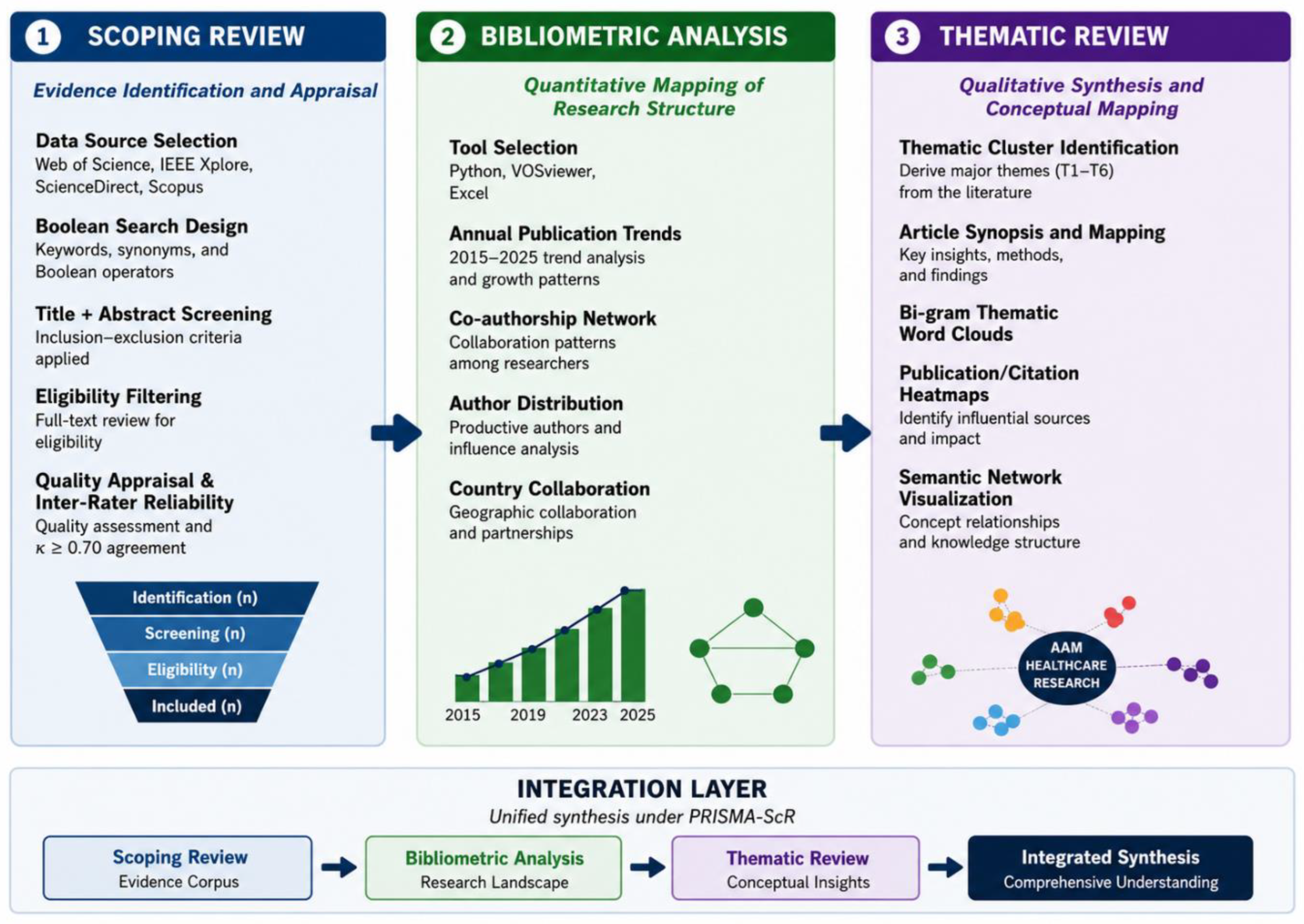
Figure 2.
PRISMA flow diagram for the study selection process.
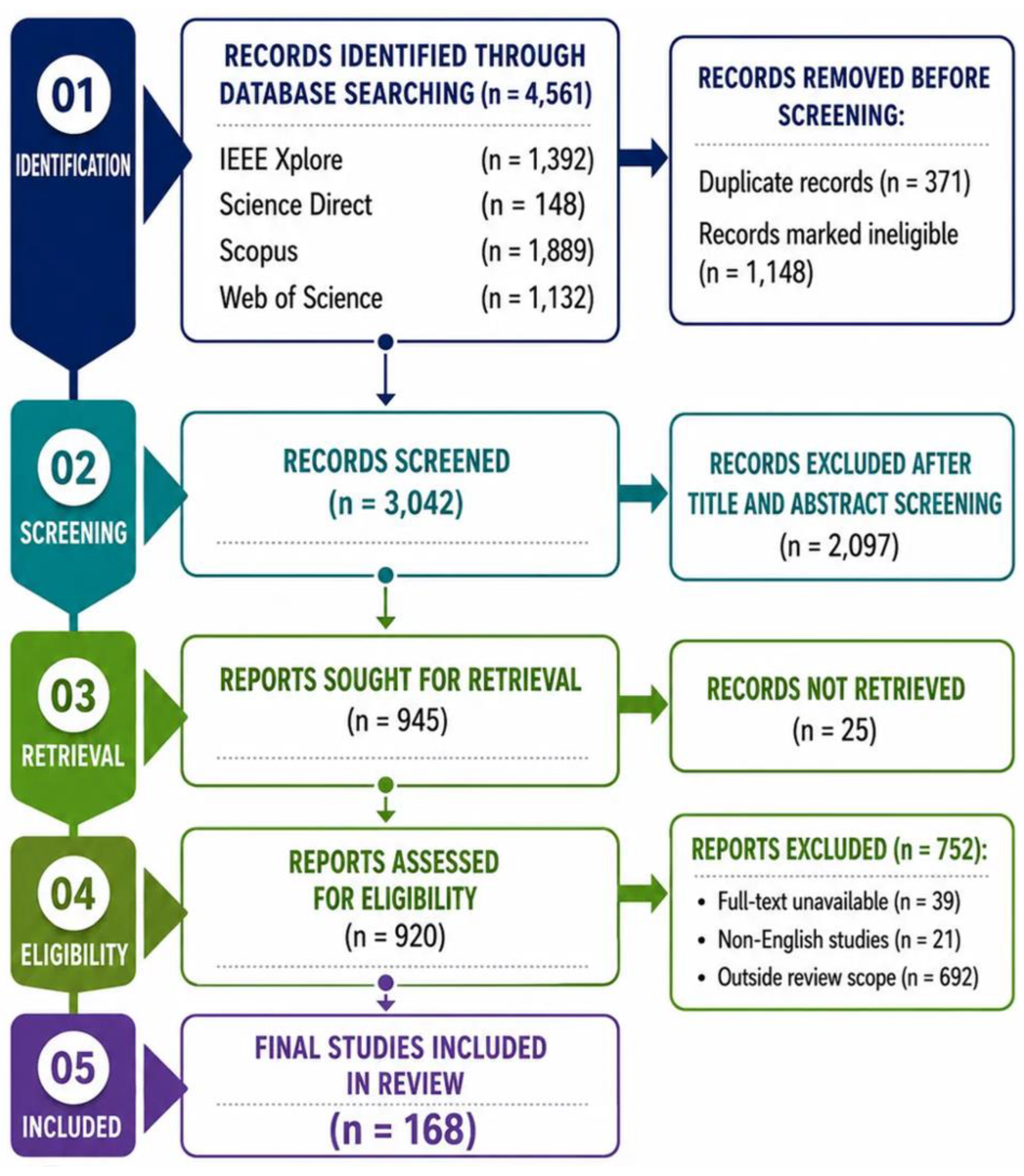
Figure 3.
Annual publication trend of AAM Healthcare Integration Studies.
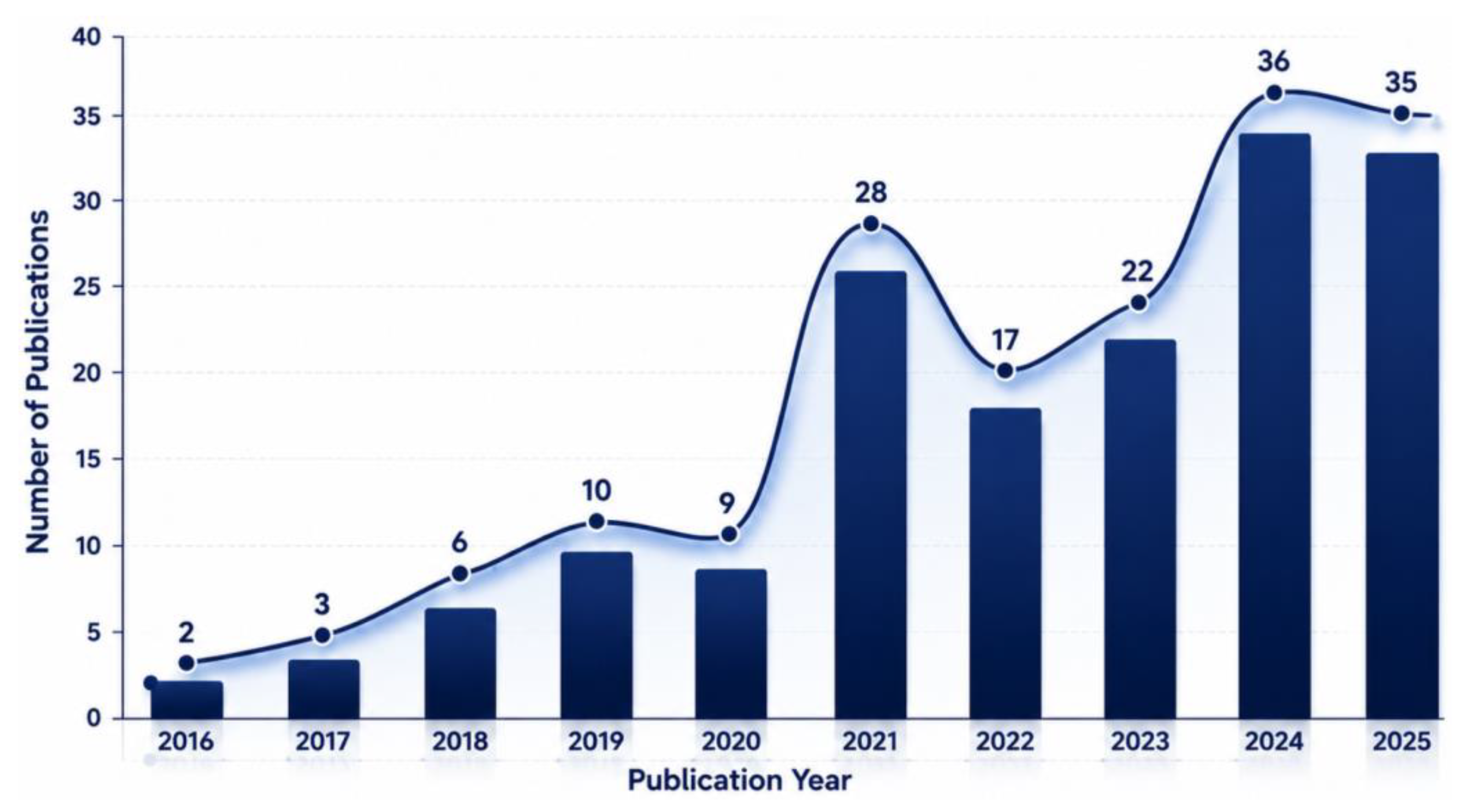
Figure 4.
Distribution of the number of authors per article.
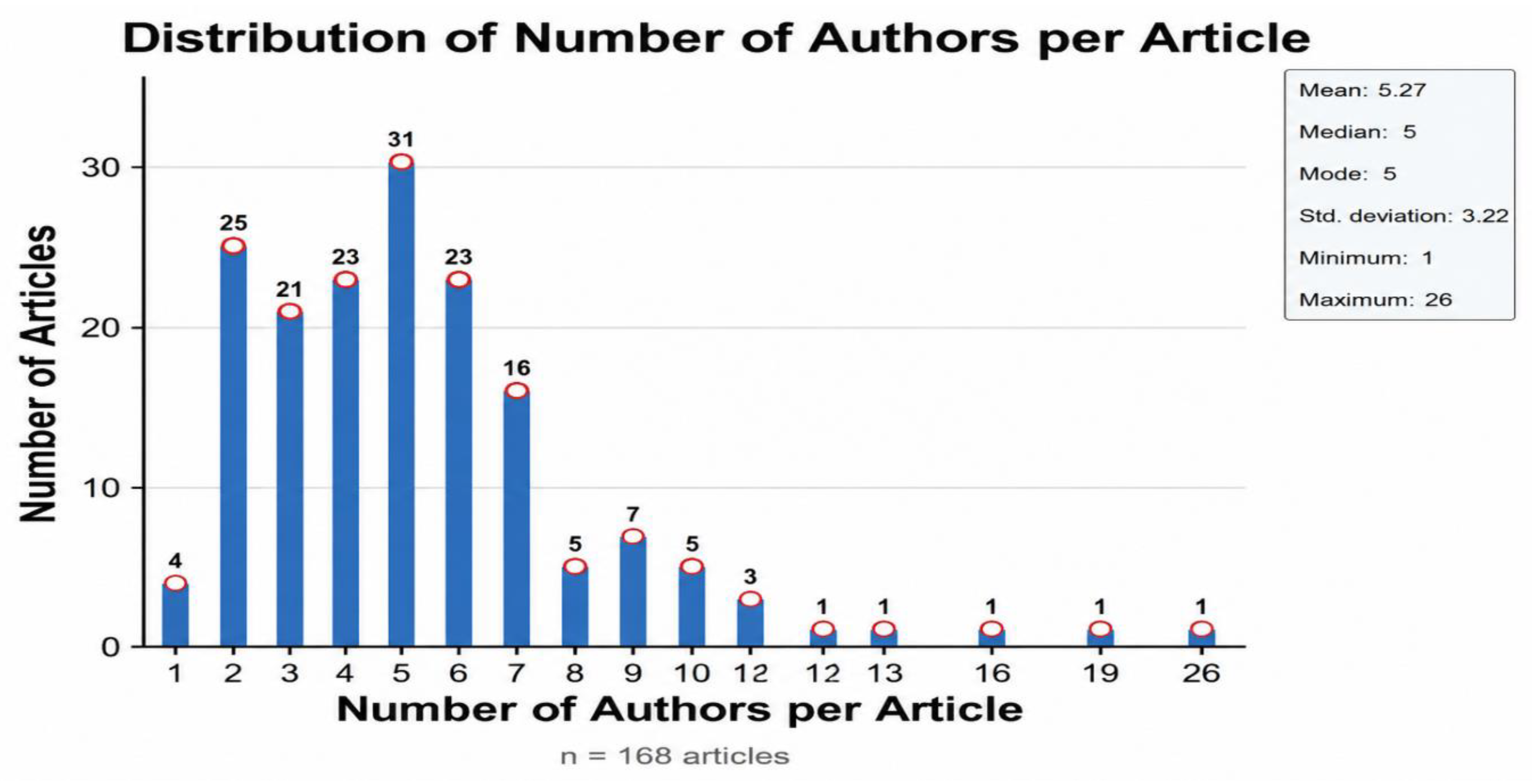
Figure 5.
Country collaboration network.
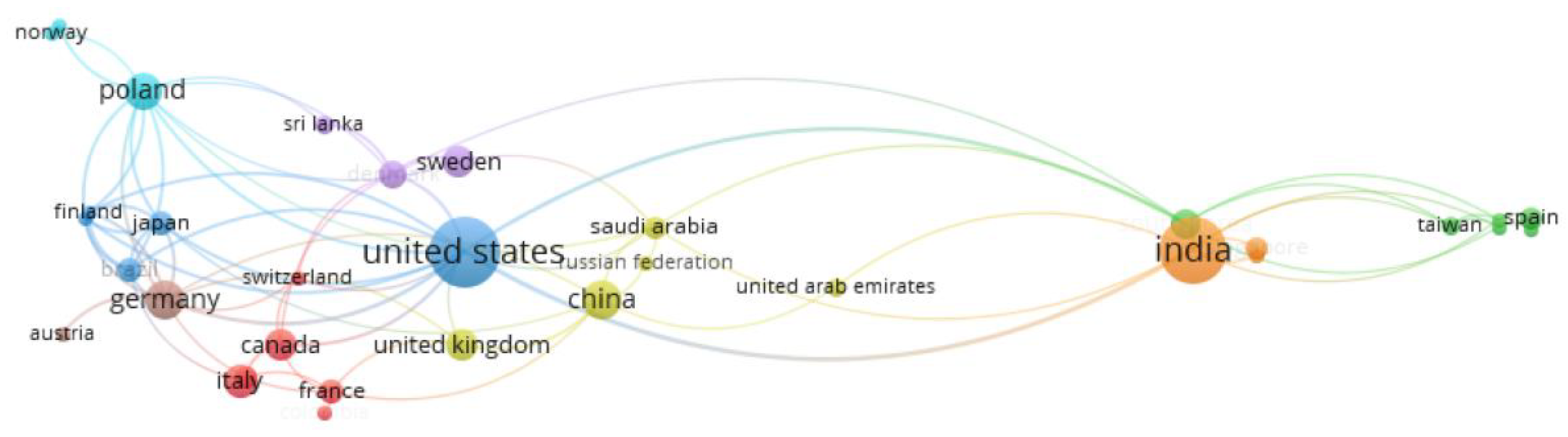
Figure 6.
Word cloud of healthcare-focused AAM research keywords.
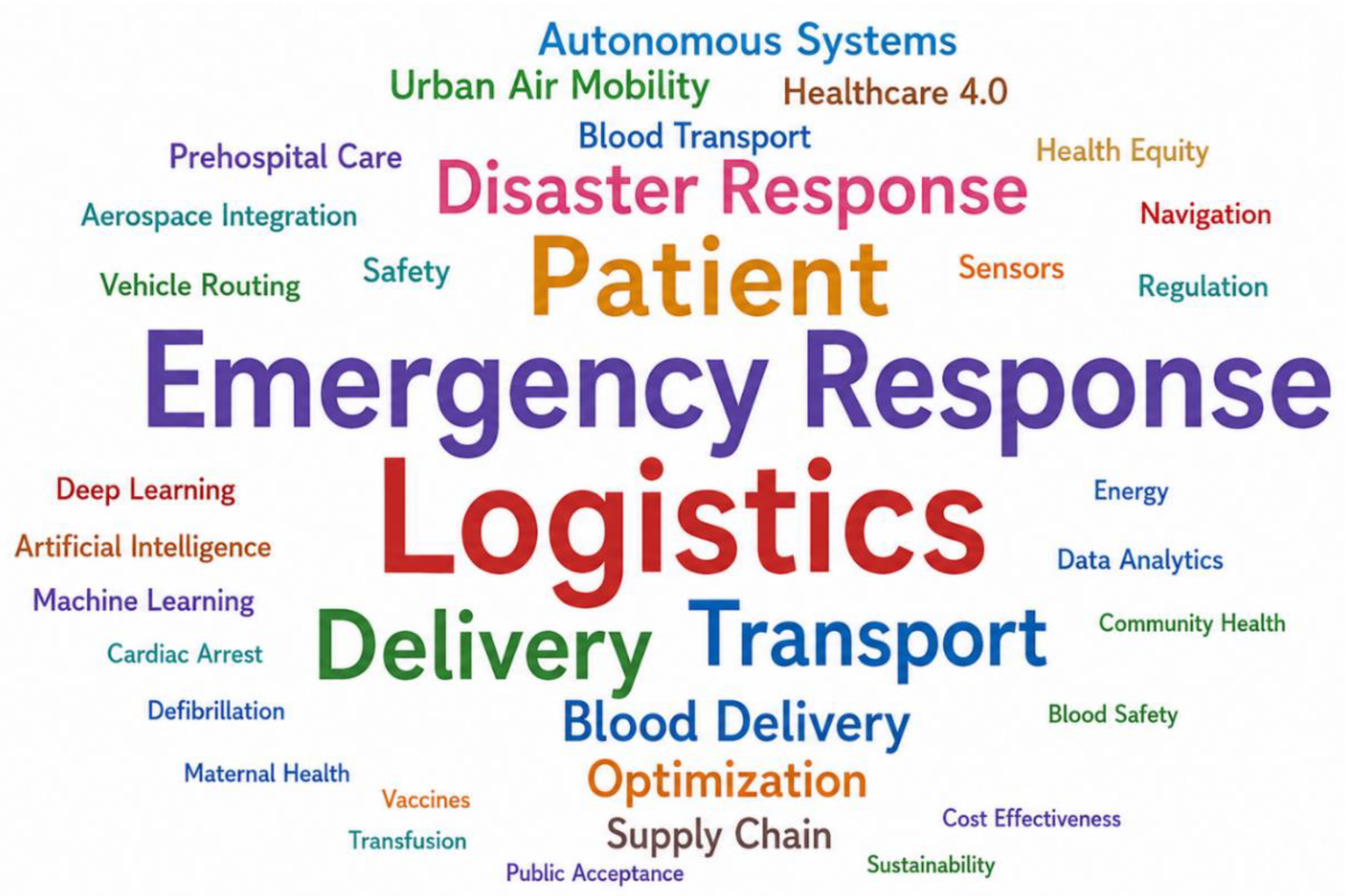
Figure 7.
Number of publications by thematic cluster and year.
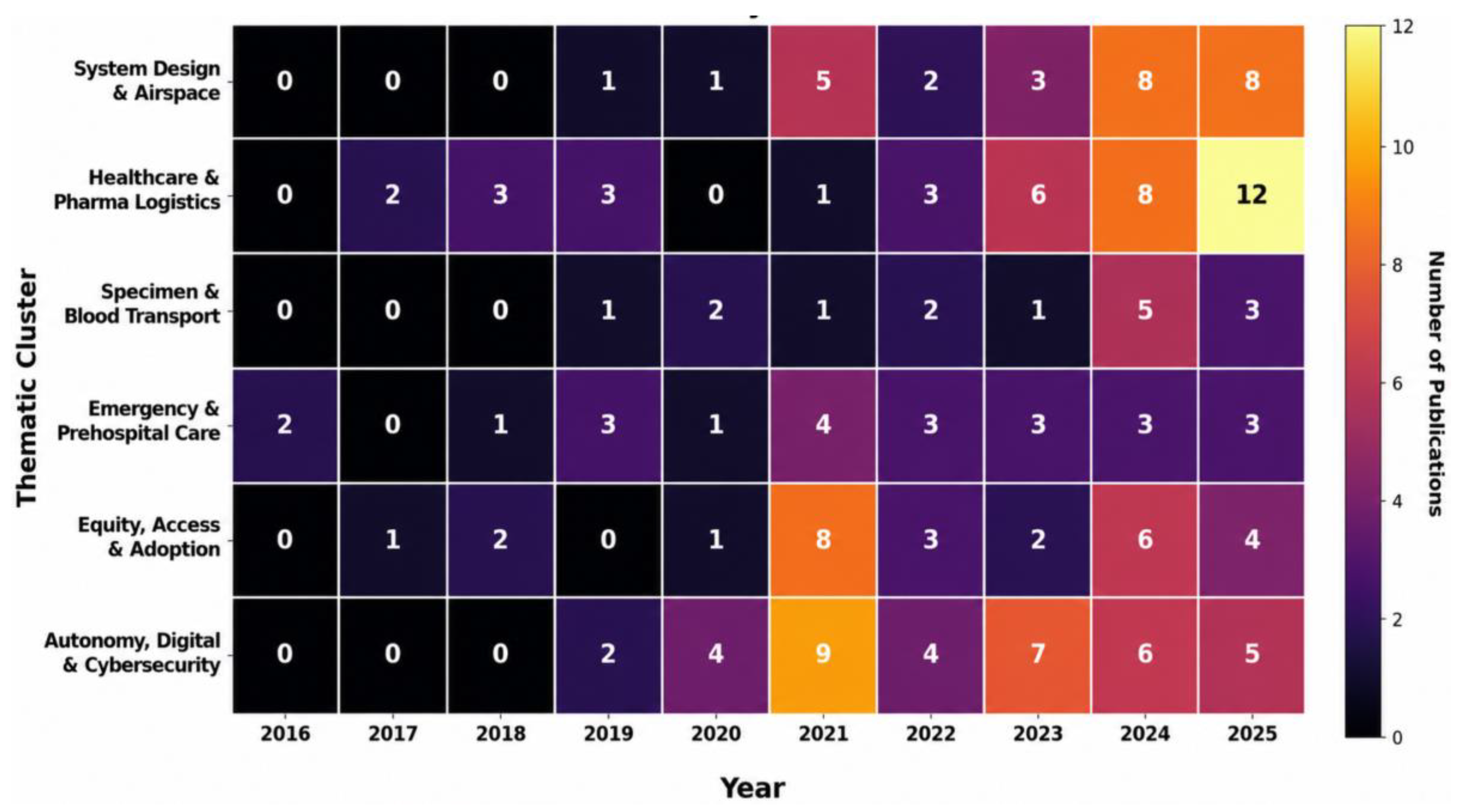
Figure 8.
Citation distribution across thematic clusters.
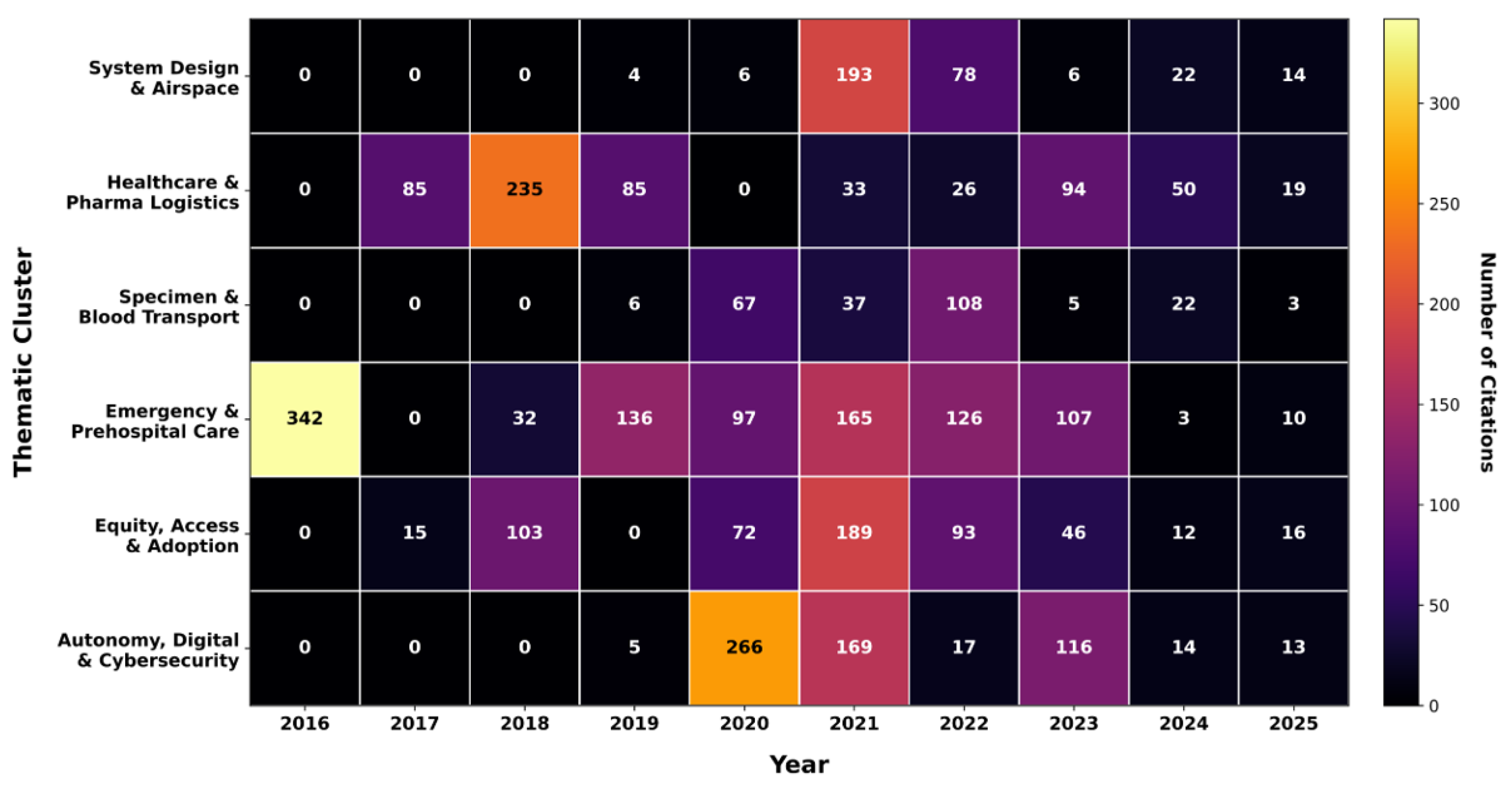
Figure 9.
Index keyword co-occurrence network.
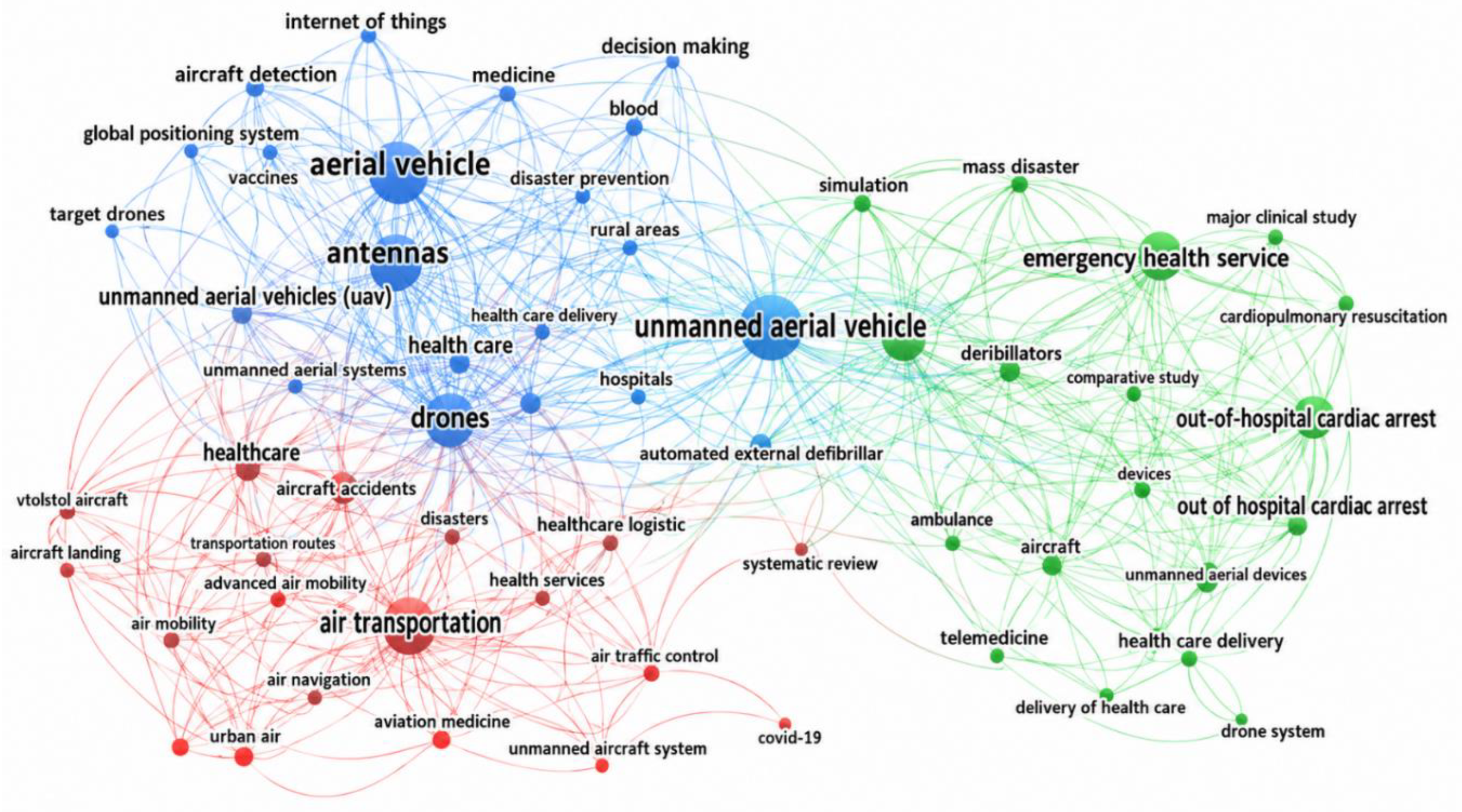

Table 1.
Inclusion and Exclusion Criteria for Literature Selection.
| Category | Inclusion Criteria | Exclusion Criteria |
| Source type |
Peer-reviewed articles, conference proceedings, doctoral dissertations | Preprints, master’s theses, reports, news articles, magazines, clinical trials, and grants |
| Text accessibility |
Full-text access to relevant publications | Availability of only title and/or abstract |
| Language | English language | Non-English articles |
| Search phrases | Based on the selected keywords | Keywords outside the chosen keywords |
| Uniqueness | Non-duplicate relevant studies from the selected databases | Duplicate publications from other databases or the selected databases |
| Focus | Relevant studies focused on healthcare applications of advanced air mobility | Studies outside the defined scope |
| Publication date | January 2015 to December 2025 | Studies published outside of the date range |
Table 2.
Inter-rater reliability across the review process.
| Review Stage | Reviewers | Cohen’s κ | Interpretation |
| Title and abstract screening | Two SMEs | 0.82 | Almost perfect agreement |
| Full-text eligibility assessment | Two SMEs | 0.76 | Substantial agreement |
| Thematic classification | Three SMEs | 0.71 | Substantial agreement |
Table 3.
Initial Database Results.
| Source | Records Retrieved (N) |
| IEEE Xplore | 1,392 |
| ScienceDirect | 148 |
| Scopus | 1,889 |
| Web of Science | 1,132 |
| Total | 4,561 |
Table 4.
Final Thematic Framework Derived from Inductive Coding and Computational Clustering.
| Thematic Cluster | Description | Articles |
| T1: AAM System Design and Airspace Integration (n = 28) |
System design and enabling technologies. Aircraft engineering, modeling, simulation, and performance evaluation, including propulsion, energy, sensors, and vertiport and charging infrastructure. Also covers airspace governance, U-space integration, BVLOS operations, detect-and-avoid systems, and eVTOL certification. | [1,8,9,10,11,12,13,14,15,16,17,18,19,20,21,22,23,24,25,26,27,28,29,30,31,32,33,34,35] |
| T2: Healthcare and Pharmaceutical Supply Chain Logistics (n = 37) |
Healthcare logistics and pharmaceutical distribution. Transport of medical items such as samples, equipment, medicines, organs, and blood, including inter-hospital deliveries, rural access, and cold-chain logistics. Emphasizes routing optimization, last-mile delivery, and perishable-payload handling. | [2,4,6,36,37,38,39,40,41,42,43,44,45,46,47,48,49,50,51,52,53,54,55,56,57,58,59,60,61,62,63,64,65,66,67,68,69,70] |
| T3: Biological Specimen and Blood Product Transport (n = 15) |
Clinical specimen integrity and blood logistics. Empirical studies of whether aerial transport compromises blood components, laboratory specimens, and biological materials, measuring the effects of vibration, temperature, altitude, and transit time on sample integrity and clinical validity. | [65,71,72,73,74,75,76,77,78,79,80,81,82,83,84] |
| T4: Time-Critical Emergency Response and Prehospital Care (n = 21) |
Emergency medical services and cardiac response. Aerial systems to reduce response times in out-of-hospital cardiac arrest, including Automated External Defibrillator( AED) delivery, dispatch optimization, and first-responder support. The most highly cited cluster in the corpus (median citations = 24). | [85,86,87,88,89,90,91,92,93,94,95,96,97,98,99,100,101,102,103,104,105] |
| T5: Health Equity, Access, and Societal Adoption (n = 31) |
Societal readiness and health equity. Public acceptance and the ethics of deployment, alongside use in underserved, rural, and low-income settings, maternal care, disaster relief, and regulatory barriers. Concerns include safety, privacy, noise, and equitable access. | [2,5,7,106,107,108,109,110,111,112,113,114,115,116,117,118,119,120,121,122,123,124,125,126,127,128,129,130,131,132] |
| T6: Autonomous Systems, Digital Infrastructure, and Cybersecurity (n = 36) |
Enabling digital and autonomous technologies. Computational, communications, and security infrastructure for aerial healthcare logistics, including machine learning for navigation, IoT monitoring, blockchain security, edge computing, and resilience in GPS-denied conditions. | [133,134,135,136,137,138,139,140,141,142,143,144,145,146,147,148,149,150,151,152,153,154,155,156,157,158,159,160,161,162,163,164,165,166,167,168] |
Disclaimer/Publisher’s Note: The statements, opinions and data contained in all publications are solely those of the individual author(s) and contributor(s) and not of MDPI and/or the editor(s). MDPI and/or the editor(s) disclaim responsibility for any injury to people or property resulting from any ideas, methods, instructions or products referred to in the content. |
© 2026 by the authors. Licensee MDPI, Basel, Switzerland. This article is an open access article distributed under the terms and conditions of the Creative Commons Attribution (CC BY) license (http://creativecommons.org/licenses/by/4.0/).
Copyright: This open access article is published under a Creative Commons CC BY 4.0 license, which permit the free download, distribution, and reuse, provided that the author and preprint are cited in any reuse.


