
Submitted:
12 July 2026
Posted:
13 July 2026
You are already at the latest version
Abstract
Northeast India sits within the Indo-Burma and Eastern Himalaya biodiversity hotspots, yet its forests face accelerating loss from extractive industries, infrastructural expansion, and weak governance. Although global conservation discourse increasingly recognises community-based approaches, the contributions of vernacular grassroots organisations from frontier regions remain insufficiently documented in peer-reviewed scholarship. This article addresses that gap. It examines the conservation praxis of Nature's Beckon, an independent activist organisation founded in Dhubri, Assam, in 1982, and the work of its founder-director Soumyadeep Dutta, an Ashoka Fellow and naturalist-writer. The study adopts a qualitative, analytical methodology that integrates historical and ecocritical approaches. Data are drawn from organisational records, Dutta's published Assamese-language corpus, news media, government notifications, and peer-reviewed scientific literature on protected-area outcomes. Four case studies are analysed: the Chakrashila Wildlife Sanctuary movement (1983–1995); the Dehing Patkai rainforest campaign (1992–2021); primate conservation focused on the golden langur (Trachypithecus geei) and western hoolock gibbon (Hoolock hoolock); and the Village Sanctuary institutional model. Findings indicate that Nature’s Beckon has played a documented and substantial role in measurable conservation outcomes, including the gazettement of two protected areas with a combined area of approximately 277.22 km². The article advances an ecology of the margins framework to characterise the organisation's distinctive integration of scientific documentation, vernacular advocacy, and community institution-building. Practical policy implications include formal recognition of community-conserved areas, integration of vernacular knowledge into protected-area management, replication of the eco-emissary training framework, and alignment of conservation funding cycles with the multi-decadal time horizons that durable place-based conservation requires.
Keywords:
community-based conservation
; environmental activism
; biodiversity governance
; Indo-Burma hotspot
; protected areas
; ecology of the margins
; postcolonial environmentalism
; political opportunity structure
; vernacular ecological knowledge
1. Introduction
Biodiversity loss is now ranked among the most urgent global environmental problems. The Intergovernmental Science-Policy Platform on Biodiversity and Ecosystem Services has documented unprecedented species declines and the systematic erosion of ecological functions across tropical regions [1]. Mutualistic interactions between species, and the regenerative capacity of forest ecosystems, are being lost at rates that exceed species extinction itself [2]. Within this crisis, the role of local communities and grassroots organisations has acquired renewed policy salience. The Kunming-Montreal Global Biodiversity Framework's 30×30 target commits signatory states to protecting 30% of terrestrial and marine areas by 2030 [3]. Community-led mechanisms are central to its delivery.
Northeast India occupies a position of exceptional importance in global biodiversity conservation. It lies at the convergence of two of the world’s thirty-six biodiversity hotspots—regions holding outstanding concentrations of endemic species under severe threat of habitat loss—namely the Indo-Burma and Eastern Himalaya hotspots [4,5] (Figure 1). It contains roughly 8000 of India’s 15000 flowering plant species and 14 primate species, including the only ape native to the country [4,6]. Despite covering only 8% of India’s land area, the region accounts for nearly 25% of national forest cover [3]. The Indo-Burma hotspot supports 29 endemic primate species, more than one-fifth of which are globally threatened [6].
The biological wealth is under sustained pressure. Tea plantation, coal mining, hydropower, oil exploration, and rapid infrastructural expansion have all fragmented forest landscapes [7]. The 2020 controversy over coal-mining approvals inside the Dehing Patkai rainforest illustrates how persistent these pressures remain [7]. Climate models project significant range contraction for endemic Indo-Burma flora by 2050, even under moderate emissions scenarios [8]. Layered upon ecological pressure is a political economy shaped by ethnic conflict, militarisation, and the developmental marginalisation of indigenous communities. Conventional state-led conservation is rendered fragile in this context [9].
1.1. Research Gap
Within this terrain, indigenous and grassroots organisations have emerged as critical conservation actors. Community Reserves in Meghalaya, Arunachal Pradesh's Singchung Bugun Village Community Reserve, and Nagaland's Khonoma and Sendenyu sanctuaries deliver measurable biodiversity outcomes [10,11]. Recent peer-reviewed work confirms that mammalian diversity in community-managed lands of Ri Bhoi district, Meghalaya, compares favourably with formally protected areas, despite smaller size [10]. Yet detailed academic analysis of long-running Northeast Indian conservation organisations remains rare. Most relevant documentation is in vernacular languages. The institutional invisibility of Northeast Indian environmentalism within metropolitan policy discourse has compounded the gap.
A specific lacuna is identifiable. No peer-reviewed study has yet examined the combined role of Nature's Beckon and Soumyadeep Dutta within a unified conservation framework. Existing publications either focus narrowly on Dutta's literary output [12] or address the organisation's campaigns in isolation [7,13]. Comparative meta-analyses of community-based conservation success have likewise paid disproportionately limited attention to South Asian frontier conservation [14]. The integrative analysis required to extract transferable lessons for community-based conservation policy is missing from the international literature. This absence has policy consequences. Without sustained empirical and conceptual treatment, the model's insights cannot inform conservation governance in comparable contexts elsewhere in the global South. Comparative work on why the region’s environmental movements succeed or fail has also been slow to develop [15]. And within Assamese scholarship, Dutta’s writing has been read mainly as literature, through ecocritical and biographical criticism, rather than as a record of institutional conservation whose results can be measured [16,17].
1.2. Research Objectives
Three research objectives structure the present analysis:
- To document the institutional history and operational praxis of Nature's Beckon across four decades of conservation work;
- To evaluate the conservation outcomes of the organisation's principal campaigns through a synthesis of organisational records and peer-reviewed scientific data on protected-area effectiveness;
- To derive policy-relevant lessons for community-based conservation in postcolonial frontier regions.
1.3. Conceptual Framework: An Ecology of the Margins
The article advances a conceptual framework that we term the ecology of the margins. The phrase designates a conservation ethics and practice that emerges from peripheral regions whose communities have been marginalised by mainstream developmental discourse. An ecology of the margins is grounded in vernacular environmental knowledge. It integrates indigenous epistemologies with peer-reviewed science. It refuses two opposing temptations at once: the wilderness-preservationism that has long dominated metropolitan deep ecology, and the development-first instrumentalism characteristic of state-led conservation in postcolonial contexts. Its orientation is explicitly relational—ecological protection is sustained through, not against, the livelihoods of forest-fringe communities. We argue that the praxis of Nature's Beckon offers a particularly developed instance of this ecology, with implications well beyond its regional setting. Section 4.2 elaborates the framework in fuller analytical detail.
The term needs placing against earlier uses, since similar phrases have appeared before. Sharma and Pal write of an “ecology at the margins” in Indian comics, reading the environmental and epistemic injustice carried by communities at the edge [18]; the phrase turns up earlier still, in a quite different sense, in social-work writing [19]. What we mean by it is narrower. It describes a way of doing conservation at the developmental periphery rather than a way of reading texts, and it is meant institutionally, not as a figure of speech. The margins here are at once geographic, on the frontier where two hotspots meet; political, in a region that sits at the edge of national policy-making; and linguistic, since the knowledge that drives the work is held in Assamese. We keep the term, then, as a situated one rather than a new coinage, and say what it involves in Section 4.2.
Nature's Beckon, an independent environmental organisation registered under the Societies Registration Act in 1991 and founded as a nature club in 1982, occupies a distinctive position within the regional conservation landscape. Based in Dhubri, Assam, the organisation is credited with the rediscovery of the golden langur (Trachypithecus geei) at Chakrashila in 1986, the twelve-year movement that culminated in the gazettement of the Chakrashila Wildlife Sanctuary in 1994, the identification of one of the largest contiguous stretches of tropical lowland rainforest in India in 1992, and a sustained campaign that contributed to the declaration of the Dehing Patkai Wildlife Sanctuary in 2004 and its upgradation to National Park status in 2021 [20,21]. Its founder, Soumyadeep Dutta, an Ashoka Fellow and recipient of the Assam Baibhav civilian honour, has produced more than forty volumes of Assamese-language nature writing. His work combines scientific documentation, ecological commentary, and policy advocacy [12].
2. Materials and Methods
2.1. Research Design
This study adopts a qualitative interpretive methodology that combines analytical, historical, and ecocritical approaches. The research design is appropriate for the object of analysis—a long-running, vernacularly documented conservation organisation whose praxis cannot be captured through quantitative ecological survey methods alone. The approach follows established conventions for qualitative case-study research in conservation social science [10,22]. By ecocritical we mean the study of how writing relates to the physical environment [23,24]; in Glotfelty’s phrase, criticism that reads with the earth in mind [25]. Assamese has its own such tradition, and Dutta’s books have already been read within it as environmental thought [17,26]; here that reading is carried over into questions of institutions and policy.
Three complementary methods are integrated. The analytical method involves close reading of primary textual sources against established conceptual frameworks. The historical method situates the organisation's work within the longer trajectory of Indian environmentalism and the colonial-era restructuring of Northeast Indian forest economies. The ecocritical approach reads activist and literary texts as forms of environmental thought in their own right, building on the second-wave ecocritical insistence that environmental ethics, scientific documentation, and political mobilisation are mutually constitutive [23,24].
2.2. Data Sources
Three categories of data inform the analysis. First, organisational documents include published reports, campaign records, and online archives of Nature’s Beckon, supplemented by news media coverage from regional and national outlets. Second, the literary corpus of Soumyadeep Dutta provides primary insight into the organisation’s conservation philosophy. Key works analysed include Aranyar Cha-Pohar, Asomor Abhayaranya Aaru Rashtriya Udyan, Asomor Primate, Namchangor Anteshpur, Asomor Jalasar Charai, and Pratibad Aru Pratyasha. These were chosen because together they cover the parts of Dutta’s output that touch conservation: species monographs (Asomor Primate, Asomor Jalasar Charai), studies of protected areas and policy (Asomor Abhayaranya Aaru Rashtriya Udyan, Pratibad Aru Pratyasha), and the narrative of the rainforest movement (Namchangor Anteshpur, Aranyar Cha-Pohar). Each answers to one of the campaigns examined below, and the full corpus appears in Appendix A [16,17]. Third, peer-reviewed scientific literature on protected-area outcomes—particularly studies of golden langur populations [27,28], hoolock gibbon habitat fragmentation [29], and Northeast Indian community conservation [10,11]—provides the empirical basis for evaluating ecological outcomes.
The combined source base allows triangulation between organisational self-representation, independent media reporting, and peer-reviewed scientific evidence. Government notifications gazetting the Chakrashila Wildlife Sanctuary (1994), the Dehing Patkai Wildlife Sanctuary (2004), and the Dehing Patkai National Park (2021) provide the key administrative reference points.
Something should be said about the standing of these sources and about our own relation to them. Much of the primary record — the organisation’s reports and website, Dutta’s books, the commemorative and interview volumes, and a nature-literature number of the Asam Sahitya Sabha Patrika — comes from within the movement, and two of the Assamese volumes were edited or compiled by authors of this article [16,17,30,31,32]. We read it as a vernacular activist archive: reliable for how the organisation understands itself, for its chronology and its ideas, but not as impartial proof that a particular ecological result followed. Claims about outcomes are checked against three independent kinds of evidence — government gazette notifications, peer-reviewed studies, and independent reporting — and where the organisation’s own publications disagree with one another, as they do over species counts and over the exact area and date of the Dehing Patkai declaration, we say so and keep to the verifiable figure. We set this out plainly so the reader can hold it in view while weighing what follows.
2.3. Analytical Framework
The analytical framework draws on three theoretical resources. Ecocritical theory, particularly the formulations of Buell [23] and Garrard [24], provides tools for reading environmentally oriented texts as ethical and political interventions. Postcolonial environmental thought, articulated by Guha [33] and Huggan and Tiffin [34], frames the analysis of frontier conservation in regions shaped by colonial extraction and ongoing developmental marginalisation. Community-based conservation literature [10,11,35] provides the empirical and policy comparators against which Nature's Beckon's institutional model is evaluated.
Four case studies were selected for in-depth analysis on the basis of three criteria: (1) documented organisational involvement of Nature's Beckon; (2) availability of peer-reviewed or government-issued data on outcomes; and (3) representativeness of the organisation's principal modes of intervention—species-focused campaigns, landscape-level protection, primate conservation, and community-led institution-building.
Within each case study, three analytical questions were applied: What was the documented sequence of organisational interventions? What measurable conservation outcomes can be attributed, in whole or in substantial part, to those interventions? And what theoretical and policy-relevant lessons can be derived from the trajectory? Cross-case comparison was used to identify regularities in the organisation's approach and to distinguish features that appear to be specific to particular campaigns from features that constitute generalisable elements of the institutional model.
2.4. Limitations
Three limitations should be noted. First, the study does not include original ecological survey data; ecological outcomes are evaluated through synthesis of existing peer-reviewed studies. Second, much of the primary documentation is in Assamese; analysis relies on existing English-language scholarship [12] and the organisation's own English-language publications. Third, the qualitative interpretive approach precludes statistical generalisation. The findings are intended to inform conceptual and policy understanding rather than to support causal inference. A fourth limitation follows from the source base itself: because much of the documentary record is produced by the organisation under study, attributions of outcome carry the risk of self-representation and are advanced here only where independent notifications, peer-reviewed studies or media reporting converge with the organisational account. Internal inconsistencies in the vernacular sources—differing species counts and declaration figures—further caution against treating any single reported number as settled.
2.5. Use of Generative AI
No generative AI tools were used to develop the substantive arguments or interpretations of this manuscript. AI-assisted tools were used solely for grammatical and stylistic refinement of prose; all conceptual content, source selection, and analysis are the responsibility of the authors.
3. Nature’s Beckon in Practice: Institutional History and Campaign Analyses
3.1. Nature's Beckon: Genesis, Mission, and Institutional Praxis
Nature's Beckon was founded in 1982 as a small nature club in Dhubri, the principal town of the lower Brahmaputra valley in Western Assam. Its early activities consisted of bird-watching expeditions and forest trails in the Dhubri reserves [20]. Formal registration under the Societies Registration Act came in 1991. Registration enabled the organisation to publish books and research papers, engage in formal advocacy with the Forest Department of Assam, and access modest project funding. It did so without compromising the organisation's independence from state and corporate patrons.
The founding moment coincided with a critical phase of regional political history. The Assam Movement of 1979–1985 and the Bodoland movement that gained momentum from the late 1980s had produced a regional public sphere unusually attentive to questions of land, demography, and resource sovereignty. Nature’s Beckon’s first major campaign was at Chakrashila, which lies across the Dhubri and Kokrajhar districts in the Bodo-majority country of Lower Assam. This is a tract where the Bodo, the region’s largest plains tribe, and the Rabha alongside them, had long pressed customary claims to forest land, and where the Bodoland autonomy movement of those years had made the question of who holds the land a charged one. This was not coincidental. The campaign succeeded in part because it could articulate forest protection in idioms of indigenous custodianship that resonated with the political mood [9]. The early embedding of conservation work within regional struggles over indigeneity and resource sovereignty gave the organisation a distinctive starting point. It also exemplifies the ecology of the margins in formation: an environmentalism that draws its legitimacy from peripheral political traditions rather than from metropolitan environmental discourse.
Three commitments distinguish Nature's Beckon's organisational philosophy. First, people's participation is treated as the foundation of conservation rather than as a residual concession to social acceptability. Forest-fringe villages are framed as long-term custodians of the ecosystems in question, rather than as obstacles or passive beneficiaries [20]. Second, scientific documentation is integrated with advocacy. Each major campaign has been accompanied by baseline biological surveys, species checklists, and published monographs that establish the empirical basis for protected-area declaration. Third, the organisation operates an eco-emissary model: youth from forest-fringe villages are trained in conflict resolution, biodiversity assessment, lobbying, photography, and rescue work. According to the Ashoka Foundation's published profile of Soumyadeep Dutta, training has been conducted across more than 60 allied organisations, and over 3000 trained volunteers have been associated with the network across four decades [36].
The geographical scale of activity extends across all of Assam, with operational reach into Arunachal Pradesh and Meghalaya. Of Assam's 328 reserved forests, the organisation has prioritised twelve on the basis of fragile ecosystems, endangered wildlife, and severity of encroachment [36]. Baseline surveys have been conducted at Chakrashila, Manas National Park, Dibru-Saikhowa National Park, Panidihing Wildlife Sanctuary, Garampani Wildlife Sanctuary, and Dehing Patkai Wildlife Sanctuary [20].
A distinguishing feature of the organisation's politics has been its principled refusal of corporate sponsorship from extractive industries that operate in its working areas. At the same time, its approach has not been doctrinaire. During the Joypur campaign, the organisation entered formal dialogue with senior officials of Oil India Ltd. and Coal India Ltd. to negotiate the release of the Joypur Reserve Forest from existing lease agreements [21]. This combination of principled opposition and tactical engagement reflects an institutional politics calibrated to the specific conditions of Northeast Indian conservation, where state institutions are weak and extractive capital well-organised.
The organisation's publishing programme provides an additional element of institutional infrastructure. Nature's Beckon has produced a series of peer-relevant volumes including Chakrashila Wildlife Sanctuary, Asomor Abhayaranya Aaru Rashtriya Udyan, and Asomor Primate, alongside numerous popular articles in regional and national outlets [12,20]. The publishing function is operationally significant for three reasons. It builds the documentary archive on which protected-area declarations have been argued for and won. It cultivates a vernacular conservation public that can be mobilised at moments of crisis, as occurred during the 2020 Dehing Patkai mobilisation. And it provides a continuing source of intellectual capital that can be drawn upon by allied organisations, including state forest departments and academic institutions, for whom the organisation's output has become a primary reference resource.
3.2. Soumyadeep Dutta as Conservationist-Intellectual
Any analysis of Nature's Beckon must engage with its founder-director, Soumyadeep Dutta. Born and raised in Dhubri, Dutta's early years were shaped by the avifauna of the lower Brahmaputra and by an emerging consciousness of ecological crisis [12]. The Ashoka Foundation's selection of Dutta as a Fellow in 1998 framed his contribution in terms of "organising indigenous youth groups to conduct conflict resolution and environmental preservation in the strife-torn northeastern region of India" [36]. In 2024, Dutta received the Assam Baibhav, the highest civilian honour of the state government, recognising decades of conservation work that had often involved direct opposition to government policies [20].
Dutta's literary corpus comprises more than forty volumes of Assamese-language nature writing. The works range from species monographs (Asomor Jalasar Charai, Asomor Chikari Charai, Asomor Primate) to landscape studies (Aranyar Cha-Pohar, Namchangor Anteshpur) and policy-oriented texts (Asomor Abhayaranya Aaru Rashtriya Udyan, Pratibad Aru Pratyasha) [12]. The corpus is distinctive for refusing several conventions of Anglophone nature writing. Western nature writing has often relied on a solitary observer encountering an unpeopled wilderness [23]. Dutta's writings are different. They are densely populated. Forest-fringe villagers, indigenous hunters, forest officials, students, journalists, and oil-company managers all appear as interlocutors. The forest is not a pristine elsewhere. It is a contested, multi-tenanted space whose ecological future depends on the social relationships traversing it. The corpus is, in this sense, the textual articulation of an ecology of the margins.
Dutta's writing functions not as commentary on activism but as a constituent part of it. Each major Nature's Beckon campaign has been accompanied by clusters of texts—species monographs, popular essays, full-length books, contemporary blog posts—that constitute the documentary infrastructure on which protected-area declarations have been argued. Three consequences follow. The texts produce a vernacular public sphere in which conservation is debated in Assamese and accessible to non-Anglophone readers. They preserve campaign history in formats that often constitute the principal archival record. They position Dutta and Nature's Beckon as historians of the movement, ensuring that the meaning of campaigns is contested by participants rather than retroactively settled by external analysts.
Recent interventions during the 2020 COVID-19 pandemic and the simultaneous Dehing Patkai mining crisis indicate the continuing relevance of Dutta's public role. In a widely circulated video essay, Dutta linked the pandemic to the long history of human encroachment on forest ecosystems. He argued that pandemic disease is a structural product of the modernity that destroys habitat boundaries [20]. The argument anticipates the One Health perspective that has gained traction in international conservation policy [37]. The convergence is significant. Vernacular environmental thought, far from being parochial, can independently arrive at conceptual framings the international scientific community has reached by different routes. Recognising such convergences is itself a condition for a genuinely globalised conservation discourse.
3.3. Case Study 1: The Chakrashila Wildlife Sanctuary Movement (1983–1995)
The first major campaign undertaken by Nature's Beckon was the twelve-year movement to secure protected status for the Chakrashila hills in the Dhubri and Kokrajhar districts. The campaign began in 1983 and acquired global significance after 1986, when the organisation rediscovered a population of golden langurs (Trachypithecus geei)—a primate previously believed to be confined to a narrow range along the Indo-Bhutan border [27]. The species had been classified as Endangered on the IUCN Red List, and Chakrashila was now established as the only protected habitat for the species in India.
The campaign followed a model that subsequent Nature's Beckon interventions would replicate. Comprehensive forest area surveys produced checklists of birds, mammals, reptiles, plants, and other species. The surveys established that Chakrashila harboured not only the golden langur but also Chinese pangolin (Manis pentadactyla), clouded leopard (Neofelis nebulosa), great hornbill (Buceros bicornis), king cobra (Ophiophagus hannah), and approximately 250 species of birds [38]. On the basis of this documentation, Nature's Beckon mobilised forest-fringe Bodo and Rabha villages, building public pressure through media advocacy and direct community action—including planting food plants for the langur, creating artificial salt licks, and clearing invasive weeds such as Mikania micrantha [38].
On 14 July 1994, the Government of Assam declared Chakrashila a Wildlife Sanctuary covering 45.568 km² across the Dhubri and Kokrajhar districts. Subsequent peer-reviewed surveys have documented continuing pressures, including the loss of 18 langurs to vehicle collisions on State Highway 14 between January 2023 and December 2024, but they have also confirmed the sanctuary's role as the only consolidated protected habitat for the species in India [39]. Sengupta and Choudhury's recent occupancy modelling estimates a probability of golden langur occurrence of 0.69 ± 0.08 SE in the southern fragments that include Chakrashila, indicating that the sanctuary continues to support a viable population despite ongoing fragmentation [28]. A current population estimate of fewer than 7400 individuals across the Indo-Bhutan range underscores the species' precarious status and the disproportionate conservation value of small protected areas like Chakrashila [40].
The Chakrashila campaign also prefigured a wider idea that Nature’s Beckon would take up later: the Village Sanctuary, in which a village looks after a nearby forest itself, accepting limits on commercial use in return for continued subsistence access. Its first formal instance came in another part of the state, at Chalapathar in Charaideo district, and Section 3.6 returns to it [20].
3.4. Case Study 2: The Dehing Patkai Movement (1992–2021)
The Dehing Patkai campaign represents the largest-scale and longest-duration intervention undertaken by Nature's Beckon. The campaign began in 1992, when Dutta first identified, named, and documented the existence of contiguous tropical rainforest in the Dibrugarh and Tinsukia districts of Upper Assam. The presence of these forests had not previously been recorded in official documents or scientific publications [21]. The identification transformed the conservation politics of the region: the Dehing-Patkai forests were now recognised as one of the largest contiguous stretches of tropical lowland rainforest in India.
From 1994, Nature's Beckon led a movement for legal protection of approximately 500 km² of rainforest spanning the Joypur, Upper Dihing, and Dirok Reserved Forests. The campaign produced an extensive output of monographs and popular writings, including Rainforests of Assam, Namchangor Antexpur, and Dihing Patkai Abhyoronyo [20]. After a decade of advocacy, the Government of Assam declared 111.19 km² of rainforest as the Dehing Patkai Wildlife Sanctuary in 2004. The 2004 declaration fell well short of the 500 km² target. The Joypur Reserve Forest, ecologically integral to the rainforest matrix, was excluded because Coal India Ltd. and Oil India Ltd. held mining and exploration leases over the area. The 1973 lease had formally expired in 2003, but operations had continued in violation of the Forest (Conservation) Act 1980 and the Wildlife (Protection) Act 1972 [7].
The 2020 mining controversy brought the issue to a national audience. In April 2020, during the COVID-19 lockdown, the Standing Committee of the National Board for Wildlife approved a coal-mining project in the Saleki Proposed Reserve Forest within the sanctuary's boundaries. The decision generated a substantial digital campaign under the hashtag #SaveDehingPatkai. Activists, students, conservation NGOs, and prominent cultural figures including Adil Hussain, Papon, and Padma Shri Jadav Payeng mobilised opposition. Conservation researchers including Kashmira Kakati filed petitions with the National Green Tribunal, and a public interest litigation was filed challenging the legality of mining [7].
How the Joypur question was finally settled left a paper trail against which the movement’s account can be checked. In September 2020, after the renewed campaign, the two public-sector companies that held leases over the disputed forest wrote to Nature’s Beckon to give them up. Coal India’s North Eastern Coalfields unit confirmed that it was surrendering its colliery leases so the land could be added to the park [41]; Oil India undertook not to drill in the Jeypore Reserved Forest, which it called a biodiversity hotspot [41]. On the companies’ own letterhead, these are the firmest external evidence in the case. They turn an organisational claim into something a reader can check, and they place the decisive moment in a particular, and favourable, political conjuncture rather than in the campaign alone.
On 7 June 2021, the Government of Assam declared 231.65 km² as the Dehing Patkai National Park, more than doubling the protected area. The trajectory from 1992 identification to 2021 national park declaration represents a near-three-decade arc of sustained movement-building. As Sengupta and Borgohain note in their analysis of the 2020 mobilisation, the protests reflected a productive contradiction between metropolitan and indigenous versions of ecological nationalism [7]. The metropolitan version was articulated through Anglophone social media and celebrity endorsements. The indigenous version was rooted in long-term grassroots organising by communities mobilised by Nature’s Beckon and allied groups. Both registers contributed to the success. The indigenous version, however, had established the conditions of possibility for the metropolitan moment. It is better read as two steps than one: a first declaration of 231.65 km² in 2020, then the final notification of the enlarged park in 2021. The organisation’s account and the gazette differ a little over the figure and the date; where they do, we follow the gazette [41].
The ecological significance of the Dehing Patkai protection extends beyond the headline area. The forest hosts more than 290 bird species, 47 mammal species, and serves as a critical habitat for the western hoolock gibbon, the endangered Asian elephant (Elephas maximus), and several globally threatened reptiles [13]. Recent satellite-based assessments have nonetheless documented continuing pressure: rat-hole mining operations have persisted in adjacent reserve forests, and satellite imagery from January 2025 revealed extensive denudation within the park's boundaries, with mining activities encroaching on protected zones [7,13]. The trajectory thus illustrates both the achievements of sustained grassroots advocacy and the structural limits of formal protection in the absence of effective enforcement.
3.5. Case Study 3: Primate Conservation
The third dimension of Nature's Beckon's contribution concerns primate conservation, particularly its sustained engagement with the western hoolock gibbon (Hoolock hoolock) and the golden langur. Hoolock gibbons—the only ape native to India—are classified as Endangered on the IUCN Red List. Recent peer-reviewed work documents that habitat fragmentation by tea gardens, roads, oil exploration, and the railway line that bisects the Hollongapar Gibbon Sanctuary in Assam have produced a slow extinction event, with only an estimated 125 individuals surviving in the sanctuary as of 2023 [29]. The Lumding-Dibrugarh railway electrification, confirmed in 2024, has further alarmed conservationists [42].
Nature's Beckon's primate conservation work has included baseline surveys at Dehing Patkai, the publication of Asomor Primate and other species monographs, advocacy against infrastructural fragmentation, and partnerships with research-driven organisations such as Aaranyak. The organisation's strategic use of the charisma of the golden langur and the hoolock gibbon to secure protection for entire forest ecosystems—rather than reducing conservation to single-species programmes—anticipates contemporary "umbrella species" approaches in conservation biology [43].
A particularly notable development is the emergence of community-led co-existence models in proximity to areas where Nature's Beckon has long worked. At Barekuri village near Tinsukia, residents protect trees around their homes so that gibbons can move freely [44]. Recent ecological work confirms the conservation value of this kind of community-based approach: occupancy modelling for golden langur shows that probability of presence is positively associated with intact forest cover and inversely associated with anthropogenic edge effects, both of which can be more effectively managed at the community than at the protected-area scale [28]. The translocation programme initiated to establish a second golden langur population at the Manas-Umananda island, although outside Nature's Beckon's direct operational area, builds on the species-conservation infrastructure that the organisation's earlier work helped to establish.
Habitat fragmentation analysis underscores the urgency of these efforts. Sharma and colleagues' work on the Upper Brahmaputra Valley primate communities documents that local primate distribution is most strongly associated with intact forest cover, the presence of large fig trees, and proximity to undisturbed core forest [29]. The same study identifies edge effects from tea plantations and roads as primary determinants of primate occupancy decline. The findings provide empirical support for the kind of landscape-scale, connectivity-focused conservation approach that Nature's Beckon has consistently advocated, and indicate that the organisation's emphasis on contiguous rainforest protection at Dehing Patkai has been ecologically prescient.
3.6. Case Study 4: The Village Sanctuary Model and Eco-Education
The Village Sanctuary is the organisation’s most original institutional contribution. It is a community-run arrangement that sits outside the statutory categories of Wildlife Sanctuary and Community Reserve: a village takes on the protection of a forest and accepts limits on its commercial use while keeping access for its own needs. The clearest case is the Chala Village Sanctuary at Chalapathar in Charaideo district, in eastern Assam, where the Tai Khamyang Buddhist community has taken charge of the adjoining Chala Reserve Forest; the organisation records it as the first Village Sanctuary in the state, and the arrangement has since been taken up at other forest-fringe sites [20].
The Village Sanctuary model resonates with established literature on common-pool resource governance, which has demonstrated that under appropriate institutional conditions communities can sustainably manage shared resources without privatisation or state command [45]. It also aligns with recent comparative work on Community Reserves in Northeast India. Lyngdoh and colleagues' camera-trap-based assessment of five Community Reserves in Ri Bhoi district, Meghalaya, confirms substantial mammalian diversity in community-managed forests, including 23 mammal species across the five reserves [10]. What Nature's Beckon's contribution adds to this literature is the sustained, multi-decadal demonstration that the model can be built—not only inherited from prior tradition—in collaboration with communities whose pre-existing conservation institutions had been disrupted.
Educational work complements institutional building. The organisation has run children's nature trails, mobile exhibitions, and eco-tourism workshops; trained conservation volunteers across more than 60 allied organisations; and produced popular materials in Assamese for school audiences [20,36]. Dutta's articulated stance on eco-tourism—distinguishing ecological education and modest local livelihood from commodified spectacle—is a substantive intervention in a region where mass tourism oriented to Kaziranga and Manas has often produced new pressures on protected ecosystems [12]. The educational programme has cultivated a regional cadre of ecologically literate citizens whose presence is a precondition for any sustained environmental politics in the longer term.
The Village Sanctuary model has implications for the recently emerging policy framework around Other Effective Area-Based Conservation Measures (OECMs), which the Government of India has identified as a key vehicle for meeting its 30×30 commitments under the Kunming-Montreal Global Biodiversity Framework [3]. Village Sanctuaries developed by Nature's Beckon and similar arrangements would naturally fit within this OECM framework, and their formal designation could substantially expand the proportion of national territory under effective biodiversity conservation without requiring new protected-area gazettements.
A summary of the four case studies and their principal outcomes is presented in Table 1.
3.7. Cross-Case Synthesis
Across the four case studies, four recurrent operational patterns emerge. First, every successful campaign was preceded by sustained baseline biological survey work that established the species and habitat values at risk. Second, advocacy work integrated formal engagement with state institutions (the Forest Department, the Ministry of Environment) with mobilisation of local communities and—where feasible—national media. Third, the organisation's documentary output served as the principal reference resource for academic, policy, and media engagement with the relevant landscapes. Fourth, institutional outcomes were achieved over time horizons of one to three decades. Each campaign built on the documentary infrastructure and political capital generated by earlier interventions.
This pattern indicates that Nature's Beckon's conservation success cannot be attributed to any single intervention or to charismatic leadership alone. It is the product of a structured institutional praxis that integrates knowledge production, community engagement, and political advocacy across long time horizons. The four operational patterns above can be read as the empirical signature of the ecology of the margins in practice: epistemic plurality (vernacular and scientific documentation), institutional relationality (community–state–NGO triangulation), and temporal patience (multi-decadal time horizons). The structural character of the praxis is what makes its features potentially transferable to other regional and national contexts.
4. Analysis: Outcomes, Framework, and Comparative Position
4.1. Outcomes Assessment and the Conservation Value of Sustained Grassroots Work
The combined evidence from the four case studies indicates that Nature’s Beckon has produced measurable, durable conservation outcomes. Two protected areas with a combined area of approximately 277.22 km² (Chakrashila, 45.568 km²; Dehing Patkai, 231.65 km²) were gazetted following campaigns in which Nature’s Beckon played a documented and substantial role [20,21]. The Chakrashila Wildlife Sanctuary remains the only consolidated protected habitat for the golden langur in India; recent peer-reviewed occupancy modelling confirms that the species continues to occur at relatively high probability across the southern fragments that include the sanctuary [28]. The Dehing Patkai National Park has secured legal protection for one of the largest contiguous stretches of tropical lowland rainforest in India, although mining pressures on adjacent reserve forests persist [7].
These outcomes are notable in three respects. They have been achieved without large-scale international funding or media attention; they have proceeded through cumulative advocacy over multi-decadal time horizons rather than through single-event mobilisations; and they have been built through partnership with communities whose involvement has been substantive rather than tokenistic. Each of these features distinguishes Nature's Beckon from many contemporary conservation organisations and offers transferable lessons for community-based conservation in other postcolonial contexts.
The temporal dimension warrants particular emphasis. The Chakrashila campaign required twelve years of sustained advocacy before formal gazettement; the Dehing Patkai trajectory unfolded across nearly three decades from initial identification (1992) to full national park status (2021). Comparative work on protected-area effectiveness has consistently identified institutional continuity as a critical variable: longer-running organisations produce more durable outcomes than short-cycle projects [14]. Nature's Beckon's experience supports this conclusion empirically. It also indicates a structural mismatch. Dominant conservation funding cycles run for three to five years. Lasting protected-area declarations, however, take fifteen to thirty years. Funding mechanisms designed around short cycles are ill-suited to support the kind of sustained advocacy the case studies show is necessary.
A second comparative observation concerns the scientific basis of advocacy. The empirical foundation of each major Nature's Beckon campaign has been a baseline biological survey, with checklists of birds, mammals, reptiles, and plants that established the conservation value of the proposed protected area. This is not unusual in international conservation practice, but it is striking how rare it remains in vernacular South Asian conservation, where advocacy more often proceeds through generalised appeals to environmental value rather than species-specific documentation. Subsequent peer-reviewed studies have largely confirmed the species and habitat assessments developed by the organisation in the 1980s and 1990s [27,28,39], indicating that the empirical work was scientifically sound and not merely rhetorical.
4.2. The Ecology of the Margins: Elaborating the Framework
The conservation philosophy that emerges from Nature's Beckon's praxis cannot be reduced to a strong anthropocentrism or a strong biocentrism. It is biocentric in its insistence on the intrinsic worth of the golden langur, the hoolock gibbon, and the great hornbill. It is ecocentric in its emphasis on rainforest contiguity and habitat connectivity. Yet it is also unapologetically humanist. Conservation must serve, and be carried out by, the people who live with the forest. This refusal to choose between the human and the non-human is the operative core of what we call the ecology of the margins.
Three features specify the framework. First, an ecology of the margins is epistemically plural. It treats indigenous and vernacular environmental knowledge as theory in its own right, not merely as raw material for scientific processing. Dutta's literary corpus is exemplary: it is simultaneously ethnobotanical record, ecological elegy, and policy intervention. Second, an ecology of the margins is institutionally relational. Conservation outcomes emerge from institutional configurations—the Village Sanctuary, the eco-emissary network, the alliance between trained volunteers and forest-fringe communities—that integrate human livelihood and non-human flourishing. Third, an ecology of the margins is temporally patient. It works across multi-decadal time horizons because durable conservation in postcolonial frontier regions cannot be achieved by single-event mobilisations.
The framework resolves a long-standing tension in Indian environmentalism. Guha's well-known critique of deep ecology argued that the anthropocentrism–biocentrism distinction was of "little use to the vast majority of the world's population." Wilderness preservation could not be pursued, he argued, without considering social equity and the integration of ecological concerns with livelihood and work [33]. Nature's Beckon's praxis demonstrates that biocentric commitments to species diversity and the postcolonial insistence on social equity can be productively negotiated. The negotiation does not happen at the level of theoretical reconciliation alone. It happens through forms of institutional practice that refuse to choose between human and non-human flourishing.
The implications extend beyond regional politics. Recent ecocritical scholarship has identified the integration of biocentric ethics with social-equity concerns as a defining challenge for postcolonial environmental humanities [34,37]. The Nature's Beckon trajectory provides empirical material for theoretical work on this challenge. The case study shows that integration is not merely conceivable in the abstract but achievable in sustained institutional practice. Such empirical grounding is rare in environmental humanities scholarship, which has tended to operate at the level of textual interpretation rather than institutional analysis. The framework therefore has implications for both fields. It points toward closer dialogue between conservation social science and environmental humanities, with practical conservation governance as the shared horizon.
This deserves a more sceptical eye, and the regional literature offers one. Studying four environmental movements in the Northeast through the idea of political opportunity structure, Rout and Yudik find that what decides success is less the force or the justice of a campaign than the shape of the political opening it meets — whether the ruling party is aligned, whether there are allies among elites, whether the state is disposed to listen [15]. Seen that way, the Dehing Patkai result of 2020–2021 was not simply advocacy rewarded. It came together with a change of government in the state, with pressure from the National Green Tribunal and the courts, and with the two public-sector lessees’ agreeing to give up their claims. Nature’s Beckon’s long years of work were necessary — they built the ecological case and a public ready to act on it — but they were not sufficient; the remainder came from an opening the movement did not control. The same idea explains the partial defeat of 2004, when live mining and exploration leases, backed by well-organised capital, kept Joypur outside the sanctuary despite a campaign no less determined. Success and failure track the political opening, then, and not the effort alone.
Put this way, the ecology of the margins is less a coinage than a summary of something Assamese ecocriticism had already started to describe, in reading Dutta’s writing as a deliberate environmental ethic rather than as scenery [16,17,26]. What this study adds is the connective tissue between that ethic on the page and the machinery — surveys, village sanctuaries, trained emissaries — through which it has turned into protected areas on the ground.
4.3. Comparative Position in Indian Environmentalism
Nature's Beckon does not fit neatly into existing typologies of Indian environmental organisation. Compared to the Chipko movement of the Garhwal Himalayas, the organisation has operated through a more institutionalised form: formal registration, sustained publication, and a multi-decadal eco-emissary training programme [46]. Compared to large urban-based environmental NGOs that emerged in the 1990s with international funding, Nature's Beckon has remained markedly vernacular in discursive register and grassroots in sociological base. Compared to the digital climate-justice mobilisations that emerged after 2018, the organisation has demonstrated the importance of long-term, place-rooted continuity. The 2020 Dehing Patkai mobilisation paradoxically reaffirmed this. The digital wave depended on decades of prior ground-level work for its substantive content [7].
This integrative character—combining grassroots movement, formal NGO, knowledge institution, and public intellectual platform—is the most significant institutional feature of the organisation. The model invites comparison with the Singchung Bugun Village Community Reserve in Arunachal Pradesh, the Khonoma Nature Conservation and Tragopan Sanctuary in Nagaland, and the Lemsachenlok Organization. All have been recognised through India Biodiversity Awards and other formal channels [11]. What distinguishes Nature's Beckon from these comparators is its integration of literary production with organisational praxis. This feature has implications for replicability, discussed in Section 5.
The contribution should also be situated within recent comparative work on community-based conservation success. Brooks and colleagues' meta-analysis identified four design features that consistently predicted positive outcomes across multiple national contexts: tenure security, capacity-building investment, equitable benefit-sharing, and effective external linkage to scientific and policy networks [14]. Nature's Beckon's institutional design exhibits all four. Tenure security has remained an unresolved tension in the Joypur extension of Dehing Patkai. The convergence between empirical predictors of conservation success and the principles internalised by Nature's Beckon over four decades is striking. The model is not idiosyncratic. It exemplifies design choices that the comparative literature has independently validated as core features of an ecology of the margins.
4.4. Limitations and Tensions
Three tensions warrant explicit registration. The first concerns charismatic leadership. The intertwining of organisational identity with the personal authority of Soumyadeep Dutta has been both a strength and a vulnerability. Continuity across four decades has provided the institutional memory and moral authority that has held the organisation together; but the question of succession remains open. Recent academic engagement with Dutta's corpus [12] indicates that knowledge transmission is under way, but its institutional consolidation is incomplete.
The second concerns scale. The Village Sanctuary model is built through painstaking, trust-based engagement with specific communities over multi-year time horizons. It is not obvious that this model can be scaled to landscape levels without compromise of quality. The challenge of scale is well documented in community-based conservation literature [14,35]. Nature's Beckon's experience suggests that durable outcomes are achievable where the underlying social conditions of community capacity and organisational continuity exist; the question of how to create those conditions where they do not yet exist remains open.
The third concerns the politics of engagement with extractive capital. The organisation's nuanced approach—principled opposition to corporate sponsorship combined with selective dialogue during specific campaigns—has produced both successes and critiques. Critics from more radical positions may view the organisation as insufficiently confrontational; state-aligned actors may view it as obstructionist. The continuing question is whether tactical flexibility can be sustained without compromise of underlying principle.
A fourth difficulty concerns evidence, and it bears on how the claims above should be taken. The fullest record of the movement is the one the movement itself keeps, and that record does not always agree with itself: the organisation’s books give different species counts for Dehing Patkai and more than one figure and date for the declaration [41], and the commemorative and interview volumes are, understandably, admiring [31,32]. Two things follow from this. Credit has to be shared rather than handed to a single actor; the organisation’s own records spread it among villagers, allied groups, sympathetic officials and, in the end, the state and its companies, and we have kept to that spread. And a declaration is not the same as protection on the ground: the sources say little about money, monitoring or governance after 2021, and the rat-hole mining that goes on in the reserve forests nearby is a reminder that a notification fixes a boundary on paper more easily than it holds one in the field. These are limits of the evidence as much as of the model, and the conclusions are qualified to match.
4.5. Policy Implications for Conservation Practice
The analysis yields six policy implications relevant to conservation practice in Northeast India and other postcolonial frontier regions.
First, community-conserved areas require formal legal recognition. The Village Sanctuary model demonstrates that community-led institutions can deliver durable conservation outcomes, but their absence from Indian environmental law leaves them institutionally vulnerable. The Government of Arunachal Pradesh's 2024 draft guidelines for recognition of Community Conserved Areas under the Sixth Schedule, and the Karbi Anglong Autonomous Council's parallel initiative, represent steps in the right direction [3]. The framework should be extended across all Northeast Indian states, with provisions that recognise vernacular institutions on their own terms rather than forcing them into existing administrative categories.
Second, vernacular environmental knowledge should be integrated into protected-area management. Dutta's literary corpus and similar bodies of vernacular work in other regional languages contain substantive ecological information that is not available in the English-language scientific literature. Translation initiatives, archival projects, and inclusion of vernacular sources in protected-area management plans would substantially enhance the empirical basis for conservation decision-making.
Third, the eco-emissary training model should be replicated and scaled. Nature's Beckon's investment in training youth from forest-fringe communities has generated a generation of locally embedded conservation practitioners. The model provides a template that can be adapted by state forest departments, Joint Forest Management committees, and conservation NGOs across Northeast India. Implementation requires sustained institutional commitment over multi-year horizons; short-term training programmes are unlikely to reproduce its outcomes.
Fourth, conservation governance should integrate scientific documentation with vernacular advocacy. The Nature's Beckon experience demonstrates that protected-area declarations are most durable when supported by both empirical biological surveys and accessible vernacular communication. Public interest litigation and digital mobilisation can amplify campaigns at critical moments, but they cannot substitute for sustained groundwork. Conservation policy should encourage institutional configurations that support both registers.
Fifth, regulatory frameworks must address the contradictions between extractive industry and conservation in protected-area buffer zones. The Dehing Patkai trajectory illustrates the long-term costs of allowing extractive operations to continue in violation of existing legislation. Strengthening enforcement of the Forest (Conservation) Act 1980 and the Wildlife (Protection) Act 1972, including timely judicial review of mining leases in eco-sensitive zones, would address a structural barrier to effective conservation in Northeast India.
Sixth, infrastructural development in biodiversity hotspots requires sectoral integration. The fragmentation of the Hollongapar Gibbon Sanctuary by railway electrification, the bisection of golden langur habitat by State Highway 14, and the proposed exploration in the eco-sensitive zone of multiple sanctuaries all reflect the absence of effective integration between transport, mining, and conservation policy [29,39,42]. Mandatory cumulative impact assessment, transparent eco-sensitive zone notifications, and the systematic installation of canopy bridges, underpasses, and other mitigation infrastructure should be incorporated into infrastructure-planning protocols for Northeast Indian protected-area landscapes. Roy and colleagues' recent peer-reviewed monitoring of fifteen artificial canopy bridges installed across SH-14 near Chakrashila documented golden langur uptake in 74% of 112 observed crossings (n = 83 of 112), illustrating the kind of targeted intervention that should be scaled across the region [39].
Seventh, funding architecture for conservation should be aligned with multi-decadal time horizons. The Chakrashila and Dehing Patkai trajectories indicate that durable protected-area outcomes typically require fifteen to thirty years of sustained advocacy, baseline science, and community engagement. Conservation funding cycles, which are typically three to five years, are structurally mismatched to these requirements. Bilateral donors, multilateral institutions, and Indian philanthropic organisations should explore mechanisms for longer-cycle institutional support, including endowed funding for organisations with demonstrated track records of place-based conservation work.
The replicability of Nature's Beckon's model in other regions is a final consideration. Three transferable elements stand out. The integration of scientific documentation with vernacular advocacy is broadly applicable. The eco-emissary training framework is portable across regional and linguistic contexts. The Village Sanctuary institutional design can be adapted to landscapes with prior traditions of community-based forest management. What is less easily transferred is the long-term institutional continuity that has characterised Nature's Beckon. This depends on social conditions—organisational stability, charismatic leadership, sustained vernacular publishing—that cannot be manufactured by policy intervention alone but can be enabled or constrained by the institutional environment.
Implementation of these recommendations would also contribute to India's commitments under the Kunming-Montreal Global Biodiversity Framework. Target 3 of the framework requires effective conservation of 30% of terrestrial and marine areas by 2030 through "ecologically representative, well-connected and equitably governed systems" [3]. Formal recognition of community-conserved areas of the kind pioneered by Nature's Beckon directly advances this target. India's recently announced commitment to identify Other Effective Area-Based Conservation Measures (OECMs) as part of its 30×30 strategy provides a specific institutional vehicle through which Village Sanctuaries and similar community-led arrangements could be systematically incorporated into national conservation accounting.
5. Conclusions
This study has examined the conservation praxis of Nature's Beckon and the contributions of its founder-director Soumyadeep Dutta to environmental preservation in Northeast India. The principal findings can be summarised as follows:
- Across four decades of work, Nature's Beckon has produced measurable conservation outcomes. These include the gazettement of two protected areas with a combined area of approximately 277.22 km² (Chakrashila, 45.568 km²; Dehing Patkai National Park, 231.65 km²), sustained protection of habitat for the endangered golden langur, and the establishment of community-led Village Sanctuaries.
- The organisation's distinctive institutional model integrates scientific documentation, sustained advocacy, vernacular eco-textuality, and community-based eco-emissary training. The configuration is not closely matched by other Indian conservation organisations.
- Soumyadeep Dutta's literary corpus constitutes a substantive body of vernacular environmental thought. Its theoretical implications—particularly for the negotiation of biocentric and anthropocentric ethics—merit further scholarly attention.
- The article advances an ecology of the margins framework to characterise the organisation's praxis. The framework integrates indigenous knowledge with peer-reviewed science, refuses both wilderness-preservationism and developmental instrumentalism, and operates across multi-decadal time horizons. It offers a productive resolution to the tension identified in postcolonial ecocriticism between deep-ecological commitments to species diversity and the postcolonial insistence on social equity.
- Seven policy implications follow: formal recognition of community-conserved areas; integration of vernacular knowledge into protected-area management; replication of the eco-emissary training model; integration of scientific documentation with vernacular advocacy; stronger regulatory enforcement against extractive industry in protected-area buffer zones; sectoral integration of infrastructural development with biodiversity conservation; and alignment of conservation funding cycles with multi-decadal time horizons.
Future research should pursue four directions. First, systematic biological-survey-based assessment of conservation outcomes across the organisation's working areas would strengthen the evidentiary basis for policy advocacy. Second, ethnographic work on the eco-emissary network would illuminate the social mechanisms of conservation knowledge transmission. Third, comparative work linking Nature's Beckon to other Northeast Indian conservation institutions would specify the distinctive features of the Assamese case. Fourth, translation and critical edition of Dutta's vernacular corpus would expand the resources available to international ecocritical scholarship.
The Nature's Beckon experience demonstrates that durable, biologically meaningful conservation outcomes can be achieved through sustained, place-based, community-engaged work. This is true even under the politically constrained conditions of frontier regions. In an era of accelerating biodiversity loss and climate disruption, the model has implications well beyond its regional setting. The ecology of the margins is not a marginal contribution to global environmental thought. It is, increasingly, a necessary one. Recognition of the substantive contributions of vernacular grassroots organisations is overdue in international conservation policy. This study has aimed to make a contribution to that recognition.
Author Contributions
Conceptualization, A.R. and P.B.; methodology, A.R. and P.B.; investigation, P.B., M.D. and C.J.C.; formal analysis, P.B., A.R. and C.J.C.; resources, A.R., B.S. and P.K.; writing—original draft preparation, P.B. and A.R.; writing—review and editing, A.R., P.B., C.J.C., M.D., B.S. and P.K.; supervision, A.R.; project administration, A.R. All authors have read and agreed to the published version of the manuscript.
Funding
This research received no external funding.
Institutional Review Board Statement
Not applicable. This study is based on publicly available documents, published literature, organisational records, and media sources, and did not involve interviews, surveys, or experimental work with human or animal subjects.
Informed Consent Statement
Not applicable.
Data Availability Statement
No new data were created in this study. All sources analysed are publicly available and cited in the reference list.
Acknowledgments
The authors acknowledge the long-term work of Nature's Beckon and the contributions of Soumyadeep Dutta to conservation in Northeast India. The authors thank scholarly reviewers for constructive comments on an earlier draft.
Conflicts of Interest
The authors declare no conflicts of interest.
Appendix A
Selected Assamese-language conservation and nature writings of Soumyadeep Dutta. This inventory responds to the request for a systematic listing of Dutta’s vernacular corpus. Only the conservation-, wildlife-, forest- and nature-writing titles are given here; the author’s general travelogues and cultural studies fall outside the scope of this article. Transliteration follows the spellings printed on each volume; a fuller corpus of more than forty titles is catalogued in the vernacular bibliographies cited above.
- Datta, S. Asomor Bonoriya Mekuri [Wild Cats of Assam]; Bhabani Print & Publications: Guwahati, India, 2010; ISBN 978-93-80390-78-9.
- Datta, S. Asomar Charai Paryabekshanar Hatputhi [A Handbook of Bird-Watching in Assam]; Lahkar, S., Ed.; Banphool Prakashan: Guwahati, India, 2011 (2nd ed. 2013); ISBN 978-81-909523-8-5.
- Datta, S. Bipanna Dharitri: Sankatat Banyaprani [Imperilled Earth: Wildlife in Crisis]; Jyoti Prakashan: Guwahati, India, 2012; ISBN 978-93-81485-35-4.
- Datta, S. Ecotourist; Nature’s Beckon in association with Bhabani Books: Guwahati, India, 2014; ISBN 978-93-82624-95-0.
- Datta, S. Aranyar Cha-Pohar [The Light and Shade of the Forest]; Banalata: Dibrugarh, India, 2003 (Banalata ed. 2015); ISBN 978-93-82750-88-8.
- Datta, S. Aranyatur Bhramankatha [Travel Tales of the Wilderness]; Banalata: Guwahati, India, 2015; ISBN 978-93-82056-01-0.
- Datta, S. Asomor Sikari Sorai [Birds of Prey of Assam]; Banalata: Dibrugarh, India, 2018; ISBN 978-93-87956-08-7.
- Datta, S. Udbhaxito Mayabon [The Radiant Enchanted Forest]; Creative Design: Dibrugarh, India, 2021; ISBN 978-93-89865-51-6.
- Datta, S. Asomor Aranya, Abhayaranya aru Rastriya Udyan [Forests, Wildlife Sanctuaries and National Parks of Assam]; Banalata: Dibrugarh, India, 2023; ISBN 978-93-5849-001-5.
- Datta, S. Asomor Barxaranya Dihing Patkai Rastriya Udyan [Assam’s Rainforest: Dihing Patkai National Park]; Vistaar: Kolkata, India, 2024; ISBN 978-81-971709-5-9.
References
- IPBES. Global Assessment Report on Biodiversity and Ecosystem Services of the Intergovernmental Science-Policy Platform on Biodiversity and Ecosystem Services; Brondízio, E.S., Settele, J., Díaz, S., Ngo, H.T., Eds.; IPBES Secretariat: Bonn, Germany, 2019. [CrossRef]
- Valiente-Banuet, A.; Aizen, M.A.; Alcántara, J.M.; Arroyo, J.; Cocucci, A.; Galetti, M.; García, M.B.; García, D.; Gómez, J.M.; Jordano, P.; et al. Beyond species loss: The extinction of ecological interactions in a changing world. Funct. Ecol. 2015, 29, 299–307. [CrossRef]
- Pillai, A.; Naskar, R. Community-based conservation can help achieve 30×30 biodiversity target. Mongabay India Commentary, 20 December 2024. Available online: https://india.mongabay.com/2024/12/commentary-community-based-conservation-can-help-achieve-30x30-biodiversity-target/ (accessed on 25 April 2026).
- Mittermeier, R.A.; Turner, W.R.; Larsen, F.W.; Brooks, T.M.; Gascon, C. Global biodiversity conservation: The critical role of hotspots. In Biodiversity Hotspots; Zachos, F.E., Habel, J.C., Eds.; Springer: Berlin/Heidelberg, Germany, 2011; pp. 3–22. [CrossRef]
- Myers, N.; Mittermeier, R.A.; Mittermeier, C.G.; da Fonseca, G.A.B.; Kent, J. Biodiversity hotspots for conservation priorities. Nature 2000, 403, 853–858. [CrossRef]
- Chatterjee, S. Biodiversity conservation issues of Northeast India. Int. For. Rev. 2008, 10, 315–324. [CrossRef]
- Sengupta, A.; Borgohain, S. Dehing Patkai National Park: Ecological nationalism and the politics of conservation. Econ. Polit. Wkly. 2023, 58, 23–28.
- Chitale, V.S.; Behera, M.D.; Roy, P.S. Future of endemic flora of biodiversity hotspots in India. PLoS ONE 2014, 9, e115264. [CrossRef]
- Aiyadurai, A. Tigers Are Our Brothers: Anthropology of Wildlife Conservation in Northeast India; Oxford University Press: New Delhi, India, 2017.
- Lyngdoh, A.W.; Kumara, H.N.; Babu, S.; Karunakaran, P.V. Community Reserves: Their significance for the conservation of mammals in a mosaic of community-managed lands in Meghalaya, Northeast India. PLoS ONE 2023, 18, e0280994. [CrossRef]
- Reddy, C.S.; Saranya, K.R.S.; Pasha, S.V.; Satish, K.V.; Jha, C.S.; Diwakar, P.G.; Dadhwal, V.K.; Rao, P.V.N.; Murthy, Y.V.N.K. Assessment and monitoring of deforestation and forest fragmentation in South Asia since the 1930s. Glob. Planet. Chang. 2018, 161, 132–148. [CrossRef]
- Rajkhowa, A.; Borah, P. Assamese nature writing and Soumyadeep Datta's contribution. Educ. Adm. Theory Pract. 2024, 30, 2636–2639. [CrossRef]
- Pathak, A.R.; Bharadwaj, J. The Dehing Patkai rainforest and coal mining in northeastern India. Crit. Asian Stud. Comment. Board 2020. Available online: https://criticalasianstudies.org/commentary/2020/6/19 (accessed on 22 April 2026).
- Brooks, J.S.; Waylen, K.A.; Borgerhoff Mulder, M. How national context, project design, and local community characteristics influence success in community-based conservation projects. Proc. Natl. Acad. Sci. USA 2012, 109, 21265–21270. [CrossRef]
- Rout, S.; Yudik, A. Environmental movements in North-East India: Political opportunity structure and movement success. Rev. Dev. Change 2021, 26, 226–246. [CrossRef]
- Rajkhowa, A., Ed. Asamiya Prakriti-Sahitya aru Soumyadeep Dutta [Assamese Nature-Literature and Soumyadeep Dutta], 3rd ed.; North Lakhimpur College Publication: North Lakhimpur, Assam, India, 2024 (1st ed. 2021); ISBN 978-81-925881-2-4. (In Assamese.).
- Borah, P. Ekabingsha Satikar Asamiya Sahityat Paribesh Chetana [Environmental Consciousness in Twenty-First-Century Assamese Literature]; Aheli Prakashan: Guwahati, Assam, India, 2024. (In Assamese.).
- Sharma, S.; Pal, P. Ecology at the margins: Epistemic and environmental injustices in Rohan Chakravarty’s comics. J. Graph. Novels Comics 2024, 16, 396–414. [CrossRef]
- Socialno Delo (Social Work); University of Ljubljana Faculty of Social Work: Ljubljana, Slovenia, 1998; Vol. 37, No. 3–5. Available online: https://www.fsd.uni-lj.si/en/faculty/operational_units/sd_eng/archive/ (accessed on 5 July 2026).
- Nature's Beckon. Activities and Achievements. Available online: https://naturesbeckon.org/activities-and-achievements (accessed on 22 April 2026).
- Nature's Beckon. Axomar Boraxaranya Dihing Patkai Rashtriya Udyan: Unraveling the Unspoken Truth Behind the Declaration of the Dihing Patkai National Park. Available online: https://naturesbeckon.org/blog/axomar-boraxaranya-dihing-patkai-rashtriya-udyan (accessed on 22 April 2026).
- Bennett, N.J.; Roth, R.; Klain, S.C.; Chan, K.; Christie, P.; Clark, D.A.; Cullman, G.; Curran, D.; Durbin, T.J.; Epstein, G.; et al. Conservation social science: Understanding and integrating human dimensions to improve conservation. Biol. Conserv. 2017, 205, 93–108. [CrossRef]
- Buell, L. The Future of Environmental Criticism: Environmental Crisis and Literary Imagination; Blackwell: Oxford, UK, 2005.
- Garrard, G. Ecocriticism, 2nd ed.; Routledge: London, UK, 2012.
- Glotfelty, C.; Fromm, H., Eds. The Ecocriticism Reader: Landmarks in Literary Ecology; University of Georgia Press: Athens, GA, USA, 1996.
- Chamua, N.K. Axomat Xeuj Xonrokhyon Chetona aru Sahitya [Green-Conservation Consciousness and Literature in Assam]; Naksha Print & Publication: Dhemaji, Assam, India, 2017. (In Assamese.).
- Wangchuk, T. Status and conservation of golden langur (Trachypithecus geei) in Bhutan and India. Primate Conserv. 2013, 27, 47–55. [CrossRef]
- Sengupta, S.; Choudhury, B.C.; Kumara, H.N. Ecological determinants of occupancy of golden langur Trachypithecus geei and its population characteristics in India. Glob. Ecol. Conserv. 2024, 52, e02969. [CrossRef]
- Sharma, N.; Madhusudan, M.D.; Sinha, A. Local and landscape correlates of primate distribution and persistence in the remnant lowland rainforests of the Upper Brahmaputra Valley, northeastern India. Conserv. Biol. 2014, 28, 95–106. [CrossRef]
- Dutta, P.K., Ed. Prakriti-Sahitya aru Nature’s Beckon [Nature-Literature and Nature’s Beckon]; Nature’s Beckon: Dibrugarh, Assam, India, 2022; ISBN 978-81-952976-3-4. (In Assamese.).
- Bora, P. (questions); Gogoi, B.; Hazarika, S.; Chetia, C.; Barthakur, D. (interviewers). Interview with Soumyadeep Dutta. Asam Sahitya Sabha Patrika 2026, 79, 137–152. (In Assamese.).
- Sharma, N. Soumyadeep Datta: The Changemaker; Vistaar: Kolkata, India, 2025; ISBN 978-81-982286-8-0.
- Guha, R. Radical American environmentalism and wilderness preservation: A third world critique. Environ. Ethics 1989, 11, 71–83. [CrossRef]
- Huggan, G.; Tiffin, H. Postcolonial Ecocriticism: Literature, Animals, Environment, 2nd ed.; Routledge: London, UK, 2015. [CrossRef]
- Berkes, F. Community-based conservation in a globalized world. Proc. Natl. Acad. Sci. USA 2007, 104, 15188–15193. [CrossRef]
- Ashoka Foundation. Soumyadeep Datta: Ashoka Fellow Profile. Available online: https://www.ashoka.org/en-us/fellow/soumyadeep-datta (accessed on 22 April 2026).
- Destoumieux-Garzón, D.; Mavingui, P.; Boetsch, G.; Boissier, J.; Darriet, F.; Duboz, P.; Fritsch, C.; Giraudoux, P.; Le Roux, F.; Morand, S.; et al. The One Health concept: 10 years old and a long road ahead. Front. Vet. Sci. 2018, 5, 14. [CrossRef]
- Kalpavriksh. Chakrashila Village. Available online: https://kalpavriksh.org/chakrashila-village/ (accessed on 22 April 2026).
- Roy, S.; Brahma, B.K.; Khan, A.M.; Nath, A.J.; Lahkar, B.P. Mitigating road-induced mortality of an arboreal primate: Use of artificial canopy bridges by golden langurs (Trachypithecus geei) in Assam, India. Glob. Ecol. Conserv. 2025, 57, e03378. [CrossRef]
- Choudhury, A.U. The status of golden langur (Trachypithecus geei) in northeast India and Bhutan: An update. J. Threat. Taxa 2014, 6, 5482–5494. [CrossRef]
- Datta, S. Asomor Barxaranya Dihing Patkai Rastriya Udyan [Assam’s Rainforest: Dihing Patkai National Park]; Nature’s Beckon/Vistaar: Kolkata, India, 2024; ISBN 978-81-971709-5-9. (In Assamese.).
- Saikia, P. Hoolock gibbon's survival threatened by mining and railway electrification in Assam sanctuary. Down to Earth 2025, 8 February. Available online: https://www.downtoearth.org.in/wildlife-biodiversity/threat-to-survival (accessed on 25 April 2026).
- Roberge, J.-M.; Angelstam, P. Usefulness of the umbrella species concept as a conservation tool. Conserv. Biol. 2004, 18, 76–85. [CrossRef]
- Down to Earth. The ape in our stories: Living with the western hoolock gibbon in Assam. Down to Earth 2026, 17 January. Available online: https://www.downtoearth.org.in/wildlife-biodiversity/the-ape-in-our-stories (accessed on 25 April 2026).
- Ostrom, E. Governing the Commons: The Evolution of Institutions for Collective Action; Cambridge University Press: Cambridge, UK, 1990. [CrossRef]
- Guha, R. Speaking with Nature: The Origins of Indian Environmentalism; Yale University Press: New Haven, CT, USA, 2024.
Figure 1.
Major conservation sites associated with Nature’s Beckon in Assam. The map marks Chakrashila Wildlife Sanctuary in western Assam, the Chala Village Sanctuary at Chalapathar in Charaideo district, and Dehing Patkai National Park in the Dibrugarh–Tinsukia region; the organisation’s headquarters at Dhubri is also shown. These sites represent, respectively, golden langur conservation, community-led village-sanctuary practice, and rainforest conservation. The map is intended as a locator figure; site markers are approximate and not drawn to survey scale.
Figure 1.
Major conservation sites associated with Nature’s Beckon in Assam. The map marks Chakrashila Wildlife Sanctuary in western Assam, the Chala Village Sanctuary at Chalapathar in Charaideo district, and Dehing Patkai National Park in the Dibrugarh–Tinsukia region; the organisation’s headquarters at Dhubri is also shown. These sites represent, respectively, golden langur conservation, community-led village-sanctuary practice, and rainforest conservation. The map is intended as a locator figure; site markers are approximate and not drawn to survey scale.
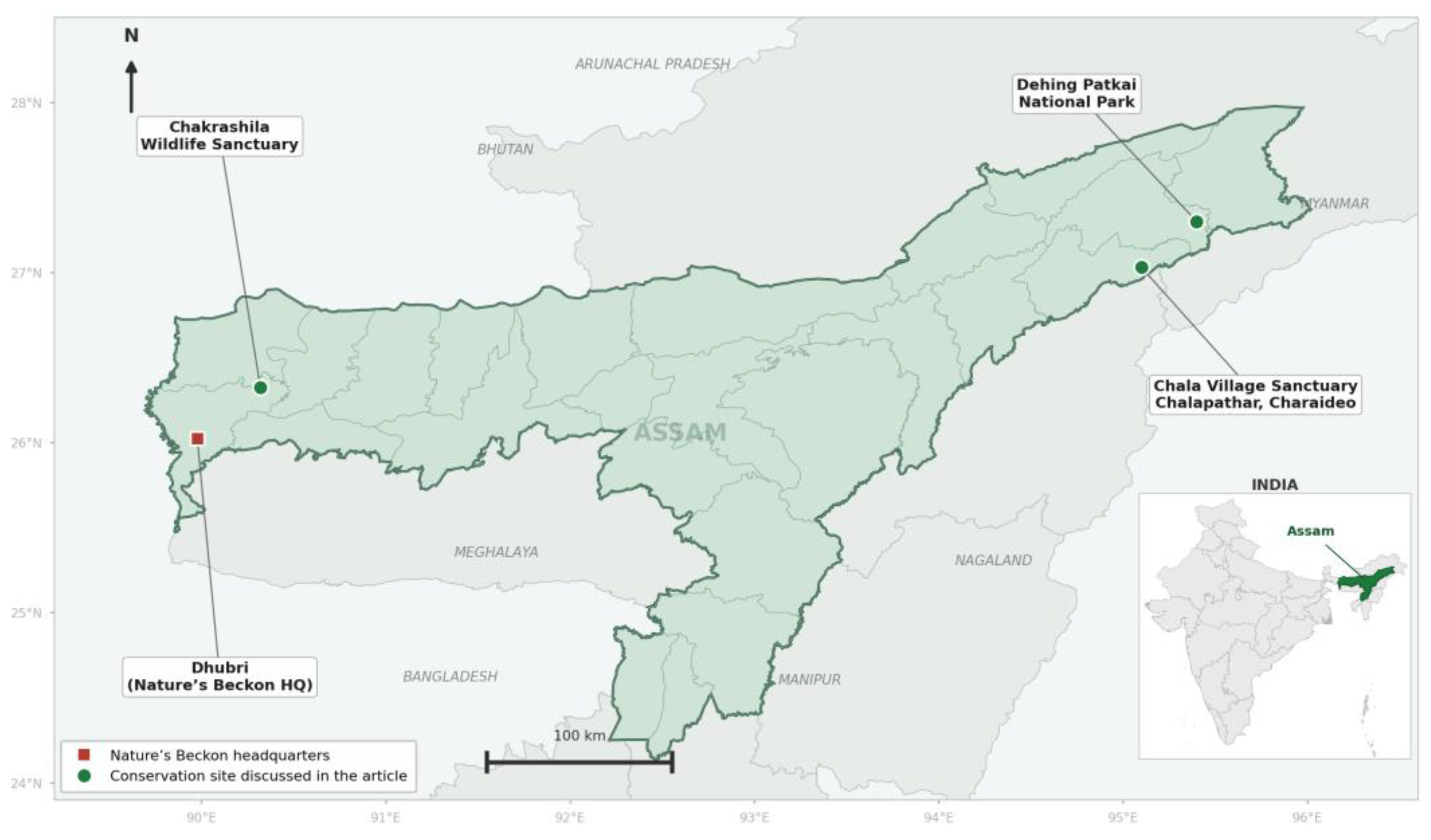

Table 1.
Summary of Nature's Beckon's principal conservation campaigns, 1983–2021.
| Campaign | Period | Area / Location | Key Species | Documented Outcome | Refs. |
|---|---|---|---|---|---|
| Chakrashila | 1983–1995 | 45.568 km²; Dhubri and Kokrajhar | Trachypithecus geei | Wildlife Sanctuary gazetted 14 July 1994 | [27,38] |
| Dehing Patkai | 1992–2021 | 231.65 km²; Dibrugarh and Tinsukia | Rainforest assemblage; Hoolock hoolock | Wildlife Sanctuary 2004; National Park 2021 | [7,21] |
| Primate conservation | 1986–present | Multi-site | T. geei; H. hoolock | Species monographs; habitat advocacy | [12,28,29] |
| Village Sanctuary | c. 2010–present | Chala Village Sanctuary, Chalapathar, Charaideo district; and other forest-fringe sites | Multi-species | Community-led conservation institution; ecological effectiveness requires further independent assessment | [20,45] |
Note: protected-area sizes are based on government gazette notifications. Refs. column lists the principal supporting sources used in the analysis.
Disclaimer/Publisher’s Note: The statements, opinions and data contained in all publications are solely those of the individual author(s) and contributor(s) and not of MDPI and/or the editor(s). MDPI and/or the editor(s) disclaim responsibility for any injury to people or property resulting from any ideas, methods, instructions or products referred to in the content. |
© 2026 by the authors. Licensee MDPI, Basel, Switzerland. This article is an open access article distributed under the terms and conditions of the Creative Commons Attribution (CC BY) license.
Copyright: This open access article is published under a Creative Commons CC BY 4.0 license, which permit the free download, distribution, and reuse, provided that the author and preprint are cited in any reuse.


