
Submitted:
10 July 2026
Posted:
13 July 2026
You are already at the latest version
Abstract
This study aimed to evaluate the distribution of lead (Pb), cadmium (Cd), chromium (Cr), and arsenic (As) in Andean dairy production systems located within areas affected by volcanic ash deposition, and to analyse their implications for milk safety. To this end, samples from 15 georeferenced dairy production units were analysed to determine heavy metals and physicochemical characteristics in soil, forage, feed, drinking water, and raw milk. Soil and forage were considered the main environmental matrices within the soil–forage–milk pathway, whereas feed and drinking water were interpreted as external exposure matrices. The data were analysed using descriptive statistics, box plots, principal component analysis, and Spearman correlation analysis. The findings indicated that heavy metal behaviour was metal-specific and did not follow a strictly linear pattern. Pb and As exhibited marked attenuation before reaching milk, suggesting limited final transfer to the consumable product. Cd exhibited greater biological mobility, with detectable concentrations in milk and stronger relevance from a chronic exposure perspective. Cr persisted at relatively high levels in forage and feed but decreased substantially in milk. Correlation analysis demonstrated that Pb, Cr, and As were mainly associated with the solid fraction of milk, whereas Cd demonstrated an inverse relationship with corrected density, protein, lactose, and total solids. Overall, the results indicate that milk safety in volcanic-influenced Andean dairy systems should be assessed through an integrated chemical and physicochemical approach, considering environmental availability, external dietary inputs, and milk compositional quality.
Keywords:
volcanic ashfall
; bovine feeding
; raw milk quality
; forage uptake
; environmental contamination
; trace elements
1. Introduction
Heavy metals constitute one of the main environmental concerns in agricultural systems because of their persistence, capacity for accumulation, and potential entry into the food chain [1]. This issue becomes particularly relevant in volcanic-influenced regions, where ash deposition may modify soil physicochemical properties, alter nutrient availability, and favour the presence or mobilisation of metal contaminants in productive matrices [2]. In Ecuador, a country characterised by significant volcanic activity, agricultural and livestock areas have been affected by these processes, increasing the need to understand their implications for food production and public health [3]. In this context, metal contamination should be regarded as the result of interactions between natural inputs associated with volcanism and possible anthropogenic contributions derived from agricultural practices, livestock management, and the rural environment [4].
Among the production systems vulnerable to this situation, Andean dairy systems occupy a particularly sensitive position. Milk represents not only a product of economic importance for rural communities, but also a frequently consumed food of high nutritional value. Therefore, any alteration in the quality of soil, forage, drinking water, or supplementary feed supplied to livestock may ultimately affect the safety of the final product [5]. Unlike other agricultural commodities, milk may reflect the interaction of several environmental and dietary exposure matrices, including soil, forage, drinking water, supplementary feed, and the animal product itself [6]. However, these matrices should not be interpreted as a single linear transfer sequence, since feed and water may originate from external sources and contribute directly to animal intake. Therefore, the presence of lead (Pb), cadmium (Cd), chromium (Cr), and arsenic (As) in any of these matrices is of particular interest, as these elements may compromise animal health [7], affect the quality of the production system, and constitute a route of dietary exposure for the human population [8].
The mobility and bioavailability of heavy metals within dairy production systems do not depend solely on their initial concentration, but also on the physicochemical characteristics of each matrix [9]. In soil, variables such as pH, organic matter, electrical conductivity, bulk density, cation exchange capacity, and nutrient content may decisively influence the retention, solubility, adsorption, and transport of these elements [10]. Likewise, the ability of plant species to absorb, exclude, or accumulate metals may determine the degree to which contaminants present in soil are reflected in forage. In addition, supplementary feed and drinking water may act as external exposure matrices, while animal physiological processes may modulate the final presence of metals in milk [11]. In soils of volcanic origin, moreover, the presence of amorphous minerals, iron oxides, and organo-mineral complexes may enhance the adsorption of certain elements and partially limit their bio accessibility; however, this behaviour is not uniform and may vary according to the metal involved and the local conditions of the system [12].
In Ecuador, several studies have warned of the presence of heavy metals in agricultural and livestock matrices in areas affected by volcanic ash deposition. It has been reported that areas exposed to the influence of the Tungurahua volcano present risks associated with the accumulation of metal contaminants in soils and agricultural products [13]. Previous research conducted in volcanic-influenced dairy systems has already documented the presence of heavy metals in soil, forage, and milk, as well as bioaccumulation patterns suggesting differential behaviour among matrices [3]. Nevertheless, the available evidence remains insufficient to provide an integrated understanding of how Pb, Cd, Cr, and As are distributed across environmental matrices, external exposure sources, and the final dairy product, and what the actual implications of this behaviour are for milk safety [14].
This limitation is relevant because milk safety does not depend exclusively on the isolated presence of chemical contaminants, but also on the way these contaminants relate to the physicochemical properties of the matrices involved in dairy production. In soil, edaphic attributes help to interpret the retention or availability of metals within the system; in milk, parameters such as protein, lactose, corrected density, total solids, fat, acidity, pH, and electrical conductivity provide information on the compositional quality of the product [15]. Therefore, an integrated physicochemical approach is necessary to understand not only the distribution of heavy metals among matrices, but also their relationship with milk quality and the potential risks associated with consumption.
In this context, the hypothesis was formulated that the movement of heavy metals in Andean dairy systems under volcanic influence is metal-specific and is modulated by the interaction between soil physicochemical properties, forage accumulation, external exposure matrices, and physiological processes involved in the final presence of metals in milk. It was hypothesised that Pb and As would demonstrate greater retention or attenuation before reaching the final product, whereas Cd would exhibit greater biological mobility, and Cr would tend to persist in matrices consumed by cattle before decreasing in milk. Therefore, this study aimed to evaluate the distribution of Pb, Cd, Cr, and As in a volcanic-influenced Andean dairy system and to analyse their implications for milk safety from the perspective of matrix distribution, external exposure sources, and physicochemical quality.
2. Materials and Methods
2.1. Study Area
This study was conducted in Bilbao parish, located on the northern flank of the Tungurahua volcano in the central Andean region of Ecuador. Administratively, Bilbao belongs to Penipe Canton, Chimborazo Province, approximately 42 km southeast of Riobamba. The parish is located between the central and western Andean Mountain ranges, at approximately 1.44° S latitude and 78.50° W longitude. The study area extends across an altitudinal gradient ranging from approximately 2100 to 4900 m above sea level, with a mean annual temperature close to 15 °C, annual precipitation between 700 and 1000 mm, and relative humidity ranging from 65% to 85%. These agroclimatic conditions favour pasture establishment, forage growth, soil regeneration, and the development of livestock production systems based mainly on dairy farming.
Bilbao has been historically affected by volcanic ash deposition associated with the eruptive activity of the Tungurahua volcano, one of the most active volcanoes in Ecuador during the last decades. The eruptive period recorded between 1999 and 2016 generated recurrent ashfall events that affected agricultural land, pastures, water sources, and livestock production in communities located around the volcano. In this context, volcanic ash represents a relevant environmental input because it may modify soil physicochemical properties, contribute mineral and potentially toxic elements, and influence the mobility and bioavailability of heavy metals in productive matrices. Therefore, the location of Bilbao on the northern flank of Tungurahua provides an appropriate setting for assessing heavy metal distribution in an Andean dairy system exposed to volcanic influence.
The parish is characterised by mixed agricultural and livestock practices, with dairy farming representing an important component of local livelihoods. Pasture-based cattle production predominates in the area, supported by natural and cultivated forage resources adapted to Andean agroecological conditions. Local production units commonly integrate grazing areas, forage collection, supplementary feeding, and raw milk production for household consumption and local commercialisation. Given the dietary and economic relevance of milk in these rural communities, evaluating the presence of Pb, Cd, Cr, and As in soil, forage, feed, water, and milk is essential to identify potential exposure pathways and assess implications for chemical milk safety.
2.2. Study Design and Sampling Strategy
This study used an observational, cross-sectional design aimed at evaluating the distribution of heavy metals in different matrices associated with Andean dairy production systems. A total of 15 georeferenced sampling points were included in Bilbao parish. The sampling points were selected using simple random sampling, considering the presence of dairy livestock, accessibility to production units, vegetation cover, and the representativeness of local agro-productive conditions.
Sampling was conducted between September and October 2023 in the communities of Huerta Redonda, Pichan Grande, and Urbina. At each georeferenced point, samples were collected from matrices associated with the dairy production system, including soil, forage, feed, water, and raw milk, depending on their availability at the production unit. Soil and forage were considered the main environmental matrices within the soil–forage–milk pathway, whereas feed and water were incorporated as external exposure matrices that may contribute to the intake of heavy metals by cattle. Raw milk was considered the final product for evaluating implications for chemical milk safety.
The geographic coordinates of each sampling point were recorded using a high-precision GPS device. This spatial registration made it possible to link the analytical results to specific production units and to characterise the distribution of heavy metals within the study area.
2.3. Sample Collection and Preservation
Soil, forage, feed, drinking water, and raw milk samples were collected from the selected dairy production units. Soil samples were taken at a depth of 40–50 cm, corresponding to the rooting zone of the grasses. At each sampling site, three subsamples were collected and combined to form a composite sample of approximately 2 kg. Forage samples consisted mainly of perennial ryegrass (Lolium perenne) and kikuyu grass (Cenchrus clandestinus), which are commonly used for cattle feeding in the study area. Plant material, including root and aerial fractions, was collected representatively at each site and homogenised to obtain a composite sample. Feed samples supplied to cattle were collected directly from the portions available at each production unit, homogenised, and stored in clean, properly labelled containers until laboratory processing.
Raw milk samples were collected during morning and afternoon milking sessions to obtain a representative sample from each production unit. After milking, the milk was homogenised according to the usual tank-storage procedure used by local producers, and approximately 300 mL was collected in previously coded sterile containers. Drinking water samples used for cattle consumption were also collected from the available water sources or troughs. Milk and water samples were transported under refrigerated conditions and stored at 4 °C until analysis. Feed and water were included as external exposure matrices, considering that supplementary inputs and water sources in volcanic-influenced areas may contribute to heavy metal intake by cattle.
2.4. Sample Preparation and Physicochemical Analyses
Soil, forage, feed, water, and milk samples were prepared according to previously described protocols for dairy systems affected by volcanic activity (1, with adaptations according to the matrices included in the present study. Soil samples were air-dried, homogenised, sieved, and conditioned prior to physicochemical analysis. Forage and feed samples were cleaned, when necessary, homogenised, and prepared for compositional analysis and subsequent metal determination. Milk samples were filtered using a plastic sieve, conditioned to approximately 20 °C, and homogenised before analysis using a LACTOSCAN device (Milkotronic Ltd., Nova Zagora, Bulgaria).
Physicochemical analyses were conducted to characterise the main properties of each matrix and support the interpretation of heavy metal behaviour within the dairy production system. In soil, pH, electrical conductivity, moisture, dry matter, organic matter, carbon, nitrogen, C/N ratio, cation exchange capacity, chlorides, phosphates, nitrates, sulphates, bulk density, and particle density were determined. In forage and feed, pH, electrical conductivity, organic matter, and selected microelements were analysed. In drinking water, pH, electrical conductivity, total dissolved solids, hardness, and alkalinity were determined, given its role as an external exposure matrix. In milk, pH, acidity, corrected density, protein, lactose, fat, total solids, electrical conductivity, and added water were analysed to assess the compositional quality of the final product and its relevance for chemical milk safety.
2.5. Determination of Heavy Metals
For the quantification of Pb, Cd, Cr, and As in the soil, forage, feed, and milk matrices, acid digestion was applied prior to instrumental analysis, following the methodology of [17], with modifications. In milk samples, digestion was conducted with concentrated nitric acid at a ratio of 1:2 (v/v) for 12 hours at room temperature. Subsequently, distilled water was added at a milk-to-water ratio of 1:4, and the mixture was digested at 100 °C until its volume had been reduced to one third. An equivalent volume of concentrated hydrochloric acid and distilled water was then added, and a second digestion was performed until a clear digest was obtained. Finally, the solution was filtered and subjected to instrumental analysis.
For the solid matrices, namely soil, forage, and feed, wet digestion with 65% nitric acid was used, following the procedure employed by [18], which had previously been applied in the baseline study for solid materials within the agricultural production system. Metal determination was conducted by atomic absorption spectrophotometry using a SpectrAA 220 instrument (Varian Inc., Victoria, Australia). Analytical quality was verified using blanks, replicates, and spiked samples to ensure precision and reliability in the measurements. Detection limits were calculated from the mean blank value plus three times the standard deviation, adjusted according to the corresponding dilution factor. Values below the detection limit were treated as non-detected during the interpretation of the results.
2.6. Statistical Analysis
The statistical analysis focused on the distribution of Pb, Cd, Cr, and As in soil, forage, feed, drinking water, and milk matrices. Heavy metal concentrations were explored using descriptive statistics and box plots to visualise central tendency, interquartile dispersion, and variability among the main environmental and dietary matrices and the final dairy product [20,21]. The soil–forage–milk pathway was considered the main environmental transfer route, whereas feed and drinking water were treated as external exposure matrices.
Principal component analysis (PCA) was applied to evaluate multivariate relationships among matrices and to identify potential patterns associated with heavy metal transfer [24,25]. Two complementary PCA models were developed. The first PCA included soil physicochemical properties, soil heavy metal concentrations, and forage heavy metal concentrations to explore how edaphic characteristics, such as pH, organic matter, electrical conductivity, and other soil variables, were associated with the presence of metals in forage. The second PCA included heavy metal concentrations in forage, feed, drinking water, and milk, when paired data were available, to examine the relationship between potential dietary exposure sources and the metals detected in the final dairy product. Prior to PCA, variables were standardised because they were expressed in different units and scales. Interpretation was based on the variance explained by the first principal components and on the contribution of each variable to the factorial planes.
Correlation analysis was also used to assess the relationship between heavy metal concentrations in milk and the physicochemical quality parameters of the product [26]. Spearman’s rank correlation coefficients were calculated because of the exploratory nature of the study and the available sample size. The results were represented using a correlation heatmap to identify positive and negative associations between Pb, Cd, Cr, and As in milk and milk quality variables, including pH, acidity, corrected density, protein, lactose, fat, total solids, electrical conductivity, and added water. These associations were interpreted as exploratory patterns and not as evidence of direct causality. All statistical analyses were conducted in R version 4.5.2.
3. Results and Discussion
3.1. Distribution of Heavy Metals Across the Studied Matrices
Figure 1 shows clear differences in the distribution of Pb, Cd, Cr, and As across the matrices evaluated in the Andean dairy production system. The concentrations varied according to both the metal and the type of matrix, indicating that the presence of these elements was not homogeneous across the system. It is important to note that feed and drinking water were not considered direct components of the soil–forage–milk transfer pathway, since both represent external exposure matrices. Therefore, the boxplots were used to compare the variation in heavy metal concentrations among the studied matrices rather than representing a strictly linear transfer sequence. In this sense, soil and forage were interpreted as part of the main environmental pathway, whereas feed was considered an external dietary matrix and milk represented the final product for assessing chemical safety.
In the case of Pb, the highest concentrations were recorded in the soil, followed by a marked decrease in forage, a moderate increase in feed, and minimum values in milk. The soil matrix demonstrated a median concentration of 1.496 mg kg−1, while forage presented values close to or below the analytical detection limit, indicating very low plant uptake under the conditions evaluated. Feed demonstrated a higher median concentration than forage, suggesting that supplementary feed may represent an additional external source of exposure. In contrast, milk demonstrated the lowest concentration, with a median value of 0.014 mg L−1. This pattern indicates that the soil acted as the main reservoir of Pb, whereas its movement towards forage and milk was strongly attenuated. Even considering the low values detected in forage, the concentration remained below the reference value of 0.2 mg kg−1 cited by FAO/WHO for food crops and far below the phytotoxicity thresholds of 30 mg kg−1 and 100 mg kg−1 proposed by AFNOR for dry matter, although these values should be interpreted with caution, as they are not specific to forage crops [27,28].
Compared with studies conducted in contaminated environments, where Pb levels in plants range from 0.34 to 13.4 mg kg−1 and may reach values close to 20 mg kg−1 in mining and metallurgical areas, the findings of this study show that the mobility of the metal was limited. This pattern is consistent with the low biological availability that Pb generally exhibits in soils with a high adsorption capacity, in which organic matter, clays, and reactive surfaces favour its retention in less mobile fractions. Therefore, the lower levels observed in milk indicate that Pb underwent substantial reduction along the soil–forage–milk pathway, decreasing its immediate contribution to food-related risk in the final product, although the need for regular monitoring should not be ruled out [29].
Unlike lead, cadmium exhibited more marked mobility within the system. The highest concentration was recorded in forage, with a median value of 0.312 mg kg−1, while soil demonstrated a lower median concentration of 0.108 mg kg−1. Feed presented mostly low or non-detected values, although the dispersion observed in this matrix suggests possible variability in the origin or composition of supplementary inputs. Milk showed detectable Cd concentrations, with a median value of 0.114 mg L−1. The concentration observed in forage fell within the range established for forage crops (0.04–1.02 mg kg−1), indicating moderate but environmentally significant accumulation. In terms of its distribution, this pattern suggests that cadmium demonstrated a more continuous transfer from the environmental matrices to the final product compared with lead. The presence of the metal in milk supports this conclusion and demonstrates that, under the conditions analysed, cadmium was able to move through the food chain more effectively than other elements within the system [30].
This behaviour is consistent with the greater biological mobility frequently associated with Cd in agricultural environments, particularly when its availability is influenced by interactions among pH, organic matter, cation exchange capacity, and amorphous soil minerals. In volcanic soils, these reactive phases may, to some extent, reduce its bioaccessibility [31]; nevertheless, the presence of Cd in milk suggests that such retention was not sufficient to prevent its final transfer. Therefore, the findings indicate that the soil system functioned more as a partial filter than as a complete barrier [32]. Likewise, the continuity observed across the matrices supports the notion that Cd has a greater tendency to bioaccumulate and to remain available for entry into biological compartments, which increases its relevance from the perspective of chronic exposure and food safety [33].
Chromium demonstrated a relatively high presence in soil, forage, and feed, with median values of 15.897 mg kg−1, 15.973 mg kg−1, and 19.249 mg kg−1, respectively. In contrast, milk demonstrated a marked decrease, with a median concentration of 3.005 mg L−1. Although the amount in soil remained below the limit of 200 mg kg−1 established for this matrix, the levels found in forage and, above all, in feed exceeded the range reported for forage crops (0.035–2.612 mg kg−1). This indicates that Cr not only remained active within the system but also became significantly concentrated in the intermediate and external dietary matrices before decreasing at the final stage [34]. Therefore, the observed distribution indicates substantial persistence in the matrices consumed by cattle and, at the same time, partial attenuation before reaching the milk.
The persistence of relatively high levels in forage and feed can be understood as a consequence of the availability of the metal in the soil and of possible additions associated with the nature of the inputs supplied to livestock. This interpretation is consistent with the behaviour of chromium in volcanic areas, where it tends to bind to clay particles, iron oxides, and other reactive surfaces, thereby partly limiting its mobility [35]. However, this does not rule out its propagation within the system when local conditions favour its persistence in bioavailable forms. Therefore, the decrease observed in milk should not be interpreted as an absence of transfer, but rather as an indication that the system moderated its movement towards the final matrix after relatively sustained circulation through the matrices consumed by cattle [36]. From a safety perspective, this pattern deserves particular attention, as forage and feed may be functioning as critical points of exposure prior to the final product.
Finally, As demonstrated more limited migration to milk, although with marked variability in the initial and external matrices. Soil presented a median concentration of 0.832 mg kg−1, while forage demonstrated substantially lower values, with a median of 0.069 mg kg−1. Feed exhibited greater variability, with a median concentration of 0.495 mg kg−1 and several high values, suggesting heterogeneity in the origin or composition of supplementary inputs. In contrast, milk exhibited the lowest concentrations, with a median value of 0.006 mg L−1. Taken together, this trend suggests that, although arsenic was present in environmental and feed-related matrices, its final transfer to the consumable product was markedly limited.
This pattern may be understood in light of the specific chemistry of arsenic in soils of volcanic origin, where the presence of ferric oxides, organic matter, and other reactive surfaces may restrict its availability to plants and, consequently, reduce its transfer to subsequent matrices [37]. However, the persistence observed in soil, forage, and feed indicates that the element was not completely immobilized but rather continued to circulate unevenly within the system. The slight recovery observed in feed also suggests that this matrix may reflect variation in the origin of inputs, the water used, or specific feed mixtures, rather than uniform transfer from the soil [38]. Therefore, although the low concentration of arsenic in milk reduces the immediate concern regarding direct exposure through the final product [39], the continued presence of arsenic in earlier matrices indicates that the system still bears an environmental burden that requires constant monitoring and preventive assessment.
3.2. Drinking Water Characterisation as an External Exposure Matrix
Drinking water used for cattle consumption was analysed separately because it is not a direct component of the soil–forage–milk transfer pathway. However, its inclusion was relevant because water may act as an external exposure matrix, particularly in volcanic-influenced areas where geological conditions and ash deposition may favour the mobilisation of potentially toxic elements into water sources. The physicochemical results demonstrated a pH of 7.732, electrical conductivity of 417.07 µS cm−1, total dissolved solids of 208.57 mg L−1, hardness of 381.33 mg L−1, and alkalinity of 105.00 mg L−1, indicating a moderately mineralised water profile.

Table 1.
Physicochemical characteristics and heavy metal concentrations in drinking water used for cattle consumption.
Table 1.
Physicochemical characteristics and heavy metal concentrations in drinking water used for cattle consumption.
| Parameter | Result | Unit |
|---|---|---|
| pH | 7.732 | — |
| Electrical conductivity | 417.07 | µS cm−1 |
| Total dissolved solids | 208.57 | mg L−1 |
| Hardness | 381.33 | mg L−1 |
| Alkalinity | 105.00 | mg L−1 |
| Cd | <0.004 | mg L−1 |
| Cr | <0.300 | mg L−1 |
Note. Drinking water was analysed as an external exposure matrix and not as a direct component of the soil–forage–milk pathway. Values reported as “<“ indicate concentrations below the analytical detection or quantification limit.
The pH value observed in the drinking water was within the slightly alkaline range and was consistent with recent studies reporting that water quality varies considerably according to geological context, land use, and the interaction between surface and groundwater systems [40,41]. The electrical conductivity and total dissolved solids values indicated a moderate mineral load, lower than values reported in more impacted surface water or reservoir systems, where elevated dissolved solids, nutrients, and turbidity have been associated with reduced water suitability for animal consumption [42]. Hardness was relatively high, which may influence water palatability and intake by livestock; however, it did not occur together with detectable Cd or Cr concentrations in the analysed water source.
Regarding heavy metals, Cd and Cr were below the analytical detection or quantification limits, with values of <0.004 mg L−1 and <0.300 mg L−1, respectively. This contrasts with recent studies in which heavy metals have been detected in groundwater or surface water used for human, animal, or agricultural purposes, particularly in areas affected by natural geochemical enrichment, agricultural activity, mining, or industrial pressure [41,43,44]. Under the conditions analysed in the present study, drinking water did not represent a measurable source of Cd or Cr exposure for cattle. Nevertheless, the limited number of water samples and the restricted number of analysed metals mean that these results should be interpreted as descriptive evidence rather than as a definitive assessment of water-related risk.
In volcanic-influenced dairy systems, water quality may vary spatially and seasonally depending on ash deposition, runoff, groundwater interactions, and the geochemical characteristics of surrounding soils. Therefore, drinking water should be considered a complementary external matrix within the assessment of heavy metal exposure, together with forage and supplementary feed. Regular monitoring is recommended, especially in livestock systems that depend on local water sources potentially affected by volcanic materials, agricultural practices, or natural geochemical inputs [42,45].
3.3. Transfer and Attenuation Patterns Along the Soil–Forage–Milk Pathway
The patterns observed in Figure 2 indicate that the movement of Pb, Cd, Cr, and As along the soil–forage–milk pathway was not uniform but exhibited metal-specific behaviour. In this analysis, soil and forage were considered the main environmental matrices involved in the transfer route towards milk, whereas feed was interpreted as an external dietary exposure matrix. Therefore, changes in metal concentrations between forage and feed should not be interpreted as transfer between these matrices, since feed may originate from external sources and may contribute directly to animal intake. Overall, the median values and interquartile variability indicated that milk retained lower concentrations than the environmental and dietary matrices, suggesting attenuation before reaching the consumable product. However, the extent of this attenuation varied according to the metal and was influenced by the geochemical behaviour of each element, soil properties, plant uptake, dietary exposure, and physiological barriers within the animal.
In the case of lead, the soil demonstrated the highest median concentration, followed by a marked decrease in forage and very low values in milk. This pattern indicates limited transfer from soil to forage and a strongly attenuated final presence in the dairy product. The very low Pb values observed in forage should be interpreted as concentrations close to or below the analytical detection limit, supporting the notion of minimal plant uptake under the conditions evaluated [40]. Although lead transfer through the soil–pasture–milk pathway has been reported in mining areas or highly contaminated environments, the results obtained in this study revealed a different pattern, characterised by early and substantial attenuation. This difference may be attributed to the low bioavailability of Pb in soils with high adsorption capacity, where it tends to bind to stable fractions, thereby limiting its assimilation by plants. The higher Pb values observed in feed, compared with forage, should be interpreted as evidence of possible external dietary inputs rather than as transfer from the forage matrix [41]. Overall, Pb remained largely associated with the soil system and made only a limited final contribution to milk.
Cadmium displayed more active and biologically dynamic behaviour than lead. Its concentration increased from soil to forage, reaching its highest median in the plant matrix, while milk showed detectable amounts. This pattern indicates that Cd may have undergone more effective movement within the soil–forage–milk pathway than Pb. In agricultural and livestock contexts, this behaviour is often associated with the greater mobility of Cd in plants and with external contributions, such as phosphate fertilizers, contaminated irrigation water, or other environmental inputs [42]. In the present study, feed presented mostly low or non-detected Cd values, although variability within this matrix indicates that supplementary inputs should not be completely ruled out as occasional sources of exposure. However, because feed is external to the soil–forage system, its role should be interpreted only as a potential direct dietary contribution to milk contamination, not as an intermediate transfer stage. The detection of Cd in milk suggests that its presence in the final product may result from the interaction between forage intake, total diet, and physiological processes of absorption, distribution, and excretion in the animal [43,44]. Compared with the other elements analysed, Cd demonstrated clearer continuity towards milk, which increases its relevance from the perspective of chronic exposure and food safety.
Regarding Cr, Figure 2 shows relatively similar median concentrations in soil and forage, followed by higher values in feed and a marked decrease in milk. The similarity between soil and forage suggests that Cr remained available within the environmental pathway, although its final transfer to milk was clearly reduced. The higher concentration observed in feed should not be interpreted as a continuation of the soil–forage pathway, but rather as evidence that supplementary feed may represent an independent dietary source of Cr exposure. This distinction is important because feed composition may depend on external inputs, processing conditions, or mixed ingredients unrelated to the local soil. In this study, the marked decrease observed in milk suggests that, although Cr was present in the matrices consumed by cattle, there was substantial attenuation before reaching the final dairy product [7]. This behaviour may be attributed to the partial adsorption of Cr onto clay particles, iron oxides, and reactive soil surfaces, which restricts its overall mobility but does not prevent its presence in forage or feed [45]. Therefore, Cr appears to behave as a metal with persistence in matrices consumed by cattle, but with considerable reduction before reaching milk.
Arsenic demonstrated limited final presence in milk, although variability was observed among the environmental and external matrices. The trend showed detectable concentrations in soil, a marked decrease in forage, greater variability in feed, and very low values in milk. This pattern indicates that As availability was restricted within the soil–forage pathway and that its effective transfer towards the final product was limited. The dispersion observed in feed should be interpreted as heterogeneity associated with the origin of inputs, the water used in feed preparation, or the specific composition of supplementary diets, rather than as direct transfer from forage. In the literature, arsenic has been reported to transfer to milk less efficiently than other metals, and its pathway may be more strongly influenced by contaminated water or diet than by direct movement from soil [46]. In this regard, the marked decrease between soil and forage found in this study supports the idea of a significant restriction in arsenic bioavailability within the edaphic system, probably related to adsorption processes on iron oxides and interactions with organic matter [47]. Therefore, although arsenic was detectable in the system, its effective mobility towards milk was considerably reduced, which lowers its immediate risk through consumption of this product, but does not eliminate the need for constant environmental monitoring.
3.4. Results of the Physicochemical Analyses of Soil and Milk
Figure 3 presents a summary of the multivariate structure of the physicochemical characteristics of soil and milk through principal component analysis (PCA). In the case of soil (Figure 3a), the first two components accounted for 57.01% of the total variability (PC1 = 32.40%; PC2 = 24.61%), whereas in milk (Figure 3b) they explained 55.24% (PC1 = 33.87%; PC2 = 21.37%). In both cases, these values indicate that the first two axes captured a substantial proportion of the system’s variation and facilitated the identification of important functional gradients among the variables studied.
In the soil matrix, the first principal component (PC1) showed a positive relationship with organic matter percentage, carbon percentage, moisture percentage, cation exchange capacity (CEC), and, to a lesser extent, with chlorides and the carbon-to-nitrogen ratio (C/N). By contrast, the opposite side included dry matter percentage, bulk density, particle density, phosphates, nitrates, and sulphates. This trend illustrates a gradient contrasting wetter, more organic soils with greater exchange capacity against drier, denser soils with a higher mineral content. The proximity between organic matter and carbon confirms an expected positive covariation, whereas their opposite positioning relative to the density variables indicates that a higher proportion of organic fraction is associated with lower relative compaction. From a functional perspective, this axis may be interpreted as an organic-structural gradient, which is consistent with findings from soil quality studies, where organic matter, carbon, and CEC act as key indicators of fertility and physical stability [48].
PC2 for soil demonstrated a positive association with electrical conductivity, pH, nitrogen percentage, and nitrogen expressed in milligrams per kilogram, suggesting a second axis fundamentally linked to the chemical and nutritional condition of the edaphic system. Taken together, the divergence between the organic-structural axis and the chemical-nutritional axis indicates that soil variability was not based on a single set of characteristics, but rather on the interaction among structure, organic content, nutritional status, and chemical condition. This arrangement is consistent with the expected behaviour of soils of volcanic origin, where organic compounds and reactive surfaces play a crucial role in nutrient retention and availability [49].
In the milk matrix, the first principal component revealed a clear opposition between added water and characteristics such as lactose, protein, corrected density, total solids, acidity, and, to a lesser extent, pH, thus establishing a spectrum of dilution versus compositional integrity. The grouping of lactose, protein, corrected density, and total solids suggests that these characteristics varied jointly and represent the solid and nutritional fraction of the product [50]. By contrast, the opposite direction of added water implies that the dilution effect was associated with a decrease in those components, a pattern consistent with what has been observed in changes in milk quality or authenticity [51].
PC2 for milk was largely determined by fat content, added water, and pH, in contrast to electrical conductivity, proteins, lactose, adjusted density, and acidity. This implies a second dimension related to the distinction between the lipid fraction and the soluble-structural fraction of milk. This distribution indicates that product variability was not determined solely by solids content, but also on alterations in the relationship among fat, soluble components, and physicochemical balance [52].
3.5. Association Between Milk Heavy Metals and Physicochemical Milk Quality
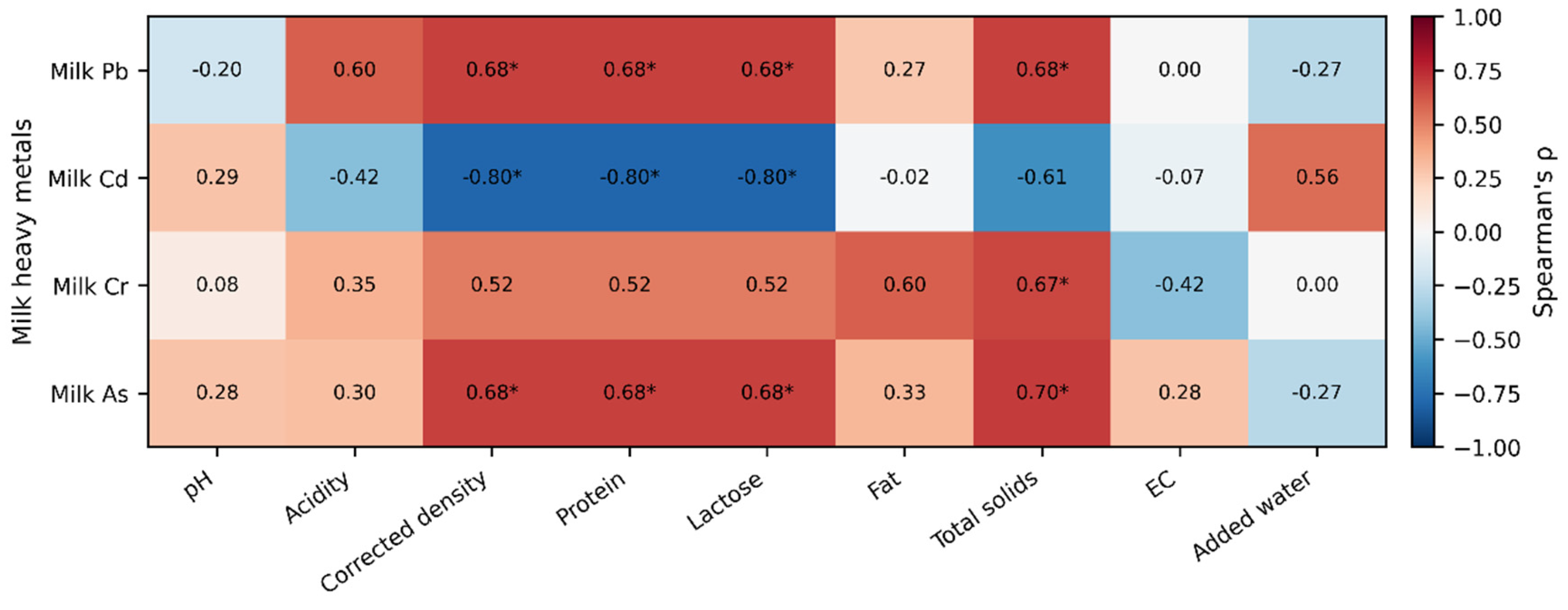
Figure 4 Correlation heatmap between heavy metal concentrations in milk and physicochemical milk quality parameters. Positive correlations are shown in red and negative correlations in blue. Asterisks indicate statistically significant correlations. EC: electrical conductivity.
Milk Pb showed positive and statistically significant correlations with corrected density, protein, lactose, and total solids, with values of ρ = 0.68 in all cases. A moderate positive association was also observed with acidity (ρ = 0.60), whereas the correlations with pH and added water were negative but weak. This pattern indicates that Pb tended to vary together with the solid fraction of milk rather than with indicators of dilution or ionic alteration. The grouping of corrected density, protein, lactose, and total solids reflects the solid and nutritional fraction of milk, which commonly varies jointly when the compositional integrity of the product is preserved [50]. Therefore, the occurrence of Pb in milk should not be interpreted as a direct sign of conventional physicochemical deterioration, but rather as a chemical safety concern associated with the compositional structure of the product.
Milk Cd exhibited the most distinctive behaviour among the analysed metals. Significant negative correlations were observed with corrected density, protein, and lactose, with values of ρ = −0.80 for each parameter. Cd also showed a negative association with total solids (ρ = −0.61) and acidity (ρ = −0.42), while its relationship with added water was positive (ρ = 0.56). This pattern indicates that higher Cd concentrations tended to occur in milk samples with lower compositional density and lower levels of key milk solids. The opposite direction between added water and the main compositional parameters is consistent with a dilution effect, in which the increase in added water is associated with a reduction in lactose, protein, corrected density, and total solids [51]. Although this does not show that Cd caused changes in milk composition, it indicates that Cd was the metal most clearly associated with an unfavourable compositional profile in the analysed samples.
Milk Cr showed mostly positive correlations with the compositional parameters of milk. The strongest association was observed with total solids (ρ = 0.67), followed by fat (ρ = 0.60), corrected density, protein, and lactose (ρ = 0.52 in each case). In contrast, Cr showed a negative correlation with electrical conductivity (ρ = −0.42) and a weak relationship with pH. These results suggest that Cr was more closely associated with the solid and lipid-related fraction of the milk matrix than with acidity or ionic balance. This distribution indicates that product variability was not determined solely by total solids content, but also on the relationship among fat, soluble components, and the physicochemical balance of the milk matrix [52]. Therefore, although Cr was detected at higher concentrations than the other metals in milk, its correlation pattern suggests a matrix-related association rather than a direct signal of physicochemical instability.
Milk As demonstrated a pattern similar to Pb, with positive and statistically significant correlations with corrected density, protein, lactose, and total solids. The strongest association was observed with total solids (ρ = 0.70), followed by corrected density, protein, and lactose (ρ = 0.68 in each case). The associations with pH, acidity, fat, and electrical conductivity were positive but weaker, whereas added water demonstrated a weak negative correlation. This behaviour indicates that As tended to increase in samples with higher values of milk solids and compositional density, rather than in samples showing signs of dilution. This pattern may be explained by the fact that some potentially toxic elements can be distributed within the milk matrix according to their affinity with specific compositional fractions, rather than being reflected only in conventional quality parameters such as pH or electrical conductivity [53].
Overall, the heatmap revealed that the association between heavy metals and milk quality parameters was metal-specific. Pb, Cr, and As were mainly related to the solid fraction of milk, particularly corrected density, protein, lactose, and total solids. In contrast, Cd demonstrated an inverse relationship with these same parameters, making it the most differentiated element in terms of its association with milk composition. These findings reinforce the need to assess heavy metals in milk not only as isolated contaminants, but also in relation to physicochemical quality parameters that may help explain their distribution within the product [54]. Nevertheless, because this analysis was exploratory and based on a limited number of milk samples, the observed correlations should not be interpreted as evidence of causality. Future studies should include larger sample sizes, seasonal monitoring, and paired evaluation of forage, feed, water, and milk to better clarify the mechanisms that regulate the final occurrence of heavy metals in dairy products.
4. Conclusions
The study demonstrated that the distribution and movement of Pb, Cd, Cr, and As in volcanic-influenced Andean dairy systems were clearly metal-specific and matrix-dependent. Along the soil–forage–milk pathway, Pb and As exhibited marked attenuation before reaching milk, suggesting limited final transfer to the consumable product. In contrast, Cd exhibited greater biological mobility, with detectable concentrations in milk, while Cr maintained relatively high levels in forage and feed before decreasing in the final dairy matrix. However, feed should not be interpreted as a direct component of the soil–forage–milk pathway, but rather as an external dietary exposure matrix that may contribute directly to animal intake. These results indicate that the presence of heavy metals in milk cannot be inferred solely from their concentration in soil but must be understood through the interaction of soil retention, plant uptake, external dietary inputs, and physiological regulation within the animal.
The physicochemical analyses revealed that soil variability was determined by the interaction between organic, structural, chemical, and nutritional characteristics, which may influence the retention, mobility, and availability of metals within the production system. In milk, the correlation patterns demonstrated that Pb, Cr, and As were mainly associated with the solid fraction of the product, particularly corrected density, protein, lactose, and total solids, whereas Cd demonstrated an inverse relationship with these same compositional parameters. This suggests that milk safety does not depend only on the concentration of heavy metals, but also on the physicochemical context of the final dairy matrix. Therefore, heavy metals in milk should be evaluated not only as isolated contaminants, but also in relation to milk compositional quality.
Overall, the findings support the need for an integrated chemical and physicochemical approach to assess milk safety in Andean dairy systems affected by volcanic ash deposition. Soil and forage represent the main environmental matrices within the soil–forage–milk pathway, whereas feed and drinking water should be considered external exposure matrices that may influence animal intake depending on their origin and composition. Continuous monitoring of soil, forage, feed, drinking water, and raw milk is therefore recommended, together with improved management of supplementary feeding and local water sources. These actions would help to reduce long-term exposure risks, strengthen chemical milk safety, and support safer dairy production in volcanic-influenced agricultural areas.
Author Contributions
S.R.-R.: Writing—original draft, Visualization, Formal analysis, Conceptual ization, Methodology, Validation, Investigation, Data Curation. I.G.-T.: Writing—Review and Editing, Conceptualization, Methodology, Validation, Resources, Supervision, Funding acquisition. J.H.-N.: Writing—Review and Editing, Conceptualization. S.R.-R.: Writing—Review and Editing, Conceptualization. S.C.G-P.: Writing—Review and Editing, Conceptualization. A.V.-R.: Writing—Review and Editing, Conceptualization. C.P.: Writing—Review and Editing, Conceptualization, Validation, Formal analysis, Data Curation, Visualization, Supervision. All authors have read and agreed to the published version of the manuscript.
Funding
This work was supported by the Higher Polytechnic School of Chimborazo (Ecuador), in the framework of the 1824.IDI.ESPOCH.2021 project. The APC was funded by Facultad de Industrias Agropecuarias y Ciencias Ambientales, Carrera de Agropecuaria, Universidad Politécnica Estatal del Carchi (UPEC).
Institutional Review Board Statement
Not applicable.
Data Availability Statement
The data and original contributions presented in this study are included in the article. Any additional information beyond that presented in the article is available upon request from the corresponding author.
Acknowledgments
This study is part of the research project entitled: “Evaluation of the bioavailabil ity of heavy metals and their degree of impact in the areas influenced by the Tungurahua volcano and a study of bioaccumulation in soils and products derived from agricultural activities”, carried out between the Associated Research Group in Biotechnology, Environment and Chemistry (GAIBAQ) of the Higher Polytechnic School of Chimborazo and the Environmental Research Group of Agro chemistry and Environment (GIAAMA) of the Miguel Hernández University of Elche, for which the authors appreciate their financial support and scientific contribution.”.
Conflicts of Interest
The authors declare no conflicts of interest.
Abbreviations
The following abbreviations are used in this manuscript:
| Pb | Lead |
| Cd | Cadmium |
| Cr | Chromium |
| As | Arsenic |
References
- Akansha, K.; Jain, M.; Sharma, B.M.; Bharat, G.K. Global environmental occurrence of heavy metals. In Endocrine-Disrupting Chemicals; Elsevier, 2024; pp. 237–247. [Google Scholar] [CrossRef]
- Rajmi, S.L.; Gusnidar, G.; Lubis, R.L.; Ginting, F.I.; Hidayat, F.R.; Zulhakim, H.; et al. Improving Volcanic Soil Chemistry After the Eruption of Mt. Sinabung, North Sumatera in 2020. IOP Conf. Ser. Earth Environ. Sci. 2021, 757(1), 012042. [Google Scholar] [CrossRef]
- Carrera-Beltrán, L.; Gavilanes-Terán, I.; Valverde-Orozco, V.H.; Ramos-Romero, S.; Paredes, C.; Carbonell-Barrachina, Á.A.; et al. Assessment of Heavy Metal Transfer from Soil to Forage and Milk in the Tungurahua Volcano Area, Ecuador. Agriculture 2025, 15(19), 2072. [Google Scholar] [CrossRef]
- Carrera-Beltrán, L.; Gavilanes-Terán, I.; Idrovo-Novillo, J.; Valverde, V.H.; Rodríguez-Pinos, A.; Paredes, C.; et al. Environmental pollution by heavy metals within the area influenced by the Tungurahua volcano eruption – Ecuador. Ecotoxicol. Environ. Saf. 2024, 270, 115919. [Google Scholar] [CrossRef] [PubMed]
- Su, C.; Gao, Y.; Qu, X.; Zhou, X.; Yang, X.; Huang, S.; et al. The Occurrence, Pathways, and Risk Assessment of Heavy Metals in Raw Milk from Industrial Areas in China. Toxics 2021, 9(12), 320. [Google Scholar] [CrossRef] [PubMed]
- Ugulu, I.; Khan, Z.I.; Ameer, N.; Ashfaq, A.; Ahmad, K.; Ullah, S.; et al. Multimatrix evaluation of heavy metal transfer via Sorghum bicolor L. Moench: Soil-fodder-milk contamination and risk assessment. J. Food Compos. Anal. 2026, 151, 108976. [Google Scholar] [CrossRef]
- Davidov, I.; Kovacevic, Z.; Strojanovic, D.; Pucarevic, M.; Radinovic, M.; Stojic, N.; et al. Contamination of Cow Milk by Heavy Metals in Serbia. Acta Sci. Vet. 2019, 47(1). [Google Scholar] [CrossRef]
- Souto, M.R.S.; Pimenta, A.M.; Catarino, R.I.L.; Leal, M.F.C.; Simões, E.T.R. Heavy Metals in Milk and Dairy Products: Safety and Analysis. Pollutants 2025, 5(3), 29. [Google Scholar] [CrossRef]
- Xu, D.; Shen, Z.; Dou, C.; Dou, Z.; Li, Y.; Gao, Y.; et al. Effects of soil properties on heavy metal bioavailability and accumulation in crop grains under different farmland use patterns. Sci. Rep. 2022, 12(1), 9211. [Google Scholar] [CrossRef] [PubMed]
- Fu, C.; Wang, J.B.; Meng, L.; Ning, M.H.; Wang, R.; Deng, H.; et al. Translocation Characteristics of Heavy Metals in Soil-Rice Systems Under Conventional Field Planting Environment. Huan Jing Ke Xue 2025, 46(9), 6066–6074. [Google Scholar] [CrossRef] [PubMed]
- Wang, J.; Zhang, C.B.; Jin, Z.X. The distribution and phytoavailability of heavy metal fractions in rhizosphere soils of Paulownia fortunei (seem) Hems near a Pb/Zn smelter in Guangdong, PR China. Geoderma 2009, 148(3–4), 299–306. [Google Scholar] [CrossRef]
- Schiavo, B.; Meza-Figueroa, D.; Morton-Bermea, O.; Angulo-Molina, A.; González-Grijalva, B.; Armienta-Hernández, M.A.; et al. Metal(loid) bioaccessibility and risk assessment of ashfall deposit from Popocatépetl volcano, Mexico. Environ. Geochem. Health 2024, 46(9), 354. [Google Scholar] [CrossRef] [PubMed]
- Briceño, J.; Tonato, E.; Silva, M.; Paredes, M.; Armado, A. Impact of metal content in agricultural soils near the Tungurahua volcano on the cultivation of Allium fistulosum L. La Granja 2020, 32(2), 114–126. [Google Scholar] [CrossRef]
- Dong, S.; Li, L.; Chen, W.; Chen, Z.; Wang, Y.; Wang, S. Evaluation of heavy metal speciation distribution in soil and the accumulation characteristics in wild plants: A study on naturally aged abandoned farmland adjacent to tailings. Sci. Total Environ. 2024, 917, 170594. [Google Scholar] [CrossRef] [PubMed]
- Fehér Pindešová, I.; Fehér, A.; Prus, P.; Zajác, P.; Prčík, M. Farm Level Milk Adulteration: Changes in the Physicochemical Properties of Raw Cow’s Milk after the Addition of Water and NaCl. Agriculture 2022, 12(2), 136. [Google Scholar] [CrossRef]
- Silalahi, E.M.; Lioe, H.N.; Faridah, D.N. Heavy Metals Cd, Hg, and Pb in Fresh Milk from Dairy Farms in South Jakarta Analysed by ICP-MS. Trop. Anim. Sci. Journal. 2023, 46(4), 502–508. [Google Scholar] [CrossRef]
- Shirisha, K.; Sahrawat, K.L.; Devi, B.P.; Wani, S.P. Simple and Accurate Method for Routine Analysis of Heavy Metals in Soil, Plant, and Fertilizer. Commun. Soil Sci. Plant Anal. 2014, 45(16), 2201–2206. [Google Scholar] [CrossRef]
- Bulanov, N.M.; Suvorov, A.Yu.; Blyuss, O.B.; Munblit, D.B.; Butnaru, D.V.; Nadinskaia, M.Yu.; et al. Basic principles of descriptive statistics in medical research. Sechenov Med. J. 2021, 12(3), 4–16. [Google Scholar] [CrossRef]
- Majaw, N.; Ahmed, S.S. Exploring Data Distributions using Box and Whisker Plot Analysis. In 2023 14th International Conference on Computing Communication and Networking Technologies (ICCCNT); IEEE, 2023; pp. 1–8. [Google Scholar] [CrossRef]
- Milinovic, J.; Vale, C.; Azenha, M. Recent advances in multivariate analysis coupled with chemical analysis for soil surveys: a review. J. Soils Sediments 2023, 23(3), 1085–1098. [Google Scholar] [CrossRef]
- Nazrin, M.; Arifin, A. Soil quality dynamics under tropical land-use change: implications for sustainable management. Environ. Monit. Assess. 2025, 197(12), 1378. [Google Scholar] [CrossRef] [PubMed]
- Dudáš, A. Graphical representation of data prediction potential: correlation graphs and correlation chains. Vis. Comput. 2024, 40(10), 6969–6982. [Google Scholar] [CrossRef]
- Getu, A.; Seid, Y.; Asrade, B. Determination of the Level of Heavy Metals in the Selected Cereals from Debre Markos Local Market, Amhara Region, Ethiopia. Int. J. Anal. Chem. 2022, 2022, 7146439. [Google Scholar] [CrossRef] [PubMed]
- Khan, M.U.; Malik, R.N.; Muhammad, S. Human health risk from heavy metal via food crops consumption with wastewater irrigation practices in Pakistan. Chemosphere 2013, 93(10), 2230–2238. [Google Scholar] [CrossRef] [PubMed]
- Chirinos-Peinado, D.; Castro-Bedriñana, J.; Barnes, E.P.G.; Ríos-Ríos, E.; García-Olarte, E.; Castro-Chirinos, G. Assessing the Health Risk and Trophic Transfer of Lead and Cadmium in Dairy Farming Systems in the Mantaro Catchment, Central Andes of Peru. Toxics 2024, 12(5), 308. [Google Scholar] [CrossRef] [PubMed]
- Castro-González, N.P.; Moreno-Rojas, R.; Calderón Sánchez, F.; Moreno-Ortega, A.; Tamariz-Flores, J.V. Metales pesados en leche de vacas alimentadas con alfalfa producida en suelos irrigados con aguas residuales en Puebla y Tlaxcala, México. Rev. Mex. De Cienc. Pecu. 2018, 9(3), 466–485. [Google Scholar] [CrossRef]
- Chen, R.; Liu, Z.; Yang, J.; Ma, T.; Guo, A.; Shi, R. Predicting cadmium enrichment in crops/vegetables and identifying the effects of soil factors based on transfer learning methods. Ecotoxicol. Environ. Saf. 2025, 291, 117823. [Google Scholar] [CrossRef]
- Castro-Bedriñana, J.; Chirinos-Peinado, D.; Ríos-Ríos, E.; Castro-Chirinos, G.; Chagua-Rodríguez, P.; De La Cruz-Calderón, G. Lead, Cadmium, and Arsenic in Raw Cow’s Milk in a Central Andean Area and Risks for the Peruvian Populations. Toxics 2023, 11(10), 809. [Google Scholar] [CrossRef] [PubMed]
- Nassiri, K.; Raeeszadeh, M.; Ahmadi, E. Assessment of elements (toxic and essential) concentrations and methicillin resistance in Staphylococcus aureus strains isolated from raw milk in the Kurdistan province. Int. J. Dairy Technol. 2024, 77(4), 1119–1130. [Google Scholar] [CrossRef]
- Saleem, M.H.; Afzal, J.; Rizwan, M.; Shah, Z.-u.h.; Depar, N.; Usman, K. Chromium toxicity in plants: consequences on growth, chromosomal behaviour and mineral nutrient status. Turk. J. Agric. For. 2022, 46(3), 371–389. [Google Scholar] [CrossRef]
- Luo, Y.; Ding, J.; Hai, J.; Tan, W.; Hao, R.; Qiu, G. Interaction mechanism of dissolved Cr(VI) and manganite in the presence of goethite coating. Environ. Pollut. 2020, 260, 114046. [Google Scholar] [CrossRef] [PubMed]
- Wang, H.; Jiang, Y.; Tian, C.; Pan, R.; Dang, F.; Feng, J.; et al. Determination of the transfer of lead and chromium from feed to raw milk in Holstein cows. Food Addit. Contam. Part A 2018, 35(10), 1990–1999. [Google Scholar] [CrossRef] [PubMed]
- Caporale, A.G.; Adamo, P.; Azam, S.M.G.G.; Rao, M.A.; Pigna, M. May humic acids or mineral fertilisation mitigate arsenic mobility and availability to carrot plants (Daucus carota L.) in a volcanic soil polluted by As from irrigation water? Chemosphere 2018, 193, 464–471. [Google Scholar] [CrossRef] [PubMed]
- Pullyottum Kavil, S.; Ghosh, D.; Pašić, I.; Routh, J. Temporal dynamics of arsenic uptake and distribution: food and water risks in the Bengal basin. Toxicol. Environ. Chem. 2020, 102(1–4), 62–77. [Google Scholar] [CrossRef]
- Sarsembayeva, N.; Abdigaliyeva, T.; Utepova, Z.; Biltebay, A.; Aidarbekova, A. Assessment of Heavy Metals Migration in the Water–Soil–Fodder–Milk Food Chain in the Almaty Region. Online J. Biol. Sci. 2021, 21(2), 365–375. [Google Scholar] [CrossRef]
- Abdelhafiz, M.A.; Elnazer, A.A.; Seleem, E.-M.M.; Salman, S.A.; Feng, X. Chemical and bacterial quality monitoring of the Nile River water and associated health risks in Qena–Sohag sector, Egypt. In Environmental Geochemistry and Health; 2021. [Google Scholar] [CrossRef] [PubMed]
- Fan, C.; Liu, Y.; Liu, C.; Zhao, W.; Hao, N.; Guo, W.; et al. Water quality characteristics, sources, and assessment of surface water in an industrial mining city, southwest of China. Environ. Monit. Assess. 2022, 194, 259. [Google Scholar] [CrossRef] [PubMed]
- Muchanga, M. Water quality assessment of the Makoye reservoir and its implications on livestock health, southern Zambia. Environ. Geochem. Health 2026, 48(3), 108. [Google Scholar] [CrossRef] [PubMed]
- Veiga-Gómez, M.; Nebot, C.; Falqué, E.; Pérez, B.; Franco, C.M.; Cepeda, A. Determination of pharmaceuticals and heavy metals in groundwater for human and animal consumption and crop irrigation in Galicia. Food Addit. Contam. Part A 2021, 38(12), 2055–2076. [Google Scholar] [CrossRef] [PubMed]
- Mohana Priya, E.; Uma, E.; Mitra, D.; Tamilselvi, K.S. Preliminary assessment of domestic well water quality and heavy metal contamination near Orathupalayam dam, India. Clean. Water 2025, 4, 100177. [Google Scholar] [CrossRef]
- Peluso, J.; Martínez Chehda, A.; Olivelli, M.S.; Aronzon, C.M.; et al. Impacts of cattle management and agricultural practices on water quality through different approaches: physicochemical and ecotoxicological parameters. Environ. Sci. Pollut. Res. 2024, 31(32), 45177–45191. [Google Scholar] [CrossRef] [PubMed]
- Amorim, H.C.S.; Hurtarte, L.C.C.; Vergütz, L.; Silva, I.R.; Costa, O.D.V.; Pacheco, A.A.; et al. Lead speciation and availability affected by plants in a contaminated soil. Chemosphere 2021, 285, 131468. [Google Scholar] [CrossRef] [PubMed]
- Chirinos-Peinado, D.; Castro-Bedriñana, J.; García-Olarte, E.; Quispe-Ramos, R.; Gordillo-Espinal, S. Transfer of lead from soil to pasture grass and milk near a metallurgical complex in the Peruvian Andes. Transl. Anim. Sci. 2021, 5(1), txab003. [Google Scholar] [CrossRef] [PubMed]
- Khan, Z.I.; Hamdani, M.; Ahmad, K.; Ashfaq, A.; Fatima, S.; Bashir, S.; et al. Assessment of cadmium toxicity in buffaloes grazing on forages cultivated in diverse irrigated soils: a comprehensive analysis. Plant Soil Environ. 2025, 71(3), 202–212. [Google Scholar] [CrossRef]
- Yang, Y.; Wu, Y.N.; Zhang, Y.H.; Cui, X.S.; Lv, X.Y.; Chen, Z.; et al. Distribution Characteristics and Pollution Assessment of Lead and Cadmium Content in Selected Dairy Farms in Jiangsu, China. Vet. Sci. 2025, 12(11), 1042. [Google Scholar] [CrossRef] [PubMed]
- Culqui, L.; Haro, N.; Rascón, J.; Tafur Chuquizuta, L.; Vigo, C.N.; Leiva-Tafur, D.; et al. Analysis of heavy metals in silvopastoral systems: a strategy for livestock sustainability in the district of Molinopampa, Amazonas, Peru. Soil Secur. 2025, 20, 100197. [Google Scholar] [CrossRef]
- Nguyen, T.T.; Marsac, R.; Groleau, A.; Scaria, J.; Sivry, Y. Binding mechanisms of trivalent chromium on colloidal phases from ultramafic systems: Insights from batch experiments and XAS analysis. Colloids Surf. A Physicochem. Eng. Asp. 2025, 704, 135448. [Google Scholar] [CrossRef]
- Tanaka, R.T.; Weber OL dos, S.; Torres, G.N.; de Miranda, J.G.; Couto, E.G. Soil aggregation and organic carbon under different management systems in the cerrado of Mato Grosso. Rev. Caatinga 2025, 38. [Google Scholar] [CrossRef]
- Mukai, M.; Aiba, S.; Kitayama, K. Effects of tree-root exudates on the solubilization of phosphorus adsorbed to non-crystalline minerals in the rhizosphere volcanic soils on Yakushima Island, Japan. Trees 2021, 35(6), 2031–2041. [Google Scholar] [CrossRef]
- Wagner, C.; Singh, R.; Amamcharla, J.K. Determination of lactose in milk and milk-derived ingredients using biosensor-based techniques. In Enzymes Beyond Traditional Applications in Dairy Science and Technology; Elsevier, 2023; pp. 427–444. [Google Scholar] [CrossRef]
- Fehér Pindešová, I.; Fehér, A.; Prus, P.; Zajác, P.; Prčík, M. Farm Level Milk Adulteration: Changes in the Physicochemical Properties of Raw Cow’s Milk after the Addition of Water and NaCl. Agriculture 2022, 12(2), 136. [Google Scholar] [CrossRef]
- Sala, G.; Scholten, E. Oral Processing of Dairy Products. In Oral Processing and Consumer Perception; The Royal Society of Chemistry, 2022; pp. 248–282. [Google Scholar] [CrossRef]
- Alinezhad, Z.; Hashemi, M.; Tavakoly Sany, S.B. Concentration of heavy metals in pasteurized and sterilized milk and health risk assessment across the globe: A systematic review. PLoS ONE 2024, 19(2), e0296649. [Google Scholar] [CrossRef] [PubMed]
- Basaran, B.; Yilmaz, A.; Cinar, A.; et al. Occurrence of Potentially Toxic Metals Detected in Milk and Dairy Products: Levels, Exposure Assessment, and Risk Characterisation. Foods 2025, 14(15), 2561. [Google Scholar] [CrossRef] [PubMed]
Figure 1.
Distribution of Pb, Cd, Cr, and As across the studied matrices. Boxplots show the median, interquartile range, and dispersion of metal concentrations in soil, forage, feed, and milk. Soil, forage, and feed concentrations are expressed in mg kg−1, whereas milk concentrations are expressed in mg L−1. Feed was considered an external dietary exposure matrix and not a direct component of the soil–forage–milk pathway.
Figure 1.
Distribution of Pb, Cd, Cr, and As across the studied matrices. Boxplots show the median, interquartile range, and dispersion of metal concentrations in soil, forage, feed, and milk. Soil, forage, and feed concentrations are expressed in mg kg−1, whereas milk concentrations are expressed in mg L−1. Feed was considered an external dietary exposure matrix and not a direct component of the soil–forage–milk pathway.
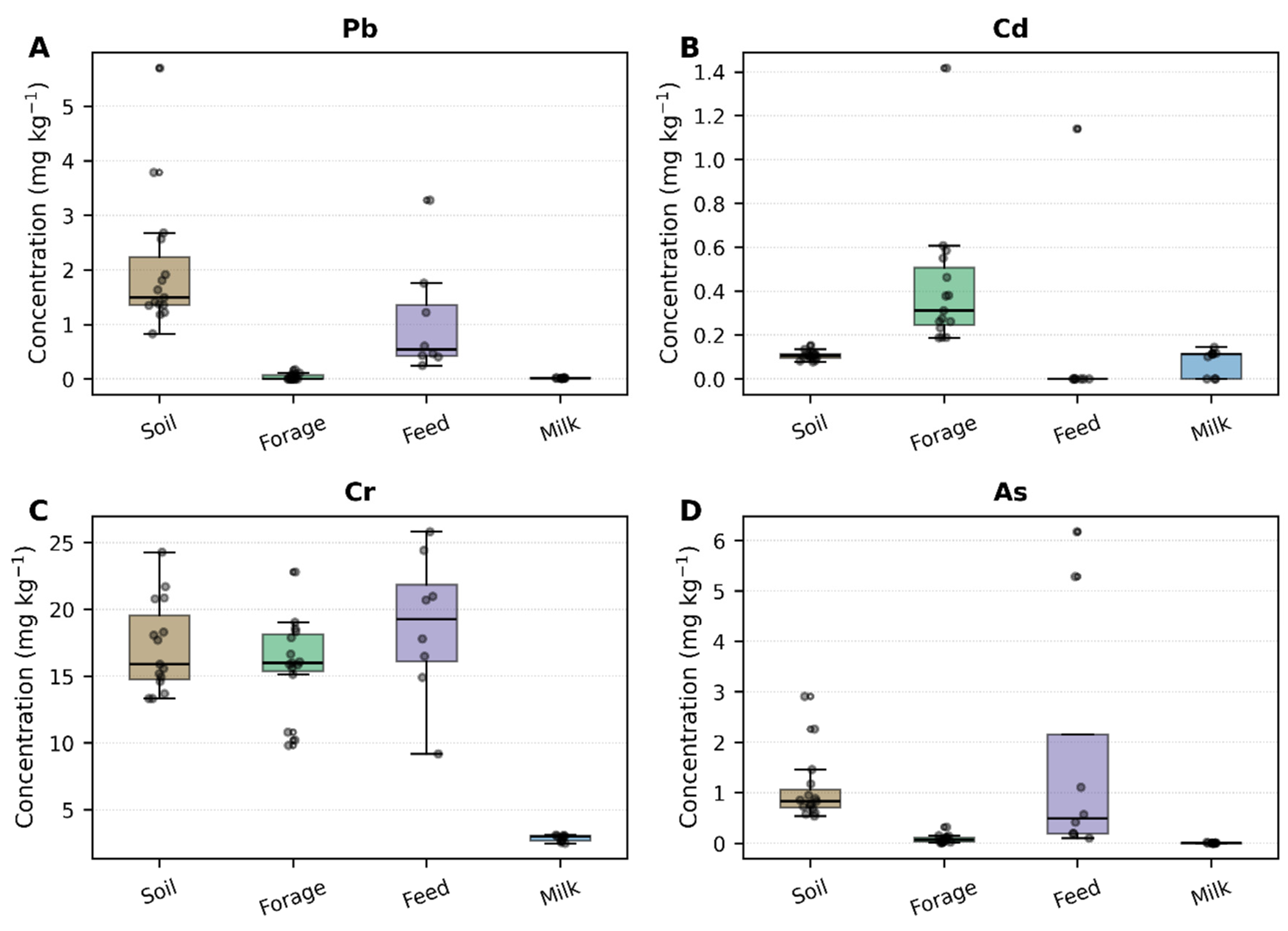
Figure 2.
Transfer and attenuation profiles of Pb, Cd, Cr, and As along the soil–forage–milk pathway. Median concentrations are shown for soil, forage, and milk. Feed is represented as an external dietary exposure matrix. Error bars indicate interquartile dispersion. Soil, forage, and feed concentrations are expressed in mg kg−1, whereas milk concentrations are expressed in mg L−1.
Figure 2.
Transfer and attenuation profiles of Pb, Cd, Cr, and As along the soil–forage–milk pathway. Median concentrations are shown for soil, forage, and milk. Feed is represented as an external dietary exposure matrix. Error bars indicate interquartile dispersion. Soil, forage, and feed concentrations are expressed in mg kg−1, whereas milk concentrations are expressed in mg L−1.
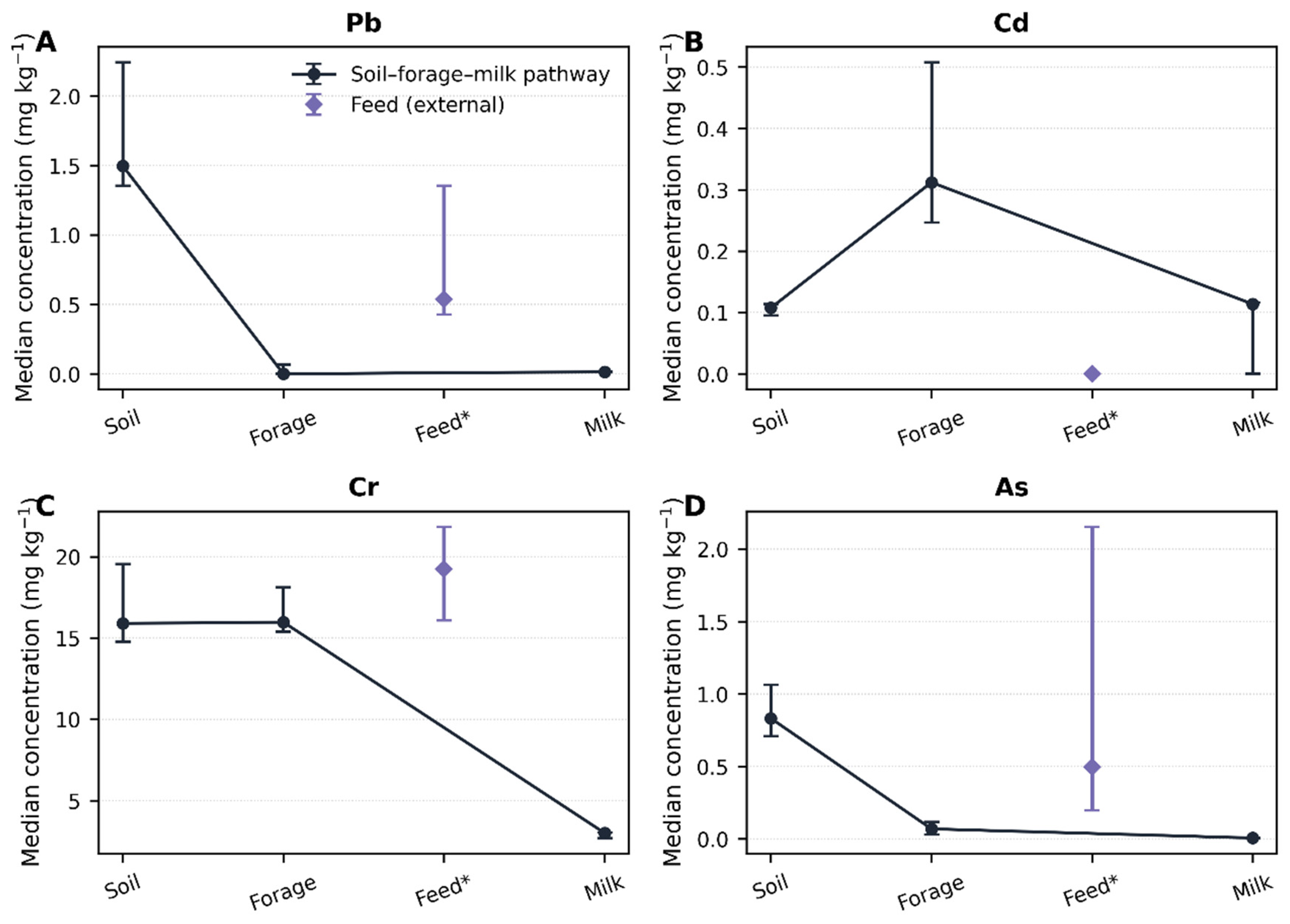
Figure 3.
Principal component analysis (PCA). (a) PCA of soil physicochemical variables. (b) PCA of milk variables. The percentages on the axes correspond to the variance explained by each principal component.
Figure 3.
Principal component analysis (PCA). (a) PCA of soil physicochemical variables. (b) PCA of milk variables. The percentages on the axes correspond to the variance explained by each principal component.
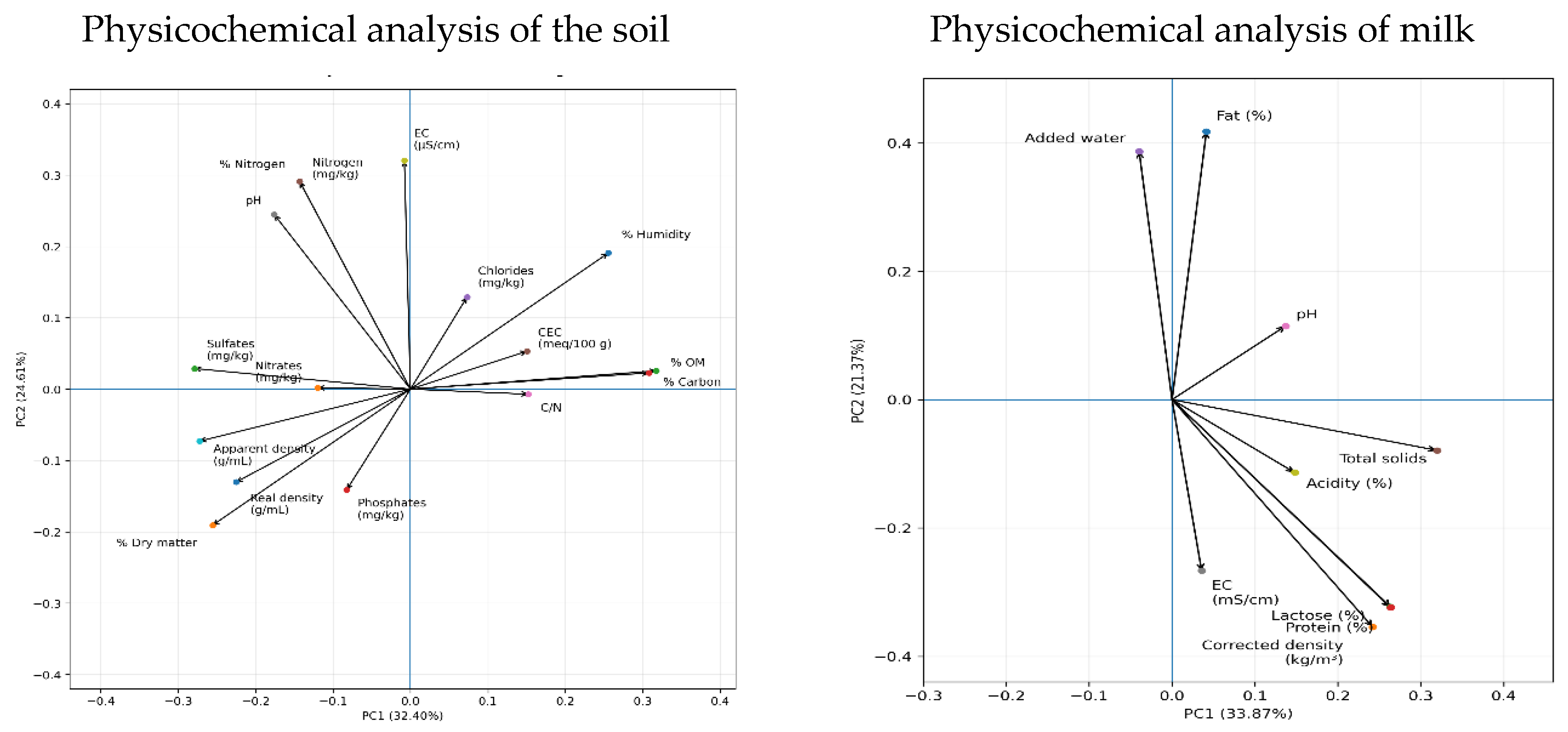
Figure 4.
Presents the Spearman correlation heatmap between the concentrations of Pb, Cd, Cr, and As in milk and the physicochemical quality parameters of the same matrix. Unlike the previous analyses, which focused on the distribution of metals across environmental and exposure matrices, this section examines whether the presence of heavy metals in the final dairy product was associated with changes in milk composition. In general terms, the correlations did not demonstrate a uniform pattern for all metals. Instead, metal-specific associations were observed, suggesting that the relationship between heavy metal occurrence and milk quality depends on the chemical behaviour of each element and on the compositional characteristics of the milk matrix. This interpretation is relevant because milk is not only a final product for consumption, but also a complex biological matrix in which contaminants may interact differently with proteins, fat, lactose, minerals, and total solids [48,49].
Figure 4.
Presents the Spearman correlation heatmap between the concentrations of Pb, Cd, Cr, and As in milk and the physicochemical quality parameters of the same matrix. Unlike the previous analyses, which focused on the distribution of metals across environmental and exposure matrices, this section examines whether the presence of heavy metals in the final dairy product was associated with changes in milk composition. In general terms, the correlations did not demonstrate a uniform pattern for all metals. Instead, metal-specific associations were observed, suggesting that the relationship between heavy metal occurrence and milk quality depends on the chemical behaviour of each element and on the compositional characteristics of the milk matrix. This interpretation is relevant because milk is not only a final product for consumption, but also a complex biological matrix in which contaminants may interact differently with proteins, fat, lactose, minerals, and total solids [48,49].
Disclaimer/Publisher’s Note: The statements, opinions and data contained in all publications are solely those of the individual author(s) and contributor(s) and not of MDPI and/or the editor(s). MDPI and/or the editor(s) disclaim responsibility for any injury to people or property resulting from any ideas, methods, instructions or products referred to in the content. |
© 2026 by the authors. Licensee MDPI, Basel, Switzerland. This article is an open access article distributed under the terms and conditions of the Creative Commons Attribution (CC BY) license.
Copyright: This open access article is published under a Creative Commons CC BY 4.0 license, which permit the free download, distribution, and reuse, provided that the author and preprint are cited in any reuse.


