
Submitted:
10 July 2026
Posted:
13 July 2026
You are already at the latest version
Abstract
Background: Adolescence is a critical developmental stage during which preventive mental healthcare interventions may strengthen psychological resources and reduce vulnerability. School-based mental health promotion programmes delivered by mental health nurses have emerged as promising strategies to improve adolescents' well-being. This pilot study evaluated the effectiveness of the Brilho da Mente Program in promoting Positive Mental Health (PMH), hope, reducing psychological vulnerability, and decreasing mental health stigma among adolescents. Methods: A quasi-experimental pilot study with a pre-test/post-test design was conducted with a convenience sample of 91 Portuguese adolescents enrolled in the 8th and 9th grades. Participants were allocated by classroom clusters to an intervention group (n = 71) or a comparison group (n = 20). The intervention consisted of an eight-session school-based PMH programme delivered by specialist mental health nurses during Citizenship classes. Outcomes were assessed using the Positive Mental Health Questionnaire (PMHQ), the Psychological Vulnerability Scale (PVS), the Attribution Questionnaire (AQ-8-C), and the Hope Thermometer. Paired-samples t-tests and Pearson's correlation analyses were performed. Results: Participants presented high baseline levels of Positive Mental Health. Following the intervention, hope significantly increased (p = 0.03), whereas psychological vulnerability significantly decreased (p < 0.05). Although improvements in overall PMH and reductions in mental health stigma were observed, these changes did not reach statistical significance. Positive Mental Health was moderately and negatively correlated with psychological vulnerability (r = −0.629, p < 0.001). Conclusions: The Brilho da Mente Program showed promising effects in strengthening adolescents' psychological resources, particularly hope and psychological vulnerability. These findings support the potential contribution of school-based mental health nursing interventions to improving preventive healthcare services for adolescents, although larger controlled studies with long-term follow-up are required.
Keywords:
adolescents
; positive mental health
; mental health nursing
; school health services
; mental health promotion
; hope
; psychological vulnerability
; stigma
; mental health literacy
1. Introduction
Adolescence is a critical developmental period characterised by profound biological, psychological, and social changes that shape mental health trajectories across the life course. During this stage, adolescents undergo rapid neurodevelopment while facing increasing academic demands, evolving peer relationships, identity formation, and greater autonomy, all of which may influence their psychological well-being (Sawyer et al., 2018; Patton et al., 2016). Although most adolescents experience healthy development, this period is also marked by increased vulnerability to emotional distress and the onset of mental disorders, with approximately half of all mental health conditions emerging before the age of 18 and most before the age of 25 (Kessler et al., 2005; World Health Organisation, 2021). Consequently, adolescence represents a crucial window for implementing evidence and school-based mental health promotion and prevention strategies (World Health Organisation [WHO] & United Nations Educational, Scientific and Cultural Organisation [UNESCO], 2021). Strengthening preventive healthcare services for adolescents through evidence-based school interventions has become a global public health priority because schools provide equitable access to large populations of young people before mental health disorders become established (Barry et al., 2019; WHO & UNESCO, 2021).
Positive Mental Health is increasingly recognised as a protective health outcome and an essential component of person-centred preventive healthcare rather than merely the absence of mental illness (Lluch, 2008; WHO, 2021). Promoting Positive Mental Health (PMH) during adolescence is increasingly recognised as a public health priority because it contributes to healthy development, resilience, adaptive functioning, and improved quality of life (Shahraki-Mohammadi et al., 2022). Although adolescence is generally considered a healthy life stage, approximately half of all mental disorders begin before the age of 14 years, highlighting the importance of preventive interventions during this developmental period (Patalay & Gage, 2019).
Positive Mental Health extends beyond the absence of mental illness and refers to an individual's capacity to function optimally while maintaining emotional, psychological, and social well-being. According to Lluch's Multifactorial Model, PMH comprises six interrelated dimensions: Personal Satisfaction, Prosocial Attitude, Self-control, Autonomy, Problem-solving and Self-actualisation, and Interpersonal Relationship Skills (Lluch-Canut, 1999; Lluch, 2008). Higher levels of PMH have consistently been associated with greater resilience, better academic performance, stronger interpersonal relationships, increased creativity and productivity, healthier lifestyles, and greater life satisfaction (Ahrnberg et al., 2021; Nobre et al., 2023). Conversely, exposure to developmental challenges and psychosocial stressors may compromise adolescents' mental well-being and increase psychological vulnerability (Ahrnberg et al., 2021; Bjørnsen et al., 2019; Lam, 2014; Nobre et al., 2022).
Psychological vulnerability is particularly relevant during adolescence because maladaptive cognitive schemas established during this developmental period may persist into adulthood, increasing the lifetime risk of emotional disorders (Lam, 2014; Satici, 2016). Psychological vulnerability represents a cognitive predisposition characterised by excessive dependence on external validation, perfectionistic beliefs, self-criticism, and rigid cognitive schemas that increase susceptibility to psychological distress when facing adversity.
Higher levels of psychological vulnerability have been associated with anxiety, depressive symptoms, reduced resilience, and poorer psychological adjustment. Consequently, strengthening protective factors through school-based mental health promotion programmes may reduce adolescents' vulnerability while enhancing their psychological resources.
Another important determinant of adolescent mental health is mental health-related stigma. Stigmatising beliefs contribute to discrimination, social exclusion, delayed help-seeking, and poorer mental health outcomes among young people. Reducing stigma is therefore recognised as a central objective of school-based mental health promotion initiatives, contributing to more supportive school environments and facilitating early access to mental healthcare.
Schools provide an ideal setting for implementing universal mental health promotion programmes because they reach young people during a crucial developmental stage while facilitating the acquisition of socio-emotional competencies within their daily educational environment. Mental Health Literacy (MHL) programmes have demonstrated positive effects on adolescents' knowledge, attitudes, emotional well-being, coping skills, self-esteem, and help-seeking behaviours (Barry et al., 2013; Bjørnsen et al., 2019; Ma et al., 2023; Horne et al., 2024; Wei et al., 2013). Beyond improving knowledge about mental health, these interventions contribute to reducing stigma and promoting Positive Mental Health by strengthening emotional competencies and resilience (Alves, 2018; International Council of Nurses, 2019; Nogueira et al., 2023; Özbıçakçı & Salkim, 2024; Shahraki-Mohammadi et al., 2022). Nevertheless, despite increasing international recognition of their effectiveness, school-based PMH programmes remain insufficiently implemented, and evidence regarding their impact on broader indicators of positive mental health, hope, stigma, and psychological vulnerability remains limited.
Hope is recognised as a fundamental psychological resource that supports adolescents' emotional well-being, resilience, and adaptive coping when facing developmental challenges. Rather than representing simple optimism, hope is a multidimensional construct involving positive expectations about the future, goal-directed thinking, and the perceived ability to identify pathways to achieve personal goals (Bryce et al., 2020; Laranjeira & Querido, 2022). Higher levels of hope have consistently been associated with better mental health, greater life satisfaction, psychological well-being, resilience, and lower levels of emotional distress among adolescents and young adults (Jiang et al., 2018; Satici, 2016; Satici & Uysal, 2016).
Hope has increasingly been recognised as a protective factor that strengthens adolescents' capacity to cope with adversity while reducing the impact of psychological vulnerability. School-based mental health promotion programmes that encourage self-efficacy, emotional regulation, problem-solving, and realistic goal setting may contribute to strengthening hope and fostering positive psychological development (Bryce et al., 2020; Laranjeira & Querido, 2022). In clinical nursing practice, hope-enhancing interventions include providing accurate information, facilitating self-understanding, encouraging active participation in self-care, promoting cognitive reframing, supporting meaningful interpersonal relationships, and facilitating social connectedness (Niebieszczanski, 2005). Although these principles originate from mental health nursing, they are equally applicable to universal mental health promotion programmes implemented within educational settings.
International organisations have consistently recognised childhood and adolescence as priority periods for mental health promotion. The World Health Organisation has emphasised the importance of implementing school-based programmes that promote emotional well-being, prevent violence and bullying, strengthen resilience, and reduce the risk of future mental disorders (WHO & UNESCO, 2021). Similarly, the Portuguese National Mental Health Plan highlights schools as strategic settings for promoting mental health and preventing psychosocial problems during childhood and adolescence.
Specialist Mental Health and Psychiatric Nurses are strategically positioned to design, implement, and evaluate school-based preventive interventions that promote psychological well-being before the onset of mental disorders. Their competencies extend beyond clinical care to include health promotion, psychoeducation, resilience-building, stigma reduction, and the strengthening of adolescents' psychological resources (International Council of Nurses, 2021; Sequeira & Sampaio, 2020; Dias et al., 2020). Such interventions are consistent with a preventive and health-promoting approach, focusing on empowering adolescents before the onset of mental disorders.
Despite increasing evidence supporting school-based mental health promotion programmes, few studies have simultaneously evaluated their effects on Positive Mental Health, hope, psychological vulnerability, and stigma within a nursing-led preventive healthcare framework. This pilot study, therefore, aimed to evaluate the effectiveness of the Brilho da Mente Program in improving Positive Mental Health, hope, stigma, and psychological vulnerability among Portuguese adolescents attending lower secondary schools. We hypothesised that adolescents receiving the Brilho da Mente Program would demonstrate higher Positive Mental Health and hope, together with lower psychological vulnerability and stigma following the intervention.
2. Methods
2.1. Study Design and Participants
This pilot quasi-experimental
study followed the Transparent Reporting of Evaluations with Non-randomised
Designs (TREND) recommendations and employed a pre-test/post-test design with
an intervention group and a non-equivalent comparison group
The study was conducted with a non-probabilistic convenience sample of 91 (see Figure 1, Flow diagram of participant recruitment in section results). Portuguese adolescents enrolled in the 8th and 9th grades of public schools in the northern region of Portugal. Data collection and intervention procedures were carried out during the school year from November 2021 to March 2022. Participants were allocated to classroom clusters. Four classes were randomly selected to comprise the experimental group, whereas one 9th-grade class was randomly selected as the control group. All students and their legal guardians provided written informed consent before participation. Students who declined participation were not assessed, although they remained present during the educational sessions.
2.2. Intervention: Positive Mental Health Promotion Program
The Positive Mental Health Promotion Program (PMHPP), originally developed by Olga Ribeiro, was subsequently adapted for adolescents by Alves (2018), while preserving its theoretical foundations and core components.
The program aims to enhance mental health literacy and strengthen socio-emotional competencies associated with Positive Mental Health. Intervention fidelity was ensured through the use of a standardised programme manual, and delivery by Mental Health and Psychiatric Nursing specialists trained in the Brilho da Mente Program, during regular Citizenship classes over eight consecutive weeks (Ribeiro, 2010; Alves, 2018). Each session lasted approximately 45 minutes and followed a structured format that included presentation of objectives, interactive activities, and group discussion.

Table 1.
Structure of the Brilho da Mente Program sessions.
| Session | Main content |
|---|---|
| 1 | Program presentation, mental health promotion concepts, and baseline assessment (M0) |
| 2 | Self-concept and strategies for its development |
| 3 | Self-esteem enhancement strategies |
| 4 | Assertive communication, active listening, and empathy |
| 5 | Conflict resolution and decision-making skills |
| 6 | Tolerance and diversity |
| 7 | Emotional expression and stress reduction |
| 8 | Program closure and post-intervention assessment (M1) |
2.3. Data Collection
Data were collected during school hours, at two time points: baseline (M0), before the intervention, and post-intervention (M1), immediately after completion of the eight-session PMHPP program. Participants completed an online self-administered questionnaire under the supervision of the principal investigator. The average completion time was approximately 17–19 minutes. To assess the clarity and comprehensibility of the questionnaire, a pilot pre-test was conducted with eight adolescents from the target population before the main study. The control group completed the same assessment protocol at the corresponding evaluation period of the experimental group, but did not receive the intervention.
2.4. Outcome Measures
Positive Mental Health Questionnaire (PMHQ). Positive Mental Health was assessed using the Portuguese version of the PMHQ (Sequeira et al., 2014). The instrument contains 39 items distributed across six dimensions: Personal Satisfaction, Prosocial Attitude, Self-control, Autonomy, Problem-solving and Personal Achievement, and Interpersonal Relationship Skills. Items are rated on a 4-point Likert scale, yielding total scores ranging from 39 to 156, with higher scores indicating better Positive Mental Health. The Portuguese version demonstrated excellent internal consistency (Cronbach’s α = 0.92) and strong test–retest reliability (Sequeira et al., 2014).
Hope Thermometer. Hope was measured using the Hope Thermometer (Fonseca, 2012; Querido & Charepe, 2016), a single-item instrument rated on a 10-point scale, with higher scores indicating greater perceived hope.
Attribution Questionnaire (AQ-8-C). Mental health stigma was assessed using the Portuguese adolescent version of the AQ-8-C (Corrigan et al., 2003; Sousa et al., 2008). The instrument comprises eight items rated on a 9-point Likert scale, with higher scores reflecting greater stigmatising attitudes.
Psychological Vulnerability Scale (PVS). Psychological vulnerability was evaluated using the Portuguese version of the PVS (Nogueira et al., 2017). The scale consists of six items assessing maladaptive cognitive characteristics such as perfectionism, dependence on external approval, and negative self-appraisal. Items are rated on a 5-point Likert scale, producing total scores between 6 and 30, with higher scores indicating greater psychological vulnerability. The Portuguese version showed adequate internal consistency (Cronbach’s α = 0.73) and excellent test–retest reliability (r = .88) (Portuguese validation study).
2.5. Statistical Analysis
Data were analysed using IBM SPSS Statistics version 24 (IBM Corp., Armonk, NY, USA). Descriptive statistics were used to characterise the sample, including frequencies and percentages for categorical variables and means with standard deviations for continuous variables. Internal consistency of the instruments was assessed using Cronbach's alpha coefficients. Normality of continuous variables was assessed using the Shapiro–Wilk test before inferential analyses. Baseline differences between groups were examined using independent-samples t-tests for continuous variables and chi-square tests for categorical variables, when appropriate. Changes between baseline (M0) and post-intervention (M1) within the intervention group were analysed using independent-samples t-tests, as the samples differed between assessment points. Statistical significance was established at p < .05. Effect sizes (Cohen's d) were calculated to facilitate interpretation of the magnitude of the observed differences. According to Cohen's criteria, effect sizes of 0.20, 0.50, and 0.80 were interpreted as small, medium, and large, respectively. Pearson's correlation coefficient was used to explore associations among Positive Mental Health, hope, stigma, and psychological vulnerability. Questionnaires with more than 10% missing data on any scale were excluded from analysis.
2.6. Ethical Considerations
The study was conducted in accordance with the principles of the Declaration of Helsinki and the Oviedo Convention. Ethical approval was obtained from the Ethics Committee of ESECVP–Alto Tâmega (UI&D 04/2021-ESECVP-AT) on 27 April 2021, and authorisation was granted by the boards of the participating educational institutions.
Written informed consent was obtained from all adolescents and their legal guardians before participation. Participants were informed about the study objectives, the voluntary nature of participation, confidentiality procedures, and their right to withdraw at any time without consequences. All data were collected and analysed in anonymised form.
3. Results
3.1. Participants' Characteristics
A total of 91 adolescents were recruited, including 71 allocated to the intervention group and 20 to the comparison group (Figure 1). At baseline, 69 participants from the intervention group completed the assessment because two students were absent on the day of data collection. These students completed the post-intervention assessment, resulting in 71 completed questionnaires at M1. The comparison group completed the baseline assessment only because post-intervention data collection could not be rescheduled owing to school logistical constraints.
Participants 13. 97 years (SD = 2.5), were predominantly Portuguese (97.2%), and slightly more than half were male (57.7%). Most participants attended the 9th grade (54.9%). Baseline demographic and lifestyle characteristics are presented in Table 2.
3.2. Positive Mental Health
Baseline Positive Mental Health levels were high, with 67.8% of adolescents classified as flourishing according to the PMHQ scoring system, 31.6% presenting intermediate levels, and only one participant (0.6%) classified as having low Positive Mental Health. Following the intervention, the overall PMHQ score increased slightly from 118.3 (SD = 14.8) to 118.7 (SD = 15.6). Small improvements were observed in the Personal Satisfaction, Self-control, and Autonomy dimensions, whereas Prosocial Attitude, Problem-solving and Personal Achievement, and Interpersonal Relationship Skills showed slight decreases. However, none of these changes reached statistical significance (Table 3).
3.3. Hope
Hope significantly increased following the intervention, with mean scores rising from 8.00 (SD = 2.58) to 8.51 (SD = 1.69) (p = 0.030), although the magnitude of the effect was small (d = 0.23). Baseline hope scores were lower in the comparison group (5.80 ± 2.50), suggesting lower perceived psychological resources before the intervention.
3.4. Stigma Towards Mental Illness
Mean AQ-8-C scores decreased slightly after the intervention (25.6 vs. 24.9), indicating a tendency towards lower mental health stigma. However, this difference was not statistically significant (p = 0.510).
3.5. Psychological Vulnerability
Psychological vulnerability decreased significantly following the intervention (p < 0.05), with a small effect size (d = −0.18). Lower scores indicate reduced cognitive vulnerability, suggesting that the intervention may have contributed to strengthening adolescents' psychological resilience.
3.6. Correlation Between Positive Mental Health And Psychological Vulnerability
Pearson correlation analysis demonstrated a strong negative association between overall Positive Mental Health and psychological vulnerability (r = −0.629, p < 0.001). Large negative correlations were observed for Personal Satisfaction, Self-control, and Autonomy, whereas a moderate negative correlation was found for Problem-solving and Personal Achievement.
Interpersonal Relationship Skills showed a small negative correlation, and Prosocial Attitude was not significantly associated with psychological vulnerability (Table 4).
4. Discussion
This pilot quasi-experimental study evaluated the effectiveness of a school-based Mental Health Promotion Programme delivered by specialist Mental Health and Psychiatric Nurses. Overall, the findings suggest that the Brilho da Mente Program contributed to strengthening important psychological resources among adolescents, particularly hope and psychological vulnerability, while maintaining high levels of Positive Mental Health throughout the intervention period.
Participants reported predominantly healthy lifestyle behaviours, including adequate sleep duration, regular physical activity, daily consumption of fruit and vegetables, and low rates of tobacco and alcohol use, corroborating previous findings (Alves, 2018; Jayasinghe & Hills, 2023). As expected, friends and family were identified as the adolescents' main sources of emotional support, highlighting the importance of interpersonal relationships during this developmental stage (Garcia & Sequeira, 2016).
Although no statistically significant improvements were observed in overall Positive Mental Health, these findings should be interpreted cautiously. Participants already presented high baseline PMHQ scores, with more than two-thirds classified as flourishing. This suggests a possible ceiling effect, whereby limited room for improvement reduces the likelihood of detecting statistically significant gains despite clinically meaningful changes. Similar findings have been reported in recent school-based mental health promotion studies involving adolescents with relatively high baseline well-being (Nobre et al., 2023; Jayasinghe Hills, 2023).
Hope emerged as the outcome showing the clearest improvement following the intervention. Hope is increasingly recognised as a central psychological resource supporting resilience, adaptive coping, academic engagement, and emotional well-being throughout adolescence (Bryce et al., 2020; Laranjeira & Querido, 2022). Recent evidence further suggests that hope mediates the relationship between psychological resources and mental well-being, reinforcing its importance as a target for preventive interventions (Shahraki-Mohammadi et al., 2022; Horne et al., 2024).
The significant reduction observed in psychological vulnerability suggests that the intervention may have contributed to modifying maladaptive cognitive schemas associated with dependence on external validation, perfectionism, and self-criticism. These findings are particularly relevant because psychological vulnerability has consistently been associated with anxiety, depression, and poorer psychological adjustment during adolescence (Lam, 2014; Satici, 2016).
Although mental health stigma decreased slightly, statistical significance was not achieved. Nevertheless, even modest reductions may be clinically relevant because repeated exposure to mental health literacy programmes may progressively change adolescents' attitudes towards mental illness over time (Ma et al., 2023; Horne et al., 2024). These findings reinforce the potential value of mental health promotion programmes delivered in school settings.
The moderate negative correlation between Positive Mental Health and psychological vulnerability reinforces the theoretical assumption that strengthening positive psychological resources may protect adolescents against maladaptive cognitive patterns associated with future mental health problems. Adolescents with higher levels of positive mental health tended to report lower psychological vulnerability, supporting the theoretical assumption that positive mental health acts as a protective factor against maladaptive cognitive patterns and emotional distress. This finding is consistent with previous literature highlighting the reciprocal relationship between psychological resources and positive mental health (Garcia & Sequeira, 2016; Sequeira et al., 2019).
These findings reinforce the important contribution of specialist Mental Health and Psychiatric Nurses to preventive healthcare services delivered in school settings. Nursing-led interventions extend beyond mental health literacy by strengthening resilience, emotional regulation, hope, and adaptive coping, thereby supporting adolescents before the onset of mental disorders. Such interventions align with international recommendations advocating integrated school-based mental healthcare services for children and adolescents (WHO & UNESCO, 2021).
Several limitations should be acknowledged. First, the pilot design and relatively small convenience sample limit external validity. Second, the comparison group completed only the baseline assessment, precluding robust between-group longitudinal analyses. Third, all outcomes relied on self-report instruments, increasing the possibility of social desirability bias. Finally, the absence of long-term follow-up prevented evaluation of the sustainability of programme effects. Future randomised controlled trials with larger samples and repeated follow-up assessments are warranted.
5. Conclusions
The Brilho da Mente Program demonstrated promising potential as a school-based mental health promotion intervention delivered by specialist Mental Health and Psychiatric Nurses. Although improvements in overall Positive Mental Health were modest, significant gains in hope and reductions in psychological vulnerability suggest that the programme strengthened important protective psychological resources among adolescents.
These findings support the integration of structured mental health promotion programmes into school healthcare services as part of comprehensive preventive strategies targeting vulnerable adolescent populations. Nursing-led interventions may contribute to strengthening resilience, promoting emotional well-being, and reducing future demand for specialised mental healthcare.
Future research should include larger randomised controlled trials with long-term follow-up to determine programme effectiveness and identify the mechanisms through which Positive Mental Health interventions influence adolescent mental health outcomes.
References
- Ahrnberg, H.; Appelqvist-Schmidlechner, K.; Mustonen, P.; Fröjd, S.; Aktan-Collan, K. Determinants of Positive Mental Health in Adolescents–A Cross-Sectional Study on Relationships between Positive Mental Health, Self-Esteem, Character Strengths and Social Inclusion. International Journal of Mental Health Promotion 2021, 23(3), 361–374. [Google Scholar] [CrossRef]
- Alves, S. P. Criação e validação de um programa promotor de saúde mental positiva em adolescentes [Creation and validation of a program to promote positive mental health in adolescents; Porto Higher School of Nursing, 2018. [Google Scholar]
- Barry, M. M.; Clarke, A. M.; Jenkins, R.; Patel, V. A systematic review of the effectiveness of mental health promotion interventions for young people in low and middle-income countries. BMC Public Health 2013, 13(1). [Google Scholar] [CrossRef] [PubMed]
- Barry, M. M.; Clarke, A. M.; Petersen, I.; Jenkins, R. Promotion of Mental Health and Prevention of Mental Disorders. In Oxford Textbook of Public Mental Health; Oxford University Press, 2019. [Google Scholar] [CrossRef]
- Berger, E.; Jamshidi, N.; Reupert, A.; Jobson, L.; Miko, A. Review: The mental health implications for children and adolescents impacted by infectious outbreaks – a systematic review. Child and Adolescent Mental Health 2021, 26(2), 157–166. [Google Scholar] [CrossRef] [PubMed]
- Bersia, M.; Charrier, L.; Berchialla, P.; Cosma, A.; Comoretto, R. I.; Dalmasso, P. The Mental Well-Being of Italian Adolescents in the Last Decade through the Lens of the Dual Factor Model. Children 2022, 9(12), 1981. [Google Scholar] [CrossRef] [PubMed]
- Bjørnsen, H. N.; Espnes, G. A.; Eilertsen, M.-E. B.; Ringdal, R.; Moksnes, U. K. The Relationship Between Positive Mental Health Literacy and Mental Well-Being Among Adolescents: Implications for School Health Services. The Journal of School Nursing 2019, 35(2), 107–116. [Google Scholar] [CrossRef] [PubMed]
- Bryce, C. I.; Alexander, B. L.; Fraser, A. M.; Fabes, R. A. Dimensions of hope in adolescence: Relations to academic functioning and well-being. Psychology in the Schools 2020, 57(2), 171–190. [Google Scholar] [CrossRef]
- Corrigan, P.; Markowitz, F.; Watson, A.; Rowan, D.; Kubiak, M. An attribution model of public discrimination towards persons with mental illness. Journal of Health and Social Behavior 2003, 44(2), 162–179. [Google Scholar] [CrossRef]
- Dias, C.; Valentim, O.; Seabra, P.; Nogueira, M. J. Intervenções promotoras de esperança em enfermagem de saúde mental e psiquiátrica – uma scoping review. Revista Portuguesa de Enfermagem de Saúde Mental 2020, 7. [Google Scholar] [CrossRef]
- Ferreira, P.; Varanda, M.; Nogueira, M. J. Efeitos do Mindfulness na Saúde Mental dos Adolescentes: Uma Scoping Review. Revista Portuguesa de Enfermagem de Saúde Mental 2021, 8, 67–72. [Google Scholar]
- Garcia, I. R.; Sequeira, C. A. da C. Saúde mental positiva em adolescentes [ESEP - Escola Superior de Enfermagem do Porto ESEP] 2016.
- Horne, K. L.; Bernes, K. B.; Gunn, T. M.; Balderson, D. Canadian undergraduate students’ mental health literacy and its influence on psychological distress and help-seeking behaviour. International Journal of Mental Health 2024, 1–19. [Google Scholar] [CrossRef]
- International Council of Nurses. Programa Nacional para a Saúde Mental . International Council of Nurses. 2019. Available online: https://www.icn.ch/what-we-do/projects/ehealth-icnptm/icnp-browser.
- Jayasinghe, S.; Hills, A. P. Strategies to improve physical activity and nutrition behaviours in children and adolescents: A review. Nutrients 2023, 15(15), 3370. [Google Scholar] [CrossRef] [PubMed]
- Jiang, X.; Otis, K. L.; Weber, M.; Huebner, E. S. Hope and adolescent mental health. In The Oxford handbook of hope; Gallagher, M. W., Lopez, S. J., Eds.; Oxford University Press, 2018; pp. 299–312. [Google Scholar]
- Kessler, R. C.; Berglund, P.; Demler, O.; Jin, R.; Merikangas, K. R.; Walters, E. E. Lifetime prevalence and age-of-onset distributions of DSM-IV disorders in the National Comorbidity Survey Replication. Archives of General Psychiatry 2005, 62(6), 593–602. [Google Scholar] [CrossRef] [PubMed]
- Kuettel, A.; Pedersen, A. K.; Larsen, C. H. To Flourish or Languish, that is the question: Exploring the mental health profiles of Danish elite athletes. Psychology of Sport and Exercise 2021, 52, 101837. [Google Scholar] [CrossRef]
- Lam, L. T. Mental health literacy and mental health status in adolescents: A population-based survey. Child and Adolescent Psychiatry and Mental Health 2014, 8(1). [Google Scholar] [CrossRef]
- Laranjeira, C. A.; Querido, A. I. F. O modelo multidimensional de esperança como uma prática focada no recovery em enfermagem de saúde mental. Revista Brasileira de Enfermagem 2022, 75. [Google Scholar] [CrossRef] [PubMed]
- Lluch-Canut, T. Construccion De Una Escala Para Evaluar La Salud Mental Positiva.; Universidad de Barcelona: Barcelona, Spain, 1999. [Google Scholar]
- Ma, K. K. Y.; Anderson, J. K.; Burn, A. Review: School-based interventions to improve mental health literacy and reduce mental health stigma – a systematic review. Child and Adolescent Mental Health 2023, 28(2), 230–240. [Google Scholar] [CrossRef] [PubMed]
- Nobre, J.; Arco, H.; Monteiro, F.; Oliveira, A. P.; Ferré-Grau, C.; Sequeira, C. Development of a Proposal for a Program to Promote Positive Mental Health Literacy among Adolescents: A Focus Group Study. International Journal of Environmental Research and Public Health 2023, 20(6), 4898. [Google Scholar] [CrossRef] [PubMed]
- Nobre, J.; Calha, A.; Luis, H.; Oliveira, A. P.; Monteiro, F.; Ferré-Grau, C.; Sequeira, C. Mental Health Literacy and Positive Mental Health in Adolescents: A Correlational Study. International Journal of Environmental Research and Public Health 2022, 19, 8165. [Google Scholar] [CrossRef] [PubMed]
- Nogueira, M. J.; Dias, C.; Alves, P.; Teixeira, D. Promoção da literacia e saúde mental positiva: Estudo quase-experimental com adolescentes em contexto escolar. Revista ROL de Enfermería 2023, 46(Suplemento 03), 34–38. [Google Scholar] [CrossRef]
- Özbıçakçı, Ş.; Salkim, Ö. Ö. The predictors of mental health literacy among adolescents students. Archives of Psychiatric Nursing 2024, 50, 1–4. [Google Scholar] [CrossRef] [PubMed]
- Patalay, P.; Gage, S. H. Changes in millennial adolescent mental health and health-related behaviours over 10 years: a population cohort comparison study. International Journal of Epidemiology 2019, 48(5), 1650–1664. [Google Scholar] [CrossRef] [PubMed]
- Patton, G. C.; Sawyer, S. M.; Santelli, J. S.; et al. Our future: a Lancet commission on adolescent health and wellbeing. The Lancet 2016, 387(10036), 2423–2478. [Google Scholar] [CrossRef] [PubMed]
- Ribeiro, O. M. P. L. Promoção da Saúde Mental Positiva: Desenvolvimento e avaliação de um programa de intervenção em saúde mental. Doctoral dissertation, Universidade do Porto, 2010. [Google Scholar]
- Roldán-Merino, J.; Lluch-Canut, M. T.; Casas, I.; Sanromà-Ortíz, M.; Ferré-Grau, C.; Sequeira, C.; Falcó-Pegueroles, A.; Soares, D.; Puig-Llobet, M. Reliability and validity of the Positive Mental Health Questionnaire in a sample of Spanish university students. Journal of Psychiatric and Mental Health Nursing 2017, 24(2–3), 123–133. [Google Scholar] [CrossRef] [PubMed]
- Sawyer, S. M.; Azzopardi, P. S.; Wickremarathne, D.; Patton, G. C. The age of adolescence. The Lancet Child & Adolescent Health 2018, 2(3), 223–228. [Google Scholar] [CrossRef] [PubMed]
- Rosa, A. G. S. Literacia Em Saúde Mental Em Adolescentes. Desenvolvimento De Um Instrumento De Avaliação. 2018. Available online: https://sigarra.up.pt/icbas/pt/pub_geral.pub_view?pi.
- Satici, S. A. Psychological vulnerability, resilience, and subjective well-being: The mediating role of hope. Personality and Individual Differences 2016, 102. [Google Scholar] [CrossRef]
- Satici, S. A.; Uysal, R. Psychological Vulnerability and Subjective Happiness: The Mediating Role of Hopelessness. Stress and Health 2016, 1–8. [Google Scholar] [CrossRef] [PubMed]
- Sequeira, C.; Carvalho, J. C.; Sampaio, F.; Sá, L.; Lluch-Canut, T.; Roldán-Merino, J. Avaliação das propriedades psicométricas do questionário de saúde mental positiva em estudantes portugueses do ensino superior. Revista Portuguesa de Enfermagem de Saúde Mental 2014, 11, 45–53. [Google Scholar] [CrossRef]
- Sequeira, C.; Sampaio, F. Enfermagem em Saúde Mental; Lidel – Edições Técnicas (org.), L., Ed.; Lidel Enfe, 2020. [Google Scholar]
- Shahraki-Mohammadi, A.; Panahi, S.; Ashouri, A.; Sayarifard, A. Important Systemic Factors for Improving Adolescent Mental Health Literacy. Iranian Journal of Psychiatry 2022, 1–10. [Google Scholar]
- Vidourek, R. A.; Burbage, M. Positive mental health and mental health stigma: A qualitative study assessing student attitudes. Mental Health & Prevention 2019, 13, 1–6. [Google Scholar] [CrossRef]
- Wei, Y.; Hayden, J. A.; Kutcher, S.; Zygmunt, A.; McGrath, P. The effectiveness of school mental health literacy programs to address knowledge, attitudes and help-seeking among youth. Early Intervention in Psychiatry 2013, 7(2), 109–121. [Google Scholar] [CrossRef] [PubMed]
- World Health Organisation. Guidance on community mental health services: Promoting person-centred and rights-based approaches. 2021. Available online: https://www.who.int/publications/i/item/9789240025707.
- World Health Organisation; United Nations Educational; Scientific and Cultural Organisation. Making every school a health-promoting school: Global standards and indicators for health-promoting schools and systems. In World Health Organisation; 2021; Available online: https://www.who.int/publications/i/item/9789240025059.
Figure 1.
Flow diagram of participant recruitment, allocation, intervention and assessment.
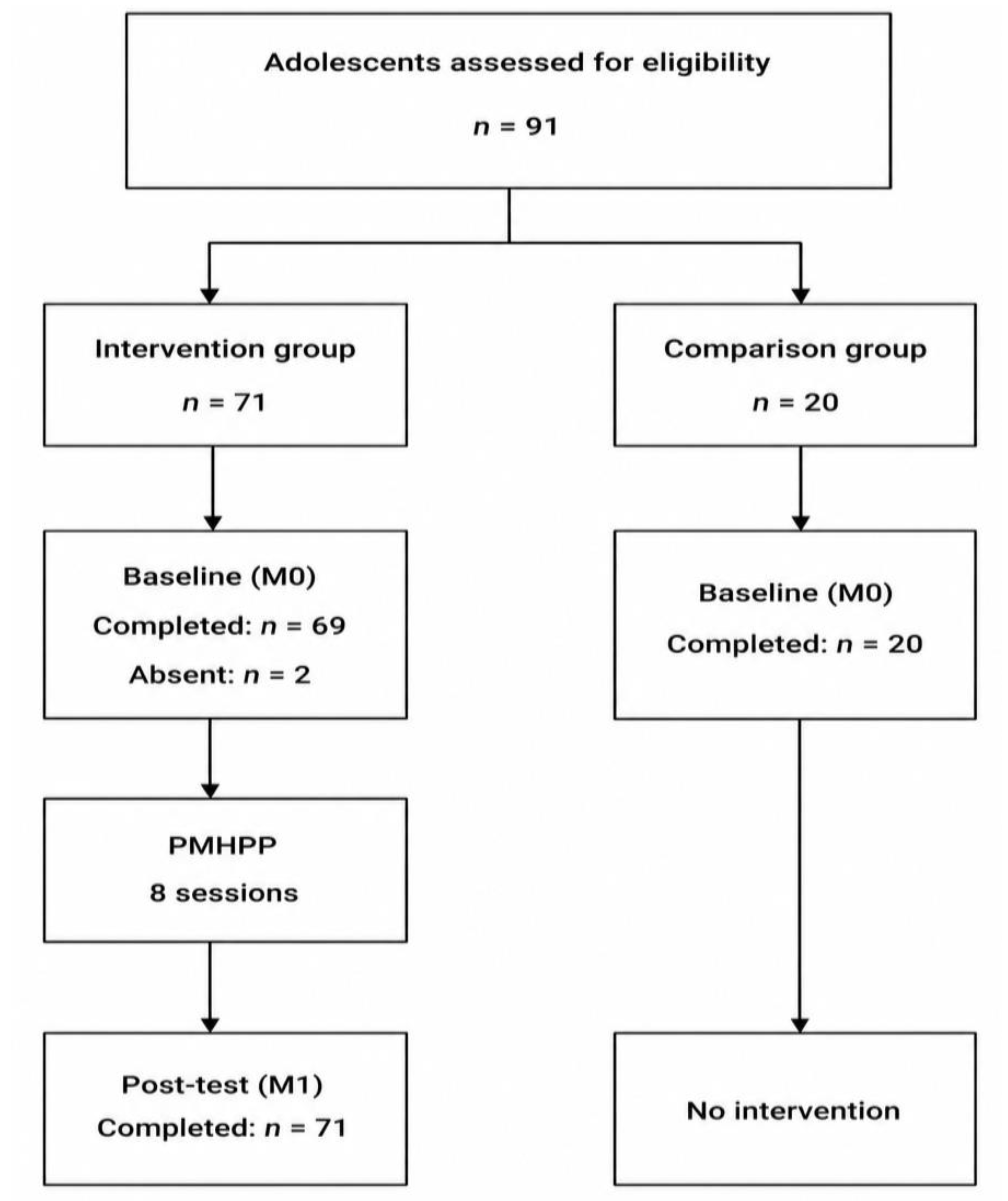
Table 2.
Baseline demographic and lifestyle characteristics of the intervention and comparison groups.
Table 2.
Baseline demographic and lifestyle characteristics of the intervention and comparison groups.
| Characteristic | Intervention Group (n = 69) |
Comparison Group (n = 20) |
|---|---|---|
| Age, years, mean (SD) | 13.97 (2.5) | 14.3 |
| Sex, n (%) | ||
| Male | 38 (55.1) | 9 (45.0) |
| Female | 31 (44.9) | 11 (55.0) |
| Nationality, n (%) | ||
| Portuguese | 65 (94.2) | 20 (100.0) |
| Other nationalities* | 4 (5.8) | 0 |
| School grade, n (%) | ||
| 8th grade | 30 (43.5) | — |
| 9th grade | 39 (56.5) | 20 (100.0) |
| Regular physical exercise, n (%) | ||
| ≥2 times/week | 46 (66.6) | 11 (55.0) |
| No regular exercise | 12 (17.4) | 5 (25.0) |
| Missing/other frequency | 11 (15.9) | 4 (20.0) |
| Adequate sleep duration, n (%) | ||
| Yes | 59 (85.5) | 15 (75.0) |
| No | 10 (14.5) | 5 (25.0) |
| Daily fruit and vegetable consumption, n (%) | ||
| Yes | 63 (91.3) | 14 (70.0) |
| No | 6 (8.7) | 6 (30.0) |
| Smoking, n (%) | ||
| No | 67 (97.1) | 18 (90.0) |
| Yes | 2 (2.9) | 2 (10.0) |
| Alcohol consumption, n (%) | ||
| No | 64 (92.8) | 18 (90.0) |
| Yes | 5 (7.2) | 2 (10.0) |
| Sleeping medication, n (%) | ||
| No | 69 (100.0) | 19 (95.0) |
| Yes | 0 | 1 (5.0) |
| *Other nationalities included Brazilian (n = 1), Canadian (n = 1), Senegalese (n = 1), and American (n = 1); SD, standard deviation. | ||
Table 3.
Positive Mental Health, Hope, Stigma and Psychological Vulnerability, comparisons between before (M0) and after (M1) the intervention.
Table 3.
Positive Mental Health, Hope, Stigma and Psychological Vulnerability, comparisons between before (M0) and after (M1) the intervention.
| Outcome | Intervention M0 Mean (SD) N=69 |
Intervention M1 Mean (SD) N=71 |
Comparison Group Mean (SD) n=20 | p-value | Cohen's d |
|---|---|---|---|---|---|
| PMHQ Total | 118.3 (14.8) | 118.7 (15.6) | 112.3 (15.0) | 0.421 | 0.03 |
| F1 Personal Satisfaction | 26.1 (5.2) | 26.3 (5.1) | 18.8 (3.4) | - | 0.04 |
| F2 Prosocial Attitude | 17.4 (2.0) | 17.3 (2.4) | 15.5 (2.4) | - | −0.08 |
| F3 Self-control | 15.0 (3.0) | 15.4 (3.4) | 14.2 (3.1) | - | 0.13 |
| F4 Autonomy | 15.0 (3.1) | 15.6 (3.4) | 12.4 (2.6) | - | 0.19 |
| F5 Problem-solving and Personal Achievement | 28.8 (4.1) | 28.3 (4.1) | 27.1 (4.6) | - | −0.12 |
| F6 Interpersonal Relationship Skills | 19.9 (2.2) | 19.1 (2.6) | 16.7 (3.2) | - | −0.34 |
| Hope Thermometer | 8.00 (2.58) | 8.51 (1.69) | 5.80 (2.50) | 0.030 | 0.23 |
| AQ-8-C Total | 25.6 (5.2) | 24.9 (5.1) | 25.4 (5.2) | 0.510 | −0.14 |
| PVS Total | 15.2 (5.5) | 14.2 (5.5) | 15.3 (5.4) | <0.05 | −0.18 |
Note.p-values refer to the intervention group; Effect sizes (Cohen's d) were calculated using pooled standard deviations. According to Cohen's criteria, values of 0.20, 0.50 and 0.80 indicate small, medium and large effects, respectively.
Table 4.
Pearson's correlations between PMHQ dimensions and PVS.
| PMHQ Dimension | Pearson's r | p value |
|---|---|---|
| F1. Personal Satisfaction | −0.637 | <0.001 |
| F2. Prosocial Attitude | −0.120 | 0.320 |
| F3. Self-control | −0.549 | <0.001 |
| F4. Autonomy | −0.562 | <0.001 |
| F5. Problem-solving and Personal Achievement | −0.464 | <0.001 |
| F6. Interpersonal Relationship Skills | −0.294 | 0.013 |
| Total PMHQ | −0.629 | <0.001 |
Note. PMHQ = Positive Mental Health Questionnaire; PVS = Psychological Vulnerability Scale. Correlation strength was interpreted according to Cohen (1988): small (|r| ≥ 0.10), moderate (|r| ≥ 0.30), and large (|r| ≥ 0.50).
Disclaimer/Publisher’s Note: The statements, opinions and data contained in all publications are solely those of the individual author(s) and contributor(s) and not of MDPI and/or the editor(s). MDPI and/or the editor(s) disclaim responsibility for any injury to people or property resulting from any ideas, methods, instructions or products referred to in the content. |
© 2026 by the authors. Licensee MDPI, Basel, Switzerland. This article is an open access article distributed under the terms and conditions of the Creative Commons Attribution (CC BY) license (http://creativecommons.org/licenses/by/4.0/).
Copyright: This open access article is published under a Creative Commons CC BY 4.0 license, which permit the free download, distribution, and reuse, provided that the author and preprint are cited in any reuse.


