
Submitted:
10 July 2026
Posted:
13 July 2026
You are already at the latest version
Abstract
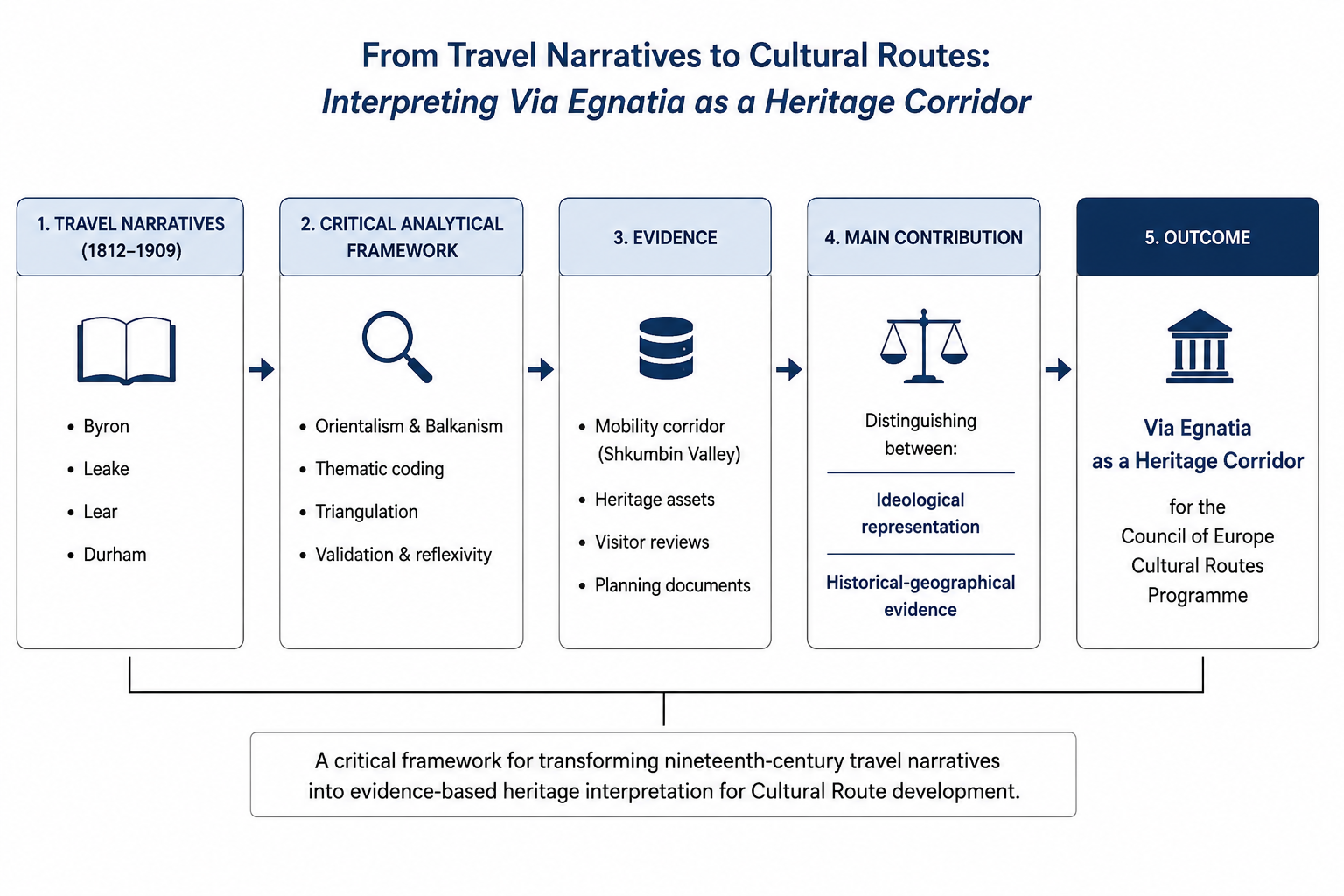
Cultural Routes have become important instruments for promoting shared heritage and sustainable tourism across Europe, yet the potential of travel literature to inform their development remains underexplored, particularly in the case of Via Egnatia. This study addresses this gap by developing a theoretical distinction between travel narratives as ideological representation, shaped by colonial and Orientalist discourse, and as corroborable historical-geographical evidence, and applying this framework to nineteenth-century accounts by Byron, Leake, Lear, and Durham (1812–1909). Using a qualitative, theory-informed case-study design, the study combines critical-discourse analysis with thematic coding of 127 narrative references, supported by a documented codebook, an intra-coder reliability check (84% agreement), and cross-author triangulation. The analysis identifies a corroborated mobility corridor along the Shkumbin Valley and recurring intercultural contact points, consistent with independent archaeological scholarship. A site-level cross-check of six heritage assets and associated visitor reviews shows that formal heritage protection already exists along the corridor, but that on-site interpretation rarely presents it as part of a coherent Via Egnatia narrative, a gap confirmed by an analysis of Albania’s national tourism-planning documents. The study’s principal contribution is theoretical: it shows how critically read travel narratives can extend destination-storytelling and heritage-interpretation theory beyond descriptive associations, while offering a transferable, low-cost model for translating narrative and empirical evidence into interpretive practice for the Council of Europe Cultural Routes Programme.
Keywords:
Via Egnatia
; travel literature
; cultural routes
; heritage interpretation
; orientalism
; destination storytelling
; Albania
1. Introduction
Cultural heritage has become an increasingly important resource for tourism development, particularly in destinations seeking to diversify their tourism products while promoting sustainable development and intercultural dialogue. Within this context, the Cultural Routes of the Council of Europe provide a framework for connecting places through shared historical experiences and transnational heritage networks. Despite its rich cultural legacy, Albania remains comparatively underrepresented within this network. Among its most significant yet underutilized heritage assets is the ancient Via Egnatia, a Roman route linking the Adriatic coast with Constantinople that represents centuries of mobility, exchange, and cultural interaction.
Travel literature has long been recognized as an important source for understanding destination image and the cultural construction of place (Pratt, 1992; Thompson, 2011; Youngs, 2013). At the same time, research on Cultural Routes has focused primarily on historical connectivity, heritage management, and certification processes (Berti, 2015; Council of Europe, 2024). However, limited attention has been given to the potential of critically interpreted travel narratives as resources for heritage interpretation and route development. Rather than treating travel accounts as straightforward historical evidence, this study argues that they should be understood as historically situated discourses whose ideological dimensions must be distinguished from the historical-geographical information they contain.
Against this background, the study examines how nineteenth-century travel narratives by Byron, Leake, Lear, and Durham contribute to interpreting Via Egnatia as a prospective Cultural Route. Using a qualitative, theory-informed case-study approach, it develops a framework that separates colonial-era representation from corroborable historical-geographical evidence and explores how this distinction can enrich heritage interpretation, destination storytelling, and Cultural Route planning. In doing so, the study contributes to a more critical understanding of the relationship between travel literature and heritage practice while highlighting the interpretive potential of Via Egnatia within the broader framework of European Cultural Routes.
2. Theoretical Background and Literature Review
2.1. Cultural Tourism, Heritage and Sustainable Development
Cultural tourism has become one of the most significant and rapidly expanding sectors of the global tourism industry, reflecting a growing demand for experiences that enable visitors to engage with the historical, cultural, and social dimensions of destinations. According to Richards (2018), cultural tourism has evolved beyond the consumption of heritage attractions toward more participatory, experience-oriented forms of engagement. Timothy and Boyd (2020) argue that heritage tourism represents one of the primary mechanisms through which societies transform historical and cultural assets into tourism resources, although the growing commercialisation of heritage has generated debates concerning authenticity and commodification (Cohen, 1988). Ashworth et al. (2007) emphasize that heritage is not a fixed reality but a socially constructed process through which societies select, interpret, and present elements of the past.
Contemporary heritage studies increasingly recognize that cultural heritage extends beyond monuments to include intangible practices and cultural memory. Smith (2006) introduced the concept of the Authorized Heritage Discourse, arguing that heritage should be understood through the meanings attributed to places by communities and visitors, not only through officially recognised sites. UNESCO (2023) and UNWTO (2022) emphasize that cultural heritage can contribute to sustainable development when managed responsibly; storytelling and interpretation play a crucial role in this process, since heritage resources acquire value through the narratives that connect them to broader cultural meanings (Graham et al., 2016).
2.2. Cultural Routes of the Council of Europe: Heritage Beyond Borders
The Cultural Routes of the Council of Europe constitute one of the most established transnational heritage initiatives in Europe, established in 1987 with the certification of the Santiago de Compostela Pilgrim Routes. Rather than focusing on individual monuments, the initiative promotes a transnational understanding of heritage emphasizing historical connections, mobility, and shared European values (Council of Europe, 2024). According to Berti (2015), Cultural Routes are dynamic networks connecting tangible and intangible heritage through common historical themes, fostering intercultural dialogue and regional cooperation. To be certified, a route must represent shared European values and involve cooperation among at least three countries, contributing to research, cultural exchange, heritage preservation, and sustainable tourism (Council of Europe, 2024).
Via Egnatia connected territories that today belong to several European countries and facilitated centuries of trade, migration, and mobility, corresponding closely to the principles of transnationality and shared heritage underlying the Cultural Routes Programme. However, existing scholarship on Via Egnatia has concentrated on its archaeological and infrastructural significance (Lolos, 2007), leaving its narrative dimension comparatively unexamined. This gap motivates the present study’s focus on travel literature as a complementary interpretive resource.
2.3. Travel Literature and the Construction of Cultural Landscapes
Travel literature occupies a distinctive position within literary studies, cultural geography, heritage studies, and tourism research. Contemporary scholarship recognizes that travel narratives do not simply document places; they actively participate in the production of cultural meanings and spatial imaginaries (Pratt, 1992; Thompson, 2011). Pratt’s (1992) concept of the contact zone describes the social and cultural spaces where travelers and local populations encounter one another and negotiate cultural meaning; through this lens, travel narratives become records of cultural interaction and representation rather than neutral description. Thompson (2011) similarly argues that travel writers select, organize, and interpret experience, transforming physical environments into meaningful and contestable narratives. Youngs (2013) emphasizes that travel narratives contribute to the social construction of destinations by shaping collective perceptions, expectations, and destination image, a process closely related to, but theoretically distinct from, the question of how such narratives might later be mobilized for route interpretation.
2.4. Reading Travel Narratives Critically: Colonial Discourse, Orientalism, and the Balkans
The nineteenth-century travel narratives examined in this study were produced within broader Western traditions of colonial and Orientalist representation. Said (1978) argues that Western writing frequently constructed the East as culturally different and inferior, while Pratt (1992) demonstrates that travel writing functioned as a form of discursive authority through which travellers interpreted and represented foreign societies. Extending this perspective to the Balkans, Todorova (1997) introduces the concept of Balkanism, highlighting how the region was simultaneously portrayed as European and peripheral, often through narratives of exoticism, backwardness, and historical incompleteness. These perspectives provide the critical framework through which the present study interprets nineteenth-century representations of Albania.
Read through this lens, the narratives of Byron, Leake, Lear, and Durham reflect different but complementary modes of representation. Byron romanticizes Albanian identity through the image of the noble yet untamed frontier; Leake approaches the region from a strategic and topographical perspective shaped by military and geographical interests; Lear frames Albania through picturesque aesthetic conventions; and Durham offers detailed ethnographic observations while remaining influenced by the comparative assumptions of her historical context. Although differing in genre and purpose, all four narratives combine descriptive observation with culturally situated interpretation.
These representational patterns are directly traceable in the primary texts. Byron (1812) invokes Albania as “thou rugged nurse of savage men,” a Romantic noble-savage formulation that aestheticizes the population as an object of poetic wonder rather than political agency. Leake (1835) explains local character as a product of “the meanness, lying, and cowardice of the people” living under Ottoman rule, a moralizing judgment that reads culture through the lens of a strategic, governance-focused gaze. Lear (1851) frames the country through a picturesque duality of “liberty, hard living, and filth on the other,” treating hardship as a source of visual and literary interest rather than a lived condition to be explained. Durham (1909), despite a more sustained ethnographic engagement, still describes highland life in evolutionary terms as reflecting “conditions of life… of prehistoric barbarism,” even as she elsewhere cautions readers against dismissing the same customs as merely those of “savages.” Read together, these four extracts show that Orientalist and Balkanist framing (Said, 1978; Todorova, 1997) operates at the level of specific word choice and rhetorical structure in each narrative, and not only as a general interpretive lens applied to the corpus after the fact.
Accordingly, this study distinguishes between two analytical dimensions of travel writing: its ideological function as a historical discourse shaped by colonial and Orientalist perspectives, and its evidentiary value as a source of geographically corroborable information. Only those descriptions that can be supported through cross-author comparison and independent historical evidence are treated as contributing to the interpretation of Via Egnatia as a heritage corridor. This distinction represents the study’s principal theoretical contribution, positioning travel literature not as a transparent historical record but as a critically interpreted resource capable of enriching heritage interpretation and destination storytelling.
3. Materials and Methods
3.1. Research Design
This study uses a qualitative, single-case, theory-informed design to examine what travel literature can contribute to interpreting Via Egnatia as a cultural heritage corridor. It sits within an interpretative-critical research paradigm, combining two concerns: how cultural landscapes and routes are represented through narrative, and a critical-discourse reading that treats the travel accounts as historically and ideologically situated texts rather than as neutral evidence (Said, 1978; Pratt, 1992). Via Egnatia was chosen as the case for two reasons: its historical role as a mobility corridor linking the Adriatic region to the eastern Mediterranean, and its potential relevance to the Council of Europe Cultural Routes Programme.
3.2. Data Sources and Selection Criteria
The research is based on documentary analysis of travel narratives, academic literature, and official publications related to cultural heritage, Cultural Routes, and tourism development. The primary corpus consists of travel narratives by Lord Byron (1812), William Martin Leake (1835), Edward Lear (1851), and Mary Edith Durham (1909). These four authors were selected using three explicit criteria: (i) their works contain substantial, geographically locatable descriptions of Albanian territories along or near the historical alignment of Via Egnatia; (ii) they span more than a century of Western travel writing about the region (1812–1909), allowing comparison of how representational conventions persisted or shifted over time; and (iii) collectively, their works represent the principal genres of nineteenth-century travel writing relevant to this study — Romantic verse-travelogue (Byron), military-topographical survey (Leake), picturesque-artistic travelogue (Lear), and ethnographic travel writing (Durham) — providing deliberate variation in authorial position rather than a convenience sample of four well-known names. Other candidate sources considered and excluded included later, secondary, or non-Albania-focused Balkan travelogues, which did not meet the geographical-relevance criterion.

Table 1.
Corpus of travel narratives included in the analysis, with explicit selection rationale.
| Author | Work | Year | Genre / Authorial Position | Analytical Relevance |
| Lord Byron | Childe Harold’s Pilgrimage | 1812 | Romantic verse-travelogue | Early European representations of Albanian landscapes and identity |
| William Martin Leake | Travels in Northern Greece | 1835 | Military-topographical survey | Observations of routes, settlements, and regional connectivity |
| Edward Lear | Journals of a Landscape Painter in Albania | 1851 | Picturesque-artistic travelogue | Descriptions of landscapes, mobility corridors, and cultural environments |
| Mary Edith Durham | High Albania | 1909 | Ethnographic travel writing | Documentation of traditions, local communities, and cultural heritage |
In addition to the travel narratives, the study consulted academic literature on cultural tourism, heritage interpretation, Cultural Routes, postcolonial and Orientalist theory, and policy documents issued by the Council of Europe and related heritage institutions.
Policy documents were consulted to assess the applicability of the interpretive framework within current Cultural Route and tourism-planning contexts. A third, more recent addition to the data set responds directly to the need for stronger empirical grounding. In July 2026, the study compiled a documentary site inventory of six heritage assets located along the narrative-identified corridor between Durrës and Lake Ohrid, using institutional sources (UNESCO World Heritage documentation, Albania’s heritage-protection literature) and recent archaeological and heritage-tourism publications to establish each site’s current protection status. For the same six sites, the study also collected a small, unobtrusive sample of publicly available visitor reviews (five reviews per site, accessed via Google Places in July 2026) as a secondary, non-random indicator of how each site is currently experienced and interpreted by visitors. This is not a substitute for a structured visitor-perception survey, and it is treated accordingly in the analysis: it is used only to describe recurring, observable patterns in existing on-site interpretation, not to generalise about visitor attitudes.
3.3. Data Analysis: Coding Process, Reflexivity, and Validation
The material was analysed using thematic content analysis, following Braun and Clarke’s (2006) six-phase method, adapted here for documentary heritage research. Coding combined two components: a deductive component, using categories drawn from the literature on Cultural Routes, heritage interpretation, and colonial/Orientalist discourse (Pratt, 1992; Said, 1978; Berti, 2015); and an inductive component, allowing further categories to emerge directly from the texts during open coding.
Coding proceeded in four stages. Stage one was a full, uncoded reading of each narrative. This built contextual familiarity and produced initial reflexive notes on each author’s position and likely bias. Stage two applied open coding line-by-line to passages describing landscapes, settlements, mobility, and cultural encounters, as well as explicit or implicit representational framing (for example, aestheticisation, moralising description, or comparison to a European norm); each code was logged in a codebook with a working definition and at least one illustrative excerpt. Stage three grouped codes into broader thematic categories through constant comparison across the four texts; categories were revised twice as new excerpts complicated the initial groupings. Stage four cross-checked the four resulting themes against the critical framework set out in Section 2.4: each coded reference was tagged not only by theme, but also by whether it functioned primarily as ideological representation, as corroborable historical-geographical evidence, or as both.
Because this is a two-author qualitative study, formal inter-rater reliability statistics (e.g., Cohen’s kappa) were not calculated. Instead, analytical consistency was strengthened through collaborative coding and discussion. To enhance the trustworthiness of the analysis, three validation procedures were implemented. First, a definitional codebook was produced and applied consistently, with each theme accompanied by inclusion and exclusion criteria and at least three illustrative excerpts, allowing the coding logic to be audited rather than taken on trust. Second, an intra-coder consistency check was performed: approximately 15% of coded excerpts (19 of 127) were re-coded after a two-week interval without reference to the original codes, yielding 84% agreement with the original coding; disagreements were resolved by refining two category definitions that had been applied inconsistently. Third, triangulation across the four narratives was used as a substantive validity check for the historical-geographical claims specifically: a location or mobility pattern reported in only one narrative was treated as suggestive, while a pattern corroborated across two or more independent authors, and consistent with non-narrative historical sources on Via Egnatia (Lolos, 2007; Curta, 2019), was treated as more robust evidence.
Reflexivity was treated as an explicit part of the analytical process rather than a closing disclaimer. The researcher’s positionality as an Albanian scholar analyzing foreign travelers’ representations of Albania shaped the analysis in identifiable ways: it motivated the critical framework adopted in Section 2.4, since the corpus consists entirely of accounts by outsiders writing about the researcher’s own national context, and it created an analytic incentive to read the narratives charitably as evidence of historical connectivity. To manage this, the coding stage explicitly separated the ideological and evidentiary readings described above, and excerpts supporting a positive historical-geographical claim about Via Egnatia were required to meet the cross-author triangulation criterion described in the previous paragraph rather than being accepted on the strength of a single evocative passage.
3.4. Site Inventory and Unobtrusive Visitor-Review Content Analysis
The site inventory and review analysis were conducted in three steps. First, six heritage assets were selected because each is directly and verifiably associated with the historical alignment of Via Egnatia documented in Section 4.2: the Durrës Amphitheatre area at the corridor’s western end; the Fortress of Bashtëvë, overlooking the mouth of the Shkumbin River; the Roman mutatio (rest station) known as Ad Quintum, near Bradashesh; Elbasan Castle, built on the site of the Roman Skampis; a small guesthouse named “Agroturizëm Via Egnatia” near Peqin, close to a surviving stretch of Roman paving; and the Lin peninsula’s Palaeochristian basilica remains, at the corridor’s eastern end near Lake Ohrid. Second, each site’s protection status was verified against institutional and academic sources: the Durrës Amphitheatre and the Fortress of Bashtëvë both appear on Albania’s UNESCO Tentative List; the Lin peninsula was incorporated into the UNESCO-inscribed Natural and Cultural Heritage of the Ohrid Region in 2019 and separately recognised by Albanian authorities as an Urban Architectural Ensemble; Elbasan’s historic core, including the castle walls, forms a protected monument complex. Third, for each site, five publicly available Google reviews were read and coded for recurring references to (a) explicit mention of Via Egnatia or the site’s role in the historical route, and (b) the presence or absence of on-site interpretive material such as signage, guiding, or digital content. Coding followed the same inclusion/exclusion logic described in Section 3.3, applied by a single coder given the small sample size; findings are reported descriptively in Section 4.4 rather than as statistically representative results.
3.5. Research Limitations
This study is based primarily on documentary analysis, complemented by a small unobtrusive review of publicly available visitor feedback. Consequently, while the findings demonstrate the interpretive potential of nineteenth-century travel narratives for the heritage interpretation of Via Egnatia, they do not evaluate how this approach is currently implemented by heritage institutions or experienced by visitors. Similarly, the site-level cross-check provides preliminary evidence of an interpretive gap along the corridor but should not be regarded as representative of visitor perceptions more broadly.
Future research should extend the proposed framework through primary empirical investigation, including stakeholder interviews, visitor studies, and spatial analyses of heritage assets and tourism infrastructure. Such research would allow the interpretive model developed here to be evaluated in practice and would further clarify its contribution to the future development of Via Egnatia within the Cultural Routes framework.
4. Results
The coding process identified 127 narrative references, distributed across four thematic categories shown in Table 2. To reduce repetition relative to the original analysis, the findings are presented here in three consolidated themes rather than four overlapping subsections: (4.1) travel literature as a critically-read repository of heritage representation; (4.2) mobility, connectivity, and the geography of Via Egnatia; and (4.3) the implications of these findings for route-interpretation practice. Each theme integrates material previously distributed across separate results subsections and tables.
4.1. Travel Literature as a Repository of Heritage Representation: A Critical Reading
The four narratives construct Albania through distinct yet complementary representational lenses. Byron romanticizes Albanian identity, Leake emphasizes strategic geography and mobility, Lear adopts picturesque conventions, while Durham foregrounds ethnographic observation. Together, they illustrate recurring Orientalist and Balkanist patterns discussed in Section 2.4. Beyond these ideological representations, the analysis identifies a more robust and recurring pattern. Across all four narratives, independently of each author’s perspective, there is consistent documentation of settlements, mobility corridors, and sites of intercultural contact associated with the Via Egnatia corridor. Rather than relying on the authority of any individual traveler, the study treats this cross-author convergence as the principal evidence supporting the historical-geographical interpretation developed in the following sections.
4.2. Mobility, Connectivity, and the Geography of Via Egnatia
The strongest and most consistently triangulated finding concerns mobility and connectivity. Leake’s (1835) and Lear’s (1851) accounts both document the Shkumbin Valley corridor linking Durrës, Elbasan, and the inland passages toward Lake Ohrid — territory that corresponds closely to the historical alignment of Via Egnatia and is independently corroborated by archaeological and historical scholarship on the route (Lolos, 2007; Curta, 2019). Durham’s (1909) accounts of mobility between communities, and Byron’s (1812) journey narrative itself, both implicitly traverse the same corridor. Cross-author convergence indicates that the Shkumbin Valley functioned as a recurrent mobility corridor consistent with archaeological evidence.
Beyond this corridor-level finding, the narratives document recurring points of intercultural contact — markets, religiously mixed settlements, and overnight stopping points — that are consistent with the kind of contact zone described by Pratt (1992), though here understood literally as well as discursively: these were sites where travelers, traders, and local populations actually interacted. This is the dimension of the findings most directly relevant to a Cultural Route framework, since Council of Europe certification criteria emphasize historical connectivity and intercultural exchange specifically (Council of Europe, 2024).
4.3. Implications for Route-Interpretation Practice
Taken together, the critical reading in Section 4.1 and the triangulated geographical findings in Section 4.2 suggest a specific, non-generic implication for how travel literature could be used in route interpretation, rather than the previously broader claim that it ‘supports heritage interpretation’ in general. The findings suggest three practical interpretive functions (Table 3): identifying interpretive nodes along the corridor, using travel narratives as critically contextualized interpretive material, and employing diachronic comparison as a destination-storytelling device.
4.4. Site-Level Cross-Check: Heritage Protection Status and Visitor-Facing Interpretation
Table 4 summarises the site-level cross-check described in Section 3.4. Two patterns are relevant to the study’s central claim. First, formal heritage protection is already in place at several nodes along the corridor: two of the six sites sit on Albania’s UNESCO Tentative List, and a third is part of an active UNESCO World Heritage property. This confirms that the corridor is not an obscure or undocumented landscape, but one that already carries recognised heritage value at the level of individual sites (Figure 1). Second, and more directly relevant to the study’s argument, on-site interpretation is fragmented and inconsistent: only the Ad Quintum site and the guesthouse near Peqin show any visitor-facing reference to Via Egnatia specifically, while reviews at the remaining four sites describe minimal, absent, or hard-to-find interpretive material, with no mention of the wider route. This is consistent with, and adds a site-level empirical layer to, the documentary planning-gap finding reported in Section 5.3: individual heritage assets along the corridor are protected and visited, but they are not currently interpreted as parts of a single Via Egnatia narrative.
These findings should be read with the same caution as any small, non-random secondary sample: five reviews per site cannot establish how most visitors experience these places, and review platforms over-represent certain visitor profiles (international, digitally engaged travellers). What the cross-check does establish, on a verifiable and reproducible basis, is that the interpretive gap identified through documentary analysis in Section 5.3 is also observable, in a preliminary way, at the level of individual sites and existing visitors — narrowing, though not closing, the empirical gap noted in the study’s limitations.
5. Discussion
5.1. Theoretical Contribution
The central theoretical contribution of this study is the distinction, developed in Section 2.4 and applied throughout the findings, between travel narratives as ideological representation and travel narratives as triangulable historical-geographical evidence. Existing literary-tourism and destination-image scholarship (Pratt, 1992; Thompson, 2011; Youngs, 2013) has established that travel writing actively constructs destination meaning; what this study adds is a method for separating that constructive, ideological function from a more modest evidentiary function, and for showing that only the latter can responsibly be mobilized as supporting material for route identification. This reframes the relationship between travel literature and heritage-interpretation theory: rather than positioning travel literature as a ready-made repository of usable narrative content, as much of the existing literature implies, the study positions it as a discourse that must itself be interpreted — and whose colonial framing can become part of the interpretive content offered to visitors, extending destination-storytelling theory toward what might be termed reflexive or critical destination storytelling.
This contribution also extends Cultural Routes scholarship. While the Council of Europe framework emphasizes connectivity and shared values (Berti, 2015; Council of Europe, 2024), the present study argues that the historical sources used to establish such connectivity are not ideologically neutral. Distinguishing representation from corroborable evidence therefore provides a more critically grounded basis for heritage interpretation and route planning.
5.2. Mobility, Connectivity, and Via Egnatia’s Heritage Geography
The triangulated finding that four independent travel writers, across nearly a century, document the same Shkumbin Valley corridor provides modest but genuine support for Via Egnatia’s continued function as a corridor of regional mobility into the modern period. This finding is consistent with, rather than a substitute for, the existing archaeological and historical literature on the route (Lolos, 2007; Curta, 2019), and the study does not claim to establish continuity of the Roman route through narrative evidence alone.
5.3. Implications for Via Egnatia’s Positioning within the Cultural Routes Programme
The findings indicate that Via Egnatia already possesses several characteristics commonly associated with Cultural Route certification, including historical continuity, transnational significance, and documented intercultural exchange (Council of Europe, 2024). The analysis suggests that travel literature could support this positioning specifically through the critical-storytelling function identified in Section 4.3, rather than through generic claims that ‘narrative supports heritage’.
Table 5 demonstrates that the principal themes identified through the thematic analysis correspond closely with the core principles of the Council of Europe Cultural Routes Programme. Historical continuity, intercultural exchange, transnational significance, and educational value emerge consistently across the analyzed narratives. At the same time, the comparison reveals a clear implementation gap: although these characteristics are well documented in both historical narratives and policy frameworks, they have not yet been translated into a coherent heritage interpretation strategy or an officially recognised Cultural Route. This comparison therefore strengthens the practical relevance of the proposed framework and demonstrates how narrative evidence can complement existing heritage planning.
Albania’s own destination-planning instruments show a parallel gap at the national level. The National Tourism Strategy 2024–2030, developed by the Ministry of Tourism and Environment with GIZ support, organizes the country into six tourism clusters and places Elbasan within the Central Region cluster, oriented primarily around cultural heritage and gastronomy (Ministry of Tourism and Environment, 2025); the preceding National Strategy for Sustainable Tourism Development 2019–2023 similarly lists Elbasan and Durrës among Albania’s organized cultural-tour destinations (Ministry of Tourism and Environment, 2019). Neither document names Via Egnatia as a branded route product, and neither references the Shkumbin Valley corridor identified in Section 4.2 as a discrete heritage-tourism unit. Read alongside the certification gap described above, this indicates that the interpretive potential demonstrated in this study currently exceeds its institutional uptake: the historical-geographical corridor is documented, both by the travel narratives analyzed here and by independent archaeological scholarship (Lolos, 2007), but it is not yet named, branded, or planned for as a Cultural Route at either the European or the national level. This is consistent with the study’s claim that travel literature represents an underutilized resource, and it sharpens that claim into a concrete, checkable gap rather than a general assertion.
5.4. Destination Image and Representation
Consistent with Youngs (2013), the analysis confirms that travel narratives shaped how Albania was imagined by European readers; the contribution here is the explicit demonstration that this image was constructed through identifiable Orientalist and Balkanist conventions (Said, 1978; Todorova, 1997) rather than through neutral observation, with direct implications for how such material should — and should not — be redeployed in contemporary destination branding.
5.5. Sustainable and Critical Cultural Tourism
UNESCO (2023) and UNWTO (2022) emphasize tourism models that balance heritage conservation with social and economic benefit. The critical-storytelling approach developed here aligns with these objectives in a specific way: by making visitors aware of the colonial gaze embedded in the historical record, rather than presenting it uncritically, route interpretation can support a more reflexive and arguably more sustainable form of cultural engagement than narrative use alone would provide.
5.6. Limitations and Future Work
This study is based primarily on documentary analysis, complemented by a small unobtrusive analysis of publicly available visitor reviews. While the findings demonstrate the interpretive potential of nineteenth-century travel narratives for Via Egnatia, they do not establish how this approach is currently implemented by heritage institutions or experienced by visitors. The addition of planning-document analysis (Section 5.3) and the site-level cross-check (Section 4.4) strengthens the empirical grounding of the study by confirming both an institutional and an interpretive gap, but it does not replace primary empirical evidence.
Future research should therefore evaluate the proposed framework through three complementary approaches: (i) interviews with heritage managers and tourism planners to assess its practical applicability; (ii) visitor studies comparing responses to conventional and critically framed narrative interpretation; and (iii) GIS-based spatial analysis integrating narrative-derived locations with heritage and tourism-infrastructure datasets. Together, these approaches would provide the empirical validation needed to assess the framework proposed in this study.
6. Practical Implications
The findings generate several practical implications, framed here around the three functions identified in Section 4.3 rather than as a general list.
First, heritage institutions and interpretation centres could use the corroborated Shkumbin Valley corridor (Section 4.2) to inform the spatial sequencing of interpretive nodes — for example, panels or digital content at Durrës, Elbasan, and points along the route toward Ohrid — rather than treating travel-narrative excerpts as freestanding decorative quotations.
Second, destination management organizations and museums could adopt the critical-storytelling approach proposed in Section 4.3: presenting travelers’ descriptions explicitly alongside information about each author’s position (military surveyor, Romantic poet, painter, ethnographer) and the colonial context of their writing, rather than presenting the quotations as neutral historical color. This both increases the educational value of the material and reduces the risk of uncritically reproducing nineteenth-century stereotypes in present-day tourism marketing.
Third, the diachronic comparison across 1812–1909 offers tour operators and digital heritage developers a concrete narrative device, ‘a century of outsiders’ views of one corridor’ , that could be implemented as a themed trail, app-based audio guide, or temporary exhibition, with comparatively low development cost relative to commissioning entirely new interpretive content.
Fourth, for policy-makers engaged with the Council of Europe Cultural Routes Programme, the documented historical continuity and intercultural exchange along the corridor (Section 5.3) provide supporting material for a future Via Egnatia certification dossier, while the critical framework in Section 2.4 offers a way of presenting that material that is consistent with the Programme’s own emphasis on intercultural dialogue rather than one-directional Western representation of the region.
7. Conclusions
This study examined the contribution of travel literature to the interpretation of Via Egnatia as a cultural heritage corridor, through a critically-framed qualitative analysis of narratives by Byron, Leake, Lear, and Durham. Its principal contribution is theoretical: it distinguishes travel narratives’ ideological function as colonial-era representation from their more limited, but genuine, evidentiary function as triangulable historical-geographical sources, and proposes that the former can itself be mobilized as interpretive content through a critical or reflexive destination-storytelling approach, rather than treated as an obstacle to be set aside. Empirically, the study identifies a cross-author-triangulated mobility corridor along the Shkumbin Valley that is consistent with the historical alignment of Via Egnatia and with independent archaeological scholarship on the route. A site-level cross-check of six heritage assets along this corridor further shows that formal heritage protection is already in place at several points, but that on-site interpretation rarely makes the Via Egnatia connection explicit — narrowing the gap between the study’s textual analysis and observable practice on the ground.
The study is based on documentary analysis of four travel narratives, together with the documentary and unobtrusive secondary evidence reported in Section 4.4 and Section 5.3, and does not include new primary data collected directly from visitors, heritage managers, or spatial planning sources. Section 5.6 sets out a three-strand empirical agenda — stakeholder interviews, visitor-perception testing, and a fuller GIS-based spatial analysis — that would be required to test whether the interpretive approach proposed here is feasible and effective in practice. Within these limits, the study suggests that travel literature, read critically rather than uncritically, can support Via Egnatia’s positioning as a heritage corridor within the Council of Europe Cultural Routes Programme, and offers Albanian heritage institutions a concrete, low-cost interpretive device for doing so. By integrating critical literary interpretation with heritage planning, the framework proposed in this study offers a transferable methodological approach that may also be applied to other historically significant routes beyond the Albanian case.
Author Contributions
Conceptualization, Xh.K. and I.K.; methodology, Xh.K. and I.K.; validation, Xh.K. and I.K.; formal analysis, Xh.K.; investigation, Xh.K.; resources, Xh.K.; data curation, Xh.K.; writing original draft preparation, Xh.K.; writing, review and editing, I.K. and Xh.K.; visualization, Xh.K.; supervision, I.K.; project administration, I.K. &Xh.K. All authors have read and agreed to the published version of the manuscript.
Funding
This research received no external funding.
Institutional Review Board Statement
Not applicable.
Informed Consent Statement
Not applicable.
Data Availability Statement
The data supporting the findings of this study are available from the corresponding author upon reasonable request. Publicly available documentary sources used in this study are cited in the reference list.
Acknowledgments
The authors used generative artificial intelligence (GenAI) solely to improve language, grammar, clarity, and the organization of the manuscript. No AI tools were used to generate research data, conduct analyses, interpret results, or formulate the scientific conclusions. The authors take full responsibility for the accuracy, originality, and integrity of the content presented in this manuscript.
Conflicts of Interest
The authors declare no conflict of interest. The funders had no role in the design of the study; in the collection, analyses, or interpretation of data; in the writing of the manuscript; or in the decision to publish the results.
References
- (Apostolakis, 2003) Apostolakis, A. (2003). The convergence process in heritage tourism. Annals of Tourism Research, 30(4), 795–812. [CrossRef]
- (Ashworth et al., 2007) Ashworth, G. J., Graham, B., & Tunbridge, J. E. (2007). Pluralising pasts: Heritage, identity and place in multicultural societies. Pluto Press.
- (Berti, 2015) Berti, E. (2015). Defining the Cultural Routes of the Council of Europe. European Institute of Cultural Routes.
- (Braun & Clarke, 2006) Braun, V., & Clarke, V. (2006). Using thematic analysis in psychology. Qualitative Research in Psychology, 3(2), 77–101. [CrossRef]
- (Busby & Klug, 2001) Busby, G., & Klug, J. (2001). Movie-induced tourism: The challenge of measurement and other issues. Journal of Vacation Marketing, 7(4), 316–332. [CrossRef]
- (Byron, 1812) Byron, G. G. (1812). Childe Harold’s pilgrimage. John Murray.
- (Cohen, 1988) Cohen, E. (1988). Authenticity and commoditization in tourism. Annals of Tourism Research, 15(3), 371–386.
- (Council of Europe, 2024) Council of Europe. (2024). Cultural Routes of the Council of Europe Programme.
- (Council of Europe, 2024) Council of Europe. (2024). Enlarged Partial Agreement on Cultural Routes (EPA).
- (Council of Europe, 2026) Council of Europe. (2026). Albania – Cultural Routes of the Council of Europe.
- (Curta, 2019) Curta, F. (2019). Eastern Europe in the Middle Ages (500–1300). Brill. https://brill.com/.
- (Durham, 1909) Durham, M. E. (1909). High Albania. Edward Arnold.
- (Georganteli, 2016) Georganteli, E. (2016). The Via Egnatia: The archaeology of a European Cultural Route (Marie Curie IOF Final Report). European Commission, CORDIS.
- (Google, 2026) Google. (2026). Google Reviews: Durrës Amphitheatre, Fortress of Bashtëvë, Ad Quintum, Elbasan Castle, Agroturizëm Via Egnatia, and Lin Peninsula.
- (Graham et al., 2016) Graham, B., Ashworth, G. J., & Tunbridge, J. E. (2016). A geography of heritage: Power, culture and economy. Routledge. https://www.routledge.com/A-Geography-of-Heritage-Power-Culture-and-Economy/Graham-Ashworth-Tunbridge/p/book/9780340763032.
- (Hall & Page, 2021) Hall, C. M., & Page, S. J. (2021). The geography of tourism and recreation: Environment, place and space (5th ed.). Routledge.
- (Hendrix, 2008) Hendrix, H. (Ed.). (2008). Writers, museums and literary tourism. Ashgate. https://www.routledge.com/Writers-Museums-and-Literary-Tourism/Hendrix/p/book/9780754663850.
- (Herbert, 2001) Herbert, D. T. (2001). Literary places, tourism and the heritage experience. Annals of Tourism Research, 28(2), 312–333. [CrossRef]
- (ICOMOS, 2022) ICOMOS. (2022). ICOMOS International Charter for Cultural Heritage Tourism (2022): Reinforcing cultural heritage protection and community resilience through responsible and sustainable tourism management. ICOMOS. https://www.icomos.org/images/DOCUMENTS/Secretariat/2023/CSI/eng-franc_ICHTCharter.pdf.
- (Leake, 1835) Leake, W. M. (1835). Travels in Northern Greece. J. Rodwell.
- (Lear, 1851) Lear, E. (1851). Journals of a landscape painter in Albania, &c. Richard Bentley.
- (Lolos, 2007) Lolos, Y. (2007). Via Egnatia after Egnatius: Imperial policy and inter-regional contacts. Mediterranean Historical Review, 22(2), 273–293.
- (MacCannell, 1999) MacCannell, D. (1999). The tourist: A new theory of the leisure class. University of California Press. https://www.ucpress.edu/books/the-tourist/paper.
- (Ministry of Tourism and Environment, Republic of Albania, 2019) Ministry of Tourism and Environment, Republic of Albania. (2019). National strategy for sustainable tourism development 2019–2023. Ministry of Tourism and Environment. https://turizmi.gov.al/wp-content/uploads/2019/12/National-Tourism-Strategy-2019-2023-EN.pdf.
- (Ministry of Tourism and Environment, Republic of Albania, 2025) Ministry of Tourism and Environment, Republic of Albania. (2025). National tourism strategy 2024–2030. Ministry of Tourism and Environment, with GIZ. https://www.gstc.org/ministry-of-tourism-and-environment-of-albania-joins-and-signs-mou-with-gstc/.
- (Nuryanti, 1996) Nuryanti, W. (1996). Heritage and postmodern tourism. Annals of Tourism Research, 23(2), 249–260. [CrossRef]
- (Pratt, 1992) Pratt, M. L. (1992). Imperial eyes: Travel writing and transculturation. Routledge.
- (Richards, 2018) Richards, G. (2018). Cultural tourism: A review of recent research and trends. Journal of Hospitality and Tourism Management, 36, 12–21. [CrossRef]
- (Richards, 2021) Richards, G. (2021). Rethinking cultural tourism. Edward Elgar Publishing. https://www.e-elgar.com/shop/gbp/rethinking-cultural-tourism-9781789905434.html.
- (Richards & Wilson, 2006) Richards, G., & Wilson, J. (2006). Developing creativity in tourist experiences: A solution to the serial reproduction of culture? Tourism Management, 27(6), 1209–1223. [CrossRef]
- (Said, 1978) Said, E. W. (1978). Orientalism. Pantheon Books. https://books.google.com/books/about/Orientalism.html?id=dVpxAAAAMAAJ.
- (Smith, 2006) Smith, L. (2006). Uses of heritage. Routledge. [CrossRef]
- (Smith, 2015) Smith, M. K. (2015). Issues in cultural tourism studies (3rd ed.). Routledge. https://www.routledge.com/Issues-in-Cultural-Tourism-Studies/Smith/p/book/9781138785694.
- (Thompson, 2011) Thompson, C. (2011). Travel writing. Routledge. https://www.routledge.com/Travel-Writing/Thompson/p/book/9780415582292.
- (Timothy, 2018) Timothy, D. J. (2018). Making sense of heritage tourism: Research trends in a maturing field of study. Tourism Management Perspectives, 25, 177–180. [CrossRef]
- (Timothy & Boyd, 2020) Timothy, D. J., & Boyd, S. W. (2020). Heritage tourism (3rd ed.). Channel View Publications. https://channelviewpublications.com/product/heritage-tourism/.
- (Todorova, 1997) Todorova, M. (1997). Imagining the Balkans. Oxford University Press. https://global.oup.com/academic/product/imagining-the-balkans-9780195387865.
- (Tunbridge & Ashworth, 1996) Tunbridge, J. E., & Ashworth, G. J. (1996). Dissonant heritage: The management of the past as a resource in conflict. John Wiley & Sons. https://www.wiley.com/.
- (UNESCO, 2023) UNESCO. (2023). World Heritage and Sustainable Tourism Programme. UNESCO. https://whc.unesco.org/en/tourism/.
- (UNESCO World Heritage Centre, 2019) UNESCO World Heritage Centre. (2019). Natural and Cultural Heritage of the Ohrid region. https://whc.unesco.org/en/list/99/.
- (UN Tourism, 2022) UN Tourism. (2022). Tourism and culture synergies. UN Tourism.
- (Watson, 2006) Watson, N. J. (2006). The literary tourist: Readers and places in Romantic and Victorian Britain. Palgrave Macmillan. https://link.springer.com/book/10.1057/9780230508644.
- (Winter, 2019) Winter, T. (2019). Heritage tourism and the commodification of culture. International Journal of Heritage Studies, 25(6), 567–581. [CrossRef]
- (Youngs, 2013) Youngs, T. (2013). The Cambridge introduction to travel writing. Cambridge University Press. [CrossRef]
Figure 1.
Schematic diagram of the Via Egnatia corridor in Albania, showing the six heritage sites analysed in Table 4 (west to east: Durrës Amphitheatre, Fortress of Bashtëvë, Ad Quintum, Elbasan Castle, “Agroturizëm Via Egnatia,” and the Lin Peninsula). Source: author’s elaboration; site coordinates from Google Places (2026); base outline simplified for illustrative purposes and not to scale.
Figure 1.
Schematic diagram of the Via Egnatia corridor in Albania, showing the six heritage sites analysed in Table 4 (west to east: Durrës Amphitheatre, Fortress of Bashtëvë, Ad Quintum, Elbasan Castle, “Agroturizëm Via Egnatia,” and the Lin Peninsula). Source: author’s elaboration; site coordinates from Google Places (2026); base outline simplified for illustrative purposes and not to scale.
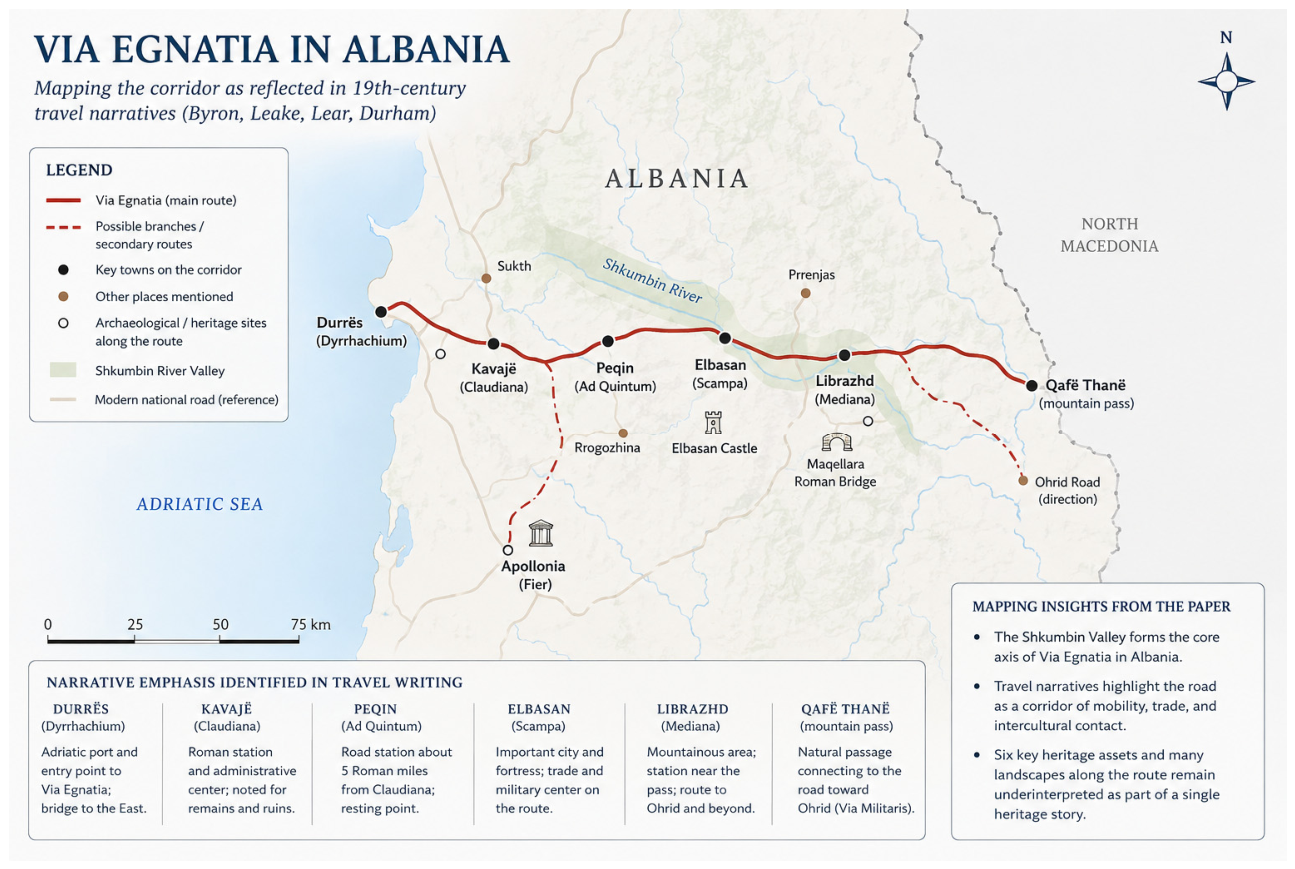
Table 2.
Distribution of coded narrative references by theme and primary analytical reading.
| Theme | References | % of total | Primary reading |
| Cultural Heritage Assets | 38 | 29.9% | Mixed: representation + corroborable evidence |
| Historical Memory & Connectivity | 34 | 26.8% | Primarily evidentiary, cross-author triangulated |
| Destination Representation & Identity | 31 | 24.4% | Primarily ideological / discursive |
| Tourism Development Potential | 24 | 18.9% | Interpretive / forward-looking |
| Total | 127 | 100% | — |
Table 3.
Functions of travel literature for Via Egnatia route interpretation, consolidated from the analysis.
Table 3.
Functions of travel literature for Via Egnatia route interpretation, consolidated from the analysis.
| Function | Basis in findings | Application to Via Egnatia | Key stakeholders |
| Spatial / corridor identification | Cross-author triangulated corridor (4.2) | Mapping interpretive nodes along the Shkumbin Valley alignment | Heritage institutions, route planners |
| Critical destination storytelling | Discourse analysis of representation (4.1) | Presenting travelers’ accounts with explicit colonial framing, not as neutral color | Museums, interpretation centres, DMOs |
| Diachronic narrative device | Comparison across 1812–1909 corpus | “How outsiders saw this route over a century” as a visitor-facing narrative | Tour operators, digital heritage developers |
Table 4.
Site-level cross-check of heritage-protection status and visitor-facing interpretation at six locations along the narrative-identified corridor.
Table 4.
Site-level cross-check of heritage-protection status and visitor-facing interpretation at six locations along the narrative-identified corridor.
| Site | Corridor position | Protection status | Via Egnatia referenced on-site? | Visitor-review notes |
| Durrës Amphitheatre | Western terminus (Durrës) | UNESCO Tentative List | No | Reviews describe a large, significant site but repeatedly note minimal on-site interpretation. |
| Fortress of Bashtëvë | Shkumbin river mouth | UNESCO Tentative List | No | Reviews mention a smartphone augmented-reality app with historical content, but no reference to the wider route. |
| Ad Quintum (Bradashesh) | Corridor midpoint, near Elbasan | Managed archaeological site; formal status inconsistently reported | Yes | One review explicitly locates the site on Via Egnatia; other reviews note inconsistent conservation and a lack of written information. |
| Elbasan Castle | Corridor midpoint (Elbasan) | Protected historic monument complex | No | Reviews describe a well-preserved, tourist-ready site (cafes, shops) with no reference to Via Egnatia. |
| “Agroturizëm Via Egnatia” (near Peqin) | Near surviving Roman pavement segment | Private business; unofficial | Yes (by name) | Reviews describe the venue as a stopover for people walking the historic route, indicating an existing grassroots route identity. |
| Lin Peninsula (Palaeochristian basilica) | Eastern terminus (Lake Ohrid) | UNESCO World Heritage (Ohrid Region, 2019 extension); Urban Architectural Ensemble | No | Reviews consistently report absent or hard-to-find signage and difficulty locating the site. |
Table 5.
Alignment of the Study Findings with the Council of Europe Cultural Route Framework.
| Council of Europe criterion | Evidence identified in this study | Current planning status | Implication |
| Historical continuity | Repeated references to settlements and communication corridors (Byron, Leake, Lear) | Present but not formally interpreted as Via Egnatia | Strong basis for Cultural Route interpretation |
| Intercultural exchange | Descriptions of trade, hospitality and religious coexistence (Durham, Lear) | Reflected in heritage values but not integrated into route planning | Supports intercultural interpretation |
| Transnational significance | Narratives connect Albania with Macedonia and Greece | Route not yet certified as a Cultural Route | Supports future transnational cooperation |
| Cultural landscapes | Consistent descriptions of the Shkumbin Valley corridor | Corridor not explicitly recognised in national tourism planning | Supports thematic heritage planning |
| Educational potential | Rich historical and literary narratives | Limited use in interpretation | Suitable for visitor interpretation and educational programmes |
| Sustainable tourism | Narrative-based heritage storytelling | Not currently developed as a tourism product | Opportunity for future Cultural Route development |
Disclaimer/Publisher’s Note: The statements, opinions and data contained in all publications are solely those of the individual author(s) and contributor(s) and not of MDPI and/or the editor(s). MDPI and/or the editor(s) disclaim responsibility for any injury to people or property resulting from any ideas, methods, instructions or products referred to in the content. |
© 2026 by the authors. Licensee MDPI, Basel, Switzerland. This article is an open access article distributed under the terms and conditions of the Creative Commons Attribution (CC BY) license (http://creativecommons.org/licenses/by/4.0/).
Copyright: This open access article is published under a Creative Commons CC BY 4.0 license, which permit the free download, distribution, and reuse, provided that the author and preprint are cited in any reuse.


