

Submitted:
06 July 2026
Posted:
13 July 2026
You are already at the latest version
Abstract
Background: In Parkinson’s disease (PD), gait and balance impairments severely reduce patient independence. This exploratory study compared a multimodal Adapted Physical Activity (APA) protocol, a tango-based program (Riabilitango®, RT), and standard care (Control), while examining how joint constraints and plantar load distributions affect dynamic locomotor outcomes. Methods: Twenty-seven participants (Hoehn & Yahr stage 1–3) were divided into APA (n=10), RT (n=10), and Control (n=7) groups for a 3-month supervised intervention (24 sessions). Blinded assessors evaluated static balance and walking performance on a WalkerView™ treadmill at baseline (T0) and post-intervention (T1). Results: At T1, both active groups showed large effect sizes for reduced static sway versus Control, though differences were not statistically significant. Notably, the APA cohort demonstrated a substantial, significant increase in dynamic gait distance (d=2.17 vs. Control; d=1.50 vs. RT), whereas RT showed no significant walking improvements. APA also minimized the impact of joint range of motion constraints and suggested superior active postural-load regulation. Conclusions: While both interventions benefited static posture, APA was uniquely effective in improving walking distance, likely due to task-specific behavioral adaptations countering rigidity.
Keywords:
adapted physical activity
; Parkinson’s disease
; exercise medicine
; tango therapy
; gait analysis
; postural stability
; plantar load
; locomotor biomechanics
; neurorehabilitation
; preventive motor activity
1. Introduction
Parkinson’s disease (PD) is a progressive neurodegenerative disorder characterized by a broad spectrum of motor impairments, including bradykinesia, resting tremor, postural instability, and significant disturbances in gait and balance [1]. Among these, freezing of gait and balance deficits drastically elevate the risk of falls, leading to severe injuries, a pervasive fear of falling, and a subsequent loss of independence [2,3].
Beyond these hallmark motor deficits, a wide array of non-motor symptoms is increasingly recognized as a major determinant of long-term disability. These encompass autonomic dysfunctions, sleep disorders, and prominent neuropsychiatric manifestations such as depression and anxiety [4,5,6]. Within the framework of the International Classification of Functioning, Disability and Health (ICF), recent evidence has shown that non-motor symptoms often correlate more strongly with reductions in Health-Related Quality of Life (HRQoL) than motor symptoms alone [7].
Epidemiologically, PD imposes a substantial and expanding global burden, affecting approximately 6.1 million individuals worldwide [8,9]. Neuropathologically, the hallmark of the disease is the abnormal accumulation of misfolded α-synuclein [8] and the progressive loss of dopaminergic neurons within the substantia nigra pars compacta [10,11], the functional severity of which is commonly staged clinically using the Hoehn and Yahr (H&Y) scale.
Although pharmacological treatments, primarily levodopa, remain the gold standard for symptomatic management, they do not halt the underlying neurodegenerative process and are frequently associated with long-term motor complications [12]. As a result, structured physical exercise is now widely advocated not only for symptom management but also as a potential disease-modifying strategy [13]. This view has been reinforced by recent reviews framing exercise as a cornerstone of PD rehabilitation and, potentially, as a therapeutic strategy with broader clinical implications [14] beyond symptomatic management [15,16,17].
Extensive research demonstrates that regular physical activity may promote neuroplasticity, enhance brain-derived neurotrophic factor (BDNF) expression, and potentially modify the disease trajectory [18,19,20]. Recent systematic reviews and network meta-analyses confirm the broad efficacy of various exercise modalities in improving both functional capacity and motor symptoms in individuals with PD [16,21,22]. However, the relative superiority of specific exercise modalities remains uncertain. Emerging evidence suggests that multimodal and sensorimotor interventions may be particularly relevant for balance control, gait adaptability, and functional mobility [16,23]. In particular, treadmill training has demonstrated high efficacy by serving as an external pacemaker to improve gait rhythm, walking speed, and overall endurance [24,25].
In addition to traditional motor reconditioning, rhythm-based interventions have emerged as effective rehabilitative tools. Among these, Argentine Tango has attracted considerable scientific interest [26,27]. Recent reviews and controlled studies continue to support Argentine Tango as a promising rehabilitation strategy for balance, gait, and functional mobility, while also highlighting methodological heterogeneity, small sample sizes, and the need for direct comparisons with other structured exercise approaches [28]. The therapeutic efficacy of tango is attributed to its unique structural and biomechanical features, including constant multisensory integration, rhythmic auditory cueing, and frequent backward walking, which specifically target postural stability and reduce freezing episodes [29].
Additionally, the social and partner-based aspects of tango may enhance psychological well-being and treatment adherence compared to conventional, isolated physiotherapy approaches [30]. Nevertheless, whether static postural adaptations translate into dynamic functional mobility to the same extent across different exercise modalities requires further investigation. Previous systematic-review evidence has highlighted the growing relevance of both aerobic exercise and dance-based interventions for individuals with PD, while also emphasizing the need for more direct comparisons between different structured exercise modalities using objective functional and biomechanical outcomes. This gap is particularly relevant because PD is associated with measurable alterations in lower-limb range of motion, joint kinematics, and gait-related biomarkers, supporting the use of quantitative assessment frameworks to characterize treatment-related locomotor adaptations [31,32].
Within this context, the present exploratory controlled study was designed to compare a multimodal Adapted Physical Activity (APA) program, a specialized tango-based therapy protocol (Riabilitango®, RT), and standard care in individuals with PD. Specifically, the study aimed to determine whether changes in static posturographic outcomes were paralleled by improvements in dynamic walking capacity and to explore whether joint kinematic constraints and plantar-load redistribution were associated with locomotor performance. Given the exploratory nature of the study, regression and coupling analyses were interpreted as hypothesis-generating evidence of possible biomechanical correlates rather than as proof of causal mechanisms.
2. Materials and Methods
2.1. Participants
This prospective controlled study assessed the effects of RT therapy and an APA program on gait kinematics, postural control, and stabilometric balance in patients with PD. Data collection occurred from February to July 2025 at multiple specialized facilities: the Neurology Clinical Unit of the Foggia Polyclinic, the Sports Therapy Gym belonging to the Sports Medicine Outpatient of the same Polyclinic, and the Libertango gym A.P.S.
Participants were recruited voluntarily from the Neurology Clinical Unit outpatient. Intervention group sizes ranged from two to three participants to ensure close supervision and safety. The study adhered to the Declaration of Helsinki and received approval from the Ethics Committee of the University Hospital Ospedali Riuniti of Foggia (approval code: Studio ETRMPEMP_2024; approval date: October 17, 2024). Written informed consent was obtained from all participants prior to enrollment.
Table 1 summarizes the baseline demographic and clinical characteristics of the study population, including age, body weight, sex distribution, and disease severity by Hoehn and Yahr (H&Y) stage, grouped by intervention.
2.2. Eligibility Criteria
Initial screening evaluated 30 individuals with PD, resulting in a final sample of 27 participants. Inclusion criteria were:
- A formal diagnosis of idiopathic PD confirmed by a neurologist according to established clinical criteria;
- Disease severity between stage I and III on the Hoehn and Yahr scale [33];
- Ability to walk independently without assistive devices for at least 10 minutes; and
- Clinical stability of the antiparkinsonian pharmacological regimen prior to enrollment, with no major medication changes during the intervention period.
Exclusion criteria included severe orthopedic comorbidities, uncorrected visual or vestibular deficits, unstable cardiovascular or metabolic conditions, or any concurrent medical condition contraindicating moderate-intensity physical exercise [34]. Participants were also excluded if they exhibited clinically relevant cognitive impairment, defined as a Mini-Mental State Examination (MMSE) score below 24/30, or if cognitive or neuropsychiatric symptoms limited their ability to understand instructions, provide reliable cooperation, or safely participate in the intervention.
Participants were instructed to maintain their standard pharmacological therapy and routine daily activities throughout the study and to refrain from initiating any new structured exercise programs outside the assigned intervention.
2.3. Study Design and Allocation Procedure
This investigation was structured as an exploratory, prospective, parallel-group controlled intervention study. Following eligibility screening and baseline assessment, participants were allocated to one of three study arms:
- A Control group that maintained standard activities of daily living;
- An RT tango-based therapy group; or
- An APA group.
Group allocation utilized a computer-generated random sequence with an intended 1:1:1 ratio. The randomization list was generated in R software by an investigator not involved in outcome assessment or intervention delivery. Due to the small sample size and exploratory design, final group sizes were slightly unequal. No formal allocation-concealment procedure was implemented, which should be considered when interpreting the results.
The intervention phase lasted 12 weeks. Participants in the APA and RT groups completed 24 supervised sessions, delivered twice weekly for 60 minutes per session. Comprehensive instrumental evaluations of gait and posture were conducted at baseline (T0) and at the end of the 12-week intervention period (T1). Attendance was recorded at each supervised session, and adherence was calculated as the percentage of completed sessions out of the 24 scheduled.
This exploratory controlled study was not prospectively registered. This limitation is acknowledged and should be considered when interpreting the findings.
2.4. Interventions
Each training session lasted 60 minutes and was continuously supervised by a kinesiologist specializing in preventive and adapted physical activity. Vital signs were assessed before and after each session.
2.4.1. Riabilitango® Tango-Based Therapy Protocol (RT)
RT sessions commenced with a standardized 10-minute warm-up focused on joint mobility and weight-shifting between the lower limbs. The central phase emphasized dynamic postural control and multi-directional stepping, incorporating Argentine tango elements adapted for PD. These included rhythmic walking synchronized to external auditory cues (music), “enrosque” (pivoting), and backward walking. The final phase consisted of partnered exercises designed to enhance physical connection, somatosensory feedback, and reactive balance.
2.4.2. Adapted Physical Activity Protocol
The APA program was designed in accordance with the FITT-VP principles of the American College of Sports Medicine [22,35]. Sessions commenced with a 5-minute warm-up on a cycle ergometer, followed by aerobic conditioning on a treadmill. Treadmill intensity was titrated to achieve a target heart rate of 60–70% of the maximum heart rate (HRmax). Cardiovascular response was monitored in real-time using a Polar H10 chest strap (Polar Electro Oy, Kempele, Finland). Treadmill walking duration progressively increased from 20 to 30 minutes, followed by functional resistance and balance training, concluding with a targeted stretching protocol.
2.5. Instrumental Postural, Stabilometric, and Gait Assessment
All instrumental evaluations were performed while participants were in their self-reported “ON” medication state, according to their usual antiparkinsonian pharmacological schedule. Although the exact interval between medication intake and testing was not rigidly standardized across participants, assessments were scheduled when patients reported their best usual motor response to therapy. When feasible, baseline and post-intervention evaluations were performed at a comparable time of day and within a similar individual medication-response window, in order to minimize intra-subject variability related to dopaminergic fluctuations.
The investigators responsible for data processing and statistical analysis were blinded to group allocation. Due to the behavioral nature of the interventions, participants and exercise supervisors could not be blinded to treatment assignment.
2.5.1. Postural and Stabilometric Assessment (ProKin System)
Static and dynamic postural alignment, as well as stabilometric balance, were evaluated using the advanced ProKin 252® system (TecnoBody S.r.l., Bergamo, Italy), which has been previously validated for the highly accurate measurement of kinematic profiles and gait variables [36]. The protocol included a 30-second static stabilometric test in the upright Romberg position under Eyes Open (EO) conditions [37].
The primary variables extracted included Sway Area (SEEO_A, mm2) and Postural Load distribution (PA_P.S.I.AVG_total, %), identifying compensatory torso and weight-bearing strategies during static stance.
2.5.2. Instrumental Gait Analysis (Walker View)
Kinematic and spatiotemporal gait parameters were acquired using the advanced TecnoBody Walker View 3.0 SCX treadmill (TecnoBody S.r.l., Bergamo, Italy). After 2 minutes of familiarization, participants performed a continuous walking test at a self-selected speed. The primary functional outcome evaluated was the total Gait Distance covered (GA_D, km), alongside secondary kinematic parameters such as lower limb Range of Motion (ROM). A comprehensive summary of all dataset variables, including their respective instrumental source systems, operational definitions, and units of measurement, is detailed in Table 2.
2.6. Study Design Quality Control
To improve internal validity, all instrumental assessments were conducted using the same standardized protocol at T0 and T1. Participants were instructed to maintain their usual pharmacological treatment and daily activities throughout the study period and to avoid initiating additional structured exercise programs outside the assigned intervention. Attendance was recorded for each supervised session, and adherence was calculated as the proportion of completed sessions out of the 24 scheduled sessions. Safety was monitored by recording vital signs before and after each session and by documenting any adverse events, falls, musculoskeletal complaints, cardiovascular symptoms, or interruptions to interventions.
2.7. Statistical Analysis
All statistical analyses were performed on a per-protocol basis. The final analytical population included only participants who completed both baseline (T0) and post-intervention (T1) assessments. For participants allocated to the active intervention groups, inclusion in the per-protocol analysis also required meeting the predefined adherence threshold of ≥17/24 supervised sessions. No imputation procedures were applied because no post-intervention outcome data were missing in the final analytical sample. Statistical analysis was conducted using R software, version 4.4.2 (R Foundation for Statistical Computing, Vienna, Austria).
Descriptive data are reported as mean ± standard deviation for continuous variables and as absolute frequency and percentage for categorical variables. The alpha level for statistical significance was set at p < .05, using two-tailed tests.
Model Assumptions and Diagnostics: Prior to inferential analyses, model assumptions were evaluated. Normality was assessed using the Shapiro–Wilk test and visual inspection of Q–Q plots, with particular attention to model residuals. Homogeneity of variance across groups was examined using Levene’s test. For ANCOVA models, the homogeneity-of-regression-slopes assumption was assessed before interpreting adjusted group effects. Because of the small sample size, inferential results were interpreted together with effect sizes, 95% confidence intervals, and graphical inspection of the data.
Inferential Models and Effect Sizes: The primary inferential analysis focused on the Group × Time interaction for gait distance (GA_D), the main functional outcome. A two-way mixed ANOVA was used to examine the effects of Group (APA, RT, Control), Time (T0, T1), and their interaction on walking distance. When significant main or interaction effects were observed, post-hoc between-group comparisons were performed using Tukey’s honestly significant difference adjustment. To evaluate between-group differences in changes in postural parameters, one-way ANOVA was applied to delta values (Δ = T1 – T0). Effect sizes for ANOVA and ANCOVA models were reported as partial eta-squared (ηp2). To control for baseline biomechanical asymmetries and postural-load differences, ANCOVA was performed on post-intervention sway area, using postural load as a covariate. Between-group effect sizes for post-intervention gait distance and static sway area were calculated using Cohen’s d with 95% confidence intervals. Effect-size magnitude was interpreted according to Sawilowsky’s expanded descriptors: small (0.20), medium (0.50), large (0.80), very large (1.20), and huge (>2.0).
Correlation and Regression Analyses: Pearson correlation coefficients were used to explore associations between walking distance and lower-limb range-of-motion variables. Given the small sample size, these analyses were considered exploratory. Where appropriate, Spearman rank correlations have been used as sensitivity analyses. To reduce the risk of type I error across multiple bivariate correlation tests, adjusted p-values were calculated using the Holm–Bonferroni procedure. Simple linear regression models were used to explore the association between selected biomechanical predictors and functional outcomes. These regression and delta-coupling analyses were interpreted as exploratory mechanistic support and hypothesis-generating evidence; they were not used to infer causality or to establish definitive biomechanical mechanisms.
3. Results
3.1. Participant Flow, Adherence, and Safety
Of the 30 participants assessed for eligibility, 3 were excluded for not meeting eligibility criteria or for declining to participate. Twenty-seven participants were allocated to the APA (n = 10), RT (n = 10), or Control group (n = 7). All participants completed the post-intervention assessment and were included in the final analysis; therefore, the final analytical population corresponded to the per-protocol sample (Figure 1).
All participants in the active intervention groups met the predefined adherence threshold of ≥17/24 supervised sessions. Mean attendance was 21.8 ± 1.7 sessions in the APA group and 21.4 ± 1.9 sessions in the RT group, corresponding to adherence rates of 90.8 ± 7.1% and 89.2 ± 7.9%, respectively. Across the two active intervention groups, overall attendance was 21.6 ± 1.8 sessions, corresponding to an adherence rate of 90.0 ± 7.5%. No serious adverse events were recorded during the intervention period. Where minor deviations from normality or variance homogeneity were observed, results were interpreted cautiously and supported by effect-size estimates, confidence intervals, and graphical inspection.
3.2. Static Postural Stability and Balance Outcomes
To evaluate modifications in static postural stability, a one-way ANOVA was performed on the delta scores (Δ = T1 – T0) of the Sway Area (SEEO_A). The analysis did not reveal a statistically significant difference between the three groups (F(2,24) = 0.886, p = .425, ηp2 = .069, observed power = .203).
To further control for initial biomechanical asymmetries, an ANCOVA was executed on the post-intervention (T1) Sway Area, utilizing Postural Load as a covariate. The covariate did not show a significant main effect (F(1,23) = 2.56, p = .123), and the main effect of the group intervention did not reach statistical significance (F(2,23) = 0.72, p = .498).
Despite the lack of significance in the omnibus tests, the adjusted mean sway area was lower in the APA group (353.27 mm2) compared to the RT group (377.53 mm2). Conversely, the Control group exhibited a paradoxically lower adjusted mean (160.61 mm2), which likely reflects increased compensatory postural rigidity and joint stiffness rather than true functional stability.
Although the omnibus ANOVA and ANCOVA models did not reveal statistically significant between-group differences in Sway Area, the analysis of post-intervention effect sizes suggested large observed differences for both active interventions relative to standard care. Specifically, Cohen’s d values indicated large effect-size profiles for lower sway area in the APA versus Control comparison (d = 1.15) and in the RT versus Control comparison (d = 0.88) (Table 3). The APA versus RT comparison showed a negligible effect size (d = 0.04), suggesting a comparable observed effect-size profile for static sway outcomes between the two active exercise protocols.
3.3. Functional Gait Capacity and Walking Performance
A two-way mixed ANOVA was conducted to examine the effects of Group (APA, RT, Control) and Time (T0, T1) on functional walking endurance via Gait Distance (GD). The analysis revealed a significant main effect of Time (F(1,48) = 9.64, p = .003), indicating overall performance modifications across the sample, and a significant main effect of Group (F(2,48) = 3.45, p = .039). Most importantly, a statistically significant Group × Time interaction was observed (F(2,48) = 4.95, p = .011), indicating that changes in walking performance over the 12-week period differed by intervention type (Figure 2).
Pairwise post-hoc comparisons using Tukey’s HSD adjustment at T1 identified structural differences between cohorts. At T1, the APA group showed a statistically greater walking distance compared to both the Control group (mean difference = 0.058 km, SE = 0.015, t = 3.91, p < .001) and the RT group (mean difference = 0.038 km, SE = 0.013, t = 2.81, p = .019). No significant difference was observed between RT and Control at post-intervention (Figure 3).
These findings were further substantiated by effect-size analysis (Table 3). The APA intervention demonstrated a huge effect size (d = 2.17) compared to the Control group and a very large effect size (d = 1.50; 95% CI: [0.44, 2.57]) compared to the RT group, suggesting a large observed effect whose clinical relevance should be confirmed in larger samples. In contrast, the RT group displayed only a moderate effect size (d = 0.67) relative to standard care (see Table 3).
3.4. Kinematic Predictors, Bivariate Correlations, and Biomechanical Coupling
To establish the global relationship between joint kinematics and functional ambulation across the entire study population, a preliminary bivariate Pearson correlation analysis was executed between Total Walking Distance (GA_D) and lower-limb range of motion (ROM) parameters. The analysis revealed that all examined joint mobility variables were significantly and positively correlated with functional walking performance (Table 4).
Specifically, positive linear correlations were found for Left Hip ROM (r = .283, p = .038) and Right Hip ROM (r = .312, p = .021). Notably, knee joint mobility showed a stronger association and higher statistical significance, with Left Knee ROM (r = .366, p = .006) and Right Knee ROM (r = .380, p = .004) emerging as more robust linear correlates of walking endurance (see Table 4). These preliminary findings suggest that knee joint excursions may be relevant correlates of functional walking capacity in this cohort.
To explore potential biomechanical correlates of these functional adaptations, simple linear regression and coupling analyses were executed. At baseline (T0), right hip flexion-extension ROM was a statistically significant predictor of walked distance across all cohorts, accounting for a substantial proportion of the variance in this sample (see Figure 4) (APA: R2 = .767, p < .001, slope = 0.0056; RT: R2 = .852, p < .001, slope = 0.0025; Control: R2 = .759, p = .010, slope = 0.0029).
Post-intervention (T1), while the positive association remained significant (p < .05), a general attenuation in the coefficients of determination was observed in the active groups (APA: R2 = .477, p = .027, slope = 0.0023; RT: R2 = .406, p = .048, slope = 0.0026), whereas the Control group maintained a strong, rigid dependency on hip joint mobility (R2 = .615, p = .037, slope = 0.0031) (Figure 5).
This pattern was further explored during analysis of left knee flexion-extension ROM. At baseline, left knee mobility significantly predicted walking performance in the Control (R2 = .731, p = .014, slope = 0.0033) and RT groups (R2 = .465, p = .030, slope = 0.0019), but not in the APA group (R2 = .266, p = .127). Following the 12-week program (T1), the association between knee ROM and walking distance was attenuated and no longer statistically significant in the active cohorts, with the relationship becoming entirely non-significant for both the APA (R2 = .010, p = .783) and RT groups (R2 = .304, p = .098). Conversely, in the Control group, the predictive value of knee joint range of motion strengthened (R2 = .843, p = .003, slope = 0.0035), suggesting that passive joint constraints may have remained more closely related to functional capacity.
To further explore associations between postural-load redistribution and changes in stability, linear regression models were applied to the delta scores (Δ = T1 – T0) of Total Postural Load (%) and Sway Area (mm2) (Figure 6). In the APA group, a statistically significant linear association was observed (slope = 8.96, R2 = .72, p = .002), indicating a strong association between changes in postural-load distribution and sway-area variation. In sharp contrast, an absence of a statistically evident association was observed in the RT group (slope = –1.61, R2 = .02, p = .719) and the Control group (slope = –1.70, R2 = .04, p = .673).
4. Discussion
4.1. Statement of Principal Findings
The primary objective of this study was to compare the effects of a multimodal APA protocol, RT Tango-based therapy, and standard care on postural stability, gait kinematics, plantar load redistribution, and functional walking capacity in patients with PD. The findings reinforce the importance of structured exercise as a non-pharmacological approach for managing PD-related motor impairment [22]. Furthermore, the results indicate that different exercise modalities may elicit distinct functional and biomechanical adaptation profiles. This interpretation aligns with recent evidence positioning exercise as a fundamental component of PD rehabilitation and as a clinically relevant intervention that should be tailored to individual needs alongside conventional pharmacological management [15,16,17].
The most robust statistically supported finding pertained to dynamic walking capacity. In this sample, the APA group demonstrated a greater improvement in gait distance compared to the RT and Control groups, indicating a stronger transfer of the multimodal APA protocol to functional walking performance. In contrast, the RT group did not exhibit the same level of gait-distance improvement. However, this should not be interpreted as evidence against the rehabilitative value of tango-based therapy. Within the context of the current protocol and sample size, RT was less clearly associated with gains in dynamic walking distance than the multimodal APA intervention.
Interpretation of static sway outcomes warrants caution. Although both active interventions demonstrated favorable effect-size profiles compared to the Control group, omnibus ANOVA/ANCOVA analyses did not reveal statistically significant between-group differences in Sway Area. Consequently, the static postural findings should be regarded as effect-size-supported trends rather than definitively statistically confirmed improvements. Exploratory regression and delta-coupling analyses further suggested that the APA-related improvement in walking distance may be linked to changes in the relationship among joint range of motion, plantar-load redistribution, and postural stability. These findings remain hypothesis-generating and should be viewed as preliminary biomechanical correlates rather than evidence of definitive causal mechanisms.
4.2. The APA Paradox: Postural Stability vs. Dynamic Gait and Neuroplasticity
A notable finding of this exploratory study is the divergence between static postural outcomes and dynamic walking performance. Although the omnibus ANCOVA on post-intervention Sway Area (SEEOA) did not demonstrate a statistically significant group effect, effect-size analysis indicated favorable profiles for both APA (d = 1.15) and RT (d = 0.88) compared to the Control group. Thus, static postural findings should be interpreted as effect-size–supported trends rather than definitive statistically significant between-group effects.
This pattern suggests that structured exercise, whether delivered as multimodal APA or as progressive rhythmic-based therapy, may contribute to beneficial posturographic adaptations in patients with PD, consistent with previous evidence on the interaction between physical activity and postural-control networks [38,39].
A clinically relevant divergence was observed in dynamic walking capacity. In this sample, the APA group exhibited a more pronounced improvement in walking distance than the RT and Control groups, indicating a stronger transfer of the multimodal APA protocol to functional walking performance. In contrast, the RT group did not achieve the same degree of gait-distance improvement relative to standard care. This result should not be interpreted as evidence against the rehabilitative value of RT tango-based therapy. Rather, within the current protocol, sample size, and outcome framework, RT was less clearly associated with dynamic walking-distance gains than the multimodal APA intervention.
This difference may reflect distinct training emphases: RT may preferentially enhance rhythmic cueing, sensorimotor integration, partner-mediated balance control, social engagement, and treatment adherence, as supported by previous and recent evidence on tango-based rehabilitation in PD [26,28,30]. In contrast, APA may offer a broader combination of aerobic load, treadmill-based locomotor exposure, balance training, functional strengthening, and continuous postural-load regulation. This interpretation is consistent with evidence supporting multimodal and sensorimotor exercise approaches for balance, gait adaptability, and functional mobility in PD [19,22,23,40]. The stronger gait-distance response observed after APA may therefore reflect the more direct locomotor and metabolic demands incorporated within the protocol, including progressive endurance exposure, treadmill walking, functional resistance training, and balance-oriented exercises.
This interpretation aligns with activity-dependent neuroplasticity models in PD, which propose that task-specific, progressive, and cognitively engaging exercise can enhance motor learning and functional adaptation [18,20]. From this perspective, the APA protocol represents a multimodal, task-specific intervention that requires continuous cognitive-motor engagement. By integrating structural, metabolic, coordinative, and balance-related challenges, APA may activate internal cueing and cognitive-motor control processes frequently impaired in PD. This behavioral engagement may provide an optimal neuroplastic stimulus, potentially facilitating the translation of basic postural-control adaptations into coordinated dynamic ambulation [22].
However, given the exploratory design and small sample size, this interpretation should be regarded as hypothesis-generating and requires confirmation in larger random ized studies directly comparing multimodal APA and tango-based interventions with harmonized functional and biomechanical endpoints.
4.3. Biomechanical Decoupling and Adaptive Loading Mechanisms
An exploratory mechanistic aspect of this study is reflected in the linear regression and coupling analyses, which indicate that APA may be associated with changes in the relationships among lower-limb kinematics, plantar-load redistribution, and functional walking performance.
This interpretation is consistent with recent instrumental-gait literature demonstrating that PD is linked to measurable alterations in spatiotemporal gait parameters, lower-limb range of motion, joint kinematics, and objective locomotor biomarkers, supporting the use of quantitative assessment frameworks to detect treatment-related motor adaptations [31,32].
At baseline (T0), walking distance across cohorts was strongly associated with passive joint mobility, with right hip ROM showing a substantial relationship with ambulation performance. This association aligns with biomechanical constraints commonly observed in PD gait, where reduced joint excursion, bradykinesia, stiffness, and impaired postural adjustments may contribute to less adaptable locomotor strategies.
After the 12-week intervention, a divergent post-intervention pattern emerged. In the Control group, the association between joint ROM and walking distance persisted and appeared to strengthen, particularly at the knee level. This may reflect the continuation of a constraint-dependent gait strategy, where functional walking performance remains closely linked to peripheral joint mobility. In contrast, in the active intervention groups, especially the APA group, the association between joint ROM and walking distance was attenuated. In the APA group, the relationship between left knee ROM and walking distance was no longer statistically significant, and the predictive value of hip ROM was reduced.
Rather than indicating diminished movement quality, this pattern may suggest a more flexible locomotor strategy, where walking performance becomes less dependent on isolated joint excursions. The multi-axial, high-coordination tasks incorporated in the APA protocol may have encouraged participants to reduce reliance on rigid peripheral constraints and to adopt more integrated kinetic-chain strategies. Within this framework, individuals trained with APA may have developed a more adaptable locomotor organization, supported by the combined effects of treadmill walking, functional strengthening, balance tasks, and postural-load regulation. Nonetheless, this interpretation remains exploratory and should be considered a possible biomechanical explanation rather than definitive evidence of a causal pathway.
This hypothesis is further supported, though not conclusively proven, by regression models tracking the delta transformations (∆T1 − T0) between Total Postural Load (%) and Sway Area (mm2). In the APA group, changes in postural-load distribution were statistically associated with changes in sway-area variation, accounting for a substantial proportion of variance in this exploratory model. This association was not observed in the RT or Control groups. Collectively, these findings suggest a plausible exploratory biomechanical interpretation of the APA-related response: the multimodal APA protocol may be linked to a partial shift from a constraint-dependent gait pattern toward more active postural-load regulation, potentially enhancing dynamic walking performance through more flexible weight-bearing control.
As these analyses were exploratory and correlational, they should be regarded as hypothesis-generating rather than confirmatory. Future studies with larger samples, prospective mechanistic endpoints, and integrated neurophysiological and biomechanical assessments are necessary to validate this interpretation.
4.4. Support from Meta-Analyses and Clinical Implications
The present findings offer preliminary support for incorporating specialized APA programs into neurological care pathways for PD. Consistent with recent systematic reviews and network meta-analyses, exercise programs that integrate aerobic, coordinative, balance, and functional components may provide significant benefits for motor symptoms, mobility, and functional capacity in individuals with PD [16,21,40]. This perspective aligns with broader clinical recommendations that emphasize individualized, multi-component physical activity prescriptions for chronic neurological conditions, prehabilitation protocols in clinical populations, and interventions aimed at preventing functional decline [17,41,42,43].
From a clinical exercise prescription standpoint, the results indicate that different intervention models may be selected based on therapeutic priorities. RT tango-based therapy remains a promising option when clinical objectives include rhythmic cueing, sensory-motor integration, balance confidence, social engagement, and adherence. In contrast, multimodal APA may be particularly suitable when the primary therapeutic target is dynamic walking capacity, as it combines treadmill-based locomotor exposure, aerobic conditioning, balance tasks, functional strengthening, and postural-load regulation within a single structured protocol.
These observations support a goal-oriented approach to exercise prescription in PD. Rather than treating exercise modalities as interchangeable, clinicians and rehabilitation teams should match intervention content to the patient’s predominant functional limitation. Patients with significant balance insecurity, reduced confidence, or a need for rhythmic external cueing may benefit from dance-based and rhythm-oriented approaches, whereas those requiring improvement in walking endurance and dynamic gait capacity may need protocols with stronger locomotor, aerobic, and task-specific components.
Future clinical pathways should evaluate how multimodal APA and tango-based interventions can be integrated, sequenced, or combined according to individual motor phenotype, functional goals, adherence profile, and disease stage.
5. Study Limitations
Several limitations should be acknowledged.
First, the total sample size was relatively small (N = 27), with limited numbers within each study arm. This reduces statistical power, limits generalizability to the broader PD population, and requires cautious interpretation of subgroup analyses, effect-size estimates, and exploratory regression models. Accordingly, the biomechanical and delta-coupling findings should be considered hypothesis-generating rather than confirmatory.
Second, although group allocation was performed using a computer-generated random sequence, no formal allocation-concealment procedure was implemented. This may have introduced potential selection bias and should be considered when interpreting the internal validity of the findings. Moreover, the final group sizes were slightly unequal, reflecting the exploratory nature and small scale of the study.
Third, the analysis was performed on a per-protocol basis. Although all participants included in the final analysis completed both baseline and post-intervention assessments and all participants in the active groups met the predefined adherence threshold, the absence of an intention-to-treat (ITT) analysis limits the ability to generalize the findings to broader clinical settings where adherence and dropout may be more variable.
Fourth, a relevant limitation concerns baseline demographic imbalance across groups, particularly sex distribution. The APA group was predominantly male, whereas the Control group included a higher proportion of female participants. Since sex-related differences may influence PD phenotype, gait characteristics, postural control, and responsiveness to exercise interventions, future studies should include larger and more balanced samples.
Fifth, although all instrumental assessments were conducted during the self-reported “ON” medication state, the exact interval between antiparkinsonian medication intake and instrumental testing was not strictly standardized. This may have introduced residual variability related to dopaminergic motor fluctuations and should be controlled more rigorously in future studies.
Sixth, the study focused primarily on instrumental posturographic, gait, ROM, and plantar-load outcomes. Although this approach represents a strength from a biomechanical perspective, future trials should integrate additional clinical endpoints, such as disease-specific motor scales, freezing of gait assessment, fall history, balance confidence, quality of life, and patient-reported outcomes, in order to better determine the clinical relevance of the observed instrumental changes.
Finally, the study was not prospectively registered and lacked long-term follow-up. Therefore, the durability of the observed adaptations remains unknown. Larger, prospectively registered randomized controlled trials with allocation concealment, balanced recruitment, intention-to-treat analysis, longer follow-up, and integrated clinical, neurophysiological, and biomechanical endpoints are needed to confirm and extend these exploratory findings.
6. Conclusions
In summary, this exploratory controlled study indicates that a multimodal APA protocol may be associated with greater improvement in dynamic walking capacity compared to RT tango-based therapy or standard care in individuals with PD. While both active interventions demonstrated favorable effect-size profiles for static postural outcomes, only the APA group achieved a statistically supported improvement in walking distance, suggesting a potentially greater transfer from postural and coordinative training to dynamic gait performance.
The primary contribution of this study is the provision of exploratory evidence for potential biomechanical correlates underlying the observed functional divergence. Exploratory regression and delta-coupling analyses suggest that the functional advantage following APA may be linked to partial attenuation of rigid joint ROM constraints and to more coordinated redistribution of plantar weight-bearing loads. These findings support the hypothesis that multimodal, task-specific exercise may foster more flexible postural-control strategies in PD.
However, due to the small sample size and the exploratory nature of the mechanistic analyses, these observations should be interpreted with caution. Larger randomized trials incorporating neurophysiological, biomechanical, and functional endpoints are required to confirm this hypothesis-generating interpretation.
Author Contributions
Conceptualization, A.A.V. and G.Ci.; study design, A.A.V. and G.D.; methodology, A.A.V., R.R.R.M., and G.D.; participant recruitment and clinical screening, D.M. and G.Ca.; intervention delivery and supervision, G.Ci. and R.R.R.M.; instrumental postural and gait assessment, N.F.; data curation, N.F.; formal statistical analysis, P.V. and G.D.; interpretation of results, A.A.V., G.D., and P.V.; writing—original draft preparation, A.A.V. and G.Ci.; writing—review and editing, A.A.V., G.Ci., and G.D.; visualization, G.D.; supervision, G.Ci.; project administration, R.R.R.M. and G.D. All authors have read and agreed to the published version of the manuscript.
Funding
This research was funded by the University of Foggia (Università di Foggia) through the University Research Projects fund (Progetti di Ricerca di Ateneo - PRA). The APC was funded by the University of Foggia.
Institutional Review Board Statement
The study was conducted in accordance with the Declaration of Helsinki, and approved by the Ethics Committee of the University Hospital Ospedali Riuniti of Foggia (approval code: Studio ETRMPEMP_2024; approval date: October 17, 2024).
Informed Consent Statement
Informed consent was obtained from all subjects involved in the study.
Data Availability Statement
The data supporting the findings of this study are available from the corresponding author upon reasonable request.
Acknowledgments
The authors wish to thank all participants and their families for their availability and commitment throughout the study. The authors also acknowledge the clinical and technical staff of the Neurology Department of the Foggia Polyclinic, the Sports Medicine Unit, and the Libertango A.P.S. gym for their organizational and logistical support. The authors are grateful to Antonella Salerno and the Libertango A.P.S. team for their contribution to the implementation of the tango-based intervention. During the preparation of this manuscript, the authors used Grammarly (Free Version) for the purposes of English language editing, proofreading, and grammatical refinement. The authors have reviewed and edited the output and take full responsibility for the content of this publication.
Conflicts of Interest
The authors declare no conflicts of interest.
References
- Marsden, C. D. Parkinson’s disease. J. Neurol. Neurosurg. Psychiatry 1994, 57, 672–681.
- Macht, M.; Kaussner, Y.; Möller, J. C.; et al. Predictors of freezing in Parkinson’s disease: A survey of 6,620 patients. Movement Disorders 2007, 22, 953–956.
- Liu, W.-Y.; Tung, T.-H.; Zhang, C.; Shi, L. Systematic review for the prevention and management of falls and fear of falling in patients with Parkinson’s disease. Brain Behav. 2022, 12, e2690.
- Reijnders, J. S. A. M.; Ehrt, U.; Weber, W. E. J.; et al. A systematic review of prevalence studies of depression in Parkinson’s disease. Movement Disorders 2008, 23, 183–189.
- Broen, M. P. G.; Narayen, N. E.; Kuijf, M. L.; et al. Prevalence of anxiety in Parkinson’s disease: A systematic review and meta-analysis. Movement Disorders 2016, 31, 1125–1133.
- Sveinbjornsdottir, S. The clinical symptoms of Parkinson’s disease. J. Neurochem. 2016, 139, 318–324.
- van Uem, J. M. T.; Marinus, J.; Canning, C.; et al. Health-Related Quality of Life in patients with Parkinson’s disease—A systematic review based on the ICF model. Neurosci. Biobehav. Rev. 2016, 61, 26–34.
- Dorsey, E. R.; Elbaz, A.; Nichols, E.; et al. Global, regional, and national burden of Parkinson’s disease, 1990–2016. Lancet Neurol. 2018, 17, 939–953.
- Deuschl, G.; Beghi, E.; Fazekas, F.; et al. The burden of neurological diseases in Europe. Lancet Public Health 2020, 5, e551–e567.
- Przedborski, S. Pathogenesis of nigral cell death in Parkinson’s disease. Parkinsonism Relat. Disord. 2005, 11 (Suppl 1), S3–S7.
- Shahmoradian, S. H.; Lewis, A. J.; Genoud, C.; et al. Lewy pathology in Parkinson’s disease consists of crowded organelles and lipid membranes. Nat. Neurosci. 2019, 22, 1099–1109.
- Aradi, S. D.; Hauser, R. A. Medical Management and Prevention of Motor Complications in Parkinson’s Disease. Neurotherapeutics 2020, 17, 1339–1365.
- Trinh, J.; de Vries, N. M.; Chan, P.; et al. The role of lifestyle interventions in symptom management and disease modification in Parkinson’s disease. Lancet Neurol. 2026, 25, 90–102.
- Wilson, A. C.; Pountney, D. L.; Khoo, T. K. Therapeutic Mechanisms of Exercise in Parkinson’s Disease. Int. J. Mol. Sci. 2025, 26, 4860.
- Langeskov-Christensen, M.; Franzén, E.; Grøndahl Hvid, L.; Dalgas, U. Exercise as medicine in Parkinson’s disease. J. Neurol. Neurosurg. Psychiatry 2024, 95, 1077–1088.
- Ernst, M.; Folkerts, A. K.; Gollan, R.; et al. Physical exercise for people with Parkinson’s disease: a systematic review and network meta-analysis. Cochrane Database Syst. Rev. 2023, 1, CD013856.
- Osborne, J. A.; Botkin, R.; Colon-Semenza, C.; et al. Physical Therapist Management of Parkinson Disease: A Clinical Practice Guideline. Phys. Ther. 2022, 102, pzab302.
- Hirsch, M. A.; Farley, B. G. Exercise and neuroplasticity in persons living with Parkinson’s disease. Eur. J. Phys. Rehabil. Med. 2009, 45, 215–229.
- Speelman, A. D.; van de Warrenburg, B. P.; van Nimwegen, M.; et al. How might physical activity benefit patients with Parkinson disease? Nat. Rev. Neurol. 2011, 7, 528–534.
- Petzinger, G. M.; Fisher, B. E.; McEwen, S.; et al. Exercise-enhanced neuroplasticity targeting motor and cognitive circuitry in Parkinson’s disease. Lancet Neurol. 2013, 12, 716–726.
- Goodwin, V. A.; Richards, S. H.; Taylor, R. S.; et al. The effectiveness of exercise interventions for people with Parkinson’s disease. Movement Disorders 2008, 23, 631–640.
- Alberts, J. L.; Rosenfeldt, A. B. The Universal Prescription for Parkinson’s Disease: Exercise. J. Parkinson’s Dis. 2020, 10 (s1), S21–S27.
- Wallin, A.; Franzén, E.; Studsgaard, J.; et al. Balance exercise interventions in Parkinson’s disease: A systematic mapping review. Parkinsonism Relat. Disord. 2025, 133, 107310.
- Frenkel-Toledo, S.; Giladi, N.; Peretz, C.; et al. Treadmill walking as an external pacemaker to improve gait rhythm and stability in Parkinson’s disease. Movement Disorders 2005, 20, 1109–1114.
- Mehrholz, J.; Kugler, J.; Storch, A.; et al. Treadmill training for patients with Parkinson’s disease. Cochrane Database Syst. Rev. 2015, No. CD007830.
- Hackney, M. E.; Kantorovich, S.; Levin, R.; Earhart, G. M. Effects of tango on functional mobility in Parkinson’s disease: a preliminary study. J. Neurol. Phys. Ther. 2007, 31, 173–179.
- Hackney, M.; Earhart, G. M. Effects of dance on movement control in Parkinson’s disease. J. Rehabil. Med. 2009, 41, 475–481.
- Giorgi, F.; Platano, D.; Berti, L.; et al. Dancing Towards Stability: The Therapeutic Potential of Argentine Tango for Balance and Mobility in Parkinson’s Disease. Diseases 2025, 13, 82.
- McNeely, M. E.; Duncan, R. P.; Earhart, G. M. Impacts of dance on non-motor symptoms, participation, and quality of life in Parkinson disease and healthy older adults. Maturitas 2015, 82(4), 336–341.
- Duncan, R. P.; Earhart, G. M. Randomized controlled trial of community-based dancing to modify disease progression in Parkinson disease. Neurorehabil. Neural Repair 2012, 26, 132–143.
- Zhang, W.; Ling, Y.; Chen, Z.; et al. Wearable sensor-based quantitative gait analysis in Parkinson’s disease patients. npj Digit. Med. 2024, 7, 169.
- Russo, M.; Amboni, M.; Pisani, N.; et al. Biomechanics Parameters of Gait Analysis to Characterize Parkinson’s Disease: A Scoping Review. Sensors 2025, 25, 338.
- Hoehn, M. M.; Yahr, M. D. Parkinsonism: onset, progression and mortality. Neurology 1967, 17, 427–442.
- Opara, J.; Małecki, A.; Małecka, E.; Socha, T. Motor assessment in Parkinson’s disease. Ann. Agric. Environ. Med. 2017, 24, 411–415.
- American College of Sports Medicine. ACSM’s Guidelines for Exercise Testing and Prescription, 10th ed.; Wolters Kluwer: Philadelphia, 2018.
- Bravi, M.; Massaroni, C.; Santacaterina, F.; et al. Validity analysis of WalkerView™ instrumented treadmill for measuring spatiotemporal and kinematic gait parameters. Sensors 2021, 21, 4795.
- Cattaneo, D.; Jonsdottir, J. Sensory impairments in quiet standing in subjects with multiple sclerosis. Mult. Scler. J. 2009, 15, 59–67.
- Stożek, J.; Rudzińska, M.; Pustułka-Piwnik, U.; et al. The effect of the rehabilitation program on balance, gait, physical performance and trunk rotation in Parkinson’s disease. Aging Clin. Exp. Res. 2016, 28, 1169–1177.
- Aktar, B.; Donmez Colakoglu, B.; Balci, B. Does the postural stability of patients with Parkinson’s disease affect the physical activity? Int. J. Rehabil. Res. 2020, 43, 41–47.
- Lorenzo-García, P.; Cavero-Redondo, I.; et al. Effects of physical exercise interventions on balance, postural stability and general mobility in Parkinson’s disease: a network meta-analysis. J. Rehabil. Med. 2024, 56, jrm10329.
- World Health Organization. WHO guidelines on physical activity and sedentary behaviour; WHO: Geneva, 2020.
- American College of Sports Medicine. ACSM’s Exercise Management for Persons with Chronic Diseases and Disabilities, 2nd ed.; Human Kinetics: Champaign, IL, 2003.
- Valenzano, A. A.; Vasco, P.; D’Orsi, G.; et al. Impact of Exercise Therapy in ERAS Prehabilitation for Major Surgery: A Systematic Review. Sports 2025, 13(9), 315.
Figure 1.
Participant flow diagram, allocation, and per-protocol final analysis population.
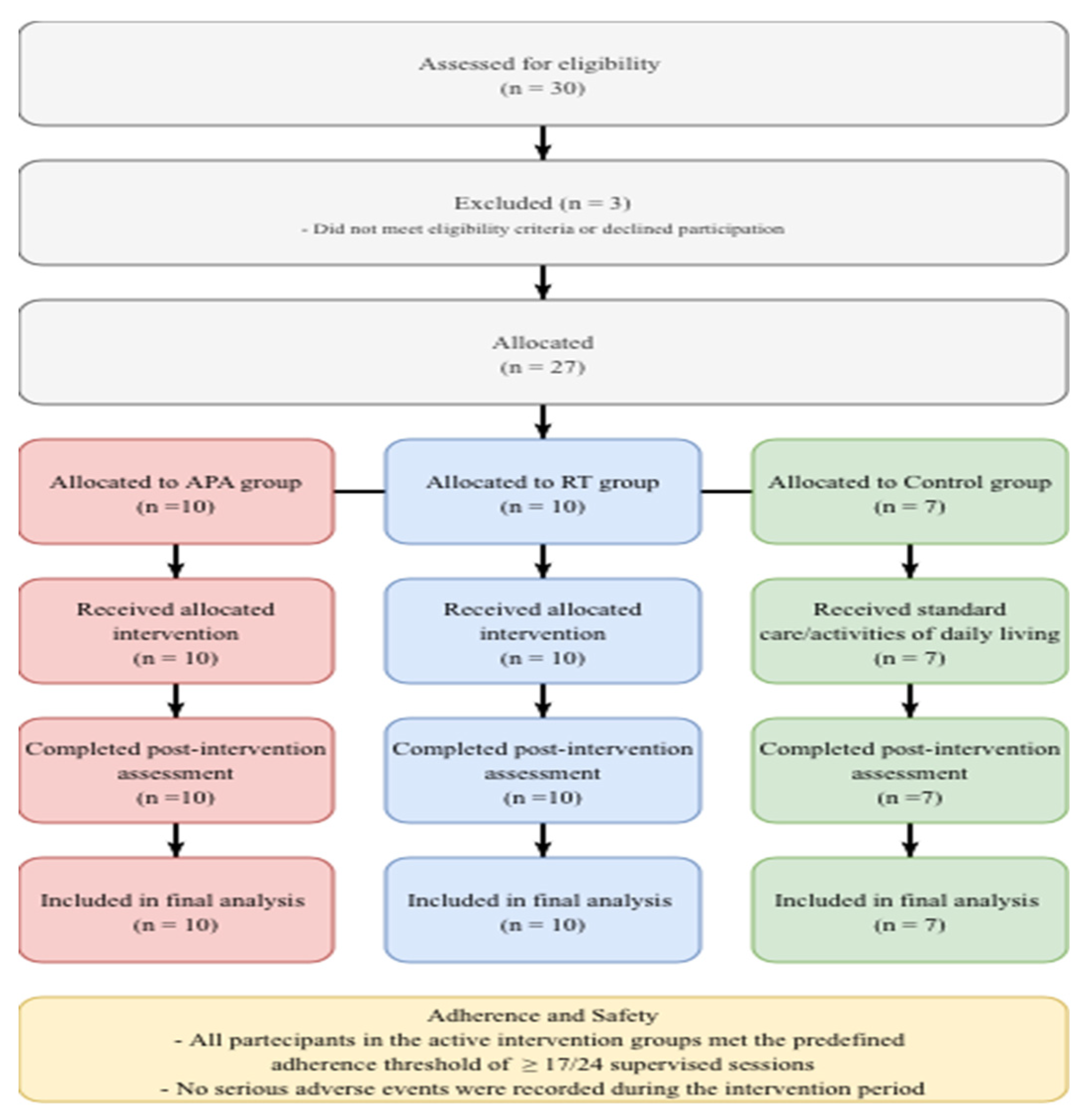
Figure 2.
Mixed ANOVA boxplot illustrating the distribution and significant variations of Walked Distance (km) across APA, RT, and Control groups from baseline (T0) to post-intervention (T1).
Figure 2.
Mixed ANOVA boxplot illustrating the distribution and significant variations of Walked Distance (km) across APA, RT, and Control groups from baseline (T0) to post-intervention (T1).
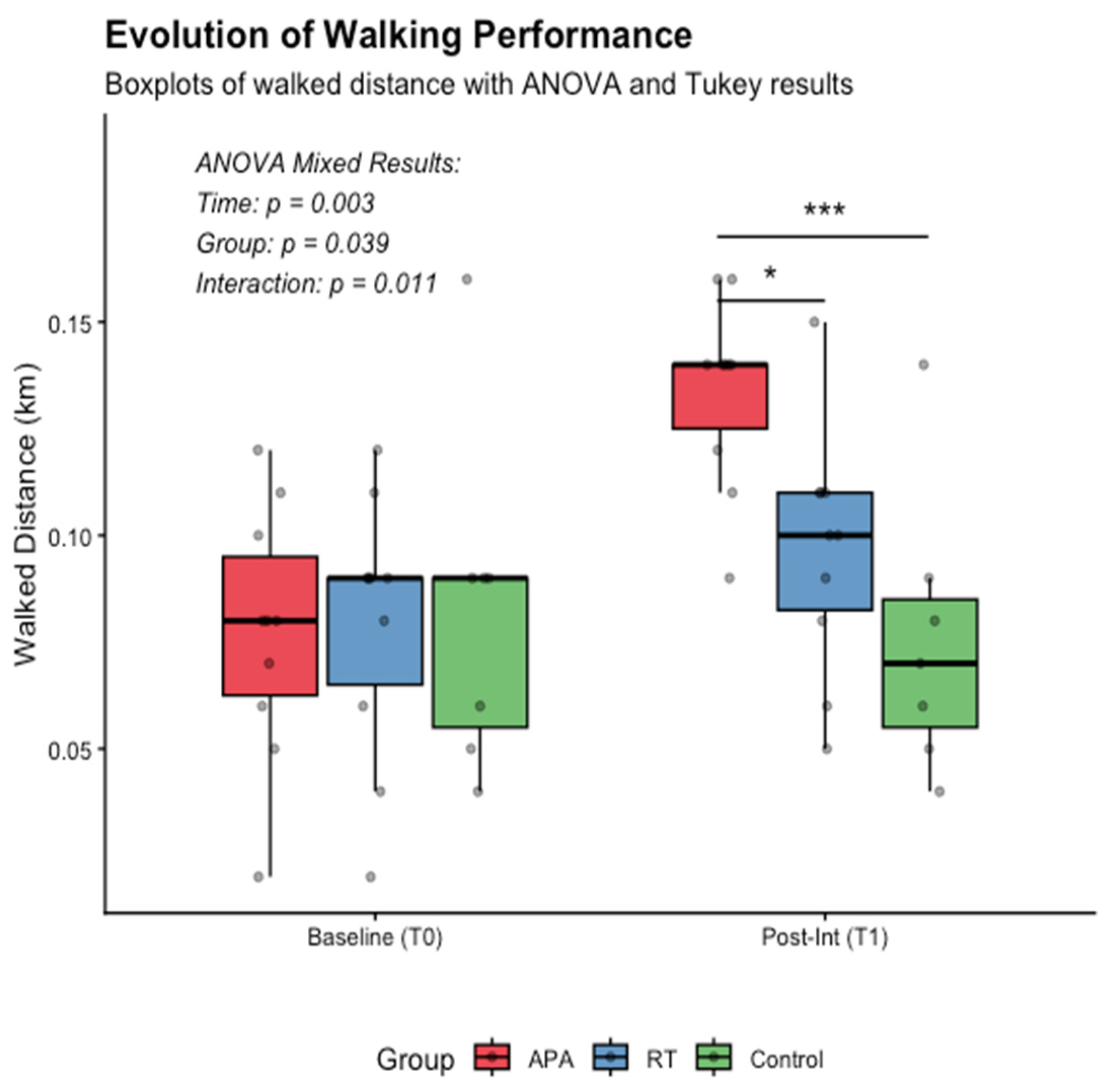
Figure 3.
Pairwise post-hoc comparisons (Tukey’s HSD) at post-intervention (T1), highlighting the greater walking distance achieved by the APA group compared to the RT and Control groups.
Figure 3.
Pairwise post-hoc comparisons (Tukey’s HSD) at post-intervention (T1), highlighting the greater walking distance achieved by the APA group compared to the RT and Control groups.
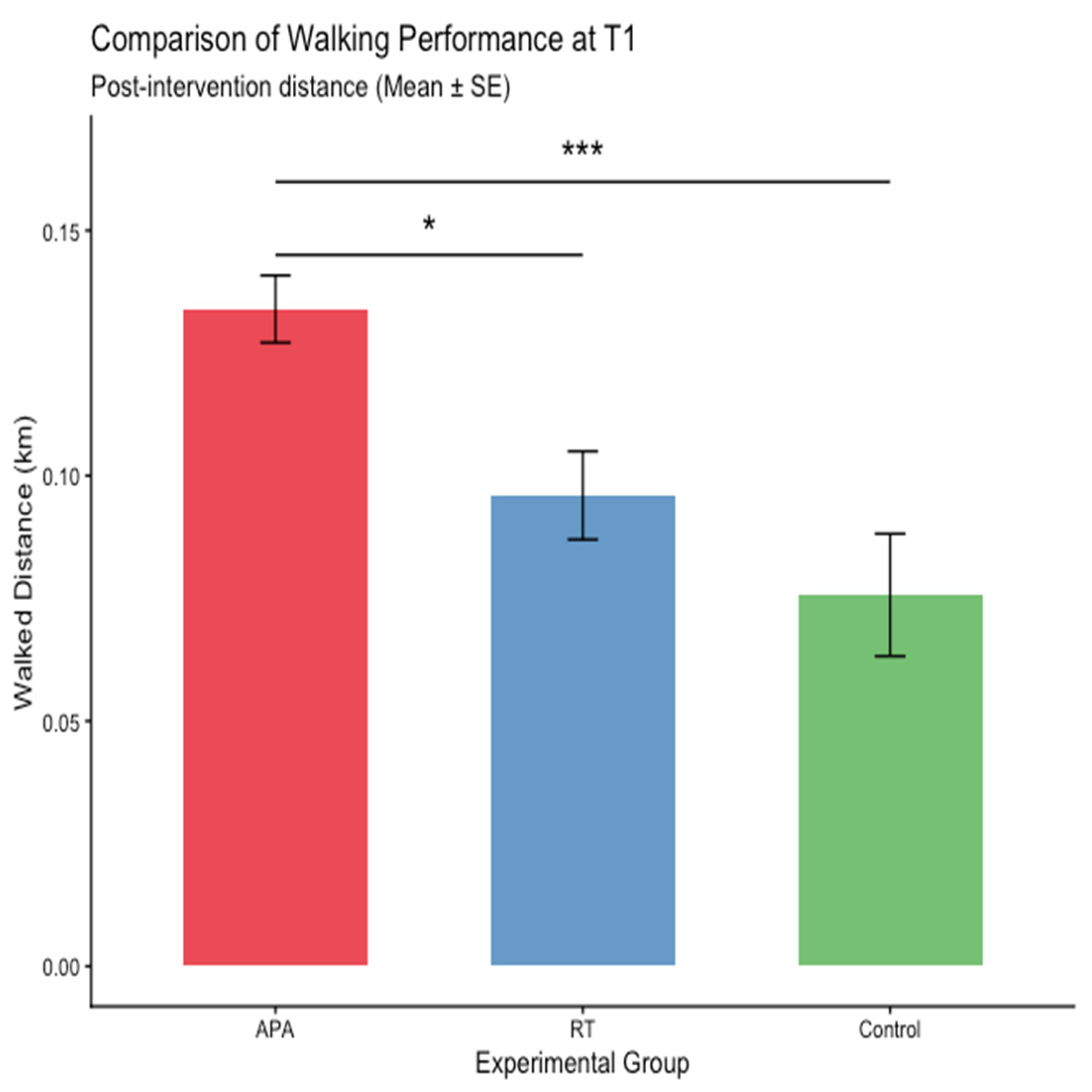
Figure 4.
Linear regression analysis showing the relationship between Right Hip Flex-Ext ROM and Walked Distance (m) at baseline (T0) for APA (red), RT (green), and Control (blue) groups.
Figure 4.
Linear regression analysis showing the relationship between Right Hip Flex-Ext ROM and Walked Distance (m) at baseline (T0) for APA (red), RT (green), and Control (blue) groups.
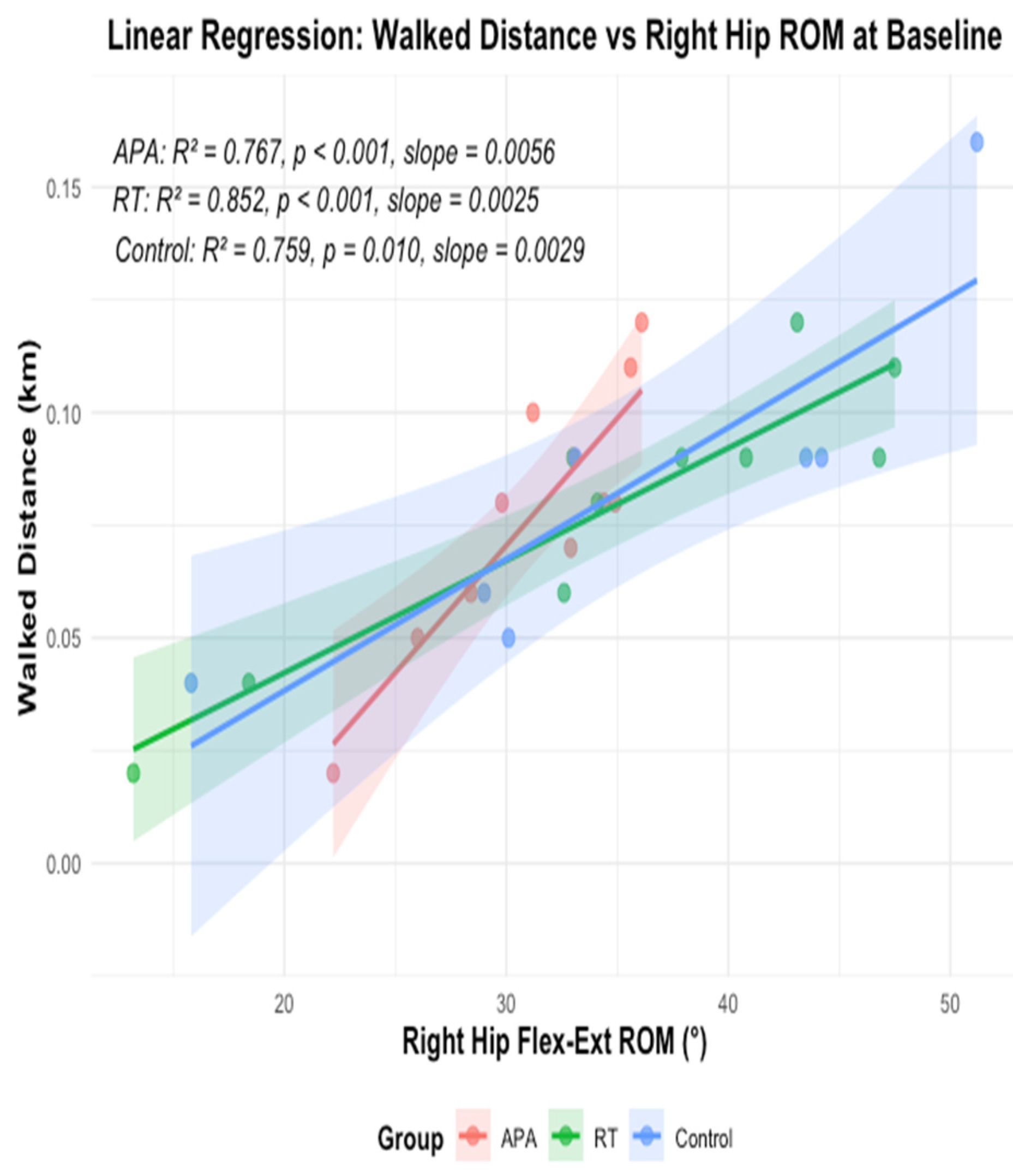
Figure 5.
Linear regression analysis showing the relationship between Right Hip Flex-Ext ROM and Walked Distance (m) post-intervention (T1) for APA (red), RT (green), and Control (blue) groups.
Figure 5.
Linear regression analysis showing the relationship between Right Hip Flex-Ext ROM and Walked Distance (m) post-intervention (T1) for APA (red), RT (green), and Control (blue) groups.
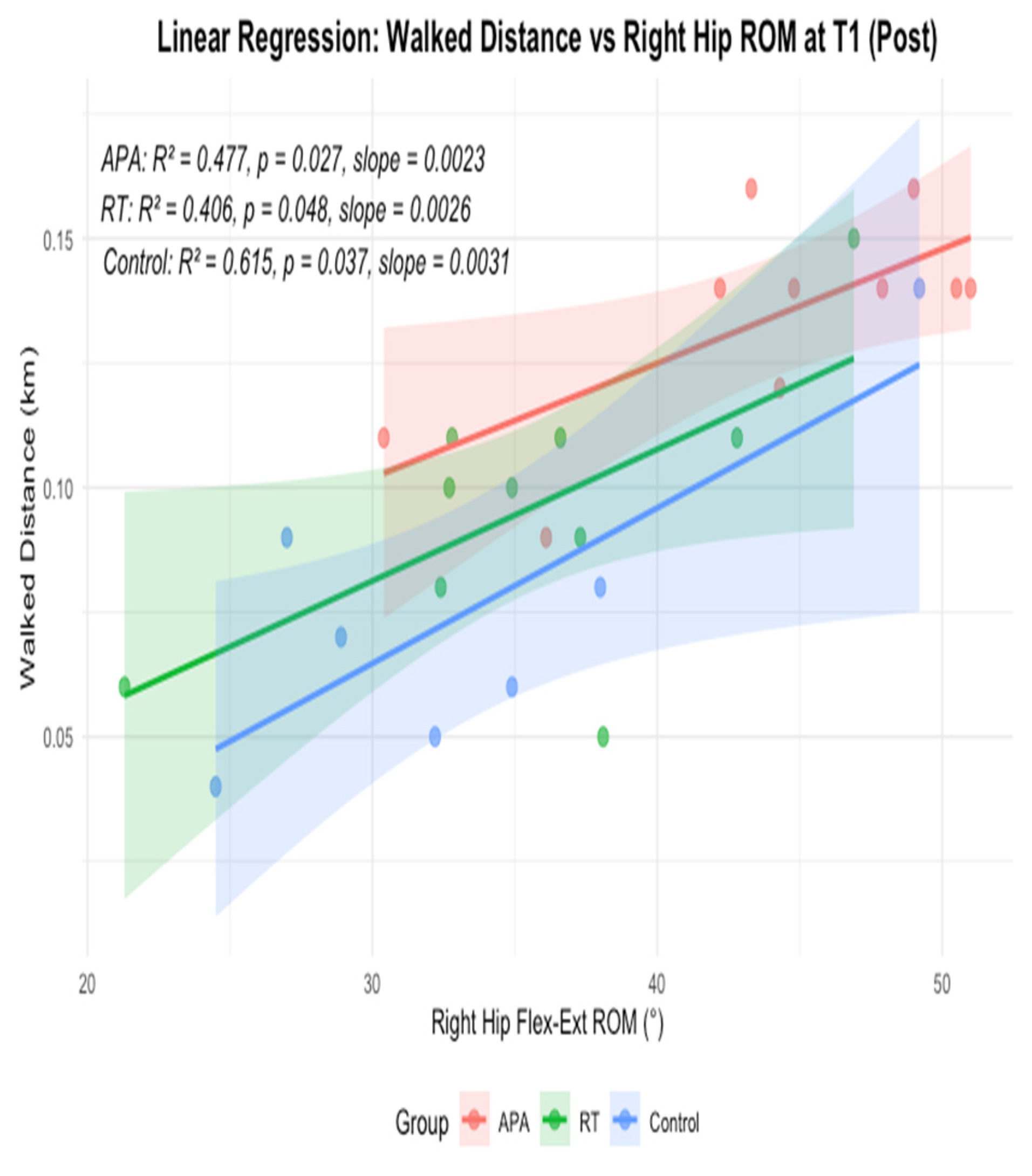
Figure 6.
Linear regression models applied to delta scores (Δ T1 – T0), illustrating the association between changes in postural-load distribution and sway area. A statistically evident relationship was observed exclusively in the APA group.
Figure 6.
Linear regression models applied to delta scores (Δ T1 – T0), illustrating the association between changes in postural-load distribution and sway area. A statistically evident relationship was observed exclusively in the APA group.
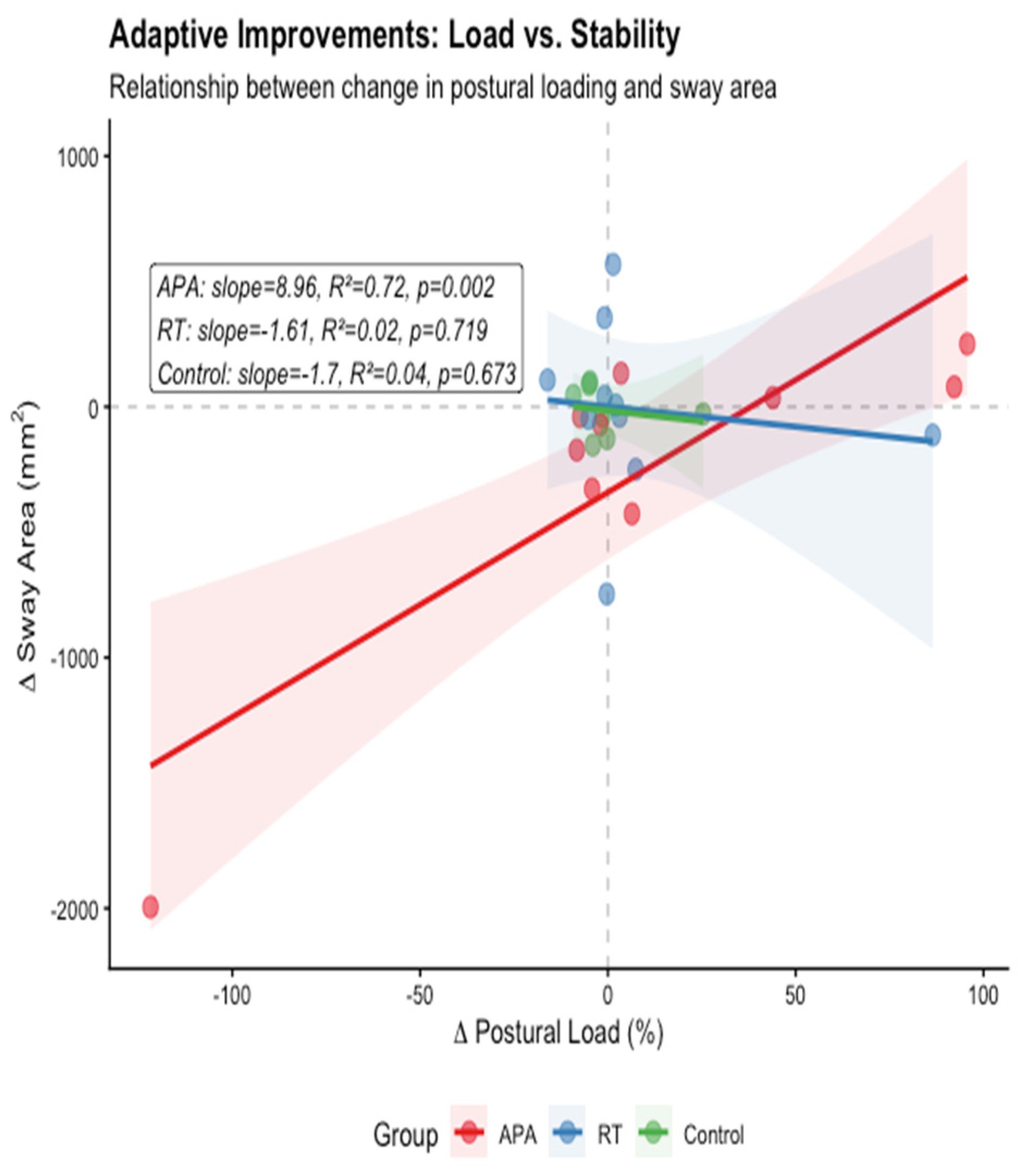

Table 1.
Baseline demographic and clinical characteristics of the study population.
| Characteristic | Total (N=27) | APA (N=10) | RT (N=10) | Control (N=7) |
| Age (years) | 70 (9) | 70 (7) | 68 (8) | 71 (12) |
| Weight (kg) | 75 (14) | 70 (12) | 79 (18) | 75 (11) |
| Sex | ||||
| – Female | 8 (30%) | 1 (10%) | 3 (30%) | 4 (57%) |
| – Male | 19 (70%) | 9 (90%) | 7 (70%) | 3 (43%) |
| Hoehn & Yahr Stage | ||||
| – Stage 1 | 3 (11%) | 0 (0%) | 1 (10%) | 2 (29%) |
| – Stage 1.5 | 2 (7.4%) | 2 (20%) | 0 (0%) | 0 (0%) |
| – Stage 2 | 5 (19%) | 3 (30%) | 1 (10%) | 1 (14%) |
| – Stage 2.5 | 11 (41%) | 3 (30%) | 5 (50%) | 3 (43%) |
| – Stage 3 | 6 (22%) | 2 (20%) | 3 (30%) | 1 (14%) |
Note: Data are presented as Mean (Standard Deviation) for continuous variables, and as n (%) for categorical variables. APA = Adapted Physical Activity; RT = Riabilitango® Tango-based therapy; Control = Control Group.
Table 2.
Operational Definitions, System Sources, and Measurement Units of Dataset.
| Variable Code | System | Full Parameter Name | Unit |
| Group | Demographics | Intervention Group | 1=APA; 2=RT; 3=Control |
| t | Timeline | Assessment Time Point | 1=T0; 2=T1 |
| SEEO_A | ProKin | CoP Ellipse Area (EO) | mm2 |
| SEEO_P | ProKin | CoP Perimeter (EO) | mm |
| SEEO_V | ProKin | Mean Sway Velocity (EO) | mm/s |
| SEEC_A | ProKin | CoP Ellipse Area (EC) | mm2 |
| SEEC_P | ProKin | CoP Perimeter (EC) | mm |
| SEEC_V | ProKin | Mean Sway Velocity (EC) | mm/s |
| DE_TSI | ProKin | Total Stability Index | Degrees |
| PA_P.S.I.AVG_total | ProKin | Mean Postural Load Distr. | % |
| GA_D | Walker View | Total Walking Distance | km |
| VO CoG | Walker View | Vert. Oscillation of CoG | cm |
| ROM_H_R_MAX | Walker View | Right Hip Max ROM | Degrees |
| ROM_H_L_MAX | Walker View | Left Hip Max ROM | Degrees |
| ROM_K_R_MAX | Walker View | Right Knee Max ROM | Degrees |
| ROM_K_L_MAX | Walker View | Left Knee Max ROM | Degrees |
Note: APA = Adapted Physical Activity; RT = Riabilitango® Tango-based therapy; ROM = Range of Motion.
Table 3.
Effect Size Analysis (Cohen’s d) for Postural Stability and Functional Walking Outcomes at T1.
Table 3.
Effect Size Analysis (Cohen’s d) for Postural Stability and Functional Walking Outcomes at T1.
| Comparison | Outcome | Cohen’s d | Magnitude | Interpretation |
| APA vs. Control | Sway Area | 1.15 | Large | Substantial reduction in sway |
| RT vs. Control | Sway Area | 0.88 | Large | Prominent reduction in sway |
| APA vs. RT | Sway Area | 0.04 | Negligible | Comparable static profiles |
| APA vs. Control | Gait Distance | 2.17 | Huge | Marked increase in walking distance |
| APA vs. RT | Gait Distance | 1.50 | Very Large | Marked difference in favor of APA |
| RT vs. Control | Gait Distance | 0.67 | Medium | Moderate difference in walking gain |
Table 4.
Bivariate Pearson Correlation Coefficients between Total Walking Distance and Joint Range of Motion (ROM) across the Whole Cohort.
Table 4.
Bivariate Pearson Correlation Coefficients between Total Walking Distance and Joint Range of Motion (ROM) across the Whole Cohort.
| Correlated Variables | Pearson r | p-value | Significance |
| Walking Distance vs. Left Hip ROM | 0.283 | .038 | * |
| Walking Distance vs. Right Hip ROM | 0.312 | .021 | * |
| Walking Distance vs. Left Knee ROM | 0.366 | .006 | ** |
| Walking Distance vs. Right Knee ROM | 0.380 | .004 | ** |
Note: All coefficients represent zero-order Pearson product-moment correlations calculated across the entire analytical sample (N = 27). * p < .05; ** p < .01 (two-tailed tests). N = 27. ROM = Range of Motion.
Disclaimer/Publisher’s Note: The statements, opinions and data contained in all publications are solely those of the individual author(s) and contributor(s) and not of MDPI and/or the editor(s). MDPI and/or the editor(s) disclaim responsibility for any injury to people or property resulting from any ideas, methods, instructions or products referred to in the content. |
© 2026 by the authors. Licensee MDPI, Basel, Switzerland. This article is an open access article distributed under the terms and conditions of the Creative Commons Attribution (CC BY) license (http://creativecommons.org/licenses/by/4.0/).
Copyright: This open access article is published under a Creative Commons CC BY 4.0 license, which permit the free download, distribution, and reuse, provided that the author and preprint are cited in any reuse.


