
Submitted:
10 July 2026
Posted:
13 July 2026
You are already at the latest version
Abstract
Modern technologies increasingly depend on microwave signals with exceptional timing stability and spectral purity. Recent advances have enabled the generation of low-phase-noise microwave signals by coherently transferring the stability of ultra-stable optical references to the microwave domain through optical frequency division, where optical microcombs serve as the bridge. Historically, most optical frequency division systems have been based on benchtop (bulk optic or fibre based) sources, with recent demonstrations focused on the potential to lower size, weight and power by leveraging integrated microcomb chip sources. Despite the extremely low noise of the microwave signals that these microcomb photonic systems can achieve, they have been typically implemented using active servos or other elaborate external control/stabilization. This greatly increases the complexity of the system, limiting its potential for miniaturization, cost and energy efficiency. Here, we demonstrate ultra-low-noise microwave generation from a fully free-running, stand-alone soliton crystal microcomb. Optical comb lines are photodetected to produce a K-band microwave signal at 25 GHz, achieving a phase noise of −120 dBc/Hz at 10 kHz offset (when scaled to a typical 10-GHz carrier frequency). This phase noise represents a 20-40 dB reduction compared with other microwave oscillators based on free-running microcomb sources, and indeed is even lower than many stabilized microcombs. Our oscillator achieves low phase noise and high fidelity while eliminating the need for any optical references or complex electronic control, thus representing a significant advance in photonics-based generation of ultralow noise microwave signals for optical frequency synthesis, LiDAR, time transfer for optical clocks, 5G/6G transceivers, radar systems and many other applications.
Keywords:
microwave photonics
; low noise
; microcomb
Low-noise microwave oscillators are of critical importance for a broad range of applications, including high-fidelity radar and LIDAR [1], high-capacity wireless communications [2], and emerging fields such as high-coherence quantum systems [3]. The rapid progress of these technologies drives an ever-growing need for microwave oscillators that meet ever stricter constraints on size, weight, and power consumption (SWaP), while delivering extremely high signal quality. Compared with electronic methods, photonic approaches have emerged as an outstanding alternative for producing microwave signals with low noise and high frequency stability, offering advantages due to high quality (Q) factors of optical resonators [4]. This capability has been greatly enhanced by the development of optical microcombs [5,6], which leverage Kerr nonlinearities in high-Q resonators to divide optical frequencies down to the microwave regime, thus providing a phase-coherent link between the optical and microwave domains [7,8]. To overcome the limitations of bulk optics or fibre-based platforms, integrated microcombs have emerged, which combine miniaturization, robustness, and complementary metal-oxide-semiconductor (CMOS) compatibility, enabling practical deployment in compact systems [9,10,11].
Most microwave oscillators based on integrated microcombs have been achieved using dissipative Kerr soliton (DKS) microcombs, that rely on a self-organizing mechanism arising from a balance between parametric gain and cavity loss, as well as between nonlinearity and dispersion [12,13]. For free-running DKS microcombs [14], a changing centre frequency of the soliton state causes a change in the repetition rate, which converts cavity–pump detuning fluctuations into timing jitter (i.e., microwave phase noise) [15,16,17]. To further reduce the phase noise, optical frequency division (OFD) offers an effective approach to transfer the frequency stability of stable optical references to the microwave domain via a phase-locked DKS [18,19,20,21]. Although these demonstrations have achieved phase noise as low as −152 dBc/Hz at 10 kHz offset when the carrier frequency is scaled to 10 GHz [19], reference lasers, reference resonators, and active feedback control loops are required. To reduce the SWaP of such systems, significant engineering challenges remain to achieve a vision of on-chip integration. Recently, optical synchronization methods, including all-optical OFD [22], Kerr-induced synchronization (KIS) [23], and colour KIS [24], have been demonstrated to enable phase-noise reduction through all-optical locking instead of electronic feedback. While this has significantly reduced the overall system complexity, it requires a reference laser, light source, or an additional resonator serving as a passive reference. Furthermore, the resulting phase noise is notably inferior to OFD-based approaches.
Here, we achieve ultra-low phase-noise microwave oscillation generated by a fully free-running soliton crystal microcomb without any external reference or feedback control (Figure 1). A microring resonator (MRR) with a radius of ~1.18 mm fabricated on a CMOS-compatible doped silica platform [9,10] as shown in the inset of Figure 1 is used to generate soliton crystals, which allows repetition rates to reach 25 GHz (25.175 ± 0.125 GHz). We generate low phase-noise microwave signals by detecting two or more soliton crystal comb lines on a high-bandwidth photo detector (PD). The generated 25-GHz signal achieves a low phase noise of −112.3 dBc/Hz at a 10 kHz offset frequency (equivalent to −120.4 dBc/Hz for 10 GHz carrier frequency). Our results fall within the lowest phase noise regime currently reported amongst all microwave oscillators based on either free-running or optically synchronized integrated microcombs. Only systems involving significant external stabilization are able to outperform our free-running system. Our demonstration establishes soliton crystals as a promising platform for fully integrated and self-stabilized photonic microwave oscillators with unprecedented phase-noise performance.
Results
Soliton crystals [25] have attracted attention as a distinct tightly packed regime of optical pulses that combine high coherence with long-term stability [26,27]. They have found broad applications in ultrahigh-bandwidth optical communications [7,27], neuromorphic computing [28,29,30,31,32], and microwave photonics [33,34,35,36,37]. They exhibit deterministic [26] soliton formation enabled by the avoided mode-crossing-induced background wave and high intracavity power, which results in a phase-locked soliton ensemble showing collective temporal ordering. In addition, the intracavity energy experiences a minimal “soliton step” [12] during the generation of soliton crystals, significantly simplifying the requirements for pump laser control, and enabling adiabatic generation of stable states through simple – even manual - wavelength sweeping.
The soliton crystal state we employ is of the ‘palm’ type that we typically use in our applications [27,28,29,31]. The device is pigtailed and packaged to a fibre array and placed on a Peltier element for long-term temperature stabilization (Figure 1b). This state is generated by simple adiabatic laser wavelength tuning over about 1 FSR (25 GHz), and once generated is run open loop (i.e., independent controls for chip temperature and laser wavelength), with the set-up shown in Figure 2a. We use a standard commercially available telecom-grade tunable laser as the pump laser (ECDL – see methods).
The microwave signal was generated from the free-running soliton crystal through photodetection of a filtered portion of the microcomb spectrum, after optical amplification (Figure 2a). Although the dual-bus structure naturally filters out broadband pump amplified spontaneous emission (ASE), a 100 GHz band-pass filter (BPF, centered at 1553.33 nm) was needed to remove the influence of MRR filtered ASE on the cross-polarization mode from affecting measurements.
The main lobe (shadowed area in Figure 2b) of the soliton crystal microcomb is a region where the lines of the microcomb nominally have the same phase, and so can coherently beat together. To fully characterize the performance of the microwave signal, we measured its phase noise when generated from the entire main lobe of the soliton crystal to assess the overall source coherence, as well as the signal generated from the beating of just two isolated comb lines to investigate the local coherence. The comb lines were selected by a bandwidth and wavelength tunable optical filter (WaveShaper), where the CW pump was suppressed when we measured the phase noise generated from the main lobe. Microwave signals were generated upon photo detection via a 40-GHz bandwidth PD with an integrated transimpedance amplifier (TIA). After photo detection, the phase noise of the 25-GHz signals was directly measured on a phase noise analyser (PNA). Figure 2c shows the phase noise of two isolated comb lines located within the main lobe ranging from 1542.6 − 1564.2 nm. The results at 1-kHz and 10-kHz offset exhibit a small variation across the main lobe wavelength range of only up to 4.2 dBc/Hz (Figure 2d), verifying that the phase noise remains stable across this region. The phase noise of the microwave signals generated by both the main lobe (red) and two lines centred around 1564 nm (blue) is shown in Figure 2e. At a 10-kHz offset frequency, the phase noise drops down to -111.4 dBc/Hz when using the entire main lobe and -112.3 dBc/Hz when using two lines. The Allan deviation at an integration time of 1s is 6.5 × 10⁻⁸ (Supplementary Section 1), which is lower than that reported for a free-running DSK state [14]. The electrical spectra of the generated microwave signal were also measured with a resolution bandwidth (RBW) of 10 Hz on the PNA as shown in Figure 2f, with signal-to-noise ratios (SNRs) of 86.2 dB and 77.0 dB for the microwave signal generated from the main lobe and two lines, respectively. This is particularly advantageous for practical applications that require both high signal fidelity and detection sensitivity.
We further characterized the phase noise of microwave signals derived from soliton crystals generated in a series of MRRs fabricated in the same CMOS-compatible doped silica glass platform. Four soliton crystals (Figure 3a) generated from four different MRRs (MRR-1 to MRR-4) were employed to produce microwave signals with repetition rates of 25.22 GHz, 25.18 GHz, 25.17 GHz, and 25.17 GHz, respectively. We note that the soliton crystal in Figure 2b, Figure 3a(i), and Figure 3b(i) were both generated from MRR-1. The ‘palm-round’ state in Figure 3a was generated when we set the temperature of the MRR chip to 29.1 ℃, which was 0.4 ℃ lower than the ‘palm’ state in Figure 2b. Figure 3b shows the measured phase noise of microwave signals generated by the main lobes of the respective microcombs. At a 10 kHz offset, the phase noise across the different soliton crystals lies between -111 dBc/Hz and -107 dBc/Hz, exhibiting variations of up to 4.2 dB. The results of two isolated comb lines are presented in Figure 4. As can be seen, the phase noise at a 10 kHz offset varies by < 7.9 dB, demonstrating the device-to-device consistency.
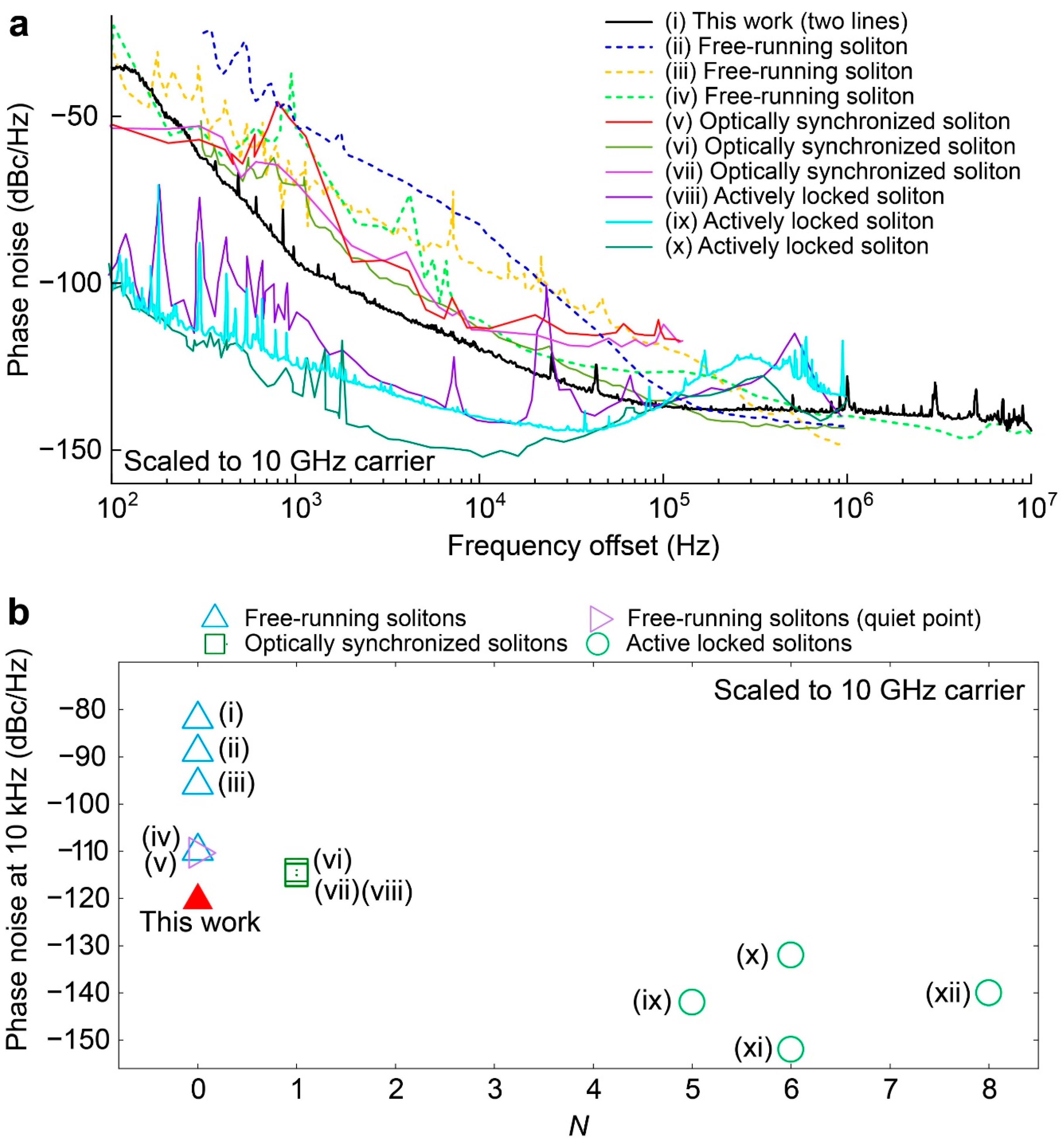
In Figure 5, we compare our results with state-of-the-art microwave oscillators based on integrated microcombs, where all the carrier frequencies are scaled to 10 GHz. We limit our comparison to integrated microcombs because the underlying thermo-optic noise processes in these devices are intrinsically distinct from those governing bulk high-Q resonators. Our best result, obtained from the soliton crystal generated by MRR-1 (shown in Figure 2), reaches a phase-noise (at the 10-kHz offset) of -120.4 dBc/Hz for the signal generated by the two lines (black). Our results are remarkably low at 10 kHz (Figure 5a), surpassing not only the best results from a free-running soliton microwave oscillator [14] (dashed green) but also the best results using optically synchronized microcombs [22] (solid green). Below 1 kHz, the noise mainly results from the pump laser relative intensity noise (RIN) [38] and can be mitigated by employing a lower noise pump laser (Supplementary Section 2). Although OFD has led to the most stable microwave signals ever generated [19] (solid dark green, “x” in Figure 5a), this requires reference lasers, additional high-Q resonators, and servo control loops, all of which increase the SWaP and make system integration onto a chip-scale platform difficult. In addition, mechanical vibrations result in fluctuations in the FSR of the MRR and corresponding frequency instability in the generated microwave signal. This can be alleviated by employing a lower noise pump, thermally stable substrates and vibration-insensitive packaging to block environmental perturbations [39], or potentially a simple phase-locked loop to stabilize slow frequency fluctuations. The phase noise at frequency offsets from 1 kHz to 1 MHz benefits from the stabilizing soliton-crystal dynamics and the inherently low-noise doped-silica platform, leading to an ultra-low phase-noise level. We assume the noise floor (> 1 MHz) to be shot-noise limited, depending on the fundamental quantum limit of the photo detection process [38].
Figure 5b compares the phase noise at a 10 kHz offset achieved here with other microwave oscillators based on microcombs, plotted as a function of the number of sub-systems (N) used to stabilize the state. These subsystems include electronic feedback loops, additional resonators, reference lasers, and other key sub-systems (Supplementary Section 3). For actively locked systems, we find that N = 5−8, which represents relatively complex systems, and indicates that these were carefully designed and optimized to minimize system instabilities. This complexity can be greatly reduced by employing optical synchronization (square) methods, such as Kerr-induced synchronization (KIS) [23,24] and all-optical OFD [22]. However, although no electronics are needed for optical synchronization, it requires additional optical references or auxiliary resonators. We note that the optical synchronization systems show a higher scaled phase noise than our oscillator. When reducing system complexity to the lowest level by using free-running states, DKS states generally exhibit higher phase noise because of the repetition rate sensitivity to pump-resonator detuning fluctuations. We also note that this study used only a standard, commodity telecom integrated tunable laser assembly, packaged as test equipment (i.e., a Keysight N7714A), making our approach compatible with volume-manufactured optical components.
Our microwave oscillator, based on free-running soliton crystal microcombs, yields 20-40 dB less phase noise than other free-running systems [14,15,18,20,22] (Figure 5b). For DKS microcomb states, for example, changes in detuning between the microcavity resonance and the pump laser frequency give rise to repetition rate changes, driven primarily by a change in Raman self-frequency shift (RSFS) [15,16]. This results in a drift of the repetition rate with noise-driven changes in pump-resonance detuning, which gives rise to repetition rate noise, mapping directly onto phase noise. This can be balanced out by a “recoil” effect from interactions with third order dispersion, and effects that cause a background wave superimposed upon the soliton state, exploiting “quiet points” through dispersive waves enabled by an avoided mode crossing (AMX) [15,39], or Kerr-induced synchronization [23,24] to bind a comb line to a specific frequency. The repetition rate can be expressed as [15]
where D1 and D2 are the FSR and the second-order dispersion of the MRR. ΩRaman represents the change in repetition rate caused by the spectral shift induced by the Raman effect, while Ωrecoil corresponds to an opposing change in repetition rate.
A possible contributing factor to the low phase noise of microwave signals generated by soliton crystals is that they are a distinct tightly packed set of optical pulses, whose formation and stability are mediated by an avoided mode crossing (AMX) [26,40]. Similar to the recoil mechanisms established in soliton–radiation interactions in fibres [41,42], an AMX introduces distortions in the dispersion spectrum that enable dispersive-wave formation, which can contribute to Ωrecoil [15] opposing the spectral shift arising from the RSFS.
Recently, it has been shown [43] that trace copper contamination in silicon nitride integrated MRRs introduced by Cu diffusion from the substrate during high temperature annealing, can strongly perturb DKS dynamics by introducing excess absorption, enhanced thermal loading, and additional fluctuation pathways that degrade soliton stability, [43] which, in addition affecting the formation dynamics, could also potentially influence the repetition-rate stability. Since our doped-silica platform is intrinsically copper-free, being fabricated with low-temperature CMOS-compatible processes without high-temperature annealing, it is possible that this is a contributing factor to our low phase-noise performance.
Finally, using actively locked solitons could suppress our noise even further. This would come, however, at the expense of requiring feedback, reference lasers, or reference resonators, significantly limiting the scalability of the system and ultimately the possibility for full on-chip integration.
In conclusion, we demonstrate a microwave oscillator based on a free-running soliton crystal microcomb source that produces 25 GHz signals with phase noise of -112.3 dBc/Hz at 10 kHz offset frequency (equivalent to -120.4 dBc/Hz for 10 GHz carrier frequency) and an SNR up to ~86.2 dB. Our oscillator, which avoids the need for any external optical or electronic stabilizing systems, achieves low phase noise compared with other oscillators based on free-running DKS microcombs, including those based on quiet points or optically synchronized systems.
Given the growing demand for compact and fully integrated photonic systems [44,45], the simplicity and intrinsic stability of free-running soliton crystals highlight their potential as a practical and compact source for integrated microwave photonics, paving the way for next-generation telecommunication networks, spectroscopy, as well as radar and LIDAR systems. This work has broad implications for microcombs [47,48,49,50,51,52,53,54,55,56,57,58,59,60,61,62,63,64,65,66,67,68,69,70,71,72,73,74,75,76,77] and their applications to microwave photonics, neuromorphic processors and communications. [78,79,80,81,82,83,84,85,86,87,88,89,90,91,92,93,94,95,96,97,98,99,100,101,102,103,104,105,106,107,108,109,110,111,112,113,114,115,116,117,118,119,120,121,122,123,124,125,126,127,128] The addition and use of 2D materials [129,130,131,132,133,134,135,136,137,138,139,140,141,142,143,144,145,146,147,148,149,150,151,152,153,154,155,156,157,158,159,160,161,162,163,164,165,166,167,168,169,170,171,172,173,174] will add extra functionality to microcomb chips for potential applications to quantum photonics [175,176,177,178,179,180,181,182,183,184,185,186,187,188,189,190] and other areas [191,192,193,194,195,196,197,198,199,200]
Methods
Soliton Crystal Generation
The soliton crystal in our system is generated from an MRR fabricated on a CMOS-compatible doped silica glass platform [9,10] packaged with a standard temperature stabilization stage (Figure 1b). The intrinsic Q factor of the MRR exceeds 3 million (loaded ~2.8M) and the radius of it is ~1.18 mm (Figure 1b), yielding a (cold) FSR around 25.224 GHz (i.e., ~0.2 nm) with a D2 of 51 kHz/mode2. Soliton crystals are generated by harnessing an AMX [40], as indicated by the dispersion diagram of the MRR in (Supplementary Section 4). The initiation of the soliton crystal was achieved via a simple, slow and adiabatic pump wavelength sweeping method [46], where a CW pump laser (Keysight N7714A), amplified to ~32.9 dBm by an erbium-doped fibre amplifier (EDFA, IdealPhotonics), was swept in wavelength from blue to red. As the detuning was progressively adjusted, a stable soliton crystal oscillation state was achieved as shown in Figure 2b, generating 105 comb lines across the main lobe (shadow area) at a pump wavelength of ~1553.29 nm. When the soliton crystal is generated, a bright green emission is observed from the MRR (Figure 1b (right)) due to third-harmonic generation, where the intense intracavity field at the pump wavelength is frequency-tripled through the third-order nonlinearity of the doped silica, thus emitting light near 518 nm. Soliton crystals can demonstrate remarkable long-term power stability, with a measured relative standard deviation of -14 dB over 66 hours [27], highlighting their stability for use as a microwave oscillator.
RF Phase Noise Measurement
The lines that beat together to generate the microwave signal are selected with a WaveShaper (Coherent 4000A) as a tunable band-pass filter, where the ~10 GHz optical transfer function of these wavelength-selective switch devices enables line-by-line selection of the 25.2 GHz spaced comb lines. The WaveShaper also provides an advanced filtering function, enabling selection of the main lobe while simultaneously suppressing the pump during phase noise measurements. A standard EDFA (FiberLabs AMP-FL8015-CB), with output power tunable up to 18 dBm, is used to amplify the lines after selection, and the optically amplified lines are then sent to a 40-GHz bandwidth photodetector with an inbuilt transimpedance amplifier (Finisar XPRV2021A). The phase noise analyser (PNA) is a Rohde & Schwarz FSPN26, with the number of cross correlations set to 1. The phase noise in dBc/Hz is normalized to a measurement bandwidth of 1 Hz by the device. The nominal sensitivity of the PNA is -129 dBc/Hz at 10kHz offset at a 26 GHz carrier frequency, 17 dB lower than our measured value.
Supplementary Materials
The following supporting information can be downloaded at the website of this paper posted on Preprints.org.
Conflicts of Interest
The authors declare no competing interests.
References
- Maleki, L. The optoelectronic oscillator. Nat. Photonics 2011, 5, 728–730. [Google Scholar] [CrossRef]
- Maiwald, T.; et al. A Review of Integrated Systems and Components for 6G Wireless Communication in the D-Band. Proc. IEEE 2023, 111, 220–256. [Google Scholar] [CrossRef]
- Yan, C.; et al. A low-noise on-chip coherent microwave source. Nat. Electron. 2021, 4, 885–892. [Google Scholar] [CrossRef]
- Matei, D.; et al. 1.5 μ m Lasers with Sub-10 mHz Linewidth. Phys. Rev. Lett. 2017, 118, 263202. [Google Scholar] [CrossRef]
- Sun, Y.; et al. Applications of optical microcombs. Adv. Opt. Photon. 2023, 15, 86–175. [Google Scholar] [CrossRef]
- Fortier, T.; Baumann, E. 20 years of developments in optical frequency comb technology and applications. Commun. Phys. 2019, 2, 153. [Google Scholar] [CrossRef]
- Corcoran, B.; Mitchell, A.; Morandotti, R.; Oxenløwe, L. K.; Moss, D. J. Optical microcombs for ultrahigh-bandwidth communications. Nat. Photonics 2025, 19, 451–462. [Google Scholar] [CrossRef]
- Pasquazi, et al. Micro-combs: A novel generation of optical sources. Phys. Rep. 2018, 729, 1–81. [Google Scholar] [CrossRef]
- Razzari, L.; et al. CMOS-compatible integrated optical hyper-parametric oscillator. Nat. Photonics 2010, 4, 41–45. [Google Scholar] [CrossRef]
- Moss, D.; Morandotti, R.; Gaeta, A. L.; Lipson, M. New CMOS-compatible platforms based on silicon nitride and Hydex for nonlinear optics,". Nat. Photonics Review (in English). 2013, 7, 597–607. [Google Scholar] [CrossRef]
- Levy, J. S.; Gondarenko, A.; Foster, M. A.; Turner-Foster, A. C.; Gaeta, A. L.; Lipson, M. CMOS-compatible multiple-wavelength oscillator for on-chip optical interconnects,". Nat. Photonics Article (in English). 2010, 4, 37–40. [Google Scholar] [CrossRef]
- Kippenberg, T. J.; Gaeta, A. L.; Lipson, M.; Gorodetsky, M. L. Dissipative Kerr solitons in optical microresonators. Science 2018, 361. [Google Scholar]
- Guo, H.; et al. Universal dynamics and deterministic switching of dissipative Kerr solitons in optical microresonators. Nat. Phys. 2017, 13, 94–102. [Google Scholar]
- Liu, J.; et al. Photonic microwave generation in the X- and K-band using integrated soliton microcombs. Nat. Photonics 2020, 14, 486–491. [Google Scholar] [CrossRef]
- Yi, X.; Yang, Q.-F.; Zhang, X.; Yang, K. Y.; Li, X.; Vahala, K. Single-mode dispersive waves and soliton microcomb dynamics. Nat. Commun. 2017, 8, 14869. [Google Scholar] [CrossRef] [PubMed]
- Mitschke, F. M.; Mollenauer, L. F. Discovery of the soliton self-frequency shift. Opt. Lett. 1986, 11, 659–661. [Google Scholar] [CrossRef] [PubMed]
- Gordon, J. P. Theory of the soliton self-frequency shift. Opt. Lett. 1986, 11, 662–664. [Google Scholar] [CrossRef] [PubMed]
- Sun, S.; et al. Integrated optical frequency division for microwave and mmWave generation. Nature 2024, 627, 540–545. [Google Scholar] [CrossRef] [PubMed]
- Ji, Q.-X.; et al. Dispersive-wave-agile optical frequency division. Nat. Photonics 19, 624–629, 2025/06/01 2025. [CrossRef] [PubMed]
- Kudelin, et al. Photonic chip-based low-noise microwave oscillator. Nature 2024, 627, 534–539. [Google Scholar] [CrossRef] [PubMed]
- Sun, S.; et al. Microcavity Kerr optical frequency division with integrated SiN photonics. Nat. Photonics 2025, 19, 637–642. [Google Scholar] [CrossRef]
- Zhao, Y.; et al. All-optical frequency division on-chip using a single laser. Nature 2024, 627, 546–552. [Google Scholar] [CrossRef] [PubMed]
- Moille, G.; et al. Kerr-induced synchronization of a cavity soliton to an optical reference. Nature 2023, 624, 267–274. [Google Scholar] [CrossRef] [PubMed]
- Moille, G.; Shandilya, P.; Niang, A.; Menyuk, C.; Carter, G.; Srinivasan, K. Versatile optical frequency division with Kerr-induced synchronization at tunable microcomb synthetic dispersive waves. Nat. Photonics 2025, 19, 36–43. [Google Scholar] [CrossRef]
- Cole, D. C.; Lamb, E. S.; Del’Haye, P.; Diddams, S. A.; Papp, S. B. Soliton crystals in Kerr resonators. Nat. Photonics 2017, 11, 671–676. [Google Scholar] [CrossRef]
- Yang, X.; et al. Turnkey Deterministic Soliton Crystal Generation. Laser Photon. Rev. 2025, 19, 2401687. [Google Scholar] [CrossRef]
- Corcoran, B.; et al. Ultra-dense optical data transmission over standard fibre with a single chip source,". Nat. Commun. Article 2020, 11, 7. (In English) [Google Scholar] [CrossRef] [PubMed]
- Xu, X.; et al. 11 TOPS photonic convolutional accelerator for optical neural networks. Nature 2021, 589, 44–51. [Google Scholar] [CrossRef] [PubMed]
- Bai, Y.; et al. TOPS-speed complex-valued convolutional accelerator for feature extraction and inference. Nat. Commun. 2025, 16, 292. [Google Scholar] [CrossRef] [PubMed]
- Chen, S.; et al. High-Bit-Efficiency TOPS Optical Tensor Convolutional Accelerator Using Microcombs. Laser Photon. Rev. 2025, 19, 2401975. [Google Scholar] [CrossRef]
- Tan, M.; et al. Photonic signal processor based on a Kerr microcomb for real-time video image processing. Commun. Eng. 2023, 2, 94. [Google Scholar] [CrossRef]
- Xu, X.; et al. Photonic Perceptron Based on a Kerr Microcomb for High-Speed, Scalable, Optical Neural Networks,". Laser Photon. Rev. Article (in English). 2020, 14, 2000070. [Google Scholar] [CrossRef]
- Tan, M.; et al. Highly Versatile Broadband RF Photonic Fractional Hilbert Transformer Based on a Kerr Soliton Crystal Microcomb. J. Light. Technol. 2021, 39, 7581–7587. [Google Scholar] [CrossRef]
- Tan, M.; et al. Photonic RF Arbitrary Waveform Generator Based on a Soliton Crystal Micro-Comb Source,". Journal Light. Technol. Article 2020, 38, 6221–6226. (In English) [Google Scholar] [CrossRef]
- Xu, X.; et al. Broadband Photonic RF Channelizer With 92 Channels Based on a Soliton Crystal Microcomb,". Journal Light. Technol. Article 2020, 38, 5116–5121. (In English) [Google Scholar] [CrossRef]
- Xu, X.; et al. Advanced Adaptive Photonic RF Filters with 80 Taps Based on an Integrated Optical Micro-Comb Source,". Journal Light. Technol. 2019, 37, 1288–1295. (In English) [Google Scholar] [CrossRef]
- Xu, X.; et al. Reconfigurable broadband microwave photonic intensity differentiator based on an integrated optical frequency comb source. APL Phontonics 2017, 2, 096104. [Google Scholar] [CrossRef]
- Liang, W.; et al. High spectral purity Kerr frequency comb radio frequency photonic oscillator. Nat. Commun. 2015, 6, 7957. [Google Scholar] [CrossRef] [PubMed]
- Yang, Q.-F.; et al. Dispersive-wave induced noise limits in miniature soliton microwave sources. Nat. Commun. 2021, 12, 1442. [Google Scholar] [CrossRef] [PubMed]
- Murray, C. E.; et al. Investigating the thermal robustness of soliton crystal microcombs. Opt. Express 2023, 31, 37749–37762. [Google Scholar] [CrossRef]
- Akhmediev, N.; Karlsson, M. Cherenkov radiation emitted by solitons in optical fibers. Phys. Rev. A 51, 2602–2607. [CrossRef] [PubMed]
- Erkintalo, M.; Xu, Y. Q.; Murdoch, S. G.; Dudley, J. M.; Genty, G. Cascaded Phase Matching and Nonlinear Symmetry Breaking in Fiber Frequency Combs. Phys. Rev. Lett. 2012, 109, 223904. [Google Scholar] [CrossRef] [PubMed]
- Ji, X.; et al. Deterministic soliton microcombs in Cu-free photonic integrated circuits. Nature 2025, 646, 843–849. [Google Scholar] [CrossRef] [PubMed]
- Han, C.; Bowers, J. E. Microcomb technology: enabling scalable integrated photonic systems. Photonics Insights 2025, 4, C05. [Google Scholar] [CrossRef]
- Farmakidis, N.; Dong, B.; Bhaskaran, H. Integrated photonic neuromorphic computing: opportunities and challenges. Nat. Rev. Electr. Eng. 2024, 1, 358–373. [Google Scholar] [CrossRef]
- Wang, W.; et al. Robust soliton crystals in a thermally controlled microresonator. Opt. Lett. 2018, 43, 2002–2005. [Google Scholar] [CrossRef] [PubMed]
- Moss, D. J.; Morandotti, R.; Gaeta, A. L.; Lipson, M. New CMOS compatible platforms based on silicon nitride and Hydex for nonlinear optics. Nat. Photonics 2013, 7, 597–607. [Google Scholar] [CrossRef]
- Razzari, L.; et al. CMOS-compatible integrated optical hyper-parametric oscillator. Nat. Photonics 2010, 4, 41–45. [Google Scholar]
- Pasquazi, et al. Sub-picosecond phase-sensitive optical pulse characterization on a chip. Nat. Photonics 2011, 5, 618–623. [Google Scholar] [CrossRef]
- Ferrera, M.; et al. On-Chip ultra-fast 1st and 2nd order CMOS compatible all-optical integration. Opt. Express 2011, 19, 23153–23161. [Google Scholar] [CrossRef]
- Bao, C.; et al. Direct soliton generation in microresonators. Opt. Lett. 2017, 42, 2519. [Google Scholar] [CrossRef] [PubMed]
- Ferrera, M.; et al. CMOS compatible integrated all-optical RF spectrum analyzer. Opt. Express 2014, 22, 21488–21498. [Google Scholar] [CrossRef]
- Kues, M.; et al. Passively modelocked laser with an ultra-narrow spectral width. Nat. Photonics 2017, 11, 159. [Google Scholar] [CrossRef]
- Ferrera, M.; et al. Low-power continuous-wave nonlinear optics in doped silica glass integrated waveguide structures. Nat. Photonics 2008, 2, 737–740. [Google Scholar] [CrossRef]
- Ferrera, M. On-Chip ultra-fast 1st and 2nd order CMOS compatible all-optical integration. Opt. Express 2011, 19, 23153–23161. [Google Scholar] [CrossRef]
- Duchesne, D.; Peccianti, M.; Lamont, M. R. E.; et al. Supercontinuum generation in a high index doped silica glass spiral waveguide. Opt. Express 2010, 18, 923–930. [Google Scholar] [CrossRef]
- Bao, H.; et al. Turing patterns in a fiber laser with a nested microresonator: Robust and controllable microcomb generation. Phys. Rev. Res. 2020, 2, 023395. [Google Scholar] [CrossRef]
- Ferrera, M.; et al. On-chip CMOS-compatible all-optical integrator. Nat. Commun. 2010, 1, 29. [Google Scholar]
- Pasquazi, et al. All-optical wavelength conversion in an integrated ring resonator. Opt. Express 2010, 18, 3858–3863. [Google Scholar] [CrossRef]
- Pasquazi; Park, Y.; Azana, J.; et al. Efficient wavelength conversion and net parametric gain via Four Wave Mixing in a high index doped silica waveguide. Opt. Express 2010, 18, 7634–7641. [Google Scholar] [CrossRef]
- Peccianti; Ferrera, M.; Razzari, L.; et al. Subpicosecond optical pulse compression via an integrated nonlinear chirper. Opt. Express 2010, 18, 7625–7633. [Google Scholar] [CrossRef]
- Ferrera, M.; et al. All-optical 1st and 2nd order integration on a chip. Opt. Express 2011, 19, 23153–23161. [Google Scholar] [CrossRef]
- Ferrera, M.; et al. Low Power CW Parametric Mixing in a Low Dispersion High Index Doped Silica Glass Micro-Ring Resonator with. Opt. Express 2009, vol.17, 14098–14103. [Google Scholar] [CrossRef]
- Peccianti, M.; et al. Demonstration of an ultrafast nonlinear microcavity modelocked laser. Nat. Commun. 2012, 3, 765. [Google Scholar]
- Pasquazi, et al. Self-locked optical parametric oscillation in a CMOS compatible microring resonator: a route to robust optical frequency comb generation on a chip. Opt. Express 2013, 21, 13333–13341. [Google Scholar] [CrossRef]
- Pasquazi, et al. Stable, dual mode, high repetition rate mode-locked laser based on a microring resonator. Opt. Express 2012, 20, 27355–27362. [Google Scholar] [CrossRef]
- Pasquazi, A.; et al. Micro-combs: a novel generation of optical sources. Phys. Rep. 2018, 729, 1–81. [Google Scholar] [CrossRef]
- Bao, H.; et al. Laser cavity-soliton microcombs. Nat. Photonics 2019, 13, 384–389. [Google Scholar] [CrossRef]
- Cutrona, et al. High Conversion Efficiency in Laser Cavity-Soliton Microcombs. Opt. Express 2022, 30, 39816–39825. [Google Scholar] [CrossRef]
- Rowley, M.; et al. Self-emergence of robust solitons in a micro-cavity. Nature 2022, 608, 303–309. [Google Scholar] [CrossRef]
- Cutrona, et al. Nonlocal bonding of a soliton and a blue-detuned state in a microcomb laser. Nat. Commun. Phys. 2023, 6, 259. [Google Scholar]
- Aadhi, A.; et al. Mode-locked laser with multiple timescales in a microresonator-based nested cavity. APL Photonics 2024, 9, 031302. [Google Scholar]
- Cooper, et al. Parametric interaction of laser cavity-solitons with an external CW pump. Opt. Express 2024, 32, 21783–21794. [Google Scholar] [CrossRef] [PubMed]
- Cutrona, et al. Stability Properties of Laser Cavity-Solitons for Metrological Applications. Appl. Phys. Lett. 2023, 122, 121104. [Google Scholar]
- Murray, E.; et al. Investigating the thermal robustness of soliton crystal microcombs. Opt. Express 2023, 31, 37749–37762. [Google Scholar] [CrossRef] [PubMed]
- Sun, Y.; et al. Enhancing laser temperature stability by passive self-injection locking to a micro-ring resonator. Opt. Express 2024, 32, 23841–23855. [Google Scholar] [CrossRef] [PubMed]
- Sun, Y.; et al. Applications of optical micro-combs. Adv. Opt. Photonics 2023, 15, 86–175. [Google Scholar] [CrossRef]
- Xu, X.; et al. Reconfigurable broadband microwave photonic intensity differentiator based on an integrated optical frequency comb source. APL Photonics 2017, 2, 096104. [Google Scholar]
- Xu, X.; et al. Photonic microwave true time delays for phased array antennas using a 49 GHz FSR integrated micro-comb source. Photonics Res. 2018, 6, B30–B36. [Google Scholar] [CrossRef]
- Xu, X.; et al. Microcomb-based photonic RF signal processing. IEEE Photonics Technol. Lett. 2019, 31, 1854–1857. [Google Scholar] [CrossRef]
- Aadhi, A.; Di Lauro, L.; Fischer, B.; Dmitriev, P.; Alamgir, I.; Mazoukh, C.; Perron, N.; Viktorov, E.; Kovalev, A.; Eshaghi, A.; Vakili, S.; Chemnitz, M.; Roztocki, P.; Little, B.E.; Chu, S. T.; Moss, D. J.; Morandotti, R. Scalable Photonic Reservoir Computing for Parallel Machine Learning Tasks. Nat. Commun. 2026, 17. [Google Scholar]
- Li, Yang; Sun, Yang; Wu, Jiayang; Ren, Guanghui; Nguyen, Thach G.; Corcoran, Bill; Xu, Xingyuan; Chu, Sai T.; Little, Brent E.; Morandotti, Roberto; Mitchell, Arnan; Moss, David J. Reconfigurable Microwave Photonic Filters with Ultrasteep Roll-Off Based on Optical Microcombs. Laser Photonics Rev. 2026, 20. [Google Scholar] [CrossRef]
- Xu, et al. Advanced adaptive photonic RF filters with 80 taps based on an integrated optical micro-comb source. J. Light. Technol. 2019, 37, 1288–1295. [Google Scholar] [CrossRef]
- Xu, X.; et al. Photonic RF and microwave integrator with soliton crystal microcombs. IEEE Trans. Circuits Syst. II Express Briefs 2020, 67, 3582–3586. [Google Scholar] [CrossRef]
- Xu, X.; et al. High performance RF filters via bandwidth scaling with Kerr micro-combs. APL Photonics 2019, 4, 026102. [Google Scholar] [CrossRef]
- Tan, M.; et al. Microwave and RF photonic fractional Hilbert transformer based on a 50 GHz Kerr micro-comb. J. Light. Technol. 2019, 37, 6097–6104. [Google Scholar] [CrossRef]
- Tan, M.; et al. RF and microwave fractional differentiator based on photonics. IEEE Trans. Circuits Syst. Express Briefs 2020, 67, 2767–2771. [Google Scholar] [CrossRef]
- Tan, M.; et al. Photonic RF arbitrary waveform generator based on a soliton crystal micro-comb source. J. Light. Technol. 2020, 38, 6221–6226. [Google Scholar] [CrossRef]
- Tan, M.; et al. RF and microwave high bandwidth signal processing based on Kerr Micro-combs. Adv. Phys. X 2021, 6, 1838946. [Google Scholar]
- Xu, X.; et al. Advanced RF and microwave functions based on an integrated optical frequency comb source. Opt. Express 2018, 26, 2569. [Google Scholar] [CrossRef]
- Tan, M.; et al. Highly Versatile Broadband RF Photonic Fractional Hilbert Transformer Based on a Kerr Soliton Crystal Microcomb. J. Light. Technol. 2021, 39, 7581–7587. [Google Scholar] [CrossRef]
- Wu, J.; et al. RF Photonics: An Optical Microcombs’ Perspective. IEEE J. Sel. Top. Quantum Electron. 2018, 24, 1–20. [Google Scholar] [CrossRef]
- Nguyen, T. G.; et al. Integrated frequency comb source-based Hilbert transformer for wideband microwave photonic phase analysis. Opt. Express 2015, 23, 22087–22097. [Google Scholar] [CrossRef]
- Xu, X.; et al. Broadband RF channelizer based on an integrated optical frequency Kerr comb source. J. Light. Technol. 2018, 36, 4519–4526. [Google Scholar] [CrossRef]
- Xu, X.; et al. Continuously tunable orthogonally polarized RF optical single sideband generator based on micro-ring resonators. J. Opt. 2018, 20, 115701. [Google Scholar] [CrossRef]
- Xu, X.; et al. Orthogonally polarized RF optical single sideband generation and dual-channel equalization based on an integrated microring resonator. J. Light. Technol. 2018, 36, 4808–4818. [Google Scholar] [CrossRef]
- Xu, X.; et al. Photonic RF phase-encoded signal generation with a microcomb source. J. Light. Technol. 2020, 38, 1722–1727. [Google Scholar] [CrossRef]
- Xu, X.; et al. Broadband microwave frequency conversion based on an integrated optical micro-comb source. J. Light. Technol. 2020, 38, 332–338. [Google Scholar] [CrossRef]
- Tan, M.; et al. Photonic RF and microwave filters based on 49GHz and 200GHz Kerr microcombs. Opt. Commun. 2020, 465, 125563. [Google Scholar] [CrossRef]
- Xu, X.; et al. Broadband photonic RF channelizer with 90 channels based on a soliton crystal microcomb. J. Light. Technol. 2020, 38, 5116–5121. [Google Scholar] [CrossRef]
- Tan, M. Orthogonally polarized Photonic Radio Frequency single sideband generation with integrated micro-ring resonators. IOP J. Semicond. 2021, 42, 041305. [Google Scholar] [CrossRef]
- Tan, M.; et al. Photonic Radio Frequency Channelizers based on Kerr Optical Micro-combs. IOP J. Semicond. 2021, 42, 041302. [Google Scholar]
- Corcoran, et al. Ultra-dense optical data transmission over standard fiber with a single chip source. Nat. Commun. 2020, 11, 2568. [Google Scholar]
- Xu, X. Photonic perceptron based on a Kerr microcomb for scalable high speed optical neural networks. Laser Photonics Rev. 2020, 14, 2000070. [Google Scholar]
- Xu, X.; et al. 11 TOPs photonic convolutional accelerator for optical neural networks. Nature 2021, 589, 44–51. [Google Scholar] [CrossRef]
- Xu, X.; et al. Neuromorphic computing based on wavelength-division multiplexing. IEEE J. Sel. Top. Quantum Electron. 2023, 29, 7400112. [Google Scholar]
- Bai, Y.; et al. Photonic multiplexing techniques for neuromorphic computing. Nanophotonics 2023, 12, 795–817. [Google Scholar] [CrossRef]
- Prayoonyong, et al. Frequency comb distillation for optical superchannel transmission. J. Light. Technol. 2021, 39, 7383–7392. [Google Scholar]
- Tan, M.; et al. Integral order photonic RF signal processors based on a soliton crystal micro-comb source. IOP J. Opt. 2021, 23, 125701. [Google Scholar] [CrossRef]
- Han, W.; et al. Dual-polarization RF Channelizer Based on Microcombs. Optics Express 2024, 32, 11281–11295. [Google Scholar] [CrossRef] [PubMed]
- Han, W.; et al. Photonic RF Channelization Based on Microcombs. IEEE J. Sel. Top. Quantum Electron. 2024, 30, 7600417. [Google Scholar] [CrossRef]
- Xu, X.; et al. Microcomb-enabled parallel self- calibration optical convolution streaming processor. Light Sci. Appl. 2025. [Google Scholar] [CrossRef] [PubMed]
- Liu, Z.; et al. Advances in Soliton Crystals Microcombs. Photonics 2024, 11, 1164. [Google Scholar]
- Corcoran, et al. Optical microcombs for ultrahigh-bandwidth communications. Nature Photonics 2025, 19, 451–462. [Google Scholar] [CrossRef]
- Chen, S. Integrated photonic neural networks. npj Nanophotonics 2025, 2, 28. [Google Scholar] [CrossRef]
- Li, Y.; et al. Feedback control in micro-comb-based microwave photonic transversal filter systems. IEEE J. Sel. Top. Quantum Electron. 2024, 30, 2900117. [Google Scholar]
- Sun, Y.; et al. Optimizing the performance of microcomb based microwave photonic transversal signal processors. J. Light. Technol. 2023, 41, 7223–7237. [Google Scholar] [CrossRef]
- Tan, M.; et al. Photonic signal processor for real-time video image processing based on a Kerr microcomb. Nat. Commun. Eng. 2023, 2, 94. [Google Scholar] [CrossRef]
- Sun, Y.; et al. Quantifying the Accuracy of Microcomb-based Photonic RF Transversal Signal Processors. IEEE J. Sel. Top. Quantum Electron. 2023, 29, 7500317. [Google Scholar] [CrossRef]
- Mazoukh, et al. Genetic algorithm-enhanced microcomb state generation. Nature Communications Physics 2024, 7, 81. [Google Scholar]
- Chen, S.; et al. High-bit-efficiency TOPS optical tensor convolutional accelerator using micro-combs. Laser Photonics Rev. 2025, 19, 2401975. [Google Scholar] [CrossRef]
- Li, Y.; et al. Performance analysis of microwave photonic spectral filters based on optical microcombs. Adv. Phys. Res. 2025, 4, 2400084. [Google Scholar]
- di Lauro, L.; et al. Optimization Methods for Integrated and Programmable Photonics in Next-Generation Classical and Quantum Smart Communication and Signal Processing. Advances Opt. Photonics 2025, 17, 526–622. [Google Scholar] [CrossRef]
- Li, Y.; et al. Processing accuracy of microcomb-based microwave photonic signal processors for different input signal waveforms. Photonics 2023, 10, 10111283. [Google Scholar] [CrossRef]
- Sun, Y.; et al. Comparison of microcomb-based RF photonic transversal signal processors implemented with discrete components versus integrated chips. Micromachines 2023, 14, 1794. [Google Scholar] [CrossRef] [PubMed]
- Aadhi, A.; Di Lauro, L.; Fischer, B.; Dmitriev, P.; Alamgir, I.; Mazoukh, C.; Perron, N.; Viktorov, E.; Kovalev, A.; Eshaghi, A.; Vakili, S.; Chemnitz, M.; Roztocki, P.; Little, B.E.; Chu, S. T.; Moss, D. J.; Morandotti, R. Scalable Photonic Reservoir Computing for Parallel Machine Learning Tasks. Nature Communications 2025. [Google Scholar] [CrossRef] [PubMed]
- Xia, Chengzhuo; Xu, Yifu; Chen, Shifan; Huang, Sirui; Bai, Yunping; Chu, Sai T.; Little, Brent E.; Morandotti, Roberto; Moss, David J.; Xu, Xingyuan; Xu, Kun. TOPS-speed Reconfigurable Photonic Transposed Convolution Accelerator for Generative Tasks. Laser Photonics Rev. 2025, 0, e00771. [Google Scholar] [CrossRef]
- Tan, M.; et al. The laser trick that could put an ultraprecise optical clock on a chip. Nature 2023, 624, 256–257. [Google Scholar] [CrossRef] [PubMed]
- Hu, et al. Thermo-optic response and optical bistablility of integrated high index doped silica ring resonators. Sensors 2023, 23, 9767. [Google Scholar] [CrossRef] [PubMed]
- Zhang, Y.; et al. 2D material integrated photonics: towards industrial manufacturing and commercialization. Appl. Phys. Lett. Photonics 2025, 10, 040903. [Google Scholar]
- Jiang, W.; et al. Enhanced thermo-optic performance for silicon microring resonators integrated with 2D graphene oxide films. ACS Appl. Electron. Mater. 2025, 7, 5650–5661. [Google Scholar] [CrossRef]
- Yang, X.; et al. Turnkey deterministic soliton crystal generation. Laser Photonics Rev. 2025, 19, 2401687. [Google Scholar] [CrossRef]
- Sun, Y.; et al. Self-locking of free-running DFB lasers to a single microring resonator for dense WDM. J. Light. Technol. 2025, 43, 1995–2002. [Google Scholar] [CrossRef]
- Han, W.; et al. TOPS-speed complex-valued convolutional accelerator for feature extraction and inference. Nat. Commun. 2025, 16, 292. [Google Scholar] [PubMed]
- Hu, et al. Silicon photonic polarizers incorporating 2D MoS2 films. Invit. Pap. IEEE Journal Sel. Top. Quantum Electron. 2025, 31. [Google Scholar] [CrossRef]
- Khallouf, et al. Raman scattering and supercontinuum generation in high-index doped silica chip waveguides”, Nonlinear Optics and its Applications; Dudley, John M., Peacock, Anna C., Stiller, Birgit, Tissoni, Giovanna, Eds.; SPIE, 2024; Volume 13004, p. 130040I. [Google Scholar]
- Zerbib, et al. Observation of Brillouin scattering in a high-index doped silica chip waveguide. Results Phys. 2023, 52, 106830. [Google Scholar] [CrossRef]
- Khallouf, et al. Raman scattering and supercontinuum generation in high-index doped silica chip waveguides”, Nonlinear Optics and its Applications; Dudley, John M., Peacock, Anna C., Stiller, Birgit, Tissoni, Giovanna, Eds.; SPIE, 2024; Volume 13004, p. 130040I. [Google Scholar]
- Khallouf, et al. Supercontinuum generation in high-index doped silica photonic integrated circuits under diverse pumping settings. Opt. Express 2025, 33, 8431–8444. [Google Scholar] [CrossRef] [PubMed]
- Khallouf; Sader, L.; Bougaud, A.; Fanjoux, G.; Little, B.; Chu, S. T.; Moss, D. J.; Morandotti, R.; Agrawal, G. P.; Dudley, J. M.; Wetzel, B.; Sylvestre, And T. Dual-pumping supercontinuum generation and temporal reflection in a nonlinear photonic integrated circuit. Optics Express 2025. [Google Scholar] [CrossRef] [PubMed]
- Della Torre, et al. Mid-Infrared Supercontinuum Generation in a Varying Dispersion Waveguide for Multi-Species Gas Spectroscopy. IEEE J. Sel. Top. Quantum Electron. 2023, 29, 5100509. [Google Scholar]
- Yang, Y.; et al. Enhanced four-wave mixing in graphene oxide coated waveguides. Appl. Phys. Lett. Photonics 2018, 3, 120803. [Google Scholar]
- Wu, J.; et al. Graphene oxide waveguide and micro-ring resonator polarizers. Laser Photonics Rev. 2019, 13, 1900056. [Google Scholar] [CrossRef]
- Zhang, Y.; et al. Enhanced Kerr nonlinearity and nonlinear figure of merit in silicon nanowires integrated with 2D graphene oxide films. ACS Appl. Mater. Interfaces 2020, 12, 33094–33103. [Google Scholar]
- Qu, Y.; et al. Enhanced nonlinear four-wave mixing in silicon nitride waveguides integrated with 2D layered graphene oxide films. Adv. Opt. Mater. 2020, 8, 2001048. [Google Scholar]
- Hameed, Shahaz S.; Jin, Di; Zhao, Aihao; Wu, Jiayang; Hu, Junkai; Cueff, Sebastien; Grillet, Christian; Zhang, Yuning; Abidi, Irfan H.; Walia, Sumeet; Monat, Christelle; Moss, David J. Enhanced self-phase modulation in silicon nitride waveguides integrated with 2D MoS2 films. Adv. Mater. Technol. 2026, 11. [Google Scholar] [CrossRef]
- Wang, Rong; Jin, Di; Hu, Junkai; Liu, Wenbo; Zhang, Yuning; Abidi, Irfan H.; Walia, Sumeet; Jia, Baohua; Huang, Duan; Wu, Jiayang; Moss, David J. AI-guided design and optimization of 2D material based optical polarizers. Chip 2026. [Google Scholar] [CrossRef]
- Wang, Rong; Wang, Yijun; Jin, Di; Hu, Junkai; Liu, Wenbo; Zhang, Yuning; Jia, Baohua; Huang, Duan; Wu, Jiayang; Moss, David J. AI-guided optimization of integrated waveguide polarizers with 2D reduced graphene oxide. JOSA B 2026. [Google Scholar] [CrossRef]
- Wu, J.; et al. Enhanced nonlinear four-wave mixing in microring resonators integrated with layered graphene oxide films. Small 2020, 16, 1906563. [Google Scholar]
- Wu, J.; et al. Graphene oxide waveguide polarizers and polarization selective micro-ring resonators. Paper 11282-29, SPIE Photonics West, San Francisco, CA, 4 - 7 February (2020).
- Zhang, Y.; et al. Design and optimization of four-wave mixing in microring resonators integrated with 2D graphene oxide films. J. Light. Technol. 2021, 39, 6553–6562. [Google Scholar] [CrossRef]
- Qu, Y.; et al. Analysis of four-wave mixing in silicon nitride waveguides integrated with 2D layered graphene oxide films. J. Light. Technol. 2021, 39, 2902–2910. [Google Scholar] [CrossRef]
- Wu, J.; et al. Graphene oxide: versatile films for flat optics to nonlinear photonic chips. Adv. Mater. 2021, 33, 2006415. [Google Scholar]
- Qu, Y.; et al. Paper No. 11688-30, PW21O-OE109-36, 2D Photonic Materials and Devices IV; Graphene oxide for enhanced optical nonlinear performance in CMOS compatible integrated devices. SPIE Photonics West, 6-11 ( March 2021. [CrossRef]
- Zhang, Y.; et al. Optimizing the Kerr nonlinear optical performance of silicon waveguides integrated with 2D graphene oxide films. J. Light. Technol. 2021, 39, 4671–4683. [Google Scholar] [CrossRef]
- Qu, Y.; et al. Photo thermal tuning in GO-coated integrated waveguides. Micromachines 2022, 13, 1194. [Google Scholar]
- Zhang, Y.; et al. Graphene oxide-based waveguides for enhanced self-phase modulation. Ann. Math. Phys. 2022, 5, 103–106. [Google Scholar] [CrossRef]
- Zhang, Y.; et al. Enhanced spectral broadening of femtosecond optical pulses in silicon nanowires integrated with 2D graphene oxide films. Micromachines 2022, 13 756. [Google Scholar]
- Zhang, Y.; et al. Enhanced supercontinuum generated in SiN waveguides coated with GO films. Adv. Mater. Technol. 2023, 8, 2201796. [Google Scholar] [CrossRef]
- Zhang, Y.; et al. Graphene oxide for nonlinear integrated photonics. Laser Photonics Rev. 2023, 17, 2200512. [Google Scholar] [CrossRef]
- Wu, J.; et al. Graphene oxide for electronics, photonics, and optoelectronics. Nat. Rev. Chem. 2023, 7, 162–183. [Google Scholar] [CrossRef] [PubMed]
- Zhang, Y.; et al. Enhanced self-phase modulation in silicon nitride waveguides integrated with 2D graphene oxide films. IEEE J. Sel. Top. Quantum Electron. 2023, 29, 5100413. [Google Scholar]
- Qu, Y.; et al. Integrated optical parametric amplifiers in silicon nitride waveguides incorporated with 2D graphene oxide films. Light Adv. Manuf. 2023, 4 39. [Google Scholar]
- Wu, J.; et al. Novel functionality with 2D graphene oxide films integrated on silicon photonic chips. Advanced Mater. 2024, 36, 2403659. [Google Scholar]
- Jin, et al. Silicon photonic waveguide and microring resonator polarizers incorporating 2D graphene oxide films. Appl. Phys. Lett. 2024, 125, 053101. [Google Scholar]
- Zhang, Y.; et al. Advanced optical polarizers based on 2D materials. npj Nanophotonics 2024, 1, 28. [Google Scholar] [CrossRef]
- Hu, J.; et al. 2D graphene oxide: a versatile thermo-optic material. Adv. Funct. Mater. 2024, 34, 2406799. [Google Scholar] [CrossRef]
- Zhang, Y.; Torres, Carlos M., Jr.; Deng, Hui; et al. Graphene oxide for enhanced nonlinear optics in integrated photonic chips”, Paper 12888-16, Conference OE109, 2D Photonic Materials and Devices VII, Chair(s): Arka Majmdar; Carlos M. Torres Jr.; Hui Deng, SPIE Photonics West, San Francisco CA, January 27 – February 1 (2024). Proceedings Volume 12888, 2D Photonic Materials and Devices VII; 1288805 (2024). [CrossRef]
- Jin, et al. Thickness and Wavelength Dependent Nonlinear Optical Absorption in 2D Layered MXene Films. Small Sci. 2024, 4, 2400179. [Google Scholar] [CrossRef] [PubMed]
- Hu, J.; et al. Integrated waveguide and microring polarizers incorporating 2D reduced graphene oxide. Opto-Electron. Sci. 2025, 4, 240032. [Google Scholar] [CrossRef]
- Jia, et al. Third-order optical nonlinearities of 2D materials at telecommunications wavelengths. Micromachines 2023, 14, 307. [Google Scholar] [CrossRef] [PubMed]
- Jia, Linnan; Wu, Jiayang; Zhang, Yuning; Qu, Yang; Jia, Baohua; Chen, Zhigang; Moss, David J. Fabrication Technologies for the On-Chip Integration of 2D Materials. Small Methods 2022, 6, 2101435. [Google Scholar] [CrossRef]
- Jia, L.; et al. BiOBr nanoflakes with strong nonlinear optical properties towards hybrid integrated photonic devices. Appl. Phys. Lett. Photonics 2019, 4, 090802. [Google Scholar]
- Jia, L. Large Third-Order Optical Kerr Nonlinearity in Nanometer-Thick PdSe2 2D Dichalcogenide Films: Implications for Nonlinear Photonic Devices. ACS Appl. Nano Mater. 2020, 3, 6876–6883. [Google Scholar] [CrossRef]
- Kues, M.; et al. Quantum optical microcombs. Nat. Photonics 2019, 13, 170–179. [Google Scholar] [CrossRef]
- Reimer, C.; et al. Integrated frequency comb source of heralded single photons. Opt. Express 2014, 22, 6535–6546. [Google Scholar] [CrossRef]
- Reimer, C.; et al. Cross-polarized photon-pair generation and bi-chromatically pumped optical parametric oscillation on a chip. Nat. Commun. 2015, 6, 8236. [Google Scholar]
- Caspani, L.; et al. Multifrequency sources of quantum correlated photon pairs on-chip: a path toward integrated Quantum Frequency Combs. Nanophotonics 2016, 5, 351–362. [Google Scholar] [CrossRef]
- Montaut, et al. Progress in integrated and fiber optics for time-bin based quantum information processing. Adv. Opt. Technol. 2025, 14, 1560084. [Google Scholar] [CrossRef]
- Reimer, C.; et al. Generation of multiphoton entangled quantum states by means of integrated frequency combs. Science 2016, 351, 1176–1180. [Google Scholar] [CrossRef]
- Kues, M.; et al. On-chip generation of high-dimensional entangled quantum states and their coherent control. Nature 2017, 546, 622–626. [Google Scholar] [CrossRef]
- Roztocki, et al. Practical system for the generation of pulsed quantum frequency combs. Opt. Express 2017, 25, 18940–18949. [Google Scholar] [CrossRef]
- Zhang, Y.; et al. Induced photon correlations through superposition of two four-wave mixing processes in integrated cavities. Laser Photonics Rev. 2020, 14, 2000128. [Google Scholar]
- Reimer, C.; et al. High-dimensional one-way quantum processing implemented on d-level cluster states. Nat. Phys. 2019, 15, 148–153. [Google Scholar]
- Roztocki, et al. Complex quantum state generation and coherent control based on integrated frequency combs. J. Light. Technol. 2019, 37, 338–347. [Google Scholar] [CrossRef]
- Sciara, S.; et al. Generation and Processing of Complex Photon States with Quantum Frequency Combs. IEEE Photonics Technol. Lett. 2019, 31, 1862–1865. [Google Scholar] [CrossRef]
- Yu, H.; et al. Quantum key distribution implemented with d-level time-bin entangled photons. Nat. Commun. 2025, 16, 171. [Google Scholar] [CrossRef] [PubMed]
- Yu, H.; et al. Exploiting nonlocal correlations for dispersion-resilient quantum communications. Phys. Rev. Lett. 2025, 134, 220801. [Google Scholar] [CrossRef] [PubMed]
- Sciara, S.; et al. Scalable and effective multilevel entangled photon states: A promising tool to boost quantum technologies. Nanophotonics 2021, 10, 4447–4465. [Google Scholar] [CrossRef]
- Caspani, L.; et al. Multifrequency sources of quantum correlated photon pairs on-chip: a path toward integrated Quantum Frequency Combs. Nanophotonics 2016, 5, 351–362. [Google Scholar] [CrossRef]
- Arianfard, H.; et al. Sagnac interference in integrated photonics. Appl. Phys. Rev. 2023, 10, 011309. [Google Scholar] [CrossRef]
- Arianfard, H.; et al. Optical analogs of Rabi splitting in integrated waveguide-coupled resonators. Adv. Phys. Res. 2023, 2, 2200123. [Google Scholar] [CrossRef]
- Arianfard, H.; et al. Spectral shaping based on optical waveguides with advanced Sagnac loop reflectors”, Paper PW22O-OE201-20, SPIE-Opto, Integrated Optics: Devices, Materials, and Technologies XXVI, SPIE Photonics West, San Francisco CA January 22 - 27 (2022).
- Jin, Di; et al. Modelling of complex integrated photonic resonators using scattering matrix method. Photonics 2024, 11, 1107. [Google Scholar]
- Arianfard, H.; et al. Spectral Shaping Based on Integrated Coupled Sagnac Loop Reflectors Formed by a Self-Coupled Wire Waveguide. IEEE Photonics Technol. Lett. 2021, 33, 680–683. [Google Scholar] [CrossRef]
- Arianfard, H.; et al. Three Waveguide Coupled Sagnac Loop Reflectors for Advanced Spectral Engineering. J. Light. Technol. 2021, 39, 3478–3487. [Google Scholar] [CrossRef]
- Arianfard, H.; et al. Advanced Multi-Functional Integrated Photonic Filters based on Coupled Sagnac Loop Reflectors. J. Light. Technol. 2021, 39, 1400–1408. [Google Scholar] [CrossRef]
- Arianfard, H.; et al. Advanced multi-functional integrated photonic filters based on coupled Sagnac loop reflectors” Paper 11691-4, PW21O-OE203-44, Silicon Photonics XVI, SPIE Photonics West, San Francisco CA March 6-11 (2021).
- Wu, J.; et al. Advanced photonic filters via cascaded Sagnac loop reflector resonators in silicon-on-insulator integrated nanowires. Appl. Phys. Lett. Photonics 2018, 3, 046102. [Google Scholar]
- Wu, J.; et al. Micro-ring resonator quality factor enhancement via an integrated Fabry-Perot cavity. Appl. Phys. Lett. Photonics 2017, 2, 056103. [Google Scholar]
Figure 1.
Schematic representation of microwave signal generation using a free-running integrated soliton crystal microcomb. MRR: microring resonator. PD: photo detector. Inset: Photograph of the CMOS-compatible doped silica glass platform (left top), MRR (left bottom), and the packaged chip under operation for soliton crystal generation (right).
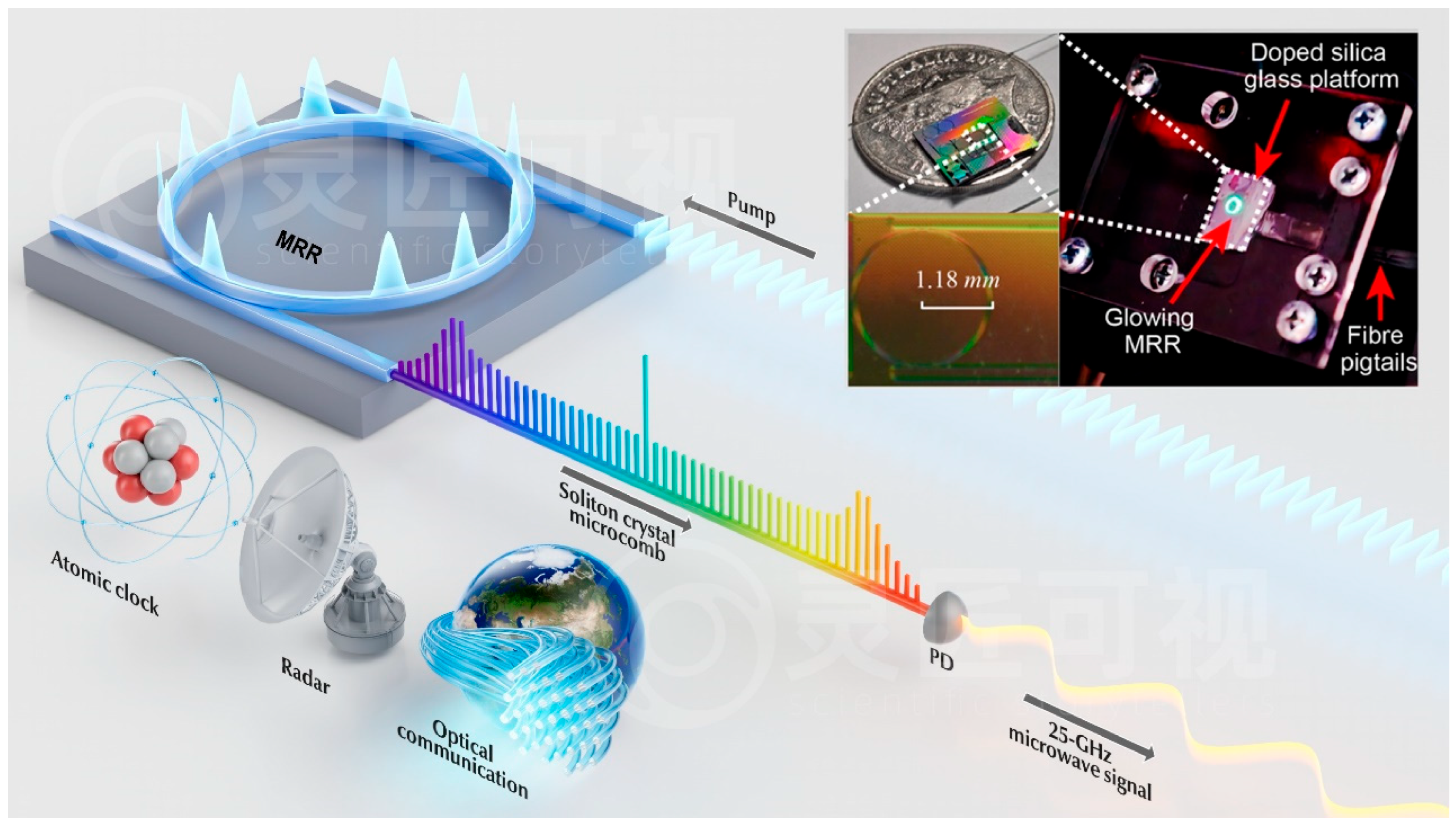
Figure 2.
Characterization of the microwave signal generated from the free-running soliton crystal. a. Schematic of the experimental set-up. A standard tunable telecom external cavity diode laser (ECDL) is amplified by a high-power erbium-doped fibre amplifier (EDFA), filtered with a fixed band-pass filter (BPF) to remove excess ASE, and then pumps microcomb generation in the microring resonator (MRR). The microcomb is filtered with a bandwidth and wavelength tunable bandpass filter (T-BPF) to reject the pump and select lines, optical amplified by a standard EDFA, then the microwave signal is generated with a photodiode (PD), and the phase noise is measured with a phase noise analyzer (PNA). b. Measured optical spectrum of the soliton crystal. The microcomb has a repetition rate of ~25.22 GHz, and 105 lines within the main lobe. c. The phase noise of microwave signals generated by two isolated comb lines located within the main lobe ranging from 1542.6 − 1564.2 nm. d. Phase noise at 1 kHz and 10 kHz offset of microwave signals generated from two isolated lines at different locations on the spectrum of the soliton crystal. e. Phase noise of microwave signals generated by the main lobe and two isolated comb lines centred around 1564 nm is shown in red and blue, respectively. Phase noise at 1 kHz and 10 kHz offsets, for the 25.2 GHz carrier, are -86 and -112 dBc/Hz, respectively. The PNA instrument limit is shown as the yellow dashed line. f. Electrical spectra of the generated 25-GHz microwave signal from the main lobe (left) and two tones (right). RBW, resolution bandwidth.
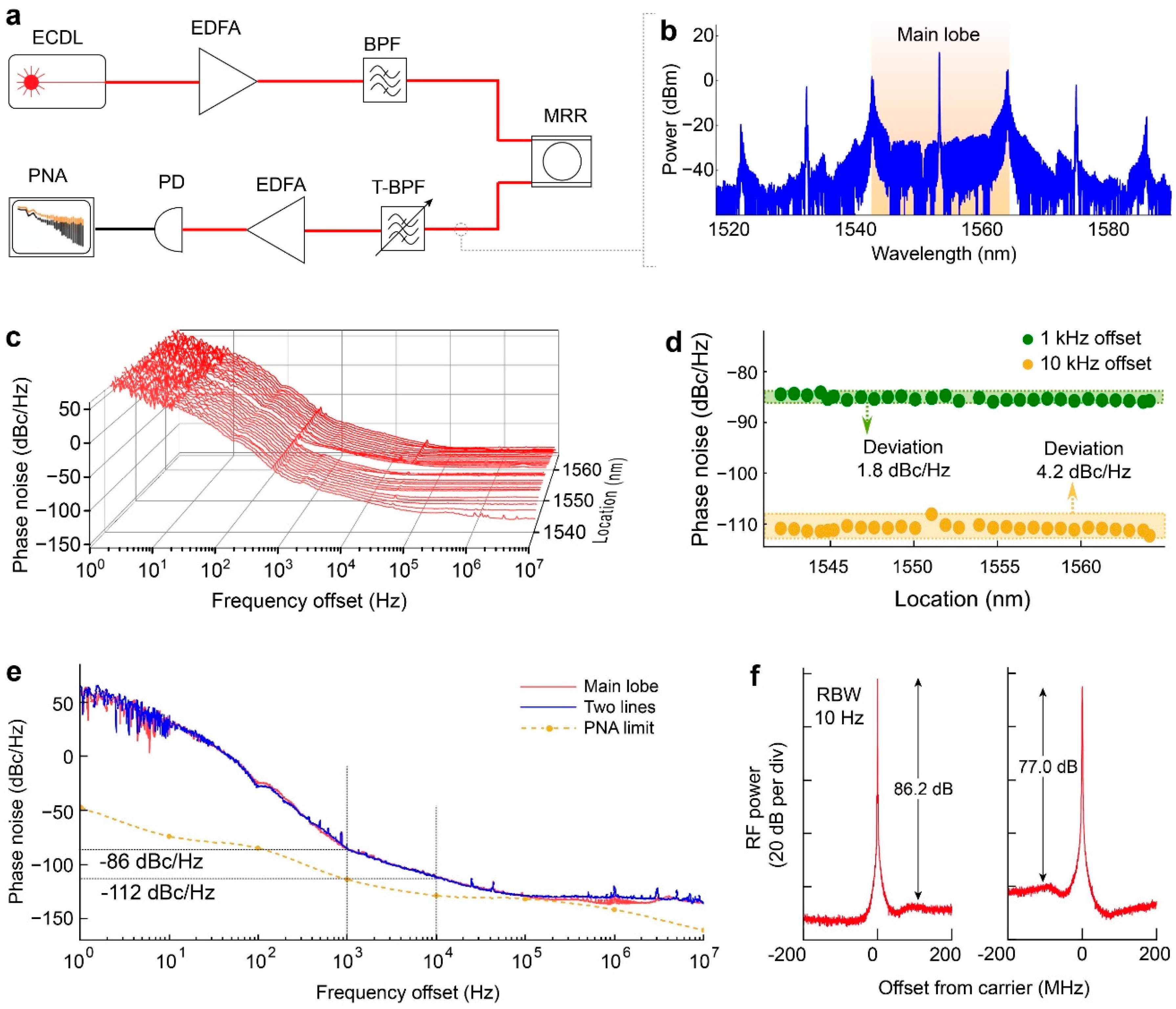
Figure 3.
Reproducible phase-noise performance measured from soliton crystals across a series of MRRs fabricated on the CMOS-compatible doped silica glass platform. (a) Measured optical spectra of soliton crystals generated from four different MRRs. The repetition rates are (ⅰ) 25.22 GHz, (ⅱ) 25.18 GHz, (ⅲ) 25.17 GHz, and (ⅳ) 25.17 GHz for the four soliton crystals generated from MRR-1 − MRR-4, respectively. The soliton crystal in Figure 2b and here (i) were both generated from MRR-1. (b) The phase noise of microwave signals generated by the main lobes of different soliton crystals. Phase noise at 10 kHz offsets ranges from -111 dBc/Hz to -107 dBc/Hz.
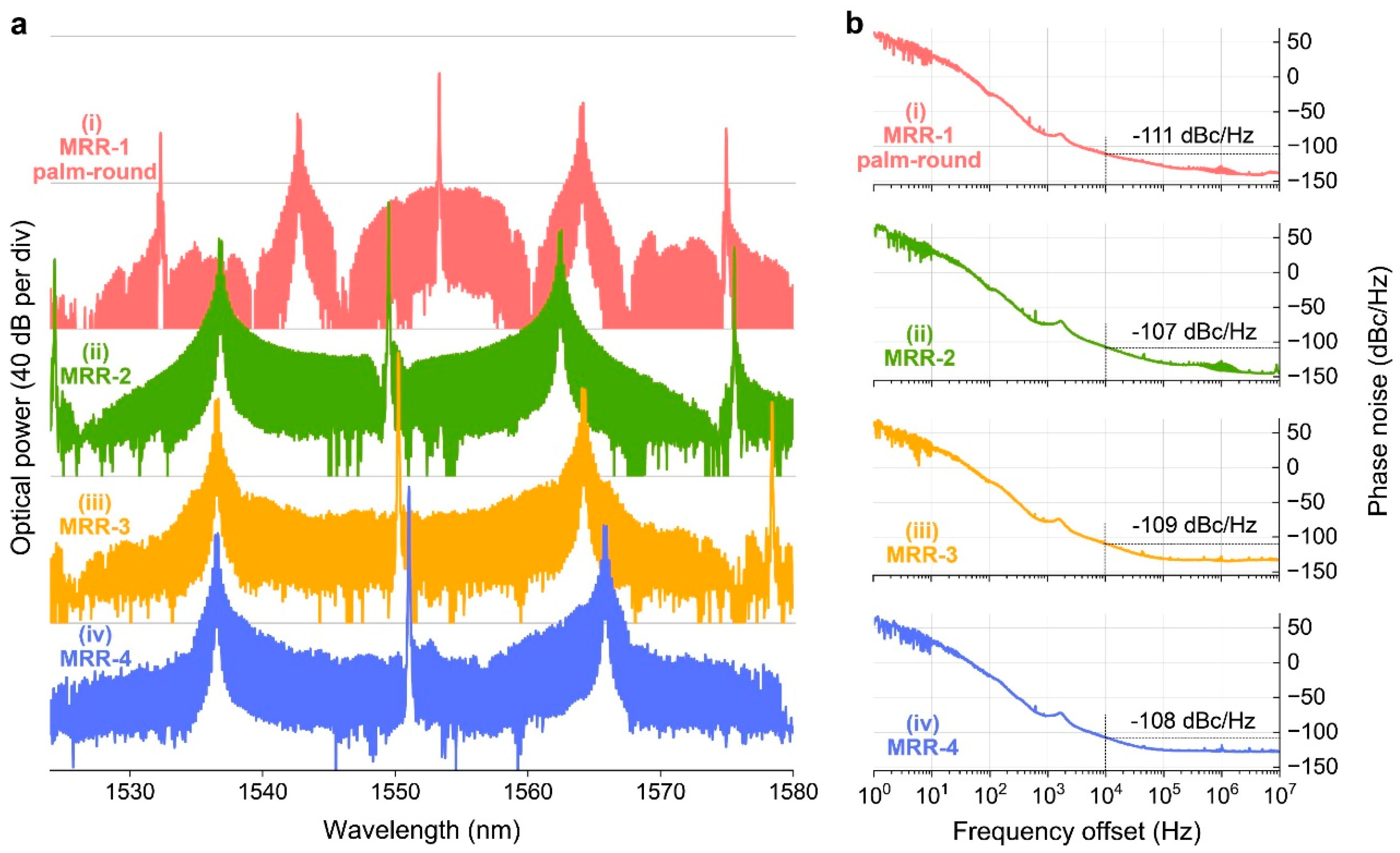
Figure 4.
Phase noise of microwave signals produced by two comb lines of different soliton crystals. (a) Phase noise results of microwave signals generated from (ⅰ) MRR-1 (palm-round state), (ⅱ) MRR-2, (ⅲ) MRR-3, and (ⅳ) MRR-4. (b) Phase noise at 10 kHz offset of microwave signals generated from two lines at different locations on the spectrum of the soliton crystal. Results from multiple soliton crystals are presented in different colours. The phase noise of two lines varies by up to 7.9 dB.
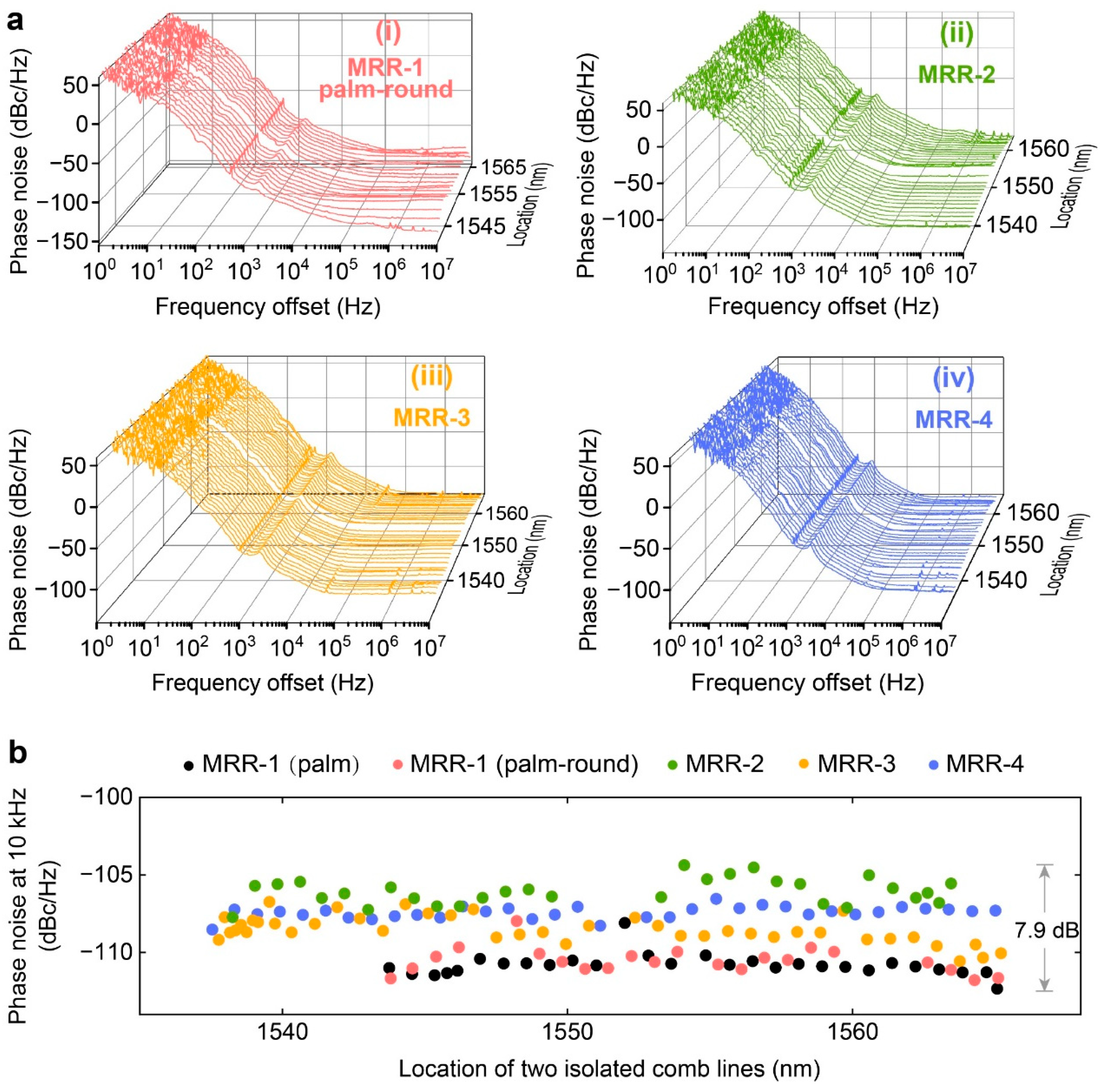
Figure 5.
Phase noise of state-of-the-art microwave oscillators based on integrated microcomb. For comparison, the carrier frequency is scaled to 10 GHz for all traces and points. a, Comparison of phase noise spectra. (i) 25-GHz soliton crystal in this work generated from two isolated comb lines. (ii) 16-GHz free-running soliton[22]. (iii) 100-GHz free-running soliton[18]. (iv) 10 GHz free-running soliton microcomb[14]. (v) 1-THz optically synchronized soliton based on KIS[23]. (vi) 227-GHz optically synchronized soliton based on all-optical OFD[22]. (vii) 1-THz optically synchronized soliton based on colour KIS[24]. (viii) 100-GHz actively locked soliton based on OFD [18]. (ix) 20-GHz actively locked dark soliton based on two-point OFD[20]. (x) 20-GHz actively locked soliton based on two-point OFD[19]. b, Phase noise comparison at 10 kHz frequency offset as a function of the number of sub-systems used to stabilize the state (N). (i) 227-GHz free-running soliton[22]. (ii) 20-GHz free-running dark soliton[20]. (iii) 100-GHz free-running soliton[18]. (iv) 10 GHz free-running soliton microcomb[14]. (v) 22-GHz free-running soliton at quiet point from a wedge resonator[15]. (vi) 1-THz optically synchronized soliton based on colour KIS[24]. (vii) 1-THz optically synchronized soliton based on KIS[23]. (viii) 227-GHz optically synchronized soliton based on all-optical OFD[22]. (ix) 109.5 GHz actively locked soliton based on OFD[21]. (x) 100-GHz actively locked soliton based on OFD [18]. (xi) 20 GHz actively locked soliton based on two-point OFD[19]. (xii) 20-GHz actively locked dark soliton based on two-point OFD[20].
Disclaimer/Publisher’s Note: The statements, opinions and data contained in all publications are solely those of the individual author(s) and contributor(s) and not of MDPI and/or the editor(s). MDPI and/or the editor(s) disclaim responsibility for any injury to people or property resulting from any ideas, methods, instructions or products referred to in the content. |
© 2026 by the authors. Licensee MDPI, Basel, Switzerland. This article is an open access article distributed under the terms and conditions of the Creative Commons Attribution (CC BY) license (http://creativecommons.org/licenses/by/4.0/).
Copyright: This open access article is published under a Creative Commons CC BY 4.0 license, which permit the free download, distribution, and reuse, provided that the author and preprint are cited in any reuse.