

Submitted:
10 July 2026
Posted:
13 July 2026
You are already at the latest version
Abstract
Physical activity is a key non-pharmacological strategy for healthy aging, but the relationship between total self-reported activity volume, functional balance, mobility, and socioeconomic indicators remains insufficiently characterized in community-dwelling older adults. This exploratory cross-sectional study examined 16 community-dwelling older men. Weekly physical activity volume was assessed using the short version of the International Physical Activity Questionnaire. Functional balance was assessed using the Berg Balance Scale, and functional mobility was assessed using an extended Timed Up and Go test. Self-reported monthly household income was collected by interview; income analyses were conducted with available cases (n = 15). Correlations were examined using Pearson or Spearman coefficients according to variable characteristics. Weekly physical activity volume showed an unexpected significant inverse correlation with Berg Balance Scale scores (rho = -0.694, p = 0.002), explaining approximately 47% of score variance. Physical activity volume was not significantly correlated with Timed Up and Go performance (r = -0.152, p = 0.294), and Berg Balance Scale scores were not significantly correlated with Timed Up and Go performance (rho = 0.381, p = 0.080). Self-reported income showed a weak, non-significant positive association with physical activity volume (rho = 0.33, p = 0.236). In this small exploratory sample, total self-reported physical activity volume was not consistently associated with better functional performance. The inverse association with balance scores suggests that activity quality, specificity, and socioeconomic context may be more informative than total weekly volume alone. Larger longitudinal studies using objective activity measures are needed.
Keywords:
aging
; balance
; functional mobility
; physical activity
; socioeconomic factors
; older adults
1. Introduction
Physical activity is widely recommended as a non-pharmacological strategy for preserving health, functional independence, and quality of life during aging [1,2]. Regular activity is associated with lower risk of chronic disease, better physical function, and reduced consequences of inactivity in older adults [2]. However, the volume of activity accumulated during daily life does not necessarily indicate that the activity is sufficiently structured, intense, or neuromotor-specific to improve balance and mobility outcomes.
Aging is accompanied by progressive physiological and functional changes, including losses in muscle mass, neuromuscular performance, postural control, and gait efficiency [3,4,5]. These changes may increase vulnerability to falls, disability, and dependence. Because functional decline is multidimensional, clinical assessment commonly integrates measures of balance, mobility, and physical activity behavior. The Berg Balance Scale (BBS) and Timed Up and Go (TUG) test are frequently used to assess functional balance and mobility in older populations [13,14,15,16,17]. Nevertheless, these instruments evaluate related but distinct constructs: the BBS emphasizes performance across balance tasks, whereas the TUG captures transfers, gait initiation, turning, and return to sitting.
Previous studies suggest that physically active older adults may present better physical performance and quality of life than inactive peers [6,7]. Resistance training and multimodal exercise have also been recommended as priority strategies for improving strength, balance, mobility, and fall-related outcomes in older adults [8]. Yet, a critical distinction remains between total physical activity volume and specific exercise content. Walking for transportation, domestic activities, informal daily movement, and structured neuromotor training may contribute differently to balance and mobility adaptations.
Socioeconomic conditions may further influence physical activity behavior. Income can shape access to safe environments, health information, transportation, exercise programs, and supervised professional support. Therefore, investigating income alongside physical activity and functional measures may help clarify whether functional health in aging is associated not only with biological factors, but also with social determinants.
The present study aimed to examine correlations between weekly physical activity volume, functional balance, functional mobility, and self-reported income in community-dwelling older men. We hypothesized that higher physical activity volume would be associated with better functional balance, faster mobility performance, and higher self-reported income. Given the small sample and cross-sectional design, this study should be interpreted as exploratory.
2. Materials and Methods
2.1. Participants
Fifteen community-dwelling older men (age: 69.60 ± 4.50 years; height: 1.69 ± 0.06 m; body mass: 90.09 ± 26.90 kg; body mass index: 31.44 ± 9.02 kg/m2) were recruited for this study. A priori sample size estimation was considered during planning, following recommendations for strength and conditioning and behavioral research [9,10]. All participants answered ‘no’ to the health screening criteria listed on the Physical Activity Readiness Questionnaire [11].
Participants were eligible if they were older men living independently in the community and able to complete the proposed functional tests. Before participation, all volunteers read and signed an informed consent form describing the procedures, potential risks and benefits, and voluntary nature of participation. The study procedures followed Brazilian ethical regulations for research involving human participants and were approved by the Research Ethics Committee of the Augusto Motta University Center, Rio de Janeiro, Brazil (approval number: 4.534.149).
2.2. Study Design and Procedures
This was an exploratory, observational, cross-sectional study conducted in a laboratory setting. No intervention, randomization, allocation sequence, blinding, crossover procedure, or Latin-square counterbalancing was applied. Participants attended two laboratory visits over four days, with at least 48 h between visits. The first visit was used for screening, informed consent, anthropometric assessment, and familiarization with procedures. The second visit was used to assess functional capacity and physical activity level.
All assessments were performed in the morning to reduce potential circadian variability. Total body mass and height were measured using a mechanical scale with stadiometer (Filizola®, Brazil), with 100 g accuracy and 150 kg maximum capacity. Body mass index was calculated as body mass divided by height squared. Anthropometric procedures followed international standards for anthropometric assessment [12].
2.3. Functional Balance, Mobility, and Physical Activity
Functional mobility was assessed using an extended TUG test adapted from the original protocol [13]. Participants were instructed to rise from a chair, walk 10 m in a straight line, turn 180 degrees around a floor marker, return to the chair, and sit down. Three trials were performed, with 5 min of recovery between attempts. The highest recorded time was retained for analysis.
Functional balance was assessed using the BBS [14]. This 14-item scale uses a 5-point ordinal scoring system for each item, ranging from 0 to 4, with a maximum total score of 56. Higher scores indicate better balance performance. The BBS has shown reliability and validity for use in older adults and has been used to identify fall-related balance impairment [15,16,17].
Weekly physical activity volume was assessed using the short version of the International Physical Activity Questionnaire (IPAQ). The IPAQ short form records the frequency and duration of physical activity performed during a typical week and has demonstrated reproducibility and validity in Brazilian samples, including older men [18,19]. Participants were descriptively classified as physically active when reporting at least 150 min/week of physical activity.
2.4. Self-Reported Income
Socioeconomic status was explored using self-reported monthly household income, collected by direct interview at the time of data collection. Participants reported total gross monthly household income in Brazilian Reais (BRL). Income was treated as a continuous variable in correlation analyses. For descriptive purposes, participants were also grouped into lower income (Class D/E), middle income (Class C), and upper-middle income (Class C/B) strata based on the income categories used in the study protocol. Because only income was collected, these strata should not be interpreted as a full asset-based economic classification according to the complete Brazilian Economic Classification Criterion [20]. One participant did not provide income data; therefore, analyses involving income were conducted with available cases (n = 15).
2.5. Statistical Analyses
Data were analyzed using Python 3.10. Normality of continuous variables was assessed using the Shapiro-Wilk test, complemented by inspection of kurtosis values, histograms, and Q-Q plots, as recommended for applied biostatistical analysis [21]. Weekly physical activity volume demonstrated normal distribution (W = 0.929; p = 0.259), whereas self-reported income violated the assumption of normality (W = 0.560; p < 0.001).
Pearson’s correlation coefficient was used for associations between continuous variables when assumptions were considered acceptable. Spearman’s rank correlation coefficient was used for analyses involving ordinal BBS scores and non-normally distributed income. Correlation magnitude was interpreted according to established applied biostatistical criteria [21]. The coefficient of determination was calculated for the significant association between physical activity volume and BBS scores. Statistical significance was set at alpha = 0.05.
3. Results
3.1. Physical Activity, Balance, and Mobility
Weekly physical activity volume showed a significant inverse and moderate correlation with BBS scores (rho = -0.694, p = 0.002). The coefficient of determination indicated that weekly physical activity volume explained approximately 47% of the variance in BBS scores (Table 1). Because higher BBS scores indicate better balance performance, this negative coefficient indicates that greater self-reported physical activity volume was associated with lower balance scores in this sample.
Weekly physical activity volume was not significantly correlated with extended TUG performance (r = -0.152, p = 0.294). The correlation between BBS scores and extended TUG performance was positive and weak, without reaching statistical significance (rho = 0.381, p = 0.080).
3.2. Physical Activity and Self-Reported Income
Self-reported income was available for 15 participants. Spearman’s correlation between income and weekly physical activity volume was positive and weak, without statistical significance (rho = 0.33, p = 0.236). Pearson’s correlation showed the same directional trend (r = 0.42, p = 0.121), also without reaching statistical significance.
Descriptively, mean physical activity volume increased across income strata: participants classified in the lower income stratum reported 103 min/week (n = 11), those in the middle-income stratum reported 138 min/week (n = 3), and the single participant in the upper-middle income stratum reported 167 min/week (n = 1) (Figure 1).
4. Discussion
4.1. Physical Activity Volume and Balance Performance
The main finding of this exploratory study was an unexpected inverse association between weekly physical activity volume and BBS scores in community-dwelling older men. Contrary to the initial hypothesis, higher self-reported physical activity volume was associated with lower functional balance scores. This finding should not be interpreted as evidence that physical activity worsens balance. Rather, it suggests that total weekly activity volume, when measured by self-report, may be an imprecise proxy for the type, quality, intensity, and neuromotor specificity of activity required to improve balance.
This interpretation is consistent with the broader exercise literature in older adults. Exercise interventions designed to challenge strength, coordination, and postural control can improve balance and mobility outcomes [4,8]. In contrast, the IPAQ captures total activity volume across different domains and may include walking for transportation, household tasks, or other daily activities that do not systematically train balance. Therefore, an older adult may report a high weekly activity volume without performing exercise that specifically targets postural control, lower-limb strength, reactive balance, or gait adaptability.
The inverse association may also reflect contextual and measurement factors. First, participants with lower functional balance may have accumulated more low-intensity activity through domestic or transportation demands rather than structured exercise. Second, self-reported physical activity is susceptible to recall and social desirability biases, particularly in older adults [22]. Third, small samples can amplify unstable estimates and increase the influence of individual observations. Finally, the BBS is an ordinal clinical scale and may be affected by ceiling effects in healthier community-dwelling samples, although this cannot be fully assessed without item-level data.
The non-significant association between physical activity volume and extended TUG performance further supports the idea that total volume alone does not sufficiently explain functional mobility. The TUG requires a sequence of chair rise, gait initiation, walking, turning, and sitting, reflecting dynamic mobility rather than only static or semi-static balance [13]. Previous studies have shown that balance and mobility tests are related but not interchangeable, because each measure emphasizes different functional dimensions [24]. Thus, the lack of significant association between BBS and TUG in the present sample is plausible, especially considering the small sample size.
These findings reinforce the need to distinguish physical activity from structured exercise prescription. In clinical and public health settings, encouraging older adults to accumulate more movement remains important. However, when the outcome of interest is balance or fall-risk-related function, professionals should consider exercises that specifically overload postural control, lower-limb strength, anticipatory and reactive balance, and mobility transitions. Studies using structured modalities such as Pilates or walking meditation have reported improvements in balance-related outcomes in older adults [25,26,27], supporting the principle that specificity of training may be more relevant than total activity volume alone.
4.2. Physical Activity and Self-Reported Income
The association between self-reported income and physical activity volume was positive but weak and non-significant. Descriptively, participants in higher income strata reported greater weekly physical activity volume. Although this pattern should be interpreted cautiously, it aligns with literature indicating that socioeconomic position can influence physical activity participation through access to safe environments, transportation, leisure opportunities, health information, and supervised exercise programs [23].
The absence of statistical significance is likely related to sample size and restricted income variability. Most participants were concentrated in the lowest income stratum, while only one participant represented the highest descriptive stratum. This uneven distribution limited the ability to detect associations and prevented robust comparison across socioeconomic groups. Moreover, income was assessed by self-report and only one socioeconomic dimension was collected. A more complete assessment would include education, occupation, household assets, neighborhood characteristics, and access to public or private exercise opportunities.
Even as an exploratory finding, the income gradient has practical relevance. Older adults with lower income may face more barriers to structured physical exercise, including financial cost, transportation difficulties, unsafe walking environments, and limited access to qualified professionals. Community-based programs, low-cost group exercise, supervised walking programs, resistance training in primary care or community centers, and balance-focused interventions may help reduce inequities in functional aging.
4.3. Strengths and Limitations
This study has strengths that should be acknowledged. It examined clinically relevant outcomes in older adults using widely recognized functional tests and considered socioeconomic context alongside physical activity and functional performance. The study also explicitly addresses the distinction between physical activity volume and exercise specificity, which is relevant for gerontology, rehabilitation, and public health.
However, several limitations restrict interpretation. The sample was small (N = 16), composed only of men, and recruited by convenience, which limits external validity. The cross-sectional design prevents causal inference; therefore, it is not possible to determine whether physical activity volume influenced balance or whether balance status influenced reported activity. Physical activity and income were self-reported, which may introduce recall and reporting biases. Income data were available for 15 participants, and the income distribution was highly skewed. The extended TUG protocol used a 10 m walking distance, which differs from the original 3 m version and should be considered when comparing results with other studies. Finally, the absence of objective activity monitoring, item-level BBS data, and detailed exercise-type classification limits mechanistic interpretation.
5. Conclusions
In this exploratory cross-sectional study of community-dwelling older men, weekly self-reported physical activity volume was inversely associated with BBS scores and was not significantly associated with extended TUG performance. Self-reported income showed a weak, non-significant positive association with physical activity volume. These findings indicate that total weekly physical activity volume should not be interpreted as a direct indicator of better balance or mobility performance. The results support a more cautious and specific interpretation: activity type, exercise quality, neuromotor specificity, and socioeconomic context may be more informative than total self-reported volume alone. Longitudinal and intervention studies with larger and more diverse samples, objective physical activity monitoring, and detailed exercise characterization are needed to clarify these relationships.
Author Contributions
Conceptualization, E.R.M.; B.P.F.; S.M-N. and J.S.N.; methodology, E.R.M.; B.P.F.; S.M-N. and J.S.N.; validation, E.R.M.; B.P.F.; S.M-N. and J.S.N.; formal analysis, E.R.M.; investigation, E.R.M.; resources, E.R.M.; data curation, E.R.M.; B.P.F.; S.M-N. and J.S.N.; writing—original draft preparation, E.R.M.; B.P.F.; S.M-N. and J.S.N.; writing—review and editing, E.R.M.; B.P.F.; S.M-N. and J.S.N.; supervision, S.M-N. and J.S.N. All authors have read and agreed to the published version of the manuscript.
Funding
This research received no external funding.
Institutional Review Board Statement
The study was conducted in accordance with the Declaration of Helsinki, and approved by the Institutional Review Board of Augusto Motta University Center (protocol code 4.534.149 and approved at 25 March 2026).
Informed Consent Statement
Informed consent was obtained from all subjects involved in the study.
Data Availability Statement
Data will be made available by the corresponding author upon reasonable request.
Acknowledgments
The authors thank all participants for their voluntary contribution to this study.
Conflicts of Interest
The authors declare no conflicts of interest.
Abbreviations
The following abbreviations are used in this manuscript:
| BBS | Berg Balance Scale |
| BRL | Brazilian Reais |
| IPAQ | International Physical Activity Questionnaire |
| TUG | Timed Up and Go |
References
- American College of Sports Medicine. Quantity and quality of exercise for developing and maintaining cardiorespiratory, musculoskeletal, and neuromotor fitness in apparently healthy adults: guidance for prescribing exercise. Med. Sci. Sports Exerc 2011, 43, 1334–1359. [Google Scholar] [CrossRef] [PubMed]
- Cunningham, C.; O’Sullivan, R.; Caserotti, P.; Tully, M.A. Consequences of physical inactivity in older adults: a systematic review of reviews and meta-analyses. Scand. J. Med. Sci. Sports 2020, 30, 816–827. [Google Scholar] [CrossRef] [PubMed]
- McPhee, J.S.; Cameron, J.; Maden-Wilkinson, T.; Piasecki, M.; Yap, M.H.; Jones, D.A.; et al. The contributions of fiber atrophy, fiber loss, in situ specific force, and voluntary activation to weakness in sarcopenia. J. Gerontol. A Biol. Sci. Med. Sci. 2018, 73, 1287–1294. [Google Scholar] [CrossRef] [PubMed]
- Cadore, E.L.; Rodríguez-Mañas, L.; Sinclair, A.; Izquierdo, M. Effects of different exercise interventions on risk of falls, gait ability, and balance in physically frail older adults: a systematic review. Rejuvenation Res. 2013, 16, 105–114. [Google Scholar] [CrossRef] [PubMed]
- Matchar, D.B.; Duncan, P.W.; Lien, C.T.; Ong, M.E.H.; Lee, M.; Gao, F.; et al. Randomized controlled trial of screening, risk modification, and physical therapy to prevent falls among the elderly recently discharged from the emergency department to the community: the STRIDE study. Arch. Phys. Med. Rehabil. 2017, 98, 1086–1096. [Google Scholar] [CrossRef] [PubMed]
- Milanović, Z.; Pantelić, S.; Trajković, N.; Sporiš, G.; Kostić, R.; James, N. Age-related decrease in physical activity and functional fitness among elderly men and women. Clin. Interv. Aging 2013, 8, 549–556. [Google Scholar] [CrossRef] [PubMed]
- Vagetti, G.C.; Barbosa Filho, V.C.; Moreira, N.B.; de Oliveira, V.; Mazzardo, O.; de Campos, W. Association between physical activity and quality of life in the elderly: a systematic review, 2000-2012. Braz. J. Psychiatry 2014, 36, 76–88. [Google Scholar] [CrossRef] [PubMed]
- Fragala, M.S.; Cadore, E.L.; Dorgo, S.; Izquierdo, M.; Kraemer, W.J.; Peterson, M.D.; et al. Resistance training for older adults: position statement from the National Strength and Conditioning Association. J. Strength Cond. Res. 2019, 33, 2019–2052. [Google Scholar] [CrossRef] [PubMed]
- Beck, T.W. The importance of a priori sample size estimation in strength and conditioning research. J. Strength Cond. Res. 2013, 27, 2323–2337. [Google Scholar] [CrossRef] [PubMed]
- Faul, F.; Erdfelder, E.; Lang, A.G.; Buchner, A. G*Power 3: a flexible statistical power analysis program for the social, behavioral, and biomedical sciences. Behav. Res. Methods 2007, 39, 175–191. [Google Scholar] [CrossRef] [PubMed]
- Luz, L.G.O.; Maranhão Neto, G.A.; Farinatti, P.T.V. Validity of the physical activity readiness questionnaire (PAR-Q) in older subjects. Rev. Bras. Cineantropom Desempenho Hum. 2007, 9, 366–371. [Google Scholar]
- Marfell-Jones, M.; Stewart, A.D.; de Ridder, J.H. International standards for anthropometric assessment; International Society for the Advancement of Kinanthropometry: Wellington, 2012. [Google Scholar]
- Podsiadlo, D.; Richardson, S. The timed ‘Up & Go’: a test of basic functional mobility for frail elderly persons. J. Am. Geriatr. Soc. 1991, 39, 142–148. [Google Scholar] [CrossRef] [PubMed]
- Berg, K.; Wood-Dauphinee, S.; Williams, J.I.; Gayton, D. Measuring balance in the elderly: preliminary development of an instrument. Physiother. Can. 1989, 41, 304–311. [Google Scholar] [CrossRef]
- Berg, K.O.; Maki, B.E.; Williams, J.L.; Holliday, P.J.; Wood-Dauphinee, S.L. Clinical and laboratory measures of postural balance in an elderly population. Arch. Phys. Med. Rehabil. 1992, 73, 1073–1080. [Google Scholar] [PubMed]
- Berg, K.; Wood-Dauphinee, S.; Williams, J. I. The Balance Scale: reliability assessment with elderly residents and patients with an acute stroke. Scand. J. Rehabil. Med. 1995, 27, 27–36. [Google Scholar] [CrossRef] [PubMed]
- Bogle Thorbahn, L.D.; Newton, R.A. Use of the Berg Balance Test to predict falls in elderly persons. Phys. Ther. 1996, 76, 576–583. [Google Scholar] [CrossRef] [PubMed]
- Matsudo, S.; Araújo, T.; Matsudo, V.; Andrade, D.; Andrade, E.; Oliveira, L.C.; et al. International Physical Activity Questionnaire (IPAQ): study of validity and reproducibility in Brazil. Rev. Ativ. Fis. Saude 2001, 6, 5–18. [Google Scholar]
- Benedetti, T.R.B.; Antunes, P.C.; Rodriguez-Añes, C.R.; Mazo, G.Z.; Petroski, E.L. Reproducibility and validity of the International Physical Activity Questionnaire (IPAQ) in elderly men. Rev. Bras. Med. Esporte 2007, 13, 11–16. [Google Scholar] [CrossRef]
- Associação Brasileira de Empresas de Pesquisa. Critério de Classificação Econômica Brasil; ABEP: São Paulo, 2024; Available online: https://abep.org/criterio-brasil/ (accessed on 19 May 2026).
- Chan, Y.H. Biostatistics 101: data presentation. Singap. Med. J. 2003, 44, 280–285. [Google Scholar]
- Doherty, A.; Jackson, D.; Hammerla, N.; Plötz, T.; Olivier, P.; Granat, M.H.; et al. Validity of the International Physical Activity Questionnaire (IPAQ) for assessing moderate-to-vigorous physical activity and sedentary behaviour of older adults in the United Kingdom. BMC Med. Res. Methodol. 2017, 17, 176. [Google Scholar]
- Gidlow, C.; Johnston, L.H.; Crone, D.; Ellis, N.; James, D. A systematic review of the relationship between socio-economic position and physical activity. Health Educ. J. 2006, 65, 338–367. [Google Scholar] [CrossRef]
- Hasegawa, R.; Shimada, H.; Tsuji, T.; Nakagawa, T.; Makizako, H. Reliability and validity of balance tests for community-dwelling older adults with musculoskeletal ambulation disability symptom complex. J. Bodyw. Mov. Ther. 2024, 40, 1828–1836. [Google Scholar] [CrossRef]
- Rezaee, Z.; Esfarjani, F. Influence of the Pilates method on postural balance parameters in older women: an exploratory single-arm trial. J. Bodyw. Mov. Ther. 2024, 37, 70–75. [Google Scholar]
- Salomón-Moreno, J.; Moreno-García, C.; Ruiz-Fernández, M.; del Valle Soto, M.; Ranz-Calleja, M.; Jiménez-Díaz, J.F. Six weeks of Pilates improved functional mobility, postural balance and spatiotemporal parameters of gait to decrease the risk of falls in healthy older adults. J. Bodyw. Mov. Ther. 2022, 26, 36–42. [Google Scholar]
- Siriphorn, A.; Chamonchant, D. Walking meditation promotes ankle proprioception and balance performance among elderly women. J. Bodyw. Mov. Ther. 2019, 23, 32–38. [Google Scholar] [CrossRef]
Figure 1.
Descriptive mean weekly physical activity volume according to self-reported income strata. Income data were available for 15 participants. Values represent mean minutes per week reported using the short version of the International Physical Activity Questionnaire.
Figure 1.
Descriptive mean weekly physical activity volume according to self-reported income strata. Income data were available for 15 participants. Values represent mean minutes per week reported using the short version of the International Physical Activity Questionnaire.
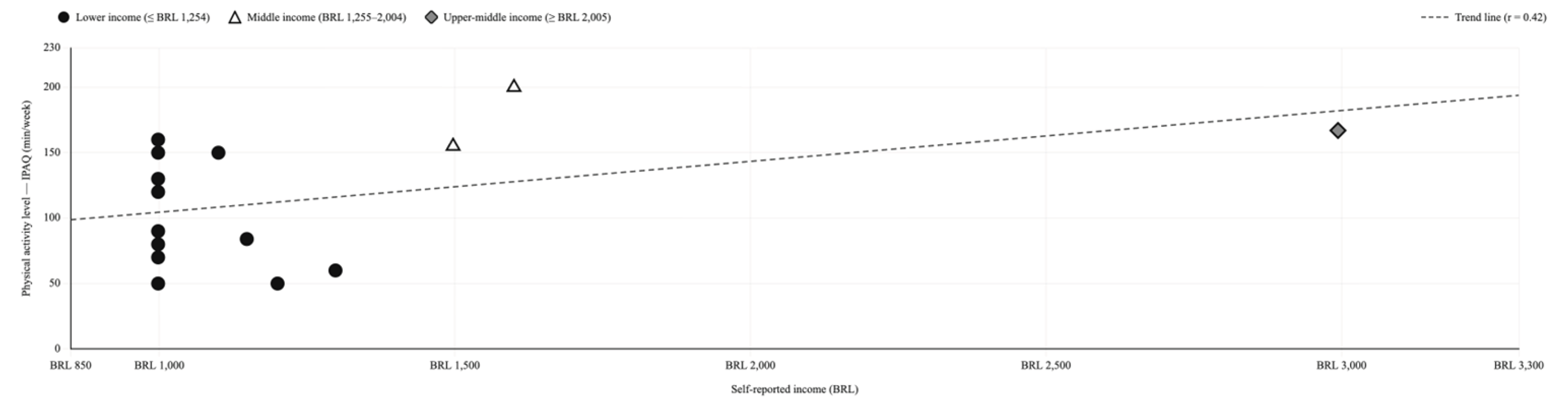

Table 1.
Correlations between weekly physical activity volume, functional balance, and functional mobility.
Table 1.
Correlations between weekly physical activity volume, functional balance, and functional mobility.
| Analysis | Coefficient | Magnitude | p value | R2 |
| Physical activity volume × Berg Balance Scale | rho = -0.694 | Moderate | 0.002 | 0.47 |
| Physical activity volume × extended Timed Up and Go | r = -0.152 | Weak | 0.294 | - |
| Berg Balance Scale × extended Timed Up and Go | rho = 0.381 | Weak | 0.080 | - |
r = Pearson correlation coefficient; rho = Spearman rank correlation coefficient; R2 = coefficient of determination. Higher Berg Balance Scale scores indicate better functional balance.
Disclaimer/Publisher’s Note: The statements, opinions and data contained in all publications are solely those of the individual author(s) and contributor(s) and not of MDPI and/or the editor(s). MDPI and/or the editor(s) disclaim responsibility for any injury to people or property resulting from any ideas, methods, instructions or products referred to in the content. |
© 2026 by the authors. Licensee MDPI, Basel, Switzerland. This article is an open access article distributed under the terms and conditions of the Creative Commons Attribution (CC BY) license (http://creativecommons.org/licenses/by/4.0/).
Copyright: This open access article is published under a Creative Commons CC BY 4.0 license, which permit the free download, distribution, and reuse, provided that the author and preprint are cited in any reuse.


