
Submitted:
09 July 2026
Posted:
10 July 2026
You are already at the latest version
Abstract
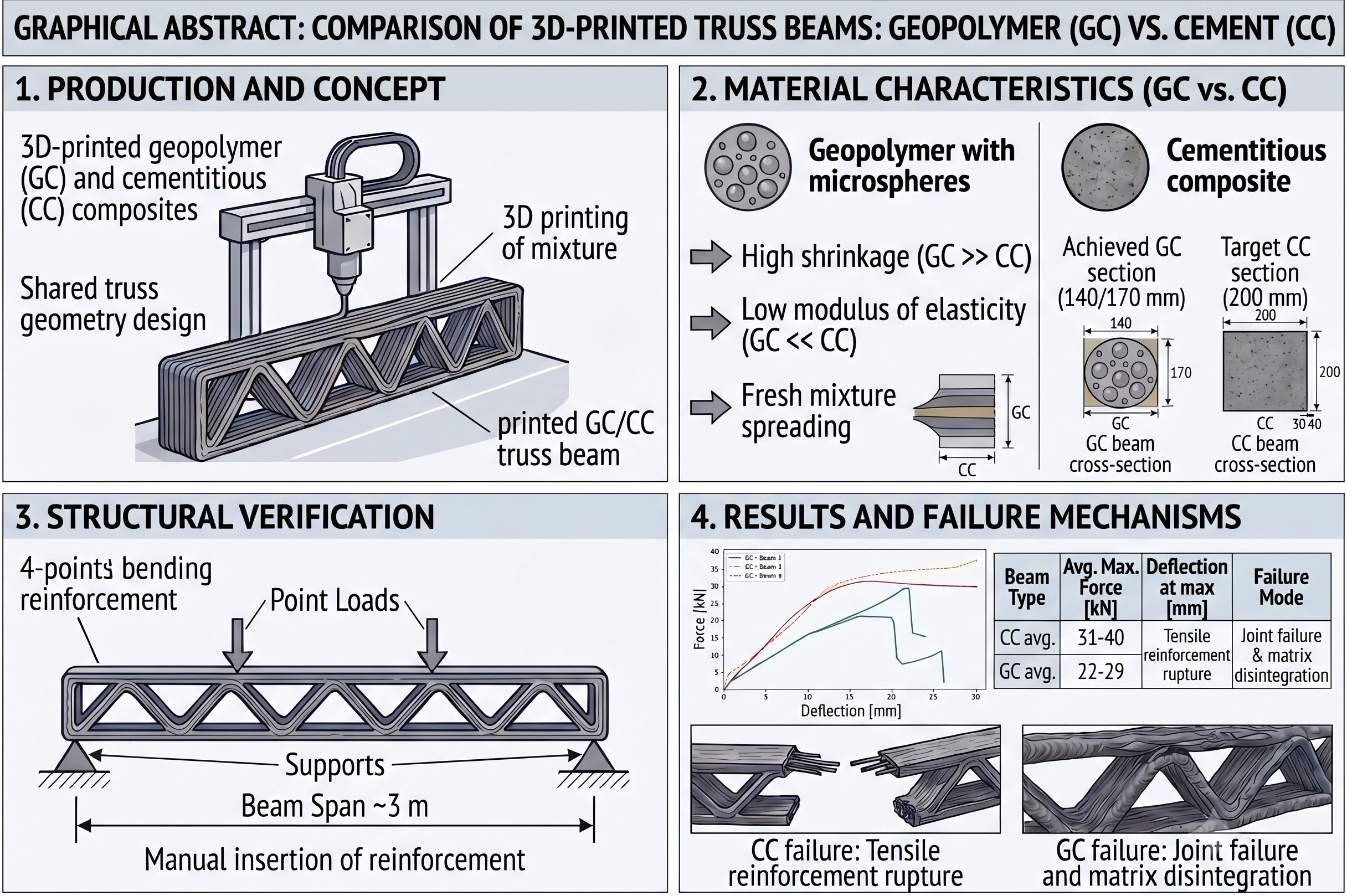
Geopolymers represent a promising material platform for extrusion-based 3D printing; however, current research remains largely focused on mix design, rheology, printability, buildability, and the relationship between process parameters and the resulting microstructure (1–7). This article therefore compares the behaviour of two 3D-printed geopolymer composite truss beams with reference cementitious composite beams developed within the 3D STAR project (8). The geopolymer elements, 2932 mm long, were designed for the same material volume and target geometry as the reference CC element; however, because of mixture spreading, they reached cross-sections of only approximately 140/250 mm and 170/250 mm. The first beam was printed without setting acceleration, while the second was locally treated with a hot-air gun. In four-point bending, the geopolymer beams reached maximum forces of 22 and 29 kN, whereas the reference cementitious beams reached 31 and 40 kN. The CC elements failed by rupture of the tensile reinforcement, while the GC elements failed by joint failure followed by deformation and local disintegration of the composite. The study thus shows that the main difference between the two systems lies not only in the achieved load-bearing capacity, but also in stiffness, the shape of the load-displacement diagrams, and the failure mechanism.
Keywords:
3D printing
; geopolymer
; truss beam
; four‐point bending
; reinforcement
; buildability
; mechanical failure
Copyright: This open access article is published under a Creative Commons CC BY 4.0 license, which permit the free download, distribution, and reuse, provided that the author and preprint are cited in any reuse.


