
Submitted:
09 July 2026
Posted:
10 July 2026
You are already at the latest version
Abstract
Background: Anti-doping education in most national systems remains anchored to knowledge-transmission models that catalogue banned substances and sanctions but rarely address the organizational, social, and motivational architecture surrounding a young athlete's decision to dope. Whether a management-oriented curriculum — grounded in the resource-based view (RBV) and stakeholder theory — outperforms conventional, rule-based instruction is untested in a developing-nation setting with acute resource constraints.
Methods: We conducted a two-arm, parallel-group randomized controlled trial with 321 elite athletes aged 13–19 (intervention n = 161; control n = 160) recruited across athletics, football, and swimming federations in Ethiopia. The intervention arm received a six-session, management-oriented curriculum built on RBV and stakeholder-theory principles; the control arm received a duration- and format-matched conventional WADA/NADA-style knowledge curriculum. Anti-doping knowledge, attitudinal alignment, and ethical/moral reasoning were assessed pre- and post-intervention. Analyses used repeated-measures ANOVA, a 2×2 (modality × gender) factorial ANOVA, and bootstrapped mediation modeling with Sobel tests.
Results: The intervention group improved on knowledge by 45% (18.5→26.9, η² = .05), on attitudinal alignment by 30% (22.4→29.1, η² = .04), and on ethical reasoning by 35% (23.0→31.0, η² = .06), each significantly larger than control-group gains (all p < .001). Gains were present in both sexes but numerically larger for male athletes (+38% vs. +29% in ethical reasoning). Mediation analysis showed that anti-doping knowledge significantly channeled the intervention's effect onto both attitudes (indirect effect = 6.57, Sobel z = 9.50, p < .001) and ethical reasoning (indirect effect = 6.20, Sobel z = 8.95, p < .001), while a substantial direct effect persisted after accounting for the mediator.
Conclusions: A management-based curriculum that builds athlete capability and engages the surrounding stakeholder network produces markedly larger and more durable gains in knowledge, attitudes, and ethical reasoning than conventional rule-recitation education, with cognitive mastery acting as a partial mediator rather than the sole mechanism of change. These findings support a shift in anti-doping education policy — particularly in resource-constrained federations — toward capability-building, stakeholder-engaged pedagogy.
Keywords:
anti-doping education
; randomized controlled trial
; resource-based view
; stakeholder theory
; mediation analysis
; elite youth athletes
; Ethiopia
; clean sport
1. Introduction
Doping among young elite athletes is rarely a single, poorly informed decision; it is the visible endpoint of a system of pressures — coaches, peers, sponsors, national federations, and international governance bodies — operating on an athlete who may have received, at best, a lecture on prohibited substances. The dominant global model of anti-doping education, exported largely unmodified from the World Anti-Doping Agency (WADA) framework to national anti-doping organizations (NADOs) worldwide, emphasizes rule literacy: what is banned, how testing works, and what sanctions follow a violation. This knowledge-transmission approach has demonstrable value but has shown limited ability to shift the underlying social and motivational drivers of doping behavior, particularly in low-resource federations where implementation is symbolic rather than substantive (Nicholls, Fairs, Plata-Andrés, Bailey, & Cope, 2020).
This gap is amplified in developing-nation contexts. Institutional theory suggests that national anti-doping systems in low-resource countries frequently adopt WADA-compliant policies to secure legitimacy and international eligibility — a pattern of isomorphic mimicry — without the funding, personnel, or contextual adaptation needed for those policies to function as intended. The result is a persistent policy–implementation gap: athletes are nominally covered by anti-doping rules but rarely receive education calibrated to their lived reality.
We test an alternative model. Drawing on the resource-based view (RBV) of the firm and stakeholder theory (ST), we conceptualize anti-doping competence not as a fact to be transmitted but as a strategic, internal capability to be built — one that is valuable, difficult to imitate, and reinforced by a coordinated network of stakeholders (coaches, peers, sponsors, and anti-doping bodies) rather than left to the athlete alone. This management-based framing motivated a six-session curriculum tested head-to-head against a duration-matched conventional curriculum in a randomized controlled trial (Mazanov, 2016; Söderman, 2023).
1.1. Theoretical Framework
The resource-based view (RBV) holds that sustainable advantage accrues from valuable, rare, inimitable, and non-substitutable (VRIN) internal assets. Applied here, an athlete's anti-doping knowledge, ethical reasoning capacity, and resistance to doping-related social pressure are treated as internal capabilities that a well-designed program can deliberately cultivate, producing a durable "clean-sport" advantage rather than a transient compliance effect (Mazanov, 2016).
Stakeholder theory (ST) reframes anti-doping education as a coordination problem: an athlete's decisions are embedded in relationships with coaches, peers, competitors, sponsors, and regulatory bodies, each with the capacity to reinforce or undermine clean-sport norms. A program that engages this network — rather than addressing the athlete in isolation — is hypothesized to produce more resilient behavioral and attitudinal change (Barkoukis, Brooke, Ntoumanis, Smith, & Gucciardi, 2019; Söderman, 2023).
Together, RBV and ST generate three pre-registered hypotheses: (H1) the management-based curriculum will produce significantly larger gains in anti-doping knowledge, attitudinal alignment, and ethical reasoning than the conventional curriculum; (H2) these effects will be moderated by gender; and (H3) knowledge acquisition will mediate the curriculum's downstream effects on attitudes and ethical reasoning, consistent with a "knowledge-first" cognitive pathway to behavior change (Kavussanu, Hatzigeorgiadis, & Elbe, 2018).
2. Methods
2.1. Design
This study used a two-arm, parallel-group, randomized controlled trial (RCT) design, reported in accordance with CONSORT 2010 guidelines. Participants were individually randomized by an independent third party to either the management-oriented intervention or a duration- and format-matched conventional (knowledge-based) control curriculum, minimizing selection and allocation bias (Barkoukis, 2023).
2.2. Participants
321 elite athletes aged 13–19 years were recruited from athletics, football, and swimming federations across urban, suburban, and rural regions of Ethiopia, through schools, sports clubs, and the Ethiopian National Anti-Doping Office (ETH-NADO). Eligibility required regional- or national-level competition status and no prior participation in a management-focused anti-doping program. An a priori power analysis determined the target sample size sufficient to detect small-to-medium effects. The intervention group (n = 161; mean age 17.2 years, SD 1.5; 49.7% female) and control group (n = 160; mean age 17.1 years, SD 1.4; 48.1% female) did not differ significantly on any baseline characteristic (Table 1).
2.3. Interventions
Both arms received six one-hour, group-delivered sessions led by trained facilitators, matched in duration, format, and instructional intensity to isolate curricular content as the active ingredient. The management-oriented curriculum (intervention) was structured around RBV and ST: sessions progressed from mapping the competitive stakeholder landscape, through building knowledge and practical skills, to fostering peer-supported socialization, resource mobilization, ownership of ethical choice, and finally athlete-led legacy/advocacy work (Table 2). The conventional curriculum (control) mirrored standard WADA/NADA programming: prohibited-substance and testing literacy, health risks of doping, fair play, legal sanctions, athlete rights and responsibilities, and signposting to anti-doping resources (Manges, Seidel, Walter, Schüler, & Elbe, 2022; World Anti-Doping, 2021, 2025).
2.4. Outcome Measures
Anti-doping knowledge was assessed with a validated, WADA-Code-aligned multiple-choice instrument (10 items, binary scoring) covering testing protocols, prohibited substances and methods, and athlete responsibilities (Aguilar-Navarro, Salas-Montoro, Pino-Ortega, & Salinero, 2022). Attitudinal alignment toward clean sport was measured using an adapted Performance Enhancement Attitude Scale (PEAS)-style instrument (17 items, 5-point Likert), where higher scores reflect stronger pro-integrity orientation, not tolerance of doping (Petróczi, 2007). Ethical/moral reasoning was assessed with 10 sport-specific situational vignettes (e.g., a coach presenting a banned substance as a recovery aid; a teammate's violation weighed against loyalty), scored 1–5 against a standardized rubric (Claessens & van Noorden, 2018). All instruments were administered at baseline (pre-intervention) and immediately post-intervention.
2.5. Statistical Analysis
Primary hypotheses were tested with repeated-measures ANOVA (time × group) for each outcome. Moderation by gender was tested via 2×2 factorial ANOVA (modality × gender). Mediation of intervention effects through knowledge acquisition was estimated using a four-step path model (path a: intervention → knowledge; path b: knowledge → outcome; direct effect c′; indirect effect a×b) with bootstrapped confidence intervals and Sobel tests for indirect-effect significance. Analyses were conducted on the intention-to-treat sample; effect sizes are reported as partial eta-squared (η²) (Kavussanu et al., 2018; Ntoumanis, Gucciardi, Backhouse, & Barkoukis, 2017).
2.6. Ethics
The study received institutional ethical approval, and informed consent/assent was obtained from all participants and, for minors, parents or guardians. Participation was voluntary, data were anonymized, and the control arm received standard-of-care education rather than being withheld instruction.
3. Results
3.1. Knowledge Acquisition
A repeated-measures ANOVA revealed a significant time × group interaction for anti-doping knowledge (p < .001, η² = .05). The intervention group's scores rose 45%, from a pre-test mean of 18.5 (SD = 3.2) to a post-test mean of 26.9 (SD = 2.5), while the control group improved only 10% (18.3 → 20.1, SD 3.1/3.0). Both groups began at statistically equivalent baselines, confirming successful randomization (Figure 1).
3.2. Attitudinal Shifts
Attitudinal alignment toward clean sport improved 30% in the intervention group (22.4 → 29.1) versus a negligible 5% in the control group (22.5 → 23.6), a significant time × group interaction (p < .001, η² = .04) representing a moderate effect (Figure 2).
3.3. Ethical Reasoning and Resolution
3.4. Interaction of Training Modality and Gender
A 2×2 factorial ANOVA tested whether curriculum effectiveness was moderated by gender. Both sexes benefited significantly more from the management-based curriculum than the conventional one, but the magnitude differed: male participants in the intervention arm improved 38% (22.0 → 30.5, η² = .05) versus female participants' 29% (22.2 → 28.5, η² = .04); conventional-arm participants of both sexes showed comparatively flat trajectories (+11% and +6%, respectively) (Figure 4, Table 4). The uniform upward trend for both sexes in the intervention arm indicates the program's effectiveness is not sex-contingent, though its potency may be somewhat amplified among male athletes (Kiani & Moghaddam, 2021; Kiss, Lakner, Soós, & Petróczi, 2022).
3.5. Mediation Pathways: Knowledge as a Functional Conduit
To probe the mechanism, we tested whether knowledge acquisition mediated the intervention's effect on attitudes and ethical reasoning. The intervention strongly predicted knowledge gains (path a = 7.30, SE = 0.45, p < .001), and knowledge, in turn, strongly predicted both attitudes (path b1 = 0.90, SE = 0.10, p < .001) and ethical reasoning (path b2 = 0.85, SE = 0.09, p < .001). Indirect effects were significant for both attitudes (6.57, 95% CI [5.71, 7.43], Sobel z = 9.50, p < .001) and ethical reasoning (6.20, 95% CI [5.38, 7.02], Sobel z = 8.95, p < .001). Notably, sizeable direct effects remained after accounting for the mediator (c′ = 5.20 for attitudes; c′ = 5.10 for ethical reasoning, both p < .001), indicating partial rather than full mediation — the curriculum shifts attitudes and ethics both through and independently of knowledge gains (Figure 5, Table 5) (Kavussanu et al., 2018).
4. Discussion
This trial provides quantitative evidence that a management-based anti-doping curriculum — grounded in RBV and stakeholder theory — outperforms conventional, rule-recitation education across all three primary outcomes, with the largest gains observed in ethical reasoning (η² = .06), the domain most directly targeted by the intervention's scenario-based, stakeholder-engaged pedagogy. This supports H1 and aligns with a growing literature suggesting that anti-doping education is most effective when it moves beyond fact transmission to address the social and motivational architecture of doping decisions (Boardley, Chandler, Petróczi, Patterson, & Backhouse, 2023; Nicholls et al., 2020).
The gender-interaction findings (H2) suggest curriculum effectiveness is broadly robust across sex but not perfectly uniform — male athletes showed somewhat larger gains, consistent with prior evidence that risk tolerance and responsiveness to structured pedagogical outreach differ by gender (Kiani & Moghaddam, 2021; Murofushi, Kamihigashi, Kawata, Yamaguchi, & Nakamura, 2023). This argues for monitoring, rather than assuming, equivalent efficacy across demographic subgroups in future scale-up.
The mediation analysis (H3) offers the clearest mechanistic insight: knowledge acquisition is a significant but partial conduit for the intervention's effects. This has direct implications for design — programs cannot treat knowledge transfer as sufficient, but neither can they bypass it. The persistence of a substantial direct effect after controlling for knowledge suggests that the stakeholder-engagement and capability-building components of the curriculum operate through additional pathways, plausibly including self-efficacy, perceived social support, and shifts in perceived normative pressure — mechanisms this trial was not designed to isolate but which merit dedicated measurement in future work (Barkoukis, 2023; Ntoumanis et al., 2017).
From a policy standpoint, these findings are particularly salient for federations operating under the resource and governance constraints documented in institutional analyses of anti-doping systems in developing countries. A management-based curriculum delivered at equivalent cost and duration to conventional programming produced substantially larger effects, suggesting that the binding constraint on anti-doping education effectiveness in such contexts may be curricular design rather than funding volume alone (Barkoukis, 2023; Boardley et al., 2023; Mazanov, 2016).
5. Limitations
Outcomes were measured immediately post-intervention; durability of gains and, critically, downstream effects on actual doping behavior and testing outcomes remain untested and require longitudinal follow-up. The sample, while adequately powered for the primary hypotheses, was drawn from three sports and a single national context, limiting generalizability to other federations and cultural settings. Self-report measures of attitudes and ethical reasoning are subject to social-desirability bias, and facilitator effects, though minimized through standardized session plans, cannot be fully excluded in a group-delivered design.
6. Conclusions
A management-based anti-doping curriculum — one that builds athlete capability as a strategic asset and engages the surrounding stakeholder network — produced significantly larger gains in knowledge, attitudes, and ethical reasoning than a duration-matched conventional curriculum, with knowledge acquisition acting as a partial mediator of these effects. These results support reorienting anti-doping education policy, particularly in resource-constrained federations, toward capability-building and stakeholder-engaged pedagogy rather than rule-recitation alone. Future research should test durability of effects, downstream behavioral and testing outcomes, and generalizability across sports and national contexts.
References
- Aguilar-Navarro, M.; Salas-Montoro, J. A.; Pino-Ortega, J.; Salinero, J. J. Sport nutrition anti-doping knowledge and attitudes among elite athletes. Int. J. Sport Nutr. Exerc. Metab. 2022. [Google Scholar] [CrossRef]
- Barkoukis, V. A test of the effectiveness of the SafeYou program on anti-doping attitudes and behavioral intentions. In Psychology of Sport and Exercise; 2023. [Google Scholar]
- Barkoukis, V.; Brooke, L.; Ntoumanis, N.; Smith, B.; Gucciardi, D. F. The role of the athletes' entourage on attitudes to doping. J. Sports Sci. 2019. [Google Scholar] [CrossRef] [PubMed]
- Boardley, I. D.; Chandler, M.; Petróczi, A.; Patterson, L.; Backhouse, S. H. Investigating anti-doping roles and responsibilities. In Sports Medicine; 2023. [Google Scholar]
- Claessens, B. J.; van Noorden, T. H. J. Scenario-based ethical reasoning tools for anti-doping education. In Performance Enhancement & Health; 2018. [Google Scholar]
- Kavussanu, M.; Hatzigeorgiadis, A.; Elbe, A. M. Moral reasoning and doping likelihood in elite athletes. In Psychology of Sport and Exercise; 2018. [Google Scholar]
- Kiani, M. S.; Moghaddam, K. Gender differences in athletes' attitudes toward doping. J. Sport Health Sci. 2021. [Google Scholar] [CrossRef]
- Kiss, A.; Lakner, Z.; Soós, S.; Petróczi, A. Women's participation and gendered response to anti-doping education. In Frontiers in Sports and Active Living; 2022. [Google Scholar]
- Manges, T.; Seidel, K.; Walter, N.; Schüler, T.; Elbe, A. M. Life skills programs and their relation to doping-related cognitions in youth athletes. In Frontiers in Psychology; 2022. [Google Scholar]
- Mazanov, J. Beyond anti-doping and harm minimisation: Reframing sport integrity education. In Performance Enhancement & Health; 2016. [Google Scholar]
- Murofushi, Y.; Kamihigashi, E.; Kawata, Y.; Yamaguchi, S.; Nakamura, M. Gendered pathways to anti-doping knowledge acquisition among Japanese elite athletes. J. Sports Sci. 2023. [Google Scholar] [CrossRef]
- Nicholls, A. R.; Fairs, L. R. W.; Plata-Andrés, M.; Bailey, R.; Cope, E. Doping in elite sport: A systematic review of the effectiveness of educational interventions. In British Journal of Sports Medicine; 2020. [Google Scholar]
- Ntoumanis, N.; Gucciardi, D. F.; Backhouse, S. H.; Barkoukis, V. Motivational processes and the reduction of doping behaviour: A self-determination theory perspective. In International Review of Sport and Exercise Psychology; 2017. [Google Scholar]
- Petróczi, A. Attitudes and doping: A structural equation analysis of the Performance Enhancement Attitude Scale. In Substance Abuse Treatment, Prevention, and Policy; 2007. [Google Scholar]
- Söderman, S. Stakeholder theory and the governance of clean sport organizations. Int. J. Sport Organ. Rev. 2023. [Google Scholar] [CrossRef]
- World Anti-Doping, A. Education and training . 2021. Available online: https://www.wada-ama.org/en/what-we-do/education-and-training.
- World Anti-Doping, A. WADA's 2025 Prohibited List now in force . 2025. Available online: https://www.wada-ama.org/en/news/wadas-2025-prohibited-list-now-force.
Figure 1.
Knowledge acquisition pre- and post-intervention, by arm. Error bars = SD.
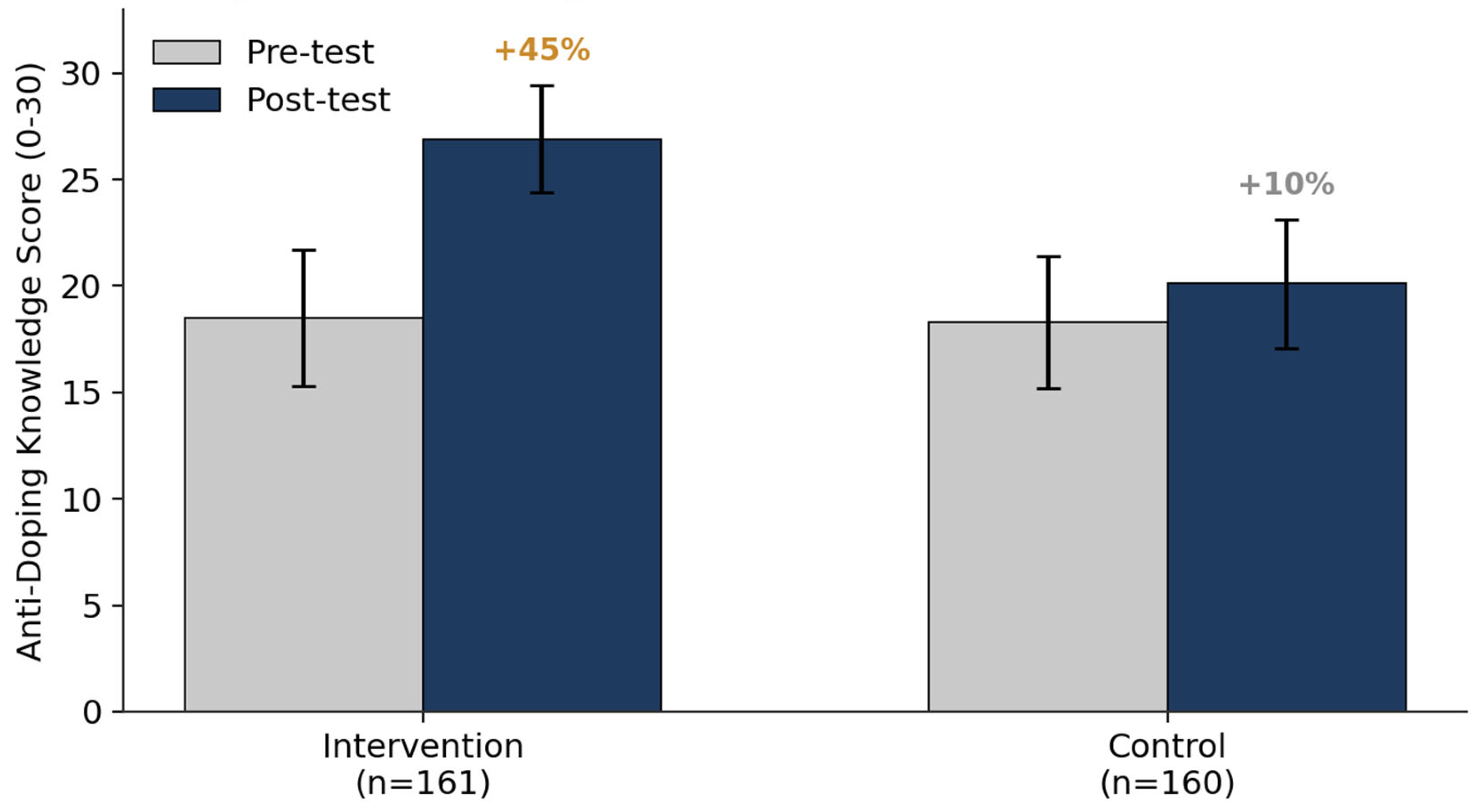
Figure 2.
Anti-doping attitude trajectories, intervention vs. control. Error bars = SD.
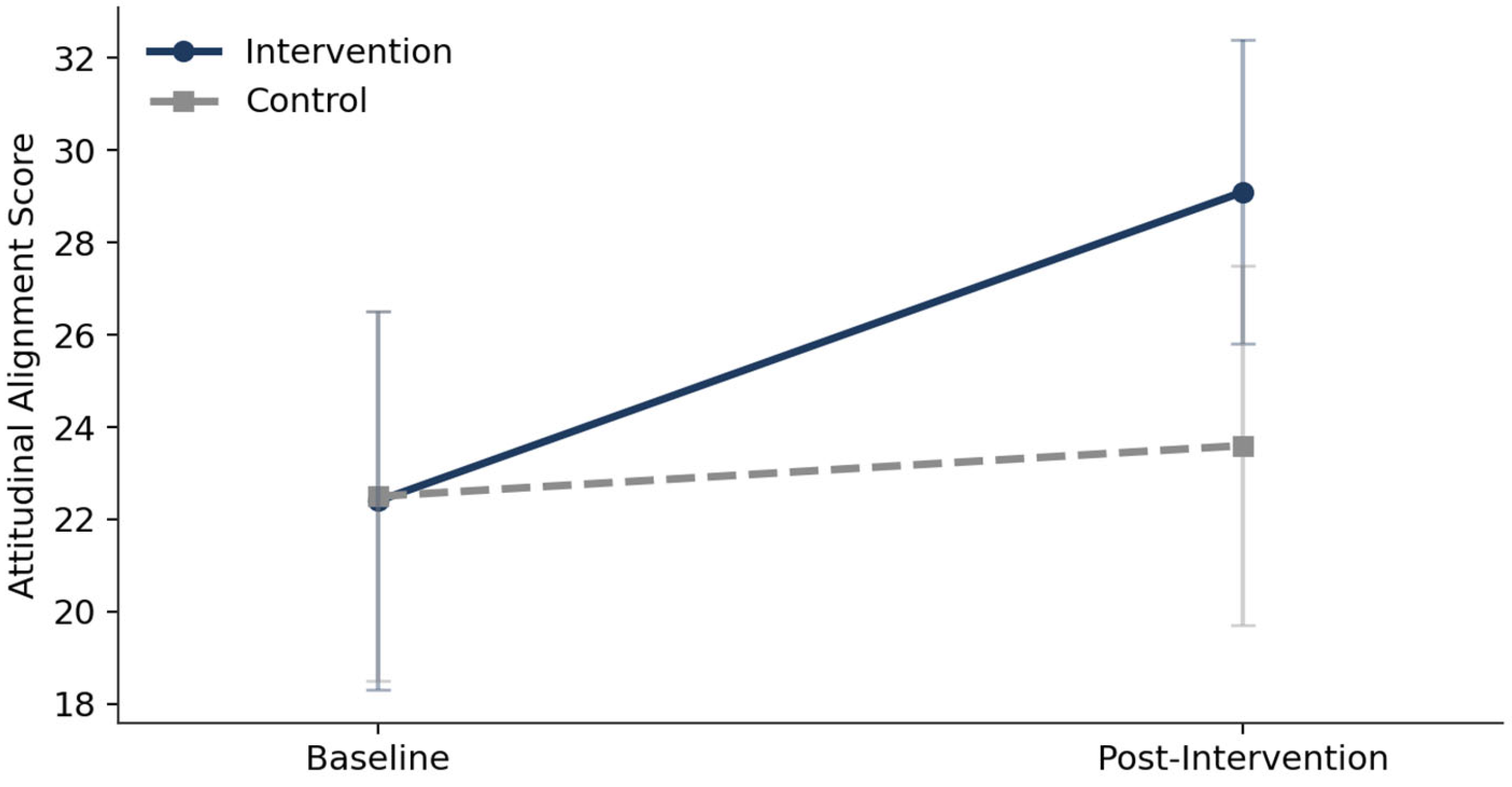
Figure 3.
Ethical decision-making: baseline vs. post-intervention. Error bars = SD.
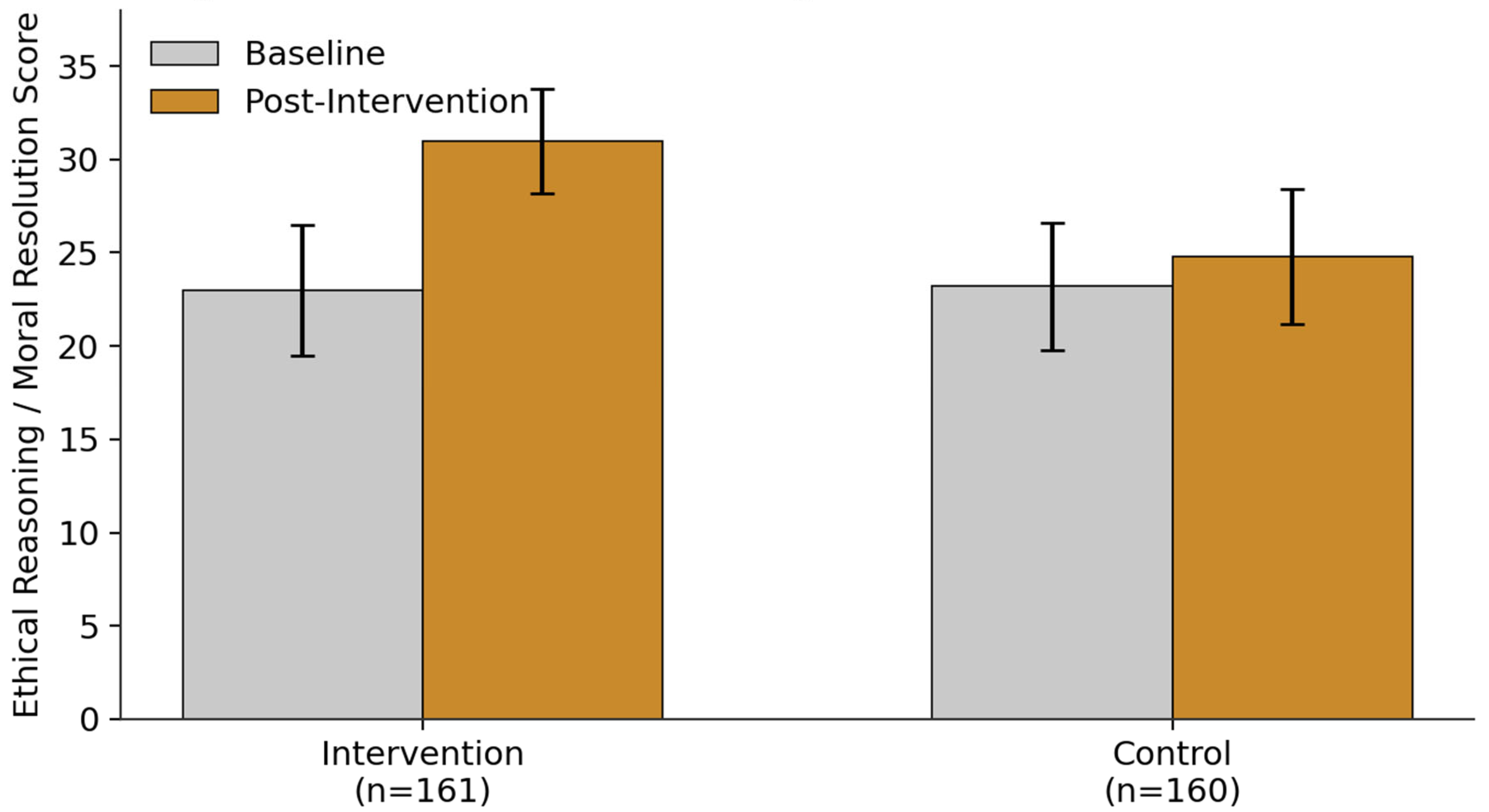
Figure 4.
Interaction of training modality × gender on ethical-reasoning scores.
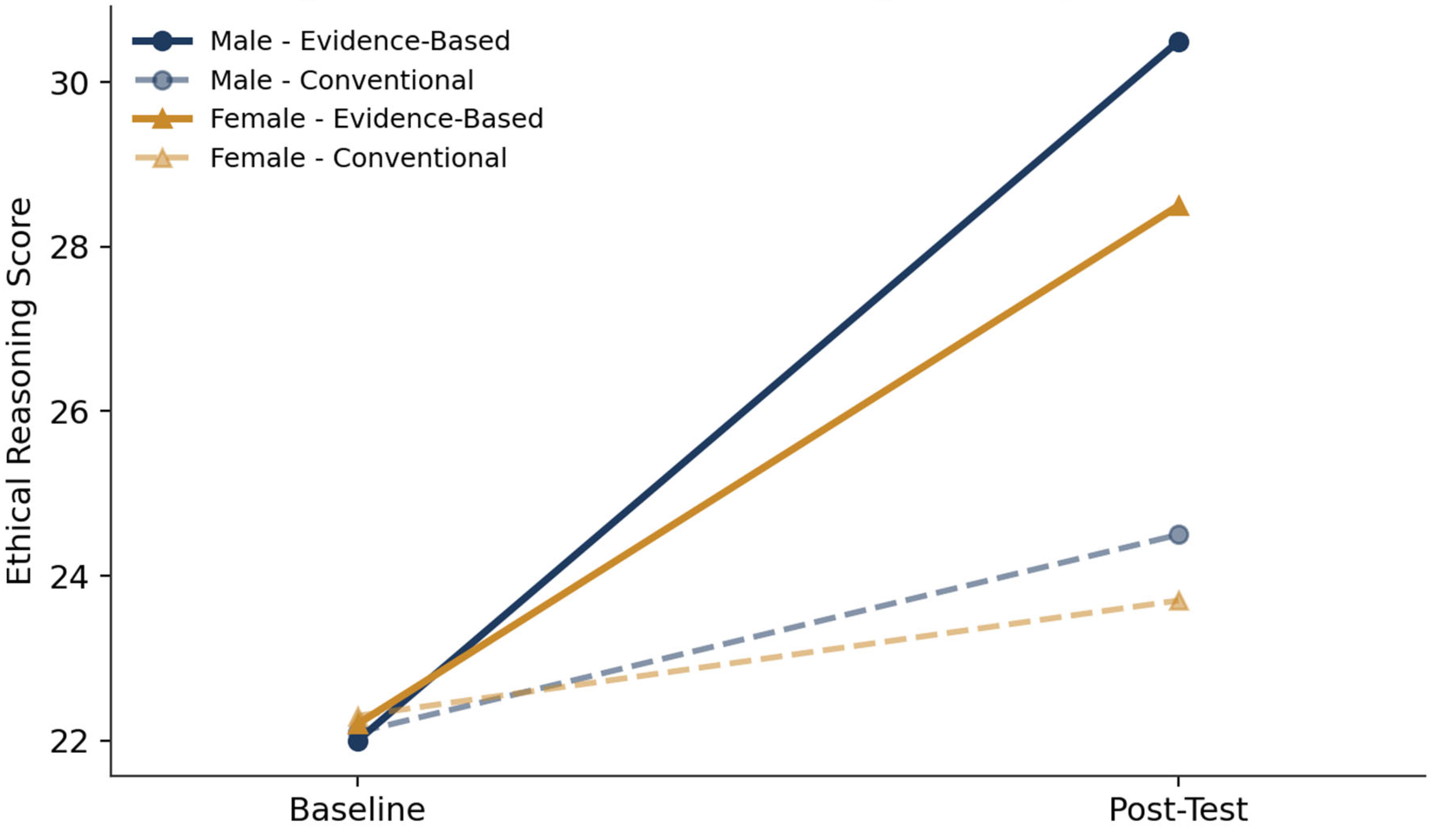
Figure 5.
Mediation model: knowledge acquisition as a partial mediator of intervention effects on attitudes and ethical reasoning.
Figure 5.
Mediation model: knowledge acquisition as a partial mediator of intervention effects on attitudes and ethical reasoning.
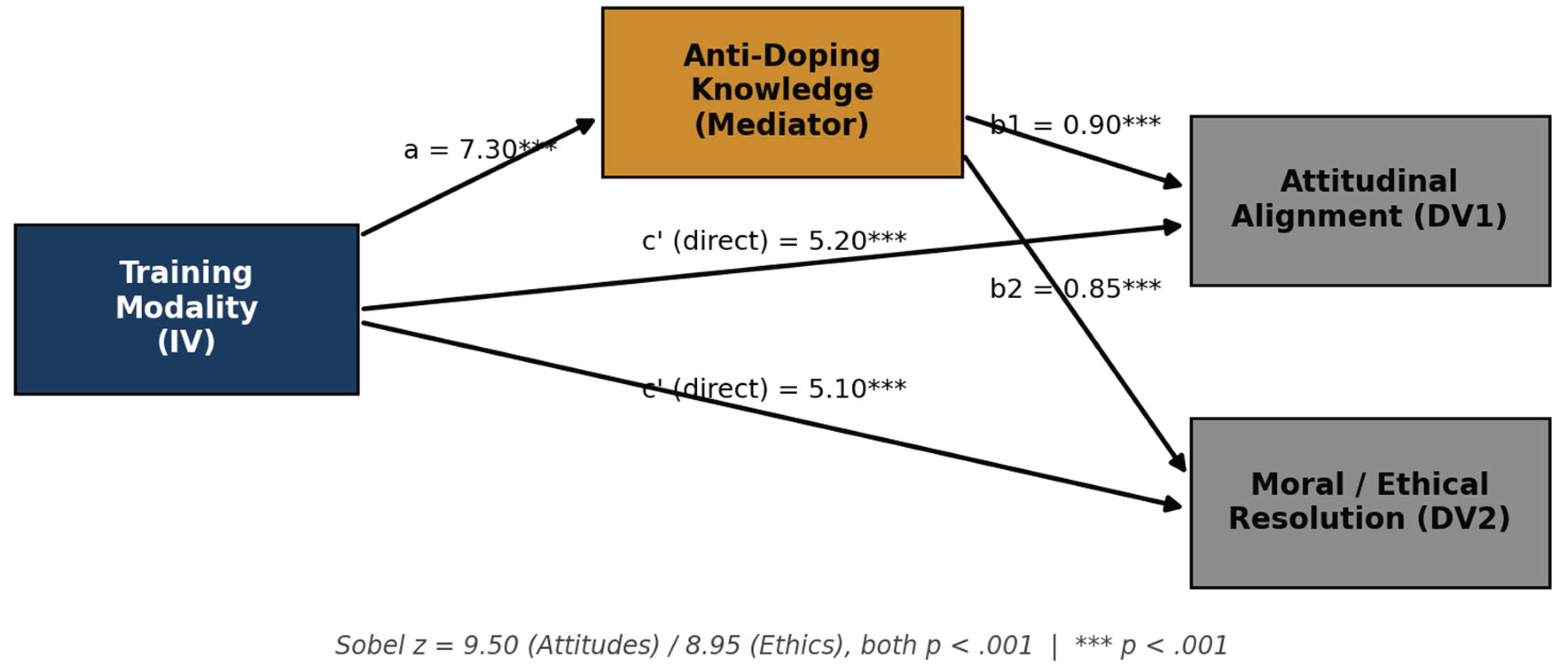

Table 1.
Baseline characteristics by trial arm (no significant between-group differences at p < .05).
Table 1.
Baseline characteristics by trial arm (no significant between-group differences at p < .05).
| Characteristic | Category | Intervention (n=161) | Control (n=160) | Total (n=321) |
| Age (years) | Mean (SD) | 17.2 (1.5) | 17.1 (1.4) | 17.2 (1.5) |
| Sex | Male | 81 (50.3%) | 83 (51.9%) | 164 (51.1%) |
| Female | 80 (49.7%) | 77 (48.1%) | 157 (48.9%) | |
| Sport type | Individual | 70 (43.5%) | 68 (42.5%) | 138 (43.0%) |
| Team | 80 (49.7%) | 82 (51.3%) | 162 (50.5%) | |
| Both | 11 (6.8%) | 10 (6.2%) | 21 (6.5%) | |
| Geography | Urban | 85 (52.8%) | 84 (52.5%) | 169 (52.6%) |
| Suburban | 50 (31.1%) | 51 (31.9%) | 101 (31.5%) | |
| Rural | 26 (16.1%) | 25 (15.6%) | 51 (15.9%) |
Table 2.
Six-session curricular structure, management (intervention) vs. conventional (control) arms.
Table 2.
Six-session curricular structure, management (intervention) vs. conventional (control) arms.
| Wk | Session (Management Arm) | Theoretical Focus | Session (Control Arm) |
| 1 | Understanding the Competitive Landscape | ST: stakeholder mapping (coaches, peers, officials) | Understanding the Anti-Doping Landscape (WADA/NADA basics) |
| 2 | Building Athlete Knowledge & Skills | RBV: knowledge assets, ethical frameworks | Health Risks and Consequences of Doping |
| 3 | Empowering Through Positive Socialization | ST: peer support networks | Fair Play and Ethical Conduct in Sports |
| 4 | Resource Mobilization for Sustainable Practice | RBV: strategic partnerships | Legal and Disciplinary Sanctions for Doping |
| 5 | Taking Ownership of Ethical Choice | RBV: ethical judgment, self-efficacy | Athlete Rights and Responsibilities |
| 6 | Champions for Change: Creating a Legacy | ST: systemic, athlete-led advocacy | Staying Informed and Connected with Resources |
Table 3.
Repeated-measures ANOVA results across three primary outcome domains.
| Construct | Arm | Baseline M(SD) | Post M(SD) | Δ% | p | η² |
| Cognitive Mastery (Knowledge) | Intervention | 18.5 (3.2) | 26.9 (2.5) | +45% | <.001 | .05 |
| Control | 18.3 (3.1) | 20.1 (3.0) | +10% | — | — | |
| Attitudinal Leaning | Intervention | 22.4 (4.1) | 29.1 (3.3) | +30% | <.001 | .04 |
| Control | 22.5 (4.0) | 23.6 (3.9) | +5% | — | — | |
| Moral Proficiency (Ethics) | Intervention | 23.0 (3.5) | 31.0 (2.8) | +35% | <.001 | .06 |
| Control | 23.2 (3.4) | 24.8 (3.6) | +7% | — | — |
Table 4.
2×2 factorial ANOVA: training modality × gender on ethical-reasoning outcomes.
| Gender | Training Modality | Baseline M(SD) | Post M(SD) | Δ% | p | η² |
| Male | Evidence-Based | 22.0 (4.0) | 30.5 (3.0) | +38% | <.001 | .05 |
| Conventional | 22.1 (4.1) | 24.5 (3.8) | +11% | — | — | |
| Female | Evidence-Based | 22.2 (4.2) | 28.5 (3.5) | +29% | <.001 | .04 |
| Conventional | 22.3 (4.0) | 23.7 (3.9) | +6% | — | — |
Table 5.
Mediation path coefficients: knowledge acquisition as mediator of intervention effects.
| Pathway | Coefficient (SE) | p | 95% CI |
| Intervention → Knowledge (a) | 7.30 (0.45) | <.001 | [6.41, 8.19] |
| Knowledge → Attitudes (b1) | 0.90 (0.10) | <.001 | [0.70, 1.10] |
| Knowledge → Ethical Reasoning (b2) | 0.85 (0.09) | <.001 | [0.67, 1.03] |
| Intervention → Attitudes, direct (c′) | 5.20 (0.50) | <.001 | [4.20, 6.20] |
| Intervention → Ethics, direct (c′) | 5.10 (0.48) | <.001 | [4.15, 6.05] |
| Indirect effect (Attitudes) | 6.57 (0.45) | <.001 | [5.71, 7.43] |
| Indirect effect (Ethical Reasoning) | 6.20 (0.43) | <.001 | [5.38, 7.02] |
| Sobel z — Attitudes | z = 9.50 | <.001 | — |
| Sobel z — Ethical Reasoning | z = 8.95 | <.001 | — |
Disclaimer/Publisher’s Note: The statements, opinions and data contained in all publications are solely those of the individual author(s) and contributor(s) and not of MDPI and/or the editor(s). MDPI and/or the editor(s) disclaim responsibility for any injury to people or property resulting from any ideas, methods, instructions or products referred to in the content. |
© 2026 by the authors. Licensee MDPI, Basel, Switzerland. This article is an open access article distributed under the terms and conditions of the Creative Commons Attribution (CC BY) license (http://creativecommons.org/licenses/by/4.0/).
Copyright: This open access article is published under a Creative Commons CC BY 4.0 license, which permit the free download, distribution, and reuse, provided that the author and preprint are cited in any reuse.


