

Submitted:
09 July 2026
Posted:
10 July 2026
You are already at the latest version
Abstract
This study examines social media communication in Kenya to assess how dryland pastoral concerns are represented in national climate policy dialogues. Approximately 80% of Kenya’s land area consists of drylands that support pastoral livelihoods, yet recurring droughts and increasingly variable rainfall threaten these social‐ecological systems. Although Sustainable Development Goal 13 (Climate Action) emphasizes adaptation, progress is typically measured using national indicators that may overlook local priorities. We analyzed digital communications from pastoral nongovernmental organizations, civil society organizations, newspapers, and government agencies using an adaptation pathways framework to examine links among climate risks, governance, and decision‐making. Five themes emerged: water security, rangeland degradation and mobility, climate communication, gender and social inclusion, and climate finance. Kenya has developed relatively strong national climate policies, but social media reveals a persistent implementation gap between national policy and local pastoral priorities. Pastoral communities consistently emphasize Indigenous and local knowledge, women’s leadership, community participation, and locally appropriate adaptation strategies. Social media provides a novel source of evidence for identifying these local priorities and informing more participatory, place‐based climate adaptation.
Keywords:
digital communication
; Indigenous knowledge
; climate change adaptation
; Kenya
; pastoralism
; policy engagement
1. Introduction
Adaptation to climate change is essential in the context of rising greenhouse gas emissions, increasing extreme weather events, and ongoing environmental degradation. Sustainable Development Goal 13 (Climate Action) emphasizes strengthening resilience and adaptive capacity (United Nations, 2015; Epule et al., 2017). The Paris Agreement (2015) further highlights that adaptation should be country-driven, participatory, and informed by both scientific and local knowledge, while integrated across policy domains (IPCC, 2015; Ford et al., 2016).
Despite this emphasis, national-level adaptation strategies often prioritize technological and economic interventions—those more readily measurable—over social dimensions such as equity, justice, collaboration, and institutional flexibility (Patterson et al., 2017; Stojanovic et al., 2016; McIlwain et al., 2023). This imbalance limits the effectiveness of adaptation efforts. Indigenous and local knowledge (ILK) plays a critical role in understanding climate impacts on biophysical and socioeconomic systems, yet a gap persists between globally defined indicators and locally relevant priorities (McElwee et al., 2020; Zorondo-Rodríguez et al., 2014). Although local knowledge has historically been undervalued, it is increasingly recognized as empirically robust and essential for effective adaptation (Lauer, 2017).
This paper examines how Kenyan pastoralists articulate perspectives on climate change and adaptation through social media. The analysis addresses the challenge of linking localized knowledge with national and global frameworks such as the Sustainable Development Goals (SDGs), where local contributions are often underrepresented. The objective is to connect pastoralist perspectives, as expressed through digital networks, to inform more contextually grounded adaptation strategies for Kenya’s drylands. We argue that achieving international climate goals requires integrating social dimensions of adaptation at appropriate scales.
Adaptation is defined in multiple ways within the global environmental change literature (Feola, 2015). We adopt an adaptation pathways framework that links climate uncertainty, governance, and decision-making. This framework is guided by four principles: (1) climate impacts and responses are embedded within social-ecological systems; (2) adaptation must account for diverse and potentially conflicting stakeholder values and knowledge systems; (3) responses must operate across multiple spatial scales and sectors; and (4) planning should address both immediate drivers of vulnerability and underlying systemic factors, including institutional and political marginalization (Butler et al., 2016).
1.1. Climate Change Adaptation in Africa
Although Africa contributes relatively little to global greenhouse gas emissions, it is among the region’s most vulnerable to anthropogenic climate change (Amegah et al., 2016). Projected impacts include rising temperatures, more frequent extreme heat, greater rainfall variability, increasing aridity, more frequent flooding, and sea-level rise, all of which threaten food and water security and the ecosystem services on which many livelihoods depend (Alagidede et al., 2016; Coffel et al., 2017; Serdeczny et al., 2017; Fuller et al., 2018). These multiple stressors underscore the need for effective adaptation strategies across the continent.
SDG 13 (Climate Action) promotes climate adaptation through nationally defined targets and indicators. Complementing this approach, the African Union’s Policy Framework for Pastoralism in Africa (African Union, 2013) provides a continent-wide framework for protecting pastoral livelihoods. Together, these initiatives establish a nested governance structure spanning global, continental, national, and local scales. However, pastoral systems operate according to ecological and social processes that frequently transcend administrative boundaries, creating challenges for implementing policies designed at broader scales.
Effective adaptation requires meaningful participation by local actors. Local engagement improves the relevance, legitimacy, and effectiveness of adaptation strategies by incorporating social, cultural, and environmental knowledge into decision-making (Sterling et al., 2017). Strong social capital—including inclusive institutions, transparent governance, fair conflict-resolution mechanisms, and opportunities for dialogue—further enhances community-based resource management (Musavengane & Simatele, 2017; Fjelde & von Uexkull, 2012; Hendrix & Salehyan, 2012). In contrast, elite capture can undermine trust, equity, and effective governance (Sterling et al., 2017).
Despite broad recognition of the importance of local participation, significant challenges remain in connecting place-based knowledge with policies developed at national, continental, and global scales. Aggregating local perspectives into broader policy frameworks can obscure important social and ecological differences, limiting the effectiveness of adaptation strategies. Addressing these cross-scale disconnects is therefore essential for developing adaptation policies that are both locally relevant and broadly applicable. Social media reveals the adaptation pathways and local priorities that conventional SDG reporting and national policy fail to capture.
1.2. Climate Change in the Dryland Regions of Kenya
Approximately 80% of Kenya consists of arid and semi-arid lands (ASALs) (Figure 1). These regions support about 10 million people, many of whom depend on pastoralism for their livelihoods. Livestock production contributes an estimated 10–13% of Kenya’s gross domestic product (GDP) and remains the most viable land-use system in much of the country’s drylands (Obath, 2020). In northern Kenya, pastoralism provides approximately 90% of youth employment and more than 95% of rural household income (Mokku, 2023).
Kenya’s drylands are experiencing increasing climate variability, including recurrent droughts, erratic rainfall, water scarcity, and episodic flooding (Connolly-Boutin & Smit, 2016). These pressures are compounded by population growth, expanding infrastructure, and fragmentation of rangelands, all of which reduce livestock mobility—a fundamental adaptation strategy that enables pastoralists to access seasonal forage and water (Galvin et al., 2020; Reid et al., 2014). Together, these environmental and socioeconomic pressures threaten the long-term resilience of pastoral livelihoods.
Kenya has developed several policy instruments to strengthen climate adaptation in pastoral regions, including the National Policy for the Sustainable Development of Northern Kenya and Other Arid Lands (GOK, 2012), the Community Land Act (GOK, 2016), and County Integrated Development Plans (CIDPs), which were introduced following devolution to better align national priorities with county-level development needs (CIDP, 2018). Despite these initiatives, participation by dryland communities in national climate policy remains limited. The Climate Governance in Kenya report identifies stakeholder engagement as a continuing weakness in climate governance (Climate Action Tracker, 2020).
This disconnect between national policy and local experience motivates the present study. Examining how Indigenous pastoralists discuss climate change through social media provides insight into locally perceived priorities, adaptation needs, and the extent to which existing policies reflect community perspectives.
2. Materials and Methods
2.1. Research Approach
This study uses digital ethnography to examine how Kenyan pastoralists and organizations discuss climate change and adaptation through social media. Digital ethnography treats online communication as a legitimate field site in which people construct meaning, exchange knowledge, and engage in social and political processes (Ardèvol & Gómez-Cruz, 2014; Bruijn, 2022; Muindi, 2018; Mosse, 2011). Because digital interactions are embedded within everyday social life rather than separate from it, social media provides a valuable setting for examining contemporary environmental discourse (Aykut et al., 2024; Lähdesmäki et al., 2020). In a regional case, Serengeti Watch utilized a Facebook campaign to oppose a proposed highway, raising international awareness, influencing the Tanzanian government, and coordinating with other NGOs (Gardner, 2017).
Digital spaces have assumed an even greater role in public debates since the COVID-19 pandemic and are increasingly recognized as platforms for communication and discussion (Aykut et al., 2024). Platforms like X have provided activists and civil society leaders with direct communication channels to their audiences. Even in areas described as remote, mobile phones and social media increasingly allow individuals and organizations to engage with and discuss climate impacts and solutions (Bruijn, 2022).
2.2. Data Collection
Publicly accessible social media content was collected from Facebook, X (formerly Twitter), and Instagram between May 2023 and August 2025 (Figure 2). These platforms were selected because they are widely used by Kenyan government agencies, civil society organizations, news media, and pastoral organizations to communicate about climate change and environmental issues. See Supplementary Materials for specific search terms for all platforms. Although Facebook has the largest user base in Kenya, X plays a particularly important role in climate advocacy and policy discussions (Kemp, 2024; Aykut et al., 2024).
Although Facebook has the largest user base in Kenya, X plays a particularly important role in climate advocacy and policy discussions (Marion Suiseeya & Zanotti, 2019; Kemp, 2024; Aykut et al., 2024). The analysis focused on posts authored by Kenyan pastoral NGOs, civil society organizations, government agencies, newspapers, and recognized community leaders. The data were collected from 20 organizations and individual activists/leaders, with 135 posts; nine news media organizations provided 63 posts, and 10 government agencies provided 59 posts. A total of 257 posts were analyzed. See Supplementary Material, Tables S1–S3 for specific user groups and platform details. Account identities were verified through organizational websites and other publicly available sources to improve contextual reliability (Rana et al., 2022). Social media content was interpreted alongside government documents and news reports to provide contextual triangulation. Searches were designed to capture discussions of climate change and adaptation in Kenya’s drylands rather than to provide an exhaustive inventory of Kenyan social media.
2.3. Data Analysis
All materials were imported into Quirkos (i.e., qualitative data analysis software) and analyzed using inductive open coding (Ryan & Bernard, 2023). Authors (Z W-H and KG) examined the posts, identifying frequent and significant concepts. Codes were iteratively grouped into broader thematic categories. We applied the codes to relevant text, keeping notes of recurring ideas (Braun & Clark, 2006, 2013). We debriefed to describe the codes, discussing the links between themes and patterns (Lincoln & Guba, 1986). For example, codes related to drought, water shortages, and water infrastructure were combined into the broader theme Water.
2. Results
Five major themes emerged from the digital ethnographic analysis: Water, Rangelands, Communication, Gender, and Climate Finance. Table 1 summarizes the frequency of these themes across organizations, news media, government agencies, individual activists, and digital platforms (Facebook, X, Instagram, and organizational websites).
Across all sources, Rangelands was the most prominent theme, followed by Water. The remaining themes—Climate Finance, Communication, and Gender—appeared less frequently, although their relative prominence varied among source types. Organizations emphasized rangelands, news media focused primarily on water and rangelands, while government agencies distributed attention more evenly across water, communication, and rangelands. These patterns provide the basis for the thematic analysis presented below.
3.1. Water
Water emerged as a dominant theme in discussions of climate change in Kenya’s drylands. Across social media platforms, drought, water scarcity, flooding, and water management were consistently identified as major threats to pastoral livelihoods. Contributors emphasized that recurrent water shortages limit their ability to adapt to climate change by reducing access to drinking water for people and livestock, constraining mobility, and increasing livelihood insecurity. Improving access to clean water for both people and livestock was seen as an essential basic service.[1] Pastoral groups, in particular, noted that the climate crisis is no longer a looming disaster but an already felt reality.[2] During the 2023 drought, Kenya lost approximately 2.5 million livestock, while millions more experienced severe shortages of pasture and water (Mokku, 2023).
Flooding was also widely discussed, particularly in county government communications from areas such as Garissa, where extreme rainfall damages infrastructure, degrades water resources, and disrupts livelihoods. Social media posts and policy documents from county governments, such as Garissa County, indicate that the county is prone to flooding, which threatens livelihoods and leads to environmental degradation[3]. Social media highlighted locally led adaptation initiatives, including the work of the Ildalalekutuk Maasai Action for Development in Kajiado County, which promotes reliable access to clean water and reduces the burden on women and girls, who often travel long distances to collect it. Efforts to increase access to water keeps girls in school[4]. These initiatives emphasize community participation and collaboration among local organizations, county governments, national agencies, faith groups, NGOs, and development partners.
Posts from community organizations and NGOs frequently described practical adaptation measures, including rainwater harvesting, construction of water pans, dams, and boreholes, restoration of wetlands and seasonal rivers, and improved irrigation practices[5]. Women in particular use year-round access to water for crop irrigation, which cushions them against food insecurity[6],[7]. However, contributors also expressed concern that poorly planned water infrastructure, particularly new dams and boreholes, could degrade natural lakes, rivers, and wetlands, illustrating tensions between expanding water access and protecting ecosystems[8].
A recurring theme across platforms was concern about climate governance and financing around water issues. Kenya has established legal and institutional frameworks to address water issues in the context of climate change, including county-level Climate Change Funds[9] that allocate resources to water management projects, and the integration of water resource management in Climate Change Action Plans. Numerous posts called for greater accountability, increased investment in grassroots organizations, and stronger community participation in decisions regarding water management and climate[10].
These social media discussions illustrate an adaptation pathway focused on community water governance. Pastoral communities frame water security as both a technical challenge and socio-ecological system requiring adaptive management under increasingly uncertain climatic conditions.
3.2. Rangelands
Rangelands emerged as the most prominent theme across the digital ethnographic data. Social media discussions consistently identified rangeland degradation as a major consequence of climate change and a direct threat to pastoral livelihoods. Contributors linked prolonged drought, overgrazing, deforestation, and unsustainable land use to declining forage availability, livestock losses, and reduced household food security. Many posts also highlighted the spread of invasive species, particularly Opuntia and Prosopis juliflora, which further reduce grazing quality and limit access to productive rangelands[11].
Posts from pastoral organizations, NGOs, and government agencies emphasized a range of adaptation strategies intended to improve rangeland resilience. Frequently discussed approaches included rotational grazing, establishment of grazing blocks, restoration of degraded rangelands, conservation of drought-tolerant indigenous livestock breeds such as Red Maasai sheep and Sahiwal cattle, and diversification of livelihoods through activities including beekeeping, ecotourism, handicrafts, and, where feasible, crop production[12],[13] . Several posts also described the development of grass banks, hay reserves, dams, and boreholes to increase resilience during drought, often through partnerships involving county governments, national agencies, and international organizations such as the World Food Programme and the Food and Agriculture Organization.
A recurring concern across social media was the governance of shared rangeland resources. Contributors described increasing competition for grazing land and water as drought intensifies, leading to conflict within and across communities[14]. Cross-border livestock mobility was frequently presented as both an essential adaptation strategy and a growing source of political tension over resources[15]. Discussions surrounding the 2024 negotiations between Kenya and Uganda to develop a Memorandum of Understanding on cross-border pastoral mobility reflected support for regional cooperation, but many contributors questioned whether existing agreements provide sufficient policy direction, funding, or enforcement to protect pastoralists’ access to shared rangeland resources[16].
Rangeland social media posts reveal adaptation as a dynamic process under rapidly changing conditions. Successful adaptation depends on protecting movement across landscapes, restoring degraded ecosystems, and supporting pastoral livelihoods. These discussions highlight an adaptive pathway where resilience is based upon flexible management rather than fixed land use strategies.
3.3. Communication
Communication emerged as a central component of climate adaptation in Kenya’s drylands. Communication—especially early warning systems—is viewed as a critical adaptation tool, but current systems remain inaccessible to many pastoralists due to language barriers, geographic isolation, and limited integration of Indigenous knowledge.
Across government agencies, NGOs, news media, and community organizations, social media discussions emphasized the importance of timely, accessible, and locally relevant climate information[17],[18],[19]. National and county climate policies similarly identify public awareness, education, and stakeholder engagement as essential components of climate adaptation, with increasing emphasis on early warning systems and community participation[20],[21].
Early warning systems were among the most frequently discussed adaptation strategies. Social media posts highlighted the value of weather forecasting, drought monitoring, and climate information services in reducing livestock losses and improving pastoral decision-making[22]. Contributors described initiatives led by the Kenya Meteorological Department, the International Livestock Research Institute, county governments, and international partners to expand climate forecasting, automatic weather stations, and localized weather information[23],[24],[25],[26] . Examples included text-message forecasts delivered in local languages to support pastoral mobility and grazing decisions[27]. Due to increasingly extreme and unreliable weather conditions, pastoralists are looking to other sources of information, technologies, and management practices rather than relying solely on traditional knowledge[28],[29],[30],[31] .
Despite these advances, social media discussions consistently identified barriers to effective communication. Contributors noted that many pastoral communities have limited access to meteorological information, difficulties interpreting technical forecasts, and inadequate access to services because of distance, digital infrastructure, or language[32],[33]. Numerous posts emphasized that climate information should be communicated in local languages and integrated with Indigenous knowledge to improve its relevance and credibility[34]. Rather than replacing traditional environmental knowledge, contributors argued that scientific forecasting and Indigenous knowledge should complement one another to strengthen locally appropriate adaptation strategies[35].
Beyond weather forecasting, discussions also emphasized the need for improved communication regarding rangeland degradation, climate risks, and community-based monitoring. Across platforms, communication was framed not simply as information dissemination but as a participatory process that enables informed decision-making and strengthens climate resilience[36],[37].
Communication enables communities to share, adjust, and anticipate climate impacts through information exchange. Adapative strategies integrate scientific forecasting with Indigenous knowledge, improve access through the use of local languages, and identify ways to strengthen two-way exchanges between communities and institutions.
3.4. Gender Issues
Across Kenyan social media and policy documents, women and girls are consistently portrayed as disproportionately affected by climate change, particularly in the drylands[38]. Posts frequently emphasize that prolonged drought, resource scarcity, and environmental degradation intensify existing gender inequalities. Water insecurity is a recurring concern because women are traditionally responsible for collecting household water. As shallow wells become less reliable, they must travel longer distances to obtain water, increasing both their workload and exposure to physical risks[39],[40]. Discussions also highlight higher rates of malnutrition among women and girls, increased mortality during climate-related disasters, greater incidence of child marriage as drought places economic stress on households, and heightened gender-based violence associated with resource scarcity[41],[42],[43],[44].
At the same time, social media presents pastoralist women not simply as vulnerable populations but as essential actors in climate adaptation. Numerous posts argue that women should play a larger role in climate policy development, implementation, and international climate negotiations because of their extensive knowledge of food production, livestock management, and local ecosystems[45],[46],[47]. Women’s leadership is also linked to broader issues of food sovereignty, land tenure, and sustainable rangeland management[48],[49],[50], . Examples include Samburu women’s groups leading rangeland restoration initiatives to improve pasture conditions for livestock and wildlife[51],[52] and the women-led Spring of the ASAL (Arid and Semi-Arid Lands) initiative, which combines community-based adaptation with efforts to reduce gender inequality and strengthen women’s roles within pastoralist communities[53].
Food security and livelihood diversification are among the most common themes associated with women’s adaptation strategies. Social media highlights women harvesting rainwater for crop irrigation, producing grass seed and hay for income generation, participating in tree-planting programs, and joining other nature-based livelihood initiatives[54]. News reports similarly describe pastoral households increasingly participating in women’s collectives to diversify incomes during periods of climatic uncertainty[55]. Other examples include national campaigns promoting women-led climate action through clean cooking technologies, which reduce dependence on fuelwood while decreasing the time women and girls spend collecting firewood[56],[57].
Government policies broadly reinforce these themes through commitments to gender inclusion, although they typically frame women within broader categories of vulnerable populations. Garissa County’s Development Plan (2023–2027) reports increased household access to clean cooking technologies and emphasizes gender mainstreaming across all development sectors[58],[59]. Similarly, the Garissa County Climate Change Fund Act (2018), Kenya’s Climate Change Amendment Bill (2023), and the Ministry of Environment’s Climate Change Plan (2023–2027) all call for gender-responsive climate action, equitable representation, and economic empowerment of women through climate and landscape restoration programs[60],[61],[62],[63].
Despite these policy commitments, important differences emerge between official discourse and grassroots narratives. Government documents generally emphasize gender equity through representation, mainstreaming, and assistance to vulnerable groups. For example, the Deputy Governor of Marsabit County encouraged women, youth, and persons with disabilities to organize collectively to access government and NGO resources[64]. In contrast, social media discussions more frequently portray women as knowledgeable leaders whose lived experience and environmental expertise are critical for successful climate adaptation. At the same time, posts acknowledge ongoing structural barriers, particularly in counties such as Turkana, where women remain underrepresented in local governance and face limited access to markets and public services. Overall, grassroots discussions frame women’s knowledge and leadership as central to climate adaptation, whereas government policies more often position women within broader frameworks of vulnerability and social inclusion.
Gender-related discussions demonstrate that adaptation pathways are strengthened when women are recognized as knowledge holders, decision-makers, and leaders rather than solely as vulnerable populations. Social media consistently portrays women’s environmental knowledge, livelihood diversification, and community leadership as essential capacities for building resilience. This theme expands adaptation beyond reducing vulnerability to enhancing the agency and adaptive capacity of pastoral communities.
3.5. Climate Finance
Climate finance refers to financial mechanisms that support greenhouse gas mitigation, climate adaptation, and sustainable development at global, national, and local levels (Wang & Tang, 2026). Although climate finance receives relatively little direct attention in Kenyan social media, discussions frequently focus on the funding and implementation of climate initiatives, government programs, and community projects. Financial support is generally framed as essential for strengthening local resilience, improving water security, restoring ecosystems, and supporting pastoral livelihoods.
Many discussions highlight international and national financing mechanisms that support climate adaptation. In 2023, the European Union provided €13 million to Kenya to strengthen climate change mitigation and support a transition from reactive drought response to proactive drought management[65]. Similarly, the National Drought Emergency Fund supports drought risk management through investments such as modernized early warning systems[66]. The World Bank-funded Financing Locally Led Climate Action (FLLoCA) program operates across all 47 Kenyan counties and emphasizes participatory planning. For example, Kajiado County used the program to convene local stakeholders in identifying climate risks, priorities, and adaptation strategies[67].
At the community level, social media emphasizes practical adaptation projects that depend on sustained external funding. Frequently discussed initiatives include water harvesting infrastructure, dams, water pans, piped water systems, catchment restoration, regenerative pastoralism, tree planting, and improved livestock management[68]. Several organizations are attempting to develop longer-term financing models. The Maasai Center for Regenerative Pastoralism, for example, combines tourism, education, and training in holistic grazing and drought-resilient agricultural practices to generate financial support while strengthening local livelihoods[69]. County governments similarly promote locally financed adaptation through initiatives such as Garissa County’s Million Trees program, planned grazing, and promotion of indigenous livestock breeds[70],[71]. County Climate Change Funds in counties including Turkana, Marsabit, and Garissa provide financial support for locally identified adaptation priorities, while nongovernmental organizations such as Spring of the ASAL and Friends of Lake Turkana mobilize additional resources for projects including water access, ecosystem restoration, and tree planting[72],[73].
Carbon finance generates substantially more debate than other forms of climate funding. Government policies generally present carbon markets as opportunities to finance sustainable development and low-carbon growth, while social media, newspaper articles, and civil society organizations express a broader range of perspectives regarding their effectiveness and distributional impacts. National and county policies consistently promote emissions reductions and renewable energy, including solar-powered irrigation, geothermal development, and other low-carbon technologies. At the same time, public discussions question whether carbon finance adequately benefits pastoralist communities or primarily serves external interests[74],[75].
The Northern Rangelands Trust carbon project illustrates these tensions. Since 2010, the project has generated carbon credits through rangeland management and conservation activities[76]. Supporters argue that revenues strengthen conservancies and improve rangeland management, whereas critics question whether financial benefits reach participating communities, whether estimates of carbon sequestration are adequately verified, and whether prescribed rotational grazing systems conflict with customary pastoral management practices and local governance institutions[77],[78]. These concerns illustrate broader debates about equity, accountability, and the compatibility of market-based conservation with Indigenous pastoral systems[79],[80],[81].
Similar debates surround Kenya’s Climate Change (Amendment) Bill of 2023, which seeks to expand carbon credit markets[82]. While the legislation prohibits approval of emissions-credit projects associated with human rights violations or significant social and environmental harm, civil society organizations argue that it provides insufficient safeguards for community participation, land rights, and equitable benefit sharing[83]. Critics also contend that carbon offset markets do not address the underlying drivers of greenhouse gas emissions because they allow continued emissions elsewhere while shifting mitigation activities to pastoral landscapes. Although the legislation identifies communities as stakeholders in negotiating community development agreements, questions remain regarding the strength of consultation requirements and mechanisms for ensuring meaningful local participation[84],[85],[86].
Overall, discussions of climate finance reveal a contrast between official policy and grassroots perspectives. Government agencies emphasize international investment, carbon markets, and institutional financing as mechanisms for achieving climate adaptation and low-carbon development. In contrast, social media and civil society discussions focus more heavily on whether financial resources reach local communities, support locally identified priorities, respect land rights, and strengthen rather than undermine pastoral livelihoods. Across both perspectives, adequate and sustained financing is viewed as essential for building climate resilience in Kenya’s drylands.
Climate fincance social media discussions reveal that adaptation depends on both availability of financial resources but also on how resources are governed and aligned with local priorities. From an adaptive pathways perspective, equitable and participatory financing is viewed as an essential component of long-term climate resilience rather than simply a source of project funding.
4. Discussion
This study demonstrates that social media provides a valuable perspective on climate adaptation priorities among Kenya’s dryland pastoral communities that is often absent from national policy documents and SDG reporting. Although the five themes identified through our analysis closely align with Kenya’s climate policies and broader international frameworks—including the SDGs, the Policy Framework for Pastoralism in Africa, and the Community Land Act—they also reveal important differences in emphasis between national policy objectives and locally articulated priorities. These findings suggest that effective climate adaptation depends not only on well-designed national policies but on mechanisms that enable local knowledge, experiences, and institutions to shape policy implementation.
The themes identified in this study illustrate the interconnected nature of the SDGs. While the research focuses primarily on SDG 13 (Climate Action), pastoral concerns extend across multiple goals. Rangeland degradation, mobility, and conflict are closely linked to SDG 15 (Life on Land), water insecurity reflects SDG 6 (Clean Water and Sanitation), and gender inequalities are directly related to SDG 5 (Gender Equality). These findings reinforce previous work demonstrating that climate adaptation in pastoral systems cannot be separated from broader social, ecological, and governance objectives.
The results reinforce growing evidence that successful adaptation requires combining national policy frameworks with Indigenous and local knowledge (Friis-Hansen, 2017; Magni, 2017; McElwee et al., 2020; Adenle et al., 2017). Although Kenyan climate policies increasingly recognize participation and traditional knowledge, social media discussions indicate that many pastoral communities continue to perceive a gap between policy commitments and implementation. Local organizations consistently emphasize participation, mobility, land rights, water security, and women’s leadership as immediate priorities, suggesting that adaptation is viewed less as a technical exercise than as a process of strengthening local institutions and livelihoods.
One of the clearest findings is the mismatch between the scales at which climate policy is designed and the scales at which pastoral adaptation occurs. National policies establish broad institutional frameworks and financing mechanisms, whereas pastoral livelihoods depend on highly localized ecological conditions, seasonal mobility, and community governance that frequently extend across county and international borders. Consequently, nationally aggregated indicators often fail to capture the diversity of adaptation needs across Kenya’s drylands. Place-based adaptation strategies therefore require locally relevant social and ecological information, including land tenure arrangements, resource access, mobility patterns, and ecological monitoring, together with adequate financial resources and institutional support (Ndiritu et al., 2025).
The adaptation pathways framework provides a useful lens for interpreting these findings because it emphasizes that adaptation involves governance, knowledge systems, spatial scale, and structural inequalities rather than simply technical interventions (Table 2; Patterson et al., 2017). Across all four pathway principles, social media consistently highlights the importance of strengthening relationships between national institutions and local communities.
The first pathway underscores the importance of institutions and politics. The Intergovernmental Relations Act (2012), for example, prioritizes the involvement of pastoralists in policymaking. Pastoral communities repeatedly call for stronger representation in policy development and greater recognition of customary governance institutions. These institutions have historically managed common resources, mobility, and conflict resolution and remain central to adaptation in highly variable dryland environments.
The second pathway emphasizes the need to recognize diverse goals, values, and knowledge systems, though it is often included in plans and programs, such as those of the National Council for Nomadic Education (NACONEK). Although Kenyan policies increasingly acknowledge participation, social media discussions suggest that local knowledge is still insufficiently incorporated into planning and implementation. Particular emphasis is placed on women’s leadership, pastoral education, secure land rights, and livelihood diversification as prerequisites for effective adaptation, as envisioned by the National Land Use Policy (GOK, 2017).
The third pathway highlights the importance of multiple spatial and institutional scales (Geels, 2019). This emerged as one of the most significant challenges identified in the study. Adaptation policies frequently operate at the national or county level, while pastoral systems function across landscapes that span administrative boundaries. Bridging these jurisdictional mismatches will require greater coordination among government agencies, stronger support for cross-border mobility, and improved mechanisms for incorporating local priorities into planning processes. For example, the Equalization Fund (2021), which provides funding to marginal areas at the sub-county level, is an effort of this type of cross-scale coordination.
Finally, the fourth pathway demonstrates that adaptation strategies must address both immediate climate risks and the systemic factors that produce vulnerability. Investments in early warning systems, climate finance, rotational grazing, water infrastructure, and drought preparedness remain important, but their effectiveness depends on addressing broader issues of political representation, gender inequality, land tenure, and equitable access to resources. The National Policy on Gender and Development (2019) is an example of efforts to examine and improve existing policies for vulnerable populations. These structural dimensions of vulnerability were consistently emphasized across social media discussions but were generally less prominent in official policy documents.
Taken together, the findings suggest that Kenya has developed a comprehensive national policy framework for climate adaptation, yet important implementation gaps remain at the local level. Social media provides a complementary source of evidence that captures community priorities, concerns, and emerging adaptation practices that are often overlooked by conventional policy assessments. Incorporating these perspectives into county and national planning could strengthen participatory governance, improve the targeting of climate investments, and increase the effectiveness and legitimacy of adaptation policies in Kenya’s drylands.
5. Conclusions
Social media reveals local adaptation priorities that are largely missing from national climate policy and SDG implementation, and these perspectives should inform future adaptation planning.
This study demonstrates that social media provides an important window into how pastoral communities in Kenya’s drylands understand climate change, identify adaptation priorities, and evaluate government responses. Although Kenya has developed an extensive policy framework to support climate adaptation and implementation of SDG 13, our findings reveal a persistent gap between national policy objectives and locally expressed priorities. Social media captures perspectives that are often absent from formal policy documents, including concerns about rangeland degradation, water insecurity, pastoral mobility, gender equity, climate finance, and community participation.
The findings suggest that achieving climate adaptation in ways that are both socially equitable and environmentally sustainable requires greater integration of Indigenous and local knowledge into planning, implementation, and evaluation. Adaptation strategies should be developed through participatory processes that recognize the diversity of Kenya’s drylands rather than relying primarily on nationally aggregated indicators. Because adaptation needs vary across ecological, cultural, and institutional contexts, place-based approaches are essential for ensuring that policies respond to local priorities and strengthen pastoral livelihoods.
The adaptation pathways framework highlights that successful adaptation extends beyond technical interventions. Strengthening local institutions, improving coordination across governance scales, expanding meaningful participation, addressing gender inequities, and ensuring equitable access to climate finance are all necessary components of resilient pastoral systems. Although Kenya has adopted progressive national policies that recognize many of these principles, implementation remains uneven, and local communities continue to identify significant barriers to participation and resource access.
More broadly, this study demonstrates the value of social media as a complementary source of evidence for climate adaptation research. Digital conversations provide timely insights into community concerns, emerging adaptation practices, and perceptions of policy implementation that are difficult to capture through conventional policy analysis alone. Integrating these perspectives into county and national planning could improve the legitimacy, responsiveness, and effectiveness of climate adaptation strategies.
As climate change intensifies across Africa’s drylands, strengthening partnerships among governments, civil society organizations, researchers, and pastoral communities will be increasingly important. Policies that recognize local knowledge, support hybrid governance systems that combine customary and formal institutions, and ensure that adaptation investments reach local communities are likely to be more effective in building resilience while advancing both sustainable development and climate justice.
Note:a[Drylands are defined as areas where the aridity index (AI = annual precipitation ÷ potential evapotranspiration) is less than 0.65 (Reid et al., 2014; Reynolds et al., 2007). These regions have low and unpredictable rainfall, high evaporation rates and sparse vegetation. They cover about 41% of the Earth’s land surface and drylands is the term used in UN frameworks. Arid and semi-arid lands (ASALs) are a subset of global drylands, and the term is most often used in East Africa regarding development policy, pastoralism, and drought management (GOK, 2012; Opiyo et al., 2014). Rangelands are ecosystems managed primarily for grazing livestock and wildlife. They are dominated by native vegetation such as grasses, shrubs and open landscapes rather than crops (Reid et al., 2014; Allen et al., 2011).
Author Contributions
KG conceived the initial idea for the paper in collaboration with ML. ZW-H collected and analyzed the data, with contributions from KG. All authors contributed to drafting and revising the manuscript, and ML helped refine the final draft.
Funding
This work was supported in part by the Department of Anthropology and Geography and the College of Liberal Arts, with Z W-H as a graduate student, for digital communications research. We thank graduate students Andie Conlon and Kirk Saylor for their review of relevant literature.
Data Availability Statement
The authors confirm that all data supporting the findings are publicly available and included in this article. They are found in the footnotes and summarized in the Supplementary Material.
Conflicts of Interest
The authors declare no conflicts of interest. The funders had no role in the design of the study; in the collection, analyses, or interpretation of data; in the writing of the manuscript; or in the decision to publish the results.
References
- Adenle, A. A.; Ford, J. D.; Morton, J.; Twomlow, S.; Alverson, K.; Cattaneo, A.; Cervigni, R.; Kurukulasuriya, P.; Huq, S.; Helfgott, A.; Ebinger, J. O. Managing climate change risks in Africa: A global perspective. Ecological Economics 2017, 141, 190–201. [Google Scholar] [CrossRef]
- African Union. Policy framework for pastoralism: Securing, protecting and improving the lives, livelihoods and rights of pastoralist communities. 2013. Available online: https://au.int/sites/default/files/documents/30259-doc-pastoral_policy_framework_-_low_res.pdf.
- Alagidede, P.; Adu, G.; Frimpong, P. B. Effect of climate change on economic growth in SSA. Environmental Economics and Policy Studies 2016, 18(3), 417–436. [Google Scholar] [CrossRef]
- Allen, V. G.; Batello, C.; Berretta, E. J.; Hodgson, J.; Kothmann, M.; Li, X.; McIvor, J.; Milne, J.; Morris, C.; Peeters, A.; Sanderson, M. An international terminology for grazing lands and grazing animals. Grass and Forage Science 2011, 66(1), 2–28. [Google Scholar] [CrossRef]
- Amegah, A. K.; Rezza, G.; Jaakkola, J. J. Temperature-related morbidity/mortality in Sub-Saharan Africa: A systematic review of the empirical evidence. Environment International 2016, 91, 133–149. [Google Scholar] [CrossRef] [PubMed]
- Ardèvol, E.; Gómez-Cruz, E. Digital ethnography and media practices. In The International Encyclopedia of Media Studies; Wiley-Blackwell, 2014; Vol. 7, pp. 498–518. [Google Scholar] [CrossRef]
- Aykut, S. C.; Braun, M.; Rodder, S. Collaborative ethnography of global environmental governance: Concepts, methods and practices; Cambridge University Press, 2024. [Google Scholar] [CrossRef]
- Braun, V.; Clarke, V. Using thematic analysis in psychology. Qualitative research in psychology 2006, 3(2), 77–101. [Google Scholar] [CrossRef]
- Braun, V.; Clarke, V. Successful qualitative research: A practical guide for beginners; Sage, 2013. [Google Scholar]
- Bruijn, M. E. de. Mediatization of ethnographic research practice in the digital age: An essay about research and Sahel dynamics since the 1990s; Kroeker, L., Ed.; University of Bayreuth African Studies Online, 2022; Vol. 9, pp. 79–95. Available online: https://hdl.handle.net/1887/3479645.
- Butler, J. R. A.; Wise, R. M.; Skewes, T. D.; Bohensky, E. L.; Peterson, N.; Suadnya, I. W.; Yanuartati, Y.; Handayani, T.; Habibi, P.; Puspadi, K.; Adhuri, D. S.; Duggan, K. Scenario planning to leap-frog the Sustainable Development Goals: An adaptation pathways approach. Climate Risk Management 2016, 12, 83–99. [Google Scholar] [CrossRef]
- Chemam, M. Climate activists say African summit failed despite billion-dollar pledges. RFI. 9 September 2023. Available online: https://www.rfi.fr/en/africa/20230909-climate-activists-say-african-summit-failed-despite-billion-dollar-pledges.
- CIDP (County Integrated Development Plans). 2018–2022. Available online: https://open.africa/dataset/county-integrated-development-plans-kenya-2018-2022.
- Tracker, Climate Action. Climate governance in Kenya. 2020. Available online: https://climateactiontracker.org/publications/climate-governance-in-kenya/.
- Coffel, E. D.; Horton, R. M.; De Sherbinin, A. Temperature and humidity based projections of a rapid rise in global heat stress exposure during the 21st century. Environmental Research Letters 2017, 13(1), Article 014001. [Google Scholar] [CrossRef] [PubMed]
- Connolly-Boutin, L.; Smit, B. Climate change, food security, and livelihoods in Sub-Saharan Africa. Regional Environmental Change 2016, 16(2), 385–399. Available online: https://climateactiontracker.org/publications/climate-governance-in-kenya/.
- Diedong, A. L.; Naaikuur, L. Localising Sustainable Development Goals through Participatory Community Radio in Ghana. Journal of Development Communication 2023, 34(1), 38–46. Available online: https://jdc.journals.unisel.edu.my/index.php/jdc/article/view/244.
- Epule, T. E.; Ford, J. D.; Lwasa, S.; Lepage, L. Climate change adaptation in the Sahel. Environmental Science & Policy 2017, 75, 121–137. [Google Scholar] [CrossRef]
- Feola, G. Societal transformation in response to global environmental change: A review of emerging concepts. Ambio 2015, 44(5), 376–390. [Google Scholar] [CrossRef] [PubMed]
- Fjelde, H.; von Uexkull, N. Climate triggers: Rainfall anomalies, vulnerability and communal conflict in Sub-Saharan Africa. Political Geography 2012, 31(7), 444–453. [Google Scholar] [CrossRef]
- Ford, J. D.; Cameron, L.; Rubis, J.; Maillet, M.; Nakashima, D.; Willox, A. C.; Pearce, T. Including Indigenous Knowledge and Experience in IPCC Assessment Reports. Nature Climate Change 2016, 6, 349–353. Available online: https://doi-org.ezproxy2.library.colostate.edu/10.1038/nclimate2954. [CrossRef]
- Friis-Hansen, E. (Ed.) Decentralized governance of adaptation in Africa; CABI Publishing, 2017. [Google Scholar]
- Fuller, T. L.; Clee, P. R. S.; Njabo, K. Y.; Tróchez, A.; Morgan, K.; Meñe, D. B.; Smith, T. B. Climate warming causes declines in crop yields and lowers school attendance rates in Central Africa. Science of the Total Environment 2018, 610–611, 503–510. [Google Scholar] [CrossRef] [PubMed]
- Galvin, K. A.; Even, T.; Reid, R. S.; Njoka, J.; Roque de Pinho, J.; Thornton, P.; Saylor, K. Understanding climate from the ground up: Knowledge of environmental changes in the East African savannas. In Changing climate, changing worlds: Local knowledge and the challenges of social and ecological change; Welch-Devine, M., Sourdril, A., Burke, B. J., Eds.; Springer Nature, 2020; pp. 221–242. [Google Scholar] [CrossRef]
- Gardner, B. Stopping the Serengeti road: Social media and the discursive politics of conservation in Tanzania. In Other geographies: The influences of Michael Watts; Chari, S., Freidberg, S., Gidwani, V., Ribot, J., Wolford, W., Eds.; Wiley, 2017. [Google Scholar] [CrossRef]
- Geels, F. W. Socio-technical transitions to sustainability: A review of criticisms and elaborations of the multi-level perspective. Current Opinion in Environmental Sustainability 2019, 39, 187–201. [Google Scholar] [CrossRef]
- GOK. National policy for sustainable development of northern Kenya and other arid lands. 2012. Available online: https://repository.kippra.or.ke/server/api/core/bitstreams/896337f6-bd1c-490d-bc18-e80116c383f5/content.
- Government of Kenya. Community Land Act (Revised 2023). 2016. Available online: https://new.kenyalaw.org/akn/ke/act/2016/27/eng@2022-12-31.
- GOK. National Land Use Policy. 2017. Available online: https://repository.kippra.or.ke/server/api/core/bitstreams/80221acb-99f9-496f-a455-882f8d3d8073/content.
- Gupta, A.; Ferguson, J. Discipline and practice: The field” as site, method, and location in anthropology. In Anthropological locations: Boundaries and grounds of a field science; Gupta, A., Ferguson, J., Eds.; University of California Press, 1997; pp. 1–46. [Google Scholar]
- Hendrix, C. S.; Salehyan, I. Climate change, rainfall, and social conflict in Africa. Journal of Peace Research 2012, 49(1), 35–50. [Google Scholar] [CrossRef]
- IPCC (Intergovernmental Panel on Climate Change). Paris Agreement, Article 7:9. 2015. Available online: https://treaties.un.org/doc/Treaties/2016/02/20160215%2006-03%20PM/Ch_XXVII-7-d.pdf.
- Kemp, S. Digital 2024: Kenya. DataReportal – Global Digital Insights. 2024. Available online: https://datareportal.com/reports/digital-2024-kenya.
- Lauer, M. Changing understanding of local knowledge in island environments. Environmental Conservation 2017, 44(4), 336–347. [Google Scholar] [CrossRef]
- Lähdesmäki, T.; Koskinen-Koivisto, E.; Ceginskas, V. L. A.; Koistinen, A. K. Challenges and solutions in ethnographic research: Ethnography with a twist, 1st ed.; Routledge, 2020. [Google Scholar] [CrossRef]
- Lincoln, Y. S.; Guba, E. G. But is it rigorous? Trustworthiness and authenticity in naturalistic evaluation. New directions for program evaluation 1986, 30(1), 73–84. [Google Scholar] [CrossRef]
- Magni, G. Indigenous knowledge and implications for the sustainable development agenda. European Journal of Education 2017, 52(4), 437–447. [Google Scholar] [CrossRef]
- Marion Suiseeya, K. R.; Zanotti, L. Making influence visible: Innovating ethnography at the Paris Climate Summit. Global Environmental Politics 2019, 19(2), 38–60. [Google Scholar] [CrossRef]
- McElwee, P.; Fernández-Llamazares, Á.; Aumeeruddy-Thomas, Y.; Babai, D.; Bates, P.; Galvin, K.; Guèze, M.; Liu, J.; Molnár, Z.; Ngo, H. T.; et al. Working with Indigenous and local knowledge in large-scale ecological assessments: Reviewing the experience of the IPBES Global Assessment. Journal of Applied Ecology 2020, 57(8), 1526–1536. [Google Scholar] [CrossRef]
- McIlwain, L.; Holzer, J. M.; Baird, J.; Baldwin, C. L. Power research in adaptive water governance and beyond: A review. Ecology and Society 2023, 28(2), 22. [Google Scholar] [CrossRef]
- Mokku, J. Kenya: Climate change destroys livelihoods of pastoralists; AllAfrica, 2023. [Google Scholar]
- Mosse, D. Introduction: The anthropology of expertise and professionals in international development. In Adventures in Aidland: The anthropology of professionals in international development; Mosse, D., Ed.; Berghahn Books, 2011. [Google Scholar]
- Muindi, B. Negotiating the balance between speed and credibility in deploying Twitter as journalistic tool at the Daily Nation newspaper in Kenya. African Journalism Studies 2018, 39(1), 111–128. [Google Scholar] [CrossRef]
- Musavengane, R.; Simatele, D. Significance of social capital in collaborative management of natural resources in Sub-Saharan African rural communities: A qualitative meta-analysis. South African Geographical Journal 2017, 99(3), 267–282. [Google Scholar] [CrossRef]
- Ndiritu, S. W.; Waimiri, A. M. G.; Muthanga, A.; Baskaran-Makanju, S. An in-depth assessment of pastoral policy landscape in Kenya. In Pastoralism: Research, Policy and Practice; 2025. [Google Scholar] [CrossRef]
- Obath, P. Covid-19 risking the livelihoods of pastoralists. Business Daily Africa. 2020. Available online: https://www.businessdailyafrica.com/analysis/ideas/Covid-19-risking-the-livelihoods-of-pastoralists/4259414-5528670-q4l0qy/index.html.
- Opiyo, F. E. O.; Wasonga, O. V.; Nyangito, M. M. Measuring household vulnerability to climate-induced stresses in pastoral rangelands of Kenya. Pastoralism: Research, Policy and Practice 2014, 4(1), 10. [Google Scholar] [CrossRef]
- Patterson, J.; Schulz, K.; Vervoort, J.; van der Hel, S.; Widerberg, O.; Adlaer, C.; Hurlbert, M.; Anderton, K.; Sethi, M.; Barau, A. Exploring the governance and politics of transformations towards sustainability. Environmental Innovation and Societal Transitions 2017, 24, 1–16. [Google Scholar] [CrossRef]
- Rana, S. M.; Ismail, M. N.; Ismail, I.; Uddin, M. S. Applying a Digital Ethnographic Tool into a Data Triangulation and Trustworthiness of Microfinance Over-Indebtedness Study in Bangladesh During COVID-19. In Practices, Challenges, and Prospects of Digital Ethnography as a Multidisciplinary Method; Chowdhury, J. S., et al., Eds.; IGI Global, ProQuest Ebook Central, 2022; Available online: http://ebookcentral.proquest.com/lib/ucb/detail.action?docID=7074003.
- Reid, R. S.; Fernández-Giménez, M. E.; Galvin, K. A. Dynamics and resilience of rangelands. Annual Review of Environment and Resources 2014, 39, 217–242. [Google Scholar] [CrossRef]
- Reynolds, J. F.; Smith, D. M.; Lambin, E. F.; Turner, B. L., II; Mortimore, M.; et al. Global desertification: Building a science for dryland development. Science 2007, 316(5826), 847–851. [Google Scholar] [CrossRef] [PubMed]
- Ryan, G. W.; Bernard, H. R. Techniques to identify themes. Field Methods 2003, 15(1), 85–109. [Google Scholar] [CrossRef]
- Schubiger, E. Turkana’s extractive promises in limbo. Third World Quarterly 2025, 1–18. [Google Scholar] [CrossRef]
- Serdeczny, O.; Adams, S.; Baarsch, F.; Coumou, D.; Robinson, A.; Hare, W.; Schaeffer, M.; Perrette, M.; Reinhardt, J. Climate change impacts in Sub-Saharan Africa: From physical changes to their social repercussions. Regional Environmental Change 2017, 17(6), 1585–1600. [Google Scholar] [CrossRef]
- Sever, S. D.; Tok, E.; Sellami, A. L. Sustainable Development Goals in a Transforming World: Understanding the Dynamics of Localization. Sustainability 2025, 17(6), 2763. [Google Scholar] [CrossRef]
- Shultis, J.; Heffner, S. Hegemonic and emerging concepts of conservation: A critical examination of barriers to incorporating Indigenous perspectives in protected area conservation policies and practice. Journal of Sustainable Tourism 2016, 24(8), 1–16. [Google Scholar] [CrossRef]
- Sterling, E. J.; Filardi, C.; Toomey, A.; Sigouin, A.; Betley, E.; Gazit, N.; Newell, J.; Albert, S.; Alvira, D.; Bergamini, N.; Blair, M.; others. Biocultural approaches to well-being and sustainability indicators across scales. Nature Ecology & Evolution 2017, 1, 1798–1806. [Google Scholar] [CrossRef] [PubMed]
- Stojanovic, T.; McNae, H. M.; Tett, P.; Potts, T. W.; Reis, J.; Smith, H. D.; Dillingham, I. The “social” aspect of social-ecological systems: A critique of analytical frameworks and findings from a multisite study of coastal sustainability. Ecology and Society 2016, 21(3), 15. [Google Scholar] [CrossRef]
- United Nations. Sustainable development goals. 2015. Available online: https://www.un.org/sustainabledevelopment/sustainable-development-goals/.
- Wang, L.; Tang, J. From Climate Finance to Sustainable Development: The Synergy of Financial Instruments and National Governance for Achieving SDG 13. In Sustainable Development1–25; 2026. [Google Scholar] [CrossRef]
- Zorondo-Rodríguez, F.; Gómez-Baggethun, E.; Demps, K.; Ariza-Montobbio, P.; Garcia, C. A.; Reyes-García, V. What defines quality of life? The gap between public policies and locally defined indicators among residents of Kodagu, Karnataka (India). Social Indicators Research 2014, 115, 441–456. [Google Scholar] [CrossRef]
[1] PACJA [@pacja_org]. (2025, May 29). Parliament's recent move to slash the climate change budget. Instagram. https://www.instagram.com/p/DKOoovItIEz/?igsh=MWdqa3Nhd3BiazlsdQ== |
[2] itsmunasworld [@itsmunasworld]. (2022, June 18). For Pastoral communities like mine, #ClimateCrisis is no longer a looming disaster. Instagram. https://www.instagram.com/p/Ce9IeZIoqjY/?igshid=MzRlODBiNWFlZA== |
[3] County Government of Garissa. (2022). Garissa County Annual Development Plan, Financial Year 2023/2024. Garissa County Assembly. https://garissaassembly.go.ke/wp-content/uploads/2023/11/Adopted-Garissa-ADP-2023-2024.pdf; SNDAfrica [@SNDAfrica]. (2025, February 10). As climate change intensifies, pastoralist communities…. Facebook. https://www.facebook.com/share/p/17JhKHeGQi/
|
[4] Ildalalekutuk Maasai Action for Development. (2016). Strategic Plan 2016 – 2021. Ildalalekutuk Maasai Action for Development. https://www.maasaiactionfordevelopment.org/strategy.html
|
[5] Turkana County News Online [@NewsTurkana]. (2019, May 24). Climate Change Awareness Walk in Turkana County. Facebook. www.facebook.com/NewsTurkana; Government of Kenya spokesperson [@SpokesPersonKenya]. (2022, March 28). Research to mitigate Drought in Kenya. Facebook. https://www.facebook.com/share/p/1Co2JNUYvh/
|
[6] Agency for Cross-Border Pastoralists Development [@apadlodwar]. (2021, March 15). Helps build resilience against climate change for the Turkana community. X (formerly Twitter). https://twitter.com/apadlodwar
|
[7] Turkana County News Online, 2019 May 24 |
[8] Friends of Lake Turkana [@FoLTurkana]. (2025, May 16). Lake Turkana faces similar threats. X (formerly Twitter). https://x.com/FoLTurkana/status/1923432981407883532
|
[9] Mazingira Na Misitu [@MENRKE]. (2021, October 26). Monitoring of the drought situation. Facebook. https://www.facebook.com/MENRKE
|
[10] Spring of the ASALs [@spring_of_the_asal]. (2023, May 1). Gender Based Violence (GBV) and Climate change- Grassroots Study in Kenya. Instagram. https://www.instagram.com/p/CrsNx7hoGP_/?igshid=MzRlODBiNWFlZA== |
[11] Northern Rangelands Trust. (2019). The Northern Rangelands Trust: Rangelands Strategy 2019-2022. NRT-Kenya. |
[12] County Government of Garissa, 2022 |
[13] Salesa, H. (2021, October 29). Drought-hit Herders Embrace Farming as Coping Strategy. The Star. https://www.the-star.co.ke/counties/north-eastern/2021-10-29-drought-hit-herders-embrace-farming-as-coping-strategy/; Ekiru, Y. (2021, December 1). Groundnuts farming brings hope to Turkana farmers. Turkana Guardian. https://www.turkanaguardian.com/post/groundnuts-farming-brings-hope-to-turkana-farmers
|
[14] Turkana County News Online, 2019 May 24; Government of Kenya spokesperson, 2022 March 28 |
[15] Friends of Lake Turkana [@FoLTurkana]. (2025, June 20). We continue to advocate for... X (formerly Twitter). https://x.com/FoLTurkana/status/1936102603529560194; PS Kello Harsama, CBS [@harsama_kello]. (2025, August 4). The collaboration seeks to enhance cross-border integration. X (formerly Twitter). https://x.com/harsama_kello/status/1952317600639410376
|
[16] Ministry of East African Community (EAC), the ASALs & Regional Development. (2024, September 24). Kenya-Uganda meet to chart cross border peace and development. State Department for East African Community. https://www.eac.go.ke/kenya-uganda-meet-chart-cross-border-peace-and-development
|
[17] Republic of Kenya. (2012). The Climate Change Authority Bill. Kenya Gazette Supplement No. 61 (Bills No. 29). |
[18] Parliament of Kenya. (2023). The Climate Change (Amendment) Act, 2023. Amendment of section 2 of No. 11 of 2016.
|
[19] Parliament of Kenya. (2023). The Climate Change (Amendment) Act, 2023. Amendment of section 2 of No. 11 of 2016.
|
[20] Ministry of Environment, Climate Change and Forestry. (2023). Draft Strategic Plan 2023-2027. Government of Kenya, p.13. |
[21] Kajiado County. (2020). The Kajiado County Climate Change bill, 2020. Special issue Kenya Gazette Supplement No. 3 (Kajiado County Bills No. 2). |
[22] ICPALD [@ICPALD]. (2022, December 14). IGAD MS experts meet to review early warning for early action tools… Twitter. https://x.com/ICPALD/status/1602924484604067840?s=20
|
[23] Ministry of Environment, 2023 |
[24] AFP. (2019, May 24). Tradition meets tech as herders adapt to climate change North Eastern. The Standard. https://www.standardmedia.co.ke/business/north-eastern/article/2001326949/tradition-meets-tech-as-herders-adapt-to-climate-changeBottom of Form
|
[25] Kenya Met Department [@meteokenya]. (2023, May 11). Instagram. https://www.instagram.com/p/CsHH1_vN8-i/?igshid=MzRlODBiNWFlZA== |
[26] Kenya Met Department [@meteokenya]. (2023, July 5). Instagram. https://www.instagram.com/p/CuUpZeQA5na/?igshid=MzRlODBiNWFlZA== |
[27] Kenya Met Department, 2023 July 5 |
[28] AFP, 2019 |
[29] Kenya Met Department, 2023 July 5 |
[30] Turkana County. (2020). Turkana County Climate Change Bill. https://devolutionhub.or.ke/resources/turkana-county-climate-change-bill-2020?media_id=7e14b3d7-441d-4035-b9c8-21c6bb2054c6, p.26 |
[31] Turkana County News Online, 2019 May 24 |
[32] Spring of the Arid and Semi-Arid Lands (SASAL). (2019, October 26). Workshop on change in livelihoods due to droughts: Summary report on workshop proceedings. Olkiramatian |
[33] Wangulu, E. (2019, December 3). Supporting pastoralists to tackle climate change. The Standard. https://www.standardmedia.co.ke/farmkenya/article/2001351877/supporting-pastoralists-to-tackle-climate-change
|
[34] SASAL, 2019 |
[35] Pacida Kenya [@PacidaKenya]. (2023, September 8). There is need to integrate indigenous knowledge in science to develop early warning systems… Twitter. https://x.com/PacidaKenya/status/1700065097442365750?s=20
|
[36] ASAL Humanitarian Network–Kenya [@KenyaAsal]. (2025, July 17). In Garissa and Tana River… X (formerly Twitter). https://x.com/KenyaAsal/status/1945771226095300852
|
[37] Northern Rangelands Trust, 2019 |
[38] Friends of Lake Turkana [@FoLTurkana]. (2025, March 7). How is climate change affecting pastoralists… X (formerly Twitter). https://x.com/FoLTurkana/status/1898044769437131185; Sustainable Approaches for Communities Empowerment [@SAPCONE]. (2025, July 19). Monitoring women-led businesses powered… X (formerly Twitter). https://x.com/SAPCONE/status/1946634162372321373
|
[39] Spring of the ASALs [@spring_of_the_asal]. (2025, July 30). In early 2023, when we set out to understand… Instagram. https://www.instagram.com/reel/DMuIEA6IqAt/?igsh=c3R2NWo0Y3kxajU2
|
[40] Spring of the ASALs, 2023 May 23; Agency for Cross-Border Pastoralists Development [@apadlodwar]. (2020, October 11). When it comes to climate change, women and girls in pastoralist communities… Twitter; Turkana Empowerment Advocacy Group [@turkanaempowerment]. (2022, April 14). The effect of climate change to the pastoralist women of Turkana… Facebook. https://www.facebook.com/turkanaempowerment
|
[41] SLU Global [@slu.global]. (2023, April 21). The group of researchers in the Drylands Transform project Instagram… https://www.instagram.com/p/CrSwQArswJW/?igshid=MzRlODBiNWFlZA== |
[42] Indigenous Women and Girls Initiative [@NetworkofIndig1]. (2023, April 12). Communities have solutions to climate change… Twitter. |
[43] Spring of the ASALs [@spring_of_the_asal]. (2023, March 31). Instagram. https://www.instagram.com/reel/Cqc5bC-IZBU/?igshid=MzRlODBiNWFlZA== |
[44] Spring of the ASALs [@spring_of_the_asal]. (2023, July 31). Instagram. https://www.instagram.com/reel/CvXxjtcoGwM/?igshid=MzRlODBiNWFlZA==; Spring of ASAL [@spring_of_the_asal]. (2023, August 4). The Eco-village model for gender equality and climate resilience… Instagram. https://www.instagram.com/p/Cvg1xUeIC8R/?igshid=MzRlODBiNWFlZA==. |
[45] Indigenous Women and Girls Initiative [@NetworkofIndig1]. (2023, March 16). Happening now, gender climate change action… Twitter. |
[46] Indigenous Women and Girls Initiative [@NetworkofIndig1]. (2023, March 16). Happening now, gender climate change action… Twitter. |
[47] Indigenous Women and Girls Initiative [@NetworkofIndig1]. (2023, March 18). We had a interactive session today…Twitter; Indigenous Women and Girls Initiative [@NetworkofIndig1]. (2023, May 4). We have solutions to our problems… Twitter. |
[48] Friends of Lake Turkana [@FoLTurkana]. (2021, February 11). We celebrate women whose… Twitter. https://twitter.com/FoLTurkana/status/1359891073884164096?s=20
|
[49] Indigenous Women and Girls Initiative [@NetworkofIndig1]. (2023, June 30). Twitter. https://twitter.com/NetworkofIndig1/status/1674680682239410180?s=20
|
[50] Indigenous Women and Girls Initiative [@NetworkofIndig1]. (2023, June 30). Twitter. https://twitter.com/NetworkofIndig1/status/1674680682239410180?s=20
|
[51] MWCT [@mwct_kenya]. (2021, March 30). Women of KGR take a lead in restoring… Instagram. https://www.instagram.com/p/CNCursVDKHw/?igshid=MzRlODBiNWFlZA==; MWCT [@mwct_kenya]. (2021, March 24). Instagram. https://www.instagram.com/p/CMytuJADwdJ/?igshid=MzRlODBiNWFlZA== |
[52] SLU Global [@slu.global]. (2018, November 26). An amazing meeting with a group…
|
[53] Spring of the ASALs [@spring_of_the_asal]. (2023, July 23). Our solution addressing #genderinequality and #climate #vulnerability… Instagram. https://www.instagram.com/p/CvEVqS9IK58/?igshid=MzRlODBiNWFlZA==; Spring of the ASALs [@spring_of_the_asal]. (2023, September 03). So excited to announce the launch of our… Instagram. https://www.instagram.com/p/Cwub4KHo0Cf/?igshid=MzRlODBiNWFlZA== |
[54] Agency for Cross-Border Pastoralists Development [@apadlodwar]. (2021, March 15). helps build resilience against climate change for the Turkana community… Twitter; MWCT [@mwct_kenya]. (2022, January 24). Through the @globallandscapesforum funds, our Moilo grass seed bank… Instagram. https://www.instagram.com/p/CZG9fkbt5UV/?igshid=MzRlODBiNWFlZA==; MWCT, 2021 March 24; Garissa Million Trees [@garissamilliontrees]. (2022, May 18). We will continue impacting… Instagram. |
[55] AFP, 2019 |
[56] Mazingira Na Misitu [@MENRKE]. (2023, January 12). Environment and Climate Change, Principal Secretary… Facebook. https://www.facebook.com/MENRKE
|
[57] Garissa County Assembly, 2023 |
[58] Garissa County Assembly, 2023 |
[59] Garissa County Assembly, 2023 |
[60] Garissa County Climate Change Fund Act, 2018. http://site.adaconsortium.org/wp-content/uploads/2022/09/Garissa_County_Climate_Change_ACT-Final.pdf
|
[61] Kajiado County, 2020 |
[62] Parliament of Kenya, 2023 |
[63] Ministry of Environment, 2023 |
[64] Chari, A. (2022, December 2). Marsabit pastoralists urged to keep sizeable numbers of animals. |
[65] Citizen TV Kenya [@citizentvkenya]. (2023, April 4). Speaking in Nairobi during the launch of the Dryland Climate Action for Community.Instagram. https://www.instagram.com/p/CqnG3DkAbo_/?igshid=MzRlODBiNWFlZA== |
[66] Mazingira Na Misitu, 2021 October 26 |
[67] Spring of the ASALs [@spring_of_the_asal]. (2023, May 18). Speaking in Nairobi during the launch of the Dryland Climate Action for Community Today… Instagram. https://www.instagram.com/p/CsY5Sp-o6Hn/?igshid=MzRlODBiNWFlZA== |
[68] Spring of the ASALs [@spring_of_the_asal]. (2023, May 18). Speaking in Nairobi during the launch of the Dryland Climate Action for Community Today… Instagram. https://www.instagram.com/p/CsY5Sp-o6Hn/?igshid=MzRlODBiNWFlZA== |
h[69] Ildalalekutuk Maasai Action for Development, 2016 |
[70] Spring of the ASALs, 2023 May 18 |
[71] County Government of Garissa, 2022 |
[72] Spring of the ASALs [@spring_of_the_asal]. (2023, May 23). A rather late post but just appreciating @pamoja_forum for organizing. Instagram. https://www.instagram.com/reel/CslgzdfojAz/?igshid=MzRlODBiNWFlZA== |
[73] Spring of the ASALs, 2023 May 23; Friends of Lake Turkana [@FoLTurkana]. (2022, July 19). Yesterday we joined stakeholders and the county government. X (formerly Twitter). https://twitter.com/FoLTurkana/status/1549412226381058052?s=20
|
[74] Kenya Land Alliance. (2025, August 11). Land in the news… X (formerly Twitter). https://x.com/KLandalliance/status/1954810329336053896; NRT_Kenya. (2025, July 21). Last week, we wrapped up a 3-day meeting with the Carbon Council of Elders. X (formerly Twitter). https://x.com/NRT_Kenya/status/1947306666879275219; Power Shift Africa. (2025, August 10).Carbon offsets are not climate justice. X (formerly Twitter). https://x.com/PowerShftAfrica/status/1954513056827949130
|
[75] Kenya Land Alliance. (2025, August 11). Land in the news… X (formerly Twitter). https://x.com/KLandalliance/status/1954810329336053896; NRT_Kenya. (2025, July 21). Last week, we wrapped up a 3-day meeting with the Carbon Council of Elders. X (formerly Twitter). https://x.com/NRT_Kenya/status/1947306666879275219; Power Shift Africa. (2025, August 10).Carbon offsets are not climate justice. X (formerly Twitter). https://x.com/PowerShftAfrica/status/1954513056827949130
|
[76] Northern Rangelands Trust, 2019 |
[77] Mbuthia, W. (2025, June 9). Green grabbing: lack of land rights promotes unjust climate actions. Daily Nation. https://nation.africa/kenya/health/green-grabbing-lack-of-land-rights-promotes-unjust-climate-action-5067628?mc_cid=495e46386b&mc_eid=a3df0c541c
|
[78] Counsell, S. and Survival International. (2023). Blood Carbon: how a carbon offset scheme makes millions from Indigenous land in Northern Kenya. Survival International. https://assets.survivalinternational.org/documents/2466/Blood_Carbon_Report.pdf, p.6; Fischer, T. & Knuth, H. (2023, March 17). CO₂ certificates: Greenwashing in the African savannah. Ziet Online. https://www.zeit.de/wirtschaft/2023-03/co2-zertifikate-netflix-luxus-kritik
|
[79] Ministry of Environment, 2023 |
[80] Kajiado County, 2020; Garissa County Assembly, 2023 |
[81] Kajiado County Assembly [@KCAPRO]. (2017, September 21). Kajiado County speech…
|
[82] Parliament of Kenya, 2023 |
[83] Elmawi, O. and I. Ang'elei (2023, June 14). Climate Change (Amendment) Bill, 2023 a step backwards. The Star. https://www.the-star.co.ke/opinion/columnists/2023-06-14-elmawi--angelei-climate-change-amendment-bill-2023-a-step-backwards/
|
[84] Parliament of Kenya, 2023 |
[85] Parliament of Kenya, 2023 |
[86] Parliament of Kenya, 2023 |
Figure 1.
Kenya Arid and Semi-Arid Lands Districts.
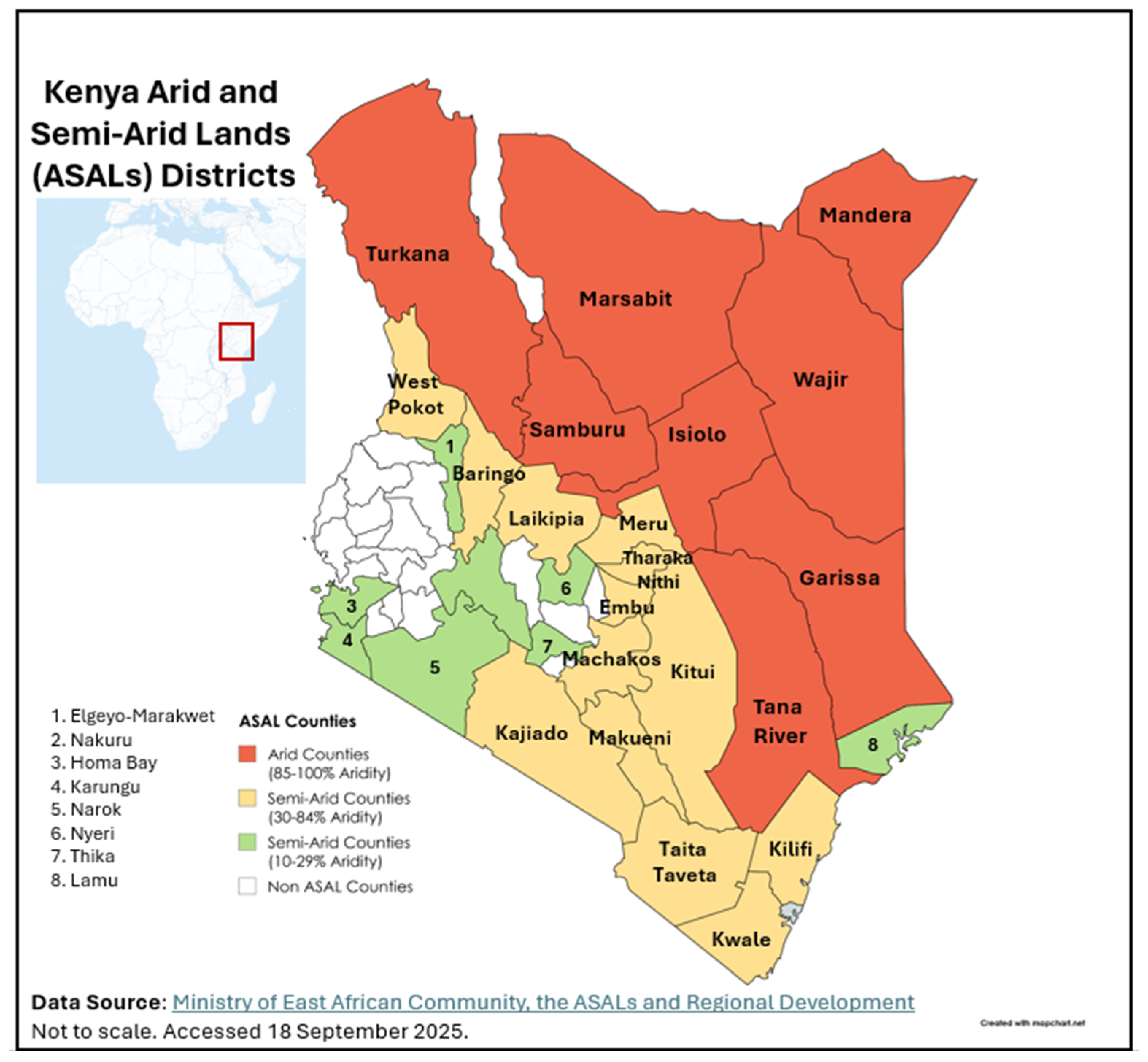
Figure 2.
Research methodology.
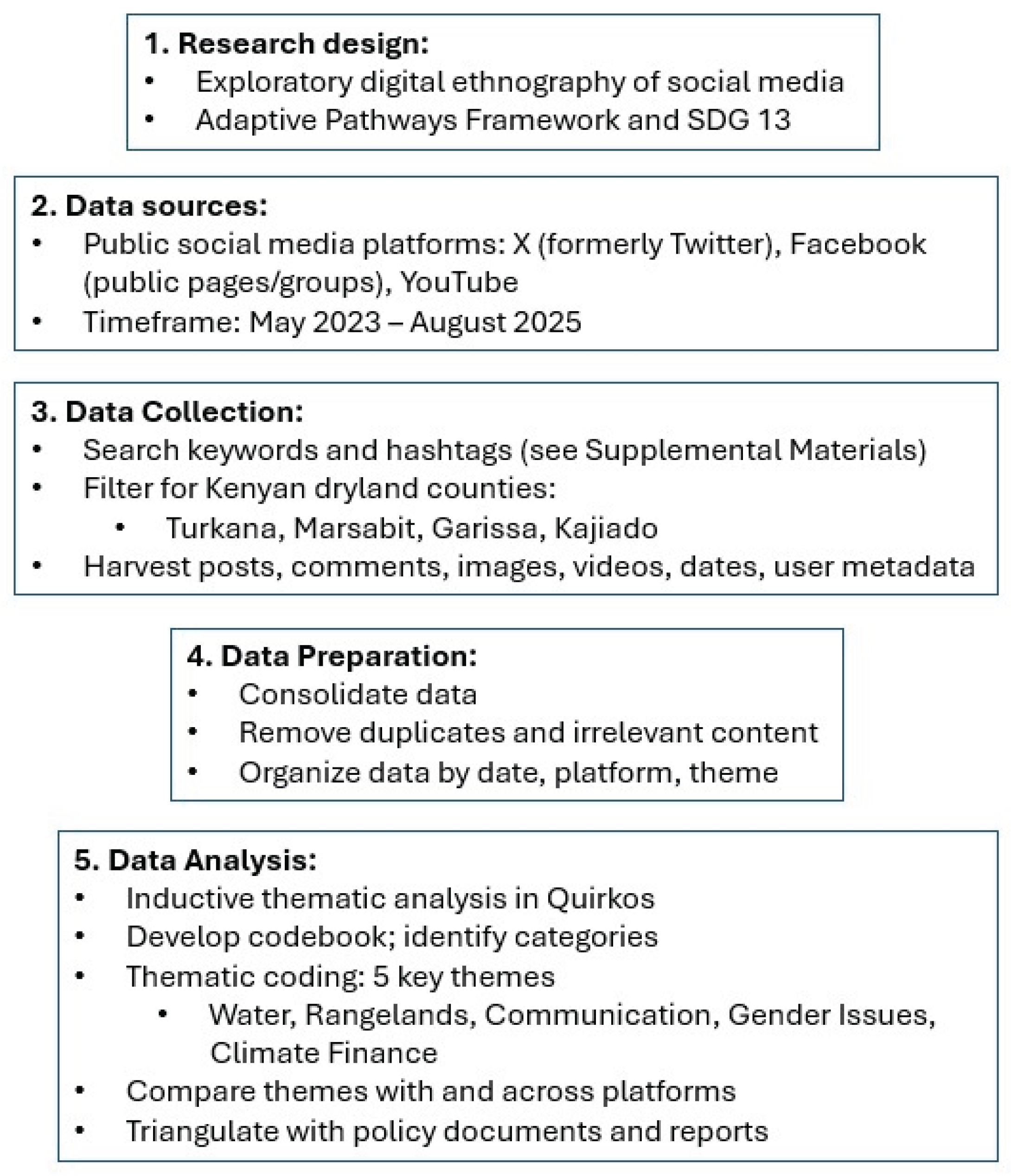

Table 1.
Summary of Social Media platforms and themes. (Accessed 2023–2025)*.
| Type |
Social Media Platform |
Themes | ||||
| Water | Rangelands | Communication |
Gender issues |
Climate finance |
||
| Organizations | X Instagram Facebook Website |
27 | 39 | 17 | 26 | 18 |
| Individual activists |
X |
3 | 1 | 0 | 1 | 1 |
| News media,a | Instagram Facebook Website |
20 | 18 | 10 | 2 | 13 |
| Government agencies | Website, X Instagram Facebook | 15 | 13 | 14 | 7 | 10 |
| Total | 65 | 71 | 41 | 38 | 42 | |
*All supporting data can be found in the Supplementary Materials. aAll news media have links via their websites to X, Facebook, Linked-In, You-Tube.
Table 2.
Adaptive Pathway Principles applied to Kenyan pastoralists.
| Pathway | Policy | Perspective (social media) |
|
|
|
|
|
|
|
|
|
| 4.a. Adaptive strategies |
|
|
| 4.b. Systemic causes |
|
|
Disclaimer/Publisher’s Note: The statements, opinions and data contained in all publications are solely those of the individual author(s) and contributor(s) and not of MDPI and/or the editor(s). MDPI and/or the editor(s) disclaim responsibility for any injury to people or property resulting from any ideas, methods, instructions or products referred to in the content. |
© 2026 by the authors. Licensee MDPI, Basel, Switzerland. This article is an open access article distributed under the terms and conditions of the Creative Commons Attribution (CC BY) license.
Copyright: This open access article is published under a Creative Commons CC BY 4.0 license, which permit the free download, distribution, and reuse, provided that the author and preprint are cited in any reuse.