

Submitted:
09 July 2026
Posted:
10 July 2026
You are already at the latest version
Abstract
This study uses causal loop diagram (CLD) to explore the system dynamics of urban waste management analysing the interdependencies among waste generation, operational efficiencies, governance, public behaviour, and environmental outcomes. The model identifies key reinforcing and balancing feedback loops that drive system performance, including data–policy–performance, awareness–segregation, and technology–innovation dynamics. It also highlights critical constraints such as collection inefficiencies under system overload and the adverse effects of inadequate monitoring and data availability. Findings suggest that strengthening monitoring systems, enhancing public awareness, and investing in technological innovation, concomitantly, can create reinforcing improvements across the waste management system. On the other hand, weak governance and data gaps undermine system responsiveness and environmental outcomes. The study contributes to policy design by providing a holistic framework for understanding leverage points that can improve sustainability and resilience in waste management systems.
Keywords:
systems dynamics
; causal loop
; urban waste management
; infrastructure planning
; policy analysis
1. Introduction
Municipal solid waste management is a complex operation. Rapid urbanisation, population growth, and changing consumption patterns introduce complications into municipal solid waste management systems, particularly in low- and middle-income countries. According to the World Bank’s What a Waste 2.0 report (Kaza et al., 2018), global waste generation is projected to increase significantly in coming decades, with the steepest growth occurring in rapidly urbanising regions. Kaza et al. (2018) estimates that the world currently generates about 2.01 billion tonnes of municipal solid waste annually, a figure expected to rise sharply to 3.4 billion tonnes by 2050. On average, individuals produce about 0.74 kilograms of waste per day, although this varies widely depending on income levels and regions (Kaza et al., 2018). Waste generation in low- and middle-income countries is projected to grow much faster, driven by urbanization, population growth, and rising incomes. At least one-third of global waste is not managed in an environmentally safe manner, with the situation particularly severe in low-income countries where over 90% of waste is openly dumped or burned (Kaza et al., 2018). This projected increase in waste generation places inordinate pressure on already constrained waste management infrastructures, often resulting in inefficient waste collection, inadequate waste treatment, and environmentally harmful disposal practices. In many cities, especially across sub-Saharan Africa, waste systems are characterised by fragmented governance, limited financial resources, and insufficient technical capacity, leading to persistent gaps in service delivery and environmental protection.
Traditional approaches to waste management have largely been linear, focusing on downstream solutions such as collection and disposal, rather than addressing upstream drivers such as waste generation and segregation behaviour. However, such approaches often fail to capture the complex, interdependent nature of waste systems, where social, institutional, technological, and environmental factors interact through feedback mechanisms. Scholars in systems thinking, particularly within the field of System Dynamics, have long argued that complex public service systems cannot be effectively understood or managed through reductionist frameworks alone (Haynes, 2015; Head, 2022; Mansoor & Williams, 2024). Instead, they require holistic analytical tools that account for feedback loops, time delays, and non-linear relationships. A growing body of literature emphasises the value of systems-based approaches in environmental management (see Alaoui et al., 2025; Gondak et al., 2025; Nyieku et al., 2022; Saatchi et al., 2025; Yaala et al., 2026). For instance, applications of causal loop diagrams (CLDs) have been used to map the interactions between policy, infrastructure, and human behaviour in waste systems, revealing how reinforcing and balancing feedback loops shape system performance over time. Studies highlight that improvements in one component—such as waste collection efficiency—may be undermined by weaknesses elsewhere, such as poor segregation or inadequate treatment capacity. This underscores the importance of integrated frameworks that can identify leverage points across the entire waste management chain. In addition, governance and institutional effectiveness have emerged as critical determinants of waste system outcomes. Research consistently shows that strong policy frameworks, enforcement mechanisms, and regulatory oversight are associated with higher levels of service efficiency and environmental compliance (see Handoyo, 2024; Lappe-Osthege, 2024; Ogwu et al., 2025). On the other hand, weak governance structures often lead to inefficiencies, including irregular waste collection, illegal waste dumping, and limited investment in waste infrastructure (Danso & He, 2025; Offenhuber, 2023; Phala et al., 2026). Equally important is the role of data and monitoring systems, which enable evidence-based decision-making and adaptive policy responses. Without reliable data on waste generation, composition, and system performance, as well as appropriate analytical frameworks that integrate system components, policymakers face significant challenges in designing and implementing effective interventions.
Behavioural dimensions also play a pivotal role. Public awareness, attitudes, and participation in waste segregation directly influence the effectiveness of downstream processes such as recycling and treatment (Konstantinidou et al., 2024). Empirical studies have shown that source segregation significantly enhances the efficiency of waste recovery systems, reduces contamination, and lowers the burden on landfills (Dafalla et al., 2026; Trushna et al., 2024; Zhang et al., 2022). However, achieving sustained behavioural change requires not only awareness campaigns but also supportive policies, incentives, and enforcement mechanisms. Technological innovation adds another layer of complexity and opportunity. Advances in waste treatment technologies, digital monitoring systems, and circular economy practices have the potential to transform waste management systems. Yet, the adoption and scaling of such innovations are often contingent on enabling policy environments, financial investment, and institutional capacity. This creates dynamic interactions between technology, governance, and system performance that are best understood through a systems perspective.
Despite the recognition of these interconnected factors, there remains a gap in the extant literature on integrative models that explicitly map and analyse the feedback structures within waste management systems, particularly in developing urban contexts. Many existing studies focus on isolated components—such as recycling behaviour or landfill management—without adequately capturing the systemic interactions that drive overall outcomes. While the literature provides valuable insights into individual components of waste management systems, there remains a gap in integrative analyses that explicitly capture the feedback structures linking governance, behaviour, technology, and environmental outcomes. Many studies adopt fragmented or linear perspectives, limiting their ability to explain system-wide dynamics. System dynamics has been applied in waste management research, but there is still a need for more accessible conceptual tools that can support policy analysis and stakeholder engagement, particularly in data-limited contexts. Causal loop diagrams offer a useful approach for visualising complex interactions and identifying leverage points without requiring extensive quantitative data. We develop a comprehensive CLD that integrates multiple dimensions of the waste management system. By explicitly mapping reinforcing and balancing feedback loops, we contribute to a more holistic understanding of system behaviour and provide a foundation for more effective policy design. The objectives of the study are to (i) identify key feedback loops that influence system behaviour, (ii) analyse how interactions among governance, behaviour, infrastructure, and technology shape environmental outcomes, and (iii) highlight leverage points for policy intervention. We contribute to a deeper understanding of how waste systems function and offer insights into designing more effective and sustainable waste management strategies.
The study is guided by the following research questions:
- What are the critical feedback loops governing the performance of urban waste management systems?
- In what ways do governance, public behaviour, and technological innovation interact to influence system efficiency and environmental impact?
- What leverage points can be identified to improve waste system sustainability and resilience?
Through this systems-oriented approach, we move beyond fragmented analyses and contribute to a more integrated understanding of waste management challenges and solutions.
2. Literature Review
2.1. Overview of Waste Management Systems
Municipal solid waste management (MSWM) has transitioned from a narrow focus on collection and disposal toward more integrated and sustainable approaches that emphasise waste minimisation, reuse, recycling, and recovery. The waste hierarchy, promoted by institutions such as the United Nations Environment Programme, prioritises prevention and resource efficiency as central pillars of sustainable waste systems (UNEP, 2015). This extends the MSWM model to include considerations of the attitudes, behaviours, technologies, and governance processes underpinning MSWM. Despite this conceptual shift, implementation remains uneven, particularly in low- and middle-income countries. According to the World Bank, global waste generation is expected to rise from 2.01 billion tonnes in 2016 to 3.40 billion tonnes by 2050, with the fastest growth occurring in sub-Saharan Africa (Kaza et al., 2018). In many cities, waste systems are characterised by limited collection coverage, reliance on informal actors, and insufficient treatment infrastructure (Wilson et al., 2012). These constraints often result in open dumping and unmanaged landfills, contributing to environmental degradation and health risks. Scholars argue that these persistent challenges reflect the systemic nature of waste management, where technical, institutional, and social factors interact dynamically (see Guerrero, Maas, & Hogland, 2013). This perspective necessitates analytical frameworks that move beyond linear process models to capture system-wide interdependencies.
2.2. Systems Dynamics in Environmental and Waste Management
The field of System Dynamics provides a theoretical and methodological foundation for analysing complex systems characterised by feedback loops, delays, and nonlinearity. Originating from the work of Jay W. Forrester (1961), system dynamics has been widely applied in urban planning and environmental management. In the context of waste management, system dynamics approaches have been used to model interactions between waste generation, infrastructure capacity, and policy interventions (Dyson & Chang, 2005). Causal loop diagrams (CLDs), in particular, enable the visualisation of reinforcing and balancing feedback loops that drive system behaviour. For example, studies have shown that increased recycling capacity can create reinforcing loops by improving environmental outcomes and attracting further investment (Sufian & Bala, 2007). Despite these advances, much of the existing literature focuses on quantitative simulation models that require extensive datasets, limiting their applicability in data-scarce environments. There is therefore a growing recognition of the value of qualitative system dynamics tools, such as CLDs, for conceptual modeling and stakeholder engagement (Armah et al., 2010a; Armah et al., 2010b; Armah et al., 2014; Sterman, 2000; Yengoh et al., 2009).
2.3. Governance, Institutions, and Policy Effectiveness
Governance is widely recognised as a critical determinant of waste management performance. It provides the grounds for decisions and actions that mobilize stakeholders and resources to drive MSWM processes. Effective systems are typically supported by coherent policy frameworks, clear institutional roles, resource allocation and robust enforcement mechanisms. Comparative studies indicate that cities with strong governance structures achieve higher levels of collection efficiency and environmental compliance (Wilson et al., 2015). On the other hand, weak governance often leads to fragmented service delivery, inadequate infrastructure investment, and regulatory failures. In many developing contexts, overlapping institutional mandates and limited financial resources hinder effective policy implementation (Guerrero et al., 2013). Furthermore, the absence of reliable data systems constrains evidence-based decision-making, reducing policy responsiveness and effectiveness. The literature also emphasises the importance of adaptive governance, where policies evolve in response to system feedback and changing conditions. For example, performance monitoring and data collection enable policymakers to identify inefficiencies and adjust interventions accordingly (Kaza et al., 2018). However, where monitoring systems are weak, feedback loops between system performance and policy response are significantly impaired.
2.4. Behavioural Dimensions and Public Participation
Behavioural factors play a central role in shaping waste management outcomes as these affect the effectiveness of waste reduction and resource recovery. Public participation in waste segregation and recycling is essential for improving system efficiency and reducing environmental impacts. Research shows that household behaviour is influenced by a combination of awareness, social norms, convenience, and economic incentives (Ajzen, 1991; Barr, 2007). Source segregation is particularly critical, as it directly affects the quality and recoverability of waste streams. Empirical studies demonstrate that effective segregation at the household level significantly enhances recycling rates and reduces contamination in treatment processes (Wilson et al., 2012). However, sustained behavioural change requires supportive infrastructure, consistent service delivery, and credible policy enforcement. Importantly, feedback relationships exist between system performance and public behaviour. For instance, visible improvements in waste collection and environmental quality can increase public trust and participation, creating reinforcing feedback loops (Bolaane, 2006). Conversely, poor service delivery can undermine trust and reduce compliance, leading to system deterioration.
2.5. Technology and Innovation in Waste Systems
Technological innovation is a key enabler of improved waste management performance. Advances in treatment technologies, such as composting, anaerobic digestion, and waste-to-energy systems, offer opportunities to reduce landfill dependence and recover valuable resources (Arena, 2012). Additionally, digital technologies—including geographic information systems (GIS) and sensor-based monitoring—enhance operational efficiency and data-driven decision-making. However, the adoption and proper functioning of such technologies are often constrained by financial, institutional, and contextual factors. Studies emphasise that technological solutions must be aligned with local capacities and governance structures or processes to be effective (Marshall & Farahbakhsh, 2013). In many cases, low-cost and decentralised solutions may be more appropriate than capital-intensive technologies. Innovation also extends beyond technical solutions to include institutional and social innovations, such as public–private partnerships and community-based waste management initiatives. These approaches can enhance system resilience and adaptability, particularly in resource-constrained settings.
3. Methods
3.1. Research Design and Systems Approach
This study adopts a qualitative systems-based approach grounded in System Dynamics to analyse the structural complexity of urban waste management systems. System dynamics is particularly suited for examining complex socio-environmental systems characterised by feedback loops, time delays, and non-linear interactions (Sterman, 2000). Rather than focusing on isolated variables or units, this approach emphasises endogenous system behaviour—how system structure drives observed outcomes over time. A causal loop diagram (CLD) is employed as the primary analytical tool. CLDs are widely used in system dynamics to represent feedback relationships among system variables and to identify reinforcing (positive) and balancing (negative) loops (Forrester, 1961; Sterman, 2000). In environmental management research, CLDs have proven effective for structuring complex problems, facilitating stakeholder understanding, and identifying leverage points for intervention (Vennix, 1996; Videira et al., 2010). Given the exploratory nature of this study and the challenges associated with data availability in many urban contexts, a qualitative CLD approach is appropriate. It allows for the integration of insights from diverse sources without requiring extensive quantitative datasets, while still providing a rigorous framework for system analysis.
3.2. System Boundary Definition
Defining system boundaries is a critical step in system dynamics modeling, as it determines which variables and interactions are included in the analysis (Sterman, 2000). This study adopts a functional boundary that encompasses the core stages of the waste management value chain—generation, segregation, collection, transportation, treatment, and disposal—alongside key enabling and contextual factors such as governance, public behaviour, monitoring systems, and technological innovation. The system is conceptualised at the urban scale, with particular relevance to cities in developing-country contexts where institutional and infrastructural constraints are pronounced. External factors such as global market dynamics for recyclables and national-level policy frameworks are acknowledged but treated as exogenous influences to maintain analytical focus. The boundary selection is informed by prior studies emphasising the need for integrated approaches to waste management that capture interactions between technical, institutional, and social dimensions (Guerrero et al., 2013; Marshall & Farahbakhsh, 2013).
3.3. Variable Selection and Conceptualisation
The selection of variables is guided by both theoretical relevance and empirical evidence from literature. Core variables were identified to represent key components of the waste management system and their interactions: Waste Generation (WG), Waste Segregation Efficiency (WSE), Collection Efficiency (CE), Transportation Efficiency (TE), Treatment Capacity & Effectiveness (TC), Disposal Burden (DB), Environmental & Health Impact (EHI), Policy & Governance Strength (PG), Monitoring & Data Availability (MD), Public Awareness & Behaviour (PA), and Innovation & Technology Adoption (IT). Waste Segregation Efficiency (WSE) refers to the extent to which waste is properly sorted into different categories such as organic, recyclable, hazardous, and residual waste at the point of generation. Effective segregation improves recycling, treatment, and disposal processes by reducing contamination and increasing resource recovery. Collection Efficiency (CE) describes the proportion of total waste generated that is successfully collected by formal waste management systems within a specific area. It reflects the accessibility, reliability, and coverage of waste collection services provided to households, businesses, and institutions. Transportation Efficiency (TE) measures how effectively waste is moved from collection points to treatment or disposal facilities. It considers factors such as route optimization, fuel consumption, transportation costs, timeliness, and the prevention of waste spillage during transit. Treatment Capacity and Effectiveness (TC) refer to the ability of waste treatment facilities to handle the volume of waste generated and the efficiency with which these facilities reduce waste quantity, toxicity, or environmental harm through methods such as recycling, composting, or incineration. Disposal Burden (DB) represents the quantity of waste that ultimately requires final disposal in landfills or dumpsites after all recovery and treatment efforts have been completed. A high disposal burden indicates greater pressure on disposal facilities and lower levels of waste recovery. Environmental and Health Impact (EHI) refers to the effects of waste management activities on the environment and public health, including pollution, greenhouse gas emissions, water and soil contamination, and the spread of diseases associated with poor waste handling practices. Policy and Governance Strength (PG) describes the effectiveness of laws, regulations, institutional arrangements, and enforcement mechanisms that guide waste management systems. Strong governance ensures proper planning, accountability, and compliance with environmental standards. Monitoring and Data Availability (MD) refer to the extent to which accurate, reliable, and timely data on waste generation, collection, treatment, and disposal are systematically gathered and made accessible for planning, evaluation, and decision-making purposes. Public Awareness and Behaviour (PA) relate to the level of knowledge, attitudes, and participation of individuals and communities in proper waste management practices such as waste reduction, segregation, recycling, and responsible disposal. High public awareness often leads to greater cooperation and improved waste management outcomes. Innovation and Technology Adoption (IT) refer to the integration and use of modern technologies, digital systems, and innovative approaches in waste management operations to improve efficiency, sustainability, monitoring, and resource recovery.
These variables reflect widely recognised dimensions of waste systems, including operational performance, institutional capacity, behavioural factors, and environmental outcomes (Wilson et al., 2012; Kaza et al., 2018). For instance, waste segregation efficiency is included due to its critical role in improving downstream processing and reducing contamination; while monitoring and data availability are incorporated to capture the importance of information flows in enabling effective governance. Each variable is defined conceptually rather than quantitatively, consistent with the qualitative nature of CLD modeling. This allows for flexibility in representing relationships where precise measurement may be difficult but causal direction is well established in the literature.
3.4. Model Development Process
The development of the causal loop diagram follows an iterative and structured process consistent with best practices in system dynamics modeling (Sterman, 2000; Vennix, 1996):
-
Problem ArticulationWe started by defining the central problem: inefficiencies and environmental impacts in urban waste management systems arising from complex interdependencies among technical, institutional, and behavioural factors.
-
Identification of Key VariablesThrough a review of existing literature and synthesis of common themes in waste management research we identified relevant variables (see Guerrero et al., 2013; Wilson et al., 2015).
-
Mapping Causal RelationshipsWe then established directed links between variables based on theoretically and empirically supported causal relationships. Each link was assigned a polarity:
- ○
- Positive (+) sign: variables move in the same direction
- ○
- Negative (–) sign: variables move in the opposite direction
-
Identification of Feedback LoopsFeedback loops were identified and categorised as:
- ○
- Reinforcing loops (R): self-amplifying processes
- ○
- Balancing loops (B): goal-seeking or stabilising processes
-
Model RefinementThe CLD was refined through iterative review to ensure internal consistency, logical coherence, and alignment with established knowledge.
This process ensured that the resulting model captured both the structural complexity and dynamic behaviour of the system.
3.5. Analytical Framework
The analysis focused on interpreting the structure and implications of the identified feedback loops. Particular attention was given to:
- Reinforcing loops, which can drive exponential improvements or deteriorations in waste system performance
- Balancing loops, which regulate system behaviour and introduce constraints
- Interaction effects between loops, which may produce unintended consequences
The framework also emphasised the identification of leverage points, defined as places within a system where targeted interventions can produce significant and sustained improvements (Meadows, 1999). For example, enhancing monitoring systems (MD) may strengthen governance (PG), which in turn improves multiple operational efficiencies.
3.6. Validity and Limitations
As a qualitative modeling approach, the CLD was intended to provide conceptual insights rather than precise predictions. Its validity is grounded in its consistency with established theory and empirical findings in the literature. However, some limitations should be acknowledged:
- Lack of Quantification: The model does not specify magnitudes or time delays, limiting its ability to simulate system behaviour numerically.
- Context Sensitivity: Relationships may vary across different urban contexts, depending on local institutional and socio-economic conditions.
- Simplification: While efforts are made to capture key dynamics, the model necessarily simplifies reality by excluding certain variables and interactions.
Despite these limitations, qualitative system dynamics models are widely recognised as valuable tools for problem characterisation, problem structuring and policy analysis, particularly in complex and data-constrained environments (Sterman, 2000; Videira et al., 2010).
3.7. Ethical and Practical Considerations
The study relied exclusively on secondary data and conceptual modeling and did not involve human subjects or require ethical approval. However, the research was guided by principles of responsible scholarship, including accurate representation of existing literature and transparency in model assumptions. From a practical perspective, the use of CLDs supports stakeholder engagement by providing a visual and intuitive representation of system dynamics. This is particularly important in policy contexts, where diverse actors must collaborate to address complex challenges.
4. Results: Causal Loop Diagram (CLD) Analysis
This section presents the results of the causal loop diagram (CLD) analysis, focusing on the identification and interpretation of key feedback structures that govern the behaviour of the urban waste management system. Drawing on principles from System Dynamics, the analysis distinguishes between reinforcing loops (R), which amplify system dynamics, and balancing loops (B), which stabilise or regulate system behaviour (Sterman, 2000). In addition, particular attention is given to weak or broken feedback that constrain system performance.
4.1. Reinforcing Feedback Loops
R1: Data–Policy–Performance Loop
This reinforcing loop captures the relationship between monitoring systems, governance quality, and operational efficiency. Improvements in Monitoring & Data Availability (MD) enhance the ability of policymakers to design informed and adaptive interventions. As noted in the literature, reliable data systems are critical for evidence-based decision-making and policy effectiveness (Kaza et al., 2018). Stronger Policy & Governance (PG), in turn, improves Collection Efficiency (CE), Transportation Efficiency (TE), and Treatment Capacity (TC) through better planning, resource allocation, and enforcement. These improvements reduce Environmental & Health Impact (EHI), which increases institutional credibility and public demand for continued monitoring and transparency.
This loop (Figure 1) exemplifies a virtuous cycle in which investments in data infrastructure generate system-wide performance gains, reinforcing the importance of monitoring as a leverage point. However, the strength of this loop depends on institutional capacity to utilise data effectively, an issue frequently highlighted in developing-country contexts (Guerrero et al., 2013).
R2: Awareness–Segregation Loop
The second reinforcing loop emphasises the role of public behaviour in shaping system outcomes. Increased Public Awareness & Behaviour (PA) leads to improved Waste Segregation Efficiency (WSE) at the source. Empirical studies consistently show that effective segregation enhances downstream processing efficiency and reduces contamination (Wilson et al., 2012). Improved segregation increases Treatment Effectiveness (TC), enabling more efficient recycling and resource recovery. This reduces the Disposal Burden (DB) and, consequently, lowers Environmental & Health Impact (EHI).
As environmental conditions improve, public trust in the waste management system increases, further reinforcing awareness and participation. This loop (Figure 2) highlights the importance of behavioural interventions as a complement to technical solutions. It also demonstrates how visible system improvements can create positive feedback that sustain long-term behavioural change (Bolaane, 2006).
R3: Technology & Innovation Loop
The technology and innovation loop illustrates how investments in Innovation & Technology Adoption (IT) can drive improvements in system performance. Advances in treatment technologies increase Treatment Capacity & Effectiveness (TC), reducing the volume of waste requiring final disposal. Lower Disposal Burden (DB) leads to reduced Environmental & Health Impact (EHI), which can create favorable conditions for further investment in innovation—either through public funding or private sector engagement.
This dynamic shown in Figure 3 aligns with findings that technological progress in waste systems often follows cumulative investment patterns (Arena, 2012). However, the literature cautions that the effectiveness of this loop depends on enabling conditions such as governance quality, financial resources, and technical capacity (Marshall & Farahbakhsh, 2013). Without these, technological investments may fail to deliver expected benefits.
R4: Governance–Compliance Loop
This reinforcing loop focuses on the relationship between governance and public compliance. Strong Policy & Governance (PG) enhances enforcement mechanisms and regulatory frameworks, leading to higher levels of compliance in waste segregation and disposal practices (WSE). Improved compliance increases overall system efficiency, particularly in Collection (CE) and Treatment (TC). As system performance improves, institutional credibility is strengthened, reinforcing governance capacity and legitimacy.
This loop (Figure 4) reflects findings in the literature that effective governance not only shapes system performance directly but also influences public behaviour through trust and accountability mechanisms (Wilson et al., 2015). It underscores governance as both a driver and an outcome of system performance.
4.2. Balancing Feedback Loops
B1: Waste Generation Pressure Loop
This balancing loop represents the system’s response to increasing Waste Generation (WG). As waste generation rises, it places greater pressure on disposal systems, increasing the Disposal Burden (DB) and exacerbating Environmental & Health Impact (EHI). In response, policymakers are likely to implement measures aimed at reducing waste generation, such as regulations, economic instruments, or awareness campaigns. These interventions strengthen Policy & Governance (PG), which acts to reduce WG, thereby stabilising the system.
This loop reflects the goal-seeking behaviour typical of balancing feedback, where policy responses are triggered by undesirable outcomes (Figure 5). However, the effectiveness of this loop depends on the timeliness and strength of policy interventions, as well as public compliance (Sterman, 2000).
B2: Collection & Transport Constraint Loop
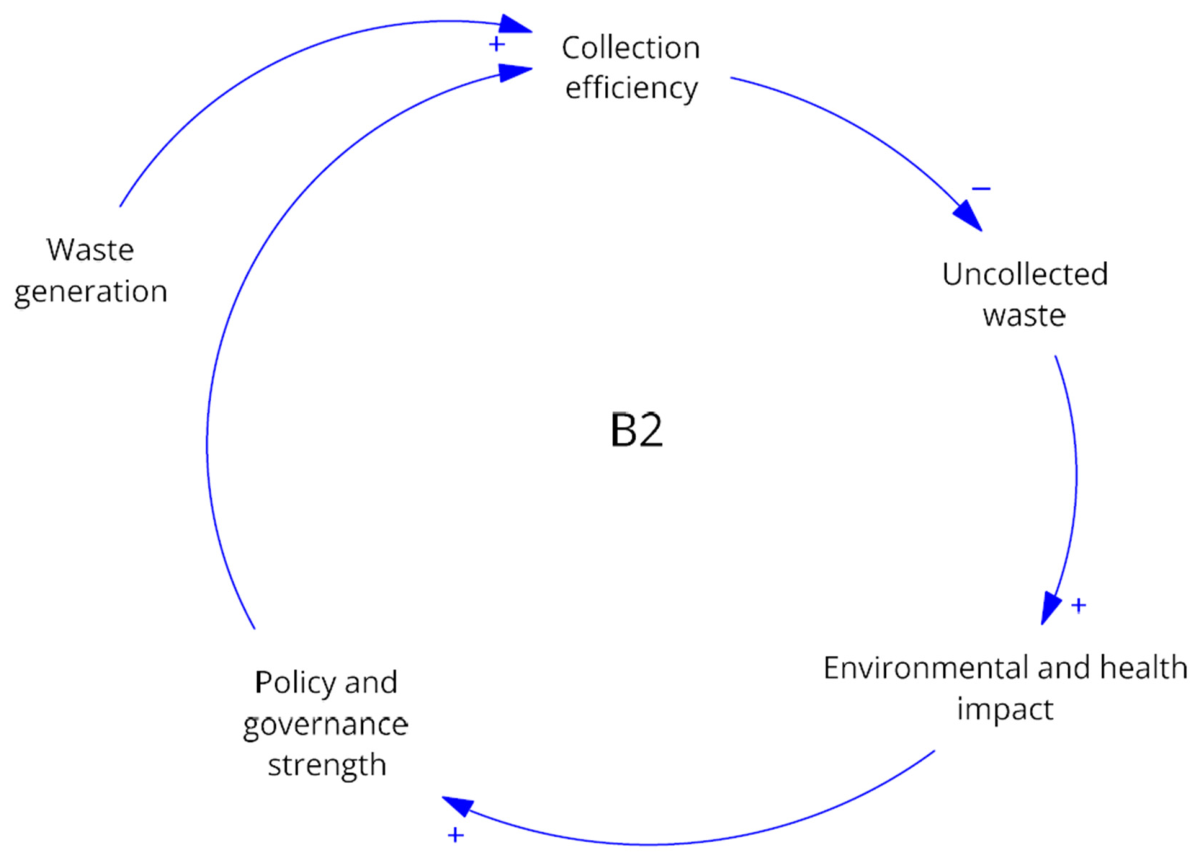
The second balancing loop highlights capacity constraints within the collection and transportation system. As Waste Generation (WG) increases, demand for collection services rises. If system capacity is exceeded, Collection Efficiency (CE) declines, leading to an accumulation of uncollected waste. This results in increased Environmental & Health Impact (EHI), which triggers Policy & Governance (PG) interventions aimed at restoring system performance—such as expanding fleet capacity, improving logistics, or contracting private service providers.
While this loop acts to stabilise the system (Figure 6), it also reveals a critical vulnerability: delays in policy response or insufficient capacity expansion can lead to persistent inefficiencies and environmental degradation. Similar dynamics have been observed in rapidly growing cities where infrastructure development lags behind waste generation (Guerrero et al., 2013).
4.3. Weak Link: Monitoring Gap Loop
In contrast to the reinforcing and balancing loops described above, the Monitoring Gap Loop represents a dysfunctional feedback structure. Low levels of Monitoring & Data Availability (MD) weaken Policy & Governance (PG) by limiting access to reliable information. This results in reduced system efficiency across Collection (CE), Transportation (TE), and Treatment (TC), leading to increased Environmental & Health Impact (EHI). As impacts worsen, the system’s ability to respond effectively is further constrained due to the lack of actionable data and structural weaknesses already incurred. This broken feedback loop illustrates how deficiencies in information systems can propagate throughout the entire waste management system, undermining both operational performance and policy effectiveness. The importance of data systems as a foundational component of effective waste governance is well documented (Kaza et al., 2018).
4.4. Cross-Loop Interactions and System Behaviour
While individual loops provide insights into specific dynamics, system behaviour emerges from the interaction of multiple feedback loops. For example:
- Reinforcing loops (R1, R2, R3, R4) can generate virtuous cycles of improvement when aligned, leading to sustained enhancements in system performance.
- Balancing loops (B1, B2) introduce constraints that prevent unchecked growth or decline but may also create delays and oscillations in system behaviour.
- Weak or broken loops, such as the monitoring gap, can dampen or disrupt otherwise beneficial dynamics.
The interaction between governance, behaviour, and technology is particularly significant. For instance, investments in technology (R3) may be ineffective without strong governance (R4) and public participation (R2). Similarly, improvements in monitoring (R1) can amplify the effectiveness of multiple loops simultaneously. These findings are consistent with systems literature emphasising that leverage points often lie in the structure of feedback relationships rather than in individual variables (Meadows, 1999). In this context, interventions that strengthen reinforcing loops or repair weak feedback are likely to yield the greatest system-wide benefits.
4.5. Implications for System Leverage Points
The CLD analysis identifies several high-impact leverage points within the waste management system:
- Monitoring & Data Systems (MD): Strengthening data infrastructure enhances multiple feedback loops simultaneously.
- Public Awareness & Behaviour (PA): Behavioural interventions can trigger reinforcing improvements in system efficiency.
- Policy & Governance (PG): Effective governance underpins both operational performance and public compliance.
- Innovation & Technology (IT): Strategic investments can reduce disposal burdens and improve environmental outcomes.
Targeting these leverage points can help shift the system toward more sustainable and resilient trajectories.
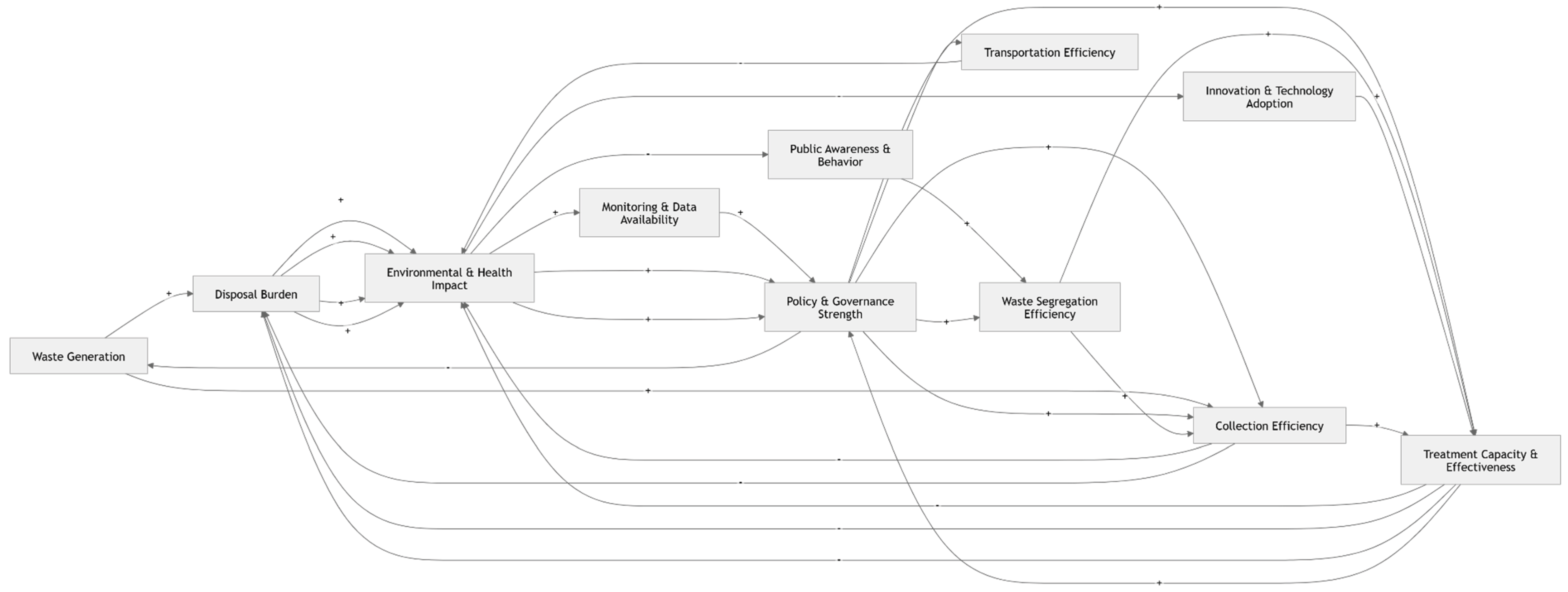
Figure 7.
Overall system showing feedback loops among the six sub-systems.
5. Discussion
The causal loop diagram (CLD) analysis reveals that urban waste management systems are governed by tightly interconnected feedback structures spanning governance, behaviour, infrastructure, and technology. Drawing on insights from System Dynamics, the findings underscore that system performance is not determined by individual components in isolation, but by the configuration and interaction of reinforcing and balancing feedback loops (Sterman, 2000). This section interprets these dynamics in relation to existing literature, identifies key leverage points, and reflects on broader theoretical and practical implications.
5.1. Interdependence and Systemic Complexity
A central insight from the analysis is the high degree of interdependence across system components. Reinforcing loops such as the Data–Policy–Performance (R1) and Governance–Compliance (R4) loops illustrate how improvements in one domain can propagate across the system, generating cumulative benefits. For example, enhanced monitoring strengthens governance, which in turn improves operational efficiencies and environmental outcomes. This aligns with prior research emphasising that waste management systems function as complex adaptive systems, where outcomes emerge from interactions among technical, institutional, and social variables (Marshall & Farahbakhsh, 2013; Guerrero et al., 2013). The implication is that fragmented interventions—such as investing solely in infrastructure without addressing governance or behaviour—are unlikely to produce sustained improvements. At the same time, the presence of balancing loops, particularly Waste Generation Pressure (B1) and Collection Constraint (B2), highlights the system’s inherent limits. These loops introduce regulatory mechanisms that can stabilise performance but may also create delays and unintended consequences. For instance, rapid increases in waste generation can overwhelm collection systems before policy responses take effect, leading to service breakdowns and environmental degradation.
5.2. Governance and Data as Foundational Leverage Points
The analysis identifies Policy & Governance (PG) and Monitoring & Data Availability (MD) as foundational leverage points with system-wide influence. The reinforcing relationship between data and governance (R1) suggests that investments in monitoring systems can have multiplicative effects, enhancing policy design, implementation, and evaluation. Data is the foundation of science-informed management systems. This finding is strongly supported in the literature. The World Bank emphasises that reliable data on waste generation and system performance is essential for effective planning and resource allocation (Kaza et al., 2018). Similarly, studies show that weak data systems are a major constraint in developing countries, limiting the ability of governments to respond adaptively to emerging challenges (Wilson et al., 2015). Importantly, the Monitoring Gap Loop identified in the CLD illustrates how deficiencies in data can create a downward spiral of poor governance, declining system efficiency, and increasing environmental impact. This reinforces the argument that strengthening information systems is not merely a technical upgrade but a strategic priority for systemic improvement. Apart from improving governance and operational efficiency, data also enhances public appreciation of the state of the system and thereby elicit supportive behaviours and participation that inure to improvements in overall system performance.
5.3. Behavioural Dynamics and Social Feedback
The Awareness–Segregation Loop (R2) highlights the critical role of human behaviour in shaping system outcomes. Unlike purely technical systems, waste management depends heavily on household and community participation, particularly in source segregation and proper disposal practices. The reinforcing nature of this loop suggests that behavioural change can be self-sustaining under the right conditions. As environmental outcomes improve, public trust and engagement increase, further strengthening positive behaviours. This dynamic is consistent with empirical findings that visible service improvements can enhance citizen participation and compliance (Bolaane, 2006). However, the literature also cautions that behavioural change is highly context-dependent and influenced by factors such as convenience, infrastructure availability, and institutional credibility (Barr, 2007). The CLD reinforces this by showing that behavioural loops are closely linked to governance and service delivery. For example, poor collection services (B2) can undermine public willingness to segregate waste, weakening the reinforcing cycle.
5.4. Technology as an Enabler, not a Panacea
The Technology & Innovation Loop (R3) demonstrates the potential for technological advancements to improve treatment capacity and reduce environmental impacts. However, the analysis also highlights that technology operates within a broader system context and is not a standalone solution. This reflects a well-established theme in literature: technological interventions are most effective when supported by strong governance, adequate financing, and appropriate institutional arrangements (Marshall & Farahbakhsh, 2013). For instance, advanced waste-to-energy systems may fail in contexts where waste segregation is poor or where operational expertise is lacking. Moreover, the reinforcing nature of the innovation loop suggests that initial investments can catalyse further development, but only if enabling conditions are in place. Without these conditions, technological investments may result in underutilised infrastructure or financial inefficiencies.
5.5. Trade-Offs, Delays, and Unintended Consequences
The interaction of reinforcing and balancing loops introduces important trade-offs and temporal dynamics. Policy interventions aimed at reducing waste generation (B1), for example, may take time to produce measurable effects, during which environmental impacts may continue to rise. Similarly, expanding collection capacity (B2) may alleviate short-term pressures but could inadvertently encourage higher waste generation if not accompanied by reduction strategies. Such dynamics are characteristic of complex systems and highlight the risk of unintended consequences. As noted by Meadows (1999), interventions in complex systems often produce counterintuitive outcomes due to feedback delays and indirect effects. The CLD provides a framework for anticipating these dynamics and designing more robust policies.
5.6. Integration with Existing Studies
The findings of this study are broadly consistent with existing research while offering additional integrative insights. Previous studies have emphasised individual dimensions of waste management—such as governance (Wilson et al., 2015), behaviour (Barr, 2007), or technology (Arena, 2012)—but have often treated these factors separately. By explicitly mapping feedback loops, this study demonstrates how these dimensions interact dynamically. For example:
- Governance influences behaviour through enforcement and trust (R4, R2)
- Behaviour affects technological effectiveness through segregation (R2, R3)
- Data systems enhance governance and operational efficiency (R1)
This integrative perspective contributes to a more holistic understanding of waste systems and supports the argument that effective interventions must be multi-dimensional.
5.7. Implications for Policy and Practice
The discussion points to several strategic implications for policymakers and practitioners:
- Adopt systems thinking approaches: Policies should be designed with an understanding of feedback dynamics and interdependencies, rather than focusing on isolated interventions.
- Prioritise data and monitoring systems: Strengthening information flows can enhance governance and improve system responsiveness.
- Promote behavioural change alongside infrastructure investment: Public awareness and participation are essential for maximising the effectiveness of technical solutions.
- Align technological innovation with local context: Investments should be tailored to institutional capacity and supported by appropriate governance frameworks.
- Anticipate delays and unintended effects: Policies should incorporate mechanisms for monitoring and adaptation to address emerging challenges.
6. Policy Implications
From a theoretical perspective, this study contributes to the application of System Dynamics in environmental management by demonstrating the value of causal loop diagrams as integrative tools for analysing complex systems. It extends existing literature by explicitly linking governance, behaviour, technology, and environmental outcomes within a unified framework. From a practical perspective, the CLD provides a diagnostic tool for identifying leverage points and potential intervention pathways. It is particularly relevant for cities in developing contexts, where resource constraints and data limitations necessitate flexible and holistic approaches to system analysis. The causal loop diagram (CLD) analysis provides a systems-based foundation for identifying strategic intervention points in urban waste management. Consistent with principles from System Dynamics, the most effective policies are those that target high-leverage nodes within the system—particularly where reinforcing loops can be strengthened or dysfunctional feedback repaired (Meadows, 1999; Sterman, 2000). This section translates the analytical insights into actionable policy recommendations.
6.1. Strengthening Monitoring and Data Systems
A primary implication of the analysis is the central role of Monitoring & Data Availability (MD) in enabling effective governance and system performance. Investments in data infrastructure—such as waste tracking systems, digital reporting platforms, and performance monitoring tools—can significantly enhance decision-making capacity. The World Bank emphasises that reliable data is essential for planning, budgeting, and evaluating waste management interventions (Kaza et al., 2018). In practice, this includes:
- Establishing standardised data collection protocols
- Integrating digital technologies (e.g., GIS, sensor-based systems)
- Enhancing transparency and data accessibility
Strengthening data systems not only improves policy effectiveness but also reinforces public trust and accountability, thereby activating positive feedback loops (R1).
6.2. Enhancing Governance and Institutional Capacity
The findings underscore Policy & Governance (PG) as a foundational driver of system performance. Effective governance requires coherent regulatory frameworks, clear institutional roles, and robust enforcement mechanisms. Policy priorities include:
- Clarifying mandates across national, municipal, and private actors
- Strengthening enforcement of waste segregation and disposal regulations
- Developing sustainable financing mechanisms (e.g., user fees, public–private partnerships)
- Building institutional capacity through training and resource allocation
Evidence suggests that cities with strong governance structures achieve higher levels of service efficiency and environmental compliance (Wilson et al., 2015). Importantly, governance reforms should be adaptive, incorporating feedback from monitoring systems to continuously improve policy design.
6.3. Promoting Behavioural Change and Public Participation
The Awareness–Segregation Loop (R2) highlights the importance of aligning public behaviour with system goals. Policies aimed at improving Public Awareness & Behaviour (PA) should go beyond information campaigns to include structural and incentive-based measures. Effective strategies include:
- Providing accessible and reliable waste segregation infrastructure
- Implementing incentive schemes (e.g., pay-as-you-throw, recycling rewards)
- Embedding behavioural nudges and social norm interventions
- Engaging communities through participatory programs
Research indicates that sustained behavioural change is more likely when awareness is combined with convenience and institutional support (Barr, 2007). Moreover, visible improvements in service delivery can reinforce public participation, creating self-sustaining feedback loops.
6.4. Investing in Context-Appropriate Technology and Innovation
While Innovation & Technology Adoption (IT) offers significant potential for improving system efficiency, the analysis emphasises that technological solutions must be context sensitive. Policymakers should prioritise technologies that align with local capacities, waste characteristics, and financial constraints. Key considerations include:
- Scaling decentralised and low-cost treatment solutions where appropriate
- Supporting innovation ecosystems through research and development funding
- Encouraging private sector participation in technology deployment
- Integrating digital tools for system optimisation and monitoring
As highlighted in the literature, technology should be viewed as an enabler rather than a standalone solution, requiring complementary investments in governance and human capacity (Marshall & Farahbakhsh, 2013).
6.5. Managing System Constraints and Anticipating Growth
Balancing loops such as B1 (Waste Generation Pressure) and B2 (Collection Constraint) point to the need for proactive capacity planning and demand management. Policies should aim to both reduce waste generation and expand system capacity in a coordinated manner. Recommended approaches include:
- Implementing waste reduction policies (e.g., bans on single-use plastics, extended producer responsibility)
- Expanding collection and transportation infrastructure in line with urban growth
- Optimising logistics through route planning and resource allocation
- Encouraging circular economy practices to reduce overall waste flows
These measures can help prevent system overload and reduce the risk of service breakdowns, particularly in rapidly growing urban areas.
6.6. Integrated and Adaptive Policy Design
A key takeaway from the CLD analysis is the necessity of integrated policy approaches that address multiple system components simultaneously. Isolated interventions—such as investing in treatment facilities without improving segregation—are unlikely to yield optimal results. Policymakers should adopt:
- Cross-sectoral coordination mechanisms
- Iterative policy design informed by continuous monitoring
- Scenario planning to anticipate future system dynamics
- Stakeholder engagement processes to incorporate diverse perspectives
Such approaches align with the broader shift toward adaptive governance in complex systems, where policies evolve in response to feedback and changing conditions (Guerrero et al., 2013).
6.7. Recommendations for Future Research
As a qualitative model, the CLD does not quantify relationships or simulate system behaviour over time. Future research could extend this work by developing stock-and-flow models to test policy scenarios and quantify system dynamics. Additionally, empirical validation through case studies in specific urban contexts would enhance the robustness and applicability of the findings.
7. Conclusion
This study analysed urban waste management systems through a causal loop diagram (CLD), with the aim of identifying key feedback structures, understanding system behaviour, and highlighting key leverage points for intervention. By applying a System Dynamics perspective, the study demonstrates that waste management outcomes are shaped by dynamic interactions among governance, behaviour, infrastructure, technology, and environmental factors. The findings reveal the presence of multiple reinforcing and balancing feedback loops that collectively determine system performance. Reinforcing loops—such as those linking data, governance, behaviour, and innovation—have the potential to drive sustained improvements when properly activated. At the same time, balancing loops introduce constraints that can stabilise or hinder system performance, particularly under conditions of rapid urban growth. A critical contribution of the study is the identification of monitoring and governance as foundational leverage points, supported by behavioural change and technological innovation. The analysis also highlights the risks associated with weak feedback structures, particularly in the absence of reliable data systems. From a theoretical standpoint, the study contributes to the application of systems thinking in environmental management by providing an integrative framework that captures the complexity of waste systems. It demonstrates the value of causal loop diagrams as tools for synthesising knowledge, structuring problems, and informing policy design. From a practical perspective, the findings underscore the need for holistic and adaptive policy approaches that address multiple dimensions of the system simultaneously. For policymakers, this implies prioritising investments in data infrastructure, strengthening governance mechanisms, promoting public participation, and aligning technological solutions with local contexts. As urbanisation accelerates and waste generation continues to rise, the need for effective and sustainable waste management systems becomes increasingly urgent. This study highlights that addressing this challenge requires more than technical solutions—it demands a systemic understanding of how policies, behaviours, and infrastructures interact over time. By embracing system thinking, policymakers and practitioners can better navigate complexity and design interventions that lead to lasting and transformative change.
References
- Ajzen, I. The theory of planned behaviour. Organisational Behaviour and Human Decision Processes 1991, 50(2), 179–211. [Google Scholar] [CrossRef]
- Alaoui, M. L. T.; Belhiah, M.; Ziti, S. IoT-enabled waste management in smart cities: A systematic literature review. Int. J. Adv. Comput. Sci. Appl 2025, 16(4), 131–138. [Google Scholar] [CrossRef]
- Arena, U. Process and technological aspects of municipal solid waste gasification. Waste Management 2012, 32(4), 625–639. [Google Scholar] [CrossRef] [PubMed]
- Armah, F. A.; Luginaah, I.; Yengoh, G. T.; Taabazuing, J.; Yawson, D. O. Management of natural resources in a conflicting environment in Ghana: unmasking a messy policy problem. Journal of Environmental Planning and Management 2014, 57(11), 1724–1745. [Google Scholar]
- Armah, F. A.; Yawson, D. O.; Pappoe, A. A. A systems dynamics approach to explore traffic congestion and air pollution link in the city of Accra, Ghana. Sustainability 2010a, 2(1), 252–265. [Google Scholar] [CrossRef]
- Armah, F. A.; Yawson, D. O.; Yengoh, G. T.; Odoi, J. O.; Afrifa, E. K. Impact of floods on livelihoods and vulnerability of natural resource dependent communities in Northern Ghana. Water 2010b, 2(2), 120–139. [Google Scholar] [CrossRef]
- Barr, S. Factors influencing environmental attitudes and behaviours. Environment and Behaviour 2007, 39(4), 435–473. [Google Scholar] [CrossRef]
- Bolaane, B. Constraints to promoting people-centered approaches in recycling. Habitat International 2006, 30(4), 731–740. [Google Scholar] [CrossRef]
- Dafalla, M.; Abdeljaber, A.; Abdallah, M.; Alsalem, W. Integrated assessment of source separation programs coupled with waste-to-energy systems across diverse country income levels. Energy for Sustainable Development 2026, 91, 101912. [Google Scholar] [CrossRef]
- Danso, E. Y. A.; He, J. Understanding ‘Bad Governance’ in the urban south: a case study of solid waste management in Ghana. Journal of Environmental Policy & Planning 2025, 1–27. [Google Scholar] [CrossRef]
- Dyson, B.; Chang, N.-B. Forecasting municipal solid waste generation in a fast-growing urban region with system dynamics modeling. Waste Management 2005, 25(7), 669–679. [Google Scholar] [CrossRef] [PubMed]
- Forrester, J. W. Industrial Dynamics; MIT Press, 1961. [Google Scholar]
- Gondak, M. D. O.; do Prado, G. F.; Hluszko, C.; de Souza, J. T.; de Francisco, A. C. Interactive map of stakeholders’ journey in construction: focus on waste management and circular economy. Sustainability 2025, 17(11), 5195. [Google Scholar] [CrossRef]
- Guerrero, L. A.; Maas, G.; Hogland, W. Solid waste management challenges for cities in developing countries. Waste Management 2013, 33(1), 220–232. [Google Scholar] [CrossRef] [PubMed]
- Handoyo, S. Public governance and national environmental performance nexus: Evidence from cross-country studies. Heliyon 2024, 10(23). [Google Scholar] [CrossRef] [PubMed]
- Haynes, P. Managing complexity in the public services; Routledge, 2015. [Google Scholar]
- Head, B. W. Wicked problems in public policy: Understanding and responding to complex challenges; Springer Nature, 2022; p. 176. [Google Scholar]
- Kaza, S.; Yao, L.; Bhada-Tata, P.; Van Woerden, F. What a Waste 2.0: A Global Snapshot of Solid Waste Management to 2050; World Bank, 2018; Available online: https://openknowledge.worldbank.org/handle/10986/30317.
- Konstantinidou, A.; Ioannou, K.; Tsantopoulos, G.; Arabatzis, G. Citizens’ attitudes and practices towards waste reduction, separation, and recycling: A systematic review. Sustainability 2024, 16(22), 9969. [Google Scholar] [CrossRef]
- Lappe-Osthege, T. The ripple effects of compliance: Reconfiguring EU policy effectiveness in transboundary environmental governance. JCMS: Journal of Common Market Studies 2024, 62(3), 653–670. [Google Scholar]
- Mansoor, Z.; Williams, M. J. Systems approaches to public service delivery: methods and frameworks. Journal of Public Policy 2024, 44(2), 258–283. [Google Scholar]
- Marshall, R. E.; Farahbakhsh, K. Systems approaches to integrated solid waste management in developing countries. Waste Management 2013, 33(4), 988–1003. [Google Scholar] [CrossRef] [PubMed]
- Meadows, D. H. Leverage points: Places to intervene in a system; Sustainability Institute, 1999. [Google Scholar]
- Nyieku, F. E.; Essandoh, H. M.; Armah, F. A.; Awuah, E. Modelling the interaction between physico-chemical and bacteriological characteristics of oilfields produced water from a waste management facility. Cleaner Waste Systems 2022, 3, 100054. [Google Scholar] [CrossRef]
- Offenhuber, D. Waste is information: infrastructure legibility and governance; MIT Press, 2023. [Google Scholar]
- Ogwu, M. C.; El Malahi, S.; Izah, S. C. Policy and regulatory frameworks for sustainable environmental practices. In Evaluating environmental processes and technologies; Cham; Springer Nature Switzerland, 2025; pp. 513–544. [Google Scholar]
- Phala, M.; Nzimande, N. P.; Xulu, S. Institutional and Governance Barriers to Effective Municipal Waste Management: Stakeholder Perspectives from Thabazimbi Local Municipality; Environmental Research Communications, 2026. [Google Scholar]
- Pinha, A. C. H.; Sagawa, J. K. A system dynamics modelling approach for municipal solid waste management [Journal article]. Journal of Cleaner Production 2020, 269, 122350. [Google Scholar] [CrossRef]
- Saatchi, P.; Salamian, F.; Manavizadeh, N.; Rabbani, M. A sustainable network design for municipal solid waste management considering waste-to-energy conversion under uncertainty. Engineering Optimization 2025, 57(9), 2505–2528. [Google Scholar]
- Sancheta, L. do N.; Chaves, G. de L. D.; Siman, R. R. The use of system dynamics on urban solid waste management: A literature analysis [Literature review]; Gestão & Produção, 2021. [Google Scholar]
- Sterman, J. D. Business Dynamics: Systems Thinking and Modeling for a Complex World; McGraw-Hill, 2000. [Google Scholar]
- Trushna, T.; Krishnan, K.; Soni, R.; Singh, S.; Kalyanasundaram, M.; Annerstedt, K. S.; Diwan, V. Interventions to promote household waste segregation: A systematic review. Heliyon 2024, 10(2). [Google Scholar] [CrossRef] [PubMed]
- Vahidi, H.; Kohbanani, M. A. B. Modeling the causal loop diagram of the waste management cycle and providing a solution to organise the existing situation: Kerman case study. SOFEH Environmental Journal 2024, 22(3), 407–426. [Google Scholar]
- Vennix, J. A. M. Group Model Building: Facilitating Team Learning Using System Dynamics; Wiley, 1996. [Google Scholar]
- Videira, N.; Schneider, F.; Sekulova, F.; Kallis, G. Improving understanding on degrowth pathways: An exploratory study using collaborative causal models. Ecological Economics 2010, 69(4), 778–789. [Google Scholar]
- Wilson, D. C.; Rodic, L.; Modak, P. Global Waste Management Outlook; United Nations Environment Programme, 2015. [Google Scholar]
- Wilson, D. C.; Velis, C.; Cheeseman, C. Role of informal sector recycling in waste management in developing countries. Habitat International 2012, 36(1), 95–102. [Google Scholar]
- Yaala, I.; Osei, M. A.; Armah, F. A. Electronic Waste-Associated Lead Exposure and Child Neurodevelopment in Sub-Saharan Africa: A Systematic Review and Meta-Analysis. 2026. Available online: https://www.preprints.org/manuscript/202601.1358.
- Yengoh, G.T.; Armah, F. A.; Svensson, M. Technology adoption in small-scale agriculture. Science, Technology & Innovation Studies 2009, 5(2). [Google Scholar]
- Zhang, X.; Liu, C.; Chen, Y.; Zheng, G.; Chen, Y. Source separation, transportation, pretreatment, and valorization of municipal solid waste: a critical review. Environment, development and sustainability 2022, 24(10), 11471–11513. [Google Scholar] [PubMed]
Figure 1.
Reinforcing Data–Policy–Performance Loop. Strong monitoring improves governance, which boosts system efficiency, reduces environmental impact, and further enhances monitoring.
Figure 1.
Reinforcing Data–Policy–Performance Loop. Strong monitoring improves governance, which boosts system efficiency, reduces environmental impact, and further enhances monitoring.
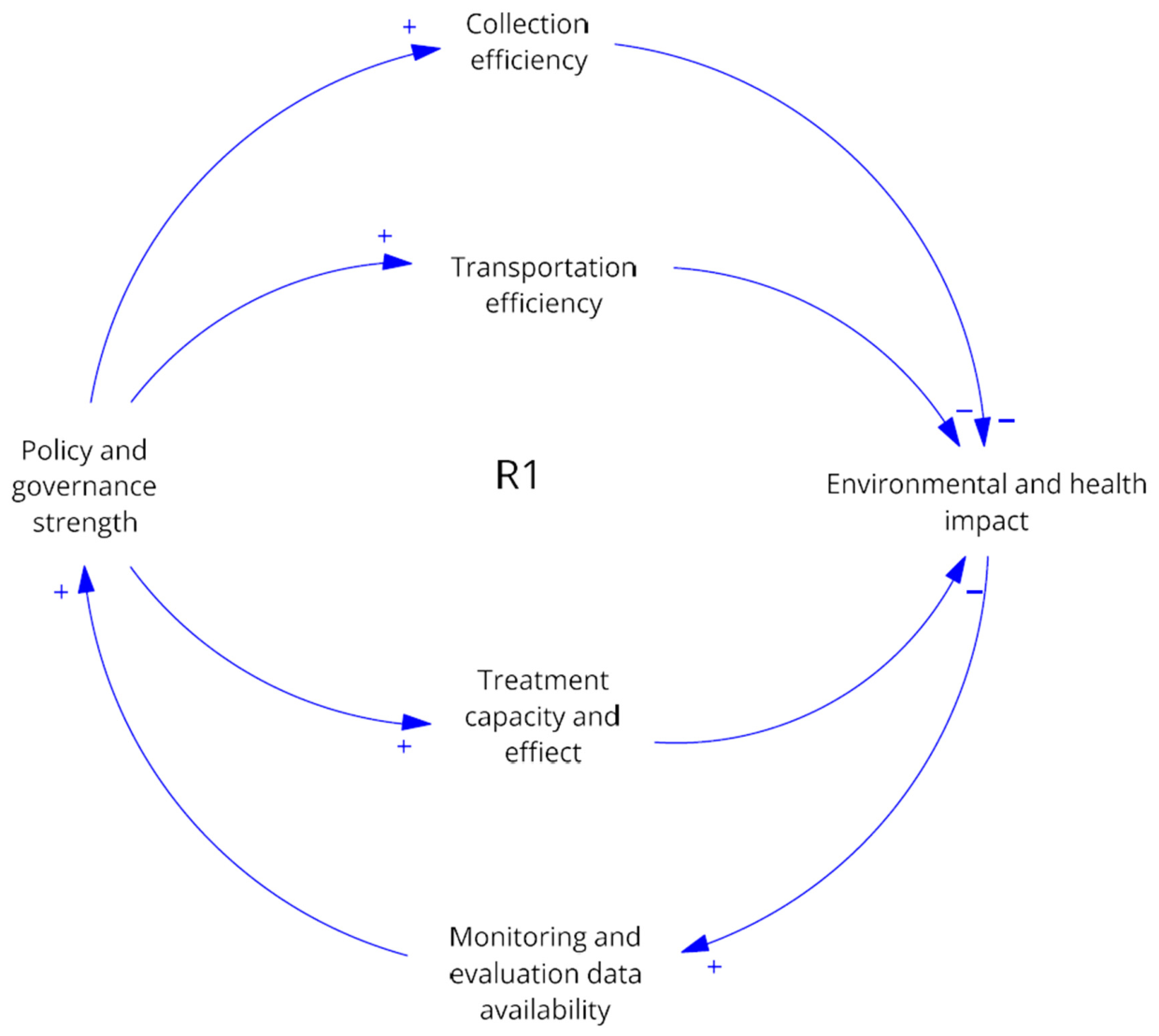
Figure 2.
Reinforcing Awareness–Segregation Loop. Public awareness enhances segregation, improving treatment outcomes, lowering disposal burden, and positively reinforcing awareness.
Figure 2.
Reinforcing Awareness–Segregation Loop. Public awareness enhances segregation, improving treatment outcomes, lowering disposal burden, and positively reinforcing awareness.
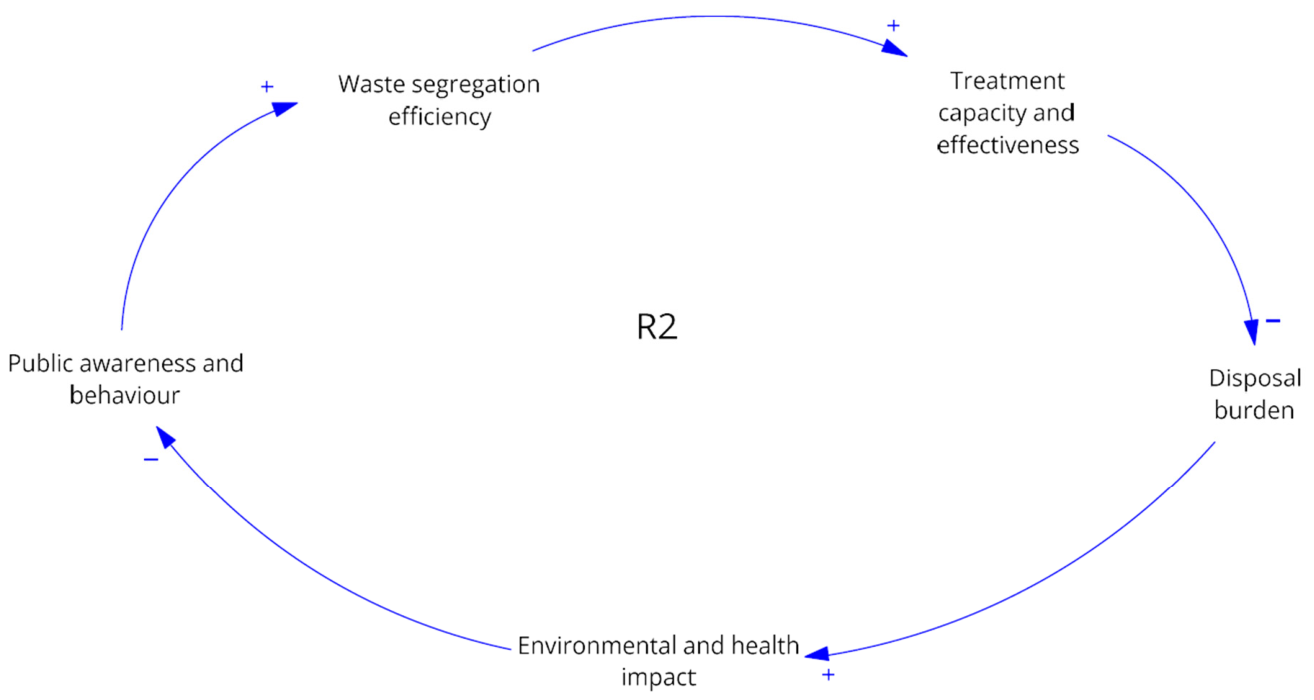
Figure 3.
Reinforcing Technology & Innovation Loop. Innovation improves treatment, reduces disposal burden and environmental impact, which encourages further technological investment.
Figure 3.
Reinforcing Technology & Innovation Loop. Innovation improves treatment, reduces disposal burden and environmental impact, which encourages further technological investment.
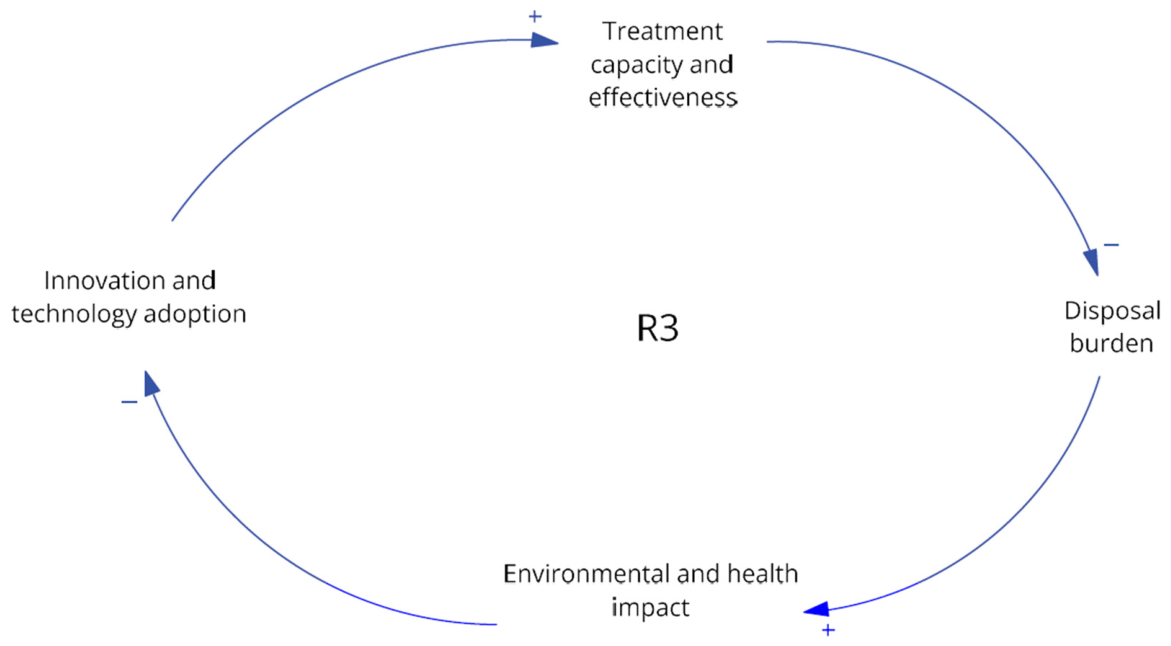
Figure 4.
Reinforcing Governance–Compliance Loop. Strong governance improves compliance and system efficiency, which enhances policy credibility and further strengthens governance.
Figure 4.
Reinforcing Governance–Compliance Loop. Strong governance improves compliance and system efficiency, which enhances policy credibility and further strengthens governance.
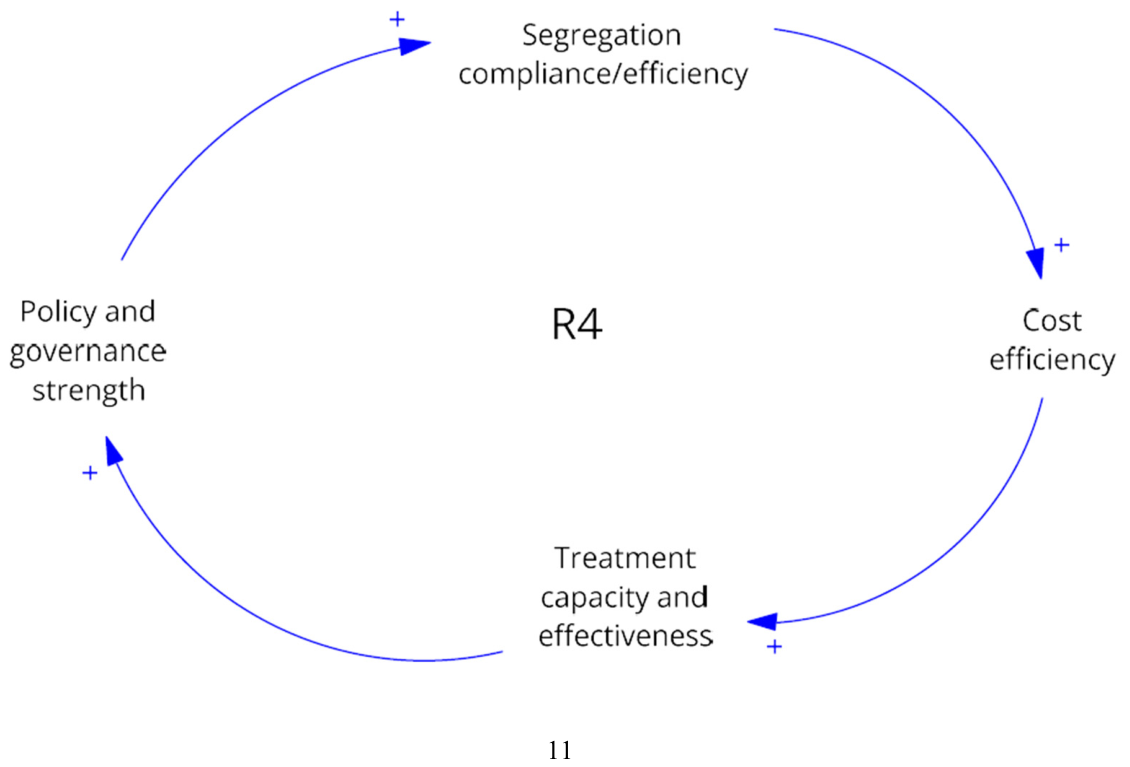
Figure 5.
Balancing Waste Generation Pressure Loop. Rising waste increases environmental impact, triggering policy interventions that reduce waste generation.
Figure 5.
Balancing Waste Generation Pressure Loop. Rising waste increases environmental impact, triggering policy interventions that reduce waste generation.
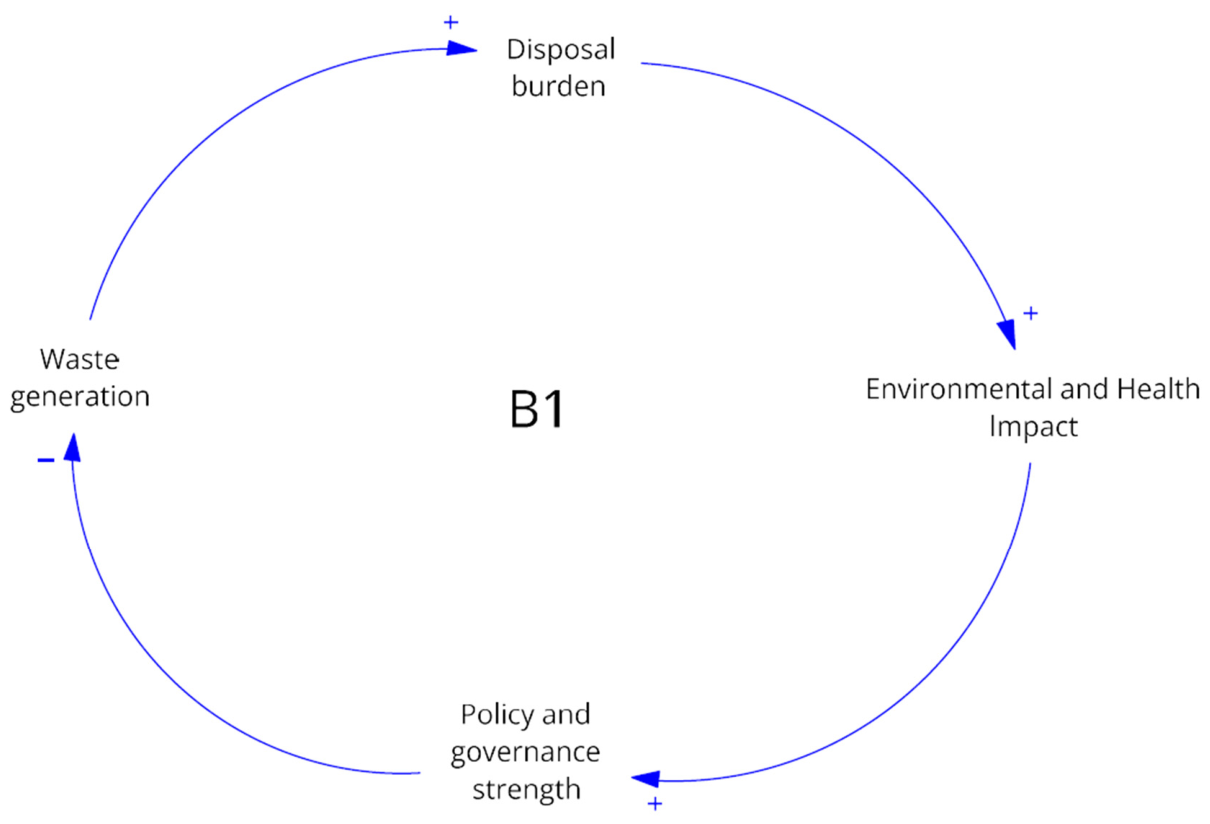
Figure 6.
When waste generation increases rapidly without corresponding improvements in infrastructure, collection systems can become overwhelmed.
Figure 6.
When waste generation increases rapidly without corresponding improvements in infrastructure, collection systems can become overwhelmed.
Disclaimer/Publisher’s Note: The statements, opinions and data contained in all publications are solely those of the individual author(s) and contributor(s) and not of MDPI and/or the editor(s). MDPI and/or the editor(s) disclaim responsibility for any injury to people or property resulting from any ideas, methods, instructions or products referred to in the content. |
© 2026 by the authors. Licensee MDPI, Basel, Switzerland. This article is an open access article distributed under the terms and conditions of the Creative Commons Attribution (CC BY) license.
Copyright: This open access article is published under a Creative Commons CC BY 4.0 license, which permit the free download, distribution, and reuse, provided that the author and preprint are cited in any reuse.


